

Early Neolithic rice dating to 8000 BP from the Kuahuqiao site in the lower Yangzi region has played a significant role in the recent discussions on rice domestication (Reference FullerFuller et al. 2007; Reference LiuLiu et al. 2007a). As a member of the Kuahuqiao research team, I was puzzled by Reference FullerFuller et al.'s (2007) case for immature wild rice harvesting because neither the Kuahuqiao nor Hemudu publications mention immature rice. The problem is a mistaken translation. Although Reference LiuLiu et al. (2007b: 1063) have already argued that the rice remains do not necessarily indicate immature rice harvesting, I want to correct the impression that the principal investigators have reported immature rice at the sites, as claimed by Reference FullerFuller et al.'s (2007) article. This is important because Reference FullerFuller et al. (2008) still believe that the rice being harvested during the Early Neolithic in China was an immature wild form. One key passage in Reference FullerFuller et al. (2007: 322), a translation from the Chinese texts, requires clarification:
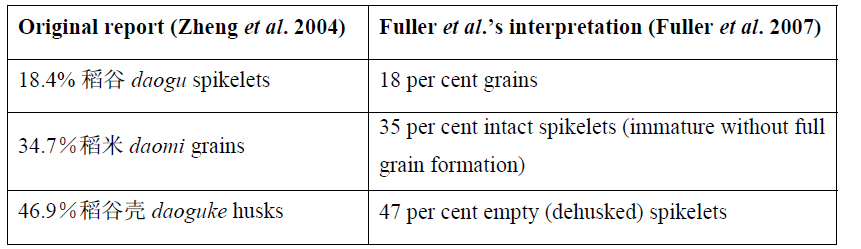
‘At Hemudu finds included “abundant empty husks of immature spikelets” (Reference ZhouZhou 2003: 430 [Chinese original]). Similarly at Kuahuqiao, quantified rice remains included about 18 per cent grains, 47 per cent empty (dehusked) spikelets and 35 per cent intact spikelets (immature without full grain formation) (Reference ZhengZheng et al. 2004a).’
The argument for hunter-gatherer rice exploitation in Reference FullerFuller et al. (2007; Reference Fuller2008) hinges on this translation, said to be the ‘Chinese original’. The Chinese statements are actually rather different:
For the Kuahuqiao rice remains:
(1) ‘In the sample comprising more than 1000 pieces of rice remains, there are 196 intact spikelets [daogu 稻谷], accounting for 18.4%; 369 rice grains [daomi 稻米], 34.7%; and 498 husks [daoguke 稻谷壳], 46.9%” (Zheng et al. 2004: 121).
(2) ‘The excavated rice contains 40% husks [daoguke]’ and; ‘In comparison with the spikelets, the grain is on average 26.5% shorter in length and 22.8% thinner in width. This phenomenon is rarely seen in modern domesticated rice in normal conditions’ (Reference ZhengZheng et al. 2004: 123).
For the Hemudu rice remains:
(3) ‘The deposits in the same stratum include abundant empty husks of bidao 粃稻, rice leaves, stems and water caltrop. The rice has proven to be domesticated annual rice instead of wild rice foraged by humans or perennial wild rice’ (Reference ZhouZhou 2003: 430).

In paragraph (2), Reference ZhengZheng et al. (2004) indicate that the smaller grains are a result of conditions that are not normal (normally, the grains fill the husks), rather than the grains being immature and/or wild progenitors as interpreted by Reference FullerFuller et al. (2007: 322). In paragraph (3), bidao was interpreted to mean ‘empty husks of immature spikelets’. The translation of the Chinese word, bidao, to ‘immature rice’ is critical for Reference FullerFuller et al.'s (2007: 320-3) argument that the rice from Kuahuqiao and Hemudu represents hunter-gatherer targeting of immature wild rice.
In the first two statements there is no reference to immature rice in the original Chinese text; the phrase ‘immature without full grain formation’ in the parenthetical note was added by Reference FullerFuller et al. (2007: 322) as their interpretation for ‘intact spikelets’. However, if the spikelets are relatively intact, this situation would have been potentially related to a key trait of domesticated grasses such as rice: non-brittle rachillae that prevent spikelet shattering. They also interpret the significant number of empty rice husks at Hemudu to be immature (Reference QinQin et al. 2006: 330). Clarification is in order.
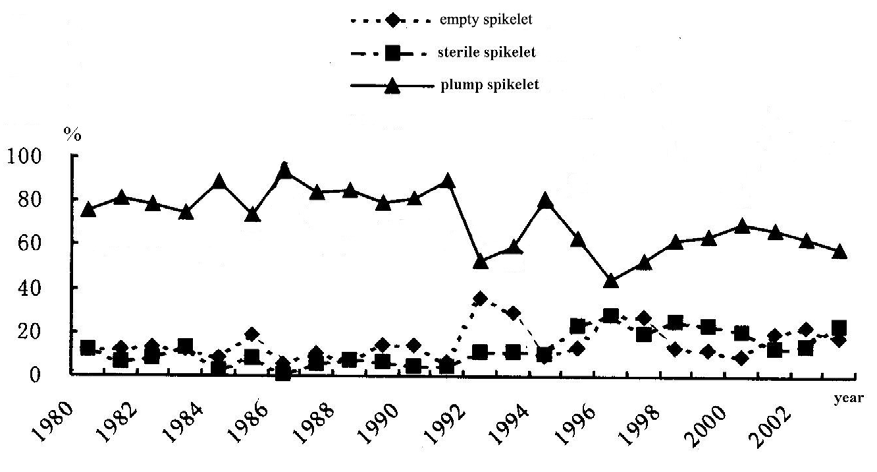
Zheng Yunfei, the rice expert who examined the remains from Kuahuqiao, in fact did not use the Chinese term for ‘immature’ (PICAZ & XM 2004; Reference ZhengZheng et al. 2004; Reference Zheng2007). The Chinese terms ‘bidao’ or ‘bigu’ (秕谷) 1 are causing the confusion. Bigu refers to the shriveled, intact spikelets that sometimes include relatively intact empty husks (PICAZ & XM 2004: 273, 325; Reference ZhouZhou 2003: 430). The term is borrowed from ancient Chinese and is not commonly used today. Bigu actually means buyun xiaosui 不孕小穗, which translates to ‘sterile spikelet’ (You 1995: 69). If sterile spikelets are immature neither the grain nor the husk is mature, so not only would the spikelets appear to be shriveled but the husks would be fragile and likely would not be preserved. The sterile spikelets are actually evidence of abnormal growth rather than immaturity. Considerable research has been done on the causes of sterility and reduced seed development in cultigen rice spikelets (e.g. Reference GUGu 1995; Reference WangWang 2005; Reference JagadishJagadish et al. 2007). Such sterile spikelets are well known in grasses such as rice and may result from a shortage of nutrients, diseases and insect pests, failed pollination, inferior assimilate supply during the grain-filling period (Kobata et al. 2006) or other stresses such as a lack of rainfall. Therefore the husks of such rice are developed (hard) but the grains are tiny or non-existent. Zheng's view (pers. comm.) is that the abundant husks and intact spikelets at Kuahuqiao site represent abnormal growth, not immaturity. Additionally, infertile spikelets are quite common in modern cultivars of rice (e.g. Reference GUGu 1995; Kobata et al. 2006). Normally, such spikelets account for 10-20 per cent of a modern domesticated rice population (Figure 1). This is not to say the Kuahuqiao rice is fully domesticated; however, the case for the rice being harvested in an immature state does not hold up.
The curves display the proportions of empty husks, sterile spikelets and plump spikelets in a modern cultivar of rice (Oryza sativa) population. The horizontal axis represents years; the vertical axis represents percentage of different types of spikelets (adapted from Zhang et al. 2005)

Furthermore, Zheng attempts to avoid simply classifying either the husks or smaller/thinner spikelets as ‘bigu’ because this term does not particularly refer to either. However, he mentioned bigu twice in the archaeological report (PICAZ & XM 2004),
(1) ‘In the sample of more than 1000 pieces of rice remains, there are 196 intact spikelets, accounting for 18.4%; 369 rice grains, 34.7%; and 498 bigu (秕谷), 46.9%.’ (p. 273).
(2) ‘In the stratum of middle period, a bunch of rice with its stalks was discovered and the spikelets are all bigu (秕谷), indicating that the yield of this cultivated rice could have still remained relatively low.’ (p. 325).
Zheng (pers. comm.) acknowledges that because the report was prepared in a hurry the term bigu was not carefully considered. In the first statement the term should be replaced by ‘rice husks.’ In addition, even the key Chinese character ‘秕’ was misprinted as ‘秘’. In the second statement, bigu actually refers to ‘shriveled spikelets’.
Reference FullerFuller et al. (2007) argue that the Kuahuqiao rice was harvested by hunter-gatherers but suggest that some cultivation was taking place by the end of the cultural sequence (2007: 325), and they do not explain how they arrive at this interpretation. Their conclusion that immature rice was harvested is based on the incorrect translation of ‘bigu’ and ‘bidao’ that they interpreted to be immature wild rice. Sensitivity to the Chinese terminology and what it means to the Chinese readership is crucial to this discussion. Reference ZhengZheng et al. (2007) do not view the rice as fully domesticated. In fact it was ‘primitive cultivated rice undergoing domestication’ (Reference ZhengZheng et al. 2007: 4). Fully domesticated rice has not been presumed here (Fuller et al. are critical of East Asian archaeologists whom they feel presume domestication). A case for the Kuahuqiao rice being on the way to being cultivated (domesticated) was made in the original reports. Rather than the rice from Kuahuqiao representing part of a continuum of wild rice use by foragers (Reference FullerFuller et al. 2007: 316), Reference FullerFuller et al. (2008) acknowledge that there is a mixture of wild- and domesticated-types at Kuahuqiao ‘with nearly half or less being domesticated.’ In their recent study Reference ZhengZheng et al. (2007) documented a high proportion of the non-brittle phenotype (cultigen) in the Kuahuqiao rice assemblage although the brittle phenotype (wild) is also very common indicating a mixed population of rice. The discussion of the mixture of wild and domesticated phenotypes in early rice exploitation/cultivation is intriguing and is among the earliest documented rice populations of its type.
Acknowledgements
I would like to thank Professors Zheng Yunfei, Gary Crawford, Liu Li and Gyoung-Ah Lee for their encouragement and comments on drafts of this paper.