


Post-modernism is a term that is omnipresent in the media, academic circles and contemporary culture. It is also a term that has caused substantial consternation among systemic family therapists. Systemic family therapy traces its origins from the 1950s, and there are currently several different models contained within the systemic paradigm. A unifying feature of systemic therapy is the importance placed on understanding psychological difficulties in the context of social relationships. Another point of agreement among systemic therapists is the significance of drawing distinctions and marking ‘difference’ as an aspect of creating change. A third common feature is the practice of working in teams, where one therapist conducts the interview, while a small number of others comment on their observations. The degree to which these models and practices have been influenced by post-modernism varies.
As part of my attempt to summarise the current thinking and practice of what has become known as post-modern systemic therapy, I will briefly describe the two major models: the post-modern model (Reference AndersenAndersen, 1987; Reference Anderson, Goolishian, McNee and Gergen>Anderson & Goolishan, 1992; Reference AndersonAnderson, 1997) and the narrative therapy model (Reference White and EpstonWhite & Epston, 1990).
After defining modernism and post-modernism, I will compare these two movements by touching on selected themes of structuralism, ‘the self’, perspective and language, and discuss the relevance of post-modernism to practice in the National Health Service (NHS).
Family therapy and the path towards post-modernism
Family therapy became a distinct form of practice with the adaptation of general systems theory (Reference von Bertalanffyvon Bertalanffy, 1950). The major points of development were based on Bateson's cybernetic model (1972) and Minuchin's structural family therapy model (1968). The latter remained primarily concerned with the issue of the optimal organisation of the family and clarity of boundaries. The cybernetic model was adapted by clinicians to consider the family as a homoeostatic mechanism with communication patterns analogous to those in mechanical information-processing systems. The Milan method (Reference Selvini Palazzoli, Boscolo and CecchinSelvini Palazzoli et al, 1978) and brief therapy (Reference De ShazerDe Shazer, 1985) are based on this model. These were the major paradigms until the mid 1980s. This was first-order family therapy, characterised by the therapist's observation of the system from the outside.
Second-order family therapy was marked by the inclusion of the concept of constructivism. Inherent in this body of thought is the notion that what is ‘known’ in the external world is determined by our innate mental and sensory structures (Reference Maturana and VarelaMaturana & Varela, 1984). This was a change from the former position that external reality was ‘knowable’. In terms of family therapy, this now meant that therapists were called upon to include their own personal or theoretical bias as part of the observation.
Another profoundly different way of considering reality came from the body of work known as social constructionism. This suggests that reality is created through language in an ongoing interactional and relational process. Discourse about the world is not a reflection or map of reality, but an artefact of communal interchange (Reference GergenGergen, 1985). Family therapists now became interested in the active process of meaning-making and the greater variation of possibilities – the inherent assumptions in particular discourses and ideas that had been excluded.
For systemic thinking, the movement from constructivism to social constructionism initially appeared to have been a small step, but it proved to be a huge leap (Reference GergenGergen, 1991). Social constructionism introduced us to post-modernism. Hoffman (1993: 83), proclaiming her loss of enthusiasm with cybernetics and constructivism, said, “Postmodernism, whatever that meant, was a small black cloud on the horizon for many of us systemic people for several years, then it burst with thunder storm force on the field of family therapy”.
The post-modern model
Anderson and Goolishian (1988, 1992) define their practice as post-modern therapy (Box 1). Social constructionism, as defined by Gergen (1991), has played a large part in the development of this model. The other important cornerstone is the philosophical culture of hermeneutics, the science of interpretation and explanation.
The structure of therapy is less about beginning, middle and end points, and more about creating space for a specific kind of conversation between participants. If one were observing this therapy in action, the process would be characterised by a quiet, reflective stance on the part of the therapist. Questions would gently be aimed at the expansion and uncovering of meanings for the individuals in the system. Conversation would have a zigzagging style, with the therapist avoiding invitations to take on the role of the one who ‘knows’. Advice or research evidence in relation to a particular problem might be offered as one of many potential ideas. The therapist would appreciate that some ‘information’ might not fit with the clients' experience and would be genuinely respectful of and interested in the clients' thoughts and reactions. The therapist's primary contribution to the process of change is in the construction of a particular style of conversation. ‘Reflecting-team conversations’ are ones in which team members speak to one another in front of the family (Reference AndersenAndersen, 1987). Members of the team elaborate and embellish themes from the session, introduce ideas they have had as they have been listening and actively respond to meanings emerging during the conversation. The family and therapist are then free to ignore, negate or develop them in more detail.
The principal components of post-modern therapy
The therapist is the participant–manager of the conversation, not the ‘expert’
Language, rather than interactional pattern, is the system
Meaning and understanding are achievable through continued efforts
Difficulties are constructed in the language system and can be ‘dissolved’ through language
Change occurs through development of new language
Reflecting teams are used to comment on and participate in the co-construction of alternative meanings
Clinical example
A referral, such as a young boy with a behavioural problem, might involve creating a dialogue between the family and the therapist around the meaning of the behaviour as construed by the different family members. For example, the mother might describe the child as “mad from the day he was born”. The therapist might explore what the mother means by madness and its connection with misbehaviour. The history of that idea would be developed. Was the child's ‘madness’ inherited or the result of some event? Are there openings for alternative explanations? The father might feel that the problem behaviour is the child's retaliation for some grievance. The therapist might develop a further conversation about the nature of the grievance, whether it required some different response on the part of the child or the parent(s). Views around issues of equity, hierarchy and fairness in parent–child relationships may ensue. The therapist might share his or her thoughts about potential alternatives. The child might feel that his behaviour is particularly noticed because his older sibling is ‘sneakier’. The therapist might wonder aloud about what gets noticed in this family and the advantages and disadvantages of being noticed. It would be assumed that the process of developing more complex and mutual understandings would produce positive movement. Original descriptions would be revisited as other ideas emerged. For example, the therapist might pose the possibility that the mother's worries about the child mean that she is more watchful of him than of his older sibling.
The narrative model
The narrative model (Box 2) is also based on social constructionism, but it has drawn more directly from the French post-structuralists. Derrida's (1976) concept of deconstruction and Foucault's (1975) ideas about dominant and subjugated discourses are central notions. Using Bruner and Luciarello's research (1989) on the importance of narrative structure in meaning-making for humans, White has linked societal discourses to individual narratives (Reference White and EpstonWhite & Epston, 1990; Reference Epston and WhiteEpston & White, 1992).
If one were observing the narrative model in action, one would notice that the therapist is particularly interested in the description of the presenting problem. Typically, the view of the problem given by the ‘instigator of the referral’ (the parent(s)) differs from that given by the ‘identified client’ (the child). A primary task is to work towards identifying the link between the issues for the instigator of the referral and the problem experienced by the identified client. Once the problem is named by the client to his or her satisfaction, then it is externalised. The linguistic structure of a therapist's questions implies that the problem is something other than the client's core identity. The effect of the narrative model is that not just the child alone, but the therapist, child and important others together work against the problem. Problem descriptions are diminished by the therapist's very active noticing of episodes that bring forth more positive self-descriptions. Again, reflecting teams can elaborate these new stories in front of the child and the family members. Team members may disclose personal experiences related to the specific issue, if their accounts contain stories of success and optimism. Narrative therapy is particularly sensitive to the potential for institutions to engage in abusive practices.
The principal components of narrative therapy
An individual's identity is embodied in a personal narrative that includes different versions of the self
Clients come to therapy with a ‘problem-saturated narrative’ that has become internalised as their primary self-description
Problem stories/identities are created, lived and kept alive by their connection to important others
The technique of externalisation disconnects the problem from the client's self-descriptions
The influence of the problem is ‘mapped’, thus connecting the problem narrative to relevant others
Narratives are created at a societal level, so problem ideas held by family members require ‘deconstruction’
The therapist looks for ‘unique outcomes’ – positive exceptions to the problematic story – and amplifies change using letter-writing, specific audiences (others who have successfully conquered the same issue) and personal enthusiasm
Clinical example
The same referral, a behavioural problem in a young boy, would involve the therapist developing an understanding of how the problem is defined by the child. He might say it was anger at the unfairness that he got into trouble while his sneakier older brother escaped notice. He might name the anger, calling it ‘Get Back’. Externalisation could be achieved by using questions such as: “When Get Back is egging you on, how much trouble does he want you to get into?”; “Who helps Get Back grow bigger and stronger?”; “When Get Back is around, how does it affect your relationship with your mother?”; “When have you managed to ignore Get Back, and who noticed that you had been so successful?”
An alternative story might be related to the child's sense of himself as a fair and honest individual. Episodes of honesty and fair problem-solving are noticed and developed by the therapist in relation to other aspects of identity. For example, “We have seen that when you use your very good brain to think first, then Get Back is frightened away”. These shifts are encouraged by building in elements that might serve to strengthen the emerging self: “Your teacher has noticed the power of your good brain and has seen you using it against Get Back in class. He has also seen your sense of justice help another child who was being bullied”.
What are modernism and post-modernism?
Modernism was the name given to a dramatic period in European culture from the late 19th to the mid-20th century. An emphasised faith in reason, freedom and the concept of progress reveals its origins in the philosophy of the Enlightenment. A key concept in the later modern period was the process of getting to the underlying structure, and this was played out in both the arts and the sciences. The concepts of modernism and post-modernism are outlined in Box 3.
Did post-modernism come after modernism, as the name suggests, or did the two exist concurrently? Some feel that post-modernism is not actually a different period; rather, it embodies the further developments of a modernism that has existed for long enough to reflect upon itself. Another view is that the only real difference between the two is that post-modernism eschews nostalgia. Others insist that post-modernism is not an identifiable chronological period, but more a way of thinking. Some say that it represents a fundamental sea change, with radically different perspectives on just about everything, from philosophical positions, art and architecture to the very meaning of what it is to be human. One of the major differences between the two is the extent to which the values of the Enlightenment, faith in human progress and reason, are seen as useful for social and cultural understandings.
Concepts associated with modernism and post-modernism
Modernism
Belief in societal progress
Optimism
Rationality
Belief in absolute knowledge through science, technology and politics
Belief in the true self
Belief in universal structures, usually containing binary opposites
Post-modernism
Multiple versions of post-modernism: no single definition
Distrust in promises made in the name of progress
Looking for what is between binary opposites and what has been excluded by the particular distinctions
Importance of variation over coherence
Belief in a socially constructed self
Edmundson (1989) decribes two forms of post-modernism. The first was an earlier, negative or demystifying sort. This phase was about the description of what it is like to live in a world that no longer possessed a transcendent vantage point, and was against the modernist's determined efforts to account for deeper meanings. The second is a newly emerging positive or romantic expression that applauds the opportunity for remaking ourselves.
Like all psychotherapy, family therapy first developed in the age of modernism and it has incorporated its assumptions. However, its situation is in contrast to that of the visual and literary arts, which have to some degree a definite modern period out of which, or in opposition to which, grew the post-modern creations. Family therapists had made distinctions between first- and second-order therapy, but ‘noticed’ modernism only after the concept of post-modernism was introduced.
Which features of modernism post-modernism do we use?
“From the modernism you choose you get the post-modernism you deserve.” (Reference AntinAntin, 1972)
Systemic therapists have been particularly interested in questions concerning (a) structure, (b) definitions of the self, (c) perspective and (d) language.
Structuralism and post-structuralism
Structuralism and post-structuralism are frequently introduced into discussions of modernism and post-modernism. Structuralism is essentially the notion that there are discernible underlying entities that offer principles for organisation, and that these structures have a fixed relationship to each other that transcends time and often operates in a duality. Examples of such entities would be: Descartes' notion of the structural duality of mind and body; Saussure's semiotics (that language contains inherent relationships between signs and signifiers, binary opposites and deep structures); Freud's notion that the mind has a basic structure of conscious and unconscious and is driven by life and death instincts; Marx's dialectical materialism; and Levi Strauss's ideas on cultures and myths. Everything is fixed at the level of the system and observed from the outside or above (Reference SarupSarup, 1986).
Attacks on structuralism's ability to explain overarching systems with fixed relationships between subcomponents came from several fields. The most noted was that of the French philosopher, Derrida, against Saussure (1959). Derrida challenged semiotics' assumption of explicable structures, of discernible fixed meanings that the reader could construe. He argued that words are not to be trusted as representing something ‘out there’ and that the understanding of text separately from its author's experience is impossible. Others were also unsettling the structuralists' claim to an overarching principle. Newtonian physics was challenged by Einstein's theory of relativity; Freud suffered a structuralist analysis by the French psychoanalyst Lacan (whose work itself became the subject of a post-structuralist attack based on the premise that there is more than one reading of Freud's work).
The formative theories of family therapy were all structuralist in nature. We understood families in terms of general systems theory (the relation of parts to the whole), cybernetics (families as information-processing systems with feedback loops and a drive for homoeostasis) or the structural model (the family as an organisation with executive functions, generation boundaries and interactional patterns). These models, it was argued, enabled us to determine the fundamental essence of the family. This process of post-structural analysis seeped into systemic therapy. Under its influence, underlying assumptions and contradictory positions could be examined. Lynn Hoffman lists the five sacred cows of modern psychology: the ‘objectivity’ of social research; the restrictive notion of a core self; the overemphasis on predetermined pathways for change (i.e. developmental psychology); the special status of emotions; and the hierarchy of levels in reference to the theory of coordinated management of meaning (Reference HoffmanHoffman, 1993).
The movement towards constructivism could be seen as another form of structuralism, but its impact has been to allow differences in perceptions of what is out there, thus beginning to erode the concept of a single external reality. Social constructionism truly moved the systemic therapists to appreciate the fluidity of language and meaning.
The self: core identity or social creation?
A theme of modernism is the dichotomy between the universal and the individual. Although the construction of self is seen as an illusion by Eastern religions, the Western notion of self is that of an individualistic true self. This is reflected in the ancient Greek dictum “to thine own self be true”. The foundation of psychoanalytic work rests on uncovering layers to reach deeper, more fundamental features of the individual. Most psychotherapy is based on this Westernised notion of the individual self, and in this psychotherapy is a child of modernism (Reference ParryParry, 1991).
Systemic family therapy substituted the idea of the singular system for the singular self. This stance meant that therapeutic consideration was directed at the level of the family system. In systemic work the parallel to the notion of the psychodynamic ‘true self’ was a belief in the system's self-correcting nature. If systemic therapy was directed to the family as a whole, then all the individuals within it would benefit. Wider perspectives (the influence of culture, institutions and political circumstances) and narrower perspectives (the separate needs of individuals within the family) were not given equal weight. Feminists and those working in the fields of child abuse and domestic violence were most influential in helping systemic practitioners reconsider their assumptions about power and the problems created by dichotomous boundaries: family system/individual and family/wider social context. The deconstructive process described above in relation to post-structuralism also occurred in relation to the concepts of individual identity. When social construction is moved into the domain of the self, it becomes possible to consider that the notion of the ‘core self’ is no more than a particular discourse. The prominence of the concept of ‘a core identity’ began to crumble. Family therapists who had focused on collective descriptions in terms of family typologies or shared family belief systems began to pay more attention to the variation within the family. The definition of the system became much more fluid. Systems were formed and maintained around specific problems. Depending on the content of a conversation, different aspects of a family would become apparent and would also be created. Post-modernist contributions to the concept of self relate to the transience and malleability of definitions. In popular culture, figures like the singer Madonna are cited as indicative of the capacity for alternative self-definitions. The post-modernist self is ever evolving and moves in simultaneous social domains. At worst, it is fragmented, at best, it is creatively free.
Perspective
Robert Hughes (1991), art critic and cultural commentator, writing of the beginning of early modernism in the visual arts, describes the radical change in perspective. He defines Renaissance art as having the convention of one-point perspective, using the geometrical properties of reducing the size of an object to depict distance. This is a simplified static relationship between the eye, brain and object, and is not the way in which perspective develops. None the less, this model held sway until the 1900s.
In simultaneous but unrelated movements, F.H. Bradley, Alfred North Whitehead, Albert Einstein and Paul C′ezanne were all working on ideas of alternative perspectives: those of relativity and the uncertainty principle (Reference HughesHughes, 1991). In the art world, these ideas defined the early modernist period (Cubism and Expressionism), and post-modern art has moved well beyond them. Recent Turner prize winners testify to the degree to which the post-modern movement has extended notions of art. Post-modernism's influence can be seen as a multiplicity of perspectives: the reflection of the artist's perspective and prior artistic and cultural preoccupations; the active placing of the audience in these multiple points of view; and the context of the viewing itself.
The current trend in systemic therapy reflects, to some degree, a renewed willingness to make use of a variety of models and techniques without the pressure to synthesise or force an artificial coherence. Perhaps what might have been known as eclecticism based on pragmatic considerations is now considered curiosity about the impact of introducing alternatives. Lines that define the different systemic models are very much less clear and the debates seem less relevant, leaving more potential for borrowing perspectives rather than defecting to them. Increasingly, client perspectives are included in the shaping of the therapeutic process. This translates into such activities as therapists explaining to clients the different ways of working and asking which is most suited to the clients' ideas of therapy, empowering the clients to invite the reflecting team into the room when they want their input, and asking clients their views on working with a therapist of a different culture.
Language
Language is so important to psychotherapy that it merits special consideration. In the modernist sense, language is generally understood as having a fixed structure and as representing ‘reality’. It is used by rational beings as a means of conveying thoughts, feelings or expressions. Two people in conversation can assume they share a very similar understanding and that the words used are closely linked to what they each understand them to mean.
Lyotard (1984) takes the position that it is impossible fully to understand any particular discourse and impossible to critique or compare alternative discourses, as each are so entrenched in their own particular historical and idiosyncratic rules of language. He argues that the best that can be hoped for is the ‘little narrative’, or the local rather than the global understanding. He considers language more a matter of aesthetics than of truth. A more hopeful position is that of Gergen (1991), who agrees that looking for a deep structure is impossible, but proposes that understanding can evolve from interaction between people.
For therapists, it is fairly important to come to some position about the relationship between understanding and language. Language is one of the tools with which the therapist exercises his or her entitled position to discover, explain, predict and effect change (Reference AndersonAnderson, 1997). Systemic post-modernists agree on the failure of language to be representative, but vary in the degree to which they find this problematic.
Are systemic therapists really post-modern?
Frosh (1995) takes the view that the modernism/post-modernism issue has been confused by family therapists, who have taken on board certain aspects, but have not really been thoroughly converted. He turns to Baudrillard (1988), one of the more extreme post-modernists, who thinks that any interpretative endeavour is doomed to failure if it attempts to move beyond the superficial. Frosh argues that therapists, whose questions and comments are based on some form of interpretative dimension, are inevitably working in a modernist fashion. Parry (1991) takes the position that narrative therapy offers the post-modern way forward: “the post-modern treatment of a story as simply a story offers the narrative therapist a tool for enabling clients to shake off constraining beliefs”. But Doan (1998) points out that narrative therapists, like post-modernists, risk contradicting themselves by producing yet another ‘discourse’, while simultaneously protesting against the creation of ‘grand narratives’.
Futhermore, attempts to find the definitive position of systemic therapy in terms of the modernist and post-modernist positions are obviously themselves modernist activities (Reference ParkerParker, 1999). When viewed from a social constructionist perspective, psychotherapy as a discipline is in danger of collapsing under the weight of its contradictions (Reference McLeodMcLeod, 1997). It may be that the tensions between therapy as a problem-solving endeavour, as a more personal philosophical journey and as a treatment for illness further divide the field of psychotherapy into irreconcilable camps.
Application in the National Health Service
What does a practice informed by post-modern sensibilities have to offer to the NHS? The attention to relative perspectives and movement of power may well aid the clinician in institutional and management contexts. There is a growing awareness that a consultation style that facilitates client involvement improves both client satisfaction and outcome (Reference Roberts and HolmesRoberts & Holmes, 1998). It fosters greater appreciation of the differing theories held by various professions in multi-disciplinary teams. And, by using a greater variety of techniques and stances, it may enable both the therapist and the client to find a better working relationship. On the other hand, post-modernist influences may be seen as encouraging ungrounded and tangential ways of attending to problems. Fiscal constraints and waiting lists often demand that therapy be more focused and time-limited. Additionally, the concern for evidence-based practice and outcome measures may disadvantage certain elements of post-modernism, which resist static definitions. But there is also a growing criticism about the effects of very reductivist research in relation to human behaviour (Reference LaugharneLaugharne, 1999). At a more abstract level, it is difficult to know yet how sensitive the models are to working with differences in culture or language. Some people may find the ‘non-expert’ position of the post-modern therapist unsettling or disrespectful. The relationship to language is even more of an issue if the therapist is working through an interpreter, when the capacity for abstraction or the playful use of language may be lost. And finally, sometimes families want simple, straightforward expert advice.
Conclusion
Drawing conclusions about the influence of post-modernism on systemic family therapy presents difficulties: not only would it be an ideological anathema to do so; more important, it is just too early to tell. We are still working out our relationship to many of post-modernism's ideas and its long-term repercussions, if any, have not had enough time to show themselves.
Some philosophical writers are calling for a more integrative position, while others continue to question the validity of the concept of modern and post-modern periods. I suspect that Edmundson (1989) is correct in his ideas about the changing nature of post-modernism and in his belief that the ‘deconstructive’ work has been part of the early period. Cynicism and fragmentation do not sit naturally with psychotherapy, and his idea of another, more positive phase in which post-modernism can offer the opportunities to remake the self is exciting. The concept of narrative also invites us to address with a lighter touch the client's need for personal coherence.
The ascendance of language, rather than interactional pattern, has been observed, but it may well be that the future includes another look at the many communicational elements in therapy that are not conducted through speech.
It is my contention that systemic therapy, as we know it, is bound to its modernist foundations, but therapists and clients alike have benefited from the stimulation created by post-modernism. We could perhaps do worse than employ the post-modernists' contribution as an opportunity for more creative play with ideas, rather than being driven by the ideas.
Multiple choice questions
-
1. Post-modernism is:
-
a a chronological period separate from modernism
-
b something that runs parallel with modernism
-
c modernism that has had enough time to reflect on itself
-
d without a singular definition.
-
-
2. In the model of post-modern therapy, the therapist is most likely to:
-
a want to orchestrate a particular kind of dialogic conversation
-
b develop a hypothesis about the real nature of presented difficulties
-
c be interested in interactional patterns
-
d none of the above.
-
-
3. In narrative therapy, a technique separating the problem from the self is called called:
-
a reframing
-
b externalisation
-
c deconstruction
-
d deviation amplification.
-
-
4. Social constructionism has most to do with:
-
a people working in teams
-
b constructivism
-
c reality being created through language
-
d semiotics.
-
-
5. Systemic family therapy is:
-
a wholly of the post-modern world
-
b both modern and post-modern
-
c fundamentally a modernist endeavour
-
d both b and c.
-
MCQ answers
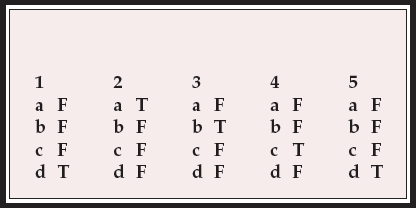
| 1 | 2 | 3 | 4 | 5 | |||||
| a | F | a | T | a | F | a | F | a | F |
| b | F | b | F | b | T | b | F | b | F |
| c | F | c | F | c | F | c | T | c | F |
| d | T | d | F | d | F | d | F | d | T |



eLetters
No eLetters have been published for this article.