


Introduction
Civil society is widely valued as a vital pillar in the creation, consolidation, and maintenance of a well-functioning and healthy democracy (Hahn-Fuhr & Worschech, Reference Hahn-Fuhr, Worschech, Beichelt, Hahn-Fuhr, Schimmelfennig and Worschech2014; Paxton, Reference Paxton2002; Arvidson et al., Reference Arvidson, Johansson and Scaramuzzino2018b). With the passage of time, many established western democracies have seen their civil society become more formalized and established as a distinct sector, in which we observe increasing professionalization and clear organizational structures (Eikenberry & Kluver, Reference Eikenberry and Kluver2004; Hwang & Powell, Reference Hwang and Powell2009; Heylen et al., Reference Heylen, Willems and Beyers2020). Departing from these trends of professionalization and institutionalization, scholars have started to pay attention to the most senior leaders of large and well-resourced civil society organizations (CSOs) and asked whether they may constitute an elite (Altermark et al., Reference Altermark, Johansson and Stattin2022a, Reference Altermark, Ivanovska Hadjeveska and Johansson2022b; Santilli & Scaramuzzino, Reference Santilli and Scaramuzzino2021). In turn, this very question elicits discursive friction between long-standing civil society theories and elite theories.
From the perspective of the iron law of oligarchy (Michels, Reference Michels1911), it is expected that individuals that rise in the ranks to become leaders of well-resourced organizations in civil society present a set of attributes and priorities closer to those of other elites, hampering the role of advocating on behalf of the people. This theoretical expectation gives rise to a conflict when it intersects with civil society theory, wherein CSOs are expected to represent their members and constituencies (Lee & Scaramuzzino, Reference Lee, Scaramuzzino, Johansson and Meeuwisse2024), act as transmission belts between civil society and policymakers (Albareda, Reference Albareda2018), and act as a check on government overreach and autocratic tendencies (de Tocqueville, Reference de Tocqueville2006; Paxton, Reference Paxton2002). The more civil society leaders tend to resemble other elite groups and disregard advocacy for social change as a priority, the more there is a risk for CSOs not being able to fulfill their democratic function. To be able to “mirror” the masses in their leaders’ social composition and attitudes is for many organizations in civil society crucial for achieving representativity (Lee & Scaramuzzino, Reference Lee, Scaramuzzino, Johansson and Meeuwisse2024). At the same time specific skills and resources necessary for organizational capacity (Albareda, Reference Albareda2018) might require leaders with elite attributes.
Elites have been, and continue to be, extensively studied across the social science fields, yet only a scant number of studies had examined the possibility of elites in the civil society sector. In fact, this topic has been generally disregarded in both elite and civil society studies (Johansson & Uhlin, Reference Johansson and Uhlin2020:82). However, civil society encompasses a broad makeup of different actors, some of them occupying positions that allow them to dominate and have significant influence over others:
They tend to hold status positions that allow them to control valuable resources, such as money, information, expertise and knowledge or ability to mobilize extensive numbers of people to push for policy change. They also enjoy prestige and status within, but also beyond civil society and their particular area of concern. They furthermore often have a ‘seat at the table’ to discuss pressing issues (ibid.).
We employ Kahn’s definition of elites as members of society who disproportionately control “the value of, and distribution of, resources” (Khan, Reference Khan2012: 362–363). Further, this position allows those individuals to enjoy great influence and advantages (ibid.). While elite studies have traditionally focused on political and business elites, Kahn’s definition of elites allows for the exploration of highly privileged members of society in all sectors. Even though research into a potential elite within the civil society sector is relatively new, the main tenet can be applied: resources and power allow for potential elites to have massive advantages, influence and control over resources within civil society and greater society at large (de Tocqueville, Reference de Tocqueville2006: 445).
Our study places itself at the crossroads between civil society studies and elite studies and is motivated by a potential conflict between, one the one hand, the conception of a sector that is commonly expected to perform a democratic duty in holding the government and other elites to account and, on the other, the elite status held by some of the leaders within the sector. The study uses survey data to explore satisfaction with democracy among leaders of well-resourced CSOs at the national level in Sweden and the UK. Different understandings of the role of civil society prevail in these two countries, something that we expect to have an impact on civil society elites’ attitudes.
In line with previous research, we interpret leaders’ ‘satisfaction with democracy’ in terms of their level of support for the government or how satisfied they are with the performance of the government, rather than how satisfied they are with the way democracy in their country is functioning (Linde & Ekman, Reference Linde and Ekman2003; Zmerli & Newton, Reference Zmerli and Newton2008: 711). In this sense leaders’ satisfaction with democracy is used as a proxy for identification with the views of political elites, and we are interested in the extent to which satisfaction with democracy is affected by the leaders’ social status-related attributes.
We consider these leaders as part of a civil society elite based on a definition of elites as individuals controlling a disproportionate amount of resources. The aim is to understand levels of satisfaction with democracy among the civil society elite by addressing the determinants of the leaders’ attitudes in terms of country context and individual attributes. The following research questions guide our study:
(1) How does civil society elite’s satisfaction with democracy differ across social-democratic and liberal civil society regimes?
(2) Which individual attributes can explain civil society elite’s satisfaction with democracy?
While these research questions are explorative in terms of addressing what explains differences in attitudes among civil society elite, our analysis is informed by an interest into the extent to which different understandings of the role of civil society seem to affect the elite’s attitudes. We also want to explore the extent to which leaders that are at the top of the hierarchy based on their socio-demographic attributes, are more satisfied with democracy than the leaders that are placed, attribute-wise, on a lower level of the social hierarchy. To contextualize the comparison of the attitudes of the civil society elite in the two countries, we also consider differences in the attitudes of the general population in each country.
The survey respondents are top-level leaders, representing and managing the most well-resources CSOs at the national level in each country and can hence be considered comprising a civil society elite. Being placed at the national level they tend to represent organizations or movements vis-á-vis the state. Whether they represent interest groups, environmental organizations, solidarity organizations, sports associations, or service-producing organizations, their national-level organizations tend to have an advocacy role rather than a service production role.
The paper is structured as follows: after the introduction, we discuss the theoretical perspectives informing our research questions and expectations as to civil society leaders’ satisfaction with democracy. Next, we introduce previous studies that have explored the factors that affect people’s satisfaction with democracy. We then continue with the description of our sample of civil society leaders, providing contextual information about the country cases studied (Sweden and the UK), survey data and the analysis methods used. Analysis and results are followed by conclusions and a discussion of the results.
Theoretical Perspectives: The Role of Civil Society in a Democracy and its Challenge
The civil society sector is often referred to as distinct from the public and the private sectors. Civil society theory centers around the notion that CSOs play a vital role in the creation, consolidation and maintenance of a strong democracy (Arvidson et al., Reference Arvidson, Johansson, Meeuwisse and Scaramuzzino2018a: 341; Paxton, Reference Paxton2002: 254; Cohen & Arato, Reference Cohen, Arato, Blaug and Schwarzmantel2016: 370; Hahn-Fuhr & Worschech, Reference Hahn-Fuhr, Worschech, Beichelt, Hahn-Fuhr, Schimmelfennig and Worschech2014:2–3; Putnam, Reference Putnam2016: 376). Civil society’s importance to democracy manifests in a plethora of ways. One of the most important democratic functions of CSOs is their role in keeping check on the power of the state, the private sector, and even wealthy elite forces (Cohen & Arato, Reference Cohen, Arato, Blaug and Schwarzmantel2016: 370). They may act as a sort of watchdog against abuses of power and even authoritarian tendencies by leveraging their resources (their reputation and esteem, connections to the media and membership base) to call for equity and transparency. This essential role helps maintain democracy by rebutting power grabs and attacks on civil liberties. While there can be negative attacks on democracy from within the sector, such as when ethnic supremacist or fascist organizations arise, these groups can be countered by organizations that represent cross-cutting sections or societal issues (Paxton, Reference Paxton2002: 259; Cohen & Arato, Reference Cohen, Arato, Blaug and Schwarzmantel2016: 374).
CSOs also provide structures for citizens to connect and organize. By joining forces, larger groups of people have more power and visibility than individuals, which allows them to more easily amplify or counter voices. Cohen and Arato (Reference Cohen, Arato, Blaug and Schwarzmantel2016) argue that civil society is as a crucial part of a well-functioning democracy, depending however on egalitarian organizations and institutions that allow participation of citizens. This notion is however challenged by Michels’ iron law of oligarchy (Michels, Reference Michels1911). Organizations assure that political resistance and the voices of the proletariat are heard. However, as organizations grow larger and their leaders obtain more power, the formation of elites is inevitable (Higley & Burton, Reference Higley and Burton2006:5) and their leaders become more professionalized and contribute to the decline of democracy.
Michels refers to this as the inevitable oligarchization of organizations and a result of technical-administrative, psychological, and intellectual factors (ibid.), also relevant in present civil society organizations (Jonsson & Zakrisson, Reference Jonsson and Zakrisson2005). The technical-administrative factor describes the need for there to be leaders in order for people to organize themselves due to the sheer size of the masses. The psychological factor suggests that it is in the masses’ nature to need leadership (Hartmann, Reference Hartmann2007). Finally, the intellectual factor refers to the inevitable professionalization of the leadership, the intelligentsia, that results from experience gained through their positions in the organizations (ibid.:17). Fundamentally, the leadership ends up being disconnected from the masses and leaders reorient their power toward their own personal needs. Michels argues that people have a “natural hunger for power” and that power has an impact on the character of the leader (ibid.). Once organizations gain enough resources and power, the cycle of oligarchization of organizations is inevitable and perpetual. Thus, when a ruling power is overthrown by an opposing force, the opposition inevitably becomes the elite it overthrew.
Following this line of reasoning, the higher one’s position in an organization, the more likely one is to become a member of the elite (Hartmann, Reference Hartmann2007:16). This leads us to an expectation that the more civil society leaders become part of an elite, the more likely they are to be satisfied with the status quo and the less likely they are to challenge or express dissatisfaction with the government’s performance. Accordingly, the more a leader can be characterized as belonging to the elite, the more satisfied they can be expected to be with the ways in which democracy works in a given context. This theoretical perspective strongly clashes with civil society theory whereby CSOs are expected to perform a democratic function as part of the system of checks and balances. With the advantages that come with a leadership position, such as a higher income, influence and resources, they may be less likely to be critical of the government, in order to maintain the status quo and thereby consolidate their power and position. In other words, the status quo benefits the elite in their leadership positions, and their role as advocates for the people becomes questionable.
Previous Studies on Satisfaction with Democracy
Vast research on satisfaction with democracy (SWD) using public surveys has been conducted to date. A number of previous studies have focused on the issues, aspects and events that have an impact on the satisfaction score (Wagner et al., Reference Wagner, Schneider and Halla2009; Armigeon & Guthmann, Reference Armigeon and Guthmann2013), whereas other studies have tried to explain how satisfaction with democracy should be understood (Linde & Ekman, Reference Linde and Ekman2003; Ceka & Magalhães, Reference Ceka, Magelhaes, Ferrin and Kriesi2016), and others still have been conducted with the aim of providing methodological contributions (Valgarđsson & Devine, 2022; Ariely, Reference Ariely2015). Research around satisfaction with democracy mostly focuses on survey data that is either independently gathered or sourced from Eurobarometer, the European Social Survey (ESS), the International Social Survey Programme (ISSP) or the World Values Survey, to name a few (Valgarđsson & Devine, Reference Valgarðsson and Devine2022). In this article we use ESS data to contextualize the scores attained by the civil society leaders in relation to those of the general population in each country studied (see the Data and Operationalization section below).
The task of understanding what satisfaction with democracy means, and even the notion of democracy itself, is riddled with ambiguities. Satisfaction with democracy is commonly argued to imply public support for the way democratic regimes are working in practice (Linde & Ekman, Reference Linde and Ekman2003:391; Armigeon & Guthmann, Reference Armigeon and Guthmann2013; Norris, Reference Norris2011) instead of whether the democratic principles are supported, thus shedding light on the extent to which there is support for the political parties in power. There are several previous studies that are of particular importance to our study. Ceka and Magalhães (Reference Ceka, Magelhaes, Ferrin and Kriesi2016), for instance, looked into how an individual’s values impact on the version of democracy they endorse, concluding that the higher one’s social status is, e.g., how privileged they are in terms of socio-economic status (class, education and income), the more their notion of democracy aligns with the status quo. The result suggests that high-status individuals have a more positive view of political institutions and their legitimacy than people with lower status. This confirms the social dominance theory notion that more dominant groups tend to accept the status quo due to the benefits they derive from it (Turner & Reynolds, cited in Ceka & Magalhães, Reference Ceka, Magelhaes, Ferrin and Kriesi2016:93). Another study by Anderson and Guillory (Reference Anderson and Guillory1997) illustrates how, in the case of representative democracy, the political minority tends to be less satisfied with democracy than the political majority. This line of studies exemplifies that satisfaction with democracy indicates support for the political regime rather than democracy itself.
Torcal and Trechsel (Reference Torcal, Trechsel, Ferrin and Kriesi2016) consider the weight individuals give to normative views on democracy, particularly liberal democracy, social justice and direct democracy, and how their conception of what democracy should be affects their satisfaction with democracy. Their study shows that satisfaction with democracy is influenced by the moral weight individuals put on these normative values. Interestingly, they conclude that the more an individual places themselves on the left on the left–right political spectrum, the less satisfied they are likely to be with social justice in their country. This implies that individuals placing themselves on the right would consider that what is being done regarding social justice is sufficient and there is no need for further advancements (ibid.: 217). In their comparative study of East and West Germany 30 years after reunification, Welsch (Reference Welsch2022) concluded that in the East economic interests have a greater impact on satisfaction with democracy than in the West, and the reverse is true when it comes to moral concerns. In West Germany, individuals who demand more redistribution, i.e., the notion of narrower income gaps, had lower satisfaction with democracy, while the impact of redistribution demands was insignificant in East Germany. Instead, employment and income played a significant role in how satisfied people were with democracy in East Germany (ibid.:209).
Satisfaction with democracy also relates to the output side of democratic regimes. Dahlberg and Holmberg’s research (Reference Dahlberg and Holmberg2012), for instance, demonstrates that the effectiveness of the government matters more when it comes to how satisfied people are with democracy compared to ideological congruence. Wagner et al. (Reference Wagner, Schneider and Halla2009), on the other hand, show that the quality of institutions whose job is to allocate resources and other institutional factors, such as the level of corruption and rule of law, correlate with satisfaction with democracy in Western Europe.
While country comparisons have been popular (see, e.g., Armigeon & Guthmann Reference Armigeon and Guthmann2013; Anderson & Guillory, Reference Anderson and Guillory1997; Ariely, Reference Ariely2015; Linde & Ekman, Reference Linde and Ekman2003), and some studies have focused on the role of civil society in satisfaction with democracy (Mishra & Abdullahi, Reference Mishra and Abdullahi2020), no previous study has focused on the population looked at in our study, i.e., civil society leaders of well-resourced organizations. We therefore aim to contribute to this research gap by studying satisfaction with democracy among potential civil society elites. Drawing on the previous studies discussed above, our study explores whether the profiles of civil society leaders, the historical role of the civil society sector in Sweden and the UK, and some of the values and attitudes held by the leaders have an impact on their satisfaction with democracy. Our analytical focus moreover contributes to a new perspective in the scholarly debate about the autonomy of the civil society sector. The risk of potential co-optation of CSOs has been discussed in relation to resource dependency and the changing role of civil society as service-provider (see for instance Arvidson et al., Reference Arvidson, Johansson and Scaramuzzino2018b; Eikenberry & Kluver, Reference Eikenberry and Kluver2004). Our study ads a new perspective by exploring potential mechanism of (elite) co-optation mediated by the preferences and attitudes held by the leaders of powerful CSOs.
Country Contexts and Case Selection
Sweden and the UK are ideal case selections for a comparative endeavor in our study, as the countries represent two ends of the liberal democracy spectrum. The UK has a strong history of liberal democracy and Sweden is renowned for its corporatist social-democratic model. Thus, both countries fall under the umbrella of liberal democracies, yet with varying characters in relation to interest representation and thus the role of civil society. The two countries belong to two distinct civil society regimes, demonstrating different ways in which civil society is structured and functions (Salamon & Anheier, Reference Salamon and Anheier1998). The respective relationships between the state and civil society in the UK and Sweden, for instance, are quite different from each other, with Sweden’s CSOs representing a strong advocacy mindset and the UK’s being more service-oriented (Kendall, Reference Kendall and Kendall2009; Olsson et al., Reference Olsson, Nordfeldt, Larsson, Kendall and Kendall2009; Salamon & Anheier, Reference Salamon and Anheier1998:242).
Sweden has a long tradition of strong CSOs that formed by popular mass movements; in fact, the state has encouraged this structure via policies and funding (Lundström & Svedberg, Reference Lundström and Svedberg2003:224). This has fostered close ties with the state, which shapes a political environment where CSOs and the state work interdependently (ibid.). Therefore, Swedish CSOs have not only been allowed to critique policies and political actors but rather are expected to do so (Arvidson et al., Reference Arvidson, Johansson, Meeuwisse and Scaramuzzino2018a:342). This relationship between the civil society sector and the state highlights the culture of advocacy that exists in Sweden (Arvidson et al., Reference Arvidson, Johansson, Meeuwisse and Scaramuzzino2018a:343), with CSOs assigned the role of “critical reviewers, advocates and opinion makers” (Arvidson et al., Reference Arvidson, Johansson, Meeuwisse and Scaramuzzino2018a:345). This role has however developed within a corporatist context with CSOs generally entertaining cordial relations with the state (Trägårdh, Reference Trägårdh and Trägårdh2007) often in exchange for influence and legitimacy, based on a ‘neo-Hegelian’ theory of state–civil society relations (Trägårdh, Reference Trägårdh2010).
In the UK, on the other hand, consulting the civil society sector regarding policy design and other inputs is of a less pronounced norm (Kendall, Reference Kendall2003:49). Moreover, advocacy-related civil society activity, a secondary responsibility of the civil society sector, observed negative growth in the UK during the 1990s (Kendall, Reference Kendall2003:43). The historical traditions of civil society in the UK have therefore been antithetical to those of Sweden (Kendall, Reference Kendall2003:40; Reuter et al., Reference Reuter, Wijkström and von Essen2012:5). The political environment in the UK was in other words not conducive to the development of an advocacy-based culture. Hence, CSOs’ advocacy function has been greatly informed by a ‘liberal’ tradition and an understanding of civil society as a guard against the tyranny of the majority impersonated by the state (Somers, Reference Somers1995).
Based on these differences, Salamon and Anheier’s (Reference Salamon and Anheier1998:228–229) “social origins theory” categorizes Sweden and the UK into two different civil society regimes, with the UK representing the liberal model and Sweden representing the social-democratic model (Reuter et al., Reference Reuter, Wijkström and von Essen2012:7). The comparison of the UK and Sweden allows us thus to analyze whether CSO leaders’ satisfaction with democracy is contingent on which civil society regime they belong to.
Data and Operationalization
To identify organizations that have leaders who would fall into our definition of a civil society elite, i.e., individuals controlling a disproportionate amount of resources, we developed a novel process called the Multidimensional Measure of Resource Stratification in Civil Society (MMRSC) (Scaramuzzino & Lee, Reference Scaramuzzino and Lee2024). Following the MMRSC, we use six indicators of economic and political resources, internal and external to civil society to identify well-resourced CSOs at the national level. Internal to civil society, we included economic resources such as employed staff and/or budget and political resources such as participation in umbrella organizations and networks that have the task of representing the sector within a specific policy field or the civil society sector as a whole. Among external resources, we included access to public funding as well as posts on committees and consultation with public authorities.
Furthermore, the mapping of CSOs was guided by the following criteria: first, the organizations should be part of civil society. Here, we include CSOs representing broader public interests, minority rights or service users, while we exclude those representing economic, professional or employers’ interests. This entails that we exclude political parties, organizations representing business interests (e.g., employers’ associations), public authorities (e.g., associations of municipalities or regions), and trade unions. Although these organizations can be considered as a part of the civil society sector—considering their organizational form as associations—our focus on investigating the civil society elites motivates that we exclude them as they have previously been identified as a part of the political elite (Best & Higley, Reference Best and Higley2018). Second, the organizations should be involved in one of the following policy areas: Age, Culture, Disability, Environment, Gender Equality, Human Rights and Democracy, Migration and Ethnic groups, Religion, Solidarity, or Sports and Leisure. We also included organizations representing the non-profit sector’s interests. Given the sheer number as well as diversity of CSOs, these selection criteria were used in order to make the mapping task feasible while aiming for a comprehensive coverage.
We ended up with a population of well-resourced CSOs composed by 394 organizations in Sweden and 434 organizations in the UK. These populations should not be seen as representative of the civil society sector as a whole. Rather, they consist of the most well-resourced CSOs at the national level, whose leaders could be defined as a civil society elite.
Once these organizations have been identified, the top-level leaders (presidents, vice presidents, chairs, directors, et cetera) are identified as part of the elite. A survey consisting of 60 single and multipart questions relating to leadership, career, and attitudes on socio-political issues were sent to the individuals in leadership positions in Sweden and the UK. The organizational makeup of respondents comprised a wide array of areas of advocacy including, but not limited to, democracy and human rights, sports and leisure, religion and religious organizations, the needs of older people and aging, disability, philanthropy, culture and education, migration and ethnic groups, gender equality, and the environment and sustainability. 865 surveys were sent out to CSO leaders in Sweden in 2020, with 308 returned (a response rate of 37%). 1005 surveys were sent out to CSO leaders in the UK in 2021, with 123 returned (a response rate of 12%). Due to the lower response rate in the UK, a non-response bias analysis of the study was conducted based on three variables for which we knew the distribution in the survey population: the number of resource indicators that the leaders’ organizations fulfilled, the role of the leaders, and the gender of the leaders. The analysis showed very small differences in both contexts in terms of the distribution of the population and the respondents (Scaramuzzino & Lee, Reference Scaramuzzino and Lee2024). These survey data allow insight into the opinions on satisfaction with democracy among civil society leaders who arguably fall into an elite category.
In answering our research questions, we formulated two hypotheses which are based on theoretically informed expectations concerning civil society leaders’ satisfaction with democracy. Departing from the theoretical notion of the iron law of oligarchy and drawing insights from previous research about satisfaction with democracy (e.g., social dominance theory) as well as the differing civil society regime characteristics across the two country contexts, we hypothesize:
H1
British CSO leaders are less satisfied with democracy than Swedish CSO leaders.
H2
CSO leaders characterized by higher social status are more satisfied with democracy than the others.
The first hypothesis (H1) will be explored by comparing the answers of civil society leaders in the two countries and by addressing country context as a factor explaining different levels of satisfaction with democracy in a multivariate analysis. Our expectation is that the British civil society leaders are less satisfied with democracy due to a more conflictual understanding of their role within the liberal tradition. This effect could be strengthened by the fact that Swedish democracy may function better than British democracy, at least according to the existing knowledge based on system comparison (i.e., Varieties of Democracy project, Alizada et al., Reference Alizada, Cole, Gastaldi, Grahn, Hellmeier, Kolvani, Lachapelle, Lührmann, Maerz, Pillai and Lindberg2021). According to the V-Dem Institute’s Democracy Report 2021, Sweden ranked second, scoring 0.87, while the UK ranked 14th, scoring 0.8. Despite this difference, both countries are ranked in the top 10% of the Liberal Democracy Index (LDI) and thus the difference between the two countries is not particularly significant. We therefore do not put much emphasis on the actual functioning of democracy in our hypothesis.
The second hypothesis (H2) is addressed by examining which factors may contribute to civil society leaders’ satisfaction with democracy, across the country contexts. Although we define all our respondents as part of an elite, we still acknowledge a spectrum of status or privilege among them. We select variables that describe social backgrounds and current personal profiles. For the latter, we compiled variables for age, income, gender, class background and level of education. We expect to find that the more the CSO leaders are characterized by higher status or privileged positions (i.e., the higher-class background, the greater their income and the higher education they have), the more satisfied they are with democracy. Additionally, as previous research indicates that values and attitudes may also influence satisfaction with democracy, we control for three additional variables: the self-reported amount of influence in society, the level of general social trust, and the respondents’ political position on the left–right scale. The following section presents the variables used in the analysis.
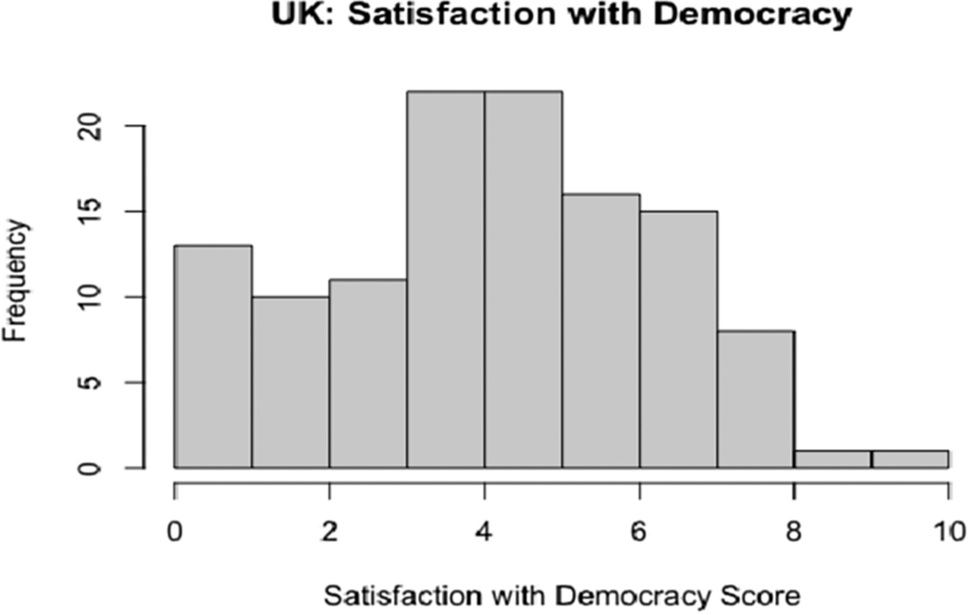
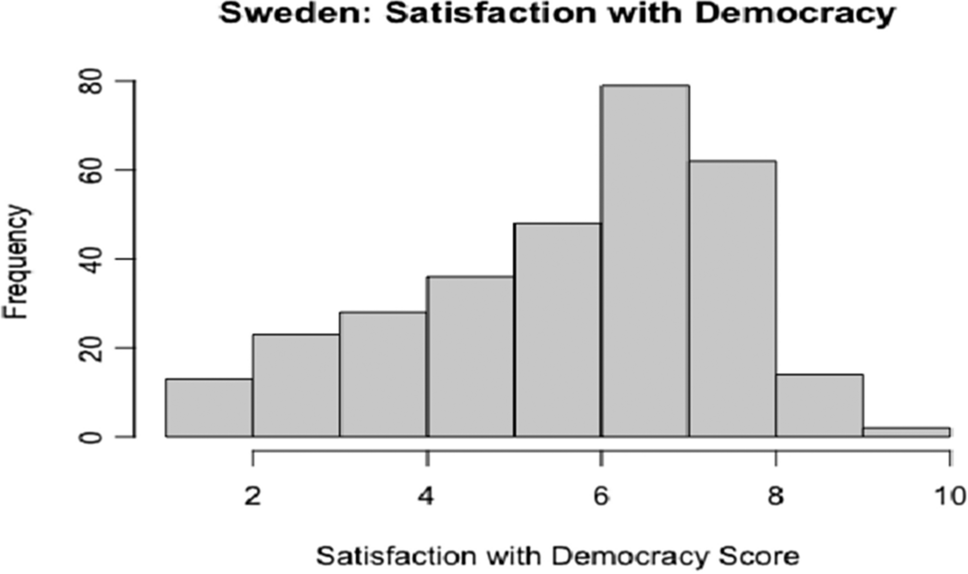
Our dependent variable is our survey item about satisfaction with democracy which was worded in accordance with the European Social Survey (ESS, 2018): “On the whole, how satisfied are you with the way democracy works in your country?” (0 = extremely dissatisfied, 10 = extremely satisfied). To find support for our first hypothesis, we would expect Swedish civil society leaders to have a higher median score for our dependent variable than their UK colleagues.
The independent variables included in our analyses describe the leaders’ background and social position: gender (female, male, non-binary, prefer not to answer); age; income (monthly income before tax); class background (upper class, upper-middle class, lower-middle class, working class, lower class); education (Ph.D., MA, BA, diploma in vocational training, secondary school, primary school, no formal education, prefer not to answer). To find support for our second hypothesis we would expect male leaders, older leaders, leaders with higher income, leaders from higher classes and leaders with higher education to be more satisfied with democracy.
Another set of independent variables describe the leaders’ values and attitudes and are used as control variables: general trust (“Would you say that most people can be trusted, or that you can’t be too careful in dealing with people? 0 = you can’t be too careful and 10 = that most people can be trusted”); left to right scale (“In politics people sometimes talk of “left” and “right”. Where would you place yourself on this scale, where 0 = on the left and 10 = on the right?”); perception of influence (“How influential do you consider that you are in our society today in relation to the questions you work with?”, 1 = not influential at all, 5 = very influential).
The categorical variables were transformed into factors in the models which allowed them to be implemented correctly; in other words, assigned the correct degrees of freedom. We also use the country context as a control variable, as we might expect the actual functioning of democracy in the two countries to affect the degree of satisfaction with democracy among civil society leaders.
Analysis and Results
Country Comparison
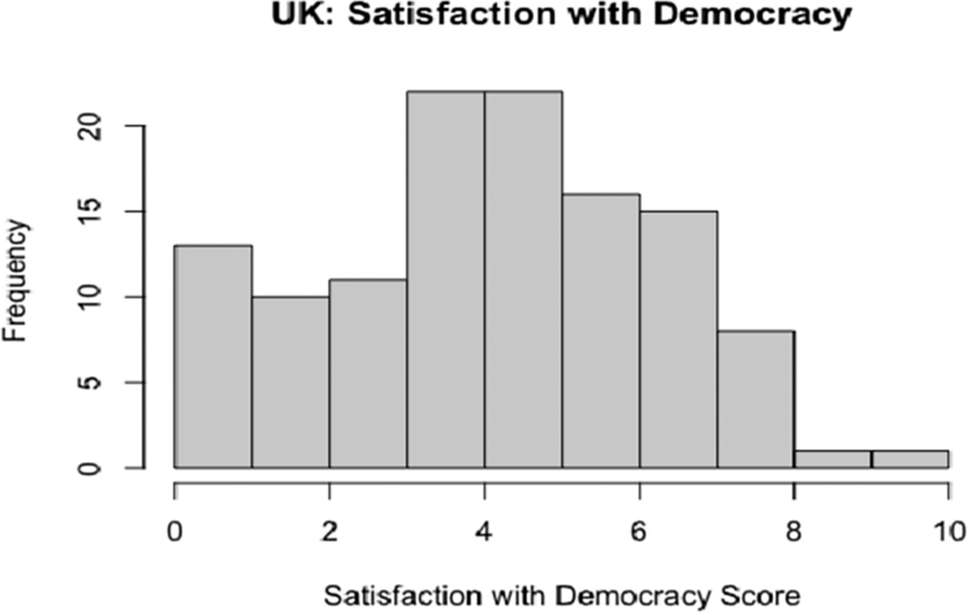
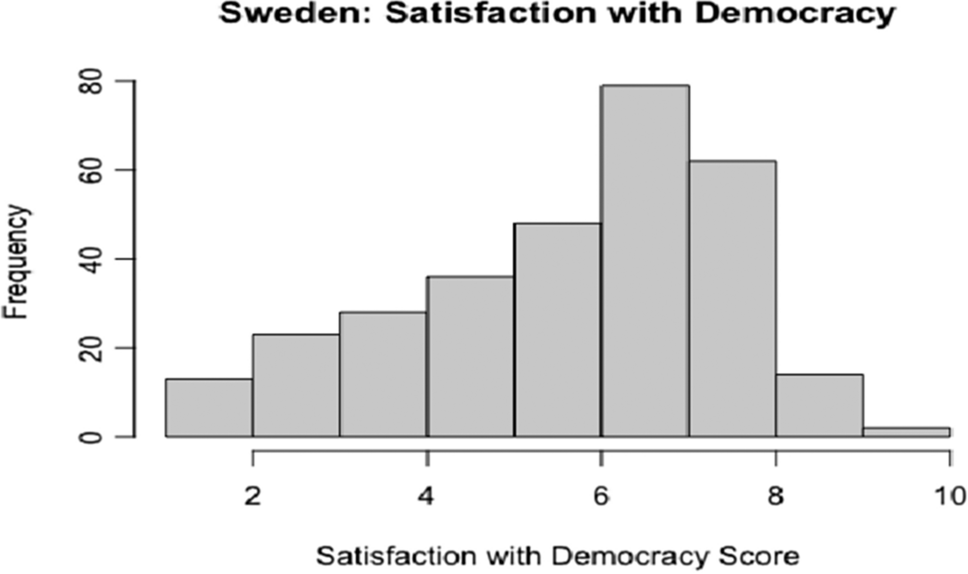
A comparison of the mean values of satisfaction with democracy among Swedish and UK CSO leaders, respectively, shows that Swedish leaders are in general more satisfied with democracy than their UK counterparts. In fact, Swedish leaders have a mean satisfaction value of 6.1 (N. 305) while that of UK leaders is 4.6 (N. 119) (Eta squared 0.107; sig. < 0.001). These results seem to support our first hypothesis that, due to their role which has traditionally been focused on being a counter-weight to the state, British leaders are likely to be more critical (see Figs. 1 and 2).
Satisfaction with democracy among UK CSO leaders
Satisfaction with democracy among Swedish CSO leaders
However, a contextual understanding of the leaders’ attitudes requires that we consider the general attitude toward democracy in each country and, more specifically, the mean score for satisfaction with democracy among the general public. As civil society leaders tend to form their opinions and attitudes toward democracy within their specific national context, it is reasonable to check whether Swedish leaders might be more critical than their UK colleagues in relation to the general population. Since our dependent variable is based on the same survey question as is asked in the European Social Survey, we are able to perform such analysis.
We find, at general population level, differences between Sweden and the UK in terms of satisfaction with democracy. In Sweden the average satisfaction with democracy score is 6.4, while in the UK it is 5.1 (according to the EES data from 2018, which is the most comparable to our survey). Thus, we find that the general population is also less satisfied with democracy in the UK compared to Sweden. The gap of satisfaction between the civil society elite and the general population is 0.3 for Sweden and 0.5 for the UK. This more contextualized result does not support our first hypothesis but neither does it indicate the opposite; the result rather suggests that civil society leaders in both countries are relatively dissatisfied with democracy compared to the general population.
Is Satisfaction with Democracy Linked to Elitism Among Civil Society Leaders?
Michels (Reference Michels1911) maintains that people have a “natural hunger for power” and that the power they acquire affects the personality of the leader and consequently, the leaders’ actions no longer represent the interests of the masses (Michels cited in Hartmann, Reference Hartmann2007:17). Since the status quo benefits and maintains their position and power, CSO leaders’ elite status should be related to their satisfaction with democracy rating to be greater than the rest of the population. However, our results do not support such an expectation but rather tend to contradict it, as shown above. Both in Sweden and in the UK, civil society elites tend to be less satisfied with democracy than the general population. In the coming analysis, we test our second hypothesis based on internal stratification within the civil society elite, focusing on the leaders’ background and social position.
To account for such stratification, it is important to consider how diverse the group of civil society leaders of well-resourced CSOs in Sweden and the UK is in terms of socio-demographic background. In terms of gender, 58 percent of Swedish leaders and 40 percent of UK leaders are female. The average age among the leaders is 57 for both countries. The average monthly income (converted into euros) is almost 5900 euros for Swedish leaders and about 13,500 for UK leaders, ranging from zero to 30 000 for Sweden and to almost 60 000 for the UK. Concerning class background, 29 percent of Swedish leaders and 26 percent of UK leaders come from a lower or working-class background. Finally, when it comes to education, 77 percent of Swedish leaders have a higher education qualification compared to 88 percent in the UK.
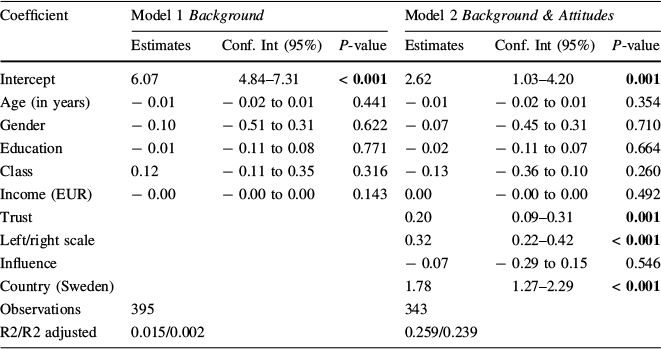
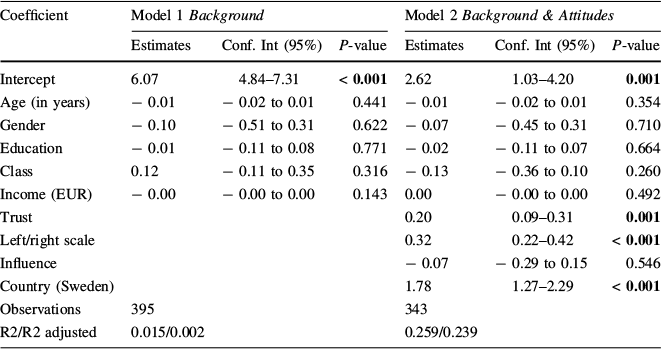
Based on the assumption that Michels’ iron law of oligarchy applies to the elite CSO leaders sampled, we expect to find a robust correlation between many, if not all, of the aforementioned profile variables and satisfaction with democracy. Our multivariate models with the survey data present the results for the socio-demographic background variables as well as the values and attitudes and the country context. In the first model in Table 1, which consists solely of background variables, we do not observe any significant correlation or predictive power. However, the second model, which also includes value variables, reveals that general trust and the political orientation (left–right scale), in addition to the country dummy variable which represents Sweden, have significance. The second model, with an r square of 0.259, can explain 25.9 percent of the variation in our dependent variable, satisfaction with democracy. After the dummy variable ‘Sweden’, the left–right scale has the most influence, followed by general trust.
Regression models explaining satisfaction with democracy among CSO leaders in the UK and Sweden
Coefficient |
Model 1 Background |
Model 2 Background & Attitudes |
||||
|---|---|---|---|---|---|---|
Estimates |
Conf. Int (95%) |
P-value |
Estimates |
Conf. Int (95%) |
P-value |
|
Intercept |
6.07 |
4.84–7.31 |
< 0.001 |
2.62 |
1.03–4.20 |
0.001 |
Age (in years) |
− 0.01 |
− 0.02 to 0.01 |
0.441 |
− 0.01 |
− 0.02 to 0.01 |
0.354 |
Gender |
− 0.10 |
− 0.51 to 0.31 |
0.622 |
− 0.07 |
− 0.45 to 0.31 |
0.710 |
Education |
− 0.01 |
− 0.11 to 0.08 |
0.771 |
− 0.02 |
− 0.11 to 0.07 |
0.664 |
Class |
0.12 |
− 0.11 to 0.35 |
0.316 |
− 0.13 |
− 0.36 to 0.10 |
0.260 |
Income (EUR) |
− 0.00 |
− 0.00 to 0.00 |
0.143 |
0.00 |
− 0.00 to 0.00 |
0.492 |
Trust |
0.20 |
0.09–0.31 |
0.001 |
|||
Left/right scale |
0.32 |
0.22–0.42 |
< 0.001 |
|||
Influence |
− 0.07 |
− 0.29 to 0.15 |
0.546 |
|||
Country (Sweden) |
1.78 |
1.27–2.29 |
< 0.001 |
|||
Observations |
395 |
343 |
||||
R2/R2 adjusted |
0.015/0.002 |
0.259/0.239 |
||||
Bold values indicate statistically significant
Data source: Civil Society Elite Survey (author’s own dataset)
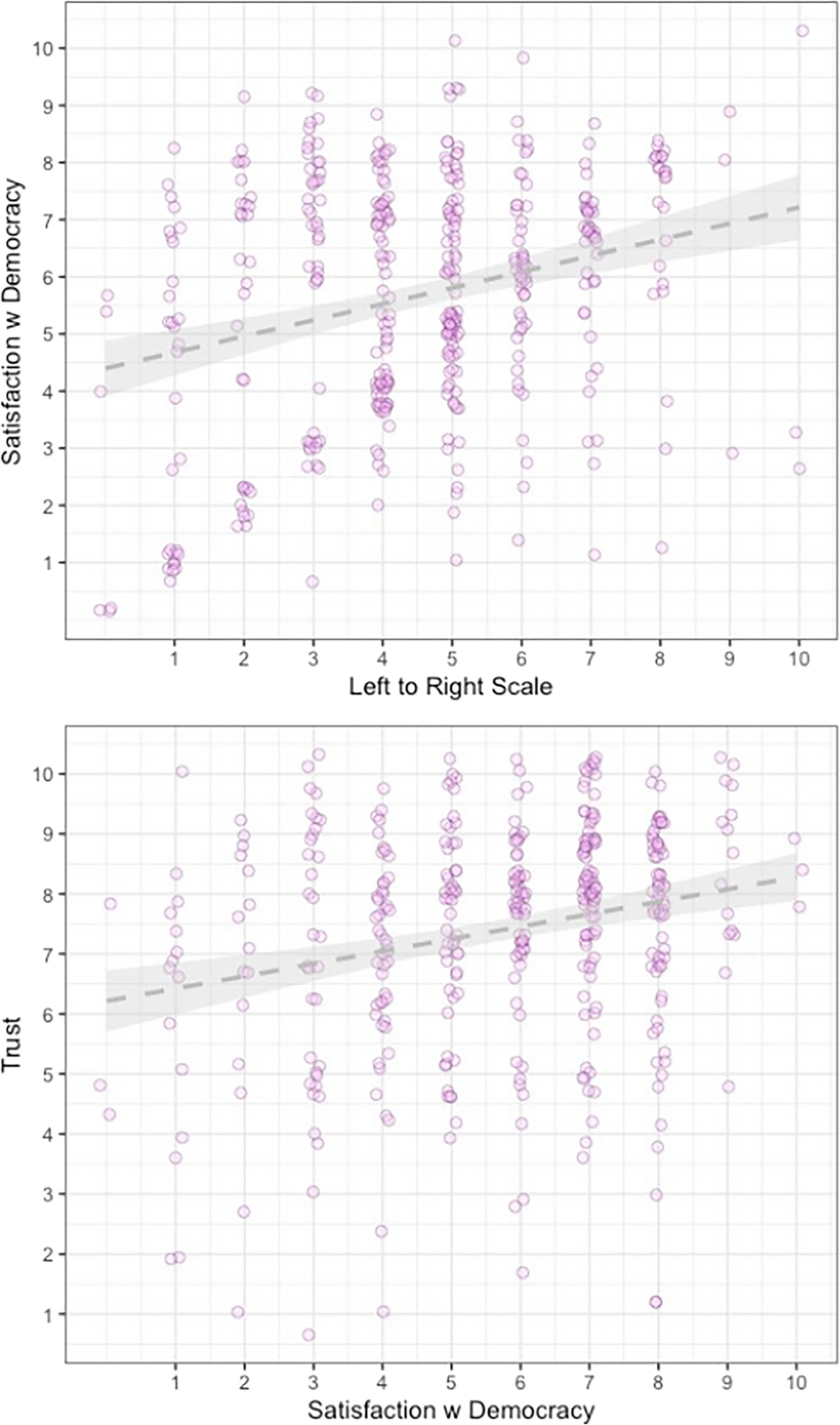
Civil society leaders’ satisfaction with democracy in Sweden and the UK does not significantly correlate to their background and social position. Yet, in terms of their value characteristics (self-reported) societal influence of the leaders played little to no role in their satisfaction with democracy, while general trust and political orientation were able to explain a small but significant 4.5% and 7.1% of the variance in our dependent variable, respectively. As the respondents’ trust increased, so too did their satisfaction with democracy. Likewise, as the respondents moved closer to the right (conservative) end of the left–right scale, their satisfaction with democracy increased (see the scatter plots in Appendix).
As the background variables do not seem to be correlated with satisfaction with democracy in either the UK or Sweden, we conclude that Michels’ law of oligarchy does not apply to civil society leaders. The notion that the more CSO leaders have elitist attributes, the more satisfied they are with democracy turns out to be an incorrect expectation. However, there is still a large amount of variation in the dependent variable that is yet to be explained and can be investigated further in future research.
Conclusions and Discussion
Our study began by articulating the tension between, on the one hand, the understanding that the civil society sector is rooted in its democratic function, i.e., holding the government and other elites to account, and, on the other, the elite status enjoyed by the top-level leaders of the most well-resourced CSOs. This theoretical conflict did not, however, empirically materialize in our analysis of survey answers from civil society leaders in Sweden and the UK. Generally speaking, civil society leaders tend to hold a more critical stance toward democracy than the general population, although many of them can arguably be seen as part of a societal elite in terms of their background and social position, i.e., most leaders are highly educated, have an income level much higher than the average population, occupy top-level positions of the most well-resourced national-level CSOs, etc. Furthermore, we find that none of the status-related individual attributes that have been proven relevant in previous research of satisfaction with democracy seem to have any explanatory power for this specific population.
One possible explanation of our results might be that attitudes among people engaged in civil society follow a specific logic that is shaped by the core mission of the sector and the ideologies of equality and solidarity which underpin the operation of many CSOs in western democracies. It might be that the leaders tend to perform their role of being critical even when they reach a high societal position that brings them closer to other elite groups. Whether this characteristic is to be linked to the process of value and attitude formation within the civil society sector as leaders are fostered (Ivanovska Hadjievska et al., Reference Ivanovska Hadjievska, Johansson and Altermark2023), or if it is more a matter of selection and ideological control informing career advancement in the sector, are questions that we cannot answer conclusively with our data. However, our finding is important, especially considering the critique raised by populist leaders against many civil society leaders in Europe in recent years that civil society leaders have become detached from the people and become part of the ruling class (see Santilli & Scaramuzzino, Reference Santilli and Scaramuzzino2022).
In the meantime, in line with previous research on the relationship between distributive preference and satisfaction with democracy, it is clear that leaders who are oriented toward the political right, who in our data are in a minority compared to left-leaning leaders, tend to be more satisfied with democracy. We also found a correlation with social trust, showing that leaders with a higher level of generalized trust tend also to be more satisfied with democracy. This is a compelling finding which complements previous knowledge, supporting the view of generalized trust being linked to a functioning democracy (Putnam, Reference Putnam2007), as well as to trust in public authorities (Kumlin & Rothstein, Reference Kumlin and Rothstein2010).
Lastly, in light of the general level of satisfaction in each country, civil society leaders tend to be slightly less satisfied with democracy in both countries, possibly due to their particular role as a counter-weight to the state and a watchdog for specific collective interests. The Swedish results are also in line with the corporatist tradition in Swedish politics which requires civil society to be engaged in advocacy but to closely cooperate with the state on the basis of mutual trust and respect for each party’s role (cf. Trägårdh, Reference Trägårdh and Trägårdh2007). Thus, what we might be observing is a tension between the notion of civil society as a fabric of social trust, which tends to be associated with satisfaction with democracy. This contrasts with its role of being critical of public policies. It is also worth noting that both Sweden and the UK represent relatively well-functioning democracies in international comparisons, scoring highly on many measurements of institutional fairness, transparency, and democracy (Alizada et al., Reference Alizada, Cole, Gastaldi, Grahn, Hellmeier, Kolvani, Lachapelle, Lührmann, Maerz, Pillai and Lindberg2021). Comparisons with a country with an evidently less well-functioning democracy would likely lead to different insights into the way in which civil society leaders understand democracy in their country.
A limitation of our study is that due to the anonymity of the survey data we could not analyze the potential mediating effect of the organizational types on the civil society leaders’ satisfaction with democracy. It would have been interesting, for instance, to explore whether the type of CSO, its relation to the state, or the policy area of activity mattered for the level of satisfaction with democracy of the leaders.
Funding
Open access funding provided by University of Gothenburg. The Funding was provided by Swedish Foundation for the Humanities and Social Sciences (grant number: M17-0188:1).
Declarations
Ethical Approval
The survey study on which the research article is based was reviewed and approved by the Swedish Ethical Review Authority prior to data collection (Dnr 2019-04400).
Appendix

 Open access

