

Following the events of September 11, 2001, the CIA established “the High-Value Detainee Program,” also known as the Rendition Detention Interrogation Program. On December 14, 2014, the U.S. Senate Select Committee on Intelligence released a heavily redacted 500-page Executive Summary of the Committee's “Study of the Central Intelligence Agency's Detention and Interrogation Program.” The full Committee Study is more than 6,700 pages long and remains classified. The release of the Executive Summary, however, disclosed new facts and provided a significant amount of new information to the European Court of Human Rights—mostly based on CIA classified documents—about the CIA extraordinary rendition and secret detention operations; their foreign partners or cooperators; as well as the plight of certain detainees, including Abu-Zubaydah. Abu Zubaydah v. Lithuania is the European Court's first judgment to have taken advantage of the information provided in the Senate Committee's Executive Summary of its Study.
The case of Abu Zubaydah and the companion case of Al Nashiri, involving Romania and issued the same day, both involved individuals who had been captured in 2002 and were held at “black sites” until their transfer to Guantánamo Bay in 2006. The European Court declared that Lithuania and Romania violated Articles 3 (torture), 5 (liberty), 8 (private life), and 13 (right to an effective legal remedy) of the European Convention on Human Rights for hosting secret prisons where the CIA held and interrogated terrorism suspects during the period from 2002 to 2006. Lithuania and Romania both argued that there was insufficient evidence to prove that the detainees had been held in secret detention centers on their territory or that the governments knew about their ill-treatment. The European Court's judgment is an encyclopedic collection of all the available evidence about the secret detention and interrogation program in a 317-page opinion, including, in particular, the Senate's Executive Summary. The judgment concludes that it would have been “inconceivable” that “activities of such character and scale, possibly vital for the country's military and political interests, could have been undertaken on Lithuanian territory without the Lithuanian authorities' knowledge and without the necessary authorisation and assistance being given at the appropriate level of the State.” The European Court has no jurisdiction over the United States but it does over Lithuania and Romania, and they were ordered to pay 100,000 Euros, respectively, to the two detainees, who are still being held at Guantánamo.
Abu Zubaydah is not the first “extraordinary rendition” case considered by the European Court, but he is, perhaps, the most notorious, since he was considered by the CIA to be the first “high value detainee” (HVD).Footnote 1 President George W. Bush and members of his administration described him as al-Qaeda's “top operative,” “number three person,” and “chief of operations.” It turns out that Abu Zubaydah was never even a member of al-Qaeda. Given his presumed importance, of the thirty-nine detainees considered HVDs, the CIA subjected Abu Zubaydah to the most horrific “enhanced interrogation techniques” (EITs), such as “attention grasp, walling, facial hold, facial or insult slap”; cramped confinement in a coffin-sized box for eleven days; “insects, wall-standing, stress positions, sleep deprivation, use of diapers”; and most notably, eighty-three water-boardings.
Abu Zubaydah is a stateless Palestinian who was captured in Pakistan in March 2002 and was first moved to a CIA prison in Thailand where he was tortured and lost his left eye. He was flown to another “black site” in Poland in December 2002. He is believed to have been held in Lithuania from February 2005 to March 2006, when he was moved to Afghanistan and then to Guantánamo, where he has been since September 2006.
The Executive Summary explains, for example, that the CIA rejected that Abu Zubaydah be placed under U.S. military custody, in large part because of the lack of security and the fact that he would have to be declared to the International Committee of the Red Cross (ICRC).Footnote 2 When they were sent to the military base at Guantánamo, the ICRC was granted access and the “strictly confidential” report on the detention regime was leaked and published in the New York Review of Books on April 6, 2009.
David Weissbrodt and Amy Bergquist, in a prescient article that appeared in 2006, identified “extraordinary rendition” as a new form of human rights violation to have emerged, different from the more traditional forms, such as crimes against humanity, genocide, and forced disappearances.Footnote 3 The authors define “extraordinary rendition” as
a hybrid human rights violation, combining elements of arbitrary arrest, enforced disappearance, forcible transfer, torture, denial of access to consular officials, and denial of impartial tribunals. It involves the state-sponsored abduction of a person in one country, with or without the cooperation of the government of that country, and the subsequent transfer of that person to another country for detention and interrogation. As is the case with state-sponsored disappearances, extraordinary rendition appears to be a practice in which perpetrators attempt to avoid legal and moral constraints by denying their involvement in the abuses.Footnote 4
The human rights community has established a practice of defining new types of violations through existing international human rights treaties. The Inter-American system, for example, defined the practice of “forced disappearances” as comprised of a violation of the right to life, the right to personal integrity, and the right not to be arbitrarily detained. Many years after the Inter-American Court issued its famous Velasquez Rodriguez judgment, identifying these elements as constituting a forced disappearance, a convention prohibiting “forced disappearances” was adopted at the international level.Footnote 5
Weissbrodt and Berquist similarly examined provisions of existing UN human rights treaties to determine which articles in international human rights treaties were violated by the practice of “extraordinary rendition.” Given that many of the countries that collaborated with the United States were in Europe, it is the European Court of Human Rights, and not one of the UN human rights treaty bodies, that has taken on the task of defining the elements of the human rights violation termed “extraordinary rendition” in its jurisprudence.
It is important to recall that in Europe, the prohibition on torture (Article 3) is absolute: it “makes no provision for exceptions and no derogation from it is permissible under Article 15 § 2 even in time of war or other public emergency threatening the life of the nation.”Footnote 6 When an individual “raises an arguable claim that he has suffered treatment infringing Article 3 at the hands of agents of the respondent State or, likewise, as a result of acts performed by foreign officials with that State's acquiescence or connivance, that provision, . . . requires by implication that there should be an effective official investigation. Such investigation should be capable of leading to the identification and—where appropriate—punishment of those responsible.”Footnote 7
The eventual release of the entire Study of the CIA's Detention and Interrogation Program should result in an effective identification and punishment of those responsible for what may eventually be termed the human rights crime of “extraordinary rendition.”

FIRST SECTION
CASE OF ABU ZUBAYDAH v. LITHUANIA
(Application no. 46454/11)
JUDGMENT
STRASBOURG
31 May 2018
This judgment will become final in the circumstances set out in Article 44 § 2 of the Convention. It may be subject to editorial revision.

PROCEDURE………………[ILM Page 727]
THE FACTS………………[ILM Page 729]
I. PRELIMINARY CONSIDERATIONS REGARDING THE ESTABLISHMENT OF THE FACTS………………[ILM Page 729]
II. EVIDENCE BEFORE THE COURT………………[ILM Page 729]
III. BACKGROUND TO THE CASE………………[ILM Page 730]
A. The so-called “High-Value Detainee Programme”………………[ILM Page 730]
1. The establishment of the HVD Programme………………[ILM Page 731]
(a) The US President's memoranda………………[ILM Page 731]
(i) Memorandum of 17 September 2001………………[ILM Page 731]
(ii) Memorandum of 7 February 2002………………[ILM Page 731]
(b) Abu Zubaydah's capture and transfer to a CIA covert detention facility in March 2002………………[ILM Page 732]
(c) Setting up the CIA programme “to detain and interrogate terrorists at sites abroad”………………[ILM Page 732]
2. Enhanced Interrogation Techniques………………[ILM Page 733]
(a) Description of legally sanctioned standard and enhanced interrogation techniques………………[ILM Page 733]
(b) Expanding the use of the EITs beyond Abu Zubaydah's interrogations………………[ILM Page 735]
3. Standard procedures and treatment of “high value detainees” in CIA custody (combined use of interrogation techniques)………………[ILM Page 735]
4. Conditions of detention at CIA “Black Sites”………………[ILM Page 740]
5. The scale of the HVD Programme………………[ILM Page 740]
6. Closure of the HVD Programme………………[ILM Page 741]
B. The United States Supreme Court's judgment in Rasul v. Bush………………[ILM Page 741]
C. Role of Jeppesen Dataplan, Richmor Aviation and other air companies in the CIA rendition operations………………[ILM Page 741]
1. Jeppesen Dataplan Inc.………………[ILM Page 741]
2. Richmor Aviation………………[ILM Page 742]
3. Other companies………………[ILM Page 742]
D. Review of the CIA's activities involved in the HVD Programme in 2001-2009 by the US Senate………………[ILM Page 743]
1. Course of the review………………[ILM Page 743]
2. Findings and conclusions………………[ILM Page 744]
IV. THE PARTICULAR CIRCUMSTANCES OF THE CASE………………[ILM Page 747]
A. Restrictions on information about the applicant's secret detention and his communication with the outside world………………[ILM Page 747]
B. The applicant's capture, transfer to CIA custody, secret detention and transfers from 27 March 2002 to 22 September 2003, as established by the Court in Husayn (Abu Zubaydah) v. Poland and supplemented by the 2014 US Senate Committee Report………………[ILM Page 747]
C. The applicant's transfers and detention between his rendition from Poland on 22 September 2003 and his alleged rendition to Lithuania on 17 February or 18 February 2005 as established by the Court in Husayn (Abu Zubaydah) v. Poland, reconstructed on the basis of the 2014 US Senate Committee Report and other documents and as corroborated by experts heard by the Court………………[ILM Page 751]
D. The applicant's alleged secret detention at a CIA “Black Site” in Lithuania from 17 February or 18 February 2005 to 25 March 2006 as described by the applicant, reconstructed on the basis of the 2014 US Senate Committee Report and other documents and as corroborated by experts heard by the Court………………[ILM Page 754]
1. The applicant's alleged rendition to Lithuania on 17 February or 18 February 2005 and his rendition from Lithuania on the plane N733MA on 25 March 2006………………[ILM Page 754]
(a) The applicant's submissions………………[ILM Page 754]
(i) Rendition to Lithuania (17 or 18 February 2005)………………[ILM Page 754]
(ii) Rendition from Lithuania (25 March 2006)………………[ILM Page 755]
(b) Evidence before the Court………………[ILM Page 755]
(i) The 2015 Reprieve Briefing………………[ILM Page 756]
(α) As regards the colour-coded names of the CIA detention facilities and periods of their operation………………[ILM Page 756]
(β) As regards the CIA prisoners' transfers into Lithuania………………[ILM Page 757]
– February 2005 transfers………………[ILM Page 757]
– October 2005 transfer………………[ILM Page 758]
– March 2006 transfer………………[ILM Page 759]
(ii) Expert evidence………………[ILM Page 759]
(iii) “Detention Site Violet” in the 2014 US Senate Committee Report………………[ILM Page 772]
2. Detention and treatment to which the applicant was subjected………………[ILM Page 774]
E. The applicant's further transfers during CIA custody (until 5 September 2006) as reconstructed on the basis of the 2014 US Senate Committee Report and other documents and as corroborated by experts heard by the Court………………[ILM Page 777]
F. The applicant's detention at the US Guantánamo Bay facility since 5 September 2006 to present………………[ILM Page 777]
G. Psychological and physical effects of the HVD Programme on the applicant………………[ILM Page 778]
H. Identification of locations of the colour code-named CIA detention sites in the 2014 US Senate Committee Report by experts………………[ILM Page 779]
I. Parliamentary inquiry in Lithuania………………[ILM Page 779]
1. The Seimas investigation and findings………………[ILM Page 779]
2. Extracts from transcripts of the Seimas' debates on the CNSD Findings………………[ILM Page 785]
J. Criminal investigation in Lithuania………………[ILM Page 787]
1. Investigation conducted in 2010-2011………………[ILM Page 787]
2. Reopening of the investigation on 22 January 2015 and further proceedings………………[ILM Page 795]
V. RELEVANT DOMESTIC LAW AND PRACTICE………………[ILM Page 796]
A. Constitution of the Republic of Lithuania………………[ILM Page 796]
B. Criminal Code………………[ILM Page 797]
C. Code of Criminal Procedure………………[ILM Page 799]
D. Civil Code………………[ILM Page 803]
E. The Law on Intelligence………………[ILM Page 804]
F. The Statute of the Seimas………………[ILM Page 804]
G. The Law on the Seimas Ad Hoc Investigation Commissions………………[ILM Page 806]
H. The Constitutional Court's case-law………………[ILM Page 806]
VI. RELEVANT INTERNATIONAL LAW………………[ILM Page 807]
A. Vienna Convention on the Law of Treaties………………[ILM Page 807]
B. International Covenant on Civil and Political Rights………………[ILM Page 807]
C. The United Nations Torture Convention………………[ILM Page 807]
D. UN Geneva Conventions………………[ILM Page 808]
1. Geneva (III) Convention………………[ILM Page 808]
2. Geneva (IV) Convention………………[ILM Page 809]
E. International Law Commission, 2001 Articles on Responsibility of States for Internationally Wrongful Acts………………[ILM Page 809]
F. UN General Assembly Resolution 60/147………………[ILM Page 811]
VII. SELECTED PUBLIC SOURCES CONCERNING GENERAL KNOWLEDGE OF THE HVD PROGRAMME AND HIGHLIGHTING CONCERNS AS TO HUMAN RIGHTS VIOLATIONS ALLEGEDLY OCCURRING IN US-RUN DETENTION FACILITIES IN THE AFTERMATH OF 11 SEPTEMBER 2001………………[ILM Page 811]
A. United Nations Organisation………………[ILM Page 811]
1. Statement of the UN High Commissioner for Human Rights on detention of Taliban and Al-Qaeda prisoners at the US Base in Guantánamo Bay, Cuba, 16 January 2002………………[ILM Page 811]
2. Statement of the International Rehabilitation Council for Torture………………[ILM Page 811]
3. UN Working Group on Arbitrary Detention, Opinion No. 29/2006, Mr Ibn al-Shaykh al-Libi and 25 other persons v. United States of America, UN Doc. A/HRC/4/40/Add.1 at 103 (2006)………………[ILM Page 811]
B. Parliamentary Assembly of the Council of Europe Resolution no. 1340 (2003) on rights of persons held in the custody of the United States in Afghanistan or Guantánamo Bay, 26 June 2003………………[ILM Page 812]
C. International non-governmental organisations………………[ILM Page 813]
1. Amnesty International, Memorandum to the US Government on the rights of people in US custody in Afghanistan and Guantánamo Bay, April 2002………………[ILM Page 813]
2. Human Rights Watch, “United States, Presumption of Guilt: Human Rights Abuses of Post-September 11 Detainees”, Vol. 14, No. 4 (G), August 2002………………[ILM Page 813]
3. Human Rights Watch, “United States: Reports of Torture of Al-Qaeda Suspects”, 26 December 2002………………[ILM Page 813]
4. International Helsinki Federation for Human Rights, “Anti-terrorism Measures, Security and Human Rights: Developments in Europe, Central Asia and North America in the Aftermath of September 11”, Report, April 2003………………[ILM Page 813]
5. Amnesty International Report 2003 – United States of America, 28 May 2003………………[ILM Page 814]
6. Amnesty International, “Unlawful detention of six men from Bosnia-Herzegovina in Guantánamo Bay”, 29 May 2003………………[ILM Page 814]
7. Amnesty International, “United States of America, The threat of a bad example: Undermining international standards as ‘war on terror’ detentions continue”, 18 August 2003………………[ILM Page 814]
8. Amnesty International, “Incommunicado detention/Fear of ill-treatment”, 20 August 2003………………[ILM Page 814]
9. International Committee of the Red Cross, United States: ICRC President urges progress on detention-related issues, news release 04/03, 16 January 2004………………[ILM Page 814]
10. Human Rights Watch - Statement on US Secret Detention Facilities of 6 November 2005………………[ILM Page 815]
11. Human Rights Watch – List of “Ghost Prisoners” Possibly in CIA Custody of 30 November 2005………………[ILM Page 816]
VIII. SELECTED MEDIA REPORTS AND ARTICLES………………[ILM Page 817]
A. International media………………[ILM Page 817]
1. Reports published in 2002………………[ILM Page 817]
2. Reports published in 2005………………[ILM Page 819]
3. ABC News reports of 2009………………[ILM Page 822]
4. Other Reports (2009–2011)………………[ILM Page 825]
B. Lithuanian media………………[ILM Page 828]
IX. INTERNATIONAL INQUIRIES RELATING TO THE CIA SECRET DETENTION AND RENDITION OF SUSPECTED TERRORISTS IN EUROPE, INCLUDING LITHUANIA………………[ILM Page 829]
A. Council of Europe………………[ILM Page 829]
1. Procedure under Article 52 of the Convention………………[ILM Page 829]
2. Parliamentary Assembly's inquiry - the Marty Inquiry………………[ILM Page 831]
(a) The 2006 Marty Report………………[ILM Page 831]
(b) The 2007 Marty Report………………[ILM Page 832]
(c) The 2011 Marty Report………………[ILM Page 835]
B. European Parliament………………[ILM Page 837]
1. The Fava Inquiry………………[ILM Page 837]
2. The 2007 European Parliament Resolution………………[ILM Page 838]
3. The Flautre Report and the 2012 European Parliament Resolution………………[ILM Page 839]
4. The 2013 European Parliament Resolution………………[ILM Page 840]
5. The 2015 European Parliament Resolution………………[ILM Page 841]
6. The October 2015 hearing before the LIBE………………[ILM Page 841]
7. The 2016 European Parliament Resolution………………[ILM Page 842]
C. The 2007 ICRC Report………………[ILM Page 842]
D. The 2010 UN Joint Study………………[ILM Page 845]
X. SUMMARY OF WITNESS TESTIMONY PRODUCED BY THE GOVERNMENT………………[ILM Page 846]
Witness A………………[ILM Page 847]
Witness A1………………[ILM Page 847]
Witness A2………………[ILM Page 847]
Witness A3………………[ILM Page 848]
Witness A4………………[ILM Page 848]
Witness B………………[ILM Page 848]
Witness B1………………[ILM Page 848]
Witness B2………………[ILM Page 849]
Witness B3………………[ILM Page 849]
Witness B4 (also referred to as “person B” by the Government)………………[ILM Page 849]
Witness C………………[ILM Page 849]
Witness C1………………[ILM Page 849]
Witness C2 (also referred to as “person C” by the Government)………………[ILM Page 850]
Witness D………………[ILM Page 850]
Witness D1………………[ILM Page 850]
Witness E………………[ILM Page 850]
Witness E1………………[ILM Page 850]
Witness F………………[ILM Page 850]
Witness F1………………[ILM Page 850]
Witness G………………[ILM Page 851]
Witness G1………………[ILM Page 851]
Witness G2………………[ILM Page 851]
Witness H………………[ILM Page 851]
Witness H1………………[ILM Page 851]
Witness K………………[ILM Page 852]
Witness L………………[ILM Page 852]
Witness M………………[ILM Page 852]
Witness N………………[ILM Page 853]
1. Questioning on 9 March 2010………………[ILM Page 853]
2. Questioning on 16 March 2010………………[ILM Page 853]
Witness O………………[ILM Page 854]
1. Questioning on 9 March 2010………………[ILM Page 854]
2. Questioning on 10 March 2010………………[ILM Page 854]
Witness P………………[ILM Page 854]
Witness Q………………[ILM Page 854]
Witness R………………[ILM Page 854]
Witness S………………[ILM Page 855]
Witness T………………[ILM Page 855]
1. Questioning on 2 March 2010………………[ILM Page 855]
2. Questioning on 16 March 2010………………[ILM Page 855]
Witness U………………[ILM Page 856]
Witness U1………………[ILM Page 856]
Witness V………………[ILM Page 856]
Witness X………………[ILM Page 856]
Witness Y………………[ILM Page 856]
Witness Z………………[ILM Page 856]
XI. OTHER DOCUMENTS AND EVIDENCE BEFORE THE COURT………………[ILM Page 856]
A. The 2011 CPT Report………………[ILM Page 856]
B. The Lithuanian Government's Response to the 2011 CPT Report………………[ILM Page 860]
C. Mr Fava's testimony regarding the “informal transatlantic meeting” given in Al Nashiri v. Poland and Husayn (Abu Zubaydah) v. Poland………………[ILM Page 863]
D. Documents concerning the on-site inspection of Project No. 1 and Project No. 2 carried out by the investigating prosecutor………………[ILM Page 865]
1. Record of on-site inspection of Project No. 1 of 17 March 2010.………………[ILM Page 865]
2. Record of the on-site inspection of Project No. 2 of 4 June 2010………………[ILM Page 866]
E. Resolution and Operational Action Plan of 25 July 2002………………[ILM Page 867]
F. Report on the incident of 6 October 2005 in Vilnius airport………………[ILM Page 868]
G. Letter from former President of Lithuania Mr Adamkus to the CNSD of 26 November 2009………………[ILM Page 868]
H. Letter from the Ministry of the Interior of 9 December 2009………………[ILM Page 869]
I. Letter from Palanga airport of 15 March 2010………………[ILM Page 869]
J. The Customs Department letter of 12 April 2010………………[ILM Page 869]
K. The SBGS letter of 27 April 2010………………[ILM Page 870]
XII. EXTRACTS FROM TESTIMONY OF EXPERTS HEARD BY THE COURT………………[ILM Page 870]
A. Presentation by Senator Marty and Mr J.G.S. “Distillation of available evidence, including flight data, in respect of Lithuania and the case of Abu Zubaydah”………………[ILM Page 870]
B. Senator Marty………………[ILM Page 873]
C. Mr J.G.S.………………[ILM Page 874]
D. Mr Black………………[ILM Page 876]
THE LAW………………[ILM Page 878]
I. THE GOVERNMENT'S PRELIMINARY OBJECTIONS TO THE ADMISSIBILITY OF THE APPLICATION………………[ILM Page 878]
A. Lithuania's lack of jurisdiction and responsibility under the Convention in respect of the applicant's alleged rendition to Lithuania, detention and ill-treatment in a CIA detention facility in Lithuania and transfer out of Lithuania and the applicant's lack of victim status………………[ILM Page 878]
1. The Government………………[ILM Page 878]
2. The applicant………………[ILM Page 879]
3. The Court's assessment………………[ILM Page 880]
B. Non-compliance with the rule of exhaustion of domestic remedies and the six-month rule………………[ILM Page 881]
1. The Government………………[ILM Page 881]
(a) Non-exhaustion of domestic remedies………………[ILM Page 881]
(b) Non-compliance with the six-month rule………………[ILM Page 882]
2. The applicant………………[ILM Page 882]
(a) Non-exhaustion of domestic remedies………………[ILM Page 882]
(b) Non-compliance with the six-month rule………………[ILM Page 883]
3. The Court's assessment………………[ILM Page 883]
II. THE COURT'S ESTABLISHMENT OF THE FACTS AND ASSESSMENT OF EVIDENCE………………[ILM Page 883]
A. The parties' positions on the facts and evidence………………[ILM Page 883]
1. The Government………………[ILM Page 883]
(a) Lack of credibility of evidence adduced by the applicant………………[ILM Page 883]
(b) Lack of evidence demonstrating that certain CIA-linked planes landing in Lithuania between 17 February 2005 and 25 March 2006 carried out extraordinary rendition missions………………[ILM Page 884]
(c) Lack of evidence demonstrating that a CIA secret detention facility operated in Lithuania and that the applicant was detained in that facility………………[ILM Page 885]
(i) As regards the alleged existence of a CIA secret detention facility………………[ILM Page 885]
(ii) As regards the applicant's alleged secret detention in Lithuania………………[ILM Page 887]
(d) Lack of evidence demonstrating that the Lithuanian authorities agreed to the running of a secret detention facility by the CIA on Lithuanian territory or cooperated in the execution of the HVD Programme………………[ILM Page 888]
(e) Lack of evidence of Lithuania's knowledge of the CIA HVD Programme at the material time………………[ILM Page 888]
2. The applicant………………[ILM Page 888]
(a) As regards the Government's allegation of a lack of credibility of sources of information and evidence before the Court………………[ILM Page 888]
(b) As regards the CIA-linked planes landing in Lithuania between 17 February 2005 and 25 March 2006………………[ILM Page 889]
(c) As regards the existence of a CIA secret detention facility in Lithuania and the applicant's secret detention in Lithuania………………[ILM Page 890]
(d) As regards the Lithuanian authorities' agreement to the running of a secret detention facility by the CIA on Lithuanian territory and their complicity in the execution of the HVD Programme………………[ILM Page 891]
(e) As regards Lithuania's knowledge of the CIA HVD Programme at the material time………………[ILM Page 891]
B. Joint submissions by Amnesty International (AI) and the International Commission of Jurists (ICJ) on public knowledge of US practices in respect of captured terrorist suspects………………[ILM Page 892]
C. HFHR submissions………………[ILM Page 894]
D. The parties' positions on the standard and burden of proof………………[ILM Page 894]
1. The Government………………[ILM Page 894]
2. The applicant………………[ILM Page 895]
E. The Court's assessment of the facts and evidence………………[ILM Page 895]
1. Applicable principles deriving from the Court's case-law………………[ILM Page 895]
2. Preliminary considerations concerning the assessment of the facts and evidence in the present case………………[ILM Page 896]
3. As regards the establishment of the facts and assessment of evidence relevant to the applicant's allegations concerning his transfers and secret detention by the CIA before his rendition to Lithuania (27 March 2002 to 17 or 18 February 2005)………………[ILM Page 897]
(a) Period from 27 March 2002 to 22 September 2003………………[ILM Page 897]
(b) Whether the applicant's allegations concerning his secret detention and transfers in CIA custody from 22 September 2003 (transfer out of Poland) to 17 or 18 February 2005 (transfer out of Morocco) were proved before the Court………………[ILM Page 897]
4. As regards the establishment of the facts and assessment of evidence relevant to the applicant's allegations concerning his rendition by the CIA to Lithuania, secret detention in Lithuania and transfer by the CIA out of Lithuania (17 or 18 February 2005 to 25 March 2006)………………[ILM Page 899]
(a) Whether a CIA secret detention facility existed in Lithuania at the time alleged by the applicant (17 or 18 February 2005 to 25 March 2006)………………[ILM Page 899]
(b) Whether the applicant's allegations concerning his rendition to Lithuania, secret detention at the CIA Detention Site Violet in Lithuania and transfer from Lithuania to another CIA detention facility elsewhere were proved before the Court………………[ILM Page 908]
(i) Preliminary considerations………………[ILM Page 908]
(ii) Transfers and secret detention………………[ILM Page 909]
(iii) The applicant's treatment in CIA custody in Lithuania………………[ILM Page 912]
5. As regards the establishment of the facts and assessment of evidence relevant to the applicant's allegations concerning Lithuania's knowledge of and complicity in the CIA HVD Programme………………[ILM Page 913]
(a) Relations of cooperation between the Lithuanian authorities and the CIA, including an agreement to host a CIA detention facility, acceptance of a financial reward for supporting the HVD Programme and assistance in the acquisition and adaptation of the premises for the CIA's activities (Project No. 1 and Project No. 2)………………[ILM Page 913]
(i) Agreement to host a CIA detention facility and acceptance of a financial reward for supporting the HVD Programme………………[ILM Page 913]
(ii) Assistance in the acquisition and adaptation of the premises for the CIA's activities (Project No. 1 and Project No. 2)………………[ILM Page 914]
(b) Assistance in disguising the CIA rendition aircraft routes through Lithuania by means of the so-called “dummy” flight planning………………[ILM Page 914]
(c) Special procedure for CIA flights………………[ILM Page 915]
(d) Circumstances routinely surrounding HVDs transfers and reception at the CIA “black site”………………[ILM Page 915]
(e) Public knowledge of treatment to which captured terrorist suspects were subjected in US custody in 2002–2005………………[ILM Page 915]
(f) Informal transatlantic meeting………………[ILM Page 916]
6. The Court's conclusion as to the Lithuanian authorities' knowledge of and complicity in the CIA HVD Programme………………[ILM Page 917]
III. LITHUANIA'S JURISDICTION AND RESPONSIBILITY UNDER THE CONVENTION AND THE APPLICANT'S VICTIM STATUS………………[ILM Page 919]
A. The parties' submissions………………[ILM Page 919]
B. The Court's assessment………………[ILM Page 919]
1. As regards jurisdiction………………[ILM Page 919]
2. As regards the State's responsibility for an applicant's treatment and detention by foreign officials on its territory………………[ILM Page 919]
3. As regards the State's responsibility for an applicant's removal from its territory………………[ILM Page 919]
4. Conclusion as to the Lithuanian Government's preliminary objections that Lithuania lacks jurisdiction and responsibility under the Convention and as to the applicant's victim status………………[ILM Page 920]
IV. ALLEGED VIOLATION OF ARTICLE 3 OF THE CONVENTION………………[ILM Page 921]
A. Procedural aspect of Article 3………………[ILM Page 921]
1. The parties' submissions………………[ILM Page 921]
(a) The Government………………[ILM Page 921]
(b) The applicant………………[ILM Page 923]
2. Joint submissions by Amnesty International (AI) and the International Commission of Jurists (ICJ) on “effective investigation”………………[ILM Page 924]
3. The Court's assessment………………[ILM Page 925]
(a) Admissibility………………[ILM Page 925]
(b) Merits………………[ILM Page 925]
(i) Applicable general principles deriving from the Court's case-law………………[ILM Page 925]
(ii) Application of the above principles to the present case………………[ILM Page 926]
B. Substantive aspect of Article 3………………[ILM Page 928]
1. The parties' submissions………………[ILM Page 928]
(a) The Government………………[ILM Page 928]
(b) The applicant………………[ILM Page 928]
2. The Court's assessment………………[ILM Page 929]
(a) Admissibility………………[ILM Page 929]
(b) Merits………………[ILM Page 929]
(i) Applicable general principles deriving from the Court's case-law………………[ILM Page 929]
(ii) Application of the above principles to the present case………………[ILM Page 930]
(α) Treatment to which the applicant was subjected at the relevant time………………[ILM Page 930]
(β) Court's conclusion as to Lithuania's responsibility………………[ILM Page 932]
V. ALLEGED VIOLATION OF ARTICLE 5 OF THE CONVENTION………………[ILM Page 932]
A. The parties' submissions………………[ILM Page 933]
1. The Government………………[ILM Page 933]
2. The applicant………………[ILM Page 933]
B. The Court's assessment………………[ILM Page 934]
1. Admissibility………………[ILM Page 934]
2. Merits………………[ILM Page 934]
(a) Applicable general principles deriving from the Court's case-law………………[ILM Page 934]
(b) Application of the above principles to the present case………………[ILM Page 935]
VI. ALLEGED VIOLATION OF ARTICLE 8 OF THE CONVENTION………………[ILM Page 936]
A. The parties' submissions………………[ILM Page 936]
1. The Government………………[ILM Page 936]
2. The applicant………………[ILM Page 936]
B. The Court's assessment………………[ILM Page 936]
1. Admissibility………………[ILM Page 936]
2. Merits………………[ILM Page 936]
VII. ALLEGED VIOLATION OF ARTICLE 13 IN CONJUNCTION WITH ARTICLE 3 OF THE CONVENTION………………[ILM Page 937]
A. The parties' submissions………………[ILM Page 937]
B. The Court's assessment………………[ILM Page 937]
1. Admissibility………………[ILM Page 937]
2. Merits………………[ILM Page 938]
(a) Applicable general principles deriving from the Court's case-law………………[ILM Page 938]
(b) Application of the above principles to the present case………………[ILM Page 938]
VIII. APPLICATION OF ARTICLES 46 AND 41 OF THE CONVENTION………………[ILM Page 939]
A. Article 46 of the Convention………………[ILM Page 939]
B. Article 41 of the Convention………………[ILM Page 940]
1. Damage………………[ILM Page 941]
2. Costs and expenses………………[ILM Page 941]
3. Default interest………………[ILM Page 941]
ANNEX I: LIST OF ABBREVIATIONS USED IN THE COURT'S JUDGMENT………………[ILM Page 942]
ANNEX II: LIST OF REFERENCES TO THE COURT'S CASE-LAW………………[ILM Page 945]
In the case of Abu Zubaydah v. Lithuania,
The European Court of Human Rights (First Section), sitting as a Chamber composed of:
Linos-Alexandre Sicilianos, President,
Kristina Pardalos,
Robert Spano,
Aleš Pejchal,
Egidijus Kūris,
Mirjana Lazarova Trajkovska,
Paul Mahoney, judges,
and Abel Campos, Section Registrar,
Having deliberated in private on 28 and 29 June 2016 and 10 April 2018,
Delivers the following judgment, which was adopted on the last of these dates:
PROCEDURE
1. The case originated in an application (no. 46454/11) against the Republic of Lithuania lodged with the Court under Article 34 of the Convention for the Protection of Human Rights and Fundamental Freedoms (“the Convention”) by a stateless Palestinian, Mr Zayn Al-Abidin Muhammad Husayn, also known as Abu Zubaydah (“the applicant”), on 14 July 2011.
2. The applicant was represented before the Court by Ms H. Duffy, a lawyer practising in The Hague, Mr G.B. Mickum IV, member of the District of Columbia and Virginia Bars, and Mr J. Margulies, member of the Illinois Bar. The Lithuanian Government (“the Government”) were represented by their Agent, Ms K. Bubnytė.
3. The applicant alleged, in particular:
(i) a breach of Articles 3, 5 and 8 of the Convention on account of the fact that Lithuania had enabled the Central Intelligence Agency of the United States (“the CIA”) to detain him secretly on its territory, thereby allowing the CIA to subject him to treatment that amounted to torture, incommunicado detention, various forms of mental and physical abuse and deprivation of any access to, or contact with, his family or the outside world;
(ii) a breach of Articles 3, 5 and 8 of the Convention on account of the fact that Lithuania had enabled the CIA to transfer him from its territory, thereby exposing him to years of further torture, ill-treatment, secret and arbitrary detention and physical abuse in the hands of the US authorities, as well as lack of any contact with his family;
(iii) a breach of Article 13 taken separately and in conjunction with Article 3 on account of Lithuania's failure to conduct an effective investigation into his allegations of serious violations of Article 3 of the Convention.
4. The application was allocated to the Second Section of the Court (Rule 52 § 1 of the Rules of Court).
5. On 14 December 2012 the President of the Second Section accorded priority to the application, in accordance with Rule 41 and gave notice of the application to the Government, in accordance with Rule 54 § 2 (b).
6. The Government and the applicant each filed written observations on the admissibility and merits of the case. In addition, third-party comments were received from the Helsinki Foundation for Human Rights (“HFHR”), Amnesty International (hereinafter also referred to as “AI”) and the International Commission of Jurists (hereinafter also referred to as “ICJ”).
7. On 17 March 2015 the Chamber that had been constituted to consider the case (Rule 26 § 1) decided to ask the Government to submit documentary evidence, including declassified parts of the material from the criminal investigation into the applicant's allegations that was conducted in Lithuania and flight data concerning the alleged landings of CIA rendition aircraft in Lithuania. The parties were also invited to produce any further evidence on which they wished to rely before the Court and make comments on the case in the light of the Court's judgments in El-Masri (see El-Masri v. the former Yugoslav Republic of Macedonia [GC], no. 39630/09, ECHR 2012), Al Nashiri v. Poland (see Al Nashiri v. Poland, no. 28761/11, 24 July 2014), and Husayn (Abu Zubaydah) v. Poland (see Husayn (Abu Zubaydah) v. Poland, no. 7511/13, 24 July 2014).
8. Following the re-composition of the Court's Sections, the application was assigned to the First Section of the Court, pursuant to Rule 52 § 2.
9. Subsequently, the Chamber of the First Section that had been constituted to consider the case, having consulted the parties, decided that a public hearing on the admissibility and merits of the case be held on 29 June 2016.
The Chamber also decided, of its own motion, to hear evidence from experts (Rule A1 of the Annex to the Rules of Court). The date for a fact-finding hearing was set for 28 June 2016.
In this connection, the President of the Chamber directed that verbatim records of both hearings be made, pursuant to Rule 70 of the Rules of Court and Rule A8 of the Annex to the Rules of Court, and instructed the Registrar accordingly.
10. On 28 June 2016 the Chamber held a fact-finding hearing and took evidence from experts, in accordance with Rule A1 §§ 1 and 5 of the Annex.
11. In the course of the fact-finding hearing the parties were also invited to state their position on the confidentiality of certain documents produced by the Lithuanian Government (Rule 33 § 2), in particular those relating to the criminal investigation, including a summary of witness evidence and some other material collected in the context of that investigation (see also paragraphs 178-199, 301-346, 357, 362, 365 and 367-368 below). The applicant was in favour of full disclosure, whereas the Government considered that the confidentiality of all documents submitted by them should be maintained. The Court decided to invite the Government to prepare a redacted version of the confidential documents after the hearing and instructed the parties that at the public hearing confidentiality was to be respected in a manner which would not lead to disclosure of sources of evidence obtained in the criminal investigation or the identities of witnesses or third parties involved.
12. A public hearing took place in public in the Human Rights Building, Strasbourg, on 29 June 2016 (Rule 59 § 3).
There appeared before the Court:
(a) for the Government
Ms K. Bubnytė, Agent of the Government of the Republic of Lithuania to the European Court of Human Rights,
Mr P. Griciūnas, the Vice Minister of Justice of the Republic of Lithuania,
Mr E. Pašilis, the Prosecutor General of the Republic of Lithuania;
(b) for the applicant
Ms H. Duffy, Counsel,
Ms A. Jacobsen, Counsel.
The Court heard addresses by Mr Griciūnas, Mr Pašilis and Ms Duffy.
13. The Government, in their oral submissions, stated that they wished to withdraw their request to apply Rule 33 § 2 in respect of all documents submitted by them, except to the extent necessary to ensure the protection of personal data.
14. The fact-finding hearing and the public hearing were presided over by Mirjana Lazarova Trajkovska, former President of the First Section of the Court. Following the end of her term of office and elections of Section Presidents, Linos-Alexandre Sicilianos, President of the First Section, became the President of the Chamber (Rules 8 § 1, 12 and 26 § 3). Judges Lazarova-Trajkovska and Mahoney continued to deal with the case after the end of their terms of office (Rule 26 § 3).
THE FACTS
15. The applicant was born in 1971 and is currently detained in the Internment Facility at the US Guantánamo Bay Naval Base in Cuba.
I. PRELIMINARY CONSIDERATIONS REGARDING THE ESTABLISHMENT OF THE FACTS
16. It is to be noted that in the present case involving, as the applicant's previous application before the Court, complaints of secret detention and torture to which the applicant was allegedly subjected during the extraordinary rendition operations by the United States authorities (see paragraphs 19-88 below) the Court is deprived of the possibility of obtaining any form of direct account of the events complained of from the applicant (see Husayn (Abu Zubaydah) v. Poland, cited above, § 397; and Al Nashiri v. Poland, cited above, § 397; see also paragraph 90 below).
As in Husayn (Abu Zubaydah) v. Poland and Al Nashiri v. Poland (both cited above), in the present case the facts as adduced by the applicant were to a considerable extent a reconstruction of dates and other elements relevant to his rendition, detention and treatment in the US authorities' custody, based on various publicly available sources of information. The applicant's version of the facts as stated in his initial application of 14 July 2011 evolved and partly changed during the proceedings before the Court (see paragraphs 111-117 below).
The respondent Government contested the applicant's version of the facts on all accounts, maintaining that there was no evidence demonstrating that they had occurred in Lithuania (see paragraphs 398-405 and 423-446 below).
17. In consequence, the facts of the case as rendered below (see paragraphs 90-211 below) are based on the applicant's account supplemented by various items of evidence in the Court's possession.
II. EVIDENCE BEFORE THE COURT
18. In order to establish the facts of the case the Court relied on its findings in Husayn (Abu Zubaydah) v. Poland and Al Nashiri v. Poland (both cited above), documentary evidence supplied by the applicant and the Government, including witness testimony obtained in the criminal investigation (see paragraphs 304-349 below), observations of the parties, material available in the public domain (see paragraphs 234-263 below), and testimony of experts who had given oral evidence before the Court at the fact-finding hearing held on 28 June 2016 (see paragraphs 372-395 below).
#In the course of that hearing the Court, with the participation of the parties, took evidence from the following persons:
(1) Senator Dick Marty, in his capacity as Rapporteur of the Parliamentary Assembly of the Council of Europe (“PACE”) in the inquiry into allegations of CIA secret detention facilities in the Council of Europe's member States (hereinafter “the Marty Inquiry” – see paragraphs 269–280 below);
(2) Mr J.G.S., in his capacity as advisor to Senator Marty in the Marty Inquiry and advisor to Mr Hammarberg, the former Commissioner for Human Rights of the Council of Europe, who had dealt with, among other things, compiling data on flights associated with the CIA extraordinary rendition (see paragraphs 266-274, 370-375 and 382-386 below), as well as an expert who had submitted a report on the applicant's case in El-Masri (cited above, § 75) and who had given oral evidence before the Court in the cases of Husayn (Abu Zubaydah) v. Poland (cited above, §§ 42, 305-312 and 318-325) and Al Nashiri v. Poland (cited above, §§ 42, 311-318 and 324-331) and also in connection with his investigative activities concerning the CIA extraordinary rendition operations in general.
In the course of giving evidence to the Court, Senator Marty and Mr J.G.S. also gave a PowerPoint presentation entitled “Distillation of available documentary evidence, including flight data, in respect of Lithuania and the case of Abu Zubaydah”;
(3) Mr Crofton Black, in his capacity as an investigator at the Bureau of Investigative Journalism, an expert in the European Parliament Committee on Civil Liberties, Justice and Home Affairs' (“LIBE Committee”) investigation of alleged transportation and illegal detention of prisoners in European countries by the CIA (see paragraphs 284-291 and 387 below) and also in connection with his involvement in research and various investigative tasks concerning the CIA extraordinary rendition operations in general, including tasks performed for the UK-based non-governmental organisation Reprieve.
19. The relevant passages from the experts' testimony are reproduced below (see paragraphs 126-145 and 372-395 below).
III. BACKGROUND TO THE CASE
A. The so-called “High-Value Detainee Programme”
20. On an unspecified date following 11 September 2001 the CIA established a programme in the Counterterrorist Center (“CTC”) to detain and interrogate terrorists at sites abroad. In further documents the US authorities referred to it as “the CTC program” (see also paragraph 35 below) but, subsequently, it was also called “the High-Value Detainee Program” (“the HVD Programme”) or the Rendition Detention Interrogation Program (“the RDI Programme”). In the Council of Europe's documents it is also described as “the CIA secret detention programme” or “the extraordinary rendition programme” (see also paragraphs 264-280 below). For the purposes of the present case, it is referred to as “the HVD Programme”.
21. A detailed description of the HVD Programme made on the basis of materials that were available to the Court in the case of Husayn (Abu Zubaydah) v. Poland on the date of adoption of the judgment (8 July 2014) can be found in paragraphs 47-69 of that judgment. Those materials included the classified CIA documents released in redacted versions in 2009-2010 (see also paragraphs 34-56 below).
22. On 9 December 2014 the United States authorities released the Findings and Conclusions and, in a heavily redacted version, the Executive Summary of the US Senate Select Committee on Intelligence's “Study of the Central Intelligence Agency's Detention and Interrogation Program”. The full Committee Study – as stated therein, “the most comprehensive review ever conducted of the CIA Detention and Interrogation Program” – which is more than 6,700 pages long, remains classified. The declassified Executive Summary (hereinafter “the 2014 US Senate Committee Report”) comprises 499 pages (for further details concerning the US Senate's review of the CIA's activities involved in the HVD Programme see paragraphs 70–89 below).
23. The 2014 US Senate Committee Report disclosed new facts and provided a significant amount of new information, mostly based on the CIA classified documents, about the CIA extraordinary rendition and secret detention operations, their foreign partners or co-operators, as well as the plight of certain detainees, including the applicant in the present case (see also paragraphs 76, 80-81 and 92-96 below). However, all names of the countries on whose territories the CIA carried out its extraordinary rendition and secret detention operations were redacted and all foreign detention facilities were colour code-named. The 2014 US Senate Committee Report explains that the CIA requested that the names of countries that hosted CIA detention sites, or with which the CIA negotiated hosting sites, as well as information directly or indirectly identifying countries be redacted. The countries were accordingly listed by a single letter of alphabet, a letter which was nevertheless blackened throughout the document. Furthermore, at the CIA's request the original code names for CIA detention sites were replaced with new identifiers – the above-mentioned colour code-names.
24. The 2014 US Senate Committee Report refers to eight specifically colour code-named CIA detention sites located abroad: “Detention Site Green”, “Detention Site Cobalt”, “Detention Site Black”, “Detention Site Blue”, “Detention Site Gray”, “Detention Site Violet”, “Detention Site Orange” and “Detention Site Brown” (see also paragraph 166 below).
25. The description of the HVD Programme given below is based on the CIA declassified documents that were available to the Court in Husayn (Abu Zubaydah) v. Poland and Al Nashiri v. Poland, supplemented by the 2014 US Senate Committee Report.
1. The establishment of the HVD Programme
(a) The US President's memoranda
(i) Memorandum of 17 September 2001
26. The 2014 US Senate Committee Report states that on 17 September 2001 President George W. Bush signed a covert action Memorandum of Notification (“the MON”) to authorise the Director of the CIA to “undertake operations designed to capture and detain persons who pose a continuing, serious threat of violence or death to U.S. persons and interests or who are planning terrorist activities”. Although the CIA had previously been provided with certain limited authority to detain specific, named individuals pending the issuance of formal criminal charges, the MON provided unprecedented authority, granting the CIA significant discretion in determining whom to detain, the factual basis for the detention, and the length of their detention. The MON made no reference to interrogations or interrogation techniques.
27. Before the issuance of the MON, on 14 September 2001, the Chief of operations of the CIA, based on an urgent request from the Chief of the CTC, had sent an email to CIA Stations seeking input on appropriate locations for potential CIA detention facilities.
28. A CIA internal memorandum, entitled “Approval to Establish a Detention Facility for Terrorists”, drawn up on an unspecified date in November 2001, explained that detention at a US military base outside of the USA was “the best option”. In the context of risks associated with the CIA maintaining a detention facility, it warned that “as captured terrorists may be held days, months, or years, the likelihood of exposure will grow over time”. It anticipated that “in a foreign country, close cooperation with the host government will entail intensive negotiations” and warned that “any foreign country poses uncontrollable risks that could create incidents, vulnerability to the security of the facility, bilateral problems, and uncertainty over maintaining the facility”. The memorandum recommended the establishment of a “short-term” facility in which the CIA's role would be limited to oversight, funding and responsibility”.
It further stated that the CIA would “contract out all other requirements to other US Government organizations, commercial companies and, as appropriate, foreign governments”.
(ii) Memorandum of 7 February 2002
29. On 7 February 2002 President Bush issued a memorandum stating that neither al-Qaeda nor Taliban detainees qualified as prisoners of war under the Geneva Conventions and that Common Article 3 of the Geneva Conventions (see paragraphs 226-231 below), requiring humane treatment of individuals in a conflict, did not apply to them. The text of the order read, in so far as relevant, as follows:
“…
2. Pursuant to my authority as commander in chief and chief executive of the United States, and relying on the opinion of the Department of Justice dated January 22, 2002, and on the legal opinion rendered by the attorney general in his letter of February 1, 2002, I hereby determine as follows:
a. I accept the legal conclusion of the Department of Justice and determine that none of the provisions of Geneva apply to our conflict with al-Qaida in Afghanistan or elsewhere throughout the world because, among other reasons, al-Qaida is not a High Contracting Party to Geneva.
…
c. I also accept the legal conclusion of the Department of Justice and determine that common Article 3 of Geneva does not apply to either al-Qaida or Taliban detainees, because, among other reasons, the relevant conflicts are international in scope and common Article 3 applies only to armed conflict not of an international character.’
d. Based on the facts supplied by the Department of Defense and the recommendation of the Department of Justice, I determine that the Taliban detainees are unlawful combatants and, therefore, do not qualify as prisoners of war under Article 4 of Geneva. I note that, because Geneva does not apply to our conflict with al-Qaida, al-Qaida detainees also do not qualify as prisoners of war.
3. Of course, our values as a nation, values that we share with many nations in the world, call for us to treat detainees humanely, including those who are not legally entitled to such treatment. Our nation has been and will continue to be a strong supporter of Geneva and its principles. As a matter of policy, the United States Armed Forces shall continue to treat detainees humanely and, to the extent appropriate and consistent with military necessity, in a manner consistent with the principles of Geneva.
…
6. I hereby direct the secretary of state to communicate my determinations in an appropriate manner to our allies, and other countries and international organizations cooperating in the war against terrorism of global reach.”
30. On the same day, at the press conference, the White House Press Secretary announced the President's decision. The President's memorandum was subsequently widely commented in the US and international media.
(b) Abu Zubaydah's capture and transfer to a CIA covert detention facility in March 2002
31. On 27 March 2002 the Pakistani authorities working with the CIA captured Abu Zubaydah, the applicant in the present case and the first so-called “high-value detainee” (“HVD”) in Faisalabad, Pakistan. Abu Zubaydah's capture accelerated the development of the HVD Programme (see Husayn (Abu Zubaydah) v. Poland, cited above, §§ 82-84).
32. According to the 2014 US Senate Committee Report, in late March 2002, anticipating its eventual custody of Abu Zubaydah, the CIA began considering options for his transfer to CIA custody and detention under the MON. The CIA rejected the option of US military custody, mostly relying on the lack of security and the fact that in such a case Abu Zubaydah would have to be declared to the International Committee of the Red Cross (ICRC).
33. On 29 March 2002 President Bush approved moving forward with the plan to transfer Abu Zubaydah to a covert detention facility, codenamed “Detention Site Green” in a country whose name was blackened in the 2014 US Senate Committee Report (see also paragraphs 92-96 below).
The report further states:
“Shortly thereafter, Abu Zubaydah was rendered from Pakistan to Country [name redacted] where he was held at the first CIA detention site, referred to in this summary as ‘DETENTION SITE GREEN’.”
(c) Setting up the CIA programme “to detain and interrogate terrorists at sites abroad”
34. On 24 August 2009 the US authorities released a report prepared by John Helgerson, the CIA Inspector General, in 2004 (“the 2004 CIA Report”). The document, dated 7 May 2004 and entitled “Special Review Counterterrorism Detention and Interrogation Activities September 2001–October 2003”, with appendices A-F, had previously been classified as “top secret”. It was considerably redacted; overall, more than one-third of the 109-page document was blackened out.
35. The report, which covers the period from September 2001 to mid–October 2003, begins with a statement that in November 2002 the CIA Deputy Director for Operations (“the DDO”) informed the Office of Inspector General (“OIG”) that the Agency had established a programme in the CTC “to detain and interrogate terrorists at sites abroad”.
36. The background of the HVD Programme was explained in paragraphs 4-5 as follows:
“4. [REDACTED] the Agency began to detain and interrogate directly a number of suspected terrorists. The capture and initial Agency interrogation of the first high-value detainee, Abu Zubaydah, in March 2002, presented the Agency with a significant dilemma. The Agency was under pressure to do everything possible to prevent additional terrorist attacks. Senior Agency officials believed Abu Zubaydah was withholding information that could not be obtained through then-authorized interrogation techniques. Agency officials believed that a more robust approach was necessary to elicit threat information from Abu Zubaydah and possibly from other senior Al'Qaeda high value detainees.
5. [REDACTED] The conduct of detention and interrogation activities presented new challenges for CIA. These included determining where detention and interrogation facilities could be securely located and operated, and identifying and preparing qualified personnel to manage and carry out detention and interrogation activities. With the knowledge that Al'Qaeda personnel had been trained in the use of resistance techniques, another challenge was to identify interrogation techniques that Agency personnel could lawfully use to overcome the resistance. In this context, CTC, with the assistance of the Office of Technical Service (OTS), proposed certain more coercive physical techniques to use on Abu Zubaydah. All of these considerations took place against the backdrop of pre-September 11, 2001 CIA avoidance of interrogations and repeated US policy statements condemning torture and advocating the humane treatment of political prisoners and detainees in the international community.”
37. As further explained in the 2004 CIA Report, “terrorist targets” and detainees referred to therein were generally categorised as “high value” or “medium value”. This distinction was based on the quality of intelligence that they were believed likely to be able to provide about current terrorist threats against the United States. “Medium-value detainees” were individuals believed to have lesser direct knowledge of terrorist threats but to have information of intelligence value. “High-value detainees” (also called “HVDs”) were given the highest priority for capture, detention and interrogation. In some CIA documents they are also referred to as “high-value targets” (“HVTs”).
2. Enhanced Interrogation Techniques
(a) Description of legally sanctioned standard and enhanced interrogation techniques
38. According to the 2004 CIA Report, in August 2002 the US Department of Justice had provided the CIA with a legal opinion determining that 10 specific “Enhanced Interrogation Techniques” (“EITs”), to be applied to suspected terrorists, would not violate the prohibition of torture.
39. The EITs are described in paragraph 36 of the 2004 CIA Report as follows:
“[1.] The attention grasp consists of grasping the detainee with both hands, with one hand on each side of the collar opening, in a controlled and quick motion. In the same motion as the grasp, the detainee is drawn toward the interrogator.
[2.] During the walling technique, the detainee is pulled forward and then quickly and firmly pushed into a flexible false wall so that his shoulder blades hit the wall. His head and neck are supported with a rolled towel to prevent whiplash.
[3.] The facial hold is used to hold the detainee's head immobile. The interrogator places an open palm on either side of the detainee's face and the interrogator's fingertips are kept well away from the detainee's eyes.
[4.] With the facial or insult slap, the fingers are slightly spread apart. The interrogator's hand makes contact with the area between the tip of the detainee's chin and the bottom of the corresponding earlobe.
[5.] In cramped confinement, the detainee is placed in a confined space, typically a small or large box, which is usually dark. Confinement in the smaller space lasts no more than two hours and in the larger space it can last up to 18 hours.
[6.] Insects placed in a confinement box involve placing a harmless insect in the box with the detainee.
[7.] During wall standing, the detainee may stand about 4 to 5 feet from a wall with his feet spread approximately to his shoulder width. His arms are stretched out in front of him and his fingers rest on the wall to support all of his body weight. The detainee is not allowed to reposition his hands or feet.
[8.] The application of stress positions may include having the detainee sit on the floor with his legs extended straight out in front of him with his arms raised above his head or kneeling on the floor while leaning back at a 45 degree angle.
[9.] Sleep deprivation will not exceed 11 days at a time.
[10.] The application of the waterboard technique involves binding the detainee to a bench with his feet elevated above his head. The detainee's head is immobilized and an interrogator places a cloth over the detainee's mouth and nose while pouring water onto the cloth in a controlled manner. Airflow is restricted for 20 to 40 seconds and the technique produces the sensation of drowning and suffocation.”
40. Appendix F to the 2004 CIA Report (Draft OMS Guidelines on Medical and Psychological Support to Detainee Interrogations, of 4 September 2003) refers to “legally sanctioned interrogation techniques”.
It states, among other things, that “captured terrorists turned over to the CIA for interrogation may be subjected to a wide range of legally sanctioned techniques. … These are designed to psychologically ‘dislocate’ the detainee, maximize his feeling of vulnerability and helplessness, and reduce or eliminate his will to resist … efforts to obtain critical intelligence”.
The techniques included, in ascending degree of intensity:
(1) Standard measures (that is, without physical or substantial psychological pressure): shaving; stripping; diapering (generally for periods not greater than 72 hours); hooding; isolation; white noise or loud music (at a decibel level that will not damage hearing); continuous light or darkness; uncomfortably cool environment; restricted diet, including reduced caloric intake (sufficient to maintain general health); shackling in upright, sitting, or horizontal position; water dousing; sleep deprivation (up to 72 hours).
(2) Enhanced measures (with physical or psychological pressure beyond the above): attention grasp; facial hold; insult (facial) slap; abdominal slap; prolonged diapering; sleep deprivation (over 72 hours); stress positions: on knees body slanted forward or backward or leaning with forehead on wall; walling; cramped confinement (confinement boxes) and waterboarding.
41. Appendix C to the 2004 CIA Report (Memorandum for John Rizzo Acting General Counsel of the Central Intelligence Agency of 1 August 2002) was prepared by Jay S. Baybee, Assistant Attorney General in connection with the application of the EITs to Abu Zubaydah, the first high-ranking al-Qaeda prisoner who was to be subjected to those interrogation methods. This document, a classified analysis of specific interrogation techniques proposed for use in the interrogation of Abu Zubaydah, was declassified in 2009.
It concludes that, given that “there is no specific intent to inflict severe mental pain or suffering …” the application “of these methods separately or a course of conduct” would not violate the prohibition of torture as defined in section 2340 of title 18 of the United States Code.
42. The US Department of Justice Office of Professional Responsibility Report: “Investigation into the Office of Legal Counsel's Memoranda Concerning Issues Relating to the Central Agency's Use of ‘Enhanced Interrogation Techniques’ on Suspected Terrorists” (“the 2009 DOJ Report”) was released by the US authorities in a considerably redacted form in 2010. The report is 260 pages long but all the parts that seem to refer to locations of CIA “black sites” or names of interrogators are redacted. It states, among other things, as follows:
“The issue how to approach interrogations reportedly came to a head after the capture of a senior al'Qaeda leader, Abu Zubaydah, during a raid in Faisalabad, Pakistan, in late March 2002. Abu Zubaydah was transported to a ‘black site’, a secret CIA prison facility [REDACTED] where he was treated for gunshot wounds he suffered during his capture. …”
43. According to the 2009 DOJ Report, the CIA psychologists eventually proposed twelve EITs to be used in the interrogation of Mr Abu Zubaydah: attention grasp, walling, facial hold, facial or insult slap, cramped confinement, insects, wall-standing, stress positions, sleep deprivation, use of diapers, waterboarding – the name of the twelfth EIT was redacted.
(b) Expanding the use of the EITs beyond Abu Zubaydah's interrogations
44. The 2004 CIA Report states that, subsequently, the CIA Office of General Counsel (“OGC”) continued to consult with the US Department of Justice in order to expand the use of EITs beyond the interrogation of Abu Zubaydah.
According to the report, “this resulted in the production of an undated and unsigned document entitled Legal principles Applicable to CIA Detention and Interrogation of Captured Al'Qaeda Personnel’”. Certain parts of that document are rendered in the 2004 CIA report. In particular, the report cites the following passages:
“the [Torture] Convention permits the use of [cruel, inhuman, or degrading treatment] in exigent circumstances, such as a national emergency or war. … The interrogation of Al'Qaeda members does not violate the Fifth and Fourteenth Amendments because those provisions do not apply extraterritorially, nor does it violate the Eighth Amendment because it only applies to persons upon whom criminal sanctions have been imposed. …
The use of the following techniques and of comparable, approved techniques does not violate any Federal statute or other law, where the CIA interrogators do not specifically intend to cause the detainee to undergo severe physical or mental pain or suffering (i.e., they act with the good faith belief that their conduct will not cause such pain or suffering): isolation, reduced caloric intake (so long as the amount is calculated to maintain the general health of the detainees), deprivation of reading material, loud music or white noise (at a decibel level calculated to avoid damage to the detainees’ hearing), the attention grasp, walling, the facial hold, the facial slap (insult slap), the abdominal slap, cramped confinement, wall standing, stress positions, sleep deprivation, the use of diapers, the use of harmless insects, and the water board.”
The report, in paragraph 44, states that according to OGC this analysis embodied the US Department of Justice's agreement that the reasoning of the classified OLC opinion of 1 August 2002 extended beyond the interrogation of Abu Zubaydah and the conditions specified in that opinion.
45. The application of the EITs to other terrorist suspects in CIA custody began in November 2002.
3. Standard procedures and treatment of “high value detainees” in CIA custody (combined use of interrogation techniques)
46. On 30 December 2004 the CIA prepared a background paper on the CIA's combined interrogation techniques (“the 2004 CIA Background Paper”), addressed to D. Levin, the US Acting Assistant Attorney General. The document, originally classified as “top secret” was released on 24 August 2009 in a heavily redacted version. It explains standard authorised procedures and treatment to which high-value detainees – the HVDs – in CIA custody were routinely subjected from their capture, through their rendition and reception at a CIA “black site”, to their interrogation. It “focuses on the topic of combined use of interrogation techniques, [the purpose of which] is to persuade high-value detainees to provide threat information and terrorist intelligence in a timely manner. … Effective interrogation is based on the concept of using both physical and psychological pressures in a comprehensive, systematic and cumulative manner to influence HVD behaviour, to overcome a detainee's resistance posture. The goal of interrogation is to create a state of learned helplessness and dependence … The interrogation process could be broken into three separate phases: Initial conditions, transition to interrogation and interrogation” (see also El-Masri, cited above, § 124).
47. The first section of the 2004 CIA Background Paper, entitled “Initial Capture”, was devoted to the process of capture, rendition and reception at the “black site”. It states that “regardless of their previous environment and experiences, once a HVD is turned over to CIA a predictable set of events occur”. The capture is designed to “contribute to the physical and psychological condition of the HVD prior to the start of interrogation”.
48. The said “predictable set of events” following the capture started with the rendition, which was described as follows:
“a. The HVD is flown to a Black Site. A medical examination is conducted prior to the flight. During the flight, the detainee is securely shackled and is deprived of sight and sound through the use of blindfolds, earmuffs, and hoods. [REDACTED] There is no interaction with the HVD during this rendition movement except for periodic, discreet assessments by the on-board medical officer.
b. Upon arrival at the destination airfield, the HVD is moved to the Black Site under the same conditions and using appropriate security procedures.”
49. The description of the next “event” – the reception at the “black site” – reads as follows:
“The HVD is subjected to administrative procedures and medical assessment upon arrival at the Black Site. [REDACTED] the HVD finds himself in the complete control of Americans; [REDACTED] the procedures he is subjected to are precise, quiet, and almost clinical; and no one is mistreating him. While each HVD is different, the rendition and reception process generally creates significant apprehension in the HVD because of the enormity and suddenness of the change in environment, the uncertainty about what will happen next, and the potential dread an HVD might have of US custody. Reception procedures include:
a. The HVD's head and face are shaved.
b. A series of photographs are taken of the HVD while nude to document the physical condition of the HVD upon arrival.
c. A Medical Officer interviews the HVD and a medical evaluation is conducted to assess the physical condition of the HVD. The medical officer also determines if there are any contra indications to the use of interrogation techniques.
d. A psychologist interviews the HVD to assess his mental state. The psychologist also determines if there are any contra indications to the use of interrogation techniques.”
50. The second section, entitled “Transitioning to Interrogation – The Initial Interview”, deals with the stage before the application of EITs. It reads:
“Interrogators use the Initial Interview to assess the initial resistance posture of the HVD and to determine – in a relatively benign environment – if the HVD intends to willingly participate with CIA interrogators. The standard on participation is set very high during the Initial Interview. The HVD would have to willingly provide information on actionable threats and location information on High-Value Targets at large not lower level information for interrogators to continue with the neutral approach. [REDACTED] to HQS. Once approved, the interrogation process begins provided the required medical and psychological assessments contain no contra indications to interrogation.”
51. The third section, “Interrogation”, which is largely redacted, describes the standard combined application of interrogation techniques defined as (1) “existing detention conditions”, (2) “conditioning techniques”, (3) “corrective techniques” and (4) “coercive techniques”.
(1) The part dealing with the “existing detention conditions” reads:
“Detention conditions are not interrogation techniques, but they have an impact on the detainee undergoing interrogation. Specifically, the HVD will be exposed to white noise/loud sounds (not to exceed 79 decibels) and constant light during portions of the interrogation process. These conditions provide additional operational security: white noise/loud sounds mask conversations of staff members and deny the HVD any auditory clues about his surroundings and deter and disrupt the HVD's potential efforts to communicate with other detainees. Constant light provides an improved environment for Black Site security, medical, psychological, and interrogator staff to monitor the HVD.”
(2) The “conditioning techniques” are related as follows:
“The HVD is typically reduced to a baseline, dependent state using the three interrogation techniques discussed below in combination. Establishing this baseline state is important to demonstrate to the HVD that he has no control over basic human needs. The baseline state also creates in the detainee a mindset in which he learns to perceive and value his personal welfare, comfort, and immediate needs more than the information he is protecting. The use of these conditioning techniques do not generally bring immediate results; rather, it is the cumulative effect of these techniques, used over time and in combination with other interrogation techniques and intelligence exploitation methods, which achieve interrogation objectives. These conditioning techniques require little to no physical interaction between the detainee and the interrogator. The specific conditioning interrogation techniques are
a. Nudity. The HVD's clothes are taken and he remains nude until the interrogators provide clothes to him.
b. Sleep Deprivation. The HVD is placed in the vertical shackling position to begin sleep deprivation. Other shackling procedures may be used during interrogations. The detainee is diapered for sanitary purposes; although the diaper is not used at all times.
c. Dietary manipulation. The HVD is fed Ensure Plus or other food at regular intervals. The HVD receives a target of 1500 calories per day per OMS guidelines.”
(3) The “corrective techniques”, which were applied in combination with the “conditioning techniques”, are defined as those requiring “physical interaction between the interrogator and detainee” and “used principally to correct, startle, or to achieve another enabling objective with the detainee”. They are described as follows:
“These techniques – the insult slap, abdominal slap, facial hold, and attention grasp – are not used simultaneously but are often used interchangeably during an individual interrogation session. These techniques generally are used while the detainee is subjected to the conditioning techniques outlined above (nudity, sleep deprivation, and dietary manipulation). Examples of application include:
a. The insult slap often is the first physical technique used with an HVD once an interrogation begins. As noted, the HVD may already be nude, in sleep deprivation, and subject to dietary manipulation, even though the detainee will likely feel little effect from these techniques early in the interrogation. The insult slap is used sparingly but periodically throughout the interrogation process when the interrogator needs to immediately correct the detainee or provide a consequence to a detainee's response or non-response. The interrogator will continually assess the effectiveness of the insult slap and continue to employ it so long as it has the desired effect on the detainee. Because of the physical dynamics of the various techniques, the insult slap can be used in combination with water dousing or kneeling stress positions. Other combinations are possible but may not be practical.
b. Abdominal Slap. The abdominal slap is similar to the insult slap in application and desired result. It provides the variation necessary to keep a high level of unpredictability in the interrogation process. The abdominal slap will be used sparingly and periodically throughout the interrogation process when the interrogator wants to immediately correct the detainee [REDACTED], and the interrogator will continually assess its effectiveness. Because of the physical dynamics of the various techniques, the abdominal slap can be used in combination with water dousing, stress positions, and wall standing. Other combinations are possible but may not be practical.
c. Facial Hold. The facial hold is a corrective technique and is used sparingly throughout interrogation. The facial hold is not painful and is used to correct the detainee in a way that demonstrates the interrogator's control over the HVD [REDACTED]. Because of the physical, dynamics of the various techniques, the facial hold can be used in combination with water dousing, stress positions, and wall standing. Other combinations are possible but may not be practical.
d. Attention Grasp. It may be used several times in the same interrogation. This technique is usually applied [REDACTED] grasp the HVD and pull him into close proximity of the interrogator (face to face). Because of the physical dynamics of the various techniques, the attention grasp can be used in combination with water dousing or kneeling stress positions. Other combinations are possible but may not be practical.”
(4) The “coercive techniques”, defined as those placing a detainee “in more physical and psychological stress and therefore considered more effective tools in persuading a resistant HVD to participate with CIA interrogators”, are described as follows:
“These techniques – walling, water dousing, stress positions, wall standing, and cramped confinement – are typically not used in combination, although some combined use is possible. For example, an HVD in stress positions or wall standing can be water doused at the same time. Other combinations of these techniques may be used while the detainee is being subjected to the conditioning techniques discussed above (nudity, sleep deprivation, and dietary manipulation). Examples of coercive techniques include:
a. Walling. Walling is one of the most effective interrogation techniques because it wears down the HVD physically, heightens uncertainty in the detainee about what the interrogator may do to him, and creates a sense of dread when the HVD knows he is about to be walled again. [REDACTED] interrogator [REDACTED]. An HVD may be walled one time (one impact with the wall) to make a point or twenty to thirty times consecutively when the interrogator requires a more significant response to a question. During an interrogation session that is designed to be intense, an HVD will be walled multiple times in the session. Because of the physical dynamics of walling, it is impractical to use it simultaneously with other corrective or coercive techniques.
b. Water Dousing. The frequency and duration of water dousing applications are based on water temperature and other safety considerations as established by OMS guidelines. It is an effective interrogation technique and may be used frequently within those guidelines. The physical dynamics of water dousing are such that it can be used in combination with other corrective and coercive techniques. As noted above, an HVD in stress positions or wall standing can be water doused. Likewise, it is possible to use the insult slap or abdominal slap with an HVD during water dousing.
c. Stress Positions. The frequency and duration of use of the stress positions are based on the interrogator's assessment of their continued effectiveness during interrogation. These techniques are usually self-limiting in that temporary muscle fatigue usually leads to the HVD being unable to maintain the stress position after a period of time. Stress positions requiring the HVD to be in contact with the wall can be used in combination with water dousing and abdominal slap. Stress positions requiring the HVD to kneel can be used in combination with water dousing, insult slap, abdominal slap, facial hold, and attention grasp.
d. Wall Standing. The frequency and duration of wall standing are based on the interrogator's assessment of its continued effectiveness during interrogation. Wall standing is usually self-limiting in that temporary muscle fatigue usually leads to the HVD being unable to maintain the position after a period of time. Because of the physical dynamics of the various techniques, wall standing can be used in combination with water dousing and abdominal slap. While other combinations are possible, they may not be practical.
e. Cramped Confinement. Current OMS guidance on the duration of cramped confinement limits confinement in the large box to no more than 8 hours at a time for no more than 18 hours a day, and confinement in the small box to 2 hours. [REDACTED] Because of the unique aspects of cramped confinement, it cannot be used in combination with other corrective or coercive techniques.”
52. The subsequent section of the 2004 CIA Background Paper, entitled “Interrogation – A Day-to-Day Look” sets out a – considerably redacted – “prototypical interrogation” practised routinely at the CIA “black site”, “with an emphasis on the application of interrogation techniques, in combination and separately”. A detailed description of such “prototypical interrogation” can be found in Husayn (Abu Zubaydah) v. Poland (cited above, § 66) and in Al Nashiri v. Poland (cited above, § 68).
53. From the end of January 2003 to September 2006 the rules for CIA interrogations were set out in the Guidelines on Interrogations Conducted Pursuant to the Presidential Memorandum of Notification of 17 September 2001 (“the DCI Interrogation Guidelines”), signed by the CIA Director, George Tenet on 28 January 2003.
The 2014 US Senate Committee Report states that, although the above guidelines were prepared as a reaction to the death of one of the HVDs, Gul Rahman, at Detention Site Cobalt and the use of unauthorised interrogation techniques on Mr Al Nashiri at Detention Site Blue (see Al Nashiri v. Poland, cited above, §§ 99-100), they did not reference all interrogation practices that had been employed at CIA detention sites. For instance, they did not address whether techniques such as the “rough take down”, the use of cold water showers and prolonged light deprivation were prohibited.
According to the 2014 US Senate Committee Report, the CIA officers had a “significant amount of discretion” in the application of the interrogation measures. The relevant part of the 2014 US Senate Committee Report reads:
“[B]y requiring advance approval of ‘standard techniques’ ‘whenever feasible, the guidelines allowed CIA officers a significant amount of discretion to determine who could be subjected to the CIA's ‘standard’ interrogation techniques, when those techniques could be applied, and when it was not ‘feasible’ to request advance approval from CIA Headquarters. Thus, consistent with the interrogation guidelines, throughout much of 2003, CIA officers (including personnel not trained in interrogation) could, at their discretion, strip a detainee naked, shackle him in the standing position for up to 72 hours, and douse the detainee repeatedly with cold water without approval from CIA Headquarters if those officers judged CIA Headquarters approval was not ‘feasible’. In practice, CIA personnel routinely applied these types of interrogation techniques without obtaining prior approval.”
4. Conditions of detention at CIA “Black Sites”
54. From the end of January 2003 to September 2006 the conditions of detention at CIA detention facilities abroad were governed by the Guidelines on Confinement Conditions for CIA Detainees (“the DCI Confinement Guidelines”), signed by the CIA Director, George Tenet, on 28 January 2003.
This document, together with the DCI Interrogation Guidelines (see paragraph 53 above), set out the first formal interrogation and confinement guidelines for the HVD Programme. The 2014 US Senate Committee Report relates that, in contrast to earlier proposals of late 2001, when the CIA expected that any detention facility would have to meet US prison standards, the guidelines set forth minimal standards and required only that the facility be sufficient to meet “basic health needs”.
According to the report, that meant that even a facility comparable to the “Detention Site Cobalt” in which detainees were kept shackled in complete darkness and isolation, with a bucket for human waste, and without heat during the winter months, met the standard.
55. According to the guidelines, at least the following “six standard conditions of confinement” were in use during that period:
(i) blindfolds or hooding designed to disorient the detainee and keep him from learning his location or the layout of the detention facility;
(ii) removal of hair upon arrival at the detention facility such that the head and facial hair of each detainee is shaved with an electric shaver, while the detainee is shackled to a chair;
(iii) incommunicado, solitary confinement;
(iv) continuous noise up to 79dB, played at all times, and maintained in the range of 56-58 dB in detainees' cells and 68-72 dB in the walkways;
(v) continuous light such that each cell was lit by two 17-watt T-8 fluorescent tube light bulbs, which illuminated the cell to about the same brightness as an office;
(vi) use of leg shackles in all aspects of detainee management and movement.
56. The Memorandum for John A. Rizzo, Acting General Counsel at the CIA, entitled “Application of the Detainee Treatment Act to Conditions of Confinement at Central Intelligence Agency Facilities”, dated 31 August 2006, which was released on 24 August 2009 in a heavily redacted form, referred to conditions in which High-Value Detainees were held as follows:
“… the CIA detainees are in constantly illuminated cells, substantially cut off from human contact, and under 24-hour-a-day surveillance. We also recognize that many of the detainees have been in the program for several years and thus that we cannot evaluate these conditions as if they have occurred only for a passing moment … .
Nevertheless, we recognize that the isolation experienced by the CIA detainees may impose a psychological toll. In some cases, solitary confinement may continue for years and may alter the detainee's ability to interact with others. …”
5. The scale of the HVD Programme
57. According to the 2014 US Senate Committee Report, the CIA held detainees from 2002 to 2008.
Early 2003 was the most active period of the programme. Of the 119 detainees identified by the Senate Intelligence Committee as held by the CIA, fifty-three were brought into custody in 2003. Of thirty-nine detainees who, as found by the Committee, were subjected to the EITs, seventeen were subjected to such methods of interrogation between January 2003 and August 2003. During that time the EITs were primarily used at the Detention Site Cobalt and the Detention Site Blue.
58. The report states that by the end of 2004 the overwhelming majority of CIA detainees – 113 of the 119 identified in the report – had already entered CIA custody. Most of the detainees remaining in custody were no longer undergoing active interrogations; rather, they were infrequently questioned and awaiting a “final disposition”. The CIA took custody of only six new detainees between 2005 and January 2009: four detainees in 2005, one in 2006, and one in 2007.
6. Closure of the HVD Programme
59. On 6 September 2006 President Bush delivered a speech announcing the closure of the HVD Programme. According to information disseminated publicly by the US authorities, no persons were held by the CIA as of October 2006 and the detainees concerned were transferred to the custody of the US military authorities in the US Naval Base in Guantánamo Bay.
60. In January 2009 President Obama signed Executive Order 13491 that prohibited the CIA from holding detainees other than on a “short-term, transitory basis” and limited interrogation techniques to those included in the Army Field Manual.
B. The United States Supreme Court's judgment in Rasul v. Bush
61. On 28 June 2004 the Supreme Court gave judgment in Rasul v. Bush, 542 U.S. 466 (2004). It held that foreign nationals detained in the Guantánamo Bay detention camp could petition federal courts for writs of habeas corpus to review the legality of their detention. The relevant part of the syllabus reads as follows:
“United States courts have jurisdiction to consider challenges to the legality of the detention of foreign nationals captured abroad in connection with hostilities and incarcerated at Guantánamo Bay.
“(a) The District Court has jurisdiction to hear petitioners' habeas challenges under 28 U.S.C. § 2241, which authorizes district courts, within their respective jurisdictions, to entertain habeas applications by persons claiming to be held “in custody in violation of the … laws … of the United States,” §§ 2241(a), (c)(3).
Such jurisdiction extends to aliens held in a territory over which the United States exercises plenary and exclusive jurisdiction, but not ultimate sovereignty. …”
C. Role of Jeppesen Dataplan, Richmor Aviation and other air companies in the CIA rendition operations
62. According to various reports available in the public domain and material collected during international inquiries concerning the CIA's HDV Programme (see paragraphs 269-277 and 281-283 below), the CIA used a network of at least twenty-six private planes for their rendition operations. The planes were leased through front companies. The CIA contracts remain classified but parts of the contracts between front companies (such as, for example, Richmor Aviation) and their contractors are publicly available.
1. Jeppesen Dataplan Inc.
63. Jeppesen Dataplan. Inc. is a subsidiary of Boeing based in San Jose, California. According to the company's website, it is an international flight operations service provider that coordinates everything from landing fees to hotel reservations for commercial and military clients.
64. In the light of reports on rendition flights, a unit of the company Jeppesen International Trip Planning Service (JITPS) provided logistical support to the CIA for the renditions of persons suspected of terrorism.
65. In 2007 the American Civil Liberties Union (“ACLU”) filed a federal lawsuit against Jeppesen Dataplan, Inc., on behalf of three extraordinary rendition victims, with the District Court for the Northern District of California. Later, two other persons joined the lawsuit as plaintiffs. The suit charged that Jeppesen knowingly participated in these renditions by providing critical flight planning and logistical support services to aircraft and crews used by the CIA to forcibly disappear these five men to torture, detention and interrogation.
In February 2008 the District Court dismissed the case on the basis of “state secret privilege”. In April 2009 the 9th Circuit Court of Appeals reversed the first-instance decision and remitted the case. In September 2010, on the US Government's appeal, an 11-judge panel of the 9th Circuit Court of Appeals reversed the decision of April 2009. In May 2011 the US Supreme Court refused the ACLU's request to hear the lawsuit.
2. Richmor Aviation
66. Richmor Aviation is an aircraft company based in Hudson, New York.
67. According to Reprieve, documents detailing Richmor Aviation's involvement in CIA rendition missions were made public by it in 2011. These documents included litigation material concerning a dispute for a breach of contract between Richmor Aviation and Sportsflight, a contractor organising flights. They show that Richmor Aviation was involved in the rendition operations in particular through a Gulfstream jet under their management, N85VM, which was later redesignated as N227SV (see also paragraphs 123-125 below). Other planes operated by Richmor Aviation were also involved in the programme.
Richmor Aviation became a part of this programme as early as June 2002, when the US government's initial prime contractor DynCorp entered into a single entity charter contract with broker Capital Aviation to supply Richmor Aviation's Gulfstream jet N85VM.
Under that contract, Richmor Aviation was subcontracted to perform numerous missions. For instance, Hassan Mustafa Osama Nasr aka Abu Omar's rendition flight from Germany to Egypt on 17 February 2003 was operated by Richmor Aviation on behalf of DynCorp (see also Nasr and Ghali v. Italy, no. 44883/09, §§ 39, 112 and 231, 23 February 2016).
It is also reported that the CIA, acting through Computer Sciences Corporation (“CSC”), arranged for Richmor Aviation jet N982RK to transfer Mr El-Masri from a CIA “black site” in Afghanistan to Albania (see El-Masri, cited above, § 46).
3. Other companies
68. An inquiry into the alleged existence of CIA secret prisons in Europe launched by the European Parliament (“the Fava Inquiry”; see paragraphs 281-284 below) examined, among other things, the use by the CIA of private companies and charter services to carry out the rendition operations. The relevant parts of working document no. 4 produced in the course of the inquiry read as follows:
“Within the context of the extraordinary renditions, the CIA had often used private companies and charter services for aircraft rentals. Through the civil aviation it is possible to reach places where the military aircraft would be seen suspiciously. Thanks to the civil aviation, the CIA avoids the duty to provide the information required by States concerning government or military flights.
Most of these companies are the so-called shell companies: they only exist on papers (post offices boxes, for instance) or they have a sole employee (normally a lawyer). These shell companies appear the owners of some aircrafts which are systematically object of buy-and-sell operations. After each transaction, planes are re-registered in order to [lose] their tracks. …
Sometimes shell companies used by CIA rely on other real companies endowed with premises and employees (so called: operating companies). These companies are entrusted to stand behind the shell companies; they provide the CIA aircrafts with all necessary logistics (pilots, catering, technical assistance). In some cases the operating companies are directly linked to the CIA. One example is Aero Contractor, a company described by the New York Times as the ‘major domestic hub of the Central Intelligence Agency's secret air service.
The system is well described by the New York Times:
‘An analysis of thousands of flight records, aircraft registrations and corporate documents, as well as interviews with former C.I.A. officers and pilots, show that the agency owns at least 26 planes, 10 of them purchased since 2001. The agency has concealed its ownership behind a web of seven shell corporations that appear to have no employees and no function apart from owning the aircraft. The planes, regularly supplemented by private charters, are operated by real companies controlled by or tied to the agency, including Aero Contractors and two Florida companies, Pegasus Technologies and Tepper Aviation.’
Finally, in other cases, the CIA leases airplanes from normal charter agents, as it is the case for Richmor Aviation. Richmor Aviation is one of the oldest charter and flight management companies. The Gulfstream IV, N85VM belongs to Richmor Aviation (plane involved in the abduction of Abu Omar).
Ultimately, in this inextricable net, there is also the possibility that single aircrafts change their registration numbers (as for the Gulfstrean V, from Richmor Aviation, registered as N379P, then, N8068V and then N44982).
There are indeed 51 airplanes alleged to be used in the extraordinary renditions, but, according the Federal Aviation Administration records, there would be 57 registration numbers. It comes out that some of them are registered more than once.
Among the 51 airplanes alleged to be used by CIA:
26 planes are registered to shell companies and sometimes supported by operating companies.
10 are designed as ‘CIA frequent flyers, they belong to Blackwater USA, an important CIA and US Army ‘classified contractor’. It provides staff, training and aviation logistic. In this case there is no intermediation of shell companies.
The other 15 planes are from occasional rental from private companies working with CIA as well as with other customers.”
69. The document listed the following operating companies involved in the rendition operations: Aero Contractors, Ltd; Tepper Aviation; Richmor Aviation; and subsidiaries of Blackwater USA.
Aero Contractors was the operating company for the following shell companies: Steven Express Leasing Inc., Premier Executive Transport Service, Aviation Specialties Inc. and Devon Holding and Leasing Inc.
D. Review of the CIA's activities involved in the HVD Programme in 2001-2009 by the US Senate
1. Course of the review
70. In March 2009 the US Senate Intelligence Committee initiated a review of the CIA's activities involved in the HVD Programme, in particular the secret detention at foreign “black sites” and the use of the EITs.
That review originated in an investigation that had begun in 2007 and concerned the CIA's destruction of videotapes documenting interrogations of Abu Zubaydah and Al Nashiri at Detention Site Green (see also paragraphs 24 above and 94-96 and 166 below).. The destruction was carried out in November 2005.
71. The Committee's “Study of the Central Intelligence Agency's Detention and Interrogation” was finished towards the end of 2012. The document describes the CIA's HVD Programme between September 2001 and January 2009. It examined operations at overseas CIA clandestine detention facilities, the use of the EITs and conditions of 119 known individuals detained by CIA during that period (see also paragraphs 22-24 above).
The US Senate Committee on Intelligence, together with their staff, reviewed thousands of CIA cables describing the interrogations of Abu Zubaydah, Al Nashiri and other CIA prisoners, and more that than six million pages of CIA material, including operational cables, intelligence reports, internal memoranda and emails, briefing materials, interview transcripts, contracts and other records.
72. On 3 April 2014 the Intelligence Committee decided to declassify the report's executive summary and twenty findings and conclusions. In this connection, Senator Dianne Feinstein issued a statement which read, in so far as relevant, as follows:
“The Senate Intelligence Committee this afternoon voted to declassify the 480-page executive summary as well as 20 findings and conclusions of the majority's five-year study of the CIA Detention and Interrogation Program, which involved more than 100 detainees.
The purpose of this review was to uncover the facts behind this secret program, and the results were shocking. The report exposes brutality that stands in stark contrast to our values as a nation. It chronicles a stain on our history that must never again be allowed to happen. …
The report also points to major problems with CIA's management of this program and its interactions with the White House, other parts of the executive branch and Congress. This is also deeply troubling and shows why oversight of intelligence agencies in a democratic nation is so important. …
The full 6,200-page full report has been updated and will be held for declassification at a later time.”
The executive summary with findings and conclusions was released on 9 December 2014 (see also paragraph 22 above).
73. The passages of the 2014 US Senate Committee Report relating to Mr Abu Zubaydah's secret detention relevant for the present case are rendered below (see paragraphs 76, 80-81 and 92-96 below).
2. Findings and conclusions
74. The Committee made twenty findings and conclusions. They can be summarised, in so far as relevant, as follows.
75. Conclusion 2 states that “the CIA's justification for the use of its enhanced interrogation techniques rested on inaccurate claims of their effectiveness”.
76. Conclusion 3 states that “[t]he interrogations of the CIA were brutal and far worse than the CIA represented to policymakers and others”. In that regard several references are made to Mr Abu Zubaydah's treatment and interrogations:
“Beginning with the CIA's first detainee, Abu Zubaydah, and continuing with numerous others, the CIA applied its enhanced interrogation techniques with significant repetition for days or weeks at a time. Interrogation techniques such as slaps and ‘wallings’ (slamming detainees against a wall) were used in combination, frequently concurrent with sleep deprivation and nudity. Records do not support CIA representations that the CIA initially used an ‘an open, nonthreatening approach’, or that interrogations began with the ‘least coercive technique possible’ and escalated to more coercive techniques only as necessary.
The waterboarding technique was physically harmful, inducing convulsions and vomiting. Abu Zubaydah, for example, became ‘completely unresponsive, with bubbles rising through his open, full mouth’. Internal CIA records describe the waterboarding of Khaled Shaykh Mohammad as evolving into a ‘series of near drownings’.
Sleep deprivation involved keeping detainees awake for up to 180 hours, usually standing or in stress positions, at times with their hands shackled above their heads. At least five detainees experienced disturbing hallucinations during prolonged sleep deprivation and, in at least two of those cases, the CIA nonetheless continued the sleep deprivation.
Contrary to CIA representations to the Department of Justice, the CIA instructed personnel that the interrogation of Abu Zubaydah would take ‘precedence’ over his medical care, resulting in the deterioration of a bullet wound Abu Zubaydah incurred during his capture. …”
77. Conclusion 4 states that “the conditions of confinement for CIA detainees were harsher than the CIA had represented to the policymakers and others” and that “conditions at CIA detention sites were poor, and were especially bleak early in the programme”. As regards conditions at later stages, the following findings were made:
“Even after the conditions of confinement improved with the construction of new detention facilities, detainees were held in total isolation except when being interrogated or debriefed by CIA personnel.
Throughout the program, multiple CIA detainees who were subjected to the CIA's enhanced interrogation techniques and extended isolation exhibited psychological and behavioral issues, including hallucinations, paranoia, insomnia, and attempts at self-harm and self-mutilation.
Multiple psychologists identified the lack of human contact experienced by detainees as a cause of psychiatric problems.”
78. Conclusion 8 states that “the CIA operation and management of the program complicated, and in some cases impeded, the national security missions of other Executive Branch Agencies”, including the Federal Bureau of Investigation (“the FBI”), the State Department and the Office of the Director of National Intelligence (“the ODNI”). In particular, the CIA withheld or restricted information relevant to these agencies' missions and responsibilities, denied access to detainees, and provided inaccurate information on the HVD Programme to them.
79. The findings under Conclusion 8 also state that, while the US authorities' access to information about “black sites” was restricted or blocked, the local authorities in countries hosting CIA secret detention facilities were generally informed of their existence. In that respect, it is stated:
“The CIA blocked State Department leadership from access to information crucial to foreign policy decision-making and diplomatic activities. The CIA did not inform two secretaries of state of locations of CIA detention facilities, despite the significant foreign policy implications related to the hosting of clandestine CIA detention sites and the fact that the political leaders of host countries were generally informed of their existence. Moreover, CIA officers told U.S. ambassadors not to discuss the CIA program with State Department officials, preventing the ambassadors from seeking guidance on the policy implications of establishing CIA detention facilities in the countries in which they served.
In two countries, U.S. ambassadors were informed of plans to establish a CIA detention site in the countries where they were serving after the CIA had already entered into agreements with the countries to host the detention sites. In two other countries where negotiations on hosting new CIA detention facilities were taking place, the CIA told local government officials not to inform the U.S. ambassadors.”
80. Conclusion 11 states that “the CIA was unprepared as it began operating its Detention and Interrogation Program more than six months after being granted detention authorities”. In that regard, references are made to the applicant, stating that “the CIA was not prepared to take custody of its first detainee”, Abu Zubaydah, and lacked a plan for the eventual disposition of its detainees. After taking custody of Abu Zubaydah, CIA officers concluded that he “should remain incommunicado for the remainder of his life”, which “may preclude [his] being turned over to another country”.
Also, as interrogations started, the CIA deployed persons who lacked relevant training and experience.
81. According to Conclusion 13, “two contract psychologists devised the CIA enhanced interrogation techniques and played a central role in the operation, assessment and management of the [programme]”. It was confirmed that “neither psychologist had any experience as an interrogator. Nor did either have specialised knowledge of Al-Qa'ida, a background in counter-terrorism, or any relevant or cultural or linguistic expertise”.
The contract psychologists developed theories of interrogation based on “learned helplessness” and developed the list of EITs approved for use against Abu Zubaydah and other detainees.
82. Conclusion 14 states that “CIA detainees were subjected to coercive interrogation techniques that had not been approved by the Department of Justice or had not been authorised by the CIA Headquarters”.
It was confirmed that prior to mid-2004 the CIA routinely subjected detainees to nudity and dietary manipulation. The CIA also used abdominal slaps and cold water dousing on several detainees during that period. None of these techniques had been approved by the Department of Justice. At least seventeen detainees were subjected to the EITs without authorisation from CIA Headquarters.
83. Conclusion 15 states that “the CIA did not conduct a comprehensive or accurate accounting of the number of individuals it detained, and held individuals who did not meet the legal standard for detention”. It was established that the CIA had never conducted a comprehensive audit or developed a complete and accurate list of the persons it had detained or subjected to the EITs. The CIA statements to the Committee and later to the public that the CIA detained fewer than 100 individuals, and that less than a third of those 100 detainees were subjected to the CIA's EITs, were inaccurate. The Committee's review of CIA records determined that the CIA detained at least 119 individuals, of whom at least thirty-nine were subjected to the CIA's enhanced interrogation techniques. Of the 119 known detainees, at least twenty-six were wrongfully held and did not meet the detention standard in the MON (see paragraph 26 above).
84. Conclusion 19 states that “the CIA's Detention and Interrogation Program was inherently unsustainable and had effectively ended by 2006 due to unauthorized press disclosures, reduced cooperation from other nations, and legal and oversight concerns”.
85. It was established that the CIA required secrecy and cooperation from other nations in order to operate clandestine detention facilities.
According to the 2014 US Senate Committee Report, both had eroded significantly before President Bush publicly disclosed the programme on 6 September 2006 (see also paragraph 59 above). From the beginning of the programme, the CIA faced significant challenges in finding nations willing to host CIA clandestine detention sites. These challenges became increasingly difficult over time. With the exception of one country (whose name was redacted) the CIA was forced to relocate detainees out of every country in which it established a detention facility because of pressure from the host government or public revelations about the program.
Moreover, lack of access to adequate medical care for detainees in countries hosting the CIA's detention facilities caused recurring problems. The refusal of one host country to admit a severely ill detainee into a local hospital due to security concerns contributed to the closing of the CIA's detention facility in that country.
86. In early 2004, the anticipation of the US Supreme Court's decision to grant certiorari in the case of Rasul v. Bush (see also paragraph 61 above) prompted the CIA to move detainees out of a CIA detention facility at Guantánamo Bay, Cuba.
In mid-2004 the CIA temporarily suspended the use of the EITs after the CIA Inspector General recommended that the CIA seek an updated legal opinion from the Office of Legal Counsel.
In late 2005 and in 2006, the Detainee Treatment Act and then the US Supreme Court decision in Hamdan v. Rumsfeld (548 U.S. 557,635 (2006)) caused the CIA to again temporarily suspend the use of the EITs. In Hamdan v. Rumsfeld the US Supreme Court ruled that the Guantánamo military commission set up to try terrorist-suspects captured during the “war on terror” “lack[ed] the power to proceed because its structure and procedures violate[d] both the UCMJ [Uniform Code of military Justice] and the four Geneva Conventions signed in 1949” (for further details see Husayn (Abu Zubaydah) v. Poland, cited above, §§ 73-75).
87. According to the report, by 2006, press disclosures, the unwillingness of other countries to host existing or new detention sites, and legal and oversight concerns had largely ended the CIA's ability to operate clandestine detention facilities.
By March 2006 the program was operating in only one country. The CIA last used its EITs on 8 November 2007. The CIA did not hold any detainees after April 2008.
88. Finally, Conclusion 20 states that “the CIA's Detention and Interrogation Program damaged the United States' standing in the world, and resulted in other significant monetary and non-monetary costs”.
It was confirmed that, as the CIA records indicated, the HVD Programme costed well over USD 300 million in non-personnel costs. This included funding for the CIA to construct and maintain detention facilities, including two facilities costing nearly [number redacted] million that were never used, in part due to the host country's political concerns.
89. According to the 2014 US Senate Committee Report:
“to encourage governments to clandestinely host CIA detention sites, or to increase support for existing sites, the CIA provided millions of dollars in cash payments to foreign government officials. The CIA Headquarters encouraged CIA Stations to construct ‘wish lists’ of proposed financial assistance to [phrase REDACTED] [entities of foreign governments] and to ‘think big’ in terms of that assistance”.
IV. THE PARTICULAR CIRCUMSTANCES OF THE CASE
A. Restrictions on information about the applicant's secret detention and his communication with the outside world
90. In the application and further written pleadings, the applicant's lawyers stressed that restrictions on information regarding the entirety of Abu Zubaydah's detention necessarily meant that the case presented a range of complex, unusual and at times unique characteristics that the Court should be aware of in its consideration. In their view, several factors heightened the already significant challenges related to uncovering and presenting evidence in the case.
First, the clandestine nature of the rendition operations coupled with a concerted cover-up intended to withhold or destroy any evidence relating to the rendition programme inherently limited the applicant's ability to produce evidence in his case.
Second, the lack of any meaningful investigation by the Lithuanian authorities, in whose hands much of the necessary information rested, impeded access to evidence and information.
Third, they referred to what they called “the unprecedented restrictions on communication” between Mr Abu Zubaydah, his counsel and the Court, which “precluded the presentation of information or evidence directly from or in relation to the client”. Only the applicant's US counsel with top-secret security clearance could meet with the applicant and all information obtained from him was presumptively classified. In consequence, counsel could not disclose to other members of the legal team or to the Court any information obtained from the applicant or other classified sources without obtaining the declassification of that information by the US authorities.
According to the applicant's lawyers, “Abu Zubaydah [was] a man deprived of his voice, barred from communicating with the outside world or with this Court and from presenting evidence in support of his case”. For that reason, his story was therefore to be told and the case was presented on his behalf by reference principally to publicly available documentation (see also Husayn (Abu Zubaydah) v. Poland, cited above, § 80).
B. The applicant's capture, transfer to CIA custody, secret detention and transfers from 27 March 2002 to 22 September 2003, as established by the Court in Husayn (Abu Zubaydah) v. Poland and supplemented by the 2014 US Senate Committee Report
91. As regards the events preceding the applicant's secret detention in Poland, i.e. his capture in Faisalabad, Pakistan on 27 March 2002 and his initial detention from that date to 4 December 2002, in Husayn (Abu Zubaydah) v. Poland the Court held as follows:
“404. In the light of the above first-hand CIA documentary evidence and clear and convincing expert evidence, the Court finds established beyond reasonable doubt that the applicant, following his capture on 27 March 2002, was detained in the CIA detention facility in Bangkok from an unknown date following his capture to 4 December 2002, that Mr Al Nashiri was also held in the same facility from 15 November 2002 to 4 December 2002 and that they were both moved together to ‘another CIA black site’ on 4 December 2002 (see also Al Nashiri, cited above, § 404).”
The experts, Senator Marty and Mr J.G.S., heard by the Court at the fact-finding hearing in Husayn (Abu Zubaydah) v. Poland and Al Nashiri v. Poland identified the detention facility in Bangkok, Thailand as the one referred to in CIA declassified documents under the codename “Cat's Eye” or “Catseye” (see Husayn (Abu Zubaydah) v. Poland, cited above, § 403; and Al Nashiri v. Poland, cited above, § 403). In the 2014 US Senate Committee Report that facility is referred to as “Detention Site Green”.
92. The 2014 US Senate Committee Report relates the events concerning the applicant's capture and initial detention as follows:
“In late March 2002, Pakistani government authorities, working with the CIA, captured Qa'ida facilitator Abu Zubaydah in a raid during which Abu Zubaydah suffered bullet wounds. At that time, Abu Zubaydah was assessed by CIA officers in ALEC Station, the office within the CIA with specific responsibility for al-Qa'ida, to possess detailed knowledge of al-Qa'ida terrorist attack plans. However, as is described in greater detail in the full Committee Study, this assessment significantly overstated Abu Zubaydah's role in al-Qa'ida and the information he was likely to possess.
…
In late March 2002, anticipating its eventual custody of Abu Zubaydah, the CIA began considering options for his transfer to CIA custody and detention under the MON. The CIA rejected U.S. military custody [REDACTED] in large part because of the lack of security and the fact that Abu Zubaydah would have to be declared to the International Committee of the Red Cross (ICRC). The CIA's concerns about custody at Guantánamo Bay, Cuba, included the general lack of secrecy and the ‘possible loss of control to US military and/or FBI’. …
Over the course of four days, the CIA settled on a detention site in Country [REDACTED] because of that country's [REDACTED] and the lack of U.S. court jurisdiction. The only disadvantages identified by the CIA with detention in Country [REDACTED] were that it would not be a ‘USG-controlled facility’ and that ‘diplomatic/policy decisions’ would be required. As a[t] March 28, 2002, CIA document acknowledged, the proposal to render Abu Zubaydah to Country [name REDACTED] had not yet been broached with that country's officials. …
The decision to detain Abu Zubaydah at a covert detention facility in Country [REDACTED] did not involve the input of the National Security Council Principals Committee, the Department of State, the U.S. ambassador, or the CIA chief of Station in Country. On March 29, 2002, an email from the Office of the Deputy DCI stated that ‘[w]e will have to acknowledge certain gaps in our planning/preparations, but this is the option the DDCI will lead with for POTUS consideration’. That morning, the president approved moving forward with the plan to transfer Abu Zubaydah to Country [REDACTED]. During the same Presidential Daily Brief (PDB) session, Secretary of Defense Rumsfeld suggested exploring the option of putting Abu Zubaydah on a ship; however, CIA records do not indicate any further input from the principals. That day, the CIA Station in Country obtained the approval of Country's [REDACTED] officials for the CIA detention site. … Shortly thereafter, Abu Zubaydah was rendered from Pakistan to Country [REDACTED] where he was held at the first CIA detention site, referred to in this summary as ‘DETENTION SITE GREEN’.”
93. The report cited a CIA cable dated April 2002 relating the applicant's physical conditions of detention as follows:
“[REDACTED] a cable described Abu Zubaydah's cell as white with no natural lighting or windows, but with four halogen lights pointed into the cell. An air conditioner was also in the room. A white curtain separated the interrogation room from the cell. The interrogation cell had three padlocks. Abu Zubaydah was also provided with one of two chairs that were rotated based on his level of cooperation (one described as more comfortable than the other). Security officers wore all black uniforms, including boots, gloves, balaclavas, and goggles to keep Abu Zubaydah from identifying the officers, as well as to prevent Abu Zubaydah ‘from seeing the security guards as individuals who he may attempt to establish a relationship or dialogue with’. The security officers communicated by hand signals when they were with Abu Zubaydah and used hand-cuffs and leg shackles to maintain control. In addition, either loud rock music was played or noise generators were used to enhance Abu Zubaydah's ‘sense of hopelessness’. Abu Zubaydah was typically kept naked and sleep deprived.”
94. The report states that on 3 August 2002 the CIA Headquarters informed the interrogation team at Detention Site Green that it had formal approval to apply the EITs, including waterboarding, against Abu Zubaydah. After Abu Zubaydah had been held in complete isolation for forty-seven days, the most aggressive interrogation phase began “at approximately 11:50 a.m. on August 4, 2002”. The report gives the following description of that particular interrogation session:
“Security personnel entered the cell, shackled and hooded Abu Zubaydah, and removed his towel (Abu Zubaydah was then naked). Without asking any questions, the interrogators placed a rolled towel around his neck as a collar, and backed him up into the cell wall (an interrogator later acknowledged the collar was used to slam Abu Zubaydah against a concrete wall). The interrogators then removed the hood, performed an attention grab, and had Abu Zubaydah watch while a large confinement box was brought into the cell and laid on the floor. A cable states Abu Zubaydah ‘was unhooded and the large confinement box was carried into the interrogation room and paced [sic] on the floor so as to appear as a coffin’. The interrogators then demanded detailed and verifiable information on terrorist operations planned against the United States, including the names, phone numbers, email addresses, weapon caches, and safe houses of anyone involved. CIA records describe Abu Zubaydah as appearing apprehensive. Each time Abu Zubaydah denied having additional information, the interrogators would perform a facial slap or face grab. At approximately 6:20 PM, Abu Zubaydah was waterboarded for the first time. Over a two-and-a half-hour period, Abu Zubaydah coughed, vomited, and had ‘involuntary spasms of the torso and extremities’ during waterboarding. Detention site personnel noted that ‘throughout the process [Abu Zubaydah] was asked and given the opportunity to respond to questions about threats’ to the United States, but Abu Zubaydah continued to maintain that he did not have any additional information to provide.”
95. From 4 August to 23 August 2002 the CIA interrogators subjected Abu Zubaydah to EITs on a near 24-hour-per-day basis. The report relates the following facts:
“The use of the CIA's enhanced interrogation techniques – including ‘walling, attention grasps, slapping, facial hold, stress positions, cramped confinement, white noise and sleep deprivation’ – continued in ‘varying combinations, 24 hours a day’ for 17 straight days, through August 20, 2002. When Abu Zubaydah was left alone during this period, he was placed in a stress position, left on the waterboard with a cloth over his face, or locked in one of two confinement boxes. According to the cables, Abu Zubaydah was also subjected to the waterboard ‘2-4 times a day … with multiple iterations of the watering cycle during each application’.
The ‘aggressive phase of interrogation’ continued until August 23, 2002. Over the course of the entire 20 day ‘aggressive phase of interrogation’, Abu Zubaydah spent a total of 266 hours (11 days, 2 hours) in the large (coffin size) confinement box and 29 hours in a small confinement box, which had a width of 21 inches, a depth of 2.5 feet, and a height of 2.5 feet. The CIA interrogators told Abu Zubaydah that the only way he would leave the facility was in the coffin-shaped confinement box.
According to the daily cables from DETENTION SITE GREEN, Abu Zubaydah frequently ‘cried’, ‘begged’, ‘pleaded’, and ‘whimpered’, but continued to deny that he had any additional information on current threats to, or operatives in, the United States.
By August 9, 2002, the sixth day of the interrogation period, the interrogation team informed CIA Headquarters that they had come to the ‘collective preliminary assessment’ that it was unlikely Abu Zubaydah ‘had actionable new information about current threats to the United States’. On August 10, 2002, the interrogation team stated that it was ‘highly unlikely’ that Abu Zubaydah possessed the information they were seeking. …
[REDACTED] DETENTION SITE GREEN cables describe Abu Zubaydah as ‘compliant’, informing CIA Headquarters that when the interrogator ‘raised his eyebrow, without instructions’, Abu Zubaydah ‘slowly walked on his own to the water table and sat down’. When the interrogator ‘snapped his fingers twice’, Abu Zubaydah would lie flat on the waterboard. Despite the assessment of personnel at the detention site that Abu Zubaydah was compliant, CIA Headquarters stated that they continued to believe that Abu Zubaydah was withholding threat information and instructed the CIA interrogators to continue using the CIA's enhanced interrogation techniques.
[REDACTED] At times Abu Zubaydah was described as ‘hysterical’ and ‘distressed to the level that he was unable to effectively communicate’. Waterboarding sessions ‘resulted in immediate fluid intake and involuntary leg, chest and arm spasms’ and ‘hysterical pleas’. In at least one waterboarding session, Abu Zubaydah ‘became completely unresponsive, with bubbles rising through his open, full mouth’. According to CIA records, Abu Zubaydah remained unresponsive until medical intervention, when he regained consciousness and expelled ‘copious amounts of liquid’.”
According to the report, “CIA records indicate that Abu Zubaydah never provided the information for which the CIA's enhanced interrogation techniques were justified and approved”. Furthermore, “as compared to the period prior to August 2002, the quantity and type of intelligence produced by Abu Zubaydah remained largely unchanged during and after the August 2002 use of the CIA enhanced interrogation techniques”.
96. The report also confirms that Abu Zubaydah and Al Nashiri were held at Detention Site Green until its closure in December 2002 and that they were then moved together to another CIA detention facility, Detention Site Blue. The relevant part of the report reads as follows:
“In December 2002, when DETENTION SITE GREEN was closed, Al Nashiri and Abu Zubaydah were rendered to DETENTION SITE BLUE.”
97. As regards the events after 4 December 2002, in Husayn (Abu Zubaydah) v. Poland (§ 419) the Court held:
“419. Assessing all the above facts and evidence as a whole, the Court finds it established beyond reasonable doubt that:
(1) on 5 December 2002 the applicant, together with Mr Al Nashiri arrived in Szymany on board the CIA rendition aircraft N63MU;
(2) from 5 December 2002 to 22 September 2003 the applicant was detained in the CIA detention facility in Poland identified as having the codename ‘Quartz’ and located in Stare Kiejkuty;
(3) during his detention in Poland under the HVD Programme he was ‘debriefed’ by the CIA interrogation team and subjected to the standard procedures and treatment routinely applied to High-Value Detainees in the CIA custody, as defined in the relevant CIA documents;
(4) on 22 September 2003 the applicant was transferred by the CIA from Poland to another CIA secret detention facility elsewhere on board the rendition aircraft N313P.”
98. The events that took place between 5 December 2002 and 22 September 2003 at the CIA detention facility code-named “Quartz” and located in Poland correspond to the events that the 2014 US Senate Committee Report relates as occurring at “Detention Site Blue” (see paragraphs 24 above and 166 below; see also Al Nashiri v. Romania, cited above, § 101).
C. The applicant's transfers and detention between his rendition from Poland on 22 September 2003 and his alleged rendition to Lithuania on 17 February or 18 February 2005 as established by the Court in Husayn (Abu Zubaydah) v. Poland, reconstructed on the basis of the 2014 US Senate Committee Report and other documents and as corroborated by experts heard by the Court
99. The applicant submitted that on 22 September 2003 he had been transferred from Poland to a CIA detention facility at Guantánamo Bay. In Spring 2004, in anticipation of the US Supreme Court's ruling in Rasul v. Bush granting Guantánamo detainees the right to legal counsel and habeas corpus review of their detention in a US federal court (see also paragraph 61 above), he had again been secretly transferred, this time to a facility in Morocco, where he had been detained incommunicado for almost a year.
100. In that regard, he relied on a July 2011 report by the Associated Press stating that “according to two former US intelligence officials” Abu Zubaydah had been held in “a secret prison in Lithuania”. Another press report indicated that his detention in Lithuania had followed his detention in Morocco.
101. On the basis of their investigations, research and various material in the public domain, the experts heard by the Court at the fact-finding hearing reconstructed the chronology of the applicant's transfers and identified the countries of his secret detention in the period from 22 September 2003 to 17-18 February 2005.
102. In the light of the material in the Court's possession the chronology of the applicant's detention can be described as follows.
103. In Husayn (Abu Zubaydah) the Court, in its findings as to the applicant's transfer out of Poland considered, among other things, the collation of data from multiple sources, including flight plan messages concerning the N313P flight circuit executed through Poland on 22 September 2003 (see Husayn (Abu Zubaydah) v. Poland, cited above, § 109). Those data showed that N313P had travelled the following routes:
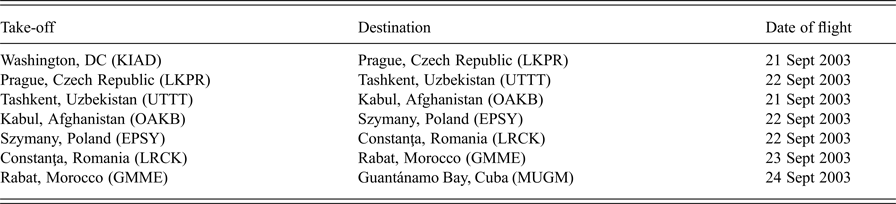
104. Mr J.G.S., at the fact-finding hearing in the above case testified as follows (ibid. § 312):
“One flight circuit however is of particular significance and this is the final part of our presentation in which we would like to discuss how the detention operations in Poland were brought to an end.
In September 2003 the CIA rendition and detention programme underwent another overhaul analogous to the one which had taken place in December 2002 when Mr Nashiri and Mr Zubaydah were transferred from Thailand to Poland. On this occasion, the CIA executed a rendition circuit which entailed visiting no fewer than five secret detention sites at which CIA detainees were held. These included, in sequence, Szymany in Poland, Bucharest in Romania, Rabat in Morocco and Guantánamo Bay, a secret CIA compartment of Guantánamo Bay, having initially commenced in Kabul, Afghanistan. On this particular flight route, it has been found that all of the detainees who remained in Poland at that date were transferred out of Poland and deposited into the successive detention facilities at the onward destinations: Bucharest, Rabat and Guantánamo. Among those persons was one of the applicants today, Mr Zubaydah, who was taken on that date from Poland to Guantánamo Bay.
This particular flight circuit was again disguised by dummy flight planning although significantly not in respect of Poland. It was the sole official declaration of Szymany as a destination in the course of all the CIA's flights into Poland. The reason therefor being that no detainee was being dropped off in Szymany on the night of 22 September and the methodology of disguising flight planning pertained primarily to those renditions which dropped a detainee off at the destination. Since this visit to Szymany was comprised solely of a pick-up of the remaining detainees, the CIA declared Szymany as a destination, openly, and instead disguised its onward destinations of Bucharest and Rabat, hence demonstrating that the methodology of disguised flight planning continued for the second European site in Bucharest, Romania and indeed for other detention sites situated elsewhere in the world.”
105. At the fact-finding hearing in the present case, in the course of the PowerPoint presentation, Mr J.G.S. testified as follows:
“Abu Zubaydah was the first high value detainee, he was arrested in late March 2002 in an operation in Faisalabad, Pakistan and was initially held in Thailand. We have established before this Court the mode of his transfer to Europe. First to Poland on 5 December 2002 and he was detained in that site for 292 days. … We know that when he departed Poland on 22 September 2003 upon the closure of the site, that he did not go to Romania directly, he was rather held in both Guantánamo Bay, at the CIA facility there, and in Rabat – Morocco, for a period of over one year after his departure from Poland. Unlike Mr Nashiri whom we refer to in earlier proceedings [Al Nashiri v. Romania], when Zubaydah left Guantánamo he was taken back to the same site in Morocco at which he had previously been detained, Rabat – Morocco, the site which had been the subject of some acrimonious relations between the CIA and its Moroccan counterparts.
It was in this site that Mr Zubaydah found himself in early 2005, specifically February 2005, when the aforementioned clear-out of Morocco took place and, as I stated, and connected with specific flight paths, the destination of his transfer out of Morocco was Lithuania.”
106. Mr J.G.S. further explained that the applicant was transferred from Guantánamo to Rabat on board rendition plane N85VM on 27 March 2004 and provided details of the flight circuit executed by that plane.
In Mr J.G.S.’ description, “the CIA facility at Guantánamo was cleared in March-April 2004 as the CIA sought to evade justice”; in this respect he referred to the passage in the 2014 US Senate Report speaking of moving the CIA detainees from Guantánamo in anticipation of the US Supreme Court's ruling in Rasul v. Bush (see also paragraph 61 above and paragraph 110 below).
107. The N85VM flight on 27 March 2004 was the first part of the CIA double rendition circuit performed by that plane between 27 March and 13 April 2004. On the first circuit some prisoners, including the applicant, were transferred from Guantánamo to Rabat directly. The plane then returned to Washington on 29 March 2004. The second part of the circuit took place between 12 and 13 April 2004 and N85VM brought the remaining prisoners from Guantánamo via Tenerife, Spain to the CIA secret prison in Bucharest, Romania, returning to Washington via Rabat on 13 April 2004 (see also Al Nashiri v. Romania, no. 33234/12, §§ 119-120, 31 May 2018).
108. Mr Black, at the fact-finding hearing, testified as follows:
“We know that Abu Zubaydah was in Poland and that he was transferred out of Poland in September 2003. The transfer that took him out of Poland in September 2003 had two possible destinations, one of which was Romania and one of which was Guantánamo Bay. Prima facie it is possible that he could have gone to either. In 2011 I received an off-the-record briefing and my take-away from this briefing, which I believe to be accurate, was that in the Summer of 2005 or before that Abu Zubaydah had not been held in Romania. It follows from this that Abu Zubaydah must therefore have been taken to Guantánamo on that flight in September 2003. We know that everyone who was taken there had to be moved out in March or April 2004. They were taken to Morocco. We also know that after a certain time in Morocco, the CIA had too many disagreements with the Moroccan Intelligence Agencies with regard to the treatment of prisoners in Morocco. This is dealt with at some length in the Senate Report. And so everyone who was in Morocco was moved out at the latest in February 2005.”
109. The 2014 US Senate Committee Report's section entitled “Country [name REDACTED] Detains Individuals on the CIA's Behalf” reads, in so far as relevant, as follows:
“Consideration of a detention facility in Country [REDACTED] began in [month REDACTED] 2003, when the CIA sought to transfer Ramzi bin al-Shibh from the custody of a foreign government to CIA custody [REDACTED] which had not yet informed the country’ political leadership of the CIA's request to establish a clandestine detention facility in Country [REDACTED], surveyed potential sites for the facility, while the CIA set aside [USD] [number REDACTED] million for its construction.
In 2003, the CIA arranged for a ‘temporary patch’ involving placing two CIA detainees (Ramzi bin al-Shibh and Abd al-Rahim al-Nashiri) within an already existing Country [REDACTED] detention facility, until the CIA's own facility could be built.
…
By [day/month REDACTED] 2003, after an extension of five months beyond the originally agreed upon timeframe for concluding CIA detention activities in Country [REDACTED], both bin al-Shibh and al-Nashiri had been transferred out of Country [REDACTED] to the CIA detention facility at Guantánamo Bay, Cuba.”
110. The report, in the section entitled “US Supreme Court Action in the case of Rasul v. Bush Forces Transfer of CIA Detainees from Guantánamo to Bay to Country [name REDACTED]” (see also paragraph 61 above), states:
“Beginning in September 2003, the CIA held a number of detainees at CIA facilities on the grounds of, but separate from, the U.S. military detention facilities at Guantánamo Bay, Cuba. In early January 2004, the CIA and the Department of Justice began discussing the possibility that a pending U.S. Supreme Court case Rasul v. Bush, might grant habeas corpus rights to the five CIA detainees then being held at a CIA detention facility at Guantánamo Bay. Shortly after these discussions, CIA officers approached the [REDACTED] in Country [REDACTED] to determine if it would again be willing to host these CIA detainees, who would remain in CIA custody within an already existing Country [REDACTED] facility. By January [day REDACTED] 2004, the [REDACTED] in Country [REDACTED] had agreed to this arrangement for a limited period of time.
Meanwhile, CIA General Counsel Scott Muller asked the Department of Justice, the National Security Council, and the White House Counsel for advice on whether the five CIA detainees being held at Guantánamo Bay should remain in Guantánamo Bay or be moved pending the Supreme Court's decision. After consultation with the U.S. solicitor general in February 2004, the Department of Justice recommended that the CIA move four detainees out of a CIA detention facility at Guantánamo Bay pending the Supreme Court's resolution of the case. The Department of Justice concluded that a fifth detainee, Ibn Shaykh al-Libi, did not need to be transferred because he had originally been detained under military authority and had been declared to the ICRC. Nonetheless, by April [REDACTED two-digit number] 2004, all five CIA detainees were transferred from Guantánamo Bay to other CIA detention facilities.
[REDACTED] Shortly after placing CIA detainees within already existing Country [REDACTED] facility for a second time, tensions arose between the CIA and [REDACTED] Country [REDACTED]. In [month REDACTED] 2004, CIA detainees in a Country [REDACTED] facility claimed to hear cries of pain from other detainees presumed to be in the [REDACTED] facility. When the CIA chief of Station approached the [REDACTED] about the accounts of the CIA detainees, the [REDACTED] stated with ‘bitter dismay’ that the bilateral relationship was being ‘tested’. There were also counterintelligence concerns relating to CIA detainee Ramzi bin al-Shibh, who had attempted to influence a Country [REDACTED] officer. These concerns contributed to a request from [REDACTED] in [month REDACTED] 2004 for the CIA to remove all CIA detainees from Country [REDACTED].
[REDACTED] In [month REDACTED] 2004 the chief of Station in Country [REDACTED] again approached the [REDACTED] with allegations from CIA detainees about the mistreatment of Country [REDACTED] detainees [REDACTED] in the facility, the chief of Station received an angry response that, as he reported to CIA Headquarters, ‘starkly illustrated the inherent challenges [of] [REDACTED]’. According to the chief of Station, Country [REDACTED] saw the CIA as ‘querulous and unappreciative recipients of their [REDACTED] cooperation’. By the end of 2004, relations between the CIA and Country [REDACTED] deteriorated, particularly with regard to intelligence cooperation. The CIA detainees were transferred out of Country [REDACTED] in [name of month REDACTED; appears to have comprised eight characters] 2005.”
D. The applicant's alleged secret detention at a CIA “Black Site” in Lithuania from 17 February or 18 February 2005 to 25 March 2006 as described by the applicant, reconstructed on the basis of the 2014 US Senate Committee Report and other documents and as corroborated by experts heard by the Court
1. The applicant's alleged rendition to Lithuania on 17 February or 18 February 2005 and his rendition from Lithuania on the plane N733MA on 25 March 2006
(a) The applicant's submissions
(i) Rendition to Lithuania (17 or 18 February 2005)
111. In his initial submissions of 14 July 2011 and 27 October 2011 the applicant maintained that the existence of a CIA secret prison in Lithuania had first been disclosed in August 2009, when ABC News had reported that according to “former CIA officials directly involved or briefed” on the CIA HVD Programme, the Lithuanian authorities had provided the CIA with a building on the outskirts of Vilnius where terrorist suspects had been held for “more than a year” (see also paragraph 257 below).
112. He further submitted that after his rendition from Poland to Guantánamo on 22 September 2003 and from Guantánamo to Rabat in Spring 2004, he had been transferred from Rabat to Lithuania “in early 2005”. Relying on flight information supplied by the Lithuanian Civil Aviation Administration (Civilinės Aviacijos Administracija – “CAA”), Reprieve and Interights, he indicated two possible dates – 17 February 2005 and 18 February 2005 – and two CIA rendition aircraft – N724CL and N787WH – on which he could have been transferred to Lithuania.
113. On 10 September 2012 the applicant filed with the Court's Registry a pleading entitled “Additional Submission” in which he rectified and supplemented information of his alleged rendition to and from Lithuania in the light of newly emerging materials in the public domain.
114. As regards the alleged rendition to Lithuania on 17 February 2005 or 18 February 2005, the information produced by the applicant could be summarised as follows:
(a) Between 15-19 February 2005, N787WH and N724CL, arranged by CSC, travelled from the USA to Lithuania via Morocco and back to the USA. No other flights of CIA-related aircraft have so far come to light connecting the three countries during or around this period;
(b) Data from the Federal Aviation Authority and EuroControl showed that N787WH, a Boeing 737 operated by Victory Aviation Florida, executed the following flight circuit on 15-19 February 2005:
Baltimore (KBWI) - Santa Maria, Azores (LPAZ) - Salzburg (LOWS) - Malaga (LEMG) - Rabat (GMME) - Constanţa/Bucharest (LRCK / LRBS) - Palanga (EYPA) - Copenhagen (EKCH) - Gander (CYQX) - Baltimore (KBWI).
(c) Data from the Federal Aviation Authority and EuroControl showed that another Boeing 727, registered as N724CL, followed a similar route to N787WH on its flight circuit executed on 15-18 February 2005:
Van Nuys (KVNY) - Baltimore (KBWI) - Santa Maria, Azores (LPAZ) - Gran Canaria (GCLP) - Rabat (GMME) - Amman (OJAM) - Vilnius (EYVI) - Keflavik (BIKF) - Goose Bay (CYYR) - Baltimore (KBWI) - Van Nuys (KVNY).
(d) Both planes travelled from the USA to Morocco; their paths then diverged, as N787WH went on to Romania and N724CL to Amman, Jordan. Both planes then re-converged on Lithuania, arriving within twenty-four hours of each other, before returning to the USA.
(ii) Rendition from Lithuania (25 March 2006)
115. In his initial submissions the applicant did not indicate any specific date of his rendition from Lithuania.
116. In his Additional Submission of 10 September 2012 (see also paragraph 112 above), he stated that, according to public sources, the CIA “black site” in Lithuania had been closed “in the first half of 2006 and its occupants transferred to Afghanistan or other countries”.
The applicant indicated 25 March 2006 as the date of his rendition from Lithuania, which he linked with the flight circuit executed through Palanga Airport in Lithuania by the CIA rendition plane registered as N733MA on 23-27 March 2006. It was alleged that he had been transferred to Afghanistan by the so-called “double-plane switch”. This operation was executed by using two planes, each one of which completed only half the route so that the CIA prisoners could be transferred from one plane to another in an airport in which they converged. It involved N733MA and another CIA rendition aircraft registered as N740EH, which both made a connection in Cairo on the night of 26 March 2006.
117. It was submitted that N733MA's landing in Palanga on 25 March 2006 had been mentioned in the Lithuanian Parliamentary inquiry. No further information about it was provided by the Parliamentary investigators, other than that “no customs inspection was carried out” and the border guard provided “no records of the landing and inspection of this aircraft” (see also paragraph 173 below).
While an entry in the records of the Palanga Airport indicated that N733MA departed from Palanga to Porto, Portugal on 25 March 2006, the analysis of flight plan data released by PANSA and EuroControl showed that N733MA did not fly to Porto but proceeded to Cairo, Egypt. On 26 March 2006 in Cairo the plane converged with another Boeing 737 rendition aircraft registered as N740EH. Afterwards, N733MA travelled from Cairo to Heraklion, Greece. It had left Heraklion for Keflavik, Iceland in the morning of 27 March 2006. On 26 March 2006 N740EH, shortly after the arrival of N733MA in Cairo, took off from there for Kabul, Afghanistan. It then stopped briefly in Amman, Jordan and travelled to Heraklion, Greece. On 28 March 2006 it left Heraklion for Keflavik, Iceland.
Both planes were chartered by CSC and operated by Miami Air International, Florida.
(b) Evidence before the Court
118. The applicant produced flight and other data from multiple sources, including extracts from EuroControl and Lithuanian aviation authorities’ flight records, flight messages regarding circuits executed by N787WH on 15-19 February 2005, N724CL on 15-18 February 2005 and the landing of N7333MA at Palanga Airport on 25 March 2006, as well as aircraft charter contracts concluded in respect of those flights.
He also produced, among other things, flight data concerning the “double-switch” flight circuits executed by planes N308AB and N787WH between 4 and 7 October 2005 and by N733MA and N740EH on 23-28 March 2006, the Report to the Lithuanian Government on the visit to Lithuania carried out by the European Committee for the Prevention of Torture and Inhuman or Degrading Treatment or Punishment (“CPT”) from 14 to 18 June 2010 (“2011 CPT Report”) and the Briefing and Dossier for the Lithuanian Prosecutor General: CIA Detention in Lithuania and the Senate Intelligence Committee Report dated 11 January 2015 and prepared by Reprieve (“2015 Reprieve Briefing”).
119. Other evidence before the Court comprised the 2014 US Senate Committee Report, publicly available flight data, testimony of the experts heard at the fact-finding hearing and the material of the PowerPoint presentation given by Senator Marty and Mr J.G.S.
(i) The 2015 Reprieve Briefing
120. The 2015 Reprieve Briefing states that the partially released 2014 US Senate Committee Report confirmed previous accounts of CIA secret detention in Lithuania and existing public source data on transfer dates of prisoners into and out of Lithuania and referred to prisoners held in Lithuania. The conclusions were as follows:
(a) it was established beyond reasonable doubt that one of the facilities adapted by the CIA in Lithuania was used to hold prisoners;
(b) prisoners were transferred into this facility in February and October 2005;
(c) prisoners were transferred out of this facility in March 2006;
(d) the transfers were carried out on planes contracted to Computer Sciences Corporation, all operating within a linked group of contracts.
121. The document summarises key statements in the 2014 US Senate Committee Report relating to three CIA detention facilities referred to therein – Detention Site Black, Detention Site Violet and Detention Site Brown and, using also other public source data, concludes that Detention Site Violet was located in Lithuania. Also, on the basis of the number of the characters blackened in the redacted passages of the report, it attempts to decipher certain dates.
The 2015 Reprieve Briefing's findings as to the operation of the CIA secret detention site in Lithuania and the flights indicated by the applicant as those on which he could have been transferred from Morocco to Lithuania and out of Lithuania can be summarised as follows.
122. The Reprieve document provides the following information:
(a) According to the 2014 US Senate Committee Report, CIA detainees were transferred to Detention Site Black in “the fall of 2003”. The closure of that site was precipitated by revelations in the Washington Post, published on 2 November 2005 (see also paragraphs 149 and 256 below; see also Al Nashiri v. Romania, cited above, §§ 133 and 161). At this point the host country demanded “within [two characters/digits redacted] hours” the site's closure and the remaining detainees were transferred out of that country “shortly thereafter”;
(b) Detention Site Violet, in a different country from “Black”, opened “in early 2005”. The CIA conducted discussions with officials from “Violet's” host country; these discussions left one such official “shocked” but host country approval was nonetheless given for the facility. Evidently the CIA had originally constructed a “holding cell” in the same country as Detention Site Violet, which was not used. They then decided to “build a new, expanded detention facility” in the same country. Approval was provided by an official from that country. Money, in the amount of several million dollars, was also provided to that country, although this required the development of “complex mechanisms” to effect the transfer.
(c) The first detainees were transferred to the expanded site “Violet” [fourteen lower-case characters redacted for the date]. This information corresponds to the flight data analysed by Reprieve, which indicates flights by two planes N787WH and N724CL, contracted by Computer Sciences Corporation, into Lithuania on 17 February and 18 February 2005 respectively. They came via Morocco, Romania and Jordan and were operating under the same renditions-specific contract.
(d) Detention Site Violet was closed as a result of a lack of available medical care “in [five lower-case characters redacted for the month] 2006.” The CIA then transferred its remaining detainees to Detention Site Brown. At that point, all CIA detainees were located in Country [name redacted];
(e) Detention Site Brown was in the same country as Detention Sites Cobalt, Gray and Orange. It first received detainees in “[five lower-case characters redacted for the month] 2006”. The 2014 US Senate Committee Report states that Khalid Sheikh Mohammed was transferred into Detention Site Brown on “[two characters redacted for the date] March 2006”. Prior to this he was held in a different site, to which he had been transferred after being held at Detention Site Black. He was transferred from that site to site [six upper-case character redacted] in 2005, on a redacted date [eight lower- case characters redacted]. Detention Site Cobalt, on the basis of extensive reporting, can be firmly placed in Afghanistan. Detention Site Brown must therefore be in the same country.
(f) A transfer of prisoners into Kabul, organised by the CSC within their rendition contracting network took place on 25-26 March 2006. The transfer came from Lithuania and used two planes – N733MA and N740EH – travelling via Cairo. The former carried out the leg of the trip from Lithuania to Cairo, the latter from Cairo to Kabul.
(g) The above March 2006 transfer matches the closure of Detention Site Violet which, according to the 2014 US Senate Committee Report, was closed as a result of lack of available medical care in [five characters for the month redacted] 2006. The five-character redacted month could only be “March” or “April” on account of the length of the redaction. Of these two possibilities, March fits the data given in the report for Khalid Sheikh Mohammed's transfer to Detention Site Brown.
(h) The lack of medical care which caused the closure of Detention Site Violet seems to have affected Mustafa al-Hawsawi and “four other CIA detainees”.
(i) On 1 January 2006 the CIA were holding twenty-eight prisoners, divided between Detention Site Orange and Detention Site Violet.
(j) Despite the redactions in the above citations, careful reading of the 2014 US Senate Committee Report alongside other public source documents supports the conclusions that:
– Detention Site Black was in Romania;
– Detention Site Violet was in Lithuania;
– Detention Site Brown was in Afghanistan;
– CIA detainees were first transferred into Detention Site Violet in February 2005;
– Detainees were transferred out of Detention Site Violet into Detention Site Brown in March 2006.
123. The Reprieve document states that the first transfer occurred in early 2005. The transfer could have been carried out on either or both of two planes (N787WH and N724CL), one from Morocco and Amman, one from Morocco and Bucharest, arriving in Lithuania on 17 and 18 February 2005 respectively.
(a) N787WH and N724CL were operating under subcontract S1007312 to CSC. Their trips in February 2005 were task orders 20 and 21 of this subcontract.
(b) Data from EuroControl shows N787WH's progress from the USA to Morocco, Romania, Lithuania and back.
On 15 February 2005 it flew from Baltimore Washington International (KBWI) to Santa Maria, Azores (LPAZ). It then filed a flight plan to Munich (EDDM) but was impeded by snow and went instead to Salzburg (LOWS). On 17 February it left Salzburg in the afternoon and headed to Malaga (LEMG), where it paused until the middle of the night. It then left Malaga in the early hours of 18 February 2005, arriving in Rabat (GMME) around 02:40. After just over two hours in Rabat it proceeded to Romania, filing a flight plan into Constanţa (LRCK) – although its flight plan for the next leg of the trip was filed not out of Constanţa but out of Bucharest Băneasa Airport (LRBS). It left Bucharest in the afternoon of 18 February 2005 and filed a false flight plan into Gothenburg, Sweden. Its true destination was Palanga where it arrived, according to an invoice for “State Charge for Air and Terminal Navigations Services – Palanga”, at 18:09.
EuroControl and Palanga airport records both indicate that it left Palanga shortly afterwards, at 19:30, bound for Copenhagen. The plane paused overnight in Copenhagen, then continued to Gander, Canada (CYQX). Information released by the Federal Aviation Authority shows that it then returned to Baltimore International (KBWI/ BWI) and finally to its home base in Florida (FLL).
(c) Although the Lithuanian Parliamentary Committee on National Security and Defence inquiry cited N787WH's flight from Bucharest to Palanga on 18 February 2005, the Committee was not aware of the plane's complete route, its contractual basis, or the identification of its contractual basis with rendition operations (see also paragraph 173 below).
(d) N724CL's flight under the same subcontract occurred at the same time (16-17 February 2005) as the flight of N787WH and took a similar route: Rabat (GMME) – Amman (OJAM) – Vilnius (EYVI) – Keflavik (BIKF).
124. The 2015 Reprieve Briefing states that prisoners were again transferred into Lithuania from Romania in October 2005. The document refers to the flight circuits executed by N308AB and N787WH on 1–7 October 2005.
(a) Data from EuroControl shows that N308AB flew from Teterboro, New Jersey, to Slovakia on 4 October 2005. After an overnight stop it proceeded to Romania, filing a flight plan to Constanţa on the evening of 5 October 2005. It left Romania soon afterwards (this time filing a flight plan out of Bucharest) and headed to Tirana, Albania.
(b) An email and a “preliminary requirements” document corresponding to this flight give further information, namely that on arrival in Romania the plane was to pick up two people (“PU 2 PAX”) in addition to the five people it had set off with. In Albania it was to “Drop All PAX”. The document instructs: “Must have 3 pilots, NO Flight Attendants. At least a G-IV performance with 10 PAX capability. No customs help”.
(c) Flight data shows that on its drop-off in Albania N308AB was met by N787WH, which proceeded just over an hour later to Lithuania. N787WH disguised its route into Lithuania by filing a flight plan to Tallinn (EETN). The Vilnius Airport “State Charge” document incorrectly asserts that N787WH arrived from Tallinn, while another airport log shows that it did in fact arrive from Tirana.
(d) On its arrival in Vilnius, as recorded by the Lithuanian Parliamentary Committee on National Security and Defence (see also paragraph 173 below), a border guard was prevented from carrying out his duties and checking the plane; he observed a vehicle drive away from it and exit the perimeter of the airport.
125. The 2015 Reprieve Briefing states that the CIA prisoners were transferred out of Lithuania to Afghanistan in March 2006.
(a) Two trips contracted by Computer Sciences Corporation on 25–26 March 2006, involving planes N333MA and N740EH, connect Lithuania to Afghanistan and correspond to the closure of Detention Site Violet and the transfer of its prisoners to Detention Site Brown.
(b) The Lithuanian parliamentary inquiry noted that N733MA had arrived in Palanga on 25 March 2006, coming from Porto, and that it had returned to Porto; no further information about it was provided, other than the facts that “no customs inspection was carried out” and the border guard provided “no records of the landing and inspection of this aircraft”. Investigation by Reprieve has established that, far from returning to Porto as recorded by officials at Palanga Airport, N733MA continued to Cairo, where it made a connection with N740EH. N740EH then proceeded to Kabul. Both planes were chartered by Computer Sciences Corporation and operated by Miami Air International, Florida.
(c) Data provided by EuroControl shows that N740EH flew from New Castle, Delaware (KILG) to Marrakesh (GMMX) on 23 March 2006. There is no record of its subsequent movements until 26 March 2006. In the meantime, N733MA, having left Philadelphia International (KPHL), passed through Porto (LPPR), then filed a flight plan to Helsinki (EFHK) on the afternoon of 25 March.Instead of going to Helsinki, however, N733MA went to Palanga (EYPA), touching down at 22:25 local time (in close proximity to its scheduled arrival time of 20:38 GMT). It paused for 90 minutes in Palanga. Records from EuroControl and the Polish Air Navigation Authority both show that on leaving Palanga it went not to Porto, as the Lithuanian parliamentary inquiry was informed (see also paragraph 173 below), but to Cairo (HECA). Its scheduled arrival time in Cairo was 02:19 GMT on 26 March.
(d) While N733MA was making its way to Palanga, N740EH was on its way to Cairo. Although records do not show when it arrived in Cairo, or from where, they do indicate that it left Cairo shortly after N733MA arrived there – at 02:45 GMT on 26 March 2006 – and that it went from Cairo to Kabul (OAKB), with an arrival time in Kabul of 08:32.N740EH then returned westwards from Kabul, pausing briefly in Amman (OJAI) before making a longer stop in Heraklion (LGIR). It arrived in Heraklion around 23:07 on 26 March 2006. N733MA had also flown to Heraklion direct from Cairo and was waiting there, having arrived at 04:59 the same day. Both planes left Heraklion for Keflavik (BIKF) – N733MA on the morning of 27 March 2006, and N740EH on the morning of 28 March 2006.
(e) Documents relating to the planning of these two trips show complex attempts to disguise the fact that the purpose of the trips was to provide a connection between Lithuania and Afghanistan. Both trips were included in one invoice. Consistent with the other trips mentioned in the briefing, the invoice relates the task back to the original rendition subcontract.
(f) The flight schedule accompanying the charter contract shows that both planes' destinations were kept secret up to the last minute.
126. At the fact-finding hearing the experts, Mr J.G.S. and Mr Black, gave evidence on the alleged operation of the CIA secret detention facility in Lithuania, code-named “Detention Site Violet” in the 2014 US Senate Committee Report, the applicant's alleged rendition to Lithuania, his secret detention and his transfer out of the country. They replied to various questions from the judges and the parties. They testified as follows.
127. In the course of the PowerPoint presentation Mr J.G.S., when explaining in general the rendition scheme operated by the CIA, characterised Lithuania as a “drop-off” point for CIA detainees, which had served the purpose of hosting a detention facility. In particular, he stated:
“I wish to begin by setting out in the form of a graphic illustration the system in which such detention sites were situated. This is a system that spanned the entire globe but it had at its heart several hubs of operation here on the European continent. I am using a map of the world to show those present several categories of places at which aircraft landed in the course of the so-called ‘war on terror’.
We categorised these landing points according to a set of criteria developed in 2006 whereby each landing point exhibited certain characteristics which allowed us to discern the purpose for which an aircraft landed there. The four categories as denoted are first stopover points where aircraft tended to stop shortly, primarily to refuel, staging points where often two or more aircraft would converge in their planning or preparation of specific detainee transfer operations, pick up points at which individual suspects, persons captured by the CIA, were taken on board rendition aircraft by CIA rendition crews in order to be flown to secret detention, in places of the last category detainee transfer or drop-off points.
The original graphic on display here dates to 2006. We are in a position today to add one further detainee transfer drop-off point in Vilnius on the territory of the Republic of Lithuania. Having subsequently uncovered records of flights into and out of that territory and been able to devote an equal amount of rigour and attention to the underlying documents, we have found that Vilnius together with Szymany and Bucharest bore the character of a detainee drop-off point in the CIA's system of renditions. I will explain how that occurs by developing some of the analysis further.
…
Vilnius has been added here for the specific purpose of today's proceedings albeit that at the time in 2006 and 2007 we did not have sufficient information to place it on the original map. What we can say today about the CIA's operations of a ‘black site’ in Lithuania has increased considerably in scope and volume thanks to various declassifications, also various records obtained through court proceedings in the United States of America, and indeed through the diligent efforts of various Lithuanian partners who have investigated this issue since its first exposure in 2009 and 2010.
… [F]or example … this is a document on record before the court which attests to the landings of CIA rendition aircraft in Vilnius in the months of February and October 2005. This is significant and this was furnished in 2011 by the Lithuanian authorities themselves. It is significant because the aircraft denoted in these disclosures are not the same aircraft that carried out the bulk of the rendition operations in respect of Poland and Romania earlier in the life of the program.”
128. According to Mr J.G.S., the first CIA detainees were transferred to Lithuania in February 2005. He stated that 17-18 February 2005 had been the critical juncture at which CIA detention operations overseas had once again been dramatically overhauled and that the removal of CIA detainees from Morocco had led to the opening of their new “black site” in Lithuania. Mr Zubaydah was transferred to Lithuania in February 2005. Other detainees were transferred to the country in October 2005. The closure of the site had been marked by the transfer of the CIA detainees, including the applicant, out of Lithuania on 25 March 2006. He referred to the following elements in support of his conclusions.
129. He first referred to the “cyclical nature” of CIA secret detention sites and explained its relevance for the opening and closure of the CIA secret prison in Lithuania as follows:
“The Court will recall my reference to the CIA's in-house aviation service providers. There was a shell company known as Aero Contractors that administered two aircraft N313P and N379P in the early years of the rendition programme and much of the planning for the flights was done by one provider Jeppesen Dataplan. In those early years therefore there is quite a consistent pattern to the execution of rendition operations and that certainly encompasses the timeframe of the Polish site –from December 2002 until September 2003 – and it encompasses much of the operations at the Romanian site from September 2003 until November 2005. But in Lithuania we do not have any record of a single landing of either of those aircraft, the typical rendition aircraft: neither the Boeing Business Jet, nor the Gulfstream express plane which were used customarily in the early years. However, through these disclosures the Lithuanian records allow us to find out how the CIA developed its methodology, expanded its fleet and in some cases replaced its original operator with new contractors, new aircraft and new modus operandi.
Among the routes flown by these new aircraft was the putative transfer of the applicant in today's proceedings into Lithuania in February of 2005. For reasons I have addressed in [Al Nashiri v. Romania] proceedings, Madam President, it stands to reason that February 2005 was another important juncture in the evolution of the CIA secret detention program. As I will demonstrate in my presentation the programme was cyclical in character: detention sites did not exist in perpetuity for the entire lifespan of the war on terror, rather the CIA tended to innovate and improvise to situations as it found them.
Its earliest sites, in theatre, in a country like Afghanistan, they were able to last somewhat longer because of the context and often also because of the military support that they were able to draw upon, but in the cases of Thailand and Poland and Morocco and even Guantánamo Bay, extenuating circumstances caused by external factors, whether political, legal or reputational, led to the abrupt closure of detention sites at moments when the CIA had not necessarily planned for them to close.
So the story of the secret detention programme includes several of these junctures at which one detention site closes abruptly and another opens in its place. However, that February 2005 fits into this pattern for the specific reason that in February 2005 the cooperation with the Moroccan authorities in the administering of a secret detention site in Rabat, Morocco finally ran aground. All the CIA's remaining detainees in Morocco had to be moved out. In February 2005 the flight data tells us that there were two principal destinations for detainees being taken out of Morocco. Those were the two European sites. Firstly Romania, which we have addressed in the [Al Nashiri v. Romania] proceedings, and secondly, for the first time, Lithuania.”
He added:
“Detention sites did not endure for periods of several years, rather at particular junctures in the programme they were abruptly closed and all classified information housed in those facilities destroyed. Here we have the example of when Thailand was closed, December 2002. And by collating material from the reporting the cabling at the base with flight data, including that from our own investigations we identified this juncture of … December 4th-5th, 2002 as the first of several on which CIA detention and interrogation operations were dramatically overhauled. That meant that one base closed - CATESEYE in Thailand and immediately afterwards a new base opened – QUARTZ base in Poland. And just as the detainees from one site moved to another so the operational focus shifted with them. QUARTZ became the facility from 5 December 2002, to which the CIA brought its highest value detainees for HVD interrogation. Likewise, if we move forward nine months, the same report reveals that QUARTZ itself only existed until 22 September 2003, whereupon QUARTZ base in Poland was closed and a successor site BRIGHTLIGHT base in Romania was opened, 22 September 2003. This cyclical nature evidenced in the documents and supported by analysis of the flight data persisted all the way till the end of Europe's participation in the rendition programme.
Specifically the last juncture of interest to the Court is that on 25 March 2006. Detention Site Violet, the Lithuanian site itself, would close and would lead to a wholesale transfer of detainees from that site to the final site in the programme back in Afghanistan. So, rather than having multiple sites existing simultaneously and in perpetuity, the story of this programme is of a shifting operational focus whereby each site at one time is the hub of operations where the key interrogations are taking place, where enhanced interrogation techniques are being routinely authorised and instrumentalised, and where new detainees captured are sent by rendition aircraft in order to enable this honing of resources.”
130. In this connection, in the course of the PowerPoint presentation, Mr J.G.S. demonstrated two rendition circuits executed through Lithuania, the first executed by aircraft N724CL in February 2005, the second by aircraft N787WH on 5-6 October 2005.
(a) As regards N724CL's circuit in February 2005:
“This circuit in February 2005 encompasses the period from the 15th to 20th February 2005 in which two rendition aircraft deployed to Morocco simultaneously.
I shall demonstrate the circuit of the aircraft N724CL which embarked here from Gran Canaria to the pickup of the remaining detainees in Rabat - Morocco. It flew the path to Amman - Jordan before flying onward to Vilnius - Lithuania. This is the first of the landings which the Lithuanian authorities themselves evidenced in their documentary submissions of 2011. The aircraft landed in Vilnius on 17 February 2005, the date on which the applicant of ours, the beginning of his secret detention in Lithuania. It departed via Keflavík before returning to its base in the United States.
This simple illustration is backed up by a large trench of documentation and in particular it is in respect of these contractor operations that we are able to draw upon the docket of litigation in the United States between two contractors, both of them servicing the CIA's rendition programme. The name of the case in question which is in the records before the Court is Sportsflight Air Inc. [sic] versus Richmor Aviation.”
(b) As regards the N787WH circuit in October 2005, Mr J.G.S. testified that it had involved the transfer of detainees between the CIA “black sites” in Romania and Lithuania, which had been disguised by using both the so-called “dummy” flight planning and the CIA methodology of “switching” aircraft. The CIA, under its aviation services contract with Computer Sciences Corporation, tasked two rendition aircraft – N308AB and N787WH – with flights to Europe simultaneously.
N308AB arrived in Bratislava, Slovakia from Teterboro, USA, while N787WH landed in Tirana, Albania. A “dummy” flight plan from Bratislava to Constanţa, Romania was filed in respect of N308AB but when the plane entered Romanian airspace, the Romanian aviation authorities navigated it to an undeclared landing in Bucharest. The plane collected CIA detainees from Romania. Subsequently, N308AB flew from Bucharest to Tirana on the night of 5 October 2005. The CIA detainees “switched” aircraft in Tirana; they were transferred onto N787WH for the rendition flight. A “dummy” flight plan from Tirana to Tallinn, Estonia was filed in respect of N787WH. Instead, the plane flew to Lithuania and the Lithuanian aviation authorities navigated it to an undeclared landing at Vilnius in the early hours of 6 October 2005. The plane dropped off the CIA detainees for ground transportation to the CIA “black site” in Lithuania. Then the planes departed; N787WH flew to Oslo, Norway and onwards, N308AB made a stopover in Shannon, Ireland and returned to its base in the USA (see also Al Nashiri v. Romania, cited above, § 135).
Mr J.G.S. stated, in particular:
“In respect of Lithuania I would like to draw attention in particular to the records around the October 2005 flights. On this occasion two aircraft are implicated in the transfer of a single group of detainees. There are records pertaining to N308AB and there are also records pertaining to N787WH. N787WH is a Boeing business Jet, a 737, and as I mentioned it took the place of the earlier N313P aircraft in performing large scale transfers of detainees simultaneously. Among the documents there are emails and other items of correspondence which give an extraordinary insight into the CIA's planning of these operations.
If asked how do we know that the deceit was deliberate, how do we know that the disguise was a tactic rather than a facet of in-flight changes, I would point to the documents in this docket which refer explicitly to sleight of hand. They deliberately purport to file flight plans to destinations of which the aircraft has no intention of flying and they include such statements as ‘no customs help’ or on occasion ‘drop all passengers’ or on occasion ‘hard arrival’, which are not legal terms in the planning of international flights; they are rather efforts to circumvent the system of controls and regulations put in place by among others the international civil aviation organisation.
This particular circuit, which I will demonstrate, is of great relevance to our proceedings today because it links the detention site in Bucharest - Romania with the detention site in Vilnius - Lithuania and demonstrates how the CIA's tactics to evade accountability had evolved over the course of the programme. Herein we will see not only instances of dummy flight planning, the customary filing of false flight plans but also the use of a new methodology switching aircraft mid operation to avoid the eventuality that the same aircraft appeared in the site of two different places of detention.
On this map we have two aircraft which arrived in Europe simultaneously on 5 October 2005. The first N308AB arrived from its base in Teterboro – New Jersey, the second N787WH arrived from Keflavík and landed at Tirana – Albania. Tirana Albania was to be the point at which these two aircraft would converge hence it is marked here as a staging point. Before arriving there, however, the first aircraft N308AB filed a dummy flight plan to the false destination of Constanţa, Romania and then flew to its real destination Bucharest Băneasa airport, where it collected detainees from the Romanian detention site. After its collection it flew to Tirana from Bucharest directly with the prior instruction to drop all packs. This in jargon means the passengers on the plane, explicitly here the crew, the rendition personnel who are responsible for removing, securing and transporting the detainees. In Tirana the crew transferred onto the waiting second aircraft N787WH together with the detainees. The dummy flight plan was then filed for this second aircraft furthering the layers of deceit. Tallinn, Estonia was used as a false destination to enable the flight to enter Lithuanian airspace and land at Vilnius airport in Lithuania.
This is the point at which the detainees on board were dropped off, hence the direct link between the ‘black site’ in Bucharest and the ‘black site’ in Vilnius. Both aircraft thereafter returned towards the United States, N787WH flying via Oslo and northward, N308AB flying via stopover in Shannon back to New Jersey. Again Lithuanian records attest to the landing of N787WH in Vilnius, notwithstanding its false or ‘dummy’ flight planning and this document, which also forms part of the records before the court from the Litcargus provider at Vilnius, is the completion of the switching aircraft operation, a typical and short time on the ground in Vilnius in the early hours of the morning in which the detainees were transported by ground to the detention facility in Lithuania.”
131. Replying to the judges' question about the relation between the above circuit and the applicant's case, Mr J.G.S. testified as follows:
“You asked also why did I focus my attention on this pattern of switching aircraft in October 2005 and it is because that operation links two detention sites in European territories, namely the detention site in Romania and the detention site in Lithuania, and illustrates adequately to the Court that there were complex, deliberately deceitful, tactics at play that make it very difficult to follow a particular detainee's path for the transfers that the CIA undertook in moving its detainees from one site to another. That particular joint operation, involving N308AB and N787WH, is an operation to which I have devoted considerable time in documenting, in correlating, collating different information sources and I am confident in pronouncing that as a rendition operation in which persons from Romania were transported via a switching of aircraft in Tirana to the site in Lithuania. At this present time that operation stands as the only other confirmed inward rendition to Lithuania that I have been able to document from material in the public domain. And it is for that reason that I presented it to the Court because it enhances the certainty with which we can see a detention site existed in Lithuania.”
132. In reply to the judges' question as to whether it could be established that the CIA detention facility in Lithuania was code-named “Violet” in the 2014 US Senate Committee Report and, if so, on what basis, Mr J.G.S. testified:
“The Detention Site Violet is the colour code name used to denote Lithuania in the [2014 US Senate Committee] Report. I have reached this conclusion by collating information around specific dates, specific detainees, and specific junctures in the broader CIA programme that are explicitly mentioned and unredacted in the report. I refer in particular to the nexus between different detention sites and the cyclical nature of the programme, such that when one site closed another opened, when one site was demoted in importance another site was promoted, and establishing the identity of Detention Site Violet as Lithuania derives from a deep understanding of both Romania's role under the code name ‘Black’, and in particular the role played by Morocco, an authority that is only referred to by a country letter rather than a colour, because it did not act as a detention site or ‘black site’ within the CIA structure. But I would direct the Court in particular to pages 139 to 142 of the [2014 US Senate Committee Report], in which the role of Morocco is described extensively as a country which ‘detains individuals on the CIA's behalf’ and through a close reading of these passages linked with the evidence I have presented in these and earlier [Al Nashiri v. Romania] proceedings, one reaches the incontrovertible conclusion that when the facility in Morocco was finally closed the only possibility is that Detention Site Violet, namely Lithuania, then took the detainees from that country in conjunction with ‘Detention Site Black’. In particular a paragraph on page 142, which describes the end of relations between the CIA and Morocco, concludes with the passage that the CIA detainees were transferred out of this country in February 2005 and corresponds precisely with the flight movements, the planning documentation and the detailed insights afforded by the American litigation proceedings, to lead us from Rabat - Morocco to Vilnius - Lithuania.”
133. As regards other elements justifying the conclusion that Detention Site Violet was located in Lithuania Mr J.G.S. testified as follows:
“I would like now to move on to some of the references in the declassified American documents that might help the Court to place the Lithuanian site in the context of the broader rendition detention and interrogation programme. In respect of Lithuania the most important document at hand is the declassified [2014 US Senate Committee Report], the Feinstein Report as it is sometimes known. Whilst incomplete and whilst heavily redacted, the document nonetheless plays into the aforementioned collation or distillation of multiple documentary sources and it is possible to link the colour coded references to specific detention sites in the report to known and recognisable host countries of ‘black sites’ including that of Lithuania.
As has been widely reported since this document was declassified the Lithuanian site is associated with the colour code Violet. References in the [2014 US Senate Committee Report] to Detention Site Violet accord completely with the timings, with the character and with the chronological progression of detention operations in respect of Lithuania. Notably I would point the Court to two sections of the report, pages 96 to 98 and pages 154 to 156. In these two sections the Committee engages in an analysis of the reasons behind both the opening and the closing of Detention Site Violet in Lithuania and it delivers several pertinent observations regarding the question of relations with the host national authorities.
It is important first in order to establish this relation to the coding to recognise that Detention Site Violet was created in a separate country to any of the other detention sites mentioned in the report. So, where there is a raft of evidence connecting Detention Site Cobalt to Afghanistan correlating with many of the detentions we know took place there and indeed many of the techniques practised there; Detention Site Green we know to have been Thailand, the place in which Al Nashiri and today's applicant Abu Zubaydah were waterboarded and the only site at which videotaping took place; Detention Site Blue, the first European site at Szymany in Poland to which both today's applicant Mr Zubaydah and Mr Nashiri were transferred upon the closing of the Thai site in December 2002, and as mentioned in earlier [Al Nashiri v. Romania] proceedings Detention Site Black, the site situated in Romania at which Mr Al Nashiri and others were detained between 2003 September and 2005 November.
The reference to a separate country here opens a new territory to the programme. Here we see discussion of political approval of the site which indicates that the same processes were aptly as pertained in Poland and Romania and as were described in the Marty Reports. The same conceptual framework where authorisation was required to situate a detention site in a European country from the highest levels of government. Here we have references in descriptive narrative to how Lithuanian counterpart officials may have been ‘shocked’ by the presence of detainees on their territory but ‘nonetheless’ approved.
We know from both the [US] Senate inquiry and the inquiry undertaken by the Lithuanian Parliament, the Seimas, that there were in fact two projects in Lithuania aimed at providing support for the CIA detention operations. These are referred to in the Lithuanian reports as Project No. 1 and Project No. 2. In the [2014 US Senate Committee Report] these projects are referred to somewhat more obtusely but notably it states that by mid-2003 the CIA had concluded that its completed but still unused holding cell in this country, by which is meant Project No. 1, was insufficient, given the growing number of CIA detainees in the programme and the CIA's interest in interrogating multiple detainees at the same detention site. This sentence is very important in respect of Lithuania because it corresponds precisely with the description of the provenance of Project No. 2 furnished by the Lithuanian Parliament. It states the CIA thus sought to build a new expanded detention facility in the country. The Committee report provides insight into both the opening and the closing of the site referred to in Romania and this is important because it will also help to situate the Lithuanian site in the timeline. Here, as mentioned in earlier proceedings, we learned that Detention Site Black opened in the fall of 2003, the specific date 22 September 2003. We also learn that it closed within a period of only a few days after the publication of the exposé in the Washington Post; namely on 5 November 2005. The Detention Site Black closed. Therefore, the reference to a separate country means a site that endured beyond Detention Site Black in Romania and in fact endured beyond the period at which the secret detention system in Europe was known about, hence my earlier reference. The Lithuanian Detention Site Violet became the longest or latest standing European detention site. …”
He added:
“I want to share the few further insights into operations in Lithuania which come by looking at specific CIA detainee case studies. We have been able definitively to associate three of the CIA's high-value detainees with the site in Lithuania. However, we know that at least five persons were detained there because in the Senate Committee Inquiry Report it refers to one of these men, Mustafa al-Hawsawi, and four others simultaneously being in country. So today I am only in a position to provide references to these three individuals here: the applicant in today's proceedings, the applicant Abu Zubaydah, Khalid Sheikh Mohammed, at the bottom left, who was detained at one time in each of the European sites - in Poland, then in Romania and finally in Lithuania, and the aforementioned Mustafa al-Hawsawi, who became one of the reasons for which the site was closed, as I will illustrate.”
134. In reply to the judges' question whether the applicant's allegations that he had been transferred to Lithuania on 17 or 18 February 2005 and transferred out of the country on 25 March 2006 could be confirmed, Mr J.G.S. testified:
“With regard to inward transfer, I can attest that an operation was mandated by the CIA through the air branch of its rendition group to its principal air services/division services contractor to carry out a movement of detainees held in Morocco towards other active ‘black sites’/detention sites, namely those in Romania and Lithuania. I can further attest by analysis of the documents that this operation was executed by using two aircraft. The two aircraft you mentioned, N724CL and N787WH. In my presentation I illustrated the flight of N724CL for the express reason that that aircraft flew, and can be demonstrated to have flown, to Vilnius. And Vilnius is unambiguously the airfield associated with the detention site in Lithuania, the physical location of which, as I have suggested, is undisputed.
In my experience each detention site is inexorably connected with one destination airfield, hence the Polish site with Szymany airport, hence the Romanian site with Bucharest Băneasa and in my understanding the Lithuanian site is principally primarily associated with the airfield Vilnius airport, denoted by its code EYVI. That is the reason I chose that flight to illustrate to the Court.
However, I cannot rule out the possibility that another airfield may have been used in conjunction with Vilnius in operating in Lithuania, and at the present time there is insufficient evidence in the public domain to make a categorical determination, for example as to the use of Palanga airfield. By way of explanation, the tactical methodologies of the CIA did evolve over time as I have presented to the Court today. This switching aircraft methodology was something which was not used in the early years of the programme, it was rather a later resort. So it is eminently possible that in pursuit of the same objectives absolute secrecy, security of transfer, evasion of accountability, the CIA innovated new methods of transfer which entailed using other airports inside the territory of Lithuania. I cannot rule that out nor can I make a categorical pronouncement as to which of those two aircraft brought Mr Zubaydah to Lithuania.
I can, however, state that he was detained there in that last year of Europe's participation in the ‘black sites’ programme, and that at this moment the only known and evidenced outward flight from Lithuania was the N733MA flight on 25 March 2006, which engaged in an analogous switching aircraft operation, and carried ultimately the detainees who were left at Detention Site Violet to Detention Site Brown, the newly opened site in Afghanistan, thereby closing the chapter on the Lithuanian site. On that front and again, notwithstanding my recognition that other evidence may yet be revealed, I would feel confident in associating this aircraft with the outward rendition of Mr Zubaydah.”
In that context, he also added:
“I cannot rule out that there was another form of deceit or sleight of hand at play that led to the appearance of two Lithuanian airports in some of these flight routes. Palanga does not immediately strike me as being an airfield associated with the site because of its geographical distance from Antaviliai, but I cannot rule out that perhaps flights landed there and detainees were then transported onwards by some other means. I do not have categorical information on that question. What I can say is that the flights mentioned in the statement of facts, as I have read it, include two flights in this period in February, between 15 and 20 February 2005, one of which is confirmed to have landed at Vilnius, N724CL on 17 February, the other of which N787WH is recorded as having landed at Palanga. On one of these aircraft the applicant was brought to Lithuania but beyond that categorical certainty is not yet achievable.”
As regards the applicant's transfer out of Lithuania, he further stated:
“You asked about the destination of his outward flight and it is fairly clear that that was Afghanistan. I would say beyond a reasonable doubt he was taken to Afghanistan when he left Lithuania, because he was one of the fourteen high-value detainees who were transported from Afghanistan to Guantánamo Bay and declared by President George W. Bush to have been held in the CIA programme in September 2006, when he revealed its existence for the first time to the world. So there were no further renditions between March 2006 and September 2006. So I would be confident in concluding that he was taken from Lithuania to Afghanistan and thereafter to Guantánamo, and I believe the records that are before the Court state as to how and when those transfers took place.”
135. As regards the applicant's alleged detention at the CIA detention site in Lithuania and the closure of that site, Mr J.G.S. also stated:
“Mr Zubaydah does not have a mention by name in [the 2014 US Senate Committee Report] in connection with the Site Violet but the other two detainees cited here, both do. In the case of Khalid Sheikh Mohammed, there is a lengthy description of his detention in multiple different sites, notably in this passage the reference to his being transferred to Detention Site Violet on that earlier switching aircraft circuit in October 2005. He was also held in Lithuania up until the point of the site's closure. Hence his final transfer to Detention Site Brown which was in Afghanistan on March 25, 2006. The passage around Khalid Sheikh Mohammed also talks about how reporting around him accounted for up to 15% of all CIA detainee intelligence reporting, which demonstrates his enduring importance to the purported intelligence gathering objectives of the programme. I find that pertinent because Khalid Sheikh Mohammed was detained in Poland, he was detained in Romania, he was detained in Lithuania, and he stands as a symbol of the centrality of these detention sites in Europe to the overall objectives of the CIA's programme.
The third detainee, Mustafa al-Hawsawi is mentioned in the report in relation to his need for medical care. In this passage here which comes from the later section, pages 154-156, it states that the CIA was forced to seek assistance from three third-party countries in providing medical care to Mustafa al-Hawsawi because the local authorities in Lithuania had been unable to guarantee provision of emergency medical care. And as is stated explicitly in the Senate Committee's Report, based upon cables sent from the base at Detention Site Violet, these medical issues resulted in the closing of the site in this country in the date March 2006. It was at that point that the CIA transferred its remaining detainees to Detention Site Brown.
In my view these passages, when read in conjunction with the other documents, constitute a fairly comprehensive record of the reasoning and indeed the methodology behind the closure of the Lithuanian site. Furthermore, subsequent packet passage refers to the overall number of persons in the programme at 1 January 2006 as having been twenty-eight. It states that these twenty-eight persons were divided between only two active operational facilities at that time. One was Detention Site Orange in Afghanistan but importantly the other was Detention Site Violet, the Lithuanian site. The date references here, corresponding with the different flights we have had coming in and later going out, place Detention Site Violet in that time period as the hub of detention operations.”
136. In response to the Government's question as to whether he could attribute a colour code to each CIA “black site” mentioned in the 2014 US Senate Committee Report and whether there had been any locations with no colour codes, Mr J.G.S. stated:
“Yes, I can attribute colour codes as mentioned in the Senate Committee Report to each of the detention locations that had the character of a CIA ‘black site’. In order to be clear, there were some places used by the CIA that did not meet the precise criteria of a ‘black site’, a customised high-value detainee facility. Those criteria were set out in the Inspector General's Report. I indicated it in my presentation, and among the criteria were the exclusive operation by CIA agents and contractors without the participation of foreign counterparts. The criteria for a ‘black site’ are in fact enumerated in several of the CIA documents and those sites in the Senate Committee Report were all accorded a colour code. So, for example, whilst Lithuania is associated with Violet, Romania is associated with Black, Poland is associated with Blue, Thailand is associated with Green, in Afghanistan there are several sites, notably Cobalt, Orange and Brown. At Guantánamo also there are multiple sites, notably Maroon and Indigo in the report. But Morocco, a country in which CIA detainees were housed at several points in the programme, does not have its own colour code because it did not meet the criteria as a customised high-value detainee facility. Specifically, Moroccans participated in the detention of CIA HVDs on their territory and they housed those persons within existing detention operations in Morocco, as is described in the report. So I can attribute colour codes to every one of the ‘black sites’ and I can also further identify countries that did not have a colour code, but which bore characteristics unique to one country and through the collation of other data sources allow me to categorically pronounce where they were situated. I am not alone in this endeavour, I can say that, having met with several of those involved in the Senate inquiry process, I believe that most reasonably informed observers would be able to associate now the publicly available information with at least one or more of those colour codes. I am not alone, this is not at a simple personal conclusion. It is one which is widely shared, not contradicted across the community of investigators who have occupied themselves with these matters.”
137. Replying to the judges' questions as to whether it could be established that Abu Zubaydah had been secretly detained at Detention Site Violet and what was the physical location of that site on Lithuanian territory, Mr J.G.S testified:
“The report does not mention the applicant Mr Zubaydah explicitly by name in connection with the Detention Site Violet. However, through an intimate familiarity with the chronology of his detention, much of which I have presented in evidence in these proceedings and the prior proceedings, I have reached the conclusion that there is only one place he could have been in the early part of 2005 and that that place was indeed Morocco. Furthermore, having closely analysed the text regarding Morocco in the report, some of which derives from cables declassified correspondence and other sources which I have also engaged with, I know that the transfers out of Morocco in 2005 went to other active ‘black sites’, that one of these was ‘Detention Site Black’ in Romania, but that there was also another one in a separate country, to use the terms of the report and based on the answer I gave to Your Honourable colleague Judge Sicilianos, this other country was Lithuania. Because the applicant Mr Zubaydah did not arrive in Romania, ‘Detention Site Black’, which I know based upon my years' long investigations into the operations of that site much of which I have presented to the Court, the only other destination to which he could have been transferred was the active site in Lithuania and this transfer took place in accordance with the flights described in February 2005. Therefore, on the balance of probabilities, I believe it is established that Abu Zubaydah was secretly detained at Site Violet.
As to the physical location of the facility in Lithuania it is my understanding that there is no dispute that there was a facility purpose-built, that this was the converted site of the horseback riding academy at Antaviliai, that the CIA oversaw the construction afresh, that this place was referred to as Project No. 2 in the Seimas parliamentary inquiry in Lithuania, and that the evidence gathered both through the Senate Inquiry and through the Lithuanian authorities' own inquiries is in fact perfectly convergent on this point.
I should also note that esteemed colleagues in the Committee for Prevention of Torture have visited the site and chronicled many aspects of it, which accord perfectly with the description of secret detention facilities I am familiar with from the American documentation. So as to the physical location, I think it is established beyond a reasonable doubt that this place was the ‘black site’ on the territory of Lithuania.”
138. In response to the judges' question as to what extent, in comparison to Mr Abu Zubaydah's case against Poland, or to Al Nashiri v. Poland and Al Nashiri v. Romania, he considered his conclusions in the present case to be based on the same elements of certainty, Mr J.G.S. stated:
“Thank you, Your Honour, and I appreciate very much the focus on my choice of words because I have attempted, wherever possible, to be quite precise and circumspect in the pronouncements I make with regards to issues of fact. You are quite correct that in respect of this same applicant in his application against Poland I was able to make categorical pronouncements against a burden of proof beyond a reasonable doubt, that he was transferred into Poland on a specific date, that he was subjected to specific forms of treatment, that he was held together with Mr Nashiri and various other aspects, because they were described chapter and verse in documents declassified and made public by the CIA itself, notably the Inspector General's Report. In respect of Romania, again by virtue of its earlier start date of operations, it was included by reference in the Inspector General's inquiry and furthermore features prominently in the [US] Senate's inquiry. 2003, according to the Senate, is the year in which the most high-value detainees persons involved in this programme were captured and interrogated, so understandably, since the Romanian site was the hub of operations, the most important ‘black site’ at that time, it is possible to glean a higher quality and volume of evidence from the declassified documents in respect of Romania, hence being able to associate more high-value detainees, more types of treatment as practised on the territory, and indeed a greater degree of certainty when pronouncing on questions of fact in respect of Romania.
As I mentioned in the presentation, Lithuania was the latest of the European sites to be opened and therefore received detainees at a later phase of their detention cycles or, alternatively, received fewer detainees whose cases were subjected to the scrutiny of the oversight bodies I have mentioned. There is no Inspector General reference to Lithuania because at the moment when he published his special review in May 2004, the site in Lithuania had not yet been opened. In the Senate Report there are extensive references to Detention Site Violet, but naturally because the preponderance of detainees and their interrogations had taken place in the earlier years of the programme, it is not possible to find as many specific or explicit date references or references to specific renditions as is the case for the other two countries.”
139. Lastly, in reply to the applicant's counsel question as to whether, based on his years as investigator, he was satisfied or was in doubt as to Abu Zubaydah's presence in Morocco, Afghanistan and Lithuania at times referred to by him, Mr J.G.S. testified:
“Yes, I am satisfied as to the presence of Mr Zubaydah, respectively in early 2005 in Morocco up to the point where the CIA detention site in Morocco was cleared, thereafter on the territory of Lithuania in the detention site coded as ‘Violet’ and thereafter on the territory of Afghanistan in the detention site coded as ‘Brown’.”
140. Mr Black, in reply to the judges' question regarding the alleged existence of the CIA detention facility in Lithuania, in particular whether it could be established beyond reasonable doubt that it had operated in Lithuania and, if so, whether its location could be established, stated:
“The answer to both parts of that question is unequivocally yes. It is certainly the case beyond reasonable doubt that the CIA established a detention centre in Lithuania. It is certainly the case beyond reasonable doubt that that facility – the facility that they established was in fact used for the purpose of holding prisoners – was in the warehouse outside the village of Antaviliai, a little bit to the north-east of Vilnius. So the issue of the evidence that allows me to make these statements and to say that they are beyond reasonable doubt is necessarily fairly lengthy and it rests on a number of key points which I shall do my best to summarise as concisely as possible.
The Senate Report clearly indicated the times of operation of a site which it called Violet, which operated from February 2005 until March 2006. The site was in a country where there had previously been another site established that was in fact never used. This is discussed in the Senate Report. This detail of there having been two sites, one never used and one which was used between February 2005 and March 2006, corresponds accurately with the details given in the Lithuanian Parliamentary Committee's investigation published in 2009, where they state very clearly that their partners, by which they mean the CIA, equipped two sites: one that was not used and one that was used for a purpose which the Parliamentary Committee does not reach a firm conclusion on, at least in its printed document. Now, it is further the case that my research has established flights going into and out of Lithuania precisely at the times that prisoners are said to have been moved into and out of the facility in Violet and that this corresponds with flights into and out of Lithuania in, firstly, February 2005, then in October 2005 and lastly in March 2006. And it is further the case that all these flights are contractually related, that is they are related by their contract numbers, their task order numbers, their invoice numbers and other details to an overall contract, that – we have been able to establish beyond reasonable doubt – was used by the CIA, by the US Government, for the purpose of outsourcing the movement of prisoners. I think that covers the essentials of how we can identify the Violet, the country that site Violet was in, with Lithuania.
In terms of the precise circumstances of the building in Antaviliai, it is clear from documents that were gathered by the Parliamentary Committee in Lithuania, as well as from my own field researches – around that area I made several trips to that place in 2011-2012 to interview people around there – it is clear from those interviews and those documents that that building was essentially bought by a company and that Americans were in it, were fitting it out, were then guarding it, that vehicles were coming and going with tinted windows, there was one person living in the vicinity who called this ‘certain emptiness’, was the phrase he used that settled over the site at the time. The Parliamentary Report is quite clear that the CIA were occupying the building and it is also quite clear that Lithuanian officers did not necessarily have access to the entire building or if they did have access to it they did not necessarily take advantage of that access. It is also clear that the planes which were arriving in Lithuania, pursuant to the contracts that I mentioned, were being met by a very special regime of, there is a witness statement, that was made by an employee of the border guards and transmitted by his boss – whose name I believe is Kasperavičius, although probably I am pronouncing that wrong – in which he describes the landing of a plane on 6 October 2005 in Vilnius, and he describes how he was told by State security officials that he was not allowed to carry out his normal inspections of the plane and that, although he was kept away from the plane by a security coordinator, he was able to see in the distance a vehicle driving away from the plane. Now new documents which have been released very recently, earlier this month by the CIA pursuant to information requests by the American civil liberties union, allow us to clarify today that that plane was transporting Khalid Sheikh Mohammed into Lithuania. Previously in the dossier that I submitted to the prosecutor in January 2015, I said that it was not clear whether he came on the February flight or the October flight. It is now clear that he came on the October flight. I am sorry that it is a rather long-winded answer to your question, but I think that it has covered most of the main points that I think are necessary and sufficient to show that there was a prison in Lithuania and that it was in the site in Antaviliai.”
141. In reply to the judges' question whether it could be established beyond reasonable doubt that Mr Abu Zubaydah had been secretly detained in Lithuania, Mr Black testified:
“I have no doubt that Site Violet was in Lithuania and I have no doubt that prisoners were held in it, including, as I said before, Khalid Sheikh Mohammed, also including others who I believe, on the basis of my professional opinion, include Abu Zubaydah. To explain why I believe Abu Zubaydah was held in Lithuania, we need to retrace our steps in a way so that I can explain to you the logical sequence of events that leads me to this conclusion. …
We … know that after a certain time in Morocco, the CIA had too many disagreements with the Moroccan Intelligence Agencies with regard to the treatment of prisoners in Morocco. This is dealt with at some length in the Senate Report. And so everyone who was in Morocco was moved out at the latest in February 2005. Now again, prima facie, it is possible that Abu Zubaydah, being in Morocco in February 2005, was moved either to Romania or to Lithuania. But again, the statement which I take to be accurate, that he was not in Romania in or prior to the Summer 2005, means that logically he must have gone to Lithuania on that flight on 18 February 2005. I can explain momentarily why I believe he was on N787WH and not on N724CL but if you do not mind I will come back to that.
There is a further indicator of his presence in Lithuania, specifically soon after February 2005 – which is new research that has been done by my colleague, Sam Raphael, at the rendition project which has not yet been published, I have seen his work product and I have worked with it and I believe it will be published later this year – this research indicates that a cable relating to Abu Zubaydah was sent in March 2005, although the provenance of the cable is redacted, the length of the redaction is consistent with it coming from Lithuania and inconsistent with the coming from either of the two possible sites at the time which are in Romania or in Afghanistan. Cumulatively I take the total effect of all these bits of evidence to my satisfaction to say that beyond reasonable doubt Abu Zubaydah was held in Lithuania, starting in February 2005.”
142. As regards the date and the flight on which the applicant had been transferred from Morocco to Lithuania, Mr Black testified:
“The reason I believe that he was flown in on the plane on 18 February rather than that on 17 February is simply that when you analyse the logs that we published for the 17 February flights, what appears is that everyone on that plane actually got off it in Jordan prior to its landing in Lithuania. So I do not think that the N724CL plane, that went via Jordan to Vilnius, transported prisoners into Lithuania. What it did in Jordan I do not know. I think it is also clear, it follows subsequently, that everybody who was held in Lithuania was moved out in March 2006, on 25 March 2006. I think perhaps it was previously unclear, a couple of years ago, where their destination was, but it is now clear – and it has been corroborated by the Senate Report – that the country to which they were moved was Afghanistan.”
143. In his reply to the judges' further question about the flight of N787WH on 18 February 2005, identified as being the one on which the applicant had been transferred to Lithuania, Mr Black confirmed that, in his view, on the basis of evidence this had been established beyond reasonable doubt, adding that “to provide an alternative narrative one ha[d] to enter a kind of world of absurdity”.
When a similar question regarding the dates on which the applicant had been transferred into and out of Lithuania was put by the Government –whose representatives also asked how relevant the N787WH October 2005 flight was in the context of the applicant's alleged rendition – Mr Black stated:
“So to clarify, I believe that Abu Zubaydah was flown into Lithuania on N787WH on 18 February 2005. I believe that he was flown out of Lithuania on N733MA and N740EH on 25 March 2006. The reason I mention the October 2005 flight is because it is to that flight that we can firmly correlate, again in my opinion beyond reasonable doubt, the arrival of Khalid Sheikh Mohammed in Lithuania and I mention it because (a) it provides more evidence of the pattern of conduct that was engaged by and in Lithuania and (b) because it is specifically for that flight that we have the data relating to the very special, as it were, welcoming procedures that the flight had. Although it has been clarified I believe by the Lithuanian Parliamentary Committee that these same procedures were also in effect for other flights, but I mention that one because the document exists that describes very clearly what these procedures were. So I believe it is important holistically taking into account all the evidence that is available to us – I believe that flight is another important part of the puzzle.”
144. In response to the Government's further question whether the 2014 US Senate Committee Report – on which his conclusions were based –indicated the years and exact months of the opening and closure of Detention Site Violet, Mr Black stated:
“If I remember rightly, the Senate Report indicates the year and the months are generally redacted. Because of the way in which they are redacted it is possible to deduce the number of letters, so in a sense it is easy to say which is a long month and which is a short month. One can tell that, let's say, it might be February but not June or so on. Now, the weights of these redactions has to be calculated in accordance when they correlate other public information. So, for example, the new document released of Khalid Sheikh Mohammed's Combatant Status Review Tribunal, is consistent with the redacted Senate Report but it also adds new unredacted information, to the extent that it gives the months of October and March, which are what our reconstruction initially was. And the same can be said of the redacted February. In one place there is a word that is the same length as February that has been redacted and in another place it says ‘in early 2005’. We have the flights that are the only flights at that point that correspond to it. Taking the whole weight of those and other indicators, to me, that is the only solution that makes any sense is the solution that indeed the site in Lithuania operated at the times that we have stated and was serviced by the flights that we have stated.”
145. In reply to the Government's question as to whether the 2014 US Senate Committee Report did state that the national institutions had refused high-value detainees access to medical institutions, Mr Black stated:
“Yes, that was specifically stated of Site Violet in the Senate Report and it was also discussed in the new release of the, I think it is called, the facility audit, which is one of the documents released in the last few weeks by the CIA. That document describes the problems that the CIA had in 2005 and 2006 getting medical attention in host countries. Now the new document, the facility audit, does not specifically mention which countries it refers to, although the only countries that were operating at the time that it covers were Lithuania and Afghanistan. The Senate Report on the other hand, contextually, in that paragraph it is clear, I believe, that it references to Lithuania and what it says is that they did not have the right type of medical facilities on their site to deal with medical problems and that they initially had an agreement with the host country that the host country would provide medical facilities in such eventualities. The host country had decided that it was not going to do that. The word that is used in the facility audit is that it ‘reneged’. I do not think that word is used in the Senate Report.”
146. The 2014 US Senate Committee Report refers to “Detention Site Violet” in several sections concerning various events.
147. In the chapter entitled “The CIA establishes DETENTION SITE BLACK in COUNTRY [REDACTED] and DETENTION SITE VIOLET in Country [REDACTED]” the section referring to Detention Site Violet reads as follows:
“[REDACTED] In a separate [from country hosting Detention Site Black], Country [name blackened], the CIA obtained the approval of the [REDACTED] and the political leadership to establish a detention facility before informing the U.S. ambassador. As the CIA chief of Station stated in his request to CIA Headquarters to brief the ambassador, Country [REDACTED]'s [REDACTED] and the [REDACTED] probably would ask the ambassador about the CIA detention facility. After [REDACTED] delayed briefing the [REDACTED] for [number blackened] months, to the consternation of the CIA Station, which wanted political approval prior to the arrival of CIA detainees. The [REDACTED] Country [REDACTED] official outside of the [REDACTED] aware of the facility, was described as ‘shocked’, but nonetheless approved.
[REDACTED] By mid-2003 the CIA had concluded that its completed, but still unused ‘holding cell’ in Country [REDACTED] was insufficient, given the growing number of CIA detainees in the program and the CIA's interest in interrogating multiple detainees at the same detention site. The CIA thus sought to build a new, expanded detention facility in the country. The CIA also offered $ [one digit number blackened] million to the [REDACTED] to ‘show appreciation’ for the [REDACTED] support for the program. According to a CIA cable however [long passage blackened]. While the plan to construct the expanded facility was approved by the [REDACTED] of Country [REDACTED], the CIA and [passage redacted] developed complex mechanisms to [long passage REDACTED] in order to provide the $ [one digit number blackened] million to the [REDACTED].
[REDACTED] in Country [REDACTED] complicated the arrangements. [long passage REDACTED] when the Country [REDACTED] requested an update on planning for the CIA detention site, he was told [REDACTED] – inaccurately – that the planning had been discontinued. In [date REDACTED], when the facility received its first detainees, [REDACTED] informed the CIA [REDACTED] that the [REDACTED] of Country [REDACTED] ‘probably has an incomplete notion [regarding the facility's] actual function, i.e., he probably believes that it is some sort of [REDACTED] center.”
148. In the chapter entitled “The Pace of CIA Operations Slows; Chief of Base Concerned About ‘Inexperienced, Marginal, Underperforming’ CIA Personnel; Inspector General Describes Lack of Debriefers As ‘Ongoing Problem’”, the section referring to Detention Site Violet reads as follows:
“[REDACTED] In 2004, CIA detainees were being held in three countries: at DETENTION SITE BLACK in Country [REDACTED], at the [redacted] facility [REDACTED] in Country [REDACTED], as well as at detention facilities in Country [REDACTED]. DETENTION SITE VIOLET in Country [REDACTED] opened in early 2005.”
149. In the chapter entitled “Press Stories and the CIA's Inability to Provide Emergency Medical Care to Detainees Result in the Closing of CIA Detention Facilities in Countries [REDACTED] and [REDACTED]”, the section referring to the disclosure regarding CIA secret prisons in Europe published in the Washington Post and the closure of Detention Site Black and Detention Site Violet reads as follows:
“In October 2005, the CIA learned that the Washington Post reporter Dana Priest had information about the CIA's Detention and Interrogation Program, [REDACTED]. The CIA then conducted a series of negotiations with The Washington Post in which it sought to prevent the newspaper from publishing information on the CIA's Detention and Interrogation Program.
…
After publication of the Washington Post article, [REDACTED] Country [REDACTED] demanded the closure of DETENTION SITE BLACK within [REDACTED two-digit number]. The CIA transferred the [REDACTED]| remaining CIA detainees out of the facility shortly thereafter.
…
[long passage REDACTED] In [REDACTED] Country [REDACTED] officers refused to admit CIA detainee Mustafa Ahmad al-Hawsawi to a local hospital despite earlier discussions with country representatives about how a detainee's medical emergency would be handled. While the CIA understood the [REDACTED] officers' reluctance to place a CIA detainee in a local hospital given media reports, CIA Headquarters also questioned the ‘willingness of [REDACTED] to participate as originally agreed/planned with regard to provision of emergency medical care’. After failing to gain assistance from the Department of Defense, the CIA was forced to seek assistance from three third-party countries in providing medical care to al-Hawsawi and four other CIA detainees with acute ailments. Ultimately, the CIA paid the [REDACTED] more than $ [two-digit number redacted] million for the treatment of [name REDACTED] and [name REDACTED], and made arrangements for [name REDACTED] and [name REDACTED] be treated in [REDACTED]. The medical issues resulted in the closing of DETENTION SITE VIOLET in Country [REDACTED] in [five characters for the month REDACTED] 2006. The CIA then transferred its remaining detainees to DETENTION SITE BROWN. At that point, all CIA detainees were located in Country [REDACTED].
…
The lack of emergency medical care for detainees, the issue that had forced the closing of DETENTION SITE VIOLET in Country [REDACTED] was raised repeatedly in the context of the construction of the CIA detention facility in Country [REDACTED].
…
In early January 2006, officials at the Department of Defense informed CIA officers that Secretary of Defense Rumsfeld had made a formal decision not to accept any CIA detainees at the U.S. military base at Guantánamo Bay, Cuba. At the time, the CIA was holding 28 detainees in its two remaining facilities, DETENTION SITE VIOLET, in Country [REDACTED], and DETENTION SITE ORANGE, in Country [REDACTED]. In preparation for a meeting with Secretary of Defense Rumsfeld on January 6, 2006, CIA Director Goss was provided a document indicating that the Department of Defense's position not to allow the transfer of CIA detainees to U.S. military custody at Guantánamo Bay ‘would cripple legitimate end game planning’ for the CIA.”
2. Detention and treatment to which the applicant was subjected
150. The applicant submitted that throughout his detention by the CIA he had been subjected to torture and other forms of ill-treatment prohibited by Article 3 of the Convention.
In that regard he relied, among other things, on his own description of his experience in CIA custody and conditions of detention, as related in the 2007 ICRC Report. The report was based on interviews with the applicant and thirteen other high-value detainees, including Mr Al Nashiri, after they had been transferred to military custody in Guantánamo (for more details, see paragraphs 296-299 below).
151. Annex I to the 2007 ICRC Report contains examples of excerpts from some of the interviews conducted with the fourteen prisoners. These excerpts are reproduced verbatim. The verbatim record of the interview with the applicant gives details of his ill-treatment in the CIA custody “regarding his detention in Afghanistan where he was held for approximately nine months from May 2002 to February 2003”.
The applicant's account of the abuse that he endured in CIA custody as rendered in the 2007 ICRC Report reads, in so far as relevant, as follows:
“I was then dragged from the small box, unable to walk properly, and put on what looked like a hospital bed, and strapped down very tightly with belts. A black cloth was then placed over my face and the interrogators used a mineral water bottle to pour water on the cloth so that I could not breathe. After a few minutes the cloth was removed and the bed was rotated into an upright position. The pressure of the straps on my wounds was very painful. I vomited. The bed was then again lowered to a horizontal position and the same torture carried out again with the black cloth over my face and water poured on from a bottle. On this occasion my head was in a more backward, downwards position and the water was poured on for a longer time. I struggled against the straps, trying to breathe, but it was hopeless. I thought I was going to die. I lost control of my urine. Since then I still lose control of my urine when under stress.
I was then placed in the tall box again. While I was inside the box loud music was played again and somebody kept banging repeatedly on the box from the outside. I tried to sit down on the floor, but because of the small space the bucket of urine tipped over and spilt over me. … I was then taken out and again a towel was wrapped around my neck and I was smashed into the wall with the plywood covering and repeatedly slapped in the face by the same two interrogators as before.
I was then made to sit on the floor with a black hood over my head until the next session of torture began. The room was always kept very cold.
This went on for approximately one week. During this time the whole procedure was repeated five times. On each occasion, apart from one, I was suffocated once or twice and was put in the vertical position on the bed in between. On one occasion the suffocation was repeated three times. I vomited each time I was put in the vertical position between the suffocations.
During that week I was not given any solid food. I was only given Ensure to drink. My head and beard were shaved every day.
I collapsed and lost consciousness on several occasions. Eventually the torture was stopped by the intervention of the doctor.”
152. A more detailed description of various methods of ill-treatment inflicted on the applicant as related in the 2007 ICRC Report and the 2004 CIA Report can be found in Husayn (Abu Zubaydah) v. Poland, cited above, §§ 102-107).
153. In connection with the fact-finding hearing, the applicant also produced an extract from partly declassified transcripts of hearings before the Combatant Status Review Tribunal in Guantánamo, held on 27 March 2007, during which he had related his treatment in CIA custody. That document was released on 13 June 2016. It reads, in so far as relevant, as follows:
“In the name of God the Merciful. Mr. President and Members of the Tribunal, I would have liked to have spoken to you today on my own, but I have been having seizures lately which have temporarily affected my ability to speak and write without difficulty. Therefore, I asked my Personal Representative to speak on my behalf. I hope from you justice, and I know that is what you seek. Do not make the mistake the CIA has made when they first arrested me on 28 March 2002. After months of suffering and torture, physically and mentally, they did not care about my injuries that they inflicted to my eye, to my stomach, to my bladder, and my left thigh and my reproductive organs. They didn't care that I almost died from these injuries. Doctors told me that I nearly died four times. Then they transferred me to a secret location. They transferred me in a way that a normal, ordinary person would be embarrassed to be treated. They even prevented me from going to the bathroom at least five times, and sometimes I was deprived from being able to go to the bathroom for 24 to 36 hours when we travelled. … They did this to me because they thought I was the number three leader in al Qaida and a partner to USAMA BIN LADEN, as is mentioned in the unclassified Summary of Evidence against me.
…
First thing, during I'm still – I was in – still in the hospital. They would ask me and I would answer. From the hospital, after, I don't know how many months, how many times. They take me to their secret place. From that lime I was naked. And I think you know how much it is the bad for us as the Muslims, and I think it is problem for you as Christian or Jew. I don't know but at least for us, it was very bad thing. I was too weak; they make me sleep in a metal bed, [via Language Analyst] a medical metal bed. It look like this. Naked and feel cold and this still bleeding [pointing to the inside of left thigh urea] from this area. … So it take days and days, too cold place, naked and position sleeping. After this, they put me in the chair – same circumstance – naked, too much cold, no food, only Ensure [Language Analyst clarifies Ensure – Force feeding Ensure]. …
And they not give me chance, all this, maybe one-two week, I don't know the time. No food, no sleep, not allowed to sleep. When I feel sleep, they shake me like this [shaking chair] or make me stand. But all that time I am sitting twenty-four hours, only sorry again, when I use the toilet, bucket, not real toilet, bucket near of me and in front of them, and from that time I feel shy …
So all that time they ask me, they talk. One person talk and they leave another two, another two another two, no sleeping, no food, nothing, and cold, cold. … After time, I don't know how many, it's weeks and weeks, they give me chance to sleep once. Maybe once in the two months, two weeks. I don't know exactly, once a month. I again make me sit on the floor. Also cold, naked, try to cover my private part, because the shackles even I can't because kind of chair like this but it have [via President and Language Analyst arm rest]. So I tried to cover nothing and start makes me stand hours and hours. …
I request, I tell him, ‘do as you like; tell me the time I want to pray. No chance to pray. Give me the time and not need water. I need pray without cleaning. I should make some cleaning before I pray’. I make request number of time. Nothing. After this put me in the big box same my tall but it's not and they put the bucket with me. Toilet bucket. I had no chance to sit, only in the bucket and because the bucket its not have cover or sometime they put cover I found myself inside the bucket like this [trying to move and show while in chair]. And the place too close; I take hours and hours ‘til he came and save me from the bucket, again and again sorry it full of urine. And start from that time-time and time put me in this and put me in small box. I can't do anything. I can't sit stay do anything and hours and hours. Start beat me in the wall … Beat me badly in the back, in my back, in my head. Last thing, of course same thing use again and again, different time, plus they put me in the same [via Language Analyst] a medical bed. They shackle me completely, even my head; I can't do anything. Like this and they put one cloth in my mouth and they put water, water, water. …
Last thing they do they – I am still shackled. I was naked; I am naked; they bring the [via Language Analyst] interrogator, female interrogator in front. I was naked, like this. …
But the truth after this after the second – or second – after one complete year, two year, they start tell me the time for the pray and slowly, slowly, circumstance became good. They told me sorry we discover that you are not number three, not a partner even not a fighter. …”
154. At the fact-finding hearing Mr J.G.S. made the following statements concerning the treatment to which the applicant could be subjected during his alleged detention in Lithuania:
“The bulk of the enhanced interrogation to which Mr Zubaydah was subjected is clearly documented as having taken place in Thailand. There he was waterboarded and there he was subjected to a grotesque form of experimentation whereby unauthorised and sometimes barely authorised techniques were practised upon him as the CIA developed its early rules and regulations as to how detainees could lawfully be interrogated. By the time he reached Poland, however, he had been declared compliant. So it is not possible to state with certainty which additional techniques were used on him in Europe.”
In reply to the judges’ further question regarding that matter, he stated:
“It is not possible to pronounce categorically on specific interrogation techniques or other forms of treatment or ill-treatment practised on Mr Zubaydah in Lithuania, because, again, they are not explicitly described in any of the reports available to us in the public domain. However, I would be prepared to state that the conditions of confinement in the ‘black site’ in Lithuania alone pass a threshold that in our human rights protection culture, signified by the European Convention on Human Rights, amounts to a violation of Article 3. There are, by routine and described in documents, practices such as sensory deprivation, sleep deprivation, denial of religious rights, incommunicado detention, indefinite detention on a prolonged basis, as well as a variety of conditioning techniques, as the CIA calls them, which in any other case would themselves be considered forms of ill-treatment. Here they do not even warrant mention in the reporting, because they had become commonplace, but I would not wish for the absence of explicit descriptions of waterboarding or other EITs to be taken as a sign that he was not ill-treated during his time in Lithuania. And I should also point out that, having been detained at that point for more than three years and even up to four years in the totality of his transfer through the sites, there must have been a cumulative effect to the ill-treatment which he underwent at the hands of his captors.”
155. Mr Black testified as follows:
“… [I]t is true that relatively there is less information about treatment of prisoners in the CIA detention programme in 2005–2006 than there is in the previous years. There are a few exceptions to this. The recently declassified Memorandum from the CIA's Office of Medical Services, which is part of the batch of the records declassified earlier this month, is dated December 2004. It comes into force directly prior to the time that – I take – Abu Zubaydah to have been rendered into Lithuania. This document describes basically the full range of enhanced interrogation techniques, in other words it makes clear that as of December 2004 and thus into 2005, that this full range of techniques is available, it is on the menu. In terms to what extent these techniques were used, we have relatively few indications but there are a couple that I think are worth mentioning. The Senate Report states that there are several occasions on which for example the CIA failed to adhere to his own guidelines in keeping naked prisoners in cold conditions. The guidelines are set out in the Memorandum that I just mentioned, the December 2004 Office of Medical Services Memorandum. The Senate Report says that after that Memorandum, going up until the last time it cites is December 2005, there were prisoners who were being held in colder conditions than what this Memorandum sanctioned. Likewise there were prisoners who were captured in 2005, including Abu Faraj al-Libbi, whom we know from the Senate Report was exposed to lengthy sleep deprivation. Beyond that I do not have any further information about precise conditions, although it is clear – it has been reiterated by the recent batch of declassified documents – that during this time 2005 – 2006, prisoners continued to be held in solitary confinement, that is clear. It is also clear that prior to their arrival in the last site in Afghanistan, which was in March 2006, they did not have any access to natural light. The first time they had access to natural light was following that arrival in March 2006. That is pretty much all I can say on the topic.”
156. The 2014 US Senate Committee Report states that “from Abu Zubaydah's capture … to his transfer to Department of Defense custody on September 5, 2006, information provided by Abu Zubaydah resulted in 766 disseminated intelligence reports”, of which ninety-five were produced during the initial phase of his detention in April and May 2002 (which included a period during which the applicant was on life support and unable to speak) and ninety-one during the months of August and September 2002.
E. The applicant's further transfers during CIA custody (until 5 September 2006) as reconstructed on the basis of the 2014 US Senate Committee Report and other documents and as corroborated by experts heard by the Court
157. In his initial submissions the applicant maintained that after he had been transferred by extraordinary rendition out of Lithuania, he had been detained in an undisclosed facility in a third country, from where he had later been transferred to US custody at Camp 7 at the US Naval Base at Guantánamo Bay, Cuba.
158. As stated above, according to the experts, on 25 March 2006 the applicant was transferred from Lithuania to Afghanistan via a double-plane switch in Cairo and was subsequently detained at the CIA's only remaining detention facility – Detention Site Brown (see paragraphs 133-134, 138 and 140-144 above).
159. The 2014 US Senate Committee Report refers to Detention Site Brown in the context of rendition and secret detention of Khalid Sheikh Mohammed (referred to as “KSM”) as follows:
“KSM was transferred to DETENTION SITE [REDACTED] on [day and month REDACTED] 2005, to DETENTION SITE BROWN on March [two-digit date REDACTED] 2006, and to U.S. military detention at Guantánamo Bay, Cuba, on September 5, 2006.”
160. The 2014 US Senate Committee Report states that the applicant “was transferred to U.S. military custody on September 5, 2006.”
F. The applicant's detention at the US Guantánamo Bay facility since 5 September 2006 to present
161. Since 5 September 2006 the applicant has been detained in the US Guantánamo Bay Naval Base in the highest security Camp 7 in – as described by his lawyers – “extreme conditions of detention”.
Camp 7 was established in 2006 to hold the high-value detainees transferred from the CIA to military custody. Its location is classified. It currently holds fifteen prisoners, including the applicant and Mr Al Nashiri.
Visitors other than lawyers are not allowed in that part of the Internment Facility. The inmates are required to wear hoods whenever they are transferred from the cell to meet with their lawyers or for other purposes. The applicant is subjected to a practical ban on his contact with the outside world, apart from mail contact with his family.
162. The Inter-American Commission on Human Rights' Report “Towards the Closure of Guantánamo”, published on 3 June 2015, describes general conditions in Camp 7 as follows:
“120. Although progress has been made to improve conditions of detention at Guantánamo, there are still many areas of concern. The Inter-American Commission notes in this regard that detainees at Camp 7 do not enjoy the same treatment accorded to other prisoners; that health care faces many challenges, in particular given the ageing population at Guantánamo; and that religion is still a sensitive issue. Further, the IACHR is especially concerned with the suffering, fear and anguish caused by the situation of ongoing indefinite detention, which has led to several hunger strikes as a form of protest and, in some extreme cases, to the drastic decision by prisoners to end their lives.
…
122. The Inter-American Commission has received troubling information regarding prison conditions at Camp 7, a single-cell facility currently used to house a small group of special detainees, known as ‘high-value detainees’. These detainees are reportedly held incommunicado and are not subject to the same treatment accorded to other prisoners. On May 20, 2013, a group of eighteen military and civilian defense counsel representing the ‘high-value detainees’ sent a joint request to Secretary of Defense Charles Hagel to improve the conditions of confinement in Guantánamo. They pointed out that these detainees are not permitted to contact their families by telephone or video; that their access to religious materials has been restricted (such as the sayings and descriptions of the life of the Prophet Mohammed); that they have limited recreational opportunities; and that they are not permitted to participate in group prayer, contrary to the entitlements of other detainees.
…
136. The Inter-American Commission considers that the conditions of confinement described above constitute a violation of the right to humane treatment. Further, in order to guarantee that prisoners' rights are effectively protected in accordance with applicable international human rights standards, the State must ensure that all persons deprived of liberty have access to judicial remedies. The IACHR notes with deep concern that prisoners at Guantánamo have been prevented from litigating any aspect of the conditions of their detention before federal courts, which constitutes per se a violation of one of their most fundamental human rights. This point, as well as some recent developments regarding this issue, will be assessed in the chapter on access to justice. Further, as it will be addressed below, detainees' lack of legal protection and the resulting anguish caused by the uncertainty regarding their future has led them to take the extreme step of hunger strikes to demand changes in their situation.”
163. The applicant has not been charged with any criminal offence. The only review of the basis of his detention was carried out by a panel of military officials as part of the US military Combatant Status Review Tribunal on 27 March 2007 (see also paragraph 153 above). The panel determined that he could be detained.
164. The applicant is not listed for trial by military commission. He is one of the high-value detainees who remain “in indefinite detention” (see also paragraph 80 above).
G. Psychological and physical effects of the HVD Programme on the applicant
165. According to the applicant, as a result of torture and ill-treatment to which he was subjected when held in detention under the HVD Programme, he is suffering from serious mental and physical health problems.
The applicant's US counsel have been unable to provide many of the details of his physical and psychological injuries because all information obtained from him is presumed classified. The lawyers have stated that publicly available records described how prior injuries had been exacerbated by his ill-treatment and by his extended isolation, resulting in his permanent brain damage and physical impairment.
The applicant is suffering from blinding headaches and has developed an excruciating sensitivity to sound. Between 2008 and 2011 alone he experienced more than 300 seizures. At some point during his captivity, he lost his left eye. His physical pain has been compounded by his awareness that his mind has been slipping away. He suffers from partial amnesia and has difficulty remembering his family.
H. Identification of locations of the colour code-named CIA detention sites in the 2014 US Senate Committee Report by experts
166. The experts heard by the Court identified the locations of the eight colour code-named CIA detention sites (see paragraph 24 above) as follows: Detention Site Green was located in Thailand, Detention Site Cobalt in Afghanistan, Detention Site Blue in Poland, Detention Site Violet in Lithuania, Detention Site Orange in Afghanistan, Detention Site Brown in Afghanistan, Detention Site Gray in Afghanistan, and Detention Site Black was identified as having been located in Romania (see also paragraphs 122 and 132-145 above; see also Al Nashiri v. Romania, cited above, § 159).
I. Parliamentary inquiry in Lithuania
167. The facts set out below are based on the Annex to the Seimas' Resolution No. XI-659 of 19 January 2010 – “Findings of the parliamentary investigation by the Seimas Committee on National Security and Defence concerning the alleged transportation and confinement of persons detained by the Central Intelligence Agency of the United States of America on the territory of the Republic of Lithuania” (“CNSD Findings”; see paragraph 173 below), a document which contains a comprehensive description of a parliamentary investigation conducted in Lithuania in 2009–2010 in the context of the alleged existence of a CIA secret detention facility in the country.
168. On 9 September 2009, in connection with various media reports and publicly expressed concerns regarding the alleged existence of a CIA secret detention facility in Lithuania, the Seimas Committee on National Security and Defence (“the CNSD” or “the Committee”) and the Seimas Committee on Foreign Affairs held a joint meeting at which they heard representatives of State institutions in relation to the media reports concerning the transportation and detention of CIA prisoners in the Republic of Lithuania. The committees did not receive any data confirming the existence of a CIA prison in Lithuania. Written replies submitted to them by State institutions denied that such a prison had ever existed.
169. On 20 October 2009, during his visit to Lithuania, the Commissioner for Human Rights of the Council of Europe, Mr Thomas Hammarberg urged the authorities to carry out a thorough investigation concerning the suspicions that a secret CIA prison had operated in the country.
170. On 20 October 2009, at a press conference, the President of the Republic, Ms Dalia Grybauskaitė, in reply to questions regarding the alleged existence of a CIA prison in Lithuania, said that she had “indirect suspicions” that it could have been in Lithuania.
1. The Seimas investigation and findings
171. On 5 November 2009 the Seimas adopted Resolution No. XI-459, assigning the CNSD to conduct a parliamentary investigation into the allegations of transportation and confinement of individuals detained by the CIA on Lithuanian territory.
The following questions were posed to the CNSD:
(1) whether CIA detainees were subject to transportation and confinement on the territory of the Republic of Lithuania;
(2) whether secret CIA detention centres had operated on the territory of the Republic of Lithuania;
(3) whether State institutions of the Republic of Lithuania (politicians, officers, civil servants) considered issues relating to activities of secret CIA detention centres or transportation and confinement of detainees in the Republic of Lithuania.
172. While conducting the parliamentary investigation, the CNSD interviewed, either orally or in writing, fifty-five individuals who might have been aware of information or who declared that they were aware of information relating to the issues under investigation. The Committee interviewed politicians, civil servants and officers who had held office between 2002 and 2005 or at the time of the investigation, including, among others, the Presidents of the Republic, the Speakers of the Seimas, the Prime Ministers, the Members of the European Parliament, the Ministers of National Defence, Foreign Affairs and the Interior, the Vice Minister of the Interior, the Commanders of the Armed Forces, the Chairmen and members of the Seimas Committee on National Security and Defence and the Seimas Committee on Foreign Affairs, the Directors and the Deputy Directors of the State Security Department (“SSD”), the Director and the Deputy Directors of the Second Investigation Department under the Ministry of National Defence, the Commanders and the Deputy Commanders of the State Border Guard Service at the Ministry of the Interior (“SBGS”), advisers to the Presidents of the Republic, the Director of the Civil Aviation Administration, the Director of Vilnius International Airport and the Aviation Security Director of Vilnius International Airport.
173. In addition, requests for submission of information in writing were addressed to the various ministries, the civil aviation administration, the SBGS, Vilnius International Airport, the Customs Department and other authorities. Requests were also submitted to the international organisation Amnesty International, Senator Dick Marty and, with the assistance of the Ministry of Foreign Affairs, the relevant authorities in the United States. The authorised representatives of the latter replied orally.
In the course of the parliamentary investigation, some facilities and premises were inspected.
174. On 19 January 2010 the Seimas adopted Resolution No. XI-659, whereby it endorsed the CNSD Findings, which, in so far as relevant, read as follows:
“1. Were CIA detainees subject to transportation and confinement on the territory of the Republic of Lithuania?
According to the data of the state enterprise Oro navigacija [Air Navigation], in 2002-2005 the US aircraft referred to in the media and official investigations of the European Parliament as aircraft used to transport CIA detainees, i.e. N85VM (GLF4), N2189M (C-130), N8183J (C-130), N8213G (C-130), 510MG (GLF4), N313P (Boeing 737), No N379P, (GLF5), N1HC (GLF5), crossed Lithuania's airspace on 29 occasions. These data were presented on 28 April 2006 when preparing a reply to an inquiry by Dick Marty, Chairman of the Committee on Legal Affairs and Human Rights of the Parliamentary Assembly of the Council of Europe, regarding the numbers of 41 aircraft indicated therein.
In the course of the investigation, the Committee established that three occasions of crossing of Lithuania's airspace were omitted in the mentioned reply to … D. Marty … and in the data provided by the state enterprise Oro navigacija:
(1) CASA C-212 N96IBW, landed in Palanga on 2 January 2005;
(2) Boeing 737 N787WH, landed in Palanga on 18 February 2005;
(3) Boeing 737 N787WH, landed in Vilnius on 6 October 2005.
In the course of the investigation, with a view to verifying whether the CIA-related aircraft indicated in the material of the Temporary Committee of the European Parliament landed at Lithuania's airports and whether the enterprises referred to in the material made financial settlements for servicing of these aircraft, the Civil Aviation Administration was addressed and provided the information on the flights of the US aircraft, based on the data and financial documents of the companies and aircraft service enterprises operating at Vilnius, Kaunas, Šiauliai and Palanga airports.
When comparing the submitted data with the material of the Temporary Committee of the European Parliament, it was established that:
Two CIA-related aircraft landed at Vilnius International Airport:
(1) ‘C-130’, registration No N8213G (4 February 2003, route Frankfurt-Vilnius-Warsaw, landed at 6.15 p.m., departed at 7.27 p.m.);
(2) ‘Boeing 737’, registration No N787WH (6 October 2005, route Antalya-Tallinn-Vilnius-Oslo. A letter from Vilnius International Airport dated 7 December 2009 states that this aircraft arrived from Tirana at 4.54 a.m. and departed at 5.59 a.m. According to the documents of the SBGS, this aircraft arrived from Antalya and departed for Oslo).
Three CIA-related aircraft landed at Palanga International Airport:
(1) ‘CASA C-212’, registration No N961BW (2 January 2005, operator Presidential Airways, route Flesland (Norway)-Palanga-Simferopol (Ukraine), departed on 5 January 2005 at 9 a.m.);
(2) ‘Boeing 737’, registration No N787WH (18 February 2005, operator Victory Aviation, route Bucharest-Palanga-Copenhagen, arrived at 6.09 p.m., departed at 7.30 p.m. It was recorded that the aircraft arrived carrying five passengers and three crew members);
(3) ‘Boeing 737-800’, registration No N733MA (25 March 2006, route Porto (Portugal)-Palanga-Porto, arrived at 10.25 p.m. and departed at 11.55 p.m.).
In the course of the investigation, the Committee did not establish any cases of CIA-related aircraft landing at Kaunas and Šiauliai airports.
Attention should be drawn to the fact that the Committee did not receive any data or documents from Vilnius International Airport or airport service companies confirming that on 20 September 2004 and in July 2005 (the exact date was not specified by the US television channel ABC News) presumable CIA-related aircraft landed at Vilnius International Airport.
In the course of the parliamentary investigation, the SSD submitted information regarding its cooperation with the SBGS in 2002-2006. It is evident from the documents submitted to the Committee that there had been an intensive exchange of data (including data provided by partners regarding the search for persons suspected of terrorism) in the field of combating terrorism. A period of time from April 2004 until September 2005 during which the SSD did not provide any information on the suspected terrorists to the SBGS should be singled out.
During the investigation, three occasions were established on which, according to the testimony of the SSD officers, they received the aircraft and escorted what was brought by them with the knowledge of the heads of the SSD:
(1) ‘Boeing 737’, registration No N787WH, which landed in Palanga on 18 February 2005. According to data submitted by the SBGS, five passengers arrived in that aircraft, none of whom was mentioned by the former Deputy Director General of the SSD Dainius Dabašinskas in the explanations he gave the Committee at the meeting. According to Customs data, no thorough customs inspection of the aircraft was carried out and no cargo was unloaded from it or onto it;
(2) ‘Boeing 737’, registration No N787WH, which landed in Vilnius on 6 October 2005. According to data submitted by the SBGS, its officers were prevented from inspecting the aircraft; therefore, it is impossible to establish whether any passengers were on board of the aircraft. No customs inspection of the aircraft was carried out;
(3) ‘Boeing 737-800’, registration No N733MA, which landed in Palanga on 25 March 2006. According to Customs data, no customs inspection was carried out. The documents of the SBGS contain no records of the landing and inspection of this aircraft.
Persons providing explanations to the Committee indicated that in similar cases cooperation takes place in accordance with the provisions of the Law on Intelligence in relation to the provision of assistance to an intelligence service in getting unrestricted access to aircraft and access to/departure from the territory of the airport; however, as indicated by the information submitted by the SBGS, upon the landing of the unscheduled aircraft from Antalya at Vilnius International Airport at 5.15 am on 6 October 2005, civil aviation officers prevented the SBGS officer from approaching the aircraft. In his official report, the officer stated that a car drove away from the aircraft and left the territory of the airport border control point. Upon contacting the civil aviation officers, it was explained that the heads of the SBGS had been informed of the landing of the above mentioned aircraft and the actions taken by the civil aviation officers. The letter from the SSD marked as ‘CLASSIFIED’ regarding the mentioned event was received by the SBGS on 7 October 2005, i.e., post factum.
It should to be noted that before the above mentioned event, the SSD had never issued any letters of similar content to other services. The explanations provided in the course of the investigation make it evident that oral arrangements had been made with representatives of the airport and aviation security.
In the course of the investigation, another occasion was established on which the SSD applied to the SBGS with a similar letter (24 March 2006) in relation to the flight of an aircraft to Palanga airport on 25 March 2006.
As explained by the heads of the SBGS, this is a common cooperation practice. According to Commander of the SBGS General S. Stripeika, had the SBGS received the letter from the SSD before 6 October 2005, the incident would have not occurred and officers of the SBGS would have not interfered with the activities of the SSD.
In 2002-2005, the aircraft which official investigations link to the transportation of CIA detainees crossed the airspace of the Republic of Lithuania on repeated occasions. The data collected by the Committee indicate that CIA-related aircraft did land in Lithuania within the mentioned period of time.
The Committee failed to establish whether CIA detainees were transported through the territory of the Republic of Lithuania or were brought into or out of the territory of the Republic of Lithuania; however, conditions for such transportation did exist.
Deputy Director General of the SSD D. Dabašinskas, with the knowledge of Director General of the SSD A. Pocius, provided the US officers with opportunities to have unrestricted access to the aircraft on at least two occasions. In addition, at least on one occasion the opportunities for inspection of the aircraft by the SBGS officers were deliberately restricted. In all the above-mentioned cases, there was no customs inspection. Therefore, it was impossible to establish either the identity of the passengers or the purpose of the cargo.
2. Did secret CIA detention centres operate in the territory of the Republic of Lithuania?
The cases of partnership cooperation which are of relevance to the parliamentary investigation, carried out by the SSD in 2002-2006 and involving the equipment of certain tailored facilities, may be referred to as Project No. 1 and Project No. 2.
Based on the information received in the course of the parliamentary investigation, the implementation of partnership cooperation Project No. 1 was commenced by the SSD in 2002. In the course of the project, facilities suitable for holding detainees were equipped, taking account of the requests and conditions set out by the partners. Director General of the SSD M. Laurinkus and his deputy D. Dabašinskas both had knowledge of the project. When instructing the contractors to equip the facilities, the latter mentioned that the project ‘had been blessed by the top officials of the State’; however, according to the testimony of the then political leadership, they had not been informed of it.
According to the data available to the Committee, the facilities were not used for the purpose of holding detainees. At present, they are used for other purposes.
The SSD submitted information that based on the documents held by the SSD, these facilities were equipped for the purpose other than holding detainees.
The implementation of Project No. 2, which was also examined in the course of the parliamentary investigation, was commenced by the SSD in the beginning of 2004. The necessary acquisitions were made for the purpose of implementation of the project, construction works were carried out to equip the facility, with the progress of works ensured by the partners themselves. The building was reconstructed to meet certain security requirements.
The SSD officers participated in the implementation of this project together with partners and, according to the officers, had unrestricted access to all the premises of the facility, however, when representatives of the partners were present in the facility, they did not visit some of the premises. The time of such meetings and adequate arrangements were communicated to the SSD officers by Deputy Director General of the SSD D. Dabašinskas.
According to the SSD officers, representatives of the partners were never left alone in the facility. They were always accompanied by either D. Dabašinskas or one of the SSD officers.
According to the information received in the course of the investigation, it is evident that the SSD did not seek to control the activities of the partners in Project No. 2. The SSD did not monitor and record cargoes brought in and out and did not control the arrival and departure of the partners; in addition, the SSD did not always have the possibility to observe every person arriving and departing.
The procedure for accounting and using monetary funds and material valuables intended for financing of joint actions is approved by internal regulations of the SSD, however, based on the explanation provided in the course of the parliamentary investigation regarding one of the implemented joint projects and monetary funds used for its implementation, the accounting of these funds was inappropriate. Explanations provided by individual persons in relation to the sources of financing of joint actions, amounts of monetary funds used for separate actions or accounting thereof are not consistent and therefore require further investigation.
The Committee established that the SSD had received a request from the partners to equip facilities in Lithuania suitable for holding detainees.
While implementing Project No. 1 in 2002, conditions were created for holding detainees in Lithuania; however, according to the data available to the Committee, the premises were not used for that purpose.
The persons who gave testimony to the Committee deny any preconditions for and possibilities of holding and interrogating detainees at the facilities of Project No. 2; however, the layout of the building, its enclosed nature and protection of the perimeter as well as fragmented presence of the SSD staff in the premises allowed for the performance of actions by officers of the partners without the control of the SSD and use of the infrastructure at their discretion.
3. Did state institutions of the Republic of Lithuania (politicians, officers and civil servants) consider the issues relating to activities of secret CIA detention centres in the territory of the Republic of Lithuania, transportation and confinement of detainees in the territory of the Republic of Lithuania?
The Committee received certain information about international cooperation of the SSD with partners and application of special measures provided for in the Law on Intelligence during joint operations. The legal basis of international cooperation of the SSD is laid down in the Law on Intelligence. …
When summarising [the relevant provisions of the Law on Intelligence], a conclusion should be drawn that legal acts do not directly require the directions (tasks) of international cooperation of the SSD to be approved at any specific political level (at the State Defence Council, the CNSD); such directions (tasks) used to arise from a general need for international cooperation and direct contacts of the SSD with secret services of other countries. However, in seeking to obtain recommendations of the State Defence Council concerning international cooperation, the SSD could submit to the State Defence Council (or the President of the Republic, who initiates sittings of the State Defence Council) the information necessary to draw up such recommendations. In 2002-2005, such issues were not considered at the State Defence Council and there were no recommendations. This is partially confirmed by the letter of the Secretary of the State Defence Council of 3 December 2009, stating that in 2001-2005 wide-scale direct cooperation between the SSD and CIA was mentioned only once - at a sitting of the State Defence Council (19 September 2001) when considering the issue on international terrorism and anti-terrorist actions and prevention, crisis management and the legal base.
None of the country's top officials, according to them, were informed about the purposes and content of partnership cooperation of the SSD in 2002. Only several officers of the SSD had knowledge of Project No. 1.
According to the testimony of the former Director General of the SSD M. Laurinkus, in mid-2003 he informed the then President of the Republic R. Paksas about a possibility, after Lithuania's accession to NATO, to receive a request to participate in the programme concerning the transportation of detainees. According to the testimony of R. Paksas, Lithuania was requested permission to bring into the country the persons suspected of terrorism. The information submitted to the President of the Republic did not contain any mention of a detention centre or a prison. In August of the same year, when President of the Republic R. Paksas enquired the then acting Director General D. Dabašinskas if there was any new information concerning Lithuania's participation in the said programme, he was told that there was no new information.
Although Director General of the SSD M. Laurinkus received a negative answer from President of the Republic R. Paksas regarding the bringing into the Republic of Lithuania of persons interrogated by the USA, neither the then President of the Republic R. Paksas nor acting President of the Republic A. Paulauskas was asked for political approval of activities under Project No. 2. M. Laurinkus had knowledge of launching the activities under Project No. 2 in March–April 2004. According to President of the Republic V. Adamkus, he was informed about cooperation with the USA in general terms and no information was provided to him about running of Project No. 2 in 2004-2006. According to A. Pocius, President of the Republic V. Adamkus and his advisors were adequately informed of the project. Several SSD officers, including M. Laurinkus, A. Pocius, D. Dabašinskas, had the knowledge of Project No. 2 at the time of launching and running thereof.
On 18 August 2009, Head of the SSD P. Malakauskas informed President of the Republic D. Grybauskaitė (as well as former Presidents of the Republic V. Adamkus and A. M. Brazauskas) that ABC News was preparing articles about the CIA detainees who had allegedly been confined in Lithuania and planning to name one of the facilities owned by the SSD as a prison. P. Malakauskas could not deny the possibility of confinement in Lithuania of the persons detained by the CIA.
Likewise, while considering the reports of the SSD, the CNSD was provided information about international cooperation in a fragmentary manner. For instance, when considering the SSD's activity report of 2003, it was mentioned that ‘cooperation with NATO member states is in progress. A wish for more active cooperation with the SSD can already be perceived on the side of the Allies, which will require additional staff, investments.’ Decisions of the CNSD on the SSD's reports never contained any proposals concerning international cooperation.
Information gathered by the Committee and the explanations received by it show that the State Defence Council, the Government and the Seimas have not considered issues relating to any activities of secret CIA detention centres in the territory of the Republic of Lithuania, or to the transportation and confinement of detainees in the territory of the Republic of Lithuania.
According to the country's top officials (Presidents of the Republic, Prime Ministers, and Speakers of the Seimas), the members of the CNSD of the Seimas were informed about the international cooperation between the SSD and the CIA in a general fashion, without discussing specific operations or their outcomes. The mention of wide-scale direct cooperation between the SSD and CIA was made only once, at a sitting of the State Defence Council (19 September 2001) when considering the issue of international terrorism and anti-terrorist actions and prevention, crisis management and the legal bases for all these. Transportation and detention of detainees were not discussed at the sitting of the State Defence Council of Lithuania. The CNSD of the Seimas was not informed of the nature of the cooperation taking place.
On the basis of the information received, the Committee established that when carrying out the SSD partnership cooperation Project No. 1 and Project No. 2, the then heads of the SSD did not inform any of the country's top officials of the purposes and content of the said Projects.”
175. The final proposal was formulated as follows: “to propose to the Prosecutor General's Office to investigate whether the actions of M. Laurinkus, A. Pocius and D. Dabašinskas had elements of abuse of office or exceeding authority”.
176. The findings were accompanied by eight recommendations, including, among other things, “enhancing coordination and control of activities of intelligence services”, “improving the provision of information to the country's top officials” and “improving provisions of the Law on Intelligence”.
2. Extracts from transcripts of the Seimas' debates on the CNSD Findings
177. The applicant supplied a summary of the transcripts of the debates on the CNSD Findings held in the Lithuanian Parliament on 14 January 2010.
178. That documents reads, in so far as relevant, as follows:
“MP A. Anušauskas, Chairman of the CNSD, is invited to present the draft Resolution on the Findings.
… During the investigation, the Committee obtained considerable amount of secret information, ranging from restricted to highly classified information marked as ‘Top Secret’. Because of the high amount of classified information, the preparation of the findings was not an easy task.
The classified information was related to the activities of secret services and subtle options the services use in their work. Without these subtle options, neither intelligence nor cooperation with the special services of other states in such areas as fight with terrorism would be possible.
Despite that, parliamentary control of secret services must nevertheless be exceptional and strong. Some of the data, gathered during the investigation, were not made public as it constitutes a state secret.
To summarize the investigation, the Committee has established that CIA aircraft have landed in Lithuania. It has not established whether the persons detained by the CIA were transported to or transferred through the Lithuanian territory; the heads of the SSD at that time created conditions for the U.S. officers to access the planes unobstructed at least on two occasions.
Moreover, at least once State Border Guard Service officers were prevented from performing border control checks. During all of the mentioned incidents, customs inspections were not carried out.
The Committee has established that the SSD received a request from partners to install premises in Lithuania, suitable for keeping detainees. …
QUESTIONS
(all replies are by MP Anušauskas, Conservative Party, ruling coalition)
MP V. Mazuronis (Order and Justice Party, opposition)
Question: I pity you that you had such an ungrateful task, similar to searching for life on Mars. I can only express my sympathy for you. But my question is that I have found in the text of the findings that President Adamkus was briefed of the cooperation with the U.S. in general terms only, but he was never informed of the Project No. 2. Mr Pocius claims in his testimony, however, that the President and his advisers were adequately informed. I can see a contradiction here and my question would be who of those two individuals have lied? The one saying he was not informed or the one saying he has informed properly? Or maybe there is a way, according to our laws, of informing without actually giving information?
Reply: Yes, the question of the level of awareness by the heads of State was being actively discussed. I have to say that in this case we relied on oral testimonies. The thing is that there are no written documents, and no recommendations issued by the State Defence Council. That means, we had to rely on testimonies given by the highest state officials. On the other hand, the former SSD officer, who was named by you, introduced us to four methods of passing information onto the head of State. Only one of those methods seemed adequate. I will not name all of them, but one of them was ‘I have informed through President's advisers, and I don't know if they understood’. In this case [replying to your question - M.A.], I think, we can select any of those two options which seems more acceptable to us.
MP V. Andriukaitis (Social Democratic Party, opposition)
Question: The Parliament has set very specific questions for the inquiry, and one of them was whether CIA detainees were transported to and detained in the territory of Lithuania. Your answer to that question is Solomon-like - that the Committee has not established but the preconditions for transportation existed. Preconditions for transportation exist in the whole world: trains, planes are flying, bicycles are being ridden. To the question whether secret detention centres were operating, you have also failed to answer. I want to ask you what exactly prevented you from answering those very specific questions - lack of data, lack of competence or maybe something else.
Reply: First of all, the Committee is not talking of such general preconditions as existence of airports, but very specific preconditions. That is, preconditions created by the SSD officers to enter the territory of Lithuania unobstructed, without aircraft inspections and customs inspections. These are relatively specific preconditions.
In this case, the findings are not based on assumptions, I will stress this, but on the testimonies of the witnesses and the documents obtained. Yes, we cannot show in the findings all of the details revealed by the testimonies and the contents of the documents obtained, because the detailed information on cooperation with foreign secret services, its proceedings, objects, contents and results constitute a state secret. In this case, this is not included in the text of the findings, but that does not mean that the Committee has not examined this data. Bearing this in mind, what might appear as assumptions at first, are based on facts and documents.
…
MP J. Juozapaitis (Social Democratic Party, opposition)
Question: Your committee writes in the findings that the preconditions were created for transportation and detention of persons. My question would be under whose orders and who has created those preconditions for transportation and detention of those prisoners in Lithuania?
Reply: I have to mention one circumstance which is often ignored. The Council of Europe and the European Parliament have also conducted investigations and established aircraft, planes which were transporting the prisoners. Some of them have acquired very clear names, and their routes were always directed to Guantánamo, and then back to Afghanistan, transiting through European states. A list of the aircraft emerged during those investigations. The aircraft was linked with transportation of prisoners. Yes, it is not known what was being transported, but it is known that the prisoners were being transported through European states. The aircraft have crossed Lithuanian airspace too. Who gave [the orders …] and who created preconditions? We named those individuals; three officers who were serving as deputies to the head of SSD, they are responsible for those actions and possible violations of the laws.
…
MP J. Veselka (Order and Justice Party, opposition)
Question: It is evident from your findings that a secret detention centre was built here for CIA money. Secondly, there were planes that were prevented by Dabašinskas from inspection. Further, George Bush has declared during his visit, that Lithuanian enemies are the US enemies. With no purpose, no one gives this kind of promises. Further, former SSD heads, as I see them, were great careerists and political cowards. Fifthly, former President Paksas testified to you that the SSD heads informed him about these matters. Hence, I draw the conclusion that the rest of the heads, who pretended they knew nothing, they, honestly speaking, lied to you, because those SSD officers, careerists and political cowards, could not have done this independently. Or do you think it's possible? What needs to be done to make the heads of State to tell the truth in this kind of situation?
Reply: There are amendments being prepared. First of all, it is necessary to make sure that document trail is left, because in this case a lot was being done by oral arrangements. I would not dare to claim the heads of State have lied. More likely they were not adequately informed, and their advisers testified that they were not being informed to an extent so that to get a clear picture of cooperation with partners. The provision of Intelligence Law, that some of the actions require recommendations from the State Defence Council, was ignored.”
J. Criminal investigation in Lithuania
1. Investigation conducted in 2010-2011
179. On 22 January 2010, the Prosecutor General's Office opened a pre-trial investigation in criminal case No. 01-2-00016-10, in relation to abuse of office, as defined in Article 228 § 1 of the Criminal Code. The scope of the investigation was defined by the circumstances stated in the CNSD Findings:
(1) the arrival of the United States CIA aircraft in Lithuania and departure therefrom, what access United States officials had to the aircraft, and the inspection of the goods and passengers on the aircraft;
(2) the implementation of Project No. 1 and Project No. 2;
(3) whether the leadership of the State Security Department kept the highest officials of the State informed on the objectives and the content of Project No. 1 and Project No. 2.
Accordingly, the pre-trial investigation had focussed on unrestricted landing and departure of aircraft at Vilnius International Airport and Palanga International Airport, equipment and use of Project No. 1 and equipment and use of Project No. 2; possible involvement of the highest officials of the State in activities related to the operation of detention centres, detainees transportation and detention in the territory of the Republic of Lithuania.
180. On 5 February 2010 the Speaker of the Seimas gave her permission to the prosecutors to consult the classified material from the parliamentary inquiry.
181. From 10 February to 14 June 2010 the prosecutor took evidence from fifty-five witnesses, including persons holding high-ranking posts in the SSD, the SBGS and employees of Vilnius and Palanga airports. The witness evidence is classified secret. The Government produced a publicly available summary of witness testimony, which is rendered below (see paragraphs 301-246 below).
182. On 18 February 2010 the prosecutor asked the SBGS for information concerning an incident that had taken place on 6 October 2005 at 5.15 a.m. when the SBGS officer, a certain R.R. (see also paragraph 366 below) had been denied access to the aircraft whose landing had been unplanned and he could not inspect that aircraft.
On the same day, the prosecutor also asked the authorities of Vilnius International Airport for information as to whether the SSD's letter regarding actions performed by the SSD in the airport on the night of 6 October 2005 had been received before that date.
183. On 18 February 2010 the Administration of Civil Aviation informed the prosecutor that, as regards the arrival of aircraft in Vilnius airport on 6 October 2005, they could have confused the code of Antalya and Tirana due to their similarity.
184. On 3 March 2010 the prosecutor asked the Customs Department for certain documents and information whether a customs inspection had been carried out in respect of, among others, the plane N787WH that had landed in Vilnius airport from Antalya, including the cargo on board the plane or the luggage of the passengers.
On 12 April 2010 the Customs Department replied that the flight from Antalya had not been inspected and that neither information about the passengers, nor their luggage nor the cargo had been recorded. It also stated that the plane N787WH that had landed on 18 February 2005 at 8.09 p.m. at Palanga airport had not been recorded.
185. On 3 and 4 March 2010 the prosecutor made various requests for information and documents to the SBGS and Vilnius and Palanga airports. In particular, he asked for copies of any SSD's requests for access to the aircraft, airport registration records, flight schedules and flight service invoices.
He subsequently received the following replies:
(a) the SBGS had received a classified letter from the SSD regarding access to the aircraft on 6 October 2005 after that date;
(b) Vilnius airport had not received the SSD's requests;
(c) flight schedules supplied by Vilnius airport confirmed that on 6 October 2005 the plane N787WH had arrived from Tirana and not from Antalya; it had then departed for Oslo;
(d) Palanga airport had received no requests from the SSD;
(e) flight schedules supplied by Palanga airport confirmed that N787WH had been listed as the flight from Bucharest to Copenhagen.
186. On 17 March 2010 the prosecutor carried out an on-site inspection of Project No. 1. In that connection, a record of the inspection and plan of the site were drawn up, and photos of the site were made (see also paragraph 361 below).
187. On 2 April 2010 the prosecutor received information relating to the transfer of title to Project No. 2 (land, buildings and other assets) to the State and the transfer of the property into the SSD's trust.
188. On 12 and 13 April 2010 the prosecutor made further requests for information and documents to the Aviation Security authorities at Vilnius airport and to the Ministry for Transport and Communications.
189. On 27 May 2010 the SSD supplied copies of documents, including an operational action plan regarding the selection of premises for “the protection of secret intelligence collaborators” (see also paragraph 365 below).
190. On 4 June 2010 the prosecutor carried out an on-site inspection of Project No. 2. In that connection, a record of the inspection and plan of the site were drawn up, and photos were made (see also paragraph 362 below).
191. On 20 September 2010, Reprieve made a “request for investigation” to the Prosecutor General, stating that they were providing legal assistance to the applicant and asking that the prosecutor “urgently investigate new and credible allegations” that Abu Zubaydah had been held by the US in Lithuania “sometime from 2004 to 2006”. They also asked the prosecutor to seek clarifications from the applicant and order an “urgent preservation and disclosure” of all relevant evidence in the possession of US and Lithuanian authorities. As regards the applicant's clarifications, they submitted a list of questions to him, offering assistance in transmitting them to him and making a declassification request to the US authorities in respect of his future answers. In the alternative or in addition, they proposed that the Lithuanian authorities could ask the US authorities to be allowed to interview the applicant themselves, with counsel present. They provided the following factual information on the applicant's secret detention:
“Unclassified evidence now in the public domain confirms that after being held in Thailand for around eight months, on 4 December 2002, Mr Husayn was ‘rendered’ with another prisoner to a secret prison in Szymany, Poland. Mr Husayn was held in Szymany for almost ten months before being transferred along with four other prisoners to a then-secret CIA section of the US military base at Guantánamo Bay. According to recent media reports, Mr Husayn was then held near Rabat, Morocco.
Mr Husayn arrived in Morocco in the spring of 2004. Between then and his second rendition to Guantánamo Bay in September 2006, recent information has come to us from a confidential and extremely reliable unclassified source, confirming that Mr Husayn was held in a secret CIA prison in Lithuania. This information come from the most credible sources inside the United States, and is not subject to doubt.
We need hardly remind you of Lithuania's duty to seriously investigate these allegations, and the importance of the preliminary work done by journalists and other fact-finders who protect their sources, in the exposure of US abuses on European soil.”
192. Mr Darius Raulušaitis, Deputy Prosecutor General, responded on 27 September 2010, explaining that the ongoing investigation already included the crimes allegedly committed against Abu Zubaydah:
“[D]uring the pre-trial investigation not only were the circumstances related to abuse of official position with major legal significance (which was why the pre-trial investigation was initiated) investigated, but also the circumstances which define other criminal acts of which possible individual signs may be seen during the pre-trial investigation. Among such criminal acts are those you have pointed out should also be mentioned, namely illegal deprivation of liberty (Article 146 of the Criminal Code) as well as illegal transportation of people across national borders (Article 292 of the Criminal Code). Considering the fact that the pre-trial investigation in relation to the circumstances provided in your application is already being conducted, please be advised that the circumstances provided in your application will be considered when performing the said pre-trial investigation No. 01-2-00016-10.”
193. Mr Raulušaitis asked Reprieve to submit all written information in their possession, which would establish Abu Zubaydah's presence in Lithuania in the context of the CIA detention, interrogation and rendition programme and to indicate the “confidential and extremely reliable unclassified source” of information relied on by them.
194. Reprieve replied on 18 November 2010. Their letter (referring to the applicant as “Mr Husayn” or “Mr Zubaydah”), in so far as relevant, read as follows.
As regards the provision of information:
“As you are likely aware, there are substantial obstacles to obtaining and providing this information to you. But we are working diligently to overcome them. Mr Husayn's communications are subject to U.S. government imposed restrictions which require his U.S. counsel to submit all written communications from Mr Husayn to a government censor. We are in the process of attempting to obtain a statement from Mr Husayn that will provide evidence relevant to the questions submitted.
We previously recommended that, in addition, the Lithuanian authorities also request from the US authorities that they be allowed to interview Mr Husayn themselves, with counsel present. I note that a bilateral treaty provides your office with an agreed mechanism to seek independently such information from Mr Zubaydah. I refer specifically to the Mutual Legal Assistance in Criminal Matters Treaty between the United States and Lithuania, which entered into force on 26 August 1999. In addition to the testimony of Mr Zubaydah, you can seek to obtain numerous additional sources of information relevant to your investigation, some of which are listed below.”
As regards sources of evidence that the prosecutor should pursue as part of a thorough investigation, Reprieve proposed that the prosecutor:
“1. Sought to obtain testimony of Abu Zubaydah, regarding the unlawful detention and subjection to torture and inhuman, degrading treatment as well as the circumstances connected with his transportation between other places of detention and circumstances allowing the identification of the place where he was detained in the Republic of Lithuania;
2. Sought to obtain testimony regarding the capture of Abu Zubaydah, place or places of his detention, conditions in which he was detained, methods of his interrogation used by CIA officers and other persons who had access to him, from George Tenet (General Director of the CIA between 11 July 1997 and 11 July 2004); John McLaughlin (acting General Director of the CIA between 11 July 2004 and 24 September 2004); Porter Goss (General Director of the CIA between 24 September 2004 and 30 May 2006); Michael Hayden (General Director of the CIA between 30 May 2006 and 12 February 2009) and Leon Panetta (current Director of the CIA) as well as from other persons cooperating with CIA officers within the territory of the Republic of Lithuania and persons possessing knowledge about their activities;
3. Sought to obtain evidence from national and international repositories of aviation and flight data, including Eurocontrol and SITA, regarding flights into and out of Lithuania during this period by the following planes mentioned in the public record: N787WH, N733MA, N8213G, N88ZL, N961BW, N1HC and N63MU. In particular, please inform me whether you have sought to obtain records regarding the flights of
a. a plane registered as N961BW on or about 2 January 2005
b. a plane registered as N787WH on or about 18 February 2005
c. a plane registered as N733MA on or about 25 March 2006
d. a plane registered as N63MU on or about 28 July 2005, probably arriving at Vilnius Airport from Kabul;
e. Any other suspicious flights during the relevant time period;
4. Sought to obtain evidence from the sites of the alleged prisons and their environs, including eyewitness testimony, forensic testimony and testimony of potential key witnesses including employees at those sites during the period in question; and to this end required the preservation of evidence on the two identified sites, including traces of blood, hair and other biological specimens that would enable the prosecutor to identify the victims and perpetrators;
5. Sought to obtain testimony from the companies involved in flights into and out of Lithuania during this period by the planes discussed in the Committee's findings, including those who took part in trip planning, ground handling, refuelling, trash disposal and other services.
6. Sought to obtain testimony on flight routes and cargo, human and otherwise, from captain and crew flight into and out of Lithuania during this period by the planes mentioned above;
7. Sought to obtain testimony concerning conditions of confinement at CIA black sites from Geoff Loane and other authors of the International Committee of the Red Cross Report on the treatment of the fourteen high-value detainees in CIA custody dated 14 February 2007;
8. Sought to obtain testimony from key witnesses from Lithuanian state institutions, regarding cooperation with the USA in the ‘War on terror’ during the period in question, including former [Minister of National Defence] Gediminas Kirkilas, former President [of the Republic] Valdas Adamkus, former [Minister of the Interior] Virgilijus Bulovas, former [Minister of the Interior] Gintaras Furmanavičius, former [Minister of Foreign Affairs] Antanas Valionis, former [Minister of National Defence] Linas Linkevičius, former Deputy Director [of the] State Security Department Darius Jurgelevičius, former [Deputy Director] for Intelligence for State Security [Department] Dainius Dabašinskas, former [Minister of Foreign Affairs] Vygaudas Ušackas, President [of the Republic] Dalia Grybauskaitė, Prime Minister Andrius Kubilius; [Dainius] Žalimas, legal adviser to the Lithuanian [Ministry of National Defence].”
Reprieve also requested information about the progress of the investigation.
195. On 13 January 2011 the prosecutor refused Reprieve's request, on the basis that Reprieve was “not a party to the proceedings [with] the right to examine the material of the pre-trial investigation”. The prosecutor also noted that, in accordance with Article 177 § 1 of the Code of Criminal Procedure, the material of the pre-trial investigation was not public.
196. On 14 January 2011 the prosecutor discontinued the pre-trial investigation No. 01-2-00016-10 on the ground that “no action/inaction had been committed which constituted evidence of a criminal offence or a criminal misdemeanour.” The decision was based on Articles 3 § 1 (1), 212 § 1, 214 and 216 of the Code of Criminal Procedure.
197. The decision stated that in the course of the pre-trial investigation the persons questioned had been those relevant to the subject matter of the investigation and possessing significant information for the resolution of the case. Documents essential for the pre-trial investigation were obtained, and information and premises inspected: these were referred to in the CNSD Findings as Project No. 1 and Project No. 2. For the prosecutor, the totality of the information obtained in the course of the pre-trial investigation was sufficient to reach a conclusion and to adopt a procedural decision. It was also noted that a large part of the information obtained in the course of the investigation was to be treated as classified, because it constituted State or official secrets. Accordingly, such information was not discussed in the report in detail, and the document was restricted to the presentation of the grounds on which the procedural decision was based.
Lastly, the prosecutor observed that in the context of the pre-trial investigation he had examined not only material related to alleged abuse of office, but also whether there was evidence of any other criminal offences in connection with the matters investigated.
198. As regards the arrival of the United States CIA aircraft in Lithuania and departure therefrom, the access the United States officials had to the aircraft and the inspection of goods and passengers on the aircraft, the prosecutor found:
“In the course of the pre-trial investigation it has been established that the aircraft linked with the United States Central Intelligence Agency did arrive in and depart from the Republic of Lithuania. It has also been established that on some occasions Customs and State Border Protection Service inspections … were not carried out. However, on every occasion such actions were taken in accordance with the procedure stipulated by the Law on Intelligence [Article 9] and the appropriate airport and State Border Protection Service officials had been advised in advance in writing (or verbally) [that SSD officials would meet the aircraft and the goods]. This was confirmed by the documents in the case file which were provided by the SSD, and also by witnesses who have been questioned – airport staff and officials of the SBGS and the SSD. … It should be noted that Article 16 of the Law on Intelligence stipulates that State institutions and officials are not allowed to interfere with or otherwise influence intelligence activities carried out by intelligence officers. Official vehicles of intelligence staff may not be inspected without the permission of the Prosecutor General.
No data have been obtained in the course of the pre-trial investigation indicating that the aforementioned aircraft were used to illegally bring or remove any persons [to and from Lithuanian territory]. On the contrary, those questioned in the course of the investigation either categorically denied this or stated that they did not have any information in that regard. Obviously, given that no inspection of the aircraft or the motor vehicles used by the intelligence officers had been carried out, this possibility, which is exceptionally theoretical, does remain (and it was so stated in the Parliament's CNSD Findings). However, there is no factual evidence to suggest that actions of such a nature (illegal transportation of persons) took place. Therefore, an assertion that the aircraft linked with the United States Central Intelligence Agency was used to transport or to bring to the territory of the Republic of Lithuania (or to remove from it) individuals detained by the CIA, from the point of view of criminal law is a hypothesis which is not supported by factual evidence. Such a hypothesis is of the same value as a hypothesis that any other persons or goods of restricted circulation were transported. In the absence of factual information to support this hypothesis, it is not possible to bring criminal charges or to continue criminal proceedings in this respect. To reach the opposite conclusion would require specific information, which could allow a finding that a criminal offence has been committed. … As has been stated, no such information is available about any possibly criminal offences at the time of this procedural decision.
Accordingly, it must be concluded that the SSD officers, who sought and obtained uninterrupted access to the airports' territory where the [CIA] aircraft had landed, had acted in a lawful manner and had not abused their office or exceeded the limits of their authority and, consequently, did not commit the criminal offence stipulated in Article 228 of the Criminal Code [abuse of office].
Having concluded that there is no information about illegal transportation of persons on board aircraft linked to the United States Central Intelligence Agency, it should also be stated that there are no grounds to bring criminal charges pursuant to Article 291 (unlawful crossing of a State border) or Article 292 (unlawful carrying of persons over a State border).”
199. Regarding the construction and operation of alleged secret prisons (Projects No. 1 and No. 2), the prosecutor stated that:
“In the course of the pre-trial investigation it was established that the SSD of the Republic of Lithuania, together with the CIA of the United States of America, implemented, in 2002, Project No. 1, referred to in the CNSD Findings, and in 2004 implemented Project No. 2, referred in the CNSD Findings. Both projects had been related to the reconstruction and outfitting of the buildings.
… The statute of limitations on any alleged abuse of office violations, which was the subject of the investigation, meant that no prosecution was possible for violations in relation to Project No. 1.
Nevertheless, regardless of this procedural impediment to the pre-trial investigation, it should also be noted that in the course thereof no unequivocal information was obtained to the effect that when implementing Project No. 1 the premises were outfitted specifically for the purpose of incarcerating detained persons. Factual information received about specific aspects of the premises (which allows the hypothesis that it was possible to keep a detained person there), when appraised together with the evidence that supports other (different) designations of the premises, and taking into account the fact that there is no information available that [any] detained persons had in fact been taken to or kept in those premises, does not provide a sufficient basis to charge a person with abuse of office and to pursue criminal proceedings.
As to Project No. 2, in the course of the pre-trial investigation no data was received to suggest that this project was used for keeping detained persons. To the contrary, the factual information and the testimony of all the witnesses support other purposes and use of the building, while the circumstances referred to in the [CNSD] Findings that ‘the layout of the building, its enclosed nature and protection of the perimeter as well as the sporadic presence of the SSD staff in the premises allowed for actions to be taken by officers of the partners without being monitored by the SSD, and also allowed them to use the infrastructure at their discretion’ do not create a basis for criminal charges and merely confirm that cooperation between the SSD and the CIA took place and that the building served other purposes. The real purpose of the building may not be revealed, as it constitutes a State secret.
It should be concluded that by the joint implementation of Project No. 1 and Project No. 2 by the SSD and the CIA a criminal offence under Article 228 of the Criminal Code [abuse of office] has not been committed.
[Moreover], even without restricting oneself merely to legal appraisal of the potentially criminal actions suggested at the beginning of the pre-trial investigation and its qualification in accordance with Article 288 of the Criminal Code, it should be noted that there are no grounds to bring criminal charges in accordance with Articles 100 (treatment of people prohibited by international law) or 146 (unlawful restriction of liberty), because, as has already been mentioned, during the pre-trial investigation no information was obtained about unlawful transportation of persons, their detention, arrest or other unlawful restriction of their liberty. …
This decision to terminate the pre-trial investigation also gives the answer to the statement by Reprieve, received by the Office of the Prosecutor General of the Republic of Lithuania on 20 September 2010. The statement presented a version of events according to which the officers of the United States Central Intelligence Agency between spring 2004 and September 2006 conveyed a detained person, [Abu Zubaydah], to the Republic of Lithuania, detained him in Lithuania and removed him from there. Reprieve did not provide any factual information to support this, no source of information has been provided or revealed, and in the course of the pre-trial investigation, as has been noted, no information was received about illegal transportation of anyone, including [Abu Zubaydah], into or out of the Republic of Lithuania by the United States Central Intelligence Agency.”
200. On the question whether the leadership of the SSD had kept the highest officials of the State informed about the objectives and the content of Project No. 1 and Project No. 2, the prosecutor found:
“As has been correctly stated in the [CNSD] Findings, the legal basis for the international cooperation of the SSD is stipulated in the Law on Intelligence, and there is no requirement in law for the directions (or tasks) relating to international cooperation to ‘be cleared’ at any political level (at the State Defence Council or the National Security and Defence Committee [of the Seimas]). The directions to be followed or tasks to be undertaken emerged from a general need for international cooperation and from direct contacts between the SSD and the special services of other countries. In the joint implementation of Project No. 1 and Project No. 2 by the SSD of the Republic of Lithuania together with the CIA of the United States of America, the leadership of the SSD at that time did not advise any high-level official of the State about the objectives and the content of these projects.
Having concluded that the law does not stipulate a duty to supply this information, and also taking into account that this information, because of its scope, may be and should be shared on a ‘need to know’ basis, it follows that in this part [of the investigation] too there is no evidence of a criminal offence or abuse of office. …
When summing up the information gathered in the course of the pre-trial investigation, it has to be stated that all necessary and sufficient measures and possibilities had been exhausted to collect information on any criminal offences committed. However, in the course of the pre-trial investigation no objective data was gathered which would confirm that there had been abuse of office (or another criminal offence) and the totality of the factual information is not sufficient to find that criminal offences were committed. Therefore, at the present time it is not possible to conclude that criminal offences were committed. On the contrary, the hypothetical suppositions which were the basis for the pre-trial investigation [on the charges of abuse of office, Article 228 of the Criminal Code] have not been confirmed, and have been ruled out of evidence. Article 3 § 1 (1) of the Code of Criminal Procedure stipulates that criminal proceedings may not be started, and if they have been started they must be terminated, where there is no indication of a criminal offence or a criminal misdemeanour. Therefore, this pre-trial investigation No. 01-2-00016-10 must be discontinued, because there is nothing to indicate that there has been a criminal offence or misdemeanour.
It has already been concluded that, to summarise the factual information contained in the material of the pre-trial investigation about the cooperation between the SSD and the United States Central Intelligence Agency in Project No. 1 and Project No. 2, no criminal offence has been committed as regards provision of information to the highest officials of the State. However, there is sufficient evidence to find that actions of the former chief executives of the SSD who had coordinated the cooperation between the SSD and the United States Central Intelligence Agency and of those who took part in that cooperation, Mečys Laurinkus, Arvydas Pocius and Dainius Dabašinskas, as well as actions of the chief executives of the SSD and its other staff who were in charge of the reconstruction of the premises (Project No. 1 and Project No. 2), who initiated this reconstruction and who carried out this reconstruction, may warrant action for disciplinary offences. However, the former chief executives of the SSD, Mečys Laurinkus, Arvydas Pocius and Dainius Dabašinskas, are no longer employed by the SSD and [thus] no disciplinary sanctions may be applied to them. In addition, in accordance with the Statute of the SSD …, no disciplinary sanction may be applied where more than one year has elapsed from the date of the offence. Therefore, even in cases where there is information which may indicate that a disciplinary offence has been committed, no decision can be made; this is stipulated by the Code of Criminal Procedure, Article 214 § 6. The matter must be transferred to other authorities for examination of a disciplinary offence after the pre-trial investigation is complete. …
Taking into account the fact that the material of the pre-trial investigation includes both a State secret and an official secret, all the material of the investigation, after the pre-trial investigation is complete, shall be passed on to the Office of the Prosecutor General of the Republic of Lithuania, the Department of Information Security and the Inspectorate of Operational Activities.”
201. Following the prosecutor's decision to discontinue the investigation, Reprieve twice wrote to the prosecutor seeking information on Abu Zubaydah's behalf. On 22 June 2011 Reprieve requested a copy of the decision to discontinue the investigation, and also asked for information on the rights available to Abu Zubaydah as a victim of the crimes covered by the investigation. On 27 June 2011 Reprieve requested the Prosecutor General to provide the following:
“(1) indicate with reference to provisions of the Criminal Code of the Republic of Lithuania which crimes were investigated within pre-trial investigation No. 01-2-00016-10;
(2) indicate chronologically all the procedural actions taken during the pre-trial investigation;
(3) state the findings of the investigation with respect to each crime; and
(4) state on what basis the investigation was closed in respect of each of the crimes.”
The Prosecutor General's Office did not respond to either letter.
202. In the meantime, in May 2011, Amnesty International had also written to the Prosecutor General, stating that in its view the investigation had failed to investigate thoroughly the allegations of torture, ill-treatment and enforced disappearance, and that information already in the public domain constituted a strong prima facie case for continuation of the investigation: the secret sites had been identified; the SSD officials had acknowledged that the sites had been established in order for suspected terrorists to be detained there; both parliamentarians and the European Committee for the Prevention of Torture (“the CPT”) in a report on its visit to Lithuania on 14-18 June 2010 (“the 2011 CPT Report”; see also paragraphs 347-351 below) had stated that the physical layout of the sites and the operational dynamic (no inspections of aircraft had been conducted and the CIA had had ultimate control over the sites) had been easily adaptable to a detention regime; at least one aircraft had carried passengers in addition to the crew.
203. In June 2011, the Prosecutor General responded to Amnesty International's letter, characterising it as a “complaint about the termination of the investigation” and stating that the organisation had no right to submit such a complaint, as it was not a party to the proceedings. He further stated that, as to the substance, he did not find a basis for reopening the investigation.
204. On 6 October 2011 Reprieve again wrote to the Prosecutor General, submitting that new evidence had emerged and asking him to take action in that respect.
The letter, in so far as relevant, read as follows:
“Compelling new information that has now come to light about the landings of CIA connected planes in Lithuania makes a rigorous and wide-ranging investigation all the more urgent. It has become obvious that previous efforts to chart the extent of the CIA,s rendition operations in Europe have only revealed the tip of the iceberg.
As you will be aware, we have recently presented some new data, connecting Morocco and Lithuania, in Amnesty International's report ‘Unlock the Truth in Lithuania: Investigate Secret Prisons Now’ (published 29 Sept. 2011). The data concerns a Boeing 727, N724CL, which flew from Morocco to Vilnius via Amman, Jordan, arriving in Vilnius International Airport on the evening of 17 February 2005. It stayed briefly in Vilnius before departing for Iceland, and then returned through Canada to the USA. The flight coincides with that of another plane, N787WH, which landed in Palanga on 18 February 2005, coming from Bucharest. We have adduced that the timing of these flights matches the timing associated, in public source accounts, with the transfer of Zayn al-Abidin Muhammad Husayn (Abu Zubaydah) from secret detention in Morocco to secret detention in Lithuania.
With this letter we enclose, for your attention, two documents relating to the arrival of N724CL in Vilnius: a disclosure from the Lithuanian Civil Aviation Authority, dated 20 June 2011, and a disclosure from Vilnius Airport, received on 19 Sept. 2011. We note that there are some discrepancies in the times recorded on the documents, but that aside from these they are in agreement. We have prepared an additional dossier of confidential material with relation to this flight, which we will forward to you on receipt of an undertaking that you will maintain its strict confidentiality.
…
We also note that the route of the other plane, N787WH between 14 and 19 February 2005, although partly disclosed in the course of the Seimas inquiry of 2009, is yet to be fully accounted for. In particular, it has not been disclosed where this plane stopped before Bucharest.
…
We are continuing actively to investigate these and other flights, and we believe that further new information will come to light in the near future. It is clear, however, that the full truth concerning these flights will not properly emerge until all responsible bodies in all connected countries search diligently through the material available to them.”
Reprieve asked the prosecutor to take specific additional investigative actions, in particular to obtain from Eurocontrol, relevant national bodies regulating air navigation, landing, servicing and customs data relating to the route planning and route costing of N787WH between 14 and 19 February 2005 and N724CL between 14 and 19 February 2005.
205. On 21 October 2011 the Prosecutor General announced that he would not reopen the terminated criminal investigation. This decision was taken on the basis that there was no evidence that anyone had been detained on Lithuanian territory.
206. On an unspecified date in January 2015 Reprieve filed with the Prosecutor General's Office the 2015 Reprieve Briefing (see also paragraph 118 above and paragraph 395 below).
2. Reopening of the investigation on 22 January 2015 and further proceedings
207. On 22 January 2015, having regard to the declassified 2014 US Senate Committee Report, the prosecutor decided to quash the decision of 14 January 2011 and to re-open the investigation No. 01-2-00016-10 under Article 228 §1 (abuse of office) of the Criminal Code. The decision, in so far as relevant read as follows:
“The decision of 14 January 2011 is annulled and the pre-trial investigation No. 01-2-00016-10 is reopened.
In accordance with Article 217 § 2 of the Code of Criminal Procedure (hereinafter referred to as CCP), a pre-trial investigation might be reopened where essential circumstances, which are relevant for a fair resolution of a case and which were not known at the moment of discontinuation of a pre-trial emerge.
US Senate published a redacted report on activities of CIA prisons on 9 December 2014. Though the report does not refer to particular countries where secret CIA detention centres were present, it refers to the ‘Violet’ centre where the citizen of Saudi Arabia Mustafa al-Hawsawi was detained.
In regard to the alleged illegal transportation of this person to Lithuania on 13 February 2014 the Prosecutor General's Office opened the pre-trial investigation [under Article 292 the CC], which to date is still in progress.
The data contained in the published Report of US Senate of 9 December 2014 to be considered as a ground to reopen the discontinued pre-trial investigation No. 01-2-00016-10 within the meaning of Article 217 § 2 of the CCP.
Taking into consideration the content of the information, some coincidences of this information with the data provided in the conclusions of the parliamentary inquiry carried out by the CNSD on the alleged transportation and confinement of persons detained by CIA in the territory of the Republic of Lithuania and with the subject-matter of the pre-trial investigation No. 01-2-200016-10, it is necessary to re-evaluate importance of the newly emerged data by procedural means in order achieve the purpose of the criminal process as it is indicated under Article 1 § 1 of CCP.”
208. On 6 February 2015 the investigation was joined with investigation No. 01-2-000-15-14 concerning Mr Mustafa Ahmed al-Hawsawi and unlawful transportation of persons across the State border, an offence defined in Article 292 of the Criminal Code.
209. In the case of Mr al-Hawsawi, on 27 January 2015, the Prosecutor General's Office had asked the Cracow Prosecutor of Appeal in Poland for legal assistance in relation to the alleged unlawful transportation of Mr Mustafa Ahmed al-Hawsawi or other persons across the Lithuanian State border.
210. On 29 May 2015 the Prosecutor General's Office asked the Prosecutor's Office attached to the Court of Cassation in Romania for legal assistance. Subsequently, requests for legal assistance were also sent to the US authorities, Morocco and Afghanistan. The US authorities, having been addressed twice, replied that they could not provide the information requested. Morocco refused the request.
211. The proceedings are still pending.
V. RELEVANT DOMESTIC LAW AND PRACTICE
A. Constitution of the Republic of Lithuania
212. The relevant provisions read as follows:
Article 20
“Human liberty shall be inviolable.
No one may be arbitrarily apprehended or detained. No one may be deprived of his liberty otherwise than on the grounds and according to the procedures established by law. No one may be arbitrarily detained or held arrested. No one may be deprived of his freedom otherwise than on the grounds and according to the procedures which have been established by law.
…”
Article 21
“The person of the human being shall be inviolable.
The dignity of the human being shall be protected by law.
It shall be prohibited to torture, injure a human being, degrade his dignity, subject him to cruel treatment as well as to establish such punishments.
No one may be subjected to scientific or medical experimentation without his knowledge and free consent.”
Article 22
“The private life shall be inviolable.
Personal correspondence, telephone conversations, telegraph messages, and other communications shall be inviolable.
Information concerning the private life of a person may be collected only upon a justified court decision and only according to the law.
The law and the court shall protect everyone from arbitrary or unlawful interference in his private and family life, and from encroachment upon his honour and dignity.”
Article 30
“A person whose constitutional rights or freedoms are violated shall have the right to apply to court.
Compensation for material and moral damage inflicted upon a person shall be established by law.”
Article 118
“A pre-trial investigation shall be organised and directed, and charges on behalf of the State in criminal cases shall be upheld, by a prosecutor.
In cases established by law, the prosecutor shall defend the rights and legitimate interests of the person, society and the State.
When performing his functions, the prosecutor shall be independent and shall obey only the law.
…”
B. Criminal Code
213. The Criminal Code, which was adopted in 2000 and, with certain amendments, came into force on 1 May 2003, has undergone numerous modifications. Its provisions at the relevant time read as follows:
Article 95
Statute of Limitations of Judgment of Conviction
“…
5. The following crimes provided for in this Code shall have no statute of limitationsFootnote 1:
2) treatment of persons prohibited under international law (Article 100);
…”
Article 100 (as in force until 30 March 2011)
Treatment of Persons Prohibited under International Law
“A person who intentionally, by carrying out or supporting the policy of the State or an organisation, attacks civilians on a large scale or in a systematic way and commits their killing or causes serious impairment to their health; inflicts on them such conditions of life as to bring about their death; engages in trafficking in human beings; commits deportation of the population; tortures, rapes, involves another in sexual slavery, forces someone to engage in prostitution, forcibly inseminates or sterilises a person; persecutes any group or community of persons for political, racial, national, ethnic, cultural, religious, sexual or other reasons prohibited under international law; detains, arrests or otherwise deprives a person of liberty, where such a deprivation of liberty is not recognised, or fails to report the fate or whereabouts of a person; or carries out the policy of apartheid;
shall be punished by imprisonment for a term of five to twenty years or by life imprisonment.”
Article 146
Unlawful Deprivation of Liberty
“1. A person who unlawfully deprives a person of his liberty, in the absence of characteristics of hostage taking,
shall be punished by a fine or by arrest or by imprisonment for a term of up to three years.
2. A person who commits the act provided for in paragraph 1 of this Article by using violence or posing a threat to the victim's life or health or by holding the victim in captivity for a period exceeding 48 hours
shall be punished by arrest or by imprisonment for a term of up to four years.
3. A person who unlawfully deprives a person of his liberty by committing him to a psychiatric hospital for reasons other than an illness
shall be punished by arrest or by imprisonment for a term of up to five years.”
Article 228 (as in force until 20 July 2007)
Abuse of Office
“l. A civil servant or a person equivalent thereto who abuses his official position or exceeds his powers, where this incurs major damage to the State, an international public organisation, a legal or natural person,
shall be punished by deprivation of the right to be employed in a certain position or to engage in a certain type of activities or by a fine or by arrest or by imprisonment for a term of up to four years.
2. A person who commits the act provided for in paragraph 1 of this Article seeking material or another personal gain, in the absence of characteristics of bribery,
shall be punished by deprivation of the right to be employed in a certain position or to engage in a certain type of activities or by imprisonment for a term of up to six years.”
Article 291
Illegal Crossing of the State Border
“1. A person who illegally crosses the State border of the Republic of Lithuania
shall be punished by a fine or by arrest or by imprisonment for a term of up to two years.
2. An alien who unlawfully enters the Republic of Lithuania seeking to exercise the right of asylum shall be released from criminal liability under paragraph 1 of this Article.
3. An alien who commits the act provided for in paragraph 1 of this Article with the intent of illegally crossing into a third State from the Republic of Lithuania shall be released from criminal liability according to paragraph 1 of this Article where he is, in accordance with the established procedure, subject to deportation back to the State from the territory whereof he illegally crosses the State border of the Republic of Lithuania or to the State of which he is a citizen.”
Article 292
Unlawful Transportation of Persons across the State Border
“1. A person who unlawfully transports across the State border of the Republic of Lithuania an alien not having a permanent place of residence in the Republic of Lithuania or transports or conceals in the territory of the Republic of Lithuania such an alien who has illegally crossed the State border of the Republic of Lithuania
shall be punished by a fine or by arrest or by imprisonment for a term of up to six years.
2. A person who commits the acts provided for in paragraph 1 of this Article for mercenary reasons or where this poses a threat to human life,
shall be punished by imprisonment for a term of up to eight years.
3. A person who organises the acts provided for in paragraph 1 of this Article
shall be punished by imprisonment for a term of four up to ten years.
4. A legal entity shall also be held liable for the acts provided for in this Article.”
C. Code of Criminal Procedure
214. The Code of Criminal Procedure, which was adopted in 2002 and came into force on 1 May 2003, underwent numerous modifications. Its provisions at the relevant time read as follows:
Article 1
The Purpose of the Criminal Procedure
“The purpose of the criminal procedure is to quickly and comprehensively detect criminal acts and to apply the law correctly when protecting human rights and rights of citizens, so that the person who committed the criminal act is justly punished and an innocent person is not convicted.”
Article 2
Duty to Detect Criminal Acts
“In every case where elements of a criminal offence are discovered, the prosecutor or the institutions of pre-trial investigation must, within the limits of their competence, take all measures provided by law to investigate and uncover the crime within the shortest time possible.”
Article 3
Circumstances when the criminal proceedings are not possible (as in force until 5 December 2017)
“1. Criminal proceedings may not be instituted, and, if instituted, must be terminated in the following cases:
1) where no act containing elements of a serious or grave crime was committed;
2) where the period of limitation for criminal liability has expired;
…”
Article 28 (as effective until 1 March 2016)
Victim
“1. The person who, as a result of a crime, sustained physical, pecuniary or non-pecuniary damage, shall be recognised as the victim. The person shall be recognised as the victim by an order of a prosecutor or a pre-trial investigation officer or by a court decision.
2. The victim and his representative shall be entitled: to adduce evidence, make motions, make challenges, examine the case file in the course of the pre-trial investigation and at court, take part in the court hearing, appeal against the actions of a pre-trial investigation officer, a prosecutor, a pre-trial investigation judge and the court, to appeal against the court's judgment or decision, and to present the closing statements.
3. The victim must testify. He shall take an oath and be held responsible for committing perjury in the same manner as a witness.”
Article 47
Defence counsel
“1. Defence counsel must be an advocate. The same advocate may not act as a counsel for the defence for two or more persons where the interests of the defence of one such person are against the interests of defence of another person.
2. A trainee advocate may act as a counsel for the defence upon instructions of the advocate, provided there is no objection from the defended person. A trainee advocate may not take part in the trial involving a serious or grave criminal offence.
3. One person may have several counsels for the defence. Where the suspect or the accused has several counsels for the defence and where at least one of them is present, proceedings may continue.”
Article 55Footnote 2
Authorised representatives
“1. The representative of a victim … shall be a person who provides legal assistance to th[is] part[y] to the proceedings, protects [his] rights and lawful interests.
2. The representative of a victim … shall be an advocate or a trainee advocate under the advocate's instruction, and, subject to leave granted by the pre-trial investigation officer, the prosecutor or the judge, or any other person with a university degree in law, whom a party to the proceedings has instructed to represent his interests. …
3. The representative of the victim … shall be permitted to participate in the proceedings from the moment the pre-trial investigation officer or the prosecutor takes such a decision, or a court adopts such a ruling. The representative may participate in the proceedings together with the person he represents or on his behalf, except when representing a victim. The represented person may, at any moment, waive the right to have a representative or choose another representative.
4. In cases set out in laws governing the provisions of the State-guaranteed legal aid, the victim … is entitled to receive the State-guaranteed legal assistance.”
Article 62
Complaint against the procedural actions and decisions of the pre-trial investigation officer
“1. Parties to the proceedings may lodge complaints against the procedural actions and decisions of the pre-trial investigation officer with the prosecutor supervising the activities of that officer. In the event that the complaint is dismissed by the prosecutor, his decision may be complained of to a higher prosecutor, pursuant to the rules set out in Article 63 of this Code.
2. The complaint shall be lodged directly with the prosecutor or through the pre-trial investigation officer against whose procedural actions or decisions a complaint is being lodged. Complaints may be made both orally and in writing. The pre-trial investigation officer or the prosecutor shall enter oral complaints in a record which shall be signed by the complainant and the pre-trial investigation officer or the prosecutor who receives the complaint.
3. The pre-trial investigation officer must, within one day, transmit the complaint together with his written explanations to the prosecutor.
4. Lodging of a complaint pending its resolution shall not suspend the performance of the action or implementation of the decision against which a complaint is being lodged, save in the cases where the pre-trial investigation officer or the prosecutor recognises that such a suspension is necessary.”
Article 63 (as effective until 2011)
Complaint against the procedural actions and decisions of the prosecutor
“1. The actions and decisions of the prosecutor in charge of the pre-trial investigation may be appealed against to a higher prosecutor. If a higher prosecutor dismisses the appeal, this decision may be appealed against to the pre-trial investigation judge.
2. The complaint shall be lodged directly with a higher prosecutor or through the prosecutor against whose procedural steps or decisions the complaint is lodged. The complaints may be made both orally and in writing. The prosecutor shall enter oral complaints in the protocol which shall be signed by the complainant and the prosecutor who receives the complaint.
3. The making of a complaint pending its resolution shall not suspend the performance of the act or implementation of the decision against which a complaint is being lodged, save in the cases where the prosecutor determines that such suspension is necessary.”
Article 109
Civil claim in a criminal case
“A person who has sustained pecuniary or non-pecuniary damage due to a criminal offence shall be entitled to bring a civil claim in a criminal case against the suspect or the accused, or the persons who bear financial responsibility for the actions of the suspect or the accused. The civil claim shall be heard by the court together with the criminal case. When a civil claim has been brought at the stage of the pre-trial investigation, data regarding the basis and amount of civil claim must be gathered during the pre-trial investigationFootnote 3.”
Article 110
Civil claimant
“1. A natural or a legal person who requests, in a criminal case, compensation for the pecuniary or non-pecuniary damage caused by the criminal offence committed by the suspect or the accused shall be recognised as a civil claimant. The person shall be recognised as a civil claimant by a decision of the pre-trial investigation officer, the prosecutor or the court.
2. The civil claimant shall be entitled:
1) to submit explanations on the substance of a civil claim;
2) to provide evidence;
3) to make motions and challenges;
4) to examine, in the course of the pre-trial investigation and at court, the material in the case file, to have extracts or copies of the documents he needs made following the established procedure;
5) to be present during the hearing at the court of the first instance;
6) to lodge complaints against the actions and to appeal against the decisions of the pre-trial investigation officer, the prosecutor, the judge or the court to the extent they are related to the civil action;
7) to be present when hearing of the case on appeal.
3. The civil claimant must:
1) when summoned, be present during the hearing of the case by the first instance court;
2) submit, at the court's request, documents in his possession which are relevant for the claim brought;
3) observe the rules of procedure established by court.”
Article 166
Institution of pre-trial investigation
“1. Pre-trial investigation shall be instituted:
1) upon receipt of a complaint, application or report about a criminal act;
2) where the prosecutor or the pre-trial investigation officer himself has established elements of a criminal act.
2. In cases established by this Code, pre-trial investigation shall be instituted only in case where there is a victim's complaint.
…”
Article 212 (effective as of 1 September 2011)
Discontinuing a pre-trial investigation
“A pre-trial investigation must be discontinued if:
1) it becomes evident that the circumstances provided for in Articl[e] 3 … of this Code exist;
…”
Article 214 (as in force until 1 March 2016)
The procedure for discontinuing a pre-trial investigation
“1. In cases established in Article 212 points 1 and 2 of this Code, a pre-trial investigation is discontinued by a decision of a prosecutor or a ruling of a pre-trial investigation judge.
…
3. The suspect, his or her representative, his or her lawyer, the victim, civil claimant and their representatives are informed about the decision to discontinue the pre-trial investigation or about the decision of the pre-trial investigation judge not to approve the prosecutor's decision to discontinue the pre-trial investigation, by sending them a copy of the act.
4. The decision specified in paragraph 1 of this Article may be appealed against to a higher prosecutor… If a higher prosecutor refuses to grant the appeal, such a decision may be appealed against to a pre-trial investigation judge. Such a decision of a pre-trial investigation judge …
…
6. If the pre-trial investigation file contains information about an administrative law violation or about another breach of the law, a prosecutor takes the decision to transfer the material to be decided upon in administrative proceedings or according to another procedure specified by law.”
Article 216 (as in force as of 11 December 2010)
The content of the decision to discontinue the pre-trial investigation
“1. The decision to discontinue the pre-trial investigation contains the description of the crime, and the grounds and reasons for discontinuing the investigation.
…”
Article 217 (as in force as of 5 July 2011)
Reopening a pre-trial investigation which has been discontinued
“1. The prosecutor may re-open the pre-trial investigation upon complaints lodged by the parties to the proceedings or on his own initiative, where there are grounds for doing so. The pre-trial investigation shall be reopened by a decision of the prosecutor, having quashed the decision to discontinue criminal proceedings.
2. A pre-trial investigation can be reopened upon the discovery of essential circumstances which are relevant for the proper examination of the case and which had not been established at the time of adopting the decision to discontinue the investigation.
…
7. The suspect, his or her representative, his or her lawyer, the victim, civil claimant and civil defendant, and their representatives are informed about the decision to re-open the pre-trial investigation. These persons have a right to appeal against the decision regarding the re-opening. The decision not to re-open criminal proceedings is notified to the party to the criminal proceedings which had submitted a complaint; that party may appeal against such a decision …”
D. Civil Code
215. The relevant provisions of the Civil Code read as follows:
Article 6.246
Unlawful actions
“1. Civil liability shall arise from the non-performance of a duty established by law or a contract (unlawful failure to act), or from the performance of actions that are prohibited by law or by contract (unlawful action), or from the violation of the general duty to behave with care.”
Article 6.263
Obligation to compensate for damage caused
“1. Every person shall have the duty to abide by the rules of conduct so as not to cause damage to another by his actions (active actions or refrainment from acting).
2. Pecuniary loss resulting from any bodily or property damage caused to another person and also, in cases established by the law, non-pecuniary damage must be fully compensated by the person liable.
3. In cases established by law, a person shall also be liable to compensation for damage caused by the actions of another person or caused by things in his possession.”
Article 6.271
Liability to compensation for damage caused by the unlawful action of public authority institutions
“1. Damage caused by the unlawful action of a public authority institution must be compensated by the State from the resources of the State budget, irrespective of any fault on the part of a particular public servant or other employee of the public authority institution. Damage caused by unlawful actions of municipal authority institutions must be redressed by the municipality from its own budget, irrespective of its employee's fault.
2. For the purposes of this Article, the notion ‘public authority institution’ shall mean any subject of public law (State or municipal institution, official, public servant or any other employee of these institutions, etc.), as well as a private person performing the functions of a public authority.
3. For the purposes of this Article, the notion ‘action’ shall mean any action (or inaction) by a public authority institution or its employees that directly affects the rights, liberties and interests of persons (legal acts or individual acts adopted by the institutions of State and municipal authorities, administrative acts, physical acts, etc., with the exception of court judgments, verdicts in criminal cases, decisions in civil and administrative cases and orders).
4. Civil liability of the State or municipality subject to this Article shall arise where employees of public authority institutions fail to act in the manner prescribed by law for these institutions and their employees.”
Article 6.272
Liability for damage caused by the unlawful actions of preliminary investigation officials, prosecutors, judges and the courts
“1. Damage resulting either from unlawful conviction, unlawful arrest, as a suppressive measure, application of unlawful procedural measures in enforcement proceedings, or unlawful imposition of an administrative penalty (arrest) shall give rise to full compensation by the State irrespective of the fault of the preliminary investigation officials, prosecution officials or courts.
2. The State shall be liable for full compensation in respect of the damage caused by the unlawful actions of a judge or a court trying a civil case, where the damage is caused through the fault of the judge himself or of any other court official.
3. In addition to pecuniary damage, the aggrieved person shall be entitled to non-pecuniary damage.
4. Where the damage arises from an intentional fault on the part of preliminary investigation, prosecution or court officials or judges, the State, after compensation has been provided, shall have the right to take action against the officials concerned for recovery, under the procedure established by law, of the sums in question in the amount provided for by the law.”
E. The Law on Intelligence
216. The Law on Intelligence, as effective between 2002 and 2012, read as follows:
Article 9
Intelligence tasks
“1. Intelligence tasks shall be set for subordinate intelligence institutions by the Minister of National Defence and the Director of the State Security Department whilst taking into account the main areas of the intelligence services' activities, the recommendations of the State Defence Council and the needs of international cooperation.
2. Ministries and Governmental or other State institutions shall provide the assistance necessary to pursue intelligence tasks.”
Article 16
Additional guarantees for intelligence officers
“1. State institutions, officials and civil servants shall be prohibited from obstructing or otherwise influencing the intelligence activities pursued by intelligence officers.
…
3. The State shall show concern for any intelligence officer or family members thereof who become victims for reasons related to service in an intelligence institution and shall provide assistance thereto.
4. The State shall compensate for the damage incurred to the intelligence officer or his family member for reasons related to service at the intelligence institution.”
F. The Statute of the Seimas
217. The relevant provisions regarding the powers of the Seimas committees read as follows.
Article 49 (as effective until 2013)
Powers of the Seimas Committees
“1. The Seimas committees shall have the following powers, within the scope of their competence:
…
9) when performing the parliamentary control, to hear information and reports from the Ministries and other State institutions concerning the execution of laws of the Republic of Lithuania and other legal acts adopted by the Seimas; to perform, on their own initiative or at the behest of the Seimas, parliamentary investigation into specific problems and to provide the Seimas with their conclusions; to consider, on their own initiative or at the behest of the Seimas, annual activity reports of State institutions that are accountable to the Seimas and to provide the Seimas with their conclusions;
…”
Article 56 (as effective until 2013)
Powers of the Seimas Committees when Performing Parliamentary Control
“1. Committees are entitled, within their competence, to verify compliance with laws, Seimas resolutions, or committee recommendations and proposals; to perform, on their own initiative or at the behest of the Seimas, parliamentary investigations into specific problems; to consider, on their own initiative or at the behest of the Seimas, annual reports of State institutions that are accountable to the Seimas;
…
3. The committees shall have the right to demand from the State institutions, except courts, and from officials, any documents, written conclusions, reports and other necessary material.
4. Committees, when performing parliamentary investigation at the behest of the Seimas, shall act in compliance with the rules of procedure of Seimas control commission or ad hoc investigation commissions, as set forth in Articles 75-76 of this Statute, and shall have the same powers.”
Article 75
The Powers and Working Procedure of an Ad Hoc Control or Investigation Commission
“1. If an issue is being examined which is relevant to a State secret, the meetings of an Ad Hoc Control or Investigation Commission shall be closed to all persons except those who have been invited thereto, of which a list shall be compiled in accordance with the commission members' wishes. In other instances the Ad Hoc Control or Investigation Commission may hold closed meetings only upon receiving leave from the Seimas.
2. The data collected in the course of the work of an Ad Hoc Control or Investigation Commission, that is relevant to a State secret, shall not be published.
3. The law shall establish the powers of Ad Hoc Control and Investigation Commissions.”
Article 76
Decisions of the Ad Hoc Control or Investigation Commission
“1. Having completed the assigned operation, the Ad Hoc Control or Investigation Commission shall submit to the Seimas the collected and summarised data, conclusions and prepared draft decision.
2. A resolution shall be passed at the Seimas sitting regarding the issue examined by the Ad Hoc Control or Investigation Commission.
3. A Seimas resolution may express no confidence in the Government, Minister or head of another State institution, who is appointed by the Seimas, or conclusions may be presented regarding the proposed impeachment process.
4. In instances of no confidence, the requirements of Articles 218 or 222 of this Statute shall be applied in order to pass a resolution.”
G. The Law on the Seimas Ad Hoc Investigation Commissions
218. Article 8 of the Law on the Seimas Ad Hoc Investigation Commissions (“the Law on the Ad Hoc Investigation Commissions”) regarding decisions of the Commission read, in so far as relevant, as follows:
“1. The results of the Commission's investigation shall be presented in a draft conclusion. It shall indicate the circumstances established in the course of the investigation, evidence gathered and provide the legal assessment of the situation.
…”
H. The Constitutional Court's case-law
219. The Constitutional Court's ruling of 13 May 2004, concerning the powers of the Seimas ad hoc investigation commissions and the nature of parliamentary inquiries carried out by them, reads, in so far as relevant, as follows:
“6. … [u]nder paragraph 1 of Article 8 (wording of 3 April 2003) of the Law [on the Seimas Ad Hoc Investigation Commissions], the draft conclusion of the Seimas ad hoc investigation commission shall contain, inter alia, a legal assessment of the situation.
One must pay attention to the fact that the Seimas ad hoc investigation commission is neither an institution of pre-trial investigation, nor the prosecutor's office, nor the court. The formula ‘legal assessment’ is a general notion; it does not mean that the Seimas ad hoc investigation commission must or may present the legal characterisation of the actions that it has investigated, of the decisions adopted by it on the issues that it was assigned to investigate, or of other circumstances that were elucidated by it, which are related to the investigated issue; that is to say, this formula does not mean that the Seimas ad hoc investigation commission has to, or may, indicate the compliance or non-compliance of the said actions, decisions or circumstances with legal acts, but it means that the said actions and decisions must be investigated, other circumstances related to the investigated question must be elucidated and that the results of the Seimas ad hoc investigation commission's inquiry must be drawn up so that on their basis it might be possible to adopt legal decisions – either to adopt respective legal acts or not to adopt them.
…
7. It needs to be emphasised that the conclusion (or some statements) of the Seimas ad hoc investigation commission in itself directly does not give rise to any legal effects for the persons indicated therein. Such effects could be caused to them only by the decisions of other institutions or their officers, which may be adopted, while taking into consideration the conclusion of the Seimas ad hoc investigation commission.
…
9. … It is clear that the Seimas is neither an institution of pre-trial investigation, nor the prosecutor's office, nor the court. Therefore, it needs to be underlined that the formulation of the opinion or point of view of the Seimas regarding the conclusion of the Seimas ad hoc investigation commission formed by it in a resolution of the Seimas may not be construed, under the Constitution, as a legal characterisation of the actions that the Seimas ad hoc investigation commission has investigated, of the decisions adopted by it on the issues that it was assigned to investigate, and of other circumstances that were elucidated by it. The Seimas, after it has decided either to approve or not to approve the conclusion of the Seimas ad hoc investigation commission, or to approve it in part (with reservations), does not adopt a decision on the compliance of the said actions, decisions, and circumstances with legal acts, as is mandatory for other State institutions (including institutions of the pre-trial investigation, the prosecutor's office or courts), but it merely formulates its point of view as to the conclusion of the Seimas ad hoc investigation commission that was formed by it. The Seimas resolution in which the opinion and point of view of the Seimas are formulated as to the conclusion of the Seimas ad hoc investigation commission that was formed by it is not binding on institutions of pre-trial investigation, the prosecutor's office or the court.”
VI. RELEVANT INTERNATIONAL LAW
A. Vienna Convention on the Law of Treaties
220. Articles 26 and 27 of the Vienna Convention on the Law of Treaties (23 May 1969), to which Lithuania is a party, provide as follows:
Article 26
“Pacta sunt servanda”
“Every treaty in force is binding upon the parties to it and must be performed by them in good faith.”
Article 27
Internal law and observance of treaties
“A party may not invoke the provisions of its internal law as justification for its failure to perform a treaty. …”
B. International Covenant on Civil and Political Rights
221. Article 7 of the International Covenant on Civil and Political Rights (“ICCPR”), to which Lithuania is a party, reads as follows:
“No one shall be subjected to torture or to cruel, inhuman or degrading treatment or punishment. In particular, no one shall be subjected without his free consent to medical or scientific experimentation.”
222. Article 10 § 1 of the ICCPR reads as follows:
“1. All persons deprived of their liberty shall be treated with humanity and with respect for the inherent dignity of the human person.”
C. The United Nations Torture Convention
223. One hundred and forty-nine States are parties to the 1984 United Nations (“the UN”) Convention against Torture and Other Cruel, Inhuman or Degrading Treatment or Punishment (“UNCAT”), including all Member States of the Council of Europe. Article 1 of the Convention defines torture as:
“any act by which severe pain or suffering, whether physical or mental, is intentionally inflicted on a person for such purposes as obtaining from him or a third person information or a confession, punishing him for an act he or a third person has committed or is suspected of having committed, or intimidating or coercing him or a third person, or for any reason based on discrimination of any kind, when such pain or suffering is inflicted by or at the instigation of or with the consent or acquiescence of a public official or other person acting in an official capacity. It does not include pain or suffering arising only from, inherent in or incidental to lawful sanctions.”
224. Article 1(2) provides that it is without prejudice to any international instrument or national legislation which does or may contain provisions of wider application. Article 2 requires States to take effective legislative, administrative, judicial or other measures to prevent acts of torture in any territory under its jurisdiction. Article 4 requires each State Party to ensure that all acts of torture are offences under its criminal law.
Article 3 provides:
“1. No State Party shall expel, return (‘refouler’) or extradite a person to another State where there are substantial grounds for believing that he would be in danger of being subjected to torture.
2. For the purpose of determining whether there are such grounds, the competent authorities shall take into account all relevant considerations including, where applicable, the existence in the State concerned of a consistent pattern of gross, flagrant or mass violations of human rights.”
225. Article 12 provides that each State Party shall ensure that its competent authorities proceed to a prompt and impartial investigation, wherever there is reasonable ground to believe that an act of torture has been committed in any territory under its jurisdiction.
Article 15 requires that each State ensure that any statement which is established to have been made as a result of torture shall not be invoked as evidence in any proceedings, except against a person accused of torture as evidence that the statement was made.
D. UN Geneva Conventions
1. Geneva (III) Convention
226. Article 4 of the Geneva (III) Convention relative to the Treatment of Prisoners of War of 12 August 1949 (“the Third Geneva Convention”), which defines prisoners of war, reads, in so far as relevant, as follows:
“Prisoners of war, in the sense of the present Convention, are persons belonging to one of the following categories, who have fallen into the power of the enemy:
(1) Members of the armed forces of a Party to the conflict, as well as members of militias or volunteer corps forming part of such armed forces.
(2) Members of other militias and members of other volunteer corps, including those of organized resistance movements, belonging to a Party to the conflict and operating in or outside their own territory, even if this territory is occupied, provided that such militias or volunteer corps, including such organized resistance movements, fulfil the following conditions:xxxxxx
(a) that of being commanded by a person responsible for his subordinates;
(b) that of having a fixed distinctive sign recognizable at a distance;
(c) that of carrying arms openly;
(d) that of conducting their operations in accordance with the laws and customs of war.
(3) Members of regular armed forces who profess allegiance to a government or an authority not recognized by the Detaining Power.
…”
227. Article 5 states:
“The present Convention shall apply to the persons referred to in Article 4 from the time they fall into the power of the enemy and until their final release and repatriation.
Should any doubt arise as to whether persons, having committed a belligerent act and having fallen into the hands of the enemy, belong to any of the categories enumerated in Article 4, such persons shall enjoy the protection of the present Convention until such time as their status has been determined by a competent tribunal.”
228. Article 13 reads:
“Art 13. Prisoners of war must at all times be humanely treated. Any unlawful act or omission by the Detaining Power causing death or seriously endangering the health of a prisoner of war in its custody is prohibited, and will be regarded as a serious breach of the present Convention. In particular, no prisoner of war may be subjected to physical mutilation or to medical or scientific experiments of any kind which are not justified by the medical, dental or hospital treatment of the prisoner concerned and carried out in his interest.
Likewise, prisoners of war must at all times be protected, particularly against acts of violence or intimidation and against insults and public curiosity.
Measures of reprisal against prisoners of war are prohibited.”
229. Article 21 reads, in so far as relevant:
“The Detaining Power may subject prisoners of war to internment. It may impose on them the obligation of not leaving, beyond certain limits, the camp where they are interned, or if the said camp is fenced in, of not going outside its perimeter. Subject to the provisions of the present Convention relative to penal and disciplinary sanctions, prisoners of war may not be held in close confinement except where necessary to safeguard their health and then only during the continuation of the circumstances which make such confinement necessary.”
2. Geneva (IV) Convention
230. Article 3 of the Geneva (IV) relative to the Protection of Civilian Persons in Time of War of 12 August 1949 (“the Fourth Geneva Convention”) reads, in so far as relevant, as follows:
“In the case of armed conflict not of an international character occurring in the territory of one of the High Contracting Parties, each Party to the conflict shall be bound to apply, as a minimum, the following provisions:
(1) Persons taking no active part in the hostilities, including members of armed forces who have laid down their arms and those placed hors de combat by sickness, wounds, detention, or any other cause, shall in all circumstances be treated humanely, without any adverse distinction founded on race, colour, religion or faith, sex, birth or wealth, or any other similar criteria.
To this end the following acts are and shall remain prohibited at any time and in any place whatsoever with respect to the above-mentioned persons:
(a) violence to life and person, in particular murder of all kinds, mutilation, cruel treatment and torture;
(b) taking of hostages;
(c) outrages upon personal dignity, in particular humiliating and degrading treatment;
(d) the passing of sentences and the carrying out of executions without previous judgment pronounced by a regularly constituted court, affording all the judicial guarantees which are recognized as indispensable by civilized peoples.”
231. Article 4 reads, in so far as relevant, as follows:
“Persons protected by the Convention are those who, at a given moment and in any manner whatsoever, find themselves, in case of a conflict or occupation, in the hands of a Party to the conflict or Occupying Power of which they are not nationals.
Nationals of a State which is not bound by the Convention are not protected by it. Nationals of a neutral State who find themselves in the territory of a belligerent State, and nationals of a co-belligerent State, shall not be regarded as protected persons while the State of which they are nationals has normal diplomatic representation in the State in whose hands they are. …”
E. International Law Commission, 2001 Articles on Responsibility of States for Internationally Wrongful Acts
232. The relevant parts of the Articles (“the ILC Articles”), adopted on 3 August 2001 (Yearbook of the International Law Commission, 2001, vol. II), read as follows:
Article l
Responsibility of a State for its internationally wrongful acts
“Every internationally wrongful act of a State entails the international responsibility of that State.”
Article 2
Elements of an internationally wrongful act of a State
“There is an internationally wrongful act of a State when conduct consisting of an action or omission:
a. Is attributable to the State under international law; and
b. Constitutes a breach of an international obligation of the State.”
Article 7
Excess of authority or contravention of instructions
“The conduct of an organ of a State or of a person or entity empowered to exercise elements of the governmental authority shall be considered an act of the State under international law if the organ, person or entity acts in that capacity, even if it exceeds its authority or contravenes instructions.
…”
Article 14
Extension in time of the breach of an international obligation
“1. The breach of an international obligation by an act of a State not having a continuing character occurs at the moment when the act is performed, even if its effects continue.
2. The breach of an international obligation by an act of a State having a continuing character extends over the entire period during which the act continues and remains not in conformity with the international obligation.
3. The breach of an international obligation requiring a State to prevent a given event occurs when the event occurs and extends over the entire period during which the event continues and remains not in conformity with that obligation.”
Article 15
Breach consisting of a composite act
“1. The breach of an international obligation by a State through a series of actions or omissions defined in aggregate as wrongful occurs when the action or omission occurs which, taken with the other actions or omissions, is sufficient to constitute the wrongful act.
2. In such a case, the breach extends over the entire period starting with the first of the actions or omissions of the series and lasts for as long as these actions or omissions are repeated and remain not in conformity with the international obligation.”
Article 16
Aid or assistance in the commission of an internationally wrongful act
“A State which aids or assists another State in the commission of an internationally wrongful act by the latter is internationally responsible for doing so if:
(a) that State does so with knowledge of the circumstances of the internationally wrongful act; and
(b) the act would be internationally wrongful if committed by that State.”
F. UN General Assembly Resolution 60/147
233. The UN General Assembly's Resolution 60/147 on Basic Principles and Guidelines on the Right to a Remedy and Reparation for Victims of Gross Violations of International Human Rights Law and Serious Violations of International Humanitarian Law, adopted on 16 December 2005, reads, in so far as relevant, as follows:
“24. … victims and their representatives should be entitled to seek and obtain information on the causes leading to their victimization and on the causes and conditions pertaining to the gross violations of international human rights law and serious violations of international humanitarian law and to learn the truth in regard to these violations”.
VII. SELECTED PUBLIC SOURCES CONCERNING GENERAL KNOWLEDGE OF THE HVD PROGRAMME AND HIGHLIGHTING CONCERNS AS TO HUMAN RIGHTS VIOLATIONS ALLEGEDLY OCCURRING IN US-RUN DETENTION FACILITIES IN THE AFTERMATH OF 11 SEPTEMBER 2001
234. The applicant submitted a considerable number of reports and opinions of international governmental and non-governmental organisations, as well as articles and reports published in media, which raised concerns about alleged rendition, secret detentions and ill-treatment of Al-Qaeda and Taliban detainees in US-run detention facilities in Guantánamo and Afghanistan. A summary of most relevant sources is given below.
A. United Nations Organisation
1. Statement of the UN High Commissioner for Human Rights on detention of Taliban and Al-Qaeda prisoners at the US Base in Guantánamo Bay, Cuba, 16 January 2002
235. The UN High Commissioner for Human Rights stated as follows:
“All persons detained in this context are entitled to the protection of international human rights law and humanitarian law, in particular the relevant provisions of the International Covenant on Civil and Political Rights (ICCPR) and the Geneva Conventions of 1949. The legal status of the detainees and their entitlement to prisoner-of-war (POW) status, if disputed, must be determined by a competent tribunal, in accordance with the provisions of Article 5 of the Third Geneva Convention. All detainees must at all times be treated humanely, consistent with the provisions of the ICCPR and the Third Geneva Convention.”
2. Statement of the International Rehabilitation Council for Torture
236. In February 2003 the UN Commission on Human Rights received reports from non-governmental organisations concerning ill-treatment of US detainees. The International Rehabilitation Council for Torture (“the IRCT”) submitted a statement in which it expressed its concern over the United States' reported use of “stress and duress” methods of interrogation, as well as the contraventions of refoulement provisions in Article 3 of the Convention Against Torture. The IRCT report criticised the failure of governments to speak out clearly to condemn torture; and emphasised the importance of redress for victims. The Commission on Human Rights communicated this document to the United Nations General Assembly on 8 August 2003.
3. UN Working Group on Arbitrary Detention, Opinion No. 29/2006, Mr Ibn al-Shaykh al-Libi and 25 other persons v. United States of America, UN Doc. A/HRC/4/40/Add.1 at 103 (2006)
237. The UN Working Group found that the detention of the persons concerned, held in facilities run by the United States secret services or transferred, often by secretly run flights, to detention centres in countries with which the United States authorities cooperated in their fight against international terrorism, fell outside all national and international legal regimes pertaining to the safeguards against arbitrary detention. In addition, it found that the secrecy surrounding the detention and inter-State transfer of suspected terrorists could expose the persons affected to torture, forced disappearance and extrajudicial killing.
B. Parliamentary Assembly of the Council of Europe Resolution no. 1340 (2003) on rights of persons held in the custody of the United States in Afghanistan or Guantánamo Bay, 26 June 2003
238. The above resolution (“the 2003 PACE Resolution”) read, in so far as relevant, as follows:
“1. The Parliamentary Assembly:
1.1. notes that some time after the cessation of international armed conflict in Afghanistan, more than 600 combatants and non-combatants, including citizens from member states of the Council of Europe, may still be held in United States' military custody – some in the Afghan conflict area, others having been transported to the American facility in Guantánamo Bay (Cuba) and elsewhere, and that more individuals have been arrested in other jurisdictions and taken to these facilities;
…
2. The Assembly is deeply concerned at the conditions of detention of these persons, which it considers unacceptable as such, and it also believes that as their status is undefined, their detention is consequently unlawful.
3. The United States refuses to treat captured persons as prisoners of war; instead it designates them as “unlawful combatants” – a definition that is not contemplated by international law.
4. The United States also refuses to authorise the status of individual prisoners to be determined by a competent tribunal as provided for in Geneva Convention (III) relative to the Treatment of Prisoners of War, which renders their continued detention arbitrary.
5. The United States has failed to exercise its responsibility with regard to international law to inform those prisoners of their right to contact their own consular representatives or to allow detainees the right to legal counsel.
6. Whatever protection may be offered by domestic law, the Assembly reminds the Government of the United States that it is responsible under international law for the well-being of prisoners in its custody.
7. The Assembly restates its constant opposition to the death penalty, a threat faced by those prisoners in or outside the United States.
8. The Assembly expresses its disapproval that those held in detention may be subject to trial by a military commission, thus receiving a different standard of justice than United States nationals, which amounts to a serious violation of the right to receive a fair trial and to an act of discrimination contrary to the United Nations International Covenant on Civil and Political Rights.
9. In view of the above, the Assembly strongly urges the United States to:
9.1. bring conditions of detention into conformity with internationally recognised legal standards, for instance by giving access to the International Committee of the Red Cross (ICRC) and by following its recommendations;
9.2. recognise that under Article 4 of the Third Geneva Convention members of the armed forces of a party to an international conflict, as well as members of militias or volunteer corps forming part of such armed forces, are entitled to be granted prisoner of war status;
9.3. allow the status of individual detainees to be determined on a case-by-case basis, by a competent tribunal operating through due legal procedures, as envisaged under Article 5 of the Third Geneva Convention, and to release non-combatants who are not charged with crimes immediately.
10. The Assembly urges the United States to permit representatives of states which have nationals detained in Afghanistan and in Guantánamo Bay, accompanied by independent observers, to have access to sites of detention and unimpeded communication with detainees. …
13. The Assembly further regrets that the United States is maintaining its contradictory position, claiming on the one hand that Guantánamo Bay is fully within US jurisdiction, but on the other, that it is outside the protection of the American Constitution. In the event of the United States' failure to take remedial actions before the next part-session, or to ameliorate conditions of detention, the Assembly reserves the right to issue appropriate recommendations.”
C. International non-governmental organisations
1. Amnesty International, Memorandum to the US Government on the rights of people in US custody in Afghanistan and Guantánamo Bay, April 2002
239. In this memorandum, Amnesty International expressed its concerns that the US Government had transferred and held people in conditions that might amount to cruel, inhuman or degrading treatment and that violated other minimum standards relating to detention, and had refused to grant people in its custody access to legal counsel and to the courts in order to challenge the lawfulness of their detention.
2. Human Rights Watch, “United States, Presumption of Guilt: Human Rights Abuses of Post-September 11 Detainees”, Vol. 14, No. 4 (G), August 2002
240. This report included the following passage:
“… the fight against terrorism launched by the United States after September 11 did not include a vigorous affirmation of those freedoms. Instead, the country has witnessed a persistent, deliberate, and unwarranted erosion of basic rights … Most of those directly affected have been non-U.S. citizens … the Department of Justice has subjected them to arbitrary detention, violated due process in legal proceedings against them, and run roughshod over the presumption of innocence.”
3. Human Rights Watch, “United States: Reports of Torture of Al-Qaeda Suspects”, 26 December 2002
241. This report referred to the Washington Post's article: “U.S. Decries Abuse but Defends Interrogations” which described “how persons held in the CIA interrogation centre at Bagram air base in Afghanistan were being subject to ‘stress and duress’ techniques, including ‘standing or kneeling for hours’ and being ‘held in awkward, painful positions’.
It further stated:
“The Convention against Torture, which the United States has ratified, specifically prohibits torture and mistreatment, as well as sending detainees to countries where such practices are likely to occur.”
4. International Helsinki Federation for Human Rights, “Anti-terrorism Measures, Security and Human Rights: Developments in Europe, Central Asia and North America in the Aftermath of September 11”, Report, April 2003
242. The relevant passage of this report read as follows:
“Many ‘special interest’ detainees have been held in solitary confinement or housed with convicted prisoners, with restrictions on communications with family, friends and lawyers, and have had inadequate access to facilities for exercise and for religious observance, including facilities to comply with dietary requirements. Some told human rights groups they were denied medical treatment and beaten by guards and inmates.”
5. Amnesty International Report 2003 – United States of America, 28 May 2003
243. This report discussed the transfer of detainees to Guantánamo, Cuba in 2002, the conditions of their transfer (“prisoners were handcuffed, shackled, made to wear mittens, surgical masks and ear muffs, and were effectively blindfolded by the use of taped-over ski goggles”) and the conditions of detention (“they were held without charge or trial or access to courts, lawyers or relatives”). It further stated:
“A number of suspected members of al-Qaeda reported to have been taken into US custody continued to be held in undisclosed locations. The US government failed to provide clarification on the whereabouts and legal status of those detained, or to provide them with their rights under international law, including the right to inform their families of their place of detention and the right of access to outside representatives. An unknown number of detainees originally in US custody were allegedly transferred to third countries, a situation which raised concern that the suspects might face torture during interrogation.”
6. Amnesty International, “Unlawful detention of six men from Bosnia-Herzegovina in Guantánamo Bay”, 29 May 2003
244. Amnesty International reported on the transfer of six Algerian men, by Bosnian Federation police, from Sarajevo Prison into US custody in Camp X-Ray, located in Guantánamo Bay, Cuba. It expressed its concerns that they had been arbitrarily detained in violation of their rights under the International Covenant on Civil and Political Rights. It also referred to the decision of the Human Rights Chamber of Bosnia and Herzegovina in which the latter had found that the transfer had been in violation of Article 5 of the Convention, Article 1 of Protocol No. 7 and Article 1 of Protocol No. 6.
7. Amnesty International, “United States of America, The threat of a bad example: Undermining international standards as ‘war on terror’ detentions continue”, 18 August 2003
245. The relevant passage of this report read as follows:
“Detainees have been held incommunicado in US bases in Afghanistan. Allegations of ill-treatment have emerged. Others have been held incommunicado in US custody in undisclosed locations elsewhere in the world, and the US has also instigated or involved itself in ‘irregular renditions’, US parlance for informal transfers of detainees between the USA and other countries which bypass extradition or other human rights protections.”
8. Amnesty International, “Incommunicado detention/Fear of ill-treatment”, 20 August 2003
246. The relevant passage of this report read as follows:
“Amnesty International is concerned that the detention of suspects in undisclosed locations without access to legal representation or to family members and the ‘rendering’ of suspects between countries without any formal human rights protections is in violation of the right to a fair trial, places them at risk of ill-treatment and undermines the rule of law.”
9. International Committee of the Red Cross, United States: ICRC President urges progress on detention-related issues, news release 04/03, 16 January 2004
247. The ICRC expressed its position as follows:
“Beyond Guantánamo, the ICRC is increasingly concerned about the fate of an unknown number of people captured as part of the so-called global war on terror and held in undisclosed locations. Mr Kellenberger echoed previous official requests from the ICRC for information on these detainees and for eventual access to them, as an important humanitarian priority and as a logical continuation of the organization's current detention work in Guantánamo and Afghanistan.”
10. Human Rights Watch - Statement on US Secret Detention Facilities of 6 November 2005
248. On 6 November 2005 Human Rights Watch issued a “Statement on US Secret Detention Facilities in Europe” (“the 2005 HRW Statement”), which indicated Romania's and Poland's complicity in the CIA rendition programme. It was given 2 days after the Washington Post had published Dana Priest's article revealing information of secret detention facilities designated for suspected terrorists run by the CIA outside the US, including “Eastern European countries” (see also paragraph 253 below).
249. The statement read, in so far as relevant, as follows:
“Human Rights Watch has conducted independent research on the existence of secret detention locations that corroborates the Washington Post's allegations that there were detention facilities in Eastern Europe.
Specifically, we have collected information that CIA airplanes travelling from Afghanistan in 2003 and 2004 made direct flights to remote airfields in Poland and Romania. Human Rights Watch has viewed flight records showing that a Boeing 737, registration number N313P – a plane that the CIA used to move several prisoners to and from Europe, Afghanistan, and the Middle East in 2003 and 2004 – landed in Poland and Romania on direct flights from Afghanistan on two occasions in 2003 and 2004. Human Rights Watch has independently confirmed several parts of the flight records, and supplemented the records with independent research.
According to the records, the N313P plane flew from Kabul to northeastern Poland on September 22, 2003, specifically, to Szymany airport, near the Polish town of Szczytno, in Warmia-Mazuria province. Human Rights Watch has obtained information that several detainees who had been held secretly in Afghanistan in 2003 were transferred out of the country in September and October 2003. The Polish intelligence service maintains a large training facility and grounds near the Szymany airport. …
On Friday, the Associated Press quoted Szymany airport officials in Poland confirming that a Boeing passenger plane landed at the airport at around midnight on the night of September 22, 2003. The officials stated that the plane spent an hour on the ground and took aboard five passengers with U.S. passports. …
Further investigation is needed to determine the possible involvement of Poland and Romania in the extremely serious activities described in The Washington Post article. Arbitrary incommunicado detention is illegal under international law. It often acts as a foundation for torture and mistreatment of detainees. U.S. government officials, speaking anonymously to journalists in the past, have admitted that some secretly held detainees have been subjected to torture and other mistreatment, including waterboarding (immersing or smothering a detainee with water until he believes he is about to drown). Countries that allow secret detention programs to operate on their territory are complicit in the human rights abuses committed against detainees.
Human Rights Watch knows the names of 23 high-level suspects being held secretly by U.S. personnel at undisclosed locations. An unknown number of other detainees may be held at the request of the U.S. government in locations in the Middle East and Asia. U.S. intelligence officials, speaking anonymously to journalists, have stated that approximately 100 persons are being held in secret detention abroad by the United States.
Human Rights Watch emphasizes that there is no doubt that secret detention facilities operated by the United States exist. The Bush Administration has cited, in speeches and in public documents, arrests of several terrorist suspects now held in unknown locations. Some of the detainees cited by the administration include: Abu Zubaydah, a Palestinian arrested in Pakistan in March 2002; … Abd al-Rahim al-Nashiri (also known as Abu Bilal al-Makki), arrested in United Arab Emirates in November 2002 … .
Human Rights Watch urges the United Nations and relevant European Union bodies to launch investigations to determine which countries have been or are being used by the United States for transiting and detaining incommunicado prisoners. The U.S. Congress should also convene hearings on the allegations and demand that the Bush administration account for secret detainees, explain the legal basis for their continued detention, and make arrangements to screen detainees to determine their legal status under domestic and international law. We welcome the decision by the Legal Affairs Committee of the Parliamentary Assembly of the Council of Europe to examine the existence of U.S.-run detention centers in Council of Europe member states. We also urge the European Union, including the EU Counter-Terrorism Coordinator, to further investigate allegations and publish its findings.”
11. Human Rights Watch – List of “Ghost Prisoners” Possibly in CIA Custody” of 30 November 2005
250. On 30 November 2005 Human Rights Watch published a “List of ‘Ghost Prisoners’ Possibly in CIA Custody” (“the 2005 HRW List”), which included the applicant. The document reads, in so far as relevant, as follows:
“The following is a list of persons believed to be in U.S. custody as ‘ghost detainees’ – detainees who are not given any legal rights or access to counsel, and who are likely not reported to or seen by the International Committee of the Red Cross. The list is compiled from media reports, public statements by government officials, and from other information obtained by Human Rights Watch. Human Rights Watch does not consider this list to be complete: there are likely other “ghost detainees” held by the United States.
Under international law, enforced disappearances occur when persons are deprived of their liberty, and the detaining authority refuses to disclose their fate or whereabouts, or refuses to acknowledge their detention, which places the detainees outside the protection of the law. International treaties ratified by the United States prohibit incommunicado detention of persons in secret locations.
Many of the detainees listed below are suspected of involvement in serious crimes, including the September 11, 2001 attacks; the 1998 U.S. Embassy bombings in Kenya and Tanzania; and the 2002 bombing at two nightclubs in Bali, Indonesia. … Yet none on this list has been arraigned or criminally charged, and government officials, speaking anonymously to journalists, have suggested that some detainees have been tortured or seriously mistreated in custody.
The current location of these prisoners is unknown.
List, as of December 1, 2005:
…
4. Abu Zubaydah (also known as Zain al-Abidin Muhammad Husain). Reportedly arrested in March 2002, Faisalabad, Pakistan. Palestinian (born in Saudi Arabia), suspected senior al-Qaeda operational planner. Listed as captured in ‘George W. Bush: Record of Achievement. Waging and Winning the War on Terror’, available on the White House website. Previously listed as ‘disappeared’ by Human Rights Watch.
…
9. Abd al-Rahim al-Nashiri (or Abdulrahim Mohammad Abda al-Nasheri, aka Abu Bilal al-Makki or Mullah Ahmad Belal). Reportedly arrested in November 2002, United Arab Emirates. Saudi or Yemeni, suspected al-Qaeda chief of operations in the Persian Gulf, and suspected planner of the USS Cole bombing, and attack on the French oil tanker, Limburg. Listed in ‘George W. Bush: Record of Achievement, Waging and Winning the War on Terror’, available on the White House website. Previously listed as ‘disappeared’ by Human Rights Watch. …
…
11. Mustafa al-Hawsawi (aka al-Hisawi)
Reportedly arrested on March 1, 2003 (together with Khaled Sheikh Mohammad), Pakistan. Saudi, suspected al-Qaeda financier. Previously listed as “disappeared” by Human Rights Watch.
12. Khaled Sheikh Mohammed
Reportedly arrested on March 1, 2003, Rawalpindi, Pakistan.
Kuwaiti (Pakistani parents), suspected al-Qaeda, alleged to have “masterminded” Sept. 11 attacks, killing of Daniel Pearl, and USS Cole attack in 2000. Listed in “George W. Bush: Record of Achievement, Waging and Winning the War on Terror,” available on the White House website. Previously listed as “disappeared” by Human Rights Watch. …”
VIII. SELECTED MEDIA REPORTS AND ARTICLES
A. International media
1. Reports published in 2002
251. On 11 March 2002 The Washington Post published an article by R. Chandrasekaran and P. Finn entitled “US Behind Secret Transfer of Terror Suspects” which read, in so far as relevant, as follows:
“Since Sept. 11, the U.S. government has secretly transported dozens of people suspected of links to terrorists to countries other than the United States, bypassing extradition procedures and legal formalities, according to Western diplomats and intelligence sources. The suspects have been taken to countries, including Egypt and Jordan, whose intelligence services have close ties to the CIA and where they can be subjected to interrogation tactics Including torture and threats to families - that are illegal in the United States, the sources said. In some cases, U.S. intelligence agents remain closely involved in the interrogation, the sources said.
After September 11, these sorts of movements have been occurring all the time', a US diplomat told the Washington Post. ‘It allows us to get information from terrorists in a way we can't do on US soil’. …
U.S. involvement in seizing terrorism suspects in third countries and shipping them with few or no legal proceedings to the United States or other countries - known as ‘rendition’ - is not new. In recent years, U.S. agents, working with Egyptian intelligence and local authorities in Africa, Central Asia and the Balkans, have sent dozens of suspected Islamic extremists to Cairo or taken them to the United States, according to U.S. officials, Egyptian lawyers and human rights groups. …”
252. On 12 March 2002 The Guardian published an article written by D. Campbell, entitled “US sends suspects to face torture” which was to an extent based on the above article in the Washington Post. It read, in so far as relevant, as follows:
“The US has been secretly sending prisoners suspected of al-Qaida connections to countries where torture during interrogation is legal, according to US diplomatic and intelligence sources. Prisoners moved to such countries as Egypt and Jordan can be subjected to torture and threats to their families to extract information sought by the US in the wake of the September 11 attacks.
The normal extradition procedures have been bypassed in the transportation of dozens of prisoners suspected of terrorist connections, according to a report in the Washington Post. The suspects have been taken to countries where the CIA has close ties with the local intelligence services and where torture is permitted.
According to the report, US intelligence agents have been involved in a number of interrogations. A CIA spokesman yesterday said the agency had no comment on the allegations. A state department spokesman said the US had been ‘working very closely with other countries’ – it's a global fight against terrorism’. …
The seizing of suspects and taking them to a third country without due process of law is known as ‘rendition’. The reason for sending a suspect to a third country rather than to the US, according to the diplomats, is an attempt to avoid highly publicised cases that could lead to a further backlash from Islamist extremists. …
The US has been criticised by some of its European allies over the detention of prisoners at Camp X-Ray in Guantánamo Bay, Cuba. After the Pentagon released pictures of blindfolded prisoners kneeling on the ground, the defence secretary, Donald Rumsfeld, was forced to defend the conditions in which they were being held. Unsuccessful attempts have been made by civil rights lawyers based in Los Angeles to have the Camp X-Ray prisoners either charged in US courts or treated as prisoners of war. The US administration has resisted such moves, arguing that those detained, both Taliban fighters and members of al-Qaida, were not entitled to be regarded as prisoners of war because they were terrorists rather than soldiers and were not part of a recognised, uniformed army.”
253. On 2 April 2002 ABC News reported:
“US officials have been discussing whether Zubaydah should be sent to countries, including Egypt or Jordan, where much more aggressive interrogation techniques are permitted. But such a move would directly raise a question of torture … Officials have also discussed sending Zubaydah to Guantànamo Bay or to a military ship at sea. Sources say it's imperative to keep him isolated from other detainees as part of psychological warfare, and even more aggressive tools may be used.”
254. Two Associated Press reports of 2 April 2002 stated:
“Zubaydah is in US custody, but it's unclear whether he remains in Pakistan, is among 20 al Qaeda suspects to be sent to the US naval station at Guantànamo Bay, Cuba, or will be transported to a separate location.”
and:
“US officials would not say where he was being held. But they did say he was not expected in the United States any time soon. He could eventually be held in Afghanistan, aboard a Navy ship, at the US base in Guantànamo Bay, Cuba, or transferred to a third country.”
255. On 26 December 2002 The Washington Post published a detailed article entitled “Stress and Duress Tactics Used on Terrorism Suspects Held in Secret Overseas Facilities”. The article referred explicitly to the practice of rendition and summarised the situation as follows:
“a brass-knuckled quest for information, often in concert with allies of dubious human rights reputation; in which the traditional lines between right and wrong, legal and inhumane, are evolving and blurred. …
‘If you don't violate someone's human rights some of the time; you probably aren't doing your job,’ said one official who has supervised the capture and transfer of accused terrorists.”
The article also noted that
“there were a number of secret detention centers overseas where US due process does not apply … where the CIA undertakes or manages the interrogation of suspected terrorists … off-limits to outsiders and often even to other government agencies. In addition to Bagram and Diego Garcia, the CIA has other detention centres overseas and often uses the facilities of foreign intelligence services”.
The Washington Post also gave details on the rendition process:
“The takedown teams often ‘package’ prisoners for transport, fitting them with hoods and gags, and binding them to stretchers with duct tape.”
The article received worldwide exposure. In the first weeks of 2003 it was, among other things, the subject of an editorial in the Economist and a statement by the World Organisation against Torture.
2. Reports published in 2005
256. On 2 November 2005 The Washington Post reported that the United States had used secret detention facilities in Eastern Europe and elsewhere to hold illegally persons suspected of terrorism. The article, entitled “CIA Holds Terror Suspects in Secret Prisons” cited sources from the US Government, notably the CIA, but no specific locations in Eastern Europe were identified. It was written by Dana Priest, an American journalist. She referred to the countries involved as “Eastern-European countries”.
It read, in so far as relevant, as follows:
“The CIA has been hiding and interrogating some of its most important al Qaeda captives at a Soviet-era compound in Eastern Europe, according to U.S. and foreign officials familiar with the arrangement.
The secret facility is part of a covert prison system set up by the CIA nearly four years ago that at various times has included sites in eight countries, including Thailand, Afghanistan and several democracies in Eastern Europe, as well as a small center at the Guantánamo Bay prison in Cuba, according to current and former intelligence officials and diplomats from three continents.
The hidden global internment network is a central element in the CIA's unconventional war on terrorism. It depends on the cooperation of foreign intelligence services, and on keeping even basic information about the system secret from the public, foreign officials and nearly all members of Congress charged with overseeing the CIA's covert actions.
The existence and locations of the facilities – referred to as ‘black sites’ in classified White House, CIA, Justice Department and congressional documents – are known to only a handful of officials in the United States and, usually, only to the president and a few top intelligence officers in each host country.
…
Although the CIA will not acknowledge details of its system, intelligence officials defend the agency's approach, arguing that the successful defense of the country requires that the agency be empowered to hold and interrogate suspected terrorists for as long as necessary and without restrictions imposed by the U.S. legal system or even by the military tribunals established for prisoners held at Guantánamo Bay.
The Washington Post is not publishing the names of the Eastern European countries involved in the covert program, at the request of senior U.S. officials. They argued that the disclosure might disrupt counterterrorism efforts in those countries and elsewhere and could make them targets of possible terrorist retaliation.
…
It is illegal for the government to hold prisoners in such isolation in secret prisons in the United States, which is why the CIA placed them overseas, according to several former and current intelligence officials and other U.S. government officials. Legal experts and intelligence officials said that the CIA's internment practices also would be considered illegal under the laws of several host countries, where detainees have rights to have a lawyer or to mount a defense against allegations of wrongdoing.
Host countries have signed the U.N. Convention Against Torture and Other Cruel, Inhuman or Degrading Treatment or Punishment, as has the United States. Yet CIA interrogators in the overseas sites are permitted to use the CIA's approved “Enhanced Interrogation Techniques,” some of which are prohibited by the U.N. convention and by U.S. military law. They include tactics such as ‘waterboarding’, in which a prisoner is made to believe he or she is drowning.
…
The contours of the CIA's detention program have emerged in bits and pieces over the past two years. Parliaments in Canada, Italy, France, Sweden and the Netherlands have opened inquiries into alleged CIA operations that secretly captured their citizens or legal residents and transferred them to the agency's prisons.
More than 100 suspected terrorists have been sent by the CIA into the covert system, according to current and former U.S. intelligence officials and foreign sources. This figure, a rough estimate based on information from sources who said their knowledge of the numbers was incomplete, does not include prisoners picked up in Iraq.
The detainees break down roughly into two classes, the sources said.
About 30 are considered major terrorism suspects and have been held under the highest level of secrecy at black sites financed by the CIA and managed by agency personnel, including those in Eastern Europe and elsewhere, according to current and former intelligence officers and two other U.S. government officials. Two locations in this category – in Thailand and on the grounds of the military prison at Guantánamo Bay – were closed in 2003 and 2004, respectively.
A second tier – which these sources believe includes more than 70 detainees – is a group considered less important, with less direct involvement in terrorism and having limited intelligence value. These prisoners, some of whom were originally taken to black sites, are delivered to intelligence services in Egypt, Jordan, Morocco, Afghanistan and other countries, a process sometimes known as “rendition.” While the first-tier black sites are run by CIA officers, the jails in these countries are operated by the host nations, with CIA financial assistance and, sometimes, direction.
…
The top 30 al Qaeda prisoners exist in complete isolation from the outside world. Kept in dark, sometimes underground cells, they have no recognized legal rights, and no one outside the CIA is allowed to talk with or even see them, or to otherwise verify their well-being, said current and former and U.S. and foreign government and intelligence officials.
…
The Eastern European countries that the CIA has persuaded to hide al Qaeda captives are democracies that have embraced the rule of law and individual rights after decades of Soviet domination. Each has been trying to cleanse its intelligence services of operatives who have worked on behalf of others – mainly Russia and organized crime.
…
By mid-2002, the CIA had worked out secret black-site deals with two countries, including Thailand and one Eastern European nation, current and former officials said. An estimated $100 million was tucked inside the classified annex of the first supplemental Afghanistan appropriation. …”
257. On 5 December 2005, ABC News published a report, by Brian Ross and Richard Esposito, entitled “Sources Tell ABC News Top Al Qaeda Figures Held in Secret CIA Prisons – 10 Out of 11 High-Value Terror Leaders Subjected to ‘Enhanced Interrogation Techniques’” and listing the names of top al-Qaeda terrorist suspects held in Poland and Romania, including the applicant. This report was available on the Internet for only a very short time; it was withdrawn from ABC News’ webpage shortly thereafter following the intervention of lawyers on behalf of the network's owners. At present, the content is again publicly available and reads, in so far as relevant, as follows:
“Two CIA secret prisons were operating in Eastern Europe until last month when they were shut down following Human Rights Watch reports of their existence in Poland and Romania.
Current and former CIA officers speaking to ABC News on the condition of confidentiality say the United States scrambled to get all the suspects off European soil before Secretary of State Condoleezza Rice arrived there today. The officers say 11 top al Qaeda suspects have now been moved to a new CIA facility in the North African desert.
CIA officials asked ABC News not to name the specific countries where the prisons were located, citing security concerns.
The CIA declines to comment, but current and former intelligence officials tell ABC News that 11 top al Qaeda figures were all held at one point on a former Soviet air base in one Eastern European country. Several of them were later moved to a second Eastern European country.
All but one of these 11 high-value al Qaeda prisoners were subjected to the harshest interrogation techniques in the CIA's secret arsenal, the so-called ‘enhanced interrogation techniques’ authorized for use by about 14 CIA officers and first reported by ABC News on Nov. 18.
Rice today avoided directly answering the question of secret prisons in remarks made on her departure for Europe, where the issue of secret prisons and secret flights has caused a furor.
Without mentioning any country by name, Rice acknowledged special handling for certain terrorists. ‘The captured terrorists of the 21st century do not fit easily into traditional systems of criminal or military justice, which were designed for different needs. We have had to adapt’, Rice said.
The CIA has used a small fleet of private jets to move top al Qaeda suspects from Afghanistan and the Middle East to Eastern Europe, where Human Rights Watch has identified Poland and Romania as the countries that housed secret sites.
But Polish Defense Minister Radosław Sikorski told ABC Chief Investigative Correspondent Brian Ross today: ‘My president has said there is no truth in these reports.’
Ross asked: ‘Do you know otherwise, sir, are you aware of these sites being shut down in the last few weeks, operating on a base under your direct control?’ Sikorski answered, ‘I think this is as much as I can tell you about this’.
In Romania, where the secret prison was possibly at a military base visited last year by Defense Secretary Donald Rumsfeld, the new Romanian prime minister said today there is no evidence of a CIA site but that he will investigate.
Sources tell ABC that the CIA's secret prisons have existed since March 2002 when one was established in Thailand to house the first important al Qaeda target captured. Sources tell ABC that the approval for another secret prison was granted last year by a North African nation.
Sources tell ABC News that the CIA has a related system of secretly returning other prisoners to their home country when they have outlived their usefulness to the United States.
These same sources also tell ABC News that U.S. intelligence also ships some ‘unlawful combatants’ to countries that use interrogation techniques harsher than any authorized for use by U.S. intelligence officers. They say that Jordan, Syria, Morocco and Egypt were among the nations used in order to extract confessions quickly using techniques harsher than those authorized for use by U.S. intelligence officers. These prisoners were not necessarily citizens of those nations.
According to sources directly involved in setting up the CIA secret prison system, it began with the capture of Abu [Zubaydah] in Pakistan. After treatment there for gunshot wounds, he was whisked by the CIA to Thailand where he was housed in a small, disused warehouse on an active airbase. There, his cell was kept under 24-hour closed circuit TV surveillance and his life-threatening wounds were tended to by a CIA doctor specially sent from Langley headquarters to assure Abu Zubaydah was given proper care, sources said. Once healthy, he was slapped, grabbed, made to stand long hours in a cold cell, and finally handcuffed and strapped feet up to a water board until after 0.31 seconds he begged for mercy and began to cooperate. …”
3. ABC News reports of 2009
258. On 20 August 2009 ABC News reported that up to the end of 2005 a secret CIA prison had been operating in Lithuania for the purposes of detention of high-value al-Qaeda terrorists. In particular, it was reported that according to “former CIA officials directly involved or briefed” on the CIA programme, “Lithuanian officials provided the CIA with a building on the outskirts of Vilnius, the country's capital, where as many as eight suspects were held for more than a year.” The published report, by Matthew Cole, was entitled “Lithuania Hosted Secret CIA Prison To Get ‘Our Ear’” reads, in so far as relevant, as follows:
“A third European country has been identified to ABC News as providing the CIA with facilities for a secret prison for high-value al Qaeda suspects: Lithuania, the former Soviet state. Former CIA officials directly involved or briefed on the highly classified program tell ABC News that Lithuanian officials provided the CIA with a building on the outskirts of Vilnius, the country's capital, where as many as eight suspects were held for more than a year, until late 2005 when they were moved because of public disclosures about the program. Flight logs viewed by ABC News confirm that CIA planes made repeated flights into Lithuania during that period.
The CIA told ABC News that reporting the location of the now-closed prison was ‘irresponsible’. ‘The CIA does not publicly discuss where facilities associated with its past detention program may or may not have been located’, said CIA spokesman Paul Gimigliano. ‘We simply do not comment on those types of claims, which have appeared in the press from time to time over the years. The dangers of airing such allegations are plain. These kinds of assertions could, at least potentially, expose millions of people to direct threat. That is irresponsible’. Former CIA officials tell ABC News that the prison in Lithuania was one of eight facilities the CIA set-up after 9/11 to detain and interrogate top al Qaeda operatives captured around the world. Thailand, Romania, Poland, Morocco, and Afghanistan have previously been identified as countries that housed secret prisons for the CIA.
According to a former intelligence official involved in the program, the former Soviet Bloc country agreed to host a prison because it wanted better relations with the U.S. Asked whether the Bush administration or the CIA offered incentives in return for allowing the prison, the official said, ‘We didn't have to’. The official said, ‘They were happy to have our ear’.
Through their embassy in Washington, the Lithuanian government denied hosting a secret CIA facility. ‘The Lithuanian Government denies all rumors and interpretations about alleged secret prison that supposedly functioned on Lithuanian soil and possibly was used by [CIA]’, said Tomas Gulbinas, an embassy spokesman.
CIA Secret Prisons
According to two top government officials at the time, revelations about the existence of prisons in Eastern Europe in late 2005 by the Washington Post and ABC News led the CIA to close its facilities in Lithuania and Romania and move the al-Qaeda prisoners out of Europe. The so-called High Value Detainees (HVD) were moved into ‘war zone’ facilities, according to one of the former CIA officials, meaning they were moved to Iraq and Afghanistan. Within nine months, President Bush announced the existence of the program and ordered the transfer of 14 of the detainees, including Khaled Sheikh Mohammed, Ramzi bin al Shihb and Abu Zubaydah, to Guantánamo, where they remain in CIA custody.
The CIA high value detainee (HVD) program began after the March 2002 capture of Abu Zubaydah. Within days, the CIA arranged for Zubaydah to be flown to Thailand. Later, in mid-2003 after Thai government and intelligence officials became nervous about hosting a secret prison for Zubaydah and a second top al Qaeda detainee, according to a former CIA officer involved in the program. One was transferred to a facility housed on a Polish intelligence base in December 2002, said a former official involved with transferring detainees. The facility was known as Ruby Base, according to two former CIA officials familiar with the location.
One of the former CIA officers involved in the secret prison program allowed ABC News to view flight logs that show aircraft used to move detainees to and from the secret prisons in Lithuania, Thailand, Afghanistan, Poland, Romania, Morocco and Guantánamo Bay. The purpose of the flights, said the officer, was to move terrorist suspects. The official told ABC News that the CIA arranged for false flight plans to be submitted to European aviation authorities. Planes flying into and out of Lithuania, for example, were ordered to submit paperwork that said they would be landing in nearby countries, despite actually landing in Vilnius, he said. ‘Finland and Poland were used most frequently’ as false destinations, the former CIA officer told ABC News. A similar system was used to land planes in Romania and Poland.
Interrogation and Detention Program
Lithuania, Poland, and Romania have all ratified the U.N. Convention Against Torture as well as the European Convention on Human Rights. All three countries' legal systems prohibit torture and extrajudicial detention. Polish authorities are currently conducting an investigation into whether any Polish law was broken by government officials there in hosting one of the secret prisons, according to a published report in the German magazine Der Spiegel.
‘There are important legal issues at stake’, said human rights researcher John Sifton. ‘As with Poland and Romania, CIA personnel involved in any secret detentions and interrogations in Lithuania were not only committing violations of U.S. federal law and international law, they were also breaking Lithuanian laws relating to lawless detention, assault, torture, and possibly war crimes. Lithuanian officials who worked with the CIA were breaking applicable Lithuanian laws as well’.
Washington has been sharply divided over whether investigations into the interrogation and detention program should be opened. The CIA has been ordered by a federal judge to declassify and release much of the agency's inspector general report about the first years of the program by next week.
Attorney General Eric Holder has said that he is weighing whether he should appoint a special prosecutor to investigate alleged abuses in the program after reading the IG report. At issue are instances of abuse that went beyond the guidelines set up by the Office of Legal Counsel (OLC), which included waterboarding and sleep deprivation of up to 11 days, according to people aware of Holder's thinking. President Obama has called the practices ‘torture and abolished the program within a few days of taking office this year. But the president has also said that his administration intended to ‘look forward’ not backward at Bush-era policies of interrogation and detention.
One current intelligence official involved in declassifying the IG report told ABC News that the unredacted portions will reveal how and when CIA interrogators used methods and tactics that were not permitted by the OLC. ‘The focus will be on the cases where rules were broken’, the official said. ‘But remember that all instances were referred to the Justice Department and only one resulted in a prosecution’, said the official, referring to the conviction of CIA contractor David Passaro, who beat an Afghan detainee to death in 2003.”
259. On 18 November 2009 ABC News published another report, by Matthew Cole and Brian Ross, entitled “CIA Secret “Torture” Prison Found at Fancy Horseback Riding Academy”. It reads, in so far as relevant, as follows:
“The CIA built one of its secret European prisons inside an exclusive riding academy outside Vilnius, Lithuania, a current Lithuanian government official and a former U.S. intelligence official told ABC News this week.
Where affluent Lithuanians once rode show horses and sipped coffee at a café, the CIA installed a concrete structure where it could use harsh tactics to interrogate up to eight suspected al-Qaeda terrorists at a time.
‘The activities in that prison were illegal’, said human rights researcher John Sifton. ‘They included various forms of torture, including sleep deprivation, forced standing, painful stress positions’.
Lithuanian officials provided ABC News with the documents of what they called a CIA front company, Elite, LLC, which purchased the property and built the “black site” in 2004.
Lithuania agreed to allow the CIA prison after President George W. Bush visited the country in 2002 and pledged support for Lithuania's efforts to join NATO.
‘The new members of NATO were so grateful for the U.S. role in getting them into that organization that they would do anything the U.S. asked for during that period’, said former White House counterterrorism czar Richard Clarke, now an ABC News consultant. ‘They were eager to please and eager to be cooperative on security and on intelligence matters’.
Lithuanian president Dalia Grybauskaitė declined ABC's request for an interview.
ABC News first reported that Lithuania was one of three eastern European countries, along with Poland and Romania, where the CIA secretly interrogated suspected high-value al-Qaeda terrorists, but until now the precise site had not been confirmed.
Until March 2004, the site was a riding academy and café owned by a local family. The facility is in the town of Antaviliai, in the forest 20 kilometers northeast of the city center of Vilnius, near an exclusive suburb where many government officials live.
A ‘Building Within A Building’
In March 2004, the family sold the property to Elite, LLC, a now-defunct company registered in Delaware and Panama and Washington, D.C. That same month, Lithuania marked its formal admission to NATO.
The CIA constructed the prison over the next several months, apparently flying in prefabricated elements from outside Lithuania. The prison opened in Sept. 2004.
According to sources who saw the facility, the riding academy originally consisted of an indoor riding area with a red metallic roof, a stable and a cafe. The CIA built a thick concrete wall inside the riding area. Behind the wall, it built what one Lithuanian source called a ‘building within a building’.
On a series of thick concrete pads, it installed what a source called ‘prefabricated pods’ to house prisoners, each separated from the other by five or six feet. Each pod included a shower, a bed and a toilet. Separate cells were constructed for interrogations. The CIA converted much of the rest of the building into garage space.
Intelligence officers working at the prison were housed next door in the converted stable, raising the roof to add space. Electrical power for both structures was provided by a 2003 Caterpillar autonomous generator. All the electrical outlets in the renovated structure were 110 volts, meaning they were designed for American appliances. European outlets and appliances typically use 220 volts.
The prison pods inside the barn were not visible to locals. They describe seeing large amounts of earth being excavated during the summer of 2004. Locals who saw the activity at the prison and approached to ask for work were turned away by English-speaking guards. The guards were replaced by new guards every 90 days.
Former CIA officials directly involved or briefed on the highly classified secret prison program tell ABC News that as many as eight suspects were held for more than a year in the Vilnius prison. Flight logs viewed by ABC News confirm that CIA planes made repeated flights into Lithuania during that period. In November 2005, after public disclosures about the program, the prison was closed, as was another ‘black site’ in Romania.
Lithuanian Prison One of Many Around Europe, Officials Said
The CIA moved the so-called High Value Detainees (HVD) out of Europe to ‘war zone’ facilities, according to one of the former CIA officials, meaning they were moved to the Middle East. Within nine months, President Bush announced the existence of the program and ordered the transfer of 14 of the detainees, including Khaled Sheikh Muhammad, Ramzi bin al Shihb and Abu Zubaydah, to Guantánamo.
In August 2009, after ABC News reported the existence of the secret prison outside Vilnius, Lithuanian president Grybauskaitė called for an investigation. If this is true’, Grybauskaitė said, ‘Lithuania has to clean up, accept responsibility, apologize, and promise it will never happen again’.
At the time, a Lithuanian government official denied that his country had hosted a secret CIA facility. The CIA told ABC News that reporting the existence of the Lithuanian prison was ‘irresponsible’ and declined to discuss the location of the prison.
On Tuesday, the CIA again declined to talk about the prison. ‘The CIA's terrorist interrogation program is over’, said CIA spokesman Paul Gimigliano. ‘This agency does not discuss publicly where detention facilities may or may not have been’.
Former CIA officials told ABC News that the prison in Lithuania was one of eight facilities the CIA set-up after 9/11 to detain and interrogate top al-Qaeda operatives captured around the world. Thailand, Romania, Poland, Morocco, and Afghanistan have also been identified as countries that housed secret prisons for the CIA. President Barack Obama ordered all the sites closed shortly after taking office in January.
The Lithuanian prison was the last ‘black’ site opened in Europe, after the CIA's secret prison in Poland was closed down in late 2003 or early 2004.
‘It obviously took a lot of effort to keep [the prison] secret’, said John Sifton, whose firm One World Research investigates human rights abuses. “There's a reason this stuff gets kept secret’. ‘It's an embarrassment, and a crime’.”
4. Other Reports (2009–2011)
260. On 19 November 2009 The Washington Post published a report by Craig Whitlock, entitled “Lithuania investigates possible ‘black site’”. It read, is so far as relevant:
“ANTAVILIAI, LITHUANIA -- Residents of this village were mystified five years ago when tight-lipped American construction workers suddenly appeared at a mothballed riding stable here and built a large, two-story building without windows, ringed by a metal fence and security cameras.
Today, a Lithuanian parliamentary committee is investigating whether the CIA operated a secret prison for terrorism suspects on the plot of land at the edge of a thick forest for more than a year, from 2004 until late 2005.
Lithuanian land registry documents reviewed by The Washington Post show the property was bought in March 2004 by Elite LLC, an unincorporated U.S. firm registered in the District.
Records in Lithuania and Washington do not reveal the names of individual officers for Elite but identify its sole shareholder as Star Finance Group and Holdings Inc., a Panamanian corporation. There is no record of Elite owning other property in Lithuania.
The company, which has since had its registration revoked by D.C. authorities, in turn sold the property to the Lithuanian government in 2007, two years after the existence of the CIA's overseas network of secret prisons known as black sites -- including some in Eastern Europe -- was first revealed by The Washington Post.
At the time, The Post withheld the names of Eastern European countries involved in the covert program at the request of White House officials, who argued that disclosure could subject those countries to retaliation from al-Qaeda.
The Lithuanian government has not publicly confirmed whether the property was one of the CIA's black sites.
The site in Antaviliai, about 15 miles outside the capital, Vilnius, is now used by Lithuania's State Security Department as a training center. Department officials have declined to comment on the circumstances under which it acquired the property or whether it was used by the CIA. A CIA spokesman also declined to comment.
Domas Grigaliūnas, a former counterintelligence officer with the Lithuanian military, said it was widely known among the Lithuanian secret services that U.S. intelligence partners had built the site, although its original purpose was kept highly classified.’
‘It just popped up out of nowhere’, he said in an interview. ‘Everybody knew this was handed to us by the Americans’.
Grigaliūnas said he was asked in 2004 by the deputy director of Lithuanian military intelligence to develop plans to help a ‘foreign partner’ that was interested in bringing individuals to Lithuania and concealing their whereabouts as part of a covert operation.
He said he made some recommendations but was never told the identity of the foreign partner or whether the operation was carried out. Since then, however, he said he has become convinced that the program involved the CIA's detention centers for terrorism suspects.
‘I have no documents to prove it, and I never worked in any prisons, but I believe they existed here’, he said in an interview.
Villagers who live in a crumbling apartment complex about 100 yards from the site recalled how English-speaking construction workers descended on a small, shuttered horse-riding academy there in 2004. They said the workers refused to answer questions about what they were doing but brought shipping containers filled with building materials. The workers also excavated large amounts of soil; with all the digging, residents said they assumed that part of the new facility was underground.
‘If you got close, they would tell us, in English, to go away’, said a retired man who lives nearby and spoke on the condition of anonymity, citing fears of retribution. ‘We were really wondering what they were up to. We even wondered if it was a Mafia drug operation or something’.
Members of the Lithuanian Parliament's National Security and Defense Committee visited the site recently as part of their investigation into whether the CIA detained terrorism suspects on Lithuanian territory.
The probe was authorized last month by the Parliament after ABC News reported in August that two CIA-chartered flights had brought al-Qaeda prisoners from Afghanistan to Vilnius in 2004 and 2005.
Lithuanian government officials denied the ABC News report at the time and said there was no documentation that the flights ever landed in their country. But the Parliament decided to take another look after Lithuania's newly elected president, Dalia Grybauskaitė, said in October that she had ‘indirect suspicions’ that reports of the CIA prison were accurate and urged a more comprehensive investigation.
Arvydas Anušauskas, chairman of the National Security and Defense Committee, declined to comment on its findings. In response to written questions submitted by The Post, he said the committee would interview ‘all the persons who might have known or could have known the information in question’.
‘The committee has all rights and tools to ultimately clarify the situation and to either confirm or deny any allegations of the transportation of detainees by the Central Intelligence Agency of the United States and their detention on the territory of the Republic of Lithuania’, he said.
Lithuanian officials have also been pressed to investigate by the Council of Europe, an official human rights watchdog, which has conducted its own probe of CIA operations on the continent. Council officials said they had received confidential records confirming that CIA-chartered planes had flown from Afghanistan to Vilnius in 2004 and 2005.
Thomas Hammarberg, the council's commissioner for human rights, said in a telephone interview that flight logs had been doctored to indicate that the planes had touched down in neighboring countries, including Finland and Poland.
Hammarberg visited Vilnius last month and said he personally urged Lithuanian officials to take the issue more seriously. ‘I told them it is quite likely that further information might leak from the United States, so they should hurry up and do their own investigation now’, he said.”
261. On 22 December 2009 Agence France Press published a report by Marielle Vitureau, entitled “Lithuania May Have Hosted Two US ‘War on Terror’ Jails”. It reads in so far as relevant, as follows:
“Vilnius - Staunch US ally Lithuania may have hosted two ‘war on terror’ lock-ups used by American agents to interrogate suspected Al-Qaeda members, the head of an inquiry commission said Tuesday.
“‘The sites existed’, Arvydas Anušauskas told reporters as he presented the findings of a probe launched last month by Lithuanian lawmakers. ‘And planes landed’. But Anušauskas noted it was not possible to say if any suspects were actually brought to the Baltic state.
‘Regarding the ‘cargo’, I can't confirm anything, because Lithuanian authorities could not carry out the usual checks, so what was being transported was unknown’, he explained.
Ex-president Valdas Adamkus, who was in power for much of the period that the sites are believed to have operated, rejected the findings. ‘I am certain this never happened and nobody proved me wrong’, Adamkus told the Baltic News Service.
Lithuania's parliament called for an investigation after the US television channel ABC alleged that the ex-Soviet republic had hosted a CIA ‘black site’, or secret facility, for a handful of captives. ABC cited unnamed former intelligence officials. The move, it was told, was a trade-off for Washington's unbending support for Lithuania's 2004 NATO admission.
Ex-communist US allies Romania and Poland have faced similar claims in the past.
‘We have identified the sites. The first project was developed from 2002. In response to the wishes of our partners and the conditions that were imposed, the site was meant to host one person. The second site was created in 2004’, Anušauskas said.
The second site is believed to have been a converted riding school in the hamlet of Antaviliai, some 20 kilometres (13 miles) from Vilnius. It was purchased in March 2004 by a US-registered firm Elite LLC - purportedly a CIA front.
According to information obtained by AFP, the US embassy in Vilnius was involved in acquiring the site for two million litas (579,000 euros, 829,000 dollars).
‘The lay-out of the buildings, their secret nature, the fence around the site, plus the only sporadic visits by VSD operatives [i.e. the SSD], enabled our partners to carry out activities without VSD control and to use the place however they liked’, said Anušauskas, using the acronym for Lithuanian intelligence.
Lithuania's land register shows that the Lithuanian state bought the property in January 2007. It reportedly has since served as a VSD training centre.
Prime Minister Andrius Kubilius, in government since winning an election in October 2008, slammed the VSD. ‘The biggest concern comes from the fact that a few agents, without consulting the head of state, took a decision that breached the law’, he told reporters, adding that ‘the VSD became a state within a state’.
Defence Minister Rasa Juknevičienė said she had previously thought the claims were ‘nonsense’. ‘I could not say this today’, she told reporters.
The probe found that five CIA-linked aircraft landed on Lithuanian soil from 2003 to 2006. Two touched down in Vilnius on February 3, 2003, and October 6, 2005. In the second case, border guards were barred from checking the plane, Anušauskas said.
Three other aircraft landed at Palanga, on the Baltic coast, around 330 kilometres from Vilnius, on January 2 and February 18, 2005, and March 25, 2006.
Anušauskas said the probe concluded that Lithuania's heads of state were ‘not informed, or only informed superficially’ about the sites.
Adamkus was in power from 1998 to 2003 and again from 2004 to 2009. In between, Rolandas Paksas served a year in office before being impeached in a graft case.
Earlier this month, Paksas said that in 2003 he declined a VSD request to transfer suspects to Lithuania. The VSD boss at the time, Mečys Laurinkus, said this month that the request had been hypothetical.”
262. On 8 December 2011 The Independent published an article written by A. Goldman and M. Apuzzo, entitled “Inside Romania's secret CIA prison”. While the article concerned the alleged CIA “black site” in Bucharest, it also referred in passing to a secret detention facility in Lithuania. The relevant parts read:
“The Romanian prison was part of a network of so-called black sites that the CIA operated and controlled overseas in Thailand, Lithuania and Poland. All the prisons were closed by May 2006, and the CIA's detention and interrogation programme ended in 2009.
Unlike the CIA's facility in Lithuania's countryside or the one hidden in a Polish military installation, the CIA's prison in Romania was not in a remote location. It was hidden in plain sight, a couple blocks off a major boulevard on a street lined with trees and homes, along busy train tracks.
…
The Romanian and Lithuanian sites were eventually closed in the first half of 2006 before CIA Director Porter Goss left the job. Some of the detainees were taken to Kabul, where the CIA could legally hold them before they were sent to Guantánamo. Others were sent back to their native countries.”
B. Lithuanian media
263. The applicant produced copies of a number of articles in the Lithuanian press published from 2003 onwards, referring to capture and transfer of detainees to Guantánamo and the conditions of their detention.
The summary of the media coverage produced by the applicant in English reads as follows:
“(i) On 18 June 2004, the Baltic News Service reported on secret CIA detention, noting that U.S. Secretary of Defence Donald Rumsfeld had acknowledged the secret detention of individuals by the CIA in order to avoid scrutiny by the ICRC. On 26 July 2004, Delfi.lt, the leading Lithuanian online news site, published a lengthy discussion of the “question of means” in the “war on terrorism.” The report described the dilemma facing European states supporting the U.S. fight against terrorism in the light of the abusive United States detention and interrogation policies in Afghanistan, Guantánamo and Iraq. In October 2004, a major daily, Lietuvos Rytas, described the ongoing scandal of prisoner torture by United States officials in Afghanistan. In March 2005, Lietuvos Rytas reported that United States allies were “irritated” by the detention and torture tactics used by the USA.
(ii) On 17 December 2004, the Baltic News Service reported on the secret CIA prison established at Guantánamo Bay and the incommunicado detention of detainees there.
(iii) On 7 March 2005, the major Lithuanian news agency ELTA reported on the classified Top Secret executive order issued by United States President George Bush in the first days after 11 September 2001 that gave broad authority for the CIA to conduct secret renditions, detention and interrogation. Referring to the “programme of prisoner rendition”, ELTA described some of the abusive conditions under which detainees were held and interrogated.
(iv) The following week ELTA reported that European officials would investigate whether the CIA agents had violated the law while carrying out rendition operations in Europe involving transfer of persons to countries where they could face torture. According to ELTA, “the CIA usually organises these operations with the consent of local surveillance organisations; the governments of Italy, Germany and Sweden are investigating whether these actions infringe local laws and human rights.” This was followed on 25 October 2005 by the Baltic News Service reporting that the United States government was seeking to exempt CIA employees from the application of the prohibition of cruel and humiliating treatment.
(v) On 2 November 2005 ELTA reported on allegations of secret detention facilities in neighbouring Poland and Romania, noting that both denied the existence of CIA secret prisons on their territory but that the Council of Europe was investigating the claims.
(vi) In November 2005 reports began to emerge in Lithuania that aircraft associated with the CIA rendition programme, including N313P and N379P, had used Lithuanian airspace. Lithuanian newspapers published numerous reports in November 2005 detailing the nature of the allegations of a CIA network of secret prisons.”
IX. INTERNATIONAL INQUIRIES RELATING TO THE CIA SECRET DETENTION AND RENDITION OF SUSPECTED TERRORISTS IN EUROPE, INCLUDING LITHUANIA
A. Council of Europe
1. Procedure under Article 52 of the Convention
264. In November 2005, the Secretary General of the Council of Europe, Mr Terry Davis, acting under Article 52 of the Convention and in connection with reports of European collusion in secret rendition flights, sent a questionnaire to – at that time 45 – States Parties to the Convention, including Lithuania.
The States were asked to explain how their internal law ensured the effective implementation of the Convention on four issues: 1) adequate controls over acts by foreign agents in their jurisdiction; 2) adequate safeguards to prevent, as regards any person in their jurisdiction, unacknowledged deprivation of liberty, including transport, with or without the involvement of foreign agents; 3) adequate responses (including effective investigations) to any alleged infringements of ECHR rights, notably in the context of deprivation of liberty, resulting from conduct of foreign agents; 4) whether since 1 January 2002 any public official had been involved, by action or omission, in such deprivation of liberty or transport of detainees; whether any official investigation was under way or had been completed.
265. Lithuania's reply was prepared by the Ministry of Foreign Affairs on the basis of information provided by the relevant State institutions. The reply was approved at a consultation meeting of the Lithuanian Government and was discussed at a meeting of the Seimas Foreign Affairs Committee when it considered the issue of the activities of the United States secret services in Europe allegedly carried out in violation of human rights. No competent State institution, either in the course of preparation of the replies by the Ministry of Foreign Affairs or during consideration of the issue by the Seimas Foreign Affairs Committee, provided evidence confirming that the CIA or other United States secret services had been engaged in the illegal confinement of suspected terrorists on Lithuanian territory. Nor was there any information confirming that Lithuania's airports had been used for covert transportation of suspected terrorists.
266. In February 2006 the Lithuanian Government provided the Secretary General with answers to the questions posed. The response was a brief summary of the legal framework governing the functioning of foreign agents in Lithuania and the theoretical possibility of claiming damages for unlawful actions by State officials.
267. In a letter of 7 March 2006 the Secretary General noted that the explanations provided by the Lithuanian Government did not address all the questions in a sufficiently detailed way. He asked for supplementary explanations on 1) control mechanisms regarding transiting aircraft which might be used for rendition purposes by foreign agencies, and to what extent the Lithuanian authorities could exercise jurisdiction over such aircraft; 2) whether since 1 January 2002 any Lithuanian officials had been involved in secret rendition, and whether any investigations had been conducted in that connection. Lithuania replied on 7 April 2006.
268. On 14 June 2006 the Secretary General issued the Supplementary report under Article 52 ECHR on the question of secret detention and transport of detainees suspected of terrorist acts, notably by or at the instigation of foreign agencies (SG/Inf92006)13). It contained the results of an analysis of the replies received in response to the second series of letters sent by the Secretary General.
Lithuania's replies as regards control mechanisms concerning transiting aircraft which might be used for rendition purposes by foreign agencies, and to what extent the Lithuanian authorities could exercise jurisdiction over such aircraft were included in the report. The relevant sections read as follows:
“3. Control mechanisms regarding transiting aircraft
…
3.2. State aircraft
51. Several States explain in detail their national legislation stipulating clearance requirements for foreign State aircraft (Denmark, Croatia, Georgia, Latvia, Lithuania and Portugal). From the replies given, it appears that foreign governments are generally not required to provide information on the identity and status of persons on board. Once an authorisation is granted, the State aircraft benefits from immunity and is not subject to controls. … No country mentions the use of specific procedures or clauses designed to ensure effective guarantees against serious human rights violations.
52. Latvia (in 2005) and Lithuania (in 2004) enacted comprehensive regulations prescribing the procedure of granting permits for foreign State aircraft. Requests for permission must be made in advance. They must indicate, among other things, the number of passengers (but not their identity, except for VIPs), the purpose of the flight, the flight route and the airports used. …
53. Estonia, Georgia, Lithuania and Slovenia indicate that any transport of detained persons through their respective territories requires prior consent by the Ministry of Justice or the Prosecutor General's Office. However, according to the replies of Lithuania and Slovenia, such consent would not be required for transportation by air without a scheduled landing.
54. In contrast to the replies to my first letter (see paragraph 55 of SG/Inf(2006)5), several countries now refer to “general” or “blanket” overflight clearances or rights. Referring to NATO regulations, Latvia and Lithuania declare that NATO has the right to carry out the control and defence of their respective airspace. Military aircraft of NATO member States are accordingly exempt from existing control mechanisms. … Such arrangements appear to be based on mutual trust. No information is provided about possible safeguards against abuse.
55. Lithuania indicates that it granted permanent permissions (valid each time for one year) to use its airspace to US State aircraft from 2001 to 2006. …”
As regards the question whether, since 1 January 2002 (or since the date of entry into force of the Convention if it had occurred later) any public official had been involved in any manner – by action or omission – in the unacknowledged deprivation of liberty of any individual or transport of any individual so deprived of their liberty, including where such deprivation of liberty may have occurred by or at the instigation of any foreign agency, Lithuania responded in the negative.
2. Parliamentary Assembly's inquiry - the Marty Inquiry
269. On 1 November 2005 the PACE launched an investigation into allegations of secret detention facilities being run by the CIA in many member states, for which Swiss Senator Dick Marty was appointed rapporteur.
On 15 December 2005 the Parliamentary Assembly requested an opinion from the Venice Commission on the legality of secret detention in the light of the member states' international legal obligations, particularly under the European Convention on Human Rights.
(a) The 2006 Marty Report
270. On 7 June 2006 Senator Dick Marty presented to the PACE his first report prepared in the framework of the investigation launched on 1 November 2005 (see paragraph 266 above), revealing what he called a global “spider's web” of CIA detentions and transfers and alleged collusion in this system by 14 Council of Europe member states. The document, as published by the PACE, was entitled “Alleged secret detentions and unlawful inter-state transfers of detainees involving Council of Europe member states” (Doc. 10957) and commonly referred to as “the 2006 Marty Report”. The report explained in detail the CIA methodology of the CIA extraordinary rendition operations and the so-called “global spider's web” of routes taken by the CIA planes executing rendition missions. The report did not refer to Lithuania.
271. Chapter 1.8, in paragraph 22 stated:
“22. There is no formal evidence at this stage of the existence of secret CIA detention centres in Poland, Romania or other Council of Europe member states, even though serious indications continue to exist and grow stronger. Nevertheless, it is clear that an unspecified number of persons, deemed to be members or accomplices of terrorist movements, were arbitrarily and unlawfully arrested and/or detained and transported under the supervision of services acting in the name, or on behalf, of the American authorities. These incidents took place in airports and in European airspace, and were made possible either by seriously negligent monitoring or by the more or less active participation of one or more government departments of Council of Europe member states.”
272. Chapter 6, entitled “Attitude of governments”, stated, among other things, the following:
“230. It has to be said that most governments did not seem particularly eager to establish the alleged facts. The body of information gathered makes it unlikely that European states were completely unaware of what, in the context of the fight against international terrorism, was happening at some of their airports, in their airspace or at American bases located on their territory. Insofar as they did not know, they did not want to know. It is inconceivable that certain operations conducted by American services could have taken place without the active participation, or at least the collusion, of national intelligence services. If this were the case, one would be justified in seriously questioning the effectiveness, and therefore the legitimacy, of such services. The main concern of some governments was clearly to avoid disturbing their relationships with the United States, a crucial partner and ally. Other governments apparently work on the assumption that any information learned via their intelligence services is not supposed to be known.”
273. Chapter 11 contained conclusions. It stated, inter alia, the following:
“280. Our analysis of the CIA rendition’ programme has revealed a network that resembles a ‘spider's web’ spun across the globe. The analysis is based on official information provided by national and international air traffic control authorities, as well as other information including from sources inside intelligence agencies, in particular the American. This ‘web’, shown in the graphic, is composed of several landing points, which we have subdivided into different categories, and which are linked up among themselves by civilian planes used by the CIA or military aircraft.
…
282. In two European countries only (Romania and Poland), there are two other landing points that remain to be explained. Whilst these do not fall into any of the categories described above, several indications lead us to believe that they are likely to form part of the ‘rendition circuits’. These landings therefore do not form part of the 98% of CIA flights that are used solely for logistical purposes, but rather belong to the 2% of flights that concern us the most. These corroborated facts strengthen the presumption – already based on other elements – that these landings are detainee drop-off points that are near to secret detention centres.
…
287. Whilst hard evidence, at least according to the strict meaning of the word, is still not forthcoming, a number of coherent and converging elements indicate that secret detention centres have indeed existed and unlawful inter-state transfers have taken place in Europe. I do not set myself up to act as a criminal court, because this would require evidence beyond reasonable doubt. My assessment rather reflects a conviction based upon careful examination of balance of probabilities, as well as upon logical deductions from clearly established facts. It is not intended to pronounce that the authorities of these countries are ‘guilty’ for having tolerated secret detention sites, but rather it is to hold them ‘responsible’ for failing to comply with the positive obligation to diligently investigate any serious allegation of fundamental rights violations.
288. In this sense, it must be stated that to date, the following member States could be held responsible, to varying degrees, which are not always settled definitively, for violations of the rights of specific persons identified below (respecting the chronological order as far as possible):
– Sweden, in the cases of Ahmed Agiza and Mohamed Alzery;
– Bosnia-Herzegovina, in the cases of Lakhdar Boumediene, Mohamed Nechle, Hadj Boudella, Belkacem Bensayah, Mustafa Ait Idir and Saber Lahmar (the ‘Algerian six’);
– The United Kingdom in the cases of Bisher Al-Rawi, Jamil El-Banna and Binyam Mohamed;
– Italy, in the cases of Abu Omar and Maher Arar;
– “The former Yugoslav Republic of Macedonia”, in the case of Khaled El-Masri;
– Germany, in the cases of Abu Omar, of the “Algerian six”, and Khaled El-Masri;
– Turkey, in the case of the “Algerian six”.
289. Some of these above mentioned states, and others, could be held responsible for collusion – active or passive (in the sense of having tolerated or having been negligent in fulfilling the duty to supervise) - involving secret detention and unlawful inter-state transfers of a non-specified number of persons whose identity so far remains unknown:
– Poland and Romania, concerning the running of secret detention centres;
– Germany, Turkey, Spain and Cyprus for being ‘staging points’ for flights involving the unlawful transfer of detainees.”
(b) The 2007 Marty Report
274. On 11 June 2007 the PACE (Committee on Legal Affairs and Human Rights) adopted the second report prepared by Senator Marty (“the 2007 Marty Report”) (doc. 11302.rev.), revealing that high-value detainees had been held in Romania and in Poland in secret CIA detention centres during the period from 2002 to 2005. The report did not rule out the possibility that the CIA secret detention facilities might also have existed in other Council of Europe member states.
The report relied, inter alia, on the cross-referenced testimonies of over thirty serving and former members of intelligence services in the US and Europe, and on a new analysis of computer “data strings” from the international flight planning system.
Lithuania was not mentioned in the document. However, the PACE urged the States to conduct national investigations of the alleged implementation of the covert CIA programme of detention and interrogation of suspected terrorists, and proposed that the democratic control and supervision of secret services be strengthened.
275. The introductory remarks referring to the establishment of facts and evidence gathered, read, in so far as relevant:
“7. There is now enough evidence to state that secret detention facilities run by the CIA did exist in Europe from 2003 to 2005, in particular in Poland and Romania. These two countries were already named in connection with secret detentions by Human Rights Watch in November 2005. At the explicit request of the American government, The Washington Post simply referred generically to ‘eastern European democracies’, although it was aware of the countries actually concerned. It should be noted that ABC did also name Poland and Romania in an item on its website, but their names were removed very quickly in circumstances which were explained in our previous report. We have also had clear and detailed confirmation from our own sources, in both the American intelligence services and the countries concerned, that the two countries did host secret detention centres under a special CIA programme established by the American administration in the aftermath of 11 September 2001 to “kill, capture and detain” terrorist suspects deemed to be of ‘high value’. Our findings are further corroborated by flight data of which Poland, in particular, claims to be unaware and which we have been able to verify using various other documentary sources.
8. The secret detention facilities in Europe were run directly and exclusively by the CIA. To our knowledge, the local staff had no meaningful contact with the prisoners and performed purely logistical duties such as securing the outer perimeter. The local authorities were not supposed to be aware of the exact number or the identities of the prisoners who passed through the facilities – this was information they did not ‘need to know.’ While it is likely that very few people in the countries concerned, including in the governments themselves, knew of the existence of the centres, we have sufficient grounds to declare that the highest state authorities were aware of the CIA's illegal activities on their territories.
…
10. In most cases, the acts took place with the requisite permissions, protections or active assistance of government agencies. We believe that the framework for such assistance was developed around NATO authorisations agreed on 4 October 2001, some of which are public and some of which remain secret. According to several concurring sources, these authorisations served as a platform for bilateral agreements, which – of course – also remain secret.
11. In our view, the countries implicated in these programmes have failed in their duty to establish the truth: the evidence of the existence of violations of fundamental human rights is concrete, reliable and corroborative. At the very least, it is such as to require the authorities concerned at last to order proper independent and thorough inquiries and stop obstructing the efforts under way in judicial and parliamentary bodies to establish the truth. International organisations, in particular the Council of Europe, the European Union and NATO, must give serious consideration to ways of avoiding similar abuses in future and ensuring compliance with the formal and binding commitments which states have entered into in terms of the protection of human rights and human dignity.
12. Without investigative powers or the necessary resources, our investigations were based solely on astute use of existing materials – for instance, the analysis of thousands of international flight records – and a network of sources established in numerous countries. With very modest means, we had to do real “intelligence” work. We were able to establish contacts with people who had worked or still worked for the relevant authorities, in particular intelligence agencies. We have never based our conclusions on single statements and we have only used information that is confirmed by other, totally independent sources. Where possible we have cross-checked our information both in the European countries concerned and on the other side of the Atlantic or through objective documents or data. Clearly, our individual sources were only willing to talk to us on the condition of absolute anonymity. At the start of our investigations, the Committee on Legal Affairs and Human Rights authorised us to guarantee our contacts strict confidentiality where necessary. … The individuals concerned are not prepared at present to testify in public, but some of them may be in the future if the circumstances were to change. …”
276. In paragraph 30 of the report it is stressed that “the HVD programme ha[d] depended on extraordinary authorisations – unprecedented in nature and scope – at both national and international levels. In paragraphs 75 and 83 it was added that:
“75. The need for unprecedented permissions, according to our sources, arose directly from the CIA's resolve to lay greater emphasis on the paramilitary activities of its Counterterrorism Center in the pursuit of high-value targets, or HVTs. The US Government therefore had to seek means of forging intergovernmental partnerships with well-developed military components, rather than simply relying upon the existing liaison networks through which CIA agents had been working for decades.
…
83. Based upon my investigations, confirmed by multiple sources in the governmental and intelligence sectors of several countries, I consider that I can assert that the means to cater to the CIA's key operational needs on a multilateral level were developed under the framework of the North Atlantic Treaty Organisation (NATO).
…”
277. In paragraphs 112-122 the 2007 Marty Report referred to bilateral agreements between the US and certain countries to host “black sites” for high value detainees. This part of the document read, in so far as relevant, as follows:
“112. Despite the importance of the multilateral NATO framework in creating the broad authorisation for US counter-terrorism operations, it is important to emphasise that the key arrangements for CIA clandestine operations in Europe were secured on a bilateral level.
…
115. The bilaterals at the top of this range are classified, highly guarded mandates for ‘deep’ forms of cooperation that afford – for example – ‘infrastructure’, ‘material support and / or ‘operational security’ to the CIA's covert programmes. This high-end category has been described to us as the intelligence sector equivalent of ‘host nation’ defence agreements – whereby one country is conducting operations it perceives as being vital to its own national security on another country's territory.
116. The classified ‘host nation’ arrangements made to accommodate CIA ‘black sites’ in Council of Europe member states fall into the last of these categories.
117. The CIA brokered ‘operating agreements’ with the Governments of Poland and Romania to hold its High-Value Detainees (HVDs) in secret detention facilities on their respective territories. Poland and Romania agreed to provide the premises in which these facilities were established, the highest degrees of physical security and secrecy, and steadfast guarantees of non-interference.
118. We have not seen the text of any specific agreement that refers to the holding of High-Value Detainees in Poland or Romania. Indeed it is practically impossible to lay eyes on the classified documents in question or read the precise agreed language because of the rigours of the security-of-information regime, itself kept secret, by which these materials are protected.
119. However, we have spoken about the High-Value Detainee programme with multiple well-placed sources in the governments and intelligence services of several countries, including the United States, Poland and Romania. Several of these persons occupied positions of direct involvement in and/or influence over the negotiations that led to these bilateral arrangements being agreed upon. Several of them have knowledge at different levels of the operations of the HVD programme in Europe.
120. These persons spoke to us upon strict assurances of confidentiality, extended to them under the terms of the special authorisation I received from my Committee last year. For this reason, in the interests of protecting my sources and preserving the integrity of my investigations, I will not divulge individual names. Yet I can state unambiguously that their testimonies - insofar as they corroborate and validate one another – count as credible, plausible and authoritative.”
(c) The 2011 Marty Report
278. On 16 September 2011 the PACE (Committee on Legal Affairs and Human Rights) adopted the third report prepared by Senator Marty, entitled “Abuse of state secrecy and national security: obstacles to parliamentary and judicial scrutiny of human rights violations” (“the 2011 Marty Report”), which described the effects of, and progress in, national inquiries into CIA secret detention facilities in some of the Council of Europe's member states.
279. The summary of the report read:
“Secret services and intelligence agencies must be held accountable for human rights violations such as torture, abduction or renditions and not shielded from scrutiny by unjustified resort to the doctrine of ‘state secrets’, according to the Committee on Legal Affairs and Human Rights.
The committee evaluates judicial or parliamentary inquiries launched after two major Assembly reports five years ago named European governments which had hosted CIA secret prisons or colluded in rendition and torture (including Poland, Romania, Lithuania, Germany, Italy, the United Kingdom and the former Yugoslav Republic of Macedonia).
Prosecutors in Lithuania, Poland, Portugal and Spain are urged to persevere in seeking to establish the truth and authorities in the United States are called on to co-operate with them. The committee considers that it is possible to put in place judicial and parliamentary procedures which protect ‘legitimate’ state secrets, while still holding state agents accountable for murder, torture, abduction or other human rights violations.”
280. Paragraphs 14-15 and 37-39 related to Lithuania. They read as follows:
“14. In Lithuania, the prosecuting authorities launched a criminal investigation following the revelations of the parliamentary inquiry concerning the existence of two ‘black sites’ in the country. The investigation drew in particular on information published in February 2010 in the United Nations joint study on secret detention, which was based on analysis of flight plans and ‘data strings’, analogous data to those already used by us to discover the existence of ‘black sites’ in Poland and Romania. The British NGO Reprieve also gave the Lithuanian [Prosecutor General] some important elements in its letter of 21 September 2010. Reprieve presented information according to which a “high-value detainee” known as Abu Zubaydah had been detained secretly in Lithuania between 2004 and 2006, in the course of a journey which had allegedly taken him from Thailand to Szymany in Poland, then to Guantánamo Bay and Morocco. After his spell in Lithuania between spring 2004 and September 2006, he was allegedly returned to Guantánamo Bay. But the Lithuanian prosecuting authorities eventually suspended their investigation without any result - despite protests by Amnesty International. Amnesty International considers that numerous ‘obvious’ leads had not been followed up by the prosecutors, who in their view also accepted too easily the limits imposed on their investigation by the invocation of state secrecy. The prosecutor's office, for its part, justifies its decision to suspend the investigation by the statute of limitations for a possible abuse of authority and by the refusal of the American authorities to provide the information requested. We consider that the lack of co-operation of the American authorities, as noted before in relation to the German, Italian and Polish authorities, raises a serious problem indeed. This situation is also due to the attitude of those European governments, which abandoned all control over the use of their own infrastructures they unconditionally put at the disposal of the American administration, in the wake of the acceptation of the implementation of Article 5 of the NATO treaty and of the operative measures accepted by the members of the alliance. In this way, the European governments effectively placed themselves in a position of reliance or even dependence on the good will of the American authorities.
15. The European Committee for the Prevention of Torture and Inhuman or Degrading Treatment or Punishment (CPT), in its report on the visit to Lithuania from 14-18 June 2010, published with the agreement of the Lithuanian authorities on 19 May 2011, provided an initial evaluation of the criminal investigation concerning the secret prisons, raising critical questions as to the promptness of the investigation, the comprehensiveness of its scope and its thoroughness. Most importantly, for this report, the CPT pointed out that it “did not receive the specific information it requested, either during the above-mentioned meeting or from the Lithuanian authorities’ response of 10 September 2010. … It is affirmed that more specific information cannot be provided as the major part of the data gathered during the investigation constitutes a state or service secret.”
The CPT has an impeccable track record, over 20 years, of keeping the confidentiality of information received in the pursuit of its delicate mission. It publishes only the final report, and only upon the request of the national authorities. It is therefore unacceptable, in my view, that even the CPT did not get access to the information required in order to determine, in accordance with its mandate, whether the investigation by the Lithuanian prosecutor's office into the serious torture allegations in question was performed with due diligence, as required both by the European Convention against Torture and Inhuman and Degrading Treatment and the European Convention on Human Rights.
…
37. In Lithuania, the Seimas finally undertook a fairly serious inquiry, following some initial hesitations. Indeed, when ABC News caused an outcry by mentioning anonymous sources linked with the CIA which claimed that Lithuania had provided a site outside Vilnius where ‘high-value detainees’ were held up to the end of 2005, the chairperson of the parliamentary [Committee on National Security and Defence], Mr Arvydas Anušauskas, initiated a preliminary inquiry. The fairly swift conclusion presented at a joint meeting of that committee with the committee on external relations was that there was not enough evidence to justify the opening of a formal parliamentary inquiry. But on the occasion of the visit of the Council of Europe Commissioner for Human Rights, Thomas Hammarberg, in October 2009, the Commissioner and the President of Lithuania, Ms Grybauskaitė, publicly expressed scepticism about the preliminary inquiry. On 5 November 2009, the Lithuanian Parliament finally instructed the [Committee on National Security and Defence] to undertake a full parliamentary inquiry, which yielded its results as early as 22 December that year. Despite the short time allowed, the findings were quite substantial: Lithuanian agents had participated in the American programme of transfer of prisoners and secret prisons; it was possible to trace at least six landings of aircraft used in this programme. The CIA asked the Lithuanian secret service (SSD) for assistance in preparing places of detention for persons suspected of activities linked with terrorism, and two locations are said to have actually been prepared for this purpose: the first had apparently never been used while the investigation was unable to establish whether people had actually been held prisoner at the second (at Antaviliai on the outskirts of Vilnius). But it reportedly emerged that the CIA agents had been able to use it as they pleased without the slightest oversight by the SSD at certain periods. Finally the investigation was also unable to establish whether the state's top leaders were informed of this co-operation. The investigation caused a spate of resignations including those of the SSD chief Povilas Malakauskas and Foreign Affairs Minister Vygaudas Ušackas. The main recommendation of the parliamentarians' report was to open the judicial investigation mentioned above, currently impeded by complete lack of co-operation from the US authorities.
38. During the parliamentary inquiry, members of the commission were able to visit the two sites in question but the authorities did not allow access for media and civil society representatives.
39. However, the CPT was able to tour the two sites during a visit to Lithuania between 14 and 18 June 2010. The report on the visit was published with the consent of the Lithuanian authorities on 19 May 2011. The CPT concluded that “the premises did not contain anything that was highly suggestive of a context of detention; at the same time, both of the facilities could be adapted for detention purposes with relatively little effort.”
B. European Parliament
1. The Fava Inquiry
281. On 18 January 2006 the European Parliament set up a Temporary Committee on the alleged use of European countries by the CIA for the transportation and illegal detention of prisoners (“TDIP”) and appointed Mr Giovanni Claudio Fava as rapporteur with a mandate to investigate the alleged existence of CIA prisons in Europe. The Fava Inquiry held 130 meetings and sent delegations to the former Yugoslav Republic of Macedonia, the United States, Germany, the United Kingdom, Romania, Poland and Portugal.
It identified at least 1,245 flights operated by the CIA in European airspace between the end of 2001 and 2005.
282. In the course of its work, the TDIP analysed specific cases of extraordinary rendition. According to the Fava Report, these cases “involved the illegal transport of a prisoner by the secret services, or other specialist services, of a third country (including, but not exclusively, the CIA and other American security services) to various locations, outside any judicial oversight, where the prisoners have neither fundamental rights nor those guaranteed by various international conventions, such as all habeas corpus procedures, the right of the defence to be assisted by a lawyer, the right to due process within a reasonable time, etc.”
The TDIP studied in detail the following cases of extraordinary rendition: Abu Omar (Hassan Mustafa Osama Nasr); Khaled El-Masri; Maher Arar; Mohammed El-Zari; Ahmed Agiza; the ‘Six Algerians’ from Bosnia-Herzegovina; Murat Kurnaz; Mohammed Zammar; Abou Elkassim Britel; Binyam Mohammed; Bisher Al-Rawi; Jamil El-Banna; and Martin Mubanga.
The TDIP met the victims themselves, their lawyers, the heads of national judicial or parliamentary bodies responsible for specific cases of extraordinary rendition, representatives of European and international organisations or institutions, journalists who followed these cases, representatives of non-governmental organisations, experts in this area either during committee meetings or during official delegation visits.
283. On 30 January 2007 the final report of the Fava Inquiry was published. As far as Lithuania was concerned, the report noted that:
(1) Lithuania provided no written response to the committee's invitation to cooperate;
(2) official representatives of Lithuania did not receive any request for meetings with the investigators of the TDIP Committee;
(3) Lithuania did not provide the investigators with anything useful.
The Working Document No. 8 on the companies linked to the CIA, aircraft used by the CIA and the European countries in which CIA aircraft have made stopovers prepared during the work of TDIP and attached to the Fava Report, contained an analysis of CIA flights having stopped over in the European Union countries.
It stated that one CIA-operated aircraft, registered N8213G, made one stopover in Lithuania. It appears from the materials of the Seimas inquiry that the flight in question took place on 4 February 2003 made a stopover in Vilnius airport en route to Warsaw, Poland (see paragraph 173 above).
The relevant section of the Working Document No. 8 read, in so far as relevant, as follows:
“Total number of stopovers of CIA aircraft in Lithuanian airports: 1
Total number of Lithuanian airports involved
1 airport involved
List of Lithuanian airports
Vilnius (1).
Total number of CIA aircraft having stopped over in Lithuania
1 different CIA aircraft.
List of CIA aircraft (Registration Numbers) having stopped over in Lithuania:
N8213G.
Total number of stopovers in Lithuania for each CIA aircraft and relevant details of specific aircraft: N8213G: 1 stopover in Lithuania”
284. The Fava Report was approved by the European Parliament with 382 votes in favour, 256 against with 74 abstentions on 14 February 2007.
2. The 2007 European Parliament Resolution
285. On 14 February 2007, following the examination of the Fava Report, the European Parliament adopted the Resolution on the alleged use of European countries by the CIA for the transportation and illegal detention of prisoners (2006/22009INI) (“the 2007 EP Resolution”). It did not refer to Lithuania.
In its general part the resolution referred, among other things, to an “informal transatlantic meeting” that had taken place on 7 December 2005 and involved foreign ministers of the of European Union (“EU”) and North Atlantic Treaty Organisation (“NATO”) and US Secretary of State Condoleezza Rice. The relevant section read as follows:
“The European Parliament,
…
L. whereas the Temporary Committee has obtained, from a confidential source, records of the informal transatlantic meeting of European Union (EU) and North Atlantic Treaty Organisation (NATO) foreign ministers, including US Secretary of State Condoleezza Rice, of 7 December 2005, confirming that Member States had knowledge of the programme of extraordinary rendition, while all official interlocutors of the Temporary Committee provided inaccurate information on this matter,”
286. The passages regarding the EU member states read, in so far as relevant:
“9. Deplores the fact that the governments of European countries did not feel the need to ask the US Government for clarifications regarding the existence of secret prisons outside US territory;
…
13. Denounces the lack of cooperation of many Member States, and of the Council of the European Union towards the Temporary Committee; stresses that the behaviour of Member States, and in particular the Council and its Presidencies, has fallen far below the standard that Parliament is entitled to expect;
…
39. Condemns extraordinary rendition as an illegal instrument used by the United States in the fight against terrorism; condemns, further, the condoning and concealing of the practice, on several occasions, by the secret services and governmental authorities of certain European countries;
…
43. Regrets that European countries have been relinquishing their control over their airspace and airports by turning a blind eye or admitting flights operated by the CIA which, on some occasions, were being used for extraordinary rendition or the illegal transportation of detainees, and recalls their positive obligations arising out of the case law of the European Court of Human Rights, as reiterated by the European Commission for Democracy through Law (Venice Commission);
44. Is concerned, in particular, that the blanket overflight and stopover clearances granted to CIA-operated aircraft may have been based, inter alia, on the NATO agreement on the implementation of Article 5 of the North Atlantic Treaty, adopted on 4 October 2001;
…
48. Confirms, in view of the additional information received during the second part of the proceedings of the Temporary Committee, that it is unlikely that certain European governments were unaware of the extraordinary rendition activities taking place in their territory;
…”
3. The Flautre Report and the 2012 European Parliament Resolution
287. On 11 September 2012 the European Parliament adopted a report prepared by Hélène Flautre within the Committee on Civil Liberties, Justice and Home Affairs (“LIBE Committee”) – “the Flautre Report”, highlighting new evidence of secret detention centres and extraordinary renditions by the CIA in European Union member states. The report, which came five years after the Fava Inquiry, highlighted new abuses – notably in Romania, Poland and Lithuania, but also in the United Kingdom and other countries – and made recommendations to ensure proper accountability. The report included the Committee on Foreign Affairs' opinion and recommendations.
288. In the course of its work, on 27 March 2012, LIBE Committee held a hearing on “What is new on the alleged CIA illegal detention and transfers of prisoners in Europe”. At that hearing Mr Crofton Black from the Bureau of Investigative Journalism was heard as an expert.
289. In April 2012 the LIBE delegation visited Lithuania. The applicant submitted an extract from a publication (in French) authored by Helene Flautre and Bertrand Verfaille entitled “Le programme secret de la CIA et le Parlement Européen – histoire d'un forfait, histoire d'un sursaut” describing the visit of the LIBE delegation to Lithuania. The LIBE delegation visited the premises of Project No. 2, which were given the following descriptionFootnote 4:
“[French – orginal]
Hélène Flautre décrit une sorte de « bâtiment dans le bâtiment », selon un principe de double coque, des salles plus basses de plafond que d'autres, des marches qui pourraient correspondre à celle que d'anciens prisonniers de la CIA se souviennent d'avoir empruntées, alors que leurs yeux étaient bandés. Le bâtiment est équipé d'un énorme appareil de conditionnement d'air et d'un système de pompage d'eau, dont on ne comprend pas bien l'utilité. …
[English translation]
Hélène Flautre described a kind of ‘building within the building’, a double-shell structure, some rooms with lower ceilings than the others and steps which could correspond to those which former prisoners remember taking when blindfolded. The building has an enormous air-conditioning system and a water-pumping system, the purpose of which is not evident.”
290. Following the examination of the Report the European Parliament adopted, on 11 September 2012, the Resolution on alleged transportation and illegal detention of prisoners in European countries by the CIA: follow-up of the European Parliament TDIP Committee report (2012/2033(INI)) (“the 2012 EP Resolution”).
Its general part, in so far as relevant, reads as follows:
“The European Parliament,
…
T. whereas the Lithuanian authorities have endeavoured to shed light on Lithuania's involvement in the CIA programme by carrying out parliamentary and judicial inquiries; whereas the parliamentary investigation by the Seimas Committee on National Security and Defence concerning the alleged transportation and confinement of persons detained by the CIA on Lithuanian territory established that five CIA-related aircraft landed in Lithuania between 2003 and 2005 and that two tailored facilities suitable for holding detainees in Lithuania (Projects Nos. 1 and 2) were prepared at the request of the CIA; whereas the LIBE delegation thanks the Lithuanian authorities for welcoming Members of the European Parliament to Vilnius in April 2012 and allowing the LIBE delegation access to Project No. 2; whereas the layout of the buildings and installations inside appears to be compatible with the detention of prisoners; whereas many questions relating to CIA operations in Lithuania remain open despite the subsequent judicial investigation conducted in 2010 and closed in January 2011; whereas the Lithuanian authorities have expressed their readiness to re-launch investigations if other new information were to come to light, and whereas the Prosecutor's Office has offered to provide further information on the criminal investigation in response to a written request from Parliament; …”
291. Paragraph 14 of the 2012 EP Resolution, which refers to the inquiries in Lithuania, reads:
“[The European Parliament],
…
“14. Notes that the parliamentary and judicial inquiries that took place in Lithuania between 2009 and 2011 were not able to demonstrate that detainees had been secretly held in Lithuania; calls on the Lithuanian authorities to honour their commitment to reopen the criminal investigation into Lithuania's involvement in the CIA programme if new information should come to light, in view of new evidence provided by the Eurocontrol data showing that plane N787WH, alleged to have transported Abu Zubaydah, did stop in Morocco on 18 February 2005 on its way to Romania and Lithuania; notes that analysis of the Eurocontrol data also reveals new information through flight plans connecting Romania to Lithuania, via a plane switch in Tirana, Albania, on 5 October 2005, and Lithuania to Afghanistan, via Cairo, Egypt, on 26 March 2006; considers it essential that the scope of new investigations cover, beyond abuses of power by state officials, possible unlawful detention and ill-treatment of persons on Lithuanian territory; encourages the Prosecutor General's Office to substantiate with documentation the affirmations made during the LIBE delegation's visit that the ‘categorical’ conclusions of the judicial inquiry are that ‘no detainees have been detained in the facilities of Projects No. 1 and No. 2 in Lithuania; …”
4. The 2013 European Parliament Resolution
292. Having regard to the lack of response to the recommendations in the 2012 EP Resolution on the part of the European Commission, on 10 October 2013 the EU Parliament adopted the Resolution on alleged transportation and illegal detention of prisoners in European countries by the CIA (2013/2702(RSP) (“the 2013 EP Resolution”).
Its general part read, in so far as relevant, as follows:
“The European Parliament,
…
F. whereas the Lithuanian authorities have reiterated their commitment to reopening the criminal investigation into Lithuania's involvement in the CIA programme if new elements emerge, but still have not done so; whereas in their observations to the ECtHR in the case of Abu Zubaydah, the Lithuanian authorities demonstrated critical shortcomings in their investigations and a failure to grasp the meaning of the new information; whereas Lithuania holds the presidency of the Council of the European Union in the second half of 2013; whereas a complaint was submitted on 13 September 2013 to the Lithuanian Prosecutor General, calling for an investigation into allegations that Mustafa al-Hawsawi, who is currently facing trial by military commission at Guantánamo Bay, had been illegally transferred to, and secretly detained and tortured in, Lithuania as part of a CIA-led programme; …”
Paragraph 4, which concerns Lithuania, reads:
“[The European Parliament,]
…
4. Urges Lithuania to reopen its criminal investigation into CIA secret detention facilities and to conduct a rigorous investigation considering all the factual evidence that has been disclosed, notably regarding the ECtHR case of Abu Zubaydah v Lithuania; asks Lithuania to allow the investigators to carry out a comprehensive examination of the renditions flight network and contact persons publicly known to have organised or participated in the flights in question; asks the Lithuanian authorities to carry out forensic examination of the prison site and analysis of phone records; urges them to cooperate fully with the ECtHR in the cases of Abu Zubaydah v Lithuania and HRMI v Lithuania; calls on Lithuania, in the context of reopening the criminal investigation, to consider applications for status/participation in the investigation from other possible victims; urges Lithuania to respond in full to requests for information from other EU Member States, in particular the request for information from the Finnish Ombudsman regarding a flight or flights that could link Finland and Lithuania to a possible rendition route; urges the Lithuanian Prosecutor General to carry out a criminal investigation into Mustafa al-Hawsawi's complaint; …”
5. The 2015 European Parliament Resolution
293. Following the publication of the 2014 US Senate Committee Report (see paragraphs 21-23 and 69-88 above), on 11 February 2015 the European Parliament adopted the Resolution on the US Senate Committee Report on the use of torture by the CIA (2014/2997(RSP)) (“the 2015 EP Resolution”).
The European Parliament, while noting that the applicant's application was pending before the ECHR, reiterated its calls on Member States to “investigate the allegations that there were secret prisons on their territory where people were held under the CIA programme, and to prosecute those involved in these operations, taking into account all the new evidence that has come to light”.
The European Parliament further expressed concern regarding the “obstacles encountered by national parliamentary and judicial investigations into some Member States’ involvement in the CIA programme”.
6. The October 2015 hearing before the LIBE
294. On 13 October 2015 a hearing was held before the LIBE Committee on “Investigation of alleged transportation and illegal detention of prisoners in European Countries by the CIA”. The aim of the hearing was to analyse all past and ongoing parliamentary and judicial inquiries relating to Member States' involvement in the CIA programme. During the hearing a research paper was presented by the Policy Department C on the latest developments on Member States investigations into the CIA programme titled: “A quest for accountability? EU and Member State inquiries into the CIA Rendition and Secret Detention Programme”. The Committee also heard a summary overview by Mr Crofton Black from the Bureau of Investigative Journalism on what had been achieved with reference to CIA operated secret prisons in Europe. In particular, Mr Black stated that since the adoption of the 2012 EP Resolution and the publication of the 2014 US Senate Committee Report the evidence had been conclusive that the CIA had operated a prison in Lithuania from February 2005 to March 2006.
7. The 2016 European Parliament Resolution
295. On 8 June 2016 the European Parliament adopted a follow-up resolution to the 2015 EP Resolution (2016/2573(RSP)) (“the 2016 EP Resolution”). In respect of Lithuania, the resolution states, in so far as relevant, as follows:
“[The European Parliament,]
11. Urges Lithuania, Romania and Poland to conduct, as a matter of urgency, transparent, thorough and effective criminal investigations into CIA secret detention facilities on their respective territories, having taken into full consideration all the factual evidence that has been disclosed, to bring perpetrators of human rights violations to justice, to allow the investigators to carry out a comprehensive examination of the renditions flight network and of contact people publicly known to have organised or participated in the flights in question, to carry out forensic examination of the prison sites and the provision of medical care to detainees held at these sites, to analyse phone records and transfers of money, to consider applications for status/participation in the investigation from possible victims, and to ensure that all relevant crimes are considered, including in connection with the transfer of detainees, or to release the conclusions of any investigations undertaken to date;
…
17. Notes that the data collected during the Lithuanian Parliamentary Committee on National Security and Defence (Seimas CNSD) inquiry into Lithuania's involvement in the CIA's secret detention programme has not been made public, and calls for the release of the data;”
C. The 2007 ICRC Report
296. The ICRC made its first written interventions to the US authorities in 2002, requesting information on the whereabouts of persons allegedly held under US authority in the context of the fight against terrorism. It prepared two reports on undisclosed detention on 18 November 2004 and 18 April 2006. These reports still remain classified.
297. After the US President publicly confirmed on 6 September 2006 that 14 terrorist suspects (“high value detainees”) – including the applicant – detained under the CIA detention programme had been transferred to the military authorities in the US Guantánamo Bay Naval Base (see paragraph 58 above), the ICRC was granted access to those detainees and interviewed them in private from 6 to 11 October and from 4 to 14 December 2006. On this basis, it drafted its Report on the Treatment of Fourteen “High Value Detainees” in CIA Custody of February 2007 – “the 2007 ICRC Report” – which related to the CIA rendition programme, including arrest and transfers, incommunicado detention and other conditions and treatment. The aim of the report, as stated therein, was to provide a description of the treatment and material conditions of detention of the fourteen detainees concerned during the period they had been held in the CIA programme.
The report was (and formally remains) classified as “strictly confidential”. It was published by The New York Review of Books on 6 April 2009 and further disseminated via various websites, including the ACLU's site.
298. Extracts from the 2007 ICRC Report giving a more detailed account of the applicant's and other HVDs' treatment in CIA custody can be found in Husayn (Abu Zubaydah) v. Poland (cited above, §§ 101-104 and 276).
299. The sections relating to main elements of the HVD Programme, routine procedures for the detainees' transfers and their detention regime read, in so far as relevant, as follows:
“1. MAIN ELEMENTS OF THE CIA DETENTION PROGRAM
… The fourteen, who are identified individually below, described being subjected, in particular during the early stages of their detention, lasting from some days up to several months, to a harsh regime employing a combination of physical and psychological ill-treatment with the aim of obtaining compliance and extracting information. This regime began soon after arrest, and included transfers of detainees to multiple locations, maintenance of the detainees in continuous solitary confinement and incommunicado detention throughout the entire period of their undisclosed detention, and the infliction of further ill-treatment through the use of various methods either individually or in combination, in addition to the deprivation of other basic material requirements.
…
2. ARREST AND TRANSFER
… Throughout their detention, the fourteen were moved from one place to another and were allegedly kept in several different places of detention, probably in several different countries. The number of locations reported by the detainees varied, however ranged from three to ten locations prior to their arrival in Guantánamo in September 2006.
The transfer procedure was fairly standardised in most cases. The detainee would be photographed, both clothed and naked prior to and again after transfer. A body cavity check (rectal examination) would be carried out and some detainees alleged that a suppository (the type and the effect of such suppositories was unknown by the detainees), was also administered at that moment.
The detainee would be made to wear a diaper and dressed in a tracksuit. Earphones would be placed over his ears, through which music would sometimes be played. He would be blindfolded with at least a cloth tied around the head and black goggles. In addition, some detainees alleged that cotton wool was also taped over their eyes prior to the blindfold and goggles being applied. The detainee would be shackled by hands and feet and transported to the airport by road and loaded onto a plane. He would usually be transported in a reclined sitting position with his hands shackled in front. The journey times obviously varied considerably and ranged from one hour to over twenty-four to thirty hours. The detainee was not allowed to go to the toilet and if necessary was obliged to urinate or defecate into the diaper. On some occasions the detainees were transported lying flat on the floor of the plane and/or with their hands cuffed behind their backs. When transported in this position the detainees complained of severe pain and discomfort.
In addition to causing severe physical pain, these transfers to unknown locations and unpredictable conditions of detention and treatment placed mental strain on the fourteen, increasing their sense of disorientation and isolation. The ability of the detaining authority to transfer persons over apparently significant distances to secret locations in foreign countries acutely increased the detainees' feeling of futility and helplessness, making them more vulnerable to the methods of ill-treatment described below.
…[T]hese transfers increased the vulnerability of the fourteen to their interrogation, and was performed in a manner (goggles, earmuffs, use of diapers, strapped to stretchers, sometimes rough handling) that was intrusive and humiliating and that challenged the dignity of the persons concerned. As their detention was specifically designed to cut off contact with the outside world and emphasise a feeling of disorientation and isolation, some of the time periods referred to in the report are approximate estimates made by the detainees concerned. For the same reasons, the detainees were usually unaware of their exact location beyond the first place of detention in the country of arrest and the second country of detention, which was identified by all fourteen as being Afghanistan. …
1.2. CONTINUOUS SOLITARY CONFINEMENT AND INCOMMUNICADO DETENTION
Throughout the entire period during which they were held in the CIA detention program – which ranged from sixteen months up to almost four and a half years and which, for eleven of the fourteen was over three years – the detainees were kept in continuous solitary confinement and incommunicado detention. They had no knowledge of where they were being held, no contact with persons other than their interrogators or guards. Even their guards were usually masked and, other than the absolute minimum, did not communicate in any way with the detainees. None had any real – let alone regular – contact with other persons detained, other than occasionally for the purposes of inquiry when they were confronted with another detainee. None had any contact with legal representation. The fourteen had no access to news from the outside world, apart from in the later stages of their detention when some of them occasionally received printouts of sports news from the internet and one reported receiving newspapers.
None of the fourteen had any contact with their families, either in written form or through family visits or telephone calls. They were therefore unable to inform their families of their fate. As such, the fourteen had become missing persons. In any context, such a situation, given its prolonged duration, is clearly a cause of extreme distress for both the detainees and families concerned and itself constitutes a form of ill-treatment.
In addition, the detainees were denied access to an independent third party. …
1.3. OTHER METHODS OF ILL-TREATMENT
… [T]he fourteen were subjected to an extremely harsh detention regime, characterised by ill-treatment. The initial period of interrogation, lasting from a few days up to several months was the harshest, where compliance was secured by the infliction of various forms of physical and psychological ill-treatment. This appeared to be followed by a reward based interrogation approach with gradually improving conditions of detention, albeit reinforced by the threat of returning to former methods.
…
1.4. FURTHER ELEMENTS OF THE DETENTION REGIME
The conditions of detention under which the fourteen were held, particularly during the earlier period of their detention, formed an integral part of the interrogation process as well as an integral part of the overall treatment to which they were subjected as part of the CIA detention program. This report has already drawn attention to certain aspects associated with basic conditions of detention, which were clearly manipulated in order to exert pressure on the detainees concerned.
In particular, the use of continuous solitary confinement and incommunicado detention, lack of contact with family members and third parties, prolonged nudity, deprivation/restricted provision of solid food and prolonged shackling have already been described above.
The situation was further exacerbated by the following aspects of the detention regime:
• Deprivation of access to the open air
• Deprivation of exercise
• Deprivation of appropriate hygiene facilities and basic items in pursuance of interrogation
• Restricted access to the Koran linked with interrogation.
These aspects cannot be considered individually, but must be understood as forming part of the whole picture. As such, they also form part of the ill-treatment to which the fourteen were subjected. …”
D. The 2010 UN Joint Study
300. On 19 February 2010 the Human Rights Council of United Nations Organisation released the “Joint Study on Global Practices in Relation to Secret Detention in the Context of Countering Terrorism of the Special Rapporteur on the Promotion and protection of Human Rights and Fundamental Freedoms while Countering Terrorism” – “the 2010 UN Joint Study” (A/HRC/1342).
301. In the summary, the experts explained their methodology as follows:
“In conducting the present study, the experts worked in an open, transparent manner. They sought inputs from all relevant stakeholders, including by sending a questionnaire to all States Members of the United Nations. Several consultations were held with States, and the experts shared their findings with all States concerned before the study was finalized. Relevant ехсerpts of the report were shared with the concerned States on 23 and 24 December 2009.
In addition to United Nations sources and the responses to the questionnaire from 44 States, primary sources included interviews conducted with persons who had been held in secret detention, family members of those held captive and legal representatives of detainees. Flight data were also used to corroborate information. In addition to the analysis of the policy and legal decisions taken by States, the aim of the study was also to illustrate, in concrete terms, what it means to be secretly detained, how secret detention can facilitate the practice of torture or inhuman and degrading treatment, and how the practice of secret detention has left an indelible mark on the victims, and on their families as well.”
302. They described their approach to the States' complicity in the secret detention as follows:
“The experts also address the level of involvement and complicity of a number of countries.
For purposes of the study, they provide that a State is complicit in the secret detention of a person when it (a) has asked another State to secretly detain a person; (b) knowingly takes advantage of the situation of secret detention by sending questions to the State detaining the person, or solicits or receives information from persons kept in secret detention; (c) has actively participated in the arrest and/or transfer of a person when it knew, or ought to have known, that the person would disappear in a secret detention facility, or otherwise be detained outside the legally regulated detention system; (d) holds a person for a short time in secret detention before handing them over to another State where that person will be put in secret detention for a longer period; and (e) has failed to take measures to identify persons or airplanes that were passing through its airports or airspace after information of the CIA programme involving secret detention has already been revealed.”
303. In relation to Lithuania the report stated, among other things, the following:
“120. With regard to Europe, ABC News recently reported that Lithuanian officials had provided the CIA with a building where as many as eight terrorist suspects were held for more than a year, until late 2005, when they were moved because of public disclosure of the programme. More details emerged in November 2009 when ABC News reported that the facility was built inside an exclusive riding academy in Antaviliai. Research for the present study, including data strings relating to Lithuania, appears to confirm that Lithuania was integrated into the secret detention programme in 2004. Two flights from Afghanistan to Vilnius could be identified: the first, from Bagram, on 20 September 2004, the same day that 10 detainees previously held in secret detention, in a variety of countries, were flown to Guantánamo; the second, from Kabul, on 28 July 2005. The dummy flight plans filed for the flights into Vilnius customarily used airports of destination in different countries altogether, excluding any mention of a Lithuanian airport as an alternate or back-up landing point.
121. On 25 August 2009, the President of Lithuania announced that her Government would investigate allegations that Lithuania had hosted a secret detention facility. On 5 November 2009, the Lithuanian Parliament opened an investigation into the allegation of the existence of a CIA secret detention on Lithuanian territory. In its submission for the present study, the Government of Lithuania provided the then draft findings of this investigation, which in the meantime had been adopted by the full Parliament. In its findings, the Seimas Committee stated that the State Security Department (SSD) had received requests to ‘equip facilities in Lithuania suitable for holding detainees’. In relation to the first facility, the Committee found that ‘conditions were created for holding detainees in Lithuania’. The Committee could not conclude, however, that the premises were also used for that purpose. In relation to the second facility, the Committee found that:
‘The persons who gave testimony to the Committee deny any preconditions for and possibilities of holding and interrogating detainees … However, the layout of the building, its enclosed nature and protection of the perimeter as well as fragmented presence of the SSD staff in the premises allowed for the performance of actions by officers of the partners without the control of the SSD and use of the infrastructure at their discretion’.
The report also found that there was no evidence that the SSD had informed the President, the Prime Minister or other political leaders of the purposes and contents of its cooperation with the CIA regarding these two premises.
122. While the experts welcome the work of the Seimas Committee as an important starting point in the quest for truth about the role played by Lithuania in the secret detention and rendition programme, they stress that its findings can in no way constitute the final word on the country's role. On 14 January 2010, President Dalia Grybauskaitė rightly urged Lithuanian prosecutors to launch a deeper investigation into secret CIA black sites held on the country's territory without parliamentary approval.
123. The experts stress that all European Governments are obliged under the European Convention of Human Rights to investigate effectively allegations of torture or cruel, inhuman or degrading treatment or punishment. Failure to investigate effectively might lead to a situation of grave impunity, besides being injurious to victims, their next of kin and society as a whole, and fosters chronic recidivism of the human rights violations involved. The experts also note that the European Court of Human Rights has applied the test of whether ‘the authorities reacted effectively to the complaints at the relevant time’. A thorough investigation should be capable of leading to the identification and punishment of those responsible for any ill treatment; it ‘must be ‘effective’ in practice as well as in law, in particular in the sense that its exercise must not be unjustifiably hindered by the acts or the omissions of the authorities'. Furthermore, according to the European Court, authorities must always make a serious attempt to find out what happened and ‘should not rely on hasty or ill-founded conclusions to close their investigation or as the basis of their decisions’.
124. According to two high-ranking Government officials at the time, revelations about the existence of detention facilities in Eastern Europe in late 2005 by the Washington Post and ABC News led the CIA to close its facilities in Lithuania and Romania and move the Al-Qaida detainees out of Europe. It is not known where these persons were transferred; they could have been moved into ‘war zone facilities’ in Iraq and Afghanistan or to another black site, potentially in Africa. The experts were not able to find the exact destination of the 16 high-value detainees between December 2005 and their move to Guantánamo in September 2006. No other explanation has been provided for the whereabouts of the detainees before they were moved to Guantánamo in September 2006.”
X. SUMMARY OF WITNESS TESTIMONY PRODUCED BY THE GOVERNMENT
304. In response to the Court's request to provide the transcripts of testimony taken from witnesses in the criminal investigation in connection with the implementation of Project No. 1 and Project No. 2, the Government, in their written observations of 17 September 2015, provided a summary description of the witness testimony in English. In order to protect the witnesses' identity and the secrecy of the investigation, their names were anonymised by a single letter of the alphabet and their workplace and function were described in a general manner.
However, in some instances several clearly different persons were anonymised by the same letter; for instance, letter “A” designated a person “who held an important political post”; an airport employee; “the officer”; a person “who held a leading post at the SBGS”; and a person “who held a leading post at the Intelligence Services”. Similarly, “B” designated a person “who held a leading post at the Intelligence Services”; an airport employee; “a politician who held an important political post”; an “SBGS officer” and an “employee of another institution”. In sum, in many instances a single letter designated various persons.
In view of the foregoing and for the sake of clarity, wherever necessary, the respective witnesses are referred to below as “A”, “A1”, “A3”, etc.
The testimony of the witnesses who stated that they “did not remember anything about 6 October 2005”; “did not know anything”; “found out about the events at issue directly from the media”; “did not know anything about any premises”; “could not remember anything of the day in issue”; and “did not know about Project No. 1 and Project No. 2, did not see any premises suitable for holding persons, “found out about the alleged detentions only from ABC News” and “never heard about the establishment of such premises” are omitted.
305. Until the public hearing, at which the Government withdrew their request to restrict public access to their pleading of 17 September 2015 and documents attached thereto, except to the extent necessary to ensure the protection of personal data, these materials were treated as confidential under Rule 33 § 2 (see also paragraphs 11 and 13 above).
306. The statements rendered below are produced verbatim from the Government's pleadingFootnote 5.
Witness A
307. On 3 March 2010 a politician, A, who held an important political post at the time of the relevant events into the circumstances of which the pre-trial investigation was initiated, was questioned. The construction of Project No. 2 was funded not by the Government but by the partners. During the investigation it was established that there were up to ten CIA-related flights in Palanga and Vilnius. The politician noted that during the presidency of Rolandas Paksas, Mečys Laurinkus – the former head of the SSD at that time – had applied for the temporary possibility of holding persons suspected of terrorism, but the Head of State had replied in the negative. He noted that it was a general inquiry and that there were such inquiries in other countries too.
Witness A1
308. During the questioning on 26 March 2010, A1, who held a post at the airport at the time of the relevant events into the circumstances of which the pre-trial investigation was initiated, indicated that he did not remember if he was working on 6 October 2005. He noted that in cases of departure through the governmental gates only the personal documents should be checked.
As an airport employee, A1 noted, during the questioning in the pre-trial investigation, that all vehicles leaving the territory of the airport, to which access was limited, were inspected, paying particular attention to the permission issued to the vehicles or leaving persons. If vehicles left through the governmental gates, they were not inspected. In such cases a letter faxed from the Seimas, the Presidency or the Government, with information as to who, when and what type of vehicle would be leaving was always submitted. Thus, only the documents of leaving persons were inspected.
Witness A2
309. On 13 April 2010 A2 was questioned for reasons other than the office he held and not directly related to the circumstances being investigated under the pre-trial investigation. The officer provided information as regards Project No. 2 and information as regards the sale of the premises of Project No. 2 in 2004. The officer observed that after the sale he did not enter the premises and from the outside there were no big changes to be seen. The premises consisted of residential premises of 240 sq. m., a stable of 350 sq. m. and an equestrian hall of 400 sq. m. After the sale the officer interacted with the residents living nearby, but they had not noticed any large equipment or vehicles with flashing lights.
Witness A3
310. During the questioning on 15 April 2010, A3, who had held a leading post at the SGPS at the time of the relevant events into the circumstances of which the pre-trial investigation was initiated, testified that there were no requests not to inspect passengers of arriving aircraft. It was also noted that customs would perform cargo control. The SGPS could check only personal documents.
Witness A4
311. On 11 June 2010, A, who held a leading post at the Intelligence Services at the time of the relevant events into the circumstances of which the pre-trial investigation was initiated, was questioned.
The officer confirmed that Project No. 1 belonged to the Ministry of Foreign Affairs, and the SSD had used it under the agreement. The officer noted that he had never visited the said auxiliary building of Project No. 1. As regards Project No. 2 the officer noted that he did not know anything about it until the premises were turned into the Training Centre of the SSD. He visited the building for the first time in 2007, but did not see any premises that would be suitable for forced restriction of freedom of persons. The officer had to interact with the representatives of international partners, they had joint projects, but no one had ever applied for unlawful detention of persons. There were no such discussions with other officers either. No transportation to/from the airport, escorts or cargos were ever organised and he did not know anything about it.
Witness B
312. On 17 February 2010, B, who held a leading post at the Intelligence Services at the time of the relevant events into the circumstances of which the pre-trial investigation was initiated, was questioned.
The officer did not know anything about Project No. 2, which is now the Training Centre. The officer had never been there. The officer mentioned that there was talk that the SSD would acquire premises to establish the Training Centre. The officer testified that he was familiar with the premises of Project No. 1.
The officer frequently visited the premises of Project No. 1, where the meetings with foreign partners were held, as the said premises were suited better for these meetings. The officer remembered that once, maybe in 2002-2003, a repair had been carried out, but he did not know what specifically had been repaired. The officer had never been in the second building, which perhaps contained garages. The officer did not know about any requests to hold or transport persons, he had never obtained such information. To his knowledge, the SSD, when carrying out joint operations with foreign partners, received funding from the partners either in money or by technical means; however the officer did not know how it was recorded.
However, he also remembered that there was talk that the SSD had to be provided with the premises for the establishment of the Training Centre.
Witness B1
313. During the questioning on 25 March 2010, B1, who held a post at the airport at the time of the relevant events into the circumstances of which the pre-trial investigation was initiated, did not remember anything about the night of 6 October 2005 or the incident in question.
As an airport employee, B1 noted that the aim of the patrolling was to ensure aviation security, i.e. to avoid violations of aviation security, to ensure that persons had permissions, corresponding to the airport regime areas, to ensure that vehicles did not violate traffic regulations and drove with flashing lights on, and to ensure the transport escort in the territory of the platform. The patrolling was shift work, and during one shift the aviation security vehicles usually patrolled. If possible, for safety purposes to observe normal procedure and to ensure that the members of the maintenance staff at the plane had permissions, corresponding to the regime area, a patrol would approach the plane. When the officers of the aviation security approached the planes, they stopped at the red line 5-10 meters away from the plane, which could not be crossed. The officers waited until the plane passengers got on the bus. If there was cargo on the plane, and unless there were call-outs or other planes landing, the officers waited until the cargo was unloaded. However, the safety of the cargo was ensured by the company maintaining the cargo.
Witness B2
314. On 8 April 2010 a politician, B2, who held an important political post at the time of the relevant events into the circumstances of which the pre-trial investigation was initiated, was questioned. The politician noted that he was addressed as regards the transportation and holding of people in Lithuania. As far as he understood, he was asked for his opinion in this regard, whether he would have approved it, if it had taken place. The topic of the conversation at the time was to aid the Americans in the fight against terrorism. B2 did not approve of the idea. While holding his post, he did not happen to hear, nor was he aware of any premises arranged for holding people or certain flights.
Witness B3
315. During the questioning on 13 April 2010, B3, who held the post of SGPS officer at the time of the relevant events into the circumstances of which the pre-trial investigation was initiated, noted that on 6 October 2005 at 5.15 a.m. an unplanned aircraft from Antalya landed. He wanted to perform an inspection, to write down the number, to find out where the aircraft was from, how many passengers there were, when it was to depart, but a vehicle of Aviation Security stopped him from approaching. He noted that some vehicle left the territory through the border control. He did not remember the data of the vehicle. He did not write anything down.
Witness B4 (also referred to as “person B” by the Government)
316. During the questioning on 18 February 2010 an employee of another institution (person B), able to provide valuable information due to his post, testified that on 6 October 2005 a private non-commercial flight of an aircraft “Boeing 737-200”, tail number N787WH, registered in the USA, was recorded. It arrived from Tallinn without passengers at 4.54 a.m. and on 5.59 a.m. departed for Oslo. It arrived at Tallinn from Antalya. On the same day at 3.58 p.m. another aircraft, model “Beech Be-9L F-90” tail number N41AK registered in the USA departed for Glasgow with two passengers. On 2 January 2005 an aircraft “CASA C-212” tail number N961BW registered in the USA landed in Palanga from Flesland (Norway) and departed for Simferopol (Ukraine). On 18 February 2005 an aircraft “Boeing 737” tail number N787WH registered in the USA from Bucharest to Copenhagen landed in Palanga. B4 noted that there were unplanned flights, but they were quite rare. In case of training mainly Palanga Airport was used, as at that airport there were fewer flights.
Witness C
317. On 19 February 2010, C, who held a leading post at the Intelligence Services at the time of the relevant events into the circumstances of which the pre-trial investigation was initiated, was questioned.
The officer noted that the work of officer D was delegated to him in June 2005. Officer D took officer C to the building in Project No. 1 where there were two-container garages and premises for economic purposes. The SSD administration premises were situated within the same territory. C was able to confirm that the SSD did not have any public or classified documents which could prove that the premises in Project No. 1 were used or arranged as a prison or temporary detention facility. Personally the officer believed that the said premises could not have been used for such purpose because there was a window, residential houses were situated nearby, and one of them was within a distance of 3-4 metres and another one right in front of it. The officer found out about Project No. 2 only in 2007, when the Training Centre began to operate there. The officer later visited it in connection with his work. The officer did not see any premises suitable for holding or detention of persons, he never heard of either.
Witness C1
318. During the questioning on 17 March 2010, C1, who held a leading post at the SGPS at the time of the relevant events into the circumstances of which the pre-trial investigation was initiated, testified that nobody applied to the State Border Protection Service to ensure that marks were not put on.
C1 noted that the function of the SGPS at the airport was to check the documents of those persons who crossed the State border. The SGPS did not perform the inspection of the planes which landed. The customs officers would inspect the cargo. When a plane landed a State border officer used to approach the plane and to escort the bus to the building. All the passengers would pass through passport control.
Witness C2 (also referred to as “person C” by the Government)
319. On 27 April 2010 an employee of another institution was questioned (person C), as he could provide valuable information due to his post. C2 noted that in 2002-2005 there were no incidents similar to that of 6 October 2005. C confirmed that there was some letter of the SSD of 5 October 2005 on the intended SSD measure. The SGPS received the letter on 7 October [2005].
Witness D
320. On 18 February 2010, D, who held a leading post at the Intelligence Services at the time of the relevant events into the circumstances of which the pre-trial investigation was initiated, was questioned. The officer participated in looking for the premises of Project No. 1 and arranging them.
Witness D1
321. On 9 March 2010, D1, who due to the duties performed was in other ways connected to the circumstances investigated under the pre-trial investigation, was questioned. The person arranged the premises in Project No. 1. The repairs lasted for around a month. He could not remember the exact works that were carried out.
Witness E
322. During the questioning on 18 February 2010, E, who held a leading post at the SGPS at the time of the relevant events into the circumstances of which the pre-trial investigation was initiated, knew about the incident of 6 October 2005 as he was informed about it at 6 a.m. by telephone. He noted that a letter of the SSD on classified training had been submitted.
Witness E1
323. On 26 February 2010, E1, who held a leading post in the Intelligence Services at the time of the relevant events into the circumstances of which the pre-trial investigation was initiated, was questioned. The officer noted that he had been at Project No. 2 and pointed out that training took place there. The officer gave lectures there himself. The officer did not know anything about any premises that were suitable for detention. The officer had to directly communicate with foreign partners, but there were no inquires as regards the terrorists. The officer also did not know anything about the flights.
An officer E1, who held a leading post at the SSD, noted that he did not know anything and that he visited Project No. 2, where, as he specified, the training took place. He himself gave lectures there.
Witness F
324. During the questioning on 20 February 2010, F, who held a leading post at the SGPS at the time of the relevant events into the circumstances of which the pre-trial investigation was initiated, noted that the aircraft departed on 6 October 2005 at 6.05 a.m. The officer had not been informed about it in advance. The officer also noted that the visibility outside was poor.
Witness F1
325. During the questioning on 3 March 2010, F1, who held a leading post at the airport at the time of the relevant events into the circumstances of which the pre-trial investigation was initiated, testified that the Operational Services used to issue permissions.
F1 noted that the CAA supervised Aviation Security and checked the work. The SSD also used to be in charge of aviation security. The officers of the Intelligence service could enter the regime area only after Aviation Security had been warned in written form about it in advance, also after the permanent permissions, issued to the officers of the Intelligence Service, who provided the airport with permanent maintenance, had been submitted, or after the official passes of those officers had been provided. The duty of the Aviation Security officers was to inspect the documents of the said persons and to check whether they actually were the officers of the Intelligence services. It was noted that Aviation Security had cooperated with the SSD as well as with the other intelligence services.
Witness G
326. During the questioning on 11 February 2010, G, who held a leading post in the SGPS at the time of the relevant events into the circumstances of which the pre-trial investigation was initiated, testified that on 6 October 2005 there was an unplanned landing. The officer also noted that the visibility outside was poor.
Witness G1
327. During the questioning on 23 February 2010, G1, who held a leading post at the airport at the time of the relevant events into the circumstances of which the pre-trial investigation was initiated, testified that a request not to perform an inspection used to be submitted by the Ministry of Transport and Communications of the Republic of Lithuania. The Patrol Services of Aviation Security together with a subdivision of the Ministry of the Interior used to control passage from/to the territory of Vilnius International Airport.
As G1 noted, the Passenger Inspection Service of Aviation Security would check the passengers and their cabin bags prior to entering the plane in order to ensure the security of the plane and the passengers. While the Patrol Services of Aviation Security, together with a department of the Ministry of the Interior, would control the entry of means of transport into the closed territory of the airport, the SGPS would check the passengers, and Customs would deal with the inspection of luggage.
Witness G2
328. On 25 March 2010, G2, who held a leading post in the Intelligence Services, associated with the premises of Project No. 2, was questioned. The officer observed that the Training Centre had been moved into Project No. 2 in the middle of 2007. The Training Centre was a structural unit of the SSD, where the introductory, qualification and special training was held. The function of the material supply of the Training Centre was assigned to another unit. There were no cells or other premises suitable for holding persons in the Training Centre. The officer did not know about the source of funding and other matters related to the arrangement of the premises. There were no guard towers or security alarms in Project No. 2.
Witness H
329. During the questioning on 11 February 2010, H, who held a post as SGPS officer at the time of the relevant events into the circumstances of which the pre-trial investigation was initiated, testified that there was an unplanned landing and that a State border officer B went to perform an inspection. As soon as a State border officer, H, learnt that he was not allowed to perform the inspection, the officer applied to Aviation Security. The Aviation Security Division made an inquiry as to whether they had received any instructions and also noted that the leading officials of the SGPS had been informed.
Witness H1
330. During the questioning on 17 February 2010, H1, who held a leading post at the airport at the time of the relevant events into the circumstances of which the pre-trial investigation was initiated, testified that on 6 October 2005 classified training of the SSD with other States could have taken place. The security of Vilnius International Airport might have been informed about it. The SSD could have brought in and taken out different letters without registering them. There were a lot of international training courses, and the employee H1 could not therefore remember a particular case. If H1 received any request, which was classified, he would keep somebody relevant informed orally.
In 2005-2006 there were a lot of flights of the aircraft of NATO member States carrying military and defence delegations in connection with the security of the conferences of NATO Defence Ministers and Ministers for Foreign Affairs in 2005-2006.
H1 noted that Aviation Security cooperated with all the Operational Services of the country: those of the Police Department, the Customs Department, the Security Department, the Second Investigation Department under the Ministry of National Defence, the SGPS, the SSD, the SIS and the intelligence services of other institutions. They used to perform certain acts in the areas of limited access in the presence of Aviation Security officers or in their absence. Aviation Security officers had a duty to inspect the documents of those persons in order to ensure that they actually were the officers of the Intelligence Services. The laws regulating the said special services established their right to gain access to the objects. The officers of the Intelligence Services could have access to the regime area after Aviation Security had been warned about it in written form in advance, and also after the permanent authorisations, issued to the officers of the Intelligence services, who provided the airport with the permanent maintenance, had been presented or after the official certificates of those services had been presented.
H1 emphasised that the classified SSD training courses with the foreign partners could have taken place and that the SSD could have informed Aviation Security about it by a classified letter. Such letters used to be registered by those institutions, which performed certain acts. There were cases when secret services used to bring such letters and take them away after the acts had been performed. Such letters were not then registered at the office of Aviation Security. The content of such letters could have comprised State secrets. The content of those letters could have been available only to those who had authorisations to work with the secret information. After they had become acquainted with the said content, they would inform orally other employees about it as far as was necessary. The officers of Aviation Security were not always aware of the measures taken by the special services at the airport, or in the area of limited access. There were cases when only oral requests were submitted.
Witness K
331. On 4 May 2010, K, who held a leading post in the Intelligence Services at the time of the relevant events into the circumstances of which the pre-trial investigation was initiated, was questioned. This officer noted that there had been a conversation with officer F as regards the possibility of accepting foreign partners and how this should be organised. He thought that the idea was to accept specialists coming for training. There were no talks about detention or about the arrangement of such premises. The officer was told that the premises were suggested for persons under witness protection programmes. It was also pointed out that the military base could be used. The conversations were abstract and there was no specific information.
Witness L
332. L, who at the relevant period of time held a leading post in the Intelligence Service, noted that he used to enter the territory controlled by the Vilnius International Airport with a permanent pass. One could also enter the territory with a temporary pass, but such persons could then only enter the territory with an escort.
Witness M
333. On 6 April 2010, M, who held a leading post in the Intelligence Services at the time of the relevant events into the circumstances of which the pre-trial investigation was initiated, was questioned. The officer had told officer D about the need to establish premises for the extradition of secret collaborators. Officer M had communicated with the representatives of foreign partners. The officer did not know exactly what the status of the operation in Project No. 1 was. The officer stated that they had discussed an idea with the partners to establish an intelligence support centre. They needed premises where it could operate. N and O were assigned the task of finding suitable premises. It was decided that the premises of Project No. 2 were suitable. Partners used to cover all the expenses. M himself supervised the arrangements process, but he could not provide many details. M noted that there were no premises suitable for custody or detention of persons. Meetings were held in the building. The supervision of the building was carried out by N and O. They used to escort the partners. Due to the fact that the partners' plans slightly changed and the building was not exploited fully, it was decided to use it for the establishment of the SSD Training Centre. In 2005 there were 2-3 flights, communications equipment was transported, parcels for partners and vice versa. The representative of partners would apply for security when escorting. The SSD drafted a letter to the airport administration, possibly to the SGPS for the officers to be given access to the territory. The SSD officers escorted the cargo. The officer did not remember where the communications equipment came from – Vilnius International Airport or Palanga Airport – but there was security organised before its transfer. Later the communications equipment was taken away.
M told an officer S, who held a leading post, that there were partners' requests to escort the cargo. M confirmed that it was possible; however, it should have been agreed with Vilnius International Airport, and the SGPS. The letters for that purpose were drafted.
Witness N
1. Questioning on 9 March 2010
334. On 9 March 2010, N, who held a post as an officer at the time of the relevant events into the circumstances of which the pre-trial investigation was initiated, was questioned. In 2003 N and O were assigned to assist the partners. There was a direct order from M. The officer looked for a place close to Vilnius for the acquisition of premises. Once they had chosen the premises, the partners came to have a look at them. The officer and O assisted the representative of the partners, who led the construction work. There were administration and recreation areas, a pool table, table football, darts, a TV, padded benches, a gym, and fitness equipment installed; normally the officer did not have access to the administration area. As regards the acquisition, establishment and maintenance of the building of Project No. 2, no operation file was initiated. There were no premises suitable for detention. N himself had free access to the premises; however, he was not aware of the content of the operations that were carried out. Persons did not arrive at the premises of Project No. 2 on their own. Always somebody, N himself or O, used to meet those persons and to escort them from the airport and back. If there was somebody on the premises of Project No. 2, there was necessarily at least one officer: N himself, M or O. Even when there was nobody on the premises, N together with O supervised the building.
N noted that in order to enter the airport a letter for the airport was to be presented. He also noted that different persons used to come to the premises of Project No. 2 more often in the beginning of 2005 and ceasing at the end of the year. He used to supervise the premises together with officer O. He himself did not notice if any equipment was transported from the premises. He visited the premises, but not all the rooms, as they were used and there was no reason for him to do that. Besides him, officers M and O were at the building. There were no other officers there. He himself carried out technical functions. In the second part of the year of 2005 officer M told him that the protection of the building was to be entrusted to a unit in charge.
2. Questioning on 16 March 2010
335. On 16 March 2010, N was questioned again. The officer noted that various persons used to arrive at the premises of Project No. 2 – at the beginning of 2005 more often, and at the end of 2005 it stopped. The officer supervised the premises with O. In the second half of 2005 the officer M told him that the execution of the supervision of the building needs was to be entrusted to a unit in charge. N himself did not see whether there had been any equipment carried away from the premises.
Once in 2005 or 2006 N escorted vehicles with the partners to Palanga, the vehicles of the SSD remained and the partners drove towards the aircraft. N himself did not see anything in particular. Then the escort went back to Vilnius. If they needed to go, a letter would be written to the airport. More than once the officer escorted the cargo from the airport, but usually only from Vilnius International Airport. There used to be a specific letter drafted for the airport.
Witness O
1. Questioning on 9 March 2010
336. On 9 March 2010, O, who held a leading post in the Intelligence Services at the time of the relevant events into the circumstances of which the pre-trial investigation was initiated, was questioned. He used to escort partners to the airport and went to Palanga and back several times.
2. Questioning on 10 March 2010
337. On 10 March 2010 O was questioned again. In 2003 N told him that it was necessary to find premises. O carried out technical operations. They found the premises needed, which later were called the premises of Project No. 2. Partners chose the premises. They had arrived several times. In the Spring of 2004 partners started to come. They themselves carried out works, brought the material and the equipment in containers. It was necessary to find a site for storage; they found a site and carried containers there. There was a residential area, recreation area, administration area, a gym, a room with table games, a room with padded benches and a TV, and a kitchenette on the premises. O himself had not been to all of the premises. The officer did not know who arrived at the premises and what they were occupied with. They actively supervised the building until the second half of 2005, then the number of visits decreased, the officers themselves were there less often. O carried out the supervision of the building of Project No. 2 in rotation together with N. O himself was there mostly during the day and N at night. A file on the acquisition, repair and maintenance of the building of Project No. 2 was not initiated. From his conversations with M, O realised that Project No. 2 was an intelligence support centre. In the beginning of 2006 the officer received an order from M that a cargo had to be delivered to Palanga Airport. The officer went together with V and N. They escorted the partners and drove several times to Palanga and back. Some vehicles approached the aircraft, there was no inspection carried out by the SGPS or the customs. They drove loaded with the cargo and returned unloaded.
Witness P
338. On 1 April 2010, P, who held a post in the Intelligence Services at the time of the relevant events into the circumstances of which the pre-trial investigation was initiated, was questioned. In 2002-2003 M told him that the representatives of the partners came and proposed to organise a joint operation, to establish premises in Lithuania for the protection of secret collaborators. The officer M was asked to inform him when a particular operation as regards the use of the premises was to be launched. However, in the end it did not take place. M said that the partners most likely abandoned the project. The premises were later used for the SSD needs [the officer was referring to Project No. 1]. During the meetings held with the representatives of the partners, the idea was raised as regards the establishment of an integrated centre in which the SSD officers would be trained and joint operations with partners would be carried out. A was responsible for the support received for Project No. 1, in the form of equipment or by other means. The officer did not know about any requests to establish a prison. The officer offered a purely theoretical consideration that in 2003 there might have been requests for assistance in the fight against terrorism and acceptance of detainees, but it was purely theoretical.
Witness Q
339. On 4 March 2010, Q, who held a leading post in the Intelligence Services at the time of the relevant events into the circumstances of which the pre-trial investigation was initiated, was questioned. He participated in looking for the premises of Project No. 1.
Witness R
340. On 30 March 2010, R, who held a post in the Intelligence Services at the time of the relevant events into the circumstances of which the pre-trial investigation was initiated, was questioned. The officer never visited the premises of Project No. 1, which were referred to in the questions asked. The premises were established for the extradition of secret collaborators. However, he was told that no prison existed. The Training Centre was situated in Project No. 2, which he visited in 2008. M mentioned to the officer R that the Training Centre was built in a joint project with the partners.
R testified that he had never been to the premises of Project No. 1, about which he was questioned. However, he noted that the premises were arranged for the extradition of secret collaborators. An officer T also noted that he had heard of the centre for the transfer of secret collaborators. An officer S, who held a leading office, knew nothing about the repair of the auxiliary premises of Project No. 1, its aims or funding resources. Only later did he learn that the premises had been established for the operation, which either ended or never took place.
Witness S
341. On 18 March 2010, S, who held a post in the Intelligence Services at the time of the relevant events into the circumstances of which the pre-trial investigation was initiated, was questioned. The officer was not aware of the repairs carried out, its purpose or the financing sources of the auxiliary premises situated in Project No. 1. He later found out that they were preparing for an operation, which either ended or did not take place. The SSD had been obliged to develop relations with the foreign partners in compliance with the Resolution of 2002. There was a need to communicate with more experienced partners, to learn from their experience and benefit from such cooperation. During this period it was decided to establish an intelligence support centre, which would be used in preparation for operations and at the same time for the training of SSD employees. M was in charge of the said sphere, thus S himself did not have any further information. The officer was informed orally about the development in cooperation with the partners as regards the regional intelligence centre. Around May 2004 M was informed that the building had been acquired. M told that him that the partners had covered all the expenses. All information about the centre was provided orally; no documents were provided. There were all sorts of talks, but nothing about terrorists, no enquiries and so on. Project No. 2 was established at the beginning of 2005. The officer went to inspect the premises, but there were no areas suitable for detention; there were recreation areas and administrative offices. The building was used minimally as the partners were slow to take any decision as regards the intelligence centre. Subsequently an agreement with the partners was reached as regards the transfer of the building to the SSD. There were only considerations as regards detention of terrorists, and no requests as regards the detention of persons were received; in theory it was only discussed with the leading officials, but they did not approve. M told him that the requests were received from the partners to escort cargo. The officer was told that they needed to coordinate it with the airport and the SGPS, thus, specific letters had to be drafted. The officer himself had no information about aircraft landing with terrorists.
Witness T
1. Questioning on 2 March 2010
342. On 2 March 2010, T, who held a post in Intelligence at the time of the relevant events into the circumstances of which the pre-trial investigation was initiated, was questioned. The officer looked for premises where safe facilities could be established for the extradition of secret collaborators. However, all the premises were inadequate. D suggested where it would be possible to arrange them and the premises were arranged in Project No. 1.
2. Questioning on 16 March 2010
343. On 16 March 2010, T was questioned again. The officer noted that they had been looking for premises for the centre to be used for the transfer of the secret collaborators. The officer never escorted any cargo and did not know anything about Project No. 2.
An Intelligence Service officer U noted that he looked for premises together with T. In compliance with the instructions given by an officer, D, in 2002 the premises were necessary for temporary accommodation and protection of secret collaborators. U noted that while working at Project No. 1 he thought that the premises were to be arranged for the transfer of secret collaborators.
Witness U
344. On 3 March 2010, U, who held a post in the Intelligence Services at the time of the relevant events into the circumstances of which the pre-trial investigation was initiated, was questioned. The officer carried out a task together with T. They looked for premises for temporary accommodation and protection of secret collaborators under the order of D of 2002.
Witness U1
345. On 8 March 2010, U1, who held a post in the Intelligence Services at the time of the relevant events into the circumstances of which the pre-trial investigation was initiated, was questioned. While working at Project No. 1, the officer thought that the premises were established for the transfer of secret collaborators. The officer considered that the premises in the city centre were unsuitable for the detention of persons.
Witness V
346. On 5 March 2010, V, who held a post in the Intelligence Services at the time of the relevant events into the circumstances of which the pre-trial investigation was initiated, was questioned. The officer saw that the building of Project No. 1 was being repaired, but he had no connection to the said project. He had escorted other vehicles together with N in March 2006 to Palanga Airport. The officer arrived at the airport and the escorted vehicle drove to the aircraft. The vehicle that drove off was loaded with boxes of not less than 1 metre in length. They were carried by two persons. The officer could not remember the exact number of boxes, but there were not less than three of them. The unloading lasted for around 20-30 minutes. He entered the airport together with M and N, who were standing approximately 50 metres from the aircraft. The aircraft was not inspected. The officer escorted M and N back from Palanga together with O. The officer N told him that there was an operation taking place. The officer knew that prior to going to the airport one of the officers had written a letter to the airport in order for them to gain access to the airport.
Witness X
347. On 5 March 2010, X, who held a post in the Intelligence Services at the time of the relevant events into the circumstances of which the pre-trial investigation was initiated, was questioned. The officer participated in arranging and implementing the repair works of the premises of Project No. 1.
Witness Y
348. On 8 March 2010, Y, who held a post in the Intelligence Services at the time of the relevant events into the circumstances of which the pre-trial investigation was initiated, was questioned. The officer participated in repairing and arranging the premises of Project No. 1. The officer did not see any unauthorised persons visiting the premises.
Witness Z
349. On 5 March 2010 Z, who held a post in the Intelligence Services at the time of the relevant events into the circumstances of which the pre-trial investigation was initiated, was questioned. The officer participated in arranging and implementing the repair works of the premises of Project No. 1.
XI. OTHER DOCUMENTS AND EVIDENCE BEFORE THE COURT
A. The 2011 CPT Report
350. Among other evidence available to the Court was the 2011 CPT Report on the CPT delegation's visit to Lithuania that took place from 14 to 18 June 2010 and which involved inspections of various places of deprivation of liberty – police, prison and psychiatric establishments. As regards the alleged existence of the CIA secret detention facilities in Lithuania, the central issue for the delegation was to try to assess the effectiveness of the pre-trial investigation. However, the delegation considered that it should also visit “the two tailored facilities” that had been identified in the parliamentary inquiry as “Project No. 1” and “Project No. 2”.
The CPT made the following findings of fact.
351. As regards the background of the CPT's visit, the 2011 CPT Report read:
“64. In August 2009, reports appeared in the media that secret detention facilities for ‘high value’ terrorist suspects, operated by the Central Intelligence Agency (CIA) of the United States, had existed in Lithuania until the end of 2005. According to these reports, as many as eight persons were held in those facilities for more than a year. The sources of this information were said to be former CIA officials directly involved with or briefed on a programme of that Agency to detain and interrogate suspected terrorists at sites abroad. Further, it was affirmed that CIA planes made repeated flights into Lithuania during the period in question.
On 25 August 2009, the President of Lithuania announced that the above-mentioned reports would be investigated. They were subsequently the subject of an investigation (started in November) by the National Security and Defence Committee of the Lithuanian Parliament. The findings of that Committee were endorsed by the Lithuanian Parliament on 19 January 2010, and a pre-trial investigation was launched on 22 January by the Prosecutor General's Office. That investigation was still underway at the time of the CPT's visit in June 2010.
65. In recent years there have been many allegations of secret detention of terror as well as of the related phenomenon of unlawful inter-State transfers of such persons. And on 6 September 2006, the President of the United States publicly acknowledged that the CIA had been holding and questioning, in secret locations overseas, a number of persons suspected of involvement in acts of terrorism.
The possible implication of European countries in the above-mentioned practices has been examined within the framework of the Council of Europe and the European Union, and reports from both the Council's Parliamentary Assembly and the European Parliament have affirmed that there has been collusion by certain of those countries.
66. As the CPT emphasised in its 17th General Report, secret detention can certainly be considered to amount in itself to a form of ill-treatment, both for the person detained and for members of his or her family. Further, the removal of fundamental safeguards which secret detention entails – the lack of judicial control or of any other form of oversight by an external authority and the absence of guarantees such as access to a lawyer – inevitably heightens the risk of resort to ill-treatment.
The interrogation techniques applied in the CIA-run overseas detention facilities have certainly led to violations of the prohibition of torture and inhuman or degrading treatment. Any doubts that might have existed on this subject were removed by the publication on 24 August 2009 of a Special Review of CIA counterterrorism detention and interrogation activities, dated 7 May 2004 and covering the period September 2001 to October 2003, carried out by the Agency's own Inspector General. Despite being extensively censored, the published version of the Special Review makes clear the brutality of the methods that were being used when interrogating terrorist suspects at sites abroad.
67. It was against this backdrop that the CPT's delegation examined the question of the alleged existence of secret detention facilities in Lithuania. The delegation had talks with the Chairman of the Parliament's Committee on National Security and Defence about the findings from the Committee's investigation into this matter, and met members of the Prosecutor General's Office entrusted with the pre-trial investigation which was underway.
The central issue for the delegation was to try to assess the effectiveness of the pre-trial investigation. However, for the record, the delegation considered that it should also visit the two tailored facilities that had been identified in the Parliamentary Committee's report when referring to partnership co-operation Projects Nos. 1 and 2.”
352. As regards the inspection of the premises of “Project No. 1” and “Project No. 2”, the report read:
“68. The facilities of Project No. 1 consisted of a small, single-storey, detached building located in a residential area in the centre of Vilnius. According to the Parliamentary Committee's report, ‘facilities suitable for holding detainees were equipped, taking account of the requests and conditions set out by the partners … however, according to the data available to the Committee, the premises were not used for that purpose’.
The facilities of Project No. 2 were located in a small locality situated some 20 kilometres outside Vilnius. Far larger than those previously mentioned, the facilities of this project consisted of two buildings (respectively with a brown and a red roof) which were connected and divided into four distinct sectors. As regards the red-roofed building, the layout of the premises resembled a large metal container enclosed within a surrounding external structure. Two parts of this building (a fitness room and a technical area) contained apparatus, machinery and spare parts of US origin as well as instructions and notices written in English. A Lithuanian official accompanying the delegation said that this equipment and written material had been left behind by the previous occupants. According to the Parliamentary Committee's report, ‘the progress of works [to equip these facilities] were ensured by the partners themselves … The persons who gave testimony to the Committee deny any preconditions for and possibilities of holding and interrogating detainees at the facilities of Project No. 2, however, the layout of the building, its enclosed nature and protection of the perimeter as well as fragmented presence of the SSD [State Security Department] staff in the premises allowed for the performance of actions by officers of the partners without the control of the SSD and use of the infrastructure at their discretion’.
The CPT shall refrain from providing a detailed description of the above-mentioned facilities. Suffice it to say that when visited by the delegation, the premises did not contain anything that was highly suggestive of a context of detention; at the same time, both of the facilities could be adapted for detention purposes with relatively little effort.”
353. As regards the effectiveness of the criminal investigation carried out in Lithuania the report read, in so far as relevant:
“70. As already indicated, the allegations of secret detention facilities in Lithuania that surfaced in August 2009 led to the setting up of a Parliamentary investigation in November 2009, the findings of which in turn resulted in the launching of a pre-trial investigation by the Prosecutor General's Office in January 2010.
It can first be asked whether the Prosecutor General's Office displayed the necessary promptitude when the reports of secret detention facilities appeared in August 2009. Admittedly, it was a question of allegations made in the media. However, those allegations had to be seen in the context of certain undisputable facts that were by that time in the public domain, namely that the CIA had been holding and questioning, in secret locations overseas, a number of suspected terrorists and that the persons concerned had been subjected to ill-treatment (see paragraphs 65 and 66). In addition, there was a growing body of evidence, emanating from reports drawn up within the framework of the Council of Europe as well as other bodies, that some of the CIA facilities concerned might have been located in European countries. Against this background, it might be argued that the Prosecutor General's Office should itself have taken the initiative and launched an investigation when the issue of the possible existence of secret detention facilities in Lithuania first came to light in the summer of 2009.
71. The question also arises whether the pre-trial investigation that was initiated on 22 January 2010 is sufficiently wide in scope to qualify as comprehensive. The investigation relates to a possible abuse of official position as set out in Article 228, paragraph 1, of the Criminal Code. Certainly, the uncovering of evidence indicative of a possible abuse of official position by certain Lithuanian civil servants was an important outcome of the Parliamentary investigation; however, it was not the only outcome.
According to the data collected by the Parliamentary Committee, aircraft which official investigations had linked to the transportation of CIA detainees repeatedly crossed Lithuanian airspace during the period 2002 to 2005 and did land in Lithuania during that period. Further, although the Committee failed to establish whether CIA detainees were brought into/out of Lithuanian territory, it concluded that the conditions for such transportation did exist. The Committee also ‘established’ that the Lithuanian State Security Department had received a request from the partners to equip facilities in Lithuania suitable for holding detainees. And, although reaching the conclusion that the facilities of Project No. 1 were ultimately not used for detention purposes, the Committee explicitly refrained from ruling out such a possibility as regards the facilities of Project No. 2 (see paragraph 68).
When the delegation raised the issue of the scope of the pre-trial investigation with members of the Prosecutor General's Office, they replied that ‘facts’ were needed to launch a criminal investigation, not ‘assumptions’; at the same time, they emphasised that if evidence of other criminal acts did come to light during the investigation, its scope could be broadened accordingly. For its part, the CPT considers that when the above-mentioned findings of the Parliamentary Committee are combined with the other elements identified in paragraph 70, it becomes clear that it would have been more appropriate for the scope of the pre-trial investigation to have expressly covered, as from the outset, the possible unlawful detention of persons (and their possible ill-treatment) on Lithuanian territory.
72. During its meeting with members of the Prosecutor General's Office, the CPT's delegation sought to ascertain whether the pre-trial investigation complied with the criterion of thoroughness. This was followed up after the visit by a written request from the CPT's President for a chronological account of all steps taken as from the opening of the pre-trial investigation (persons from whom evidence had been taken, whether orally or in writing; documents obtained and examined; on-site inspections carried out; material seized; etc.); information was also sought on whether the assistance of authorities outside Lithuania (in particular of the United States and NATO) had been requested and, if so, whether that assistance had been forthcoming.
The delegation did not receive the specific information it requested, either during the above-mentioned meeting or from the Lithuanian authorities' response of 10 September 2010. The Committee has been told that: persons related to the subject of the investigation who had meaningful information have been questioned; documents that were meaningful to the investigation have been received; the premises designated as Projects Nos. 1 and 2 have been inspected; no obstacles have been encountered in the conduct of the investigation. It is affirmed that more specific information cannot be provided as the major part of the data gathered during the investigation constitutes a state or service secret.
The CPT is not convinced that all the information that could have been provided to the Committee about the conduct of the investigation has been forthcoming. Certainly, given the paucity of the information currently available, it remains an open question whether the pre-trial investigation meets the criterion of thoroughness.
73. The pre-trial investigation has not yet been finalised. According to the Prosecutor General's Office, the collected data is still being analysed and decisions remain to be made as regards the necessity for additional investigative acts. The prosecutors met hoped that the investigation would be completed by the end of 2010.
Once it has been completed, the CPT trusts that the fullest possible information will be made public about both the methodology and the findings of the pre-trial investigation. Any restrictions on access to information on grounds of state or service secrecy should be kept to the absolute minimum. This will enable a proper assessment of the overall effectiveness of the investigation to be made and ensure that there is sufficient public scrutiny of its results.
The CPT requests that the findings of the pre-trial investigation be forwarded to the Committee as soon as they become available.
74. Finally, the CPT has been informed that, on 20 September 2010, the UK-based non-governmental organisation REPRIEVE wrote to the Prosecutor General of Lithuania on the subject of a named person who is currently being held by the US authorities in the detention facilities at Guantánamo Bay. The organisation affirms that it has received information from ‘the most credible sources inside the United States’ that this person ‘was held in a secret CIA prison in Lithuania’ during the period 2004 to 2006, and requests that this matter be investigated.
The CPT would like to be informed of the action taken by the Prosecutor General's Office in the light of the above-mentioned letter.”
354. The 2011 CPT Report listed the following comments and requests for information in respect of the alleged existence of the CIA secret detention facilities:
“Alleged existence of secret detention facilities in Lithuania
comments
– the CPT trusts that the fullest possible information will be made public about both the methodology and the findings of the pre-trial investigation launched by the Prosecutor General's Office regarding the allegations of secret detention facilities in Lithuania. Any restrictions on access to information on grounds of state or service secrecy should be kept to the absolute minimum (paragraph 73).
requests for information
– the findings of the pre-trial investigation launched by the Prosecutor General's Office regarding the allegations of secret detention facilities in Lithuania, as soon as they become available (paragraph 73);
– the action taken by the Prosecutor General's Office in the light of the letter sent to the Prosecutor General of Lithuania by the UK-based non-governmental organisation REPRIEVE on 20 September 2010 (paragraph 74).”
B. The Lithuanian Government's Response to the 2011 CPT Report
355. On 19 May 2011 the Lithuanian Government issued its response to the 2011 CPT Report and requested its publication. The Government in essence summed up the prosecutor's conclusions of 14 January 2011 (see paragraphs 191-199 above).
The passages relating to the alleged existence of secret detention facilities in Lithuania read, in so far as relevant, as follows.
356. As regards the CPT's comment “the CPT trusts that the fullest possible information will be made public about both the methodology and the findings of the pre-trial investigation launched by the Prosecutor General's Office regarding the allegations of secret detention facilities in Lithuania. Any restrictions on access to information on grounds of state or service secrecy should be kept to the absolute minimum”, the Government stated:
“Most data received during a pre-trial investigation are subject to classified information protection, as such data constitute a state or official secret bearing relevant classification markings. Whereas pre-trial investigation material contains information that constitutes a state and official secret, upon terminating a pre-trial investigation all pre-trial investigation material shall be transferred to the Information Security and Operational Control Division of the Prosecutor General's Office of the Republic of Lithuania for storage.”
357. As regards the CPT's request for “the findings of the pre-trial investigation launched by the Prosecutor General's Office regarding the allegations of secret detention facilities in Lithuania, as soon as they become available”, the Government stated:
(1) The arrival and departure of aircraft of the Central Intelligence Agency of the United States (hereinafter “the U.S. CIA”) to/from the Republic of Lithuania, U.S. officers' access to the aircraft and aircraft cargo and passenger inspections.
The arrival and departure of U.S. CIA-related aircraft to/from the Republic of Lithuania was established during the pre-trial investigation. However, the procedure set forth in the Law on Intelligence (Official Gazette Valstybes Zinios, 2000, No. 64-1931) was observed in all cases. The competent officers of the airport and the State Border Guard Service (hereinafter the ‘SBGS’) were informed in writing (or orally) in advance about aircraft and cargo checks planned by the State Security Department (hereinafter “the SSD”). This is confirmed by case documents presented by the SSD and questioned witnesses, namely airport employees, SBGS and SSD officers. No data on illegal transportation of any persons by the aforementioned aircraft was received during the pre-trial investigation. On the contrary, the persons questioned during the investigation either categorically denied such circumstances or said they had no information about it. Therefore, in terms of criminal law, the allegation that persons detained by the CIA were transported by U.S. CIA-related aircraft or brought to/from the Republic of Lithuania is just an assumption not supported by factual data, which is equivalent to an assumption about transportation of any other persons or items in the civil circulation or prohibited items. In the absence of factual data to substantiate this assumption, prosecution cannot be initiated or criminal proceedings cannot be continued at this point. Therefore, it should be stated that by seeking unhindered access to landed aircraft in airport areas and carrying out related actions, SSD officers acted lawfully, did not abuse their official position and did not exceed their powers, and therefore did not commit the criminal act provided for in Article 228 of the CC. Whereas there are no data on illegal transportation of persons by U.S. CIA-related aircraft, it should be stated that there is no reason to address the issue of criminal liability under Article 291 of the CC (Illegal crossing of the state border) and Article 292 (Unlawful transportation of persons across the state border).
(2) Implementation of Projects No. 1 and No. 2.
It was established during the pre-trial investigation that the SSD and the U.S. CIA implemented Project No. 1 in 2002 and Project No. 2 in 2004. The implementation of both projects is related to building reconstruction and equipment. Discussing the arguments for the termination of the pre-trial investigation in the section regarding the implementation of Project No. 1, it is necessary to draw attention to the term of validity of criminal laws and the statute of limitations as regards criminal liability. …. However, despite this procedural obstacle to the pre-trial investigation, it should be stated that no unambiguous data showing that during the implementation of Project No. 1 the premises had been prepared for keeping the person detained were received during the pre-trial investigation. The received factual data on the specific features of equipment of the premises (which allow to make an assumption about the possibility of keeping the detainee therein) assessed in connection with the data justifying another purpose of the premises, taking into account the fact that there are no data on any actual transportation to and keeping of detained persons on these premises, do not provide a sufficient reason for formulating a notification of a suspicion of abuse to a person and thus initiating prosecution of the person.
Regarding Project No. 2, no data on a connection between it and the keeping of detainees were received during the pre-trial investigation. On the contrary, the factual data received during the pre-trial investigation and all related witnesses who have been questioned justify another purpose and use of the building. The real purpose of the premises cannot be disclosed as it constitutes a state secret.
It must be stated that the criminal act provided for in Article 228 of the CC was not committed during the implementation of Projects No. l and No. 2 by the SSD and the U.S. CIA.
It should be noted that there is no reason to address the issue of criminal liability under Article 100 of the CC (Treatment of persons prohibited under international law) and Article 146 of the CC (Unlawful deprivation of liberty) because, as already mentioned before, no data on illegal transportation of persons, their detention or another illegal restriction or deprivation of liberty were received during the pre-trial investigation. Discussing the assumption about the possibility of keeping the person detained on the premises of Project No. 1, as regards the impossibility of classifying the act under Article 100 of the CC, it must be pointed out that in the absence of persons detained, arrested or otherwise deprived of liberty on the aforementioned premises, a legally significant feature necessary for the classification of the act under Article 100 of the CC – ‘denial’ of deprivation of liberty - cannot be stated either.
(3) Provision of information on the objectives and content of ongoing Projects No. 1 and No. 2 by SSD management to top state leaders.
The legal framework of international cooperation of the SSD is set forth in the Law on Intelligence. Legal acts do not directly require to ‘approve’ the directions (tasks) of international cooperation of the SSD at any political level. They have been determined by the general need for international cooperation and direct SSD contacts with the special services of other countries. During the implementation of Projects No. 1 and No. 2 on SSD cooperation with the U.S. CIA, the then SSD leadership failed to inform any top official of the country about the objectives and content of these projects. Upon stating that laws do not establish an obligation to provide such information, and taking into account the fact that, in view of its scope, the provision of such information can and must be performed according to the ‘need-to-know’ principle, it must be stated that there are no signs of a criminal act - abuse - at this point either.
Pursuant to Article 166 of the CCP, a pre-trial investigation shall be started (1) upon receiving a complaint, statement or report on an offence; (2) if the prosecutor or the pre-trial investigation officer discovers signs of a criminal act. In the case in question, the decision to start a pre-trial investigation into abuse under Article 228( 1) of the CC was taken by the chief prosecutor of the Organised Crime and Corruption Investigation Department of the Prosecutor General's Office who drew up an official report. There was the only ground for the pre-trial investigation, namely the circumstances indicated in the findings of a parliamentary investigation carried out by the National Security and Defence Committee of the Parliament of the Republic of Lithuania into possible transportation and keeping of persons detained by the U.S. CIA in the territory of the Republic of Lithuania.
Summarising the data collected during the pre-trial investigation, it must be stated that although all necessary and sufficient measures were used to collect factual data on suspected criminal acts, no objective data confirming the fact of abuse (or another criminal act) were collected during the pre-trial investigation, and the total factual data collected do not suffice for stating that the criminal acts had been committed. Therefore, it is not possible to state the commission of the criminal acts at the moment. On the contrary, such assumption-based information, which served as a ground for launching the pre-trial investigation under Article 228(1) of the CC, did not prove to be true and was denied. Pursuant to Article 3(1)(1) of the CCP, the criminal process shall not be initiated or, if initiated, shall be discontinued if no act having the signs of a crime or a criminal offence has been committed. Therefore, the pre-trial investigation was terminated as no act having the signs of a crime or a criminal offence had been committed.
It has already been stated that the factual data on cooperation between the SSD and the U.S. CIA in intelligence activities contained in the pre-trial investigation material showed that no criminal act had been committed when providing information on these activities to top state leaders during the implementation of Projects No. 1 and No. 2. But these data are fully sufficient to state that there were potential signs of a disciplinary offence in the actions of SSD leaders M.L., A.P. and D.D. who coordinated cooperation between the SSD and the U.S. CIA and participated in it, SSD leaders who were responsible for building reconstruction (Projects No. 1 and No. 2), initiated and performed this reconstruction, and other officers. However, the aforementioned SSD leaders do not work for the SSD any more, and disciplinary proceedings cannot be initiated against them. In addition under Article 34(2) of the SSD Statute, no disciplinary punishment can he imposed one year from the date of commission of the offence. Therefore, even if there were data on a possible disciplinary offence, the decision provided for in Article 214(6) of the CCP to hand over material when terminating a pre-trial investigation for addressing the issue of disciplinary liability cannot be taken.”
358. As regards the CPT's request for information on “the action taken by the Prosecutor General's Office in the light of the letter sent to the Prosecutor General of Lithuania by the UK-based non-governmental organisation REPRIEVE on 20 September 2010”, the Government stated:
“The aforementioned statement alleged that U.S. CIA officers transported H to the Republic of Lithuania, kept him in the territory of the Republic of Lithuania and transported him from the Republic of Lithuania in the period from the spring of 2004 to September 2006. It was stated in the decision to terminate the pre-trial investigation that REPRIEVE had not provided any facts proving this, had not indicated and disclosed the source of information, and, as already mentioned before, no data on illegal transportation of any persons, including H, by the U.S. CIA to/from the Republic of Lithuania were received during the pre-trial investigation.”
C. Mr Fava's testimony regarding the “informal transatlantic meeting” given in Al Nashiri v. Poland and Husayn (Abu Zubaydah) v. Poland
359. In Al Nashiri and Husayn (Abu Zubaydah) Mr Fava was heard in as expert in his capacity as the Rapporteur of the TDIP at the fact finding hearing (see Al Nashiri v. Poland, cited above, §§ 42 and 305-318); and Husayn (Abu Zubaydah) v. Poland, cited above, §§ 42 and 299-304). He responded, inter alia, to the Court's questions concerning records of the informal transatlantic meeting of European Union and North Atlantic Treaty Organisation foreign ministers, including Condoleezza Rice, of 7 December 2005, “confirming that Member State had knowledge of the programme of extraordinary rendition”, as referred to in paragraph “L” of the 2007 EP Resolution (see Husayn (Abu Zubaydah), cited above, § 300; and Al Nashiri v. Poland, cited above, § 306; see also paragraphs 285-286 above). He testified as follows.
As regards the checking of the credibility of the confidential source from which the records – to which he referred to as “the debriefing” – had been received:
“Yes, the reliability was checked, it was a confidential source coming from the offices of the European Union, in particular from the Commission. In Washington, when we received the debriefing of the [Washington] meeting, we checked that the latter did indeed correspond to the real content of the meeting and that same opinion was shared by the Chair of the Temporary Committee and in fact this document was acquired as one of the fundamental papers of the final report which I proposed and that the Temporary Committee has approved and that the Parliament subsequently approved.”
As regards the nature of the document:
“[A] debriefing. Some meetings, when there is a request – in that case the request had been put forward by the American Department of State – are not minuted; however, in any case a document which incorporates with sufficient details the course of the discussion is drawn up, even if this is not then formally published in the records of the meeting. In this case it was asked not to minute [the meeting], but it was asked to write this document, following the practice, and it is this document, the debriefing, that has been then provided to us.”
As regards the topic of the transatlantic meeting:
“Extraordinary renditions. The American Secretary of State, Condoleezza Rice, met the ministers and the topic of discussion was what had been discussed in those months by the general public in America and Europe – I believe our Temporary Committee had already been set up – it was a particularly burning issue and there was the concern on the part of several Governments about the consequences that these extrajudicial activities in the fight against terrorism, using extraordinary renditions as a practice, could create problems to the various Governments in respect of the public opinion and in respect of the parliamentary inquiries, some of which had already been undertaken at the time. Therefore, some Governments were asking whether what was known corresponded to the truth and whether all this was not contrary to the international conventions, beginning from the Geneva Convention onwards.
In that case, the reply – from the debriefing we received – from Madame Rice, was that that operational choice to counteract terrorism was necessary because the atypical nature of the conflict, with a subject that was not a state but a group of terrorists prevented the use in full of the international conventions which up till then had served mainly to regulate traditional conflicts. This is the thesis which also the legal counsellor of Condoleezza Rice put to us in Washington when we had a hearing and it was explained to us that they felt that they could not apply the Geneva Convention and that they thought that the extraordinary renditions were therefore a necessary and useful practice even for European Governments, because they placed European countries, European Governments [and] the European Community in a position to defend themselves from the threat of terrorism.
I also remember – of course we are talking about events of seven years ago – that from the said debriefing there emerged quite an animated discussion among the European Governments[:] between those who felt that these practices should be censored for obvious reasons linked to international law, and other Governments which felt on the contrary that they should be supported. …”
As regards the content of the document:
“[T]his document indicated precisely the interventions with the names of the ministers of member states of the European Union. That document was a fairly clear picture of how the discussion had proceeded, it was not just a summary of the various topics dealt with but the document actually recalled who said what. In fact, let's say, the discussion heated up also because of the different positions taken, [which positions] are reproduced quite faithfully in this document. Which member States had felt the need to raise doubts and objections to the practice of extraordinary renditions and which member States had felt on the contrary the need to support the thesis of Madame Rice. …
The discussion started because a few weeks before the fact had been divulged by the American press, I think it was an article of the Washington Post which was then taken up by ABC, ABC television, saying that there were secret places of detention in Europe. Extraordinary renditions were a fairly widespread practice in 2002 and 2003 and that in Europe there were at least two places of secret detention. Afterwards President Bush, in a statement, confirmed that there had been some detainees, members of Al Qaeda, who had been transferred to Guantánamo after having gone through some places of detention under the CIA's control, thereby somehow justifying and confirming what had been said by the American journalists at the time.
The meeting with Condoleezza Rice and the European ministers, as far as I remember, took place immediately after these revelations of the American press and indeed this was one of the reasons why our Temporary Committee was set up.”
D. Documents concerning the on-site inspection of Project No. 1 and Project No. 2 carried out by the investigating prosecutor
360. The Government produced copies of records made in the course of the on-site inspections of Project No. 1 and Project No. 2 which were carried out by the investigating prosecutor on, respectively, 17 March and 4 June 2010 (see also paragraphs 186 and 190 above). The documents were submitted in the Lithuanian language and with an English translationFootnote 6.
1. Record of on-site inspection of Project No. 1 of 17 March 2010.
361. The English translation of the document reads, in so far as relevant, as follows:
“Translation into English
TOP SECRET
DECLASSIFIED
[Written by hand]
RECORD ON INSPECTION OF PREMISES
17 March 2010
Vilnius
The inspection commenced at [Written by hand] 2.15 p.m., completed at [Written by hand] 3.00 p.m.
The Prosecutor of the Investigation Department of Organised Crime and Corruption of the Prosecutor General's Office of the Republic of Lithuania [full name], pursuant to Articles 166, 167, 205, 207 of the Code of Criminal Procedure, arrived at [Written by hand] the territory located at Z. Sierakausko str. 25, Vilnius and pursuant to Articles 92, 179 and 207 of the Code of Criminal Procedure performed the inspection of objects relevant to the investigation of criminal acts and recorded the course and results of this investigative action.
…
The Prosecutor General's Office's Control Section prosecutor [full name] has been participating in the course of the investigative action during the recording of the acts and results thereof …
Objects inspected: [written by hand] territory located at Z. Sierakausko str. 25, Vilnius and auxiliary building therein.
During inspection it was established: [written by hand] the territory, address Z. Sierakausko str. 25, Vilnius is located next to Z. Sierakausko street. It is a brick wall fenced from the street side and a wired fence on the other side, a fenced territory of irregular shape. Along Z. Sierakausko Street the territory is fenced with a brick coloured wall, there are multi-storey dwelling houses surrounding the territory. There is a metal gate at the entrance to the territory. There is also a metal wicket. At the entrance, there is a parking lot. On the left side of the parking a bigger brick building is located. It might be called the main building. On the right (right corner of the territory), a smaller building, which might be called the auxiliary building is located. The auxiliary one is a brick walled, yellow coloured, single-floor building. The distance between the building wall and a fence along Z. Sierakausko str. is 5.7 m. The distance between another (back) side of the building and a fence perpendicular to Z. Sierakausko str. is 3.55 m. The auxiliary building is oblong, flat roofed. The length of the building is 17.50 m, width 6.30 m. The middle part of the building seems to be sticking out if observed from the front side of it. There are two lifting white coloured gates in this part of the building - entrances to garages. Windows of the building are white, plastic. The windows of the room marked as No. 2 in the scheme are equipped with metal lifting security levers. On both sides of the building there are entrance doors, i.e. plastic white doors. Windows and doors as well as rooms indicated in the scheme annexed to the record. On the facade of the building as well as in the territory, there are CCTVs. The inspection of the premises is commenced by entering the doors, which are located in the furthermost part of the building if the building is observed from the street. Inside walls of the building brown rooms, are bricked, plastered, coloured in yellow. All inside doors are made of plywood, light coloured, equipped with an ordinary lock. Floors are tiled in the rooms, corridors, sanitary rooms, kitchen, garages. Premises marked as No. 1 and No. 2 are in linoleum flooring. Ceilings in the rooms, corridors, kitchen, sanitary rooms, are covered in plastic panelling. Ceilings of premises No. 1 and No. 2 are plastered, coloured in white. Upon entering the aforementioned doors the entrance-hall No. 2, size 1.45 x 1.07 is located. On the right side the entrance door to the room No. 2 is located. The size of this room is 4.10 x 3.06 m. height 3.61 m. The walls of these premises are plastered, coloured in yellow. Paint is peeling in some lower parts of the wall, possibly due to humidity. There are no other special features of the walls visually notable.
There is a table in the room as well as used computer parts on the table and floors. There are two windows in the room, width 1.40 m, height 52 cm. Further from the entrance-hall there is a narrow corridor, width 80 cm. On the left side of the corridor sanitary room No. 2 is located. It consists of a lavatory and a sink. At the end of the corridor, there are doors to the garage No. 2. The garage is located over the entire area of the building, and along the room there is a pit, which is covered with planks at the time of inspection. In the garage, there are different boxes, old items, bicycles, etc. There is an electric heating boiler on the wall in the garage. The heating system of the building consists of radiators, which are located in the entire building. The size of the garage No. 2 is 7.05 x 3.65 m. There are doors from the garage to the kitchen. This room is 3.20 x 3.00 in size. There is one window in the room, it is l.33 width. Along the window, there is a table with chairs. The kitchen furniture along the wall consisting of catchall, electric stove, rack as well as a sink, equips the kitchen. By the wall, opposite to the wall with the window, a ‘Sharp’ refrigerator is located. There is a shower cubicle in the corner. Further, the entrance to the garage No. 1 and to room No. 1 from the kitchen is located.
The size of the garage No. 1 is 3.85 x 3.22 m. There is a little tractor, tyres, piano, and a rack with different items located in the garage. The size of the room No. 1 is 4.12 x 3.75 m. There are two windows in the room width 1.40 m. An oval table with 6 chairs located in the room. Another table is located in the corner of the room, close to the entrance-hall. There is a plastic grey relay box 2 x 20 size, 10 cm depth on the wall, which is the closest to Z. Sierakausko street. There are cable inputs equipped in it; the cables directed to the room are not connected. The box is installed 100 cm distance from the sidewall border of the entrance-hall. From this room one enters the entrance-hall No. 1, of 2.86 x 1.18 m in size. From the entrance-hall one also enters the sanitary room No. 1, which is equipped with a lavatory and sink. Both sanitary rooms, as well as the kitchen walls, are partly covered in tiles. In the entrance-hall, the exit from the building is accessible.”
2. Record of the on-site inspection of Project No. 2 of 4 June 2010
362. The English translation of the document reads, in so far as relevant, as follows:
“English translation
RECORD ON INSPECTION OF BUILDING AND TERRITORY LOCATED AT ANTAVILIŲ STR. 27A VILNIUS
4 June 2010
Vilnius
The inspection commenced at 9.20 a.m., completed at 10.35 a.m.
Vilnius Regional Prosecutor's Office prosecutor of the Investigation Department of Organised Crime and Corruption [full name], arrived at the building and territory located at Antaviliai str. [27] A, Vilnius following Articles 92, 179 and 207 of the Code of Criminal Procedure performed the inspection of the above-mentioned objects.
…
Persons who participated during the inspection and who were present during the inspection activities: the Prosecutor's General Office prosecutor of the Investigation Department of Organised Crime and Corruption [full name], the head of the board of the State Security Department [full name], the head of the Training Centre of the State Security Department [full name].
Weather conditions, lighting during inspection: daytime, fair weather with no sun, no rainfall.
Established during inspection: The territory is fenced with a metal wire fence with no additional safety or lighting devices. Entrance to the territory through a metal wicket, equipped with an ordinary lock, locked by an ordinary key. Vehicles enter through the metal gate. There is a building within the territory consisting of two sections. Section 1 seems to be residential. It is a two-storey building with a mansard, second floor with balconies. Outside decoration made from crushed bricks and painted panelling. Section 2 is of hangar type, outside decoration is made from tin-plate.
Premises equipped in both sections have numbers, premises include classrooms, working rooms, single and double residential rooms, kitchen and laundry rooms, leisure room (tables of a billiard, table tennis), library, storage rooms, WCs, garages, watchman room, closet, fitness room, shooting hall. Mansard is non-equipped; it is without thermal insulation as well. The perimeter of the building is monitored by CCTVs; none of the windows equipped with inside or outside window bars. There are no rooms designated for temporary detention or equipped with bars or in any other way adjusted for the forced deprivation of one's liberty.
[Written by hand] Note: the shooting hall is adapted merely for laser guns, not firearms. …”
E. Resolution and Operational Action Plan of 25 July 2002
363. The Government produced copies of partly declassified documents, both dated 25 July 2002 and entitled, respectively, “Resolution to initiate the file of operation” (“2002 SSD Resolution”) and “Operational Action Plan” (“2002 SSD Action Plan”). Most parts of the documents are blackened.
364. An English translation of the 2002 SSD Resolution reads:
“EXTRACT
[the name of the addressee blackened]
RESOLUTION no. 01-21-531 vs/02
To initiate [blackened] a file
25 July 2002 Vilnius city
[three lines of the text blackened]
in case [blackened] necessity to find and arrange premises [blackened] for the purpose of extradition (transfer) of working secret intelligence collaborators, also to ensure their protection and living conditions [the remaining part of text, some half page blackened].”
365. An English translation of the 2002 SSD Action Plan reads:
“EXTRACT
[blackened] file [blackened]
[blackened] ACTION PLAN
25/07 2002 Vilnius
[three lines of the text blackened]
1) to select premises and to equip them with necessary measures for the organisation of extradition of secret intelligence collaborators [blackened]
2) to organise the protection of secret intelligence collaborators, to provide them with essential living conditions.
[the remaining text comprising some one page blackened]”
F. Report on the incident of 6 October 2005 in Vilnius airport
366. The Government produced a copy of the report (“SBGS Report”) made by J.K., an officer and senior specialist of the SBGS, which related an incident that took place on 6 October 2005 when R.R., an officer of the SBGS had been refused access to the plane N787WH, which had made an unexpected landing in Vilnius airport. An English translation of the report provided by the GovernmentFootnote 7 reads, in so far as relevant, as follows:
“Translation into English
Captain R[…]. C.[…]
Acting Chief
of the Vilnius airport Border Checkpoint
OFFICIAL REPORT REGARDING ACCIDENT AT AIRPORT BORDER CHECKPOINT 6/10/2005 VILNIUS
On 5 October at 5.15 a.m. the unplanned plane from Antalya landed in Vilnius Airport BChP [Border Checkpoint]. The state border officer R.R[…] exercising the guard ‘Escort and inspection of aircraft’ attempted to approach the mentioned aircraft and to perform actions according to his service instructions (write down board number, find out where the plane arrived from, what was the time of departure, were there any passengers), however when he was about 400 metres away from the aircraft he was stopped by the Aviation Security staff and was denied access to the aircraft. Outside there was low visibility (fog), but it was possible to discern that the Aviation Security staff were patrolling around the aircraft, and also that there were two patrol vehicles of the Aviation Security parked. The officer saw how the vehicle departed from the mentioned aircraft and left the territory of the airport BChP through the gates. I contacted the chief of the Shift of the Aviation Security, who explained to me that the SBGS commanders had been informed about the landing of this aircraft and the aviation security actions undertaken. When the mentioned aircraft had fuelled up, it departed from the Vilnius Airport BCHP at 6.05 a.m.
Vilnius frontier district OD [Officer of the day] was informed about the above-mentioned incident.”
G. Letter from former President of Lithuania Mr Adamkus to the CNSD of 26 November 2009
367. The Government produced a copy of the letter of 26 November 2009 written by Mr Valdas Adamkus, the President of the Republic of Lithuania and addressed to the CNSD in connection with the Seimas inquiry. An English translation of that letter produced by the Government readsFootnote 8, in so far as relevant, as follows:
“Having been closely following the work of the parliamentary inquiry instituted by the Seimas National Security and Defence Committee (hereinafter - Committee) concerning the alleged transportation and confinement in the territory of the Republic of Lithuania of persons detained by the United States Central Intelligence Agency, I have decided immediately to inform the Committee about the events in Lithuania at the relevant time. I am confident that this would contribute to the objectivity of the investigation.
I would like to remind [you] that on 29 March 2004 Lithuania became a member of NATO. When seeking membership in this organisation and especially when approaching the acceptance of our country into the alliance, very intense and active negotiations with many consultations and meetings took place. Therefore communication with the future and subsequently fellow partners, i.e. the NATO organisation and its member States, was very close and active.
Particularly I would like to distinguish the cooperation with the strategic partner of Lithuania - the United States of America - whose support for Lithuania's acceptance into NATO would be hard to overestimate. This communication was performed on many different levels, from delegations of heads of State to delegations of politicians, civil servants, specialists of national defence and many other spheres. Also the implementation of joint projects and operations in the sphere of defence and security in cooperation with partners was and still is very important.
As the then head of State I was informed about the most important defence and security projects implemented in co-operation with some NATO partners as demonstrating examples of mutual trust and effective cooperation. The Committee should be familiar with this information.
However, I have never been informed about the issue concerning CIA prisons which is currently under investigation and I learnt about it only from the media. When I was asked about this issue live on air on the Lithuanian Radio and during the Lithuanian Television programme ‘Paskutinis klausimas’ (Last question) I replied to the host that I had never heard of and had never been informed about the above-mentioned operations in the territory of the Republic of Lithuania. My replies were heard by Lithuanian people and the Chairman of the Seimas National Security and Defence Committee Arvydas Anušauskas who participated in the programme. Once again I state that I was not aware and I was not informed about the alleged existence of a prison, detentions and activity related to this.
I am hoping that the National Security and Defence Committee of the Seimas of the Republic of Lithuania having examined disseminated information degrading the Lithuanian State shall publish the facts revealing the truth.”
H. Letter from the Ministry of the Interior of 9 December 2009
368. The Government produced a letter from the Ministry of the Interior to the Chairman of the Seimas CNSD of 9 December 2009. The letter related, among other things, the incident of 6 October 2005. The Ministry also informed the Seimas that no internal investigation had been conducted in that respect in view of the fact that no breach of disciplinary rules had been established and that the SBGS had received a letter from the SSD informing them of the landing of N787WH and the measures that the SSD had intended to take in respect of the landing. The SSD's letter of 5 October 2005 was received by the SBGS on 7 October 2005.
I. Letter from Palanga airport of 15 March 2010
369. The Government submitted a copy of the Palanga airport's letter to the Vilnius City District Prosecutor's office of 15 March 2010 (“Palanga airport letter”). According to the letter, Palanga airport had not received any letter from the SSD concerning the “possible access of its staff to the airport and performance of any procedures in relation to the aircraft” in respect of the N787WH landing on 18 February 2005. The enclosed invoice stated that N787WH arrived from Bucharest en route to Copenhagen. It arrived at 8.09 p.m. and departed at 9.30 p.m.
J. The Customs Department letter of 12 April 2010
370. The Government submitted a copy of a letter from the Customs Department under the Ministry of Finance to the to the Vilnius City District Prosecutor's office, dated 12 April 2004, informing the prosecutor that N787WH, which had landed at Palanga airport on 18 February 2005 at 8.09 p.m. had not been recorded in the Aircraft Arrivals registration journal at the Palanga airport post of the Klaipeda Territorial Customs. Nor had any inspection been carried out in respect of N787WH when it had landed at Vilnius airport from Anatalya, Turkey on 6 October at 5.15 a.m.
K. The SBGS letter of 27 April 2010
371. The Government produced a letter from the SBGS to the to the Vilnius City District Prosecutor's office of 27 April 2010. An English translationFootnote 9 of the letter reads, in so far as relevant:
“… Hereby we submit the requested documents and we would like to inform you that in the information system of the [SBGS ] the following data have been recorded:
…
5 US citizens arrived in the Republic of Lithuania when on 18 February 2005 the aircraft tail no. N787WH landed at Palanga airport:
1. [L.E.W.], doc. no. …
2. [F.X.B.], doc. no. . .
3. [E.M.V.], doc. no. …
4. [R.A.L.Z.], doc. no. …
5. [J.S.], doc. no. …
We do not possess any other date with regard to persons who crossed the border following the arrival of the indicated aircraft. … [I]t could be noted that when on 6 October 2005 at 5.15 a.m. the unplanned airplane from Antalya landed in Vilnius airport … [Border Checkpoint] the State Border officer … when about 400 metres away from the airplane was stopped by the Aviation Security staff … and restricted access to the aircraft … [T]here were two vehicles of the Aviation Security parked. The officer saw how the vehicle departed from the mentioned aircraft and left the territory of the Airport [Border Checkpoint] through the gates controlled by the Aviation Security staff. … Afterwards the SBGS received a classified letter from the [SSD]. …”
XII. EXTRACTS FROM TESTIMONY OF EXPERTS HEARD BY THE COURT
372. On 28 June 2016 the Court took evidence from Senator Marty, Mr J.G.S. and Mr Black (see also paragraphs 17-18 above). The extracts from their statements as reproduced below have been taken from the verbatim records of the fact-finding hearing. They are presented in the order in which evidence was taken.
A. Presentation by Senator Marty and Mr J.G.S. “Distillation of available evidence, including flight data, in respect of Lithuania and the case of Abu Zubaydah”
373. On 2 December 2013 Senator Marty and Mr J.G.S. gave a similar presentation before the Court in Al Nashiri v. Poland (cited above, §§ 311–318).
374. Their oral presentation in the present case was recorded in its entirety and included in the verbatim record of the fact-finding hearing. The passages cited below have been taken from the verbatim record.
375. The aim of the presentation was explained by Mr J.G.S. as follows:
“Madam President, Honourable Judges, representatives of the parties, I have had the privilege of addressing this Court on three prior occasions in respect of cases involving aspects of the CIA's rendition, detention and interrogation programme as it has manifested itself on the territories of the Council of Europe. I am asked today to provide a distillation of available documentary evidence including flight data in respect of Lithuania and the applicant into these proceedings, Mr Abu Zubaydah. I would kindly request, however, that the Court and indeed the parties take note of my prior testimonies given in order that I do not repeat myself unduly in the course of this presentation. I would like to simply state that the abuses being discussed are part of a widespread and systematic practice intended at holding in secret and indefinitely persons suspected of terrorism, but never charged with any criminal offence – in some cases, and indeed in Mr Zubaydah's case – for periods up to and over four years in length, during which a multiplicity of abusive techniques, euphemistically described as enhanced interrogation techniques, are practised on these individuals in violation of their personal integrity in the context of the conditions of confinement in which they are held.”
This was followed by the presentation of a map showing a network of interconnected various locations, which was referred to as a “global spider's web” in the 2006 and 2007 Marty Reports (see paragraphs 270-277 above; and see Husayn (Abu Zubaydah), cited above, § 306).
376. As regards the fact that Lithuania was not included among the countries suspected of hosting CIA black sites in the Marty Inquiry, Senator Marty stated as follows:
“Madam President, Judges, Ladies and Gentlemen, a few words by way of introduction. First, why is there no mention made of Lithuania in the 2006 and 2007 reports? There are two reasons why. First, at the time, we had very few resources available, we focused on Poland and Romania. The other reason is that we spent a lot of energy establishing the spider web of aircraft movements. During that short time we spent a lot of energy collecting flight data, which was really a lot of work. And we invested a lot for the future because, even years later, such data helped us to develop cases. I speak for the first time as rapporteur for Lithuania.
In another report, that is, the [2011] Report on abuse of State secrecy I did not really go into secret prisons at that time. What I talked about was the use of State secrecy which had been invoked. It was invoked then even in respect of the inquiries of the Committee against Torture – the CPT notwithstanding the fact that the CPT was bound by the strictest confidentiality and there have never been any leaks by the CPT. Whatever the CPT has published has always been in agreement with the country concerned. So, in that part of the report when I mentioned Lithuania I naturally benefited from information that had become public thanks to the remarkable work carried out by several NGOs and I remember well at the time the prosecutor from Lithuania was also very active. What I found troubling in the report is that there too State secrecy was invoked.”
Mr J.G.S. added:
“One observation with regard to Lithuania bears mentioning at the outset. When we took up the mandate of the Council of Europe in late 2005 and early 2006, to investigate alleged secret detentions on Council of Europe Member States territories, we regarded this as an issue that had cast a dark shadow over the continent's recent past. We had understood at the time of our investigation that it was a category of abuse which had albeit recently concluded. Several years later and today I am in a position to state this categorically: we are faced with the troubling yet inescapable realisation that at the time we were investigating, the abuses were not only part of Europe's recent past but also of its present for contemporaneously to investigations led by Senator Dick Marty a secret detention site operated by the CIA and its national counterparts existed on the territory of the Republic of Lithuania.
I wish to begin by setting out in the form of a graphic illustration the system in which such detention sites were situated. This is a system that spanned the entire globe but it had at its heart several hubs of operation here on the European continent. I am using a map of the world to show those present several categories of places at which aircraft landed in the course of the so-called war on terror.”
377. The concept of the so-called “global spider's web” of rendition circuits executed by the CIA planes was explained as follows:
“In order to construct a picture of the scale and volume of operations we began to map out specific circuits flown by rendition aircraft in the material period. I shall demonstrate two of these in order to illustrate the concept. In January 2004, first of all, our rendition circuits spanning twelve days saw the transfer between multiple different sites of up to eight individuals. The aircraft flew from Washington with a stopover in Shannon before arriving at its first staging point in Larnaca Cyprus. From Larnaca it embarked on its first pickup of a detainee in Rabat - Morocco, Binyam Mohamed, the British resident, who was flown to further secret detention in Kabul - Afghanistan. Between Kabul and Algiers there was a further detainee transfer before the crew and aircraft repaired to a second staging point in Palma de Majorca. From here the aircraft embarked on a rendition operation already accounted for by this court that of the German national Khaled El-Masri from Skopje via Baghdad to secret detention in Kabul. The aircraft then carried a high-value detainee Hassan Gul from Kabul - Afghanistan, to Bucharest - Romania. The aircraft once more returned to a staging point in Palma before flying back to the United States.
This type of operation, whilst first uncovered in the Marty Report and seen as an anomaly, has in fact turned out to be quite typical of the way in which the CIA rotated and recycled its detainees among multiple secret detention sites on multiple continents. By way of further illustration in September 2003 the aircraft N313P embarked from Washington and flew to stopover in Prague before collecting detainees in Tashkent Uzbekistan handed over to the CIA by local counterparts. Those persons were transferred to Kabul, Afghanistan, whereupon a circuit encompassing five individual secret detention sites Kabul - Afghanistan, Szymany – Poland, Bucharest - Romania, Rabat - Morocco, culminating at the CIA's detention facility at Guantánamo Bay.
As early as September 2003 therefore it was not uncommon for these aircraft to be traversing long distances in short spaces of time and transferring under severe duress multiple detainees between multiple different detention sites. It is when we collated all of these operations that were known to us at the time and layered them onto this graphic, that we came upon this motif of a global spider's web.”
378. As regards the role played by the Detention Site Violet country's authorities, Mr J.G.S. stated:
“Finally, Your Honours, I wish to point to you specific references to the actions of the Lithuanian counterpart in the administering of the site. The text of the Senate Committee Inquiry appears to refer to an individual, a person, as a representative of the counterpart authority and in this passage here the word that is used, and which I find significant, is “support”. Just as in earlier proceedings we pointed to a passage which referred to the support and cooperation of the Romanian authorities. Here we have an indication that money was offered as a means of quotes “showing appreciation for the support of the local counterpart”. We know this is Lithuania because it talks about the expanded facility and it talks about Detention Site Violet earlier in the same passage. It does talk also about complex mechanisms needing to be innovated for the disbursement of this money, which also indicates that notwithstanding the nominal support there were often inclinations to keep secret the nature of the cooperation.
This is the last reference from the Senate Committee Report and I will conclude our presentation today, but I sense that it might also be important for the Court's deliberations. We have heard from both the Seimas Parliamentary inquiry in Lithuania, and subsequently in public releases from the Lithuanian Prosecutor General's office, that whilst they can confirm the existence of these two highly customised facilities fit to detain individuals, they are unable to endorse the conclusion that these were detention sites, because they have an alternative explanation as to what they were used for. This was a conclusion in the Seimas report and it has recently been cited by the Prosecutor General's office as a reason for stalling investigation. The CIA reporting appears to present a different viewpoint. The CIA states that the Lithuanian counterpart ‘probably has an incomplete notion regarding the facility's actual function’, meaning that the Lithuanians may have known of the site's existence, they may have known of a stated purpose or a stated modus of cooperation, but there were some aspects, as in all host countries, which were regulated strictly upon the “need to know principle”, and the CIA did not divulge the individual incoming or outgoing detainee transfers to its Lithuanian counterparts in a manner that would allow them to be apprised of that specific aspect. Hence, when the statement at the end says he probably believes that it is some sort of other centre, there is a plausibility to the Lithuanian position stated in the Parliamentary Inquiry, persons who were not themselves party to the operations, and I think in assessing the cooperation between these two partners we can come to a conclusion very similar to that we reached in our inquiry vis-à-vis Poland and Romania that authorisations and approvals were necessarily provided at the highest levels of government, but primacy in the execution of operations lay unambiguously with the CIA, the American operatives. Sometimes at the expense of good relations with their hosts.”
B. Senator Marty
379. Senator Marty was a member of the PACE from 1998 until the beginning of 2012. He chaired the Legal Affairs and Human Rights Committee and, subsequently, the Monitoring Committee.
At the end of 2005 he was appointed as Rapporteur in the investigation into the allegations of secret detentions and illegal transfers of detainees involving Council of Europe member States launched by the PACE (see also paragraphs 266-277 above).
On 2 December 2013 Senator Marty testified before the Court at the fact-finding hearing held in Al Nashiri and Husayn (Abu Zubaydah) (see Al Nashiri v. Poland, cited above, §§ 319-323; and Husayn (Abu Zubaydah) v. Poland, cited above, §§ 305-317).
380. In the present case, in response to the questions from the Court and the parties, Senator Marty testified as follows.
381. In response to the judges' question as to what kind of evidence formed the basis for the findings and conclusions in paragraph 37 of the 2011 Marty Report (see paragraph 277 above) as to the operation of the CIA extraordinary rendition programme and existence of a CIA secret detention facility in Lithuania were made, Senator Marty stated:
“First of all I should like to point out that the 2011 Report hardly concentrated on the problem of secret detention at all and therefore my function in relation to that of Mr [J.G.S.] is somewhat different because Mr [J.G.S.] continues to work upon the problem whereas I was occupied in other fields. …
The fundamental problem in the report of 2011 is to highlight the experiences that had been had in different activities, in other words governments increasingly had recourse to the defence of State secrets to cover the activities of the secret services. We also underscored, and the Assembly followed us in this, the need to strengthen surveillance of the secret services in different countries and we remarked that in different countries this monitoring is very weak, very loose, especially when one is dealing with military secret services.
…
Now as to the sources, well, one might say why did the source that mentioned Poland or Romania not say anything about Lithuania? Well there is a rather simple reason for that and this is a reason which we did not grasp initially, but as we moved on we did understand. It is because the timeframes are different and those responsible in the CIA that were dealing with these programmes were not necessarily the same people. Therefore those who knew about Poland did not necessarily know about Lithuania and these are sources that we found subsequently. And that is the reason why there was practically no source that was aware of everything, because there was a continuum over time with different phases as Mr [J.G.S.], I believe, was able to establish with great precision. …”
382. In reply to the judges' question whether it could be said that Lithuania knew, or ought to have known, of the nature of the CIA rendition programme operated on its territory in 2005-2006 and whether this knowledge was such as to enable the Lithuanian authorities to be aware of the purposes of the CIA aircraft landings in Lithuania in 2005-2006, Senator Mary testified:
“Well, again, it depends upon what you mean by authorities. If you're talking about the Government, I say no. If you're talking about Parliament – the Lithuanian Parliament, but that also applies to the Polish Parliament or the Romanian one – I would say no, because this operation – I like to recall for the record – was governed by the ‘need to know’ secrecy principle. So only those who absolutely had to know things, and even those who came to know, were not necessarily aware of all the details, that is the fundamental principle that governs the highest degree of military secrecy which is strictly regulated by NATO. So we never affirmed that it was the fault of the Lithuanian Government, we say that there are people at the highest level of the State in Lithuania, as in Poland, as in Romania, or Italy or Germany, who had knowledge of what was going on. Amongst those people, limited in number – politically speaking – they perhaps did not know all the details.
What is important to know is that somebody allowed the CIA to move about freely, to have access to venues or buildings or premises where they were allowed to do what they wanted without any control whatsoever. I believe that that is the key to the problem. It is a complicity that was not active in any case. I imagine that no Lithuanians, no Poles, no Romanians, participated in these interrogations which were in fact torture pursuant to the International Convention against Torture, but people did not want to know this at a certain level, among certain representatives of the State, they did not want to know. That is the real problem. In criminal law you would talk about reckless conduct.”
383. Replying to the Government's question as to what would be his opinion on Mr J.G.S.' statement that the 2014 US Senate Committee Report in sections relevant for the present case did not indicate the applicant's name, Senator Marty stated:
“It is true, it does not indicate countries either, but if we are cognisant of all the details of the case, if we know all the plane movements, if we know the movements of those detained during that time, it is relatively easy to reconstruct and come to the affirmation that Mr J.G.S. made. This obviously requires some analysis and cognisance of all the details of this rather complex case. However, if one takes the trouble to reconstruct, and Mr J.G.S. has already demonstrated this to me several times, you can only come to that conclusion.”
384. In response to the question from the applicant's counsel as to how he would categorise the attitude and the level of cooperation of the Lithuanian authorities with his inquiry or, in so far as he was aware, with other international inquiries, Senator Marty said:
“The attitude of Lithuania fully tallies, I would say, with all the other European countries that have had dealings with this CIA programme. One of the only countries where a minister immediately called me when I sent out the questionnaire and told me, “well look, I don't know anything at all”, was Luxembourg. Even my own country – Switzerland – showed itself to be extremely reticent in responding to some of my questions.”
C. Mr J.G.S.
385. Mr J.G.S. is a lawyer and investigator. He worked on multiple investigations under the mandate of the Council of Europe, including as advisor to the Parliamentary Assembly's Rapporteur Senator Marty (2006–2007) and as advisor to the former Commissioner for Human Rights, Mr Thomas Hammarberg (2010-2012). In 2008-2010 he served on the United Nations' international expert panel on protecting human rights while countering terrorism. He is presently engaged in official investigations into war crimes and organised crime cases.
On 2 December 2013 Mr J.G.S. testified before the Court at the fact–finding hearing held in Al Nashiri and Husayn (Abu Zubaydah) (see Al Nashiri v. Poland, cited above, §§ 311-318 and 324-331; and Husayn (Abu Zubaydah v. Poland, cited above, §§ 305-312 and 318-325).
386. In his testimony before the Court, he stated, among other things, as follows.
387. In reply to the judges' question whether, on the evidence known to him, it could be said that Lithuania knew or ought to have known of the nature of the CIA extraordinary rendition programme and that that programme operated on its territory in 2005-2006 and, if so, whether that knowledge was such as to enable the Lithuanian authorities to be aware of the nature and the purposes of the CIA aircraft landings on Lithuanian territory during that period, Mr J.G.S. stated:
“Yes Your Honour, it is my conclusion that the authorities of Lithuania knew about the existence of this detention facility, and that through the highest levels of their government approved and authorised its presence on the territory of Lithuania. It is my conclusion that they certainly should have known the purpose to which this facility was being put because its nature and purpose was part of a systematic practice, which had already been implemented by the CIA across multiple other countries, including territories in the neighbourhood of Lithuania, and had been widely reported by the time the site in Lithuania became active.
I would point out that there are different degrees of knowledge held by different sectors of Lithuania's authorities. Of course, on the operational level the details are restricted to a very small number of trusted counterparts, primarily within the secret services, but I am not aware of any single instance of a CIA secret detention site having existed anywhere in the world without the express knowledge and authorisation of the host authorities. I have no reason to believe that Lithuania was any different.”
388. Replying to the Government's question as to whether he had any data confirming that the aircraft that he mentioned had actually landed in Lithuania in February 2005 and March 2006 and had been used for the CIA renditions and not for other purposes in Lithuania, Mr J.G.S. testified:
“In order to provide categorical evidence of where and when particular aircraft landed, investigations have normally relied upon information generated in the host state, so, for example, where an airport authority has serviced an aircraft or ground handling company has administered services to an aircraft. Normally these would be Lithuanian entities providing document from Lithuanian sources in respect of exactly where. Now, in respect of these aircraft, we are in possession of certain Lithuanian documents, furnished by notably the airport authorities and also some of the navigation services, including real-time logs, which appear to confirm their landings at Vilnius and Palanga respectively. However, these landings are not the primary focus of the documentation that we assemble from the international perspective. The international perspective tends to tell us what their destinations were and, importantly, what their purposes were. So it is through the collation of that first category of evidence with the second category of evidence that we arrive at conclusions as to the purpose of the flight. And in this respect I can say the following: the aircraft I have mentioned were contracted by the CIA through its established network of contractors including Computer Sciences Corporation, Sportsflight Air Inc., and individual aircraft operating companies for the express and exclusive purpose of transporting detainees between CIA operated detention sites.
The particular contract in question associated with a unique billing code was administered solely for that purpose and in the course of my decade of investigations I have documented scores of rendition flights performed under this same contract, this same billing code, for the express and exclusive purpose of transporting detainees. There is not an alternative under that contractual designation, so on the second part of your question, Madam, I would say that the purpose was detainee transfer.”
389. In response to the Government's question regarding his statement that the highest officials in Lithuania knew about the detention site, as to whether he had any information about any specific official who had given his consent for the programme, he stated:
“With regard to Lithuania's officials' responsibilities, I have not undertaken the investigation to the same degree of rigour that I was able to do when I worked on these cases full-time for the Council of Europe. I can postulate that persons in positions of highest authority in Lithuania, indeed analogous positions to those whom we named in respect of Poland and Romania, would have been among those who knew. But personally I have not satisfied myself of any specific individual's knowledge and it is purely by virtue of not having had the opportunity to investigate that matter with a sufficient degree of investment, time or rigour.”
D. Mr Black
390. Mr Black is an investigator with the Bureau of Investigative Journalism and with Reprieve, having an extensive experience in the field of the CIA extraordinary rendition programme. On two occasions, in 2012 and 2015, he was heard as an expert in the LIBE inquiry into the alleged transportation and illegal detention of prisoners in European countries by the CIA (see also paragraphs 288 and 294 above). He was involved in the preparation of the 2015 Reprieve Briefing and also prepared for the LIBE a briefing of 15 September 2015 on “CIA Detention in Romania and the Senate Intelligence Committee Report” (“the 2015 LIBE briefing”; see also Al Nashiri v. Romania, cited above, §§ 288 and 355-358).
Since 2010 Mr Black has continuously carried out research on the CIA Eastern European “black sites”.
391. In his testimony before the Court he stated, among other things, as follows.
392. In reply to the judges' question whether it could be said that that Lithuania knew or ought to have known of the nature of the CIA extraordinary rendition programme and that that programme operated on its territory in February 2005-March 2006 and, if so, whether that knowledge was such as to enable the Lithuanian authorities to be aware of the purposes of the CIA aircraft landings during that time on Lithuanian soil, Mr Black testified as follows:
“I think it is pretty clear from the Senate Report that Lithuanian officials were aware of the programme operating on their soil. And there are two reasons that I would cite to support this conclusion. One is the reference to an official in the country that hosted site Violet being quite shocked but giving approval to the hosting, to the use of the site. And the other is the fact that we see from that same report that host country officials refused to allow medical access or access to their medical facilities for people in that site. I do not think it is logical to assume that they would not have allowed such access unless they believed that there was a particular security risk that was associated with the people who they believed were being held in that building. And I should add also, as in the case of Romania and indeed Poland, it is also clear from the Senate Report that the Lithuanian State received money for allowing their soil to be used in this manner. However, it is not clear how much money, we can only say that it is a certain number of millions of dollars but we cannot say, I do not know how many millions.”
393. The Government asked questions regarding Mr Black's statement that medical aid had been denied to the CIA detainees, which were formulated as follows.
– Question no. 1 “Am I right … that the same US Senate summary states that national institutions refused access of high-value … CIA detainees, to medical institutions?”
– Mr Black's reply:
“Yes, that was specifically stated of Site Violet in the Senate Report and it was also discussed in the new release of the, I think it is called, the facility audit, which is one of the documents released in the last few weeks by the CIA. That document describes the problems that the CIA had in 2005 and 2006 getting medical attention in host countries. Now the new document, the facility audit, does not specifically mention which countries it refers to, although the only countries that were operating at the time that it covers were Lithuania and Afghanistan. The Senate Report on the other hand, contextually, in that paragraph it is clear, I believe, that it references to Lithuania and what it says is that they did not have the right type of medical facilities on their site to deal with medical problems and that they initially had an agreement with the host country that the host country would provide medical facilities in such eventualities. The host country had decided that it was not going to do that. The word that is used in the facility audit is that it “reneged”. I do not think that word is used in the Senate Report.”
– Question no. 2: “Reading the Report summary it is really difficult to read it, but we have an impression that national institutions did not have knowledge as to what took place there. So if they did not know, how could they deny access?”
– Mr Black's reply:
“Well, I think it is unequivocal that the Report summary says that a host country official was quite ‘shocked’ and I think that you can draw your own conclusions as to under what circumstances somebody might be shocked. I think that, generally speaking, it is pretty clear that as far as I can say from my accumulated knowledge of the CIA secret detention programme and certainly from my close reading of the Senate Report over the last year and a half, since it came out, my feeling is quite clearly that some host country officials always knew that there were prisoners held in these facilities. That does not imply that every single host country official knew. I believe the number is probably different in each different case, but I think it is clear that (a) at least some knew that there were prisoners being held on their territory and (b) they knew that they were receiving money to facilitate this. I think we can be clear that this is what the Senate Report says.”
394. In reply to the Government's question as to whether he happened to know the names of the Lithuanian officials who had known of the above elements, Mr Black said:
“No, I do not. I have not undertaken research into specific Lithuanian officials and what they might or might not have known. I have endeavoured to make the information that I have available to Lithuanian officials. I have sent information, quite exhaustive information, about flights and contracts to the Lithuanian prosecutor to which I never received any response incidentally. But I have not beyond that tried to research personal knowledge by specific officials in Lithuania.”
395. Lastly, in reply to the questions from the applicant's counsel regarding Mr Black's field investigation undertaken in Lithuania and whether, to his knowledge the prosecutor's office had ever contacted eye-witnesses interviewed by Mr Black, he stated:
“My field investigation, when I was interviewing local eyewitnesses, was largely in 2011, and at that time we asked each individual who we interviewed as to whether or not they had been approached by a representative of the prosecutor's office to take a statement and they all said no. I do not know whether subsequently after that time, 2012 onwards, whether or not they might have been interviewed by the prosecutor, I could not say.
…
[T]o the dossier which I submitted after the publication of the Senate Report, in other words in January 2015, there was no response whatsoever. The purpose of that dossier was to essentially demonstrate the correlation between Lithuania and Site Violet. So no, there was no response to that. I believe that in 2012, when we at first identified the precise, the full contracting details and route of N787WH, I believe we published that material but we also wrote to the prosecutor offering, I guess, to engage in a dialogue about the material or to offer whatever assistance regarding that material the prosecutor's office might want. But again, we received no response to that either.”
THE LAW
I. THE GOVERNMENT'S PRELIMINARY OBJECTIONS TO THE ADMISSIBILITY OF THE APPLICATION
A. Lithuania's lack of jurisdiction and responsibility under the Convention in respect of the applicant's alleged rendition to Lithuania, detention and ill-treatment in a CIA detention facility in Lithuania and transfer out of Lithuania and the applicant's lack of victim status
396. Article 1 of the Convention states:
“The High Contracting Parties shall secure to everyone within their jurisdiction the rights and freedoms defined in Section I of [the] Convention.”
397. Article 34 of the Convention states:
“The Court may receive applications from any person, non-governmental organisation or group of individuals claiming to be the victim of a violation by one of the High Contracting Parties of the rights set forth in the Convention or the Protocols thereto. The High Contracting Parties undertake not to hinder in any way the effective exercise of this right.”
1. The Government
398. At the outset, the Government submitted that the facts of the case as described in the application amounted to a mere re-statement of some inquiry reports and various press reports without disclosing even one credible fact. The facts seemed to be based on the beliefs and assumptions of the applicant's lawyers. For instance, in support of the allegation that the applicant had secretly been detained in Lithuania, his counsel had cited a passage in a media report saying that “according to two former US intelligence officials” Abu Zubaydah had been held in “a secret prison in Lithuania”.
399. The Government stressed that the complaints raised in the application were related to charges of exceptional gravity – they concerned alleged incommunicado detention, torture and inhuman treatment, secret rendition, abduction and forcible disappearance, which were all serious crimes within the meaning of international criminal law and which would in any event constitute grave violations of human rights. They thus asked the Court to assess evidence presented by the applicant with particular circumspection.
In that regard, they referred to the Court's case-law regarding victim status which stated that a mere suspicion or conjecture was not enough to establish such status and that, in order to be able to claim to be a victim, an applicant must produce reasonable and convincing evidence. They also relied on rulings of the International Court of Justice, in particular in the case of Bosnia and Herzegovina v. Serbia and Montenegro (Judgment of 26 February 2007, § 209), in which that Court held that “claims against a State involving charges of exceptional gravity must be proved by evidence that is fully conclusive”, and also on the judgment in the Corfu Channel case (United Kingdom v. Albania, ICJ Reports 1949, p. 17).
400. At the public hearing, the Government expressed their regret that the applicant had been subjected to particularly brutal and degrading treatment as part of the CIA's secret High-Value Detainee (HVD) Programme, which was totally irreconcilable with the basic principles of democracy, respect for human rights and the rule of law guaranteed by international and national law. The facts as established in various international investigations and by the Court in Husayn (Abu Zubaydah) v. Poland (no. 7511/13, 24 July 2014), had revealed the shocking scale of that Programme. The Government did not contest those facts. However, they were convinced that no violation of the applicant's Convention rights had taken place in Lithuania.
401. Having regard to all evidence produced by the applicant and heard by the Court, the Government considered that there were no objective grounds on which to conclude that any of the aircraft referred to by the applicant had been used to transfer him or any other person to Lithuania. Nor were there any grounds to establish that a CIA secret detention facility had operated on the territory of Lithuania during the relevant or any other period. The evidence collected in the case was not sufficient to establish links between the applicant's allegations and Lithuania.
402. The Government regretted that the case was being heard before the final conclusion of the pre-trial investigation by the Lithuanian Prosecutor General's Office, which, after being discontinued in 2010, had been re-opened in 2015 and was currently ongoing. This, in their view distorted the principle of subsidiarity underlying the Convention system. As a result, in order to protect the interests of the current investigation, the Government would have to base their arguments as to Lithuania's lack of responsibility under the Convention on evidence gathered in the course of the investigation conducted in 2010.
403. To begin with, they said, the applicant's arguments as to Lithuania's involvement in the CIA secret detention programme constituted a mere presumption based on the alleged existence of some political agreements to that effect. Yet not a single high-ranking State politician or official had ever in any way admitted to having known of or agreed to the country's involvement in CIA detention facilities. There was sufficient evidence from the State officials and State Security Department officials and the persons who had held the office of the President of the Republic to corroborate that they had not had any knowledge of any such involvement.
In that respect, the Government emphasised that the President of the Republic, who was the Head of State and the Commander-in-Chief of the armed forces, had not given his consent for the operation of CIA detention centres and all persons who had held that office did not have any knowledge about the programme. All the high-ranking officials who had worked for the SSD had merely known of some theoretical considerations that there might have been some requests for assistance in the “war on terror”. This consistent and clear evidence could not be refuted merely by the information in the public domain relied on by the applicant.
404. They further stressed that the applicant's allegations concerning his secret rendition to and from Lithuania, and his detention and ill-treatment in CIA secret facilities in Lithuania, had been rejected as unfounded in the course of the pre-trial investigation carried out by the Prosecutor General's Office in 2010. In their opinion, particular importance must be attached to the prosecutor's conclusion that no evidence had been obtained concerning unlawful rendition by the CIA of any persons, including the applicant, to or from Lithuania. Having established that the applicant had not been transferred to or kept in Lithuania, or sent to other countries from Lithuania, either by its own officials or agents of the CIA, it must likewise be concluded that Lithuania could not be held responsible for any such actions since the applicant had not been within its jurisdiction.
405. Consequently, given Lithuania's lack of jurisdiction and the fact that the applicant's allegations of secret detention in the country had not been proved beyond reasonable doubt, no responsibility under the Convention could be attributed to the Lithuanian State. Likewise, since there had been no evidence that the facts as alleged by the applicant had taken place, the applicant could not be considered a victim of the acts complained of within the meaning of Article 34 of the Convention.
2. The applicant
406. The applicant asked the Court to dismiss the Government's preliminary objections. He underlined that the Government's submissions in respect of a lack of evidence in his case failed, in various respects, to take account of the nature and characteristics of the extraordinary rendition and secret detention programme, which was designed and implemented to ensure that no information came to light and that any evidence would be withheld or destroyed. It was inherent in the nature of these practices that some of the key information lay solely with the State authorities and was therefore very difficult, indeed often impossible, for individual applicants to secure. In the absence of a meaningful official investigation, as in the present case, evidence would necessarily be limited.
407. In addition, the applicant was operating under a unique set of encumbrances, arising out of the anomalous and abusive circumstances in which he was currently detained, posing unprecedented levels of difficulty in the presentation of his case. The Government, in their submissions, had made no accommodation for the applicant's circumstances or for the context within which the CIA rendition programme had operated.
Despite the challenges, the applicant had presented a compelling case that relied on evidence from a wide range of sources. His case was supported by extensive corroborative material that provided both direct and indirect evidence of the Lithuanian State's involvement in the rendition programme, and its responsibility for violations of the applicant's rights through its acts and omissions.
408. In the applicant's submission, the Government's arguments in support of their contention that the case be dismissed for lack of evidence of State responsibility should be refuted. The same applied to their objection as to the applicant's victim status.
The CIA rendition and torture programme simply would not have been possible but for the willing cooperation of States around the world, including Lithuania. Lithuania had played a key role in the rendition programme. Its role had come at an advanced stage, when knowledge of the facts, concerning the abusive nature of the secret detention programme, had been beyond plausible deniability. Despite this, Lithuania had been a willing partner, actively cooperating with the United States to set up and operate a secret detention centre on its territory. Despite now irrefutable evidence that it had hosted a “black site”, Lithuania had still failed to acknowledge the existence of the site or any responsibility on its part. It had still failed to engage in a meaningful investigation, and it had still failed to ensure that those responsible could be held to account or that lessons could be learned to ensure respect for the rule of law in the future.
As in the applicant's case against Poland, the evidence against Lithuania was necessarily drawn from diverse sources and had to be considered as a whole. Taken together, these sources provided overwhelming evidence of Lithuanian responsibility for violations of Articles 3, 5, 8 and 13 of the Convention.
409. Furthermore, it was well established that the standard for responsibility under the Convention, was whether the State “knew or should have known” of a real risk of violations and had failed to take reasonable measures to prevent the violations. In the applicant's view, Lithuanian responsibility on this point was plain. Lithuania not only should have known, it in fact had known of the risk of violations, and not only had it failed to prevent them, it had actively helped to facilitate them. Lithuania had been the last European “black site”, the applicant's detention there taking place in 2005-2006. The Court in Husayn (Abu Zubaydah) v. Poland had found that already by 2002-2004 there had been widespread generalised knowledge about secret unlawful detention and ill-treatment by the US. There was simply no plausible room for doubt as to knowledge of the nature of the secret detention system in 2005 and 2006.
3. The Court's assessment
410. The Court observes that in contrast to cases where objections that a State had no jurisdiction were based on an alleged lack of the respondent State's effective control over the “seceded” territory on which the events complained of had taken place (see Ilaşcu and Others v. Moldova and Russia [GC], no. 48787/99, §§ 300-304, ECHR 2004-VII) or the alleged lack of attributability on the grounds that the events complained of had occurred outside the respondent State's territory and were attributable to another entity (see Loizidou v. Turkey (preliminary objections), 23 March 1995, §§ 47 and 56, Series A no. 310; and Cyprus v. Turkey [GC], no. 25781/94, §§ 69-70 ECHR 2001-IV), in the present case the Government's objection in effect amounts to denying that the facts adduced by the applicant in respect of Lithuania had actually ever taken place and to challenging the credibility of the evidence produced and relied on by the applicant before the Court (see paragraphs 396-402 above).
The Government's objection alleging that the applicant lacks victim status for the purposes of Article 34 of the Convention is based on similar arguments (see paragraphs 396 and 402 above).
411. The issues of the Lithuania's State responsibility under the Convention and the applicant's victim status are therefore inherently connected with the establishment of the facts of the case and the assessment of evidence. Consequently, in order to determine whether the facts alleged by the applicant are capable of falling within the jurisdiction of Lithuania under Article 1 of the Convention and the applicant can be considered, under Article 34, a “victim of a violation … of the rights set forth in the Convention” by the respondent State, the Court is required first to establish, in the light of the evidence in its possession, whether the events complained of indeed occurred on Lithuanian territory and, if so, whether they are attributable to the Lithuanian State. The Court will therefore rule on the Government's objections in the light of its findings regarding the facts of the case (see paragraphs 584-585 below).
B. Non-compliance with the rule of exhaustion of domestic remedies and the six-month rule
412. Article 35 § 1 of the Convention states:
“The Court may only deal with the matter after all domestic remedies have been exhausted, according to the generally recognised rules of international law, and within a period of six months from the date on which the final decision was taken.”
1. The Government
(a) Non-exhaustion of domestic remedies
413. In the Government's submission, the applicant failed to exhaust all effective domestic remedies in respect of his complaints under Articles 3, 5 and 8 of the Convention.
In their initial observations, they maintained that, pursuant to the relevant provisions of the Code of Criminal Procedure, any person considering that he had been unlawfully detained (a crime defined in Article 146 of the Criminal Code) had the right to challenge, in person or through a legal representative, the lawfulness of the detention. Furthermore, he could seek redress, under Article 6.272 of the Civil Code, for any damage incurred on account of such unlawful detention.
They also stressed that torture or inhuman and degrading treatment were prohibited under Lithuanian law, and any person considering that he had been subjected to ill-treatment could address the competent authorities and request that criminal proceedings be brought (e.g. under Articles 100 or 228 of the Criminal Code). In that context, criminal liability under other Articles of the Criminal Code might also have arisen (e.g. Articles 291 and 292). Any victim could seek redress for the damage incurred due to ill-treatment before the ordinary or administrative courts (under Articles 6.271 or 6.272 of the Civil Code). A person who was a victim of a crime was entitled to participate in criminal proceedings (Article 28 of the Code of Criminal Procedure) or could submit a civil claim in the course of the criminal proceedings, seeking redress for the damage incurred as a result of a criminal offence (Article 109 of the Code of Criminal Procedure).
In sum, where a crime had been committed, the domestic legislation provided a victim of a crime with several legal avenues for the purpose of having perpetrators prosecuted and obtaining pecuniary compensation.
414. However, the applicant had failed to have recourse to any of those legal remedies available under Lithuanian law.
In particular, in the course of the pre-trial investigation carried out by the Prosecutor General's Office in 2010, Reprieve – which alleged to be “acting on behalf of the applicant” – had never asked the prosecution to recognise the applicant as a victim or had presented any authorisation from the applicant to do so. The applicant had never addressed the national competent authorities in person or through his representatives as regards the alleged breaches of the Convention committed by the Lithuanian authorities to his detriment.
As to the possibility of requesting the institution of criminal proceedings, it should be noted that according to the relevant legal provisions, a prosecutor might institute a pre-trial investigation either on his own motion, having established elements of a criminal offence, or upon receiving a notification or request indicating that a criminal offence had been committed. However, in both instances certain factual information had to be presented to the prosecuting authorities in order for them to initiate a pre-trial investigation. Neither the applicant himself nor Reprieve, which had addressed the Prosecutor General's Office on several occasions, ever presented to the prosecution any factual data or credible evidence in support of their allegations concerning the alleged rendition of the applicant to and from Lithuania or his alleged incommunicado detention at “secret CIA facilities” in Lithuania.
415. In view of the foregoing, the Government asserted that a domestic remedy had been, and still was, available to the applicant, should he ever produce evidence showing the slightest link between him and the Republic of Lithuania. However, apart from some information about the flights and the routes of the aircraft – on which, as it had been established in the course of the pre-trial investigation – no detainees had been transported to and from the territory of Lithuania, the applicant had so far not made a sufficiently credible allegation of having been secretly detained and ill-treated in the country.
416. In their further pleadings, lodged after the pre-trial investigation had been re-opened on 22 January 2015, the Government asked the Court to consider the fact that fresh proceedings relating to the applicant's allegations were ongoing in its assessment of the applicant's compliance with the exhaustion rule.
(b) Non-compliance with the six-month rule
417. The Government further argued that the applicant had also failed to comply with the six-month time-limit under Article 35 § 1. They maintained that, even assuming that the events complained of by the applicant had indeed taken place, the application had been lodged out of time.
The Government were of the view that the period of the six months had started to run on the day when the applicant's alleged detention in Lithuania ended, i. e. according to his statements, on 25 March 2006. In any event, the latest date on which the applicant could have become aware of his allegedly unlawful detention and ill-treatment in Lithuania was in 2008 when he had supposedly had his meeting with Mr Margulies, his US counsel.
Accordingly, had the applicant considered himself a victim of Convention violations on the part of Lithuania, he could have initiated the proceedings before the Court much sooner.
2. The applicant
418. The applicant invited the Court to dismiss the Government's preliminary objections.
(a) Non-exhaustion of domestic remedies
419. The applicant emphasised that the Court had repeatedly acknowledged that in cases involving violations of Article 3, the appropriate remedy to pursue for exhaustion purposes was a criminal investigation and process. The Government, however, had alleged that the applicant had failed to exhaust domestic remedies as Reprieve had not requested victim status for him. The requirement to have exhausted domestic remedies under the Convention did not require that victim status be requested in national proceedings, it was sufficient to have complained to the relevant authorities that a crime had been committed. The correspondence from Reprieve could not be interpreted in any other way than having raised such a complaint. They had done so not only in the first letter but also in subsequent correspondence.
420. Referring to El-Masri v. the former Yugoslav Republic of Macedonia ([GC], no. 39630/09, § 140, ECHR 2012) the applicant further pointed out that the Court had held, while finding that domestic remedies had been exhausted by the fact of a rendition victim alerting the prosecuting authorities, as follows:
“If the actions of the State agents involved have been illegal and arbitrary, it is for the prosecuting authorities of the respondent State to identify and punish the perpetrators. Alerting the public prosecutor's office about these actions must be seen as an entirely logical step on the part of the victim”.
The applicant considered that the rationale of the Court in the El-Masri case applied a fortiori to the present case, leading to the conclusion that he had taken all measures that could reasonably have been expected of him in the circumstances to exhaust domestic remedies. To suggest that the efforts to secure justice in Lithuania had, in all the circumstances, been insufficient, on the basis of a lack of personal involvement or a lack of formal authorisation, was, in his view, a short-sighted and formalistic approach inconsistent with the need to interpret and apply the Convention in a way that rendered its rights practical and effective. The Government's arguments were moreover disingenuous in that they could not meaningfully contend, in the light of their arguments on the nature of the investigation and the reasons for the decision to close it, that had the applicant applied for victim status, or had a written legal authorisation form been obtained, the outcome of the domestic process could or would have been any different.
(b) Non-compliance with the six-month rule
421. In the applicant's submission, the Government's argument that the time-limit of six months should have run from the day when the applicant's alleged detention in Lithuania had ended, despite the fact that he had continued to be kept in secret CIA incommunicado detention at that time and for sometime thereafter, was an absurdity. Likewise, their further argument that his meeting with Mr Margulies in 2008 represented, in temporal terms, the outer limit beyond which the current application fell foul of the six month time limit could not be accepted. Neither suggestion stood up to scrutiny when considered in the overall context of the applicant's circumstances and the availability of information concerning extraordinary rendition and secret detention in Lithuania.
The applicant had requested a criminal investigation, in pursuit of the only effective remedy in cases of this nature, and had urged that certain investigative steps be taken which should have prompted a pre-trial investigation under Article 166 of the Lithuanian Code of Criminal Procedure. Subsequently, on 14 January 2011, the Prosecutor decided to discontinue the pre-trial investigation. The applicant submitted an introductory complaint to the Court on 14 July 2011. Accordingly, he had taken his case to the Court within six months from the closure of the domestic investigation at which time it had become indisputably apparent that there would be no effective domestic remedy in Lithuania.
3. The Court's assessment
422. The Court observes that the Government's objections raise issues concerning the effectiveness of the criminal investigation into the applicant's allegations of torture and secret detention on Lithuanian territory and are thus closely linked to his complaint under the procedural limb of Article 3 of the Convention (see paragraph 3 above and paragraph 588 below). That being so, the Court considers that they should be joined to the merits of that complaint and examined at a later stage (see, mutatis mutandis, Al Nashiri v. Poland, no. 28761/11, § 343, 24 July 2014; and Husayn (Abu Zubaydah) v. Poland, cited above, § 337, both with further references to the Court's case-law).
II. THE COURT'S ESTABLISHMENT OF THE FACTS AND ASSESSMENT OF EVIDENCE
A. The parties' positions on the facts and evidence
1. The Government
423. As noted above, the Government dismissed the applicant's allegations as being unsupported by any evidence and, consequently, lacking any factual basis. They also challenged the credibility of the evidence relied on by the applicant and denied that Lithuania had any knowledge of, or complicity in, the operation of the CIA HVD Programme on its territory at the material time (see paragraphs 398-405 above).
The Government's conclusions on the facts and evidence were as follows.
(a) Lack of credibility of evidence adduced by the applicant
424. The Government contested the evidential value of the material produced by the applicant. They stressed that most of that material had originated in various public sources whose credibility had not been verifiable. The Government would not play down the significance of publicly available information about the CIA's HVD Programme; indeed, in the El-Masri case (cited above) similar material on public record had been taken into account by the Court.
However, in contrast to the present case, that material had constituted merely a supplementary source for the Court's findings. In El-Masri the Court had relied first of all on the applicant's description of the circumstances, which had been very detailed and, secondly, on indirect evidence obtained during the international inquiries and the investigation in Germany. The Court had had at its disposal scientific evidence, such as a test of the applicant's hair follicles, geological records confirming the applicant's recollection or sketches of the layout of the prison in Afghanistan that the applicant had drawn. Only in addition had the Court relied on the material available in the public domain. In the present case, the applicant had built his case the other way round, starting from publicly available information and, in fact, also finishing with it as he had been unable to produce any other evidence.
425. As regards the applicant's reliance on the case of Richmor Aviation Inc. v. Sportsflight Air Inc. (see paragraphs 450-451 below), the Government saw little, if any, connection with his alleged detention in Lithuania. The case had concerned a commercial dispute between two aviation companies, where the plaintiff, Richmor Aviation, had submitted an invoice to Sportsflight Air demanding payment for unused flight time for thirty-two months between May 2002 and January 2005. It did not appear that the companies had exclusively carried out rendition flights. The aircraft mentioned in the case-file differed from those appearing in the present case. The events that had given rise to the litigation had occurred prior to the flights to Lithuania, before February 2005. Even if the witnesses in the Richmor case had given some fragmentary testimony to the effect that the flights contracted by the US Government through the companies at the material time (from May 2002 to January 2005) and performed by the Gulfstream IV aircraft could be used sometimes for the purposes of the rendition programme, this had nothing to do with the flights to and from Lithuania allegedly used for the applicant's rendition.
(b) Lack of evidence demonstrating that certain CIA-linked planes landing in Lithuania between 17 February 2005 and 25 March 2006 carried out extraordinary rendition missions
426. The Government did not dispute the fact that during the relevant period, as well as earlier, there had been a number of CIA-linked aircraft landings in Lithuania at Palanga and Vilnius airports. The circumstances relating to those landings had been thoroughly analysed in the course of the pre-trial investigation and no links between the impugned aircraft and the CIA rendition programme had been established. In particular, all persons who had been present at the time of arrivals or departures of the planes, including the airports' employees, officers of the SBGS and the SSD had been questioned and all relevant documents had been obtained from the SSD. From the totality of that material the prosecutor had concluded that no detained persons had ever been brought into or taken from the territory of Lithuania. Furthermore, no link had been found between the flights in question and any detainees of the CIA in general and the Projects No. 1 or No. 2 in particular. The prosecuting authorities had established that despite the fact that on some occasions Customs and SBGS inspections had not been carried out, it appeared from the documents provided by the SSD that in all instances the SSD officers had had access to the aircraft in accordance with the Law on Intelligence. It had also been established that the SSD officers, who had sought and obtained uninterrupted access to the airports' sectors at which the CIA aircraft had landed, had acted in a lawful manner and had not abused their office or exceeded the limits of their authority.
427. As regards the flights N787WH of 18 February 2005 and N733MA of 25 March 2006 indicated by the applicant as those on which he had been brought into and taken out of Lithuania, the prosecution having investigated in detail both flights had established beyond any reasonable doubt that no CIA detainee (including the applicant) had been transported on them. The same applied to any other CIA-linked flights landings during the period in question.
The evidence collected in the investigation had revealed the true purpose of the N787WH's and N733MA's landings. In that connection, twenty-six witnesses had been questioned and abundant documentary evidence had been obtained.
428. It had been established that the N787WH flight of 18 February 2005 had arrived with, in the Government's words, “five foreign citizens of one State” and three crew members. Needless to say, the Government added, the applicant had not been among them. All of them had gone through a State border control for passengers between 20:05 and 20:15 and again between 20:30 and 20:50. Then the plane had left for Copenhagen. The purpose of the landing had been a carriage of some specific cargo, which explained why the vehicle had been seen next to the plane and then leaving. The carriage of the cargo had been related to the activities of the SSD, and the nature of the activities explained why the SSD had asked to be provided with access to the plane.
Likewise, the N733MA flight of 25 March 2006 had brought cargo into Lithuania and had not been involved in the transportation of the CIA detainees.
429. Notwithstanding the fact that there was no data in the pre-trial investigation as to the purpose of the cargo, on the basis of the whole body of material collected it might be concluded that “some specific cargo” could have been communications equipment necessary for the technical maintenance of the implementation of a joint project of the SSD and the partners. Due to the particular importance of certain cargo, the Intelligence Services would request direct access to planes. For this purpose, as confirmed by witnesses M, O and N, classified letters used to be written to the airport and the SBGS.
As regards the flight N787WH on 18 February 2005 it might be concluded that five persons, US citizens, had arrived at Palanga airport. As regards the cargo on the flight N733MA of 25 March 2006, it might be concluded that some equipment could have been carried on the flight at issue. It had been packed in boxes of not less than one metre in length, which, as V confirmed, had been carried by two persons. There was a record in the investigation file showing that the cargo could have been exported by the flight on 25 March 2006, as confirmed by officer O. According to the testimony of the witnesses, it might be concluded that the vehicles of partners used to enter and leave the airports escorted by the SSD officers. The officers used to escort them to the plane; officer V had stated that he had been fifty metres away from the plane.
The investigation file included the SSD's requests submitted in respect of both flights; both of them had been duly reasoned and indicated the purpose of the flights, which constituted a State secret. No customs control had been performed in either case, not because of the SSD's requests but due to legal regulations under which it had not been obligatory and could be performed on an occasional basis.
430. The SSD had asked the administration of the airport in both instances to allow their officials to access the airport in order to carry consignments and parcels from the airport to their final destination and nothing else. The SSD had never asked for a customs or State border control not to be carried out. It had not interfered in any way with the functions of the State Border Security Service. According to testimonies of many SSD officials, these two flights had not been exceptional and they were not the only ones where the SSD had asked for permission to have access to certain aircraft. In general, over the years 2005-2006 there had been an enormous number of flights of various NATO States with military, official and non-official delegations. According to the testimony of the director of the Civil Aviation Authority, Palanga International Airport had mostly been used for those landings since it received less flights than Vilnius International Airport.
431. All the SSD officials involved in the reception and transport of the cargo had been questioned by the prosecutors in that connection and had described in detail what the cargo looked like, where it had been transported, whether anyone else had been able to see it and why special supervision of the SSD had been needed. All of them had testified that it had been only boxes which had been unloaded first from the aircraft and then other boxes and some parcels which had been loaded into the aircraft. There had been many of them, all of the same size, definitely too small to place any person inside. The loading itself had been carried out openly and could be seen by the employees of the airport. The boxes brought by the aircraft had been carried by the SSD officials to Vilnius, but not to Project No. 1 or Project No. 2.
432. At the public hearing, answering the judges' questions as to the nature of the cargo, the Government further explained that the cargo had contained “special equipment that had been meant for a special investigation department” – and that the purpose had been “to equip this department and its personnel”.
(c) Lack of evidence demonstrating that a CIA secret detention facility operated in Lithuania and that the applicant was detained in that facility
(i) As regards the alleged existence of a CIA secret detention facility
433. The Government maintained that the pre-trial investigation had established conclusively that no secret prison run by the CIA had existed in Lithuania.
In particular, the applicant's allegation that a CIA secret detention facility had operated on the premises of Project No. 2 and that Project No. 1 had been designated for that purpose but not used as such had lacked any factual basis.
434. It was true that Project No. 1, which had been carried out in 2002 by the SSD and the CIA and the Project No. 2, which had been implemented by the same partners in 2004, had involved the reconstruction and fitting-out of certain premises. However, evidence gathered by the prosecutor had conclusively excluded the possibility of either of these premises having been used as a prison for CIA detainees.
435. In the course of the pre-trial investigation numerous persons had been questioned – not only those who had participated directly in the construction works on Project No. 1, but also those responsible for its subsequent use.
Having analysed all relevant evidence, the prosecutor – contrary to the statement made by the CNSD that “conditions [had been] created for holding detainees” – had concluded that this building had been used exclusively by the SSD officers and that it had been absolutely unsuitable for holding detainees due to its geographical location (the city centre) and the facilities on the premises.
In that regard, the Government also underlined that the CNSD Findings had to be seen in the light of its competence and the nature of parliamentary inquiries performed by it. According to the Constitutional Court's ruling of 13 May 2004, “the Seimas [was] neither an institution of pre-trial investigation, nor a prosecutor's office, nor the court” and therefore its conclusions were not “binding on institutions of pre-trial investigation, the prosecutor's office or the court” (see also paragraph 219 above).
436. The premises referred to as Project No. 1 were situated in an auxiliary building in the yard next to the main building at Z. Sierakausko Street in Vilnius where the premises of the SSD had been located at the material time. In 2002 the auxiliary building had been in an emergency condition, and repair works had been needed. As all repair works had been documented, the documentation had been received and analysed by the prosecutor. The builders had confirmed that no wishes had been expressed by the SSD officers that the work be related to the detention of any persons.
One of the witnesses, who, at the relevant time, had been in charge of the administration of both Projects No. 1 and No. 2, had described the purpose of the premises in the building referred to as Project No. 1 at Z. Sierakausko Street for which they had been fitted out, though he had testified that the premises had never been used since 2002 for that particular purpose. This purpose had been closely related with the structure and functions performed by the SSD, which in themselves constituted a State secret and therefore could not be declassified. Those statements had been corroborated by many other lower SSD officials and technical workers, who had testified that the premises had never been used for any other purposes that were not related to the needs of the SSD.
437. As regards Project No. 2, the Prosecutor General's Office, based on witness testimony, had established that no special facilities suitable for holding detainees had ever been installed inside the building. In particular, there had been no premises fitted with bars or otherwise specifically adapted for detention purposes. Also, it had been established that access had been permanently controlled and the persons in charge of the building's security had confirmed that no detainees had ever been present there. Thus, having regard to all the relevant evidence, the prosecution, contrary to the CNSD's findings that the SSD officers had not always had the possibility of monitoring the arrival and departure of persons at Project No. 2, concluded that access to Project No. 2 had been under permanent control, thus ruling out the possibility of bringing detainees into the building.
438. Project No. 2 was located in Antaviliai. The building had been acquired for the needs of the SSD in accordance with the requirements of national law and the repair work on the premises had started in 2004. The work had been finished in January 2005. All the SSD officials involved in this project (Director General, Deputy Director General and other SSD officials of lower rank), had been questioned by the prosecutors. They had testified that the purpose of the premises in question could not have – and in fact had not had – anything to do with the detention of any persons. All witnesses had spoken of classrooms, living and meeting rooms, as well as sports rooms. The SSD officials of lower rank had been in charge of the repair work on the premises and the security of the building after its completion. Having been questioned several times, they had confirmed that no facilities suitable for holding detainees had ever been fitted in the building. The building had never been left without supervision of the SSD officials, who had testified that there had been no secret or closed zones inside it which would not be accessible to them. Also, in the Government's view, the geographical location of the building had made it totally unsuitable for detention as it was situated in the village of Antaviliai and surrounded by residential houses.
439. According to the Director General of the SSD at the relevant time, the building had been used at the beginning of 2005 to a very limited extent – several meetings took place there. As the SSD officials in charge of the building's security had testified, it had been used randomly and only for short-term meetings in which the SSD officials and their guests had participated. The visitors had been driven there exclusively by the authorised SSD officials. Thus, contrary to the findings of the CNSD, it had not been possible for any other persons save the SSD officials to use the building at their discretion. In the second half of 2005 the surveillance of the building had been taken over by the SSD's section. At that time it had temporarily not been used at all but had remained open to the SSD employees. Since 2007 the SSD training centre had occupied the building.
440. All documents related to the Projects No. 1 and No. 2 had been collected from the SSD, including material containing State secrets. Part of those documents, for instance the records of the on-site inspection of Projects No. 1 and No. 2 together with annexes comprising the photos of the buildings, premises and their surroundings, had been declassified and submitted to the Court. The materials clearly showed that no prison could have been hosted on those premises.
441. In sum, the prosecutor had found that both premises had, at the relevant time, served other purposes, which had in no way been related to the holding or confinement of persons, although those purposes could not be declassified for the simple reason that the SSD's partner would have to consent to such disclosure.
442. At the public hearing, the Government reiterated the above statements. They added that after analysing all the relevant circumstances it had been established that the flight N787WH on 18 February 2005 and the flight N733MA on 25 March 2006 had been used for transporting a special-purpose cargo and that cargo could not contain the applicant or any other person. It had been the connection equipment for the SSD providing them and their partners with technical services in order to implement their joint project. That explained why they had asked for direct access to the aircraft.
As regards the alleged locations of the CIA prison, Project No. 1 had been used for operational activities, Project No. 2 had been used for intelligence activities. The facilities of Project No. 2 had never been used for their original purpose and they had later been reconverted and used as the SSD's training centre.
Replying to the judges' questions as to why the 2002 SSD Resolution and the 2002 SSD Action Plan referring to the purpose of the premises to be selected had spoken of the “extradition of secret intelligence collaborators”, the Government explained that this was due to the terminology used at that time – at present that term would correspond to “exfiltration” or “extraction”, meaning the relocation of special agents or secret agents into their normal life or natural environment.
The added that, as regards the purposes served by the facilities, Project No. 1 had been meant for special officers and their “extraction”, while Project No. 2 had been the support centre for intelligence.
(ii) As regards the applicant's alleged secret detention in Lithuania
443. The Government argued that there had been no credible evidence confirming the applicant's presence on the territory of Lithuania. The present case was built on some leaked information which had appeared in media in 2009 and which referred to the alleged existence of CIA secret detention facilities in Lithuania. That information had never been confirmed officially, either directly or indirectly.
Moreover, the applicant's lawyers had referred to unknown “public sources” indicating that the applicant had been moved from Morocco to Lithuania in early 2005, that the Lithuanian prison site had been closed in the first half of 2006 and that its occupants had been transferred to Afghanistan or other countries. In essence, the entire case rested on the routes of certain flights and their alleged links with the CIA. The applicant had described in detail the routes of N787WH on 15-19 February 2005 and N733MA on 23-27 March 2006, highlighting the stopovers of the first aircraft in Morocco and the second one in Cairo. He also referred to some invoices and contracts regarding those flights which, in his view, indicated their links with the CIA and the extraordinary rendition programme. Not a single direct or indirect piece of evidence had ever been produced that would reveal the slightest connection between the applicant and the flights in question.
The Government said that in this regard they would appeal to pure common sense – the routes of the flights demonstrated nothing more than the fact that the aircraft had landed for a short while in Lithuania. Even if their links with the CIA were confirmed, this did not prove by itself Lithuania's involvement in the HVD Programme, still less the applicant's secret detention on its territory.
444. The Government regretted the suffering sustained by the persons, including the applicant, detained under that programme. However, they could not but emphasise that while this might have occurred somewhere in Europe, it had not happened in Lithuania.
(d) Lack of evidence demonstrating that the Lithuanian authorities agreed to the running of a secret detention facility by the CIA on Lithuanian territory or cooperated in the execution of the HVD Programme
445. In the Government's submission, not a single high-level State politician or official had in any way admitted to knowing of or agreeing to the involvement of Lithuania in the CIA extraordinary rendition programme. It was true that the SSD officials had given some consideration to the possibility of having requests for assistance from the US authorities in the context of the war on terror but this possibility had proved to be purely theoretical because there had been no requests for the detention of any individuals.
In that regard, the Government referred to the statements of the State officials and the SSD officers who had been questioned in the pre-trial investigation. They also relied on the letter of 26 November 2009 written by Mr Adamkus, the former President of Lithuania, to the CNSD in which he had stated that he had never been informed of any CIA prisons in the country (see also paragraph 367 above). Nor had any other former President of the Republic had had any such knowledge. In the investigation the Heads of State had testified that they had not known about any transfer of any detainees and had not given their consent to the transportation of any persons held by the CIA.
(e) Lack of evidence of Lithuania's knowledge of the CIA HVD Programme at the material time
446. The Government said that they agreed with the Court's conclusions in Husayn (Abu Zubaydah) v. Poland that without the knowledge of the State authorities and their assistance, the CIA HVD Programme could not have been executed, and that the running of the CIA prisons would have been impossible in the countries concerned. However, as stated above, Lithuania had not had any knowledge of such activities on its territory. The fact that in 2005-2006, as the applicant argued, there had been generalised knowledge of the HVD Programme owing to findings of international inquiries and public reports disclosing the nature of the CIA secret scheme, was irrelevant since Lithuania had not been included in any of the inquiries and there had been no CIA prison in the country.
2. The applicant
447. The applicant maintained that the whole body of evidence from numerous sources, such as the international inquiries, recent research into the CIA rendition and secret detention operations, abundant aviation data confirming the CIA planes landings in Lithuania, declassified CIA documents, the 2014 US Senate Committee Report and evidence from the experts heard by the Court conclusively confirmed his allegations.
In his submission, it was established beyond reasonable doubt that a CIA secret detention facility – referred to as “Detention Site Violet” in the 2014 US Senate Committee Report – had operated in Lithuania in 2005-2006 and that he had been detained at that facility from 17 or 18 February 2005 to 25 March 2006.
(a) As regards the Government's allegation of a lack of credibility of sources of information and evidence before the Court
448. The applicant said that the Government's objection to his reliance on public documents, reports and other material as evidence in this case was unfounded. The Court had on a number of occasions stated that it would freely evaluate all the evidence, and might draw “such inferences as may flow from the facts and the parties' submissions”. The Court routinely relied on public source evidence; this was demonstrated, for instance, in El-Masri where the Court had taken into account publicly available information of a similar nature and evidence from a range of other sources, including reports from Amnesty International, Human Rights Watch, the International Helsinki Federation for Human Rights and the ICRC. It had also cited numerous media reports.
Consequently, the Government's objections to the nature of the evidence in the case was not based on the Court's established approach to evidence. The Court would take into account all available sources of evidence and determine whether, in the circumstances of cases such as this, taken together they were sufficient to give rise to “strong and concordant inferences” of State responsibility. In the applicant's view, the range of evidence submitted in his case considered as a whole more than satisfied the relevant test.
(b) As regards the CIA-linked planes landing in Lithuania between 17 February 2005 and 25 March 2006
449. The applicant considered that the Government's suggestion that the flights referenced in his submissions as being CIA rendition flights, even if chartered by the CIA, could have had other purposes or simply stopped at some places for technical reasons, lacked any support in the facts.
While apparently plausible, this assertion had no merit in the context of the assembled data presented as evidence to the Court. A large number of international and regional bodies, human rights organisations and respected and credible media outlets, which had acknowledged the evidence disclosing that rendition flights flew into and out of Lithuania, disagreed. For example, on 11 September 2012 the LIBE Committee, following its April 2012 visit to Lithuania, had issued a resolution noting “new evidence provided by the Eurocontrol data showing that plane N787WH, alleged to have transported Abu Zubaydah, [had] stop[ped] in Morocco on 18 February 2005 on its way to Romania and Lithuania”. It had also noted that analysis of the Eurocontrol data had revealed new information through flight plans connecting Romania to Lithuania, via a plane switch in Tirana, Albania, on 5 October 2005, and Lithuania to Afghanistan, via Cairo, Egypt, on 26 March 2006. This was mirrored in the findings and reports of other international organisations.
450. In the light of the accumulated material before the Court it was evident that the planes passing through Lithuania in February 2005 and March 2006 had been chartered by the US Government in the context and for the purpose of the rendition programme. A clear line of evidence connected these flights to Lithuania.
To begin with, all the flights involved in rendition into and out of Lithuania had been chartered by a US company, Computer Sciences Corporation on behalf of the US Government. This prime contract originated in 2002 with another US company, DynCorp Systems and Solutions LLC (DynCorp), and was then inherited by CSC through its purchase of DynCorp in 2004. The US Government's initial contract with DynCorp had given rise to a succession of subcontracts, including the agreement with Capital Aviation of 17 June 2002 and a similar agreement between Sportsflight Air as authorised agent for DynCorp and plane operator Richmor Aviation on 18 June 2002.
These companies, along with various other plane operators including Victory Aviation (operating N787WH) and Miami Air International (operating N733MA and N740EH), had thereby established a method and pattern of doing business which had lasted at least until 2006.
451. The February 2005 flights of N787WH and N724CL, travelling from the USA to Lithuania via Morocco, had been arranged under CSC's subcontract with Sportsflight Air Inc. trading as Capital Aviation. These flights corresponded to the dates on which information indicated that the applicant had been transferred from Morocco to Lithuania in early 2005. The March 2006 flights of N733MA and N740EH had also been arranged under CSC's successor subcontract with Sportsflight.
Flights organised and billed by Sportsflight and CSC had been the subject of civil litigation in New York, concluding in 2011, between Sportsflight and Richmor Aviation. During this litigation, both parties had made clear that the flights had been part of the rendition programme and that the contractual arrangements under which these flights were provided had been set up to facilitate that programme.
452. Furthermore, all the flights connecting with Lithuania in February 2005 and March 2006, as well as flight N787WH in October 2005, exhibited a common pattern of behaviour designed for the sole purpose of disguising the true flight routes, the so-called “dummy” flight planning.
Taking into account, on a cumulative basis, all the available evidence such as the contracts and invoices, the patterns of behaviour, the statements made in the litigation referred to above, the timing of the flights, and the overall context within which rendition flights had been shown to take place, there was a compelling basis on which to conclude that the sole purpose of the flights of N787WH, N724CL, N733MA and N740EH had been to interconnect the CIA's various secret prison locations. In addition, these interconnections had been made at times when, according to authoritative news reports, prisoner transfers had been made between the respective countries.
453. Lastly, even if one were to leave aside the entire significance of the above evidence, in the applicant's view a number of questions would remain. For instance, why, if these had been entirely innocent or “technical” stopovers had the SBGS been prevented from inspecting the planes? Why had the planes been cordoned off by the SSD? Why had a vehicle been seen leaving one of the planes, and the airport, if this had merely been a “technical” stop?
(c) As regards the existence of a CIA secret detention facility in Lithuania and the applicant's secret detention in Lithuania
454. In the applicant's submission, the evidence before the Court established beyond reasonable doubt, based on strong and concordant inferences of fact, that Lithuania had housed a CIA secret black-site, a site at which the applicant had been detained between 17 or 18 February 2005 and 25 March 2006. The 2014 US Senate Committee Report had referred to a detention site codenamed “Violet”, which multiple independent investigators had consistently and unequivocally identified as referring to Lithuania, as confirmed by the experts at the fact-finding hearing.
The 2014 US Senate Committee Report stated that Detention Site Violet had specifically been developed to ensure that multiple detainees could be interrogated simultaneously, that the site had begun operating as a detention centre in 2005 and that it had been closed down in 2006 due to the lack of medical care for ailing detainees. The report's categorical findings corresponded to and confirmed the credibility of a host of other evidence available at a much earlier stage. This included flight data and contracts, information collected by the Lithuanian Parliament's own Committee on National Security and Defence, the Lithuanian prosecutor's own investigation file, the statements and findings of multiple additional inquiries at the regional and international level and the work of non-governmental organisations, journalists and investigators.
455. At the fact-finding hearing the Court had heard evidence from the experts of the highest calibre who, having investigated and analysed the CIA HVD Programme for many years, had confirmed that, consistent with a cyclical pattern of sudden site closures, Lithuania had undoubtedly set up a secret detention site in 2005 following the closure of the site in Morocco.
Lithuania had become, as Mr J.G.S. had described it, the hub for detention of high-value detainees at that point. It had been the experts' firm and consistent professional assessments as investigators, that the evidence had showed that Abu Zubaydah had been among those detained in Lithuania. Senator Marty had noted that if one had taken the trouble to reconstruct the story, one could only come to that conclusion. Mr J.G.S.'s work had definitively associated Abu Zubaydah with Lithuania and Mr Black had found that the detention of Abu Zubaydah in Lithuania had been beyond reasonable doubt.
456. One aspect of the evidence before the Court, considered in detail by the experts, included evidence from multiple sources that showed the landing of rendition flights in Lithuania on 17 and 18 February 2005, having followed a circuitous route, from the United States via Morocco, where the applicant was known to have been detained at the relevant time. Likewise it showed that on 25 March 2006 another rendition flight departed from Lithuania, en route to Afghanistan, where again it was known that the applicant had been detained in 2006. False flight plans had been filed for the Lithuanian leg of these journeys, showing alternative destinations in accordance with standard modus operandi for rendition flights.
The Government had argued that there was no evidence that these had been rendition flights. Yet the pattern these flights displayed, the paths they had taken, and the contracts and invoices, combined with other corresponding details, had led to them being consistently identified by investigators, parliamentary and other inquiries, and by the experts of the Court, unequivocally as flights whose sole purpose had been extraordinary rendition. If any doubt remained about whether these had been rendition flights, it had been dispelled in the above-mentioned civil litigation between sub-contractors in US courts where the flight operators had themselves stated, in their pleadings, in clear and explicit terms that this contract had been for rendition flights carried out for the US Government.
457. The dates and routes of these rendition flights and the periods of operation of Detention Site Violet corresponded with the conclusive evidence of the applicant's location prior to and after Lithuania. As the Court noted in Husayn (Abu Zubaydah) v. Poland, the applicant, after being captured in Pakistan, had been transferred to secret CIA detention in Thailand, from there to Poland, and then on to a secret CIA site in Guantánamo Bay. Expert testimony had confirmed earlier reports that in 2004 he had been moved out of Guantánamo Bay – in anticipation of the US Supreme Court ruling granting access to lawyers and habeas corpus review – and he had been transferred to Morocco. As the experts had explained, the Moroccan site had closed in February 2005, prompting the opening of the next site in the cycle, Lithuania, precisely when rendition flights had flown the route from Morocco to Lithuania. In March 2006, the Lithuanian site itself had closed, prompting the transfer of the applicant, like all of the remaining CIA detainees, to Afghanistan. It was from Afghanistan that he had ultimately been transferred back to Guantánamo Bay in September 2006.
458. Referring to the Government's explanations as to the “special cargo” and the purposes served by Project No. 2 given at the public hearing, the applicant said these facts were entirely consistent with his statements and did not really provide any information that would counter his case. In particular, the transportation of the “cargo” was fully consistent with the expert testimony given by Mr J.G.S. in Husayn (Abu Zubaydah), stating that the high-value detainees had been treated as human cargo and that when they had been brought into a country they had not been registered – even if the passengers on the plane had been registered. Likewise, the Government's claim that Project No. 2 had been for a special intelligence purpose was entirely consistent with the purpose of Detention Site Violet and the applicant's submissions in that respect.
459. In conclusion, the applicant contended that multiple strands of corroborating evidence considered together, supportive of the first 2009 media accounts citing CIA insiders, led to the irresistible conclusion that, as confirmed by the experts, Lithuania had hosted Detention Site Violet. It had been set up by the Lithuanian authorities and had been operated with their assistance by the CIA and the applicant had been detained at that site between 17 or 18 February 2005 and 25 March 2006.
(d) As regards the Lithuanian authorities' agreement to the running of a secret detention facility by the CIA on Lithuanian territory and their complicity in the execution of the HVD Programme
460. The applicant maintained that multiple sources, including the 2014 US Senate Committee Report, the CNSD Findings and press reports, mentioned high-level members of the Government and intelligence agencies as having approved the establishment of the CIA sites. The 2014 US Senate Committee Report made it clear that millions of dollars had been covertly transferred to show appreciation for the country's support for the HVD Programme.
461. Furthermore, the applicant emphasised, for State responsibility to be engaged under the Convention it was not necessary for the highest level official of a State to have known and approved the setting up of the CIA secret “black site” in the country. It was sufficient for the relevant officials within the State to have approved and to have been responsible. In the applicant's view, there was compelling evidence that the Lithuanian State had actively undertaken to facilitate and make possible his rendition to, and secret detention in, Lithuania.
(e) As regards Lithuania's knowledge of the CIA HVD Programme at the material time
462. The applicant reiterated that there had been no plausible room for doubt as to Lithuania's knowledge of the nature of the secret detention system in 2005 and 2006. This had been clear from the vast publicly available information, including extensive media coverage which had reverberated around the globe, including in Lithuania, detailing the secret detention programme, specifically identifying Eastern European “black sites”, the nature of the enhanced interrogation techniques, and identifying Abu Zubaydah by name as one the missing “ghost prisoners”. The Marty Inquiry was already underway when the applicant had been detained in Lithuania. To suggest innocent ignorance on the part of the authorities as to what might have been going on in the secret site that they set up for the CIA by 2005 simply beggared belief.
463. In addition, evidence showed that high-level officials had had specific and direct knowledge. For example, the former President had publicly admitted having been asked by the head of intelligence whether he would be willing to bring accused terrorists into the country unofficially. The head of intelligence in response had noted that he had enquired as to the President's position precisely on the basis that he had known what had been going on in the world.
In another example, also from 2005, while the applicant was still detained in Lithuania, the Lithuanian Government attended a NATO-EU meeting with Ms Condoleezza Rice; Mr Fava's testimony set out in Husayn (Abu Zubaydah) made it clear that all member States had known about the enhanced interrogation techniques. That had been clear from the records of the meeting.
464. As experts had testified, while not everyone would have known, just as in all other host countries, some certainly had known and had approved. It was beyond reasonable doubt that by 2005 Lithuania had known of the real risk of violations on its territory and evidence demonstrated that the authorities had taken no measures to prevent, to monitor or even to enquire. The parliamentary inquiry concluded that it had been evident that the SSD had not sought to control the CIA's activities in the country and the premises placed at their disposal. It had not monitored or recorded cargoes brought in and out of the country, and it had not controlled the CIA's arrival and departure. This lack of oversight was confirmed by the prosecution file. The Lithuanian authorities had not only failed to exercise due diligence to prevent violations but they had actively intervened to support and enable them. As the evidence showed, again including evidence from the prosecution file, the Lithuanian officials had agreed to, purchased and helped to equip the CIA's secret sites. The Lithuanian officials had provided vital logistics and support for the site, keeping local inquiries at bay. The Lithuanian authorities had intervened to ensure that normal oversight of CIA flights had been lifted by the use of classified letters that had ensured that neither planes, nor passengers, nor cargo had been monitored or inspected. This had been true specifically of the rendition flights identified by the experts as bringing the CIA detainees into the country and taking them out again.
B. Joint submissions by Amnesty International (AI) and the International Commission of Jurists (ICJ) on public knowledge of US practices in respect of captured terrorist suspects
465. Referring to the knowledge of the US authorities' practices in respect of suspected terrorists attributable to any Contracting State to the Convention at the material time, AI/ICJ pointed to, among other things, the following facts that had been a matter of public knowledge.
466. They stressed at the outset that already on 16 September 2001, in an interview, the US Vice President Richard Cheney had said that, in response to the attacks of 11 September, the US intelligence agencies would operate on “the dark side”, and had agreed that US restrictions on working with “those who [had] violated human rights” would need to be lifted.
AI warned in November 2001 that the USA might exploit its existing rendition policy in the context of what it was calling the “war on terror” to avoid human rights protections. From early 2002 it became clear that non-US nationals outside the USA suspected of involvement in international terrorism were at a real risk of secret transfer and arbitrary detention by US forces.
467. In that regard, AI/ICJ submitted that from January 2002 to 2003 the USA had transferred more than 600 foreign nationals to the US Naval Base in Guantánamo Bay, Cuba, with reports from the outset of ill-treatment during transfers, holding them without charge or trial or access to the courts, lawyers or relatives. By July 2005, there were more than 500 men held there.
Cases of arbitrary detention and secret transfer continued to emerge during 2002. In April 2002, alongside the case of Abu Zubaydah, arrested in Pakistan and whose whereabouts after transfer to US custody remained unknown AI reported that “the US authorities had transferred dozens of people to countries where they [might] be subjected to interrogation tactics -including torture […]. In some cases, it [was] alleged that US intelligence agents [had] remained closely involved in the interrogation”.
Also, in December 2002, the Washington Post reported on a secret CIA facility at Bagram, Afghanistan, and the CIA's use of “stress and duress” techniques, including sleep deprivation, stress positions and hooding, and the use of renditions by the CIA. Thus, as early as the end of 2002, any Contracting Party was or should have been aware that there was substantial credible information in the public domain that the USA was engaging in practices of enforced disappearance, arbitrary detention, secret detainee transfers, and torture or other ill-treatment.
468. In the years 2003 and 2004 information continued to emerge. In June 2003, for example, AI reported that the CIA had been involved in the arrest in Malawi of five men and their rendition out of that country to an undisclosed location. In August 2003, AI reported that Indonesian national Riduan Isamuddin, also known as Hambali, was being interrogated in US custody in incommunicado detention at an undisclosed location after his arrest in Thailand.
In January 2004, the ICRC issued a press release stating that “[b]eyond Bagram and Guantánamo Bay, the ICRC [was] increasingly concerned about the fate of an unknown number of people captured as part of the so-called global war on terror and held in undisclosed locations”. Furthermore, a February 2004 confidential report of the ICRC on Coalition abuses in Iraq, leaked in 2004 and published in the media at that time, found that detainees labelled by the USA as “high-value” were at particular risk of torture and other ill-treatment and that “high value detainees” had been held for months in a facility at Baghdad International Airport in conditions that violated international law.
In May 2004, AI publicly denounced as torture the interrogation technique known as “waterboarding” reportedly used against Khalid Sheikh Mohammed, a “high-value detainee” who had by then been held in secret US detention for more than a year following his arrest in Pakistan in March 2003.
469. In June 2004, the Washington Post published a leaked August 2002 memorandum written in the US Department of Justice's Office of Legal Counsel. The memo advised, inter alia, that presidential powers or the doctrines of necessity or self-defence could override the criminal liability for torture under US law, and that a “significant range of acts” would not be punishable as they did not amount to torture. Another government memorandum leaked in 2004 asserted that not applying the Geneva Conventions to “captured terrorists and their sponsors” would reduce the threat of domestic prosecution of US interrogators for war crimes.
In June 2004, a December 2002 memorandum signed by the US Secretary of Defense was declassified. It had authorized “counter-resistance” techniques for use at Guantánamo, including stress positions, sleep deprivation, sensory deprivation, stripping, hooding, exploitation of phobias, and prolonged isolation. A 2003 Pentagon Working Group report on “detainee interrogations in the global war on terrorism”, declassified and published in June 2004 after an earlier draft of it was leaked, recommended the use of various techniques, including environmental manipulation, threat of rendition, isolation, sleep deprivation, removal of clothing, exploitation of phobias, prolonged standing, and hooding.
470. In October 2004, AI published a 200-page report on US human rights violations in the “war on terror”, including case details of secret transfers of detainees, the alleged existence of secret US detention facilities, and torture and other ill-treatment. The numerous rendition cases listed included detailed allegations made by Khaled el-Masri.
In addition, in its annual reports covering each of the years from 2002 to 2005, AI made multiple references to human rights violations in the context of US counterterrorism operations, not only in the entries on the USA, but also in a number of other country entries. Paper copies of these reports were widely distributed, including to media and governments. For example, copies of the reports were mailed at the time of their publication directly to the President, the Prime Minister, the Minister of the Interior and the Minister of Justice in Vilnius, Lithuania.
471. In the AI/ICJ's submission, by early 2005 it was beyond reasonable doubt that the USA was engaging in human rights violations against detainees, including holding individuals in secret custody at undisclosed locations, and that detainees labelled “high-value” were at particular risk as the USA pursued intelligence on al-Qaeda and associated groups.
Consequently, by 2005, any Contracting Party agreeing to host a CIA “black site” on its territory would or should have known that such a site would be part of a programme that involved unlawful transfer, enforced disappearance, and torture or other ill- treatment. Further, any Contracting Party would or should have known that any US assurances that a detainee previously subjected to the US programme would be treated in a manner consistent with international law, in the case of further transfer, lacked credibility. Any State would or should have known that even if not transferred to further undisclosed detention, the alternative for a “high-value” detainee would be indefinite arbitrary detention without charge or committal for trial by military commission with the power to hand down death sentences.
C. HFHR submissions
472. The HFHR focused on their experience regarding Poland's involvement in the CIA extraordinary rendition programme. They produced a number of documents, including flight data, concerning eleven landings of the CIA-rendition aircraft in Poland, ten of which had occurred at Szymany military airfield between 5 December 2002 (the date of the applicant's rendition to Poland) and 22 September 2003 (the date of the applicant's rendition from Poland) and one landing of a plane from Kabul in Warsaw en route to Keflavik that occurred on 28 July 2005.
D. The parties' positions on the standard and burden of proof
473. The parties expressed opposing views on the standard and burden of proof to be applied in the present case.
1. The Government
474. The Government reiterated that there was no evidence that the facts complained of had taken place in Lithuania. In their view, the applicant's allegations could not be considered sufficiently convincing or established beyond reasonable doubt, as required by the Court's case-law.
In that regard, the Government referred to the standard of proof applied by the Court in El-Masri (cited above), emphasising that the present case was substantially different in several aspects. In the first place, in the El-Masri case the applicant himself had lodged the case and presented his statements; his account had been supported by a large amount of indirect evidence obtained during the international inquiries and the investigation by the German authorities. As the Court held, Mr El-Masri's case had been “a case of documented rendition”. Secondly, there had been other relevant elements corroborating the applicant's story. Thirdly, the circumstances described by the applicant had been verified and confirmed by other international investigations concerning the applicant, to mention only the Marty and Fava Inquiries. Lastly, the Court had before it a written statement made by one of the State's top officials confirming the facts established in the course of the investigations and the applicant's consistent and coherent description of events. All this material taken together satisfied the Court that there had been prima facie evidence in favour of the applicant's version of events, and, consequently, it found the applicant's allegations sufficiently convincing and established beyond reasonable doubt.
In contrast, Mr Abu Zubaydah had failed to produce such evidence and to make a credible claim either before the domestic authorities or before the Court. In view of the foregoing, the Government were confident that the burden of proof should not be shifted to them.
475. The Government further stressed that the applicant's allegations concerning rendition to and from Lithuania, and his secret detention and ill-treatment in CIA secret facilities in Lithuania had been rejected in their entirety as unfounded following the pre-trial investigation carried out by the Prosecutor General's Office.
Those proceedings followed the Seimas inquiry. While it was true that the Seimas had come to conclusions that had left some doubt as to whether any CIA prisoners had been transported to and from the country and whether a CIA secret prison had operated on the premises of Project No. 1 and Project No. 2, all such doubts had been dispelled in the criminal investigation.
In that context, the Government also drew the Court's attention to the limited competence of the Seimas and the nature of its inquiry as defined in the Constitutional Court's ruling of 13 May 2004, holding that “the Seimas [was] neither an institution of pre-trial investigation under the Constitution, nor the prosecutor's office, nor the court” and that “the conclusions of the Seimas … investigation … may not be construed as legal qualification of the actions that [it had] investigated … and of other circumstances … elucidated by it”. Consequently, the Seimas findings had not been binding and remained subject to the verification in the prosecutor's investigation.
476. The Government attached particular importance to the prosecutor's conclusion that in the course of the pre-trial investigation no evidence concerning unlawful rendition by the CIA of any persons, including the applicant, to or from Lithuania had been obtained. That decision had been based on a wide range of evidence, including classified sources, conclusively refuting the applicant's version of the events. Those findings, made as they were on a solid evidential basis could not, therefore, be undermined by the mere flight data or other information available in the public domain.
477. In conclusion, the Government asked the Court to hold that there was no prima facie evidence in support of the applicant's version of events and that, accordingly, the burden of proof could not be shifted to them.
2. The applicant
478. The applicant submitted that in his case against Poland, the Court had acknowledged the undeniable evidential challenges that arose in a case of this nature, and how the facts of the case, and the nature of the allegations, conditioned the Court's approach to evidence and proof.
As regards the “beyond reasonable doubt” standard, to which the Government referred, the Court had long been clear that this did not have the meaning commonly associated with that term in criminal law and domestic systems. Proof might flow from the existence of sufficiently strong, clear and concordant inferences of presumptions of fact. The Court must adopt an approach consistent with its purpose as a Human Rights Court. Where the events in issue lay wholly, or in large part, within the exclusive knowledge of the domestic authorities, strong presumptions of fact might arise. When prima facie evidence was presented, the burden of proof shifted to the authorities to provide a satisfactory and convincing explanation.
479. In the applicant's view, the evidence in his case more than met the relevant standard of prima facie evidence and created, at a minimum, strong and concordant inferences of fact as to his secret detention on Lithuanian soil. The Government had failed to provide any satisfactory explanation in the face of overwhelming evidence that they had established a “black site” on their territory. Instead, they had engaged in a policy of denial and obfuscation, drawing categorical conclusions that there could not possibly have been detainees on Lithuanian soil. These conclusions were plainly at odds with the evidence before the Court. As the Court in the Polish case had noted, given the nature of the case, the fact that there was no document identifying Abu Zubaydah by name as a detainee on a specific flight or in a specific secret prison site was not surprising and could not determine the outcome in this case. As the evidence plainly showed and as all the three experts had concluded, Abu Zubaydah had been transferred to the Lithuanian “black site” on the relevant dates.
E. The Court's assessment of the facts and evidence
1. Applicable principles deriving from the Court's case-law
480. The Court is sensitive to the subsidiary nature of its role and has consistently recognised that it must be cautious in taking on the role of a first-instance tribunal of fact, where this is not rendered unavoidable by the circumstances of a particular case (see Imakayeva v. Russia, no. 7615/02, § 113, ECHR 2006-XIII (extracts); Aslakhanova and Others v. Russia, nos. 2944/06 and 4 others, § 96, 18 December 2012; and El-Masri, cited above, § 154; Al Nashiri v. Poland, cited above, § 393; and Husayn (Abu Zubaydah) v. Poland, cited above, § 393).
481. In assessing evidence, the Court has adopted the standard of proof “beyond reasonable doubt”. However, it has never been its purpose to borrow the approach of the national legal systems which use that standard. Its role is not to rule on criminal guilt or civil liability but on the responsibility of Contracting States under the Convention. The specificity of its task under Article 19 of the Convention – to ensure the observance by the Contracting States of their engagement to secure the fundamental rights enshrined in the Convention – conditions its approach to the issues of evidence and proof. In the proceedings before the Court, there are no procedural barriers to the admissibility of evidence or pre-determined formulae for its assessment. It adopts the conclusions that are, in its view, supported by the free evaluation of all evidence, including such inferences as may flow from the facts and the parties' submissions.
According to the Court's established case-law, proof may follow from the coexistence of sufficiently strong, clear and concordant inferences or of similar unrebutted presumptions of fact. Moreover, the level of persuasion necessary for reaching a particular conclusion and, in this connection, the distribution of the burden of proof, are intrinsically linked to the specificity of the facts, the nature of the allegation made and the Convention right at stake. The Court is also attentive to the seriousness that attaches to a ruling that a Contracting State has violated fundamental rights (see, among other examples, Ireland v. the United Kingdom, 18 January 1978, § 161, Series A no. 25; Nachova and Others v. Bulgaria [GC], nos. 43577/98 and 43579/98, § 147, ECHR 2005-VII; Creangă v. Romania [GC], no. 29226/03, § 88, 23 February 2012; and El-Masri, cited above, § 151; Georgia v. Russia (I) [GC], no. 13255/07, §§ 93-94, ECHR 2014 (extracts); Al Nashiri v. Poland, cited above, § 394; Husayn (Abu Zubaydah) v. Poland, cited above, § 394; and Nasr and Ghali v. Italy, no. 44883/09, § 119, 23 February 2016).
482. While it is for the applicant to make a prima facie case and adduce appropriate evidence, if the respondent Government in their response to his allegations fail to disclose crucial documents to enable the Court to establish the facts or otherwise provide a satisfactory and convincing explanation of how the events in question occurred, strong inferences can be drawn (see Varnava and Others v. Turkey [GC], nos. 16064/90 and 8 others, § 184, ECHR 2009, with further references; Kadirova and Others v. Russia, no. 5432/07, § 94, 27 March 2012; Aslakhanova and Others, cited above, § 97; Al Nashiri v. Poland, cited above, § 395; and Husayn (Abu Zubaydah) v. Poland, cited above, § 395).
483. Furthermore, the Convention proceedings do not in all cases lend themselves to a strict application of the principle affirmanti incumbit probatio. According to the Court's case-law under Articles 2 and 3 of the Convention, where the events in issue lie wholly, or in large part, within the exclusive knowledge of the authorities, for instance as in the case of persons under their control in custody, strong presumptions of fact will arise in respect of injuries and death occurring during that detention. The burden of proof in such a case may be regarded as resting on the authorities to provide a satisfactory and convincing explanation (see Çakıcı v. Turkey [GC], no. 23657/94, § 85, ECHR 1999-IV; Salman v. Turkey [GC], no. 21986/93, § 100, ECHR 2000-VII; and Imakayeva, cited above, §§ 114-115; El-Masri, cited above, § 152; Al Nashiri v. Poland, cited above, § 396; Husayn (Abu Zubaydah) v. Poland, cited above, § 396; and Nasr and Ghali, cited above, § 220).
In the absence of such explanation the Court can draw inferences which may be unfavourable for the respondent Government (see El-Masri, cited above, § 152).
2. Preliminary considerations concerning the assessment of the facts and evidence in the present case
484. The Court has already noted that it is not in a position to receive a direct account of the events complained of from the applicant (see paragraphs 15-16 above; also compare and contrast with other previous cases involving complaints about torture, ill-treatment in custody or unlawful detention, for example, El-Masri, cited above, §§ 16-36 and 156–167; Selmouni v. France [GC], no. 25803/94, §§ 13-24, ECHR 1999-V; Jalloh v. Germany [GC], no. 54810/00, §§ 16-18, ECHR 2006-IX; and Ilaşcu and Others, cited above, §§ 188-211).
485. The regime applied to High Value Detainees such as the applicant is described in detail in the CIA declassified documents, the 2014 US Senate Committee Report and also, on the basis, inter alia, of the applicant's own account, in the 2007 ICRC Report. That regime included transfers of detainees to multiple locations and involved holding them in continuous solitary confinement and incommunicado detention throughout the entire period of their undisclosed detention. The transfers to unknown locations and unpredictable conditions of detention were specifically designed to deepen their sense of disorientation and isolation. The detainees were usually unaware of their exact location (see Al Nashiri v. Poland, cited above, §§ 397-398; Husayn (Abu Zubaydah) v. Poland, cited above, §§ 397–398; and paragraphs 47-58, 85 and 299 above).
486. As held in Husayn (Abu Zubaydah) (cited above, § 397) and as emerges from the material cited above (see paragraphs 90-164 above), since 27 March 2002 the applicant has not had contact with the outside world, save the ICRC team in October and December 2006, the Combatant Status Review Tribunal's members and his US counsel. It has also been submitted that the applicant's communications with the outside world are subject to unprecedented restrictions and that his communications with his US counsel and his account of experiences in CIA custody are presumptively classified. In fact, for the last sixteen years, he has been subjected to a practical ban on communication with others, apart from mail contact with his family which was allowed at some point after his transfer to Guantánamo (see paragraphs 161-163 and 407 above).
487. The above difficulties in gathering and producing evidence in the present case caused by the restrictions on the applicant's contact with the outside world and by the extreme secrecy surrounding the US rendition operations have inevitably had an impact on his ability to plead his case before the Court. Indeed, in his application and further written pleadings the events complained of were to a considerable extent reconstructed from threads of information gleaned from numerous public sources.
In consequence, the Court's establishment of the facts of the case is to a great extent based on circumstantial evidence, including a large amount of evidence obtained through the international inquiries, considerably redacted documents released by the CIA, the declassified 2014 US Senate Committee Report, other public sources and the testimony of the experts heard by the Court (see also Husayn (Abu Zubaydah) v. Poland, cited above, § 400; and Al Nashiri v. Poland, cited above, § 400).
488. Furthermore, it is to be noted that while the Government firmly denied the applicant's allegations in so far as they concerned Lithuania, they refrained from making any comments on the facts relating to the circumstances preceding his alleged rendition to Lithuania on 17 or 18 February 2005 or following his alleged transfer from the country on 25 March 2006 (see paragraphs 423-446 above).
However, the facts complained of in the present case are part of a chain of events lasting from 27 March 2002 to 5 September 2006 and concerning various countries. The examination of the case necessarily involves the establishment of links between the dates and periods relevant to the applicant's detention and a sequence of alleged rendition flights to those countries. Accordingly, the Court's establishment of the facts and assessment of evidence cannot be limited to the events that allegedly took place in Lithuania but must, in so far as is necessary and relevant for the findings in the present case, take into account the circumstances occurring before and after his alleged detention in Lithuania (see Al Nashiri v. Poland, cited above, §§ 401-417); and Husayn (Abu Zubaydah) v Poland, cited above, §§ 401-419).
3. As regards the establishment of the facts and assessment of evidence relevant to the applicant's allegations concerning his transfers and secret detention by the CIA before his rendition to Lithuania (27 March 2002 to 17 or 18 February 2005)
(a) Period from 27 March 2002 to 22 September 2003
489. The Court has already established beyond reasonable doubt the facts concerning the applicant's capture, rendition and secret detention until 22 September 2003, the date of his rendition on plane N313P from Poland to another CIA secret detention facility (see Husayn (Abu Zubaydah) v. Poland, cited above, §§ 401-404 and 406-419). The relevant passages from Husayn (Abu Zubaydah) containing the Court's findings of fact are cited above (see paragraphs 91 and 97 above). Some additional elements, which are all fully consistent with the Court's establishment of the facts in that case, can also be found in the 2014 US Senate Committee Report (see paragraphs 92-96 and 98 above).
(b) Whether the applicant's allegations concerning his secret detention and transfers in CIA custody from 22 September 2003 (transfer out of Poland) to 17 or 18 February 2005 (transfer out of Morocco) were proved before the Court
490. It is alleged that before being rendered by the CIA to Lithuania the applicant had been detained in Guantánamo from 23 September 2003 to Spring 2004 and, subsequently in Rabat, Morocco until 17 or 18 February 2005 (see paragraph 99 above).
491. In Husayn (Abu Zubaydah) Mr J.G.S. testified that on 22 September 2003 the plane N313P had taken the applicant from Szymany, Poland via Bucharest and Rabat to Guantánamo. The plane's destinations to Romania and Morocco had been disguised by the so-called “dummy” flight planning, showing, among other things Constanţa, not Bucharest as the arrival airport in Romania (see Husayn (Abu Zubaydah) v. Poland, cited above, §§ 109 and 312; see also paragraphs 103-104 above).
In the present case, Mr Black, having analysed the available evidence, testified that “Abu Zubaydah must have … been taken to Guantánamo on that flight” (see paragraph 108 above).
492. The N313P rendition circuit of 20-24 September 2003 was analysed in detail in Husayn (Abu Zubaydah), where, as stated above, the Court held that on 22 September 2003 Mr Abu Zubaydah had been transferred by the CIA from Poland on board that plane to another CIA secret detention facility elsewhere. It also held that this flight had marked the end of CIA-associated aircraft landings in Poland and the closure of the CIA “black site” codenamed “Quartz” in that country (see Husayn (Abu Zubaydah) v. Poland, cited above, §§ 414 and 419). The collation of data from multiple sources shows that the plane left Washington D.C. on 20 September 2003 and undertook a four-day flight circuit during which it landed in six countries. It arrived in Szymany from Kabul. It flew from Szymany to Bucharest, then to Rabat and from Rabat to Guantánamo on the night of 23 September 2003, landing there in the morning of 24 September 2003 (see paragraphs 103-104 and 108 above).
493. The 2014 US Senate Committee Report confirms that “beginning in September 2003” the CIA held its detainees at CIA facilities in Guantánamo and that by a – redacted but clearly two-digit – date in April 2004 “all five CIA detainees were transferred from Guantánamo to other CIA detention facilities” pending the US Supreme Court's ruling in Rasul v. Bush which, as the US authorities expected, “might grant habeas corpus rights to the five CIA detainees”. The transfer was preceded by consultations among the US authorities in February 2004. It was recommended by the US Department of Justice (see paragraphs 61 and 110 above).
494. At the fact-finding hearing in the present case, Mr J.G.S. explained that the applicant had been transferred from Guantánamo on board the rendition plane N85VM on 27 March 2004. The flight was first part of the CIA double rendition circuit performed by that plane between 27 March and 13 April 2004. On the first circuit some prisoners, including the applicant, were transferred to Rabat directly (see paragraph 107 above). Mr Black confirmed that everyone who had been taken to Guantánamo had had to be moved out in March or April 2004 (see paragraph 108). The experts identified the country to which the applicant had been transferred from Guantánamo as Morocco on the basis of the correlation of the flight data and unredacted information in the 2014 US Senate Committee Report (see paragraphs 105-108 above).
495. Furthermore, both experts confirmed that the CIA, due to various disagreements with the Moroccan authorities, had been forced to take all its prisoners out of Morocco in early 2005. In that regard, the 2014 US Senate Committee Report relates “tensions” with a country whose name is redacted. Those tensions arose in connection with the “deterioration of intelligence cooperation” and the treatment of their prisoners by the local authorities, resulting in “cries of pain” being heard by CIA detainees kept in the same detention facility. It states that the CIA detainees were transferred out of the country concerned in 2005; the month was redacted but seems to have comprised eight characters (see paragraphs 105-110 above).
Both experts indicated February 2005 as the month in question. Mr J.G.S., referring to the Moroccan detention facility, testified that “it [had been] in this site that Mr Zubaydah found himself in early 2005, specifically February 2005, when the aforementioned clear-out of Morocco [had taken] place” (see paragraph 105 above). Mr Black stated that “after a certain time in Morocco, the CIA [had] had too many disagreements with the Moroccan Intelligence Agencies with regard to treatment of prisoners in Morocco. … And so everyone who [had been] in Morocco [had been] moved out at the latest in February 2005” (see paragraph 108).
496. In the light of the material in its possession – which has not been as such contested by the Government (see paragraph 488 above) – the Court finds no counter evidence capable of casting doubt on the accuracy of the experts' conclusions regarding the above sequence of events, the places of the applicant's secret detention and the dates of his transfers during the relevant period.
497. Accordingly, the Court finds it established beyond reasonable doubt that:
(1) on 22 September 2003 on board N313P the applicant was transferred by the CIA from Szymany, Poland to Guantánamo, Cuba;
(2) from 24 September 2003 to 27 March 2004 the applicant was detained in Guantánamo;
(3) on 27 March 2004 on board N85VM the applicant was transferred by the CIA from Guantánamo to Rabat, Morocco;
(4) from 27 March 2004 to an unspecified date in the month (redacted in the 2014 US Senate Committee Report), identified by the experts as February 2005, the applicant was detained in Morocco at a facility used by the CIA; and
(5) on an unspecified date in February 2005 he was transferred by the CIA from Morocco to another detention facility elsewhere.
4. As regards the establishment of the facts and assessment of evidence relevant to the applicant's allegations concerning his rendition by the CIA to Lithuania, secret detention in Lithuania and transfer by the CIA out of Lithuania (17 or 18 February 2005 to 25 March 2006)
(a) Whether a CIA secret detention facility existed in Lithuania at the time alleged by the applicant (17 or 18 February 2005 to 25 March 2006)
498. It is alleged that a CIA secret detention facility, codenamed “Detention Site Violet” operated in Lithuania from 17 or 18 February 2005, the dates on which either or both CIA rendition planes N724CL and N787WH brought CIA detainees to Lithuania, to 25 March 2006, when it was closed following the detainees' transfer out of Lithuania on board the rendition plane N733MA (see paragraphs 111-117 and 449-459 above). The Government denied that a CIA detention facility had ever existed in Lithuania (see paragraphs 423-446 above).
499. The Court notes at the outset that although the Government have contested the applicant's version of events on all accounts, they have not disputed the following facts, which were also established in the Seimas inquiry and confirmed in the course of the pre-trial investigation conducted in 2010-2011 (see paragraphs 174, 199, 307-349, and 367-370 above):
(a) (a) In 2002-2005 the CIA-related aircraft repeatedly crossed Lithuania's airspace; according to the CNSD Findings, on at least twenty-nine occasions.
(b) (b) In the period from 17 February 2005 to 25 March 2006 four CIA-related aircraft landed in Lithuania:
– planes N724CL and N787WH landed at Vilnius International Airport on, respectively, 17 February 2005 and 6 October 2005;
– planes N787WH and N733MA landed at Palanga International Airport on, respectively, 18 February 2005 and 25 March 2006.
(d) (d) On three occasions the SSD officers received the CIA aircraft and “escorted what was brought by them” with the knowledge of the heads of the SSD:
– on 18 February 2005 N787WH, which landed at Palanga airport with five US passengers on board, without any thorough customs inspection of the plane being carried out; according to the CNSD Findings, “no cargo was unloaded from it or onto it”;
– on 6 October 2005 N787WH, which landed at Vilnius airport, where a certain R.R., the SBGS officer, was prevented from inspecting the aircraft and no customs inspection of the plane was carried out; and
– on 25 March 2006 N733MA, which landed at Palanga airport, but the SBGS documents contained no records of the landing and inspection of the plane, and no customs inspection was carried out.
(e) (e) In connection with the landing of N787WH in Vilnius on 6 October 2005 and of N733MA in Palanga on 25 March 2006 the SSD issued classified letters to the SBGS, but the letter regarding the landing on 6 October 2005 was delivered ex post facto, and before that event the SSD had never issued such letters.
(f) (f) The SSD high-ranking officers provided the US officers with unrestricted access to the aircraft at least on two occasions, including on 6 October 2005.
(g) (g) In 2002-2006 the SSD and the CIA were in “partnership cooperation”, which involved the “equipment of certain tailored facilities”, i.e. Project No. 1 and Project No. 2.
(h) (h) The facilities of Project No. 1 were installed in 2002.
(i) (i) The SSD started the implementation of Project No. 2 in cooperation with the CIA at the beginning of 2004; this involved assisting the CIA in the acquisition of the land and building in Antaviliai and carrying out construction work in order to equip the facility; the work was carried out by contractors brought by the CIA to Lithuania; the materials and equipment for the facility were brought to Lithuania by the CIA in containers.
(j) (j) Project No. 1 and Project No. 2 were fully financed by the CIA.
(k) (k) Witnesses A and B2, politicians questioned in the criminal investigation, were addressed in connection with “the temporary possibility of holding persons suspected of terrorism” and “as regards the transportation and holding [of] people in Lithuania”.
500. The Court further notes that, according to the material in the case file, the first public disclosure of Lithuania's possible participation in the CIA secret detention scheme appeared on 20 August 2009 in the ABC News report. The report was followed by a more detailed publication of 18 November 2009. The reports mentioned “CIA officials directly involved in or briefed on the highly classified [HVD] programme”, “a former US intelligence official”, “one of the former CIA officers involved in the secret prison program”, “Lithuanian officials” and “a current Lithuanian government official” as their sources.
The August 2009 ABC News report stated that “Lithuanian officials [had] provided the CIA with a building on the outskirts of Vilnius … where as many as eight suspects [had been] held for more than a year until late 2005 when they [had been] moved because of public disclosures”. The reporters said that they had viewed flight logs – shown to them by “one of the former CIA officers involved in the secret prison program”, confirming that CIA planes made “repeated flights into Lithuania during that period” and that the purpose of the flights had been “to move terrorist suspects”. The officer told the reporters that the CIA had “arranged for false plans to be submitted to European aviation authorities”. It was also reported that “the prison in Lithuania [had been] one of eight facilities the CIA set up after 9/11 to detain and interrogate al Qaeda operatives captured around the world” (in this connection, see also paragraph 166 above).
In November 2009 ABC News reported that a current Lithuanian government official and a former US intelligence official had told them that the CIA had “built one of its secret European prisons inside an exclusive riding academy outside Vilnius”. ABC News stated that “the CIA [had built a thick concrete wall inside the riding area. Behind the wall, it [had] built what one Lithuanian source [had] called a ‘building within a building’. On a series of thick concrete pads, it [had] installed what a source called ‘prefabricated pods’ to house prisoners, each separated from another by five or six feet. Each pod included a shower, a bed and a toilet. Separate cells were constructed for interrogations. … Intelligence officers working at the prison [had been] housed next door in the converted stable … Electrical power for both structures [had been] provided by a 2003 Caterpillar autonomous generator. All the electrical outlets in the renovated structure [had been] 110 volts, meaning that they [had been] designed for American appliances” (see paragraphs 258-259 above).
501. The Government have contested the evidential value of the above publications and, in general terms, expressed reservations as to the evidential value of media and other reports in the public domain (see paragraphs 423-424 above).
However, at the material time the Lithuanian authorities apparently considered the August 2009 ABC News disclosure sufficiently credible, given that the report prompted the joint meeting of the CNSD and Committee on Foreign Affairs on 9 September 2009 and the further parliamentary inquiry, which was opened on 5 November 2009. In the course of the inquiry the CNSD interviewed fifty-five persons, including the highest authorities of the State, and obtained various evidence, including classified information (see paragraphs 167-176 above).
The CNSD, made the following findings:
(a) In 2002-2005 the aircraft that had been linked in official investigations to the transportation of CIA detainees had crossed Lithuania's airspace on repeated occasions.
(b) It had not been established whether CIA detainees had been transported through Lithuania; however, conditions for such transportation had existed.
(c) The SSD had received a request from the CIA to equip facilities suitable for holding detainees.
(d) The SSD, in Project No. 1, had created conditions for holding detainees in Lithuania; ”facilities suitable for holding detainees [had been] equipped, taking account of the requests and conditions set out by the partners”; however, according to evidence in the CNSD's possession the premises had not been used for that purpose.
(e) While persons who had given evidence to the CNSD had denied that there existed any preconditions for holding and interrogating detainees at Project No. 2, the layout of the building, its enclosed nature and protection of the perimeter, as well as the fragmented presence of the SSD staff at the premises allowed the CIA officers to carry out activities without the SSD's control and to use the infrastructure at their discretion.
The above Findings were endorsed by the Seimas in its Resolution of 19 January 2010 (see paragraph 174 above).
502. The Government submitted that the CNSD Findings had been subsequently verified in the pre-trial investigation conducted in 2010-2011. According to the Government, the investigation, based on the testimony of witnesses who had been directly involved in the implementation of Project No. 1 and Project No. 2, and in the landing and departure procedures for CIA flights, had conclusively established that there had been no CIA secret detention centre in Lithuania, that the facilities of Project No. 1 and Project No. 2 had not been, and could not have been, used for holding detainees and that there had been no evidence of CIA detainees ever being held in the country. The sole purpose of the CIA planes landing was, in the Government's words, the delivery of a “special cargo”, described as a “connection” or “communication” equipment providing the SSD and the CIA “with technical services in order to implement their joint project”. The Government also attached importance to the fact that Lithuania had not been the object of any international inquiries conducted into the European countries' collusion in the CIA HVD Programme (see paragraphs 426-446 above).
503. As regards the latter argument, the Court observes that it is true that, on account of the fact that the allegations of the CIA secret prison being run in Lithuania emerged only in August 2009 (see paragraphs 258 and 500 above), Lithuania had not been included in any of the inquiries carried out by the Council of Europe and the European Parliament in 2005-2007 (see paragraphs 269-286 above). Nor were any international investigations of a scale comparable to the Marty Inquiry and the Fava Inquiry subsequently conducted into the allegations concerning Lithuania.
504. However, the investigative work of the experts involved in the 2010 UN Joint Study encompassed Lithuania's possible involvement in the CIA scheme of secret prisons. According to the UN experts, research for the study, including data strings relating to the country, appear to confirm that it was integrated into the CIA extraordinary rendition programme in 2004 (see paragraph 303 above).
505. The CPT delegation visit to Lithuania on 14-18 June 2010 and the 2011 CPT Report involved the issue of alleged CIA secret prisons. While the central focus for the delegation was to try to assess the effectiveness of the pre-trial investigation which was at that time pending, the CPT considered it important to visit the “two tailored facilities” identified in the CNSD Findings as Project No. 1 and Project No. 2. The 2011 CPT Report, referring to Project No. 2, described the facilities as “far larger than” Project No. 1” and consisting of “two buildings … connected and divided into four distinct sectors”. In one of the buildings, “the layout of premises resembled a large metal container enclosed with a surrounding external structure”. The CPT refrained from providing a more detailed description of the facilities but concluded that even though when visited by the delegation the premises did not contain anything that was “highly suggestive of a context of detention”, both Project No. 1 and Project No. 2 could be adapted for detention purposes “with relatively little effort” (see paragraphs 350-352 above).
506. It is also to be noted that since at least early 2012, the European Parliament, through the LIBE Committee, has conducted an inquiry into allegations concerning Lithuania's complicity in the CIA extraordinary rendition scheme. As part of the inquiry, the LIBE delegation visited Lithuania and carried out an inspection of Project No. 2 which, in the words of the LIBE Rapporteur, Ms Flautre, was described as a “kind of building within the building, a double-shell structure” equipped with an “enormous air-conditioning system and a water-pumping system, the purpose of which [was] not evident” (see paragraph 289 above). That visit gave rise to concerns subsequently expressed in the 2012 EP Resolution, which stated that “the layout [of Project No. 2] and installations inside appear[ed] to be compatible with the detention of prisoners” (see paragraph 290 above).
507. Furthermore, the conclusions of the pre-trial investigation relied on by the Government and the Government's explanation of the purpose of the CIA planes landing seem to have been contradicted by other evidence in the Court's possession, including material available in the public domain and the experts' testimony.
To begin with, as regards the purpose of the CIA-linked planes landing in Lithuania at the material time, the extensive flight data produced by the applicant, including the data in the 2015 Reprieve Briefing, and expert evidence show that in respect of three out of four planes that landed in and departed from Vilnius and Palanga airports during the period from 17 February 2005 to 25 March 2006 the CIA used its methodology of “dummy” flight planning, that is to say, a deliberate disguise of their true destinations by declaring in the flight plans the route that the planes did not, nor even intended to, fly (see paragraphs 123-125 and 130-133 above). According to expert evidence obtained by the Court in Al Nashiri v. Poland and Husayn (Abu Zubaydah) v. Poland, as well as in the present case, the methodology of disguising flight planning pertained primarily to those renditions which dropped detainees off at the destination – in other words, at the airport connected with the CIA secret detention facility (see Al Nashiri v. Poland, cited above, §§ 316-318; and Husayn (Abu Zubaydah) v. Poland, cited above, § 310-312; see also paragraph 127 above).
(a) Significantly, the N787WH's circuit executed on 15-19 February 2005 included two disguised – undeclared – destinations on the plane's route from Rabat to Palanga. The first disguised destination was Bucharest, whereas the flight plan was filed for Constanţa; the second one was Palanga, whereas the flight plan was filed for Gothenburg (see paragraph 123 above).
(b) The N787WH's circuit on 1-7 October 2005 was disguised by both the “dummy” flight planning and switching aircraft in the course of the rendition operation, also called a “double-plane switch” – that is to say, another CIA method of disguising its prisoner-transfers, which was designed, according to expert J.G.S., to avoid the eventuality of the same aircraft appearing at the site of two different places of secret detention (see paragraph 129 above; see also Al Nashiri v. Romania, cited above, § 135).
The experts testified that the “double-plane switch” operation had been executed on 5-6 October 2005 in Tirana by two planes – N308AB, which arrived there from Bucharest after collecting detainees from the CIA “black site” in Romania, and N787WH. The CIA detainees “switched” planes in Tirana and they were transferred from N308AB onto N787WH for the rendition flight. On its departure from Tirana, N787WH filed a false plan to Tallinn in order to enable the flight to enter Lithuanian airspace, but its true destination was Vilnius, where it landed on 6 October 2005 in the early hours (see paragraphs 114, 130-131 and 140 above).
In relation to this flight it is also noteworthy that the flight data submitted by the Lithuanian aviation authorities to the CNSD in the course of the Seimas inquiry indicated that N787WH had arrived from Antalya, Turkey (see paragraph 174 above). Witnesses questioned in the pre-trial investigation gave inconsistent indications as to where the plane arrived from. For instance, Witness B3 spoke of an “unplanned aircraft from Antalya” (see paragraph 315 above). Witness B4 (“person B”) said that it had “arrived from Tallinn without passengers” and that it had “arrived in Tallinn from Antalya” (see paragraph 316 above). The Administration of Civil Aviation, for its part, informed the prosecutor that “they could [have] confuse[d] the code of Antalya and Tirana due to their similarity” (see paragraph 183 above).
(c) (c) According to the experts, a combination of “dummy” flight planning and aircraft switching methodologies was likewise used in connection with the N733MA flight on 25 March 2006 (see paragraphs 134 and 140 above). The Palanga airport records indicated that on that date the plane had arrived in Palanga from Porto and that it had left for Porto on the same day (see paragraphs 125 and 174 above). However, as stated in the 2015 Reprieve Briefing and confirmed by the experts at the fact-finding hearing, a false plan was filed for Porto, whereas the plane flew to Cairo where it made connection with N740EH, another CIA rendition plane. The 2015 Reprieve Briefing also states that the documents relating to the planning of these two trips showed complex attempts to disguise the fact that the purpose of the trips was to provide a connection between Lithuania and Afghanistan (see paragraph 125 above).
In the Court's view, the CIA's above repeated, deliberate recourse to the complex flight-disguising methodologies typical of rendition flights transporting detainees to “black sites” does not appear to be consistent with the stated purpose of the CIA-linked planes landing in Lithuania, which according to the Government had been merely the delivery of “special cargo”, described as “communication” or “connection” equipment”, in the context of the routine intelligence cooperation (see paragraphs 427-432 above).
508. The Court further observes that in respect of the above planes the authorities applied a distinct practice, which resembles the special procedure for landings of CIA aircraft in Szymany airport followed by the Polish authorities in December 2002-September 2003 and found by the Court to have been one of the elements indicative of the State's complicity in the CIA HVD Programme (see Al Nashiri v. Poland, cited above, §§ 418 and 442; and Husayn (Abu Zubaydah) v. Poland, cited above, §§ 420 and 444).
In particular, as in Poland, the planes were not subject to any customs or the border guard control. On 6 October 2005 the SBGS officer R.R. was prevented from carrying out the N787WH plane inspection (see paragraphs 174 and 366 above). In connection with the arrivals of the “partners'” and the SSD officers at the airports, classified letters asking for access to the aircraft were issued to the SBGS at least on two occasions – one ex post facto, following the above incident with the SBGS officer on 6 October 2005 and one in connection with the N733MA landing in Palanga on 25 March 2006. Also, the rendition planes landing involved special security procedures organised by the CIA's counterpart in Lithuania. As confirmed by the SSD officers questioned in the course of the pre-trial investigation, they used to escort “the partners”, that is to say, the CIA teams to and from Vilnius and Palanga airports. In that connection, the CIA asked the SSD to make security arrangements. In the airport, the CIA vehicles approached the aircraft, whereas the SSD's escorting vehicles remained at some distance (see paragraphs 174, 184, 315, 329, 337, 346, 366, 370-371 above).
509. At the fact-finding hearing held in the present case the experts, Mr J.G.S. and Mr Black, confirmed categorically that – beyond reasonable doubt – a CIA secret detention facility had operated in Lithuania in the period indicated by the applicant. In the same categorical terms they identified Lithuania as a country hosting the CIA secret detention facility codenamed “Detention Site Violet” in the 2014 US Senate Committee Report (see paragraphs 128-145 above). The 2015 Reprieve Briefing, relying on research into the CIA rendition operations, the analysis of the public data regarding the CIA prisoners' transfers and the unredacted parts of the report, likewise concluded that it had been established beyond reasonable doubt that one of the facilities adapted by the CIA in Lithuania had been used to hold prisoners and that Detention Site Violet had been located in Lithuania (see paragraphs 120-122 above).
510. The experts and the Briefing gave the same time-frame – February 2005-March 2006 – for the CIA's secret prison operation. The Briefing stated that the opening of the site had been marked by the transfer of prisoners which could have been effected on either or both of two CIA rendition aircraft – N724CL, which landed in Vilnius on 17 February 2005, or N787WH, which landed in Palanga on 18 February 2005 (see paragraph 123 above).
Both#experts stated that the opening of the CIA “black site” in Lithuania had been prompted by the disagreements with the Moroccan authorities in the administering of a secret detention site used by the CIA in Rabat, which had led to the transfer of the CIA detainees out of Morocco (see paragraphs 129, 132-133 and 139-141 above).
511. In that regard, Mr J.G.S. referred to the “cyclical nature” of the CIA detention sites and explained that the CIA HVD Programme had included several junctures “at which one detention close[d] abruptly and another open[ed] in its place”. In his view, “17-18 February 2005 had been the critical juncture at which CIA detention operations overseas had been dramatically overhauled”. In the light of the flight data of February 2005, there were only two destinations for detainees being taken from Morocco –Romania and Lithuania.
Mr J.G.S. reached the “incontrovertible conclusion” that when the facility in Morocco had been finally closed, the only possibility was that Detention Site Violet in Lithuania then took the detainees from Morocco in conjunction with Detention Site Black in Romania (see paragraphs 129-137 above). He further stated that references in the 2014 US Senate Committee Report had “accorded completely with the timings, with the character and with the chronological progression of detention operations in respect of Lithuania”. He referred to the report's sections stating that Detention Site Violet had been created in a “separate country” from any of the other detention sites mentioned therein. This, in his view, had opened a new territory in the CIA HVD Programme and referred to a site that had endured beyond the life span of Detention Site Black in Romania which, according to report, was closed shortly after the Washington Post publication of 2 November 2005.
In that connection, Mr J.G.S. also testified that the two projects in Lithuania aimed at providing support to the CIA detention operations, referred to in the Seimas inquiry as Project No. 1 and Project No. 2, corresponded to the description of two facilities in the country hosting Detention Site Violet. In particular, the report stated that by mid-2003 the CIA had concluded that its completed but still unused holding cell in the country – by which it had meant Project No. 1 – had been insufficient. It further stated that the CIA had thus sought to build a new expanded facility in the country. This corresponded precisely with the description of the provenance of Project No. 2 as given in the CNSD Findings (see paragraph 133 above).
512. Mr Black said that the report clearly indicated that Detention Site Violet had operated from February 2005 to March 2006. The site had been in a country where there had previously been another site that had never been used. This detail of there having been two sites, one never used and one that had been used between February 2005 and March 2006 corresponded accurately with the parliamentary inquiry's findings, stating that “partners” – the CIA – had equipped two sites. His research established that flights went into and out of Lithuania precisely at the time that the prisoners were said to have been moved into and out of Detention Site Violet. This corresponded with flights into and out of Lithuania in, firstly, February 2005, then in October 2005 and lastly in March 2006 (see paragraph 140 above).
Mr Black added that, taking into account the whole weight of various indicators, “the only solution that ma[d]e any sense is that the solution that indeed the site in Lithuania [had] operated at the times that we [had] stated and [had been] serviced by the flights that we [had] stated” (see paragraph 144 above).
513. In that context the Court would also note that, as shown by the evidence referred to above, the 17-18 February 2005 flights were followed by the landing on 6 October 2005 of the plane N787WH, which, according to the experts, transferred CIA detainees, via a “double-plane switch” operation in Tirana, from the CIA facility codenamed “Detention Site Black” in the 2014 US Senate Committee Report and located in Bucharest. Mr Black added that Khalid Sheikh Mohammed had been transferred from Romania to Detention Site Violet in Lithuania on that plane (see paragraphs 130-131 and 143-144 above).
514. The experts were not in complete agreement as to which date – 17 or 18 February 2005 – was the one definitely marking the opening of the CIA “black site” in Lithuania.
Mr J.G.S. considered that it was more likely that the flight of N734CL on 17 February 2005 signified the opening of the “black site”, since it had landed in Vilnius and Vilnius was the airport physically associated with Antaviliai, the location of the CIA facility. However, he did not rule out the possibility that another airfield, Palanga, may have been used in conjunction with Vilnius (see paragraphs 130, 134 and 137 above).
Mr Black, for his part, was categorical in stating that the transfer of detainees from Morocco to Lithuania had been executed by the N787WH flight into Palanga on 18 February 2005 (see paragraphs 141-142 above).
However, the Court does not find it indispensable to rule on which specific date the CIA site in Lithuania opened given that, according to the evidence before it, there were only these two, closely situated, dates on which it could have happened.
515. As regards the date marking the end of Detention Site Violet's operation, both Mr J.G.S. and Mr Black stated that it had been closed as a result of medical issues experienced by CIA detainees, who had been refused medical treatment in the country, as described in the 2014 US Senate Committee Report. The experts linked the closure to the rendition mission executed by the plane N733MA, which had landed in Palanga on 25 March 2006. They stated that it had taken the CIA prisoners via Cairo by means of an aircraft switching operation to another detention facility, which they unambiguously identified as “Detention Site Brown” located in Afghanistan. The 2015 LIBE Briefing likewise stated that the above transfer had matched the closure of Detention Site Violet. In that regard, it also referred to the passages in the 2014 US Senate Committee Report, stating that the site had been closed as a result of lack of available medical care in the “five-character redacted” month in 2006 – the redacted month could only be “March” or “April” on account of the length of the redaction (see paragraphs 122-125 and 128-145 above).
516. As regards the physical location of Detention Site Violet, both Mr J.G.S. and Mr Black stated that, beyond reasonable doubt, it had been located in Antaviliai, a neighbourhood of Vilnius, in the former horse-riding academy converted into a customised CIA detention facility, the construction of which had been supervised by the CIA “afresh”. Mr Black, who in 2011-2012 had made several trips to Antaviliai to interview local people, said it was clear from those interviews that the Americans had been there, had been fitting the site out, had been guarding the place and that vehicles with tinted windows had been coming and going (see paragraphs 137 and 140 above).
517. Lastly, the experts, on the analysis of the 2014 US Senate Committee Report and recently declassified CIA material, also established that at least five CIA prisoners were held at Detention Site Violet and conclusively identified three of them – Mustafa al-Hawsawi, who was explicitly mentioned in the report in connection with medical issues experienced at that site, Khalid Sheikh Mohammed and the applicant (see paragraphs 133, 135 and 141 above).
518. The Court observes that the 2014 US Senate Committee Report includes several references to Detention Site Violet. It clearly refers to two detention facilities in the country hosting that site: one completed but, “by mid-2003”, still unused and considered by the CIA as insufficient “given the growing number of CIA detainees in the program and the CIA's interest in interrogating multiple detainees at the same detention site” and one “expanded” which the CIA “sought to build”. In that connection, the CIA offered some redacted sum of USD million “to ‘show appreciation’ … for the … support” for the CIA HVD Programme (see paragraph 147 above). That information is consistent with evidence from witnesses M, N, O and P, who were questioned in the criminal investigation. They confirmed that in 2003 N and O had been assigned to assist their CIA partners in finding suitable premises for a joint project – an “intelligence support centre”– in respect of which the partners had “used to cover all expenses”. According to Witness P, in 2002-2003 the “partners” had come and proposed to organise a joint operation, “to establish the premises in Lithuania for the protection of secret collaborators”. Witness O said that the CIA partners had chosen the premises which had then become Project No. 2 and that they had started to come in Spring 2004, had carried out the work themselves and had brought material and the equipment in the containers (see paragraphs 333–337 above).
519. The 2014 US Senate Report further states that Detention Site Violet “opened in early 2005” (see paragraph 148 above). This element corresponds to the dates of the landings of the rendition planes N724CL and N787WH – 17 and 18 February 2005. It also corresponds to the statement of Witness S, who testified that Project No. 2 had been “established at the beginning of 2005” (see paragraph 341 above).
The closure of Detention Site Violet is mentioned in the report in a specific context and chronology, namely “press stories”, in particular the Washigton Post publication of 2 November 2005 that led to the closure of Detention Site Black and “the CIA's inability to provide emergency medical care” due to the refusal of the country hosting Detention Site Violet to admit Mustafa al-Hawsawi, one of the CIA detainees, to a local hospital. This refusal, according to the report, resulted in the CIA's having sought assistance from third-party countries in providing medical care to him and “four other CIA detainees with acute ailments”. In relation to the Washington Post publication, the report gives a fairly specific time-frame for the closure of Detention Site Black, which occurred “shortly thereafter”. However, Detention Site Violet still operated in “early January 2006”. At that time “the CIA was holding twenty-eight detainees in its two remaining facilities, Detention Site Violet … and Detention Site Orange”. Detention Site Violet was closed in 2006, in the month whose name comprised five characters which were redacted in the report (see paragraph 149 above). As noted in the 2015 Reprieve Briefing, there are only two possibilities: the relevant month could be either “March” or “April” 2006.
520. Considering the material referred to above as whole, the Court is satisfied that there is prima facie evidence in favour of the applicant's allegation that the CIA secret detention site operated in Lithuania between 17 or 18 February 2005 and 25 March 2006. Accordingly, the burden of proof should shift to the respondent Government (see El-Masri, cited above, §§ 154-165 and paragraph 482 above).
521. However, the Government have failed to demonstrate why the evidence referred to above cannot serve to corroborate the applicant's allegations. Apart from their reliance on the conclusions of the criminal investigation of 2010-2011 and, in particular, the testimony of witnesses who, as the Government underlined, had all consistently denied that any transfers of CIA detainees had taken place or that a CIA had run a secret detention facility in Lithuania, they have not offered convincing reasons for the series and purpose of the CIA-associated aircraft landings at Vilnius and Palanga between 17 February 2005 and 25 March 2006, the special procedures followed by the authorities in that connection and the actual purpose served by Project No. 2 at the material time (see paragraphs 424–443 above).
522. The witness testimony obtained in the criminal investigation is the key evidence adduced by the Government in support of their arguments (see paragraphs 307-349 above). The Court has not had the possibility of having access to full versions of the testimony since the relevant material was and still is classified. It has nevertheless been able to assess that evidence on the basis of a summary description produced by the Government (see paragraphs 304-306 above).
Having considered the material submitted, the Court finds a number of elements that do not appear to be consistent with the version of events presented by the Government.
523. First, the Government asserted that both Project No. 1 and No. 2 were found to have been completely unsuitable for secret detention (see paragraphs 433-442 above).
The Court does not find it necessary to analyse in detail the purposes actually served by Project No. 1 or determine whether or not that facility was used, as the Government argued at the oral hearing, for “extraction” or “exfiltration” of secret agents or otherwise, since in the present case it is not claimed that CIA detainees were held in that facility. It thus suffices for the Court to take note of the CNSD's conclusion that in Project No. 1 “conditions were created for holding detainees in Lithuania” (see paragraph 174 above).
524. Secondly, as regards Project No. 2, the Government submitted that while the exact purpose served by the premises at the material time could not be revealed since it was classified, the witnesses had unequivocally confirmed that no premises suitable for detainees had been located there. Moreover, access to the premises had been under the permanent surveillance of the SSD and there had been no secret zones inaccessible to the SSD officers in the building. This excluded any possibility of unauthorised access or holding detainees in the premises (see paragraphs 436-441 above).
However, the Court notes that Witnesses N and O, the SSD officers assigned to assist the CIA partners, who escorted them to and from the airports and who were also responsible for supervision of the premises, said that they had not visited all the rooms. Witness N said that he had not had access to the “administration area”. O was not given access to all the premises. Moreover, the building was apparently not used for the purpose of the declared “joint operation” of an intelligence support centre. The only Lithuanian intelligence personnel present in the building were the three SSD officers M, N and O, who supervised the building on changing shifts even if nobody was there. Witness O stated that he had not known who had arrived at the premises or “with what they had been occupied with”. Witness N “was not aware of the contents of the operations” that were carried out in Project No. 2. Witnesses N and O “actively supervised” the building until the second half of 2005 but then the number of the CIA partners' visits decreased (see paragraphs 333-337 above).
525. As regards the Government's explanation that the premises were acquired for the SSD's needs and used for “short-term meetings” with “their guests” (see paragraph 439 above), the layout of one of the buildings at Project No. 2, depicted by the CPT as “a large metal container enclosed within a surrounding external structure” and by the LIBE delegation as “a kind of building within the building” (see paragraphs 289 and 352 above) does not strike the Court as being a structure typical for the declared purpose. Also, no convincing explanation has been provided as to why Project No. 2, claimed to have been designated for an “intelligence support centre” and reconstructed with evidently considerable effort and expense on the part of the CIA had – according to the witnesses – been virtually unused by the SSD or their partners throughout 2005 (see paragraphs 333-338 and 341 above).
526. The Government further argued that in the light of abundant evidence it had been established in the criminal investigation that the purpose of two CIA-linked flights into Palanga, alleged to have transported the applicant to and out of Lithuania, namely N787WH and N733MA, which had taken place on, respectively, 18 February 2005 and 25 March 2006 had been the delivery of a “special cargo”. The object of the delivery was “special equipment for a special investigation department” in a number of boxes, which had all been of the same size, one metre long (see paragraphs 427-432 above).
527. However, the witness statements relied on are not only partly inconsistent with each other but they also do not fully support the Government's account. Furthermore, the Government's account is at variance with evidence collected in the course of the parliamentary inquiry. In this regard, the Court would refer to testimony given by the SSD officers involved in escorting “cargo” and the CIA partners to and from the Lithuanian airports and to the CNSD Findings.
528. As regards the Government's submission that the purpose of the flight N787WH which landed in Palanga on 18 February 2005 was the delivery of cargo containing the “connection” or “communication” equipment (see paragraphs 428-432 above), the Court notes that none of the witnesses heard in the criminal investigation referred to any “delivery of cargo” to Lithuania in relation to the plane in question (see paragraphs 333–337 and 346 above). It further notes that the Government's contention stands in contrast with the CNSD Findings, which in the light of the evidence gathered in the inquiry, established that “no cargo was unloaded from it or onto it” (see paragraph 174 above). However, as confirmed by the 2010 SBGS letter, “five US citizens arrived in the Republic of Lithuania on that plane” (see paragraph 371 above).
529. Moreover, the statements made by witnesses V and O do not support the Government's contention that the purpose of the flight N733MA into Palanga on 25 March 2006 was likewise “to deliver equipment” for the Lithuanian “special investigation department”. On the contrary, the two escorting officers clearly related the loading of a “cargo” onto the CIA aircraft from the CIA partners' vehicles (see paragraphs 333-337 and 346 above). This happened in the course of what was called an “operation”, which suggests that the activities involved in the aircraft landing and loading were not quite of a routine nature. As in respect of the other CIA aircraft landings referred to above (see paragraphs 507-508 above), the special procedure, without any customs or SBGS control, had been applied.
530. Having regard to the inconsistency of the Government's version with the witness statements and the factual findings made by the Lithuanian Parliament and in the light of the documentary and expert evidence analysed in detail above, the Government's explanations as to the purposes served by the CIA rendition flights landing in Lithuania between 17 February 2005 and 25 March 2006 and the facility Project No. 2 cannot be regarded as convincing.
531. In view of the foregoing and taking into account all the elements analysed in detail above, the Court concludes that the Government have not produced any evidence capable of contradicting the applicant's allegations.
In particular, they have not refuted the applicant's argument that the planes N724CL, N787WH and N733MA that landed in Lithuania between 17 February 2005 and 25 March 2006 served the purposes of the CIA rendition operations and the conclusions of the experts heard by the Court, categorically stating that the aircraft in question were used by the CIA for transportation of prisoners into Lithuania. Nor have they refuted the applicant's assertion that the above rendition flights marked the opening and the closure of a CIA secret prison referred to in the 2014 US Senate Report as “Detention Site Violet”, which was conclusively confirmed by expert evidence to the effect that Detention Site Violet was located in Lithuania and operated during the period indicated by the applicant (see also and compare with Al Nashiri v. Poland, cited above, §§ 414-415; and Husayn (Abu Zubaydah) v. Poland, cited above, §§ 414-415).
532. Consequently, the Court considers the applicant's allegations sufficiently convincing and, having regard to the above evidence from various sources corroborating his version, finds it established beyond reasonable doubt that:
(a) a CIA detention facility, codenamed Detention Site Violet according to the 2014 US Senate Committee Report, was located in Lithuania;
(b) the facility started operating either from 17 February 2005, the date of the CIA rendition flight N724CL into Vilnius airport, or from 18 February 2005, the date of the CIA rendition flight N787WH into Palanga airport; and
(c) the facility was closed on 25 March 2006 and its closure was marked by the CIA rendition flight N733MA into Palanga airport, which arrived from Porto, Portugal and, having disguised its destination in its flight plan by indicating Porto, on the same day took off for Cairo, Egypt.
(b) Whether the applicant's allegations concerning his rendition to Lithuania, secret detention at the CIA Detention Site Violet in Lithuania and transfer from Lithuania to another CIA detention facility elsewhere were proved before the Court
533. It is alleged that the applicant was transferred to Lithuania from Rabat, Morocco either on 17 February 2005 on board N724CL or on 18 February 2006 on board N787WH and that he had been secretly detained at Detention Site Violet in Lithuania until 25 March 2005, when he had been transferred out of Lithuania on board N733MA (see paragraphs 112–117 above).
534. The Court is mindful of the fact that, as regards the applicant's actual presence in Lithuania, there is no direct evidence that it was the applicant who was transported on 17 or 18 February 2005, the two possible dates indicated by the experts (see paragraphs 130-135 above) from Rabat to Lithuania or that he was subsequently transferred on 25 March 2006 from Lithuania to another CIA secret detention facility on board the plane N733MA.
The applicant, who for years on end was held in detention conditions specifically designed to isolate and disorientate detainees by transfers to unknown locations, even if he had been allowed to testify before the Court, would not be able to say where he was detained. Nor can it be reasonably expected that he will ever, on his own, be able to identify the places in which he was held.
No trace of the applicant can, or will, be found in any official flight or border police records in Lithuania or in other countries because his presence on the planes and on their territories was, by the very nature of the rendition operations, purposefully not to be recorded. As confirmed by expert J.G.S. in Al Nashiri v. Poland and Husayn (Abu Zubaydah) v. Poland, in the countries concerned the official records showing numbers of passengers and crew arriving and departing on the rendition planes neither included, nor purported to include detainees who were brought into or out of the territory involuntarily, by means of clandestine HVD renditions. Those detainees were never listed among the persons on board in documents filed with any official institution (see Al Nashiri v. Poland, cited above, §§ 410-411; and Husayn (Abu Zubaydah) v. Poland, cited above, §§ 410-411).
535. In view of the foregoing, in order to ascertain whether or not it can be concluded that the applicant was detained at Detention Site Violet in Lithuania at the relevant time, the Court will take into account all the facts that have already been found established beyond reasonable doubt (see paragraphs 489-532 above) and analyse all other material in its possession, including, in particular, the 2014 US Senate Committee Report and expert evidence reconstructing the chronology of the applicant's rendition and detention in 2002-2006 (see paragraphs 102-156, 159, 167-200 and 264-395 above).
536. As noted above, the facts of the present case form an integral part of a chain of events lasting from the applicant's capture on 27 March 2002 to his transfer by the CIA into the custody of the US military authorities in the Guantánamo Bay Naval Base on 5 September 2006. Those events took place in multiple countries hosting the CIA secret detention facilities that operated under the HVD Programme during that period. They involve a continuing sequence of the applicant's renditions from one country to another, with the periods of his detention at each country's “black site” being marked by the movements of the CIA's rendition aircraft corresponding to locations within the network of secret prisons (see paragraphs 485-488 above).
537. The Court further notes that the facts concerning the applicant's secret detention and continuous renditions from the time of his capture in Faisalabad, Pakistan, on 27 March 2002 to his rendition from Rabat, Morocco, in February 2005, including the names of the countries in which he was detained, the exact dates on which he was transferred by the CIA to and out of each country and the identities of all the rendition planes on which he was transferred have already been established conclusively and to the standard of proof beyond reasonable doubt in Husayn (Abu Zubaydah) v. Poland and in the present case (see Husayn (Abu Zubaydah) v. Poland, cited above, §§ 404 and 419; and paragraphs 489-532 above).
538. In particular, it has been established beyond reasonable doubt that until an unspecified date in February 2005 the applicant was held in secret detention in Morocco, at a facility used by the CIA and that on that date he was transferred by the CIA from Morocco to another detention facility elsewhere (see paragraph 497 above).
It has also been established to the same standard of proof, beyond reasonable doubt, that:
(a) The CIA secret detention facility codenamed “Detention Site Violet” in the 2014 US Senate Committee Report became operational in Lithuania either on 17 February 2005, the date of the CIA rendition flight N724CL from Rabat via Amman, which landed at Vilnius airport or on 18 February 2005, the date of the CIA rendition flight N787WH from Rabat via Bucharest, which landed at Palanga airport.
(b) The Detention Site Violet operated in Lithuania until 25 March 2006, the date of the CIA rendition flight N733MA from Palanga airport to Cairo (see paragraph 532 above).
539. It accordingly remains for the Court to determine whether it has been adequately demonstrated to the required standard of proof that the applicant was transferred from Morocco to Lithuania on either of the February 2005 CIA flights and whether he was secretly detained in Lithuania over the subsequent period, until 25 March 2006.
540. The Court observes that the main argument put forward by the Government is that there is no credible evidence confirming the applicant's presence in Lithuania during that period and no link between the impugned flights and the applicant. In the Government's submission, even if the flights had been linked with the CIA and landed in Lithuania, it could not constitute a proof of his detention in the country (see paragraphs 426 and 443 above).
It has already been reiterated above that, given the veil of secrecy surrounding the CIA rendition operations, it cannot be expected that any traces of the applicant are to be found in any official flight or border control records in Lithuania or elsewhere. As in other cases concerning the CIA HVD Programme the fate of the applicant can be reconstructed only by an analysis of strings of data from various sources available in the public domain and expert evidence (see paragraph 487 above). The fact that the applicant's name does not appear in the official record with reference to his alleged secret detention in Lithuania is not therefore decisive for the Court's assessment.
541. In that regard, the Court notes that the 2014 US Senate Committee Report contains a number of often extensive references to the applicant, in particular in relation to the EITs inflicted on him during the series of interrogations, including the use of waterboarding, in the early stages of his secret detention at Detention Site Green located in Thailand and “debriefing” that he underwent at Detention Site Blue located in Poland (see paragraphs 92-96 above). Yet, as also confirmed by the experts, the report does not mention the applicant explicitly by name in connection with Detention Site Violet (see paragraphs 135, 137 and 141 above).
542. Nonetheless, the experts, following a comprehensive analysis of the entirety of the available documentary evidence concerning the CIA's extraordinary rendition operations at the material time, were able to conclude that he had been detained at that site on the basis of a number of other elements consistently demonstrating that there is no – and there could not be any – alternative account of the applicant's fate following his February 2005 rendition from Morocco.
The Court would reiterate that the experts started by determining, beyond reasonable doubt, that Morocco was the only place in which the applicant could have been detained in February 2005 and that, according to the rendition aircraft schedules at that time he could only have been transferred from there either to Detention Site Black in Romania or to Detention Site Violet in Lithuania. On the basis of evidence indicating his absence from Detention Site Black in the relevant period, the one and only remaining destination of the applicant's transfer from Rabat was Detention Site Violet. They further went on to infer information relevant for the applicant from unredacted passages of the report concerning other HVDs in CIA custody, Khalid Sheikh Mohammed and Mustafa al-Hawsawi, simultaneously being detained in the country hosting Detention Site Violet. The experts correlated this information with the data relating to the CIA detainee transfers in the period of the operation of the Lithuanian site, including the transfer from Detention Site Black to Detention Site Violet on 6 October 2005 and the transfer from Detention Site Violet, via Cairo and an aircraft switching operation, to Detention Site Brown (see paragraphs 132, 134-135, 137 and 141–143 above).
543. The Court would refer, in particular, to the following statements made by the experts.
Mr J.G.S. stated that “through an intimate familiarity with the chronology of [the applicant's] detention” he had reached the conclusion that “there [was] only one place he could have been in the early part of 2005 and that that place was indeed Morocco”. He knew that “the transfers out of Morocco in 2005 went to other active ‘black sites’ that that one of these was ‘Detention Site Black’ in Romania, but that there was also another one in a separate country … and … this other country was Lithuania”. He added that “because [the applicant] did not arrive in Romania, ‘Detention Site Black’” – which he knew based on his “years' long investigations into the operations of that site … the only other destination to which he could have been transferred was the active site in Lithuania and this transfer took place in accordance with the flights … in February 2005” (see paragraph 137 above).
Mr Black testified that, based on the overall effect of the evidence, he was satisfied “that beyond reasonable doubt Abu Zubaydah was held in Lithuania starting from February 2005”. He said that while prima facie it was possible that the applicant, being in Morocco in February 2005, had been moved either to Romania or to Lithuania, there was evidence indicating, first, that he was not in Romania in or prior to the Summer 2005 and, second, that he was in Lithuania in March 2005 (see paragraphs 141–144 above).
544. The experts attributed a different threshold of proof to their conclusions.
Mr J.G.S. stated that on the “balance of probabilities”, he believed it was established that the applicant had been secretly detained at Detention Site Violet (see paragraph 137). He was nevertheless satisfied as to “the presence of Mr Zubaydah, respectively in early 2005 in Morocco up to the point where the CIA detention [facility] [had been] cleared, thereafter on the territory of Lithuania in Detention Site coded as ‘Violet’ and thereafter on the territory of Afghanistan in the Detention Site coded as ‘Brown’” (see paragraph 139 above). Also, he said that there was a “categorical certainty” that the applicant had been brought to Lithuania on one of the February 2005 flights from Morocco to Lithuania – N724CL or N787WH – either on 17 or on 18 February 2005 and that “beyond reasonable doubt he [had been] taken to Afghanistan when he [had] left Lithuania” (see paragraphs 134, 137 and 139 above).
Mr Black categorically stated that the applicant, beyond reasonable doubt, had been held in Lithuania from February 2005 onwards and that he believed that the applicant had been “flown into Lithuania on N787WH on 18 February 2005 and flown out of Lithuania on N733MA and N70EH on 25 March 2006” (see paragraphs 142-143 above).
545. The Court does not consider that this difference in terminology used by the experts has a direct and dispositive bearing on its own assessment of the evidence. It reiterates that, while in assessing evidence it applies “the standard of proof beyond reasonable doubt”, that concept is independent from the approach of the national legal systems which use that standard. The Court is not called upon to rule on criminal guilt or civil liability based on “beyond reasonable doubt” or “balance of probabilities” standards as applied by the domestic courts but on the responsibility of the respondent State under the Convention (see paragraph 481 above, with references to the Court's case-law).
546. Based on its free evaluation of all the material in its possession, the Court considers that there is prima facie evidence corroborating the applicant's allegation as to his secret detention in Lithuania, at Detention Site Violet, from 17 or 18 February 2005 to 25 March 2006. Consequently, the burden of proof should shift to the respondent Government.
547. However, the Government, apart from their above contention that there is no credible evidence confirming the applicant's detention in Lithuania, in particular in any border control records, and their general denial that any CIA secret detention facility had operated in the country, have not adduced any counter-evidence capable of refuting the experts' conclusions.
Having regard to the very nature of the CIA secret detention scheme, the Government's argument that there is no indication of the applicant's physical presence in Lithuania – which they sought to support by the fact that his name had not been found in the records of passengers on the flights in February 2005-March 2006 (see paragraphs 426-428 above) – cannot be upheld. In the Court's view, it would be unacceptable if the Government, having failed to comply with their obligation to register duly and in accordance with the domestic law all persons arriving on or departing from Lithuanian territory on the CIA planes and having relinquished any border control in respect of the rendition aircraft (see paragraphs 508 above), could take advantage of those omissions in the fact-finding procedure before the Court. When allowing the CIA to operate a detention site on Lithuanian soil the Government were, by pure virtue of Article 5 of the Convention, required to secure the information necessary to identify detainees brought to the country (see paragraphs 652-654 below, with references to the Court's case-law). The Court cannot accept that the Government's failure to do so should have adverse consequences for the applicant in its assessment of whether it has been adequately demonstrated by the Government, against the strong prima facie case made by the applicant, that his detention in Lithuania did not take place.
548. In view of the foregoing, the Court considers the applicant's allegations sufficiently convincing. For the same reasons as stated above in regard to the date marking the opening of Detention Site Violet (see paragraph 514 above), the Court does not find it indispensable to rule on which of the two dates indicated by the applicant – 17 or 18 February 2005 – and on which of the two planes – N724CL or N787WH – he was brought to Lithuania.
Consequently, on the basis of strong, clear and concordant inferences as related above, the Court finds it proven to the required standard of proof that:
(a) on 17 or 18 February 2005 the applicant was transferred by the CIA to from Rabat, Morocco to Lithuania on board either the rendition plane N724CL or the rendition plane N787WH;
(b) from 17 or 18 February 2005 to 25 March 2006 the applicant was detained in the CIA detention facility in Lithuania codenamed “Detention Site Violet” according to the 2014 US Senate Committee Report; and
(c) on 25 March 2006 on board the rendition plane N733MA and via a subsequent aircraft-switching operation the applicant was transferred by the CIA out of Lithuania to another CIA detention facility, identified by the experts as being codenamed “Detention Site Brown” according to the 2014 US Senate Committee Report.
549. The applicant stated that, as in Husayn (Abu Zubaydah) v. Poland on account of the secrecy of the HVD Programme and restrictions on his communications with the Court, he could not present specific evidence of what had happened to him in Lithuania. However, as the Court found in the above case, at an absolute minimum detainees in CIA custody, whether in Lithuania or elsewhere, would have been subjected to the applicable standard conditions of detention at the relevant time, including solitary confinement, shackling, exposure to bright light, low and loud noise on a constant basis and the standard conditions of transfer, stripping, shaving, hooding, diapering and strapping down into painful crammed positions.
The Government have not addressed this issue.
550. The Court observes that, in contrast to treatment inflicted on the applicant during an early period of his secret detention, which is often documented in detail in various material (see paragraphs 92-97 above), there is no evidence demonstrating any instances of similar acts at Detention Site Violet. According to the 2014 US Senate Committee Report, the applicant from his capture to his transfer to US military custody on 5 September 2006 “provided information”, which resulted “in 766 disseminated intelligence reports”. The fact that nearly 600 such reports were produced between September 2002 and September 2006 indicates that he was continually interrogated or “debriefed” by the CIA during the entire period of his secret detention (see paragraph 156 above). However, in the light of the material in the Court's possession, it does not appear that in Lithuania the applicant was subjected to the EITs in connection with interrogations (see paragraphs 48-55 above).
As regards recourse to harsh interrogation techniques at the relevant time, the 2014 US Senate Committee Report states in general terms that in mid-2004 the CIA temporarily suspended the use of the EITs. While their use was at some point resumed and they were apparently applied throughout the most part of 2005, such techniques were again temporarily suspended in late 2005 and in 2006. However, the applicant's name is not mentioned in that context (see paragraph 86 above).
551. According to the experts, it was not possible to pronounce categorically on specific interrogation techniques or other forms of treatment or ill-treatment practised on the applicant in Lithuania, as in 2005–2006 there was less information about the treatment of prisoners in the HVD Programme than there had been in the previous years. However, the CIA documents and the 2014 US Senate Committee Report described the routine conditions of detention at “black sites”, which included such practices as sensory deprivation, sleep deprivation, denial or religious rights and incommunicado detention. Those conditions alone passed the threshold of treatment prohibited by Article 3 of the Convention (see paragraphs 154–155 above).
552. As regards the Court's establishment of the facts of the case, detailed rules governing conditions in which the CIA kept its prisoners leave no room for speculation as to the basic aspects of the situation in which the applicant found himself from 17 or 18 February 2005 to 25 March 2006. The Court therefore finds it established beyond reasonable doubt that the applicant was kept – as any other high-value detainee – in conditions described in the DCI Confinement Guidelines, which applied from the end of January 2003 to September 2006 to all CIA detainees (see paragraphs 54-56 above; see also Husayn (Abu Zubaydah) v. Poland, cited above, §§ 418-419 and 510).
While at this stage it is premature to characterise the treatment to which the applicant was subjected during his detention at Detention Site Violet for the purposes of his complaint under the substantive limb of Article 3 of the Convention, the Court would point out that that regime included at least “six standard conditions of confinement”. That meant blindfolding or hooding the detainees, designed to disorient them and keep from learning their location or the layout of the detention facility; removal of hair upon arrival at the site; incommunicado, solitary confinement; continuous noise of high and varying intensity played at all times; continuous light such that each cell was illuminated to about the same brightness as an office; and use of leg shackles in all aspects of detainee management and movement (see paragraphs 55-56 above).
5. As regards the establishment of the facts and assessment of evidence relevant to the applicant's allegations concerning Lithuania's knowledge of and complicity in the CIA HVD Programme
(a) Relations of cooperation between the Lithuanian authorities and the CIA, including an agreement to host a CIA detention facility, acceptance of a financial reward for supporting the HVD Programme and assistance in the acquisition and adaptation of the premises for the CIA's activities (Project No. 1 and Project No. 2)
553. The Government firmly denied that the State authorities had received any CIA request that would even vaguely imply the running of a secret detention facility on Lithuanian territory. The prospects of receiving from the US authorities a request for assistance in the “war on terror” had been considered by the SSD on a purely theoretical basis. Moreover, in the criminal investigation all the Heads of State in office at the material time had consistently testified that they had not known about any detainees transfers and had not given their consent to the transportation of any persons held by the CIA (see paragraph 445 above).
554. However, the above contention does not seem to be supported by the CNSD Findings, which established that the SSD had received a request from the CIA “to equip facilities in Lithuania suitable for holding detainees”. In that connection, the CNSD referred to the testimony of the former Head of State, Mr Rolandas Paksas who had confirmed that Lithuania had been asked for permission to bring into the country persons suspected of terrorism; however, the information that he had received had not mentioned a detention centre or prison. The former Director General of the SSD, Mr Mečys Laurinkus testified that in mid-2003 he had informed Mr Paksas about a possibility of receiving a “request to participate in the programme concerning the transportation of detainees” after Lithuania's accession to NATO (see paragraph 174 above). In that context, the Court would refer to the 2014 US Senate Report, which states, in relation to Detention Site Violet, that at the same time, that is “by mid-2003”, the CIA “had concluded that its completed but still unused holding cell in Country … [had been] insufficient” and had “sought to build a new, expanded detention facility in the country” (see paragraph 147 above). The Court would also note that Lithuania's accession to NATO took place on 29 March 2004 (see paragraph 364 above).
The CNSD further established that, “when carrying out the SSD partnership cooperation Project No. 1 and Project No. 2, the … heads of the SSD [had] not inform[ed] any of the country's officials of the purposes and content of the said projects”. On the basis of the material in its possession, it related that although Mr Laurinkus had received a negative answer from Mr Paksas in respect of the “bringing into the Republic of Lithuania of persons interrogated by the USA”, he had not asked either Mr Paksas or acting Head of State, Mr Artūras Paulauskas, for “political approval of activities under Project No. 2”. Mr Laurinkus had “had knowledge of launching the activities under Project No. 2” in March–April 2004 – which, the Court would note, was around the same time as Lithuania's accession to NATO. Several SSD officers, including the Director General, Mr Arvydas Pocius, and acting Director General, Mr Dainius Dabašinskas had “had knowledge of Project No. 2 at the time of launching” (see paragraph 174 above).
Mr Valdas Adamkus, the former Head of State stated that “no information [had been] provided to [him] about running Project No. 2 in 2004-2006”. However, according to Mr Pocius, Mr Adamkus had been “adequately informed” of Project No. 2 (see paragraphs 174, 177-178 and 367 above).
In the Seimas public debate on the CNSD Findings it was again confirmed that the SSD had received a request from the CIA “to install premises … suitable for keeping detainees” (see paragraphs 177-178 above).
555. Witness evidence obtained in the criminal investigation also confirms that fact. Witness A, an important political post-holder at the relevant time, testified that Mr Laurinkus had addressed Mr Paksas in connection with a “temporary possibility to hold persons suspected of terrorism” and received a negative answer (see paragraph 307 above). Witness B2, an another important political post-holder, confirmed that he had been addressed “as regards the transportation and holding [of] people in Lithuania” and that he had not approved the idea (see paragraph 314 above).
556. Moreover, referring to the availability of information of the establishment of the CIA clandestine detention sites, the 2014 US Senate Committee Report clearly confirms that the “political leaders of host countries were generally informed of their existence” (see paragraph 79 above).
The report further confirms that an approval for the CIA detention facility corresponding to Project No. 2 was received from the authorities. Although the relevant section specifying a person or authority is heavily redacted, it clearly states that “the plan to construct the expanded facility was approved by the [redacted] of the Country” – which, however, required “complex mechanisms” in order to provide an unspecified amount of USD million to the country's authorities. The money was offered to “show appreciation” for the support for the CIA programme. It may be inferred from the report that certain national authorities “probably [had] an incomplete notion” as to the CIA facility's “actual function”. Also, the report refers to a certain official who, when he became aware of the facility, was described as “shocked” but “nonetheless approved” it (see paragraph 147 above).
557. As regards the money paid by the CIA to the authorities, the Court would note that the fact that such financial rewards were, as a matter of general policy and practice, offered to the authorities of countries hosting CIA “black sites” is confirmed in Conclusion 20 of the 2014 US Senate Committee Report. The conclusion states that “to encourage governments to clandestinely host CIA detention sites, or to increase support for existing sites, the CIA provided millions of dollars in cash payments to foreign government officials” and that “the CIA Headquarters encouraged CIA Stations to construct ‘wish lists’ of proposed financial assistance” and “to ‘think big’ in terms of that assistance” (see paragraph 89 above).
558. It is undisputed and has been confirmed by the CNSD Findings and in the criminal investigation that Project No. 1 and Project No. 2 were implemented in cooperation with the CIA. Nor has it been contested that in the framework of that cooperation the SSD adapted the premises of Project No. 1 according to the CIA's requests, assisted the CIA in acquiring the premises of Project No. 2 and adapting and reconstructing the premises for the CIA's needs (see paragraphs 174 and 199 above). The cooperation dated back to 2002 and started from the adaptation of Project No. 1. Later, in 2003 several officers of the SSD were assigned to assist the CIA in finding a suitable location for Project No. 2 and purchasing the land and buildings in Antaviliai. Both projects were fully financed by the CIA. Starting from the beginning of 2005 when the Project No. 2, according to Witness S, was “established”, the SSD officers ensured the security and surveillance of the premises (see paragraphs 333-338 and 341 above).
(b) Assistance in disguising the CIA rendition aircraft routes through Lithuania by means of the so-called “dummy” flight planning
559. In Al Nashiri v. Poland and Husayn (Abu Zubaydah) v. Poland the fact that the national authorities had cooperated with the CIA in disguising the rendition aircraft's actual routes and validated incomplete or false flight plans in order to cover up the CIA's activities in the country was considered relevant for the Court's assessment of the State authorities' knowledge of, and complicity in, the HVD Programme (see Al Nashiri v. Poland, cited above, §§ 419-422; and Husayn (Abu Zubaydah) v. Poland, cited above, §§ 421-424). The Court will follow that approach in analysing the facts of the present case.
560. It has already been established that in respect of three rendition flights – N787WH on 18 February 2005, N787WH on 6 October 2005 and N733MA on 25 March 2006 the CIA used the methodology of “dummy” flight planning – an intentional disguise of flight plans for rendition aircraft applied by the air companies contracted by the CIA (see paragraph 507 above).
As the Court found in the judgments referred to above, the “dummy” flight planning, a deliberate effort to cover up the CIA flights into the country, required active cooperation on the part of the host countries through which the planes travelled. In addition to granting the CIA rendition aircraft overflight permissions, the national authorities navigated the planes through the country's airspace to undeclared destinations in contravention of international aviation regulations and issued false landing permits (ibid.).
561. Consequently, the fact that the Lithuanian aviation authorities participated in the process demonstrated that Lithuania knowingly assisted in the CIA scheme disguising the rendition planes.
(c) Special procedure for CIA flights
562. The Government acknowledged that the CIA planes on two occasions had not been subject to the customs and SBGS control, in connection with the delivery of a “special cargo” for the Lithuanian services (see paragraph 429 above). To this end, the SSD addressed classified letters to the relevant authorities. The purpose was to obtain unrestricted access to the aircraft for the SSD and the CIA partners. As described by the witnesses questioned in the criminal investigation, the CIA teams were escorted to the area in the airport and drove in their vehicles to the aircraft, whereas the SSD officers escorting them remained in their vehicles at some distance. As noted above, that practice resembled the special procedure followed by the Polish authorities in respect of the CIA rendition planes landings in Szymany in December 2002-September 2003 (see paragraph 508 above, with references to Al Nashiri v. Poland and Husayn (Abu Zubaydah) v. Poland).
(d) Circumstances routinely surrounding HVDs transfers and reception at the CIA “black site”
563. The Court considers, as it did in Al Nashiri v. Poland and Husayn (Abu Zubaydah) v. Poland, that the circumstances and conditions in which HVDs were routinely transferred by the CIA from rendition planes to the CIA “black sites” in the host countries should be taken into account in the context of the State authorities' alleged knowledge and complicity in the HVD Programme (see Al Nashiri v. Poland, cited above, § 437; and Husayn (Abu Zubaydah) v. Poland, cited above, § 439).
It follows from the Court's findings in the above cases and the CIA material describing the routine procedure for transfers of detainees between the “black sites” (see paragraphs 47-48 above) that for the duration of his transfer a HVD was “securely shackled” by his hands and feet, deprived of sight and sound by the use of blindfolds, earmuffs and a hood and that upon arrival at his destination was moved to the “black site” under the same conditions.
564. The Court finds it inconceivable that the transportation of prisoners over land from the planes to the CIA detention site could, for all practical purposes, have been effected without at least minimal assistance by the host country's authorities, to mention only securing the area near and around the landing planes and providing conditions for a secret and safe transfer of passengers. Inevitably, the Lithuanian personnel responsible for security arrangements, in particular the reception of the flights and on-land transit, must have witnessed at least some elements of the detainees' transfer to Detention Site Violet, for instance the loading or unloading of blindfolded and shackled passengers from the planes (see also Al Nashiri v. Poland, cited above, §§ 330 and 437; and Husayn (Abu Zubaydah) v. Poland, cited above, §§ 322 and 439).
Consequently, the Court concludes that the Lithuanian authorities which received the CIA personnel in the airport could not have been unaware that the persons brought by them to Lithuania were the CIA prisoners.
(e) Public knowledge of treatment to which captured terrorist suspects were subjected in US custody in 2002-2005
565. The Court also attaches importance to various material referring to ill-treatment and abuse of terrorist suspects captured and detained by US authorities in the “war on terror”, which was available in the public domain at the relevant time (see El Masri, cited above, § 160; Al Nashiri v. Poland, cited above, § 439; Husayn (Abu Zubaydah) v. Poland, cited above, § 441; and Nasr and Ghali, cited above, § 234).
566. Before analysing that material, the Court would refer to President Bush's memorandum of 7 February 2002, stating that neither al-Qaeda nor Taliban detainees qualified as prisoners of war under the Geneva Conventions and that Common Article 3 of the Geneva Conventions, did not apply to them (see paragraph 226-231 above). The White House Press Secretary announced that decision at the press conference on the same day. It was widely commented in the US and international media. That decision, however, included a disclaimer that even detainees “not legally entitled” to be treated humanely would be so treated, and also spoke of respecting the principles of the Geneva Conventions “to the extent appropriate and consistent with military necessity” (see paragraphs 29-30 above). Consequently, already at this very early stage of the “war on terror” it was well known that “military necessity” was a parameter for determining the treatment to be received by the captured terrorist suspects.
567. The Court would further note that from at least January 2002, when the UN High Commissioner for Human Rights issued a statement relating to detention of Taliban and al-Qaeda prisoners in Guantánamo, strong concerns were expressed publicly as to the treatment of detainees, in particular the use of “stress and duress” methods of interrogations and arbitrary and incommunicado detention. From January 2002 onwards the international governmental and non-governmental organisations regularly published reports and statements disclosing ill-treatment and abuse to which captured terrorist suspects were subjected in US custody in various places, for instance in Guantánamo and the US Bagram military base in Afghanistan. The material summarised above and cited in the AI/ICJ's amicus curiae brief include only some sources selected from a large amount of documents available in the public domain throughout the above period (see paragraphs 234-250 and 465-471 above).
Moreover, in the 2003 PACE Resolution of 26 June 2003 – of which Lithuania, one of the Council of Europe's member States, must have been aware – the Parliamentary Assembly of the Council of Europe was “deeply concerned at the conditions of detention” of captured “unlawful combatants” held in the custody of the US authorities (see paragraph 238 above).
568. At the material time the ill-treatment, use of harsh interrogation measures, and arbitrary detention of al-Qaeda and Taliban prisoners in US custody, as well as the existence of “US overseas centres” for interrogations was also often reported in the international media from early 2002 (see paragraphs 251-255 above). Following the Washington Post report on 2 November 2005, which disclosed the complicity of the “Eastern European countries” in the CIA HVD Programme and prompted the closure of “black sites” in Europe, as well as the ABC News disclosure and the 2005 HRW Statement naming Poland and Romania as CIA accomplices, there could be no doubt as what kind of activities had been carried out by the CIA in the countries concerned (see paragraphs 248-249 and 256-257 above). At that time, Detention Site Violet in Lithuania was still active.
The issue of the CIA renditions and abusive detention and interrogation practices used against the captured terrorist suspects in their custody was also present, reported and discussed in the Lithuanian media. In particular, between June 2004 and November 2005 the Lithuanian press published a number of articles concerning secret renditions, ill-treatment of prisoners and the abusive conditions under which detainees were held and interrogated (see paragraph 263 above).
(f) Informal transatlantic meeting
569. As in Al Nashiri v. Poland (cited above, § 434) and Husayn (Abu Zubaydah) v. Poland (cited above, § 436) the Court considers the informal transatlantic meeting of the European Union and North Atlantic Treaty Organisation foreign ministers with the then US Secretary of State, Ms Condoleezza Rice, held on 7 December 2005, to be one of the elements relevant for its assessment of the respondent State's knowledge of the CIA rendition and secret detention operations in 2003-2005.
570. In his testimony in Al Nashiri v. Poland and Husayn (Abu Zubaydah) v. Poland, Mr Fava stated that the meeting had been convened in connection with recent international media reports, including disclosures by the Washington Post and ABC News of, respectively, 2 November 2005 and 5 December 2005, naming European countries that had allegedly had CIA “black sites” on their territories (see Al Nashiri v. Poland, cited above, §§ 306 and 434; and Husayn (Abu Zubaydah) v. Poland, cited above, §§ 300 and 436). He also described the content of the “debriefing” of that meeting, a document that the TDIP obtained from a credible confidential source in the offices of the European Union. He stated that it had appeared from Ms Rice's statement “we all know about these techniques” made in the context of the CIA operations and interrogations of terrorist suspects, which had been recorded in the debriefing that there had been an attempt on the USA's part to share the “weight of accusations” (ibid., see alsp paragraph 359 above)).
As pointed out by the applicant (see paragraph 460 above), Lithuania, an EU and NATO member must have participated in that meeting and been aware of the issues discussed. At that time, the CIA detention site in Lithuania was still active.
6. The Court's conclusion as to the Lithuanian authorities' knowledge of and complicity in the CIA HVD Programme
571. The Court is mindful of the fact that knowledge of the CIA rendition and secret detention operations and the scale of abuse to which high-value detainees were subjected in CIA custody has evolved over time, from 2002 to the present day. A considerable part of the evidence before the Court emerged several years after the events complained of (see paragraphs 22-24, 34-56, 287-294 and 296-303 above; see also Al Nashiri v. Poland, cited above, § 440; and Husayn (Abu Zubaydah) v. Poland, cited above, § 442).
Lithuania's alleged knowledge and complicity in the HVD Programme must be assessed with reference to the elements that its authorities knew or ought to have known at or closely around the relevant time, that is to say, between 17 or 18 February 2005 and 25 March 2006. However, the Court, as it has done in respect of the establishment of the facts relating to the applicant's secret detention in Lithuania, will also rely on recent evidence which, as for instance the 2014 US Senate Committee Report and expert evidence obtained by the Court, relate, explain or disclose facts occurring in the past (see Al Nashiri v. Poland, cited above, § 440 and Husayn (Abu Zubaydah) v. Poland, cited above, § 442).
572. In its assessment, the Court has considered all the evidence in its possession and the various related circumstances referred to above. Having regard to all these elements taken as a whole, the Court finds that the Lithuania authorities knew that the CIA operated, on Lithuanian territory, a detention facility for the purposes of secretly detaining and interrogating terrorist suspects captured within the “war on terror” operation by the US authorities.
This finding is based on the material referred to extensively above, in particular the evidence deriving from the 2014 US Senate Committee Report and, to a considerable extent, the evidence from experts.
The passages of the report relating the approval for the plan to construct the expanded detention facility given by the Detention Site Violet host country leave no doubt as to the Lithuanian high-office holders' prior acceptance of hosting a CIA detention site on their territory. Nor can there be any doubt that they provided “cooperation and support” for the “detention programme” and that, in appreciation, were offered and accepted a financial reward, amounting to some redacted sum of USD million (see paragraphs 554-557 above).
573. Furthermore, the experts, who in the course of their inquiries also had the benefit of contact with various sources, including confidential ones, unanimously and categorically stated that Lithuania not only ought to have known but actually did know of the nature and purposes of the CIA activities in the country.
Senator Marty stated that since the operation had been governed by the “need-to-know” secrecy principle, only those few people who had absolutely needed to know had known about it. As in other countries, there had been persons at the highest level of the Lithuanian State who had had certain knowledge of what had been going on but even those who had come to know had not necessarily known all the details. Yet somebody had allowed the CIA to move about freely and have access to premises where they had been allowed to do what they had wanted without any control whatsoever. He described the national authorities' conduct as complicity which had not been active; the national authorities had not participated in the CIA interrogations (see paragraph 382 above).
Mr J.G.S. testified that the authorities of Lithuania had known about the existence of the detention facility and that through the highest levels of their government had approved and authorised its presence on their territory. In his view, they certainly should have known the purpose which the facility had served because its nature and purpose was part of a systematic practice, which had already been implemented by the CIA across multiple other countries and had been widely reported by the time the site in Lithuania had become active. There had been different degrees of knowledge in different sectors of Lithuania's authorities. At the operational level the details had been known to a very small number of trusted counterparts, primarily within the secret services. He added that he was not aware of any single instance of a CIA detention site having existed anywhere in the world without the express knowledge and authorisation of the host authorities (see paragraph 387 above).
Mr Black stated that it had been clear from the 2014 US Senate Committee Report that the Lithuanian officials had been aware of the CIA programme operating on their territory. He added that, as he could say from his accumulated knowledge of the CIA HVD Programme and close reading of the 2014 US Senate Committee Report, some host country officials had always known that there had been prisoners held in the facilities. That did not imply that every single host country official had known but in Lithuania's case it was evident that at least some had known that the prisoners had been held on their territory and they had known that they had been receiving money to facilitate this (see paragraphs 392-393 above).
574. The Court, as in previous similar cases, does not consider that the Lithuanian authorities necessarily knew the details of what exactly went on inside the CIA secret facility or witnessed treatment or interrogations to which the CIA prisoners were subjected in Lithuania. As in other countries hosting clandestine prisons, the operation of the site was entirely in the hands of the CIA and the interrogations were exclusively the CIA's responsibility (see paragraph 272 above; see also Al Nashiri v. Poland, cited above, § 441; and Husayn (Abu Zubaydah) v. Poland, cited above, § 443).
575. However, in the Court's view, even if the Lithuanian authorities did not have, or could not have had, complete knowledge of the HVD Programme, the facts available to them through their contacts and cooperation with their CIA partners, taken together with extensive and widely available information on torture, ill-treatment, abuse and harsh interrogation measures inflicted on terrorist-suspects in US custody which in 2002-2005 circulated in the public domain, including the Lithuanian press (see paragraphs 565-568 above), enabled them to conjure up a reasonably accurate image of the CIA's activities and, more particularly, the treatment to which the CIA was likely to have subjected their prisoners in Lithuania.
In that regard the Court would reiterate that in Al Nashiri v. Poland and Husayn (Abu Zubaydah) v. Poland it has found that already in 2002-2003 the public sources reported practices resorted to, or tolerated by, the US authorities that were manifestly contrary to the principles of the Convention. All the more so did the authorities, in 2005-2006, have good reason to believe that a person detained under the CIA rendition and secret detention programme could be exposed to a serious risk of treatment contrary to those principles on their territory.
It further observes that it is – as was the case in respect of Poland – inconceivable that the rendition aircraft could have crossed the country's airspace, landed atand departed from its airports, or that the CIA could have occupied the premises offered by the national authorities and transported detainees there, without the State authorities being informed of or involved in the preparation and execution of the HVD Programme on their territory. Nor can it stand to reason that activities of such character and scale, possibly vital for the country's military and political interests, could have been undertaken on Lithuanian territory without the Lithuanian authorities' knowledge and without the necessary authorisation and assistance being given at the appropriate level of the State (see Al Nashiri v. Poland, cited above, §§ 441-442 and Husayn (Abu Zubaydah) v. Poland, cited above, §§443-444).
576. The Court accordingly finds it established beyond reasonable doubt that:
(a) the Lithuanian authorities knew of the nature and purposes of the CIA's activities on its territory at the material time;
(b) the Lithuanian authorities, by approving the hosting of the CIA Detention Site Violet, enabling the CIA to use its airspace and airports and to disguise the movements of rendition aircraft, providing logistics and services, securing the premises for the CIA and transportation of the CIA teams with detainees on land, cooperated in the preparation and execution of the CIA rendition, secret detention and interrogation operations on its territory; and
(c) given their knowledge of the nature and purposes of the CIA's activities on their territory and their involvement in the execution of that programme, the Lithuanian authorities knew that, by enabling the CIA to detain terrorist suspects – including the applicant – on their territory, they were exposing them to a serious risk of treatment contrary to the Convention.
III. LITHUANIA'S JURISDICTION AND RESPONSIBILITY UNDER THE CONVENTION AND THE APPLICANT'S VICTIM STATUS
A. The parties' submissions
577. The parties' submissions regarding the Government's objections that Lithuania lacked jurisdiction within the meaning of Article 1 of the Convention and, consequently, could not be responsible under the Convention and the applicant's victim status are set out above (see paragraphs 398-409 above).
B. The Court's assessment
578. The Court notes that the applicant's complaints relate both to the events that occurred on Lithuanian territory and to the consequences of his transfer from Lithuania to other places where he was secretly detained (see paragraphs 110-160 above).
In that regard, the Court will reiterate the relevant applicable principles.
1. As regards jurisdiction
579. It follows from Article 1 of the Convention that Contracting States must answer for any infringement of the rights and freedoms protected by the Convention committed against individuals placed under their “jurisdiction”.
The exercise of jurisdiction is a necessary condition for a Contracting State to be able to be held responsible for acts or omissions attributable to it which give rise to an allegation of the infringement of rights and freedoms set forth in the Convention.
In that regard, the Court would refer to its case-law to the effect that the concept of “jurisdiction” for the purposes of Article 1 of the Convention must be considered to reflect the term's meaning in public international law (see Gentilhomme, Schaff-Benhadji and Zerouki v. France, nos. 48205/99 and 2 others, § 20, 14 May 2002; Banković and Others v. Belgium and Others (dec.) [GC], no. 52207/99, §§ 59-61, ECHR 2001-XII; Assanidze v. Georgia [GC], no. 71503/01, § 137, ECHR 2004-II; and Ilaşcu and Others, cited above, §§ 311-312).
From the standpoint of public international law, the words “within their jurisdiction” in Article 1 of the Convention must be understood to mean that a State's jurisdictional competence is primarily territorial, but also that jurisdiction is presumed to be exercised normally throughout the State's territory (see Ilaşcu and Others, cited above, § 312 with further references to the Court's case-law; and Sargsyan v. Azerbaijan [GC], no. 40167/06, §§ 149-150, ECHR 2015).
580. It must also be reiterated that, for the purposes of the Convention, the sole issue of relevance is the State's international responsibility, irrespective of the national authority to which the breach of the Convention in the domestic system is attributable (see, Assanidze, cited above, § 146, with further references to the Court's case-law).
2. As regards the State's responsibility for an applicant's treatment and detention by foreign officials on its territory
581. In accordance with the Court's settled case-law, the respondent State must be regarded as responsible under the Convention for internationally wrongful acts performed by foreign officials on its territory with the acquiescence or connivance of its authorities (see Ilaşcu and Others, cited above, § 318; El-Masri, cited above, § 206; Al Nashiri v. Poland, cited above, § 452; Husayn (Abu Zubaydah) v. Poland, cited above, § 449; and Nasr and Ghali, cited above, § 241).
3. As regards the State's responsibility for an applicant's removal from its territory
582. The Court has repeatedly held that the decision of a Contracting State to remove a person – and, a fortiori, the actual removal itself – may give rise to an issue under Article 3 where substantial grounds have been shown for believing that the person in question would, if removed, face a real risk of being subjected to treatment contrary to that provision in the destination country (see Soering v. the United Kingdom, 7 July 1989, §§ 90–91 and 113; Series A no. 161; Saadi v. Italy [GC], no. 37201/06, § 125, ECHR 2008; Babar Ahmad and Others v. the United Kingdom, nos. 24027/07 and 4 others, § 168, 10 April 2012; El-Masri, cited above, §§ 212-214, with further references; Al Nashiri v. Poland, cited above, § 454; Husayn (Abu Zubaydah) v. Poland, cited above, § 450; and Nasr and Ghali, cited above, § 242).
Where it has been established that the sending State knew, or ought to have known at the relevant time, that a person removed from its territory was being subjected to “extraordinary rendition”, that is, “an extra-judicial transfer of persons from one jurisdiction or State to another, for the purposes of detention and interrogation outside the normal legal system, where there was a real risk of torture or cruel, inhuman or degrading treatment”, the possibility of a breach of Article 3 is particularly strong and must be considered intrinsic in the transfer (see El-Masri, cited above, §§ 218-221; Al Nashiri v. Poland, cited above, § 454; Husayn (Abu Zubaydah) v. Poland, cited above, § 450; and Nasr and Ghali, cited above, § 243).
583. Furthermore, a Contracting State would be in violation of Article 5 of the Convention if it removed, or enabled the removal, of an applicant to a State where he or she was at real risk of a flagrant breach of that Article (see Othman (Abu Qatada) v. the United Kingdom, no. 8139/09, §§ 233 and 285, ECHR 2012 (extracts); and El-Masri, cited above, § 239).
Again, that risk is inherent where an applicant has been subjected to “extraordinary rendition”, which entails detention “outside the normal legal system” and which, “by its deliberate circumvention of due process, is anathema to the rule of law and the values protected by the Convention” (see El-Masri, ibid.; Al Nashiri v. Poland, cited above, § 455; Husayn (Abu Zubaydah) v. Poland, cited above, § 451; and Nasr and Ghali, cited above, § 244).
584. While the establishment of the host State's responsibility inevitably involves an assessment of conditions in the destination country against the standards set out in the Convention, there is no question of adjudicating on or establishing the responsibility of the destination country, whether under general international law, under the Convention or otherwise.
In so far as any responsibility under the Convention is or may be incurred, it is responsibility incurred by the host Contracting State by reason of its having taken action which has as a direct consequence the exposure of an individual to proscribed ill-treatment or other alleged violations of the Convention (see Soering, cited above, §§ 91 and 113; Mamatkulov and Askarov v. Turkey [GC], nos. 46827/99 and 46951/99, §§ 67 and 90, ECHR 2005-I, with further references; Othman (Abu Qatada), cited above, § 258; and El-Masri, cited above, §§ 212 and 239).
585. In determining whether substantial grounds have been shown for believing that a real risk of the Convention violations exists, the Court will assess the issue in the light of all the material placed before it or, if necessary, material it has obtained proprio motu. It must examine the foreseeable consequences of sending the applicant to the destination country, bearing in mind the general situation there and his personal circumstances.
The existence of the alleged risk must be assessed primarily with reference to those facts which were known or ought to have been known to the Contracting State at the time of the removal. However, where the transfer has already taken place at the date of the Court's examination, the Court is not precluded from having regard to information which comes to light subsequently (see Al-Saadoon and Mufdhi v. the United Kingdom, no. 61498/08, § 125, ECHR 2010; and El-Masri, cited above, §§ 213-214, with further references; Al Nashiri v. Poland, cited above, § 458; Husayn (Abu Zubaydah) v. Poland, cited above, § 455; and Nasr and Ghali, cited above, § 246).
4. Conclusion as to the Lithuanian Government's preliminary objections that Lithuania lacks jurisdiction and responsibility under the Convention and as to the applicant's victim status
586. Following an extensive and detailed analysis of evidence in the present case, the Court has established conclusively and to the required standard of proof that the Lithuanian authorities hosted CIA Detention Site Violet from 17 or 18 February 2005 to 25 March 2006; that the applicant was secretly detained there during that period; that the Lithuanian authorities knew of the nature and purposes of the CIA's activities in their country and cooperated in the execution of the HVD Programme; and that the Lithuanian authorities knew that, by enabling the CIA to detain terrorist suspects – including the applicant – on their territory, they were exposing them to a serious risk of treatment contrary to the Convention (see paragraph 576 above).
The above findings suffice for the Court to conclude that the matters complained of in the present case fall within the “jurisdiction” of Lithuania within the meaning of Article 1 of the Convention and are capable of engaging the respondent State's responsibility under the Convention, and that the applicant can be considered a “victim” for the purposes of Article 34 of the Convention.
Accordingly, the Government's preliminary objections on these grounds must be dismissed.
587. The Court will accordingly examine the applicant's complaints and the extent to which the events complained of are attributable to the Lithuanian State in the light of the above principles of State responsibility under the Convention, as deriving from its case-law (see also Al Nashiri v. Poland, cited above, § 459; and Husayn (Abu Zubaydah) v. Poland, cited above, § 456).
IV. ALLEGED VIOLATION OF ARTICLE 3 OF THE CONVENTION
588. The applicant's complaints under Article 3 of the Convention concerned both substantive and procedural aspects of this provision.
(1) As regards his alleged ill-treatment and detention in Lithuania, he complained that the Lithuanian authorities had knowingly and intentionally enabled the CIA to hold him in secret detention at the CIA site for over one year. Lithuania had known about the CIA's rendition programme on its territory and of the real and immediate risk of torture to which high-value detainees under this programme had been subjected. Lithuania had actively agreed to establish a secret detention site and to facilitate the CIA unhindered use of that site.
(2) Furthermore, the applicant alleged that Lithuania, by enabling the CIA to transfer him from its territory to its other secret “black sites”, had exposed him to further torture and ill-treatment. The Lithuanian authorities had known, or should have known, of the real risk that he would continue to be held in the same detention regime as that to which he had hitherto been subjected.
(3) He also complained under Article 3 taken separately and in conjunction with Article 13 of the Convention that the Lithuanian authorities had been in breach of the procedural obligations under Article 3 and that he had been denied the right to a remedy under Article 13, since they had failed to conduct an effective investigation into his allegations of torture, ill-treatment and secret detention in a CIA-run detention facility on Lithuanian territory and of being unlawfully transferred to places where he had faced further torture and ill-treatment.
589. Article 3 of the Convention states:
“No one shall be subjected to torture or to inhuman or degrading treatment or punishment.”
590. The Court will first examine the applicant's complaint under the procedural aspect of Article 3 about the lack of an effective and thorough criminal investigation into his allegations of ill-treatment when in CIA custody on Lithuanian territory (see El-Masri, cited above, § 181; Al Nashiri v. Poland, cited above, § 462; and Husayn (Abu Zubaydah) v. Poland, cited above, § 459).
A. Procedural aspect of Article 3
1. The parties' submissions
(a) The Government
591. In their written and oral pleadings, the Government submitted that the pre-trial investigation in 2010-2011 had been prompt, independent, thorough and transparent as required by Article 3. They also underlined that the proceedings had been re-opened on 22 January 2015 immediately after the publication of the 2014 US Senate Committee Report disclosing new evidence concerning the CIA rendition operations.
592. As regards the proceedings conducted in 2010-2011, the Government maintained that, despite the fact that the prosecution had not been obliged to follow the CNSD's recommendation to initiate a pre-trial investigation, that investigation had been opened and carried out promptly after the adoption of the Seimas Resolution. There could be no doubt as to the independence of the investigation since, as set forth in the Constitution, a prosecutor “shall be independent and obey only the law”.
The investigation had been thorough; it had not been limited to materials available to the Seimas and replies to requests for information from the relevant State institutions. In the course of the proceedings numerous additional witnesses had been questioned, including all persons who had been involved in, or had had knowledge of, the circumstances being investigated, such as airport workers, the SSD officials, Customs and SBGS officials, or other former and current State officials. However, since the issues concerning the State or official secrets and classified information had been involved in the investigation, it was not possible for the Government to disclose the identities of all witnesses.
In that regard, the Government also explained that the succinct nature of the Prosecutor's decision to discontinue the pre-trial investigation did not reflect the exact scope and content of the investigation because part of the materials in the file constituted a State secret. This particular reason precluded the Government from providing the Court with a more detailed description of all procedural steps taken by the prosecution in the course of the pre-trial investigation or more detailed explanations of the factual circumstances that had been disclosed. Yet part of the material had been declassified and had been submitted to the Court in order to assure the Court that all relevant information had been gathered by the prosecution, rebutting the hypothesis raised earlier in the course of the parliamentary inquiry.
593. As to the victim's participation in the investigation, in the present case no ground had been established to grant the applicant victim status in the proceedings as not the slightest link had been established between the applicant and the circumstances under examination. The Government noted that under Article 28 of the Lithuanian Code of Criminal Procedure, a person could be recognised as a victim of a criminal offence by a decision of the prosecutor adopted on his own initiative.
As regards the letter of 20 September 2010 from Reprieve, requesting investigation into “new and credible allegations that our client Mr Husayn had been held in Lithuania sometime from 2004 to 2006”, the Government noted that Reprieve had provided only some publicly available information of a general nature, which had already been in the possession of the Seimas and the prosecutor. Moreover, Reprieve had not asked for victim status to be granted to the applicant under Article 28 of the Code of Criminal Procedure, nor had it ever presented the applicant's authorisation. It had been alleged in Reprieve's request that “recent information [had] come to us from a confidential and extremely reliable unclassified source, confirming that Mr Husayn [had been] held in a secret CIA prison in Lithuania”. The Prosecutor General's Office had asked it to provide all information leading to the conclusion as to Mr Husayn's transportation to/from Lithuania and his alleged presence from Spring 2004 to 2006 September and also to indicate the “confidential and extremely reliable source” referred to in the request. However, no further information had been provided and no source had been indicated.
594. Overall, the investigation had met the requirements under the procedural limb of Article 3 of the Convention. It had made a serious attempt to find out what happened and, relying on the entirety of information obtained in the course of the pre-trial investigation, had established beyond reasonable doubt that no persons, including the applicant, had been brought into Lithuania or detained there. The prosecution had acted actively and independently, gathering information of a much more detailed nature compared with that available to the CNSD, the mass media, NGOs and, to a certain extent, even international delegations which had carried out their respective research into the circumstances of the disputed events. Furthermore, “the State secret” concept had not precluded the prosecuting authorities from undertaking an adequate investigation, as in the course of the pre-trial investigation they had been given full access to all classified information and, thereby enabling them to find out the nature and purpose of the above-mentioned Projects Nos. 1 and 2, and to other information which had been withheld from other persons. The information at the prosecutor's disposal had been much more extensive, and of a much more exact and reliable nature, than the publicly available information on which the applicant had relied. Also, in the Government's view, public scrutiny had been ensured, since part of the material had been declassified in the context of the proceedings before the Court.
595. Lastly, as regards the proceedings reopened on 22 January 2015, the Government submitted that they had progressed without delay. However, the authorities had been confronted with numerous obstacles on the part of other countries to which they had addressed requests for legal assistance. They had sent six requests. Poland's response had been received after ten months. As at June 2016, they had not received any replies to the requests that had been sent to Romania and Afghanistan a year or so earlier. Morocco had refused the request. The US authorities, addressed twice, replied that they could not provide the information requested.
(b) The applicant
596. The applicant maintained that Lithuania had failed to carry out an investigation that satisfied its obligations under Article 3 of the Convention.
In his submission, the authorities had failed to meet any of the Convention benchmarks of promptness, independence, thoroughness, effectiveness or transparency. As regards promptness, it was eleven years since the applicant had been detained on Lithuanian territory. It was eleven years since media reports had revealed secret CIA detention in Eastern European sites, and six years since reports had addressed Lithuanian responsibility specifically and identified the applicant. When specific reports had come out in relation to Lithuania in 2009, the Prosecutor had waited half a year to open his investigation – and then opened it only after the express prompting of the Parliamentary Committee.
Four years had then passed from the closure of that investigation until the purported re-opening that had been announced in January 2015. During this four year interim period, there had been consistent and pervasive calls for the investigation to be re-opened, including from the applicant's representatives, from NGO's such as AI, Human Rights Watch, Redress, the Human Rights Monitoring Institute, the Constitution Project, from the head of the Lithuanian Parliamentary Committee, from Senator Dick Marty, the European Parliament, the Human Rights Council's Special Rapporteur on Terrorism, the UN Committee against Torture, and others.
The Prosecutor had been alerted to a growing body of evidence, not encompassed in the original, cursory investigation, but had failed to follow leads.
597. The lack of thoroughness and effectiveness of the investigation was apparent in various ways. It was apparent from the limited scope of the investigation. An investigation in a case of this type must look at crimes and reflect the nature and gravity of the violations at the heart of the case; in this case, torture, mistreatment of persons and forced disappearance, for example. However, the public statements and information provided to the Court had suggested a much narrower framing, limited previously to possible “abuse of office” offences, more recently perhaps to the crime of transfer. One of the implications of the focus on less grave crimes was the suggestion that had been advanced by the Prosecutor when closing the initial investigation, that the crimes in question might be subject to a statute of limitations; and in the applicant's view this would also entail a violation of Convention obligations. A thorough investigation, he argued, should also embrace the full range of those potentially responsible, directly and indirectly. In this case there was nothing to suggest any intention or effort to investigate and hold to account the full range of Lithuanian and foreign US agents, at all levels, who had together engaged in this international criminal conspiracy. Most notably, the lack of thoroughness and effectiveness was seen in the failure of the Prosecutor's Office to take basic investigative steps that it had been called upon to take for many years.
598. The information from the prosecution file suggested, for example, that there had not been an attempt to take testimony from key eye-witnesses, including local inhabitants of the area, from foreign officials, agents, contractors, psychologists, pilots crew or brokers, interrogators at the heart of this case, several of whom had now publicly confessed to their involvement in Abu Zubaydah's rendition and torture, or from witnesses at the highest levels of authority within the Lithuanian Government. There had not been an investigation into key rendition flights including one of those entering Lithuania from Morocco on the relevant dates.
599. Finally and critically, in the applicant's submission, the Convention's requirements of transparency and the essential element of public scrutiny had been flouted in this case. The Prosecutor's Office had refused to respond to or share information with the applicant, other victims, or with the public, or to cooperate adequately with international inquiries. The process had been shielded by an excessive and overreaching approach to State secrecy.
The 2010 investigation had been closed on the basis that there was no remaining doubt concerning detainees, though even the partially redacted summary version of the evidence from the Prosecutor's file made it clear that the evidence supported the applicant's case and certainly could not plausibly justify closure. While there had been public statements on the purported re-opening of the investigation, the State had notably provided no information in its written submissions about any progress in that investigation, despite being asked by the Court to do so explicitly and despite being permitted to present a summary investigative file to the Court on a confidential basis.
600. In sum, Lithuania had categorically failed to meet its Convention obligations.
2. Joint submissions by Amnesty International (AI) and the International Commission of Jurists (ICJ) on “effective investigation”
601. AI/ICJ, relying on the Court's case-law, submitted that a duty to investigate implied an obligation to act “with the required determination to identify and prosecute those responsible”. Criminal proceedings were a critical aspect of ensuring an effective remedy for gross violations of Convention rights. They were the primary means through which the victims' right to the truth could be given effect, including in respect of identifying the perpetrators. Although there was no right guaranteeing the prosecution or conviction of a particular person, prosecuting authorities had to, where the facts so warranted, take the necessary steps to bring those who had committed serious human rights violations to justice”.
602. As regards the State parties' involvement or complicity in systematic human rights violations such as those that had occurred in the CIA secret detention and rendition programme, failure to conduct timely an effective investigations or prosecutions in appropriate cases would violate the Convention rights, including rights under Articles 3 and 5 ECHR, and would seriously undermine public confidence in Contracting Parties' adherence to the rule of law throughout the Council of Europe.
603. Furthermore, the State's duty to initiate and continue an investigation could not be limited by the fact that alleged victims found themselves in situations where it was impossible for them to produce evidence of violations of their Convention rights. This was the case not only regarding detention by public authorities, but also in cases of detention by third parties. Where an individual was held within the exclusive control of the authorities, and there was a prima facie indication that the State might have been involved in the violations alleged, the burden of proof in establishing the violations shifted on the State, since the events in issue might lie wholly, or in large part, within the exclusive knowledge of the authorities. These principles applied in cases of forced disappearances, including those within the extraordinary rendition programme.
604. In order to be effective, an investigation had to be initiated promptly once the matter had come to the attention of the authorities and must be conducted with reasonable expedition. As regards the latter requirement, the Court had, for instance, criticised situations where multiple adjournments of an investigation had occurred.
The obligation to ensure an effective investigation would not be met where significant delays were combined with a restricted scope of a criminal investigation – for example, one which focused only on offences which were subject to limitation periods under domestic law, when the allegations related to offences that were not time-barred under international law. Nor could any investigation lacking the necessary public scrutiny be regarded as compatible with Article 3 of the Convention.
605. Lastly, the interveners, referring to El-Masri (cited above) and the right to the truth, maintained that the right to an effective investigation, under, inter alia, Articles 3 and 5, taken together with Article 13, entailed a right to the truth concerning the violations of Convention rights perpetrated in the context of the “secret detentions and renditions system”. This was so, not only because of the scale and severity of the human rights violations concerned, but also in the light of the widespread impunity for these practices, and the suppression of information about them, which had persisted in multiple national jurisdictions. Where renditions or secret detentions had taken place with the co-operation of Contracting Parties to the Convention, or in violation of those States' positive obligations of prevention, the positive obligations of those States required that they take all reasonable measures open to them to disclose to victims, their families and society as a whole information about the human rights violations that those victims suffered within the renditions system.
3. The Court's assessment
(a) Admissibility
606. The Court takes the view that the applicant's complaint under the procedural aspect of Article 3 raises serious issues of fact and law under the Convention, the determination of which requires an examination of the merits. Furthermore, the Court has already found that the Government's objection based on non-compliance with the rule of exhaustion of domestic remedies and with the six-month rule should be joined to the merits of this complaint (see paragraph 422 above). Consequently, it cannot be considered that the complaint is manifestly ill-founded within the meaning of Article 35 § 3 (a) of the Convention. No other ground for declaring it inadmissible having been established, the complaint must therefore be declared admissible.
(b) Merits
(i) Applicable general principles deriving from the Court's case-law
607. Where an individual raises an arguable claim that he has suffered treatment infringing Article 3 at the hands of agents of the respondent State or, likewise, as a result of acts performed by foreign officials with that State's acquiescence or connivance, that provision, read in conjunction with the Contracting States' general duty under Article 1 of the Convention to “secure to everyone within their jurisdiction the rights and freedoms defined in … [the] Convention”, requires by implication that there should be an effective official investigation. Such investigation should be capable of leading to the identification and – where appropriate – punishment of those responsible. Otherwise, the general legal prohibition of torture and inhuman and degrading treatment and punishment would, despite its fundamental importance, be ineffective in practice and it would be possible in some cases for agents of the State to abuse the rights of those within their control with virtual impunity (see, among other examples, Assenov and Others v. Bulgaria, 28 October 1998, § 102, Reports of Judgments and Decisions 1998–VIII; Ilaşcu and Others, cited above, §§ 318, 442, 449 and 454; El-Masri, cited above, § 182; Al Nashiri v. Poland, cited above, § 485; Husayn (Abu Zubaydah) v. Poland, cited above, § 479; Cestaro v. Italy, no. 6884/11, §§ 205-208, 7 April 2015; Nasr and Ghali, cited above, § 262; see also Armani Da Silva v. the United Kingdom [GC], no. 5878/08, § 233, ECHR 2016).
608. The investigation into serious allegations of ill-treatment must be both prompt and thorough. That means that the authorities must act of their own motion once the matter has come to their attention and must always make a serious attempt to find out what happened and should not rely on hasty or ill-founded conclusions to close their investigation or to use as the basis of their decisions. They must take all reasonable steps available to them to secure the evidence concerning the incident, including, inter alia, eyewitness testimony and forensic evidence. Any deficiency in the investigation which undermines its ability to establish the cause of injuries or the identity of the persons responsible will risk falling foul of this standard.
The investigation should be independent of the executive. Independence of the investigation implies not only the absence of a hierarchical or institutional connection, but also independence in practical terms. Furthermore, the victim should be able to participate effectively in the investigation in one form or another (see, El-Masri, cited above, §§ 183–185; Al-Skeini and Others v. the United Kingdom [GC], no. 55721/07, § 167; Al Nashiri v. Poland, cited above, § 486; and Husayn (Abu Zubaydah) v. Poland, cited above, § 480).
609. Even if there is a strong public interest in maintaining the secrecy of sources of information or material, in particular in cases involving the fight against terrorism, it is essential that as much information as possible about allegations and evidence should be disclosed to the parties in the proceedings without compromising national security. Where full disclosure is not possible, the difficulties that this causes should be counterbalanced in such a way that a party can effectively defend its interests (see Al Nashiri v. Poland, cited above, § 494-495; and Husayn (Abu Zubaydah) v. Poland, cited above, § 488-489, both judgments with further references to the Court's case-law).
610. Furthermore, where allegations of serious human rights violations are involved in the investigation, the right to the truth regarding the relevant circumstances of the case does not belong solely to the victim of the crime and his or her family but also to other victims of similar violations and the general public, who have the right to know what has happened.
An adequate response by the authorities in investigating allegations of serious human rights violations may generally be regarded as essential in maintaining public confidence in their adherence to the rule of law and in preventing any appearance of impunity, collusion in or tolerance of unlawful acts. For the same reasons, there must be a sufficient element of public scrutiny of the investigation or its results to secure accountability in practice as well as in theory (see El-Masri, cited above, §§191-192; Al Nashiri v. Poland, cited above, § 495; and Husayn (Abu Zubaydah) v. Poland, cited above, § 489, with further references to the Court's case–law).
(ii) Application of the above principles to the present case
611. The Court, having regard to the fact that the Prosecutor General's Office opened the pre-trial investigation within a few days after the Seimas Resolution of 19 January 2010 endorsing the CNSD Findings and recommendations (see paragraphs 174 and 179 above), does not consider that the authorities failed to give a prompt response to the public allegations suggesting Lithuania's possible complicity in the CIA extraordinary rendition programme. Nor can it be said that during the subsequent six months the authorities failed to display procedural activity. From 10 February to 14 June 2010 the prosecutor took evidence from fifty-five witnesses, including some high political post-holders, the SSD officers, the SBGS, and the airport authorities and employees. Over that period numerous requests for information were addressed to various bodies, including the relevant ministries, airports, the aviation authorities, the Customs Service and others. The prosecution also consulted classified material of the parliamentary inquiry and carried out on-site inspections of Project No. 1 and Project No. 2 (see paragraphs 181-190 above).
612. However, it does not appear that, after June 2010, any further actions were taken, apart from responding to correspondence from Reprieve, which had addressed the prosecutor in connection with the suspicion that the applicant had been secretly detained in a CIA detention facility in Lithuania.
The first letter, of 20 September 2010, in which Reprieve asked the prosecution to investigate the matter, gave a fairly extensive description of the applicant's detention in other countries, before his alleged rendition to Lithuania. It indicated the putative period of his detention, which was situated between spring 2004 and September 2006 and matched the repeated movements of the CIA-linked aircraft through Lithuania's airspace, which were the object both of the parliamentary inquiry and current investigation. The prosecution replied that these circumstances had already been covered by the pending investigation. No action was taken.
In the second letter, of 18 November 2010, Reprieve asked the prosecutor to attempt to interview the applicant under the bilateral agreement on mutual legal assistance in criminal matters between the USA and Lithuania and, in addition, made eight motions for taking evidence from various sources, including the US CIA officials and Lithuanian officials listed by name, eyewitnesses, forensic evidence, companies involved in flights and many others. It also asked for information about the progress of the investigation On 13 January 2011 the prosecutor refused the request since Reprieve “was not party to the proceedings [with] the right to examine the material of the pre-trial investigation”. None of the proposed actions were taken. The next day the prosecutor discontinued the investigation, finding that there had been no evidence demonstrating “illegal transportation of anyone”, by the CIA, including of the applicant, into or out of Lithuania (see paragraphs 191-195 above).
613. The Court observes that the Government have stated that the prosecutor's decision was based on the fact that Reprieve had not provided any new evidence apart from the information already in the public domain and available to the authorities. This, however, does not explain the lack of any attempt to consider evidential motions which do not appear to have been unreasonable or unrelated to the object of the investigation.
614. It is not the Court's role to advise the domestic authorities about which evidence is to be admitted and which is to be refused, but their decisions in that respect are subject to the Court's scrutiny for compliance with the requirements of an “effective and thorough investigation”. According to the Courts case-law, as stated above, the authorities must “always make a serious attempt to find out what happened and should not rely on hasty or ill-founded conclusions to close their investigation or to use as the basis of their decisions” (see paragraph 608 above, with references to the Court's case-law).
615. In that regard, the Court cannot but note that the prosecutor had in his possession personal details, including passports numbers, of the five US citizens who arrived on the CIA plane N787WH at Palanga airport on 18 February 2005 (see paragraph 371 above). Also, despite the fact that the case involved allegations of a large-scale rendition scheme operated by the CIA and that it was clearly established in the investigation that the CIA-linked aircraft “did arrive and did depart” from Lithuania at the material time (see paragraph 198 above), the prosecutor apparently made no effort to identify, and to obtain evidence from, US citizens who could have been involved in the “partnership cooperation” with the SSD by means of formal requests for legal assistance to the US authorities. In the light of the material before the Court such formal requests were only made in the proceedings that were re-opened in January 2015 (see paragraphs 209–210 and 595 above).
616. The Court also takes note of concerns regarding the adequacy of the investigation expressed in the 2011 CPT Report. In particular, the CPT stated that, given that the investigation had related to a possible abuse of power, “the question [arose] whether [it] … [was] sufficiently wide in scope to qualify as comprehensive”. When the CPT delegation raised the issue of the scope of the investigation with the Prosecutor General's Office, they replied that “facts” were needed to launch a criminal investigation, not “assumptions” (see paragraph 353 above).
617. After the investigation was discontinued on 14 January 2011, in 2011-2013 the Lithuanian prosecutors received repeated requests from non-governmental organisations and appeals from the European Parliament to resume the proceedings in order to consider newly emerging evidence (see paragraphs 201-205 and 290-295 above). No response was given. Until the publication of the 2014 US Senate Committee Report and receipt of the detailed 2015 Reprieve Briefing – to which, according to Mr Black, the prosecutor has not so far responded either – the authorities remained totally passive (see paragraphs 206 and 395 above). Moreover, on the basis of the Government's summary description of the fresh investigation, ongoing since 22 January 2015, it does not appear that any meaningful progress in investigating Lithuania's complicity in the CIA HVD Programme and identifying the persons responsible has so far been achieved (see paragraphs 206-211 above).
618. Nor does it seem that any information from the 2010-2011 investigation or the fresh proceedings regarding their conduct has been disclosed to the public. The Government have argued that the 2010-2011 investigation was transparent and subject to public scrutiny since part of the material was declassified in the context of the proceedings before the Court (see paragraph 592 above). However, the Court notes that this material had not been publicly accessible until the public hearing in the present case held on 29 June 2016, at which the Government withdrew their request to apply Rule 33 § 2 to all documents submitted by them, except to the extent necessary to ensure the protection of personal data (see paragraphs 11 and 13 above). It further notes that both Reprieve and Amnesty International were either denied any information about the progress and scope of the investigation or refused access – even restricted – to the investigation file, or had their requests to that effect left unanswered (see paragraphs 195 and 201-205 above).
Furthermore, as stated in the 2011 CPT Report, the CPT's delegation “did not receive the specific information it requested” about the investigation. In that context, the CPT also expressed doubts as to whether “all the information that could have been provided to [it] about the conduct of the investigation ha[d] been forthcoming” and whether the investigation was sufficiently thorough, “given the paucity of the information currently available” (see § 72 of the Report cited in paragraph 353 above).
619. The Court would emphasise that the importance and gravity of the issues involved require particularly intense public scrutiny of the investigation. The Lithuanian public has a legitimate interest in being informed of the criminal proceedings and their results. It therefore falls to the national authorities to ensure that, without compromising national security, a sufficient degree of public scrutiny is maintained in respect to the investigation (see Al Nashiri v. Poland, cited above, § 497 and Husayn (Abu Zubaydah) v. Poland, cited above, § 489).
620. The Court would further underline that the securing of proper accountability of those responsible for enabling the CIA to run Detention Site Violet on Lithuanian territory is conducive to maintaining confidence in the adherence of the Lithuanian State's institutions to the rule of law. The applicant and the public have a right to know the truth regarding the circumstances surrounding the extraordinary rendition operations in Lithuania and his secret detention and to know what happened at the material time. A victim who has made a credible allegation of being subjected to ill-treatment in breach of Article 3 of the Convention has the right to obtain an accurate account of the suffering endured and the role of those responsible for his ordeal (see paragraph 610 above; see also Association “21 December 1989” and Others v. Romania, nos. 33810/07 and 18817/08, § 144, 24 May 2011; Al Nashiri v. Poland, cited above, § 495; and Husayn (Abu Zubaydah) v. Poland, cited above, § 487).
621. Having regard to the above deficiencies of the impugned proceedings, the Court considers that Lithuania has failed to comply with the requirements of an “effective and thorough” investigation for the purposes of Article 3 of the Convention.
622. Accordingly, the Court dismisses the Government's preliminary objections of non-exhaustion of domestic remedies and non-compliance with the six-month rule (see paragraphs 413-417 above) and finds that there has been a violation of Article 3 of the Convention, in its procedural aspect.
B. Substantive aspect of Article 3
1. The parties' submissions
(a) The Government
623. The Government submitted that, having regard to Lithuania's lack of jurisdiction as invoked above, they would refrain from making any observations on the merits of the applicant's complaint under the substantive limb of Article 3 of the Convention.
(b) The applicant
624. The applicant submitted that Lithuania had known, or ought to have known about the CIA's secret detention and extraordinary rendition programme, the secret CIA prison in Lithuania, and the torture and cruel, inhuman and degrading treatment to which the CIA had subjected high-value detainees as part of this programme.
625. He therefore asked the Court to follow Husayn (Abu Zubaydah) v. Poland (cited above), and find a violation of Article 3 of the Convention. In his view, there was no doubt that the standard conditions of detention and transfer to which he had been subjected, the nature of the interrogation techniques having been used against him and the secrecy of his detention itself amounted to torture and cruel, inhuman and degrading treatment. This was confirmed by disclosures in the 2014 US Senate Committee Report, which had clearly shown that the extent of the extreme brutality and cruelty of the CIA HVD Programme had gone beyond what had been known when the Court had adopted the above judgment.
626. In the applicant's submission, the cumulative effect of the features of his rendition and secret detention showed beyond reasonable doubt that he was a victim of treatment prohibited by Article 3. In that regard, he referred to the complete arbitrariness of the rendition programme, the uncertainty as to his fate, which had been entirely in the hands of his captors and abusers, and the deliberate manipulation of fear and disorientation, which had been designed to and had in fact resulted in a long-term psychological impact. Furthermore, the prolonged duration of the secret incommunicado detention compounded its intensity and effect. The applicant had been held: in secret, unacknowledged detention for a prolonged period of several years, from the date of his arrest on 27 March 2002, at least until his transfer to the custody of the US Department of Defence at the US Naval Base at Guantànamo Bay on 5 September 2006. This period included over one year of secret detention in Lithuania.
627. Lithuania had been under a positive obligation under Article 3 to protect him from torture and other forms of ill-treatment by the CIA on its territory and to prevent his transfer from its territory to other CIA secret detention facilities, which had exposed to him to further torture, ill-treatment and abuse in CIA custody. However, the authorities, despite the fact that at the relevant time they knew and ought to have known, that under the HVD Programme CIA prisoners had been subjected to interrogation methods and other practices manifestly incompatible with the Convention, had failed to prevent his transfer to other secret CIA detention sites elsewhere, thus exposing him to a continued and prolonged risk of treatment contrary to Article 3 of the Convention.
2. The Court's assessment
(a) Admissibility
628. The Court notes that this complaint is not manifestly ill-founded within the meaning of Article 35 § 3 (a) of the Convention. It further notes that it is not inadmissible on any other grounds. It must therefore be declared admissible.
(b) Merits
(i) Applicable general principles deriving from the Court's case-law
629. Article 3 of the Convention enshrines one of the most fundamental values of democratic societies. Unlike most of the substantive clauses of the Convention, Article 3 makes no provision for exceptions and no derogation from it is permissible under Article 15 § 2 even in time of war or other public emergency threatening the life of the nation (see, among many other examples, Soering, cited above, § 88; Selmouni, cited above, § 95; Labita v. Italy [GC], no. 26772/95, § 119, ECHR 2000-IV; Ilaşcu and Others cited above, § 424; Shamayev and Others v. Georgia and Russia, no. 36378/02, § 375, ECHR 2005-III; El-Masri, cited above, § 195; see also Al-Adsani v. the United Kingdom [GC], no. 35763/97, §§ 26-31, ECHR 2001-XI).
Even in the most difficult circumstances, such as the fight against terrorism and organised crime, the Convention prohibits in absolute terms torture and inhuman or degrading treatment or punishment, irrespective of the conduct of the person concerned (see Chahal v. the United Kingdom, 15 November 1996, § 79, Reports 1996-V; see Labita, cited above, § 119; Öcalan v. Turkey [GC], no. 46221/99, § 179, ECHR 2005–IV ; El-Masri, cited above, § 195; Al Nashiri v. Poland, cited above, § 507; Husayn (Abu Zubaydah) v. Poland, cited above, § 499; and Nasr and Ghali, cited above, § 280).
630. In order for ill-treatment to fall within the scope of Article 3 it must attain a minimum level of severity. The assessment of this minimum depends on all the circumstances of the case, such as the duration of the treatment, its physical or mental effects and, in some cases, the sex, age and state of health of the victim (see Ireland v. the United Kingdom, cited above, § 162; Kudła v. Poland [GC], no. 30210/96, § 92, ECHR 2000-XI; and Jalloh, cited above, § 67). Further factors include the purpose for which the treatment was inflicted together with the intention or motivation behind it (compare, inter alia, Aksoy v. Turkey, 18 December 1996, § 64, Reports 1996-VI; Egmez v. Cyprus, no. 30873/96, § 78, ECHR 2000-XII; Krastanov v. Bulgaria, no. 50222/99, § 53, 30 September 2004; and El-Masri, cited above, § 196).
Treatment has been held by the Court to be “inhuman” because, inter alia, it was premeditated, was applied for hours at a stretch and caused either actual bodily injury or intense physical and mental suffering, and also “degrading” because it was such as to arouse in its victims feelings of fear, anguish and inferiority capable of humiliating and debasing them (see Labita, cited above, § 120).
In order to determine whether any particular form of ill-treatment should be classified as torture, the Court must have regard to the distinction drawn in Article 3 between this notion and that of inhuman or degrading treatment. This distinction would appear to have been embodied in the Convention to allow the special stigma of “torture” to attach only to deliberate inhuman treatment causing very serious and cruel suffering (see Aksoy, cited above, § 62). In addition to the severity of the treatment, there is a purposive element, as recognised in the United Nations Convention against Torture and Other Cruel, Inhuman or Degrading Treatment or Punishment, which came into force on 26 June 1987, which defines torture in terms of the intentional infliction of severe pain or suffering with the aim, inter alia, of obtaining information, inflicting punishment or intimidating (Article 1 of the United Nations Convention) (see İlhan v. Turkey [GC], no. 22277/93, § 85, ECHR 2000–VII; El-Masri, cited above, § 197; Al Nashiri v. Poland, cited above, § 508; and Husayn (Abu Zubaydah) v. Poland, cited above, § 500).
631. Furthermore, a threat of conduct prohibited by Article 3, provided it is sufficiently real and immediate, may fall foul of that provision. Thus, to threaten an individual with torture may constitute at least inhuman treatment (see Gäfgen v. Germany [GC], no. 22978/05, § 91, ECHR 2010; and Husayn (Abu Zubaydah) v. Poland, cited above, § 501).
632. The obligation on the High Contracting Parties under Article 1 of the Convention to secure to everyone within their jurisdiction the rights and freedoms defined in the Convention, taken together with Article 3, requires States to take measures designed to ensure that individuals within their jurisdiction are not subjected to torture or inhuman or degrading treatment or punishment, including such ill-treatment administered by private individuals (see A. v. the United Kingdom, 23 September 1998, § 22, Reports 1998-VI; and Z and Others v. the United Kingdom [GC], no. 29392/95, § 73, ECHR 2001–V). The State's responsibility may therefore be engaged where the authorities fail to take reasonable steps to avoid a risk of ill-treatment about which they knew or ought to have known (see Mahmut Kaya v. Turkey, no. 22535/93, § 115, ECHR 2000–III; El-Masri, cited above, § 198; Al Nashiri v. Poland, cited above, § 509; Husayn (Abu Zubaydah) v. Poland, cited above, § 502; and Nasr and Ghali, cited above, § 283).
(ii) Application of the above principles to the present case
633. The Court has already found that the applicant's assertions concerning his secret detention in Lithuania from 17 or 18 February 2005 to 25 March 2006 and his transfer from Lithuania to another CIA “black site” on the latter date have been proved before Court and that those facts are established beyond reasonable doubt (see paragraph 548 above).
It remains to be determined whether the treatment to which he was subjected during his detention falls within the ambit of Article 3 of the Convention and, if so, whether and to what extent it can be attributed to the respondent State (see paragraph 587 above).
634. In the light of the material in the case file, as the Court has already pointed out, it does not appear that at Detention Site Violet the applicant was subjected to the EITs in connection with interrogations, although there are indications that he must have been continually interrogated or “debriefed” by the CIA during the entire period of his secret detention (see paragraphs 550-552 above). In that regard, the Court also notes that on 27 March 2007, at the hearing before the Combatant Status Review Tribunal in Guantánamo the applicant, after relating the ordeal to which he had been subjected in CIA custody, stated that “after the second – or second – after one complete year, two year, they start[ed] tell[ing] me the time for the pray[ers] and slowly, slowly circumstances [had become] good”. However, that statement must be read in the context of the treatment inflicted on him previously and in the light of what had happened to him before. The description of his plight given by the applicant at the above hearing and records of his statements in the 2007 ICRC Report give a shocking account of the particularly cruel treatment to which he had been subjected in CIA custody, from the waterboarding, being slammed against the wall and kept naked for days or months on end, through the confinement in a coffin-shaped box, to sleep deprivation, prolonged stress positions, exposure to cold temperature and food deprivation (see paragraphs 151-153 and 299 above; see also Husayn (Abu Zubaydah) v. Poland, cited above, §§ 102-107 and 508).
The Court considers that the applicant's experience in CIA custody prior to his detention in Lithuania is an important factor to be taken into account in its assessment of the severity of the treatment to which he was subsequently subjected (ibid.).
635. The Court has established beyond reasonable doubt that during his detention in Lithuania the applicant was kept – as any other CIA detainee – under the regime of “standard conditions of confinement” laid down in the DCI Confinement Guidelines. That regime included, as a matter of fixed, predictable routine, blindfolding or hooding of the detainees, designed to disorient them and keep from learning their location or the layout of the detention facility; removal of hair upon arrival at the site; incommunicado, solitary confinement; continuous noise of high and varying intensity played at all times; continuous light such that each cell was illuminated to about the same brightness as an office; and use of leg shackles in all aspects of detainee management and movement (see paragraphs 54-56 and 552 above). Conditions of confinement were an integral part of the CIA interrogation scheme and served the same purposes as interrogation measures, namely to “dislocate psychologically” the detainee, to “maximise his feeling of vulnerability and helplessness” and “reduce or eliminate his will to resist … efforts to obtain critical intelligence” (see paragraphs 46-53 above).
636. A complementary description of the applicant's conditions of detention throughout the entire period that he spent in CIA custody can also be found in the 2007 ICRC Report. According to that description, based on the applicant's own account and on that of thirteen other high-value detainees' they “had no knowledge of where they were being held, no contact with persons other than their interrogators or guards”; and “even the guards were usually masked and, other than the absolute minimum, did not communicate in any way with detainees”. None of the detainees “had any real – let alone regular – contact with other persons detained, other than occasionally for the purposes of inquiry when they were confronted with another detainee”. They had “no access to news from the outside world, apart from the later stages of their detention when some of them occasionally received printouts of sports news from the Internet and one reported receiving newspapers”. The situation was further exacerbated by other aspects of the detention regime, such as deprivation of access to the open air and exercise, lack of appropriate hygiene facilities and deprivation of basic items in pursuance of interrogations (see paragraph 299 above).
637. Referring to the general situation in the CIA secret prisons, the 2014 US Senate Committee Report states that “the conditions of confinement for CIA detainees were harsher than [those] the CIA represented to the policymakers and others” and describes them as being “poor” and “especially bleak early in the programme” (see paragraph 84 above). It further states that in respect of the conditions of detention the DCI Confinement Guidelines of 28 January 2003 set forth minimal standards and required only that the facility be sufficient to meet “basic health needs”. That, according to the report, in practice meant that a facility in which detainees were kept shackled in complete darkness and isolation, with a bucket for a human waste and without heating during the winter months met that standard (see paragraphs 54-56 and 77 above).
638. As regards the impact of the regime on the CIA detainees, the 2014 US Senate Committee Report states that “multiple CIA detainees who were subjected to the CIA's enhanced interrogation techniques and extended isolation exhibited psychological and behavioural issues, including hallucinations, paranoia, insomnia and attempts at self-harm and self-mutilation” and that “multiple psychologists identified the lack of human contact experienced by detainees as a cause of psychiatric problems” (see paragraph 77 above). In the CIA's declassified documents, adverse effects of extreme isolation to which HVDs were subjected have been recognised as imposing a “psychological toll” and capable of altering “the detainee's ability to interact with others” (see paragraph 56 above).
639. For the purposes of its ruling the Court does not find it necessary to analyse each and every aspect of the applicant's treatment in detention, the physical conditions in which he was detained in Lithuania or the conditions in which he was transferred to and out of Lithuania. While the intensity of the measures inflicted on him by the CIA might have varied, the predictability of the CIA's regime of confinement and treatment routinely applied to the high-value detainees give sufficient grounds for the Court to conclude that the above described standard measures were used in respect of the applicant in Lithuania and likewise elsewhere, following his transfer from Lithuania, as an integral part of the HVD Programme (see also Al Nashiri v. Poland, cited above, §§ 514-515; and Husayn (Abu Zubaydah) v. Poland, cited above, § 510).
640. Considering all the elements, the Court finds that during his detention in Lithuania the applicant was subjected to an extremely harsh detention regime including a virtually complete sensory isolation from the outside world and suffered from permanent emotional and psychological distress and anxiety also caused by the past experience of torture and cruel treatment in the CIA's hands and fear of his future fate. Even though at that time he had apparently not been subjected to interrogations with the use of the harshest methods, the applicant – having beforehand experienced the most brutal torture, (see Husayn (Abu Zubaydah) v. Poland, cited above, §§ 86–89, 99-102, 401 and 416-417; see also paragraphs 149-152 and 296 above) – inevitably faced the constant fear that, if he failed to “comply”, the previous cruel treatment would at any given time be inflicted on him again. Thus, Article 3 of the Convention does not refer exclusively to the infliction of physical pain but also to that of mental suffering, which is caused by creating a state of anguish and stress by means other than bodily assault (see El-Masri, cited above, § 202; and Husayn (Abu Zubaydah) v. Poland, cited above, §§ 509-510).
Consequently, having regard to the regime of detention to which the applicant must have been subjected in Lithuania and its cumulative effects on him, the Court finds that the treatment complained of is to be characterised as having involved intense physical and mental suffering falling within the notion of “inhuman treatment” under Article 3 of the Convention (see paragraphs 630-631 above, with references to the Court's case-law).
641. The Court has already found that the Lithuanian authorities knew of the nature and purposes of the CIA's activities on its territory at the material time and cooperated in the preparation and execution of the CIA extraordinary rendition, secret detention and interrogation operations on Lithuanian territory. It has also found that, given their knowledge and involvement in the execution of the HVD Programme the Lithuanian authorities knew that, by enabling the CIA to detain terrorist suspects – including the applicant – on Lithuania's territory, they were exposing them to a serious risk of treatment contrary to the Convention (see paragraph 576 above).
642. It is true that in the assessment of the experts – which the Court has accepted – the Lithuanian authorities did not know the details of what exactly happened inside Detention Site Violet or witnessed the treatment to which the CIA's detainees were subjected. The running of the detention facility was entirely in the hands of and controlled by the CIA. It was the CIA personnel who were responsible for the physical conditions of confinement, interrogations, debriefings, ill-treatment and inflicting of torture on detainees (see paragraphs 571-575 above).
However, under Article 1 of the Convention, taken together with Article 3, Lithuania was required to take measures designed to ensure that individuals within its jurisdiction were not subjected to torture or inhuman or degrading treatment or punishment, including ill-treatment administered by private individuals (see paragraph 632 above).
Notwithstanding the above Convention obligation, the Lithuanian authorities, for all practical purposes, facilitated the whole process of the operation of the HVD Programme on their territory, created the conditions for it to happen and made no attempt to prevent it from occurring. As held above, on the basis of their own knowledge of the CIA activities deriving from Lithuania's complicity in the HVD Programme and from publicly accessible information on treatment applied in the context of the “war on terror” to terrorist-suspects in US custody the authorities – even if they did not see or participate in the specific acts of ill-treatment and abuse endured by the applicant and other HVDs – must have been aware of the serious risk of treatment contrary to Article 3 occurring in the CIA detention facility on Lithuanian territory.
Accordingly, the Lithuanian authorities, on account of their “acquiescence and connivance” in the HVD Programme must be regarded as responsible for the violation of the applicant's rights under Article 3 of the Convention committed on their territory (see paragraph 592; see also El-Masri, cited above, §§ 206 and 211; Al Nashiri v. Poland, cited above, § 517; and Husayn (Abu Zubaydah) v. Poland, cited above, § 512).
643. Furthermore, the Lithuanian authorities were aware that the transfer of the applicant to and from their territory was effected by means of “extraordinary rendition”, that is, “an extra-judicial transfer of persons from one jurisdiction or State to another, for the purposes of detention and interrogation outside the normal legal system, where there was a real risk of torture or cruel, inhuman or degrading treatment” (see El-Masri, cited above, § 221; Al Nashiri v. Poland, cited above, § 518; and Husayn (Abu Zubaydah) v. Poland, cited above, § 513).
In these circumstances, the possibility of a breach of Article 3 was particularly strong and should have been considered intrinsic in the transfer (see paragraphs 579-580 above). Consequently, by enabling the CIA to transfer the applicant out of Lithuania to another detention facility, the authorities exposed him to a foreseeable serious risk of further ill-treatment and conditions of detention in breach of Article 3 of the Convention.
644. There has accordingly been a violation of Article 3 of the Convention, in its substantive aspect.
V. ALLEGED VIOLATION OF ARTICLE 5 OF THE CONVENTION
645. The applicant complained that Lithuania had enabled the CIA to hold him on its territory in secret, unacknowledged detention, which had been imposed and implemented outside any legal procedures and designed to ensure the complete denial of any safeguards contained in Article 5 of the Convention. In addition, by enabling the CIA to transfer him from Lithuanian territory to other secret CIA detention facilities elsewhere, it had exposed him to a real and serious of risk further undisclosed detention.
He alleged a breach of Article 5 of the Convention, which reads as follows:
“1. Everyone has the right to liberty and security of person. No one shall be deprived of his liberty save in the following cases and in accordance with a procedure prescribed by law:
(a) the lawful detention of a person after conviction by a competent court;
(b) the lawful arrest or detention of a person for non- compliance with the lawful order of a court or in order to secure the fulfilment of any obligation prescribed by law;
(c) the lawful arrest or detention of a person effected for the purpose of bringing him before the competent legal authority on reasonable suspicion of having committed an offence or when it is reasonably considered necessary to prevent his committing an offence or fleeing after having done so;
(d) the detention of a minor by lawful order for the purpose of educational supervision or his lawful detention for the purpose of bringing him before the competent legal authority;
(e) the lawful detention of persons for the prevention of the spreading of infectious diseases, of persons of unsound mind, alcoholics or drug addicts or vagrants;
(f) the lawful arrest or detention of a person to prevent his effecting an unauthorised entry into the country or of a person against whom action is being taken with a view to deportation or extradition.
2. Everyone who is arrested shall be informed promptly, in a language which he understands, of the reasons for his arrest and of any charge against him.
3. Everyone arrested or detained in accordance with the provisions of paragraph 1 (c) of this Article shall be brought promptly before a judge or other officer authorised by law to exercise judicial power and shall be entitled to trial within a reasonable time or to release pending trial. Release may be conditioned by guarantees to appear for trial.
4. Everyone who is deprived of his liberty by arrest or detention shall be entitled to take proceedings by which the lawfulness of his detention shall be decided speedily by a court and his release ordered if the detention is not lawful.
5. Everyone who has been the victim of arrest or detention in contravention of the provisions of this Article shall have an enforceable right to compensation.”
A. The parties' submissions
1. The Government
646. The Government reiterated their position that Lithuania lacked responsibility under the Convention and refrained from making any observations on the admissibility and merits of this complaint.
2. The applicant
647. The applicant, relying on El-Masri, Al Nashiri v. Poland and Husayn (Abu Zubaydah) v. Poland (all cited above), submitted that his rendition and secret detention had constituted arbitrary deprivation of liberty, defined by the Court as “anathema to the rule of law and the values protected by the Convention”. Accordingly, it had not been “in accordance with a procedure prescribed by law” and had, therefore, been in manifest violation of Article 5 § 1.
648. In the applicant's submission, Lithuania's acts and omissions in relation to the CIA HVD Programme as applied to the applicant on Lithuanian territory had also amounted to a breach of its positive obligations under Article 5. Thus, where persons directly responsible for deprivation of liberty of an individual were not the State authorities, but private persons, or another State's authorities, the State's responsibility would be engaged where it had failed to meet its positive duty to protect those within its territory and jurisdiction from arbitrary detention. The positive obligation to protect included an obligation to prevent deprivation of liberty of which the authorities had known or ought to have known, including by ensuring access to counsel and to judicial supervision and to regularly inspect places of confinement to ensure that detention was justified and that the safeguards enshrined in Article 5 had been provided.
649. Not only had Lithuania failed to comply with its positive obligations, it had also intentionally collaborated with the CIA to ensure that it could operate its HVD Programme on Lithuanian territory, outside the oversight or interference of any judicial body or institution. It had facilitated the operation of the CIA “black site” and the secrecy of that programme.
The CIA secret prison could not have operated on Lithuanian territory without the support and assistance of the State authorities.
650. After being transferred out of Lithuania the applicant had continued to be subjected to CIA secret detention elsewhere, ultimately having been transferred to Guantánamo Bay, where he was currently being held. The Lithuanian authorities knew or ought to have known of the real and substantial risk that he would continue to be held under essentially the same regime of detention as that to which he had hitherto been subjected. At the time of his transfer, information about the treatment of detainees at Guantánamo Bay had been a matter of common knowledge.
In view of the foregoing, the applicant asked the Court to find a violation of Article 5 of the Convention.
B. The Court's assessment
1. Admissibility
651. The Court notes that this complaint is not manifestly ill-founded within the meaning of Article 35 § 3 (a) of the Convention. It further notes that it is not inadmissible on any other grounds. It must therefore be declared admissible.
2. Merits
(a) Applicable general principles deriving from the Court's case-law
652. The guarantees contained in Article 5 are of fundamental importance for securing the right of individuals in a democracy to be free from arbitrary detention at the hands of the authorities. It is for that reason that the Court has repeatedly stressed in its case-law that any deprivation of liberty must not only have been effected in conformity with the substantive and procedural rules of national law but must equally be in keeping with the very purpose of Article 5, namely to protect the individual from arbitrariness (see Chahal, cited above, § 118 and El-Masri, cited above, § 230). This insistence on the protection of the individual against any abuse of power is illustrated by the fact that Article 5 § 1 circumscribes the circumstances in which individuals may be lawfully deprived of their liberty, it being stressed that these circumstances must be given a narrow interpretation having regard to the fact that they constitute exceptions to a most basic guarantee of individual freedom (see Quinn v. France, 22 March 1995, § 42, Series A no. 311; and El-Masri, cited above, § 230).
653. It must also be stressed that the authors of the Convention reinforced the individual's protection against arbitrary deprivation of his or her liberty by guaranteeing a corpus of substantive rights which are intended to minimise the risks of arbitrariness, by allowing the act of deprivation of liberty to be amenable to independent judicial scrutiny and by securing the accountability of the authorities for that act. The requirements of Article 5 §§ 3 and 4, with their emphasis on promptness and judicial supervision, assume particular importance in this context. Prompt judicial intervention may lead to the detection and prevention of life-threatening measures or serious ill-treatment which violate the fundamental guarantees contained in Articles 2 and 3 of the Convention (see Aksoy, cited above, § 76). What is at stake is both the protection of the physical liberty of individuals and their personal security in a context which, in the absence of safeguards, could result in a subversion of the rule of law and place detainees beyond the reach of the most rudimentary forms of legal protection (see El-Masri, cited above, § 231; Al Nashiri v. Poland, cited above, § 528; Husayn (Abu Zubaydah) v. Poland, cited above, § 522; and Nasr and Ghali, cited above, § 297).
654. Although the investigation of terrorist offences undoubtedly presents the authorities with special problems, that does not mean that the authorities have carte blanche under Article 5 to arrest suspects and detain them in police custody, free from effective control by the domestic courts and, in the final instance, by the Convention's supervisory institutions, whenever they consider that there has been a terrorist offence (see Aksoy, cited above, § 78; and El-Masri, cited above, § 232).
The Court emphasises in this connection that the unacknowledged detention of an individual is a complete negation of these guarantees and a most grave violation of Article 5. Having assumed control over an individual, the authorities have a duty to account for his or her whereabouts. For this reason, Article 5 must be seen as requiring the authorities to take effective measures to safeguard against the risk of disappearance and to conduct a prompt effective investigation into an arguable claim that a person has been taken into custody and has not been seen since (see Kurt v. Turkey, 25 May 1998, §§ 123-124, Reports 1998–III; and El-Masri, cited above, § 233; see also Al Nashiri v. Poland, cited above, § 529; Husayn (Abu Zubaydah) v. Poland, cited above, § 523; and Nasr and Ghali, cited above, § 298).
(b) Application of the above principles to the present case
655. In the previous cases concerning similar allegations of a breach of Article 5 arising from secret detention under the CIA HVD Programme in other European countries the Court found that the respondent States' responsibility was engaged and that they were in violation of that provision on account of their complicity in that programme and cooperation with the CIA (see El-Masri, cited above, § 241; Al Nashiri v. Poland, cited above, §§ 531-532; Husayn (Abu Zubaydah) v. Poland, cited above, §§ 525-526; and Nasr and Ghali, cited above, §§ 302-303). The Court does not see any reason to hold otherwise in the present case.
656. As the Court has held in Al Nashiri v. Poland (cited above, § 530) and Husayn (Abu Zubaydah) v. Poland (cited above, § 524), secret detention of terrorist suspects was a fundamental feature of the CIA rendition programme. The rationale behind the programme was specifically to remove those persons from any legal protection against torture and enforced disappearance and to strip them of any safeguards afforded by both the US Constitution and international law against arbitrary detention, to mention only the right to be brought before a judge and be tried within a reasonable time or the habeas corpus guarantees. To this end, the whole scheme had to operate outside the jurisdiction of the US courts and in conditions securing its absolute secrecy, which required setting up, in cooperation with the host countries, overseas detention facilities (see also paragraphs 22-23, 26-58 and 74-87 above).
The rendition operations largely depended on the cooperation, assistance and active involvement of the countries which put at the USA's disposal their airspace, airports for the landing of aircraft transporting CIA prisoners, and facilities in which the prisoners could be securely detained and interrogated, thus ensuring the secrecy and smooth operation of the HVD Programme. While, as noted above, the interrogations of captured terrorist suspects was the CIA's exclusive responsibility and the local authorities were not to be involved, the cooperation and various forms of assistance by those authorities, such as the customising of the premises for the CIA's needs or the provision of security and logistics, constituted the necessary condition for the effective operation of the CIA secret detention facilities (see Al Nashiri v. Poland, cited above, § 530; and Husayn (Abu Zubaydah) v. Poland, cited above, § 524).
657. In respect of the applicant's complaint under the substantive aspect of Article 3 the Court has already found that the Lithuanian authorities were aware that he had been transferred from their territory by means of “extraordinary rendition” and that by enabling the CIA to transfer the applicant to its other secret detention facilities, exposed him to a foreseeable serious risk of further ill-treatment and conditions of detention in breach of Article 3 of the Convention (see paragraph 643 above). These conclusions are likewise valid in the context of the applicant's complaint under Article 5. In consequence, Lithuania's responsibility under the Convention is engaged in respect of both the applicant's secret detention on its territory and his transfer from Lithuania to another CIA detention site.
658. There has accordingly been a violation of Article 5 of the Convention.
VI. ALLEGED VIOLATION OF ARTICLE 8 OF THE CONVENTION
659. The applicant further complained that Lithuania had violated his rights under Article 8 by enabling the CIA to ill-treat him, to subject him to various forms of physical and mental abuse, to detain him incommunicado on its territory and to deprive him of any contact with his family or the outside world.
Article 8 of the Convention reads as follows:
“1. Everyone has the right to respect for his private and family life, his home and his correspondence.
2. There shall be no interference by a public authority with the exercise of this right except such as is in accordance with the law and is necessary in a democratic society in the interests of national security, public safety or the economic well-being of the country, for the prevention of disorder or crime, for the protection of health or morals, or for the protection of the rights and freedoms of others.”
A. The parties' submissions
1. The Government
660. The Government restated their position that Lithuania lacked responsibility under the Convention and refrained from making any observations on the admissibility and merits of the complaint.
2. The applicant
661. The applicant submitted that under Article 8 of the Convention, the right to respect for private life covered the physical, psychological and moral integrity of the person, including, crucially, the mental health of an individual.
The secret incommunicado detention had completely isolated him and removed his ability to interact with the outside world. The physical and psychological abuse to which he had been subjected in CIA custody constituted a serious breach of the right to the physical and psychological integrity of the person, which were integral aspects of Article 8.
The absolute ban on contact with his family members or with the outside world had amounted to an interference with his private and family life, and with his correspondence. Secret detention, he added, being designed to remove the person from all contact with and support from the outside world, was the antithesis of the letter and spirit of Article 8 of the Convention.
662. The interference with his rights under Article 8 rights had had no legal basis and had not been “in accordance with the law”, whether Lithuanian or international. It had specifically pursued aims antithetical to the Convention, as it had been aimed at enhancing his vulnerability and removing him from the protection of the law, in order to achieve the all-consuming end of unfettered intelligence gathering. It had not pursued any of the legitimate aims listed in paragraph 2 of Article 8, and could not be considered “necessary” or proportionate for the purposes of that provision.
B. The Court's assessment
1. Admissibility
663. The Court notes that this complaint is not manifestly ill-founded within the meaning of Article 35 § 3 (a) of the Convention. It further notes that it is not inadmissible on any other grounds. It must therefore be declared admissible.
2. Merits
664. The notion of “private life” is a broad one and is not susceptible to exhaustive definition; it may, depending on the circumstances, cover the moral and physical integrity of the person. These aspects of the concept extend to situations of deprivation of liberty (see El-Masri, cited above, § 248, with further references to the Court's case-law; Al Nashiri v. Poland, cited above, § 538; and Husayn (Abu Zubaydah) v. Poland, cited above, § 532).
Article 8 also protects a right to personal development, including the right to establish and develop relationships with other human beings and the outside world. A person should not be treated in a way that causes a loss of dignity, as “the very essence of the Convention is respect for human dignity and human freedom” (see Pretty v. the United Kingdom, no. 2346/02, §§ 61 and 65, ECHR 2002-III). Furthermore, the mutual enjoyment by members of a family of each other's company constitutes a fundamental element of family. In that context, the Court would also reiterate that an essential object of Article 8 is to protect the individual against arbitrary interference by the public authorities (see El-Masri, cited above, § 248; Al Nashiri v. Poland, cited above, §538; and Husayn (Abu Zubaydah) v. Poland, cited above, § 532).
665. Having regard to its conclusions concerning the respondent State's responsibility under Articles 3 and 5 of the Convention (see paragraphs 643 and 657 above), the Court is of the view that Lithuania's actions and omissions in respect of the applicant's detention and transfer likewise engaged its responsibility under Article 8 of the Convention. Considering that the alleged interference with the applicant's right to respect for his private and family life occurred in the context of the imposition of fundamentally unlawful, undisclosed detention, it must be regarded as not “in accordance with the law” and as inherently lacking any conceivable justification under paragraph 2 of that Article (see El-Masri, cited above, § 249; Husayn (Abu Zubaydah) v. Poland, cited above, § 533; and Al Nashiri v. Poland, cited above, § 539).
666. There has accordingly been a violation of Article 8 of the Convention.
VII. ALLEGED VIOLATION OF ARTICLE 13 IN CONJUNCTION WITH ARTICLE 3 OF THE CONVENTION
667. The applicant complained that Lithuania had been in breach of Article 13 of the Convention, taken separately and in conjunction with Article 3, on account of having failed to carry out an effective, prompt and thorough investigation into his allegations of serious violations of the Convention.
Article 13 of the Convention reads as follows:
“Everyone whose rights and freedoms as set forth in [the] Convention are violated shall have an effective remedy before a national authority notwithstanding that the violation has been committed by persons acting in an official capacity.”
A. The parties' submissions
668. The parties essentially reiterated their observations concerning the procedural aspect of Article 3 of the Convention (see paragraphs 592-600 above).
669. The Government maintained that that the pre-trial investigation had been thorough and effective and had, therefore, met the requirements of an “effective remedy” for the purposes of Article 13 of the Convention.
670. The applicant disagreed and said that the investigation had been superficial and that he had not been able to participate effectively in the proceedings.
B. The Court's assessment
1. Admissibility
671. The Court notes that this complaint is linked to the complaint under the procedural aspect of Article 3, which has been found admissible (see paragraph 606 above). It must likewise be declared admissible.
2. Merits
(a) Applicable general principles deriving from the Court's case-law
672. Article 13 guarantees the availability at national level of a remedy to enforce the substance of the Convention rights and freedoms in whatever form they might happen to be secured in the domestic legal order. The effect of this Article is thus to require the provision of a domestic remedy allowing the competent national authority both to deal with the substance of the relevant Convention complaint and to grant appropriate relief, although Contracting States are afforded some discretion as to the manner in which they conform to their obligations under this provision. The scope of the obligation under Article 13 varies depending on the nature of the applicant's complaint under the Convention. Nevertheless, the remedy required by Article 13 must be “effective” in practice as well as in law, in particular in the sense that its exercise must not be unjustifiably hindered by the acts or omissions of the authorities of the respondent State (see, among other authorities, Kaya v. Turkey, 19 February 1998, § 106, Reports 1998–I; and Mahmut Kaya, cited above, § 124).
673. Where an individual has an arguable claim that he has been ill-treated by agents of the State, the notion of an “effective remedy” entails, in addition to the payment of compensation where appropriate, a procedure enabling a thorough and effective investigation capable of leading to the identification and punishment of those responsible and including effective access for the complainant to the investigatory procedure (see Anguelova v. Bulgaria, no. 38361/97, §§ 161-162, ECHR 2002 IV; Assenov and Others, cited above, §§ 114 et seq.; Aksoy, cited above, §§ 95 and 98; and El-Masri, cited above, § 255).
674. The requirements of Article 13 are broader than a Contracting State's obligation under Articles 3 and 5 to conduct an effective investigation into the disappearance of a person who has been shown to be under their control and for whose welfare they are accordingly responsible (see, El-Masri, cited above, § 255, with further references to the Court's case-law).
675. Given the irreversible nature of the harm that might occur if the risk of ill-treatment materialised and the importance the Court attaches to Article 3, the notion of an effective remedy under Article 13 requires independent and rigorous scrutiny of the claim of, or on behalf of, the individual concerned that there exist substantial grounds for fearing a real risk of treatment contrary to Article 3. This scrutiny must be carried out without regard to what the person may have done to warrant his expulsion or to any perceived threat to the national security of the State from which the person is to be removed (see Chahal, cited above, § 151 and El-Masri, cited above, § 257; see also Al Nashiri v. Poland, cited above, § 549; and Husayn (Abu Zubaydah) v. Poland, cited above, § 543).
(b) Application of the above principles to the present case
676. The Court has already concluded that the respondent State is responsible for violations of the applicant's rights under Articles 3, 5 and 8 of the Convention (see paragraphs 643-644, 657-658 and 665-666 above). The complaints under these Articles are therefore “arguable” for the purposes of Article 13 and the applicant should accordingly have been able to avail himself of effective practical remedies capable of leading to the identification and punishment of those responsible and to an award of compensation, as required by that provision (see paragraph 673 above; see also El-Masri, cited above, § 259; Al Nashiri v. Poland, cited above, § 550; and Husayn (Abu Zubaydah) v. Poland, cited above, § 544).
For the reasons set out in detail above, the Court has found that the criminal investigation in Lithuania fell short of the standards of the “thorough and effective investigation” that should have been carried out in accordance with Article 3 (see paragraph 621 above). In these circumstances, none of the remedies relied on by the Government (see paragraphs 413-416 above), whether civil or criminal, would have been “effective” in practice. For the reasons that prompted the Court to dismiss the Government's preliminary objection of non-exhaustion of domestic remedies (see paragraph 622 above), the Court must also find that the requirements of Article 13 of the Convention were not satisfied in the present case and that the applicant did not have available to him in Lithuania an “effective remedy” to ventilate his claims of a violation of Articles 3, 5 and 8 of the Convention.
677. Consequently, there has been a violation of Article 13, taken in conjunction with Article 3 of the Convention.
VIII. APPLICATION OF ARTICLES 46 AND 41 OF THE CONVENTION
A. Article 46 of the Convention
678. In addition to asking the Court to award him just satisfaction for non-pecuniary damage and legal costs under Article 41 of the Convention (see paragraph 686 below), the applicant sought the Court's ruling indicating that the Lithuanian Government take certain specific individual measures in execution of the judgment. That request was formulated as follows:
(a) Lithuania should carry out an effective, thorough and independent investigation to provide a full account of the applicant's rendition into and out of Lithuania and his treatment while there. The investigation should include guarantees of independence and transparency, and victim participation, in line with the State's obligations. It should pursue vigorously the investigation of past crimes, including by taking all possible measures to secure information and cooperation from the United States and conducting a rigorous forensic investigation. The investigation should lead to a full public account of Lithuanian involvement in the rendition programme.
(b) Those persons who were believed, upon proper investigation, to be responsible for crimes committed against the applicant on Lithuanian territory should be subject to prosecution and appropriate punishment in accordance with the gravity of the crimes; that the State should clarify that there could be no legal impediments to accountability for the crimes in question under Lithuanian law.
(c) The Lithuanian State should formally recognise the violations of the applicant's rights and acknowledge its wrongdoing and responsibility for those violations, and its contribution to his current circumstances; the State should provide suitable guarantees of non-repetition to ensure that violations committed against the applicant would not be repeated in the future and that its cooperation would be consistent with its human rights obligations under the Convention.
(d) Lithuania should secure, through diplomatic or other means, the cooperation and assistance of the United States Government in order to establish the full and precise details of the applicant's treatment at the hands of the CIA, and it should make such representations and interventions, individually or collectively, as were necessary to bring an end to the on-going violations of his rights.
679. The Court considers it appropriate to deal with the applicant's request under Article 46 of the Convention which, in so far as relevant, states:
“1. The High Contracting Parties undertake to abide by the final judgment of the Court in any case to which they are parties.
2. The final judgment of the Court shall be transmitted to the Committee of Ministers, which shall supervise its execution.
…”
680. The present case concerns the removal of an applicant from the territory of the respondent State by means of extraordinary rendition. The general principles deriving from the Court's case-law under Article 46 as to when, in such a situation, the Court may be led to indicate to the State concerned the adoption of individual measures, including the taking of “all possible steps” to obtain the appropriate diplomatic assurances from the destination State, have been summarised in Al Nashiri v. Poland (cited above, §§ 586-588, with further references to the Court's case-law, in particular to Hirsi Jamaa and Others v. Italy [GC], no. 27765/09, § 209, ECHR 2012; Assanidze v. Georgia [GC], no. 71503/01, §§ 198 and 202, ECHR 2004-II; Savriddin Dzhurayev v. Russia, no. 71386/10, §§ 138, 252-254 and 256, ECHR 2013 (extracts); and Al-Saadoon and Mufdhi, cited above, § 170).
681. As regards possible representations to the US authorities by the respondent State, as requested by the applicant (see paragraph 678 (d) in fine above), the Court would recall its finding that, by enabling the transfer of the applicant to another CIA detention site, the Lithuanian authorities exposed him to a foreseeable risk of continued secret, incommunicado and otherwise arbitrary detention, liable, in his case, to continue for the rest of his life, in breach of Article 5 of the Convention (see paragraphs 655-657 above; see also paragraphs 80 and 161-164 above) as well as to further ill-treatment and conditions of detention, in breach of Article 3 (see paragraphs 641-643 above). The Court is mindful of the fact that the Lithuanian authorities already sought assistance and judicial cooperation from the US authorities in the context of the domestic criminal investigation (see paragraph 210 above). However, in the opinion of the Court, the treaty obligation of Lithuania under Article 46 of the Convention to take the necessary individual measures to redress as far as possible the violation found by the Court, require that the Lithuanian authorities attempt to make further representations to the US authorities with a view to removing or, at the very least seeking to limit, as far as possible, the effects of the Convention violations suffered by the applicant.
682. In the context of individual measures to be adopted by the respondent State, the applicant also contended that the Lithuanian authorities were obliged to carry out an effective, thorough and independent investigation to provide a full account of his rendition to and from Lithuania and of his treatment in Lithuania and to ensure the punishment of those responsible (see paragraph 678 (a) and (b) above).
In this connection, it can be inferred from the Court's case-law that the obligation of a Contracting State to conduct an effective investigation under Article 3, as under Article 2, of the Convention persists as long as such an investigation remains feasible but has not been carried out or has not met the Convention standards (see, for instance, Association “21 December 1989” and Others, cited above, § 202; Benzer and Others v. Turkey, no. 23502/06, §§ 218-219, 12 November 2013; see also, mutatis mutandis, Jeronovičs v. Latvia [GC], no. 44898/10, §§ 107 and 118, 5 July 2016). An ongoing failure to provide the requisite investigation will be regarded as a continuing violation of that provision (see, mutatis mutandis, Cyprus v. Turkey, cited above, § 136; and Aslakhanova and Others v. Russia, cited above, §§ 214 and 230).
683. The Court considers that, having regard in particular to the nature of the procedural violation of Article 3 found in the present case, the obligation incumbent on Lithuania under Article 46 inevitably requires that all necessary steps to reactivate the still pending criminal investigation be taken without delay. Thereafter, in accordance with the applicable Convention principles (see paragraphs 607-610 above, with references to the Court's case-law), the criminal investigation should be brought to a close as soon as possible, once, in so far as this proves feasible, the circumstances and conditions under which the applicant was brought into Lithuania, treated in Lithuania and thereafter removed from Lithuania have been elucidated further, so as to enable the identification and, where appropriate, punishment of those responsible. The Court notes that on the basis of the elements in the case file, there appear to be no insurmountable practical obstacles to the hitherto lacking effective investigation being carried out in this manner (see, mutatis mutandis, Abuyeva and Others v. Russia, no. 27065/05, §§ 240-241, 2 December 2010). It is not, however, for the Court to address to the respondent State detailed, prescriptive injunctions of the kind requested by the applicant. It falls to the Committee of Ministers, acting under Article 46 of the Convention, to address the issue of what – in practical terms – may be required of the respondent Government by way of compliance (see, mutatis mutandis, ibid., § 243, and Al Nashiri v. Poland, cited above, § 586, with further references to the Court's case-law).
684. For the remainder, the Court is satisfied that the issues raised by the applicant in his requests for specific measures are adequately addressed by its findings of violations of the Convention.
B. Article 41 of the Convention
685. Article 41 of the Convention provides:
“If the Court finds that there has been a violation of the Convention or the Protocols thereto, and if the internal law of the High Contracting Party concerned allows only partial reparation to be made, the Court shall, if necessary, afford just satisfaction to the injured party.”
1. Damage
686. The applicant asked the Court to award him 150,000 euros (EUR) for non-pecuniary damage. He submitted that the Convention violations which he had sustained had caused significant harm to his mental and physical health. In his view, the factors relevant for an assessment of non-pecuniary harm in the present case included the “extreme seriousness of the violations of the Convention”, their duration, context and lasting impact.
687. The Government replied that the sum claimed by the applicant in respect of the alleged non-pecuniary damage was excessive.
688. Article 41 empowers the Court to afford the injured party such satisfaction as appears to it to be appropriate.
In the present case the Court has found serious violations of several Convention provisions by the respondent State. It has held that the responsibility of the respondent State is engaged in respect of the applicant's inhuman treatment and secret detention on its territory. The respondent State has also failed to carry out an effective investigation as required under Articles 3 and 13 of the Convention. In addition, the Court has found a violation of the applicant's rights under Article 8 (see paragraphs 622, 644, 658, 666, and 677 above).
In view of the foregoing, the Court considers that the applicant has undeniably suffered non-pecuniary damage which cannot be made good by the mere finding of a violation.
689. Consequently, regard being had to the extreme seriousness of the violations of the Convention of which the applicant has been a victim, and ruling on an equitable basis, as required by Article 41 of the Convention (see El-Masri, cited above, § 270; Al Nashiri v. Poland, cited above, § 595; and Huseyn (Abu Zubaydah) v. Poland, cited above, § 567), the Court awards him EUR 100,000, plus any tax that may be chargeable on that amount.
2. Costs and expenses
690. The applicant also claimed EUR 30,000 for the costs and expenses incurred before the Court.
691. The Government were of the view that the sum claimed with respect to the costs of the proceedings was exorbitant and had not been in any way substantiated by the applicant's lawyer.
692. According to the Court's case-law, an applicant is entitled to the reimbursement of costs and expenses only in so far as it has been shown that these have been actually and necessarily incurred and are reasonable as to quantum. In the present case, regard being had to the documents in its possession and the above criteria, the Court considers it reasonable to award the sum of EUR 30,000 for the proceedings before the Court.
3. Default interest
693. The Court considers it appropriate that the default interest rate should be based on the marginal lending rate of the European Central Bank, to which should be added three percentage points.
FOR THESE REASONS, THE COURT, UNANIMOUSLY,
1. Holds that the matters complained of are within the “jurisdiction” of Lithuania within the meaning of Article 1 of the Convention and that the responsibility of Lithuania is engaged under the Convention;
2. Dismisses the Government's preliminary objections as to the lack of Lithuania's jurisdiction under Article 1 and as to the lack of the applicant's victim status under Article 34 of the Convention;
3. Decides to join to the merits the Government's preliminary objections of non-exhaustion of domestic remedies and non-compliance with the six-month rule and dismisses them;
4. Declares the complaints under Articles 3, 5, 8 and 13 of the Convention admissible;
5. Holds that there has been a violation of Article 3 of the Convention in its procedural aspect on account of the respondent State's failure to carry out an effective investigation into the applicant's allegations of serious violations of the Convention, including inhuman treatment and undisclosed detention;
6. Holds that there has been a violation of Article 3 of the Convention in its substantive aspect, on account of the respondent State's complicity in the CIA's High-Value Detainee Programme, in that it enabled the US authorities to subject the applicant to inhuman treatment on Lithuanian territory and to transfer him from its territory, in spite of a real risk that he would be subjected to treatment contrary to Article 3;
7. Holds that there has been a violation of Article 5 of the Convention on account of the applicant's undisclosed detention on the respondent State's territory and the fact that the respondent State enabled the US authorities to transfer the applicant from its territory, in spite of a real risk that he would be subjected to further undisclosed detention;
8. Holds that there has been a violation of Article 8 of the Convention;
9. Holds that there has been a violation of Article 13 of the Convention on account of the lack of effective remedies in respect of the applicant's complaints under Article 3 of the Convention;
10. Holds
(a) that the respondent State is to pay the applicant, within three months from the date on which the judgment becomes final in accordance with Article 44 § 2 of the Convention, the following amounts:
(i) (i) EUR 100,000 (one hundred thousand euros), plus any tax that may be chargeable, in respect of non-pecuniary damage;
(ii) (ii) EUR 30,000 (thirty thousand euros), plus any tax that may be chargeable to the applicant, in respect of costs and expenses;
(b) (b) that from the expiry of the above-mentioned three months until settlement simple interest shall be payable on the above amount at a rate equal to the marginal lending rate of the European Central Bank during the default period plus three percentage points;
11. Dismisses the remainder of the applicant's claim for just satisfaction.
Done in English, and delivered at a public hearing in the Human Rights Building, Strasbourg, on 31 May 2018.
Abel Campos Linos-Alexandre Sicilianos
Registrar President
ANNEX I List of abbreviations used in the Court's judgment
- 2002 SSD Action Plan–
Operational Action Plan dated 25 July 2002
- 2002 SSD Resolution–
Resolution to initiate the file of operation dated 25 July 2002
- 2003 PACE Resolution
Parliamentary Assembly of the Council of Europe's Resolution no. 1340 (2003) on rights of persons held in the custody of the United States in Afghanistan or Guantánamo Bay of 26 June 2003
- 2004 CIA Background Paper–
background paper on the CIA's combined interrogation techniques of 30 December 2004
- 2004 CIA Report–
CIA Inspector General's report of 7 May 2004 “Special Review Counterterrorism Detention and Interrogation Activities September 2001-October 2003”
- 2005 HRW List–
Human Rights Watch's “List of ‘Ghost Prisoners’ Possibly in CIA Custody” of 30 November 2005
- 2005 HRW Statement–
Human Rights Watch's Statement on US Secret Detention Facilities of 6 November 2005
- 2006 Marty Report–
Report of the Parliamentary Assembly of the Council of Europe, Committee on Legal Affairs and Human Rights, Rapporteur Mr Dick Marty, of 12 June 2006, “Alleged secret detentions and unlawful inter–state transfers of detainees involving Council of Europe member states” (Doc. 10957)
- 2007 EP Resolution–
European Parliament resolution of 14 February 2007 on the alleged use of European countries by the CIA for the transportation and illegal detention of prisoners (2006/22009INI)
- 2007 Marty Report–
Report of the Parliamentary Assembly of the Council of Europe, Committee on Legal Affairs and Human Rights, Rapporteur Mr Dick Marty, of 11 June 2007, “Secret detentions and illegal transfers of detainees involving Council of Europe member states: second report” - (Doc. 11302.rev)
- 2009 DOJ Report–
Report of the US Department of Justice, Office of Professional Responsibility of 29 July 2009 -“Investigation into the Office of Legal Counsel's Memoranda Concerning Issues Relating to the Central Agency's Use of ‘Enhanced Interrogation Techniques’ on Suspected Terrorists”
- 2010 UN Joint Study–
UN Human Rights Council “Joint Study on Global Practices in Relation to Secret Detention in the Context of Countering Terrorism of the Special Rapporteur on the Promotion and protection of Human Rights and Fundamental Freedoms while Countering Terrorism”, released on 19 February 2010
- 2011 CPT Report–
Report to the Lithuanian Government on the visit to Lithuania carried out by the European Committee for the Prevention of Torture and Inhuman or Degrading Treatment or Punishment (“CPT”) from 14 to 18 June 2010
- 2011 Marty Report–
Report of the Parliamentary Assembly of the Council of Europe, Committee on Legal Affairs and Human Rights, Rapporteur Mr Dick Marty, of 16 September 2011, “Abuse of state secrecy and national security: obstacles to parliamentary and judicial scrutiny of human rights violations” (Doc. 12714)
- 2012 EP Resolution–
European Parliament resolution of 11 September 2012 on alleged transportation and illegal detention of prisoners in European countries by the CIA: follow-up of the European Parliament TDIP Committee report (2012/2033(INI))
- 2013 EP Resolution–
European Parliament resolution of 10 October 2013 on alleged transportation and illegal detention of prisoners in European countries by the CIA (2013/2702(RSP)
- 2014 US Senate Committee Report–
US Senate Select Committee on Intelligence's Executive Summary of the “Study of the Central Intelligence Agency's Detention and Interrogation Program”, released on 9 December 2014
- 2015 EP Resolution–
European Parliament resolution of 11 February 2015 on the US Senate Report on the use of torture by the CIA (2014/2997(RSP))
- 2015 LIBE Briefing–
Briefing for the European Parliament's LIBE Committee Delegation to Romania: CIA Detention in Romania and the Senate Intelligence Committee Report, dated 15 September 2015
- 2015 Reprieve Briefing–
Briefing and Dossier for the Lithuanian Prosecutor General: CIA Detention in Lithuania and the Senate Intelligence Committee Report dated 11 January 2015 and prepared by Reprieve
- 2016 EP Resolution–
European Parliament resolution of 8 June 2016 on follow-up to the European Parliament resolution of 11 February 2015 on the US Senate report on the use of torture by the CIA (2016/2573(RSP))
- ACLU–
American Civil Liberties Union
- AI–
Amnesty International,
- CAA–
Lithuanian Civil Aviation Administration (Civilinės Aviacijos Administracija)
- CIA–
Central Intelligence Agency of the United States
- CNSD–
Lithuanian Seimas Committee on National Security and Defence
- CNSD Findings–
the Annex to the Seimas' Resolution No. XI-659 of 19 January 2010 – “Findings of the parliamentary investigation by the Seimas Committee on National Security and Defence concerning the alleged transportation and confinement of persons detained by the Central Intelligence Agency of the United States of America on the territory of the Republic of Lithuania”
- CPT–
European Committee for the Prevention of Torture and Inhuman or Degrading Treatment or Punishment
- CSC–
Computer Sciences Corporation
- CTC–
Chief of the Counterterrorism Center
- DCI Confinement Guidelines–
CIA Guidelines on Confinement Conditions for CIA Detainees signed on 28 January 2003
- DCI Interrogation Guidelines–
CIA Guidelines on Interrogations Conducted Pursuant to the Presidential Memorandum of Notification of 17 September 2001 signed on 28 January 2003
- DDO–
CIA Deputy Director for Operations
- EITs–
Enhanced Interrogation Techniques
- EP–
European Parliament
- EU–
European Union
- Fava Inquiry–
inquiry following the European Parliament's decision setting up a Temporary Committee on the alleged use of European countries by the CIA for the transportation and illegal detention of prisoners of 18 January 2006, Rapporteur Giovanni Claudio Fava
- FBI–
Federal Bureau of Investigation
- Flautre Report–
Report of the European Parliament Committee on Civil Liberties Justice and Home Affairs on alleged transportation and illegal detention of prisoners in European countries by the CIA: follow-up of the European Parliament TDIP Committee (2012/2033(INI)), Rapporteur Hélène Flautre, adopted by the European Parliament on 11 September 2012
- HFHR–
Helsinki Foundation for Human Rights
- HVD–
high-value detainee
- HVD Programme–
High-Value Detainee Program
- HVTs–
high-value targets
- ICCPR–
International Covenant on Civil and Political Rights
- ICJ–
International Commission of Jurists
- ICRC–
International Committee of the Red Cross
- III Geneva Convention–
Geneva (III) Convention relative to the Treatment of Prisoners of War of 12 August 1949
- IV Geneva Convention –
Geneva (IV) Convention relative to the Protection of Civilian Persons in Time of War of 12 August 1949
- ILC Articles–
International Law Commission 2001 Articles on Responsibility of States for Internationally Wrongful Acts
- IRCT–
International Rehabilitation Council for Torture
- JITPS–
Jeppesen International Trip Planning Service
- LIBE–
European Parliament's Committee on Civil Liberties, Justice and Home Affairs
- Marty Inquiry –
inquiry into the allegations of CIA secret detention facilities in the Council of Europe's member States launched by the Parliamentary Assembly of the Council of Europe on 1 November 2005 and conducted by Senator Dick Marty
- MON –
covert action Memorandum of Notification signed by President George W. Bush on 17 September 2001
- NATO–
North Atlantic Treaty Organisation
- ODNI–
Office of the Director of National Intelligence
- OGC–
CIA Office of General Counsel
- OIG–
Office of Inspector General
- OLC–
Office of Legal Counsel
- OTS–
Office of Technical Service
- PACE–
Parliamentary Assembly of the Council of Europe
- RDI Programme–
Rendition Detention Interrogation Program
- SBGS–
Ministry of the Interior's State Border Guard Service
- SSD–
State Security Department
- TDIP–
European Parliament's Temporary Committee on the alleged use of European countries by the CIA for the transportation and illegal detention of prisoners
- UN–
United Nations
- UN Special Rapporteur –
UN Special Rapporteur on the promotion and protection of human rights and fundamental freedoms while countering terrorism
- UNCAT–
UN Convention against Torture and Other Cruel, Inhuman or Degrading Treatment or Punishment of 10 December 1984
- Venice Commission–
European Commission for Democracy through Law
ANNEX II List of references to the Court's case-law
A. v. the United Kingdom, 23 September 1998, Reports of Judgments and Decisions 1998-VI
Abuyeva and Others v. Russia, no. 27065/05, 2 December 2010
Aksoy v. Turkey, 18 December 1996, Reports of Judgments and Decisions 1996-VI
Al Nashiri v. Poland, no. 28761/11, 24 July 2014
Al Nashiri v. Romania, no. 33234/12, 31 May 2018
Al-Adsani v. the United Kingdom [GC], no. 35763/97, ECHR 2001-XI
Al-Saadoon and Mufdhi v. the United Kingdom, no. 61498/08, ECHR 2010
Al-Skeini and Others v. the United Kingdom [GC], no. 55721/07, ECHR 2011
Anguelova v. Bulgaria, no. 38361/97, ECHR 2002 IV
Armani Da Silva v. the United Kingdom [GC], no. 5878/08, ECHR 2016
Aslakhanova and Others v. Russia, nos. 2944/06 and 4 others, 18 December 2012
Assanidze v. Georgia [GC], no. 71503/01, ECHR 2004-II
Assenov and Others v. Bulgaria, 28 October 1998, Reports of Judgments and Decisions 1998-VIII
Association “21 December 1989” and Others v. Romania, nos. 33810/07 and 18817/08, 24 May 2011
Babar Ahmad and Others v. the United Kingdom, nos. 24027/07 and 4 others, 10 April 2012
Banković and Others v. Belgium and Others (dec.) [GC], no. 52207/99, ECHR 2001-XII
Benzer and Others v. Turkey, no. 23502/06, 12 November 2013
Çakıcı v. Turkey [GC], no. 23657/94, ECHR 1999-IV
Cestaro v. Italy, no. 6884/11, 7 April 2015
Chahal v. the United Kingdom, 15 November 1996, Reports of Judgments and Decisions 1996-V
Creangă v. Romania [GC], no. 29226/03, 23 February 2012
Cyprus v. Turkey [GC], no. 25781/94, ECHR 2001-IV
Egmez v. Cyprus, no. 30873/96, ECHR 2000-XII
El-Masri v. the former Yugoslav Republic of Macedonia [GC], no. 39630/09, ECHR 2012
Gäfgen v. Germany [GC], no. 22978/05, ECHR 2010
Gentilhomme, Schaff-Benhadji and Zerouki v. France, nos. 48205/99 and 2 others, 14 May 2002
Georgia v. Russia (I) [GC], no. 13255/07, ECHR 2014 (extracts)
Hirsi Jamaa and Others v. Italy [GC], no. 27765/09, ECHR 2012
Husayn (Abu Zubaydah) v. Poland, no. 7511/13, 24 July 2014
Ilaşcu and Others v. Moldova and Russia [GC], no. 48787/99, ECHR 2004-VII
İlhan v. Turkey [GC], no. 22277/93, ECHR 2000-VII
Imakayeva v. Russia, no. 7615/02, ECHR 2006-XIII (extracts)
Ireland v. the United Kingdom, 18 January 1978, Series A no. 25
Jalloh v. Germany [GC], no. 54810/00, ECHR 2006-IX
Jeronovičs v. Latvia [GC], no. 44898/10, 5 July 2016
Kadirova and Others v. Russia, no. 5432/07, 27 March 2012
Kaya v. Turkey, 19 February 1998, Reports of Judgments and Decisions 1998-I
Krastanov v. Bulgaria, no. 50222/99, 30 September 2004
Kudła v. Poland [GC], no. 30210/96, ECHR 2000-XI
Kurt v. Turkey, 25 May 1998, Reports of Judgments and Decisions 1998-III
Labita v. Italy [GC], no. 26772/95, ECHR 2000-IV
Loizidou v. Turkey (preliminary objections), 23 March 1995, Series A no. 310
Mahmut Kaya v. Turkey, no. 22535/93, ECHR 2000-III
Mamatkulov and Askarov v. Turkey [GC], nos. 46827/99 and 46951/99, ECHR 2005-I
Nachova and Others v. Bulgaria [GC], nos. 43577/98 and 43579/98, ECHR 2005-VII
Nasr and Ghali v. Italy, no. 44883/09, 23 February 2016
Öcalan v. Turkey [GC], no. 46221/99, ECHR 2005-IV
Othman (Abu Qatada) v. the United Kingdom, no. 8139/09, ECHR 2012 (extracts)
Pretty v. the United Kingdom, no. 2346/02, ECHR 2002-III
Quinn v. France, 22 March 1995, Series A no. 311
Saadi v. Italy [GC], no. 37201/06, ECHR 2008
Salman v. Turkey [GC], no. 21986/93, ECHR 2000-VII
Sargsyan v. Azerbaijan [GC], no. 40167/06, ECHR 2015
Savriddin Dzhurayev v. Russia, no. 71386/10, ECHR 2013 (extracts)
Selmouni v. France [GC], no. 25803/94, ECHR 1999-V
Shamayev and Others v. Georgia and Russia, no. 36378/02, ECHR 2005-III
Soering v. the United Kingdom, 7 July 1989, Series A no. 161
Varnava and Others v. Turkey [GC], nos. 16064/90 and 8 others, ECHR 2009
Z. and Others v. the United Kingdom [GC], no. 29392/95, ECHR 2001-V


