





It is widely recognized that political parties exist to win elections and, through holding elected office, influence public policy. In parliamentary systems, holding office often necessitates two or more parties forming a coalition government. The dynamics of coalition government – why certain coalitions form and with what consequences – have long captivated scholars (Fortunato Reference Fortunato2021). One observed consequence of government participation is that governing parties tend to be punished by the electorate in subsequent general elections, with voters shifting their support to opposition parties. This phenomenon, known as the ‘electoral cost of governing’ or the ‘negative incumbency effect’, has been well-documented (Rose and Mackie, Reference Rose, Mackie, Daalder and Mair1983; Nannestad and Paldam Reference Nannestad, Paldam, Dorussen and Taylor2002), with the extent of incumbency losses increasing steadily in the postwar era (Narud and Valen Reference Narud, Valen, Strøm, Müller and Bergman2008). Indeed, the anticipation of these electoral costs has significant implications, influencing parties’ willingness to enter and remain in government (Strøm Reference Strøm1990; Müller and Strøm Reference Müller and Strøm1999), as well as affecting legislative party unity (Bøggild and Pedersen Reference Bøggild and Pedersen2024).
Yet, the electoral cost of governing is often unevenly distributed among coalition partners, with some parties in the same coalition experiencing greater or lesser changes in their vote and seat shares. For instance, in the 2020 New Zealand general election, the Labor-New Zealand First coalition saw markedly different outcomes for its members. Labor increased its vote share by 13 percentage points, gaining 19 additional seats and securing a single-party majority government. In contrast, New Zealand First’s vote share collapsed, resulting in the loss of all nine of its seats. Similarly, variations in electoral outcomes were observed in the 2015 UK general election, where the Liberal Democrats fared poorly compared to the Conservative Party, and in the 2011 Irish general election, where the Green Party’s fortunes diverged significantly from those of Fine Gael.Footnote 1 These examples illustrate how the electoral costs of government can disproportionately impact junior coalition partners, even as senior partners may see increases in electoral support and seat gains.Footnote 2 Indeed, the tendency for smaller coalition parties to suffer disproportionately is well-documented. Rose and Mackie (Reference Rose, Mackie, Daalder and Mair1983) found that in 64 percent of cases, one coalition party gained votes while another lost them. Narud and Valen (Reference Narud, Valen, Strøm, Müller and Bergman2008) observed that the prime minister’s party typically performs better in subsequent elections compared to other coalition parties. Hjermitslev (Reference Hjermitslev2020) confirms this trend, noting that the prime minister’s party is often more insulated from the electoral penalties associated with governing, compared to junior coalition parties. Klüver and Spoon (Reference Klüver and Spoon2020) found that junior coalition parties receive about 6% fewer votes than their senior counterparts in subsequent elections. Given that vote losses for smaller parties can threaten their very survival, the impact of these electoral costs significantly influences their smaller party’s willingness to serve in government and what they demand in return (Martin Reference Martin2018) or their willingness to continue in, rather than terminate, the government (So Reference So2023).
In this paper, we examine whether junior parties can mitigate the electoral costs of government, which often affect them disproportionately. Contrary to the typical pattern where junior parties incur significant electoral penalties, there are instances where they experience less severe or even fewer costs compared to their senior coalition partners. For example, in the 2011 Finnish parliamentary elections, the junior coalition party, the National Coalition Party, faced a relatively minor negative swing of −1.9%, while the senior partner, the Centre Party, endured a much larger swing of −7.3%. This raises the question of whether certain features of a political system’s design can help shield junior parties from electoral costs.
Specifically, we investigate whether the design of legislative institutions plays a role in enabling junior parties to mitigate the electoral costs of governance. Drawing on two distinct bodies of literature – the well-established research on the role of legislative institutions in coalition governance (e.g., Martin and Vanberg Reference Martin and Vanberg2011; André et al. Reference André, Depauw and Martin2016; Fortunato Reference Fortunato2021) and the more recent and embryonic studies on the electoral fates of junior parties (notably Fortunato Reference Fortunato2019a; Hjermitslev Reference Hjermitslev2020 and Klüver and Spoon Reference Klüver and Spoon2020)Footnote 3 – we propose that legislative institutions with strong committees can help junior parties mitigate their electoral risks. The disproportionate electoral costs often faced by junior parties stem from the challenges they encounter in maintaining their policy and ideological brands within the coalition, which can lead to alienation of their supporters. Parliamentary committees can help junior parties preserve a distinct brand identity, separate from the coalition and the larger coalition partner (Fortunato Reference Fortunato2019b; Reference Fortunato2021). This paper thus contributes to the understanding of how legislative institutions influence coalition dynamics and electoral outcomes, offering insights into why junior parties may experience varying degrees of electoral cost and how institutional design conditions these effects.
Analyzing data on legislative committees and party-level electoral outcomes in 36 European and OECD countries from 1990 to 2019, we find that stronger parliamentary committee systems are associated with greater electoral costs for the prime minister’s party while reducing these electoral costs for junior coalition partners. We begin by expanding on why we believe junior parties’ electoral fortunes are impacted by legislative organization.
Junior parties’ electoral costs
This paper’s core suggestion is that strong parliamentary committees can help junior parties in a coalition government shield themselves from some of the key challenges of coalition government, thereby mitigating the electoral costs associated with being in power. Our argument is structured around four key propositions regarding actors’ interests and the function of political institutions in parliamentary democracies. First, voters reward or punish incumbent government parties based on their performance. Second, the behavior of governing parties is influenced by the anticipated electoral consequences of their performance while in office. Third, the electoral costs of governing are often pooled unequally amongst governing parties in cases of coalition government. Fourth, political institutions – and in particular legislative institutions – can serve as mechanisms that help parties in a coalition manage their relationships and navigate the complexities of multiparty governance. While these propositions are individually well understood and, in our view, both theoretically and empirically sound, our key contribution lies in demonstrating their collective impact on how legislative institutions can influence the electoral performance of incumbent parties. Specifically, we argue that the design of political institutions can affect the distribution of electoral costs associated with governance. By protecting junior parties from some of the challenges of coalition government, these institutions can play a crucial role in shaping electoral outcomes.
First, at election time, the electorate votes to either reward or punish incumbent government parties based on their performance in office. From this perspective, elections serve as a mechanism for evaluating the incumbent government’s effectiveness and holding them accountable, rather than merely selecting between the policy options offered by various political parties (Key Reference Key1966). A government that performs well is rewarded with electoral support, while a poorly performing government faces electoral punishment. As Cheibub and Przeworski (Reference Cheibub, Przeworski, Przeworski, Stokes and Manin1999, 225) describe it, ‘accountability is a retrospective mechanism, in the sense that the actions of rulers are judged ex post by the effects they have’. Scholars often assess government performance in economic terms, considering factors such as low unemployment, low inflation, and high economic growth (Key Reference Key1966). However, voters may also evaluate performance based on the governing parties’ ability to fulfill the promises made during the previous election. This concept of pledge fulfillment suggests that parties are electorally punished for failing to deliver on their promises but are rewarded when they do (Matthieß Reference Matthieß2020).
Second, due to the nature of retrospective voting, being a governing party often comes at an electoral cost at the next election, with some voters swinging away from governing parties. Even the most competent and altruistic administrations can become unpopular, as, for example, external factors and exogenous shocks may prevent parties in office from meeting their supporters’ expectations. While governments may attempt to optimize their timing of maximum popularity by manipulating the political business cycle so that the economy is strongest at election time, such strategies are difficult to implement (Lewis-Beck and Stegmaier Reference Lewis-Beck and Stegmaier2000). Consequently, parties frequently face an electoral cost of governing, in effect, an incumbency disadvantage. For instance, Narud and Valen (Reference Narud, Valen, Strøm, Müller and Bergman2008, 379) found that incumbent parties in 17 European countries between 1945 and 1999 lost, on average, 2.59 percent of the vote, with the mean loss rising to 6.28 percent in the 1990s. Additionally, government incumbency can be detrimental to a party’s performance in other (typically sub-national) elections. Parties are acutely aware of the costs of governing: in a seminal contribution, Strøm (Reference Strøm1990) suggests that the anticipated electoral cost of governing even leads some parties to abstain from participating in government. Consequently, parties often face a difficult choice between participating in government and losing votes in the next election (Müller and Strøm Reference Müller and Strøm1999). This may even prompt parties that have entered government to withdraw from coalitions (Lupia and Strøm Reference Lupia and Strøm1995). Thus, because of how voters select their preferred party at election time, governing parties operate in the shadow of the next election, always conscious of the electoral consequences of joining and remaining in government, as well as the electoral implications of their behavior and performance in office.
Third, the electoral costs of governing are often unequally distributed among government parties in coalition governments, with junior coalition parties tending to suffer disproportionately compared to the party of the prime minister. Examining the electoral performance of government coalitions, Rose and Mackie (Reference Rose, Mackie, Daalder and Mair1983) found that in 64 percent of cases, one coalition party gained votes while another lost votes. As Martin (Reference Martin2018) observes, at the government formation stage, smaller parties are more likely to be aware of the disproportionate electoral impact on them and may demand a larger share of ministerial positions to be enticed into governing.
But why are smaller parties in government disproportionately punished by voters at the next election? Fortunato (Reference Fortunato2019b) notes that voters dislike the coalition compromises often required for government formation, perceiving such compromises as a sign of party weakness, and it is particularly the case that ‘voters tend to perceive junior partners as more compromising, on average’ (Fortunato Reference Fortunato2019b, 67; see also Green-Pedersen and Hjermitslev Reference Green-Pedersen and Hjermitslev2024, and Hjermitslev Reference Hjermitslev2025). Indeed, electoral costs may stem from these negotiations at the government formation stage. For example, Hjermitslev (Reference Hjermitslev2020, 510-511) points out that the Liberal Democrats in the 2010-15 UK Coalition Government frustrated their support base by agreeing to enter government and by over-compromising in the coalition agreement with the Conservative Party. Opinion polls showed an almost immediate drop in their support among the electorate post-coalition formation, which crystallized into major seat losses in the 2015 general election, while the Conservative Party gained seats compared to the 2010 general election.
At the formation stage but also while in government, junior parties often struggle to differentiate themselves from the broader coalition policies and the performance of the party of the prime minister, which leads to erosion of their brand identity. This alienates their support base and can result in disproportionate electoral losses for the junior party in subsequent elections (Fortunato Reference Fortunato2019b; Reference Fortunato2021). Klüver and Spoon (Reference Klüver and Spoon2020) argue that this challenge is partly due to junior parties receiving less media attention, which fosters voter misperceptions about their responsibilities. Additionally, smaller parties in government face difficulty in fulfilling electoral promises, as their weaker bargaining power – stemming from fewer legislative and cabinet seats – combined with the prime minister’s institutional power to set agendas, further exacerbates the problem. Given these challenges, what, if anything, can help junior coalition parties overcome such obstacles and mitigate the electoral costs they face?
The role of parliamentary committees
Our central argument and the key contribution of this paper is that, depending on how they are designed, political institutions can play a crucial role in mitigating the electoral costs that junior parties typically incur while governing. Specifically, we propose that parliamentary committees can help junior parties overcome the unique challenges they face, which, for the reasons outlined above, often lead to these smaller governing parties disproportionately shouldering the electoral burden. We argue that a strong committee system benefits junior parties in three important ways: first, by enhancing their ability to shape public policy; second, by limiting the institutional power of the prime minister; and third, and ultimately, by enabling junior parties in government to differentiate themselves from other coalition partners.
We define a strong committee system as one that is structurally equipped to shape lawmaking and provide oversight of ministerial activities. Legislative scholars have long recognized the critical role of committees in how parliaments and legislatures function, a perspective rooted in Wilson’s canonical observation that ‘Congress in its committee-rooms is Congress at work’ (Wilson 1963 [Reference Wilson1885], 69). However, the extent of committees’ direct policymaking power – such as their involvement in policy design and review of draft legislation – and their oversight capabilities – like overseeing ministerial actions and policy implementation – varies considerably across countries (Martin and Strøm Reference Martin and Strøm2023). In some legislatures, committee systems wield significant authority and influence, whereas in others, committees may exist but have limited capacity to exert meaningful impact. The characteristics of a strong committee system typically include having a sufficient number of committees, alignment of committee jurisdictions with ministerial portfolios, the power to initiate legislation, the ability to engage with proposed legislation early in the legislative process, having proposal rights at the plenary stage, and autonomy over their work and timetables. Additionally, to maximize oversight of ministerial and government activities, strong committee systems can compel ministers and bureaucrats to appear before them (Strøm Reference Strøm1990; Mattson and Strøm Reference Mattson, Strøm and Döring1995). But how exactly does a strong, as opposed to a weak, committee system benefit junior coalition parties? In the following paragraphs, we explore the ways in which we believe junior parties are advantaged by a strong committee system within the legislature.
When sufficiently strong, parliamentary committees play a crucial role in enabling junior coalition parties to maintain their brand identity among supporters and voters. As Fortunato (Reference Fortunato2021) argues, strong legislative committees provide junior partners with opportunities to signal dissent on the government’s proposed legislation during the committee stage of the legislative process. Committees allow junior parties to table amendments to proposed government legislation, thereby scrutinizing bills and demonstrating their commitment to their policy priorities. When committees wield significant influence in the legislative process, junior coalition parties can use them to visibly challenge or amend government proposals, signaling to voters that they are not compromising their core goals. Instead, they are ‘fighting the good fight’ (Fortunato Reference Fortunato2019a, 242) without breaching the principle of collective cabinet responsibility.
Collective cabinet responsibility, both a political norm and often a constitutional requirement, mandates that parties in government present a united front at the cabinet level, avoiding overt displays of internal disagreement. By offering amendments to government bills at the committee stage, legislators from the junior parties can walk the line that is respecting collective responsibility while also effectively differentiating themselves in ideological and policy arms from the coalition. Moreover, as Fortunato (Reference Fortunato2021) finds, when governing parties strategically use the legislative review process to differentiate themselves, media narratives often emphasize coalition conflict and party distinctiveness. This provides junior parties with a mechanism to communicate their continued brand distinctiveness, ideological priorities, and policy stances, distinguishing themselves from the broader coalition and the prime minister’s party. A robust committee system, therefore, enables junior coalition parties to balance the competing demands of supporting the government while maintaining a distinct and recognizable identity.
Voters typically react negatively to brand erosion, often perceiving a junior party that compromises excessively on its electoral platform as ineffective or even incompetent (Fortunato Reference Fortunato2021). Mechanisms like strong parliamentary committees, which help junior parties signal their priorities and ideological commitments without violating collective cabinet responsibility, can thus be essential to junior parties for retaining voter support. Klüver and Spoon (Reference Klüver and Spoon2020) highlighted that junior governing parties often struggle to attract media attention, hindering their ability to signal achievements to voters. Parliamentary committees address this challenge by providing junior parties with avenues to articulate and publicize their positions. Thus, committees serve as one of the few effective mechanisms enabling junior coalition parties to distinguish themselves, demonstrating to voters their efforts to fulfill party pledges and their distinct approach to governance. By mitigating the electoral costs of governing – disproportionately borne by junior coalition parties – strong committees help sustain the party’s appeal among supporters and potential voters.
Of course, committees empower smaller governing parties to shape public policy by providing mechanisms to influence lawmaking and policy implementation, while simultaneously curbing the institutional power of the prime minister. As Martin and Vanberg (Reference Martin and Vanberg2011) argue, parliaments with strong committees are particularly well-suited to enforce coalition agreements and ensure the party of the prime minister is not simply monopolizing policy making while ignoring the policies and preferences of junior coalition parties. By policing the coalition agreement, parliamentary committees act as an institutional enforcement mechanism. Strong committee structures have the capacity to make substantive changes to the policies introduced by cabinet ministers, thereby countering potential subterfuge (Martin and Vanberg Reference Martin and Vanberg2011). Moreover, not all issues of policy are captured by coalition agreements, with new issues emerging while parties govern and requiring the government to develop or amend their policies based on unanticipated events and shocks. Thus, coalition government is rarely about simply implementing the coalition agreement but involves real-time decision-making, and committees allow junior parties the mechanism to influence such responsive policy-making and maximize their autonomy and separate brand identity from that of the coalition as a whole and/or the party of the prime minister. Strong committees can maintain vigilant oversight of the numerous post-legislative and non-legislative activities of ministers that do not require direct parliamentary approval.
A strong committee system also serves to curtail the power of the prime minister, also helping the junior party maintain its separate identity. In parliamentary systems, prime ministers often enjoy significant institutional resources and wield significant agenda-setting and agenda-control powers, making them some of the most powerful political actors. However, these powers can be tempered by the presence of other actors within the political process who possess resources, decision-making authority, and even veto power (O’Malley Reference O’Malley2007). Committee systems that are equipped with robust lawmaking and oversight capabilities effectively diminish the prime minister’s power by introducing another influential actor into the decision-making process and providing a mechanism for rigorous scrutiny of the prime minister and other cabinet members.
Lastly, a strong committee system can serve as an effective institutional mechanism to mitigate conflicts between governing parties, especially benefiting junior parties. Governing within a coalition is risky, involving both cooperation to ensure the government functions cohesively, and competition as parties pursue their distinct interests and seek to maintain their separate brands, including to be able to compete for votes in future elections. While coalition agreements often provide a platform for compromise (Klüver et al. Reference Klüver, Bäck and Krauss2023), the implementation of these agreements can generate tensions both within individual parties and between them. These dynamics are well understood in coalition systems, and committees are widely recognized as a means to help mitigate policy conflicts among coalition partners (André et al. Reference André, Depauw and Martin2016), thereby preventing disagreements from escalating into potentially bitter cabinet disputes. Particularly bitter and high-profile conflicts tend to disproportionately affect junior parties, as they are more likely to be seen to be the losers from any tensions between governing parties.Footnote 4 In contrast to our argument that strong committees help shield junior parties from the electoral costs of governing, Powell and Whitten (Reference Powell and Whitten1993) propose that strong parliamentary committees can actually reduce the electoral losses for the government and governing parties as a whole. They argue that the opportunities for opposition influence within the legislature, which strong committees may provide, diminish the clarity of responsibility – meaning the extent to which voters can clearly attribute blame or credit for policy outcomes. According to their reasoning, the more involved opposition parties are in the policymaking process, whether in a real or symbolic capacity, the less likely governing parties are to be penalized by the electorate for their performance in office. In contrast, our approach sees parliamentary committees as facilitating the clarity of responsibility within the governing coalition – with parliamentary committees providing a mechanism through which voters can differentiate between governing parties.
In a significant contribution to understanding the electoral costs of governing and coalition dynamics, Hjermitslev (Reference Hjermitslev2020, 513) argues that strong legislative institutions, particularly committee systems and opportunities for opposition influence, lead voters to believe that junior coalition partners can exercise more influence and need to compromise less, thereby reducing the electoral cost of coalition participation for these junior parties. As we interpret it, Hjermitslev’s intriguing argument centers on voters’ perceptions of the effects of institutional design. Specifically, voters assess the strength of the legislature and may penalize coalition parties that enter into agreements in systems where weak legislative institutions tilt power in favor of the prime minister’s party, forcing junior parties to make excessive compromises. While we wholeheartedly agree with Hjermitslev’s broader assertion that the strength of legislative institutions influences the electoral outcomes for junior coalition parties, we are not wholly convinced by their proposed mechanism: namely, voters’ understanding of how legislative organization affects the degree to which junior parties must compromise. While voters’ knowledge of the political system varies, our suggestion is that voters are more likely to pay attention to policy outcomes rather than institutional arrangements per se.
In summary, our suggestion is that a robust system of parliamentary committees enhances the ability of junior parties to shape public policy, providing a platform for these parties to differentiate themselves within the government, giving voters a clearer view of the positive contributions junior parties make in coalition governments. This, in turn, helps distribute any negative perceptions of the government more evenly across all governing parties, rather than disproportionately affecting junior partners. As a result, during elections, junior parties are better positioned to manage the opportunities and risks associated with retrospective voting. We contend that voters are less likely to punish junior parties when these parties have effectively utilized parliamentary committees to address the unique challenges they face in government. Consequently, our hypothesis is that a stronger parliamentary committee system decreases the electoral cost of ruling for junior coalition parties.
Data and estimation approach
To test our hypothesis, we rely on party-level data from 36 countries from 1990 to 2019. Our key independent variable is parliamentary committee power. Parliamentary committees have long been a subject of interest for scholars, with some of the empirically richest work in comparative legislative studies focusing on the systematic comparison of how different legislatures organize their committee systems. Such studies typically aim to explain the consequences of variation in the strength of legislative committees (see, for example, Mattson and Strøm Reference Mattson, Strøm and Döring1995; Martin Reference Martin2011; Martin and Vanberg Reference Martin and Vanberg2011; André et al. Reference André, Depauw and Martin2016; Zubek Reference Zubek2021). To investigate the electoral consequences of committee systems in coalition governments, we utilize Aaskoven and Martin’s (Reference Aaskoven and Martin2024) index of committee system features covering 36 OECD and European countries.Footnote 5 Aaskoven and Martin’s (Reference Aaskoven and Martin2024) index comprises nine components that influence the ability of parliamentary committees to enhance the legislature’s capacity relative to the executive. These components include the number of committees, the alignment of the committee system with ministerial portfolios, the right to call witnesses, committee resources, and the committee’s formal role in the legislative process. Details of the components of the index are provided in the online appendices. Higher scores in their index are associated with countries where the committee system provides the parliament with greater potential for parliamentary control and oversight over the executive.Footnote 6
This dataset also contains information on the vote share and government status of up to 422 political parties from these countries from the ParlGov dataset.Footnote 7 Our dependent variable is party vote share in percentages of total votes in a national lower-house election. To measure junior coalition partner status, we code – based on the ParlGov data – whether a given party is a government party at the time of the election but does not hold the prime ministership.Footnote 8 We also use this information to construct a prime minister (PM) party dummy. Descriptive statistics can be found in Table 1.
Descriptive statistics

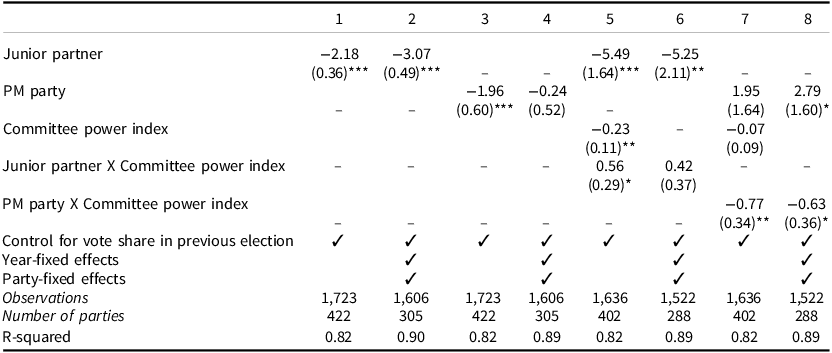
We test our hypothesis using OLS regression with party-clustered standard errors. Our main estimate of interest is an interaction between the junior partner dummy and our committee power index. We later replace the junior partner dummy with the PM party dummy to test the effect of the committee power index for the ‘cost of ruling’ for prime minister parties. In all estimations, we also control for each party’s vote share in the previous elections, as the previous vote level may influence the ability and incentive to enter a (coalition) government and may also be related to vote share in the next election. However, as many other variables usually employed in the party vote share literature, such as GDP growth and whether the government is a minority government (Hjermitslev Reference Hjermitslev2020, 515), may be post-treatment – e.g., committee power may influence government policy and thereby GDP growth as well as the dynamics around government formation (Aaskoven and Martin Reference Aaskoven and Martin2024) – we do not include such variables.Footnote 9 However – in some estimations – we also include (election) year-fixed effects and party-fixed effects, as certain parties may be more likely to enter cabinets either as junior coalition partners or prime minister parties, and these (unobserved) party-specific factors may be related to vote share (changes). As our committee power index does not vary within countries over time, in our fixed effects models, we are not able to estimate the effect of the constituting committee power index, but we are still able to estimate the effect of the interaction between government party status and our committee power index.
Results
Our main results can be found in Table 2. Models 1–2 contain the ‘pure’ effect of the ‘junior partner’ dummy, where we clearly see a ‘cost of ruling’ for junior coalition partners amounting up to a vote share loss of three percentage points. As evident from Models 3–4, there is also a ‘cost of ruling’ for the prime minister’s party, but this effect is smaller and not statistically significant with party-fixed effects in line with the findings of Hjermitslev (Reference Hjermitslev2020). However, as evident from Models 5–6, this ‘cost of ruling’ for junior coalition partners is lower in countries with greater parliamentary committee power, in line with our main hypothesis, as evidenced by the positive effect of the ‘junior partner/committee power index’ interaction. While this interaction is not statistically significant with the addition of party-fixed effects – which also decreases the number of observations substantially – in Model 6, Figure 1.a. – which plots this model – it still shows a pattern consistent with our hypothesis and theoretical argument.
Parliamentary committee power and the ‘cost of ruling’ for junior coalition partners and prime minister parties

Dependent variable is party vote share. Party-clustered standard errors in parentheses.
* p < 0.1, ** p < 0.05, *** p < 0.01.

Our results provide an indication – in line with our theoretical argument – that junior coalition partners in a coalition government may suffer lower vote losses in countries with stronger parliamentary committee systems. However, does this lower vote loss come at the expense of the party of the prime minister? In Models 7–8, we substitute the ‘junior coalition’ dummy with the PM party dummy and rerun the analyses. We find an indication that the cost of ruling for prime ministers’ parties increases with the level of parliamentary committee power – especially when party-fixed effects are included – as evident from the negative and statistically significant effect of the interaction in Models 7–8 of Table 2 and the marginal effects plot in Figure 1. b.Footnote 10
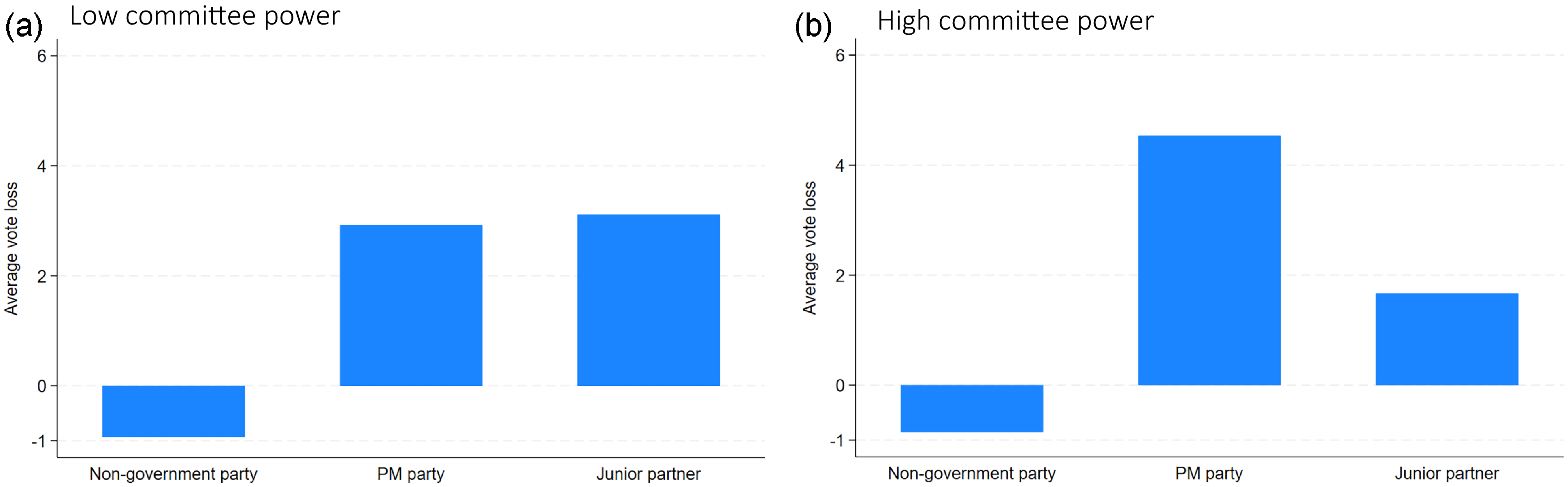
The regression resultsFootnote 11 are also reflected in the more descriptive analysis found in Figure 2, which graphs the average vote lossFootnote 12 for party types in countries with high (below average) parliamentary committee power and countries with low (at or above average) committee power. We see much lower relative (to the PM party) and absolute vote losses for junior coalition parties in countries with higher parliamentary committee power. These results – together with the previous regression results – suggest that greater levels of parliamentary committee power may also shrink the variance in the vote loss among government parties.Footnote 13
Average vote loss by party type.
Note: Vote losses are positive numbers, while vote gains are negative numbers.

Conclusion
Because voters tend to punish governing parties, political parties face an electoral cost of governing, with significant consequences for how willing parties are to join a government, stay in government, and/or what demands they make in return for governing. But in a coalition government, this cost of governing is rarely uniformly distributed among coalition partners. Typically, junior coalition parties bear a disproportionate share of this electoral cost, while the party of the prime minister either faces fewer electoral losses or even wins more votes at the next general election. Moving beyond a description of electoral consequences, recent research sheds light on the significant electoral challenges junior parties face in coalition governments.
This paper explores whether the design of legislative institutions can help mitigate these electoral costs for junior parties. Our findings suggest that a strong system of parliamentary committees can significantly aid junior parties. By providing a platform for junior parties to distinguish themselves, showcase their contributions, and ultimately help maintain their brand identity separate from the coalition and larger governing party, parliamentary committees provide voters with a clarity that allows them to distribute the costs and rewards of governing more equitably across all coalition members. An empirical analysis of electoral performance in 36 OECD and European countries from 1990 to 2019 indicates that stronger parliamentary committee systems correlate with higher electoral costs for the prime minister’s party but lower costs of governing for junior coalition partners.
We hope our contribution opens several avenues for future research and analysis. First, future research could investigate additional observable implications of the argument that strong committees disproportionately help junior parties preserve their uniqueness and brand identity, thereby improving their electoral performance. For instance, if this argument holds, strong committees should not only reduce the cost of governing for junior partners but also decrease the variance in changes in relative vote share among all governing parties. Our results provide suggestive evidence for this argument, but future research could investigate this in greater detail. Second, scholars may wish to explore the intriguing puzzle as to why junior parties do not consistently demand strong (or stronger) parliamentary committees as a precondition for entering coalition governments, given that these institutions appear central to mitigating their electoral costs of governing. One explanation could be that senior parties have a strategic interest in seeing junior partners suffer electoral losses – after all, as noted in the introduction, the party of the prime minister often benefits electorally from votes lost by the junior party. Could institutional reform form part of the package of wins or non-wins for junior parties, alongside policy and the ministerial and other offices allocated as part of coalition negotiations? Alternatively, it may be that legislative institutions are simply too difficult to reform. Understanding the extent to which junior parties attempt to shape the legislative process during coalition negotiations and agreements is therefore an area worthy of further investigation. Finally, scholars could examine other mechanisms – albeit limited in number and likely less effective than committees – that junior parties might use to protect their brand identity while participating in coalition governments. For example, strategically exiting government, selectively leaking information to the media, or using informal channels to challenge collective cabinet responsibility could serve as potential avenues for junior parties to signal their distinctiveness to voters without formally violating the norms of coalition governance.
With parliamentary government unworkable without parties being willing to coalesce to form the government, and with the electoral consequences of governing becoming more unpalatable for political parties or those portions of the party that tend to win least from participating in government and be most electorally vulnerable, strengthening legislative institutions helps address the unique challenges faced by junior coalition partners, ultimately benefiting both the parties and the electorate.
Supplementary material
The supplementary material for this article can be found at https://doi.org/10.1017/S1475676525100315.
Data availability statement
Data and replication code are available on https://github.com/Lasseaaskoven/replication-Electoral-Consequences-of-Legislative-Organization.
Acknowledgements
We thank the editors of the European Journal of Political Research as well as three anonymous reviewers for helpful comments. Ireen Litvak-Zur provided excellent research assistance.
Funding statement
Funders played no role in the design, execution, analysis, and interpretation of data or writing of this study.
Competing interests
Co-author Shane Martin serves as a member of the ECPR Publications Subcommittee. The editorial and review process followed the journal’s standard independent peer review procedures to ensure fairness and transparency.




 Open access

