


The focal article “I-O Psychology and Labor: Benign Neglect, Antipathy and Missed Opportunities” by Lefkowitz and colleagues (Reference Lefkowitz, Zickar, Cascio and Kochan2026) argues that I-O psychologists should consider working more closely with organized labor. The authors offer many reasons to support this consideration. In this article, we highlight an additional reason, which is that organized labor can play an important role in preventing the collapse of human employment to automation in highly vulnerable industries. We explicitly model the influence of organized labor on variables of AI integration, human employment, and collective bargaining strength using a system dynamics approach. From this analysis and the assumptions we make, we agree with Lefkowitz et al.’s proposed greater collaboration with labor. We find that labor unions can prevent labor displacement in the face of AI advances but only before a tipping point occurs (highlighting the need for I-O facilitation). In contrast to Lefkowitz et al.’s suggestions, that I-O psychologists should support reskilling, we find that reskilling merely delays the onset of labor displacement. Unless AI or other external forces create more jobs than AI displaces, eventually those reskilled jobs will eventually be fully displaced as well. Therefore, we argue that there is a time pressure for I-O psychologists to collaborate with labor unions to create contractual anti-automation clauses, and the pushing for automation hastens reaching the point of no return.
The push for AI automation among I-O psychologists
I-O psychologists are increasingly interested in the ways AI can improve the efficiency and effectiveness of organizations. In the SIOP white paper series article, “How to Survive the AI Revolution in HR: Culture Change and Immediate Action,” the authors claim that AI helps HR practices become more efficient, insightful, and employee-centric. They espouse that this leads to increased productivity that motivates employees through the measurement tools AI provides. By offering scalable and automated pipelines, these technologies can reduce costs and increase productivity of tasks where they are applied. Thus, I-O psychologists reason that these methods are beneficial to not only organizations but also workers.
AI integration affects workers differently, depending on their industry and progress of technology (Mehdi & Morissette, Reference Mehdi and Morissette2024). Some workers perform tasks that AI and robotics have yet to replicate (e.g., as of 2026, AI/robotics has not replicated most of the tasks of electricians, plumbers, and construction laborers). These are considered “low-exposure” occupations. Some workers may have their skills complemented/enhanced by AI’s capabilities, even if AI is relevant to the domain (e.g., as of 2026, AI is provided as a tool to judges and surgeons). These are considered “high complementarity” occupations, which are not displaceable. However, some industries have high exposure and low complementarity with AI such as technical writers, data entry clerks, and administrative assistants. These particular workers are the focus of our discussion because of the nuances of how AI directly displaces them. However, because of the gradual progress of AI, the discussion is potentially applicable to workers in all industries who may eventually find themselves in the high exposure low complementarity quadrant.
The deleterious effect of AI automation on labor unions
For workers vulnerable to AI automation, the labor-centric perspective proposed by Lefkowitz and colleagues reveals issues posed by this push for automation. I-O psychologists who implement automated solutions that reduce the tasks of low complementarity jobs (e.g., data entry interns) may be prioritizing short-term employee benefits by ostensibly making those employees’ current tasks easier at the expense of long-term job security. The labor-centric consideration highlights how automation can lead to downstream effects on collective bargaining power.
The integration of artificial intelligence and automation into organizational processes fundamentally attenuates the leverage required for effective collective bargaining. This erosion of labor power could occur through multiple mechanisms. First, automation diminishes the structural power inherent in labor networks by reducing headcount. When specific roles are automated, the remaining workforce holds less leverage to disrupt operations. For example, if air traffic controllers at regional hubs were replaced by AI, the remaining human controllers would possess reduced bargaining power. A strike would no longer paralyze the entire network, thereby weakening the efficacy of collective action. Second, even when automation does not fully displace workers, it often strips away complex responsibilities, leaving behind simplified tasks that require less training and tacit knowledge. This “taskification” lowers the barrier to entry, making employees more fungible and easier to replace. Consequently, the cost of turnover decreases for employers, while feelings of job insecurity rise among the workforce.
Labor unions as a stymie to AI adoption
Whereas AI adoption can erode collective bargaining power, the converse is also true. Specifically, collective bargaining offers a way to push back against workplace practices that replace human labor. One example is the Writers Guild of America strike of 2023, which eventually reached an agreement with the Alliance of Motion Picture and Television Producers. A focal point of the negotiations was the regulation of artificial intelligence. The writers sought to minimize the studio usage of generative AI to replace them. The strike agreement establishes strict guardrails to ensure they remain under the control of writers rather than studios. The agreement specifically prohibits studios from using AI to write or edit scripts and prevents AI-generated content from being classified as “source material.” Concurrently, the Screen Actor’s Guild Union secured protections against “digital replicas.” Studios must obtain informed consent and provide compensation if they wish to use AI to replicate an actor’s voice or likeness. Similarly, the Directors Guild of America negotiated a contract clause explicitly stating that “Generative AI does not constitute a person.” This legal distinction prevents studios from replacing a human director with an AI program for creative decisions and requires studios to consult with directors before using AI on their projects.
Unions in media, hospitality, and logistics have negotiated distinct protections to manage AI’s impact. News guilds established “human-created” clauses that limit AI to a secondary role and mandate content labeling, and Las Vegas culinary workers secured advance notice and substantial severance pay for technology-driven displacement. Additionally, UPS Teamsters successfully banned “management by algorithm,” prohibiting discipline or termination based solely on AI surveillance data without human verification.
These examples highlight the effect resistance that collective bargaining offers against employee replacement by AI. Therefore, although we argue that AI integration within the workplace will generally weaken labor unions, labor unions have the potential to stymie AI adoption. Collectively, these principles lead us to the conclusion that (a) I-O psychologists who implement AI integration in low AI complementarity occupations are adversely affecting collective bargaining; (b) I-O psychologists’ efforts are best spent working to strengthen labor unions; (c) emphasizing worker-centered alternatives (e.g., upskilling, reskilling) are counterproductive because they do not effectively prevent AI adoption, merely prolonging the time to full displacement.
Quantitatively modeling the dynamics of organizational AI adoption and unions
To illustrate the principles of the argument, we implement a computational simulation, which is a type of quantitative analysis that facilitates understanding complex dynamics, under a specific set of assumptions (Grand et al., Reference Grand, Braun and Kuljanin2025). Building off of the previous information, we invoke a dynamic systems model around variables of interest (A: Adoption of AI within an organization; E: Employed individuals within an organization; B: Bargaining power of the collection of individual employed within an organization). The dynamic systems model accommodates these features, tracking how these variables simultaneously change over time in response to the values of each other. This dynamic systems model is not intended to be definitive proof of a future outcome but rather meant to be a tool for clear dialectic discussion of the implications of certain factors/conditions according to a specific set of assumptions. Due to the complexity and interplay of the variables of interest, it helps infer what is implied by an argument.
The underlying model used is a continuous-time, nonlinear, deterministic, coupled ordinary differential equation model, simulated with a simple forward Euler time discretization. The model assumes that AI adoption is a self-sustaining process driven by a steady technological “push,” which accelerates as companies seek cost efficiency and scalability. The simulation functions as a tug of war between two forces: the “incentive” for organizations to automate and the “resistance” from workers. This resistance is not a fixed value; rather, it depends on the workers’ collective bargaining power, which is fueled by their headcount and their level of internal solidarity. However, a critical assumption of this system is that the economy has a “finite” number of jobs (i.e., the demand for goods and services stays at current levels). Because the model treats the job market as a closed pool with no new roles being created, any progress in AI adoption directly deletes an equivalent human position, equivalent to low complementarity replacement. The full model and explanations of assumptions are viewable at the paper’s OSF repository: https://osf.io/kp9uf
Results of simulation
Simulation observation #1: Collective bargaining power and employment decrease from AI adoption
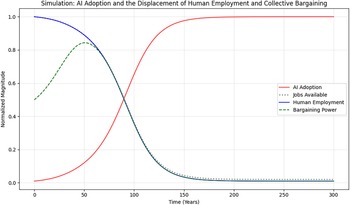
Figure 1 shows the baseline results where there is a finite number of jobs, and AI must compete against humans for them. From this visualization, we observe that collective bargaining power may increase temporarily, in response to the job insecurity caused by AI integration (e.g., the 2023 SAG-AFTRA Strike over AI protections obtaining studio concessions by holding the longest lasting strike in their history). However, this bargaining power erodes as the volume of the workforce decreases from AI supplantation. This phenomenon reflects how I-O psychologists who facilitate the rate of AI replacement could potentially decrease bargaining power of workers via decreased employment. This insight is facilitated by adopting the labor union centric perspective promoted by Lefkowitz and colleagues.
How AI Adoption Decreased Collective Bargaining Power and Human Employment

Figure 1 Long description
The line graph titled 'Simulation: A I Adoption and the Displacement of Human Employment and Collective Bargaining' shows the normalized magnitude of four variables over time in years. The x axis represents time in years, ranging from 0 to 300. The y axis represents normalized magnitude, ranging from 0 to 1. The red line represents A I adoption, starting at 0 and gradually increasing to 1 over time. The blue line represents human employment, starting at 1 and gradually decreasing to 0 over time. The green dashed line represents bargaining power, peaking around 50 years and then gradually decreasing to 0. The black dotted line represents jobs available, which starts at 1 and gradually decreases to 0 over time. All values are approximated.
Simulation observation #2: Increasing collective bargaining power can stymie AI adoption
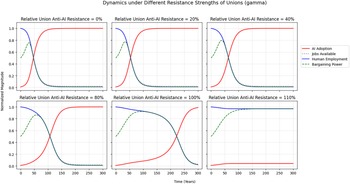
We varied the level of resistance from its baseline value of 70% (the U.S. union campaign success and approval rate), using intermediate values between 0% to 110%. The values simply represent the opposition strength against automation, with a value of 100% reflecting equivalent pushback to internal support of AI and a value over 100% reflecting a contractual union embargo (legal constraints superseding AI pressure). This variation allows exploring the contribution that forces that can increase resistance can offer. This also serves as a point where I-O psychologists can be most effective when facilitating labor union effectiveness. Figure 2 reveals how impactful interventions to increase resistance can be. A lack of collective opposition can lead to full displacement in half the number of years compared to current union support. Additionally, unions could place pressure via contractual negotiations that always outsize the pressure of AI integration, fully preventing displacement. Therefore, we believe that Lefkowitz and colleagues’ proposition that I-O psychologists’ alignment with labor unions is important as it offers a clear remedy to labor displacement for AI vulnerable occupations.
How Resistance From Labor Unions Can Prevent Displacement From AI

Figure 2 Long description
Six line graphs depict dynamics under different resistance strengths of unions. Each graph shows the relationship between A I adoption, jobs available, human employment, and bargaining power over time. The graphs are arranged in a two-by-three grid, each representing a different level of relative union anti-A I resistance: zero percent, twenty percent, forty percent, eighty percent, one hundred percent, and one hundred ten percent. The x-axis represents time in years, ranging from zero to three hundred years. The y-axis represents normalized magnitude, ranging from zero to one. The red line represents A I adoption, the dotted line represents jobs available, the blue line represents human employment, and the green dashed line represents bargaining power. As the resistance strength increases, the graphs show varying trends in A I adoption, jobs available, human employment, and bargaining power. All values are approximated.
Simulation observation #3: Reskilling and upskilling are not viable solutions
Upskilling is defined by Lefkowitz and colleagues as “deepening a skill set within a particular job,” such as a programmer learning an additional programming language, and reskilling is defined as “learning to use different skills, such as moving from auditing to cybersecurity.” Lefkowitz and colleagues suggest “I-O psychologists have much to contribute to the design of training programs to upskill or reskill workers, and to designing incentives to encourage them to participate.” At first glance, these options are seemingly reasonable alternatives for applying the I-O psychology skillset because they see AI progress as inevitable in a specific domain and will eventually claim a worker’s current job. Therefore, they desire to prepare workers for careers that are not currently automated. However, if one can assume that humans are able to reskill or upskill, then we must also consider that those who create/develop AI models are capable of the making further capability improvements, expanding AI expertise to additional domains. It follows that those jobs workers transition to are also eventually going to be automated. Further, if workers are displaced from their jobs, and the number of available jobs is finite, then reskilling will displace incumbents from their work or there will not be enough spaces for all those who were displaced from their jobs by automation.
The simulation supports the argument that incorporating reskilling does not meaningfully counter the effect of AI on employment (Figure 3). This is because of the assumption we make of there being a finite number of jobs (i.e., unchanged demand for goods and services). Under this assumption, automation is deleting an available job for a human, and so humans must take jobs from the remaining pool. However, the total number of jobs available is shrinking. So even if reskilling makes more people ready to work, there still aren’t enough jobs to employ them, because the model is removing jobs at the same pace. That means employment gets “stuck” following the shrinking job pool, so changing the reskilling percent does not change the employment curve.
AI Adoption and Employment When a Certain Percentage of Displaced Employees Can Reskill/Upskill

Figure 3 Long description
The image contains six line graphs arranged in a two-by-three grid, each showing the impact of different percentages of displaced workers reskilled on AI adoption, jobs available, human employment, and bargaining power over time. The x-axis represents time in years, ranging from 0 to 300, while the y-axis represents normalized magnitude, ranging from 0 to 1. Each graph includes four lines: a red line for AI adoption, a black dotted line for jobs available, a blue line for human employment, and a green dashed line for bargaining power. The graphs show different scenarios where 0 percent, 20 percent, 40 percent, 60 percent, 80 percent, and 100 percent of displaced workers are reskilled. In each scenario, AI adoption increases over time, while jobs available, human employment, and bargaining power decrease. The rate of decrease in human employment and bargaining power varies with the percentage of displaced workers reskilled, showing a slower decline as the percentage increases. All values are approximated.
We relaxed the assumption that the number of jobs available is finite. We included a job creation factor, which is the number of new jobs created for every position AI displaces. Although we do not expect every displaced position to have a new job available (job creation factor > 1), we investigated a wide range of values to see the contribution reskilling can offer. Figure 4 shows that displacement still occurs though humans can be fully employed. Under these conditions, reskilling requires high fidelity to be able to meet the staffing demands of jobs created. One would also expect that the job creation factor goes down over time as AI becomes adept at taking the jobs it created. Therefore, the importance of alignment with labor unions is especially important for industries with low replacement options.
Reskilling/Upskilling When Displaced Jobs Create New Job Opportunities

Figure 4 Long description
The image contains six line graphs arranged in a two-by-three grid, each representing different reskilling rates: 0 percent, 20 percent, 40 percent, 60 percent, 80 percent, and 100 percent. Each graph plots four variables over time in years: AI adoption, jobs available, human employment, and bargaining power. The x-axis represents time in years, ranging from 0 to 300, while the y-axis represents normalized magnitude, ranging from 0 to 1. The red line indicates AI adoption, the dotted line represents jobs available, the blue line shows human employment, and the green dashed line depicts bargaining power. As the reskilling rate increases, the graphs show varying impacts on human employment and bargaining power over time. For instance, at a 0 percent reskilling rate, human employment declines sharply as AI adoption increases, while bargaining power also decreases. At higher reskilling rates, such as 100 percent, human employment stabilizes, and bargaining power remains relatively steady despite increasing AI adoption. The graphs illustrate how higher reskilling rates can mitigate the negative effects of AI on employment and bargaining power.
Conclusion
I-O psychologists who advocate automating workers’ tasks in the workplace face a paradoxical reality where their embrace of automation to help workers simultaneously erodes the very labor rights necessary to protect the positions of workers ostensibly desire to help. Although the field often views automated pipelines as tools for efficiency and insight, these technologies fundamentally attenuate the leverage required for effective collective bargaining by reducing structural centrality and commodifying tasks. For workers within high AI-exposure, low-complementarity occupations, an effective method for preventing wholesale displacement via automation is the strengthening of collective bargaining to the point where its pressure outweighs automation incentives (e.g., via contractual embargos). Our analysis reveals critical inflection points where bargaining power may temporarily peak in response to the job insecurity caused by AI integration. It is imperative that I-O psychologists capitalize on this moment to promote labor union productivity and resistance, as this leverage inevitably erodes as the workforce volume decreases from supplantation. Continuing to promote automation during this window is counterproductive; it wastes the limited time available for workers to effectively leverage their collective power before they are displaced.
The strength of labor unions at preventing worker displacement is undermined by three core constraints that must also be considered: legal permissibility, tactical limitations, and technological replacement capacity. Because unions are not universally legal across all regions and industries, collective bargaining is often nonexistent, nullifying the strategy from the outset. Furthermore, even where unions exist, certain sectors, such as air traffic control, are legally barred from striking, which removes their most powerful leverage, and forces a reliance on slower legal channels. Finally, the protective power of union contracts is limited by the “break-point” of technological advancement; if AI and robotics evolve to the point where an organization can justify shuttering entire departments to replace them with automated systems, contractual barriers may be rendered obsolete.
Finally, standard recommendations for I-O psychologists to focus on transitioning displaced workers through upskilling or reskilling are misguided solutions to the threat of automation. These strategies fail to account for the reality that AI is constantly evolving and capable of eventually automating the very roles workers are transitioned into. Furthermore, reskilling does not address the fundamental issue of a shrinking job pool, meaning that even a reskilled workforce remains vulnerable to displacement without the structural protections of a union. Job creation rates must be higher than the rate jobs are replaced by AI for this approach to be tenable. Therefore, I-O psychologists must recognize that their efforts are best spent actively working to strengthen labor unions.
Competing interests
We have no known conflict of interest to disclose.


 Open access

