




Introduction
In the past three decades, Brazil has experienced a dizzying array of changes in the field of religion and politics. According to census data, the number of Catholics in this once heavily Catholic-dominant country declined from 83 percent in 1991 to 64.4 percent in 2010, while the number of Protestant Christians has surged from 9 to 22.2 percent in the same period (Instituto Brasileiro de Geografia e Estatística 2012; Mariano Reference Mariano2013).Footnote 1 For the most part, this shift reflects the rapid growth of Evangelical Christians, a grouping that in the Brazilian context encompasses both Pentecostal and Neo-Pentecostal Protestant Christians, the majority of whom live in the nation’s impoverished, and often predominantly Black, urban peripheries (Instituto Brasileiro de Geografia e Estatística 2012; Mariano Reference Mariano2013; Vital da Cunha Reference Vital da Cunha2021). In contrast to earlier Brazilian Protestant Christian communities, many of the newer Evangelical Christian churches have taken an explicit interest in politics (M. das D. C. Machado and Burity Reference Machado and Burity2014). As a result, the number of Evangelical Christian politicians intent on forwarding religiously motivated political agendas has exploded on all levels of government. Often, although not always, these agendas have been conservative in their focus on imaginaries of “traditional” family values and gender relations and strong opposition to LGBTQ and reproductive rights (Almeida Reference Almeida2017, Reference Almeida2020b; Carranza and Cunha Reference Carranza and Cunha2018; M. das D. C. Machado and Burity Reference Machado and Burity2014; Mariano Reference Mariano2016; Sales and Mariano Reference Sales and Mariano2019; Vital da Cunha, Lopes, and Lui Reference Vital da Cunha, Lopes and Lui2017; Vital and Victor Leite Lopes Reference Vital and Victor Leite Lopes2013; Vital and de Paula Reference Vital and de Paula2023).Footnote 2 While religion has never been fully absent from the Brazilian political sphere, the growing political influence of Evangelical Christians has brought religion to the center of Brazilian politics in new kinds of ways.Footnote 3 If on the one hand, it has led to what Mariano and Oro (Reference Mariano and Pedro Oro2011) have called a new kind of reciprocal instrumentalization of religion and politics in which political decisions are increasingly informed by concerns over maintaining the support of Evangelical Christians, on the other hand it has brought the relationship between religion and politics and the character of Brazilian secularism to the center of public discussions on politics (Mariano Reference Mariano2011).
In recent years, the force and stakes of these debates have only increased as conservative Evangelical Christians have joined forces with other conservative political actors. The ascent to the country’s presidency in 2019 of Jair Bolsonaro, a far-right politician, self-proclaimed homophobe and admirer of Brazil’s military dictatorship, who enjoyed strong support among Evangelical Christians, is certainly the best-known example of such political convergences, but as Lia Zanotta Machado (Reference Machado2020) has shown, political alliances between conservative Evangelical Christians and Brazil’s conservative land lobbies are also tight. Even more than conservative values, what brings these different groups together is their shared opposition to the progressive political agendas that dominated Brazilian politics during the Lula (2003–2010) and Rousseff (2011–2016) presidencies. The impact of these alliances was particularly sorely felt during Bolsonaro’s (2019–2022) presidency when many of the policies focused on supporting religious, racial, and sexual minorities that had been created by previous federal administrations were dismantled or rolled back. But they have also brought Evangelical Christian analyses of and arguments on the “correct” place of religion in Brazilian politics to the centers of state power in new ways.
The political projects forwarded by such conservative alliances have often been interpreted by progressive analysts in Brazil as well as elsewhere as assaults on liberal politics and values (Almeida Reference Almeida2017, Reference Almeida2020a; L. Z. Machado Reference Machado2020). For example, they have been described as productive of “wide-spread crisis” (Almeida Reference Almeida2020a), a “paradox” of political trajectory (Mendes Reference Mendes2020), and reflective of a move from a “time of rights” to a “time of intolerance’” in Brazilian society and politics (L. Z. Machado Reference Machado2020). Notably, these kinds of framings tend to be closely aligned with conservative politicians’ own characterization of conservative politics. Thus, for example Jair Bolsonaro’s presidential campaign was predicated on a politics of rupture that claimed that when elected he would undo Brazil’s liberal political order and dismantle its democratic institutions and pluralism (Hatzikidi and Dullo Reference Hatzikidi and Dullo2021; Taddei, Bulamah, and Schavelzon Reference Taddei, Bulamah and Schavelzon2020). The close alignment between these progressive analyses and conservative self-characterizations, however, makes it difficult to see the ways in which conservative efforts to counter progressive political trajectories also selectively invoke and mobilize liberal values.
Yet, as I show in this paper, the political successes of conservative Evangelical Christian politicians in forwarding conservative political agendas in Brazil are also enabled by their mobilization of liberal political concepts, such as “freedom,” that are semiotically indeterminate. While, on the one hand, the functioning of the liberal order relies on the indeterminacy of these concepts—they need to be broad enough to encompass multiple, and at times conflicting articulations, on the other hand, the denotational open-endedness of these concepts renders them particularly useful for efforts to unsettle liberal political projects through practices of grafting (Gal Reference Gal2018, Reference Gal2019) liberal discourses onto illiberal ones.
I develop this argument through an analysis of how one semiotically indeterminate liberal concept, “religious intolerance,” has been mobilized in Brazilian discussions on religious violence by differently positioned religious and political actors over the past twenty years. Notably, the growing public presence and political influence of conservative Evangelical Christians in Brazil has been paralleled by an explosion in Evangelical Christian attacks on African origin religious traditions, a group of religious communities that variously trace the origins of their practices to Africa.Footnote 4 These attacks have been the focus of much public debate since the early 2000s with practitioners of African origin religious traditions demanding government intervention against such “religious intolerance.” More recently, however, Evangelical Christians have sought to reorient the discussions on “religious intolerance” that these demands for government intervention have produced by claiming that they too experience “religious intolerance,” in particular in reference to their religiously motivated political views. I demonstrate in this paper that these Evangelical Christian appropriations of the discourse on ‘religious intolerance have powerfully hobbled government efforts to intervene in the Evangelical Christian attacks on African origin religious traditions through a frame of secular protections for the freedom of religion.
The problems that the semiotic indeterminacy of liberal concepts pose for recognizing the needs or demands of minority religions have tended to be understood in the scholarship on secularism as challenges of denotation. Thus, Winnifred Sullivan (Reference Sullivan2005) has argued that the open-endedness of the term “religious freedom” privileges majority religious constructions of religion in ways that render the equal treatment of all religions by the law impossible. Hussein Agrama (Reference Agrama2010), in turn has, shown how in Egypt efforts to side-step the notion of “religion” rely on another, similarly denotationally indeterminate notion, that of “public order,” which also anchors court decisions in majority religious conceptions of the proper character and place of religion. And, analysts of African derived religious traditions in the Americas have traced the exclusion of these religious traditions from the domain of legally recognized religions across the region to the ways in which the denotational contours of “religion” in Western liberal thought were constructed through an opposition to African religious practices—which were framed as “magic,” “witchcraft,” or “superstition” (i.e. not-religion) by contrast (Crosson Reference Crosson2018, Reference Crosson2020; Johnson Reference Johnson2001; Maggie Reference Maggie1992; Paton Reference Paton2009).
But not all the challenges to the political and legal recognition of minority religious traditions’ claims that are produced by the semiotic indeterminacy of liberal concepts can be traced to their denotational open-endedness or limits. They may also be caused by the ways in which the terms’ differing forms of enregisterment go unnoticed under the guise of denotational indeterminacy. The Brazilian debates on “religious intolerance” that I examine in this article provide a case in point. As I show, the political effects of the term’s various entextualizations must be understood not only in terms of the different denotational referents these entextualizations construct but also and crucially in terms of how its associations and mutual enregisterment with other terms across different religious and political domains are obscured by state institutions’ commitments to a form of religious parity that is grounded in a retainment of “religion” and is its derivates as denotationally indeterminant.
To develop this analysis, I focus my attention on the different forms of enregisterment that organize the entextualization of “religious intolerance” in religious activist and government spaces. I demonstrate that in the context of Brazilian discourses on “religious intolerance,” this takes form through processes of what Bonnie Urciuoli (Reference Urciuoli2010) has described, building on Michael Silverstein’s (Reference Silverstein2003) theorization of indexical ordering, as mutual enregisterment (see also Urciuoli Reference Urciuoli2003, Reference Urciuoli2008). Urciuoli develops this analytic through an examination of the construction of “diversity” as an object of concern in US institutions of higher education. “Diversity,” as she shows, is entextualized differently in different educational domains. Whereas university administrators associate it with a future of successful employment and workforce productivity, faculty associate it with discipline-specific frameworks. The differences in the entextualization of “diversity” across these different domains do not, however, just reflect the ways in which the term is associated to specific denotata in them. Rather, and more significantly, they are also the product of how the term is associated and mutually enregistered with different sets of other terms in these domains. As Urciuoli observes, such differential processes of enregisterment can result in a form of semiotic disconnection, of semiotic indeterminacy in which the denotata of what appear as the same signs actually differ from each other in substantial ways. Such semiotic disconnections, I suggest, constitute semiotically indeterminate terms like “religious intolerance” as particularly rich sites for political strategizing.
My analysis proceeds in three steps. First, I examine differences in the enregisterment and entextualization of “religious intolerance” among practitioner activists from African origin religious traditions and government institutions. Second, I examine the ways in which African origin religious activists and sympathetic legislators sought to transcend the challenges that government constructions of “religious intolerance” posed for their efforts to protect African origin religious communities and practices from Evangelical Christian attacks. Third, I examine how the semiotic indeterminacy of government constructions of “religious intolerance” has provided Evangelical Christian politicians with a means to undermine state efforts to intervene in their attacks on African origin religious traditions and to shift attention to the protection of Evangelical Christian religious freedoms.Footnote 5
“Religious intolerance” as site of secular indeterminacy
In religiously plural contexts, secularism both produces and relies on a set of semiotic indeterminacies. The denotational contours of its key foci, “religion,” and “religious freedom” must necessarily be left, at least partly, indeterminate to accommodate differences in their conceptualization across distinct religious traditions. Indeed, these notions may be understood quite differently from the perspective of different religious traditions. Some religious traditions, in particular Protestant forms of Christianity, which have long formed the backdrop for Western scholarly and state conceptions of religion, privilege faith, whereas others, such as Judaism and Islam but also many of the African diasporic traditions practiced in the Americas foreground practice and adherence to religious authority. In parallel, some religious traditions orient to canonical texts and are organized by centralized ecclesiastical hierarchies, while others are organized by genealogies of oral transmission and individual revelation. In practice, state efforts to transcend these differences tend to privilege models of religion that are informed by the religious traditions practiced by majorities. Thus, Christianity often provides the model against which the religion-ness of other traditions is assessed in majority Christian states (Asad Reference Asad2003; Sullivan Reference Sullivan2005). In states with Muslim majorities, in turn, this model tends to be anchored in Islam (Agrama Reference Agrama2012). These tendencies must, however, always be paralleled by efforts to maintain the uses of the term “religion” sufficiently indeterminate in order to, at least partly, accommodate all recognized religious traditions practiced in the polity. These efforts ripple across but are also variously entangled with constructions of such other key terms of secularism as “religious freedom,” “religious toleration,” and “religious intolerance.” In Brazil in the past two decades, “religious intolerance” has increasingly become a privileged site for managing and negotiating the politics of these secular indeterminacies.
“Religious intolerance” first entered public discussions in Brazil in the early 2000s as an activist term forwarded by practitioners of Brazil’s African origin religious communities. The term was used by these practitioner activists to refer to an explosion in Evangelical Christian attacks on their religious traditions. From the late 1980s onward, select, highly influential Evangelical Christian churches had begun to position African origin religious traditions as a primary target in what they described as a spiritual war against the Devil.Footnote 6 The result had been a dramatic increase in violent attacks, both verbal and physical, by Evangelical Christians on African origin religious communities and practices.Footnote 7 For practitioners of African origin religious traditions, these attacks reached a tipping point in 1999 when Mãe Gilda, an elderly temple leader of a Candomblé temple in Salvador, suffered a fatal heart attack after having first been portrayed as a charlatan on the front page of Brazil’s largest Evangelical Christian weekly Folha Universal and subsequently had her temple attacked by a group of Evangelical Christians. Her death galvanized practitioners across Brazil’s diverse African origin religious communities to come together around calls for an end to “religious intolerance” against their religious practices.
Government institutions’ subsequent broad scale embrace of a fight against religious intolerance illustrates the success of this rhetorical framing. Indeed, over the past two decades, government institutions, policy plans, and commissions of inquiry have proliferated across Brazil. Particularly notable is the designation of January 21, the date of Mãe Gilda’s passing as a National Day of Combat Against Religious Intolerance (Dia Nacional de Combate à Intolerância Religiosa), by President Luiz Inácio Lula da Silva in 2007. But the concern with religious intolerance has also become embedded in government structures from the municipal to the federal levels as governments across Brazil have created offices dedicated to combating religious intolerance, debated policy plans for addressing such violence, introduced phone hotlines for reporting incidents, trained police officers to receive and correctly file such reports, and founded centers for supporting victims of religious intolerance.
However, in the process, the semiotic object of “religious intolerance” has shifted substantively. In contrast to African origin religious practitioners’ use of the term as a descriptor for Evangelical Christian attacks on their communities, the government embrace of a politics of combating religious intolerance has relied on a broader but also more open-ended construction of “religious intolerance” that accords with the state’s secular commitments to a principle of equal treatment of all religions. This has had a deleterious effect on African origin religious practitioners’ efforts to counter Evangelical Christian aggression. On the one hand, the ways in which state constructions of “religious intolerance” position all religious traditions and all forms of religious animus on the same line has significantly constrained possibilities for addressing the particular forms of religious aggression practitioners of African origin religious traditions confront. On the other hand, they have created an opportunity for Evangelical Christians to graft African origin religious communities’ calls for combating religious intolerance onto their own agendas of expanding protections for Christian proselytization. These Evangelical Christian appropriations of the term have powerfully hampered even the most sympathetic state efforts to support African origin religious communities.
Enregistering “religious intolerance”
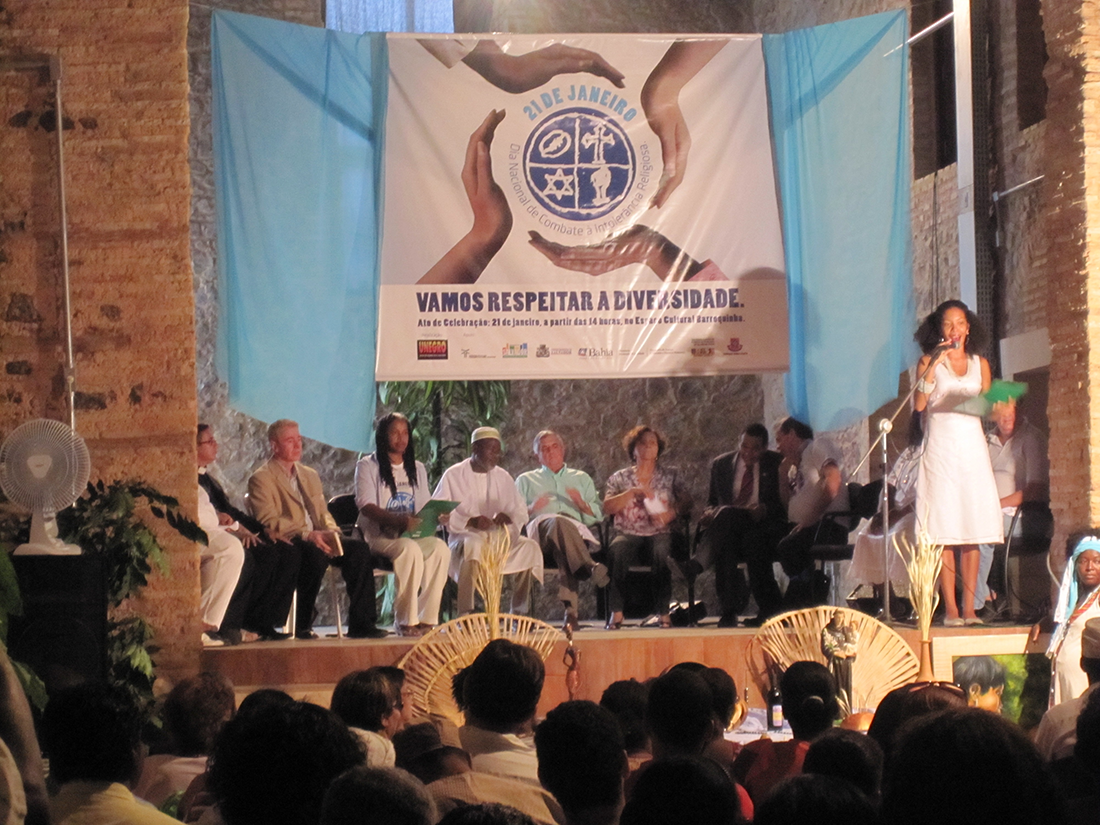
On January 21, 2010, I attended two events in Salvador that commemorated Brazil’s National Day of Combat against Religious Intolerance. The first was a march against religious intolerance that had been organized by practitioners of African origin religious traditions to commemorate the event that had led to the creation of a National Day of Combat against Religious Intolerance on this date: the death of Mãe Gilda on January 21, 1999, and to call public and governmental attention to the continuation of Evangelical Christian attacks (Figure 1). The second was a gathering that had been organized by Salvador’s municipal government in collaboration with the state of Bahia. It brought practitioners from different religions together to discuss the import of respecting religious diversity (Figure 2). There was significant overlap in the events. In addition to honoring the same holiday, both events were sponsored by the municipal and state governments and both were attended by practitioners of African origin religious traditions and government representatives, although to differing degrees. However, on closer examination, the constructions of “religious intolerance” that the events oriented to, while seemingly the same, differed from each other in substantive ways. Whereas the practitioner march deployed “religious intolerance” in reference to the preceding years’ Evangelical Christians attacks on African origin religious communities, the municipal government’s event construed “religious intolerance” as a potential threat to all religious communities that could be avoided through mutual respect for difference.
3rd March Against Religious Intolerance and for Peace in Itapuã, January 21, 2010. Photo by author.

Event to commemorate National Day for Combat against Religious Intolerance organized by the municipal government of the city of Salvador in collaboration with the state of Bahia, January 21, 2010. Photo by author.
How had this situation come to be? The question is even more pertinent when considered against the backdrop of the history of collaborations between practitioners and government institutions around questions of religious violence and intolerance. Indeed, the events’ shared orientation to the notion of “religious intolerance” was no coincidence. Instead, the construction of “religious intolerance” as an object of concern for practitioners and government actors alike had been the product of a sequence of practitioner efforts to attract government attention to and support for their struggles with Evangelical Christian aggression and subsequent government efforts to respond to these demands.
The answer to these questions can be found in the different ways in which “religious intolerance” was enregistered among practitioner activists from African origin religious traditions and government institutions. Overall, these processes of enregisterment were tightly entangled. The history of the emergence of “religious intolerance” as an object of activist and governmental concern in Brazil is somewhat peculiar as the term “religious intolerance” was introduced into Brazilian public and governmental discussions on religious discrimination and violence in the late 1990s and early 2000s by practitioner activists from African origin religious communities who sought to call attention to and attract government support for their struggles with Evangelical Christian attacks on their religious traditions. Here, the actions of the Movement against Religious Intolerance (Movimento contra Intolerância Religiosa), which was created in Salvador in 2000 to call attention to Mãe Gilda’s death, were foundational. The heart attack that had killed the woman, the movement argued, had been caused by “religious intolerance.” By 2001, the expression “religious intolerance” had also been taken up as a rallying call against Evangelical Christian aggression by practitioner activists in Rio de Janeiro, who founded the Inter-Religious Dialogue against Religious Intolerance and for Peace Movement (Movimento Diálogo Inter-Religioso contra a Intolerância Religiosa e pela Paz). In subsequent years, the expression “religious intolerance” became the go-to term for describing attacks on African origin religions among practitioners.
The broad embrace of the term “religious intolerance” among practitioners was motivated by several factors. On one level, it provided a means to counter earlier analyses of Evangelical Christian attacks on African origin religions as the products of a religious conflict or war. While such analyses had at least partly been motivated by scholarly investments in understanding Brazil’s religious developments through religious market models (Morais Reference Morais2021a), they also reproduced Evangelical Christian characterizations of the attacks as reflections of a holy war (guerra santa) between them and the devil (Camurça and Rodrigues Reference Camurça and da Silva Rodrigues2022). Irrespective of their anchoring, however, these earlier characterizations obscured the unilateral character of the attacks and instead suggested that the attacks were the product of a two-sided conflict in which both sides occupied the role of aggressor. The term “religious intolerance,” by contrast, emphasized the one-sided character of the attacks. Instead of a conflict between two religious groups, it framed Evangelical Christians as perpetrators of radical intolerance and African origin religious communities as their victims.
On another level, the term “religious intolerance” productively brought practitioners into the purview of new government initiatives to recognize the social and political rights of the nation’s large, but socially and politically marginalized Afro-Brazilian populations. Indeed, the preceding years had seen an explosion in government-led initiatives aimed at expanding Afro-Brazilian citizen participation and equality. Some of these initiatives targeted Afro-Brazilians directly, while others were focused on social inclusion and equality more generally. These efforts have often been associated directly with the Lula presidency and its progressive agendas, but in many parts of Brazil similar efforts were also forwarded by state and municipal governments. This was especially the case for Salvador where initiatives focused on the city’s Afro-Brazilian populations tended to be spearheaded by the municipal government’s office for racial reparations (Secretaria Municipal de Reparação, SEMUR).
At the practitioner activist events that I attended in Salvador in the late 2000s, the imaginary of rights-based citizenship invoked by the frame of religious intolerance was often reinforced by explicit characterizations of the attacks as violations of practitioners’ rights as Brazilian citizens. This framing opened the way for practitioners to engage various state institutions. Notably, these events tended to be oriented toward government institutions as well as practitioners. In addition to providing practitioners with a forum for discussing their experiences of religious aggression and instructing them on how to recast these experiences as examples of religious intolerance, many of these events brought practitioners in direct dialogue with representatives from government institutions responsible for protecting their rights.Footnote 8
On yet another level, this framing provided practitioners with a means to position themselves within a nationally salient imaginary of religious toleration in particularly productive ways. In calling for an end to religious intolerance, they not only construed their Evangelical Christian aggressors as intolerant but also anchored their own responses in claims to their commitments to the ideals of religious tolerance and harmony. These arguments brought their calls into alignment with other Brazilian criticisms of Evangelical Christians as un-Brazilian due to the religious grouping’s seeming rejection of the quintessential Brazilian ideals of cordiality and religious harmony. At the same time, the practitioner activists’ arguments were also supported by the contrast they drew between Evangelical Christians’ intolerance and African origin religious traditions’ openness toward and respect for others. As one practitioner put it at an activist event organized in November 2009, the doors of African origin religious communities were open to everyone, irrespective of their religious commitments or any other personal attributes. These communities had provided a haven for those who were ostracized for their difference by the rest of society. Such acceptance and tolerance for difference was ingrained in their religious foundations.
Considering the ways in which the practitioner activist usages of “religious intolerance” were enregistered with rights-based democratic discourses, it is not particularly surprising that the activists’ efforts quickly attracted the attention of government institutions and representatives sympathetic to African origin religious communities’ struggles with Evangelical Christian aggression. However, as “religious intolerance” was taken up by government institutions it was brought into a different indexical field, one organized not only by discourses of rights and respect for difference but also a concern with equality of government treatment of all religions. Notably, a central organizing principle for Brazilian secularism is the notion of religious parity, the principle of the equal treatment of all religions by the state. From this perspective, one of the greatest infractions to its secularism that the Brazilian state could perform would be to give special treatment to an individual religious group. This would raise the specter of “particularism.” The emphasis set on this principle is directly tied to the country’s history of special treatment of Catholicism. Indeed, although freedom of religion was recognized by the country in 1889, this freedom was constrained to private spaces for all religions but Catholicism until 1988. Moreover, the Catholic Church held a special relationship to the state in many ways, including in the provision of education. The recognition of Brazil as a religiously plural society in the Citizen’s Constitution of 1988 responded directly to this history in its emphasis on religious parity.
The ways in which this emphasis on religious parity led government institutions to frame their efforts to combat “religious intolerance” were particularly clearly reflected in the language of the presidential decree that established January 21 as the National Day of Combat Against Religious Intolerance in 2007.
LAW No. 11,635, OF DECEMBER 27, 2007
Establishes the National Day to Combat Religious Intolerance.
Art. 1 The National Day to Combat Religious Intolerance is hereby established to be celebrated annually throughout the national territory on January 21st.
Art. 2 The date is included in the Union’s Civic Calendar for official commemoration purposes.
Art. 3 This Law comes into force on the date of its publication.
What is notable about the wording of the law is its generality and lack of detail. Despite the law’s emergence as a reaction to attacks on African origin religions and the choice of January 21st, the death date of Mãe Gilda, as the date on which the thus established day for combating religious intolerance was to be celebrated, the law was silent on the object of the forms of combat it seeks to celebrate. It did not mention specific religions nor did it in any way qualify what forms of religious prejudice or aggression should be combatted on the nationally recognized day.
How the date has come to be commemorated by government institutions also reflects this emphasis on religious parity. The event organized by the municipal government of Salvador in 2010 provides one clear example of this. In contrast to the practitioner activist event’s focus on Evangelical Christian attacks on African origin religious traditions, the municipal government event called for the celebration of religious diversity. In reflection of this goal, the discussion at the event, while critical of the growing Evangelical Christian assault on African origin religions focused on the construction of ecumenical dialogue between religious and activist traditions, an aim that was also reflected in the composition of its invited speakers, a list that had clearly been composed with the aim of representing the diversity of religious traditions practiced in the city and demonstrating their representatives’ ability and commitment to engage in harmonious inter-religious dialogue. This goal was also forwarded by the event’s poster, which featured a globe-like circle divided into four equal size segments each featuring a symbol representing different religious traditions—a cowrie shell for African origin religious tradition, a Christian cross, a Jewish star of David, and a mano de figa (a fist with the thumb held in between middle and index fingers), a good luck symbol used for protection by practitioners of African origin religious traditions but also others—surrounded by four hands each supporting the circle from different sides.
On a pragmatic level, these efforts to abide by the principle of religious parity relied on an enregisterment of all “religions” as semiotically equivalent. The message that they conveyed of the event they promoted as a gathering that brought representatives from different religious traditions together to reflect on the need to respect, value, and accept religious difference in a secular society powerfully captured the imaginary of combat against religious intolerance projected by government constructions of “religious intolerance.” In contrast to African origin religious practitioner activists’ calls for state intervention in the attacks they suffered, from this perspective the solution to religious intolerance was greater respect for religious difference, in all its forms.
Not surprisingly, the results of the government efforts to combat “religious intolerance” that have emerged from this framing have tended to be deeply disappointing to African origin religious practitioners. Tellingly, most government efforts to combat religious intolerance have focused on educating the general public on the errors of religious intolerance or calling their attention to the import of respecting religious diversity, rather than more direct interventions into the attacks on their religious practices or the provision of support services for victims of these aggressions. The almost complete lack of legal actions taken on Evangelical Christian proponents of attacks on African origin religious traditions is also revealing. As Ana Paula Miranda and her students have described, this dearth of legal action is a direct result of state representatives’ refusal to take seriously African origin religious practitioners’ allegations of religious violence (Miranda Reference Miranda2010; Miranda, Côrrea, and Almeida Reference Miranda, Côrrea, Almeida and Perlingeiro2019). This lack of action is tightly entwined with the forms of commensuration that the government construction of “religious intolerance” relies on. If on the one hand the emphasis on the equal treatment of all religious groups severely constrains government institutions’ ability to develop programs that would be directed at supporting African origins religious communities in particular, on the other hand the ways in which these government constructions of religious intolerance commensurate a broad range of different kinds of acts of aggression as tokens of the same type effectively erases the differences in both the severity and kind in forms of aggression experienced by different religious groups. The result is a dismissal of the severity and character of the attacks on African origin religions and a de facto exculpation of those responsible for the attacks.
Countering the problems that the semiotic indeterminacy of these government constructions creates has, however, proved difficult.
Countering secular indeterminacy
Although the expression “religious intolerance” was initially championed by practitioners of African origin religious traditions as a descriptor for the attacks they suffered from Evangelical Christian aggressors, they have become increasingly critical of it since the late 2000s. It is clear that the various government campaigns against religious intolerance have done little to mitigate the attacks. Instead, the number and violence of these attacks have only grown. The reasons for this identified by practitioners have ranged from failures to apply extant legal codes on religious discrimination to incidents of attack to a more general reticence among police officers and courts to recognize such attacks as legally actionable (Miranda Reference Miranda2010; Miranda, Côrrea, and Almeida Reference Miranda, Côrrea, Almeida and Perlingeiro2019). By the end of the 2000s, however, a growing number of practitioner activists began to argue that the root problem of the state failure to intervene in the attacks was their framing as “religious intolerance.” In their analysis, the frame of “religious intolerance” had misconstrued the attacks as moral problems in need of a moral solution—toleration—rather than a political problem in need of a political solution—legislation and criminal punishment. The result was a dismissal of the severity of the attacks that African origin religious communities and practitioners suffered and a de facto exculpation of their authors from criminal prosecution.
As a solution to this situation, practitioner activists proposed the adoption of another term as a descriptor for the attacks in the late 2000s: “religious racism.”Footnote 9 This term, they argued both captured an aspect of the attacks that the term “religious intolerance” masked, namely, the attacks’ racist motivations, and configured the aggressions as political rather than moral problems. According to these activists, Evangelical Christian attacks on their religious practices, although framed as religiously motivated, could not be understood apart from the long history of negative racial stereotyping of African and African origin religious traditions in Brazil. The associations that Evangelical Christians made between these traditions and Devil worship were not new. At the same time, the reality of the attacks revealed that their target rarely was just any practitioner of African origin traditions. Instead, the activists observed, most of the attacks were directed at Black practitioners. Looked at from this perspective, the framing of the attacks as forms of religious intolerance did not only obscure the racial contours of the attacks but also, in so doing, impeded interventions in them.
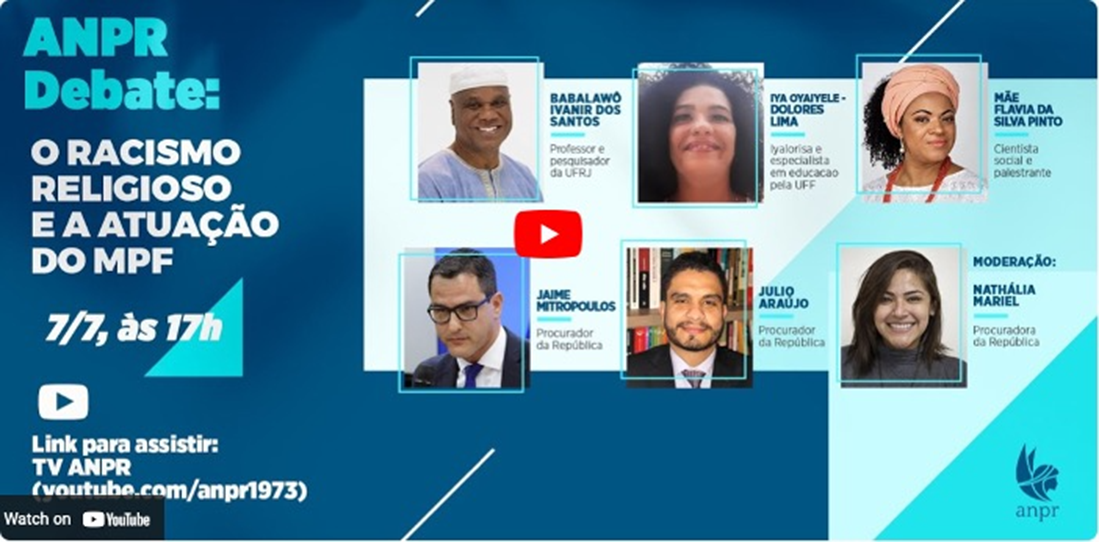
Over the past few years, these arguments have been taken up by a growing number of government representatives and institutions sympathetic with African origin religious practitioners’ plight. Thus, for example, a report on religious intolerance that was published by Brazil’s Federal Public Prosecutor’s Office in 2018 deploys the term “religious racism” in parallel to “religious intolerance” as a descriptor for acts of violence that are also motivated by or entangled with other patterns of racism (Procuradoria Federal dos Direitos do Cidadão no Combate à Intolerância Religiosa 2018). An event organized by the Federal Public Prosecutor’s Office and the National Association of State Attorneys (Associacão Nacional dos Procuradores da República) in July 2020, in turn, sought to direct the attention of state attorneys to the phenomenon of “religious racism” and its particularities vis-à-vis “religious intolerance” (Figure 3). And, in April 2021, the Legislative Assembly of the State of Rio de Janeiro accepted a law proposal that designated March 27 as a state holiday for consciousness raising on “religious racism” (Figure 4).
Advertisement for event on “religious racism” organized by the Federal Public Prosecutor’s Office and the National Association of State Attorneys (Associacão Nacional dos Procuradores da República) in July 2020. https://www.youtube.com/watch?v=9nx6r6nUBGk.
Screen capture of news article on the designation of state holiday for consciousness raising on religious racism by Legislative Assembly of State of Rio de Janeiro. Extra April 14, 2012, https://extra.globo.com/noticias/rio/alerj-aprova-dia-joaozinho-da-gomeia-de-conscientizacao-contra-racismo-religioso-lei-aguarda-sancao-do-governador-rv1-1-24969879.

Scholarly analyses of these arguments on “religious racism” have tended to emphasize the power of the race-based analyses that undergird the term (see Fernandes and Adad Reference Fernandes and Jane Costa Adad2017; Flor Do Nascimento Reference Flor Do Nascimento2014, Reference Flor Do Nascimento2017). But, arguably equally important are the ways in which the term “religious racism” draws attacks on African origin religious traditions away from the semiotically indeterminate domain of secularist government constructions of “religious intolerance” and into another domain, that of racism, which in the Brazilian context is both semiotically and politically clearly anchored in notions of Africanness and Afro-Brazilianness. Indeed, even though Afro-Brazilians are by no means the only racialized population group in Brazil, the majority of both public discussion and policy development on race focuses on Afro-Brazilians.Footnote 10 These associations are particularly clear for African origin religious traditions which have historically been celebrated as emblems of Brazil’s African cultural heritage.
Not all practitioners or government representatives who sympathize with them have embraced this argumentative move, however. Instead, many continue to see value in the frame of secularism for intervening in the attacks and the dialogues this opens for working with other religious groups. As a result, they have directed their efforts at overcoming the challenges that the frame poses toward an undoing of its semiotic indeterminacy. These efforts have proved difficult to sustain though due to the centrality of the principle of religious parity for Brazilian constructions of secularism.
One example of the challenges that these efforts have confronted is a 2016 law proposal (PL 4,295) presented by Erika Kokay, who has served as a state representative for the Federal District in Brazil’s National Congress since 2011. The law proposal sought to modify the text of the law that had established January 21 as the National Day of Combat Against Religious Intolerance in order to acknowledge the forms of religious intolerance that African origin religions experienced.Footnote 11 To this effect, it proposed the addition of the following articles:
Art. 2o-A. The commemoration of the date referred to in art. 1st will include actions aimed at religions of African origin, including:
I – production and dissemination of publications related to the exercise and dissemination of religions;
II – access to bodies and media for disseminating religions;
III – broadcasting of media campaigns;
IV – promotion of lectures and educational activities in schools.
Representative Kokay justified the proposal by pointing to the original law’s failure to recognize that most acts of religious intolerance in Brazil focused on African origin religious traditions. The original law, she argued, focused on combating intolerance against any religious manifestations. On a general level, this complied with Brazil’s constitutional guarantees for religious freedom. However, she argued, it failed to account for another constitutional obligation: the State’s duty to actively support practitioners that suffered from discrimination and social risk through affirmative policy. The inclusion of explicit efforts to combat prejudice against African origin religious traditions in the commemoration of the National Day of Combat against Religious Intolerance, she argued, would fulfill this obligation in respect to these religions.
The argument on competing state duties that representative Kokay presented failed, however, due the ways in which the law proposal came to be identified as concerned with religious freedom. Instead of being brought directly to the general plenary of the National Congress for debate and voting, it was grouped together with several other law proposals focused on questions of religious freedom that were sent to a special parliamentary commission tasked with assessing and developing law proposals on freedom of opinion in religious education.Footnote 12 The ways in which this process folded representative Kokay’s law proposal into a broader effort to develop new laws on religious freedom ran directly counter to her goal to detach the commemoration of the National Day of Combat Against Religious Intolerance from the secular principle of religious parity.
Alongside these structural challenges, similar efforts have often also failed due to Evangelical Christian resistance. This is demonstrated by the outcome of other federal-level efforts to legislate and develop policies against religious attacks on African origin religious traditions that rely on the frame of religious intolerance. Perhaps most revealing is the fate of an effort to develop a national level policy plan for combating religious intolerance. The plan, which had been devised in collaboration with African origin religious activists and the federal government, was announced in November 2008 by President Lula at an event in Rio De Janeiro that brought him in conversation with representatives from a broad range of religious groups.Footnote 13 Central foci in the plan were strengthening legal sanctions on religious persecution and impeding state support for media that incited religious intolerance. Especially the latter of these foci targeted Evangelical Christian churches’ reliance on Evangelical Christian media to slander and incite violence against African origin religious traditions. On January 11, 2010, the federal secretariat for the promotion of racial equality, a secretariat founded by President Lula in 2003 with the aim of creating a federal organ dedicated to racial equality and reparations, announced that the plan would be “launched” at an event that would be held at the Federal Ministry of Justice in Brasilia later that month on January 20th.Footnote 14 Large numbers of practitioners of African origin religious traditions from across Brazil traveled to Brasilia to the event to celebrate the establishment of the plan. However, to their surprise and disappointment, the launch was excluded from the program of the event at the last minute. The Worker’s Party’s presidential candidate and President Lula’s protégé, Dilma Rousseff, had ordered the federal secretariat to postpone the launch of the plan in efforts to avoid further conflicts with Evangelical Christians and the Catholic church in an electoral year. The plan had been deemed too controversial by the politician. After this, it was pushed to the side and outside of further political discussion to the extent that even the text of the plan was erased from the federal government’s website.Footnote 15
In parallel to such direct opposition, however, these efforts to specify the target of the efforts to combat religious intolerance have been countered by Evangelical Christians in another way: the reorientation of the discourse of religious intolerance toward a recognition of Evangelical Christian harms.
Grafting religious intolerance
Indeed, in more recent years, the political associations of the term “religious intolerance” have shifted yet again. While the term has increasingly come to be replaced by the term “religious racism” in some government contexts, it has found a new home in Evangelical Christian discourses that posit Evangelical Christians as victims of persecution. These latter discourses claim that the pushback against Evangelical Christian efforts to forward conservative Christian value politics and proselytize in public also constitute a form of religious intolerance that is equally if not even more insidious than the violence experienced by practitioners of African origin religious traditions. The aims of these characterizations have clearly been to center Evangelical Christians in government initiatives designed to protect religious freedoms at the same time as they have worked to position Evangelical Christian attacks on African origin religious traditions in a frame of religious difference and conflict rather than prejudice and discrimination.
Such efforts have been forwarded particularly forcefully by the Associação Nacional de Juristas Evangélicos (National Association of Evangelical Christian Jurists, ANAJURE), which legal and political influence in Brazil is significant. A public statement that the association released in 2022 provides an example.Footnote 16 The statement titled “On Diverse Episodes of Religious Intolerance in October 2022” (Sobre episódios diversos de intolerância religiosa em Outobro 2022) offers a list of what the association characterizes as “attacks on religious freedom.” The list, which mentions a total of eight incidents of interruptions to religious services or destruction of religious images that took place across Brazil’s national territory in October 2022, appears to have been designed to be read as politically neutral. Thus, one of the incidents mentioned concerns the disruption of services in a Catholic Church by what appear to have been supporters of Jair Bolsonaro, while another concerns disruptions caused by critics of him. Similarly, these incidents are followed by an entry on a man firing a gun into the wall of an Evangelical Church only an hour before the church was to be visited by first lady Michelle Bolsonaro and Evangelical Christian Senator Damares Alves and an entry that describes the interruption of a Catholic sermon by a women who objected to the priest’s mention of the death of Marielle Franco, a progressive council woman and Afro-Brazilian activist, arguing he should not speak of “a homosexual and leftist in a Catholic Church.” This imaginary of political neutrality is also forwarded by the title of the statement which characterizes the document as a list of “diverse episodes of religious intolerance” (emphasis added). Closer examination, however, reveals that the list is composed solely of incidents that involve Christian religious communities. In so doing, it forwards a powerful argument on the susceptibility of Christians to religious attacks across the country suggesting the existence of a more general religious animus toward Christians in Brazil.
The contours of this strategy are further illustrated by another action by ANAJURE. In February 2023, the association demanded the removal of a campaign produced by the State of Bahia for the National Day for Combat Against Religious Intolerance (Figure 5).Footnote 17 The campaign, titled “You think it is not, but, yes, it is religious intolerance” (Você acha que não, mas é intolerância religiosa, sim) featured a series of images of religious practitioners that were accompanied by phrases that could be viewed by such practitioners as religiously intolerant or inflammatory. One of the images featured a practitioner of an African origin religious tradition accompanied by the phrase “You need to find Jesus” (Você precisa encontrar Jesus). A caption on the side of the image elaborated: “It is not just Jesus <3 The basic principle of all religions is love, all that is needed is to find the one that is good for you and that elevates spirituality and affection between people.”Footnote 18 In its demand for the removal of the campaign, ANAJURE argued that the tone of this image was prejudiced against Christians. Moreover, according to the association, the image had already generated innumerable negative reactions, which suggested that not only was the image itself intolerant of Christians but also, and more seriously, it could incite viewers to such religious intolerance. The demand for removal was further grounded in an argument on the constitutional contours of the right to religious freedom in Brazil and its encompassment of Christian proselytization. In aggregate, these claims forwarded a powerful argument on both the incompatibility of the campaign with Brazil’s secular protections for religious freedoms and the threatened status of Christians in the country. The subsequent rapid removal of the campaign from the State of Bahia’s website testifies to the power of this argumentative strategy.
“Post removed! ANAJURE requests the removal of prejudiced publication on Bahian Government site on National Day for Combating Religious Intolerance,” Anajure, February 24, 2023, https://anajure.org.br/anajure-solicita-remocao-de-publicacao-preconceituosa-em-perfil-institucional-do-governo-baiano-sobre-dia-nacional-de-combate-a-intolerancia-religiosa/.

These Evangelical Christian efforts rely on a form of manipulation of secularist government discourses on “religious intolerance” that Susan Gal (Reference Gal2018, Reference Gal2019) has called grafting. Grafting, as Gal describes involves the insertion, or implanting, of linguistic, social and/or material practices that are indexical of discourses and organizations in one arena into another arena in ways that draw on the authority of the first arena. In Brazil, Evangelical Christian graftings of liberal registers on religion and religious freedoms attained a new authoritative status under Bolsonaro’s presidency that ran from 2019 to 2022. The president himself forwarded these graftings through public speeches and statements that claimed that a form of “christophobia” had taken hold in Brazil and the world more generally. Furthermore, they came to organize federal government policy as the ministry that was tasked with developing policies for the protection of religious freedoms, the Ministério da Mulher, da Família, e dos Direitos Humanos (Ministry of the Woman, the Family, and Human Rights), came to be headed by Damares Alves, an Evangelical Christian pastor, whose political platform was grounded in calls for centering “traditional” Christian values in Brazilian politics. On an overt level, the ministry continued previous administrations’ concerns over religious intolerance, but in practice it redirected the focus of such efforts toward the protection of Christian communities.
Evangelical Christian graftings of the discourse on religious intolerance were particularly well represented in news reports that circulated through digital religious spaces in the lead-up to the 2022 presidential elections. According to Coletivo Bereia, a media collective that focuses on tracking fake news in digital religious spaces, 26 of the 123 fake news items that were circulated through such spaces in 2021 and 2022 argued that Christians were facing religious persecution in Brazil.Footnote 19 The focus of many of these reports was on progressive state institutions and electoral candidates who supposedly harbored anti-Christian sentiments. Thus, for example, one report claimed that Brazil’s Federal Senate was discussing a law proposal that would prohibit religious preaching in public, while another argued that the country’s Public Prosecutor’s Office sought to intervene in discussions on homosexuality in religious spaces, and another proposed that the country’s Electoral Court’s scrutiny of Evangelical Christian churches’ engagements with President Bolsonaro in the lead-up to the election was motivated by religious intolerance. The aim of many of these news items was captured by a video made by Silas Malafaia, the head of the Evangelical Christian church Assambleia de Deus in Brazil, in which he claimed that the Workers’ Party was suing two Evangelical Christian pastors for disseminating political propaganda: “Now, Evangelical Christian people, pay attention. Imagine what will happen if the Workers’ Party wins the election. The persecution of Evangelical Christian pastors that will come.”Footnote 20 The circulation and uptake of such arguments was both predicated on and tightly entwined with the circulation of the Evangelical Christian graftings of “religious intolerance” that I have traced here.
As these examples show, the political efficacy of these graftings relies on a destabilization of signification on both the denotational and indexical levels. Specifically, the Evangelical Christian appropriation of the discourse on religious intolerance at once builds on and refigures earlier government constructions of religious intolerance as semiotically indeterminate. However, in contrast to these constructions of the term, the Evangelical Christian graftings do not work to position all religious traditions as equal. Rather, they work to create an illusion of equality that ultimately destabilizes the denotational and indexical contours of the source register. A discourse once focused on the persecution of African origin religious communities by Evangelical Christians is transformed into a discourse on Evangelical Christians’ alleged persecution by secular and leftist state actions. The consequence of this is a fundamental destabilization of the multitiered indexical order of these registers and the ways in which they clasp different social domains. However, what has made this possible in the first place are the ways in which the term “religious intolerance” has been construed as semiotically indeterminate by Brazilian government institutions intent on balancing demands for supporting the victims of Evangelical Christian “spiritual warfare” and securing religious parity.
Conclusion
In her analysis of secularism and the legal contours of religious freedom, Winnifred Sullivan (Reference Sullivan2005) argues for abandoning the legal concept of religious freedom due to its indeterminacy. Since the concept of religion is impossible to define, Sullivan argues, its legal deployment will always be biased toward majority religions or judges’ personal views on the character of religion. The question her argument has raised for many scholars of secularism has been a pragmatic one: How can the problems created by the semiotic indeterminacies that undergird secularism be resolved? If legal efforts to ensure “religious freedom” are inherently biased toward majority religions, would abandoning the notion allow for better protecting minority religions? Or could the problems created by the notion’s semiotic indeterminacies be better solved through efforts to fix legal uses of the concept of “religious freedom” in other seemingly less indeterminate legal domains than religion (see esp. Laborde Reference Laborde2017; Laborde and Sullivan Reference Laborde and Fallers Sullivan2013)? But what kind of an understanding of secularism do these proposals rely on? They seem to assume that the semiotic indeterminacies that anchor secularism are a problem that is external to the workings of secular governance. In so doing, they necessarily ignore the ways in which the functioning and power of secularism depends on a politics of semiotic indeterminacy.
That secularism’s inherent reliance on a semiotic indeterminacy of its key notions goes unrecognized in many analyses of secularism is ultimately no surprise. As my analysis of the Brazilian debates on “religious intolerance” in this paper demonstrates, the political usefulness of such secular notions as “religious freedom,” “religious tolerance,” and “religious intolerance” for both governing bodies and other political actors often depends on the invisibility of their denotationally multiple and indeterminate character. Thus, in Brazil the secular management of religious pluralism relies at once on the denotational indeterminacy of these notions and a fiction of their denotational fixity. Similar to the discourses on “diversity” in US higher education that Bonnie Urciuoli (Reference Urciuoli2010) has analyzed, it is organized by a series of semiotic disconnections that are produced by the different ways in which these seemingly uniform terms are enregistered with other terms across political domains. This construction not only powerfully obscures the forms of commensuration that it relies on but, ultimately, also the possibilities for strategic manipulation it enables, whether those be in line with or opposed to liberal principles of toleration.
Such constructions are, of course, not particular to secularism alone. Rather, they can be seen to be foundational to the workings of liberalism on a more general level. Given this reality, the abandonment of one semiotically indeterminate term can only be expected to make way for the adoption of another similarly indeterminate term, such as “public order” as Hussein Agrama’s (Reference Agrama2010, Reference Agrama2012) research on Egyptian courts demonstrates, or “egalitarian freedom” as political theorist Cécile Laborde (Reference Laborde2017) has proposed in her effort to devise a solution to the challenges that the indeterminacy of the term “religion” poses for liberal governance. While the ways in which these new terms are and can be mutually enregistered with other terms will differ from those of the original one, the substitution will not provide an escape from the problems created by the semiotic indeterminacy of the original term. Rather it will simply reconfigure these challenges around a different origo and the domains it brings together. Instead of calling for the abandonment of particular semiotically indeterminant terms, then, our analyses of the tensions but also political possibilities contained in liberal politics, liberal and otherwise, might be better served by closer analyses of the processes by which individual entextualizations of seemingly uniform liberal terms are anchored and enregistered within different political domains, and to what effect.
Acknowledgements
While I had been thinking about Brazilian discourses on “religious intolerance” for some time, my interest in examining these discourses through the frame of semiotic indeterminacy first emerged in a conversation with Ilana Gershon. I am deeply grateful to her for both the conversation and the invitation to participate in this special issue. Some of the ideas that ground my analysis in this article emerged in response to conversations I had with other participants at the Signification, Circulation, Emanations conference that was organized in Chicago in April 2024, where I presented a related analysis. Finally, the article has benefited tremendously from close readings and commentary by Asif Agha, Andy Graan, and two anonymous reviewers. All errors, of course, are my responsibility. The ethnographic research that the article relies on was supported by the Fulbright-Hayes Doctoral Dissertation Research Abroad Program, the Wenner-Gren Foundation, the Helsinki Collegium for Advanced Studies, and the Academy of Finland (decision # 324105).


 Open access

