


Chlorine formed the basis of milking equipment cleaning protocols for decades through its use as a ‘detergent steriliser’ and as a sanitising agent (Middleton et al., Reference Middleton, Panes, Widdas and Williams1965; Gilbert, Reference Gilbert1982; Reinemann et al., Reference Reinemann, Wolters, Billon, Lind and Rasmussen2003; Gleeson, Reference Gleeson2011; McCarthy et al., Reference McCarthy, O'Callaghan, Danahar, Gleeson, O'Connor, Fenelon and Tobin2018). ‘Detergent sterilisers’ are composite chemical solutions whose primary components are sodium hydroxide (2–20% of total solution) and chlorine (sodium hypochlorite; 3–9% of total solution) (Gleeson, Reference Gleeson2018). Chlorine has been the fulcrum of milking equipment cleaning protocols due to its ability to peptise proteins and eliminate a wide range of microbes, i.e., both gram-positive and gram-negative bacteria, spores, moulds, yeasts and viruses (Reinemann et al., Reference Reinemann, Wolters, Billon, Lind and Rasmussen2003). Consequently, chlorine has the capacity to deliver farm bulk milk with low total bacteria counts (TBC) and thermoduric bacteria counts. For example, mean TBC and thermoduric bacteria counts of 4,000 cfu/mL and 22 cfu/mL, respectively, were observed on 67 spring calving dairy farms in the Republic of Ireland (ROI) that used chlorine based cleaning (Paludetti et al., Reference Paludetti, Kelly, O'Brien, Jordan and Gleeson2019a).
Notwithstanding its excellent peptising and antimicrobial properties coupled with its proven ability to deliver farm bulk milk with low TBC and thermoduric bacteria counts, chlorine can also be deleterious to milk quality; specifically from a chemical residue perspective, i.e., chlorate, perchlorate and trichloromethane (TCM) (Ryan et al., Reference Ryan, Gleeson, Jordan, Furey and O'Brien2012, Reference Ryan, Gleeson, Jordan, Furey, O'Sullivan and O'Brien2013; Paludetti et al., Reference Paludetti, Kelly, O'Brien, Jordan and Gleeson2019b). Chlorate and perchlorate are degradation by-products of chlorine that form when chlorine, e.g., sodium hypochlorite is exposed to extended storage periods, sunlight and warm temperatures (Garcia-Villanova et al., Reference Garcia-Villanova, Leite, Hierro, de Castro Alfageme and Hernandez2010; Stanford et al., Reference Stanford, Pisarenko, Snyder and Gordon2011; McCarthy et al., Reference McCarthy, O'Callaghan, Danahar, Gleeson, O'Connor, Fenelon and Tobin2018). Reductions in pH and high chlorine concentrations also exacerbate chlorine degradation and the associated formation of chlorate and perchlorate (Garcia-Villanova et al., Reference Garcia-Villanova, Leite, Hierro, de Castro Alfageme and Hernandez2010; Stanford et al., Reference Stanford, Pisarenko, Snyder and Gordon2011; McCarthy et al., Reference McCarthy, O'Callaghan, Danahar, Gleeson, O'Connor, Fenelon and Tobin2018). Chlorate and perchlorate are goitrogens and therefore, if present in food, particularly foods consumed by infants and young children, e.g., in infant milk formula (IMF), can inhibit the proper function of the thyroid gland (McCarthy et al., Reference McCarthy, O'Callaghan, Danahar, Gleeson, O'Connor, Fenelon and Tobin2018). In contrast to chlorate and perchlorate, TCM is not a degradation by-product of chlorine, nor is it a goitrogen. TCM is a ‘possibly carcinogenic substance’ (International Agency for Research on Cancer (IARC), 1999) that forms when chlorine comes into contact with milk due to the haloform reaction that occurs when a halogen (chlorine) and a substance containing methylketones (milk) mix (Fuson and Bull, Reference Fuson and Bull1934). TCM will subsequently accumulate in the fat fraction of the milk, therefore, making it most pertinent to high fat dairy products such as butter (Resch and Guthy, Reference Resch and Guthy1999).
As the ROI is a significant producer and exporter of both IMF (€900 million worth of IMF exported from Ireland in 2020; CSO (2021)) and butter (€1.3 billion worth of butter exported from Ireland in 2023; Bord Bia (2024)), the presence of chlorate and perchlorate at high levels in IMF and TCM at high levels in butter could potentially damage its position in lucrative international markets. In an effort to minimise residue levels, dairy processors in the ROI decided to prohibit the use of chlorine products for cleaning and disinfection purposes on both dairy farms and in milk processing plants; commencing on 1 January 2021 (Phelan, Reference Phelan2019) and replace it with new ‘chlorine-free’ cleaning protocols. ‘Chlorine-free’ cleaning was not a widely used technology, with the exception of some robotic milking systems (Lely North America, 2020). Therefore, research was required to establish if chlorine-free protocols could effectively clean conventional milking equipment (milking parlours and bulk milk tanks) and facilitate the delivery of farm bulk milk with low TBC and thermoduric bacteria counts that were at least equivalent to those achieved when chlorine was used. Gleeson et al. (Reference Gleeson, O'Brien and Jordan2013a) found that using chlorine-free cleaning protocols to clean milking machines led to the delivery of milk with low TBC (1,040–1,920 cfu/mL; in-line milk samples) and thermoduric counts (11–44 cfu/mL; in-line milk samples) when used for a short period (3 months) in a research farm setting. Additional research conducted on commercial farms (chorine-free cleaning protocols implemented and operated in line with best practice) demonstrated that chlorine-free cleaning of both the milking machine and bulk milk tank led to the delivery of milk with low TBC (2,406–4,172 cfu/mL; bulk tank milk samples) and thermoduric counts (20–92 cfu/mL; bulk tank milk samples) (Gleeson et al., Reference Gleeson, Paludetti, O'Brien and Beresford2022). Moreover, the mean TBC for the chlorine-free cleaning treatment (3,168 cfu/mL) was significantly lower (p < 0.01) than that achieved using the chlorine-based cleaning treatment (mean TBC of 12,454 cfu/mL) (Gleeson et al., Reference Gleeson, Paludetti, O'Brien and Beresford2022). The outcomes of the research conducted by Gleeson et al. (Reference Gleeson, O'Brien and Jordan2013a, Reference Gleeson, Paludetti, O'Brien and Beresford2022) confirm that chlorine-free cleaning can effectively clean milking equipment and, therefore, facilitate the delivery of milk with low TBC and thermoduric bacteria counts; ultimately demonstrating that the change to chlorine-free cleaning on farms should not compromise milk microbiological quality.
Notwithstanding this, data provided by milk processors in the ROI regarding milk microbiological quality on commercial dairy farms using chlorine-free cleaning since 2021 showed TBC ranging from 15,000 to 45,000 cfu/mL and thermoduric counts ranging from 200 to 600 cfu/mL (O'Brien, Reference O'Brien2023).Thus, there is a possibility that chlorine-free cleaning is not being implemented as recommended on some dairy farms in the ROI. Therefore, the objectives of this study were to (1) ascertain if the essential elements of chlorine-free cleaning are being employed as recommended on commercial dairy farms in the ROI and (2) establish how failing to employ chlorine-free cleaning as recommended can impact upon the delivery of farm bulk milk of a high microbiological standard.
This research confirms that chlorine-free cleaning will facilitate the production of high-quality milk at farm level, but it is critical that the chlorine-free washing protocols are correctly implemented.
Materials and methods
Enrolling participating co-operatives
In January/February 2022, 11 milk purchasing co-operatives (co-ops) that required milk suppliers to use chlorine-free cleaning were invited (via email) to participate in this study. The objective of the study and an outline of what would be involved was shared with each. Each of the 11 co-ops that were approached agreed to participate in the study and provided researchers with the information regarding the total number of farmer milk suppliers that each co-op had in order to create a sampling population.
Calculating sample size
The total population of dairy farms across the 11 participating co-ops (co-op A–K) was 13,950. The aim was to determine a sample size that was statistically rigorous yet practical (practical from a sense that approximately 45–60 minutes was allowed for a farm visit involving the thorough evaluation of chlorine-free cleaning on each farm). The sample size for this study was calculated using an online sample size calculator (Survey Monkey, 2020). A sampling population of 102 farms was deemed most appropriate and had a margin of error [z-score × population standard deviation/sample size] of 9.7% (based on a 95% confidence interval [CI]). The number of participating farms from each co-op was proportional to the number of farms supplying milk to each co-op. For example, 18 farms from co-op E participated, but only 5 from co-op H because co-op E has approximately 3 times more suppliers than co-op H.
Enrolling participating dairy farms
Each co-op was asked to nominate farms with varying standards of milk quality to participate in the study, i.e., present a group that comprised of farms with high-quality milk (≤15,000 cfu/mL; ≤200 cfu/mL) and farms with low-quality milk (>15,000 cfu/mL; >200 cfu/mL) from a TBC and thermoduric bacteria perspective, respectively. Researchers requested that the nominated farms be notified of the research study and the associated farm visit as close as possible to the planned farm visit (to reduce the possibility of the farmer making significant changes to their milk quality management). If a nominated farm withdrew a substitute farm was selected. Researchers visited farms with co-op milk quality advisors and were not aware of the standard of milk quality on each farm before the visit.
Conducting the farm visit
Farm visits took place from August to October 2022; inclusive. On each farm, the physical cleanliness of the claw-bowl on the milking cluster was examined and scored as being either clean (no ‘build-up’ present) or dirty (evidence of scale formation) (Figure S1 [Supplementary materials]). The type of chlorine-free sodium hydroxide detergent (powder or liquid) and acid (descaler or ‘One for All’) was recorded and a water sample was taken for the purpose of determining water hardness. Alongside this, the following measurements were taken:
• Volume of chlorine-free detergent used in the hot wash solution
• Volume of acid used in wash solution (hot or cold)
• Volume of water used for rinsing the milking machine
• Volume of water used for washing the milking machine
• Temperature of the hot wash solution at the start of the wash cycle.
Detail on how to these measurements were made is presented in supplementary material in Figures S1–S8.
Ascertaining whether participating farms were using chlorine-free cleaning as recommended
To ascertain whether participating farms were using chlorine-free cleaning protocols as recommended, data gathered during the farm visits was compared with best practice, as outlined in Table 1.
Ascertaining whether participating farms were using chlorine-free cleaning as recommended

Milk quality data from each participating farm
At the beginning of each farm visit, the farmer was briefed (verbally and in writing) about the study and what measurements/observations would be made. They were also asked if they would consent to the co-op sharing their milk quality data for the purpose of inclusion in the research study. All 102 farmers consented and signed a specific consent form to confirm this (these were then given to each respective co-op as evidence of each farmers consent). The milk quality data requested by researchers was as follows; each individual TBC and thermoduric bacteria count result for every milk collection that took place in the 2 months prior to the farm visit. For example, if a farm was visited on September 1st, all milk quality results from July 1st to August 31st were requested. Results from milk produced before the farm visit were utilised as they were viewed as being more indicative of the standards of management in place at the time of the visit. Individual results were requested to allow researchers calculate average counts for each farm. Of the 102 farms that participated in this study, only 78 had data available regarding thermoduric bacteria counts.
Categorising participating farms based on milk quality results
If a participating farm had an average bulk milk tank TBC of ≤15,000 cfu/mL it was considered to produce high-quality milk from a TBC perspective (O'Brien, Reference O'Brien2016a). If a participating farm had an average bulk tank thermoduric bacteria count of ≤200 cfu/mL it was considered to produce high-quality milk from a thermoduric perspective (Gleeson et al., Reference Gleeson, O'Connell and Jordan2013b; O'Brien, Reference O'Brien2016a). Any participating farm with TBC >15,000 cfu/mL was considered to produce low-quality milk from a TBC perspective. Any farm with a thermoduric bacteria count >200 cfu/mL was considered to produce low-quality milk from a thermoduric bacteria perspective.
These thresholds were utilised for TBC and thermoduric bacteria, respectively as opposed to the penalty thresholds typically employed by co-ops, i.e., 30,000 cfu/mL for TBC (O'Connell et al., Reference O'Connell, McParland, Ruegg, O'Brien and Gleeson2015) and 1,000 cfu/mL for thermoduric bacteria (O'Brien, Reference O'Brien2016a) because the objective of this study was to ascertain the impact that suboptimal chlorine-free practices have on the capacity to produce the highest quality milk possible.
Statistical analysis
Statistical analysis was conducted using SAS version 9.4 (SAS Institute Inc., Cary NC, USA, 2016). Respective TBC and thermoduric bacteria results were analysed using the general linear model procedure with the significance level set at α = 0.05. Means were compared using the Tukey test. Estimated odds ratios (ORs) and their associated 95% confidence ratios were determined using the frequency procedure.
Results
TBC and thermoduric bacteria counts of bulk milk from participating farms
The average TBC of the bulk milk from the 102 farms visited as part of this study was 32,882 cfu/mL (2,000–1,058,000 cfu/mL). Fifty-three farms were within the TBC category of ≤15,000 cfu/mL (average TBC 7,925 ± 3,413 cfu/mL), with the remaining 49 farms within the TBC category of >15,000 cfu/mL (average TBC 64,041 ± 147,412 cfu/mL). The mean TBC of the ≤15,000 cfu/mL and >15,000 cfu/mL categories were significantly different (P < 0.01).
The average thermoduric bacteria count for the bulk milk from the 78 farms (with valid thermoduric results available) was 472 cfu/mL (0–5,728 cfu/mL). Half of the 78 farms (n = 39 farms) were within the thermoduric bacteria category ≤200 cfu/mL (average thermoduric bacteria count 68 ± 65 cfu/mL), with the remaining half (n = 39 farms) in the thermoduric bacteria category >200 cfu/mL (average thermoduric bacteria count 876 ± 1,062 cfu/mL). The mean thermoduric bacteria counts of the ≤200 cfu/mL and >200 cfu/mL categories were significantly different (P < 0.001). Of the 53 farms with a TBC of ≤15,000 cfu/mL, 42% (n = 22) had a thermoduric bacteria count ≤200 cfu/mL; with 39% (n = 19) of the farms with a TBC of >15,000 cfu/mL (n = 49) having a thermoduric bacteria count of >200 cfu/mL.
TBC and thermoduric bacteria counts of milk from participating farms
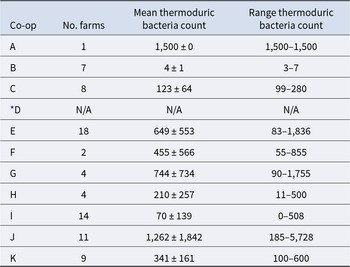
The mean, standard deviation and range values for TBC from each of the 11 co-ops are presented in Table 2. There was no significant difference (P > 0.05) between the mean TBC from each of the 11 participating co-ops. The mean, standard deviation and range values for thermoduric bacteria counts from each of the 11 co-ops are presented in Table 3. Thermoduric bacteria counts were significantly different between co-ops (P = 0.016); specifically between co-op J and co-op B (P = 0.047) and co-op J and co-op I (P = 0.013).
Total bacteria counts (TBC) for bulk tank milk from each of the 11 participating co-ops

Note: Mean, standard deviation (±) and range TBC are presented as cfu/mL.
Thermoduric bacteria counts for bulk tank milks from each of the 11 participating co-ops

Note: Mean, standard deviation (±) and range thermoduric bacteria counts are presented as cfu/mL.
* Co-op D did not test bulk tank milk for thermoduric bacteria.
Insufficiencies associated with chlorine-free cleaning practices on participating farms
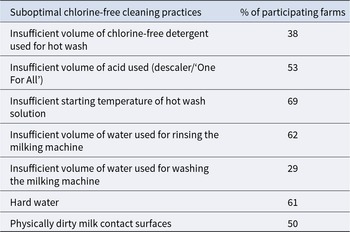
The percentage of participating farms employing suboptimal chlorine-free cleaning practices are presented in Table 4. The majority of the participating farms (61%) were using chlorine-free detergent in liquid form and 90% were using acid descalers (remaining 10% were using ‘One for All’ acids). Of the farms that were using insufficient volumes of chlorine-free detergent when ‘hot washing’ (n = 39), 62% had evidence of build-up present on the internal surfaces of claw-bowls. Fifty-one per cent of these 39 farms (n = 20) were using chlorine-free sodium hydroxide detergent in liquid form. Of the farms that were employing hot washes that were <75°C (insufficient temperature at the beginning of the cycle), just under two thirds were using chlorine-free sodium hydroxide detergent in liquid form. Of the 55 farms with hard water, 62% were using insufficient volumes of acid, 53% were using insufficient volumes of chlorine-free detergent when ‘hot washing’ and dirty claw-bowls were evident on 47% of farms. The estimated OR and associated 95% CIs for suboptimal chlorine-free cleaning practices and their influence on farm bulk milk TBC and thermoduric bacteria counts are presented in Tables 5 and 6, respectively.
The percentage of participating farms employing suboptimal chlorine-free practices

The estimated odds of employing suboptimal chlorine-free cleaning practices on farms producing high- and low-quality milk from a TBC perspective

The estimated odds of employing suboptimal chlorine-free cleaning practices on farms producing high- and low-quality milk from a thermoduric bacteria perspective

Discussion
This study shows that the volumes of detergent and required water temperature are not sufficient on some farms and this has the potential to have a negative effect on the bacterial quality of bulk tank milk. The fundamental aspects of an effective chlorine-free wash routine are sufficient volumes of detergent, acid and a hot wash starting temperature of 75–80°C (Gleeson, Reference Gleeson2018; Twomey and Gleeson, Reference Twomey and Gleeson2024). Emphasis is placed on the aforementioned factors because they compensate for the absence of chlorine. The incorrect application of chlorine-free protocols at commercial farm level may possibly be a symptom of the prolonged use of chlorine based cleaning and the simplicity that it afforded. For example, less emphasis was placed on hot water when chlorine-based cleaning was used as chlorinated chemicals are actually more stable at lower temperatures (Middleton et al., Reference Middleton, Panes, Widdas and Williams1965). That is, a lower hot wash starting temperature (minimum 70°C) (O'Brien, Reference O'Brien2016a) was required relative to that necessary for chlorine-free cleaning (75–80°C) (Gleeson, Reference Gleeson2018). Moreover, acid washing was also a minor element of chlorine-based routines, with only one acid descale wash required each week (O'Brien, Reference O'Brien2008) compared to the current requirement of a minimum of three acid washes per week when chlorine-free liquid detergents are used (Twomey and Gleeson, Reference Twomey and Gleeson2024).
The use of chlorine-free sodium hydroxide detergents is the fulcrum of a chlorine-free cleaning regimen because it is the foremost component of most recommended wash routines (Teagasc, 2017). Despite this study demonstrating that farms using insufficient volumes of detergent have a greater probability of producing high-quality milk (TBC ≤15,000 cfu/mL and thermoduric bacteria counts ≤200 cfu/mL, respectively) than low-quality milk (TBC >15,000 cfu/mL and thermoduric bacteria counts >200 cfu/mL, respectively) (Tables 3 and 4); the practice of using insufficient volumes of chlorine-free detergent needs to be addressed. Using insufficient volumes of detergent predisposes the formation of biofilms composed of organic deposits (fat and protein) on milk contact surfaces, which alongside mineral scales/milk stone results in physically dirty milking equipment (Reinemann et al., Reference Reinemann, Wolters, Billon, Lind and Rasmussen2003). Formation of biofilm/scales on milk contact surfaces provides ample conditions to accommodate bacteria, particularly thermoduric bacteria (Elias et al., Reference Elias, Songisepp, Veskioja and Rammul2017). This ultimately means that physically dirty milking equipment can become a source of thermoduric bacteria, even though thermoduric bacteria actually originate in the environment, e.g., soil/faeces (Gleeson et al., Reference Gleeson, O'Connell and Jordan2013b). Given the fact that farms with physically dirty milking equipment are 1.31 times more likely to produce milk with TBC >15,000 and 1.32 times more likely to produce milk with thermoduric bacteria counts >200 cfu/mL; it is likely that using insufficient volumes of chlorine-free detergent indirectly contributes to low milk quality.
The volume of chlorine-free detergent required to create a working solution of adequate concentration depends on whether hot or cold water is used as well as the form of detergent (liquid or powder) employed. Typically a volume of detergent equivalent to 0.5% of the overall volume of wash water is required when hot water is used (Twomey and Gleeson, Reference Twomey and Gleeson2024), e.g., 500 mL of liquid chlorine-free detergent in 100 L of water; this represents a working solution concentration of 1,200 parts per million (ppm) (Twomey and Gleeson, Reference Twomey and Gleeson2024). When cold water is used the required working solution concentration increases to 2,000 ppm (Twomey and Gleeson, Reference Twomey and Gleeson2024). This concentration can be achieved by using liquid chlorine-free detergent at a rate of 1% or a chlorine-free powder detergent at a rate of 0.5% (Twomey and Gleeson, Reference Twomey and Gleeson2024). Powder detergents can be used at 0.5% in both hot and cold water because they contain approximately threefold more sodium hydroxide (typically 75% sodium hydroxide) than liquid detergents (typically 24% sodium hydroxide) (Teagasc, 2023). The fact that just over half of the participating farms using insufficient volumes of chlorine-free detergent were using it in liquid form means that the effects of inadequate cleaning were likely to be more acute on these farms because of the lower sodium hydroxide levels present as compared to that present in powder products.
Cleaning milking equipment using acid solutions is necessary for the removal of hard water mineral deposits, scales and milk-stone (substance predominantly composed of milk and water minerals) (Leeder, Reference Leeder1956; Gleeson, Reference Gleeson2018) and a typical chlorine-free wash routine requires three acid washes per week (Twomey and Gleeson, Reference Twomey and Gleeson2024). On farms with hard water (≥100 mg/L CaCO3), an increased frequency of acid washing may be required: for example, seven acid washes and seven caustic washes per week (Gleeson and Twomey, Reference Gleeson and Twomey2023) and/or a water softener should be used (Watrous, Reference Watrous1975). Hard water is a product of high concentrations of dissolved calcium, magnesium and to a lesser extent iron in water (Watrous, Reference Watrous1975). These dissolved minerals can cause mineral scales on milk contact surfaces which can only be removed by acid solutions (Leeder, Reference Leeder1956). The significantly higher thermoduric bacteria counts on farms supplying co-op J might be attributable to hard water because certain areas of this co-ops catchment are classified as having hard water (Tedd et al., Reference Tedd, Raymond, Hunter Williams, Kelly, Lee, Carey, Doherty and Duncan2015).
The presence of hard water ions can also impede the proper function of alkali, chlorine-free detergents as they sequester the surfactants in the detergent, thereby neutralising the effect of the detergent by making it unavailable for cleaning (United States Geological Survey, 2020). This is a concern on all farms with hard water, but particularly so for those that are not using sufficient volumes of detergent, as was the case on 53% of farms identified as having hard water in this current study.
Notwithstanding, the importance of chlorine-free detergent/acid working solution concentration, it does not totally dictate the cleaning capacity of the solution, especially where hot water is used. As indicated previously, a lower working solution (1,200 ppm) is sufficient when hot washing relative to that required when cold water (2,000 ppm) is used. Hot water increases the cleaning capacity of a wash solution by two- to eightfold (Watkinson, Reference Watkinson and Tamime2008) and was found to be a protective factor with regard to milk microbiological quality in previous research (Elmoslemany et al., Reference Elmoslemany, Keefe, Dohoo and Jayarao2009). This was confirmed in the current study as farms that did not have hot water of sufficient temperature had a lower probability of delivering bulk tank milk with TBC <15,000 cfu/mL (OR = 0.68) and thermoduric bacteria counts of <200 cfu/mL (OR = 0.79). In addition to water temperature, 29% of farms used insufficient quantity of water for the wash cycle. Sixty per cent of the farms with insufficient water temperature were using chlorine-free detergent in liquid form which is much more sensitive to the use of hot water than powder detergent. Furthermore, it is imperative that the temperature of the wash solution does not decrease to less than 45°C at the end of the wash cycle (O'Brien, Reference O'Brien2016a; Gleeson, Reference Gleeson2018); otherwise, re-adherence of the soils removed during the wash is likely (Basso et al., Reference Basso, Simonato, Furlanetto and De Nardo2017). The end wash temperature was not measured in this study, so the possible impact of not maintaining temperature was not established.
Total bacteria and thermoduric bacteria counts are two distinct milk quality metrics. Therefore, farms that have a high/low TBC will not necessarily have a high/low thermoduric bacteria count and vice versa, as demonstrated in this current study. This is largely because TBC is a broad assessment of aerobic bacteria in a milk sample and can be composed of bacteria originating from both inside (mammary bacteria) and outside (environment) the udder (Blowey and Edmondson, Reference Blowey and Edmondson2010). In contrast to this, thermoduric bacteria are solely of environmental origin (Gleeson et al., Reference Gleeson, O'Connell and Jordan2013b). When these differences are considered alongside the fact that TBC and thermoduric bacteria counts are not solely influenced by milking equipment hygiene (Elmoslemany et al., Reference Elmoslemany, Keefe, Dohoo and Jayarao2009), but also by other farm management factors, i.e., having an effective milking routine that results in clusters being attached to clean, dry teats (Kelly et al., Reference Kelly, O'Sullivan, Berry, More, Meaney, O'Callaghan and O'Brien2009; Blowey and Edmondson, Reference Blowey and Edmondson2010) it is clear that effective cleaning must be employed in parallel with cow and environmental hygiene. Routinely servicing milking equipment (Fagerberg, Reference Fagerberg2007; Ryan, Reference Ryan2017) to prevent malfunctions and the presence of worn rubber ware that can act as ideal habitats for thermoduric bacteria are also vital aspects of an overall milk quality management strategy. All of the aforementioned factors that influence milk quality should be managed in concert with effective chlorine-free cleaning to maximise the quality of bulk tank milk, from both TBC and thermoduric bacteria perspectives.
Conclusion
This research has demonstrated that suboptimal chlorine-free cleaning practices are being employed on a majority of commercial dairy farms in the ROI and this is impacting the capacity to produce high-quality milk. Over half of participating farms used insufficient volumes of acid in solution and 69% used hot water of an insufficient temperature. These incorrect practices coupled with the presence of hard water and physically dirty milking equipment increase the probability of low-quality milk being produced. This research reiterates that chlorine-free cleaning will facilitate the production of high-quality milk at farm level, but it is critical that the chlorine-free washing protocols are correctly implemented in combination with a farm wide milk quality management strategy.
Supplementary material
The supplementary material for this article can be found at https://doi.org/10.1017/S0022029925101544.
Acknowledgements
Funding for this research was provided by the Irish Department of Agriculture, Food and Marine (DAFM) as part of the Food Institutional Research Measure (FIRM); Grant number 2019R555 and Dairy Research Ireland (Project number 1163). Lorna Twomey was also in receipt of a Teagasc Walsh Scholarship funded by the DAFM (FIRM) grant. The authors also wish to acknowledge the 11 milk purchasing co-ops and their respective staff and milk suppliers that participated in this study.
Competing interests
There are no conflicts of interest to report.




 Open access

