





Introduction
Schizophrenia, a chronic and debilitating psychiatric disorder, causes substantial socioeconomic burdens worldwide (Cowman et al., Reference Cowman, Holleran, Lonergan, O'Connor, Birchwood and Donohoe2021). Beyond core symptomatology, cognitive impairment has been recognized as the primary impediment to functional recovery in patients, independent of other clinical characteristics (Cowman et al., Reference Cowman, Holleran, Lonergan, O'Connor, Birchwood and Donohoe2021; Green, Horan, & Lee, Reference Green, Horan and Lee2019; McCutcheon, Keefe, & McGuire, Reference McCutcheon, Keefe and McGuire2023). Despite advances in the development of new antipsychotic drugs, current treatment strategies demonstrate limited efficacy in ameliorating cognitive impairment, leaving many patients struggling to recover (Cowman et al., Reference Cowman, Holleran, Lonergan, O'Connor, Birchwood and Donohoe2021; McCutcheon et al., Reference McCutcheon, Keefe and McGuire2023; Sinkeviciute et al., Reference Sinkeviciute, Begemann, Prikken, Oranje, Johnsen, Lei and Sommer2018). Therefore, to develop more effective treatment strategies, it is crucial to elucidate the neurobiological mechanisms underlying cognitive impairment in schizophrenia.
Dopaminergic dysfunction is one of the leading theories for the pathophysiology of schizophrenia (McCutcheon, Krystal, & Howes, Reference McCutcheon, Krystal and Howes2020). Dopamine plays a critical role in various cognitive functions across healthy individuals and patients with neuropsychiatric disorders (Cropley, Fujita, Innis, & Nathan, Reference Cropley, Fujita, Innis and Nathan2006; Takano, Reference Takano2018). However, current approved antipsychotic drugs, effective in managing psychosis through blockade of dopamine D 2 receptors, show limited success in improving cognitive impairment (Lee et al., Reference Lee, Fatouros-Bergman, Plavén-Sigray, Ikonen Victorsson, Sellgren, Erhardt and Cervenka2021; McCutcheon et al., Reference McCutcheon, Keefe and McGuire2023; Sinkeviciute et al., Reference Sinkeviciute, Begemann, Prikken, Oranje, Johnsen, Lei and Sommer2018). This disparity could be attributed to regional or circuit-specific dopamine abnormalities that contribute to the distinct clinical characteristics of schizophrenia (Howes, Bukala, & Beck, Reference Howes, Bukala and Beck2024; Weinstein et al., Reference Weinstein, Chohan, Slifstein, Kegeles, Moore and Abi-Dargham2017). For instance, subcortical hyperdopaminergia has been linked to psychosis, while cortical hypodopaminergia is suggested to be associated with cognitive impairment or negative symptoms (Howes et al., Reference Howes, Bukala and Beck2024; Weinstein et al., Reference Weinstein, Chohan, Slifstein, Kegeles, Moore and Abi-Dargham2017). Given the involvement of various mechanisms to maintain dopaminergic homeostasis in different brain regions (Brodnik, Double, España, & Jaskiw, Reference Brodnik, Double, España and Jaskiw2017; Howes et al., Reference Howes, Bukala and Beck2024; Weinstein et al., Reference Weinstein, Chohan, Slifstein, Kegeles, Moore and Abi-Dargham2017), an integrated approach is required to concurrently evaluate multiple aspects of the dopamine system to elucidate their roles in cognitive impairment in schizophrenia.
Molecular imaging is the main tool for evaluating the dopamine system in the human brain (Brugger et al., Reference Brugger, Angelescu, Abi-Dargham, Mizrahi, Shahrezaei and Howes2020; Cumming, Abi-Dargham, & Gründer, Reference Cumming, Abi-Dargham and Gründer2021). Striatum and a few subcortical regions were the primary target regions. Low levels of dopaminergic markers in other brain regions made reliable quantification difficult using conventional techniques available in clinical settings (Howes et al., Reference Howes, Bukala and Beck2024; McCutcheon et al., Reference McCutcheon, Krystal and Howes2020; Weinstein et al., Reference Weinstein, Chohan, Slifstein, Kegeles, Moore and Abi-Dargham2017). Dopamine transporter (DAT) can regulate dopaminergic homeostasis (Vaughan & Foster, Reference Vaughan and Foster2013). In the human brain, DAT is mainly disturbed in the striatum (Hall et al., Reference Hall, Halldin, Guilloteau, Chalon, Emond, Besnard and Sedvall1999), potentially explaining the more prominent role of the norepinephrine transporter in regulating cortical dopamine (Morón, Brockington, Wise, Rocha, & Hope, Reference Morón, Brockington, Wise, Rocha and Hope2002). Research on striatal DAT availability in schizophrenia has yielded inconsistent findings (Brugger et al., Reference Brugger, Angelescu, Abi-Dargham, Mizrahi, Shahrezaei and Howes2020; Howes et al., Reference Howes, Kambeitz, Kim, Stahl, Slifstein, Abi-Dargham and Kapur2012), and the link to cognitive impairment remains elusive due to a paucity of studies (Yang, Chen, Liu, Yang, & Chou, Reference Yang, Chen, Liu, Yang and Chou2022a). Interestingly, altered DAT levels could be specific to a subgroup of patients due to the high variability in striatal DAT availability in schizophrenia (Brugger et al., Reference Brugger, Angelescu, Abi-Dargham, Mizrahi, Shahrezaei and Howes2020). Considering the consistent associations between striatal DAT and cognition in various clinical groups (Chung et al., Reference Chung, Yoo, Oh, Kim, Ye, Sohn and Lee2018; Cropley et al., Reference Cropley, Fujita, Innis and Nathan2006; Yang et al., Reference Yang, Chen, Liu, Yang and Chou2022a), cognitive impairment could be a defining characteristic in patients with altered DAT levels. Therefore, the role of striatal DAT in cognitive impairment in schizophrenia deserves further investigation.
In addition to DAT, maintaining cerebral dopamine homeostasis necessitates a complex interplay between synthesis, reuptake, and release, which are tightly regulated (Best, Nijhout, & Reed, Reference Best, Nijhout and Reed2009; Okusaga et al., Reference Okusaga, Muravitskaja, Fuchs, Ashraf, Hinman, Giegling and Postolache2014; Yamamoto et al., Reference Yamamoto, Takahata, Kubota, Takano, Takeuchi, Kimura and Higuchi2021). Dopamine synthesis requires its precursor amino acids, phenylalanine and tyrosine, and brain levels of these precursors depend on blood concentrations (Bjerkenstedt et al., Reference Bjerkenstedt, Farde, Terenius, Edman, Venizelos and Wiesel2006; Leppik et al., Reference Leppik, Kriisa, Koido, Koch, Kajalaid, Haring and Zilmer2018; Wiesel et al., Reference Wiesel, Edman, Flyckt, Eriksson, Nyman, Venizelos and Bjerkenstedt2005). Moreover, branched-chain amino acids (BCAA), including leucine, isoleucine, and valine, compete with these precursors for the same transport mechanisms across the blood-brain barrier (Bjerkenstedt et al., Reference Bjerkenstedt, Farde, Terenius, Edman, Venizelos and Wiesel2006). Consequently, circulating precursor and BCAA levels can influence precursor uptake and further dopamine synthesis in the human brain. Studies have shown altered blood levels of dopamine precursors (Leppik et al., Reference Leppik, Kriisa, Koido, Koch, Kajalaid, Haring and Zilmer2018; Ma et al., Reference Ma, Gao, Zhou, Fan, Zhao, Xi and Wang2022; Okamoto et al., Reference Okamoto, Ikenouchi, Watanabe, Igata, Fujii and Yoshimura2021; Wei, Xu, Ramchand, & Hemmings, Reference Wei, Xu, Ramchand and Hemmings1995) or BCAA (Leppik et al., Reference Leppik, Kriisa, Koido, Koch, Kajalaid, Haring and Zilmer2018; Ma et al., Reference Ma, Gao, Zhou, Fan, Zhao, Xi and Wang2022; Okamoto et al., Reference Okamoto, Ikenouchi, Watanabe, Igata, Fujii and Yoshimura2021) in schizophrenia, although inconsistent results have also been reported (Davison, O'Gorman, Brennan, & Cotter, Reference Davison, O'Gorman, Brennan and Cotter2018; De Luca et al., Reference De Luca, Viggiano, Messina, Viggiano, Borlido, Viggiano and Monda2012). Significantly, these alterations have been associated with cognitive impairment (Ma et al., Reference Ma, Gao, Zhou, Fan, Zhao, Xi and Wang2022; Wiesel et al., Reference Wiesel, Edman, Flyckt, Eriksson, Nyman, Venizelos and Bjerkenstedt2005). Furthermore, phenylalanine and tyrosine are known to impact various cognitive domains in different clinical populations (Aquili, Reference Aquili2020; Dora et al., Reference Dora, Tsukamoto, Suga, Tomoo, Suzuki, Adachi and Hashimoto2023; McCann et al., Reference McCann, Aarsland, Ueland, Solvang, Nordrehaug and Giil2021; Tarn & Roth, Reference Tarn and Roth1997). Accordingly, investigating the blood levels of dopamine precursors and BCAA can help elucidate the role of the dopamine system in cognitive impairment in schizophrenia.
While striatal DAT and blood levels of dopamine precursors and BCAA are crucial aspects of the dopamine system that could contribute to cognitive impairment in schizophrenia, no research has yet examined how these dopaminergic markers interact. This study addresses this gap by employing an integrated approach to investigate the roles of striatal DAT and peripheral dopamine precursors/BCAA in cognitive impairment in schizophrenia. We hypothesized that patients with schizophrenia would exhibit poorer cognitive performance, reduced DAT availability, and altered plasma concentrations of dopamine precursors and BCAA compared to healthy controls (HC). Both altered levels of DAT and dopamine precursors would be associated with cognitive impairment.
Methods
Participants
This study received approval from the Human Ethics Committee of Taipei Veterans General Hospital (approval numbers: 2016-02-005B and 2017-12-011BC). All participants provided written informed consent before participating, and the research adhered to the Declaration of Helsinki in its latest revision. We recruited patients diagnosed with schizophrenia according to the criteria in the Diagnostic and Statistical Manual of Mental Disorders, Fifth Edition, aged between 20 and 65 years. HC were recruited from the community within the same age range and ensured that they had no first-degree relatives with a history of psychiatric disorders. Exclusion criteria were major psychiatric disorders (excluding schizophrenia in patients) or substance use disorders, as identified by the Mini-International Neuropsychiatric Interview, and a history of serious neurological or somatic problems. Participants who received medications significantly affecting DAT imaging were excluded (Chahid, Sheikh, Mitropoulos, & Booij, Reference Chahid, Sheikh, Mitropoulos and Booij2023). We rated the severity of psychopathology in patients using the Positive and Negative Syndrome Scale (PANSS) (Kay, Fiszbein, & Opler, Reference Kay, Fiszbein and Opler1987). We converted the doses of their antipsychotic drugs into the chlorpromazine equivalent doses (Leucht, Samara, Heres, & Davis, Reference Leucht, Samara, Heres and Davis2016).
Cognitive examination
A cognitive battery was administered, comprising tests to assess attention (the Go/No-Go task of Test for Attentional Performance (TAP) and the Color Trails Test), memory (the Word Lists Test and the Face Test of Wechsler Memory Scale-III), and executive function (the Wisconsin Card Sorting Test) in all participants. We computed the composite scores for each cognitive domain based on established methods (Yang, Hsieh, & Chou, Reference Yang, Hsieh and Chou2022b), with the details of the scoring process provided in the online Supplementary Methods.
Measurement of plasma marker levels
We measured plasma levels of dopaminergic precursors and BCAA using the Acquity ultra-performance liquid chromatography (UPLC) system (Waters, Milford, MA, USA) featuring a fluorescence detector. The online Supplementary Methods provide additional details on sample collection, preprocessing, and analytical methodologies.
Quantification of striatal DAT availability
Participants underwent SPECT examinations with 99mTc-TRODAT using a two-head gamma camera (E-Cam Variable Angle; Siemens Medical Systems, Erlangen, Germany) equipped with a low-energy fan-beam collimator (Yang et al., Reference Yang, Chen, Liu, Yang and Chou2022a). Magnetic resonance images were acquired using a 3.0 Tesla scanner (MR750, GE Medical Systems, Milwaukee, WI, USA) to exclude underlying intracranial pathology. We used a validated quantitative software optimized for 99mTc-TRODAT (C.-H. Wu, Yang, Chou, Wang, and Chen, Reference Wu, Yang, Chou, Wang and Chen2018) to calculate the specific uptake ratio to indicate DAT availability in four regions of interest: bilateral caudate nucleus (CN) and putamen. The occipital lobe served as a reference region. The online Supplementary Methods reported more details on image acquisition.
Statistical analysis
We employed R software (version 4.3.1, http://www.R-project.org) for statistical analyses. A two-tailed alpha level of 0.05 was predetermined for statistical significance, maintained before and after multiple comparison adjustments using the Benjamini–Hochberg procedure. The normality of continuous variables was evaluated using the Shapiro–Wilk test. Non-normally distributed variables were transformed using the R package bestNormalize (online Supplementary Table S1).
Demographic differences between groups were examined using independent t tests for continuous variables and χ2 tests for categorical variables. We used an analysis of covariance (ANCOVA) to assess group differences in cognitive performance and biological markers. Age and sex were covariates in all ANCOVA models. Additionally, years of education served as a covariate in cognitive models, while body mass index (BMI) was incorporated as a covariate for group comparisons of plasma markers.
General linear models (GLMs) were used to explore the associations between biological markers and cognition and the relationship between plasma markers and DAT availability. Age and sex were covariates in all GLMs, with years of education incorporated in models assessing cognition. We implemented a two-step analytical approach to address potential group differences in these relationships (Yang et al., Reference Yang, Liu, Liou, Hu, Yang and Chou2021). Initially, interaction terms between the group and the independent variable were incorporated into the initial GLMs to assess whether the relationships varied between the groups. Significant interaction effects prompted separate modified GLMs within each group. Conversely, models without significant interactions used all participants for subsequent modified GLMs. Finally, we calculated effect sizes for the outcomes of independent t tests, χ2 tests, and ANCOVA/GLMs using Cohen's d (suggested interpretation thresholds: small = 0.2, medium = 0.5, large = 0.8), Cramér's V (small = 0.1, medium = 0.3, large = 0.5), and partial epsilon-squared (ε2) (small = 0.01, medium = 0.06, large = 0.14) (Cohen, Reference Cohen1992).
Results
Participant characteristics
The study included 33 patients with schizophrenia and 36 HC matched for age and sex. Schizophrenia patients exhibited lower education and higher BMI levels compared to HC (Table 1). In terms of clinical characteristics of schizophrenia patients, the duration of the illness was 20.6 ± 6.1 (mean ± standard deviation) years (range: 8–40 years) with an age range of 25–58 years. Patients received antipsychotic drugs with a chlorpromazine equivalent dose of 289.7 ± 189.8 mg per day (see online Supplementary Table S2 for details) and various psychotropic medications, including anxiolytics/hypnotics (n = 22), anticholinergics (n = 12), antidepressants (n = 3), and valproate (n = 3). Additionally, seven patients with metabolic problems were prescribed antihypertensive (n = 6), antihyperlipidemic (n = 3), and antidiabetic (n = 1) medications. Their PANSS scores were 53.6 ± 14.8 (total), 12.6 ± 4.7 (positive symptoms), 15.0 ± 7.3 (negative symptoms), and 26.0 ± 7.2 (general psychopathology).
Comparisons of characteristics between healthy controls and patients with schizophrenia
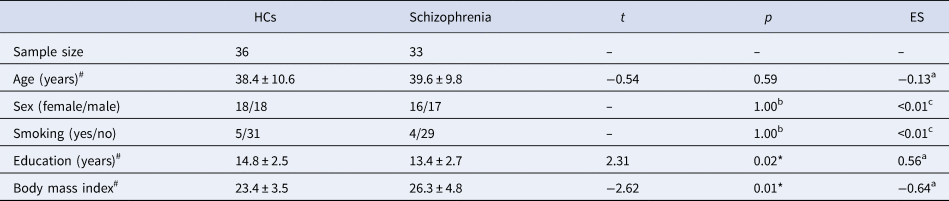
ES, effect size; HCs, healthy controls.
Mean ± standard deviation.
a Cohen's d.
b χ2 test with Yates' continuity correction (df = 1).
c Cramér's V.
# Values are normalized before statistical analysis.
* p value < 0.05 (independent t test, two-tailed).
Group comparisons of cognition and biological markers
Compared to HC, patients with schizophrenia showed significantly poorer performance in most cognitive subtests (9 out of 13), reflected by lower composite scores across all three cognitive domains: attention (F (1,62) = 20.47, p < 0.001, partial ε 2 = 0.15), memory (F (1,62) = 13.70, p < 0.001, partial ε 2 = 0.30), and executive function (F (1,61) = 5.54, p = 0.022, partial ε 2 = 0.21) (Table 2). Additionally, the patient group exhibited reduced DAT availability in all four striatal regions, decreased plasma levels of two dopaminergic precursors (phenylalanine and tyrosine) and two BCAA (leucine and isoleucine), and a lower ratio of phenylalanine plus tyrosine to BCAA than HC. Importantly, all these observed group differences remained significant after adjusting for multiple comparisons (online Supplementary Table S3). Furthermore, within the schizophrenia group, we found no significant relationships between clinical characteristics and either cognition or biological markers.
Comparisons of cognitive performance and biological markers between healthy controls and patients with schizophrenia
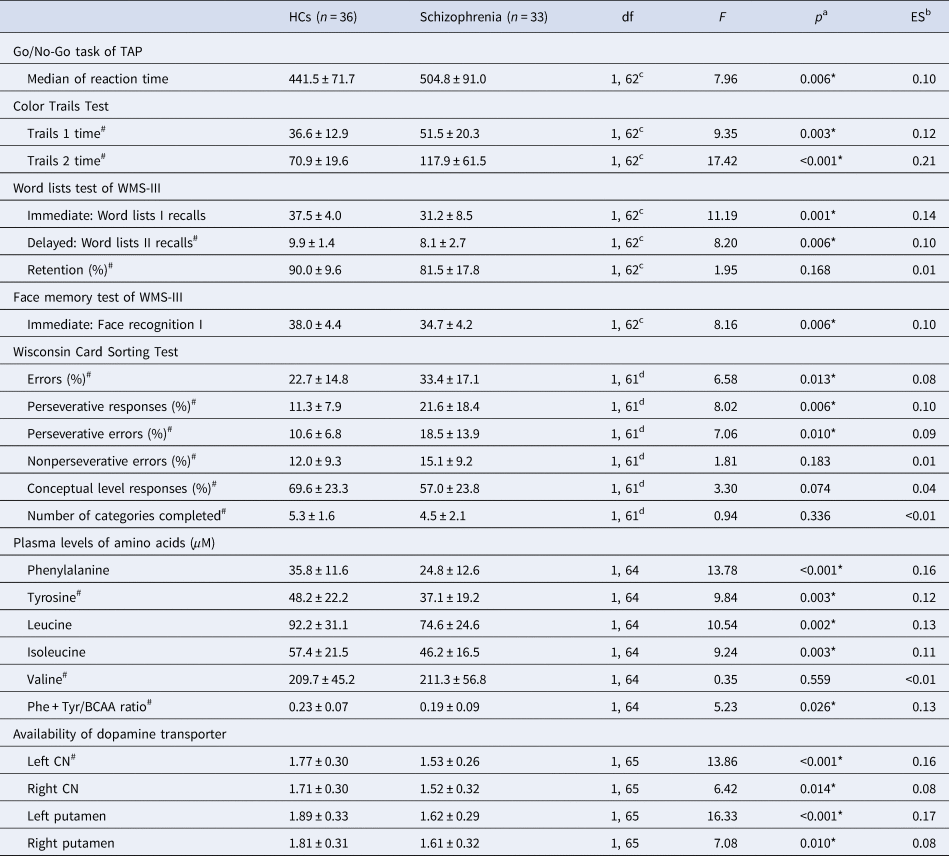
BCAA, branched-chain amino acid (leucine + isoleucine + valine); CN, caudate nucleus; df, degree of freedom; ES, effect size; HCs, healthy controls; Phe, phenylalanine; TAP, Test for Attentional Performance; Tyr, Tyrosine; WMS-III, Wechsler Memory Scale-III.
Mean ± standard deviation.
a Analyses of covariance with covariates: age, sex, and education (cognitive tests); age, sex, and body mass index (plasma amino acids); age and sex (imaging data).
b Partial epsilon-squared (ε 2).
c There are no data available for two patients with schizophrenia.
d There are no data available for three patients with schizophrenia.
# Values are normalized before statistical analysis.
* p value < 0.05 (two-tailed).
Relationships between cognition and biological markers
Among the cognition and biological markers exhibiting alterations in schizophrenia, there were significant differences between the two groups in the relationships of DAT availability in left CN or putamen with attention scores and of plasma tyrosine level or the ratio of phenylalanine plus tyrosine to BCAA with executive function scores. Consequently, we examined these four pairs of relationships between biological markers and cognition within each group while evaluating other pairs of such relationships across all participants.
For patients with schizophrenia, we observed significant positive relationships between reduced DAT availability in left CN or putamen and attention deficits. Similarly, decreased tyrosine levels or a lower ratio of phenylalanine plus tyrosine to BCAA were associated with worse executive function. HC did not exhibit these relationships (Table 3 and Fig. 1). We then examined all participants and found positive relationships between DAT availability in the right CN or putamen and memory scores. At the same time, plasma phenylalanine levels were positively associated with executive function scores (Table 4). Except for associations between DAT availability and memory scores, all observed relationships retained significance after adjusting for multiple comparisons (online Supplementary Table S4). Furthermore, we did not find significant associations between peripheral markers and striatal DAT availability.
General linear models for the biological markers associated with cognition in patients with schizophrenia
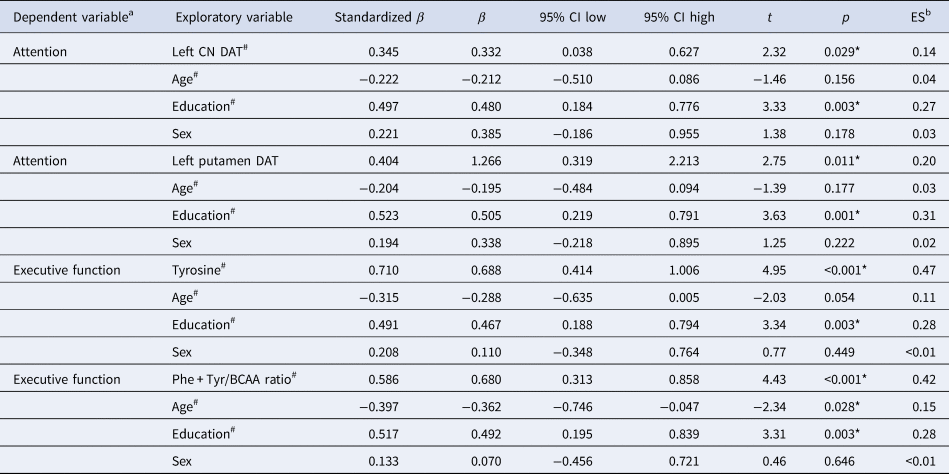
BCAA, branched-chain amino acid; CI, confidence interval; CN, caudate nucleus; DAT, dopamine transporter availability; ES, effect size; Phe, phenylalanine; Tyr, Tyrosine.
a Composite score of the cognitive domain.
b Partial epsilon-squared (ε 2).
# Values are normalized before statistical analysis.
* p value < 0.05 (two-tailed).
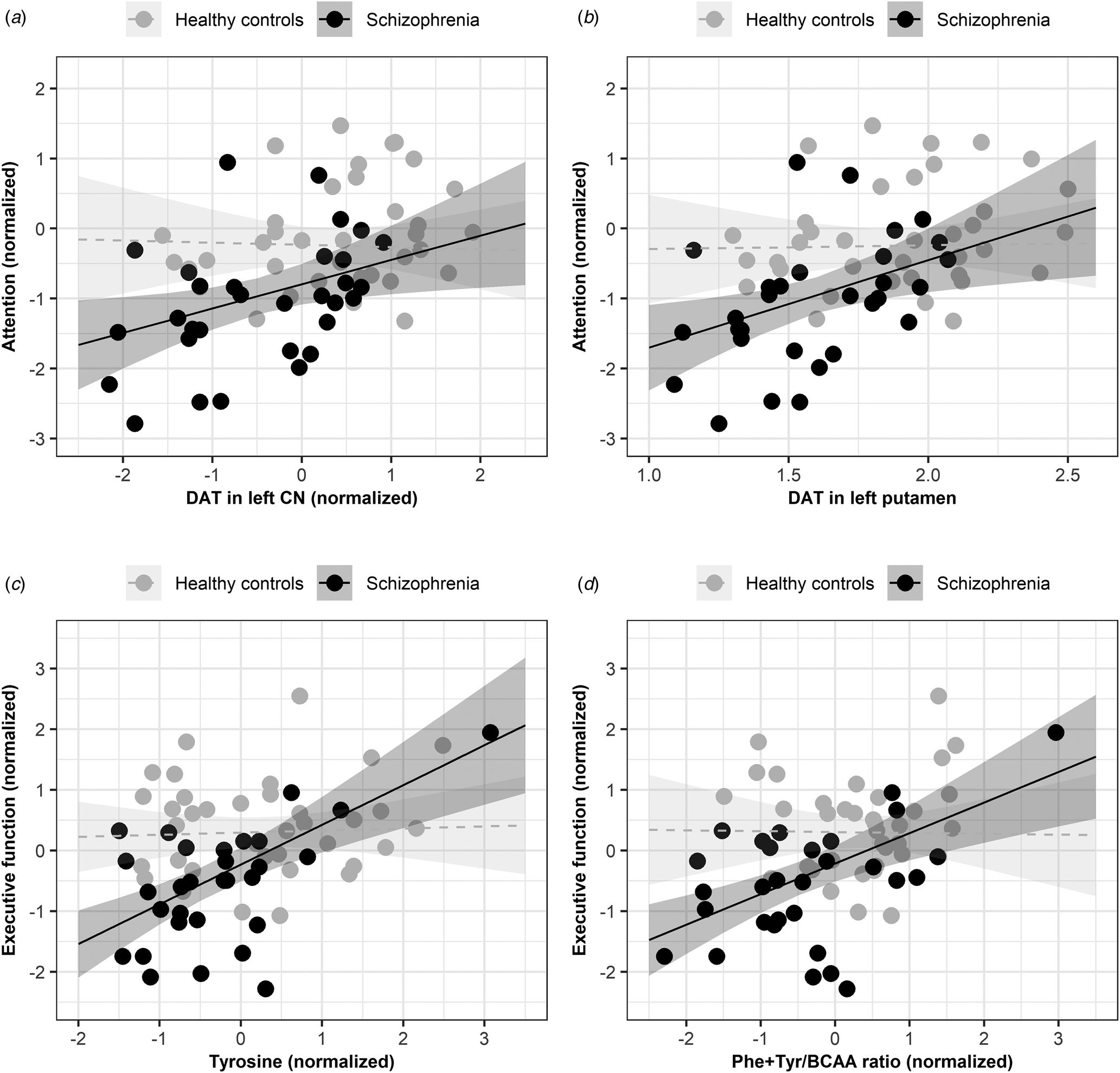
Scatter plots with linear regression lines and 95% confidence intervals illustrate the relationships between biological markers and cognitive performance in healthy controls and patients with schizophrenia. The solid lines indicated significant relationships, while the dashed lines represented nonsignificant ones. Age, sex, years of education, and group membership were covariates. All four models revealed significant group interactions for the relationships. Specifically, significant positive relationships were only observed in patients with schizophrenia but not in healthy controls (a) DAT in left CN and attention. (b) DAT in left putamen and attention. (c) Plasma concentrations of tyrosine and executive function. (d) The ratio of phenylalanine plus tyrosine to BCAA and executive function. BCAA, branched-chain amino acids; CN, caudate nucleus; DAT, dopamine transporter availability; Phe, phenylalanine; Tyr, tyrosine.
General linear models for the biological markers associated with cognition in all study participants
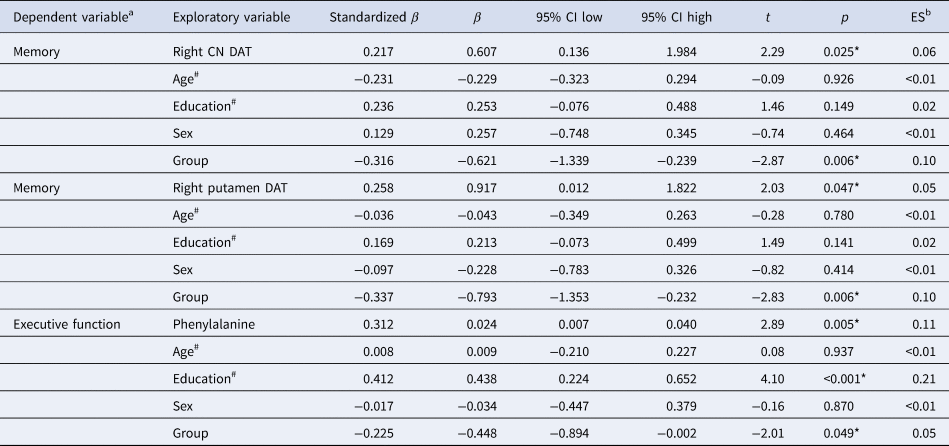
CI, confidence interval; CN, caudate nucleus; DAT, dopamine transporter availability; ES, effect size.
a Composite score of the cognitive domain.
b Partial epsilon-squared (ε 2).
# Values are normalized before statistical analysis.
* p value < 0.05 (two-tailed).
Discussion
This study investigated alterations in striatal DAT and peripheral dopaminergic markers, along with how these abnormalities relate to cognitive impairment in schizophrenia. Compared to HC, patients with schizophrenia exhibited poorer cognitive performance, reduced striatal DAT availability, and lower plasma levels of phenylalanine, tyrosine, leucine, and isoleucine, and the ratio of phenylalanine plus tyrosine to BCAA. Within the schizophrenia group, lower DAT availability in the left CN or putamen was positively associated with attention deficits. Additionally, decreased tyrosine levels and the ratio of phenylalanine plus tyrosine to BCAA exhibited positive associations with executive dysfunction. Furthermore, across all participants, DAT availability in the right CN or putamen showed a positive correlation with memory function, while plasma phenylalanine level was positively associated with executive function.
This work represents the first to combine evaluations of central and peripheral dopaminergic markers to assess their associations with cognitive impairment in schizophrenia. We observed reduced striatal DAT availability related to attention or memory deficits. At the same time, decreased levels of tyrosine, phenylalanine, and the ratio of phenylalanine plus tyrosine to BCAA were correlated with executive dysfunction. These observations expand upon previous research demonstrating links between altered striatal dopaminergic markers and cognitive impairment in schizophrenia (Takano, Reference Takano2018) and the positive relationships between reduced striatal DAT availability and attention or memory deficits in our previous work (Yang et al., Reference Yang, Chen, Liu, Yang and Chou2022a). Additionally, the present findings align with the associations of tyrosine or phenylalanine with prefrontal cortex-dependent executive functions (Ahrens, Laux, Müller, & Thiel, Reference Ahrens, Laux, Müller and Thiel2020; Aquili, Reference Aquili2020; Dora et al., Reference Dora, Tsukamoto, Suga, Tomoo, Suzuki, Adachi and Hashimoto2023).
Interestingly, previous research also indicated that tyrosine supplements primarily increase dopamine levels in the prefrontal cortex compared to the striatum (Brodnik et al., Reference Brodnik, Double, España and Jaskiw2017). This regional disparity aligns with the concept of distinct regulatory mechanisms for dopamine homeostasis across brain regions (Howes et al., Reference Howes, Bukala and Beck2024; Morón et al., Reference Morón, Brockington, Wise, Rocha and Hope2002; Weinstein et al., Reference Weinstein, Chohan, Slifstein, Kegeles, Moore and Abi-Dargham2017). Therefore, although more validation is required, these findings highlight that striatal DAT availability and peripheral dopaminergic markers could be related to distinct cognitive domains. This observation further supports the notion that regionally specific dopamine regulation abnormalities contribute to various cognitive domain impairments in schizophrenia.
The observed reductions in striatal DAT availability in schizophrenia, which correlated with attention or memory deficits, are consistent with the literature (Mateos et al., Reference Mateos, Lomeña, Parellada, Mireia, Fernandez-Egea, Pavia and Bernardo2007; Yang et al., Reference Yang, Chen, Liu, Yang and Chou2022a). As the measured availability can indicate the capacity to regulate dopamine or dopaminergic neuron integrity, reduced DAT availability reflects either downregulation of DAT expression or loss of dopaminergic neurons (Smith et al., Reference Smith, San Juan, Dang, Katz, Perkins, Burgess and Zald2018; Tseng et al., Reference Tseng, Chen, Chen, Lee, Chang, Yao and Yang2017; Vaughan & Foster, Reference Vaughan and Foster2013). Given the established striatal hyperdopaminergic state in schizophrenia (Howes et al., Reference Howes, Bukala and Beck2024; Sekiguchi, Pavey, & Dean, Reference Sekiguchi, Pavey and Dean2019) and the associations between striatal DAT availability and attention or memory functions observed across various clinical populations (Cropley et al., Reference Cropley, Fujita, Innis and Nathan2006; Itagaki et al., Reference Itagaki, Ohnishi, Toda, Sato, Matsumoto, Ito and Yabe2024; Rieckmann, Johnson, Sperling, Buckner, & Hedden, Reference Rieckmann, Johnson, Sperling, Buckner and Hedden2018; Smith et al., Reference Smith, San Juan, Dang, Katz, Perkins, Burgess and Zald2018), we posit that downregulation secondary to hyperdopaminergia is the primary cause of reduced striatal DAT availability.
Furthermore, the lack of significant alterations in striatal DAT availability in previous meta-analyses (Brugger et al., Reference Brugger, Angelescu, Abi-Dargham, Mizrahi, Shahrezaei and Howes2020; Howes et al., Reference Howes, Kambeitz, Kim, Stahl, Slifstein, Abi-Dargham and Kapur2012) could be attributed to the high variability in DAT availability reported in schizophrenia (Brugger et al., Reference Brugger, Angelescu, Abi-Dargham, Mizrahi, Shahrezaei and Howes2020), with reductions potentially limited to a subgroup of patients with significant cognitive impairment (Lewandowski et al., Reference Lewandowski, McCarthy, Öngür, Norris, Liu, Juelich and Baker2019). The clinical characteristics of our schizophrenia patients further support this notion, as most of them exhibited cognitive impairment along with reduced DAT availability, even with good clinical responses evidenced by PANSS scores (White et al., Reference White, Wigton, Joyce, Collier, Fornito and Shergill2016). In summary, our findings solidify the role of striatal DAT in cognitive impairment, particularly attention or memory deficits, in schizophrenia. It is warranted to investigate its implications for managing these cognitive deficits.
Our findings of reduced plasma concentrations of dopaminergic precursors and BCAA in schizophrenia patients corroborate previous studies (Leppik et al., Reference Leppik, Kriisa, Koido, Koch, Kajalaid, Haring and Zilmer2018; Ma et al., Reference Ma, Gao, Zhou, Fan, Zhao, Xi and Wang2022; Okamoto et al., Reference Okamoto, Ikenouchi, Watanabe, Igata, Fujii and Yoshimura2021; Wei et al., Reference Wei, Xu, Ramchand and Hemmings1995), although inconsistent findings were reported (Davison et al., Reference Davison, O'Gorman, Brennan and Cotter2018; Okusaga et al., Reference Okusaga, Muravitskaja, Fuchs, Ashraf, Hinman, Giegling and Postolache2014). These discrepancies may arise from the heterogenicity of the recruited schizophrenia patients or the methodologies for quantifying blood concentrations (Davison et al., Reference Davison, O'Gorman, Brennan and Cotter2018). Interestingly, the substantial heterogeneity in the studies with results comparable to the present work implied that these observations were not sensitive to methodological heterogeneity. Significantly, despite the observed decrease in plasma BCAA concentrations in schizophrenia, the concomitant reduction in the ratio of phenylalanine plus tyrosine to BCAA further strengthens the notion of diminished dopaminergic precursor availability in these patients.
Moreover, this work is the first to elucidate the cognitive implications of altered plasma dopaminergic precursor concentrations in schizophrenia, demonstrating positive relationships with executive dysfunction. These observations are consistent with reports of decreased blood levels of dopaminergic precursors or BCAAs in patients with dementia or cognitive decline (Conde et al., Reference Conde, Oliveira, Morais, Amaral, Sousa, Graça and Verde2024; Lista et al., Reference Lista, González-Domínguez, López-Ortiz, González-Domínguez, Menéndez, Martín-Hernández and Nisticò2023) and positive associations between these markers and cognitive function (Aquili, Reference Aquili2020; McCann et al., Reference McCann, Aarsland, Ueland, Solvang, Nordrehaug and Giil2021). As dopamine concentrations in the prefrontal cortex were sensitive to the availability of precursors (Brodnik et al., Reference Brodnik, Double, España and Jaskiw2017), the reduced plasma precursor concentrations implicated the prefrontal hypodopaminergic state in these patients. These alterations have been well-documented in schizophrenia and were associated with executive dysfunction (Howes et al., Reference Howes, Bukala and Beck2024; Weinstein et al., Reference Weinstein, Chohan, Slifstein, Kegeles, Moore and Abi-Dargham2017). In summary, the present work supported the roles of decreased plasma levels of dopaminergic precursors in executive dysfunctions in schizophrenia. More research is warranted to explore the potential treatment implications of this association.
The current findings suggest the need for various treatment approaches tailored to the specific cognitive domains of schizophrenia. Tyrosine supplementation has shown promise in enhancing cognitive function, particularly executive function, in different clinical populations (Ahrens et al., Reference Ahrens, Laux, Müller and Thiel2020; Aquili, Reference Aquili2020; Dora et al., Reference Dora, Tsukamoto, Suga, Tomoo, Suzuki, Adachi and Hashimoto2023; Thomas, Lockwood, Singh, & Deuster, Reference Thomas, Lockwood, Singh and Deuster1999). However, its application in schizophrenia requires careful consideration due to the reported inverted U-shaped relationship between dopaminergic markers and cognition (Aquili, Reference Aquili2020; Smucny, Dienel, Lewis, & Carter, Reference Smucny, Dienel, Lewis and Carter2022) and the wide range of dosing regimens employed in prior research (Ahrens et al., Reference Ahrens, Laux, Müller and Thiel2020; Aquili, Reference Aquili2020). Therefore, selecting an optimal dose is critical for maximizing therapeutic benefit. Additionally, potential adverse effects from elevated striatal dopamine levels following tyrosine supplementation warrant investigation (Howes et al., Reference Howes, Bukala and Beck2024).
Neuromodulatory techniques such as transcranial direct current stimulation (tDCS) or repetitive transcranial magnetic stimulation (rTMS) offer a promising avenue for regionally selective enhancement of the dopaminergic state (Howes et al., Reference Howes, Bukala and Beck2024; Smucny et al., Reference Smucny, Dienel, Lewis and Carter2022). Given the high density of dopamine D 1 receptors in the prefrontal cortex, D 1 receptor agonism presents a logical alternative approach, but relevant medications are not currently available (Smucny et al., Reference Smucny, Dienel, Lewis and Carter2022). On the other hand, N-acetyl-L-cysteine, an antioxidant shown to enhance DAT expression (Monti et al., Reference Monti, Zabrecky, Kremens, Liang, Wintering, Bazzan and Newberg2019), has been reported to improve cognition in patients with schizophrenia (Bradlow, Berk, Kalivas, Back, & Kanaan, Reference Bradlow, Berk, Kalivas, Back and Kanaan2022). To optimize treatment efficacy, we suggested applying pre-treatment evaluation of relevant dopaminergic markers and impaired cognitive domains to guide therapeutic selection (Conus et al., Reference Conus, Seidman, Fournier, Xin, Cleusix, Baumann and Do2018). Ultimately, these observations can inform future mechanistic and clinical studies that aim to refine treatment strategies for cognitive impairment in schizophrenia.
The current study did not identify a significant relationship between striatal DAT availability and plasma concentrations of dopaminergic precursors. There is also a lack of existing literature on this specific association. On the contrary, prior research has demonstrated relationships between striatal DAT availability and striatal dopamine synthesis capacity (Yamamoto et al., Reference Yamamoto, Takahata, Kubota, Takano, Takeuchi, Kimura and Higuchi2021) or blood levels of some amino acids (Hartstra et al., Reference Hartstra, Schüppel, Imangaliyev, Schrantee, Prodan, Collard and Nieuwdorp2020; Yang et al., Reference Yang, Chen, Liu, Yang and Chou2022a), suggesting a possible relationship between striatal DAT availability and blood concentrations of dopaminergic precursors. In light of the established various regulatory mechanisms across brain regions (Howes et al., Reference Howes, Bukala and Beck2024; Morón et al., Reference Morón, Brockington, Wise, Rocha and Hope2002; Weinstein et al., Reference Weinstein, Chohan, Slifstein, Kegeles, Moore and Abi-Dargham2017), our findings support the hypothesis that the availability of dopaminergic precursors does not primarily regulate striatal DAT availability in schizophrenia. On the other hand, associations between striatal DAT and plasma levels of metabolites involved in the methionine cycle have been reported in schizophrenia (Yang et al., Reference Yang, Chen, Liu, Yang and Chou2022a) and metabolic syndrome (Hartstra et al., Reference Hartstra, Schüppel, Imangaliyev, Schrantee, Prodan, Collard and Nieuwdorp2020), implicating the potential roles of methylation reactions or oxidative stress in DAT expressions (Kim & Andreazza, Reference Kim and Andreazza2012; Wiers et al., Reference Wiers, Lohoff, Lee, Muench, Freeman, Zehra and Volkow2018; Yang et al., Reference Yang, Chen, Liu, Yang and Chou2022a). Therefore, the absence of a link between striatal DAT and plasma dopaminergic precursors reinforces the varied regulation mechanisms for different dopaminergic markers, and diverse approaches might be needed to regulate them.
One fundamental limitation of this study is the possible confounding effect of psychotropic drugs administered to schizophrenia patients. Notably, we did not observe significant relationships between antipsychotic drug doses and cognition or biological markers. Despite a recent systemic review (Chahid et al., Reference Chahid, Sheikh, Mitropoulos and Booij2023) reporting that only Haloperidol and Bupropion, neither of which was administered in this study, significantly reduce DAT imaging, the potential influence of other psychotropic drugs on DAT imaging cannot be entirely ruled out. Antipsychotic drugs can have various effects on blood amino acid concentrations (Leppik et al., Reference Leppik, Kriisa, Koido, Koch, Kajalaid, Haring and Zilmer2018; Parksepp et al., Reference Parksepp, Leppik, Koch, Uppin, Kangro, Haring and Zilmer2020). These effects include elevations in tyrosine levels (Leppik et al., Reference Leppik, Kriisa, Koido, Koch, Kajalaid, Haring and Zilmer2018), contradicting our observations of reduced tyrosine levels in schizophrenia. Moreover, the complex interplay between antipsychotic drugs and cognitive performance, with different medications exerting varying effects (enhancing, nonsignificant, or impairing) on various cognitive domains (Baldez et al., Reference Baldez, Biazus, Rabelo-da-Ponte, Nogaro, Martins, Kunz and Czepielewski2021; Lee et al., Reference Lee, Fatouros-Bergman, Plavén-Sigray, Ikonen Victorsson, Sellgren, Erhardt and Cervenka2021; Vyas et al., Reference Vyas, Buchsbaum, Lehrer, Merrill, DeCastro, Doninger and Mukherjee2018), highlights the significant confounding influence of psychotropic drugs exposure in this study. Future research focused on drug-naive patients is warranted to replicate our findings.
Another limitation is the higher BMI levels observed in patients with schizophrenia. BMI, a known risk factor for metabolic syndrome, can influence both striatal DAT availability and blood amino acid concentrations. A recent review revealed inconsistent findings regarding the association between DAT availability and BMI: one study reported a significant negative correlation (Chen et al., Reference Chen, Yang, Yeh, Lee, Yao, Chiu and Lu2008), while four others found no such association (Pak, Seok, Lee, Kim, & Kim, Reference Pak, Seok, Lee, Kim and Kim2023). Conversely, higher BMI or related indices have been linked to increased blood concentrations of dopaminergic precursors and BCAA (Hamaya et al., Reference Hamaya, Mora, Lawler, Cook, Buring, Lee and Tobias2022; Mikkola, Salonen, Kajantie, Kautiainen, & Eriksson, Reference Mikkola, Salonen, Kajantie, Kautiainen and Eriksson2020), which contradicts the decreased levels of these markers observed in our patients with schizophrenia. To mitigate the potential confounding effects of BMI differences between groups, we included BMI as a covariate in the group comparison analyses, following the established practice of previous studies reporting higher BMI in patients with schizophrenia (Leppik et al., Reference Leppik, Kriisa, Koido, Koch, Kajalaid, Haring and Zilmer2018; Ma et al., Reference Ma, Gao, Zhou, Fan, Zhao, Xi and Wang2022; Okusaga et al., Reference Okusaga, Muravitskaja, Fuchs, Ashraf, Hinman, Giegling and Postolache2014).
Similarly, smoking, a prevalent comorbidity in schizophrenia, has a complex interaction with monoamine neurotransmission, potentially influencing striatal DAT availability and blood amino acid concentrations. While research suggests that smoking may reduce tyrosine levels, its impact on striatal DAT availability, phenylalanine, or BCAA concentrations remains inconclusive (Hamaya et al., Reference Hamaya, Mora, Lawler, Cook, Buring, Lee and Tobias2022; Mathai et al., Reference Mathai, Kanwar, Okusaga, Fuchs, Lowry, Peng and Postolache2016; Pak et al., Reference Pak, Seok, Lee, Kim and Kim2023). Given the comparable smoking rates between our study groups, it is unlikely that observed group differences in biological markers are primarily attributable to smoking. Nonetheless, future studies should apply a more detailed evaluation of smoking-related clinical characteristics to elucidate potential effects.
Furthermore, given that phenylalanine and three BCAA are essential amino acids (National Research Council, 1989), dietary habits can influence our findings, especially the frequent unhealthy nutritional patterns in schizophrenia patients (Wu, Wang, Bai, Huang, & Lee, Reference Wu, Wang, Bai, Huang and Lee2007). Remarkably, comparable reductions in these markers have been observed in diverse clinical populations with established functional implications (Aquili, Reference Aquili2020; Conde et al., Reference Conde, Oliveira, Morais, Amaral, Sousa, Graça and Verde2024; Lista et al., Reference Lista, González-Domínguez, López-Ortiz, González-Domínguez, Menéndez, Martín-Hernández and Nisticò2023; McCann et al., Reference McCann, Aarsland, Ueland, Solvang, Nordrehaug and Giil2021). These findings suggest that the present changes in schizophrenia were less likely only incidental findings caused by diet.
In addition to previously identified potential confounders, substantial heterogeneity among patients regarding age, illness duration, and clinical stage likely influenced striatal DAT availability and peripheral dopamine precursor levels (Baldez et al., Reference Baldez, Biazus, Rabelo-da-Ponte, Nogaro, Martins, Kunz and Czepielewski2021; Brugger et al., Reference Brugger, Angelescu, Abi-Dargham, Mizrahi, Shahrezaei and Howes2020). This heterogeneity probably introduced prominent variance in our outcome measures, hindering our ability to detect statistically significant results, particularly for biological markers with inherently higher variability than cognitive measures (Brugger et al., Reference Brugger, Angelescu, Abi-Dargham, Mizrahi, Shahrezaei and Howes2020; McCutcheon et al., Reference McCutcheon, Keefe and McGuire2023; Parksepp et al., Reference Parksepp, Leppik, Koch, Uppin, Kangro, Haring and Zilmer2020). Furthermore, while typical in molecular imaging studies, the relatively small sample size limited statistical power and the ability to detect potential non-linear relationships between biological markers and cognition, which precluded a comprehensive investigation of complex interactions among these variables (Aquili, Reference Aquili2020; Takano, Reference Takano2018). Further methodological limitations included the lack of specific cognitive model validation for schizophrenia patients and the inability to infer causality from the cross-sectional design. Future research should prioritize longitudinal studies to establish causality, employ larger and more homogenous patient groups, utilize validated research instruments, robustly control confounders, and explore potential non-linear relationships.
In conclusion, the present study provided further support for the involvement of the dysregulated dopamine system in cognitive impairment in schizophrenia. The observed decreased striatal DAT availability and peripheral dopaminergic precursors were consistent with the established literature on regional variations in dopaminergic abnormalities in schizophrenia. The distinct associations of striatal and peripheral dopaminergic markers with specific cognitive domain impairments align with the diverse mechanisms of dopamine regulation across brain regions and their functional roles. Future research is warranted to replicate these findings and develop targeted treatment strategies to address specific cognitive domain impairments in schizophrenia.
Supplementary material
The supplementary material for this article can be found at https://doi.org/10.1017/S0033291724002228
Acknowledgments
The authors would like to express their sincere appreciation to the staff of the Department of Radiology and Nuclear Medicine for their support in this study.
Funding statement
This work was financially supported by the Ministry of Science and Technology, Taiwan (MOST 104-2623-E-075-001-NU, MOST 105-2623-E-075-001-NU to Y.-H.C.), the Yen Tjing Ling Medical Foundation (CI-107-2 to Y.-H.C.) and Taipei Veterans General Hospital (V105C-100 to Y.-H.C.).
Competing interests
The authors declare no conflicts of interest.


 Open access

