




Introduction
The research we report here centres on the experiences and views of climate-activist teachers working in the high school years in Aotearoa New Zealand, with respect to the societal and educational response to the climate emergency. We define climate-activist teachers as educators who are actively engaged in conversations and initiatives concerning climate change, its implications for future generations, and their role as educators within this context. Teachers’ concerns about climate change are grounded in the rising awareness of humanity’s transformative impact on Earth systems in the Anthropocene (Crutzen & Stoermer, Reference Crutzen and Stoermer2000; Steffen, Reference Steffen, Williams and Taylor2022) and the dystopian futures their students might face as a consequence.
The Anthropocene is characterised by exponential trends of economic growth, resource demands, environmental degradation and climate change, resulting from the sprawling takeover of Earth by human activity and ambition. As a consequence, the resilience and sustainability of the biosphere — including human civilisation — can no longer be taken for granted (Keller et al., Reference Keller, Mateo, Punekar, Khozyem, Gertsch, Spangenberg and Adatte2018; Trisos, Merow, & Pigot, Reference Trisos, Merow and Pigot2020; Duffy et al., Reference Duffy, Schwalm, Arcus, Koch, Liang and Schipper2021; Schellnhuber et al., Reference Schellnhuber, Serdeczny, Adams, Köhler, Magdalena Otto, Schleussner, Brauch, Oswald Spring, Grin and Scheffran2016; Steffen et al., Reference Steffen, Rockström, Richardson, Lenton, Folke, Liverman and Schellnhuber2018; Steffen, Reference Steffen, Williams and Taylor2022). Because climate change is arguably the most consequential and imminent anthropogenic threat to humanity’s future, we use the summative term climate emergency (Ripple et al., Reference Ripple, Wolf, Newsome, Gregg, Lenton, Palomo and Rockström2021) to refer to this complex and multifaceted problem. We argue that efforts to mitigate and adapt to the climate emergency mandate a wide-reaching transformation of society towards sustainable practices, with challenging implications for the purpose and focus of education and the teachers who are tasked to enact it. A rapidly growing body of research centres on these implications for education (Irwin, Reference Irwin2020; Kwauk, Reference Kwauk2020; Leichenko & O’Brien, Reference Leichenko and O’Brien2020; Santone, Reference Santone2018; Tannock, Reference Tannock2021). To introduce the collective views of the authors of this paper, we refer to some of our earlier publications (Bright & Eames, Reference Bright and Eames2020; Everth et al., Reference Everth, Bright, Morey, dePetris, Gaze, Barker and Eames2021; Everth & Bright, Reference Everth and Bright2022). The lead author of this paper counts himself as a climate-activist teacher, and the motivation for undertaking this research is grounded within his personal context and concerns.
The developing focus on climate change education has been contemporary to the new materialist and posthumanist turns in social theorising and a mobilisation of the influential work by Deleuze and Guattari (Reference Deleuze and Guattari1977, Reference Deleuze and Guattari1987) in the search for a New Earth and New People (Daigle, McDonald, & ProQuest, Reference Daigle and McDonald2022; Saldanha & Stark, Reference Saldanha and Stark2016) which could lead the world out of the Anthropocene crisis. New materialism foregrounds ontology and the entangled agential relationships of matter and meaning (Barad, Reference Barad2007) within the space of what is possible, or what DeLanda (Reference DeLanda2016) calls the space of potentialities. This space, bound by the laws of physics, troubles the separation between discourse and matter, and unites the human and more-than-human worlds in one conceptual framework. MacLure (Reference MacLure2017) summarises a core tenet of new materialist theorising by stating that “[d]iscourse does not discipline matter but tangles with it in shifting assemblages” (p. 2). The work of Deleuze and Guattari (Reference Deleuze and Guattari1977, Reference Deleuze and Guattari1987) and DeLanda (Reference DeLanda2016) offers a productive theoretical framework for conceptualising and analysing the dynamics of these assemblages. Key features of assemblages are the parameters of territorialisation and coding (DeLanda, Reference DeLanda2016, p. 22). Territorialisation marks the belonging of components to assemblages, while coding determines cohesion and function within assemblages.Footnote 1 Delanda (Reference DeLanda2016) conceptualises these two parameters as tunable knobs with the potential to inform critique and decision-making for transformational change, for example within climate change education (Everth & Bright, Reference Everth and Bright2022).
Assemblage thinking has emerged as a productive research lens for understanding and navigating the complex landscape of the climate emergency. As Gillard, Gouldson, Paavola, & Van Alstine, (Reference Gillard, Gouldson, Paavola and Van Alstine2016) state, assemblage thinking assists in the search for “transformational responses to climate change” (p. 251). They argue that, by describing the complexity of the climate emergency as a Deleuzian assemblage, the “creative potential of ever-changing, and often conflicting, relations between actors (human and nonhuman alike)” is emphasised instead of a description as a “definable system” (p. 257).
Qualitative research has shifted as postqualitative approaches challenge established methodologies (Fox & Alldred, Reference Fox and Alldred2021a, Reference Fox and Alldred2021b; St. Pierre, Reference St. Pierre2019, Reference St. Pierre2021; Taylor, Reference Taylor2017). Our research with climate activist teachers started with qualitative interviews and extensive coding in a grounded theory approach (Bryant & Charmaz, Reference Bryant and Charmaz2007). However, while processing over 300,000 words of transcripts and simultaneously engaging with the work of postqualitative writers our approach pivoted toward what St. Pierre (Reference St. Pierre2019) calls an ontology of immanence. We could see from our participants’ narratives that the climate emergency already has a profound and growing deterritorialising effect on the present (Colebrook, Reference Colebrook, Harrison and Sterling2020) and we became, as St. Pierre (Reference St. Pierre2019) put it, “less interested in what is and more interested in what might be and what is coming into being” (p. 4).
Summoning posthumanist utopia: assembling education for the climate emergency
The assemblage, often grounded within a posthumanist theoretical approach, has been taken up by critical scholars as a productive and comprehensive way of approaching the climate emergency. Drawing on scholars such as Braidotti (Reference Braidotti2013), Haraway (Reference Haraway1991) and Bennett (Reference Bennett2010), Fox and Alldred (Reference Fox and Alldred2020a, Reference Fox and Alldred2020b, Reference Fox and Alldred2021c) have developed a posthumanist approach to climate change policy development by viewing economics and the environment as assemblages. Daigle et al. (Reference Daigle and McDonald2022) explore posthumanism, resistance to the present and the call for new humans through the lens of Deleuze and Guattari. Saldanha and Stark (Reference Saldanha and Stark2016) see the significance of Deleuzian ideas for the “urgent set of concerns that the Anthropocene engenders” (p. 427).
Posthumanism, per Braidotti (Reference Braidotti2013), presents a “historical moment that marks the end of the opposition between Humanism and anti-humanism” as a consequence of the “crisis of Humanism” (p. 31). Building on antihumanism and poststructuralism, posthumanism rejects forms of dualism that would separate humans from the rest of the world, centring instead on an “an environmentally integrated form of trans-individuality, and a nonunitary vision of the subject as a heterogeneous assemblage […] rejecting the transcendental power of consciousness as the organising principle and a distinctive human trait” (Braidotti, Reference Braidotti2022, pp. 3–4). Fox and Alldred (Reference Fox and Alldred2021c) argue that “[t]he entirety of the natural and social world is the environment [as a single assemblage], with nothing beyond it, and nothing (for instance, humans and their diverse cultures) excluded from it” (p. 9). These authors view humans neither as guardians or caretakers of the environment, but as “posthuman bodies [that] are intricately entangled within environment-assemblages” (p. 9).
The posthuman then becomes a discursive material assemblage that comprises the social and material environment within DeLanda’s (Reference DeLanda2016) space of potentialities. As DeLanda (Reference DeLanda2016) points out, assemblages and the space of potentialities in which they form are mutually morphogenetic; in other words, they shape each other, akin to the way matter shapes space-time which in turn shapes the trajectories of matter. Posthumanist policymaking and political activism shape the future of social-material assemblages and the potentialities of the space in which they emerge.
Posthumanism has significant implications for education, which are reflected in the recent literature. Posthumanism deconstructs the humanist educational aspirations of what it means to become human. It leaves educators, as Bayne (Reference Bayne2018) argues, “with the task of re-thinking what education is for” (p. 2). Responses to this query have begun to arise in literature. Blenkinsop, Morse, and Datura (Reference Blenkinsop, Morse and Datura2017), for instance, evoke the existentialist philosophy of Camus in their search for the posthuman rebel teacher, “working alongside others in response to overwhelming odds” (p. 595). Jeong, Sherman, and Tippins (Reference Jeong, Sherman and Tippins2021) evolve a posthumanist concept of science education for sustainability, and Sidebottom (Reference Sidebottom2021) reimagines curriculum development for posthuman times. Education is fundamentally about evoking and amplifying human capacities, yet what these capacities need to be has become uncertain as the traditional role of education as a mechanism for cultural replication is drawn into question (Irwin, Reference Irwin2020). In the times of the Anthropocene, these capacities, as Fox and Alldred (Reference Fox and Alldred2021c) and Sidebottom (Reference Sidebottom2021) argue, need to become posthuman.
Philosophising about education with respect to the climate emergency is both critical and utopian. It critically reveals structures and their behaviour that cause climate change and prevent climate action, and it is utopian in its search for solutions. Like Patton’s (Reference Patton2000) summary of Deleuzian thought, it is inherently a political activity that “summons forth new earths and new peoples” in a “complex process of reterritorialisation and deterritorialisation” of assemblages, and “is utopian in the sense that it opens up the possibility of new forms of individual and collective identity, thereby effecting the absolute deterritorialisation of the present in thought” (p. 9). Fox and Alldred (Reference Fox and Alldred2021c) point to “unusual capacities” (p. 12) of the posthuman to raise Patton’s (Reference Patton2000) utopia and address the environmental challenges we face. The process of humans becoming a posthuman assemblage, as Fox and Alldred (Reference Fox and Alldred2021c) argue, “ties justice for both posthuman and nonhuman matter inextricably to environmental sustainability” (p. 14). And we argue with Sidebottom (Reference Sidebottom2021) that the “educational precarity in the Anthropocene” (p. 3) requires decentring the human and raising posthuman assemblages according to a new curriculum framework for a sustainable future. The summoning of new and sustainable futures is becoming a central obligation for education and points toward posthumanist and new materialist philosophies as stimuli for the rethinking of education in the Anthropocene.
Method
This paper reports on one particular engagement within a larger study with 17 self-identified climate-activist teachers in Aotearoa New Zealand. We consider that climate-activist teachers act as bellwethers for the emerging dynamics of change and deterritorialisations within education as a response to the climate emergency, and we argue that interrogating their views and experiences can inform the transformation of education. The larger study collected extensive transcripts from unstructured and semistructured interviews with the participants over the course of a year (2021). Initial extensive unstructured interviews were coded in NVivo following a grounded theoretical iterative approach (Bryant & Charmaz, Reference Bryant and Charmaz2007) which resulted in a hierarchy of themes. This approach provided useful analytical concepts for the critique of the present. However, as the research progressed under the shadow of the accelerating climate emergency, our theory development became increasingly diffracted by postqualitative ideas, in particular the work of St. Pierre (Reference St. Pierre2019, Reference St. Pierre2021). This engagement with postqualitative thinking informed further engagements with the participants in the later part of the year in order to, as St. Pierre (Reference St. Pierre2019) suggests, not only “find, describe, interpret, and represent what is” (p. 9) but “to look for the conditions of emergence for what comes to be” (p. 9). In this pursuit, we report here on a particular engagement using participant-made assemblage drawings.
As part of our initial analysis we had conceptualised the educational settings of the participants, the educational leadership of the schools they worked in, as well as their persona as assemblages and discussed their interaction and overlap, resulting in the publication of interim findings (Everth & Bright, Reference Everth and Bright2022). Inspired by the work on assemblage drawings by Bazzul and Kayumova (Reference Bazzul and Kayumova2016), we asked the participants of our study to apply assemblage thinking themselves to explore their ideas and experiences by producing their own assemblage drawings. At this stage of the study, a significant rapport had been built between the researcher and the participants, who had become increasingly interested in the process and outcomes of the research. The participants were introduced to the concept of assemblages by email, in which the idea of assemblages was evolved and two papers, Bazzul and Kayumova (Reference Bazzul and Kayumova2016) and Fox and Alldred (Reference Fox and Alldred2020b), were provided to the participants for further reading.
The participants were then invited to generate two assemblage drawings in the context of the climate emergency: one of themselves as an assemblage and another of their educational institution as an assemblage. Nine participants engaged in this activity, and they produced a variety of interpretations, from textual concept maps to intricate drawings. The drawings were discussed with the participants during extended Zoom interviews to unpack their assemblages, capture their thinking and explore the semiotic capacities of the drawings themselves (Pennycook, Reference Pennycook2017, Reference Pennycook2018). This method generated a rich mix of data which problematised the separation between text and images in terms of their meaning-making potential. Participant data is presented under pseudonyms and full ethical consent was provided to use their data.
We present in this paper two of these drawings together with our interpretations. The first, Jacob’s arborescent drawing of science education, is a reflection on the actual, St. Pierre’s (Reference St. Pierre2019) ‘what is’. The second, Brent’s posthuman assemblage of himself, is stepping into virtual and into St. Pierre’s (Reference St. Pierre2019) ‘that what is coming into being’. Reflections by the first author of the paper, who conducted the interviews, are provided in italics in addition to excerpts of participant talk, the selected assemblage drawings, and discussion of research literature. We begin with a researcher reflection before exploring the two assemblage drawings.
Once I realised that humanity was not just potentially, but actually, on a path to destroy the planetary systems and the unique richness of Earth’s living ecosystems, a deep sense of sorrow filled my mind. My assemblage as a human in a world of promising modernity fell apart. The coding that had legitimised my constitution - that we humans will fix this, that technology will save us, that we will surely succeed - became meaningless. I was deterritorialised, gave up my teaching job and started researching how education could establish itself as an enabler of societal transformation in pursuit of saving this planet for my descendants.
Jacob’s arborescent drawing of science education
Jacob teaches science in a rural farming community where the local economy is dependent on dairy farming. In Aotearoa New Zealand, dairy farming produces a large amount of methane, currently our country’s most significant contribution to anthropogenic climate forcing. Jacob felt a deep sense of isolation and shared that he was the only “greenie” in his town and school. He described teaching in the time of the climate emergency as “pretty frustrating at times”. He reflected that most people in his town drove large, four-wheel-drive trucks, which were seen as an integral part of the youth culture; “having a big car is how you impress the girls, I think, for the boys. And then driving it around endlessly because there’s nothing else to do. They might sort of vaguely feel bad about all that petrol and all that carbon dioxide.”
Jacob was frustrated by the stratifications and divisions of the education system into faculties and subject areas, with no space for an integrated approach he felt was beneficial for teaching about and during the climate emergency. He produced an assemblage drawing (Figure 1) to critique the current education system and science education in particular.
Jacob’s drawing of the arboreous structure of science education.
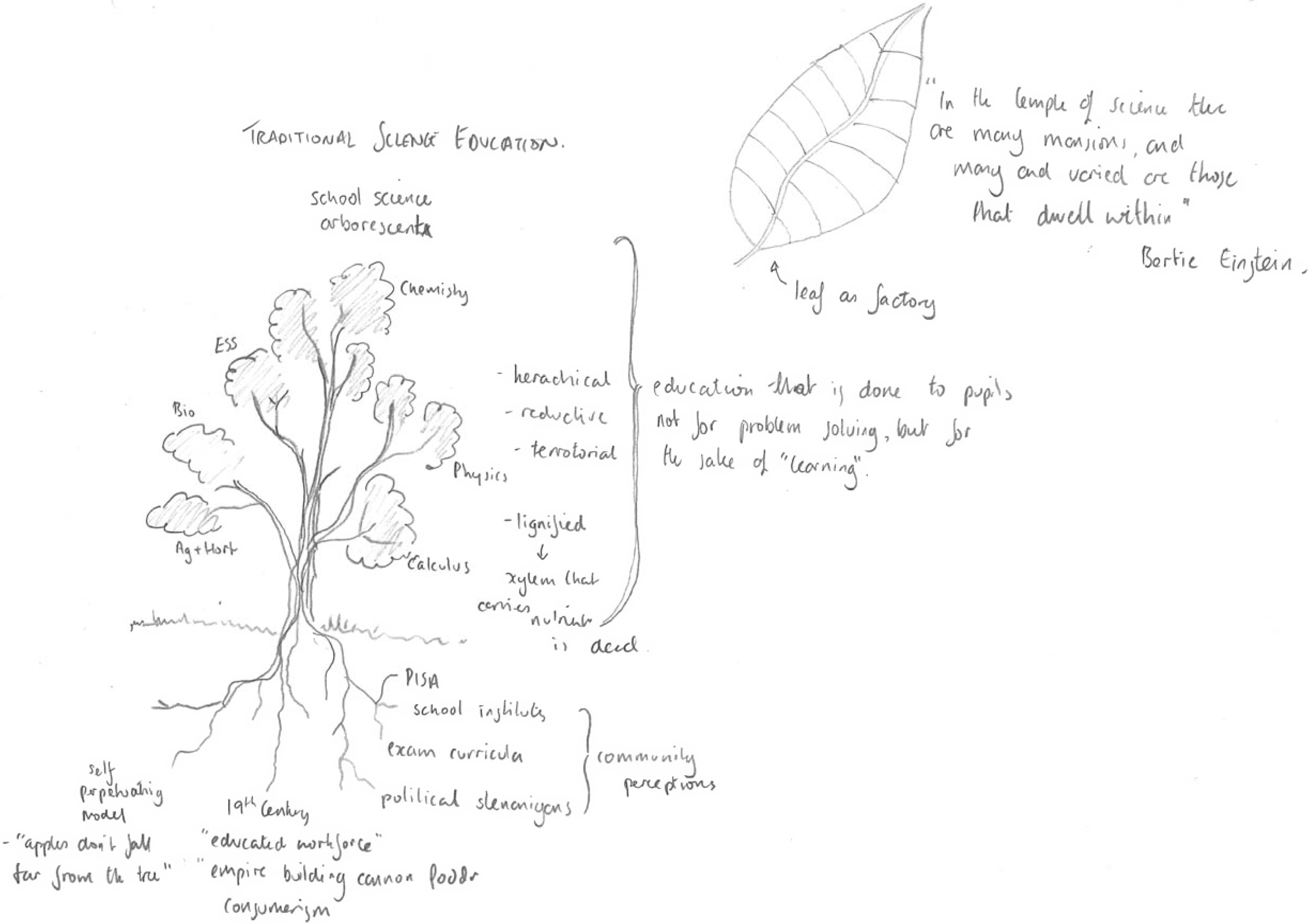
Jacob’s assemblage depicts an arborescent structure (Deleuze & Guattari, Reference Deleuze and Guattari1987, p. 17). The subject areas in education are like branches on a tree, similar in shape and connected only to the stem, but not organically networked pervasively with each other. A bidirectional flow of nutrients between the leaves on branches and the roots via the trunk keeps the tree functioning and growing.
Arborescent structures are found in evolved hierarchical systems with vertical connections that enable control, persistence and growth. They develop within DeLanda’s (Reference DeLanda2016) space of potentiality around structural attractors, and they optimise performance to govern specific societal demands through strict coding and territorialising habits (Briassoulis, Reference Briassoulis2019). These structures persist without necessarily serving a well-suited purpose when societal contexts shift. Jacob’s drawing echoes the critique of education by Bazzul and Kayumova (Reference Bazzul and Kayumova2016), who stated that institutions of science education are largely arborescent because they “work to keep practices, boundaries, and a particular distribution of materials in place” (p. 289). The structure Jacob depicts echoes a tradition of pre-humanist and humanist education that structured learning to the convenient frameworks of subjects and categorised meaning.
Jacob explained the same idea in his drawing:
It’s lignified because it’s quite structured, and it’s very, very hard to change that structure. It has become quite set in its ways. Ossified is the other word I’d use. And it branches off into separate disciplines. Like a tree branch is quite fractal, it gets smaller and more divided and more specialised. When we study science these days, we, you know, we specialise too much, I think, I think we need to go back to a more sort of an amorphous, more mutable model, that can be changed in response. Once a tree has grown, it’s grown, you can, you know, you can chop a branch off, you can prune it.
The lack of deep cross-curricular learning has been a constant frustration in my teaching. I was appalled that in New Zealand, Calculus had been removed from senior high school physics textbooks, which resulted in an artificial split between teaching physics and mathematics. Statistics is not integrated with the subjects where it is in common use outside of school contexts, and social sciences stand removed from other sciences. Students experience the deeply connected world-assemblage as a set of unconnected domains of learning and assessment through the arborescent and ossified educational structures we impose on them. It felt all so wrong.
Jacob explained that he thinks the roots of his tree of education are growing in toxic soil:
The roots are the places where we’re getting our nutrients from. But if you’re growing your tree in an environment where you’ve got to look at PISA [Programme of Internationals Student Assessment] scores, and you can have the argument about whether PISA scores are a meaningful measure of education, you know, or whether they’re just another neoliberal OECD [Organisation for Economic and Cultural Development] thing to beat teachers with, and if you’ve got these school institutes and these exam curricula and these political nutrients that are going into the tree, then your tree is going to grow in a certain way. And that’s when it becomes, you know, quite obsessed in this culture with competition, rather than cooperation. So you’re kind of growing your system, and your tree is a system in this environment that’s toxic.
Jacob offered explanations for the arborescent structures of education and dreams of a ‘wilderland’ of education where complex and diverse ecosystems sprout a healthy educational food forest from a rhizome within fertile soils:
And so we plant the seeds, but we don’t let the tree grow as it should do. It’s more like an orchard, where you’ve got row upon row of trees that have been pruned, have been controlled, and they’re all clones of one another in an orchard as well, aren’t they? They’re all, you know, they’re all grafted clones. So what we don’t have is a self-sustaining model of education. We’ve got this orchard model of education that requires a lot of input. If we had more of a sort of permaculture, horticulture, sort of a natural forest, then the lignification of it, the structure and the rigidity of it wouldn’t matter so much. Because we’d have, you know, oak trees, beech trees, whatever the succession is. But we don’t have that, you know, we haven’t got an orchard, we’ve got a plantation. And that’s not particularly healthy, I think.
Jacob’s insights, depicted in his arborescent assemblage drawing, reflect the realisation that cultural reproduction, for which the tree was optimised, is no longer sensible when the culture itself is causative of its impending demise (Irwin, Reference Irwin2020). Jacob’s arborescent structure of education is depicted as a mechanism that demands and generates conformity and extinguishes creativity. Jacob’s dreams of a ‘natural forest’ of education link to Irwin and White’s (Reference Irwin and White2021) ideas on generating and celebrating diversity as “pharmakon to this process of entropic loss of knowledge, creativity, and spirit” (p. 9) caused by ossification. These authors wonder about knowledge becoming a matter of passive conformity and consumption rather than active, reinvigorated, immanent and lived. In Irwin and White’s (Reference Irwin and White2021) focus on contemporary cultural drivers, this loss is promoted by the acceleration of exosomatic technology, digital technologies and their culture-reinforcing AI, in which real and authentic knowledge and human expertise “give way to the automated capacity of computers and robotics” (p. 7).Footnote 2 This shifts knowledge away from being actively and authentically held toward uncritical dissemination. The 20th century arborescent structures of education further enforce this conformity. In contrast, the real trees of Te Haumoana’s Tainui Trees (Irwin & White, Reference Irwin and White2021), growing for centuries after being cultivated by early Māori settlers (indigenous New Zealanders) in a diverse natural ecosystem and being part of indigenous exosomatic memories (p. 6, 11), remind of a past without the “schism between humanity and the rest of the natural world” (p. 11).
When becoming a teacher, it seemed of great importance to understand the arborescent structure in which I was to take my place. I had to assimilate myself within structures of power and tradition that define the tree’s shape; the rules of NZQA [New Zealand Qualifications Authority] assessments; the demands of measuring and performing to a coded standard; the need to grade students; to be part of a fellowship of gardeners who prune, graft and shape this tree to spoken and unspoken codes; to defend its territory. I was enculturated to send sustenance generated by dutiful teacher and student compliance down to feed the roots into Jacob’s ‘toxic soil’ which would reward me with payment of my wages and professional approval. Erring from the structure and into the Rhizomatic flows of teaching across subjects, topical topics and bending assessment standards to shape got me more than once into trouble. Delightful trouble with good endings. There is hope…
Brent’s posthuman assemblage of himself
Brent is a beginning technology teacher in rural Aotearoa New Zealand. He is highly motivated, well-versed in using digital design tools, and conscious of the world’s climate and sustainability crisis. When asked to conceptualise himself as an assemblage, Brent produced this drawing (Figure 2). Brent had not been introduced to posthumanist ideas through the research, yet his self-portrait as an assemblage appears to be a posthuman vision.
Brent’s posthuman assemblage of himself.

Brent’s vision of himself emphasises his connections to the world around him. His reflection on “the more generic way of doing assemblages” refers to two-dimensional concept map style drawings:
There were so many elements to my existence and connections, and I didn’t feel the more generic way of doing an assemblage worked for that reason. And it just becomes very convoluted. Just where am I not connected?
Brent sensed that connectedness to everything else is central to his posthuman self-image. As Fox and Alldred (Reference Fox and Alldred2021c) state, posthuman perspectives understand humans as an integral element of the environment. Yet Brent was conscious of the fact that there is more to the self than its external connections and environmental entanglement:
Where could you find me if you needed to find me in the world? And that’s kind of what that system entails. It’s just, it’s just, you know, I’m connected to something. But what’s that something, and then it kind of goes into this third tier of interconnectedness. And that’s both my transport of myself, transport of the things that come to me, and the transport of things that go from me to something else.
There is something in the centre, but you’re not quite sure what it is. And I think that’s why that view works quite well. There’s stuff that you see. And that’s the obvious stuff, and then stuff you don’t see. In a system like a school, a lot of that stuff is obvious and has to be obvious because, at some point, you might need to interact with it. Whereas an individual self, there are certain things that you may not want to know about, but you need to know about in some way, shape or form. And there’s an underbelly to an individual self. And that’s, that’s, that’s a hard thing to deal with when you put the assemblage together.
Brent’s ideas resonate with a central struggle for myself. Aware of the existential crisis that humanist hubris, colonialism and imperialism brought about, the fruits of which see me in an ultimately globally unsustainable middle-class existence, results in self-doubt. What remains once the old bastions of self-making, humanist idealism and exceptionalism are deconstructed by the global ecological and humanitarian trainwreck ‘we’ are causing? Who am I to be then? How and from where to teach and sustain hope, when the flourishing posthuman utopia I may wish to evoke seems to recede further from the grasp as war, social deprivation, and ecological tipping points are daily headline news?
Brent touches on a fundamental grappling with subjectivity in posthuman theorising and the possibility, as Callus (Reference Callus2012) argued, for “reclusiveness and the refusal of relation” that permits the placing of oneself “outside the minimal relation of being perceived by the other” (p. 293). Brent talks about the ‘underbelly’ of the self, which may wish to recuse itself from the posthuman pervasive relations to the other-than-self. Among all the connectedness and integration with the other-than-self, how does posthumanism define the self? Braidotti (Reference Braidotti2019a) suggests that it is “inappropriate to take the posthuman either as an apocalyptic or as an intrinsically subversive category, narrowing our options down to the binary: extinction-versus-liberation (of the human). We need to check both emotional reactions and resist with equal lucidity this double fallacy”; furthermore, the posthuman does not erase differences between those who are coded as human; the “post-power/ gender/ class/ race/ species relations” remain (pp. 35–36). What the posthuman offers is a more integrated knowing subject, who is “no longer the liberal individual, but a more complex transversal ensemble: of zoe/geo/techno-related factors, which include humans, as collaboratively linked to a material web of human and nonhuman agents” (Braidotti, Reference Braidotti2019b, p. 1186). How we understand our role(s) within this knowing subject is not, however, easy to intuit. Where does the self rest as a distinct valued, unique entity? Brent sees it as hidden like the invisible central element of a Rubik’s cube:
It’s like a multidimensional cube. You can move anywhere in the cube because there’s no nowhere, but there’s always a somewhere. You can always go from one corner to another, with as many or as few connections as you want. And I think that for me as an individual, this assemblage spoke clearly to me.
And then I’ve kind of got this kind of central archway, which is more of my lived experience. And that’s things like, Where do I work? Where do I sleep? Where do I cook? Where do I eat? Where do I get stuff from? Where do I hang out? Who do I meet? Where do I meet them? And all sorts of those more surface-level civilisation things. And those again, these are things that you always see, but there are things underneath that you don’t quite understand how things get to me. This is this tension. It’s a very simple system. But it’s a very simple system designed not to let you know what’s going on. And I think that’s where that quote [below] connects for me.
As Brent included in his drawing, “Nothing is really in complete control, nor is anything not in control. Everything has its place, somewhere, somehow”.
And that’s where I like kind of set and just looked at it, and I was like, hang on a moment. There’s nothing really important in the system. Like if I disappeared from the system, it would be okay. If one of those things disappeared from the system, it would probably be okay. But if you removed a whole line of it, if you removed a whole section of it? And I feel like the answer is yes. It would just get replaced with something else.
In a posthuman world, does the individual person become replaceable like a leaf on a tree? Henriksen, Creely, and Mehta (Reference Henriksen, Creely and Mehta2021) problematise individualism in posthumanism and argue, when rethinking creativity in posthumanism, even “creativity becomes not an individual and isolated process but a blossoming through the mutual connectedness of mind-body and body-ground” (p. 4). This connects to Blenkinsop et al. (Reference Blenkinsop, Morse and Datura2017) who wonder about Freedom & Flourishing in a Posthumanist Age, and with respect to the identity of teachers, eloquently invoke Camus’ novel The Plague as an analogy to “the absurdity of teaching in a time of ecological crisis” (p. 593). The authors discuss the play’s character Dr Rieux as an incarnation of an “environmental educator who enacts the rebellious paradox of negation and exaltation”. Brent wonders about his role as a climate activist teacher:
And that coming from a climate, I guess, activist teachers sort of kind of going into my first year of what do I teach people? What do I let them know? What do I let them know is important? As an individual from doing this assemblage, I realise that you’re possibly not that important in a system that’s designed around having lots of you and the system very much is designed around having lots of me. And I noticed that straight away once I put this together because it’s a visual version of it. You can see it. You can feel it.
Here Brent realises the semiotic powers emerging from his drawing. The ideas that brought this drawing about now become palpable through their realisation as an artefact to himself. Brent reflected in a later interview on the assemblage drawing engagement as an important element of his awareness building. However, Brent’s main questions remain unanswered, for himself, and likely also for many teachers who wonder how to teach in these times.
Discussion
Using participant-created assemblage drawings provided an insight into the thinking and worlds of climate activist teachers. Building on assemblage theory and applying a multimodal research approach, we probed the meaning of teachers’ ideas and experiences as expressed through their drawings and narrative. As researchers, we were inextricably involved in gathering and generating narratives at each stage. As Chandler (Reference Chandler2017) argues, “[h]uman experience is inherently multisensory”, and a new medium, such as drawings, opens up new channels where “words fail us” (p. 283) and aids in the development and exploration of complex modes of thinking. Through the representation of these drawings here, the meaning-making they evoke continues with you as a reader of this paper. The assemblage drawings from our research we discuss here show critical and visionary perspectives from the struggle towards establishing transformative climate change education.
Our choice to bring together images and texts reflects recent work conceptualising language through new materialism, which has heralded a significant shift in how language and communication are themselves ontologised. Although materially informed conceptions of language and meaning-making are not new, there has been explicit recent engagement with the work of Deleuze and Guattari through the growing body of new materialism scholarship (see, for example, Gurney & Demuro, Reference Gurney and Demuro2019; Pennycook, Reference Pennycook2017; Toohey, Reference Toohey2019). Drawing on this, we see how language functions as itself an assemblage, which interacts with and contributes to other assemblages.
An assemblage, in its multiplicity, necessarily acts on semiotic flows, material flows, and social flows simultaneously … there is no longer a tripartite division between a field of reality (the world) and a field of representation (the book) and a field of subjectivity (the author). Rather, an assemblage establishes connections between certain multiplicities drawn from each of these orders … (Deleuze & Guattari, Reference Deleuze and Guattari1987, pp. 22–23)
Adopting an assemblage frame allows us to conceptualise language “as that which is produced through the interactions between heterogeneous actants in combination and relation to each other, and determined within particular, yet ever changing, contexts” (Gurney & Demuro, Reference Gurney and Demuro2019, p. 9). Furthermore, language-as-assemblage moves away from the presumed representational quality of language and its capacity to speak about things from a distance (see Deleuze & Guattari, Reference Deleuze and Guattari1987; Demuro & Gurney, Reference Demuro and Gurney2021); rather, it positions language as a physical practice which manifests within interactions and encounters between agents (human and other) and artefacts (drawings, images, and so on). This is exemplified in the interactions between the drawings, the interviewer and interviewees, and the critical postinterview reflections, all of which contribute to meaning-making.
Jacob’s critical assemblage drawing of science education as an arborescent structure captures his critique of the education system in a compelling analogy. It identifies the territorialisation of education into faculties as a key issue preventing holistic climate change education and it depicts the relationship of the education system with the neo-liberal political soil in which it is rooted. Jacob’s drawing also corresponds to a lack of effective cross-curricular engagement that emerged as a central theme from the thematic analysis of interviews with all our participants. The wicked problems of climate change cannot be addressed by adding modules to some compartmentalised departmental curricula but require a radical reworking of education and its systems (Kwauk, Reference Kwauk2020; Santone, Reference Santone2018; Tannock, Reference Tannock2021). Tannock (Reference Tannock2021) argues that in order to enact effective climate change education we need to shift “the paradigm(s) within which school learning and knowledge are developed” (p. 53) so that the social, cultural and economic drivers of climate change can be addressed directly. The education system’s focus must pivot from the development of fractional knowledge and skills toward action competence and whole-school approaches that enable the radical social transformation that Tannock (Reference Tannock2021) calls for to address climate change effectively. The climate emergency questions the traditional role of education as a machine of cultural replication and demands that education steps forward as a lever for transformation (Irwin, Reference Irwin2020). Karl, another of our participants, stated, “[w]e actually need to stop nibbling at the edges because that’s just not going to cut it anymore. We need significant major, systemic, international, radical change to actually address these problems” (Everth & Bright, Reference Everth and Bright2022, p. 10). The education system must address the structural obstacles to this transformation.
There is no ready-made handbook for teaching in these precarious times or how teachers can form an identity that promotes their successful stance as educators in the Anthropocene. Blenkinsop et al. (Reference Blenkinsop, Morse and Datura2017) propose that “the role of environmental education ought to be one of actively undoing everything that places the human at the centre, while extending the idea of interconnection, dignity, and increasing possibility for all” (p. 592). In his insightful posthumanist assemblage drawing of himself, Brent sees himself defined by his connections to the world beyond his body. The things and structures Brent is embedded in are depicted as part of him. Brent thinks about peeling away these connected things and wonders what remains as he does. Brent finds that at his centre remains a core, a mysterious “underbelly” that is hard to know. A palpable unease about his experienced selfhood raises questions for the posthumanist project when it moves from the abstract to the concrete, from generalisations about human exceptionalism to concrete visions of freedom, autonomy, creativity and uniqueness at the level of the individual.
The current anthropocene trajectory produces end time visions of extinction and collective suicide by ecocide. Blenkinsop et al. (Reference Blenkinsop, Morse and Datura2017), in reference to Camus’ question of why humans choose life over suicide, propose a negation of collective suicide by ecocide and the affirmation of life in a more-than-human world (p. 587). This affirmation, paraphrasing Blenkinsop et al. (Reference Blenkinsop, Morse and Datura2017), will require a profound re-evaluation of individual identity through a rebellious “simultaneous, and paradoxical project of negation and exaltation” (p. 588). It requires the negation of the personal traits that contribute to ecocide and the simultaneous exaltation of life, freedom and autonomy, not of the individual as such, but the living ecosystem at large. The climate emergency sends teachers in search of their inner “rebel teacher” (Blenkinsop et al., Reference Blenkinsop, Morse and Datura2017, p. 593) and Deleuze’s nomadic quest for immanence (Tillmanns, Holland, Lorenzi, & McDonagh, Reference Tillmanns, Holland, Lorenzi and McDonagh2014, p. 9) as they contemplate their role in evoking a sustainable utopia and the generation of new people to bring it about.
Shifting the focus back from the particular engagement with climate-activist teachers we presented here to the scope and findings from the larger study we can offer some concrete steps the education systems can take to enable teacher’s engagement towards becoming nomadic changemakers (Tillmanns et al., Reference Tillmanns, Holland, Lorenzi and McDonagh2014, p. 9). Primarily we call for a deterritorialisation of the education system and the thinking of its leadership as expressed in detail in (Everth & Bright, Reference Everth and Bright2022). This would allow teachers and students much needed freedom to engage constructively and with imagination with the drawing out (educare) of the new peoples and the new ways of being we will need in order to meet the existential challenge that climate change and the anthropocene trajectory constitute for humanity.
Acknowledgements
We acknowledge the support for the PhD study that is reported on here by the University of Waikato in New Zealand.
Conflicts of Interest
None.
Financial Support
This research received no specific grant from any funding agency, commercial, or not-for-profit sectors.
Ethical Standards
Nothing to note.
Thomas Everth is a PhD candidate at the University of Waikato. He obtained a master’s degree in Physics in Germany. After a career in the IT industry, Thomas settled in New Zealand and became a teacher. He has been teaching Physics, Mathematics, IT and Earth and Space Science at high school. Thomas is currently undertaking research in Climate Change Education and is especially interested in post-humanist ontology and the relationship of society with the more-than-human world.
Dr Laura Gurney is Senior Lecturer in Te Kura Toi Tangata School of Education, University of Waikato, Hamilton, New Zealand. Her areas of interest include new materialism and posthumanism in the humanities, in particular, related to language studies; the theorisation of language and communication; and teacher learning.
Dr Chris Eames is an Associate Professor in the Technology, Environmental, Mathematics and Science Education Research Centre (TEMS) located within the Te Kura Toi Tangata School of Education, University of Waikato, Hamilton, New Zealand. He teaches pre-service and in-service teacher education students in environmental and sustainability education, and science education. He has a number of Master’s and doctoral research students studying climate change education and activism, environmental education curriculum and learning progression, as well as pedagogical content knowledge and STEM learning.

 Open access

