


Introduction
The proportion of White evangelicals in America has been steadily declining. America is no longer demographically a majority White Christian nation (Jones Reference Jones2016). According to the 2023 Public Religion Research Institute’s Census of American Religion, surveys indicate that while 23% identified as White evangelical Protestant in 2006, this number has steadily declined to 13.4% in 2023. The number of White Catholics and White mainline Protestants has also steadily fallen. However, not as drastically as White evangelical Protestants (Cox and Jones Reference Cox and Jones2017). Across race and religion, currently, 15% of Latinos identify as evangelical Protestants (Pew Research Center 2023, 12% of Asian Americans identify as evangelical Protestants (PRRI 2023), and 14% of Black evangelicals identify as evangelical Protestants (Pew Research Center 2021). Even though the White evangelical share of the electorate is declining, it is notable that their share of the voting electorate has often been above their overall share of the population in the United States (Edsall Reference Edsall2019).
What explains the voter turnout of evangelical Americans? The goal of this paper is to explain the democratic participation of evangelicals, with attention to how similar influences have varying impacts on White, Black, Latino, and Asian American evangelicals. In response to evangelicals’ safeguarding of Christian nationalism amidst demographic change (Perry and Whitehead Reference Perry and Whitehead2019; Perry et al. Reference Perry, Cobb, Whitehead and Grubbs2022), it is all the more important to understand how concerns and attitudes about race shape the voter participation of evangelical communities across the racial divide differently.
An explanation I elaborate on in this paper is that the mobilization of evangelicals to turn out to vote is on the basis of their racial attitudes. However, the influence of racial resentment on voter turnout is deeply complicated by evangelicals’ own racial/ethnic background. Drawing from conflict decision theories (Lau and Redlawsk Reference Lau and Redlawsk2006; Redlawsk Reference Redlawsk2004; Tversky and Shafir Reference Tversky and Shafir1992), I suggest that Black evangelicals may be hindered from participating in elections on the basis of their racial conservatism due to an internal conflict they might face between their religious identity juxtaposed with their identity as a racial minority in the United States. This is accompanied by unique demands even for Black evangelicals to comply with racialized social norms within the Black community (White and Laird Reference White and Laird2020). On the other hand, White evangelicals are mobilized by their racial resentment to vote. Their “overlapping” religious and racial identities (Perry Reference Perry2023) provide a condition under which racial conservatism motivates, rather than hinders, electoral participation. Given the presence of some anti-Black affect among Latinos and Asian Americans (Krupnikov and Piston Reference Krupnikov and Piston2016; Peterson and Riley Reference Peterson and Riley2022; Tokeshi Reference Tokeshi2023; and Pérez, Robertson, and Vicuña Reference Pérez, Robertson and Vicuña2023), racial resentment can also mobilize non-Black evangelicals of color to turn out to vote.
Utilizing the 2020 Collaborative Multiracial Post-Election Survey (CMPS), I conduct an analysis of how racial attitudes shape the voter turnout of evangelicals across four major racial/ethnic groups, following the work of Wong (Reference Wong2018)—which urges the disaggregation of religious communities by race. I find that White, Asian, and, to an extent, Latino evangelicals act on their racial resentment and mobilize to participate in elections. However, holding the same levels of racial conservatism is associated with different voting behavior patterns among Black evangelicals. That is, rather than political mobilization, racial resentment is related to sitting out elections uniquely among Black evangelicals.
This paper speaks to a tradition in the literature that notes the importance of race among the religious when considering political outcomes (Calhoun-Brown Reference Calhoun-Brown1998; McDaniel and Ellison Reference McDaniel and Ellison2008; Lockerbie Reference Lockerbie2013; Brown and Brown Reference Brown and Brown2015; Edwards Reference Edwards2016; and Brown et al. Reference Brown, Brown, Phoenix and Jackson2016). Expanding on recent work that has drawn attention to race and religion in politics among White Christians and evangelicals (DeMora et al. Reference DeMora, Merolla, Newman and Zechmeister2021; DeMora et al. Reference DeMora, Merolla, Newman and Zechmeister2024), this paper additionally conducts a full cross-racial analysis of evangelicals, considerate of White, Black, and immigrant-populated groups, inclusive of Latino and Asian American evangelicals (Wong Reference Wong2018). The paper not only extends the literature related to religion and political participation by considering pathways to voter turnout among evangelicals, but central to this paper’s contribution is to better heed Wong’s (Reference Wong2018) call to add needed nuance to disaggregate evangelicals by their racial group, especially in an era of demographic change.
In the following sections, I synthesize the literature concerning religion and political participation together with scholarship on the role of racial attitudes in American political behavior.Footnote 1 Then, I present my theoretical argument, which draws from various approaches in social psychology—such as conflict decision theory, which can inform our understanding about the voter behavior of evangelicals across the racial divide. I then turn to an empirical test of how racial attitudes are associated differently with voter turnout, disaggregating analyses by Black, White, Latino, and Asian American evangelicals, using the 2020 CMPS. The paper concludes by emphasizing how the politics of evangelicals are deeply complicated by race and, further, have implications for understanding how the same factors can mold different pathways to voter behavior depending on a multiplicity of various social identities.
The Religious Underpinning of Political Participation
Early studies of political participation, for example, from the Civic Voluntarism model (Verba, Schlozman, and Brady Reference Verba, Schlozman and Brady1995), note that the public takes political action because they want to, because they can, or because they are asked to. In examining the factors that shape political action, they centralize the role of civic organizations, pointing to the potential mobilization role of the church. Scholars have followed in this line of work, noting that religious affiliation matters for political activity (Peterson Reference Peterson1992; Jelen Reference Jelen1998; Jones-Correa and Leal Reference Jones-Correa and Leal2001; Wong et al. Reference Wong, Ramakrishnan, Lee and Junn2011, to name a few). Various theories have been offered to explain the positive relationship between religion and participation. The church helps attendees develop civic skills that, while inherently might be non-political, can become applicable to involvement in political life (Wald, Owen, and Hill Reference Wald, Owen and Hill1988; Peterson Reference Peterson1992; Verba, Schlozman, and Brady Reference Verba, Schlozman and Brady1995; Greenberg Reference Greenberg2000; Djupe, Sokhey, and Gilbert Reference Djupe, Sokhey and Gilbert2007). Recruitment and outreach can also happen in the context of the church as a civic organization, which also facilitates more political participation (Rosenstone and Hansen Reference Rosenstone and Hansen1993; Djupe and Grant Reference Djupe and Grant2001; Jones-Correa and Leal Reference Jones-Correa and Leal2001).
The influence of religion may also depend on the development of a civically engaged mindset. Religion may alter psychological factors associated with political action, such as increasing political information and knowledge (Wald, Owen, and Hill Reference Wald, Owen and Hill1988; Harris Reference Harris1994; Jones-Correa and Leal Reference Jones-Correa and Leal2001). Another form of psychological engagement fostered within the church, such as a politicized racial consciousness (Tate Reference Tate1991; Calhoun-Brown Reference Calhoun-Brown1996; McClerking and McDaniel Reference McClerking and McDaniel2005; Chan and Phoenix Reference Chan and Phoenix2020), or perceived in-group identification, belonging, and solidarity found within the structures of religious communities, can stimulate political activity for Muslim Americans (Jamal Reference Jamal2005; Ocampo, Dana, and Barreto Reference Ocampo, Dana and Barreto2018).
Scholars have also sought out to address pathways to political involvement, comparing mainline and evangelical Christians. Addressing how evangelicalism influences political participation, scholars have relied on the lifestyle defense theory. Such an explanation notes that evangelicals are more politically active in order to fend off threats to Christian values and to match their religious beliefs with their politics (Page and Clelland Reference Page and Clelland1978; Lorentzen Reference Lorentzen1980; Conover Reference Conover1983; James and Green Reference James and Green1987; Glazier Reference Glazier2015). Smith and Walker Reference Smith and Walker2013) note that since evangelicals are often more spiritually committed than mainline Protestants, the former are more able to “recognize the connection between their religious beliefs… and politics, with the result that they have formed a habit of voting.”
Yet, a symbolic politics approach, which has been applied to the study of evangelicals’ political participation by race, suggests that individuals’ affective attitudes toward social groups are important for their political decisions (Sears et al. Reference Sears, Lau, Tyler and Allen1980; Kinder and Sears Reference Kinder and Sears1981; Jelen Reference Jelen1991). Calhoun-Brown (Reference Calhoun-Brown1998) argues that the political behavior of Black evangelicals is influenced by affective attitudes toward salient political symbols and underlying feelings one has toward social groups. We elaborate more on how this theoretical approach fits in with our main argument in the next section.
How Racial and Religious Identities Condition the Role of Racial Attitudes in American Voter Participation
Given that scholars have continuously emphasized the centrality of race in American politics (Hutchings and Valentino Reference Hutchings and Valentino2004; Tesler Reference Tesler2016; Cramer Reference Cramer2020), we should examine how racial attitudes influence voter participation. Further though, we ought to consider the possibility that racial attitudes can consequently both mobilize or impede political action, depending on the compounding racial and religious identities that individuals can hold. Adding to the symbolic politics approach to political behavior among evangelicals, I argue that similar attitudes about race should elicit different political responses when considering Black versus White, Latino, and Asian American evangelicals.
There has been an emerging literature examining how racial resentment shapes political participation (Krupnikov and Piston Reference Krupnikov and Piston2015; Algara and Hale Reference Algara and Hale2023; and Banda and Cassese Reference Banda and Cassese2022) as an alternative—yet still important—outcome to public opinion (for example, Kinder and Sears Reference Kinder and Sears1981; Kinder and Sanders Reference Kinder and Sanders1996; Hutchings Reference Hutchings2009; Maxwell and Shields Reference Maxwell and Shields2014; Tesler Reference Tesler2016; Enders and Scott Reference Enders and Scott2019). This is even though this relationship between racial attitudes and voter turnout has been largely examined only among White Americans across the partisan divide. Crucial to my argument is that racial resentment’s impact on voter turnout depends on the multiplicity of identities that individuals hold. I posit that racial resentment should increase the voter turnout likelihood among White, Latino, and Asian American evangelicals. However, Black evangelicals holding conservative attitudes about their own racial in-group should be less likely to vote in elections. This argument is guided by theories in social and political psychology such as conflict decision theory and racialized social pressure.
Theories of conflict decision-making can inform our understanding of the political behavior of evangelicals across racial groups in the United States. According to Lau and Redlawsk (Reference Lau and Redlawsk2006), choosing between candidates in a given election requires processing and evaluating relevant political information. This is followed by a selection of one alternative over the other. However, individuals cannot consider all characteristics when choosing between all possible alternatives when making a decision. They can only rely on such attributes that are most important to them (Redlawsk Reference Redlawsk2004). Tversky and Shafir (Reference Tversky and Shafir1992) note that a decision conflict may arise where neither of the alternatives is appealing based on various attributes that are important to that individual, ultimately decreasing one’s likelihood of taking an action at all.
Such conflicts are probable when considering politically relevant identities such as race and partisanship. Krupnikov and Piston (Reference Krupnikov and Piston2015) find that voter turnout can be depressed among strong partisan, racially prejudiced Whites in elections when African American candidates are running. Further, Banda and Cassese (Reference Banda and Cassese2022) find that White Democrats can feel “cross-pressured,” as those with conservative views on race (and gender) are less likely to turn out to vote. This is while White Republicans with more conservative attitudes toward race are more likely to participate in elections, a finding that aligns with work by Algara and Hale (Reference Algara and Hale2023) and Cepuran and Berry (Reference Cepuran and Berry2022). These studies reinforce the importance of noting how multiple social identities can structure the relationship between racial attitudes and political behavior.
However, in politics, what can be said about religious identities? Margolis (Reference Margolis2018) notes that evangelicals may also be prone to cross-cutting pressure because of their religious and partisan identities; there is also some evidence that religious and gender identity can impact political decisions (Cassese Reference Cassese2020). Additionally, the main argument in this paper here is that other compounding social identities are important when making the decision to head to the ballot box. Particularly in the context of contemporary elections, race and religion have had serious political salience. For example, recent work demonstrates that the effect of xenophobia strongly predicted views of Donald Trump in 2020, suggesting that Christian nationalism is connected to fears about ethnoracial outsiders (Baker, Perry, and Whitehead Reference Baker, Perry and Whitehead2020). This makes sense during the racialized climate surrounding the year 2020, when Black Lives Matter protests were occurring after the killing of George Floyd (Reny and Newman Reference Reny and Newman2021) and during the rise of anti-Asian hate during the pandemic (Chan, Kim, and Leung Reference Chan, Kim and Leung2022; Chan, Nguy, and Masuoka 2020; Chan and Leung Reference Chan and Leung2024). The political impact of racial considerations is further contingent on “ethno-religious overlapping identities” (Perry Reference Perry2023), aligning with research that demonstrates how out-group hostility, especially toward racial minorities, can influence White evangelical public opinion (Marsh Reference Marsh2021; Allen and Olson Reference Allen and Olson2022).
Keeping in mind that race complicates the interplay between religion and politics in America (Wong Reference Wong2018; Perry et al. Reference Perry, Cobb, Whitehead and Grubbs2022; Perry and Whitehead Reference Perry and Whitehead2019; Perry and McDaniel Reference Perry and McDaniel2023; and McDaniel, Nooruddin, and Shortle Reference McDaniel, Nooruddin and Shortle2022), I additionally emphasize this point by arguing that these two identity forces, race and religion, can compete or complement each other. As Wong (Reference Wong2019) puts it, in regard to studying the politics of evangelicals, one must attend to race.
I contend that White evangelicals translate and connect their racial animus to voting. Along racial and religious lines, White evangelicals represent a case of identity alignment. White evangelicals have increasingly been a strong base of support for the Republican Party and for racially conservative candidates. This is because partisanship is closely tied and aligned to their religious identity (Jelen and Wald Reference Jelen, Wald, Rozell and Clyde2018). Margolis (Reference Margolis2019) attributes White evangelical support for certain Republican candidates to negative partisanship in more recent elections, while other scholars have noted that this trend has persisted over time (Patrikios Reference Patrikios2008; Putnam and Campbell Reference Putnam and Campbell2012). Partisans have been increasingly sorted on racial and religious lines, among other social identities (Mason Reference Mason2018). Given this, racial resentment motivates voter turnout among identity-aligned racial and religious groups, specifically among White evangelicals.
As the influence of racial resentment on voter turnout is contingent on these very racial and religious identities, I posit that Black evangelicals, who might even still hold negative in-group racial attitudes (Kam and Burge Reference Kam and Burge2019; Sommer and Franco Reference Sommer and Franco2024), are not as influenced to vote at the ballot box by their own racial conservatism. Elaborating on what was previewed earlier, Black evangelicals are more likely to experience a decision conflict between attributes that are important to them related to race and religion. That is, unlike White evangelicals, where their racial attitudes can be aligned with their racial and religious identities, holding racial conservatism among Black evangelicals is often misaligned with norms of their racial and religious identities.
It is worth mentioning that the literature on racial attitudes was developed to gauge their influence on the political behavior of White Americans (Kinder and Sears Reference Kinder and Sears1981; Kinder and Sanders Reference Kinder and Sanders1996). However, recent work has additionally examined the applicability of this racial attitudes framework among Black Americans themselves as well. This is even though Black Americans might view the structural causes of racial inequality differently than White Americans (Kam and Burge Reference Kam and Burge2018). At times, Black Americans can harbor negative attitudes toward other Black individuals (Kam and Burge Reference Kam and Burge2019; Peterson and Riley Reference Peterson and Riley2022). Further, this racial resentment among Black Americans can, at times, influence the group’s public opinion (Kam and Burge Reference Kam and Burge2019; Peterson and Riley Reference Peterson and Riley2022; Martinez and Alamillo Reference Martinez and Alamillo2024).
Other theoretical frameworks that examine racism within the Black community are also tangentially related and worth discussing. Work in social and clinical psychology has examined the levels and the impacts of internalized racism or internalized racial oppression among Black Americans (Pyke Reference Pyke2010; Bailey et al. Reference Bailey, Chung, Williams, Singh and Terrell2011; Bailey, Williams, and Favors Reference Bailey, Williams, Favors and EJR2014; Banks and Stephens Reference Banks and Stephens2018; David, Schroeder, and Fernandez Reference David, Schroeder and Fernandez2019). Lastly, system justification theory suggests that there are members of disadvantaged communities that may defend and support existing socio-political systems (Jost and Banaji Reference Jost and Banaji1994; Jost, Banaji, and Nosek Reference Jost, Banaji and Nosek2004; for further application of system justification theory to political science, see Pérez et al. Reference Pérez, Alhambra, Nguy, Bielskis, Chabane, Gudino, Katz, Liu, Mojica and Zhou2024; Goh and Chan Reference Goh and Chan2025 and Pérez et al. Reference Pérez, Rogbeer, Tran, Huynh, Ortiz, Crossley, Halili, Lee, Lempert, Morel and Passananti2025).
Nonetheless, even though the literature suggests the presence and salience of some racial conservatism in Black communities, I contend, though, that holding the same racial attitudes does not always translate equivalently to the same political behaviors. I argue that even as Black evangelicals may hold more conservative attitudes about race, they may not politically act on them like White evangelicals because they may consider their own positioning as a member of a minoritized racial group themselves that is often accompanied by pre-existing racialized Black social norms. Among the Black community, White and Laird (Reference White and Laird2020) note that there are internalized beliefs in racial group solidarity accompanied by social pressure, which may depress self-interested behavior. To prioritize racial group-based norms at the expense of one’s own self-interest allows for defected group members to maintain social ties with others in their racial in-group. Other research demonstrates the uniqueness of Black racial solidarity due to their experiences with institutionalized prejudice, racism, and discrimination (Dawson Reference Dawson1995; Sears and Savalei Reference Sears and Savalei2006; Masuoka and Junn Reference Masuoka and Junn2013), which in turn has spurred a more unique relationship between these perceived norms, racial solidarity, and Black political behavior.
Even Black evangelicals may feel pressure to abide by strongly held group-based racialized norms and thus experience a conflict in their decision to participate because of their attitudes about race. Therefore, even when Black evangelicals do hold conservative stances about race, they are confronted with Black co-ethnics that they may still want to affiliate with. Such pressure motivates a conflict in their decision based on two key social identities that are important: racial and religious identities. This conflict decision suggests that more racial resentment should be associated with staying home on election day among Black evangelicals.
I have argued that among White evangelicals, there is less misalignment between religious identity, racial identity, and possible racial resentment. As such, racial conservatism can foster greater voter participation on Election Day. Black evangelicals, on the other hand, are more constrained to follow racial group interest over self-interest (White and Laird Reference White and Laird2020). Pressure among racially conservative Black evangelicals to follow existing norms within the Black community may induce a decision conflict. This impedes the influence of racial resentment on voter turnout among Black evangelicals. Instead of mobilizing voter turnout, Black evangelicals holding more racial conservatism makes voting less likely.
What can be said additionally about the relationship between racial resentment and voter turnout among Latino and Asian American evangelicals? There is research to suggest the presence of some anti-Blackness even in these communities. That is, people of color themselves can also express anti-Black prejudice, especially to cope with their own senses of marginalization (Pérez, Robertson, and Vicuña Reference Pérez, Robertson and Vicuña2023). While Latino and Asian American evangelicals’ racial and religious identities are not as neatly aligned as those of White evangelicals, nor as conflicted as in the case of Black evangelicals, we might still expect then that racial conservatism can mobilize their voter participation more than Latino and Asian American non-evangelicals. That is, this is possible because evangelicalism is still tied to more conservative values—allowing for the electoral expression of racial animosity among non-Black evangelicals of color and Latino and Asian American evangelicals (see Figure 1).
Distributions of evangelical identity by racial/ethnic group

Note: Percentage of respondents in 2020 CMPS that identify as evangelical by racial/ethnic group. Data is weighted.
The literature, while not having looked specifically at evangelical communities, shows that racial resentment can shape the politics of Latino and Asian American groups. Krupnikov and Piston (Reference Krupnikov and Piston2016) write that Latinos are not free from prejudice against Black Americans and find that their opinions on racialized public policies are indeed shaped by prejudice against Black Americans. The role of anti-Black affect is not exclusive to White and Black Americans and has included shaping the politics of people of color, including Latinos (Ditonto, Lau, and Sears Reference Ditonto, Lau and Sears2013; Lopez and Pantoja Reference Lopez and Pantoja2004).Footnote 2 Tokeshi (Reference Tokeshi2023) illuminates how anti-Black attitudes influence public opinion among Asian Americans. In another comprehensive study of racial resentment among people of color, Peterson and Riley (Reference Peterson and Riley2022) find that not only do some racial minorities harbor negative sentiments toward Black people, but also that this racial conservatism shapes the politics of racial groups, inclusive of communities of color—Latinos and Asian Americans. I, therefore, expect that racial resentment should also motivate the voter participation of not as much Latino and Asian American non-evangelicals, but specifically among Latino and Asian American evangelicals—the latter of whom might be more accustomed to a theology and culture that might, albeit unintentionally, reinforce racial inequality (Emerson and Smith Reference Emerson and Smith2000).
Hypotheses
My hypotheses can be summarized as follows: Stronger racial resentment should be associated with a higher likelihood of turning out to vote among White evangelicals (H1a), Latino evangelicals (H1b), and Asian American evangelicals (H1c). On the other hand, racial resentment should not be associated with higher voter turnout among White (H2a), Latino (H2b), and Asian Americans (H2c) who do not identify as evangelical. Addressing the impact of attitudes toward their own racial in-group, I expect that more racial resentment is associated with a lower likelihood of voting among both Black evangelicals (H3a) and Black non-evangelicals (H3b). That is, across Black Americans—regardless of evangelical identity—holding stronger levels of racial resentment toward their own racial group may induce a conflict decision, which tempers the association between racial conservatism and voter participation.
Data and Methods
Given that our question seeks to compare the influence of racial resentment on voter turnout across evangelicals of different racial backgrounds, I must rely on a dataset that oversamples for respondents across racial and religious groups. I seek to understand the political behaviors of White, Black, Latino, and Asian Americans—both for those who identify and do not identify as evangelical. Therefore, I utilize the 2020 CMPS conducted by Frasure et al. (Reference Frasure, Wong, Vargas and Barreto2021). This survey is ideal because it includes enough respondents to do cross-racial/religious group analyses. Other standard surveys have limited power to explain differences in political behavior for groups across multiple key identities—such as race and religion. I also utilize this survey because respondents were offered the opportunity to answer questions in multiple languages, including English, Spanish, Chinese (traditional or simplified), Korean, or Vietnamese. The 2020 CMPS was conducted online, and interviews took place between April 2021 and August 2021. The data analysis presented here is weighted within each racial group to fall within the margin of error of the adult population in the 2019 Census ACS 1-year data file across age, gender, education, nativity, and ancestry.
Determining Evangelical Identification
Wong (Reference Wong2018) distinguishes between mainline and evangelical Christians; the latter is different due to the deep reliance on the Bible, missionary actions, experience as born-again, and “the belief that Jesus died on the cross to redeem humanity” (see also Bebbington 2003).Footnote 3 Similarly, I follow by utilizing a self-reported measure to determine whether an individual identified as evangelical within the 2020 CMPS: “Theologically, do you consider yourself a fundamentalist, evangelical, mainline, liberal, Pentecostal, or none of these? Select all that apply.” This question allows us to gauge respondents’ self-identification theologically—even though our main area of interest will be in identification as an evangelical.Footnote 4 I recognize similar limitations as Wong (Reference Wong2018), as self-ascription measures may fail to “capture the nuances of religious identity and may even exclude some individuals of interest.” There are other alternative ways in which scholarship has classified evangelicals, such as membership in a specific religious family associated with evangelicalism or using a religious belief-centric approach (Steensland et al. Reference Steensland, Robinson, Wilcox, Park, Regnerus and Woodberry2000; Hackett and Lindsay Reference Hackett and Lindsay2008; Burge and Lewis Reference Burge and Lewis2018; Smith et al. Reference Smith, Sciupac, Gecewicz and Hackett2018; Margolis Reference Margolis2019; and Smidt Reference Smidt2019). Future work might examine these alternative measures and disaggregate political science studies across race and attachment to evangelical identities in these ways. Table 1 presents a breakdown of evangelical identity and non-evangelical identity by racial/ethnic group using this measure from the 2020 CMPS.Footnote 5
Dependent Variable: Voter Turnout
In order to assess voter turnout, the CMPS asked: “This year a lot of people said they did NOT vote in the election because they were just too busy, not that interested in politics, or frankly don’t like their choices. How about you? Would the official vote records for [state of residence] indicate that you voted in the November 2020 election, or like many people, did you skip this one? Yes, I am 100% certain I voted (1); I think I voted (1); I think I did NOT vote (0) or I am 100% certain I did NOT vote (0).”
Independent Variable: Racial Attitudes
I utilize the standard four-item battery of racial resentment that was included in the 2020 CMPS to measure symbolic racism (Kinder and Sears Reference Kinder and Sears1981; Kinder and Sanders Reference Kinder and Sanders1996; Tesler and Sears Reference Tesler and Sears2010; Tesler Reference Tesler2016). Respondents were asked the degree to which they agreed with the following statements: 1) “Irish, Italians, Jewish and many other minorities overcame prejudice and worked their way up. Blacks should do the same without any special favors.” 2) “Generations of slavery and discrimination have created conditions that make it difficult for Blacks to work their way out of the lower class.” 3) “Over the past few years, Blacks have gotten less than they deserve.” 4) “It’s really a matter of some people not trying hard enough - if Blacks would only try harder they could be just as well off as Whites.” Respondents were provided the option to answer: Agree strongly; Agree somewhat; Neither agree nor disagree; Disagree somewhat; or Disagree strongly. I created a scale using these four questions and coded 0 as individuals who held the least racial resentment (most racially liberal) and 1 as individuals who held the most racial resentment (most racially conservative).
Methodology
I aim to look at how holding more racial animosity is associated with voter turnout. Given the binary nature of our dependent variable, I run logistic regression models. In a full test of my theoretical expectations and hypotheses—that the relationship between racial resentment and voter turnout is conditional across both race/ethnicity and evangelical identity—I disaggregate analyses across White evangelicals versus White non-evangelicals, Black evangelicals versus Black non-evangelicals, Latino evangelicals compared to Latino non-evangelicals, and Asian evangelicals compared to Asian non-evangelicals. In regression analyses, I control for standard demographics, including age, income, education, gender, and nativity. I also account for political orientations such as strength of attachment to a political party, degree of political interest, and whether the respondent was asked to vote and participate. Given the paper’s focus on religion, I also control for attending religious services. Finally, given the paper’s focus on race, I include a control variable measuring group solidarity via feelings of linked fate within each respondent’s own racial in-group.
Results
Before beginning any multivariate analyses, I simply look at the level of racial resentment across religious and racial groups. Figure 1 presents these results. First, I examine the mean level of racial resentment among evangelicals and non-evangelicals. I find that the mean level of racial resentment, scaled between 0 and 1 with higher values representing more racial conservatism, is higher among evangelicals (0.52) when compared to individuals who do not identify as evangelical (0.47). This suggests that evangelical identity is somewhat connected to more racial resentment. Next, I examine racial attitudes among evangelicals across racial groups. I find that racial conservatism is highest among White evangelicals (0.56), followed closely by Asian American evangelicals (0.54) and then Latino evangelicals (0.51). Black evangelicals have the lowest mean level of racial resentment (0.44). This demonstrates that racial resentment is not just rooted in evangelicalism but differs across racial and religious identity.
Mean level of racial resentment by racial and religious identification
Note: Weighted mean level of the racial resentment scale across racial and religious groups. Higher values indicate more racial animus.

Further in Figure 1, I observe that consistent across racial groups, evangelicals hold higher degrees of racial resentment than non-evangelicals. That is, White, Black, Latino, and Asian American evangelicals have higher mean levels of racial resentment than White, Black, Latino, and Asian Americans that do not identify as religious evangelicals. To be clear, I find that differences emerge across evangelicals versus non-evangelicals and that there is also variation in racial attitudes across racial and religious groups. The next step is to examine how these racial attitudes influence voter behavior through the lens of multiple group identities.
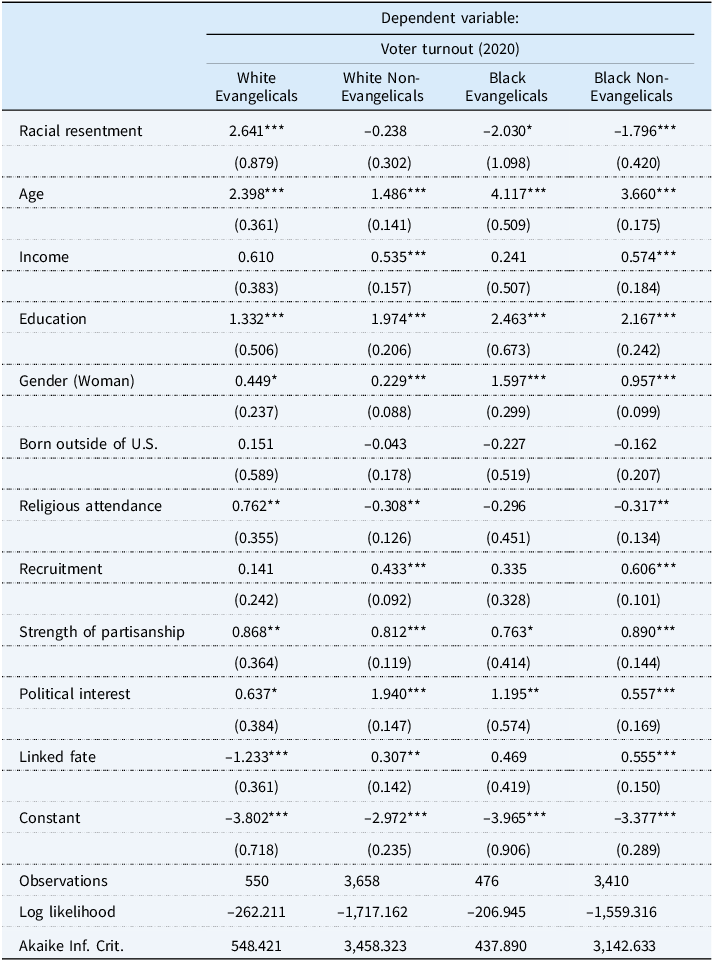
I set off to answer the main research questions, which examine the possibility that holding more negative racial attitudes, via racial resentment, might influence both evangelicals across race differently as well as evangelicals compared to non-evangelicals within the same racial groups differently. This means that empirical analysis must examine the association between racial attitudes and voter turnout separately across all combinations of racial and religious groups. Table 2 begins this regression analysis disaggregating across White evangelicals, White non-evangelicals, Black evangelicals, and Black non-evangelicals. I also present a complementary analysis visualized in Figure 2, which displays the change in predicted probability of turning out to vote, comparing respondents with the highest compared to the lowest degree of racial resentment, holding all control variables in the logistic regression models in Table 2 at their means.
Racial resentment and voter turnout by racial and religious groups (White and Black Americans across evangelical identity)

Note: Logistic regression coefficients with standard errors in parentheses. *p<0.1, **p<0.05, ***p<0.01.
Racial resentment and predicted change in likelihood of voter turnout by all racial and religious groups
Note: Change in predicted likelihood of turning out to vote comparing the highest to lowest level of racial resentment, holding all control variables in Tables 1 and 2 at their means—results disaggregated across racial/ethnic and religious identity. 95% confidence intervals.

I start with describing results for White evangelicals and White non-evangelicals in Table 2 and Figure 2. I find that stronger feelings of racial resentment are strongly correlated with higher voter turnout among White Americans who identify as evangelicals. This is while there is no statistically significant relationship between racial attitudes and voting found among Whites who do not identify as evangelicals. If anything, the results for White non-evangelicals suggest that stronger racial animus might be negatively related to turning out to vote for non-evangelical Whites (although p > 0.1). Figure 2 shows that White evangelicals who hold the strongest racial animus are 22 percentage points more likely to turn out to vote than White evangelicals with the lowest racial animus, holding controls at their means. White evangelicals are uniquely mobilized to participate in elections on the basis of their attitudes about race. This provides support for both H1a and H2a. The results here suggest that it is possible that the influence of racial attitudes on White political behavior, as previous research suggests, may be driven primarily by Whites of a particularly religious evangelical identity.
Next, I uncover the political influence of racial attitudes among Black Americans, similar to Kam and Burge (Reference Kam and Burge2019), although I take an additional step to disaggregate analyses of Black Americans by evangelical identity. Starting with Black evangelicals, in regression analysis, I find that racial resentment is strongly but negatively related to voter turnout. This provides support for H3a. As additionally noted in Figure 2, Black evangelicals that hold the most racial animus, compared to the least, are 23 points less likely to vote in elections, after accounting for control variables. This is notable, given our findings among White evangelicals demonstrated the opposite association—that racial resentment actually motivated White evangelicals to turn out to vote.
I find that among Black Americans who do not identify as evangelical, racial resentment is also an indicator of lower voter turnout, providing support for H3b. Albeit, the negative relationship is slightly stronger among Black Americans, who also identify as evangelical. Taken as a whole, I find that Black Americans across religious identities, although specifically Black evangelicals, experience a decision conflict that impedes voter participation due to their conservative attitudes about their own racial in-group. This suggests that racialized social pressure and internalized norms might play a factor in the political behavior decisions among specific groups within the Black community (White and Laird Reference White and Laird2020).
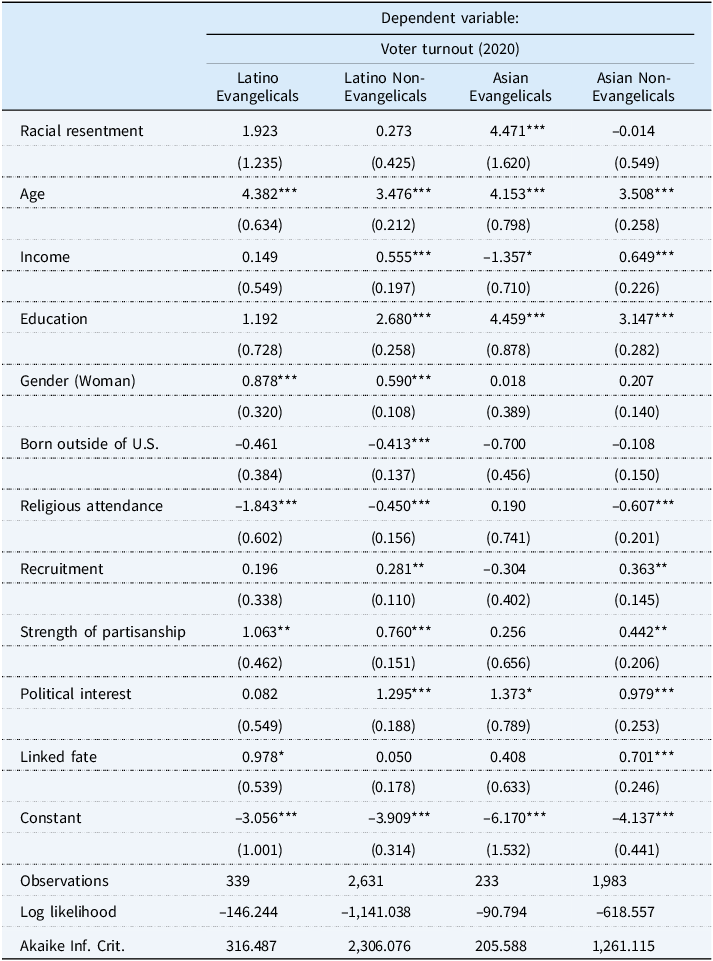
I now turn to Table 3, which analyzes the relationship between racial attitudes and voter turnout among Latinos and Asian Americans across religious identity. For Latino evangelicals, the results demonstrate that racial resentment has a strong and positive association with a higher likelihood of voting in elections. This relationship approaches statistical significance (p = 0.11), providing some suggested support for H1b. According to Figure 2, among Latino evangelicals, those with the highest racial resentment, relative to the lowest racial animus, are about 20 percentage points more likely to turn out to vote, after accounting for all covariates. The relationship is substantively and statistically insignificant among Latinos who do not identify as evangelical, demonstrating support for H2b. That is, the political mobilization of racial resentment is far more salient among Latino evangelicals than Latinos who do not identify as evangelical.
Racial resentment and voter turnout by racial and religious groups (Latino and Asian Americans by evangelical identity)

Note: Logistic regression coefficients with standard errors in parentheses. *p<0.1, **p<0.05, ***p<0.01.
Lastly, I examine Asian Americans across religious identity. In Table 3, I find that among Asian American evangelicals, racial resentment plays a very strong role in motivating voter turnout. This is consistent with expectations stated in H1c. Table 3 and Figure 2 demonstrate that this relationship is completely different among Asian Americans who do not identify as evangelical. There is no substantive correlation between racial resentment and voter turnout among Asian American non-evangelicals, providing support for H2c. However, the regression coefficient—if anything—is negative. It is Asian American evangelicals who are specifically motivated to vote on the basis of their attitudes toward race, a relationship that is not apparent among Asian Americans who do not identify as evangelical. This all suggests that compounding religious and racial identities structures the influence of racial resentment in American political behavior.
Discussion
There are several key takeaways from these analyses. I find support for most of my hypotheses that the impact of racial resentment on voter participation is conditioned by individuals’ multiple social identities. The results from the 2020 CMPS demonstrate that racial attitudes are key indicators of motivating election-related participation among White, Latino, and Asian American evangelicals. For these three racial/religious groups, holding more racial animus mobilizes turnout in elections. The results are further clear that racial resentment does not politically incentivize White, Latino, and Asian Americans who do not identify as evangelical to turn out to vote.
The findings further illuminate how the relationship between racial attitudes and voter participation among the religious is colored by race. This is for two reasons: In the analyses, I find that among Black evangelicals, racial conservatism does not mobilize voter turnout as it did for White, Latino, and Asian American evangelicals. Instead, Black evangelicals who hold the most racial animus toward their own racial in-group are actually far less likely, not more likely, to turn out to vote. I suspect that this is because there are unique racialized norms and social pressures (White and Laird Reference White and Laird2020) that induce some kind of conflict in the decision to participate on the basis of their racial animus that ultimately leads Black evangelicals who hold more racially conservative values to stay home on Election Day. I found that this conflict in decision was also present among Black Americans who do not identify as evangelical, although the negative relationship observed between racial resentment and voter turnout was not as strong relative to Black evangelicals. Based on these findings, I urge future work to think not only about how racial attitudes influence political behavior but also about whom, further considering how a multiplicity of social identities conditions this important relationship in the American politics and racial/ethnic politics literatures (Kinder and Sears Reference Kinder and Sears1981; Kinder and Sanders Reference Kinder and Sanders1996; Tesler Reference Tesler2016).
Conclusion
Early on, scholars of religion and politics have asked why similar beliefs among religious communities do not translate to similar political behaviors (Calhoun-Brown Reference Calhoun-Brown1998). I interrogate a similar puzzle here by investigating why similar beliefs about race do not motivate the same political action propensity across various racial and religious groups. I provided a theoretical explanation for why this is the case by explaining the differential political influence of racial resentment. The conflict in decision-making to vote on the basis of racial conservatism among Black evangelicals is complicated because of racialized group-based norms unique to the Black community. I have argued that this decision conflict is not present among White evangelicals, allowing their racial resentment to translate to political action. Further, as other non-Black people of color still can harbor anti-Black sentiment, racial resentment also has the capacity to guide voter decisions among Latino and Asian American evangelicals. Data analyses show that racial resentment does not necessarily motivate voter turnout among White, Latino, and Asian Americans who do not identify as evangelicals but can for White, Latino, and Asian American evangelicals. On the other hand, racial resentment is negatively correlated to voter turnout among both Black evangelicals and Black non-evangelicals. It is the complexity of multiple social identities that matters for how the relationship between racial resentment and democratic participation manifests in American politics.
The findings in this paper provide an avenue for investigation of other similar factors that can shape political behavior differently across multiple identities (for example, see Simien Reference Simien2005; Frasure-Yokley Reference Frasure-Yokley2018; Perry and Whitehead Reference Perry and Whitehead2019). While I center the different pathways to voter turnout on the basis of racial resentment here, findings also provide suggestive evidence that in-group racial linked fate also can operate differently in shaping political behavior based on these social identities. For example, in Tables 2 and 3, White linked fate is negatively related to voter turnout among White evangelicals, while positively associated with voting among White non-evangelicals. While Black linked fate has no influence on Black evangelicals, Black non-evangelicals who perceive stronger degrees of Black racial solidarity are more likely to turn out to vote; this suggests that the political influence of Black linked fate (Dawson Reference Dawson1995) is likely contingent on Black Americans’ religious identities. I find that linked fate is positively associated with voter turnout among Latino evangelicals and Asian American non-evangelicals, another conditional relationship worth more investigation in the future. I encourage future work to examine the influence of racial attitudes and other established factors in shaping American political behavior contingent on the multiplicity of social identities that individuals can hold simultaneously.Footnote 6
The paper, lastly, adds to the work of Wong (Reference Wong2018), which is still among the few to disaggregate the study of religion and politics more fully across the racial divide. This article adds to this discussion in examining the political tendencies in a comparative frame of reference, considering White, Black, Latino, and Asian American evangelicals alongside one another. I encourage future scholarship to continue examining how race shapes the politics of evangelicals, comparing White and Black religious communities and, further, going beyond the Black-White binary to include a greater understanding of the politics of Latino and Asian American evangelicals, especially crucial in an era of demographic change.
Funding statement
This research did not receive any specific financial support.
Competing interests
The author declares no competing interests.




 Open access

