


1. Introduction
In recent years, the sustainable design of technical products has evolved from an abstract demand to a central development requirement - politically, socio-culturally, ecologically, and economically (Verein Deutscher Ingenieure e.V., 2016; Reference Wolff, Fischer and BrunnWolff et al., 2020). Global analyses of the exceeding of planetary boundaries (Reference Richardson, Steffen, Lucht, Bendtsen, Cornell, Donges, Drüke, Fetzer, Bala, Bloh, Feulner, Fiedler, Gerten, Gleeson, Hofmann, Huiskamp, Kummu, Mohan, Nogués-Bravo and RockströmRichardson et al., 2023) and political and regulatory initiatives such as the European Green Deal, the Sustainable Product Regulation, and the Corporate Sustainability Reporting Directive (CSRD) highlight the urgency of systemic change in development and production (Reference Lachmayer, Wurst and ThelemannLachmayer et al., 2025). Sustainability is therefore no longer an optional guiding principle, but a technical, environmental, organisational, and economic necessity.
Product development is crucial in this transformation. As a technology-driven interdisciplinary field, its methods and tools act as enablers for sustainable innovation. With increasing demands for sustainable product design throughout the entire life cycle, it is becoming increasingly the focus of environmental and technological transformation processes. Sustainability is no longer an additional peripheral aspect, but is increasingly becoming an integral part of modern product development processes (DIN Deutsches Institut für Normung e. V., 2020; Reference Hansen, Große-Dunker, Idowu, Capaldi, Zu and GuptaHansen & Große-Dunker, 2013; Reference Lachmayer, Wurst and ThelemannLachmayer et al., 2025; McKinsey & Company und Verband Deutscher Maschinen- und Anlagenbau, 2022). According to estimates, up to 80% of a product’s environmental impact is determined in the early stages of development (Reference McAloone and BeyMcAloone & Niki Bey, 2009). Product developers, therefore, bear a special responsibility, as they not only have the greatest scope for design in the early stages, but also the greatest leverage to technically implement ecological, economic, and social sustainability goals. To fulfil this role effectively, it is essential that they are provided with appropriate tools that enable the integration of sustainability into the development process, thereby significantly influencing the shift towards sustainable products.
Within the framework of the underlying research project, sustainability is understood as a holistic system of objectives whose ecological, economic, and social dimensions are to be integrated in the technical development process. The focus is on the role of technology as an enabler, i.e., on how technical methods and development processes can contribute to the methodical and systematic implementation of these objectives. Despite numerous strategies, standards (e.g., ISO 14006) (DIN Deutsches Institut für Normung e. V., 2020), and political guidelines as well as laws, the implementation of sustainability in technical product development remains insufficient (Reference Dekoninck, Domingo, O’Hare, Pigosso, Reyes and TroussierDekoninck et al., 2016; Reference Held, Weidmann, Kammerl, Hollauer, Mörtl, Omer and LindemannHeld et al., 2018). In many cases, sustainability is still seen as an additional expense rather than an integral part of the development process (Reference Graulich, Brunn, Prieß, Quack, Scherf, Wolff and HeitlandGraulich et al., 2017; Reference Kalish, Burek, Costello, Schwartz and TaylorKalish et al., 2018). Although instruments for structured implementation are available, particularly in terms of technical design and decision support, there are considerable shortcomings in their sufficient use (Reference Held, Weidmann, Kammerl, Hollauer, Mörtl, Omer and LindemannHeld et al., 2018).
To address this challenge methodically, the “Design for X” (DfX) paradigm offers an established basis for systematically integrating specific target variables into the development process at an early stage (Reference Bender, Gericke, Heusel, Bronnhuber, Helms, Krzywinski, Klocke, Dilger, Müller, Ehlers, Lachmayer, Bender and GerickeBender et al., 2021; Reference Herrmann, Bode, Wurst, Gembarski, Mozgova and LachmayerHerrmann et al., 2022). In recent years, initial approaches to sustainability integration have been developed, such as the “Design for Sustainability” (DfS) or “Design for Circularity” (DfC) (Reference CeschinCeschin, 2020; Reference Pruhs, Kusch, Woidasky and VierePruhs et al., 2024; Reference Rocha, Antunes and PartidárioRocha et al., 2019). These concepts offer valuable specifications and guidance, but often remain methodologically abstract in their implementation. At this point, however, it is worth noting the lack of methods and mechanisms that would allow specific sustainability goals and strategies, such as R-strategies, to be translated into the product development process in a concrete and technically manageable way (Reference Dekoninck, Domingo, O’Hare, Pigosso, Reyes and TroussierDekoninck et al., 2016; Reference Rocha, Antunes and PartidárioRocha et al., 2019).
This research project addresses this gap. The aim is to develop a conceptual and methodological framework that integrates existing sustainability strategies into the technical development process in a structured manner. The focus is on how sustainability can be incorporated into product design as a technical objective that can be intentionally shaped and addressed.
This paper establishes the theoretical and methodological foundation for this proposed approach. This technology-driven and sustainability-oriented product development approach systematically operationalises sustainability based on R-strategies. The paper deliberately positions itself as a conceptual and methodological contribution within design research. Its purpose is not to present implemented methods or validated outcomes, but to provide a structured research framing for operationalising R-strategies within engineering design, thereby laying the foundation for subsequent prescriptive and evaluative studies.
The paper is structured as follows: After this introduction, Chapter 2 outlines the theoretical foundations and relevant approaches. Chapter 3 identifies the research gap and defines the objective. Chapter 4 introduces the research methodology, followed by the structural model in Chapter 5. Chapter 6 provides a critical discussion, and Chapter 7 concludes with a summary and outlook.
2. Theoretical background
Integrating sustainability into the product development process requires an examination of existing concepts of technical product development. To provide a theoretical foundation, this chapter outlines key principles, starting with the structure of established Design for X approaches (Section 2.1) and their extensions to include sustainability concepts like Design for Sustainability (DfS) and Design for Circularity (DfC). It then introduces the R-strategies as technically addressable target variables within the DfX system, followed by an analysis of the current state of research presented in Section 2.3.
2.1. Design for X as a methodological basis
Design for X (DfX) refers to a group of established concepts for the systematic consideration of specific target variables in the product development process. The “X” stands as a placeholder for different target systems, such as assembly, manufacturing, or recycling, which should be taken into account in the early stages of product development and methodically verified throughout the entire development process. DfX aims to translate overarching requirements into concrete technical decisions at an early stage and in a systematic manner (Reference Bender, Gericke, Heusel, Bronnhuber, Helms, Krzywinski, Klocke, Dilger, Müller, Ehlers, Lachmayer, Bender and GerickeBender et al., 2021; Reference McAloone, Pigosso, Bender and GerickeMcAloone & Pigosso, 2021; Reference Ponn and LindemannPonn & Lindemann, 2011).
Fundamentally, DfX follows a standardised principle: based on the respective target variable (X), evaluation variables and design guidelines are derived, which can be implemented in a targeted manner using suitable methods and tools in the development process (Reference Ponn and LindemannPonn & Lindemann, 2011; Reference Weber and KrauseWeber, 2007). This system allows a structured link between strategic requirements and operational design decisions. The relevance of this approach is particularly evident in the Munich Product Specification Model, in which the interaction between requirement definition, functional structure, and design is specifically used to take into account target variables such as “design for assembly” or “design for recycling” (Reference Ponn and LindemannPonn & Lindemann, 2011; Reference Weber and KrauseWeber, 2007). The DfX approach thus enables structured goal pursuit across all development phases, from specification to concept and design to detailing and validation. Design guidelines and evaluation criteria can be iteratively adjusted and coordinated to consistently implement technical target values. The methodological strength of DfX lies in its modularity: individual target values can be introduced or combined independently of one another without leaving the overall framework. This makes the approach not only compatible with classic target values (such as assembly suitability or maintainability) but also open to further requirements. However, the scope and effectiveness of the DfX approach largely depend on the methodological definition of the respective target parameter. If the objective remains insufficiently specified or operationalised, the potential of the DfX logic to systematically guide technical decisions cannot be fully realised (Reference Ponn and LindemannPonn & Lindemann, 2011; Reference Weber and KrauseWeber, 2007). In summary, DfX is a methodologically proven framework that, thanks to its flexible architecture and technical goal orientation, forms a sound basis for the further development of more specific development approaches.
As already indicated, increasingly complex target systems, such as sustainability, have therefore been integrated into DfX logic in recent years (Reference Herrmann, Bode, Wurst, Gembarski, Mozgova and LachmayerHerrmann et al., 2022; Reference Konig and VielhaberKonig & Vielhaber, 2024; Reference Rocha, Antunes and PartidárioRocha et al., 2019). The extensibility of this approach offers great potential for integrating new sustainability requirements into the technical design process. Despite its methodological maturity, DfX remains limited in addressing sustainability as a holistic target system. While it performs well for clearly defined technical objectives, it is less suited to system-wide goals such as sustainability, which involve cross-phase effects and complex interdependencies. In response to these shortcomings, further developments such as DfS and DfC have emerged. However, these approaches primarily provide conceptual frameworks and heuristic guidance, while not explicitly providing formalised target variables, quantifiable design parameters, or systematic decision-support mechanisms required for early-stage technical design (Reference CeschinCeschin, 2020; Reference Rocha, Antunes and PartidárioRocha et al., 2019). This development forms the basis for the transition from DfX to a new approach based on R-strategies, as described in Section 2.2.
2.2. Development path: from design for X to design for R
As discussed above, the DfX system has been increasingly expanded in recent years to include more complex target systems, in particular, sustainability aspects. The Design for Sustainability (DfS) concept was an attempt to explicitly integrate ecological, economic, and social dimensions into the technical design process (Reference CeschinCeschin, 2020; Reference Rocha, Antunes and PartidárioRocha et al., 2019). DfS thus represents an important theoretical framework, but in industrial practice it often remains at a conceptual level. There is a lack of concrete methodological and technical mechanisms to effectively translate sustainability goals into the product development process (Reference Zumach, Wehrend and KrauseZumach et al., 2025). The concept of Design for Circularity (DfC) represents a further specification. It focuses on circular strategies such as reuse, repair, remanufacturing, or recycling, aims to close cycles at the material and energy level, and thus moves closer to the practical design of more sustainable products (Reference Kirchherr, Reike and HekkertKirchherr et al., 2017; Reference Pruhs, Kusch, Woidasky and VierePruhs et al., 2024). DfC thus provides an important perspective on processual sustainability. Nevertheless, this approach is also lacking in terms of systematic and methodological embedding in concrete technical development decisions.
This is where the present research project comes in. Building on the DfX system, a new methodological approach is being formulated: “Design for R” (DfR). DfR interprets R-strategies, such as Refuse, Reduce, Reuse, Repair, Remanufacture, and Recycle, not merely as general sustainability principles but as technically addressable targets within product development. In contrast to existing concepts like DfS or DfC, which often remain on a conceptual or strategic level, DfR aims to translate these strategies into concrete elements of technical design practice. Rather than prescribing what should be achieved in terms of sustainability, DfR focuses on how these goals can be methodologically and systematically implemented, for example, using evaluation metrics, specific instructions, or development tools that support decision-making in early design phases. In this way, DfR builds on the structural logic of established DfX approaches while extending them to include actionable sustainability goals.
Nowadays, the R-strategies represent established principles of sustainable product design and are an integral part of current discourse in the context of sustainable product development (Reference Kirchherr, Reike and HekkertKirchherr et al., 2017; Reference Lachmayer, Wurst and ThelemannLachmayer et al., 2025; Reference Potting, Hekkert, Worrell and HanemaaijerPotting et al., 2017). They formulate concrete principles for resource conservation and product life extension and are considered central tools for implementing circular approaches. In practice, however, they often remain strategically abstract in their current form and are rarely translated into technical development decisions (Reference Ries, Wartzack, Zipse, Zipse, Hornegger, Becker, Beckmann, Bengsch, Feige and SchoberRies et al., 2023; Reference Schwahn, Potinecke, Block, Werner and TarlosySchwahn et al., 2024; Reference Tan, Lee, Shekar and TanTan et al., 2024).
Design for R (DfR) aims to close this gap. For each individual “R”, a set of methodological tools, design principles, and decision-making aids is to be developed to support integration into the development process. The strength of the DfX approach is most effective when the respective target is sufficiently precise and structured. This is precisely where DfR comes in as a logical further development within the existing DfX paradigm.
The conceptual development line from generic target systems (DfX) to the expansion to include sustainability targets (DfS), the focus on circularity principles (DfC), and the targeted methodological operationalisation of concrete sustainability strategies in DfR can therefore be understood as increasing specification. The accompanying figure visualises this development as a transition to a technology-driven, impact-oriented sustainability approach.
Development path of methodical sustainability integration

To align the DfR approach with ongoing developments, the next section examines key aspects of current DfX-based methods for integrating sustainability into technical product development.
While individual R-strategies have been addressed in previous work, often with a focus on specific life-cycle phases or application contexts (Reference Breimann, Rennpferdt, Wehrend, Kirchner and KrauseBreimann et al., 2023; Reference Reike, Vermeulen and WitjesReike et al., 2018), a unified methodological framing that systematically integrates the R-strategies as a coherent set of operable design targets within established DfX logic is still lacking. The novelty of the proposed DfR approach lies not in the introduction of new sustainability strategies, but in their structured and methodologically consistent integration into engineering design methodology.
2.3. State of research
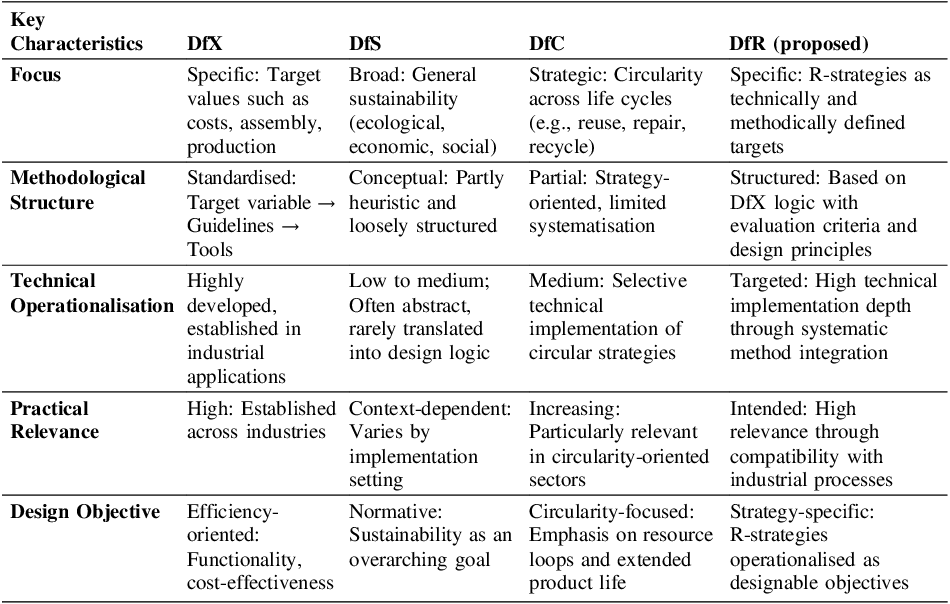
This section aims to highlight methodological similarities and differences and to conceptually classify the development towards Design for R (DfR). The selection of the following comparative aspects is based on methodological requirements derived from the context of technical product development and is informed by key insights from current design research. To effectively integrate sustainability principles into development processes, approaches must not only define clear design goals but also be methodologically structured, technically feasible, and practically compatible. Based on these criteria, five overarching key characteristics were derived: Focus, Methodological Structure, Technical Operationalisability, Practical Relevance, and Design Objective.
The following table summarises selected aspects relevant to this paper’s argument and serves as a foundation for identifying the research needs formulated in Chapter 3. The DfX, DfS, and DfC columns are informed by prior work in the fields of sustainability-oriented design, product development methodologies, and circularity integration (Reference CeschinCeschin, 2020; Reference HuangHuang, 1996; Reference Kirchherr, Reike and HekkertKirchherr et al., 2017; Reference Konig and VielhaberKonig & Vielhaber, 2024; Reference McAloone, Pigosso, Bender and GerickeMcAloone & Pigosso, 2021; Reference Pruhs, Kusch, Woidasky and VierePruhs et al., 2024; Reference Rocha, Antunes and PartidárioRocha et al., 2019; Reference Sassanelli, Urbinati, Rosa, Chiaroni and TerziSassanelli et al., 2020; Reference Vicente and CamochoVicente & Camocho, 2024). The proposed DfR characteristics are based on the research project’s goals and methods, rather than existing literature. The aim of the comparison is not to provide a final assessment but to illustrate a conceptual development path and highlight specific characteristics and gaps that motivate the proposed approach. DfS is understood here as an umbrella concept encompassing multiple methodological approaches, rather than as a single, unified method.
Conceptual Comparison of DfX, DfS, DfC, and the Proposed DfR Approach; the characterisation of DfX, DfS and DfC refers to representative approaches discussed in the design research literature and is not intended as an exhaustive review

The comparison clearly shows that while existing approaches, such as DfX, DfS, and DfC, provide important foundations for integrating sustainability, key sustainability strategies have not yet been systematically translated into technical development processes. In particular, the linking of strategic sustainability goals with concrete evaluation metrics, decision-making mechanisms, and technical design guidelines remains incomplete. Based on this, the DfR approach can be seen as a direct response to these identified methodological gaps. It aims to translate individual R-strategies into structured technical objectives and integrate them into product development processes in line with established DfX logic. Against this background, the following chapter outlines the specific research needs, specifies the underlying problem, and defines the objective of this research project.
3. Research gap and aim
Despite the methodological maturity and widespread use of DfX approaches and their extensions through DfS and DfC, a key research gap remains: the systematic and technical operationalisation of sustainability principles, particularly R-strategies, within product development processes. While R-strategies are widely discussed at a strategic level, they are rarely prepared as concrete, technically operable design targets. The DfR approach proposed in Chapter 2 addresses this gap by extending the DfX paradigm to include sustainability-related targets.
The aim of this research project is to develop the theoretical and methodological basis for such a DfR approach that bridges overarching sustainability goals and concrete technical design options. Based on this objective, the following research hypotheses are formulated:
-
• H1: R-strategies can be defined and modelled as operable target variables within DfX logic.
-
• H2: A DfR approach can serve as a methodological interface between strategic sustainability goals and technical product design.
This paper focuses on the conceptual pre-structuring of the DfR research framework and the clarification of its underlying methodological logic.
Given the complexity and system relevance of sustainability goals, the development of a DfR framework requires a structured and traceable methodological approach. Therefore, the following chapter introduces the Design Research Methodology (DRM) as the guiding framework for the research process.
4. Research methodology
To address the outlined research challenges in a structured and traceable way, the research approach is based on DRM as proposed by Blessing & Chakrabarti, which provides a systematic framework for research activities, particularly in product development. The approach divides the research process into four interlinked phases: (1) Research Clarification, (2) Descriptive Study I, (3) Prescriptive Study, and (4) Descriptive Study II. In the interests of flexible and iterative application, these phases are not strictly separated from one another, but can overlap, be weighted differently, or be run iteratively, depending on the project (Reference Blessing and ChakrabartiBlessing & Chakrabarti, 2009).
This paper does not represent a complete contribution within a single DRM phase, but structures the overarching research project on DfR conceptually and methodologically in line with DRM logic. The planned work steps are assigned to the four phases at a structural level and form the basis for subsequent elaboration steps. The planned structure of the research project along the DRM phases is as follows:
-
• Research Clarification: This phase defines the thematic framework of the project through the conceptual analysis of existing DfX, DfS, and DfC approaches, the investigation of relevant related topics, the derivation of the research gap, and the definition of the overall scope.
-
• Objective: Theoretical foundation and clarification of the problem definition.
-
• Outcome: Systematic classification of R-strategies as technically relevant target variables in terms of DfX logic and formulation of research questions and hypotheses.
-
-
• Descriptive Study I: Based on the problem definition, a systematic survey of existing methods, industrial requirements, and technical needs is conducted. This includes literature analyses, the practice-oriented analysis of existing DfX methods, the quantification of existing sustainability strategies (e.g., R-strategies), and surveys on methodological deficits in their implementation. Where appropriate, the analysis will be complemented by case studies and evaluations of concrete products to empirically examine current development practices and challenges.
-
• Objective: Empirical foundation and needs analysis; description of the status quo of sustainability-related methodology in current product development processes.
-
• Outcome: Derivation of requirements for a methodologically sound DfR concept.
-
-
• Prescriptive Study: In this phase, the DfR framework is designed as the methodological core of the research project, including evaluation criteria, guidelines, and implementation mechanisms for selected R-strategies. Suitable tools, templates, or decision-making aids may also be developed. Examples of such technically relevant target variables include, for instance, modularity and interface accessibility for repair or remanufacturing, separability and material compatibility for recycling, or component durability and interchangeability for reuse. These examples are intended to illustrate the level of technical abstraction addressed by the DfR approach, rather than to define complete metrics or design guidelines at this stage.
-
• Objective: Design of an operable DfR approach
-
• Outcome: Operational DfR framework for integrating R-strategies into product development
-
-
• Descriptive Study II: The developed framework is evaluated and validated based on qualitative and quantitative investigations. Case studies, expert feedback, and applications in research, teaching, and industrial practice, specifically in the context of practical product development processes, are planned. The aim is to examine and evaluate the applicability, effectiveness, and practicality of the developed approach. On this basis, conclusions will be drawn for the practical further development and targeted adaptation of the framework.
-
• Objective: Validation and evaluation of the framework in real application contexts
-
• Outcome: Feedback for the further development and practical adaptation of the DfR concept
-
The phases mentioned above should be understood as elements of an iterative research process. Feedback loops are particularly important between Prescriptive Study and Descriptive Study II to develop and ensure a usable, connectable, and adaptable framework. Special attention is paid to ensuring applicability at the product level, enabling concrete implementation in diverse product development scenarios. In the future, an in-depth Prescriptive Study II is planned, which will deal with the transfer of scientific and industrial findings into concrete recommendations for action, prototypical tools, and practical implementations. The design and content of this study will be the subject of future work.
5. Structural model of the research project
To systematically structure the research project and make its logic comprehensible, an overarching structural model is presented below. This section therefore, does not report results from Descriptive Study I, but introduces the structural research model that positions the DfR approach within the overall DRM and outlines the planned sequence of research activities. The model is based on the DRM described in Chapter 4 and serves as a conceptual framework to map the structure, logic, and flow of the research project as a whole. The structural model visualises how the planned research steps are organised along the DRM phases and how they build on each other, from research clarification and empirical analysis to methodological development and validation.
Structural model of the research project based on the Design Research Methodology

The model provides a visual overview of central work packages, thematic elements, and planned development steps. It encompasses already available knowledge, activities in preparation, and components that will be elaborated as the project progresses. The individual elements vary in their level of specification; some have already been explored, while others serve as placeholders for future development. The depiction aims to show the interplay between core activities such as the analysis of existing concepts, the derivation of requirements, the development of methodological building blocks, and the practical evaluation in research, education, and industry.
It is important to note that the structural model is not intended as a final representation of the DfR approach itself. Rather, it serves as a guiding framework for the iterative development of the DfR concept within the broader logic of the research project. The hypotheses formulated in Chapter 3 and the research needs outlined provide the substantive orientation, while the DRM phases structure the methodological flow. The integration of feedback loops supports the continuous refinement of the approach based on empirical findings and practical application.
The structural model thus provides a methodologically grounded and content-driven foundation for the further development of the research. It ensures a conceptual orientation, helps position individual work steps, and lays the basis for the consistent and application-oriented development of the DfR framework.
6. Discussion and critical appraisal
The structural model outlined in the previous chapters represents a conceptual framework for the overarching DfR research project, addressing the methodological gap of operationalising sustainability strategies within technical product development. At its core, DfR interprets established R-strategies as technically addressable target variables within the DfX paradigm, expanding its scope to include explicitly defined sustainability-related target systems without modifying its fundamental structure. In contrast to existing contributions that focus on individual R-strategies or specific life-cycle phases, the proposed DfR approach provides a coherent and methodologically consistent framing that integrates R-strategies as a closed set of operable design targets within the DfX logic. The structural model further outlines an iterative development logic spanning multiple research phases to support conceptual clarity, methodological connectivity, and practical applicability.
The scientific contribution of this work lies in its conceptual and methodological impact. Rather than presenting implemented methods or validated outcomes, the proposed structural model clarifies how R-strategies can be interpreted as operable design targets within established DfX logic, thereby providing an orienting foundation for subsequent prescriptive and evaluative research.
In addition to its theoretical foundation, the proposed DfR approach offers potential for practical applications. In industrial product development, for example, it can support the systematic integration of sustainability considerations into established processes, for instance, through methodical guidelines, decision-support mechanisms, or tool-based implementations for selected R-strategies. The approach further provides starting points for digital support systems such as computer-aided design (CAD) or model-based systems engineering (MBSE) implementations, where design decisions need to be consistently structured and documented. In teaching, DfR can serve as a didactic tool to familiarise students with sustainability as an integral part of technical design.
The current state of development of the DfR approach is subject to limitations. While the focus on technically tangible aspects of sustainability supports practical applicability, social and systemic sustainability dimensions are not yet addressed. Moreover, the approach remains primarily conceptual: key elements such as actionable guidelines, methodological tools, for example, construction catalogues, or digital implementation support, are still under development. Accordingly, questions regarding industrial integration, acceptance and practical validation remain open. These limitations define specific areas for further development and research, which are outlined in the Outlook (Chapter 7).
In relation to the research gap identified in Chapter 3, the structural model provides an initial conceptual contribution by bridging the gap between strategic sustainability goals and operational design. It establishes a methodological foundation for the further development of the DfR approach, while deliberately leaving specific implementation details open at this stage.
7. Conclusion and outlook
The structural model presented in this paper creates a conceptual framework for methodically translating strategic sustainability goals into technical product development. The presented approach, “Design for R,” interprets R-strategies as operable target variables in the sense of the DfX paradigm, thereby addressing a central research gap: the previously insufficient methodological connection between sustainability principles and product-oriented design. This paper outlines the methodological foundation and structure of the research project based on DRM. The model presented formulates central elements of a DfR framework, describes methodological and content-related work packages, and thus lays the foundation for the further development of a compatible and practically applicable design approach.
At the same time, the conceptual nature of this work is linked to open questions. The theoretical foundations are deliberately understood as a structuring foundation, not as a final solution. The concrete elaboration of the framework elements, their verification and validation, and their practical implementation in tools and applications are still pending and constitute the next steps within the research project. The framework’s requirements will be systematically identified through targeted analyses in industry, science, and education. In industrial contexts, these analyses focus on examining the applicability and integration of the DfR framework within existing product development processes and decision-making structures. In research and educational settings, the emphasis lies on assessing conceptual clarity, methodological usefulness, and didactic suitability, rather than on quantitative performance evaluation. This will lead to the development of methodological concepts, specific tools, and actionable recommendations for practical application in real development contexts. The development of digitally supported tools, the exemplary application of the approach in industry, research, and education-related use cases, and the development of formats for teaching and training, as outlined in (Reference Thelemann, Wurst, Wawer, Stauss, Rosemann, Hamlaoui and LachmayerThelemann et al., 2026), are also planned. This development process is iterative so that feedback and application experiences can be systematically incorporated into further development, also with a view to previously underrepresented sustainability dimensions such as social or systemic aspects. At the same time, the structural model presented is also being continuously developed. It forms the methodological basis for the entire research project, but is to be flexibly adapted to new findings, needs, and technological developments. This creates a dynamic orientation that supports both the continuous development of the DfR framework and its integration into future scientific and practical contexts.
Acknowledgement
The project “novaImpuls” was funded by the “Klimatopf Lehre” of the Leibniz University Hanover through study quality funds (Studienqualitätsmittel, SQM).



 Open access

