

Understanding other people’s mental states – and one’s own – is central to understanding social behavior, enabling one to interact with and relate to other people. The ability that allows us to attribute, predict, and comprehend mental states is known as Theory of Mind (ToM; Baron-Cohen, Leslie, & Frith, Reference Baron-Cohen, Leslie and Frith1985). At first glance, its definition is simple, but it involves a series of intrinsic and predictive aspects that were previously referred to, almost mystically, as “mind reading”. To understand other people’s mental states means not only analyzing their intentions, plans, personality, knowledge, emotions, beliefs, and desires; it also requires an understanding of the social context and situation in which events occur (Killen, Mulvey, Richardson, Jampol, & Woodward, Reference Killen, Mulvey, Richardson, Jampol and Woodward2011).
Much of our current understanding of ToM is based on studies of autism because autistic people show deficits in their mentalistic understanding of others. For that reason, prototypical ToM tasks have been widely administered to autistic individuals, for instance the classic “Sally-Anne” first-order false belief (FB) test pertaining to location change (Baron-Cohen et al., Reference Baron-Cohen, Leslie and Frith1985). As noted by Killen et al. (Reference Killen, Mulvey, Richardson, Jampol and Woodward2011), this task involves limited social content, because there is no relationship between the characters (for example, if they are friends or strangers), or between the person and object. Nor does the task recognize the intention or motivation that leads the character to take action, or the emotions the action provokes. Change-of-location tasks such as Sally-Anne are referred to as cold, or cognitive ToM, and involve understanding thoughts and beliefs. According to the model proposed by Shamay-Tsoory, Harari, Aharon-Peretz, and Levkovitz (Reference Shamay-Tsoory, Harari, Aharon-Peretz and Levkovitz2010), cognitive ToM is a prerequisite to understanding situations that more closely resemble real-life social contexts where empathy and comprehension of emotional states and feelings are the focus – that is, hot or affective ToM. Fewer tests of advanced ToM contemplate ‘hot ToM’, including the well-known “Strange Stories” (Happé, Reference Happé1994), and Faux Pas test (Baron-Cohen, O’Riordan, Stone, Jones, & Plaisted, Reference Baron-Cohen, O’Riordan, Stone, Jones and Plaisted1999), which is the main focus of the current study.
Faux Pas, Theory of Mind, and Autism
A faux pas can be defined as making a statement or taking an action that unintentionally turns out to be wrong, inopportune, or socially inappropriate.
Therefore, understanding a faux pas means activating two types of mental state: Understanding that the person said/did something they should not have – cognitive ToM – and that the listener is insulted and hurt – affective ToM (Baron-Cohen, Jolliffe, Mortimore, & Robertson, Reference Baron-Cohen, Jolliffe, Mortimore and Robertson1997; Shamay-Tsoory et al., Reference Shamay-Tsoory, Shur, Barcai-Goodman, Medlovich, Harari and Levkovitz2007). In other words, to fully understand a faux pas would require someone to, first, detect that the speaker either does not know or does not remember something (unintentional action), and second, to appreciate the emotional impact – usually negative – the comment or action may have on the listener (Baron-Cohen et al., Reference Baron-Cohen, O’Riordan, Stone, Jones and Plaisted1999). Importantly, attention to specific details can be quite taxing on working memory (WM); for that reason, WM has been controlled for in previous studies of faux pas understanding (see Gregory et al., Reference Gregory, Lough, Stone, Erzinclioglu, Martin, Baron-Cohen and Hodges2002; Zalla, Sav, Stopin, Ahade, & Leboyer, Reference Zalla, Sav, Stopin, Ahade and Leboyer2009).
Given the aforementioned important cognitive and emotional processes that mediate faux pas, autistic people often misunderstand social mores or misinterpret information, making them vulnerable to this type of situation in real life. Those difficulties are also apparent on advanced ToM reasoning tasks (Sotillo & Rivière, Reference Sotillo and Rivière2001).
Baron-Cohen et al. (Reference Baron-Cohen, O’Riordan, Stone, Jones and Plaisted1999) created one of the most widely utilized tests of faux pas recognition. Several studies have administered it to autistic people and a neurotypical (NT) comparison group, especially in adults. Their findings indicate that judging different scenarios as they are presented is complex, especially when they involve accidental actions, due to ToM difficulties and respondents’ particular way of processing important information (González-Gadea et al., Reference González-Gadea, Baez, Torralva, Castellanos, Rattazzi, Bein and Ibanez2013; Pedreño, Pousa, Navarro, Pàmias, & Obiols, Reference Pedreño, Pousa, Navarro, Pàmias and Obiols2017; Spek, Scholte, & van Berckelaer-Onnes, Reference Spek, Scholte and van Berckelaer-Onnes2010; Zalla et al., Reference Zalla, Sav, Stopin, Ahade and Leboyer2009). According to Zalla et al. (Reference Zalla, Sav, Stopin, Ahade and Leboyer2009), in which study 15 autistic adults and 15 NT adults participated (M ASD = 28 years-old; M NT = 27.8 years-old), a significant proportion of autistic adults answered incorrectly that the character acted intentionally, believing that the character had deliberately intended to humiliate or offend the other person.
However, at its inception, the Faux Pas test was created to measure advanced ToM in schoolchildren or pre-adolescents. At 7 to 11 years of age, when comprehension of similar situations would mature, children are able to recognize the recursiveness of the mental states involved in a faux pas, and its relationship to intentions, beliefs, and emotions (Baron-Cohen et al., Reference Baron-Cohen, O’Riordan, Stone, Jones and Plaisted1999; Pearson & Pillow, Reference Pearson and Pillow2016). In their study, the original authors of the Faux Pas test mentioned that autistic children had difficulty recognizing other people’s mental states. They found it hard to integrate all the information into a coherent picture, and comprehend the underlying psychological impact of a faux pas (Baron-Cohen et al., Reference Baron-Cohen, O’Riordan, Stone, Jones and Plaisted1999). In the same study, NT children (girls and boys) aged 9 and 11 years detected the faux pas, with no significant difference in the performance levels between NT girls and boys when they were 11 years old.
Likewise, Pearson and Pillow’s (Reference Pearson and Pillow2016) study of NT children (7, 8, 9 and 11 years old) and NT adults found that after 9 years of age, participants were able to recognize the character/speaker’s ignorance (s/he does not know / s/he does not remember), a fact which the 7 and 8 years old did not detect.
It is noteworthy that in both studies, the youngest NT children – 7 to 9 years old – were unable to recognize all the aspects involved in a faux pas, an ability which seems more mature from nine years of age onward.
Working Memory Controls in Theory of Mind Tests
Shifting our attention to working memory, authors such as Gregory et al. (Reference Gregory, Lough, Stone, Erzinclioglu, Martin, Baron-Cohen and Hodges2002) and Zalla et al. (Reference Zalla, Sav, Stopin, Ahade and Leboyer2009) attempted to control the burden on memory and attention – given how demanding a faux pas story is – by placing the text of the faux pas story in front of the participant.
Similar WM controls have been applied to other ToM tasks (mostly first-order FB tasks). Studies of patients with brain damage corroborate the finding that when ToM tasks increase the burden on WM or executive function (EF), performance drops significantly (Apperly, Samson, & Humphreys, Reference Apperly, Samson and Humphreys2005). Other studies tried to reduce the likelihood of error by using visual stimuli to support WM (Stone, Baron-Cohen, & Knight, Reference Stone, Baron-Cohen and Knight1998), or shortened the tests to reduce the demands on EF (Apperly, Samson, Chiavarino, & Humphreys, Reference Apperly, Samson, Chiavarino and Humphreys2004).
In light of the above, although Baron-Cohen and colleagues (1999) mentioned that their autistic participants do not have WM issues, it remains the case that comprehending a dialog- and narrative-based story can be complicated, given all the elements of verbal content one needs to remember.
Verbal Faux Pas
In studies by Baron-Cohen et al. (Reference Baron-Cohen, O’Riordan, Stone, Jones and Plaisted1999) and Zalla et al. (Reference Zalla, Sav, Stopin, Ahade and Leboyer2009), participants listened to different faux pas stories, delivered vocally by the test administrator or on a cassette tape. This sort of verbal/auditory modality has been the most widely utilized, along with mixed (vignettes plus audio), due to the importance of the verbal content to overall comprehension of a faux pas story. The controversy, then, lies in whether or not the linguistic and WM demands of these more complex tasks influence participants’ responses. Along those lines, the first part of Baron-Cohen et al.’s (Reference Baron-Cohen, O’Riordan, Stone, Jones and Plaisted1999) study found that NT children’s mistakes on faux pas stories were not due to lack of comprehension or memory, despite a correlation between verbal mental age (VMA) and correctly completing the Faux Pas test. They remarked that the correlation could simply be the result of growing maturity, on both measures: older respondents perform better, so mistakes on the Faux Pas test should not be attributed to deficits in linguistic abilities, per se. Those authors conducted a second study as part of the same research, in which autistic children also participated. The authors reported that the significantly worse results in the ASD group were not due to their verbal profiles. Unlike Study 1, no correlation was found between VMA and Faux Pas test resolution, with both groups exhibiting similar VMA (no significant between-groups differences).
Presentation Modality in Relation to Autism
There is evidence that autistic individuals are faster or more successful than NT participants at various visual tasks. Proof of that is that most materials for intervention, to date, are based on visual elements (Cohen & Sloan, Reference Cohen and Sloan2007; Dettmer, Simpson, Myles, & Ganz, Reference Dettmer, Simpson, Myles and Ganz2000; Hayes et al., Reference Hayes, Hirano, Marcu, Monibi, Nguyen and Yeganyan2010; Johnston, Nelson, Evans, & Palazolo, Reference Johnston, Nelson, Evans and Palazolo2003). Similarly, in the research literature, autistic individuals score on par with, or outperform comparison groups on visual tasks related to perception and intelligence assessment. That is true of embedded figures (Almeida, Dickinson, Maybery, Badcock, & Badcock, Reference Almeida, Dickinson, Maybery, Badcock and Badcock2010), block design (Shah & Frith, Reference Shah and Frith1993), or visual search (Joseph, Keehn, Connolly, Wolfe, & Horowitz, 2017). It is what Blaser, Eglington, Carter, and Kaldy (Reference Blaser, Eglington, Carter and Kaldy2014) called the “ASD advantage” in visual tasks. Few studies have examined this visual advantage on more abstract or ecological reasoning tasks, likely because to attribute mental states and emotions to others, verbal information (intonation, pause, indecision, speech, etc.) can sometimes be even more illuminating than visual information (e.g., facial expressions) (see Wiseman’s Reference Wiseman1995 study of lies in a NT population). In a study by Kleinman, Marciano, and Ault (Reference Kleinman, Marciano and Ault2001), autistic adults and NT solved an advanced ToM task using two modalities: Visual (expression of the eyes) and verbal (tone of voice). As predicted, the group of autistic adults performed significantly worse than the comparison group in both modalities, being unable to attribute mental states in either case.
Two of the studies most closely related to visual faux pas are Pierce, Glad, and Schreibman (Reference Pierce, Glad and Schreibman1997), and Loveland, Pearson, Tunali-Kotoski, Ortegon, & Gibbs (Reference Loveland, Pearson, Tunali-Kotoski, Ortegon and Gibbs2001), who explored schoolchildren and adolescents’ moral reasoning during social situations. Pierce et al. (Reference Pierce, Glad and Schreibman1997) found that understanding social situations in moral terms (as correct or incorrect) was harder when autistic children had to attend to several stimuli; as such, a non-verbal scenario would be easier. Loveland et al. (Reference Loveland, Pearson, Tunali-Kotoski, Ortegon and Gibbs2001) showed a series of videos depicting appropriate and inappropriate social interactions containing verbal stimuli (speech) and non-verbal stimuli (non-narrative scenes). Following Pierce and team’s study, Loveland et al. (Reference Loveland, Pearson, Tunali-Kotoski, Ortegon and Gibbs2001) ventured that the easiest scenes for autistic children and adults to comprehend would be non-verbal. The ASD group had significantly more difficulties than the comparison group identifying inappropriate behavior when the scenario was verbal. For both groups, judging conversations was harder than judging purely non-verbal interactions.
Therefore, the visual “ASD advantage” should not just occur in studies of intelligence assessment; it would also be expected during ecological tasks (containing real-life scenarios). Conversely, verbal ecological tasks and situations with multiple stimuli to attend to can be more difficult to comprehend for autistic individuals.
A Different Way to Process Information
Further examining the possible influence of verbal or non-verbal presentation, it is worth asking if the so-called visual “ASD advantage” could be explained by Weak Central Coherence theory (WCC; Frith, Reference Frith1989). WCC entails that autistic people fail to integrate information into an overall context; instead they focus preferentially on pieces of information in an isolated fashion. WCC is another plausible explanation for the superior performance of autistic individuals compared to NT people on tests involving fragmented elements, such as the block design or embedded figures tests, because such tasks favor local processing. This poses a question: Is there an advantage to visual problem solving when the stimulus is non-verbal because there are fewer stimuli to attend to, or due to a particular way of processing visual information (as in the block design test)? In fact, Baron-Cohen et al. (Reference Baron-Cohen, O’Riordan, Stone, Jones and Plaisted1999) proposed that deficient faux pas comprehension could be explained by how autistic people process information – textually citing WCC theory – such that it is laborious for them to reintegrate all the information and realize the true impact of a faux pas statement on the listener.
In light of the above, ToM is definitely a complex process, and it is affected by many other cognitive processes. To ascertain whether extraneous variables such as presentation modality, WM, IQ and age influence comprehension on advanced ToM tasks, the present study tested the influence of these variables on performance in the Faux Pas task.
In greater detail, the present study hypothesizes that (a) there will be significant differences between the groups of autistic and NT children on the Faux Pas test such that the NT group will score higher regardless of modality (Baron-Cohen et al., Reference Baron-Cohen, O’Riordan, Stone, Jones and Plaisted1999); (b) we speculate that the most difficult modality for autistic people will be either verbal, or mixed (verbal plus visual stimuli), and we expect significant differences according to modality in the ASD group such that their Faux Pas test outcomes are best in the purely visual modality (Loveland et al., Reference Loveland, Pearson, Tunali-Kotoski, Ortegon and Gibbs2001; Pierce et al., Reference Pierce, Glad and Schreibman1997); (c) we predict that while WM demands are to some degree controlled (Apperly et al., Reference Apperly, Samson, Chiavarino and Humphreys2004; Apperly et al., Reference Apperly, Samson and Humphreys2005; Stone et al., Reference Stone, Baron-Cohen and Knight1998), WM will correlate with and explain variance in Faux Pas test outcomes in both groups. Furthermore, even though both groups are of a similar age and IQ, we predict that age will influence Faux Pas test outcomes since the study’s participants include young children (Baron-Cohen et al., Reference Baron-Cohen, O’Riordan, Stone, Jones and Plaisted1999; Pearson & Pillow, Reference Pearson and Pillow2016).
Method
Participants
Sixty participants in total took part in this study, all of them enrolled in mainstream schools. They ranged in age from 84 to 145 months (7 years old - 12 years and 1 month old), with an average age of 113.63 months (SD = 18.71) – 9 years and 5 months old. Thirty participants (5 girls and 25 boys) were diagnosed with autism spectrum disorder (ASD) by one or more specialists or psychologists, using specific tests for differential diagnosis: The Autism Diagnostic Observation Schedule (ADOS; Lord, Rutter, DiLavore, & Risi, Reference Lord, Rutter, DiLavore and Risi2008) and the Autism Diagnostic Interview–Revised (ADI-R; Rutter, Le Couteur, & Lord, Reference Rutter, Le Couteur and Lord2003). Another 30 participants (7 girls and 23 boys) comprised the neurotypical (NT) group. We compared the two groups according to chronological age (in months); intelligence (IQ, range: 80–130); visual WM; and verbal WM. In addition, they all correctly completed the first-order FB ToM task (see Materials). Table 1 presents descriptive data and between-groups comparisons, which did not indicate significant differences on all measures.
Participants’ Descriptive Data
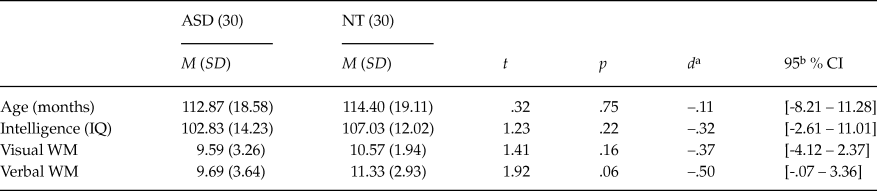
Note: ad = Effect size calculated using the Cohen’s d formula. b95 CI % = Confidence interval.
Materials
All tests were administered in Spanish since all the participants speak Spanish. The tests were of intelligence, working memory (visual and verbal), false belief, and the Faux Pas test (visual, verbal, and mixed modality).
Intelligence (IQ). To measure intelligence, we administered Sattler’s (Reference Sattler1992) short-form adaptation of the WISC–III, Wechsler Intelligence Scales for Children (Wechsler, Reference Wechsler1991). WISC–III scores of the autistic children were redacted from their psychologist or neurology specialist’s report (maximum 2-year-old report). Total WISC–III IQ scores in autistic children were highly correlated with the short form version (Sattler, Reference Sattler1992). Therefore, the NT group was administered the short-form version to get a reliable estimate of IQ in that group. The main goal was to guarantee that the two groups had comparable IQ levels.
WM tasks were divided into visual and verbal modalities:
Visual working memory . We administered the Reverse Memory subscale of the Leiter-R (Farmer, Reference Farmer and Volkmar2013), which measures memory capacity using a series of pictures. Respondents are asked to retain the image long enough to replicate the series by choosing the reverse order in which it was initially presented. For example, if the instructor points with his or her finger at “giraffe, frog, shoe,” the respondent should select “shoe, frog, giraffe.”
Verbal working memory. We administered the Digit Span subtest of the Wechsler scale (WISC–IV) (Wechsler, Reference Wechsler2005), using two variants: Forward and backward digits.
First-order false belief ToM task. We administered an adaptation of the non-verbal FB test (unexpected content) based on vignettes by de Villiers and de Villiers (Reference de Villiers and de Villiers2012), in which there is a relationship between characters (they seem to be siblings, and the “object” is an animal/pet). This supports Killen et al.’s (Reference Killen, Mulvey, Richardson, Jampol and Woodward2011) line of reasoning about limited social content.
Advanced theory-of-mind Faux Pas test. Nine faux pas stories were presented in random order using the E-prime multimedia computer program for touch-screen. For the purposes of the present study, these stories were analyzed according to presentation modality (see Table 2 and Appendices 1 and 2):
Story Classification by Modality and Error

Three visual stories. These were taken from Garcia-Molina, Clemente-Estevan, Andrés-Roqueta, and Rodríguez (Reference Garcia-Molina, Clemente-Estevan, Andrés-Roqueta and Rodríguez2016), and consisted of two vignettes recounting a situation of embarrassment or error. Questions appeared on a screen (without audio) and respondents answered visually.
Three verbal stories . Created for the purposes of this study (see Appendix 2), these are based on Baron-Cohen et al.’s (Reference Baron-Cohen, O’Riordan, Stone, Jones and Plaisted1999) Faux Pas test. They include audio that recreates a situation through dialog and narration (different, very distinct voices were used). The questions were posed via audio (not written) and respondents answered verbally (the student answered out loud, and the program recorded their answers).
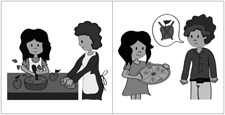
Three mixed stories. These vignettes, taken from Garcia-Molina et al. (Reference Garcia-Molina, Clemente-Estevan, Andrés-Roqueta and Rodríguez2016), are also based on Baron-Cohen et al.’s (Reference Baron-Cohen, O’Riordan, Stone, Jones and Plaisted1999) Faux Pas test. They include vignettes, written narrative, and audio to simultaneously recreate the full situation. Questions appeared on the screen (with audio) and respondents answered visually (similar to the visual stories test).
To control for working memory, on the visual- and mixed-modality tests, the pictures remained on the screen while the questions were asked and answered. During the verbal stories test, the written text was not placed in front of the participant, but they were verbally reminded of important details. For instance, while the respondent chose who said something strange, or something he/she should not have said, characters’ names were repeated along with their own voice: “If so, was it Joan (in the boy’s voice), Olga (the girl’s voice), or no one (narrator’s voice)?”
At the end of each story, the same series of questions was asked – in the visual, verbal, or mixed modality. To answer, the child was asked to choose among different forced-choice answers.
All responses to forced-choice questions (by touch or voice) were captured by the program E-prime and saved for later analysis.
The questions appear below (see Appendix 3). For ease of comprehension, the correct answer is underlined; character A is the speaker of the faux pas, and B the listener. Every single question was asked, even if the student answered an item incorrectly. The six questions were presented in the same set order, but the stories appeared in random order. Answers were scored as follows: 0 = incorrect answer; 1 = correct answer.
1. Faux pas detection: In the story, did someone say something they should not have said? (Yes/No)
2. Identification of the character: If so, who? (A/B/Nobody)
3. Emotion elicited: How must B have felt? (Good/Happy; Bad/Sad)
4. Character’s intention: Do you think A meant to make B feel that way? (Yes/No)
5. Character’s morality: Is A a good or bad person? (Good/Bad)
6. Morality of the action: Was what A did right, or wrong? (Right/Wrong)
7. Awareness or ignorance: Do you think A knew (information A does not have/is ignorant of)? (Yes/No)
Procedure
After schools consented to participate, the boy/girl’s family or legal guardian signed the corresponding consent forms for their child to be evaluated. As a result of these meetings, 32 children with a formal autism diagnosis participated in the study, from five mainstream schools and one specialized center for neuropsychological assessment and treatment in Spain; an additional 32 NT children from the same schools and levels were selected by teachers according to established criteria. In the days that followed, they administered the FB and intelligence tests. Depending on their results (passing the first-order FB test and obtaining an IQ score over 80), we proceeded with the tests of working memory (verbal and visual) and the Faux Pas test (all modalities) in spaces specially set up for it: Clear of acoustic or visual distractions, with a table and two chairs. Assessment took between 75 and 90 minutes per participant and was split into two sessions. Four participants were excluded, not falling within the established parameters, and one did not attend the last session.
Statistical Analysis
The data were analyzed using the SPSS 24 statistical package. This sample had the characteristics necessary to conduct parametric analysis. According to Kolmogorov-Smirnov’s test, the sample was normally distributed; Student’s t test for independent samples was used to observe between-groups differences; and paired t tests were carried out to determine if there were differences between modalities within each group – Hypotheses 1 and 2. With Hypothesis 3 in mind, we started by calculating correlations between WM, IQ, age, and Faux Pas test outcomes. Next, we undertook a step-wise regression procedure, adding in variables that were initially correlated. For all analyses, a p value of .05 was considered to establish statistical significance.
Results
Between-groups differences (ASD – NT) in Faux Pas Test outcomes. With regard to Hypothesis 1, between-groups differences were calculated in the three modalities of faux pas – visual, verbal, and mixed. Significant between-groups differences were found when the story’s presentation modality was visual and verbal, however differences were not significant in the mixed modality. See Table 3.
Between-groups Differences in Faux Pas Test Results According to Modality

Note: aMaximum score 21; bd = Effect size calculated using the Cohen’s d formula; c95% CI = Confidence interval.
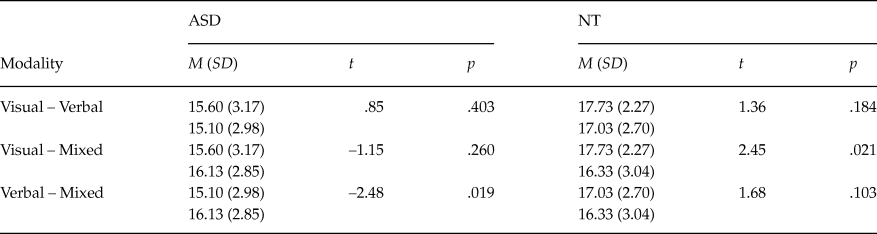
Differences according to modality (visual, verbal or mixed) on Faux Pas test. With respect to Hypothesis 2 about the differences between modalities (visual, verbal, and mixed), results in the ASD group showed significant differences between verbal and mixed modalities (with lower scores in the verbal modality). The NT group, on the other hand, displayed significant differences between visual and mixed modalities (scoring lower on mixed). See Table 4.
Differences between Modalities by Group
Effect of WM and IQ on Faux Pas test. Prior to conducting the predictive analyses relevant to Hypothesis 3, we obtained bivariate correlations between WM, intelligence, age, and Faux Pas test results across three modalities.
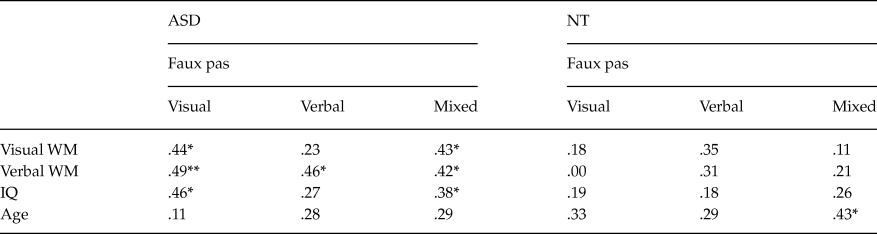
In the ASD group, significant correlations were found between: visual WM, and visual and mixed Faux Pas; verbal WM, and verbal, visual, and mixed Faux Pas; and intelligence (IQ), with visual and mixed Faux Pas.
Conversely, in the group of NT children, we found no significant correlation among these variables (WM, IQ, age and Faux Pas Test). In this group, only one correlation was found, between participants’ age and mixed faux pas.
Next, to determine which variables were independent predictors of Faux Pas test results (visual-, verbal-, and mixed-modality), we conducted multiple regression analyses using a step-wise procedure. However, this was only done in the group of autistic children, given their correlations between Faux Pas Test, WM and IQ (see Table 5 for detailed correlations by group). We excluded linear regression data from the NT group, about age in relation to mixed Faux Pas, because the model was not found to be significant, F(1, 28) = 2.12; p = .156.
Bivariate Correlations between Faux Pas, Visual WM, Verbal WM, and IQ in the ASD and NT Groups
* correlation is significant to the level of .05.
** correlation is significant to the level of .01.
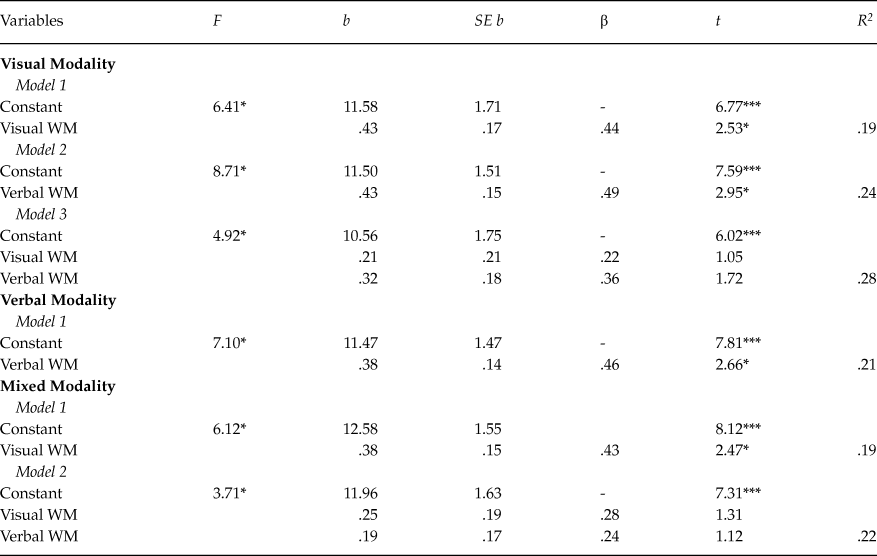
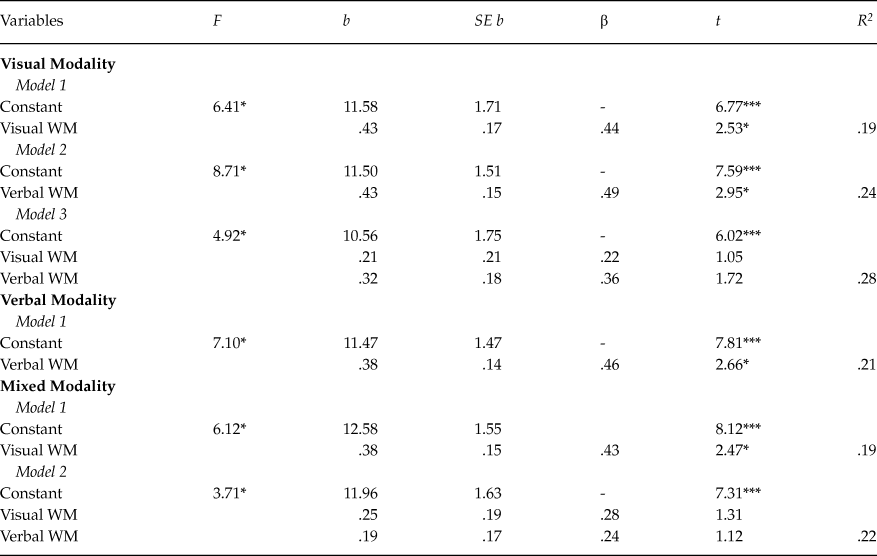
Following the step-wise procedure cited above, significant regressions were found when the model included just the dependent variable and WM. All models excluded IQ. As Table 6 shows, 19% to 28% of variability in Faux Pas test results was explained by WM test outcomes (visual or verbal). See Table 6 for all these analyses.
Summary of the Regression Analysis by Step-wise Procedure to Predict Faux Pas Test Results in Different Modalities (Visual, Verbal, and Mixed), in the ASD Group.
Note: F = F value (ANOVA); b = unstandardized βeta; SE b = standard error for the unstandardized βeta; β = standardized βeta coefficient; t = t test statistics; R 2 = coefficient of determination.
* p > .05. **p > .01. ***p > .001.
Discussion
The present study was devised to answer certain questions: Via which modality do autistic children best understand faux pas? And do certain variables influence Faux Pas test outcomes?
To begin with, we should point out that hypothesis 1 was consistent with our results in that autistic participants showed difficulty on mentalistic tasks (Baron-Cohen et al., Reference Baron-Cohen, O’Riordan, Stone, Jones and Plaisted1999; Zalla et al., Reference Zalla, Sav, Stopin, Ahade and Leboyer2009). In our study, autistic participants fared worse than NT participants on the Faux Pas test regardless of modality. Significant differences were observed between groups when test presentation was purely visual or purely verbal. That fact reiterates that faux pas comprehension is challenging for autistic people; it is classified as requiring an advanced level of ToM, and involves cognitive as well as affective ToM sub-processes (Baron-Cohen et al., Reference Baron-Cohen, Jolliffe, Mortimore and Robertson1997; Shamay-Tsoory et al., Reference Shamay-Tsoory, Shur, Barcai-Goodman, Medlovich, Harari and Levkovitz2007). Nevertheless, the two groups scored very similarly in the mixed modality, where there were no differences between groups.
Shifting our attention to Faux Pas test modalities, we shall discuss several novel findings that may have repercussions to related future research, and possible explanations closely related to information processing in autistic individuals.
The Complexity of Verbal Stimuli for Autistic Individuals
First of all, according to the so-called ASD advantage on visual tasks (Blaser et al., Reference Blaser, Eglington, Carter and Kaldy2014) – especially on mentalistic tasks (Loveland et al., Reference Loveland, Pearson, Tunali-Kotoski, Ortegon and Gibbs2001; Pierce et al., Reference Pierce, Glad and Schreibman1997) –Hypothesis 2 predicted that within the ASD group, the visual modality would have the best outcomes, and that differences might surface between the two modalities with verbal stimuli: Verbal and mixed. According to our data, the visual modality was easiest for children in the NT group, with significant differences compared to the mixed modality. Meanwhile, the highest score in the ASD group occurred in the mixed modality, and significant differences were only found compared to the verbal homologue. Contrary to expectations, in the ASD group, there were no differences between visual and verbal modalities, nor between visual and mixed. This difficulty with verbal story comprehension for the ASD group could be explained by the high imaginative and symbolic demands of deducing what is happening in a purely verbal scenario, as in a telephone conversation. An important criterion in autism diagnosis is that imagination appears to be limited (see Rutter et al., Reference Rutter, Le Couteur and Lord2003). Meanwhile, that skill was performed by NT participants without issue in the verbal modality of the Faux Pas test.
Another possible explanation for autistic children scoring lower than the NT group in the verbal modality could be that autistic children found it difficult to integrate and understand all the information provided (Baron-Cohen et al., Reference Baron-Cohen, O’Riordan, Stone, Jones and Plaisted1999). Moreover, the linguistic and WM burden of comprehending verbal fragments (presented as dialog) in a Faux Pas test, with no other type of support, may have affected overall comprehension of the verbal stories (Apperly et al., Reference Apperly, Samson, Chiavarino and Humphreys2004; Apperly et al., Reference Apperly, Samson and Humphreys2005). However, importantly, Baron-Cohen et al. (Reference Baron-Cohen, O’Riordan, Stone, Jones and Plaisted1999) argued that between-groups differences on the Faux Pas test could not be attributed to their respective linguistic ability; rather, the ASD group’s difficulty comprehending a faux pas story might be explained by how they process the information and comprehend it cohesively, as a whole. That proposal would be supported by WCC theory in autism (Frith, Reference Frith1989), that is, recognizing the parts without comprehending the big picture. For instance, in the verbal Faux Pas modality, pieces of audio from a dialog (verbal fragments) must lead the participant to make sense of an overall story. NT participants, however, had scarcely any problem solving the Faux Pas questions in verbal or visual modalities. They were able to recognize all the defining aspects of faux pas, understanding it – based on all the information together – as one entity. Additional theoretical support for these results is the theory of neural complexity, which also postulates that autistic people are good at local processing, whereas global processing is impaired. The same theory proposes that auditory processing in autistic people is the result of better perception when auditory stimuli are simple and low-level. However, there is altered perception when the auditory information is more complex (Lin, Shirama, Kato, & Kashino, Reference Lin, Shirama, Kato and Kashino2017). Along those lines, Lin et al.’s (Reference Lin, Shirama, Kato and Kashino2017) study revealed that autistic people tend to show atypical responses to social auditory stimuli, namely, voices. For example, they show less preference for their mothers’ speech, and lower attention when someone calls their name, compared to NT children. Moreover, autistic adults often have difficulty perceiving prosody.
Therefore, another possible explanation for the ASD group’s results in the verbal modality – in addition to what Baron-Cohen and team argued in their seminal study – could be reduced attention to, or altered perception of, auditory information. Difficulty recognizing voices and interpreting dialog would make that modality more challenging for autistic individuals.
Working Memory in Predicting Faux Pas Test Outcomes
One of the most striking results is the correlation and prediction displayed by WM in all modalities of the Faux Pas test, specifically, solely in the group of autistic children, and likewise for IQ. These predictive analysis results support Hypothesis 3, since visual and verbal WM would influence Faux Pas test outcomes, despite our attempt to reduce the demands on memory – as other studies have suggested the same to reduce the effect of WM (Apperly et al., Reference Apperly, Samson, Chiavarino and Humphreys2004; Apperly et al., Reference Apperly, Samson and Humphreys2005; Stone et al., Reference Stone, Baron-Cohen and Knight1998). Whereas in the NT group, WM did not correlate with Faux Pas results in any modality, in the ASD group, visual and verbal WM explained 19% to 28% of variability in Faux Pas test outcomes (verbal, visual, mixed), and IQ was excluded from all the regression models. In terms of age, although previous studies reported improved mentalistic test outcomes in older children - over 9 years old (Baron-Cohen et al., Reference Baron-Cohen, O’Riordan, Stone, Jones and Plaisted1999; Pearson & Pillow, Reference Pearson and Pillow2016), in our study, age correlated only with mixed-modality Faux Pas results in the NT group. Since the predictive model was not significant, it was not included in our detailed analyses. Therefore, our participants’ age (7 to 12 years-old) did not affect their answers on the Faux Pas test. The original age range of the test on which our study is based was children up to seven years old. Therefore, our results were in line with the Baron-Cohen study’s preliminary sample.
One last possible explanation for the unique influence of WM on remembering central aspects of faux pas in the ASD group is that autistic individuals process information and abstractly assign meaning differently. This is consistent with WCC theory (Frith, Reference Frith1989). Its premise is that autistic people do not integrate information as an overall whole – generally – but instead attend to and preferentially remember small visual (face) or verbal elements (a sentence) separately – locally (see Happé & Frith, Reference Happé and Frith2006). Along those lines, autistic participants would rely more heavily on WM than the NT group to remember the complete story and answer the test’s comprehension questions. Consequently, comprehending and memorizing contingent information as separate elements (without generalizing to form overall meaning) might be hindering overall memory of the correct understanding of the story. On a similar note, Baron-Cohen and his team (1999) specifically controlled “parroting,” because autistic children tend to resort to echolalia or repeat a particular fragment – usually the last thing they were listening to with no concrete meaning. It would stand to reason that “parroting” might also occur during the mental process of listening to the story and the corresponding questions, mentally repeating a particular fragment, and entering into a loop, impeding the person from completely construing the story’s overall meaning.
It is certainly the case, as Baron-Cohen and his team concluded, that our results shed some light on the possibility that how autistic people process information may influence their outcomes in situations requiring mentalistic reasoning. Our study contributes the novel finding that WM and presentation modality influence outcomes on advanced ToM testing.
Some limitations of the present study should be considered. The first concerns the small sample size of our groups. The second issue was the lack of validated measures of Verbal Faux Pas stories, although all the stories were created following the same structure as Baron-Cohen et al. (Reference Baron-Cohen, O’Riordan, Stone, Jones and Plaisted1999). In addition, for future research, it would be useful to find a more robust way to control WM, better than the measures used in other studies (placing the text in front of the participant) and ours (reminders while the questions were asked). Likely, attending to different stimuli at the same time (reading and listening), or to additional information (voices, background noise, etc.), could affect the final outcome. Finally, it would be interesting to administer another presentation modality. For example, stories of faux pas in video format could capture variables closer to real-life situations, such as action, gestures, glances, and body language.
This study provides empirical evidence and practical implications for autistic children and adolescents. On the one hand, the study tries to answer the question: What type of presentation is most beneficial to autistic children in advanced ToM tasks, as in the case of Faux Pas test? Results indicate the mixed format (a mix with verbal and visual information) would be the most suitable to access visual information – more closely related to affective ToM – (faces, emotions, details, etc.) and verbal information – related to cognitive ToM – (tone of voice, prosody, dialog, etc.), which are both necessary subprocesses to completely comprehend a faux pas. On the other hand, the present study emphasizes the creation of new stories and presentation modalities, to offer new resources to this field of study and practice. More materials based on advanced ToM are needed for assessment as well as intervention purposes. This study’s findings also underscore the importance of WM and the attentional demands of verbal or nonverbal stimuli during tasks based on social situations. Therefore, future intervention tools or activities should consider including reminders to enable the participant to follow the thread of the story.
Our findings could be the first step in creating new intervention materials that include simple visual stimuli rather than purely verbal stimuli to improve comprehension of daily-life situations.
Appendix 1 (Spanish)
Examples of faux pas stories
Visual faux pas story “Ball”
Visual Faux Pas Story “Ball”

Verbal faux pas story “Birthday”. Era el cumpleaños de Olga, y su novio Joan, le estaba organizando una fiesta sorpresa. Ana estaba ayudándole. Entonces, Joan le recordó a Ana: (Voz de Joan) «Y recuerda Ana, que Olga no debe saber nada de lo de su fiesta de cumpleaños sorpresa para mañana». «Sí, sí, Joan. No te preocupes». Unas horas más tarde… Voz de Ana: «Hola Olga, ¿cómo estás?... Bueno, tengo prisa. ¡Nos vemos mañana!» Voz de Olga: – «¿Mañana?». Voz de Ana: – «Sí, en tu fiesta de cumple. Nada, te dejo que voy muy apurada».
Mixed faux pas story “Apple pie”. Inés ayudó a su mamá a hacer un pastel de manzana para su tío, que vino a visitarlas. Ella lo llevó hasta su tío y le dijo: «Lo hice solo para ti». «Mmm», se le ve buena pinta... —respondió el tío Tomás, «Me encantan los pasteles, el único que no me gusta nada, nada, ¡es el de manzana!».
Mixed Faux Pas Story “Apple Pie”.

Appendix 2 (Spanish)
Verbal faux pas stories
“Exam” story. Se encontraron en el patio de la escuela Lorenzo y Marta, y Lorenzo le preguntó a Marta: «Hola Marta, ¿qué tal el examen?». Voz de Marta: «Fatal, he sacado un 3 sobre 10». Voz de Lorenzo: «Ay, pobre… Mira, ahí está Helena, vamos a preguntarle… Hola Helena, ¿qué tal tu examen?» Voz de Helena: «Buah, genial, un 10 ¡es que tienes que ser muy tonto para no aprobar un examen tan fácil!».
“Hair” story. En la cola del supermercado había dos chicos mirando a la persona que estaba delante. Esa persona era muy alta y tenía una melena larguísima. Un amigo, le dijo al otro: «Llevo diez minutos mirándola. Mírala, está ahí, ¿la ves? ¡Qué melena tan larga, qué piernas tan esbeltas! Es altísima. Uf, me acabo de enamorar, tengo que ir a hablar con ella. Es la mujer de mi vida». Unos segundos más tarde… «Disculpa guapa…» Voz de hombre muy grave: «¿Sí? ¿Querías algo?».
Appendix 3 (Spanish)
1 Detección del enunciado equívoco: ¿Alguien dijo algo que no debería haber dicho? (Si/No)
In the story, did someone say something they should not have said? (Yes/No).
2 Reconocimiento del personaje: En ese caso, ¿quién? (A/B/Nadie)
If so, who? (A/B/Nobody)
3 Emoción provocada: ¿Cómo se habrá sentido B? (Bien/Contento; Mal/Triste)
How must B have felt? (Good/Happy; Bad/Sad)
4 Intención del personaje: ¿Tú crees que A quería hacerle sentir así? (Si/No)
Do you think A meant to make B feel that way? (Yes/No)
5 Moralidad del personaje: ¿A es bueno o malo? (Bueno/Malo)
Is A a good or bad person? (Good/Bad)
6 Moralidad del acto: ¿Lo que hizo A está bien o está mal? (Bien/Mal)
Was what A did right, or wrong? (Right/Wrong)
7 Ignorancia: ¿Crees que A sabía (información que A no tiene/ignorancia)? (Sí/No)
Do you think A knew (information A does not have/is ignorant of)? (Yes/No)