

Introduction
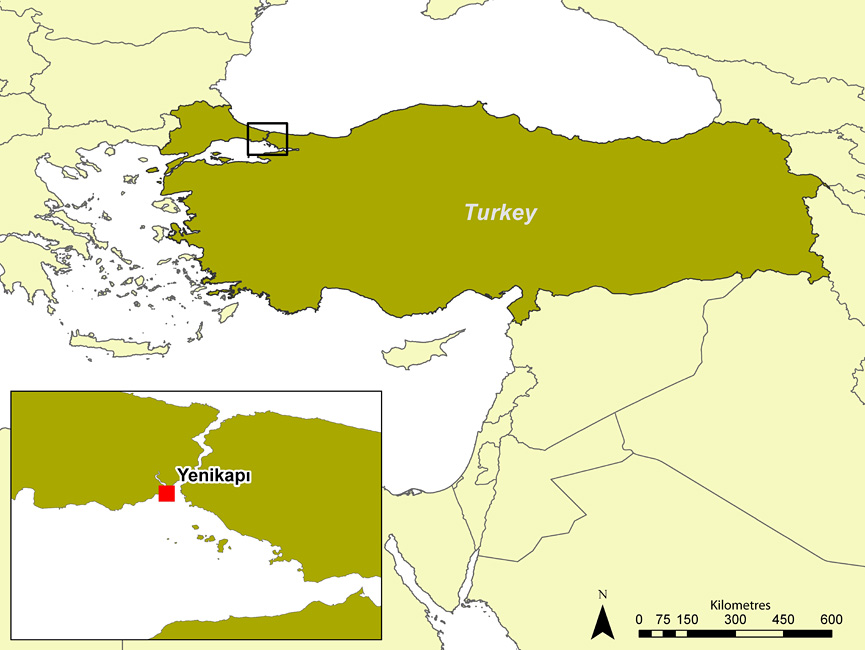
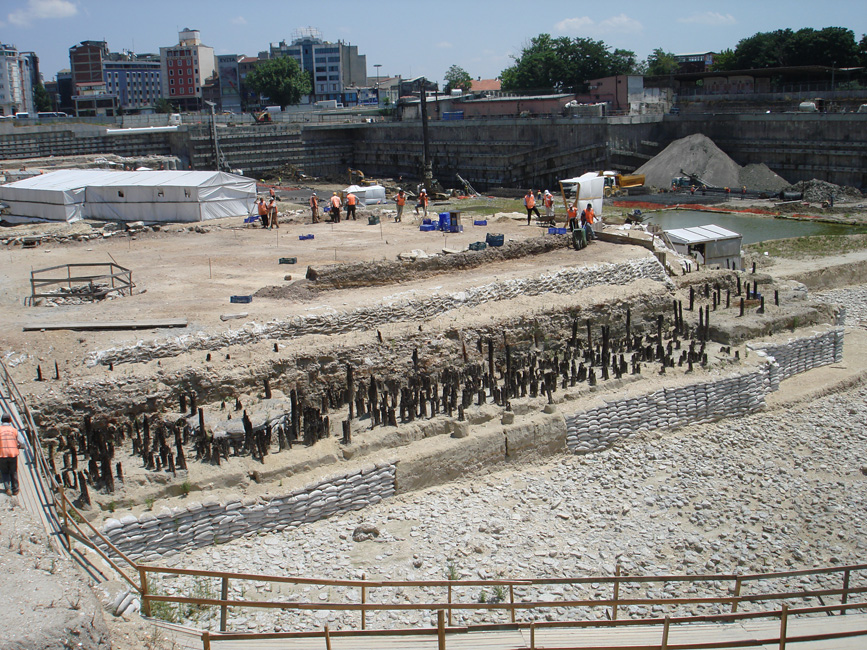
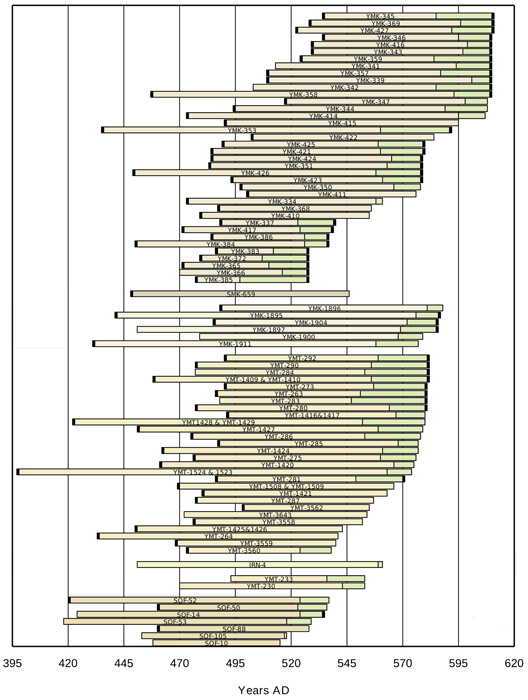
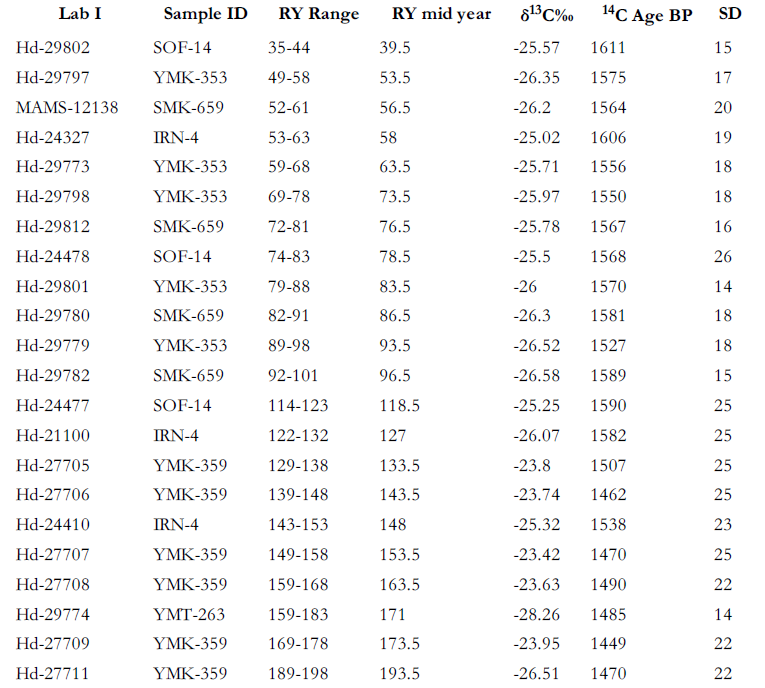
A 213-year oak tree-ring chronology has been constructed from timbers from several sites from first-millennium AD Constantinople, in particular, from the study of over 2000 samples from harbour installations at Yenikapı (Figure 1), Istanbul (Pekin & Kangal 2007) (Figure 2). A tentative dendrochronological placement of the 213-year sequence against other tree-ring series suggests an absolute date range of AD 398–610 for the time-series (Pearson et al. submitted) (Figure 3). We report a radiocarbon dating project to provide an independent near-absolute chronological placement for this important chronology. The data used are presented in Table 1.
Location of Yenikapı, Turkey.

View of a small part of the Yenikapı excavation taken in July 2009 (looking to the SE) showing one of the wooden harbour installations from which samples were taken (Mürvet's Dock, informally named after the supervisor pending official nomenclature). Sample YMT-263, which is employed in this study, came from this dock.

The 213-year dendrochronology by sample. Green indicates presence of sapwood, black indicates that pith or last ring under the bark is present. Samples are grouped according to specific structures. Samples placed at the tentative dendro-date (figure modified from Pearson et al. submitted).


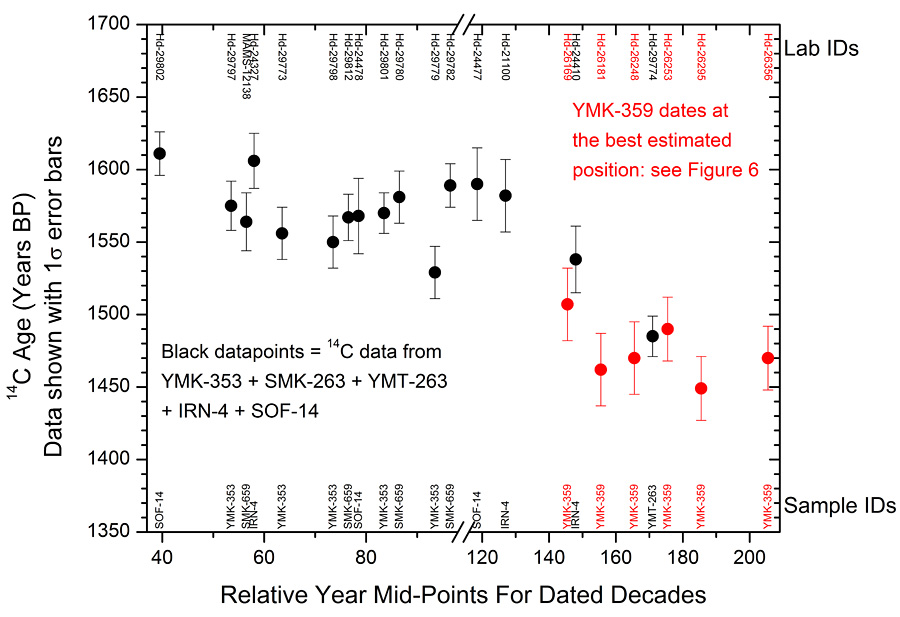
14C data and placement of the 10-year tree-ring samples (mid-points) within the 213-year chronology. Hd = Heidelberg Radiocarbon Laboratory (for sample preparation and measurement, see Kromer et al. 2010: 875). MAMS = AMS measurement at the Klaus-Tschira-Labor-Curt-Engelhorn-Zentrum Archaeometrie, Mannheim (Kromer et al. 2012). For the 14C data see Table 1.

Materials and methods
14C-wiggle-matching (e.g. Galimberti et al. 2004), employing OxCal (Bronk Ramsey et al. 2001), combined sixteen 14C measurements on 10-year samples of wood from five of the cross-dated elements of the chronology (YMK-353, SMK-659, SOF-14, IRN-4 and YMT-263) with the tree-ring- (calendar-) defined sequence (Figures 3 & 4) and the current northern hemisphere 14C calibration dataset (IntCal09: Reimer et al. 2009) as well as the less smoothed IntCal98 dataset (Stuiver et al. 1998) shown in Figures 5 and 6. Various permutations excluding samples identified as outliers using the Outlier_Model ("SSimple", N(0,2),0,"s" ) with {Outlier, 0.05} (Bronk Ramsey 2009) were also run.
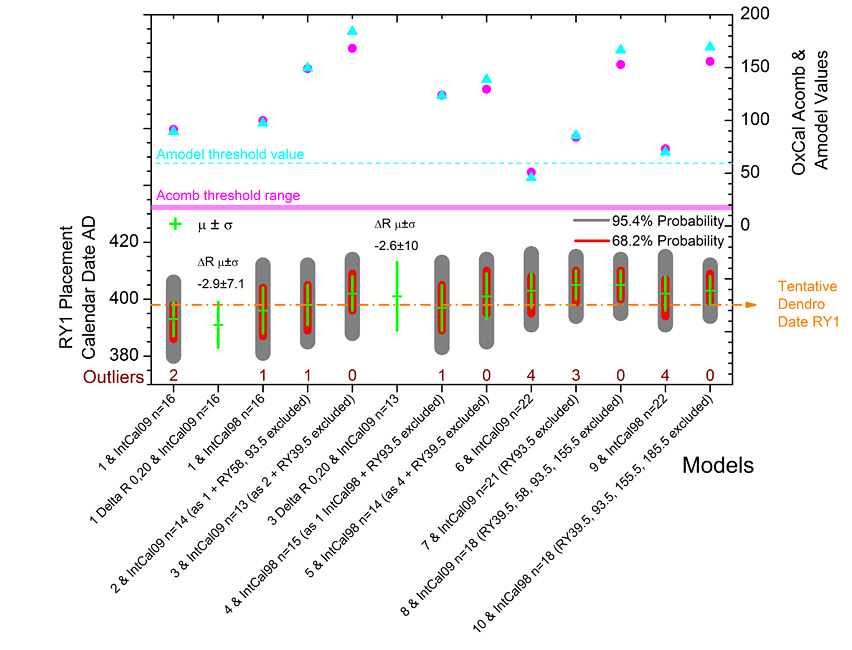
Calculated fit ranges for Relative Year (RY) 1 of the 213-year chronology according to a variety of models using OxCal and either IntCal09 or IntCal98. Models 1–5 start with the 16-date-set; Models 6–10 start with the larger 22-date-set. Two ΔR tests with a neutral offset test (of 0±20) indicate no substantive offset is relevant.

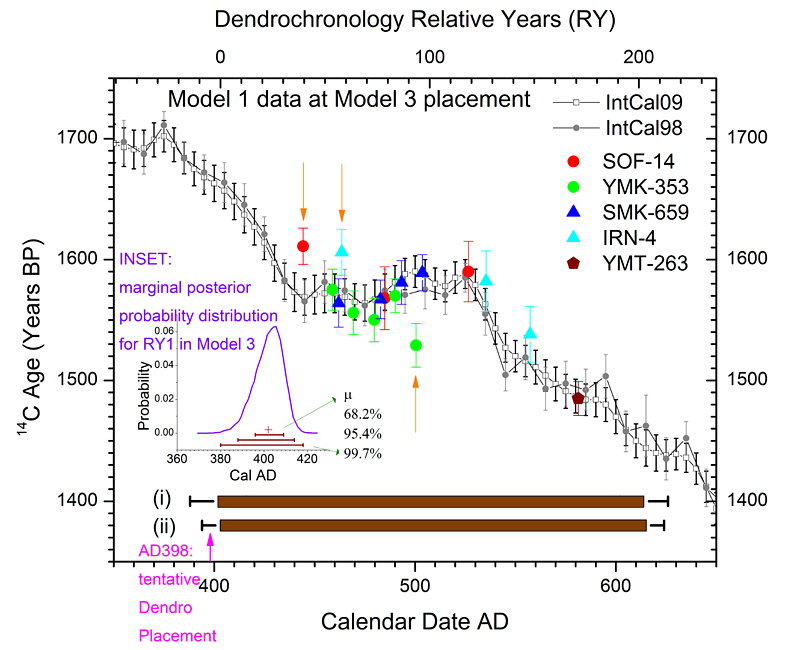
The best fit for the Constantinople dendrochronology computed by OxCal using the 16-date set (excluding dates from sample YMK-359) based on Model 3 (Figure 5) minus the three outlying dates (indicated with the orange arrows) — data positioned according to the mean (µ) of the marginal posterior probability distribution (see Inset). The datum at RY93.5 is the one very clear outlying value, and it is probably relevant that this sample was also noted as having fungal contamination (not observed on the other samples). The boxes below show: (i) the calendar placement of the 213-year dendrochronology (with Relative Year = RY1 at AD 402) within the 95.4% probability fit region from Model 3; and (ii) the calendar placement of the 213-year dendrochronology (with Relative Year = RY1 at AD 403) within the 95.4% probability fit region from Model 10.

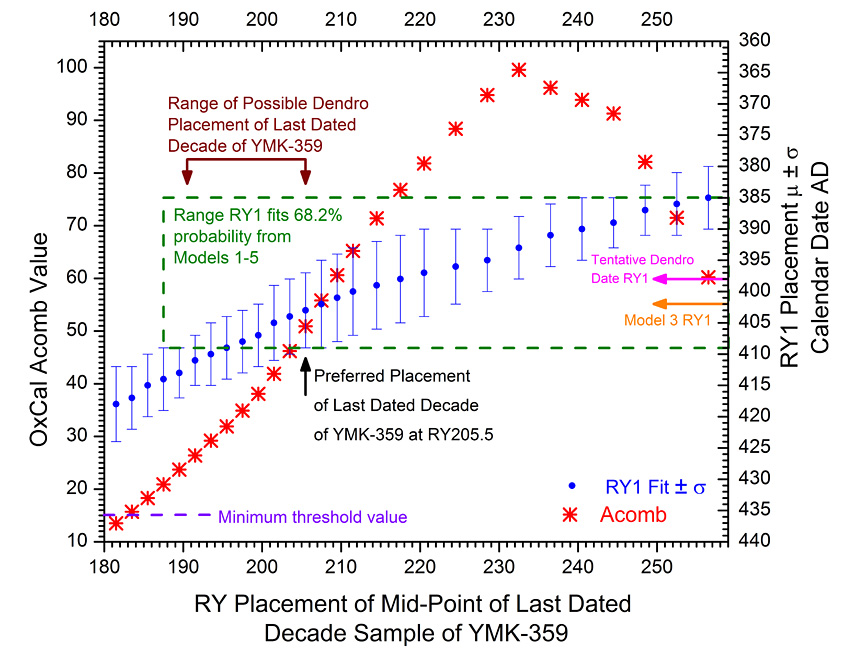
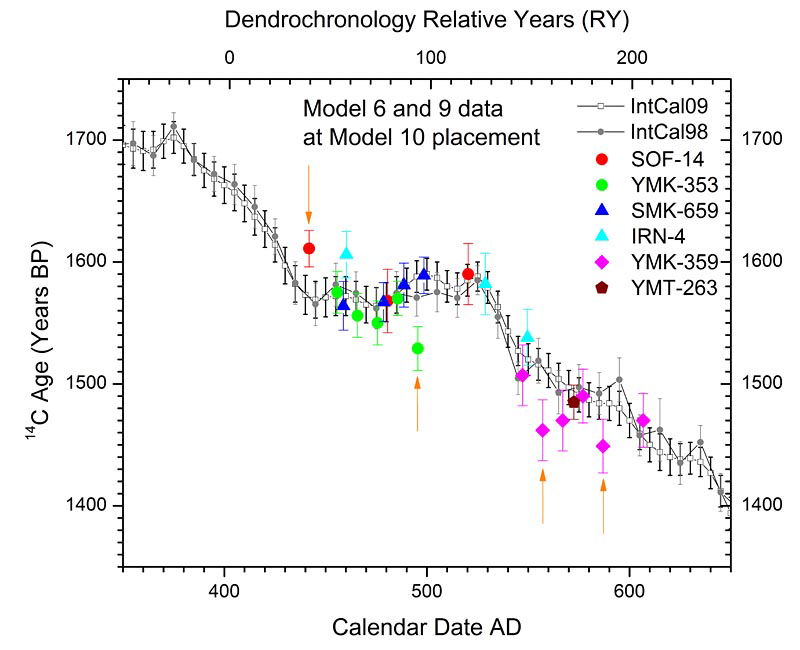
Six 14C measurements had previously been obtained on another sample from the chronology (YMK-359). The sampling was carried out five years ago, and although there is a likely placement of the seven contiguous decades dissected (one was not dated), the laboratory records leave an ambiguity of 10 or 15 years; hence we initially rejected the dataset in favour of the secure 16-date set above. The new data allows us to test both options for placement of the YMK-359 sub-set by considering the fit of the YMK-359 14C dates against the 16-date set and wiggle-match (Figure 7). This leads us to place the YMK-359 14C dates as shown in Figure 4. Models 6–10 consider the 22-date set, with the data from YMK-359 included (see Figures 5 & 8). The enlarged dataset offers placements consistent with the 16-date set. This suggests that the best estimate placement of the YMK-359 data is correct.
Quality and placement of the best fit for the 22-date wiggle-match and chronology including the dates from YMK-359 according to the Relative Ring (RY) placements of the YMK-359 samples expressed in terms of the mid-point of the last dated decadal sample from YMK-359 against IntCal09. The OxCal Acomb value is used as an indicator of the quality of the wiggle-match (higher value is better). We see that the more recent the placement of the radiocarbon-dated decades from YMK-359 within the possible dendro-range, then the better the fit, since — given no other constraints (e.g. dendro or the other sixteen 14C data) — the six YMK-359 14C data would prefer a more recent fit. The solution which best accommodates all the data and reaches a reasonable outcome is with the most recent dendrochronologically possible placement of the midpoint of the last dated decade of YMK-359 at RY205.5.

The best fit for the dataset including the YMK-359 dates (initial set of 22 dates). The fit shown, as computed by OxCal, uses eighteen 14C measurements (Model 10), excluding the four outliers indicated with the orange arrows – data positioned according to the mean (µ) of the marginal posterior probability distribution.

Results and discussion
Model 3 (excluding YMK-359) and Model 8 (including YMK-359) provide the best placements of the chronology against IntCal09 (quoting the 95.4% probability ranges in each case): respectively AD 402+12/-14 and AD 405+9/-10; and Models 5 and 10 offer the same against IntCal98: respectively AD 401+13/-16 and AD 403±9. The mean (µ) best fit point ranges vary only by 4 years across these models. Figure 6 (bottom of diagram) shows the two possible placements of the 213-year dendrochronology within 95.4% probability ranges for Model 3 (i) and Model 10 (ii). We use Model 3 as the preferred 14C-based dating since it avoids the question-mark over the exact placement of the YMK-359 data. Every model in Figure 5 provides a wiggle-match consistent within its 95.4% probability range with the tentative dendro-dating of the 213-year dendrochronology. The fact that such proximate temporal ranges have been indicated separately by both dating techniques provides us with a sound basis for suggesting that this dendrochronology is placed close to its correct absolute date range.
Historical evidence provides additional supporting evidence. The 213-year dendrochronology includes samples from the primary construction of Justinian's Hagia Sophia, the construction of which fits between the Nika Insurrection of January 532 AD and dedication in December 537 AD (Mainstone 1997; Mark & Çakmak 1992). Dendro sample SOF-14 comes from the lower levels of the structure and includes the waney edge (the last ring formed under the bark): this is placed at AD 538+12/-14. Other samples included from Hagia Sophia (with sapwood but too much decay to make waney edge determination possible) are placed at AD 540–541+12/-14. These dates are compatible with the historical evidence within the stated errors, as is the tentative dendrochronological placement (SOF-14 end date AD 534).
Conclusion
The combined evidence from the various modelled scenarios has provided a best near-absolute placement for the chronology at c. AD 402–614+12/-14 (within 95.4% probability limits). This is in good agreement with both historical evidence and a tentative dendrochronological placement proposed by Pearson et al. (submitted). The 14C wiggle-match supports the relevance of this 213-year chronology as a key building block towards a longer 1st millennium AD Aegean-region oak tree-ring chronology.
Acknowledgments
Work on the material from Yenikapı and the overall Marmaray Project has dominated the activities of The Malcolm and Carolyn Wiener Laboratory for Aegean and Near Eastern Dendrochronology at Cornell University between 2005 and 2011. This work towards a first-millennium AD oak dendrochronology in the Aegean would not have been possible without the generous long-term support of the Malcolm H. Wiener Foundation, the National Science Foundation (currently BCS1019743 to Kuniholm & Wazny), The National Endowment for the Humanities, the numerous individual patrons of the Aegean Dendrochronology Project, and the College of Arts & Sciences, Cornell University. We thank the many colleagues and students who have worked on these samples (see Pearson et al. submitted). The Yenikapı and Marmaray Project samples were collected by Peter Ian Kuniholm, Jennifer Watkins, Sturt Manning (who thanks Cemal Pulak for assistance in 2007), Tomasz Wazny, Carol Griggs, Ünal Akkemik, Nesibe Köse, Tuncay Güner and Rachel Kulick, with the assistance of the Marmaray Project team; We especially thank Zeynep Kızıltan and her predecessors for permission and Filiz Yalçindağ, Sırrı Çölmekçi and Mehmet Ali Polat for continuous support. We thank Peter Brewer at Cornell for producing Figure 1. Finally we thank Sabine Kühr and Eva Gier at Heidelberg and Susanne Lindauer at the Klaus-Tschira Scientific Dating Laboratory.