

Positive emotions have long been identified as an important factor for individuals to obtain favourable outcomes (e.g., resources and skills) and flourish in life (e.g., Fredrickson, Reference Fredrickson1998, Reference Fredrickson2001). Vigour, as a kind of positive emotion at work, has recently been proposed to play an important role in organisational settings (Shirom, Reference Shirom2011). To be vigorous means that individuals possess feelings of having physical strength, cognitive liveliness, and affective energy (Shirom, Reference Shirom, Ganster and Perrewe2004, Reference Shirom, Bakker and Leiter2010, Reference Shirom2011), which has been hypothesised to predict positive physical and mental wellbeing of employees as well as major work outcomes (Shirom, Reference Shirom2011). Typically measured using the Shirom-Melamed Vigor Scale (SMVS; Shirom, Reference Shirom, Ganster and Perrewe2004), accumulating evidence suggests that vigour might actually be worth investigating both in and out of the workplace setting (Shirom, Toker, Berliner, Shapira, & Melamed, Reference Shirom, Toker, Berliner, Shapira and Melamed2008; Shirom, Toker, Jacobson, & Balicer, Reference Shirom, Toker, Jacobson and Balicer2010; Shirom, Toker, Melamed, Berliner, & Shapira, Reference Shirom, Toker, Melamed, Berliner and Shapira2013; Steele et al., Reference Steele, Rupayana, Mills, Smith, Wefald and Downey2012). For instance, Shirom and colleagues (Shirom et al., Reference Shirom, Toker, Berliner, Shapira and Melamed2008; Shirom, Toker, Jacobson et al., Reference Shirom, Toker, Jacobson and Balicer2010; Shirom et al., Reference Shirom, Toker, Melamed, Berliner and Shapira2013) found that feeling vigorous at work predicted better self-rated health (Shirom et al., Reference Shirom, Toker, Berliner, Shapira and Melamed2008), as well as lower risk for diabetes (Shirom, Toker, Jacobson et al., Reference Shirom, Toker, Jacobson and Balicer2010) and hyperlipidemia among healthy employees (Shirom et al., Reference Shirom, Toker, Melamed, Berliner and Shapira2013). For work-related outcomes, vigour was the strongest predictor of job performance above job involvement, perceived organisational support, and work engagement (Steele et al., Reference Steele, Rupayana, Mills, Smith, Wefald and Downey2012; see also Carmeli, Ben-Hador, Waldman, & Rupp, Reference Carmeli, Ben-Hador, Waldman and Rupp2009). After reviewing these researches, it seems logical that exploring the role of this positive affective state in Thai employees is important. Specifically, Thailand is known as the ‘Land of Smiles’, which implies that Thai people use their positive emotions in many life contexts. Indeed, Sanuk, or having fun, has been suggested to be central to Thai's way of working (Kislenko, Reference Kislenko2004). Surprisingly, the role of positive emotion in the Thai workplace has been neglected, though research examining positive states such as hope and resilience have provided promising results in predicting crucial work outcomes such as job satisfaction, work happiness, and organisational commitment (Maturapodpong, Reference Maturapodpong2012). Adaptation of a validated scale measuring vigour might help to explain the role of positive affect at work in Thai culture. Such research could increase our understanding of positive psychology applied to work in a collectivistic context where work-related goals and values are different from the individualistic one (Hofstede, Reference Hofstede1980). Therefore, the primary objective of the current study was to present the adaptation of the SMVS in the Thai language in a Thai population.
Conceptualisation of Vigour at Work
Vigour, as defined in the work context, consists of feelings that one is physically (i.e., has physical energy to handle tasks at work), emotionally (i.e., able to show sympathy and empathy to coworkers and customers), and cognitively strong (i.e., have flowing thought processes and mental agility at work; Shirom, Reference Shirom, Ganster and Perrewe2004). Conceptualising vigour as an affective construct sets it apart from other similar constructs. According to Schaufeli, Salanova, González-Romá, and Bakker (Reference Schaufeli, Salanova, Gonzalez-Roma and Bakker2002), vigour is not actually a separate construct but falls within the conceptualisation of ‘work engagement’. Vigour as part of work engagement refers to a state of having high levels of energy, mental resilience, eagerness to put effort into work, and persistence in the face of work difficulty. In contrast, Shirom (Reference Shirom2011) moved away from work engagement per se and conceptualised vigour as based purely on positive affect, which can also have motivational implications. He viewed vigour to engage in work as being confounded by its possible ‘consequences’, which are resilience, willingness to work hard, and persistence. Shirom also argued that vigour and a contrasting state of burnout are conceptually independent from each other. In sum, he introduced vigour as a positive feeling or emotion that has its own place in the working context. Recently, Shirom (Reference Shirom2011) proposed a theoretical model of vigour. The model predicts that resources available to employees (e.g., positive job characteristics, high-quality relationships with coworkers) will promote energetic feelings, resulting in a number of significant positive outcomes such as greater motivation at work, heightened job performance and organisational effectiveness, increased job satisfaction, and better physical and mental health.
Measuring Vigour: The SMVS
The 14-item SMVS developed by Shirom (Reference Shirom, Ganster and Perrewe2004) consists of three subscales reflecting three theoretical dimensions of vigour, namely: physical strength (PS; five items); cognitive liveliness (CL; five items); and emotional energy (EE, four items). Respondents rate how they feel each kind of strength within the past 30 working days on a 7-point Likert scale ranging from 1 (never or almost never) to 7 (always or almost always). A global vigour score can be calculated by averaging item scores across each of the three subscales. The SMVS has good internal consistency with a Cronbach's alpha ranging between .87 to .92 for the global scale (Shirom, Reference Shirom, Ganster and Perrewe2004; Shirom, Toker, Melamed et al., Reference Shirom, Toker, Melamed, Berliner and Shapira2010; Shirom et al., Reference Shirom, Toker, Melamed, Berliner and Shapira2013). The PS subscale has especially high internal consistency (Cronbach's alpha = .93–.95), as does the EE subscale (Cronbach's alpha = .89–95; Armon & Shirom, Reference Armon and Shirom2011; Shirom, Reference Shirom, Ganster and Perrewe2004; Shirom et al., Reference Shirom, Toker, Berliner, Shapira and Melamed2008). Shirom (Reference Shirom, Ganster and Perrewe2004) reported a reliability of .72 for the CL subscale. A 13-item version with four items of CL has also been used, with reliabilities of .90–.92 (Armon & Shirom, Reference Armon and Shirom2011; Shraga & Shirom, Reference Shraga and Shirom2009). The average intercorrelations between the three subscales have been reported with a medium relationship of r = .44 (Shirom, Reference Shirom, Ganster and Perrewe2004).
Evidence supporting the validity of the SMVS is accumulating. Using a confirmatory factor analysis (CFA), Shirom and colleagues (Shirom, Reference Shirom, Ganster and Perrewe2004; Shirom et al., Reference Shirom, Toker, Berliner, Shapira and Melamed2008) found that the 14-item SMVS was best represented by the three proposed dimensions. In comparing the SMVS, work engagement (Utrecht Work Engagement [UWES]; Schaufeli et al., Reference Schaufeli, Salanova, Gonzalez-Roma and Bakker2002), and engagement measure of Britt (Reference Britt1999) against each other, Wefald, Mills, Smith, and Downey (Reference Wefald, Mills, Smith and Downey2012) reported that the SMVS fared better than the other two measures in predicting turnover intentions. The PS and CL subscales of the SMVS accounted for unique variance of turnover intentions after statistically controlling for job satisfaction and affective commitment, while none of the UWES subscales or Britt's measure did. Wefald and colleagues (Reference Wefald, Mills, Smith and Downey2012) concluded that the SMVS is probably the best measure for operationalising the construct of work engagement. The SMVS also better predicts subsequent self-rated health (Shirom et al., Reference Shirom, Toker, Berliner, Shapira and Melamed2008) and lower fibrinogen, which is an inflammatory biomarker (Shirom, Toker, Melamed et al., Reference Shirom, Toker, Melamed, Berliner and Shapira2010), demonstrating good criterion validity. We therefore chose to adapt the 14-item SMVS vigour measure for the Thai language (referred to as T-SMVS).
In adapting the SMVS, we followed the guidelines by the World Health Organization (WHO, n.d.), which suggests three steps before producing a final version of an adapted scale: forward translation, expert panel back-translation, and pretesting. We present the findings of the T-SMVS scale adaptation and validation in two steps: Step 1 describes the procedure we used for forward and backward translation, and item revision; Step 2 entails validation of the T-SMVS, including tests of the scale's construct, convergent, discriminant, and incremental validity. Although pretesting is recommended, we integrated this process into Step 1 by using experts to carefully evaluate the translated items and provide suggestions for the translation revision in order to best convey the meaning and form of the original items.
Step I: Adaptation of the T-SMVS
To construct the T-SMVS, we followed the steps outlined as follows:
Step 1: Investigation of concept
We reviewed literature on vigour and how it has been conceptualised as affect and as part of work engagement.
Step 2: Original statement translation
Thai native speakers then translated the SMVS from English to Thai. Comments and suggestions on the Thai version were obtained from 10 graduate students in psychology who were Thai native speakers and had reviewed literature on vigour. The translated scale was revised.
Step 3: Back-translation
The T-SMVS was translated back into English by two Thai psychologists who had no prior knowledge of the concept of vigour or the SMVS. The first author then synthesised the two versions into a back-translation version.
Step 4: Expert committee rating
Two additional psychologists who are native English speakers independently assessed whether the back-translated English version was comparable to the original English version. One psychologist was an expert in cognitive and language learning, while the other was an expert in research methodology. Following suggestions of Sperber (Reference Sperber2004), the back-translated English version was evaluated in terms of comparability of language and similarity of meaning. Comparability of language was assessed as whether words, phrases, and sentences were comparable between versions in terms of language form on a scale of 1 (not at all comparable) to 7 (extremely comparable). Similarity of the meaning ratings assessed whether meanings were similar between original and back-translated versions (equivalence of meaning even if the wording is not the same) as the corresponding item in the original scale (1 = not at all similar, 7 = extremely similar). Ratings of the back-translated English items are shown in Table 1.
Average Ratings of Comparability of Language and Similarity of Interpretability of the Back-Translated T-SMVS as Compared to Original Items and Standardised Solutions by Confirmatory Factor Analysis for the Three-Factor Model

Note: Items shown are from the original English language Shirom-Melamed Vigor Measure (Shirom, Reference Shirom, Ganster and Perrewe2004). COL = comparability of language, SI = similarity of interpretability, PS = physical strength, CL = cognitive liveliness, EE = emotional energy. Bold italic numbers are average ratings that are lower than midpoint of the rating scale (4, on 1–7 scale), indicating that the translated item needed revision.
Step 5: Revision of problematic items
Items that were rated lower than the midpoint (lower than 4) in either comparability of language or similarity of meaning dimensions were modified. We found that items 1, ‘I feel full of pep’, and 2, ‘I feel I have physical strength’, did not match the original items in terms of meaning. Items 5, ‘A feeling of vitality’, and 10, ‘A feeling of flow’, suffered on both form and meaning. The Thai version of these items were modified.
Step 6: Repetition of back-translation
Only items 1, 2, 5, and 10 were repeated in the back-translation process. Specifically, a psychologist who was a Thai native speaker with no background in the concept of vigour was asked to translate the items into English. The back-translated items were then subjected to the independent expert committee rating (same raters as in Step 4). Only item 10 was still evaluated as low on both form and meaning similarity (the back-translated item was ‘thought fluidity’). The item was revised again in Thai, and Steps 5 and 6 were repeated for this item only until it passed the rating criteria on its third revision.
Step II: Validation of the T-SMVS
Dimensions of vigour
To validate vigour as a psychological workplace construct and to investigate how it relates to various emotional and health indicators, a number of additional measures were administered, including reports of emotional exhaustion, job burnout, vigour as a dimension of work engagement, positive and negative affect at work, work self-efficacy, self-esteem, psychological empowerment, self-reported physical health, as well as frequency of exercise. To assess the T-SMVS construct validity, we assessed whether the scale was best represented by the three subscales of PS, CL, and EE according to the original construct outlined by Shirom (Reference Shirom, Ganster and Perrewe2004).
Hypothesis 1: A three-factor structure will be confirmed for the T-SMVS (PS, CL, and EE) to determine whether each item loads onto its corresponding dimension proposed by the original scale.
Vigour as a Positive Affect
According to Russell's (Reference Russell1980) circumplex model of affect predicting that each emotion is a product of valence and arousal dimensions combined in various degrees, vigour was postulated to locate on moderate activation (vs. deactivation) and pleasant (vs. unpleasant) quadrant (Shirom, Reference Shirom, Ganster and Perrewe2004). Therefore, the T-SMVS overall vigour score should correlate moderately with positive feelings at work in general (not specific in terms of arousal level, but specific for work setting), indicating convergent validity. At the same time, vigour as an affect should also correlate moderately with general negative affects experienced at work (e.g., nervous, distressed), which could be evidence for the T-SMVS's discriminant validity.
Hypothesis 2a: The T-SMVS global vigour score will have a moderate positive correlation with other positive affects at work, and a moderate negative correlation with negative affects at work.
In arguing for distinctiveness of vigour as purely affective, Shirom (Reference Shirom, Ganster and Perrewe2004, Reference Shirom2011) proposed that vigour should not overlap with work engagement as the former is an affective state whereas the latter can be considered a motivational consequence of vigour. Moreover, vigour as a facet of work engagement encompasses not only a high level of energy, but also mental resilience and willingness to put effort into work, which might be consequences of being vigorous rather than the construct itself. Due to some overlap in conceptualising vigour in the two frameworks, previous research found that the two vigour constructs are strongly related, but still distinctive (Wefald et al., Reference Wefald, Mills, Smith and Downey2012).
Hypothesis 2b: The T-SMVS overall vigour will have a high positive correlation with vigour in work engagement.
Vigour and Job Burnout
The state of being vigorous at work might be viewed as the absence of being stressed or burnt out. In conceptualising vigour as an affect, Shirom (Reference Shirom, Ganster and Perrewe2004, Reference Shirom2011) pointed to research findings from stress and adaptation literature for adopting the bivariate approach that views vigour and burnout as two distinct constructs instead of two poles of a single emotional dimension. He argued that vigour belongs to a behavioural approach system that directs individuals toward expanding activity levels. Job burnout, expressed as emotional exhaustion, cynicism, and reduced professional efficacy (Maslach, Schaufeli, & Leiter, Reference Maslach, Schaufeli and Leiter2001), in contrast, is viewed as a cause of behavioural avoidance system motivating individuals to withdraw from ongoing high job demands. Research examining the relationship between burnout and work engagement (with vigour as a subscale) provides evidence supporting the view that burnout and vigorous affect may be two different experiences rather than two ends of the same emotional dimension (Demerouti, Mostert, & Bakker, Reference Demerouti, Mostert and Bakker2010; González-Romá, Schaufeli, Bakker, & Lloret, Reference González-Romá, Schaufeli, Bakker and Lloret2006; Mäkikangas, Feldt, Kinnunen, & Tolvanen, Reference Mäkikangas, Feldt, Kinnunen and Tolvanen2012).
Hypothesis 3: The T-SMVS vigour will not correlate with job burnout.
Central to the job burnout concept is emotional exhaustion (Maslach et al., Reference Maslach, Schaufeli and Leiter2001). If vigour is an affective state of being resourceful emotionally, physically, and cognitively, the opposite state would be emotional exhaustion, a chronic state of resource depletion or fatigue due to excessive job demands. According to the conservation of resources model (COR; Hobfoll, Reference Hobfoll1989), emotional exhaustion could be a result of an actual/perceived resource loss, which could lead to diminished job performance and subsequent voluntary turnover (Wright & Cropanzano, Reference Wright and Cropanzano1998). Previous research (treating vigour and emotional exhaustion as part of work engagement and job burnout respectively), however, has documented a weak-to-moderate negative relationship between vigour and emotional exhaustion (Demerouti et al., Reference Demerouti, Mostert and Bakker2010; González-Romá et al., Reference González-Romá, Schaufeli, Bakker and Lloret2006; Mäkikangas et al., Reference Mäkikangas, Feldt, Kinnunen and Tolvanen2012). The weak relationship may indicate that, like vigour and job burnout, vigour and emotional exhaustion might not be opposite ends of energy levels at work, but perhaps related experiences that can occur simultaneously within a person. Investigating the relationship between vigour and emotional exhaustion will provide evidence with regard to the bivariate view of vigour and job burnout. (Mäkikangas et al., Reference Mäkikangas, Kinnunen, Rantanen, Mauno, Tolvanen and Bakker2014; Shirom et al., Reference Shirom, Toker, Melamed, Berliner and Shapira2013).
Hypothesis 4: The T-SMVS vigour will have a weak to moderate negative correlation with emotional exhaustion.
Vigour and Its Antecedents
To prove its distinctiveness, vigour should display discriminant validity with some positive but different constructs such as self-esteem, self-efficacy, and being psychologically empowered. Unlike vigour, self-esteem represents a view of the self that varies in degrees of favourableness. Self-efficacy represents cognitive, not affective, assessment of one's abilities to accomplish a task. Self-efficacy has also been proposed to be a component of psychological empowerment, a motivational state of being competent, seeing meaning in work, and having autonomy at work (Spreitzer, Reference Spreitzer1995). According to Shirom's (Reference Shirom, Ganster and Perrewe2004, Reference Shirom2011) vigour framework, these three constructs should be viewed as resources that are internal to the individual and should lead employees to subsequently feel vigorous. It was thus expected that vigour would have positive relationships, albeit only small to moderate in size, with these constructs, as described in the following hypotheses:
Hypothesis 5a: The T-SMVS vigour will have a weak-to-moderate positive correlation with self-esteem.
Hypothesis 5b: The T-SMVS vigour will have a weak-to-moderate positive correlation with self-efficacy specific to work domain.
Hypothesis 5c: The T-SMVS vigour will have a weak-to-moderate positive correlation with psychological empowerment.
Vigour and Health Consequences
Finally, to validate the T-SMVS, we included a test of its relationship with physical health. According to Shirom's (Reference Shirom2011) framework of antecedents and consequences of vigour, vigour is predictive of greater physical health. This prediction is based on research linking vigour to greater self-rated health (Shirom et al., Reference Shirom, Toker, Berliner, Shapira and Melamed2008; Shirom, Toker, Jacobson et al., Reference Shirom, Toker, Jacobson and Balicer2010).
Hypothesis 6: The T-SMVS vigour will correlate positively with self-rated health as indicated by self-report of physical health status and frequency of exercise, controlling for age, gender, and income.
Method
Participants
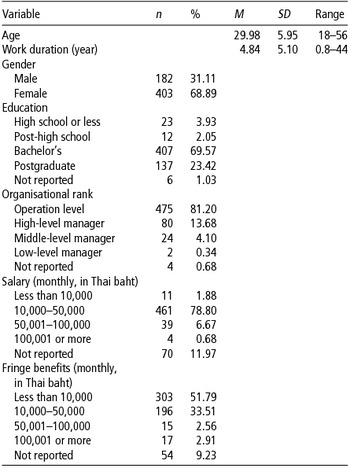
A total of 585 participants were recruited from five different work organisations in Bangkok, Thailand (68.9%, n = 403 women, 31.1%, n = 182 men), including a pharmaceutical supplier and petrochemical, telecommunications and information technology, statutory audit, and legal companies. Participants completed a number of scales in the Thai language in paper-and-pencil format. The mean age of the participants was 29.98 years (SD = 5.95). The mean length of service in current employment was 4.84 years (SD = 5.10). Characteristics of participants are shown in Table 2.
Demographic Characteristics of All Participants (N = 585)
Measures
Vigor
The 14-item back-translated T-SMVS was used to measure vigorous feelings at work. Respondents were asked to report how frequently they experience each kind of vigour dimensions (PS, CL, and EE) in the past 30 working days on a 7-point frequency scale ranging from 1 (never or almost never) to 7 (always or almost always). Responses on the 14-items were summed to yield a global vigour score, with higher scores indicating higher levels of vigour.
Emotional exhaustion
A nine-item emotional exhaustion scale of Saralumba (Reference Saralumba2009) was used. The scale assesses the extent to which a person experiences physical and emotional fatigue due to job demands. Participants were asked to indicate their degree of agreement with statements such as ‘I feel like I have overworked’, using a 6-point scale ranging from 1 (never) to 6 (always). This scale has been validated among a sample of Thai employees by Saralumba (Reference Saralumba2009) and shown to have high reliability (α = .90). Cronbach's alpha for the present sample was .88.
Job burnout
A 16-item measure of job burnout adapted from Schaufeli, Leiter, Maslach, and Jackson's (Reference Schaufeli, Leiter, Maslach, Jackson, Maslach, Jackson and Leiter1996) job burnout scale by Kleebbua (Reference Kleebbua2009) was used to gauge employees’ experience of burnout at work using three subscales: exhaustion (5 items, α = .83), cynicism (5 items, α = .90), and professional efficacy (6 items, α = .84). Participants indicated their agreement with statements such as ‘I have grown to be less interested in my job since I started it’ on a 7-point scale ranging from 0 (never) to 6 (everyday). Cronbach's alpha in our sample was high: exhaustion (five items, α = .88), cynicism (five items, α = .87), and professional efficacy (six items, α = .94).
Vigour facet of work engagement
A six-item vigour in work engagement was assessed using Jirawit-Olan's (Reference Jirawit-Olan2011) scale adapted from the UWES (Schaufeli et al., Reference Schaufeli, Salanova, Gonzalez-Roma and Bakker2002). Participants responded to statements such as ‘When I wake up in the morning, I feel I want to go to work’. Their responses were assessed on a 5-point scale ranging from 1 (strongly disagree) to 5 (strongly agree). This scale has been validated in a Thai employee sample by Jirawit-Olan (Reference Jirawit-Olan2011) with good reliability (α = .86). Cronbach's alpha for the present sample was .77.
Positive and negative affect at work
A 20-item scale from Thisaphak (Reference Thisaphak2005),which was adapted from Watson, Clark, and Tellegen's (Reference Watson, Clark and Tellegen1988) positive and negative affect scale, was used to assess the extent to which participants usually experience both kinds of affect specifically at work. The scale consists of 10 positive affect items (e.g., inspired, active) and 10 negative affect items (e.g., fear, nervous). Each item was rated on a 7-point scale ranging from 1 (very slightly or not at all) to 7 (extremely). A composite score for positive (negative) affect was computed by adding ratings of the 10 items. The scale has been validated in a sample of Thai employees and showed high reliability (α = .93 for positive affect items and α = .92 for negative affect items). Cronbach's alpha for the present sample was .95 and .92 for positive and negative affect respectively.
Work self-efficacy
An 18-item scale developed by Pattarawit (Reference Pattarawit2010) was used to gauge participants’ beliefs in their capability to overcome obstacles and accomplish their goals at work. Participants were asked to indicate their agreement with statements such as ‘I feel like I can handle difficulties in my job’ on a 5-point scale ranging from 1 (strongly disagree) to 5 (strongly agree). The scale's reliability has been established among a sample of Thai employees (α = .86). Cronbach's alpha for the current sample was .93.
Self-esteem
Global evaluation of self was measured using a 24-item, self-esteem scale developed by Srisrual (Reference Srisrual2004) based on Rosenberg's Self-Esteem Scale (Rosenberg, Reference Rosenberg1965). Participants were asked to indicate their degree of agreement with statements such as ‘I like being myself’ on a 5-point scale ranging from 1 (strongly disagree) to 5 (strongly agree). This scale has been validated in a Thai sample by Srisrual (Reference Srisrual2004) and demonstrated high reliability (α = .91). Cronbach's alpha for the current sample was .84.
Psychological empowerment
A 24-item measure of the state of being intrinsically motivated by a task was used to assess cognitive manifestations of heightened intrinsic job motivation (Boonyaprasop, Reference Boonyaprasop2011). Participants responded to statements such as ‘The job I am doing is meaningful for me’ on a 5-point scale ranging from 1 (strongly disagree) to 5 (strongly agree). This scale has been validated in a Thai sample and demonstrated high reliability (α = .97). Cronbach's alpha for the current sample was .95.
Physical health
Participants reported their general health relative to people their age on a 5-point scale ranging from 1 (poor) to 5 (excellent). Responses from these two questions were summed to derive a self-report physical health score (correlation between the two items, r = .82, p < .001).
Exercise
A single question asking participants how frequent they had exercised in the last two weeks (1 = none, 5 = very often) was used to assess physical activeness.
Data collection was deployed via 11 IRB-approved research projects that, during their scale development step, involved measuring vigour among Thai employees. These projects were independent from each other while all of them shared a goal of jointly developing the T-SMVS. Data for the T-SMVS was therefore collected from a variety of organisations in the Bangkok area of Thailand. All participants completed the T-SMVS, while each subgroup also received different sets of scales: participants 1–70 completed the positive and negative affect at work and the psychological empowerment scales; 71–140 received the emotional exhaustion, vigour in work engagement, and self-esteem scales; 141–120 and 351–420 received the burnout and work self-efficacy scales; 211–280 reported their self-esteem, physical health, and exercise, and filled out the T2 T-SMVS 2 weeks later; 281–350 reported their physical health and exercise; 421–490 completed emotional exhaustion and vigour in the work engagement scales; 491–560 reported their physical health and exercise, the positive and negative affect at work and psychological empowerment; and 561–585 only responded to the T-SMVS and no other scale.
Data Analysis
To test hypothesis 1 about the factor structure of the T-SMVS, a confirmatory factor analysis (CFA) was performed to compare model fit between the hypothesised and an alternative models. To test hypotheses 2 to 5 regarding convergent and discriminant validity, correlations were used. Finally, hypothesis 6 was tested using hierarchical regression analyses.
Criterion for Model Testing
Prior to testing our model using factor analysis, the following model fit criterion was used to determine good fit between the data and the model: the root mean square error of approximation (RMSEA) <0.06 for good fit, the standardised root mean residuals (SRMR) <0.05, the comparative fit index (CFI) >0.95, the adjusted goodness-of-fit index (AGFI) >.92, and the incremental fit index (IFI) = 0.95.
Incremental Validity of the T-SMVS
Hierarchical regression analyses were conducted to determine whether the T-SMVS vigour had unique predictive ability when other similar constructs were controlled. In all analyses, the controlled constructs included demographic variables of age, gender, and income level entered as a single block in the first step. The T-SMVS vigour score was entered in the second step. If the T-SMVS vigour was conceptually distinctive from other constructs, it should significantly explain some proportion of the variance of the outcome measures in addition to similar constructs (after the other constructs were statistically controlled).
Results
Means, SDs, and Cronbach's alphas of all measures are shown in Table 3. Participants generally reported a moderate level of vigour (M = 4.69, SD = 0.92, N = 585), moderately good health (M = 2.98, SD = 0.90, n = 210), and had exercised occasionally in the last 2 weeks (M = 2.24, SD = 1.11, n = 210). When separated by dimension, as shown in Table 4, participants reported somewhat high levels of EE (M = 5.27, SD = 1.20) and moderate levels of PS and CL (M = 4.35, SD = 1.27, and M = 4.56, SD = 1.29 respectively). The three subscales had intercorrelations between .55 to .76, with an average intercorrelation of .64. The CL and EE subscales had negatively skewed distributions, whereas the PS subscale was positively skewed. The skewness and kurtosis of all subscales, however, were within range to assume a normal distribution.
Means, Standard Deviations, and Correlations of All Variables With the T-SMVS
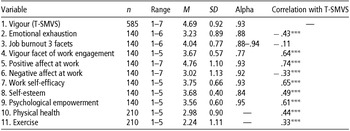
Note: ***p < .001.
Descriptive Statistics for the Three T-SMVS factors (N = 585)

Note: Range of scores is 1–7. ***p < .001.
Hypothesis Testing for Scale Validation
To test hypothesis 1, the T-SMVS was subjected to a confirmatory factor analysis (N = 585) using LISREL version 8.72 (Jöreskog & Sörbom, Reference Jöreskog and Sörbom2004) in order to test whether the three-factor model fit the data. Although there is no theoretically competing model for vigour's component, one might argue that vigour represents one type of positive affect. The hypothesised model was thus tested against an alternative model in which all 14 items were restricted to load onto a single latent vigour variable (a one-factor model). The correlated three-factor model fit the data reasonably well although the chi-square value was significant, indicating bad fit with the data, χ2(74, N = 585) = 342.26, p < .001. However, because chi-square is sensitive to large sample size (Bentler & Bonett, Reference Bentler and Bonett1980), other fit indices were considered. Other commonly used fit indices indicated that the three-factor model fit the data reasonably well: RMSEA = .08 (<0.06 for good fit), the SRMR = .04 (<0.05), CFI = .98 (>0.95), AGFI = .89 (>.92), and IFI = 0.98 (>.95 and is very close to one). All standardised loadings were higher than .70, indicating high correlations between each item and their corresponding factor. Factor loadings of each item are provided in Table 1. Each T-SMVS item loaded on its subscale in accordance with the original SMVS. The one-factor model, on the other hand, showed poor fit with the data, χ2(77, N = 585) = 1816.92, p < .001, RMSEA = .24, CFI = .88, SRMR = .11, AGFI = .46, IFI = .88. Fit statistics shown in Table 5 indicate better model fit for the correlated three-factor model on all fit indices with the value of χ2/df of the three-factor model closer to 3. A chi-square difference test indicated that the three-factor model fit significantly better than did one-factor, Δχ2(Δ3) = 1474.66, p < .001, supporting the three-factor structure hypothesis (H1). For the hypothesised model, maximum modification index indicated potential cross-loading for item 6 in CL dimension (‘I feel mentally alert’) such that it is recommended to load on the PS component, which is inconsistent with the measurement framework. Once this item was removed from the model, the fit was improved: χ2(62, N = 585) = 261.96, p < .001, RMSEA = .07, CFI = .98, SRMR = .06, AGFI = .91, IFI = .98. In summary, supporting hypothesis 1, the CFA and model comparison results indicate that the three-factor model is better with acceptable fit to the data, and thus support the construct validity of the translated version of the SMVS. Removal of item 6 seems to slightly improve model fit.
Goodness-of-Fit Indicators of the Models for the T-SMVS (N = 585)

Note: χ2 values are significant at p < .001. CFI = comparative fit index; RMSEA = root-mean-square error of approximation; SRMR = standardized root mean residuals; AGFI = adjusted goodness-of-fit index; IFI = incremental fit index.
Reliabilities of the T-SMVS
Internal consistency
As shown in Table 3 and Table 4, the T-SMVS exhibited excellent internal consistency for the overall scale (α = .93). Each subscale also showed high internal consistency (α =.93, .91, and .87 for PS, CL, and EE, respectively).
Test–retest
A subsample of 140 participants completed the T-SMVS after a 2-week interval. The T-SMVS vigour scores from the two tests were highly correlated, r = .77, p < .001, indicating good test–retest reliability of the scale.
Convergent and Discriminant Validity of the T-SMVS
To demonstrate convergent validity of the 14-item T-SMVS, scores from the scale were hypothesised to correlate moderately with measures of positive affect at work and vigour dimension of work engagement. For each subset, correlations between T-SMVS and the other variables were investigated. Correlations are shown in Table 3. Vigour scores measured by the T-SMVS had significant positive correlations with positive affect experienced in the work setting (r = .71 for PS, .59 for CL, .55 for EE, p < .001, and r = .74, p < .001, n = 140 for the entire scale), and vigour in work engagement (r = .63 for PS, .59 for CL, .29 for EE, p < .001, and r = .64, p < .001, n = 140 for the entire scale). Thus, hypotheses 2a and 2b were relatively well supported, indicating convergent validity of the T-SMVS.
Results also show that the T-SMVS total score had moderate correlations with the negative constructs of emotional exhaustion (r = −.43, p < .001, n = 140) and negative affect at work (r = −.33, p < .001, n = 140), as well as self-esteem (r = .49, p < .001, n = 140). The T-SMVS total score correlated more strongly with work self-efficacy (r = .63, p < .001, n = 140) and psychological empowerment (r = .61, p < .001, n = 140).The T-SMVS did not correlate with job burnout scale (r = −.11, p =.18, n = 140). These results lend support to hypotheses 2a–5c and thus indicates discriminant validity of the T-SMVS.
Incremental Validity
Results of the hierarchical regression are shown in Table 6.
Hierarchical Regression Analysis Summary for the T-SMVS Vigour Predicting Physical Health and Exercise
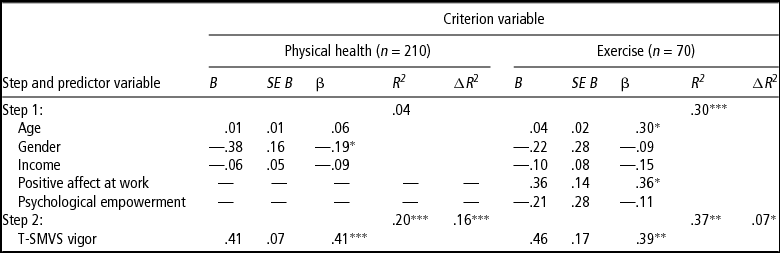
Note: *p < .05, **p < .01, ***p < .001.
Exercise
Using a subset of data (n = 70, 19 men and 51 women, M age = 34.00, SD = 7.95), the T-SMVS was tested to investigate whether it could predict amount of exercise after controlling for positive affect at work, psychological empowerment, and demographic variables. Results indicated that the T-SMVS significantly predicted amount of exercise (β = .39, p = .01) after controlling for age (β = .30, p = .02), gender (β = −.09, p = .45), income (β = −.15, p = .19), positive affect at work (β = .36, p = .02), and psychological empowerment (β = −.11, p = .45). Addition of the T-SMVS vigour score significantly increased the variance accounted for by the model from 30% to 37% (ΔR 2= .07, ΔF (1, 61) =7.29, p = .01).
Physical health
A subset of data (n = 210, 59 men and 151 women, M age = 29.70, SD = 6.13) were analysed to test whether T-SMVS vigour scores could predict health ratings after controlling for demographic variables. Results showed that the T-SMVS score (β = .41, p < .001) significantly predicted physical health after controlling for age (β = .06, p = .46), gender (β = −.19, p = .02), and income (β = −.09, p = .27). Adding the T-SMVS vigour score significantly increased the variance accounted for by the model from 4% to 20%, ΔR 2 = .16, ΔF(1, 161) = 31.68, p < .001, in support of hypothesis 6.
Discussion
The construct of vigour as an affect, a combination of being physically, mentally, and emotionally energetic at work, has been proposed to explain various positive organisational consequences (Shirom, Reference Shirom2011). The present study is the first to adapt and validate Shirom's (Reference Shirom, Ganster and Perrewe2004) measure of vigour for Thai employees. Findings support all of the hypotheses, indicating that the developed T-SMVS was a reliable tool and that vigour is a robust affective construct in workplace setting.
A CFA confirmed that the T-SMVS has three dimensions that cover physical (PS), emotional (EE), and cognitive vigour (CL) as with its original scale. Each item also loaded appropriately on its proposed dimension. Although item 6 (‘I feel mentally alert’) and 10 (‘A feeling of flow’) have sometimes been excluded from the original scale, data from Thai employees shows that both items have good loadings on the corresponding CL factor. Interestingly, like the original English SMVS, the Thai version suggests that modification of item 6 could improve the model. Exclusion or modification of item 6 is thus potentially beneficial for further developing the scale, though keeping the item is not considered problematic. An issue to be considered before removing item 6 would be whether the removal could affect coverage of the CL subscale representing states of having flowing thought processes and mental agility at work. Further CFA with larger samples would also be beneficial for testing the item's contribution to the scale.
The findings also indicate that the T-SMVS is internally consistent and psychometrically robust. We obtained strong internal consistency of the five-item CL dimension (α = .91). The EE subscale had the lowest alpha of .87, which is still considered to be high. Indeed, the present data collected from various types of organisations shows higher overall internal consistency (α = .93) than those previously reported (Shirom, Reference Shirom, Ganster and Perrewe2004; Shirom, Toker, Melamed et al., Reference Shirom, Toker, Melamed, Berliner and Shapira2010; Shirom et al., Reference Shirom, Toker, Melamed, Berliner and Shapira2013). Other analyses also indicate appropriate convergent and discriminant validity of the T-SMVS. Scores from the T-SMVS were moderately related to other kinds of positive affect at work, as well as vigour as a component of work engagement. At the same time, the T-SMVS vigour is distinguishable from self-esteem, self-efficacy, emotional exhaustion, and psychological empowerment. Interestingly, we obtained insignificant findings between T-SMVS vigour and job burnout. This provides evidence in favour of the bivariate view of vigour and job burnout adopted by Shirom (Reference Shirom2011). Specifically, findings from Thai employees provides evidence that positive affect of vigour is not similar to absence of job burnout. The two constructs might instead be viewed as two distinct states rather than two opposite ends of a single emotion. The present study, therefore, adds to the literature on the conceptualisation of vigor and job burnout.
Consistent with Shirom et al. (Reference Shirom, Toker, Berliner, Shapira and Melamed2008), the T-SMVS provided evidence for incremental validity by predicting important physical health outcomes from self-reported physical health and exercise, above and beyond the effects of other positive affect at work, psychological empowerment, and major demographic variables. These findings also provide evidence in support of Shirom's (Reference Shirom2011) framework highlighting vigorous feelings as a distinctive affect at work that is a proximal predictor of positive work and health outcomes.
Some limitations of the present study, however, deserve attention. First, the test of incremental validity is limited to health outcomes, which were health status and frequency of exercise. Although previous studies have consistently documented the predictive effects of vigour on several physiological indicators of good health (e.g., Shirom, Toker, Jacobson et al., Reference Shirom, Toker, Jacobson and Balicer2010; Shirom, Toker, Melamed et al., Reference Shirom, Toker, Melamed, Berliner and Shapira2010; Shirom et al., Reference Shirom, Toker, Melamed, Berliner and Shapira2013), findings with regard to predicting mental wellbeing and organisational outcomes are scarce (with the exception of Carmeli et al., Reference Carmeli, Ben-Hador, Waldman and Rupp2009). Future investigations might provide more evidence for incremental validity of the T-SMVS on outcomes such as employees’ subjective wellbeing and job performance. Second, related to the first issue, the current study presents tests of the T-SMVS’ independent predictive ability on amount of exercise and self-report physical health, after demographic variables and a few correlated constructs were statistically controlled. However, we did not test effects of T-SMVS vigour against other similar constructs such as vigour in work engagement. Future investigations might add stronger evidence on uniqueness of the vigour construct. Third, convenient sampling was used in the survey, which resulted in a disproportionate number of females (approximately 2:1) in the overall sample. Although sample sizes were adequate for the majority of the tests, one for testing incremental validity on amount of exercise could be considered small (n = 70). Fourth, it should be noted that the T-SMVS was validated against a Thai version of Western scales, and such validations have not been published. However, the findings show expected relationships between those measures and the T-SMVS. Finally, all of our measures were self-report, potentially creating common method variance that might influence the results. Future research may consider utilising different sources of measurement besides self-report; for example, objective health rating by physician instead of self-rated health or employer's rating of behaviour or job outcomes in providing more evidence for the predictive effects of the T-SMVS. In addition, although the current study has employed some prevention of common method variance, that is, ensuring respondent anonymity that would help reduce evaluation apprehension during the survey completion, other remedies are also recommended (e.g., Podsakoff, MacKenzie, Lee, & Podsakoff, Reference Podsakoff, MacKenzie, Lee and Podsakoff2003).
Despite the limitations of the present study, this successful adaptation of a vigour scale for a Thai context has some important applications. First, the introduction of the T-SMVS permits workplace vigour to be examined in the context of Thai culture. It may be the case that employee vigour matters more in collectivist (such as in Thailand) than individualist contexts for work productivity or other important outcomes for several reasons. As collectivist cultures place greater emphasis on group goals as compared to individualist cultures (Triandis, Reference Triandis1989), it is possible that vigour of employees in collectivistic cultures is used for achieving the goals of an organisation rather than those of an individual. Moreover, in collectivist cultures, emotional contagion occurs more frequently as individuals are influenced more strongly by the feelings of group members than are those in individualistic cultures (Ilies, Wagner, & Morgeson, Reference Ilies, Wagner and Morgeson2007). Thai people are also known as being fun loving at work. Such acceptance of displaying emotions at work should make emotional contagion occur more easily. Investigating how feelings of vigour or lack thereof might spread among employee groups could be a helpful tool to model, understand, and perhaps even improve employee morale, health, happiness, and productivity. In addition, describing how cultural systems function and interact to create vigour at work will be a major advancement for organisational and positive psychology.
Second, from an organisational psychology perspective, the T-SMVS permits investigation among Thai employees if vigorous feelings are central to various kinds of positive work-related outcomes as proposed by Shirom (Reference Shirom2011). Findings would not only provide evidence to the framework, but will also inform management of how to achieve organisational goals based on positive psychology of supplying resources and creating positive feelings among employees. For instance, supervisors may enhance subordinates’ vigorous feelings and reap the benefit of increased organisational citizenship behaviours if they support employees who have security and protection needs appropriately (Little, Nelson, Wallace, & Johnson, Reference Little, Nelson, Wallace and Johnson2011). Job performance may be enhanced via increased employees’ vigour as they have a relational leadership (Carmeli et al., Reference Carmeli, Ben-Hador, Waldman and Rupp2009). Expanding or replicating such studies in Thai employees would yield interesting findings from different cultural background that would promote a flourishing of research in positive emotions and positive organisational psychology, while also being useful for management.
Finally, with this Thai version of vigour, application of the measure within the workplace can be encouraged. Knowledge about employees’ vigour can be utilised in various ways, for instance, as an indicator of employees’ resource levels. Based on the COR theory (Hobfoll, Reference Hobfoll1989), vigorous feelings are expected to derive from various kinds of resources, both individual and work related (Shirom, Reference Shirom2011). Measuring vigour would reflect employees’ readiness to utilise such resources to attain goals at work. If vigour is low, organisations may need to find out what the antecedents might be (e.g., negative leadership behaviour, low social support, ineffective reward practice), which could lead to improvement in management system and work environment. Feeling vigorous may be more imperative for some kinds of work more than the others, such as work or tasks that are related to creative problem solving or helping others (e.g., in customer service department), and actions that are associated with having positive moods (Isen & Levin, Reference Isen and Levin1972; Isen, Daubman, & Nowicki, Reference Isen, Daubman and Nowicki1987). Knowing how much and in what context employees experience vigour is an important piece of information for promoting such outcomes. The T-SMVS thus would be a useful tool for discovering more about antecedents and consequences of feeling vigorous at work in Eastern contexts.
Acknowledgments
This study was partially funded by the Center for Psychological Assessment, Faculty of Psychology, Chulalongkorn University. We gratefully thank all the scale's raters for the back-translation procedure. We also thank graduate students in the Applied Psychology, and the Industrial and Organizational Psychology Program at the Faculty of Psychology — Chantip Songkampol, Pirada Tipparat, Kornika Thanasetsakul, Chattamakarn Ruenaim, Sriruan Sripattanakul Hanbang, Anak Sopittanon, Wisakpa Phurikrai, Massalin Nimitsopon, Maneerat Vuthitannakul, Sukanlaya Yangsongjai — who enthusiastically assisted on data collection of the present study. We also thank Professor Emeritus Nonglak Wiratchai, PhD, who provided advice on the statistical analyses of the study. In addition, we very much thank Damith Woods, PhD, and Jason Ludington, PhD, for a critical reading of and thoughtful comments on earlier versions of the manuscript. Finally, we are grateful for our reviewers who provided thoughtful comments and suggestions on improving this manuscript.


 Open access

