

Mulka’s Cave, near Hyden (Figure 1), a large hollowed-out granite boulder, is the most profusely decorated Aboriginal rock art site in south-western Australia (Reference GunnGunn 2006). Because it is only 15km from Wave Rock, a widely-advertised natural granite weathering feature, to which about 80 000 tourists now come annually, they also visit the cave. We helped Gunn to record the artwork for the Department of Indigenous Affairs (DIA) in April 2004.
Location of Hyden on the Yilgarn Block, a craton of Late Archaean shield rock that has been emergent since the break-up of Gondwana during the Late Mesozoic. The antiquity of this landscape, its nutrient-poor colluvial soils and absence of drainage, coupled with the low, erratic rainfall, facilitates erosion at Mulka’s Cave.

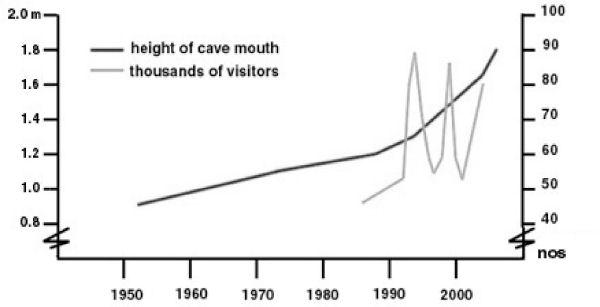
Non-indigenous people have been visiting Mulka’s Cave since the 1890s, although visitors were still rare in the 1970s (Reference RandolphRandolph 1973). The Department of Aboriginal Sites (DAS) installed some tourist infrastructure at the cave in the 1980s. By the end of the decade, tourism was beginning to affect Mulka’s Cave adversely (Reference RoddaRodda 1989). Nothing could be done to upgrade the minimal infrastructure at the site until 2006, however, because DAS, now DIA, was repeatedly restructured (and renamed) by successive State governments and heritage officers enforcedly became bureaucrats. During that period, tourist access to Mulka’s Cave was not monitored and visitor numbers increased greatly (Figure 2). In 2003-4, tourist organisations in Hyden successfully sought funding to replace the old infrastructure with an elevated walkway. Their proposal was approved by DIA and the relevant Aboriginal families in 2005. With some Aboriginal assistants, we monitored the walkway installation in May 2006.
Estimated rate of sediment erosion at Mulka’s Cave, derived from Figure 3, graphed against visitor numbers (Reference RoddaRodda 1989; DIA data). Since 1990, erosion has escalated even when tourist numbers have dropped, suggesting that sediment integrity has been damaged beyond repair.

Comparison of photographs we took in 2004 and 2006 showed that the shape of the entrance had changed; prompting us to research datable pictures of Mulka’s Cave on file at DIA. The resulting figure (Figure 3) shows that between 1952 and 1988, 0.5m of sediment was lost. By 2004, another 0.5m of deposit had disappeared. That erosion was accelerating is shown by the amount of sediment lost between 2004 and 2006. Had the walkway not been installed, erosion would have continued unabated because the deposits outside the cave were probed to a depth of -1m, without reaching bedrock.
Reconstruction of the ground level at the mouth of Mulka’s Cave (Reference DayDay 1951; Reference ServentyServenty 1952; Reference RandolphRandolph 1973; Bowdler et al. 1989 and recent photographs).

We attribute this erosion to trampling (Reference RossiRossi & Webb n.d.). There are few places within Mulka’s Cave where visitors can stand comfortably to view the artwork because it is full of boulders (Figure 4); while the floor at the base of the rock pile measures 2 x 7m. These limitations became a problem with increased tourism, particularly visits by commercial tours. These groups often comprise 30 people, two of whom are crowded into each square metre of floor space. We believe the resultant trampling has eroded 1m of the cave deposits in 50 years. That sediment is now spread over the slope outside, but the stone artefacts it contains lack stratigraphic context.
Ground level inside Mulka’s Cave in 1952 and 2004. This reconstruction and the predominance of boys' handstencils (70 per cent of those measured) suggest that Mulka’s Cave may have been a focus for ceremonies, particularly male initiation rituals, and that it was probably very dark inside when the artwork was made (Reference WebbWebb & Rossi 2008).

This demonstration of the erosive effect of visitation illustrates a cultural heritage dilemma: should people be allowed to visit sites if visitation spoils them? We hope it will prompt cultural heritage managers to monitor the erosive effects of tourism and undertake requisite mitigative action sooner rather than later. Mulka’s Cave may be unique, however. We know of no other archaeological site where erosion has been as severe over merely 50 years. We would be pleased, therefore, to learn of parallels.