





Introduction
Many scholars contend that democracy is in retreat across much of the world (Coppedge et al. 2021; Mechkova et al. Reference Mechkova, Lührmann and Lindberg2017). This retreat is driven by ‘democratic backsliding’ in which democratically elected leaders use the democratic process itself to subvert constitutional limits on their power and erode the foundation of democracy (Levitsky and Ziblatt Reference Levitsky and Ziblatt2018; Przeworski Reference Przeworski2019). Scholars diverge on the reasons for democratic backsliding. Some contend that public support for democracy has declined and anti-democratic politicians represent the policy views of the citizens who voted for them (Claassen Reference Claassen2020a, b; Donovan Reference Donovan2019; Frederiksen Reference Frederiksen2022a; Mondak and Hurwitz Reference Mondak and Hurwitz2012). Or, at the very least, partisan supporters within democratic polities have been willing to look the other way when politicians from their party seek to subvert democracy (Carey et al. Reference Carey, Helmke, Nyhan, Sanders and Stokes2019; Frederiksen Reference Frederiksen2022b, 2023; Goodman Reference Goodman2022; Graham and Svolik Reference Graham and Svolik2020; Krishnarajan Reference Krishnarajan2023) – allowing would-be autocrats in democracies to seize the moment. Other scholars contend that public support for democracy has remained relatively high and stable, suggesting that democratic backsliding has been an elite-led phenomenon (Bartels Reference Bartels2023; Wuttke et al. Reference Wuttke, Gavras and Schoen2022). And finally, an emerging line of research suggests that perhaps, there has been no secular decline in democracy and that democratic backsliding is largely found in subjective expert coder judgments rather than objective indicators (Little and Meng Reference Little and Meng2023), or as an artifact from experimental designs that pose hypothetical scenarios and, thus, do not capture how people would actually respond in a realistic setting (Broockman et al. Reference Broockman, Kalla and Westwood2023).
In this paper, we leverage the initial months of the COVID-19 pandemic in 2020 to speak to the debate regarding the malleability of the public’s support for democratic principles and the degree to which people’s partisan motivations can drive them to accept democratic erosion in the United Kingdom (UK) and United States (US).Footnote 1 The beginning of the COVID-19 pandemic constitutes a ‘hard’ case to study popular support for liberal democracy. Citizens, governments, and experts found themselves in an unprecedented global health crisis that was accompanied by huge uncertainty. As normal life came to a halt, many people found themselves isolated from others with no sense of when or if there would be a cure or treatment for the disease. The uncertainty did not only relate to the nature of the disease itself and the treatment of it, but also to the degree of economic and societal resilience. As lockdowns were implemented across the world, schools were closed, and day-to-day interactions were replaced with digital ones, and entire societies were put in hibernation. The COVID-19 pandemic, like crisis periods in the past, could tempt autocrats (and perhaps would-be autocrats) to use such extraordinary circumstances as a pretext to consolidate power (Matovski Reference Matovski2015), and due to the overall uncertainty, citizens could be swayed into supporting crackdowns on liberal democratic rights.
The pandemic context also adds credibility to our experimental vignettes. Previous experimental research, for good reasons, tends to rely on hypothetical and potentially remote scenarios, and the experiments we report in this paper present real proposals on a highly salient issue. In the early months of the pandemic (March–June 2020), when our studies were conducted, there were actual and proposed restrictions on civil rights to manage the spread of the virus. In response to the pandemic, most countries around the world adopted emergency policies to contain the spread of the virus, with widely varying effects on liberal democracy (Bolleyer and Salát Reference Bolleyer and Salát2021; Engler et al. Reference Engler, Brunner, Loviat, Abou-Chadi, Leemann, Glaser and Kübler2021; Greitens Reference Greitens2020). For example, Prime Minister Victor Orbán used the crisis to acquire powers to rule by decree in Hungary (Kelemen Reference Kelemen2020; Novak and Kingsley Reference Novak and Kingsley2020), and Israel passed a law banning protests during the second coronavirus lockdown (Guardian 2020). In the US, some politicians suggested that the pandemic was the reason for banning protests, postponing elections, and adjourning Congress (Vazquez and Mattingly Reference Vazquez and Mattingly2020). Thus, there was a real and present danger that the pandemic could lead to a lasting erosion of key liberal democratic norms in society (Goetz and Martinsen Reference Goetz and Martinsen2021).
By studying the public’s willingness to accept encroachments on liberal democratic rights during the acute phase of a crisis in the UK and the US, we look at countries that have similar cultural and legal histories and are both long-standing democracies (Almond and Verba Reference Almond and Verba1963), but differ with respect to observed democratic backsliding in recent years. While the UK has remained a stable liberal democracy, recent events in the US (some of which happened after our study) suggest that intense partisan politicization has led to some erosion in democratic norms (Arceneaux and Truex Reference Arceneaux and Truex2023; Carey et al. Reference Carey, Helmke, Nyhan, Sanders and Stokes2019; Dickson and Hobolt Reference Dickson and Hobolt2024; Druckman et al. Reference Druckman, Klar, Krupnikov, Levendusky and Ryan2020; Kalmoe and Mason Reference Kalmoe and Mason2022) and institutions (Grumbach Reference Grumbach2022) in that country.
In this paper, we distinguish between support for illiberal policies that restrict core liberal democratic rights (eg limiting freedom of the press and restricting elections) and those policies that are merely intrusive but necessary public health measures (eg mask wearing). In doing so, we investigate whether citizens are more reluctant to support policies that encroach on core liberal democratic norms compared to otherwise onerous responses to deal with a crisis that does not contract liberal democratic values.
The first wave of the COVID-19 pandemic in the spring and summer of 2020 offers an apposite case study for investigating the broader question of the resilience of liberal democratic norms, as it provides a realistic context for understanding to what degree, and for what reasons, citizens support policies that limit core political rights in the face of a crisis. It is important to note that at this time in the pandemic, restrictions on movement and behavior were common in both the UK (which was in full lockdown, see Anderson and Hobolt Reference Anderson and Hobolt2022) and across the US, even in states with Republican governors (Dickson and Hobolt Reference Dickson and Hobolt2024; Elassar Reference Elassar2020). While a number of studies have examined governments’ policy responses to the pandemic (Bolleyer and Salát Reference Bolleyer and Salát2021; Engler et al. Reference Engler, Brunner, Loviat, Abou-Chadi, Leemann, Glaser and Kübler2021; Greitens Reference Greitens2020; Hale et al. Reference Hale, Angrist, Goldszmidt, Kira, Petherick, Phillips, Webster, Cameron-Blake, Hallas, Majumdar and Tatlow2021), we know far less about the public’s reaction to policy proposals devised during the pandemic that threatened the foundations of liberal democracy.Footnote 2
Building on Alsan et al. Reference Alsan, Braghieri, Eichmeyer, Kim, Stantcheva and Yang2023’s study of people’s commitment to civil liberties in 15 countries across the globe, our paper examines people’s commitment to liberal democratic rights in two long-standing and established democracies – the UK and the US. Specifically, we present evidence based on preregistered hypotheses from four experimental studies (combined N = 9,587 conducted in May and July 2020). Our paper reveals that while on average, there is little willingness to limit core liberal democratic rights, public support for liberal democratic rights does display some degree of malleability. Citizens are willing to support illiberal policy measures that restrict core political rights in response to the public health crisis, especially where such measures are already in place or when they are endorsed by their party and trusted experts. That said, the results demonstrate a resistance to certain illiberal policy measures, including banning protests and limiting press freedom, even when prompted by an in-group partisan to support them. While these findings are consistent with extant research that demonstrates how partisan cues can increase support for democratic backsliding, they also indicate that when it comes to real-world policy proposals, partisan cues are not always effective at motivating support for actions that would erode liberal democracy.Footnote 3
Support for liberal democratic norms in times of crisis
A prominent view contends that democracy relies on support for its core features to be shared and defended by the broader society (Dahl Reference Dahl1989; Weingast Reference Weingast1997). In particular, citizens and political elites must accept a system of government where policymakers are selected via free and fair elections in which citizens have the right to vote for whomever they prefer, access information delivered by a free press, publicly criticize the government, and enjoy a set of procedural rights that limit the authority of the government to restrict individual liberties (Dahl Reference Dahl1971, Reference Dahl1989). While these rights are typically codified in constitutions and law, they constitute mere ‘paper tigers’ without a commitment on the part of political elites as well as citizens to respect the rule of law (Almond and Verba Reference Almond and Verba1963; Linz and Stepan 1978).
Nonetheless, extant research offers mixed evidence about the degree to which citizens of liberal democracies hold a principled commitment to liberal democratic norms. On the one hand, citizens in established democracies generally strongly support democracy as a system of government (Inglehart and Norris Reference Inglehart and Norris2003; Klingemann Reference Klingemann2014; Wuttke et al. Reference Wuttke, Gavras and Schoen2022). In these contexts, most citizens learn about democratic norms and processes from a young age, making departures from these norms seem intuitively wrong (Becher and Brouard Reference Becher and Brouard2020; Bor et al. Reference Bor, Mazepus, Bokemper and DeScioli2021). On the other hand, many people’s commitment to abstract democratic norms and values fails to materialize in specific instances. For instance, in the US, individuals are often willing to give the police wide latitude to violate civil liberties when the suspect has committed a serious or heinous crime (Chong Reference Chong1993). Graham and Svolik (Reference Graham and Svolik2020) show that Americans are willing to support politicians with whom they share policy preferences and partisanship, even when they take positions that violate core democratic principles (see also, Krishnarajan Reference Krishnarajan2023). In a comparative experimental study, Frederiksen (Reference Frederiksen2022a) demonstrates that voters prefer undemocratic, competent candidates to democratically compliant, incompetent candidates. Moreover, acceptance of democratic norms is not universal, even in established democracies where a nontrivial minority supports authoritarian policies (Donovan Reference Donovan2019; Malka et al. Reference Malka, Lelkes, Bakker and Spivack2020). In fact, a significant number of people in established democracies are willing to trade civil liberties for a sense of security in response to external threats (Davis and Silver Reference Davis and Silver2004; Merolla and Zechmeister Reference Merolla and Zechmeister2009; Mondak and Hurwitz Reference Mondak and Hurwitz2012), such as wars, terrorist attacks, and pandemics (Albertson and Kushner Gadarian Reference Albertson and Gadarian2015; Alsan et al. Reference Alsan, Braghieri, Eichmeyer, Kim, Stantcheva and Yang2023; Berinsky Reference Berinsky2009).
This raises the question of how strong principled support for liberal democratic norms is in times of crisis. This question defies easy answers, in part because it is unclear which benchmarks should be used. Benchmarks are crucial for understanding public opinion in other areas of public life, such as views about the economy (Kayser and Peress Reference Kayser and Peress2012) or international cooperation (De Vries Reference De Vries2018). When it comes to support for liberal democracy, an ‘ideal type democratic citizen’ would allow no concessions to core liberal democratic values. Yet, recent evidence suggests limited resilience of such norms, even in normal times, and considerable partisan malleability in support for liberal democracy norms (Graham and Svolik Reference Graham and Svolik2020). In order to further examine the resilience of popular commitment to liberal democratic right, we argue that the COVID-19 pandemic constitutes a useful case study for several reasons. Importantly, a public health crisis of this magnitude triggered drastic, but also widely varying, government responses (Hale et al. Reference Hale, Angrist, Goldszmidt, Kira, Petherick, Phillips, Webster, Cameron-Blake, Hallas, Majumdar and Tatlow2021). The unprecedented nature of COVID-19 meant that some governments adopted measures that could erode fundamental liberal democratic principles in an effort to contain the virus (Bolleyer and Salát Reference Bolleyer and Salát2021; Engler et al. Reference Engler, Brunner, Loviat, Abou-Chadi, Leemann, Glaser and Kübler2021), and the increase in public support for governments at the beginning of the pandemic (Bol et al. Reference Bol, Giani, Blais and Loewen2021; De Vries et al. Reference De Vries, Bakker, Hobolt and Arceneaux2021) could have paradoxically also boosted support for government overreach. This provides a realistic context within which to examine whether citizens are more likely to resist policy responses that encroach on core liberal democratic norms. Specifically, it allows us to examine whether citizens make a clear distinction between policies that limit fundamental political rights and those that are intrusive, but not essential to the functioning of a liberal democracy.
A key contribution to our understanding of liberal democratic norms during the COVID-19 pandemic is the work by Alsan et al. (Reference Alsan, Braghieri, Eichmeyer, Kim, Stantcheva and Yang2023). In their study, Alsan et al. (Reference Alsan, Braghieri, Eichmeyer, Kim, Stantcheva and Yang2023, p. 386) leveraged longitudinal surveys in 15 countries and concluded that ‘significant heterogeneity across groups in willingness to sacrifice [democratic] rights’ whereby ‘citizens disadvantaged by income, education, or race are less willing to sacrifice rights than their more advantaged peers in every country.’ In an information experiment, Alsan et al. (Reference Alsan, Braghieri, Eichmeyer, Kim, Stantcheva and Yang2023, p. 412) also show that manipulating health insecurity by providing people information about the pandemic or not, has ‘a positive, sizable impact … on the willingness to give up civil liberties, a finding that holds across all dimensions of civil liberties elicited.’
Here, we leverage the first wave of the COVID-19 pandemic in the spring and summer of 2020. We deepen and broaden the work of Alsan et al. (Reference Alsan, Braghieri, Eichmeyer, Kim, Stantcheva and Yang2023). First, in line with classic scholarship of democratic theory (Dahl Reference Dahl1971), we conceptualize illiberal policies as those that limit core political rights, such as freedom of the press, freedom of association, the right to fair trial, and free and fair elections. These rights need to be in place so citizens are free in their conduct of political life and can meaningfully express their preferences and hold their representatives to account (Dahl Reference Dahl1971, Reference Dahl1989). In contrast, intrusive policies, such as mask wearing and social distancing, can have a vast impact on people’s everyday lives, but are unlikely to lead to the long-term erosion of liberal democracy. Public support for policy measures in this context thus provides a critical test of the resilience of liberal democratic norms in a crisis. Research has shown that shifts in attitudes during extraordinary times may reshape public opinion in the longer term as they redraw established political boundaries (Atkeson and Maestas Reference Atkeson and Maestas2012; Balleisen et al. Reference Balleisen, Bennear and Wiener2017).
Second, while Alsan et al. (Reference Alsan, Braghieri, Eichmeyer, Kim, Stantcheva and Yang2023) focus on two sources of variation of people’s support for illiberal policies: (1) cross-country variation in the level of democracy, and (2) people’s level of health and economic insecurity, we aim to understand variation within democracies – in our case, the UK and the US – and partisan identification and partisan elite cues. A large body of research demonstrates the importance of partisan identification in shaping people’s attitudes about policies (Campbell et al. Reference Campbell, Converse, Miller and Stokes1960; Huddy et al. Reference Huddy, Mason and Aarøe2015; Westwood et al. Reference Westwood, Iyengar, Walgrave, Leonisio, Miller and Strijbis2018), and more importantly, partisanship has been an important driver of attitudes and behaviors regarding COVID-19 in the US and across Europe (Altiparmakis et al. Reference Altiparmakis, Bojar, Brouard, Foucault, Kriesi and Nadeau2021; Druckman et al. Reference Druckman, Klar, Krupnikov, Levendusky and Ryan2020; Gadarian et al. Reference Gadarian, Goodman and Pepinsky2020; Rodriguez et al. Reference Rodriguez, Gadarian, Goodman and Pepinsky2022). Furthermore, we know that endorsements by credible experts can sway policy opinions (Druckman Reference Druckman2001; Lupia and McCubbins Reference Lupia and McCubbins1998), especially when faced with a threat (Albertson and Kushner Gadarian Reference Albertson and Gadarian2015; Berinsky Reference Berinsky2009). For instance, one study from the US demonstrates that exposure to statements from President Trump attacking the legitimacy of the 2020 U.S. presidential election eroded his supporters’ trust and confidence in elections and increased the belief that elections are rigged, thus implying that the messages by political elites can undermine respect for critical democratic norms among their supporters (Clayton et al. Reference Clayton, Davis, Nyhan, Porter, Ryan and Wood2020). It is clear that the endorsements of both in-group partisan elites and public health experts shape policy support but do this extend to encroachments on liberal democratic rights? We expect that participants are more likely to accept illiberal policy proposals if they are championed by politicians who share the participants’ political party or if they are put forward by a trusted expert.
Our study addresses three questions that speak to the breadth and depth of support for liberal democracy and clearly moves beyond the current state of the art. In all three questions, we distinguish between support for intrusive and illiberal policies. First, which policy responses are people more likely to support in a crisis? Specifically, when it comes to policies to combat the virus, do liberal democratic rights – such as free elections, press freedom, and the right to protest – carry more weight to citizens than other considerations, such as personal inconvenience – for example, mask wearing and social distancing. Second, does accepting the encroachment of liberal democratic rights depend on who is endorsing them? Specifically, does the endorsement by in-group partisans, compared to out-group partisans, make citizens more inclined to support policies that restrict liberal democratic rights? Third, are particular individuals more likely to trade fundamental liberties in the hope of gaining protection?
We answer these questions based on a series of preregistered experiments conducted in the US and UK during the acute phase of the COVID-19 pandemic. These consist of a general conjoint experiment building on the design of Alsan et al. (Reference Alsan, Braghieri, Eichmeyer, Kim, Stantcheva and Yang2023), but go one step further through two preregistered follow-up vignette experiments probing people’s willingness to ban protest and postpone elections in the wake of Black Lives Matter (BLM) protests that took place in both countries. Specifically, we are interested in whether people are likely to abandon support for their liberal democratic norms and practices in a crisis, and more likely to do so when illiberal policies are proposed by their in-group party. We thus test the following preregistered hypothesis in the paper: people are more likely to support restrictions on civil liberties if endorsed by politicians affiliated with their political party. The timing and contexts used for our experiments make our study a ‘hard case’ to explore popular support for liberal democracy, since we might expect citizens’ views to be more malleable during a once-in-a-lifetime pandemic with a high death toll. Our focus on the UK and US is also challenging as both countries are long-standing democracies, which would lead us to expect entrenched liberal democratic attachments. Yet, recent experiences of democratic backsliding due to intense partisan politicization in the US context (Arceneaux and Truex Reference Arceneaux and Truex2023; Carey et al. Reference Carey, Helmke, Nyhan, Sanders and Stokes2019; Dickson and Hobolt Reference Dickson and Hobolt2024; Druckman et al. Reference Druckman, Klar, Krupnikov, Levendusky and Ryan2020; Kalmoe and Mason Reference Kalmoe and Mason2022), may lead us to expect more malleability of liberal democratic views along partisan lines in the US than compared to the UK.
Experimental approach
We conduct a series of conjoint and vignette experiments to examine the support for policies that may encroach on liberal democratic norms. Conjoint experiments are ideally suited to measure people’s preferences for complex policies and assess the value they place on protecting liberal democratic norms. Borrowed from marketing research, where it is used to study purchasing decisions, this methodology is increasingly used in public opinion research to study complex opinion formation processes such as support for immigration policies (Bansak et al. Reference Bansak, Hainmueller, Hopkins and Yamamoto2018; Hainmueller and Hopkins Reference Hainmueller and Hopkins2015), voting for candidates (Frederiksen Reference Frederiksen2022a; Hainmueller et al. Reference Hainmueller, Hopkins and Yamamoto2014), and preferences for labor market reform (Gallego and Marx Reference Gallego and Marx2017). A conjoint is a high-dimensional factorial experiment that allows researchers to uncover the relative influence of different factors in how people make decisions over bundled outcomes (Hainmueller et al. Reference Hainmueller, Hopkins and Yamamoto2014; Leeper et al. Reference Leeper, Hobolt and Tilley2020). In a conjoint study, participants are shown a series of pairs of vignettes that vary according to a determined set of features, with combinations of features randomly varied. Respondents then select which of each pair they prefer. Rather than asking people directly about each separate feature, their discrete choices reveal the acceptability of different features. In this case, that means that people have to engage directly with the difficult trade-offs involved in choosing the most acceptable policy response to a pandemic. This allows us to make comparisons between respondents’ evaluations of different bundles in order to detect the relative importance of policies that jeopardize liberal democratic rights with those that are merely intrusive. Moreover, since such sensitive attitudes are measured indirectly through respondents’ evaluations of multiple policy profiles, conjoint experiments have also been shown to reduce social desirability bias (Horiuchi et al., Reference Horiuchi, Markovich and Yamamoto2022).
We partnered with YouGov to collect nationally representative samples of adults living in the US and UK. Our first survey, fielded in 19–20 May, 2020, in the US (N = 1,450) and UK (N = 1,750), employed a conjoint experiment to investigate the relative impact of the various liberal democratic rights that people are willing to give up to address the spread of the SARS-CoV-2 virus that causes COVID-19. We preregistered our study with a time-stamped preanalysis plan on the Open Science Framework: https://osf.io/fa4zy on May 22, 2020, before we got access to the data.
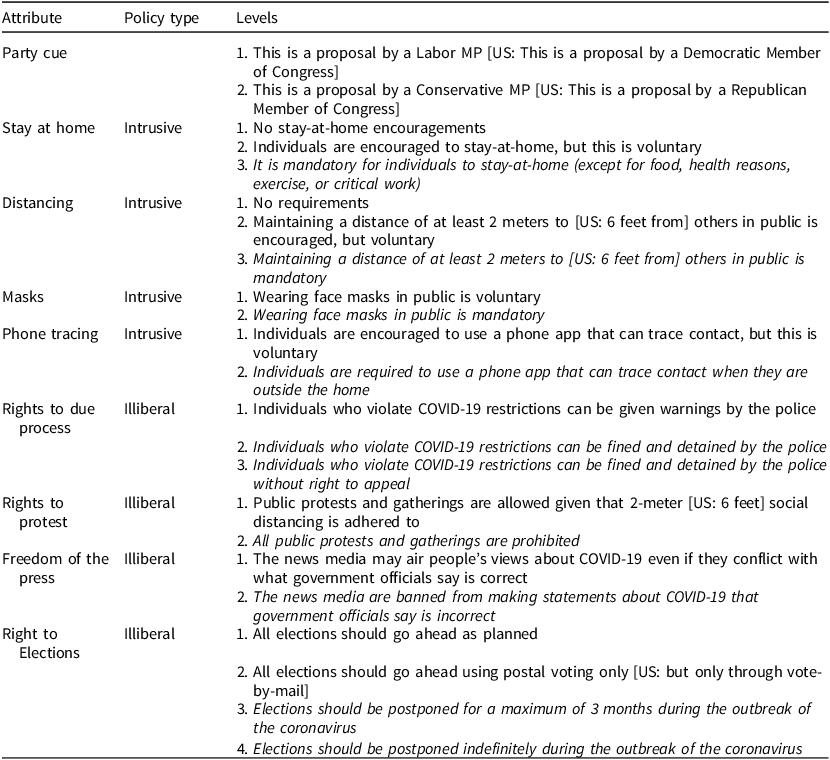
One critique of conjoint experiments is that they ask respondents to evaluate abstract policies. Yet, in our study, we selected policy proposals that were debated and implemented in various forms across the globe. Some policies are intrusive, other are illiberal. Specifically, our focus was on the following seven attributes: (1) partisanship of the proposer, (2) individual rights, (3) surveillance, (4) procedural rights, (5) right to protest, (6) freedom of the press, and (7) elections. Table 1 provides an overview of the seven attributes, the type of policy (intrusive or illiberal) and their levels. In the brackets, we provide the changes we make to the item wording in the US context. Note that the levels in italics are the more restrictive proposals within an attribute. While limits to individual rights, such as mask wearing and social distancing, are examples of intrusive polices that may cause personal inconvenience, the attributes in bold constitute encroachments on liberal democratic rights. For these attributes, the levels in italics constitute the most restrictive policy proposals and tap into people’s support for illiberal policies.
Conjoint experiment: attributes, policy type (intrusive vs. illiberal) and levels

At the start of each round, participants receive the following introduction:
We are interested in your opinions about the best policy response to tackle the coronavirus (COVID-19) pandemic in the UK [US]. The table below describes examples of alternative policies that experts and politicians have been talking about as a way to respond to the current coronavirus pandemic. Even though these proposals are hypothetical, imagine for the moment that these were real proposals. Please review the information in the table very carefully.
Respondents were asked to evaluate a successive series of tables containing two hypothetical policy proposals designed to curb the pandemic – for a stylistic example of a round in the conjoint experiment, see Table 2 below – each consisting of a set of attributes with implications for individual, procedural, and constitutional rights (see Appendix 1.4 for the details of the design). The attributes were randomly varied in each table to form a series of pairwise comparisons. Participants choose which of the two policies they support (A or B) and evaluate each policy on a scale from not at all supportive (0) to fully supportive (10).
Example round of the conjoint experiment

Appendix 1 describes the conjoint experiments in greater detail, including the ethical information (1.1) – the experiments adhere to American Political Science Association Principles and Guidance for Human Subject Research – preregistration (1.2) and deviations from preregistration (1.3), design and case selection (1.4), procedures (1.5), measures (1.6), sampling plan (1.7), analysis plan (1.8), outcome neutral quality checks (1.9), preregistered sub-group differences (1.11), results using the self-reported policy evaluation as dependent variables (1.12) and preregistered (1.13) and exploratory robustness checks (1.14).
In order to address any lingering concerns about the ecological validity of the policy proposals featured in the conjoint experiments, we also conducted two preregistered follow-up vignette experiments that presented participants with more details – for example, the type of group protesting, specific policy recommendations, and so on – as a robustness check, which corroborate the conjoint experiments. We discuss the design and results of these experiments after the conjoint experiments.
Results from the conjoint experiments in the US and the UK
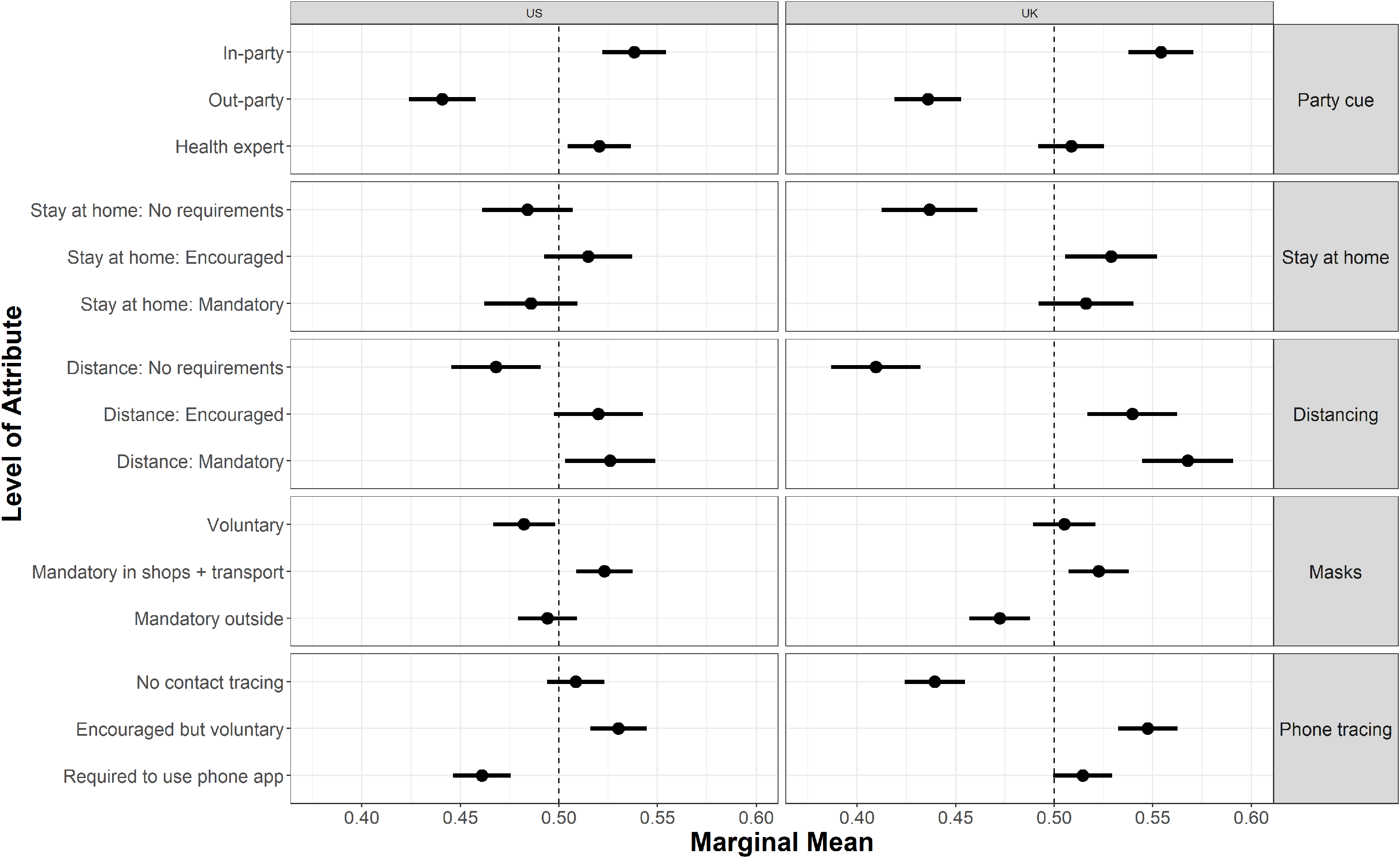
In Figure 1, we plot the marginal means for the different levels of each of the eight attributes on the support for the policy in the US and the UK. A marginal mean simply estimates the average support for policy proposals containing a given feature (Leeper et al. Reference Leeper, Hobolt and Tilley2020). Given the forced choice design, the overall mean is 0.5, indicated by the vertical dashed line. When a marginal mean exceeds 0.5, respondents favor scenarios with that feature more often than not, and when a marginal mean is below 0.5, respondents oppose scenarios with that feature more often than not. Each row is an attribute, and the marginal means for each level are plotted with confidence intervals that, correct for multiple comparisons as preregistered (p = 0.0018, z = 3.12). We discuss the results country-by-country and highlight the most important patterns. We did not preregister expectations about which policy would receive more or less support, and as such, these findings should be considered exploratory.
Support for intrusive policies. Note: Marginal means of the different levels of each attribute for Party Cues and the Social Distancing Policies – stay-at-home, social distancing, masks, and phone tracing – on policy support with confidence intervals that correct for multiple comparisons (p = 0.0018, z = 3.12).

In line with extensive research in political science, it matters greatly who puts forward the proposal (see first row of Figure 1). In the US, we see that policies supported by an out-party politician – that is, a politician from a party you do not identify with – are viewed more critically and receive less support (top left-hand column of Figure 1). At the same time, policies supported by an in-party politician – that is, a politician from a party you identify with – receive more support. We find similar patterns for out-party and in-party endorsements in the UK (top right-hand column of Figure 1). Endorsement of the policies by a health expert tends to yield a bit more support in the US, while there is no statistically significant effect of the health expert on policy support in the UK.
Intrusive policies
Turning to the social distancing policies in our conjoint experiment, we start with stay-at-home order. Here, we find no meaningful difference in support for different policies in the US (Figure 1, row 2, left-hand column), while in the UK (Figure 1, row 2, right-hand column), there is more support for policies that stimulate people to stay home and less support for policies that do nothing. Given that the government guidance in the UK during the first wave of the pandemic was to ‘stay at home’ (save for essential workers), this pattern may reflect support for the government policy at the time of the experiment. Turning to the social distancing requirements (row 3, of Figure 1), we find both in the US and the UK the same patterns: more support for policies that encourage or require social distancing and less support for polices that do not.
In the US and UK, wearing masks in stores and public transit receives a little more support, while a mandatory mask policy receives less support (only statistically significant in the UK, see (row 4 of Figure 1). Again, the UK pattern seems to reflect the government policy at the time of the experiment (ie masks were encouraged but not mandatory), and it is worth noting that mask-wearing mandates had not yet become a polarizing issue in the US (Utych Reference Utych2021).
When it comes to phone tracing (row 5, left-hand column of Figure 1), American and British respondents support a policy encouraging people to submit to contact tracing. When it comes to the other policy options, respondents from the US and the UK differ. Americans are less supportive of a requirement to use phone tracing and seem indifferent to doing nothing. In the UK, the pattern reverses: people are a bit more supportive of the requirement to use phone tracing, while they are less supportive of a policy that does not require phone tracing.
Illiberal policies
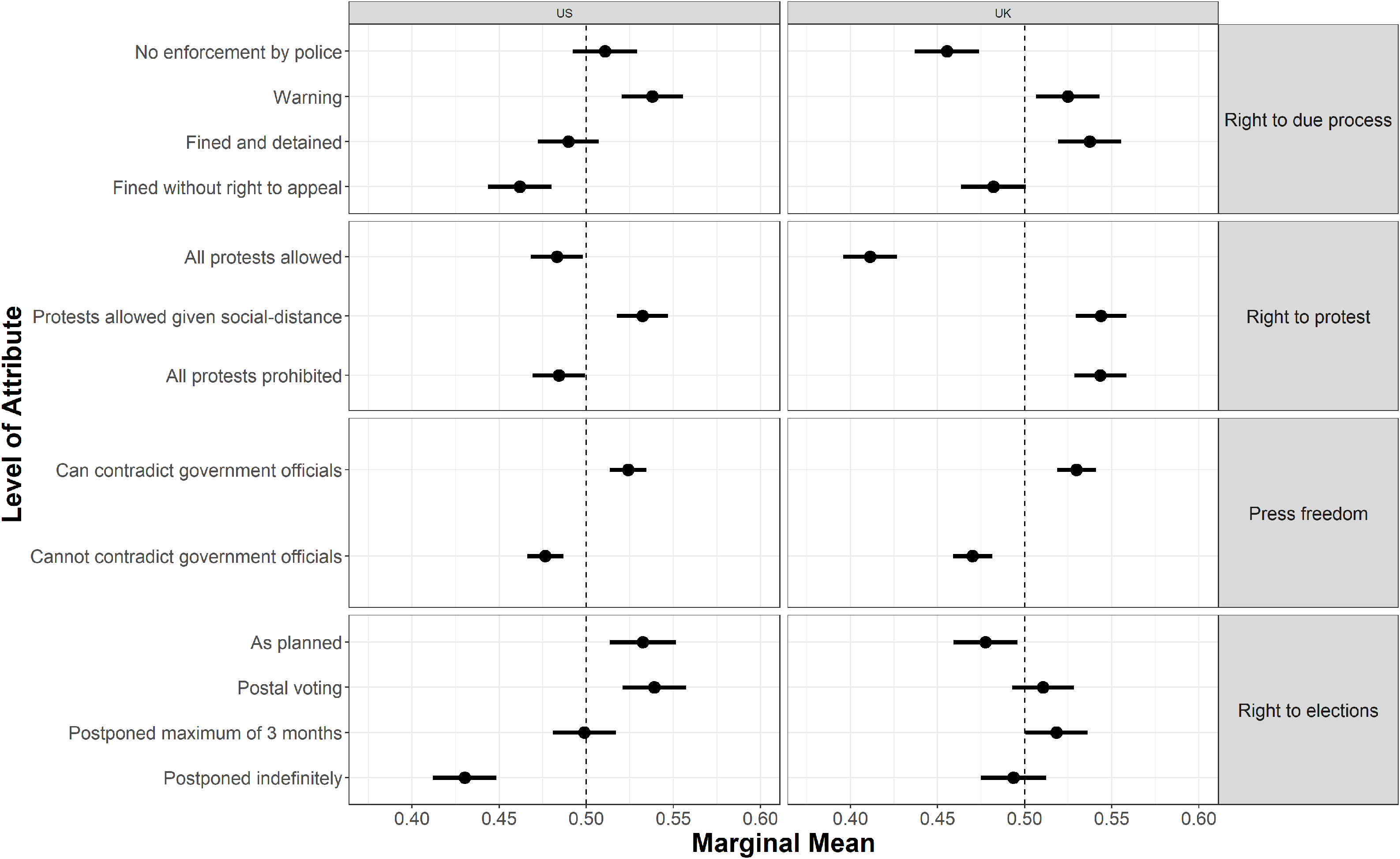
Next, we turn to the policies that infringe liberal democratic rights such as the right to due process, the right to protest, press freedom, and the right to elections. We plot the marginal means of the different attributes in Figure 2. We start in the first row of Figure 2 with the results for the right to due process. Both US and UK respondents are less supportive of illiberal policies where the police can fine and detain people without the right to appeal, while more supportive of liberal policies where the police can issue warnings.
Support for illiberal policies. Note: Marginal means of the different levels of each attribute for policies that infringe liberal democratic rights – right to due process, right to protest, press freedom, and right to elections – on policy support with confidence intervals that correct for multiple comparisons (p = 0.0018, z = 3.12).

The right to protest is supported in both countries if social distancing is maintained (row 2 of Figure 2), but support for protest is deeper in the US. Although US respondents do not support an unfettered right to protest, they also oppose banning them entirely. In the UK, we see a different pattern: participants are less supportive of policies that allow all protests to continue, while the support for policies that ban all protests is equally strong as allowing protests while maintaining social distance.
Clearer evidence of support for the protection of liberal democratic rights is found when it comes to support for the freedom of the press – both the US and the UK respondents are more supportive of policies where critical coverage is allowed, while critical of a policy proposing censoring media (row 3 of Figure 2).
Finally, in the UK, the timing of elections does not really affect policy support, while in the US, there is more support for policies that respect elections, while postponing them is opposed (row 4 of Figure 2). It is worth noting that differences in electoral systems may help explain this finding. The US has fixed elections at the federal level that have never been postponed, while the electoral system in the UK allows elections to be called before they are required to occur.
To conclude, we see that in both the US and UK, we find considerable support for liberal democratic rights: the most illiberal policies receive less support from citizens compared to merely intrusive policies. At the same time, people do seem willing to compromise on some liberal democratic rights in order to curb the pandemic. The effect sizes in our conjoint experiments are small but in line with other conjoint experiments (eg Bansak et al. Reference Bansak, Hainmueller, Hopkins and Yamamoto2018; Hainmueller et al. Reference Hainmueller, Hopkins and Yamamoto2014; Leeper et al. Reference Leeper, Hobolt and Tilley2020), the literature on support for liberal democratic rights (eg Graham and Svolik Reference Graham and Svolik2020; Krishnarajan Reference Krishnarajan2023; Merolla and Zechmeister Reference Merolla and Zechmeister2009), and in line with the small effect sizes in the social sciences (Camerer et al. Reference Camerer, Dreber, Holzmeister, Ho, Huber, Johannesson, Kirchler, Nave, Nosek, Pfeiffer, Altmejd, Buttrick, Chan, Chen, Forsell, Gampa, Heikensten, Hummer, Imai, Isaksson, Manfredi, Rose, Wagenmakers and Wu2018). Note that using the second dependent variable – self-reported evaluation of the policies – we reach similar conclusions as the ones reported here (see Appendix 1.12 for the results). This suggests that support for policies that encroach on liberal democratic rights may be malleable in a crisis. To examine this further, we look at whether individuals adopt different stances on illiberal policies depending on whether it is supported by their in-group party.
Subgroup differences: The effect of party cues
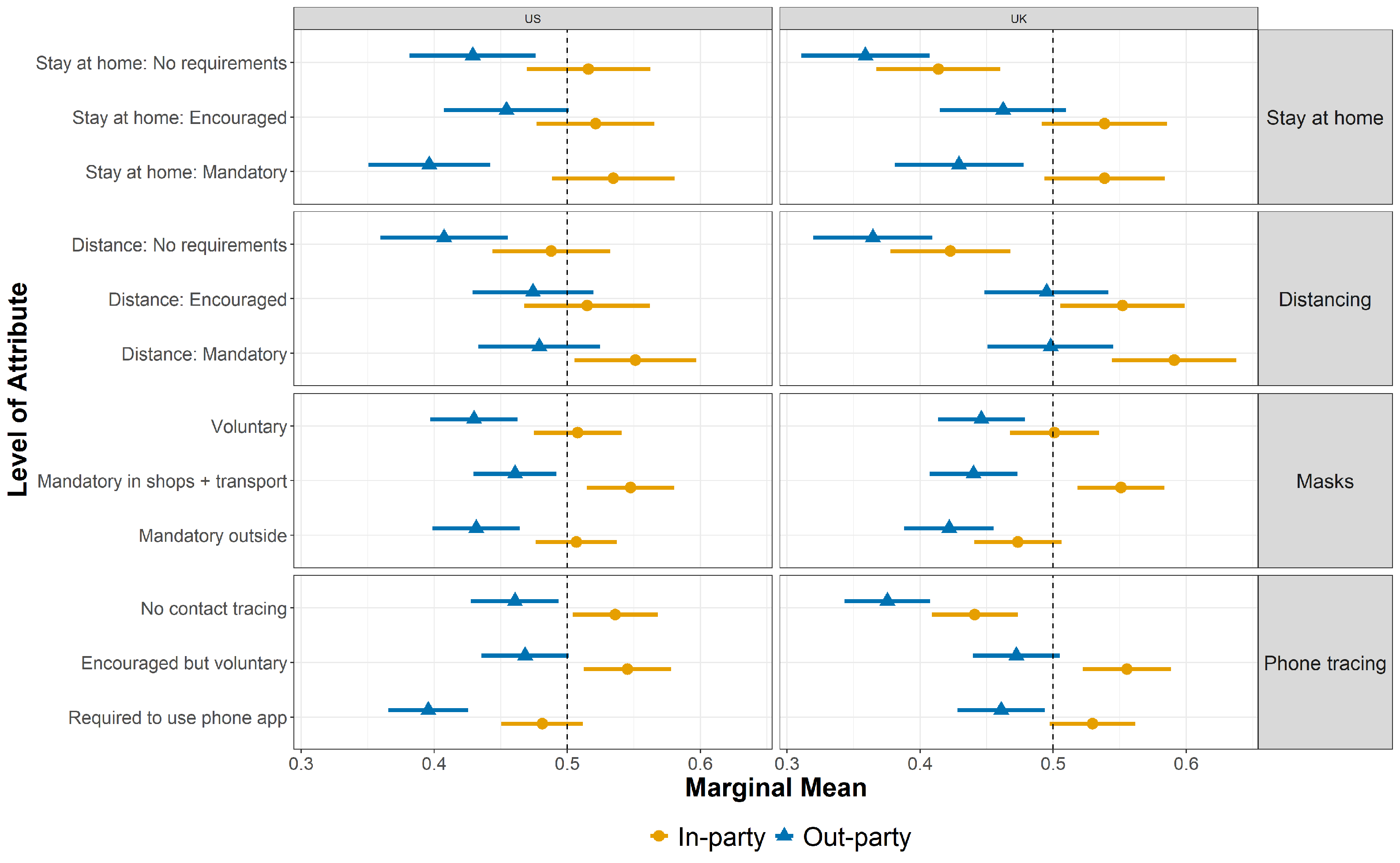
We preregistered the hypothesis that people should be more likely to support restrictions on liberal democratic rights if endorsed by politicians affiliated with their political party. To test this hypothesis, we calculate the marginal means for two subgroups: policies endorsed by the respondent’s in-party (yellow-coefficients) or policies endorsed by the respondent’s out-party (blue-coefficients). Note that we exclude the policies endorsed by a health expert here because our preregistered hypothesis focused on the difference between in-party and out-party endorsements. For full transparency, we present the marginal means for policies endorsed by the health expert in Appendix 1.10.
We begin with the marginal means for merely intrusive policies endorsed by the in-party and out-party (see Figure 3). In general, we do not find much evidence that stay-at-home orders are affected by in-party cues (row 1). Turning to distancing policies, we see in row 2 that in-party endorsements lead to more support for mandatory distancing in both the UK and the US. We also find some evidence that in-party endorsements cause US and UK respondents to support making it mandatory to wear masks in shops and public transport (row 3) as well as policies that encourage the use of phone tracing apps (row 4). At the same time, we find that in both the US and the UK, in-party endorsement does not sway respondents to back strict measures, such as mandatory mask wearing outside (row 3) or requiring contact tracing via phone apps (row 4).
Support for intrusive policies conditional upon in-party and out-party endorsement. Note: Marginal means of the different levels of each attribute on policy support for Social Distancing Policies when a policy is endorsed by the in-party or out-party with confidence intervals that correct for multiple comparisons (p = 0.0018, z = 3.12).

We did not preregister expectations about out-party endorsements, but the pattern is quite clear. Policies endorsed by out-party (coefficients in blue in Figure 3) receive less support. While there is some heterogeneity across the policies and between the two contexts, people are generally much more likely to oppose any policy endorsed by the out-party, which is in line with extant scholarship on the strength of ‘negative’ partisanship (eg Bakker et al. Reference Bakker, Lelkes and Malka2020; Bullock Reference Bullock2020; Nicholson Reference Nicholson2012).
Next, we consider support for illiberal policies to combat the virus policies that infringe on liberal democratic rights. We plot the marginal means of the different attributes when endorsed by the in-party or out-party in Figure 4. Generally, in-party endorsement does not affect support for illiberal restrictions of the right to due process (row 1). If anything, the liberal options (no enforcement or warning by the police) receive more support when endorsed by an in-party. In-party endorsements increase support for allowing protests that comply with social distance rules, but do not persuade US respondents to support a ban on all protests, while it does for UK respondents (row 2). In-party endorsements also increase support for policies favoring freedom of the press but does not persuade people to restrict press freedom (row 3). Respondents in the US and the UK differ on elections (row 4). In-party endorsements increase support for holding elections on time and expanding the franchise through mail-in voting in the US, but have no effect in the UK. All in all, these results show that even with clear in-group endorsements, most citizens remain opposed to restricting certain core liberal democratic rights, such as the right to due process and the right to protest. This implies that while party cues clearly shape policy attitudes, there is some resilience of people’s commitment to liberal democratic norms, even when faced with partisan endorsements. At the same time, we acknowledge that the effect sizes are small. But this is in line with other party cue experiments (eg Bakker et al. Reference Bakker, Lelkes and Malka2020; Bullock Reference Bullock2020; Tappin and Hewitt Reference Tappin and Hewitt2021).
Support for illiberal policies conditional upon in-party and out-party endorsement. Note: Marginal means of the different levels of each attribute on policy support when a policy is endorsed by the in-party or out-party – for the dimensions procedural rights, protests, press freedom, and elections – with confidence intervals that correct for multiple comparisons (p = 0.0018, z = 3.12).

When it comes to out-party endorsements, the pattern is again quite clear. Policies endorsed by the out-party receive less support, especially illiberal ones, such as giving fines without due process (row 1), banning protests (row 2), censoring the press (row 3), and postponing elections (row 4). We also note that the pattern of in-party vs. out-party endorsement effects does not change when we subset the data by the partisanship of the endorser (Republican/Democrat in the US or Conservative/Labor) as opposed to collapsing partisans into in-party and out-party groups (see Appendix 1.13).
Follow-up vignette experiments in the US and the UK
As we noted above, because there were active policy discussions about social distancing, mask wearing, contact tracing, banning protests, and postponing elections in the US and the UK at the time of our experiment, we believe that the design of our conjoint experiments addresses a common concern that conjoints are too ‘abstract’ for many respondents. Nonetheless, we appreciate that one may still have concerns about the policy proposals, or the politician proposing the policy, not being specific enough. In order to assess the robustness of our conjoint experiments in the face of these concerns, we conducted additional preregistered vignette experiments in the summer of 2020.
We again partnered with YouGov to conduct the follow-up surveys in the US (N = 3,101, fieldwork: July 14–17, 2020) and the UK (N = 3,286, fieldwork: July 13–15, 2020). We focused on two specific illiberal policies that were part of the conjoint experiments: (1) banning protests and (2) postponing elections. We chose these two policies because they were both live issues in the summer of 2020. The conjoint experiment suggests that people in the US and the UK place some sharp limits on restricting these core liberal rights. Yet, public support for policies is often swayed by information regarding group beneficiaries (Nicholson Reference Nicholson2011). Consequently, perhaps participants would support bans on protests if it were a protest that they did not support, or citizens would support postponing an election if it were suggested by a party leader whom they respect. To probe this further, we conducted vignette experiments in the US and the UK about banning protests and a vignette experiment in the US about postponing elections.
Compared to the conjoint experiments, the vignette experiments in these surveys increased the mundane realism of the policy proposals. In the conjoint experiment, for instance, people could imagine banning protests that they liked or did not like, whereas in the vignette experiment, in the case of banning protests, we focused participants’ attention on allowing or banning BLM-related protests, which were ongoing while our survey was in the field. Likewise, we used a generic politician in the conjoint experiments, whereas in our vignette experiment regarding postponing elections, we study whether attributing various positions to Donald Trump can sway people’s opinions. These design choices provide a strong test for whether people’s attitudes toward specific groups or politicians (eg President Trump) can overpower commitments to protecting civil liberties.
Party cues and banning of protests in the UK and the US
Our preregisteredFootnote 4 protests vignette experiment, consistent with the conjoint experiment, randomly varied whether a health expert, in-party or out-party politician, advocated banning protests to stem the spread of COVID-19. It also varied the target of the protest ban: either pro-BLM protests or ‘right-wing’ anti-BLM protests. Doing so, allows us to see whether people’s support for or opposition to BLM (which we measured on the pretest instrument) affects their support for the right to protest (see Appendix 2–3 for the ethical information [2.1], preregistration [2.2], sample [2.4], design [2.5–6], and analysis plan [3.1]).
We find that the source of the message and the target of the message have practically no effect on support for banning protests because of COVID-19 in both the US and the UK. As Figure 5 shows, the mean support for the two policies (dependent variables) – scored on a 7-point Likert-type scale from ‘no support’ [0] to ‘completely support’ [1] – do not differ much from each other. Moreover, the confidence intervals, which are adjusted for multiple comparisons as preregistered, overlap, indicating the treatments do not have a statistically significant effect on policy support. Moreover, a formal statistical test of the differences between the means – see Appendix 3.2 – does not suggest that treatments had an effect on policy support in both the US and the UK.
Vignette experiment: Support for banning mass protests in the US and the UK. Note: Means and confidence intervals of agreement with the two dependent variables across different treatment conditions in the US (top-row) and UK (bottom-row). The distribution of the observations is plotted in figure. Confidence intervals are correct for multiple comparisons as preregistered (p = 0.0018, z = 3.12). Results can be derived from the replication files.

We also tested whether the effects of the treatments were moderated by BLM-support or prejudice. However, contrary to our preregistered expectations, we find no evidence for these expectations (see Appendix 3.3).
Party cues (in the US and the UK) and postponing elections (in the US)
With respect to postponing elections, we focused the vignette experiment on the US, since the election policies appeared to have no effects in the UK, and also because the US had a presidential election scheduled for November 2020. The US has never postponed a presidential election, even during times of war, yet the idea was floated by a prominent staff member of the Trump administration in May 2020 (Karni and Haberman Reference Karni and Haberman2020). The election vignette began by noting the threat of a second wave of the Coronavirus in the fall and then randomly varied whether ‘some people’ (control) ‘health experts’ (trusted source cue), or ‘the Trump Administration’ (partisan source cue) advocated ‘ruling out’ or ‘not ruling out’ that the government postpone ‘the presidential election until it is safe to vote in person.’ For more details about the sample, design, and analysis strategy, see Appendix 2 (see specifically Appendix 2.7 for item wording).
Following our preregistered analysis plan,Footnote 5 we analyzed the effects of these experimental manipulations by participants’ partisan identities – that is, separately for Democrats (N = 1,524, 49.15% of the sample) and Republicans (N = 1,018, 32.82% of the sample), while self-identified independents (N = 555 or 21.80% of the sample) were excluded from the analyses in line with our preanalysis plan. In Figure 6, we plot the support for postponing the elections with confidence intervals adjusted for multiple comparisons.
Vignette experiment: Postponing elections in the US. Note: Means and confidence intervals of support for postponing the elections indefinitely across different treatment conditions for self-identified Republicans (left-hand panel) and self-identified Democrats (right-hand panel) in the US in July 2020. The distribution of the observations is plotted in figure. Confidence intervals are correct for multiple comparisons as preregistered (p = 0.0018, z = 3.12).

Support for indefinitely postponing the election was relatively low (M = 0.29, SD = 0.37), where 0 is strong opposition to postponing the elections and 1 is strong support for postponing the elections. We find that Democrats (M = 0.25, SD = 0.35) were less supportive of postponing the election than Republicans (M = 0.36, SD = 0.39), and this difference is statistically significant (t(2536)=−7.28, p $ \lt 0.001$
).
$ \lt 0.001$
).
Turning to the party cue effects, we find little evidence for our expectation that party cues influence people’s opinions about postponing the presidential election. This pattern is similar for self-identified Republicans and self-identified Democrats. The mean support for postponing the 2020 election is similar between the conditions and the overlapping confidence intervals (Figure 6). A more formal test of the treatment effects confirms these patterns (see Appendix 4.1). Consequently, we also reject our hypothesis that Republicans would be more likely than Democrats to support postponing the presidential election if the Trump Administration advocating considering doing so (see analysis strategy in Appendix 4.3). Our exploratory analysis for Democrats also suggests that support for postponing elections is not influenced by party cues among this group.Footnote 6
Following our preanalysis plan, we also investigated whether Republicans’ and Democrats’ beliefs about the election outcome shape their reaction to these messages. Although we find interesting correlations between partisans’ beliefs about the election outcome and their support for postponing the election, we find no evidence that either Democrats’ or Republicans’ expectations about which candidate would win the election influenced the effect of the party cue treatments (see Appendix 4.3 for details).
To conclude, the vignette experiments show that partisan appeals to ban specific protests – BLM protests (in the US and the UK) – and to postpone the US presidential election largely fell on deaf ears. This was even the case among those predisposed to accept the message – for example, anti-BLM participants who identify with the party affiliation of the messenger or Republicans who read a proposal from President Trump to consider postponing the election. In order to ensure that our treatments were sufficiently strong, we constructed them in line with other party cue vignette experiments (for an overview, Bullock Reference Bullock2020). As such, we do not think that our treatments were too weak to influence participants’ opinions as the party cues and postponing elections experiments. Also, we are not worried that our null-findings in the banning protests experiments can be explained by ceiling effects. Yes, support for banning protests is relatively high in the UK and US (see Figure 5). We were, however, sufficiently powered to reliably detect a small positive treatment effect, and there is still enough room for movement on the dependent variable to increase support a bit. To conclude, our findings corroborate both the importance of partisan identification in shaping people’s attitudes about policies, which we documented in the conjoint experiments and which others have documented (eg Huddy et al. Reference Huddy, Mason and Aarøe2015; Westwood et al. Reference Westwood, Iyengar, Walgrave, Leonisio, Miller and Strijbis2018), but also illustrate its limitations when it comes to core liberal democratic norms (Orr and Huber Reference Orr and Huber2020). In comparison to previous work documenting considerable malleability in popular support for liberal democracy based on partisanship (eg Graham and Svolik Reference Graham and Svolik2020), our results are more encouraging about the resilience of liberal democratic norms in the face of partisan cues.
Discussion
This study contributes to a growing literature on people’s attitudes toward liberal democracy and democratic backsliding (Alsan et al. Reference Alsan, Braghieri, Eichmeyer, Kim, Stantcheva and Yang2023; Carey et al. Reference Carey, Helmke, Nyhan, Sanders and Stokes2019, Carey et al., Reference Carey, Clayton, Helmke, Nyhan, Sanders and Stokes2022; Chong Reference Chong1993; Donovan Reference Donovan2019; Frederiksen Reference Frederiksen2022a; Graham and Svolik Reference Graham and Svolik2020; Krishnarajan Reference Krishnarajan2023; Mondak and Hurwitz Reference Mondak and Hurwitz2012). Although recent studies have painted a rather pessimistic picture of public support for liberal democratic rights – for example, showing that ‘only a small fraction of Americans prioritize democratic principles […], and their tendency to do so is decreasing in […] partisanship, policy extremism, and candidate platform divergence’ (Graham and Svolik Reference Graham and Svolik2020, p. 392) – this study presents a more nuanced view. By exploring how citizens in two of the world’s oldest liberal democracies approach entreaties to trade liberal democratic rights to deal with a public health crisis, we show that while they by no means resemble the ‘ideal type’ of democratic citizens that under no circumstances would make any concessions to liberal democracy, UK and US citizens display considerable support for liberal democratic rights. Our results show a notable resistance to illiberal policy measures, such as banning protests and postponing elections, even when trusted party elites endorse them. This is further supported by our follow-up experiments, where we find no indication that support for banning protests or postponing elections is conditional upon partisan cues.Footnote 7 This suggests that partisan cues do not have a uniform influence on people’s policy attitudes (eg Bakker et al. Reference Bakker, Lelkes and Malka2020; Myers Reference Myers2021; Tappin et al. Reference Tappin, Berinsky and Rand2023). It also indicates the presence of liberal democratic norms and a limit to the extent to which political elites can infringe on liberal democratic rights, at least within the US and the UK contexts. Obviously, one might wonder whether the results documented in this study extend beyond the specific crisis (COVID), the specific contexts (US and UK), and the specific time-periods (first year of the pandemic) that we conducted our experiments. These are open-ended questions. When it comes to the timing, survey-experiments conducted pre-pandemic replicated quite well during the pandemic (Peyton et al., Reference Peyton, Huber and Coppock2022). Nonetheless, we do not know for certain whether people would make the same choices post-pandemic compared to the relatively early stage of the pandemic in the summer of 2020. We also do not know whether our results generalize to other contexts. Citizens in countries with a more recent history of anti-democratic regimes might make a different set of trade-offs compared to citizens in the established democracies that we studied. In the future, we would welcome more comparative research on the support for liberal democracy (eg Alsan et al. Reference Alsan, Braghieri, Eichmeyer, Kim, Stantcheva and Yang2023; Malka et al. Reference Malka, Lelkes, Bakker and Spivack2020).
Moreover, while our findings are encouraging, they should not automatically lead us to conclude that liberal democracy is safe. Liberal democracy is not only premised on public support. It also needs the support of the major stakeholders in the political system (eg Levitsky and Ziblatt Reference Levitsky and Ziblatt2018). If prominent politicians do not respect the rule of law, public support for liberal democratic norms may not be enough to prevent elites from undermining the system of government. Nonetheless, our results do suggest that most citizens will not willingly welcome illiberal policies.
Supplementary material
For supplementary material/s referred to in this article, please visit https://doi.org/10.1017/S1475676525100145.
Data availability statement
The data and code to reproduce the results belonging to this paper can be found on our OSF page: https://osf.io/xn53k/.
Acknowledgements
We would like to thank participants at the Bocconi P&I clinic, the anonymous reviewers, and Editor Markus Wagner for their helpful comments on this paper.
Funding statement
We thank the London School of Economics and Political Science and the Amsterdam Centre for European Studies for financial support to collect the data. This publication is also part of the project ‘Under pressure: How citizens respond to threats and adopt the attitudes and behaviours to counter them’ [project number VI.Vidi.211.055 awarded to Bert N. Bakker] of the research programme NWO Talent Programme VIDI which is financed by the Dutch Research Council (NWO).
Competing interests
The authors declare no competing interests.



 Open access

