


Background
Daycare outside the home results in cognitive and social gains for preschool children (Zoritch et al., Reference Zoritch, Roberts and Oakley2000). However, daycare also increases the transmission of infectious agents, resulting in higher risk of common sicknesses such as respiratory tract infections (Hurwitz et al., Reference Hurwitz, Gunn, Pinsky and Schonberger1991; Schwartz et al., Reference Schwartz, Giebink, Henderson, Reichler, Jereb and Collet1994; Kvaerner et al., Reference Kvaerner, Nafstad and Jaakkola2000; Bradley, Reference Bradley2003) and acute gastroenteritis (Pickering et al., Reference Pickering, Bartlett and Woodward1986; Holmes et al., Reference Holmes, Morrow and Pickering1996; Bradley, Reference Bradley2003). It has been estimated that 17%–30% of the respiratory tract infections in preschool children are attributable to the daycare environment (Fleming et al., Reference Fleming, Cochi, Hightower and Broome1987; Hurwitz et al., Reference Hurwitz, Gunn, Pinsky and Schonberger1991; Nafstad et al., Reference Nafstad, Hagen, Oie, Magnus and Jaakkola1999). Invasive bacterial infections and probably skin diseases are also more common among children in daycare (Holmes et al., Reference Holmes, Morrow and Pickering1996).
Some studies have shown that hand washing and hygiene practices are of importance for respiratory illnesses in daycare (St Sauver et al., Reference St Sauver, Khurana, Kao and Foxman1998). Others have shown that multiple intervention programs can reduce absence due to infectious illness at daycare centres (DCCs) (Carabin et al., Reference Carabin, Gyorkos, Soto, Joseph, Payment and Collet1999; Uhari and Mottonen, Reference Uhari and Mottonen1999; Roberts et al., Reference Roberts, Jorm, Patel, Smith, Douglas and McGilchrist2000a; Reference Roberts, Smith, Jorm, Patel, Douglas and McGilchrist2000b).
Characteristics of the DCC are also of importance. Most studies show that preschool children at large DCCs experience more infectious episodes than preschool children who spend their daytime at smaller DCCs (Bygren et al., Reference Bygren, Cegrell, Christensen and Johansson1977; Rosen et al., Reference Rosen, Christensen, Hovelius and Prellner1984), and the more children per square metre the higher risk of transmission of infections (Petersson and Håkansson, Reference Petersson and Håkansson1989; Pönkä et al., Reference Pönkä, Nurmi, Salminen and Nykyri1991; Rindel et al., Reference Rindel, Kronborg and Jensen1992). However, one study found that preschool children who spend their daytime at large DCCs contracted fewer infections than children at smaller DCCs, possibly because larger DCCs may more often be purpose-built (Collet et al., Reference Collet, Burtin, Kramer, Floret, Bossard and Ducruet1994).
In Sweden daycare outside the home has been increasingly common since the 1980s and most preschool children are cared for outside the home during the daytime today. Of children ages one to six, 82% attends DCC, 4% have family daycare and 14% are taken care of at home. At the age of one 49% attend daycare, 91% at the age of two and 97% at the age of five (Skolverket, 2008). All children above the age of one have a right to at least 15 h daycare per week (Skolverket, 2007a). The time the children spend in daycare is based on the parent’s working time. The fee depends on the parents′ salaries but with a maximum of approximately 1260 SEK (approximately 115€) per child per month (Skolverket, 2007a).
Our study of Swedish DCCs in 2002 (Hedin, Reference Hedin2004) showed that most DCCs enrol about 50 children divided into three groups or departments. On average, there are 5.1 children per staff member. Some DCCs have only one department and others up to eight (Hedin, Reference Hedin2004), with approximately 17 children at each (Skolverket, 2007b). Typically one department is for children younger than three and the others are for older children. Of all children 40% are younger than three years and 14% of all children are in daycare less than 15 h a week.
In our study, we found that at 17% of the DCCs the children use liquid soap and paper towels instead of the traditional bars of soap and terrycloth towels. The corresponding figure for DCCs at which the personnel use liquid soap and paper towels was 24%. Routines for hand washing and diaper changing are most often unwritten and the characteristics of the diaper changing place differs among the DCCs. The personnel seldom receive information about infections in children. About 80% of the DCCs reported that they had not gone any training during the last two years and only about 60% had regular contact with the local child health centre (Hedin, Reference Hedin2004). The National Board of Health and Welfare have made written recommendations to DCCs about hygiene practices and infectious diseases ‘Infections in daycare’ (Socialstyrelsen, 2001) and about 40% of the DCCs reported that they had these recommendations.
In the second part of this study of Swedish DCCs (Hedin, Reference Hedin2004) our aim was to evaluate the impact of hygiene routines, characteristics of the DCC, training to personnel, information to parents and contact with the health care centre on absence due to illness in preschool children and to study determinants for such absence.
Methods
Study population
Before initiating the study reported above (Hedin, Reference Hedin2004) we estimated that there were about 7300 DCCs in Sweden during the year before the study. As no national register of these centres was available we made a random selection of counties representing both small and large municipalities and asked for a list of all DCC in their region. From this list we made a random selection of 5% of the DCCs, equalling 338 centres. During 2002, these 338 DCCs were contacted. Thirty declined to take part without stating any reason. To reach the 5% target of evenly distributed DCCs in Sweden; another 30 DCCs were randomly selected in a second round. The director of the preschools gave written informed consent.
Questionnaire
A questionnaire was developed by the authors and included questions on the size and number of children at the DCC and about hygiene routines for the children and staff. It also contained questions about how the staff handled contagion and infections at the DCC and questions about information on infectious diseases given to the parents. Questions on training of the staff and cooking routines were also asked (Hedin, Reference Hedin2004). One question was if the DCC had access to and has used the recommendations ‘Infections in daycare’ from the National Board of Health and Welfare (Socialstyrelsen, 2001).
The questionnaire was completely returned by all 338 DCCs. Each DCC was visited by a nurse from the local child health centres or from the county communicable disease control centre during a 2-week period in the autumn 2003. During the visit the nurse asked the questions from the questionnaire in a structured way and one staff member from the daycare who was familiar with the routines at the DCC answered the questions. All the nurses had been taught by one of the authors how to ask the questions and how to fill in the questionnaire before the study starts.
Registration of absence due to illness
During a period of two weeks in autumn of 2003 the staff at 316 of the DCCs registered absence. The registrations were made on DCC level and reported as total number of children present, total number of children absent due to vacation and total number of children absent due to illness each day. No further information was collected about the child or about the reason for the sickness absence. A similar method has been used earlier (Mottonen and Uhari, Reference Mottonen and Uhari1992).
After this registration was complete we asked each DCC to register another two weeks in the early spring months of 2004. In this registration around 183 DCCs were participated.
Definitions
Absence due to illness was defined as number of absent children due to any illness divided by the number of children who were expected to be present during the four-week registration period. Low absence due to illness was defined as illness absence below the 20th percentile.
Statistical analysis
Descriptive analyses were performed for all data and these results are presented in a Swedish report (Hedin, Reference Hedin2004).
In this explanatory study, first crude odd ratios were calculated for all the descriptive variables collected in the questionnaire. The variables included routines for hand washing for children and daycare personnel, respectively, routines for diaper changing, routines for handling foods, routines for training about infections and data about the preschool such as characteristics of the buildings, number of children at the DCC, group size and number of personnel. In order to identify the factors most important to absence due to sickness, logistic regression models were made for different categories. The variables that were found to be significant at a two-sided significance level of 0.1 were further analysed by inclusion in a multiple logistic regression model. Four variables were ultimately included in the multiple logistic regression model (Table 3).
The model was fitted in a stepwise backward fashion, meaning that at each step, the variable with the largest non-significant P-value using a significance level of 0.5% was excluded, until only significant variables remained. All statistical analyses were performed with SPSS software (Version 13.0).
Ethics
The study was approved by the Committees on Research Ethics at Lund (Dnr 427-03), Gothenburg, Stockholm, Linköping, Uppsala, Örebro and Umeå Universities.
Results
Descriptive characteristics of all DCCs from the first part of the study have been presented in a report (Hedin, Reference Hedin2004).
Of all the daycare centres, 93.5% (316/338) registered absence due to illness in the fist period and 56.8% (192/338) in the second period. Both registrations were completed by 54.1% (183/338) of the DCCs. Sickness absence was 10.3% in the autumn and 10.2% in the early spring. There were no significant differences in absence due to illness between those DCC that completed both absence registrations and those that only completed the first one (Mann-Whitney P = 0.27). In the second part of the study presented in this study we focus on the results from the 183 DCCs that took part in both registrations.
The characteristics of these 183 DCCs focusing on hand washing, diaper changing, food preparing, training for personnel, information to parents, number of children at the DCC and contact with the child health centre are shown in Table 1.
Data according to questionnaire for the daycare centres
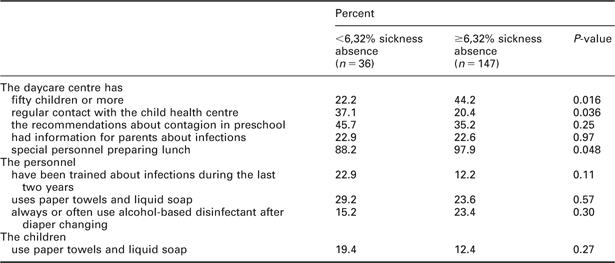
A cut off point at the 20th percentile for sickness absence was chosen. The 20th percentile of sickness absence was at the level 6.3% of expected presence. Of all the DCCs, 36 had sickness absence below and 147 above the 20th percentile.
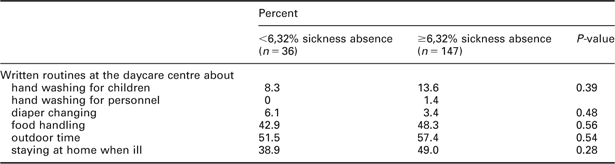
In Table 2 the written routines for the DCC are shown. When the unwritten rules about hand washing for children are included, the figures were 97.2% for the daycare centres with low sickness absence and 92.5 for those with higher sickness absence. The corresponding figures for hand washing for the personnel were 52.8% and 55.1%, respectively.
Written routines at the daycare centres
In a multiple logistic regression model, DCCs with more than 50 children and no regular contact with the local child health centre were found to be significant for absence due to sickness (Table 3).
Sickness absence at daycare centres
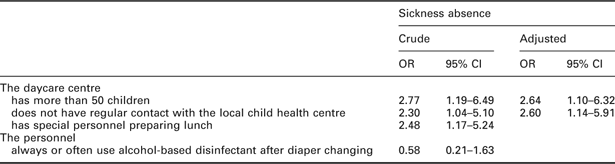
ORs = odd ratios; CI = confidence interval.
Crude and adjusted ORs with 95% CI. The variables in the last step are shown in the adjusted models. Adjusted ORs were calculated using multiple logistic regressions with backward elimination.
Adjusted for alcohol-based disinfectant always or usually used after diaper changing, lunch made by special personnel, regular contact with the local child health center and more than 50 children at the daycare centre.
Discussion
In this exploratory study absence due to sickness was about 10%. DCCs with no regular contact with the local child health centre and DCCs with more than 50 children were associated with higher absence due to sickness than DCCs with regular contact with the local child health centre and DCCs with less than 50 children.
This study was part of a large national survey focusing on routines in daycare. The nurses who visited the DCCs in the study had been taught by one of the authors about how to ask the questions and how to fill in the questionnaires before the start of the study. When visiting the DCCs they found it easy to get the answers and to discuss routines with the personnel.
Absence due to sickness reported by personnel without further information on the children from their parents has previously been useful when studying interventional effects in child daycare (Mottonen and Uhari, Reference Mottonen and Uhari1992; Pönkä et al., Reference Pönkä, Poussa and Laosmaa2004). This does not require any effort on the part of the parents in contrast to asking parents to report in detail about every absence episode and thus makes the reporting more robust. The downside of this approach is the unavailability of information on the exact cause of illness absence. From earlier studies we know that at least 90% of absence from daycare is due to infectious diseases (Sennerstam, Reference Sennerstam1995; Petersson and Håkansson, Reference Petersson and Håkansson1989; Hedin et al., Reference Hedin, Petersson, Cars, Beckman and Hakansson2006) and about 75% concerns various upper respiratory tract symptoms (Sennerstam, Reference Sennerstam1995). Absence due to illness in this study was about 10%, which is in accordance with previous Scandinavian studies (Mottonen and Uhari, Reference Mottonen and Uhari1992; Rasmussen and Bondestam, Reference Rasmussen and Bondestam1993) and we can assume that the reasons for absence are about the same as in earlier studies.
There is solid evidence that improved hand hygiene on the part of both personnel and children may reduce morbidity due to infections and absence among children attending DCCs (Koefoed et al., Reference Koefoed, Nielsen and Keiding2002; Brady, Reference Brady2005), especially for gastroenteric diseases (Bradley, Reference Bradley2003). Using alcohol-based hand disinfection seems to reduce infections even more (Lennell et al., Reference Lennell, Kuhlmann-Berenzon, Geli, Hedin, Petersson, Cars, Mannerquist, Burman and Fredlund2008). Formal written routines for infection control within the DCC have also been shown in a previous study to reduce infections (Brady, Reference Brady2005) but the presence of such written routines was not found to be of importance in our study. Only 10% of the DCCs in our study had written routines about hand washing in children and the figures were even lower for the personnel. Having unwritten routines was much more common in our study. Unwritten routines are probably better than no routines at all, but it is uncertain whether such routines are interpreted in the same way by all the personnel involved. Formulating written routines is assumed to be better since it encourages discussion of the topic among the personnel possibly resulting in higher degree of adherence to the routines.
In this study a size of more than 50 children at the DCC was a factor of importance for higher absence due to sickness. This was in accordance with the findings in previous Swedish studies (Bygren et al., Reference Bygren, Cegrell, Christensen and Johansson1977; Rosen et al., Reference Rosen, Christensen, Hovelius and Prellner1984). It is also known that the carriage rate of Pneumococcus pneumoniae has been found to be higher at DCCs with more than 45 children (Rosen et al., Reference Rosen, Christensen, Hovelius and Prellner1984). During the 1990s the number of children at each daycare department in Sweden has increased and there is no legal limit to how many children there may be in each group (Skolverket, 2003). The school legislation only states that the groups should have a suitable composition and that the setting should be adapted to its purpose (Utbildnings departmentt, 1985). The size of existing DCCs in not easy to affect, but it should be borne in mind when planning for new DCCs in the future. This highlights the importance of teamwork when planning for preschool children.
The child health centre plays an important role for families with small children, and regular contact between the DCC and the child health centre was found to be of importance for lower absence due to illness. Having such contact provides possibilities for the personnel at the DCC to be informed about infectious disease and how to handle specific problems as they arise. The nurses from the child health centres also have the possibility to visit the DCCs to give practical recommendations on how to handle contagion. With this in mind it is not surprising that absence due to illness was lower at the DCCs with regular contact with the child health centres. To our knowledge this is a factor that has not previously been studied although formal training of the DCC personnel on infection control has previously been shown to reduce infections at DCCs (Brady, Reference Brady2005). Regular information from the child health centre is requested by the DCC personnel (Hedin et al., Reference Hedin, Petersson, Cars, Beckman and Hakansson2006). We believe that regular contact with the child health centre could provide information and training opportunities. Another possibility is to provide more formal training for the DCC personnel on infectious diseases in preschool children. In Sweden no such training is given to the DCC personnel or to students who are studying to-be preschool teachers.
We also think it is important to include the parents in training activities, as parents also request information about the most common infections (Hedin et al., Reference Hedin, Cars and Petersson2000). Perhaps not only the pedagogical activity but also the contact with the health centre would be of importance. From this study we cannot draw any conclusions about how such contact is framed.
Absence due to sickness not only depends on the level of transmission of infectious agents, it also depends on parents’ judgement of an infectious episode. The Swedish National Board of Health and Welfare have issued recommendations on when to keep an infected child at home but adherence to the recommendations seems to differ. The local criteria of the DCC and the parents’ judgement of the child’s illness may also be of importance to parents’ decisions about keeping their children at home. Financial aspects are less important, since a benefit is paid to parents by the national health insurance scheme when they have to stay at home with an ill child.
In conclusion, this exploratory study shows that sickness absence is lower at DCCs with less than 50 children. Regular contact between the DCC and the local child health care centre also seems to have a positive impact on sickness absence. Regular contact with a child health centre helps to train the personnel and to give feedback on routines at the DCC. Regular contact also provides possibilities to discuss exclusion policies and how to handle outbreaks of infections.
Acknowledgements
We thank all the participating DCCs and the study nurses making the interviews. This study was supported by STRAMA and the Unit for Research and Development Kronoberg County Council, Växjö.



