


1. Introduction
Plinian eruptions are powerful explosive volcanic events that impact large areas. High eruptive columns are supplied by elevated magma discharge rates (106–108 kg s−1) that sustain plumes for hours to days (Cioni et al. Reference Cioni, Marianelli, Santacroce, Sbrana, Sigurdsson, Houghton, McNutt, Rymer and Stix2000). However, some Plinian eruptions (e.g. Tambora, El Chichón, Taupo and Novarupta) consist of more than one Plinian episode, separated by lulls of hours or days. One of the best-studied examples is the 1912 sequence at Novarupta that spanned 60 hours and consisted of three successive Plinian episodes with lulls between (Hildreth & Fierstein, Reference Hildreth and Fierstein2012). Single eruptive episodes ended with a complete eruptive hiatus, marked by deposition of water-reworked pyroclasts.
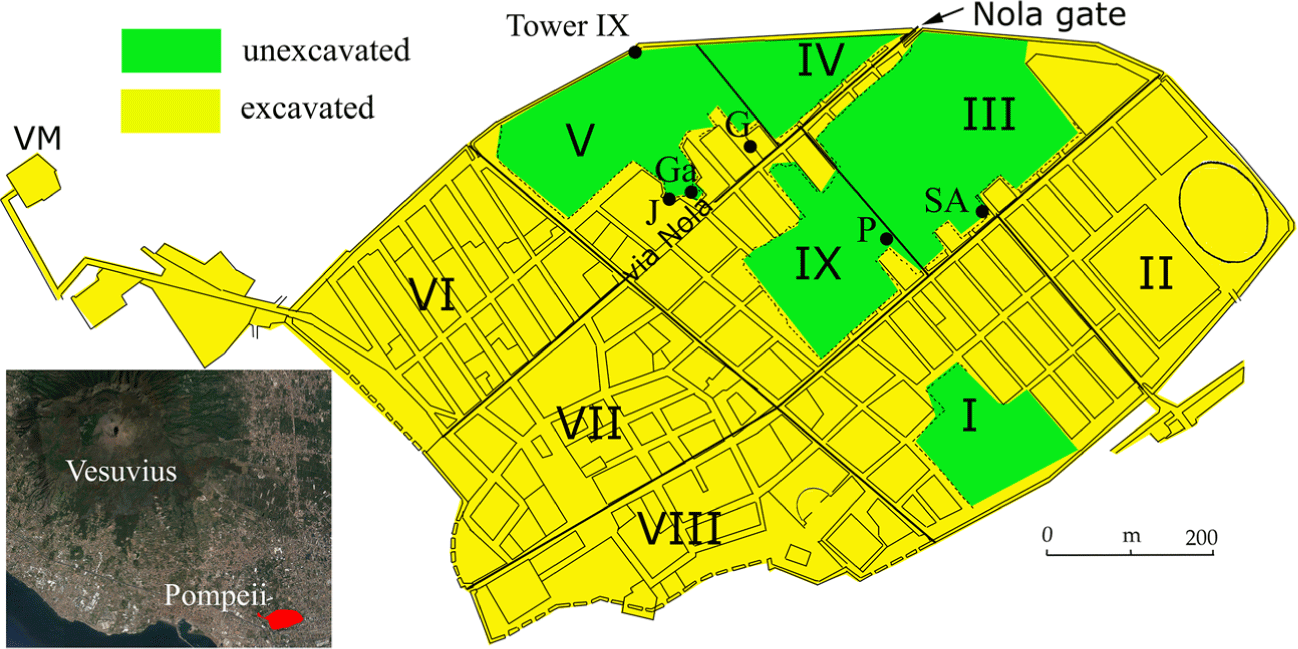
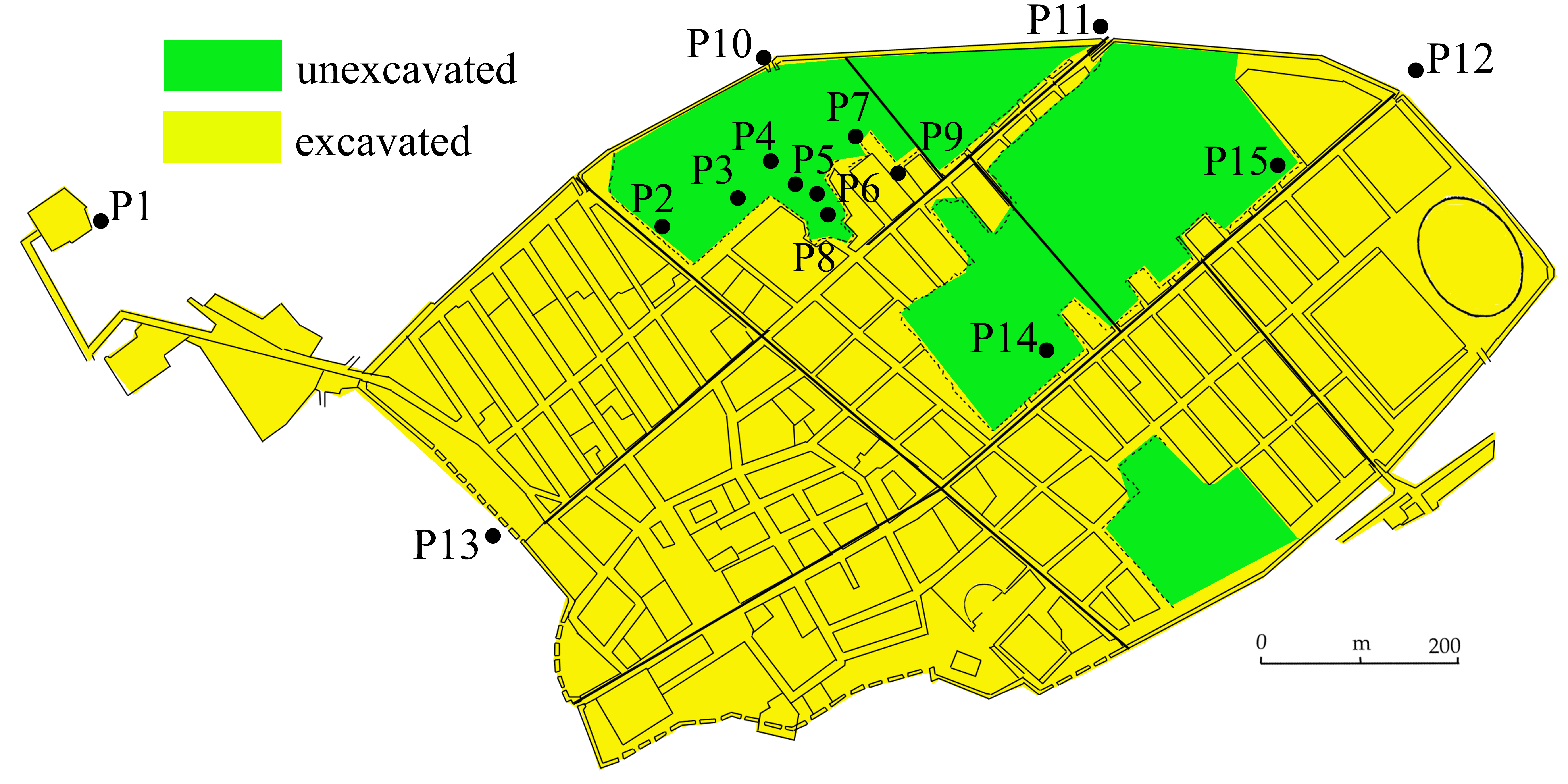
The climactic phases of the ad 79 Vesuvius eruption are described by Pliny the Younger to the historian Tacitus in two letters (Lewis, Reference Lewis1879). Pliny reports a prolonged eruptive event and provides the temporal framework used by Sigurdsson et al. (Reference Sigurdsson, Cashdollar and Sparks1982, Reference Sigurdsson, Carey, Cornell and Pescatore1985) to synchronize the emplacement of the successive pyroclastic layers. The ad 79 eruption had two main phases: first a substained eruptive column with widespread tephra fallout, and then a column collapse phase generating pyroclastic density currents (PDCs) (Sigurdsson et al. Reference Sigurdsson, Carey, Cornell and Pescatore1985). Despite Pliny’s letters, we will provide evidence to identify two hiatuses derived from the analysis of a revised sequence of the ad 79 deposits in a new excavated area within Pompeii archaeological site. One-third of the urban area (inside the walls) of the ancient town of Pompeii is still unexcavated. Roman houses, paintings and victims are preserved buried under 6 m of pyroclastic material. The boundary between excavated and unexcavated areas cuts across the town (Fig. 1) and a 2.5-km-long front looms over the unburied buildings. To secure the ancient excavation front, a re-profiling with gentle slopes is underway. Along this front (and in a few older excavated areas in Pompeii), new ad 79 pyroclastic sections are well exposed, allowing us to observe the presence of erosive scars and gullies at two well-defined stratigraphic heights. These erosive structures have been identified at three different locations, along the northern boundary of the town walls (Tower IX) and in the central part of Pompeii (near the Polibius house and close to Schola Armaturarum). The description of the short-lived erosion processes within Plinian tephra blankets, well constrained in time, is relatively rare, and here we provide stratigraphical constraints of multiple syneruptive episodes that occurred 10 km from the vent on a very gentle slope.
Plan view of Pompeii. Dots represent locations of the outcrops studied. P – Polibius’ house; SA – Schola Armaturarum; VM – Villa dei Misteri; G – Gladiator’s house; Ga – House of Garden; J – House of Jupiter. Inset: map showing the relative position of Pompeii and Mount Vesuvius.
2. General stratigraphy at Pompeii: a new proposal
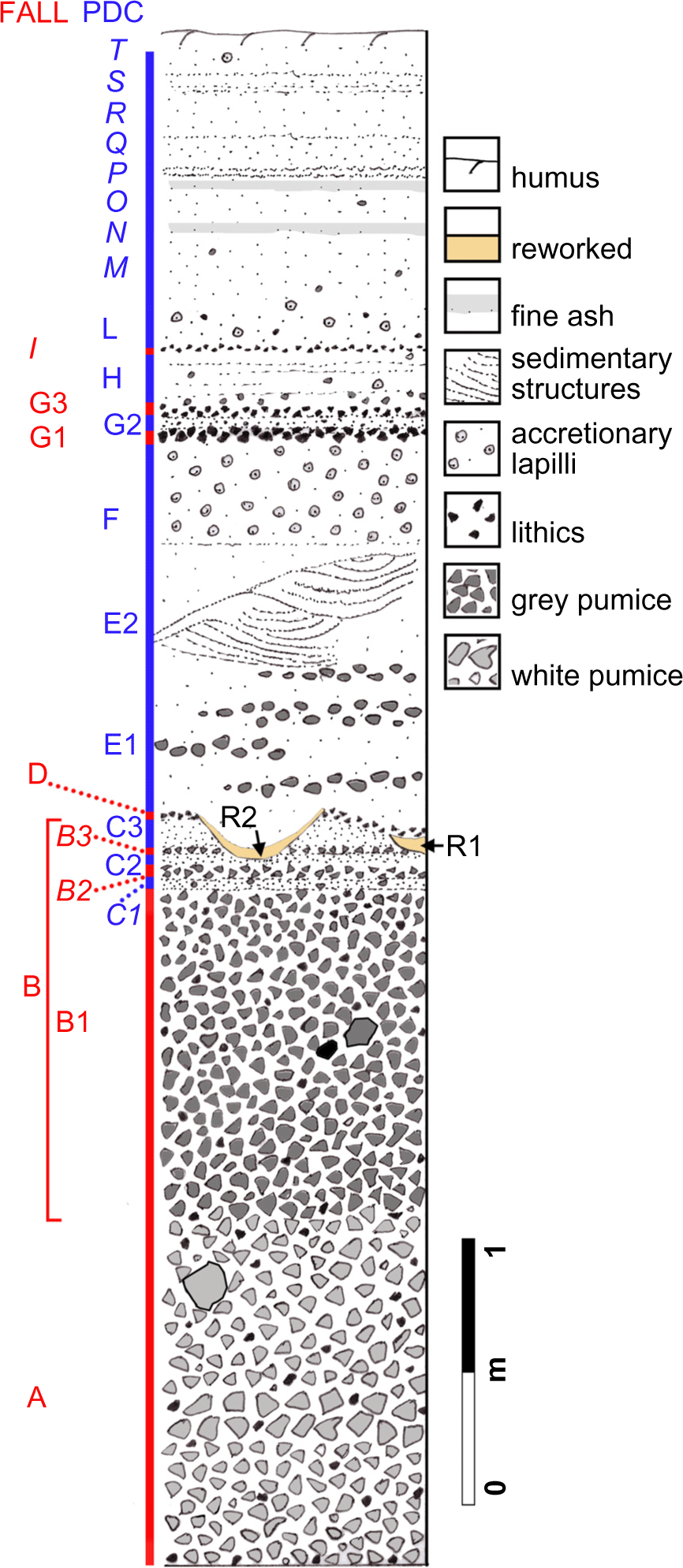
A new composite stratigraphy of the deposits of the ad 79 Vesuvius eruption at Pompeii is proposed. This modifies the sequence reported in Sigurdsson et al. (Reference Sigurdsson, Carey, Cornell and Pescatore1985), Cioni et al. (Reference Cioni, Marianelli and Sbrana1992) and Luongo et al. (Reference Luongo, Perrotta and Scarpati2003 a) on the basis of new outcrops located around or inside Pompeii (e.g. Villa dei Misteri, regio VI; Gladiator’s house, regio V; House of Garden and House of Jupiter, regio V; and Schola Armaturarum, regio III) (Fig. 1). The relationships between the stratigraphy presented in this paper and those previously published are described in online Supplementary material Table S1 (available at http://journals.cambridge.org/geo), and representative stratigraphic sections inside and outside the wall of Pompeii are reported in online Supplementary material Table S2 and Figure S1. The ad 79 deposit consists of a lower white to grey pumice lapilli bed intercalated with ash deposits, overlain by stratified ash and pumice layers with minor, thin, lithic-rich, horizons. Transport mechanisms for each unit are illustrated in Figure 2, where the whole stratigraphic sequence is reported. All layers, except C1, are dispersed across the entire Pompeii area, although some are missing locally as a result of the erosive action of the following PDC. Here we describe the main differences observed between this study and previous studies. Levels described for the first time are labelled in italics in Figure 2. The lower white to grey pumice lapilli fall bed (units A and B) is interrupted by two PDC ash layers (units C1 and C2), interstratified at the top of unit B (locally split into the layers B1, B2 and B3). The simple structure of this thick, pumice fall deposit is strongly disturbed within the buildings due to the collapse of the roof coverings and the consequent mixing of pyroclasts and wall and roof fragments. Even in open spaces, such as streets and gardens, basal fall units are locally reworked showing a well-stratified structure due to the sliding on the sloping roofs. Within unit B, C1 is a poorly sorted, ashy layer up to 1.5 cm thick, 5 cm below the top. It was reported by Sigurdsson et al. (Reference Sigurdsson, Carey, Cornell and Pescatore1985) outside the northern wall of Pompeii, but we have observed it well inside the town in an alley west of the Gladiator’s house (regio V, insula 2), a few metres from via Nola (Fig. 1). The distribution of this layer is not adequately reconstructed but its absence from the near sections, dug in the vicinity of Tower IX, in the House of Garden and at Nola Gate (Fig. 1), indicates that it is confined to a restricted sector of regio V. The local presence of C1 subdivides unit B in two pumice lapilli deposits, 125 cm (B1) and 5 cm (B2) thick. The second ash layer (C2) is interstratified at the very top of the grey lapilli bed. This is a very fine, massive ash deposit, 1–4 cm thick. The uppermost grey lapilli deposit, B3, is 0.5–1 cm thick; locally, it can be absent or reach a maximum depth of 3 cm. B3 is formed of moderately to poorly sorted fine to very fine pumice lapilli, where it is less than 1 cm thick. Where B3 is thicker, the sorting is better and the fine pumice lapilli clasts are subangular. C3 is a massive ash layer showing a stratified, lateral facies variation where it thickens. The basal contact is erosive. The upper part of the exposed sequence shows poorly sorted, PDC ash deposits (units E, F, G2, H, L, M, N, O, P, Q, R, S, T) often with erosive bases interstratified with four well-sorted, thin lithic-rich layers (units D, G1, G3 and I) that exhibit mantling structures of fall origin. Layers M to T are documented for the first time as a result of the new excavations that show, in some places, the undisturbed upper part of the ad 79 sequence, usually missing as a result of hundreds of years of ploughing. Most of the demolished walls and victims lay inside layer E (Luongo et al. Reference Luongo, Perrotta, Scarpati, De Carolis, Patricelli and Ciarallo2003 b). The thickness and sedimentary structures of this layer (thickness, 0–330 cm) show a strong lateral variation as well as a very uneven destructive impact on Roman structures. Where it is less than 30 cm thick, the deposit is fine-grained and thinly stratified. A few rounded pumice clasts are scattered inside the matrix. Where it thickens, the lower part is rich in coarse pumice lapilli and locally shows well-developed stratification (E1), while the upper part shows an internal arrangement of alternating layers of fine and coarse ash forming progressive dunes (E2). From F upwards, ash deposits show rare pumice lapilli clasts and diffuse accretionary lapilli: the latter are very abundant in layers F and L, and sporadically present in layers G2, H and T.
Composite stratigraphic section showing the maximum thickness of the units of the ad 79 deposit at Pompeii (except for unit E, reaching 3.3 m thickness at one location). On the left, all units are classified as emplaced by fall (in red) or by pyroclastic density currents (PDC) (in blue). Note the presence of two erosive surfaces filled by reworked material under fall layer D (R1) and PDC layer E (R2). Levels described for the first time are formatted in italics.
3. Erosional surfaces and reworked sediment
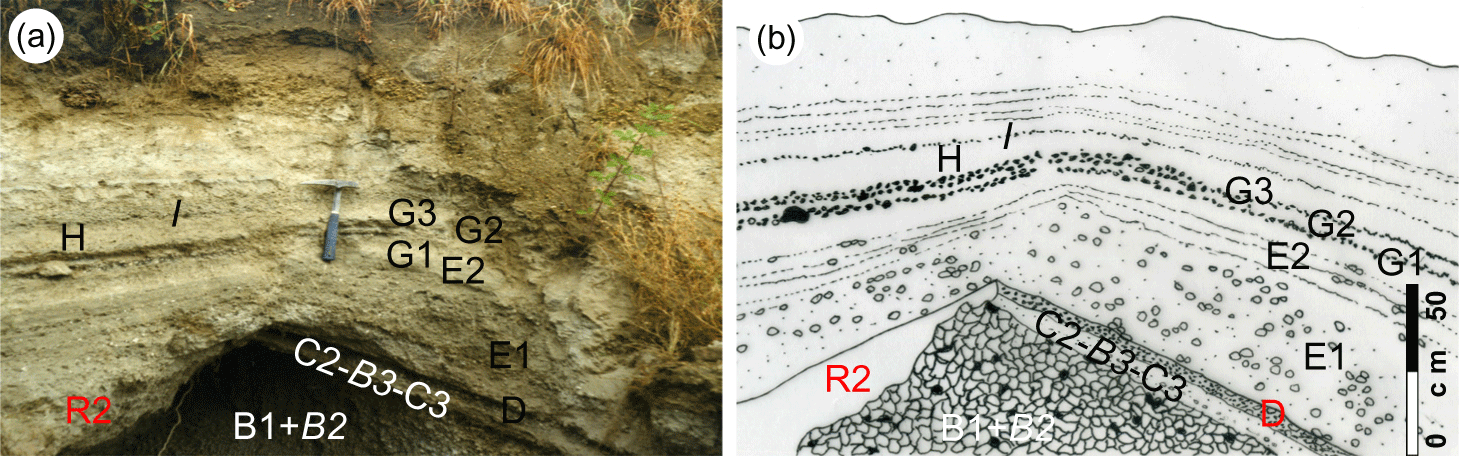
A lens of reworked material at the base of unit E was highlighted by Luongo et al. (Reference Luongo, Perrotta and Scarpati2003 a) near the Polibius house. We can better describe the material forming this lens (unit R2), confined in a 60-cm-wide gully cut into the underlying units up to the top of layer B (Fig. 3a,b). In cross-section the shape of the gully shows uneven banks, with a depth increasing from 5 to 15 cm towards the western side. This structure is filled by a massive, poorly sorted ash and pumice lapilli deposit. More recent excavations inside the town of Pompeii have exposed two other locations where erosion features are developed: along the northern boundary of the town walls (Tower IX) and in the central part of Pompeii (Schola Armaturarum) (Fig. 1).
Photograph and corresponding sketch of relevant erosive structures interstratified with the ad 79 deposits, near Polibius’ house. The location of the studied deposits is reported in Figure 1. (a, b) Reworked lens (R2) at the base of unit D. Note that the sequence on the right side is complete, while units C2 to D are missing on the left side.
3.a. Tower IX
On the northern side of Tower IX (Fig. 1) a partially excavated ad 79 sequence rests on remnants of the ancient Roman walls. The previously described stratigraphic sequence is interrupted by an erosion scar at the base of layer D (Fig. 4a,b). The erosional surface, cut through layer C3, is almost 1 m wide and 0.5–4.5 cm deep. The shape of the scar bottom is extremely irregular with relatively smooth profiles showing overall upwards concavity (Fig. 4c,d). Vertically elongated pods bending upcurrent are locally present. This structure is filled with fine-grained, stratified material (unit R1). The lower, lithic-rich deposit has a flat top and thickens in the small depressions; its depth ranges from 0.5 to 3.5 cm. The upper pumice-rich deposit, up to 1.5 cm thick, drapes the lithic-rich layer and thickens slightly in the centre of the small depressions. Both lower and upper layers are well sorted and the clasts are rounded in shape. Component analyses confirm strong lithic enrichment at the base (39 wt%), while the top is predominately formed by small pumice clasts (78 wt%) (Fig. 4). Juvenile clasts are a mixture of white (4 wt% and 15 wt%) and grey (27 wt% and 62 wt%) pumice lapilli in both layers (Fig. 4).
(a, b) View of the middle part of the ad 79 stratigraphy with reworked layer R1 near Tower IX. The erosion scar is at the base of unit D. (c, d) Detail of the erosive structure. The shape of the scar bottom is irregular and the filling material (R1) is stratified, with lithic clasts at the base and pumice fragments at the top. (e, f) Grain size and component data for the two subunits of R1.

3.b. Schola Armaturarum
Schola Armaturarum (regio III, insula 2), a structure believed to be the site where gladiators gathered and trained, was discovered by archaeologists in 1915, bombed during the Second World War and reconstructed in 1946. In 2010, the weight of unexcavated pyroclastic deposits behind the building produced its partial collapse. For safety reasons and to provide stability to this building, the 6-m-high embankment that surrounds it on two sides was terraced in 2017 with 2-m-wide and 1-m-high benches. We investigated the slopes located north and west of the Schola Armaturarum (Fig. 1). Here a blanket of reworked products, accumulated during previous archaeological excavations, was removed, exposing a thick stratigraphic sequence resting on the Roman floor.
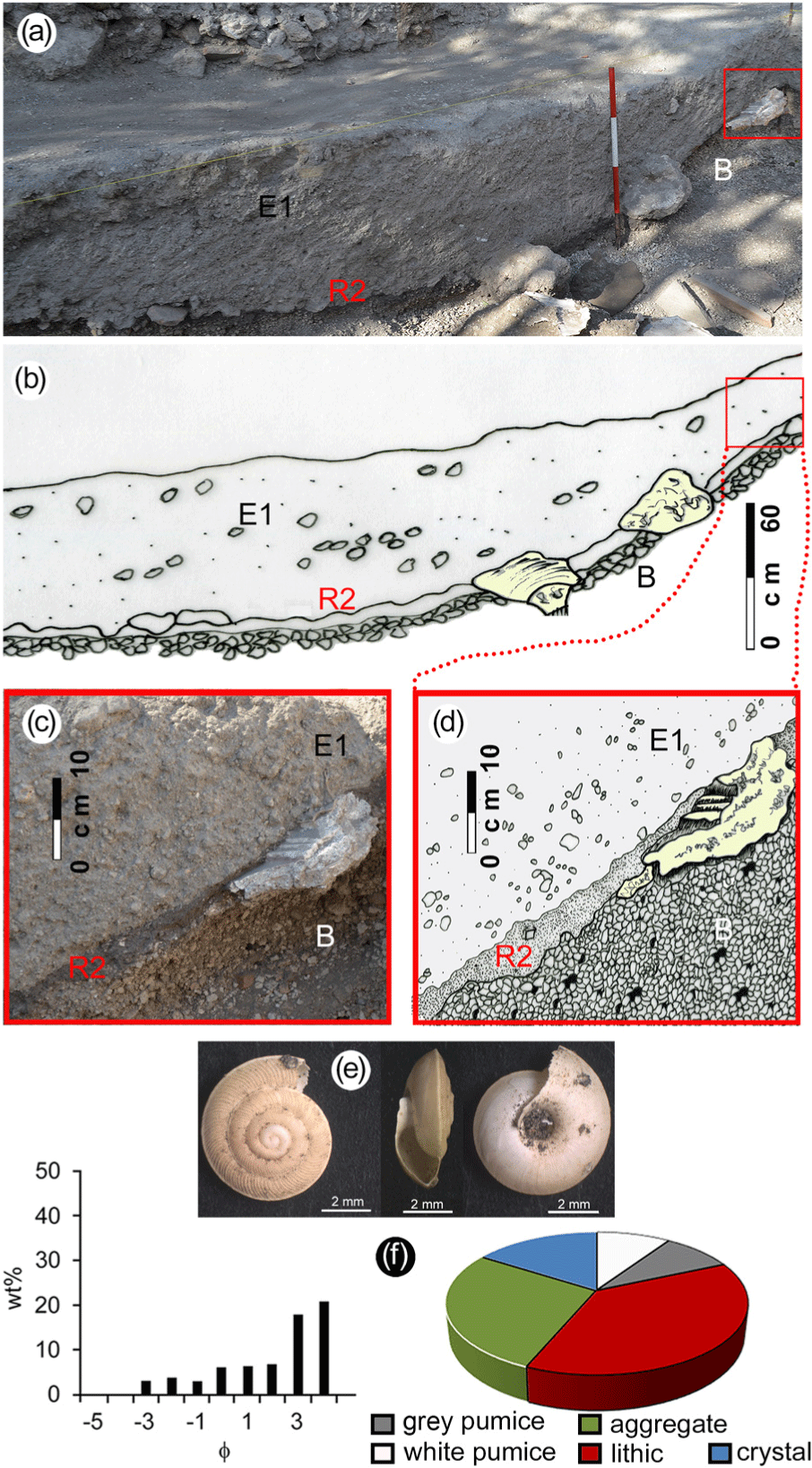
The pyroclastic sequence is strongly affected by the presence of the building, partially demolished during the eruption. Roofs and walls have affected the deposition of most of the stratigraphic units, giving rise to anomalous features and thicknesses. The pumice lapilli deposit is just 1.5 m thick on a mosaic floor in the western room, half of that accumulated in open air. Furthermore, in the northern room, the whole pumice lapilli sequence shows some unusual features: white and grey pumice clasts are mixed together and a coating of brownish ash is present all around pumice clasts. Tiles and wall fragments are intercalated within the pumice lapilli deposit (Fig. 5a). A 4-m-wide, U-shaped channel cuts through this deposit (Fig. 5b), of maximum depth 55 cm. Gully sides are quite symmetrical, with a slope angle on the southern flank of 14° and on the northern flank 24°. A thin (0–4 cm) reworked sediment (unit R2) covers the erosive surface (Fig. 5c,d). This sediment is poorly sorted and formed of centimetre-size pumice clasts within and ashy matrix rich in lithic and crystal fragments. Grain size analyses show that this horizon is enriched in fine ash (51 wt% finer than 0.063 mm) (Fig. 5f). The main components of this layer are lithic clasts (mainly lavas and rare limestones), ash aggregates, a comparable amount of white and grey pumice clasts, and some crystals (Fig. 5f). Rare shells of gastropods, whole and fragmented, are dispersed within this layer (Fig. 5e). These have been identified as continental gasteropoda Caracollina lenticula (Di Donato, pers. comm., 2019). The habitat of these gasteropoda is between plants, in soil substrate and occasionally in gardens. The channel is completely filled with a poorly sorted, ash deposit with a flat top, belonging to unit E (Fig. 5c,d). The upper part of the sequence is strongly disturbed by the presence of large fragments of walls mixed in the pyroclastic succession.
(a, b) At Schola Armaturarum a large channel cuts through the ad 79 sequence. Note the tiles in the lapilli deposit (B) and fragments of wall at the base of unit E. (c, d) Detail of the erosive structure. A thin reworked sediment (R2) covers the erosive surface. The channel is filled with the ash deposit belonging to unit E. (e) Shells of gastropods are dispersed within the reworked layer. (f) Grain size and component data for R2.
4. Discussion
The new stratigraphic sequence presented here adds some important details to those reported in previous studies (Sigurdsson et al. Reference Sigurdsson, Carey, Cornell and Pescatore1985; Cioni et al. Reference Cioni, Sbrana, Gurioli, Santacroce, Rosi, Sbrana, Cioni and Civetta1996; Luongo et al. Reference Luongo, Perrotta and Scarpati2003 a). Of great relevance is the presence of two ash layers interstratified in the upper part of the lapilli fall deposit (unit B). The lower layer (C1) was previously always identified at locations north of Pompeii or near the northern wall of the town (Sigurdsson et al. Reference Sigurdsson, Carey, Cornell and Pescatore1985), suggesting deposition from a pyroclastic current that did not have enough energy to overtop the northern walls of Pompeii. In contrast, our finding of layer C1 in regio V indicates that the first PDC was locally able to overtop the northern walls, penetrating the town by about 200 m. The lack of debris from roofs and walls, or any remnants of victims, inside this thin ash layer suggests that this first PDC was harmless. We speculate that the arrival of a (weak) PDC inside the town, near the end of the fall phase, may have further alarmed the Pompeians who remained in the town. We have identified eight previously unreported ash layers in the upper part of the ad 79 pyroclastic sequence, some of which have diffuse accretionary lapilli inside. These products were developed in a steam-rich eruptive column, confirming the evolution from magmatic to phratomagmatic style during the course of the ad 79 eruption (Sheridan et al. Reference Sheridan, Barberi, Rosi and Santacroce1981; Sigurdsson et al. Reference Sigurdsson, Carey, Cornell and Pescatore1985; Cioni et al. Reference Cioni, Sbrana, Gurioli, Santacroce, Rosi, Sbrana, Cioni and Civetta1996; Luongo et al. Reference Luongo, Perrotta and Scarpati2003 a).
Our field data document the presence of erosive features, caused by subaerial processes, within the ad 79 succession. However, it is important to note that during most of the aggrading of primary deposits no gullying occurred and no erosional scars were formed. Erosion and remobilization are concentrated within two well-defined episodes during the second phase of the ad 79 eruption. The first erosive episode occurred before the short recovery of the fall phase that emplaced layer D. This weak episode is localized close to the outer side of the northern walls and produced minor erosion, forming irregularities of the scale of a few centimetres filled with stratified material and sealed by fall layer D. A second, more widespread and intense erosive episode occurred before the PDC phase that emplaced layer E. U-shaped gullies cut the pyroclastic sequence down to layer B. A thin layer of fine material is confined at the bottom of these erosive structures, filled with the products of the following and more devastating PDC that overpassed Pompeii, aggrading layer E. R1 and R2 occur in local depressions, and single horizons are difficult to correlate across any significant distance. These units comprise centimetre-sized layers with sharp basal contacts. They are massive or stratified and matrix- to grain-supported. The juvenile fraction is formed of a mix of white and grey pumice clasts with a variable abundance of lithic clasts. Shells of gastropods, whole and in fragments, are locally found. These layers are interpreted as reworked material. The erosive structures at the base of R1 and R2 are caused by surface water runoff fed by rain. The presence of reworked material within all the studied gullies (in one case covered by a fall layer) rules out the theory that they were formed from the scouring effect of the subsequent PDCs (Richards, Reference Richards1965; Németh & Cronin, Reference Németh and Cronin2007). These units are formed by local reworking of primary pyroclastic material and hence they have limited lateral extents.
Fine ash eroded from layers C2 and C3 was possibly suspended in the water that ploughed the deposits. In the Schola Armaturarum, where the collapse of a roof at the end of the fallout phase accumulated a mix of grey and white pumice lapilli, the erosion reached this coarse horizon. Water percolated down through the highly porous structure, sticking fine particles on the pyroclasts and forming the observed coating. There is no indication of weathering or soil development between the gully bases and the sealing pyroclastic deposits, suggesting no significant time passed between gully formation, partial infilling of reworked material and resumption of the primary fall or PDC sedimentation. The interfingering of synvolcanic reworked volcaniclastic sediments within the upper part of the ad 79 pyroclastic deposits indicates an ongoing remobilization of freshly deposited tephra during the latter stages of this eruption. Syneruptive erosions, with emplacement of debris flows and hyperconcentrated flows, has been described during the destruction of Roman buildings on the northern slopes of Somma–Vesuvius by the ad 472 eruption (Mastrolorenzo et al. Reference Mastrolorenzo, Palladino, Vecchio and Taddeucci2002; Perrotta et al. Reference Perrotta, Scarpati, Luongo and Aoyagi2006; Scarpati et al. Reference Scarpati, Perrotta and De Simone2016). The presence of erosion surfaces filled with reworked sediments at Pompeii is powerful evidence of hiatuses during the ad 79 eruption in this town. Gurioli et al. (Reference Gurioli, Houghton, Cashman and Cioni2005) also suggested the occurrence of a short pause in the eruption preceding the emplacement of layer D. If we use the time framework of Sigurdsson et al. (Reference Sigurdsson, Carey, Cornell and Pescatore1985) to constrain the timing of erosion, layer C2 was emplaced at 07:30, while layer E was emplaced at 08:00, leaving only half an hour for both breaks. The calculated erosion rate of 120 cm hr−1 hour is compatible with that (1–2 m hr−1) evaluated during the two Novarupta 1912 breaks (Hildreth & Fierstein, Reference Hildreth and Fierstein2012). These time gaps represent a pause or break in continuity in the ad 79 eruption at Pompeii. They precede and follow a short-lived reappraisal of the sustained column related to layer D, increasing the time when the PDCs did not reach the town. These favourable circumstances could have pushed those inhabitants still in Pompeii during the fallout phase to leave their homes. Luongo et al. (Reference Luongo, Perrotta, Scarpati, De Carolis, Patricelli and Ciarallo2003 b) stated that during the second phase of the eruption 49% of the victims were on the roadways. Here we propose that the presence of such a high proportion of the population in open spaces during a Plinian eruption is evidence of a pause before the arrival of the most devastating PDC (aggrading layer E) at Pompeii. These pauses possibly coincide with Pliny’s escape from the Pomponian’s house to the beach at Stabiae, where he then died. The finding of similar erosive structures in other localities around the volcano could allow us to better understand the occurrence of pauses during the second phase of the ad 79 eruption. The presence of erosive gullies on the southern side of the volcano could be related to local rainstorms associated with the southwards dispersion of the eruptive cloud.
Acknowledgements
This research was possible thanks to the DiSTAR-PAP agreement to study volcanological aspects of new Pompeii excavations. We thank PAP staff and all archaeologists involved in recent excavations, who we shared the thrill of unearthing amazing findings with. Valentino Di Donato determined palaeoecology related to snail shells. An early version of the manuscript benefited from the comments by R. Cioni. We thank S. Hubbard and the reviewers (D. Pyle and an anonymous referee) for constructive comments.
Supplementary material
To view supplementary material for this article, please visit https://doi.org/10.1017/S0016756819001560
Appendix A
Grain size analyses have been performed using mechanical sieving (32 mm to 1/16 mm). Quantitative analysis of components was carried out for grain size 0.25–32 mm (2ϕ to –5ϕ). The fraction between 32 and 2 mm was separated and examined by hand; the fraction between 1 and 0.25 mm was analysed by means of the binocular microscope, counting a minimum of 500 grains for each class.




 Open access

