

1. Introduction
Deep in the waters of the Caribbean, the sponge Tectitethya crypta has existed for millennia, adapting to its environment and developing unique biochemical defences against microbial threats. Compounds first isolated from this species informed early research on nucleoside analogue drugs, which later formed the basis for life-saving medical treatments.Footnote 1 Such drugs are now essential in treating cancers and viral infections, including certain herpes viruses.Footnote 2 Research on nucleoside analogues more generally has also informed broader antiviral development, such as treatments targeting coronaviruses.Footnote 3 But despite the scientific and commercial interest surrounding these pharmaceutical innovations, many countries of origin, such as the Bahamas, face serious obstacles in translating this potential into effective benefits.Footnote 4 This enduring inequity, in which marine genetic resources (MGRs) sourced from biodiversity-rich regions sustain high-value biotechnological innovation without corresponding benefit-sharing, continues to raise urgent ethical and legal questions.Footnote 5
MGRs are biological materials derived from marine organisms that contain genetic information with potential scientific and commercial applications.Footnote 6 Unlike traditional living resources, such as fish, which are valued for their physical extraction and consumption, MGRs serve as biological resources of informational value.Footnote 7 Historically, marine-derived pharmaceuticals have been sourced from shallow-water reef invertebrates, such as sponges and tunicates. But new advances in biotechnology have enabled the discovery of medicinal agents and industrial enzymes from multiple other regions, including extremophiles found in hydrothermal vents.Footnote 8 The importance of MGRs is underscored by the global demand for new treatments, particularly in light of antibiotic resistance, the emergence of new diseases, and the need for crops resistant to climate change.Footnote 9 Unsurprisingly, the economic value of MGRs is well recognized. Corporations and research institutions are investing heavily in bioprospecting and marine scientific research (MSR) aiming to uncover commercially valuable genetic material from marine organisms. This trend is further incentivized by ongoing technological advances that continue to expand the range of applications of MGRs.Footnote 10
While there is broad consensus on the scientific and commercial value of MGRs, the legal frameworks governing them are shaped by divergent institutional logics, each negotiated at different times for distinct purposes.Footnote 11 Consequently, efforts to achieve equitable access and benefit-sharing (ABS) are hindered by regulatory fragmentation and by enduring normative tensions between competing norms embedded in multiple international instruments.Footnote 12 Because genetic material can be extracted from organisms living in various maritime zones – including areas within and areas beyond national jurisdiction (ABNJ) – questions arise regarding ownership, access rights, and benefit-sharing obligations under international law.Footnote 13 The challenges in defining and regulating MGRs, particularly in ABNJ, have only amplified their geopolitical and economic significance.Footnote 14
Existing international legal frameworks were not created with MGRs in mind.Footnote 15 The United Nations Convention on the Law of the Sea (UNCLOS)Footnote 16 does not explicitly address genetic resources, focusing instead on broad categories of ‘living’ and ‘non-living’ resources, with an emphasis on fisheries and mineral exploitation. This omission has generated legal uncertainty regarding whether MGRs should be classified under a new regime, akin to the common heritage of humankind principle applied to seabed minerals in the Area,Footnote 17 or whether they fall under the freedom of the high seas, allowing unrestricted access and utilization.Footnote 18 While UNCLOS does not regulate MGRs directly, its provisions on marine environmental protection remain relevant to their conservation. The Convention on Biological Diversity (CBD)Footnote 19 and the Nagoya ProtocolFootnote 20 regulate access to and utilization of genetic resources within national jurisdictions. But their applicability to MGRs in ABNJ remains unresolved due to the Nagoya Protocol’s focus on sovereign territories.Footnote 21 This legal ambiguity is further compounded by conflicting state interests. Developed nations, with advanced marine biotechnology capabilities, advocate for open access to MGRs, while developing nations argue for a fair distribution of benefits, fearing that corporations from wealthier countries will monopolize marine genetic discoveries without sharing monetary returns.Footnote 22 The Biodiversity Beyond National Jurisdiction (BBNJ) AgreementFootnote 23 seeks to address some of these concerns through its monetary benefit-sharing mechanism. Still, it does not resolve the fundamental dispute over the legal classification of MGRs, instead opting for a hybrid approach.Footnote 24 Similarly, the recent World Intellectual Property Organization (WIPO) Treaty on Intellectual Property, Genetic Resources and Associated Traditional Knowledge (GRATK)Footnote 25 introduces disclosure obligations in patent applications related to genetic resources, though its implications for marine bioprospecting remain uncertain.Footnote 26
This lack of clarity is deepened by the inconsistent use of legal terms, such as ‘rights’, ‘sovereignty’, and ‘jurisdiction’, which obscure the legal relations among states, corporations, and other actors involved in accessing and using MGRs, making it difficult to identify enforceable claims, corresponding duties, and the limits of state authority or corporate liberty. In this article, we propose incorporating Hohfeld’s analytical framework into the study of MGRs to clarify the different types of legal entitlements and their associated legal positions.Footnote 27 The application of Hohfeldian categories (claim-rights, duties, privileges, no-rights, powers, immunities, liabilities, and disabilities) offers a means of disentangling conflated legal concepts and clarifying which entities hold enforceable claims, which actors bear corresponding duties, and where legal disabilities or immunities limit certain actions. In doing so, we hope this categorization can enhance legal certainty and support a more coherent approach to MGR governance under international law.
More specifically, we offer a structured manual mapping of Hohfeldian legal positions as they apply to MGRs across key international legal instruments, particularly UNCLOS, the BBNJ Agreement, the CBD, the Nagoya Protocol, the Agreement on Trade-Related Aspects of Intellectual Property Rights (TRIPS),Footnote 28 and GRATK. We have manually classified these legal positions based on the provisions of these instruments and developed a dataset that maps Hohfeldian positions under these treaties.Footnote 29 We present this dataset, along with the analysis in this article, as a normative scaffolding for structured disagreement, that is, a provisional analytical framework for identifying and comparing relational legal positions. In this sense, the aim of this article is twofold: first, to map the legal positions of actors under key international instruments in relation to MGRs; and second, to demonstrate how a Hohfeldian analysis can bring clarity to terminological vagueness, revealing asymmetries, gaps, and structural issues within the existing governance framework for MGRs.
But our mapping is not merely descriptive. We use Hohfeld’s formal logic as a critical baseline, that is, an interpretive scaffold that exposes how legal structures can obscure institutional accountability, entrench power asymmetries, or enable extractivist practices. We acknowledge and embrace the fact that the categorization of legal positions is inherently subject to disagreement. Assigning a Hohfeldian classification to treaty provisions necessarily involves interpretation, a process that is particularly sensitive to ambiguities in legal drafting. To address this, we relied on the parallel work of two domain experts. When both experts reached the same conclusion, that classification was recorded. When their interpretations diverged (for example, where one identified a claim-right and the other a power), both readings were retained in the dataset.Footnote 30 This approach avoids imposing a single authoritative categorization and reflects the interpretative pluralism that characterizes legal analysis.
Our interpretative framework operates within the constraints of contemporary international law. We acknowledge that under the doctrine of the indirect effect of international law, only states and certain international organizations are considered primary subjects, with non-state actors typically addressed through indirect mechanisms and domestic implementation.Footnote 31 Our use of Hohfeld’s framework does not imply a direct effect of international law or seek to attribute direct legal subjecthood or autonomous international legal rights and obligations to non-state actors. Instead, it functions as a diagnostic tool to clarify how treaty provisions structure legal relationships, including those that affect non-state actors through state-mediated obligations. Where legal instruments impose duties on states – such as requiring free, prior, and informed consent (FPIC), ensuring benefit-sharing, or enforcing disclosure obligations – those obligations frequently shape the conduct of non-state actors, including corporations, researchers, and Indigenous Peoples and local communities (IPLCs).Footnote 32 Our analysis remains within the boundaries of the indirect effect, illustrating how international legal instruments distribute legal positions in relational terms through states, without asserting direct deontic standing for non-state actors.
This article is structured as follows: Section 2 introduces the analytical toolset of the Hohfeldian framework and explains how we applied it to map legal positions across key international instruments governing MGRs. Section 3 examines questions of sovereignty and jurisdiction over MGRs. Section 4 addresses the tension between the freedom of the high seas and the imperative of equitable benefit-sharing. Section 5 discusses the role of intellectual property (IP) rights and disclosure obligations in governing access to and utilization of MGRs. Section 6 explores the position of IPLCs, focusing on how international law structures disabilities in relation to MGR governance. Finally, Section 7 presents concluding reflections on the implications of our findings.
2. Conceptual and methodological foundations for a Hohfeldian mapping
This section introduces the analytical framework we used to map legal positions in international instruments governing MGRs. It is divided into two parts. Section 2.1 outlines Hohfeld’s theory of legal positions and explains how this conceptual framework helps to clarify legal relationships and address terminological ambiguities in international law. Section 2.2 then describes our method, that is, how we applied this framework to legal instruments relevant to MGR governance, detailing the steps taken to interpret provisions, normalize actor roles, and accommodate interpretative plurality in our dataset.
2.1. The Hohfeldian framework
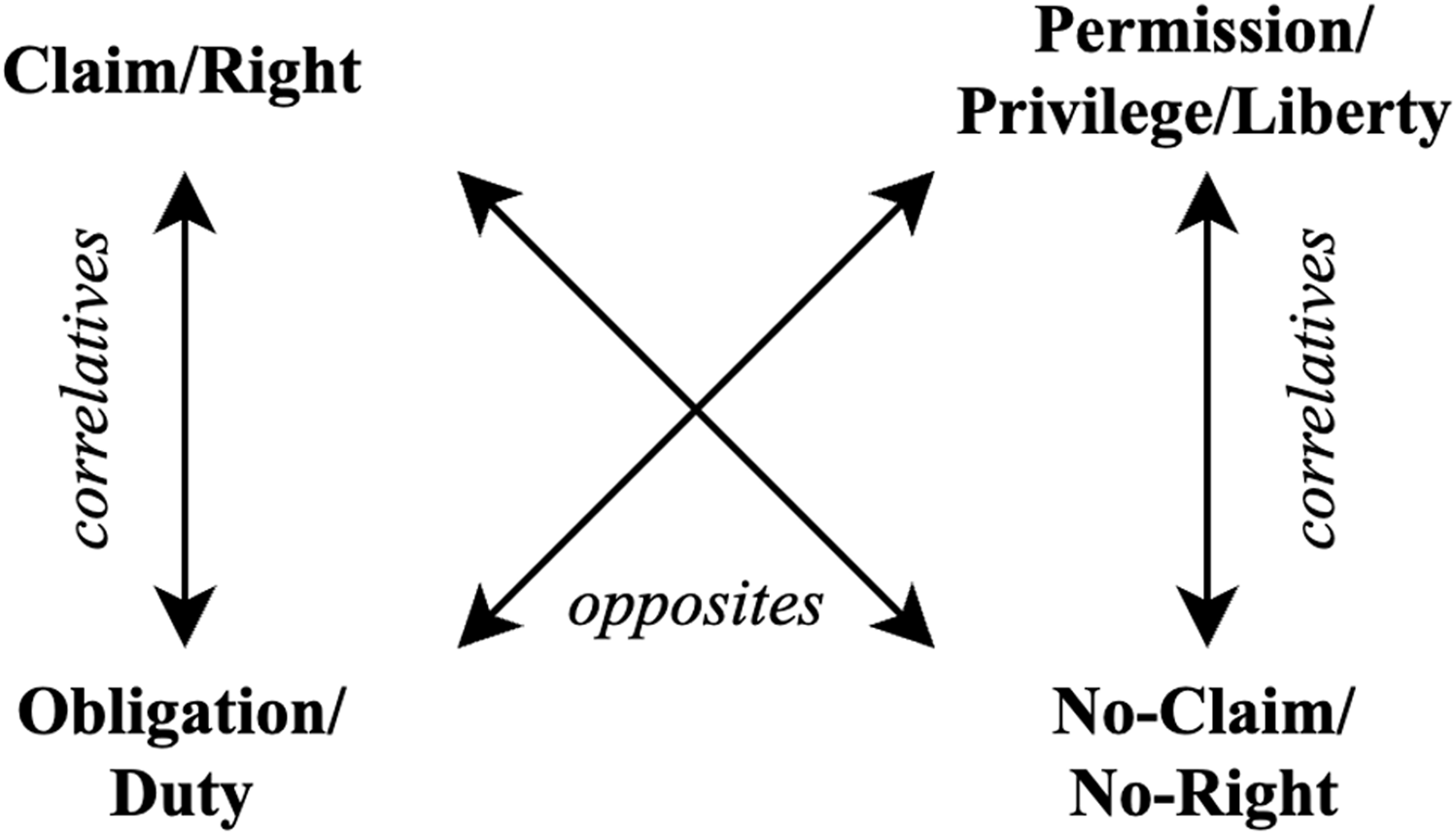
Legal discussions often rely on vague and ambiguous terminology, with terms like ‘rights’ and ‘liberties’ being used interchangeably, leading to confusion about what legal entitlements actually entail. Hohfeld sought to address this problem by providing a precise analytical framework that dissects legal positions into distinct relational categories.Footnote 33 Instead of treating ‘rights’ as a singular concept, Hohfeld identified four basic legal positions: claim-rights, duties (or obligations), liberties (also known as privileges or permissions), and no-rights (or no-claims) (Figure 1).Footnote 34 He also identified four second-order legal positions that govern changes in basic legal positions: powers, liabilities, immunities, and disabilities (Figure 2). These jural relations define how different actors can interact within a legal system, clarifying who can demand action, who is free to act, who can change legal relations, and who is protected from such changes. This approach aligns with earlier analyses that treat the law of the sea as a dense layering of jural relations and delegated powers, and with recent Hohfeldian readings of BBNJ Agreement.Footnote 35
Basic legal positions.

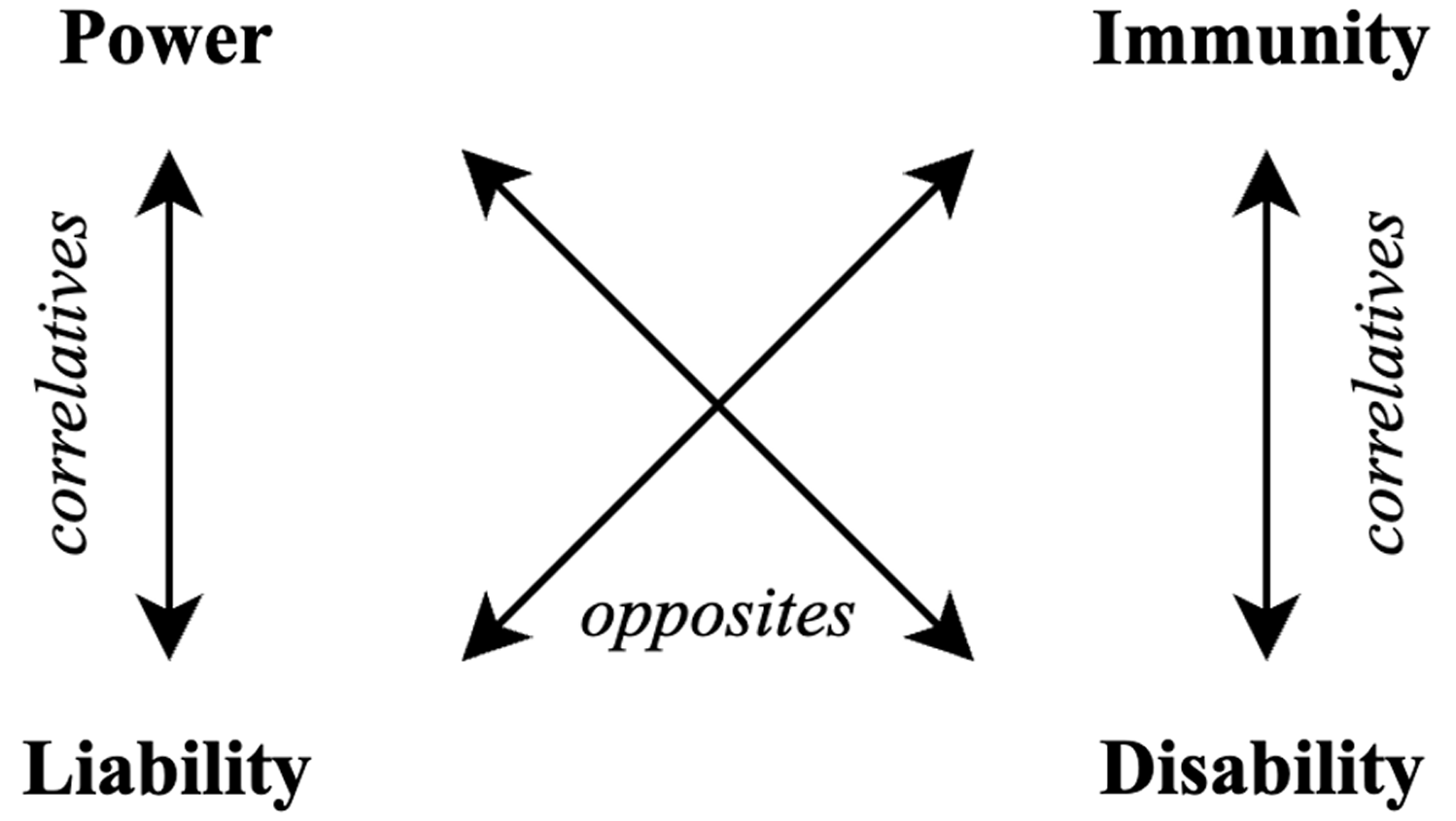
Second-order legal positions.
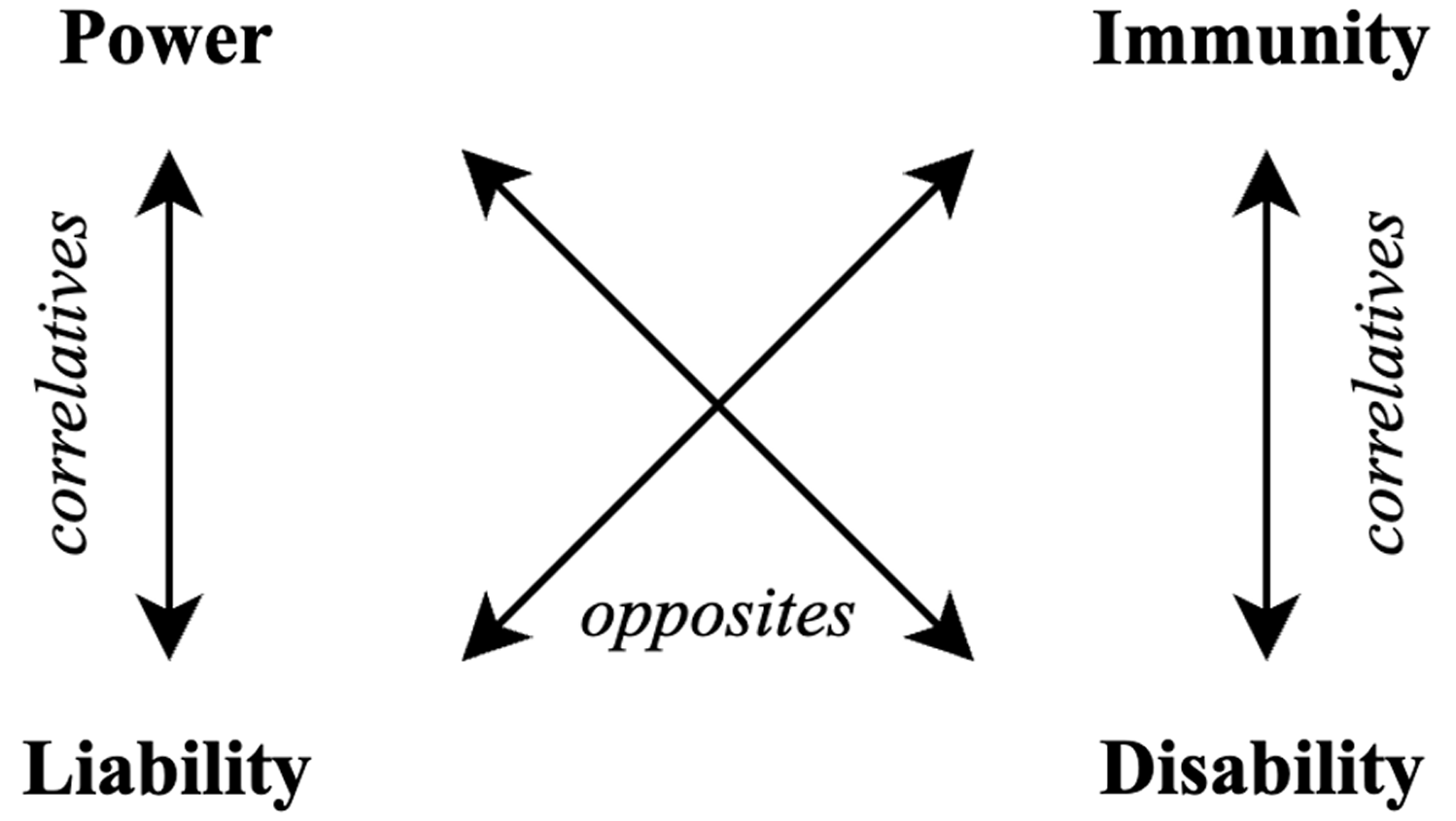
Figure 2: Long description
The diagram illustrates the relationships between four second-order legal positions: power, liability, immunity, and disability. Power and liability are correlatives, as are immunity and disability. Power and immunity are opposites, as are liability and disability. Arrows indicate these relationships, showing how each position interacts with the others.
For instance, under UNCLOS, a coastal state has a claim-right to regulate fisheries within its Exclusive Economic Zone (EEZ),Footnote 36 and foreign fishing vessels have a corresponding duty to comply with those regulations. On the high seas, states have the liberty to fish freely under UNCLOS, meaning they are not subject to a prohibition (an obligation not to) fish in those areas. This liberty, however, does not entail a claim-right to fish without restriction, as international law permits conservation measures, regional agreements, and enforcement actions that may impose duties on fishing vessels under specific circumstances.Footnote 37 Thus, while no state has an obligation to actively facilitate another state’s fishing activities, international law may still place limits on the exercise of this liberty in practice. A similar distinction arises with the right of innocent passage, which allows foreign ships to navigate through a coastal state’s territorial sea without prior permission, provided they do so in a manner that is non-threatening and does not violate international law.Footnote 38 Here, the foreign vessel has a liberty (or privilege) to pass, while the coastal state has a no-right to obstruct passage unless the vessel engages in activities that are not considered ‘innocent’ under UNCLOS. However, this privilege does not entail a claim-right to protection or assistance from the coastal state, as the latter has no obligation to provide safe passage beyond merely refraining from unlawful interference.
Hohfeld’s framework also includes powers and immunities, which govern the ability to change legal relationships.Footnote 39 A power is the legal ability to alter basic legal positions (claim-rights, duties, liberties, no-rights), while a liability exists when another party is subject to that power. A clear example of power and liability in international law is the regulation of MSR in jurisdictional waters. Under UNCLOS, coastal states have the power to grant or deny permission for foreign universities and research institutions to conduct MSR in their EEZ or on their continental shelf.Footnote 40 This means that states have the power to alter the legal position of researchers – either permitting or imposing a prohibition (a duty not to act) on conducting studies in these waters. Researchers and universities, in turn, have a liability, meaning they are legally subject to the state’s exercise of power. If the coastal state grants them permission to conduct research, the researchers may proceed under the specified conditions; if the state later imposes a duty not to conduct research (a prohibition), the researchers must comply, as their legal position is not fixed but contingent upon (or liable to) the coastal state’s power.
Finally, immunities and disabilities dictate who is protected from legal changes. Some states argue that MGRs in ABNJ should be treated as part of the common heritage of humankind,Footnote 41 a status that would grant all states an immunity from exclusive claims by any single state. Accordingly, no individual state could unilaterally assert sovereignty or ownership over these resources. States seeking to assert exclusive rights over MGRs would face a disability, meaning they would lack the legal power to alter the status of other states with respect to these resources. For example, if a state attempted to grant national companies exclusive exploitation rights over MGRs in the high seas, such an act would have no legal effect because that state lacks the power to do so under the common heritage of humankind interpretation.Footnote 42
The Hohfeldian framework is particularly relevant because it provides a structured set of inference rules for deducing correlative legal positions from any known relation. Once one legal position is identified, its corresponding counterpart can be systematically mapped. For example, if X holds a claim-right against Y to perform an act, then Y holds a duty to permit or enable that act. If X has a liberty (or privilege) with respect to Y, then Y has a no-right to prevent X from exercising that liberty. If X possesses a power over Y, then Y is subject to a corresponding liability. And if X enjoys immunity from Y, then Y is disabled from altering X’s legal position. These paired relations ensure conceptual clarity by mapping each legal position to its logical counterpart. Thus, in short, Hohfeld’s inference rules do not simply clarify legal relationships; they also provide a method for organizing legal analysis, making explicit the relational structure underpinning each entitlement and their correlate.
Applying Hohfeld’s distinctions to MGRs reveals why current legal frameworks are often inconsistent. International instruments pertinent to MGRs contain overlapping and sometimes contradictory language regarding access, benefit-sharing, and regulatory authority.Footnote 43 A structured mapping of legal positions can thus help clarify which actors hold enforceable rights, which bear obligations, and where legal authority is uncertain or contested. Note, however, that we do not present this mapping as a definitive categorization, but as a provisional analytical tool – a normative scaffolding – that helps clarify plausible legal configurations. We also recognize that the rights-based doctrinal framework of international law, and the analytic terms we use to parse it, are rooted in a European intellectual tradition.Footnote 44 To address this limitation, we treat Hohfeld not as a universal theory of entitlement but as a descriptive mapping device; we avoid universalizing claims where plural legalities and knowledge systems, including those of IPLCs, bear on stewardship. In this respect, our analysis should be understood as one situated interpretation – one possible reading among many – emerging from within a particular legal and epistemic tradition. Its purpose is not to fix meaning but to support clearer interpretation, facilitate contestation, and enable more structured discussions on the entitlements and obligations at stake in MGR governance. Further inquiry grounded in other world views and legal traditions will be essential to broaden and decolonize this analytical space.Footnote 45
2.2. Mapping legal positions in MGR treaties
This section explains the method we developed for applying the Hohfeldian framework introduced above to identify legal positions in key international instruments governing MGRs.Footnote 46 Our aim was to clarify how rights, duties, powers, and other legal positions are distributed across treaty regimes that regulate access to, utilization of, and benefit-sharing from MGRs. The analysis covered six major instruments: UNCLOS, the CBD, the Nagoya Protocol, TRIPS, the BBNJ Agreement, and GRATK. In each case, we extracted and manually classified legal positions embedded in the treaty text, using Hohfeld’s relational categories as a basis for systematic comparison.
The selection of provisions for mapping focused on those that establish, modify, or imply jural relations relevant to MGRs. This included not only clauses that explicitly articulate duties, claim-rights, or permissions, but also those that carry legal implications through their structure or omission. For example, by recognizing procedural requirements (such as FPIC) or by assigning institutional roles with regulatory effects. We considered provisions as relevant whenever they contributed to the normative architecture surrounding MGR governance, even where the language was vague, aspirational, or broadly framed – provided they could reasonably be interpreted as implying Hohfeldian jural relations. In these cases, the interpretative judgement centred on whether the provision introduced a relationship of enablement, restriction, accountability, or protection between actors. However, we excluded provisions that were purely definitional, preambulatory, or administrative, and that did not establish or imply jural relations. For instance, Article 1 of the CBD, which elaborates the general objectives of the Convention, and Article 2, which defines key terms, were not included. We also excluded provisions that were not directly relevant to MGRs, even if they might have indirect procedural relevance, such as provisions on reservations, withdrawal, depositories, and authentic languages. These were considered outside the scope of the jural analysis, as they do not structure normative relationships between actors in the governance of MGRs.
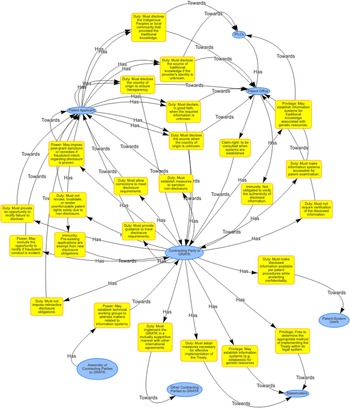
Each relevant provision was translated into a structured entry consisting of four elements: the provision itself, the actor-holder (the entity to whom the legal position is attributed), the action and jural description (typically a paraphrased normative expression such as ‘duty: must cooperate’), and the actor-affected (the entity against whom the position operates). To each entry, we assigned a Hohfeldian classification (claim-right, duty, liberty, no-right, power, liability, immunity, or disability) based on our interpretation of the legal effect created by the provision. For instance, the BBNJ Agreement requires contracting parties to ensure that traditional knowledge is accessed only with the FPIC of IPLCs.Footnote 47 In our mapping, this was recorded as a duty imposed on the state. Following the Hohfeldian framework, we inferred from this the existence of a corresponding claim-right held by the IPLCs concerned. The chosen four-element structure reflects the relational core of Hohfeld’s theory, which emphasizes that legal positions are defined not in isolation but through their effect on other actors. The inclusion of both the holder and the affected party, along with the jural position and normative content, preserves the bidirectional nature of Hohfeldian relations and enables a structured classification. Similar four-part mappings have been proposed in doctrinal legal theory to operationalize relational legal analysis, including recent logical models of legal positions grounded in Hohfeld’s framework.Footnote 48 An example of our structured mapping, applied to GRATK, is presented in Figure 3.
Mapping of the GRATK.Footnote 49
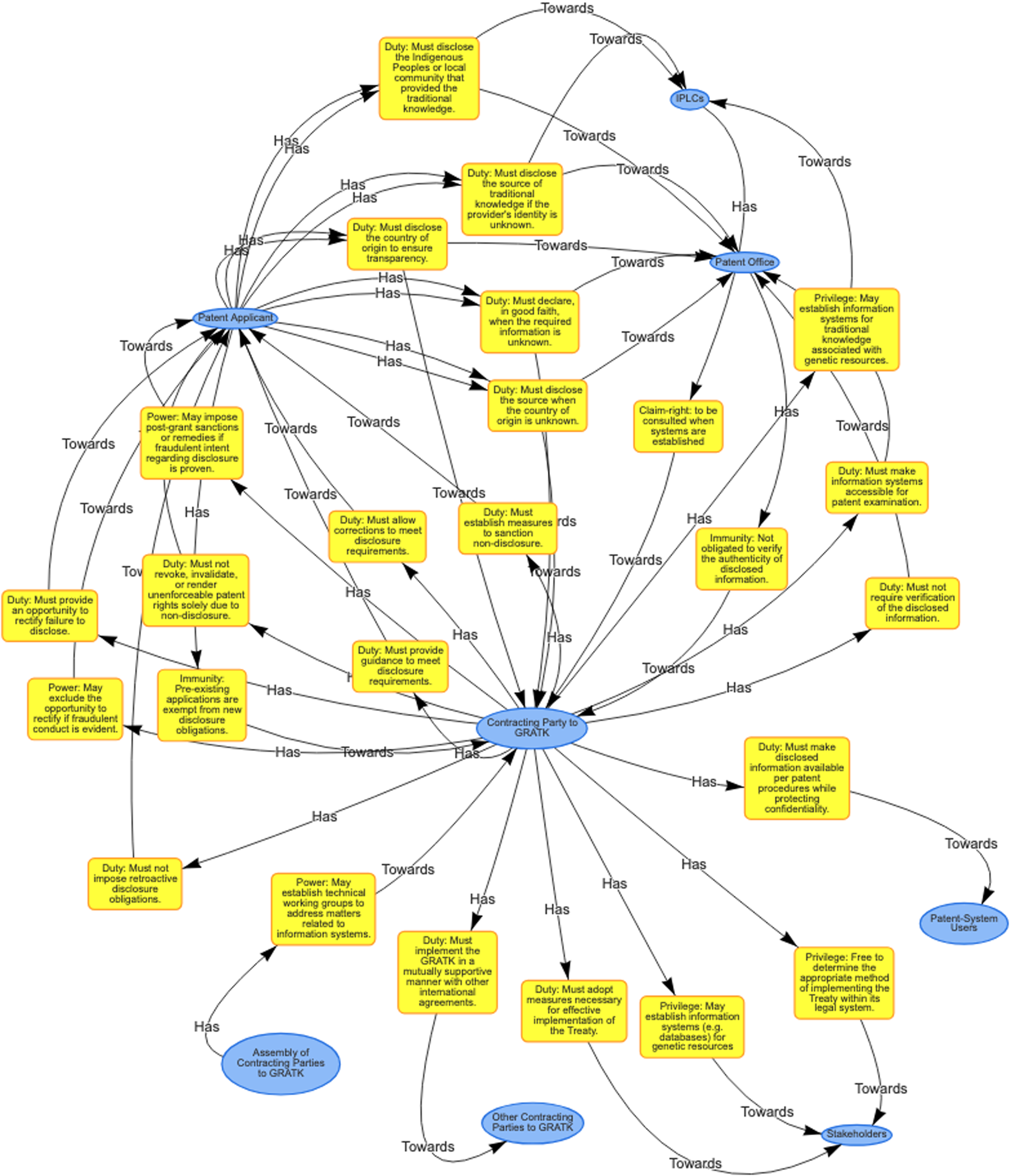
Figure 3: Long description
The diagram maps the GRATK, illustrating the relationships between different legal provisions, actors, and their effects. It includes entities such as IPLCs, Patent Office, Contracting Party to GRATK, Assembly of Contracting Parties to GRATK, Other Contracting Parties to GRATK, Patent-System Users, and Stakeholders. Each provision is structured into four elements: the provision itself, the actor-holder, the action and jural description, and the actor-affected. The diagram uses arrows to show the direction of duties, powers, privileges, and immunities among these entities. Key components include duties to disclose traditional knowledge, ensure transparency, and provide guidance, as well as powers to establish information systems and impose penalties. The relationships highlight how legal positions are defined through their effects on other actors, emphasizing the bidirectional nature of legal relations.
A further step in the mapping process involved the normalization of actor references across instruments.Footnote 50 International legal texts often refer to the same type of actor using varying expressions – for instance, ‘contracting party’, ‘party to this agreement’, or ‘state party’. To facilitate internal consistency and enable comparison across regimes, we grouped semantically equivalent designations under a controlled set of token-types.Footnote 51 This process aimed to reduce redundancy and clarify structural roles across the dataset. For example, all references to states with treaty obligations were normalized as ‘contracting party to BBNJ’, ‘contracting party to CBD’, and so forth, while recurring non-state categories such as ‘user’, ‘researcher’, or ‘resource provider’ were standardised according to their functional roles within the jural relation. At the same time, we recognize that normalization involves a degree of abstraction, and harmonizing labels inevitably entails a loss of some contextual specificity.Footnote 52 Our decisions were guided by the logic of Hohfeldian jural relations rather than by a redefinition of legal subjecthood; nonetheless, they reflect interpretative choices. This process allowed us to identify patterns of legal positions that cut across textual variation, especially in instruments where the density and complexity of provisions produce a wide array of role labels. The resulting normalization supported both the interpretative coherence of the dataset and its utility for future computational analysis.
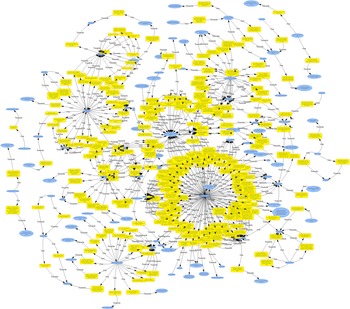
Given the inherent ambiguity and vagueness of legal language, the mapping process was designed to accommodate interpretative plurality.Footnote 53 Each provision was independently assessed by two researchers with expertise in international law. Where both analysts agreed on the classification of a legal position, that classification was adopted. In the relatively small number of cases where disagreements arose (such as one interpreter identifying a ‘claim-right’ while the other saw a ‘power’) both readings were retained in the dataset. This approach reflects a commitment to transparency and inclusivity, acknowledging that legal meaning often emerges through contestation rather than consensus. While the Hohfeldian framework provides a structured logic for deducing relational positions, its application to international treaty texts inevitably involves interpretive, value-laden judgements.Footnote 54 Consistent with our treatment of the framework as a normative scaffolding, our aim in this article is not to foreclose interpretation but to clarify and organize part of the field of legal possibilities. Therefore, instead of presenting a single authoritative mapping, we opted for an interpretative record that preserves disagreement as part of the normative landscape. The level of complexity reached through this mapping exercise can be visualized in Figure 4, which displays all provisions analysed in this manuscript; the density of interconnections renders the figure unreadable when confined to a single A4 page.Footnote 55
Cross-treaty mapping of all provisions used in this manuscript.

Figure 4: Long description
The diagram presents a detailed mapping of legal provisions across various international treaties, emphasizing the interpretative plurality inherent in legal language. Each provision is assessed independently by two researchers with expertise in international law. Where there is agreement on the classification, that classification is adopted. In cases of disagreement, both interpretations are retained, reflecting a commitment to transparency and inclusivity. The diagram uses a network of interconnected nodes and arrows to depict the relationships and classifications of legal positions, such as claim-rights and powers, within the Hohfeldian framework. This structured approach acknowledges that legal meaning often emerges through contestation rather than consensus, involving interpretive and value-laden judgments.
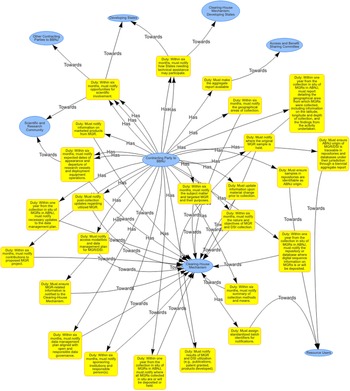
Figure 5, focusing on Article 12 of the BBNJ, illustrates the level of detail captured in the mapping, showing multiple relations between contracting parties and their corresponding relational structure. This provision alone generates over 20 distinct duties, most addressed to the Clearing-House Mechanism but also extending to other states, developing countries, and the scientific community. The Hohfeldian mapping highlights two important points. First, it reveals the ambiguity in attributing the duty of notification: while the treaty text places this on ‘contracting parties’, in practice the relevant actors are often private operators, sponsoring institutions, or cruise leaders, leaving a gap between formal and operational responsibility. Second, it shows how a single duty can generate multiple correlative claim-rights, for instance when notifications must be shared both with the Clearing-House and with other Parties or research communities. In addition, the Clearing-House itself emerges as a right- and duty-bearer under Article 12(3), demonstrating that institutional bodies, not only states, can occupy Hohfeldian positions.Footnote 56 Together, these features illustrate how the BBNJ Agreement encodes a denser and more complex relational structure than its predecessors,Footnote 57 and why Hohfeldian mapping is well-suited to uncover such ambiguities and interdependencies. Unlike other instruments, the BBNJ Agreement was explicitly negotiated to integrate multiple regulatory goals: conservation, sustainable use, benefit-sharing, capacity-building, and technology transfer. These objectives are operationalized through an institutionalized architecture involving state duties, procedural safeguards, and compliance mechanisms, which together produce a dense array of legal positions.Footnote 58 Moreover, the treaty’s language more explicitly encodes relational entitlements and obligations, setting it apart from its predecessors. In contrast, older treaties often express entitlements as broad state-based competencies without establishing correlative duties or cross-actor responsibilities. This helps account for BBNJ’s prominence in the mapping and highlights the interactive complexity of its legal design. The comparative mapping thus highlights a trend towards more complex, multilayered governance in recent instruments, especially those addressing global commons and distributive justice.Footnote 59
Mapping of Article 12, BBNJ Agreement.

Figure 5: Long description
The diagram illustrates the duties and relationships of contracting parties in the BBNJ Agreement. At the center is the Contracting Party (BBNJ), which has various duties and relationships with other entities. These entities include Developing States, Clearing-House Mechanism, Access and Benefit Sharing Committees, Resource Users, Other Contracting Parties to BBNJ, and the Scientific and Research Community. Each entity has specific duties and interactions with the Contracting Party. For example, Developing States must notify the Contracting Party of their need for technical assistance. The Clearing-House Mechanism is responsible for making reports available and ensuring the identification of repositories. The diagram uses arrows to show the direction of duties and relationships, with yellow boxes detailing specific duties such as notification requirements and reporting obligations. The overall structure highlights the interconnected responsibilities and communication flows among the parties involved in the BBNJ Agreement.
The mapping of the six instruments resulted in a structured, cross-treaty dataset that captures both the explicit and inferred legal positions embedded in the international governance of MGRs. Treaties were disaggregated into relational components using Hohfeldian categories and organized according to a normalized set of actor roles. This method revealed deontic patterns, gaps, and asymmetries that often remain obscured in conventional treaty interpretation. The resulting dataset is intended as a practical tool for researchers, policymakers, and negotiators working to clarify the legal architecture of MGR governance.Footnote 60 It also serves as the foundation for the doctrinal analysis that follows, beginning with an examination of sovereignty and jurisdiction in Section 3.
3. Sovereignty and jurisdiction
The governance of MGRs is shaped by competing legal frameworks that define who controls access and who benefits from the utilization of these resources. Central to this debate are four instruments: UNCLOS, the CBD, the Nagoya Protocol, and the BBNJ Agreement. This section begins to disentangle the complex web of entitlements and obligations governing MGRs across maritime zones through the application of Hohfeld’s framework of legal positions.
UNCLOS divides the ocean into jurisdictional zones, each conferring distinct rights and obligations.Footnote 61 In the territorial sea, coastal states hold a claim-right to full sovereignty over MGRs and the power to regulate bioprospecting and MSR. This claim-right is not absolute, however. UNCLOS imposes a duty on coastal states to permit innocent passage by foreign vessels, which entails a liberty for foreign vessels to transit and a corresponding no-right on the part of coastal states to obstruct such passage, as long as it remains innocent.Footnote 62 For example, while a coastal state may prohibit foreign entities from collecting MGRs in its territorial sea without consent, it cannot lawfully interfere with non-research-related transit. In the EEZ and continental shelf, coastal states retain sovereign rights over MGRs,Footnote 63 which grants them the power to authorize or deny MSR and bioprospecting.Footnote 64 Foreign entities, in turn, have a duty to seek consent for such activities. UNCLOS tempers these sovereign rights with a duty of due regard for the freedoms of other states, such as the liberty to lay submarine cables.Footnote 65 This balance is exemplified by disputes over deep-sea genetic resources: while coastal states may regulate seabed-associated MGRs (e.g., sedentary sponges), they arguably hold no-right over free-swimming organisms in the water column, leaving foreign entities at liberty to exploit them. On the high seas, UNCLOS enshrines liberty of open access to MGRs,Footnote 66 coupled with a disability on states asserting sovereignty.Footnote 67 This creates a legal vacuum for MGRs in ABNJ, where no state holds enforceable claim-rights. The Area (the seabed beyond national jurisdiction) further complicates governance. While UNCLOS designates mineral resources in the Area as the common heritage of humankind,Footnote 68 its silence on MGRs leaves their status ambiguous. States would thus retain liberty to exploit ABNJ MGRs unilaterally, absent binding duties to share benefits or conserve biodiversity.Footnote 69 It is important to note that, in our view, this silence operates not as a legal oversight but as a structural feature of a regime designed to facilitate selective appropriation while resisting collective accountability.
The CBD reinforces coastal states’ claim-rights over MGRs within their jurisdiction while imposing duties to ensure equitable access and benefit-sharing. Under the CBD, states hold the power to regulate access to and utilization of genetic resources through FPIC and mutually agreed terms (MAT).Footnote 70 Foreign entities, in turn, bear a duty to comply with these requirements, with failure triggering legal liabilities (e.g., penalties for biopiracy).Footnote 71 For instance, a pharmaceutical company seeking to commercialize enzymes derived from Caribbean sponges must first obtain authorization from the coastal state, which holds a correlative claim-right to benefit-sharing agreements. However, the CBD’s focus on national jurisdiction creates a governance gap for ABNJ MGRs.Footnote 72 A foreign research vessel collecting deep-sea sponges in the high seas portion of the Sargasso Sea, for example, faces no CBD-mandated duty to share benefits, as these resources lie beyond any state’s EEZ. This tension underscores a significant Hohfeldian gap: while coastal states enjoy strong claim-rights within their zones, the global community holds no claim to regulate ABNJ MGRs under the CBD. The resulting asymmetry consolidates a bifurcated regime – strong territorial control on the one hand, regulatory absence on the other – permitting the continued externalization of costs and benefits from ABNJ bioprospecting.
Although the BBNJ Agreement establishes claim-rights to equitable benefit-sharing for all states, rooted in the principle of the common heritage of humankind,Footnote 73 these obligations often come into tension with the exclusive privileges afforded by IP regimes such as TRIPS. Under the BBNJ Agreement, states are required to share both monetary and non-monetary benefits arising from the utilization of MGRs in ABNJ, implying corresponding duties on resource users and a collective claim-right held by the international community.Footnote 74 In contrast, TRIPS grants patent holders unilateral entitlements to prevent others from using, producing, or selling protected inventions, without imposing any correlative duty to disclose the origin of genetic materials or to share resulting benefits.Footnote 75 These entitlements can be understood, in Hohfeldian terms, as a power to alter the legal position of others through enforcement, and as a liberty to use the invention themselves, since no one holds a claim-right against such use; correlatively, the patent holder also possesses a claim-right against others who use the invention without consent. In effect, this legal architecture privileges proprietary enclosure over distributive justice, transforming knowledge derived from shared ecosystems into exclusive commercial assets. So, while the BBNJ Agreement recognizes a community-based framework of entitlements and obligations, TRIPS embeds proprietary rights without reciprocal accountability. Such divergence exposes deep fissures in global legal ordering, where biodiversity governance and IP law function in parallel but incompatible moral economies.
As Lavelle and Wynberg observe, the effectiveness of the BBNJ Agreement in delivering equitable benefit-sharing will hinge not only on its institutional architecture but also on its capacity to reconcile deep-rooted frictions between collective governance and proprietary innovation.Footnote 76 The Agreement builds on the common heritage principle to articulate a multilateral framework for ABNJ MGRs.Footnote 77 It imposes binding duties on users to share both monetary and non-monetary benefits (e.g., scientific data, technology transfer), thereby operationalizing a model of collective entitlement.Footnote 78 For example, a corporation commercializing drugs derived from hydrothermal vent bacteria would have a duty to contribute to a global benefit-sharing mechanism, ensuring that developing states receive fair compensation.Footnote 79 The BBNJ Agreement also reconfigures ABNJ governance by granting institutional powers to the Conference of the Parties (COP)Footnote 80 and imposing liabilities and disabilities on unilateral actors.Footnote 81 Simultaneously, the Agreement grants the global community immunity from unilateral exploitation, prohibiting states from asserting sovereignty over ABNJ MGRs.Footnote 82 This marks a departure from UNCLOS’s laissez-faire approach, replacing high seas liberties with structured duties to conserve and share. But whether this shift can recalibrate entrenched power asymmetries remains uncertain. Without effective enforcement mechanisms and genuine participation from historically marginalized states and communities, the promise of common heritage may risk devolving into procedural fiction.
4. Freedom of the high seas and benefit-sharing
The principle of freedom of the high seas, enshrined in UNCLOS, has long enabled states to exploit marine resources in ABNJ without binding legal constraints. This foundational principle of ocean governance has historically functioned as a vector for unregulated extraction, disproportionately benefiting technologically advanced states and corporate actors.Footnote 83 The rise of marine biotechnology has only intensified this structural imbalance, exposing the fundamental tension between this freedom and the imperative for equitable benefit-sharing of MGRs. This section examines how UNCLOS, the CBD, the Nagoya Protocol, and especially the BBNJ Agreement address the tension between the freedom of the high seas and equitable benefit-sharing of MGRs.
UNCLOS codifies the freedoms of all states to access and exploit resources on the high seas,Footnote 84 such as fishing and conducting MSR activities, subject to a range of obligations, including duties to conserve the marine environment and to exercise due regard for the interests of other states.Footnote 85 Although UNCLOS does not explicitly mention MGRs, these freedoms can be interpreted as implicitly encompassing access to and use of MGRs in ABNJ. However, as already explained, the absence of specific provisions on MGRs has left their legal status ambiguous and subject to divergent interpretations, contributing to ongoing debates over whether these resources should fall under the regime of high seas freedoms or be governed by the principle of the common heritage of humankind.Footnote 86 This ambivalence is not merely legal but deeply ideological, reflecting a broader reluctance to impose distributive obligations on states accustomed to sovereign liberties.Footnote 87 For MGRs, this framework creates a legal void: while states enjoy liberties to harvest genetic material in ABNJ, there is no corresponding claim-right for the international community to demand compensation or conservation. Here, UNCLOS enshrines a regime of asymmetrical privileges where the act of bioprospecting is decoupled from the act of redistribution. For example, a biotech company harvesting extremophiles from hydrothermal vents in the Mid-Atlantic Ridge (ABNJ) faces no obligation under UNCLOS to share profits or data with developing nations, even if the discovery yields a billion-dollar pharmaceutical product. UNCLOS’s silence on MGRs contrasts starkly with its treatment of mineral resources in the Area, which are designated as the common heritage of humankind.Footnote 88 This has prompted calls to extend common heritage principles to MGRs in ABNJ. However, as it stands, UNCLOS privileges corporate and state actors with the scientific and technical capacity to exploit ABNJ MGRs, leaving the rest of the global community with no claim to benefits.Footnote 89 In other words, the current legal system naturalizes North–South inequality while masking it behind formal equality.Footnote 90
The Nagoya Protocol establishes a strong regime for ABS of genetic resources, but its scope is territorially constrained.Footnote 91 The CBD applies only to genetic resources within national jurisdiction;Footnote 92 likewise, the Nagoya Protocol’s requirements for FPIC and MAT do not extend to ABNJ.Footnote 93 This territorial scope limits the applicability of benefit-sharing duties; for instance, a research institute studying deep-sea microbes in the Clarion-Clipperton Zone (ABNJ) need not comply with Nagoya’s FPIC or benefit-sharing rules, even if the research leads to a patented enzyme used in industrial processes. This territorial limitation reflects a paradigmatic Hohfeldian asymmetry: while coastal states enjoy powers and claim-rights (entailing correlative duties on users) to regulate and benefit from MGRs within their jurisdiction, the global community has no right to demand reciprocity in ABNJ. The absence of collective claim-rights also displaces demands for historical redress or distributive justice into the domain of voluntary practice. This scenario entrenches structural inequity, privileging technologically advanced actors in ABNJ. The BBNJ Agreement directly addresses this gap by introducing collective legal obligations grounded in the common heritage principle.Footnote 94 The BBNJ Agreement thus marks a paradigm shift from UNCLOS’s permissive approach to a new duty-based regime. The Agreement imposes a duty on users of ABNJ MGRs to share monetary benefits (e.g., royalties from commercial products)Footnote 95 and non-monetary benefits (e.g., scientific data, technology transfer).Footnote 96 Developing states, in turn, hold a claim-right to equitable participation in MGR utilization.Footnote 97 The Agreement also mandates environmental impact assessments for ABNJ bioprospecting, creating a duty to avoid harm to marine ecosystems.Footnote 98 However, while this duty structure is progressive in form, it still operates within the statist grammar of international law, where obligations are mediated by states rather than being directly enforceable by communities affected by extractivist practices.Footnote 99
The BBNJ Agreement COP holds the power to establish binding ABS modalities, imposing liabilities on states to comply.Footnote 100 In Hohfeldian terms, this power would enable the COP to alter the normative statuses of states by creating or modifying their legal positions, generating liabilities and duties under a collectively administered regime. These state-level obligations, in turn, require Parties to ensure that users under their jurisdiction comply with benefit-sharing duties. For example, if a pharmaceutical company based in Germany commercializes a cancer drug derived from ABNJ sea sponges, it would fall to the German government to ensure that the company contributes to a global fund supporting marine conservation in developing states.Footnote 101 Article 52 of the BBNJ Agreement establishes a financial mechanism aimed at supporting the implementation of benefit-sharing obligations under Article 14. It creates a special fund to which states and private users are expected to contribute, particularly when commercializing products derived from MGRs from ABNJ.Footnote 102 This provision marks a shift towards more structured financing in biodiversity governance. Under the CBD process, COP10 (Decision X/1) first articulated a general resource-mobilization goal.Footnote 103 COP15 (2022) then agreed to pursue a multilateral mechanism for benefit-sharing from utilization of digital sequence information (DSI) as part of the Global Biodiversity Framework. COP16 (2024) established the Cali Fund as its global fund, operationalizing the Fund through detailed modalities, with fiduciary administration entrusted to the UN Multi-Partner Trust Fund Office.Footnote 104 While these funds represent an important move towards redistributive infrastructure, commentaries have noted open design questions, a narrow initial scope, and uncertainties about legal uptake and rate-setting.Footnote 105 Unless their governance is firmly grounded in principles of co-design and epistemic justice, they risk reproducing donor-recipient hierarchies. Together, these instruments signal a growing trend of integrating equity-oriented financial tools into global biodiversity frameworks, with the COP under the BBNJ Agreement holding the authority to define the modalities for allocating and managing such funds.Footnote 106 This replaces UNCLOS’s privilege of unrestricted access with structured duties to conserve and share.Footnote 107 Yet it remains unclear whether these duties can undo, or merely obscure, the structural legacies of accumulation historically legitimized through the ‘freedom of the seas’.
5. IP rights, gatekeeping, and disclosure
The governance of MGRs intersects with IP regimes in ways that often prioritize corporate and state interests over global equity. Although some researchers aim to collect in situ marine samples, most biotechnological innovation today is driven by access to DSI, which enables users to exploit the genetic data of marine organisms without needing physical access to source material.Footnote 108 This section examines how TRIPS, the CBD, the Nagoya Protocol, and GRATK shape access to and the commercialization of MGRs. Our analysis under Hohfeld’s framework confirms the tension between IP liberties that gatekeep innovation and emerging legal duties, such as those under the BBNJ Agreement,Footnote 109 to promote transparency and equitable benefit-sharing – particularly where the absence of corresponding claim-rights structurally disadvantages provider states and communities.
TRIPS requires Members to confer on patentees the exclusive right to prevent unauthorized making, using, offering for sale, selling or importing of the patented invention. In Hohfeldian terms, this is best expressed as a claim-right held by the patentee, correlating with duties on others, together with the liberty to use and exploit the invention oneself.Footnote 110 This approach incentivizes innovation but often sidelines the rights of states and communities contributing genetic resources. For example, a pharmaceutical company patenting an anticancer compound derived from deep-sea sponges can monopolize production without disclosing the MGR’s origin or sharing benefits with the provider state. TRIPS contains no binding obligation to disclose the geographic or biological origin of genetic materials, creating a Hohfeldian gap: while patent holders retain claim-rights against unauthorized use, source states and IPLCs hold only the correlative no-right in the absence of a disclosure or benefit-sharing duty.Footnote 111 For instance, if a company were to patent a compound derived from Bahamian sponges without obtaining FPIC or agreeing to share benefits, the Bahamas would have no effective recourse under the TRIPS Agreement.Footnote 112 This asymmetry is not incidental but structurally embedded, reflecting a broader ideological ordering in which innovation is rewarded without regard for distributive consequences or historical appropriation.Footnote 113
Unlike TRIPS, the CBD and Nagoya Protocol create a jurisdiction-based framework that grants provider states enforceable rights over access to and use of genetic resources. Under the Nagoya Protocol, users of MGRs have a duty to obtain FPIC and negotiate MAT for benefit-sharing,Footnote 114 which correlates with a claim-right held by the provider state to control access and receive compensation. For instance, a European university researching Indonesian coral reefs must obtain Indonesia’s consent and agree to share royalties from any commercialized discoveries. This structured legal relationship creates enforceable entitlements: the provider state has both the power to grant access and the claim-right to demand terms, while the user is under a legal duty to comply. Non-compliance triggers penalties, including administrative penalties adopted by Member States, as enforced through the EU Regulation on Compliance with the Nagoya Protocol.Footnote 115 However, the Protocol’s territorial scope excludes ABNJ, meaning users of MGRs from those areas face no duty to disclose origin or share benefits. Moreover, phrases such as ‘fair and most favourable terms, including on concessional and preferential terms’Footnote 116 are best understood as a rhetorical strategy to encourage cooperation rather than establish enforceable legal positions. As Bodansky notes, these provisions reflect a form of soft law, signalling political aspiration and consensus-building, but lacking the legal precision necessary to generate binding obligations.Footnote 117
The GRATK addresses this gap by imposing disclosure duties in patent applications.Footnote 118 Applicants must disclose the country of origin of genetic resources and any associated traditional knowledge, with patent offices having the power to reject non-compliant applications.Footnote 119 India has long advocated for mandatory disclosure of origin and the protection of traditional knowledge in international IP negotiations. During the WIPO Intergovernmental Committee on Intellectual Property and Genetic Resources, Traditional Knowledge and Folklore (IGC), India consistently supported a binding international instrument requiring patent applicants to disclose the country of origin of genetic resources and associated traditional knowledge.Footnote 120 These proposals closely align with the core principles later formalized in the GRATK.Footnote 121 This reflects a Hohfeldian synergy: states and communities gain a claim-right to transparency, while applicants bear a duty to comply and national patent offices hold the power to reject non-compliant applications – a power that imposes a corresponding liability on those seeking patent protection.Footnote 122 However, the effectiveness of the GRATK depends on national implementation.Footnote 123 In jurisdictions that are not parties to the GRATK or the Nagoya Protocol, applicants may retain the privilege to withhold origin information, perpetuating inequities in MGR commercialization.
The clash between the privileges of TRIPS and the duties of the CBD, Nagoya, and the GRATK reveals systemic contradictions in MGR governance. IP regimes grant holders unilateral privileges without corresponding duties, while benefit-sharing frameworks rely on reciprocal claim-rights and obligations that remain territorially or institutionally constrained.Footnote 124 Although the TRIPS Agreement affirms that the protection and enforcement of IP rights should contribute to ‘the promotion of technological innovation and to the transfer and dissemination of technology’,Footnote 125 these normative objectives are often undermined in practice. Rather than functioning as mechanisms to advance innovation and public welfare, IP rights have increasingly been treated as tradable assets in bilateral and multilateral trade negotiations. In jurisdictions that are not parties to the Nagoya Protocol, patent offices lack the power to enforce disclosure, enabling biopiracy. This leaves MGRs in ABNJ subject to TRIPS privileges without corresponding duties under Nagoya or GRATK, allowing corporations to exploit genetic wealth unilaterally. This reading lays bare a deeper structural imbalance: the developmental objectives of IP regimes are routinely overshadowed by commercial and geopolitical priorities. In practice, this undermines the intended balance of rights and duties in international law, most notably, the obligation to promote benefit-sharing and ensure equitable access to technology.Footnote 126
The BBNJ Agreement attempts to address these gaps by extending the principle of the common heritage of humankind to MGRs in ABNJFootnote 127 and by mandating equitable benefit-sharing, including through technology transfer.Footnote 128 This emerging framework introduces potential claim-rights for developing countries, correlative duties for users of MGRs, and powers for institutional bodies to enforce compliance. But it also generates friction with existing intellectual property regimes such as TRIPS, which continue to prioritize exclusive claim-rights and privileges for patent holders. This unresolved tension between collective benefit-sharing and proprietary innovation models poses a significant challenge to the implementation of the BBNJ regime and its coherence with global IP law.Footnote 129 One promising approach lies in harmonizing these regimes by reinforcing currently underdeveloped Hohfeldian positions through concrete legal reforms. TRIPS, for example, could be amended to impose a duty on patent applicants to disclose the origin of genetic resources as a condition of patentability, corresponding to a hypothetical claim-right held by provider states or IPLCs and generating a liability for non-compliant applicants whose patents could be revoked or denied.
Ideally, this harmonizing logic would extend beyond TRIPS. For instance, GRATK’s disclosure obligations could be integrated into the broader WIPO framework, imposing liabilities on all patent applicants and reinforcing the institutional power of national patent offices to reject non-compliant applications. The benefit-sharing provisions under the BBNJ Agreement could also be operationalized by assigning a duty to private users of MGRs from ABNJ to contribute monetary benefits (such as royalties), correlating to a claim-right held by developing states to receive such benefits. This duty would be enforceable through the institutional powers held by the COP or other BBNJ bodies, rendering non-compliant users liable under an international mechanism. For example, if a company patents a compound derived from ABNJ tubeworms, a properly enforced BBNJ mechanism would place the operator under a duty to share benefits while granting developing states a corresponding claim-right to those funds. In ABNJ, such a claim-right would not stem from coastal or sovereign entitlements but from a multilateral scheme that allocates duties and correlative rights through the BBNJ Agreement itself. This example also illustrates the added value of a Hohfeldian mapping: it forces clarity about who owes what to whom, and under which institutional predicates. A principles-based approach may assert that benefits should be shared fairly or equitably, but it does not specify who bears the duty to share, with whom, when, or under what consequence. Without a corresponding duty, there is in fact no enforceable right. The Hohfeldian analysis makes this explicit by tying each asserted right to its correlative duty and to the responsible actor. In this regard, note that IPLCs and other indirectly affected actors do not hold a direct entitlement to draw from the fund under current instruments; their participation depends on Party-mediated arrangements.Footnote 130
The above-mentioned reforms would not only enhance legal coherence but also signify a normative realignment (from the protection of innovation to accountability for exploitation) anchored in the reciprocal logic of international legal obligations. In this way, legal instruments could transform what are currently policy aspirations into enforceable normative relationships grounded in mutually correlative legal positions.
6. The powers and disabilities of IPLCs
The governance of MGRs cannot be separated from the traditional knowledge of IPLCs, who have stewarded marine biodiversity for millennia.Footnote 131 Yet, legal frameworks like the GRATK and the Nagoya Protocol reveal a stark contrast between the recognition of Indigenous rights in principle and their marginalization in practice. This section examines how these regimes allocate powers or impose disabilities on Indigenous actors, using Hohfeld’s framework to expose systemic asymmetries and propose pathways to strengthen their normative agency. It argues that IPLCs are often granted symbolic recognition without the juridical infrastructure necessary to actualize their entitlements, reproducing what scholars have termed ‘participation without power’.Footnote 132
The GRATK introduces mechanisms to protect IPLCs’ claim-rights by obligating patent applicants to disclose the origin of genetic resources and associated traditional knowledge.Footnote 133 For example, if a biotech firm develops a cosmetic using seaweed-harvesting techniques practiced by Māori communities in Aotearoa–New Zealand, the GRATK mandates disclosure of the Māori contribution in patent filings.Footnote 134 Nonetheless, enforcement remains weak, particularly regarding DSI, which often circulates through open databases disconnected from its biological source.Footnote 135 This disconnection between biological and digital provenance effectively erases IPLCs as epistemic contributors to biotechnological innovation. To address this, states should condition patentability on prior disclosure of DSI origin, backed by legal presumptions that shift the burden of proof to applicants in cases of omission. Moreover, harmonizing disclosure protocols with WIPO standards and linking them to ABS compliance under national and regional laws (such as the EU Regulation 511/2014)Footnote 136 would help close existing legal loopholes and ensure traceable, equitable use of DSI in biotechnology.Footnote 137 The future effectiveness of GRATK is jeopardized due to jurisdictional disparities: while some countries empower IPLCs to seek legal remedies for biopiracy,Footnote 138 others deny them standing to enforce disclosure – enabling ongoing extraction where traditional knowledge fuels innovation but communities remain excluded from benefits. Moreover, this leaves IPLCs structurally disabled in governing resources their knowledge helped to valorize.Footnote 139 It also entrenches the epistemic and legal marginalization of IPLCs.Footnote 140
The GRATK builds on the foundational principles of the Nagoya Protocol, which requires FPIC from IPLCs for access to traditional knowledge associated with genetic resources.Footnote 141 For instance, Indonesian coastal communities must give consent before their knowledge of cultivating coral-derived antibiotics can be accessed or commercialized, thus affirming IPLCs’ claim-right to control access and negotiate benefit-sharing arrangements.Footnote 142 This relationship reflects a Hohfeldian pair: users bear a duty to obtain consent and share benefits, while IPLCs hold a corresponding claim-right over access to and use of their knowledge. Non-compliance may trigger penalties, including administrative penalties under Member State law.Footnote 143 However, the Nagoya Protocol’s protections are territorially constrained.Footnote 144 Traditional knowledge related to MGRs in ABNJ is excluded from the GRATK and the Nagoya Protocol. As a result, IPLCs hold no-claim-rights to benefits – even when their knowledge significantly informs bioprospecting.Footnote 145 This legal gap reinforces a structural disability, effectively marginalizing Indigenous voices in transboundary marine governance.
The structural disabilities described above persist due to at least three systemic barriers. First, jurisdictional fragmentation remains entrenched: both the GRATK and the Nagoya Protocol apply only within national boundaries, excluding Indigenous knowledge connected to ABNJ.Footnote 146 Second, asymmetric power dynamics favour patent offices and corporations in non-GRATK states, which operate with de facto immunities that shield them from accountability for biopiracy. Third, many Indigenous communities lack the financial and legal resources to pursue enforcement, rendering their claim-rights practically unenforceable.Footnote 147 Several targeted legal and institutional reforms could begin to redress these asymmetries. This includes extending disclosure requirements to MGRs found in ABNJ and recognizing traditional knowledge as part of the global genetic commons.Footnote 148 But GRATK’s disclosure requirement, focused on the ‘country of origin’, excludes MGRs from ABNJ, reflecting the territorial framing of the CBD and Nagoya Protocol.Footnote 149 In contrast, the BBNJ Agreement adopts a non-sovereign approach, referring to the ‘source’ of MGRs in ABNJ and framing benefit-sharing as a global responsibility,Footnote 150 thereby exposing a legal asymmetry that must be resolved to ensure equity for resources with no attributable state.Footnote 151 Bridging this divide requires a shift from territory-based entitlement to knowledge-based governance, where IPLCs’ epistemic contributions trigger legal obligations regardless of spatial boundaries.Footnote 152
Despite serving as long-standing custodians of marine knowledge, IPLCs continue to be structurally marginalized in MGR governance systems. The GRATK includes a safeguard clause that allows patent applicants to submit a declaration stating they are ‘unaware’ of the origin of the genetic resource used.Footnote 153 While this provision offers flexibility, it creates a critical loophole in the enforcement of benefit-sharing norms.Footnote 154 National patent offices are not obligated to verify the accuracy of such declarations, effectively shifting the compliance burden onto the applicant and relying on a presumption of good faith.Footnote 155 Without verification mechanisms or effective penalties for false declarations, this safeguard clause becomes a critical weak point undermining the very transparency the GRATK seeks to promote. The situation is especially problematic in the context of MGRs, where tracking the provenance of DSI is often complex or infeasible, further weakening disclosure-based safeguards.Footnote 156 Moving forward, patent systems could require certification from Indigenous councils for any application involving traditional knowledge, thereby shifting the liability burden to users.Footnote 157 Additionally, Indigenous IP tribunals could be created to adjudicate biopiracy claims independently of state legal systems.Footnote 158 Finally, universalizing the GRATK by encouraging ratification from non-party states would help close jurisdictional loopholes and end the de facto immunities currently enjoyed by corporations operating outside ABS frameworks.Footnote 159 For example, if a company patents a compound derived from ABNJ marine organisms whose discovery was guided by knowledge shared by a Pacific Islander or Arctic coastal community, a harmonized disclosure regime could mandate that royalties be directed to support community-led marine conservation efforts. Such mechanisms would not only restore distributive balance but also reaffirm IPLCs’ contribution to marine genetic knowledge, challenging the prevailing fiction of ownerless innovation.
7. Final remarks
This article set out to make sense of the legal architecture that governs marine genetic resources by applying Hohfeld’s framework to six key international instruments. Our aim was not only to clarify the dense web of claim-rights, duties, powers, and immunities, but also to expose the ambiguities and overlaps that so often frustrate treaty interpretation. In mapping these relationships, we found that analytical clarity can illuminate more than doctrinal puzzles; it also reveals how different regimes distribute entitlements and structure constraints in practice.
Certain patterns of asymmetry cut across these regimes. UNCLOS, for instance, protects freedoms in the high seas but disables any collective claim-rights, leaving MGRs open to unilateral appropriation and little prospect of redistribution. The CBD and Nagoya Protocol shift the focus back to national control, granting provider states new powers to regulate access and demand benefit-sharing, but only within their own boundaries. Meanwhile, TRIPS entrenches proprietary entitlements without requiring origin disclosure or sharing of benefits, producing an innovation system that remains structurally unbalanced. Although GRATK introduces disclosure obligations, its enforcement prospects remain uncertain given the many jurisdictional gaps. The BBNJ Agreement does seem to mark a normative shift, reframing bioprospecting in ABNJ as a collective responsibility, with new duties for users and enforcement powers for international institutions. Yet, for all these reforms, IPLCs remain on the margins: they still hold no enforceable claim-rights over MGRs beyond state borders. Taken together, our findings point to a persistent tension among three legal logics: the collectivist ideal of the common heritage of humankind, the individualizing thrust of intellectual property rights, and the nationalizing tendencies introduced by the CBD. Rather than treating these as mere theoretical abstractions, our mapping makes them visible as concrete, relational patterns within actual treaty practice. We hope the dataset will help others to identify not only the big normative patterns but also the silences (such as the overlooked positions of IPLCs, the persistent fragmentation of benefit-sharing arrangements) that are too often glossed over in conventional legal interpretation.
We see this mapping as both a set of analytical tools and a practical resource for anyone grappling with the complexity of emerging international regimes. It can highlight normative gaps and inconsistencies, and perhaps even help policymakers, negotiators, and scholars to refine benefit-sharing and access rules, whether by tracking claim-rights under GRATK or mapping the evolving duties set out in the BBNJ Agreement. Again, we do not claim to provide a definitive reading; instead, we hope to offer a flexible framework through which legal relationships can be scrutinized, challenged, and, where necessary, reimagined. If nothing else, making these structures visible may help reveal how the law can enable extractive practices, obscure collective interests, or impede transparency. Future research could extend the same Hohfeldian method developed in this article to other instruments that also shape the normative landscape of MGRs but were excluded here, notably the resolutions of the COPs under the CBD and related frameworks. While COP decisions are formally non-binding, they often operate as programmatic instruments that guide state practice, generate expectations of compliance, and sometimes crystallize into soft obligations that affect how benefit-sharing and disclosure duties are implemented. Mapping these resolutions would clarify how such programmatic norms interact with binding treaty obligations, either by filling regulatory gaps, creating tensions, or reshaping the allocation of duties and claim-rights. In addition, future work could bring into view the Food and Agriculture Organization’s instruments, whose distinct allocation of entitlements and obligations intersects with, complements, or at times conflicts with the regimes analysed here.
The way we have structured this mapping may also make it suitable for computational analysis. Although our approach has been entirely manual, it is possible that its underlying relational logic could be adapted for machine learning or natural language processing applications; perhaps supporting future efforts at treaty interpretation, compliance monitoring, or even comparative legal research. Similar attempts at legal ‘encoding’ can be found in the field of formal ontologies, where scholars have tried to model complex normative relationships across legal texts.Footnote 160 In this sense, we could imagine combining the Hohfeldian mapping with large language models (LLMs) so that their outputs remain anchored in the human-constructed relational structure (the mapping) through a retrieval pipeline.Footnote 161 The advantage of this hybrid approach is that it could make answers produced by LLMs traceable to explicit duties and entitlements, rather than leaving them as opaque predictions. Testing this possibility would of course require separate research, with careful evaluation of different models and methods for measuring accuracy, such as precision and recall.Footnote 162 Of course, there are significant challenges here: semantic ambiguity, context, and underlying value choices are notoriously difficult for computational tools to capture.Footnote 163 Nonetheless, this direction might open new opportunities for legal reasoning in the governance of the global commons.

 Open access

