


Introduction
Public health efforts focus on delaying women’s age at first childbearing. However, in South Asia, where women typically marry before having children, efforts need first to delay the age at which they marry (Marphatia et al., Reference Marphatia, Amable and Reid2017). The broader health and human capital consequences of early marriage for adolescents, mothers and their children also make it a key public health concern in its own right (L. M. Bates et al., Reference Bates, Maselko and Schuler2007; Chari et al., Reference Chari, Heath, Maertens and Fatima2017; Finlay et al., Reference Finlay, Özaltin and Canning2011; Godha et al., Reference Godha, Gage, Hotchkiss and Cappa2016; Goli et al., Reference Goli, Rammohan and Singh2015; Marphatia, Saville, Manandhar, Cortina-Borja, et al., Reference Marphatia, Saville, Manandhar, Cortina-Borja, Reid and Wells2021; Wells et al., Reference Wells, Marphatia, Cortina-Borja, Manandhar, Reid and Saville2021; Wodon et al., Reference Wodon, Male, Nayihouba, Onagoruwa, Savadogo, Yedan, Edmeades, Kes, John, Murithi, Steinhaus and Petroni2017). Early marriage may also be a mechanism for transmitting gendered socio-cultural norms across families and generations (Asadullah & Wahhaj, Reference Asadullah and Wahhaj2019; Bicchieri et al., Reference Bicchieri, Jiang and Lindemans2014).
The universal minimum age at marriage is set as 18 years by the United Nations (UN) and the Sustainable Development Goals (SDGs) aim to eliminate the practice of ‘child, early, and forced’ marriage by 2030 (UN General Assembly, 2015, 2018). Globally, 19% of women aged 20-24 years married <18 years; South Asia is the region with the second highest prevalence (28%) (UNICEF, 2021). In Nepal, where this study is based, 33% of women aged 20-24 years married <18 years and 8% <15 years in 2019 despite a legal minimum marriage age of 20 years (previously permitted <18 years with parental permission) (The National Civil (Code) Act, 2017 (2074), 2017; His Majesty’s Government of Nepal, 1963; UNICEF, 2021). Paradoxically, because so much attention has been directed to delaying marriage to ≥18 years, there is relatively little understanding of factors associated with delaying marriage beyond individual earlier ages such as 15, 16 and 17 years. This is despite the fact that delaying marriage beyond these ages is critical for reducing child and adolescent marriage.
Worldwide, efforts supporting girls’ schooling have had the highest rate of success in delaying marriage (Kalamar et al., Reference Kalamar, Lee-Rife and Hindin2016; Malhotra & Elnakib, Reference Malhotra and Elnakib2021b). Generally the longer girls stay in school, the later they are likely to marry (Delprato et al., Reference Delprato, Akyeampong, Sabates and Hernandez-Fernandez2015; Sekine & Hodgkin, Reference Sekine and Hodgkin2017; Wodon et al., Reference Wodon, Male, Nayihouba, Onagoruwa, Savadogo, Yedan, Edmeades, Kes, John, Murithi, Steinhaus and Petroni2017). Women with secondary education typically marry at an older age than those with primary or no education (Bongaarts et al., Reference Bongaarts, Mensch and Blanc2017; Malhotra & Elnakib, Reference Malhotra and Elnakib2021a). In Nepal, for example, uneducated women aged 25-49 years married 4.6 years earlier than secondary/higher educated women (16.8 vs 21.4 years) in 2016 (MOHP et al., 2017). Education and marriage are thus presented as mutually exclusive life pathways, but their association may be nonlinear. Studies identify a threshold effect, with secondary education of 9-11 years needed to delay marriage to ≥18 years (Bongaarts et al., Reference Bongaarts, Mensch and Blanc2017; Marphatia et al., Reference Marphatia, Saville, Amable, Manandhar, Cortina-Borja, Wells and Reid2020; Mathur et al., Reference Mathur, Greene and Malhotra2003; Pandey, Reference Pandey2017; Raj et al., Reference Raj, McDougal, Silverman and Rusch2014; Scott et al., Reference Scott, Nguyen, Neupane, Pramanik, Nanda, Bhutta, Afsana and Menon2021; Wodon et al., Reference Wodon, Male, Nayihouba, Onagoruwa, Savadogo, Yedan, Edmeades, Kes, John, Murithi, Steinhaus and Petroni2017).
Other studies have been more critical of the role that education alone can play in delaying marriage (Marphatia, Wells, et al., Reference Marphatia, Wells, Reid and Yajnik2022). For example, the substantial increase in girls’ education has not corresponded with similar delays in their age at marriage (Field & Ambrus, Reference Field and Ambrus2008; Raj et al., Reference Raj, McDougal, Silverman and Rusch2014). Even conditional cash transfers (CCTs) in Bangladesh and India which have supported girls to stay in school for longer have amounted to girls marrying just after 18 years of age, when parents received the cash transfer (Amin, Reference Amin2007; Nanda et al., Reference Nanda, Das, Datta and Lamba2015). CCTs have also had limited impact in delaying marriage and first pregnancy in Malawi and Zambia (Dake et al., Reference Dake, Natali, Angeles, de Hoop, Handa and Peterman2018). Reviewing evidence on CCTs aiming to delay marriage and increase girls’ educational attainment across South Asia and sub-Saharan Africa, Amin et al. conclude that although girls’ educational attainment has increased, it has not successfully challenged the early marriage norm, which remains widely practiced (Amin et al., Reference Amin, Asadullah, Hossain and Wahhaj2017). This suggests that we need to better understand the socio-cultural norms which shape both the level of education and age at marriage of girls in different societies (Bicchieri et al., Reference Bicchieri, Jiang and Lindemans2014; Caldwell et al., Reference Caldwell, Reddy and Caldwell1983; Maertens, Reference Maertens2011, Reference Maertens2013).
Defining ‘early’ marriage
Whilst delaying marriage to ≥18 years is the ultimate goal, in some societies it is the norm for women to marry well below this age. For example, the Maithili-speaking Madhesi women in this study who reside in the Terai (Province 2) have the lowest median age at marriage (15 years) and educational attainment (77% have never been to school) countrywide (MOHP et al., 2017; Pandey, Reference Pandey2017; Sah, Reference Sah2018). Moreover, the prevalence of women aged 20-24 years marrying <18 years in Province 2 has only marginally decreased, from 78% in 2005 to 71% in 2016 (Scott et al., Reference Scott, Nguyen, Neupane, Pramanik, Nanda, Bhutta, Afsana and Menon2021).
A previous study assessed the odds of Maithili-speaking Madhesi women delaying marriage ≥18 years (Marphatia et al., Reference Marphatia, Saville, Amable, Manandhar, Cortina-Borja, Wells and Reid2020). Results showed that women needed to complete secondary education, of 9 and ideally 11 years, to both marry after ≥18 years and to have their first pregnancy two years thereafter. Marriage was the gateway to reproduction. The most effective public health measure for delaying first pregnancy in this population would therefore be to delay the age at which women marry in the first place.
Whilst this analysis was informative, the 15% of women who actually married ≥18 years represent a rare group in this population. From both research and policy perspectives, understanding what predicts marriage at ≥18 years, although crucial in the UN/human rights literature and efforts, is of limited value for understanding why the majority of women are married at much earlier ages. Instead, the factors that predict delaying marriage to earlier ages than 18 years need to be better understood. In earlier marrying societies, nudging towards a slowly increasing marriage age and education level may represent a more realistic pathway to progress in ultimately achieving these SDGs.
Study goal and conceptual diagram
This present analysis follows previous work by Raj et al. (Raj et al., Reference Raj, McDougal, Silverman and Rusch2014), but introduces two important differences. Raj et al. used Demographic Health Survey (DHS) data (1996-2011) from Nepal on 6,774 women aged 20-24 years to examine country-level associations of women’s education with marrying <14, at 14-15 and 16-17 years (Raj et al., Reference Raj, McDougal, Silverman and Rusch2014).
Analysing data on 6,406 women aged 23-30 years, this study contributes new knowledge on how much education Maithili-speaking Madhesi women need to delay their marriage age to ≥15, ≥16, ≥17 and ≥18 years. Our study focuses on individual marriage age groups, or milestones. It considers changes in individual risk factors in relation to their associations with marrying at successive later ages, during childhood and adolescence.
In the context of our study, and generally throughout South Asia, marriage is a negotiation between women’s natal and prospective marital households based on a range of characteristics and preferences. These include caste, the educational attainment of spouses and parents, socio-economic status and needs of each household, age at menarche, and dowry rates, which increase for the natal household in association with a girl’s age and education level (Asadullah & Wahhaj, Reference Asadullah and Wahhaj2019; Human Rights Watch, 2016; Jeffrey & Jeffery, Reference Jeffrey, Jeffery and Kumar1994; Marphatia, Wells, et al., Reference Marphatia, Wells, Reid and Yajnik2022; Mathur et al., Reference Mathur, Malhotra and Mehta2001; Raj et al., Reference Raj, Ghule, Nair, Saggurti, Balaiah and Silverman2015; Samuels et al., Reference Samuels, Ghimire, Tamang and Uprety2017). Our analysis adjusts for caste.
This article is structured as follows. Section 2 describes the context of our study, data, and statistical methods. Section 3 reports our results. Section 4 discusses our results and potential policy and research implications within the context of the broader literature.
Methods
Study population
Data come from the cluster randomized controlled (non-blinded) Low Birth Weight South Asia Trial (LBWSAT), which assessed the impact of interventions during pregnancy on the birth weight and growth of children aged 0-16 months (Saville et al., Reference Saville, Shrestha, Style, Harris-Fry, Beard, Sengupta, Jha, Rai, Paudel and Pulkki-Brannstrom2016, Reference Saville, Shrestha, Style, Harris-Fry, Beard, Sen, Jha, Rai, Paudel and Sah2018). Briefly, between December 2013 and February 2015, 25,090 married and pregnant women were recruited into the trial. The Maithili-speaking Madhesi population in this study reside in southern Dhanusha and Mahottari districts of the Terai region, but their socio-cultural practices are similar to the bordering Indian state of Bihar. Our population are subsistence farmers, with 24% engaging in sharecropping, a third exchanging food for labour and 63% producing their own staple foods (e.g. pulses, rice and wheat) (Saville et al., Reference Saville, Manandhar and Wells2020).
Compared to other populations in Nepal, Madhesi women have the lowest rate of educational attainment and a high prevalence of early marriage (MOHP et al., 2017; Pandey, Reference Pandey2017; Sah, Reference Sah2018). Compared to women in Province 2 of the Terai where our study is based, Maithili-speaking Madhesi have a lower median age at marriage (16 years vs 15 years) and a greater proportion are uneducated (56% vs 77%) (Marphatia et al., Reference Marphatia, Saville, Amable, Manandhar, Cortina-Borja, Wells and Reid2020). Husbands are generally more educated and older than their wives (Niraula & Morgan, Reference Niraula and Morgan1996). Generally, women have little autonomy or choice over when and who they will marry (Clarke, Reference Clarke2013; Maharjan & Sah, Reference Maharjan and Sah2012). After marriage, seclusion norms restrict them primarily to the household (Gram et al., Reference Gram, Morrison, Sharma, Shrestha, Manandhar, Costello, Saville and Skordis-Worrall2017).
Sample selection
We used the same sample of 6,406 women aged 23-30 years as used in a previous paper investigating associations of education and marrying ≥18 years (Marphatia et al., Reference Marphatia, Saville, Amable, Manandhar, Cortina-Borja, Wells and Reid2020). Briefly, of the 25,090 women recruited into the trial, 18,684 women were excluded due to: multiple pregnancies (n = 408) during trial; no data on key variables (n = 3,883); aged <23 years (n = 13,271) and >30 years (n = 944); very young married women (<10 years, n = 76); and those having their first pregnancy either before, or >12 years after marriage (n = 102). The younger women were excluded because they would not have had the chance to complete greater levels of schooling and the older, mostly uneducated women, who were from a different cohort than the main sample in relation to their schooling (Marphatia et al., Reference Marphatia, Saville, Amable, Manandhar, Cortina-Borja, Wells and Reid2020). There were minimal biases in husband’s education between women with data vs those with missing data on their age at marriage and educational attainment (Table 1).
Bias in missing and available data on women’s age at marriage and their education

IQR interquartile range. %, Percentage.
1 For missing data, women’s age and caste n = 3,847.
2 For missing data, husband’s education n = 2,960.
3 Chi squared test.
Variables
In multivariable logistic regression models, outcome variables related to four early marriage age groups spanning childhood and adolescence: ≥15 years, ≥16 years, ≥17 years and ≥18 years. The same reference group (marrying 10-14 years) was maintained across these marriage age groups (Figure 1 ). In cox proportional hazards models, the outcome variable was age at marriage (y).
Summary of marriage age groups used in multivariable logistic regression analysis.
The outcome variable, ‘early marriage’ used four different marriage age groups, as shown in Scenarios A, B, C and D. To ensure comparability across these groups, the same reference group, of marrying <15 years, was used. Scenario A, marrying ≥15 years, included the full sample of women (n = 6,406). Scenario B, marrying ≥16 years, excluded n = 1,537 women married at 15 years. Scenario C, marrying ≥17 years, excludes n = 2,290 women married at 15-16 years. Scenario D, marrying ≥18 years, excluded n = 3,064 women married at 15-17 years.

The key predictor variable was women’s educational attainment (number of schooling years completed), coded according to the education system in Nepal: none, primary (1-5 years), lower-secondary (6-8 years) and secondary/higher (≥9 years) (Ministry of Education Nepal, 2016). Models adjusted for caste affiliation to ensure the associations between women’s education and their marriage age were not an artefact of this factor. Caste was linked to socio-economic status, and was coded as: disadvantaged (Dalit, Muslim), middle (Janjati, other Terai), or advantaged (Yadav, Brahmin). Household wealth was not included because it was measured in women’s marital household, after marriage, and is thus an inappropriate predictor of the timing of marriage (which occurred before wealth was measured).
Data analysis
Given the skewed distribution of age, women’s age and marriage age were summarised with median and interquartile range (IQR). Kaplan-Meier Survival plots estimated the probability of women delaying marriage stratified by four levels of women’s education. The log-rank test assessed these differences. Heat tables presented women’s education as a percentage within their marriage age groups.
As shown in Figure 1, other than the marrying ≥15 years group, the other marriage age groups excluded some women. Sensitivity analysis explored whether using the full sample of women across different marriage age groups changed the results.
Mixed-effects logistic regression models with a random effect on the intercept accounting for within-cluster variability were fitted to estimate adjusted Odds Ratios (aORs) at 95% Confidence Interval (CI) of (a) women’s educational attainment with marrying after different ages, and (b), accounting for caste. The Nakagawa-Schielzeth marginal R 2 value evaluated goodness-of-fit by measuring the percentage of variance explained by the model’s fixed effects (Nakagawa & Schielzeth, Reference Nakagawa and Schielzeth2013).
Mixed-effects cox proportional hazards regression models with a random effect on the intercept accounting for within-cluster variability quantified the effects of women’s education level and caste on the probability, transformed into Hazards Ratios (HR), with 95% CI, of marrying. An interaction term examined joint effects of women’s education level and caste. To interpret the interaction terms, we multiplied the relevant coefficient for education, caste and the interaction term. Goodness-of-fit was assessed by the Bayesian Information Criteria (BIC) value. A lower BIC value denoted a better fit.
As the goal in this study was to understand how much education was required to delay marriage to different ages, ‘no education’ and ‘disadvantaged caste’ were set as the reference groups for predictor variables. Models did not control for women’s age because there was no consistent pattern with the outcome variables, and there was no difference in the results when age was included. Models adjusted for trial arms, however as the trial recruited pregnant married women, interventions could not have influenced marriage age or education (which typically ends before/at marriage).
Analyses were performed in SPSS 27 (IBM Corp., Armonk, NY). Mixed-effects logistic and Cox proportional hazards regression models were fitted using the R library lme4 (D. Bates et al., Reference Bates, Mächler, Bolker and Walker2014) and coxme (Therneau, Reference Therneau2015) respectively.
Results
Descriptive findings
The study sample and the four early marriage age groups used as outcome variables are described in Table 2. Women had married at median age of 15 years (IQR 3). Women were mostly uneducated, meaning they had never been to school. Only a small proportion of women had completed lower-secondary or higher education. Husbands were more educated than wives. Thirty-seven percent of households were from disadvantaged castes, 41% from mid and 22% from advantaged caste.
Characteristics of women (n = 6,406)
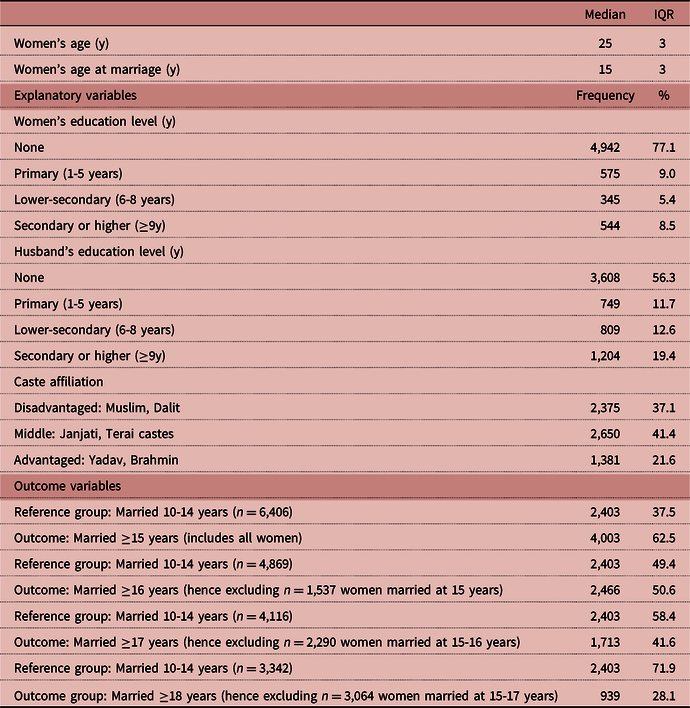
IQR, interquartile range. %, Percentage.
The Kaplan-Meier Survival plot in Figure 2 showed differences by women’s education level in the probability of delaying marriage (p < 0.001). Among women with zero, primary (1-5 years), and lower-secondary (6-8 years) education, the median age at marriage was 15 years, and for those with ≥9 years of education, the median age at marriage was 17 years.
Kaplan-Meier Survival Curves, women’s age at marriage by their educational attainment.
The Kaplan-Meier Survival plot shows differences in the probability of delaying marriage by women’s education level (p < 0.001).

Heat tables showed the proportion of women marrying at a given age by their level of education. Red shaded boxes showed the highest percentages and green the lowest. Table 3 showed that for women with zero to eight years of education, the most common age at marriage was 14-15 years. The secondary/higher educated women married variously at 15 years, 17 years, then 19 years.
Heat table for women’s education as a percentage within their age at marriage (n = 6,406)

Association of education with marriage at different age groups
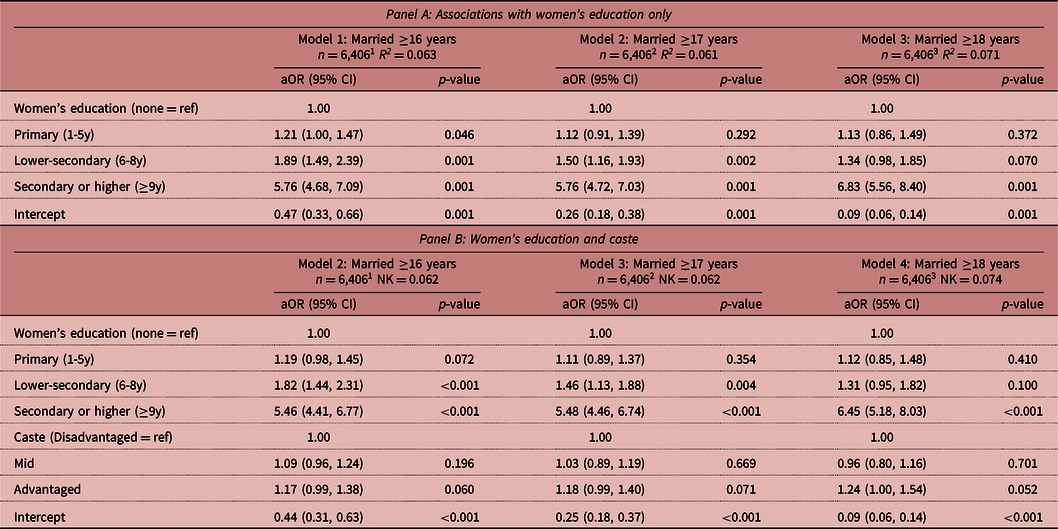
Table 4. Panel A showed adjusted ORs of women’s education with different marriage age groups. Across the different marriage age groups, relative to the reference group of uneducated women, the odds of marrying at a later age increased with each higher level of education, with the biggest pay-off for the secondary/higher educated women (Models 1-4). With each yearly increase of age at marriage, the magnitude of the effect of primary education slightly decreased, that of lower-secondary slightly increased from marrying ≥15 and ≥16 years and decreased thereafter. The aOR for secondary/higher increased substantially with each later age at marriage. For example, higher educated women were five and 15 times more likely for marrying ≥15 years and ≥18 years respectively.
Results from mixed-effects multivariable logistic regression models reporting the association of education with marrying at different age groupings

aOR, Adjusted Odds Ratio. CI, 95% Confidence Interval. Nakagawa-Schielzeth marginal R 2. Models include fixed and random effects estimates for geographic clusters and control for trial arm. As associations of trial arm with early marriage across the four age groupings were not statistically significant, they are not reported in Tables.
1 n = 2,403 married <15y vs n = 4,003 married ≥15y.
2 n = 2,403 married <15y vs n = 2,466 married ≥16y.
3 n = 2,403 married <15y vs n = 1,713 married ≥17y.
4 n = 2,403 married <15y vs n = 939 married ≥18y.
Table 4. Panel B adjusted for caste. Mid caste groups had higher odds of marrying at ≥15 years. Advantaged caste groups had higher odds of marrying across the different age groups, with the biggest pay-off for marrying ≥18 years (Models 1-4). Across the marriage age models, women’s greater educational attainment increased the odds of later marriage, with stronger associations for secondary/higher education. In comparison to Panel A, adjusting for caste marginally decreased the magnitude of the effect of women’s education.
Inclusion of caste marginally increased the proportion of the variance explained by models in Panels A and B. Overall, however, the proportion of the variance explained by these factors was low (range 0.058 to 0.137). Models explained a greater proportion of the variance as marriage age increased, suggesting that other factors (unmeasured by this study) explained the odds of marrying at younger ages, < 16 years.
Sensitivity analysis
Table 5 showed similar results when using the full sample of women across the different marriage age groups.
Results from mixed-effects multivariable logistic regression models reporting the association of education with marrying at different age groupings using the full sample of women in each marriage age group
aOR, Adjusted Odds Ratio. CI, 95% Confidence Interval. Nakagawa-Schielzeth marginal R2. Models include fixed and random effects estimates for geographic clusters and control for trial arm. As associations of trial arm with early marriage across the three age groupings were not statistically significant, they are not reported in Tables. 1 = 3,940 married <15y vs n = 2,466 married ≥16y. 2 n = 4,693 married <16y vs n = 1,713 married ≥17y. 3 n = 5,467 married <17y vs n = 939 married ≥18y.
Cox proportional hazards models
Mixed-effects cox proportional hazards regression (Table 6 Model 1) showed that relative to uneducated women, the hazard of marrying was 9% lower for primary, 20% for lower-secondary and 59% for higher-secondary/above education. Relative to the disadvantaged caste, being from an advantaged caste also reduced the hazard of marrying by 9%.
Mixed-effects cox proportional hazards model of the probability of marrying

HR, Hazards Ratio; CI Confidence Interval. Model fit was assessed by the Bayesian Information Criteria (BIC) value. Models include fixed and random effects estimates for geographic clusters and control for trial arm. As associations of trial arm with early marriage were not statistically significant, they are not reported in Tables.
The coefficients for education and advantaged caste decreased with the inclusion of interaction terms (Model 2). The joint effect of lower-secondary education and advantaged caste reduced the hazard of marrying by 9%. The joint effects of higher secondary education and mid and advantaged caste reduced the hazard of marrying by 63% and 64% respectively. However, compared to a model with no interaction terms, the goodness-of-fit (BIC value) was lower when the interaction terms were added.
Discussion
Whilst the legal minimum age at marriage is now 20 years, it is still common for Nepali women, especially those residing in Province 2 of the Terai region, and from the Maithili-speaking Madhesi group, to marry well below this age, at a median age of 15 years. Use of the ≥18 years cut-off for studying early marriage, in a population where only a small minority marries after this age, misses most of the variability in marriages taking place during childhood and adolescence. This study asks a more relevant question in this population, ‘how much education is required to achieve small increments in the age at which women marry,’ across the range of age groups from 15 years to ≥18 years. Whilst human rights legislation and efforts aim to delay all marriages to ≥18 years, in societies where the majority or women marry much earlier, understanding of what delays marriage at an earlier age is needed to develop a viable plan for long-term progress (Schaffnit et al., Reference Schaffnit, Urassa and Lawson2019).
The key finding was that associations of women’s education level with the likelihood of early marriage showed little variation, regardless of which age group was used to define early marriage. The one exception to this pattern was that the odds of marrying after a given age steadily increased with later marriage age among the most highly educated group. However, this was due to a change in the composition of this group. With each additional year used to define early marriage (e.g. from 16 to 17 years), the highly educated group disproportionately lost those with modest levels of higher education, as they were more likely to marry, and becomes increasingly characterised by those with very high levels of education. This counter-intuitively resulted in a more protective effect of secondary education as the age used to define early marriage was increased.
Second, there was a weak association of caste, with the mid caste groups having slightly higher odds of marrying at ≥15 years only and advantaged caste groups having higher odds of marrying across the different age groups. However, the proportion of the variance explained with the inclusion of caste was only marginally higher compared to models with women’s education only. This suggests that caste-based norms play a small role in driving early marriage in this population. Broader societal norms and practices may underlie women’s early marriage and lack of education [35,36], but few studies have focused on these factors specifically in early marrying populations. The joint effects of lower-secondary education and higher caste affiliation, and secondary/higher education and mid and higher caste affiliation also reduced the hazard of marrying.
Overall, therefore, women’s education of ≥9 years was most strongly associated with delaying marrying beyond the different age groupings. However, the highly educated group was a minority in this population, and overall, women’s education explained little of the variance in marriage age, accounting for < 10% of the variance in the odds of marrying ≥15 years and ≥16 years and 10% and 13% of the variance for marrying ≥17 years and ≥18 years respectively. This was most likely because most women in this society were uneducated, therefore the global effort to increase girls’ secondary education will have little bearing on the practiced norms in this society. Education at the primary, and not just secondary level, is still necessary, and has broader benefits for child and adolescent health and well-being. However, both are insufficient to substantially delay marriage. Therefore, the factors that really matter for delaying early marriage in this and other populations with median marriage ages well below the 18-years cut-off have yet to be identified.
The findings of this study are similar to two ecological analyses from Nepal, although they use slightly different groupings to define early marriage and women’s education level. Raj et al., using DHS Nepal data (1996-2011) on women aged 20-24 years, found primary education protected against marrying < 14 years, secondary education was associated with marrying at 14-15 years, but ≥9 years of schooling were needed to marry at 16-17 years (Raj et al., Reference Raj, McDougal, Silverman and Rusch2014). However, the overall effect size of education remained modest. Pandey, using Nepal 2011 DHS data on women aged 15-49 years, found weak associations of primary and secondary education, but very strong effects of >10 years of education for marrying >15 and >19 years (Pandey, Reference Pandey2017).
However, Raj et al.’s study did not investigate the variance explained by education, so we cannot attribute how much of a difference education actually makes for delaying the timing of marriage (Raj et al., Reference Raj, McDougal, Silverman and Rusch2014). Pandey reported ‘max-rescaled R 2’ values of 0.17 and 0.25 for the marrying >15 years and >19 years models but does not discuss their importance (Pandey, Reference Pandey2017). If comparable to the Nakagawa- Schielzeth R 2 values used in this study, then associations of husband’s education, caste and development region may explain their higher values, though their effect sizes were relatively weak in Pandey’s study (Pandey, Reference Pandey2017). In contrast, Scott et al., also using DHS data (on women aged 20-24 years) attributed 67% of the reduction in marriages < 18 years in Nepal between 2005 and 2016 to the increased secondary education (of ≥10 years) of girls, and 30% to improvements in household wealth (Scott et al., Reference Scott, Nguyen, Neupane, Pramanik, Nanda, Bhutta, Afsana and Menon2021).
These varying results may be explained by the use of different (and wider ranges of) marriage age and education groups, predictive factors (and the difficulty in disentangling their independent effects), societal norms, time periods and geography, whereas this study focused on a particularly early-marrying and low education population. Whilst studies typically use marital household wealth as a proxy for the natal household (Delprato et al., Reference Delprato, Akyeampong, Sabates and Hernandez-Fernandez2015; Sekine & Hodgkin, Reference Sekine and Hodgkin2017; Wodon et al., Reference Wodon, Male, Nayihouba, Onagoruwa, Savadogo, Yedan, Edmeades, Kes, John, Murithi, Steinhaus and Petroni2017), this study not include wealth because using a factor (wealth) measured in a different household, after the event (marriage age), to predict the event itself is inappropriate.
Implications
Implications of this study include the need for further research disaggregating beyond the 18 years cut-off to different earlier age thresholds, investigating both the risk of, and delay in, marriage age during childhood and adolescence. Importantly, the socio-economic profile of this and other similar populations are underrepresented in studies, and yet, is where early marriage is still prevalent despite universal legislation delaying it to 18 years, and more recently 20 years in Nepal.
Why education does, or in the case of this study, does not really appear to substantially delay marriage in some societies needs to be better understood. Longitudinal research is needed in different contexts on broader factors shaping the timing of marriage, including biological factors (maternal and infant undernutrition, age at menarche), natal household factors and decision making around which of marriage or school drop-out comes first and why (Marphatia, Wells, et al., Reference Marphatia, Wells, Reid and Yajnik2022).
We also need to better understand the socio-cultural norms underpinning not only early marriage, but also the lower educational attainment of girls, both of which are likely to maintain their lower social status (Bicchieri et al., Reference Bicchieri, Jiang and Lindemans2014; Caldwell et al., Reference Caldwell, Reddy and Caldwell1983; Maertens, Reference Maertens2011, Reference Maertens2013; Marphatia et al., Reference Marphatia, Amable and Reid2017). Lower educated women are also likely to be paired with lower educated men, and this may then adversely impact household livelihood (Marphatia, Saville, Manandhar, Amable, et al., Reference Marphatia, Saville, Manandhar, Amable, Cortina-Borja, Reid and Wells2021). In this context, early marriage, lower educational attainment, interactions with similar early married peers and marital household members may perpetuate women’s own gendered attitudes (Asadullah & Wahhaj, Reference Asadullah and Wahhaj2019).
From a policy perspective, increasing women’s time in school over time, will still have tangible effects in delaying their marriage. Greater efforts are needed to ensure girls complete the minimum 9 years of schooling required to delay marriage to 18 years. However, these school-based interventions will miss the girls who have never been to school, or already dropped out. Equal efforts are therefore needed to ensure girls go to school in the first place, and complete at the least primary education, which will build human capital and delay younger marriages when the consequences are arguably the severest.
To achieve sustained progress in delaying girls’ marriage, a holistic and longer-term approach focusing on increasing girls’ access to education and health care, supporting their empowerment, and understanding gendered social norms is likely to be more successful than a single-focus intervention, such as education or conditional cash transfers (Amin et al., Reference Amin, Asadullah, Hossain and Wahhaj2017; Malhotra, 2019; Malhotra & Elnakib, Reference Malhotra and Elnakib2021b).
Limitations of this study include the lack of data on broader factors which may contribute to delaying marriage, including natal household wealth, parental educational attainment and attitudes, the timing of menarche, and the quality of education received by women. This study focused on a particularly low-educated and earlier marrying population, but the association between education and marrying at different ages is likely to be widely applicable and valid in other parts of South Asia.
Data accessibility statement
Requests to access the dataset, through a data sharing agreement, should be directed to Dr Naomi Saville, n.saville@ucl.ac.uk.
Acknowledgements
We thank the women and their families for participating in the trial. The implementation of the trial was supported by the Public Health Offices of Dhanusha and Mahottari Districts in Nepal. We also thank Mother and Infant Research Activities (MIRA, Nepal) staff for data collection, and the UCL Institute for Global Health team for their support (see Saville et al., Reference Saville, Shrestha, Style, Harris-Fry, Beard, Sen, Jha, Rai, Paudel and Sah2018 for details).
Funding
This work was supported by the Leverhulme Trust (Grant Number: RPG-2017-264) and National Institute for Health Research (NIHR) Great Ormond Street Hospital Biomedical Research Centre. The Department for International Development (DFID) South Asian Research Hub funded the LBWSAT (Grant Number: PO 5675).
Conflict of interest statement
Authors declare no conflict of interest. Funders had no role in study design, data collection and analysis, decision to publish, or preparation of the manuscript
Ethical approval
Research ethics approvals for the trial and secondary analysis of LBWSAT data were granted by the Nepal Health Research Council (108/2012; 292/2018), University College London (4198/001, 0326/015) and University of Cambridge (1016, secondary analysis only). Village Development Committees consented to the inclusion of villages. Women gave written consent and guardians consented to the participation of married adolescents below the majority age of 18 years.


 Open access

