





Introduction
Currently, we notice multiple tensions, crises-like developments, and changes on the international scale and in Germany (cf. Häckermann & Ettrich, Reference Häckermann and Ettrich2023; Lawrence et al., Reference Lawrence, Homer-Dixon, Janzwood, Rockstöm, Renn and Donges2024): the rise of far-right parties and tendencies to create more authoritarian states. Escalating wars such as in the Middle East and Ukraine. The increase in racist attacks and hostility. Inflation and rising costs of living. Public budget cuts and austerity. These developments impact civil society organizations (CSOs) and civic space. As written in the latest CIVICUS Report: “Civic space is in its worst state since the launch of the CIVICUS Monitor’s global coverage in 2018” (CIVICUS, 2024, p. 8).
Following Lawrence et al. (Reference Lawrence, Homer-Dixon, Janzwood, Rockstöm, Renn and Donges2024, p. 2), we understand a crisis as arising “when one or more fast-moving trigger events combine with slow-moving stresses to push a global system out of its established equilibrium and into a volatile and harmful state of disequilibrium.” We consider this definition not only relevant for the global context, as studied by Lawrence et al., but also for society in Germany and the work of CSOs. In this article, we look at CSOs working in the field of anti-discrimination and diversity promotion in Germany, and ask how they are impacted by multiple crises, how their scope of action is limited and confined. How do the CSOs react to constraints, and which strategies do they develop at the same time? Which clusters of restrictions are visible, which forms of reactions?
The article is based on data on the work of 74 CSOs (collected between 2020 and 2024) that are funded through a public democracy-promotion program. The authors obtained the data by being part of the scientific evaluation of this program. After a time of expanded funding and recognition in public discourse, visible, for example, in the German government’s increase of resources for combatting racism and right-wing extremism in 2020, we notice increasing constraints on these organizations’ work as well as growing contestations of plurality in society at large. We argue that multiple crises lead to a spectrum and complexity of restrictions and reactions shaping CSOs in Germany.
The investigation is relevant to provide new empirical data on the debate around shrinking civic space and to further develop the concept. In addition, the specific field of diversity promotion and anti-discrimination CSOs—which can also be referred to as “post-migrant alliances” (Stjepandić & Karakayalı, Reference Stjepandić, Karakayalı, Foroutan, Karakayaki and Spielhaus2018)—adds new perspectives for political “claims-making” and advocacy organizations (Toepler et al., Reference Toepler, Zimmer, Obuch and Fröhlich2020, p. 649). It gives insights into the increasing questioning of diversity, mirroring the contested character of “post-migrant society” (Foroutan, Reference Foroutan2019) and the many crises that are currently shaping society.
We begin the article by introducing the two main theoretical concepts used: the debate around shrinking space and the concept of post-migrant alliances. Based on this, we analyze the empirical data. We address three areas of crises regarding restrictions as well as reactions of the studied CSOs: austerity and budgeting, right-wing surge, and war in the Middle East, which we subsequently bring together in a discussion developing different forms of restrictions and reactions. We chose the three crises because of their current political relevance for CSOs in Germany, and their mention as the strongest areas of constraints in our data.
Theory: Shrinking civic space and post-migrant alliances
Shrinking space
There is a growing body of literature that focuses on restrictions of civil society, most prominently known in relation to the concept of shrinking or closing civic space. The concept has been used by scholars for about a decade to describe—after seeing a time of expanding civic space—increasing repression, coercion, and restrictions of CSOs and of their scope of action, mainly carried out by state actors (Carothers & Brechenmacher, Reference Carothers and Brechenmacher2014; Hayes et al., Reference Hayes, Barat, Geuskens, Buxton, Dove, Martone, Twomey and Karaman2017; Rutzen, Reference Rutzen2015; van der Borgh & Terwindt, Reference van der Borgh and Terwindt2012). Not all CSOs are affected in the same way. Especially the work of (critical) “claims-making” and advocacy organizations is confined, as authors note, in contrast to service-providing and regime-loyal organizations whose space can expand or change at the same time (Toepler et al., Reference Toepler, Zimmer, Obuch and Fröhlich2020, p. 649).
Originally, the literature has focused on countries in authoritarian regimes and on cases such as Russia’s foreign agent law or prison sentences for CSOs in Egypt. However, more recent contributions also study existing restrictions in Western democratic states (Anheier et al., Reference Anheier, Lang and Toepler2019; Anheier & Toepler, Reference Anheier and Toepler2020; della Porta & Steinhilper, Reference Porta, Steinhilper, Porta and Steinhilper2022; Simsa, Reference Simsa2022; Strachwitz & Toepler, Reference Strachwitz and Toepler2022; Swiney, Reference Swiney2019), including CSOs in Germany (Bohn, Reference Bohn2019; Hummel, Reference Hummel2020, Reference Hummel2022; Sommer & Ratzmann, Reference Sommer and Ratzmann2022; Strachwitz, Reference Strachwitz2019). Here, studies especially point to bureaucratic restrictions, (outdated) laws, and “regulatory frameworks” (Anheier et al., Reference Anheier, Lang and Toepler2019, p. 1), as well as taxation requirements that impact and restrict the work of CSOs. Strachwitz and Toepler (Reference Strachwitz and Toepler2022, p. 180) speak about “shrinking civic space by softer means.”
While the debate is centered around state actors that intentionally restrict (and shrink) civic space by passing new laws or starting campaigns against the work of CSOs, literature has also noticed indirect or “passive” (Anheier et al., Reference Anheier, Lang and Toepler2019, p. 4) restrictions such as funding regulations, budget cuts, or increased bureaucratic reporting (Anheier et al., Reference Anheier, Lang and Toepler2019; Anheier & Toepler, Reference Anheier and Toepler2020; della Porta & Steinhilper, Reference Porta, Steinhilper, Porta and Steinhilper2022). Furthermore, a recent stream of literature suggests that non-state actors also play a role in restricting and shrinking the space of CSOs, such as in terms of influential donors (Sander, Reference Sander2023), online hate speech against CSOs (Scaramuzzino, Reference Scaramuzzino2023), as well as right-wing groups attacking more progressive organizations (Simsa, Reference Simsa2022; Sommer & Ratzmann, Reference Sommer and Ratzmann2022).
Despite these instances of shrinking civic space, scholars have emphasized that those forms of restrictions are not absolute. It is important to look at the agency of CSOs within these processes and not simply portray them as passive (Banerjee, Reference Banerjee2023; Berger-Kern et al., Reference Berger-Kern, Hertz, Wagner and Wolff2021; della Porta & Steinhilper, Reference Porta, Steinhilper, Porta and Steinhilper2022; Hayes et al., Reference Hayes, Barat, Geuskens, Buxton, Dove, Martone, Twomey and Karaman2017; Scaramuzzino, Reference Scaramuzzino2023; Strachwitz & Toepler, Reference Strachwitz and Toepler2022). This includes looking at reactions, coping strategies, and resistance. CSOs continue to navigate in restrictive environments and develop (new) strategies such as related to advocacy (Alexander et al., Reference Alexander, Elías and Hernández2024; Arvidson et al., Reference Arvidson, Johansson and Scaramuzzino2018; Zayed, Reference Zayed2023). We understand “strategies” as intentional and (pro)active in character, while “reactions” are rather unintentional responses (cf. Arvidson et al., Reference Arvidson, Johansson and Scaramuzzino2018).
Moreover, it remains important to note that civic space can shrink for some CSOs while expanding or changing for others (Alscher et al., Reference Alscher, Priller, Ratka and Strachwitz2017; Kuhn, Reference Kuhn2018; Toepler et al., Reference Toepler, Zimmer, Obuch and Fröhlich2020). We consider this relevant even within a certain field of CSOs: organizations can experience restrictions in some areas of their work (such as threats from right-wing actors), but changes in others (such as expanded funding). The literature will thus be used to provide different analytical lenses: to better understand forms of restrictions, including passive/indirect ways and non-state actors; to focus on the agency against restrictions; and to look at different areas of CSOs’ work which can simultaneously be subject to restrictions and reactions.
Post-migrant alliances
The sector of CSO that we focus on in this article can be referred to as “post-migrant alliances.” The term “refer[s] to that part of civil society that is explicitly in favor of plurality and against exclusion and racism” (Stjepandić, Reference Stjepandić, Bostanci, Ramadan and Albrecht2024). It comes from a theoretical framework referring to German society as a “post-migrant society” (Foroutan, Reference Foroutan2019; Foroutan et al., Reference Foroutan, Karakayaki and Spielhaus2018; Karakayalı & Tsianos, Reference Karakayalı and Tsianos2014), in which an important demarcation line is manifested between “those who accept and appreciate plurality and those who do not” (Foroutan, Reference Foroutan2017).
The concept of post-migrant society was developed by Foroutan and others in the 2000s and refers to the political and cultural transformation of societies with a history of immigration (Foroutan, Reference Foroutan2019; Karakayalı & Tsianos, Reference Karakayalı and Tsianos2014). The adjective post-migration does not seek to historicize the fact of migration but rather describes societies structured by the experience of migration (Karakayalı & Tsianos, Reference Karakayalı and Tsianos2014). Increasingly culturally diverse societies are characterized by negotiation processes: National identity, representation, and participation are constantly renegotiated and readjusted. Foroutan argues that conflicts over “migration” in these societies are only superficially about migration and often rather a cipher for broader political conflicts over plurality (gender, religion, sexual orientation, racial, and class issues) (Foroutan, Reference Foroutan2017); they are driven by the negotiation and recognition of equality as a central promise of modern democracies based on the principle of plurality (Foroutan, Reference Foroutan2019).
Based on this theoretical framework, “post-migrant alliances” (Foroutan, Reference Foroutan2019; Stjepandić, Reference Stjepandić, Bostanci, Ramadan and Albrecht2024; Stjepandić & Karakayalı, Reference Stjepandić, Karakayalı, Foroutan, Karakayaki and Spielhaus2018) are described as heterogeneous civil society actors who may come from very different backgrounds but share a positive attitude toward plurality and are connected by solidarities beyond ethnicity, religion, gender, class, or cultural heritage. Historical analogies are, for example, alliances between Black civil rights activists, feminist organizations, and gay rights groups in the USA in the 1970s (Foroutan, Reference Foroutan2019, p. 173; Stjepandić & Karakayalı, Reference Stjepandić, Karakayalı, Foroutan, Karakayaki and Spielhaus2018, p. 241). The common ground of these alliances of different actors is the experience of social inequality and the shared idea of fighting against discrimination and for a more equal society (Stjepandić & Karakayalı, Reference Stjepandić, Karakayalı, Foroutan, Karakayaki and Spielhaus2018). In these alliances, collective action is not primarily based on identity and biographical background but on a common political normative goal: resistance against racism, inequality, and discrimination (ibid.).
The conceptualization of a post-migrant society and the emergence of post-migrant alliances have been manifested in a historical context in which the recognition of Germany as “Einwanderungsland” (immigration country) and a so-called “Willkommenskultur” (culture of welcoming) toward refugees was taking place. At this time, actors from diverse backgrounds were increasingly conquering the public stage in media and politics. Foroutan refers to the last 10 years, from 2014 to 2024, as the “post-migrant decade” (Foroutan, Reference Foroutan2024). However, recent analyses sound much more pessimistic: “post-migrant society is wounded,” says Tsianos in the face of a right-wing surge and conflicts that occur in the context of the Middle East War in Germany (Tsianos, Reference Tsianos2023). Foroutan sees “post-migrant society in crisis” (Foroutan, Reference Foroutan2024), referring especially to ongoing implementations of restrictive migration policies. Our analysis takes these recent developments into account by applying the concept of contested spaces to post-migrant alliances.
In this article, we make use of the two bodies of literature—shrinking space and post-migrant alliances—to investigate and cluster our empirical data. We focus on various impacts and restrictions for the work of a particular sector of CSOs in Germany and within a specific field of claims-making and advocacy: anti-discrimination and diversity promotion. While using analytical tools from literature on shrinking spaces to capture restrictions and reactions, we use the literature on post-migrant alliances to further understand the CSOs we study as well as the crises occurring in their work.
Methods
Our sample comprises all CSOs implementing projects funded through the democracy-promotion program “Demokratie leben!” (“to live democracy”) by the German Federal Ministry for Family Affairs, Senior Citizens, Women and Youth in the area of diversity and anti-discrimination. The data emerged from the scientific evaluation of this program.
Mixed-methods design
The article is based on a longitudinal mixed-methods design (Kuckartz, Reference Kuckartz2014) combining annual quantitative online surveys and annual qualitative semi-structured interviews with the CSOs. For the analysis, we draw on interview data (N = 74) and survey data (N = 74) from 2024, supplemented by longitudinal threat scenario data from 2020, 2021, and 2024. Reflecting a convergent mixed methods logic (Creswell & Plano Clark, Reference Creswell and Clark2018), data strands were collected in parallel, independently analyzed, and merged at the interpretation stage through narrative integration, with both strands mutually contextualizing and corroborating each other (merging; Fetters et al., Reference Fetters, Curry and Creswell2013). An additional exploratory sequential element is embedded in the longitudinal design: coded segments from the 2023 interviews were systematically compiled by theme to capture observed and anticipated impacts of the right-wing surge. The resulting themes and participant framings directly informed the development of Likert-scale items for the 2024 survey items on the right-wing surge (building; Fetters et al., Reference Fetters, Curry and Creswell2013).
Sample
These publicly funded CSOs represent an analytically meaningful subset of German civil society. Launched in 2015, “Demokratie leben!” is Germany’s most comprehensive federal program for civil society democracy-promotion, including a large part of projects on diversity promotion/anti-discrimination. Our findings, therefore, speak specifically to publicly funded, professionalized CSOs. They can be generalized to, for example, activism-based or volunteer initiatives to a limited extent.
The sampled organizations work across thematic focus areas, including anti-racism, migrant support/integration, LGBTIQ+ rights, antisemitism prevention, and intersectional discrimination issues. They vary in organizational type (39% migrant and/or self-organizations; 18% educational organization; 32% other, e.g., cultural association, youth organization; 11% no category), geographic distribution (45% based in Western-German states, 21% based in Eastern-German states, 34% based in Berlin), and staff (ranging from 1 to 5 employees [22%], 6 to 15 employees [36%], 16 to 50 employees [26%], 51 to 100 employees [10%] up to more than 100 employees [7%]). Their work typically includes pedagogical work at schools and youth centers, empowerment workshops, awareness training for professionals, counseling services, or public advocacy.
Interviews
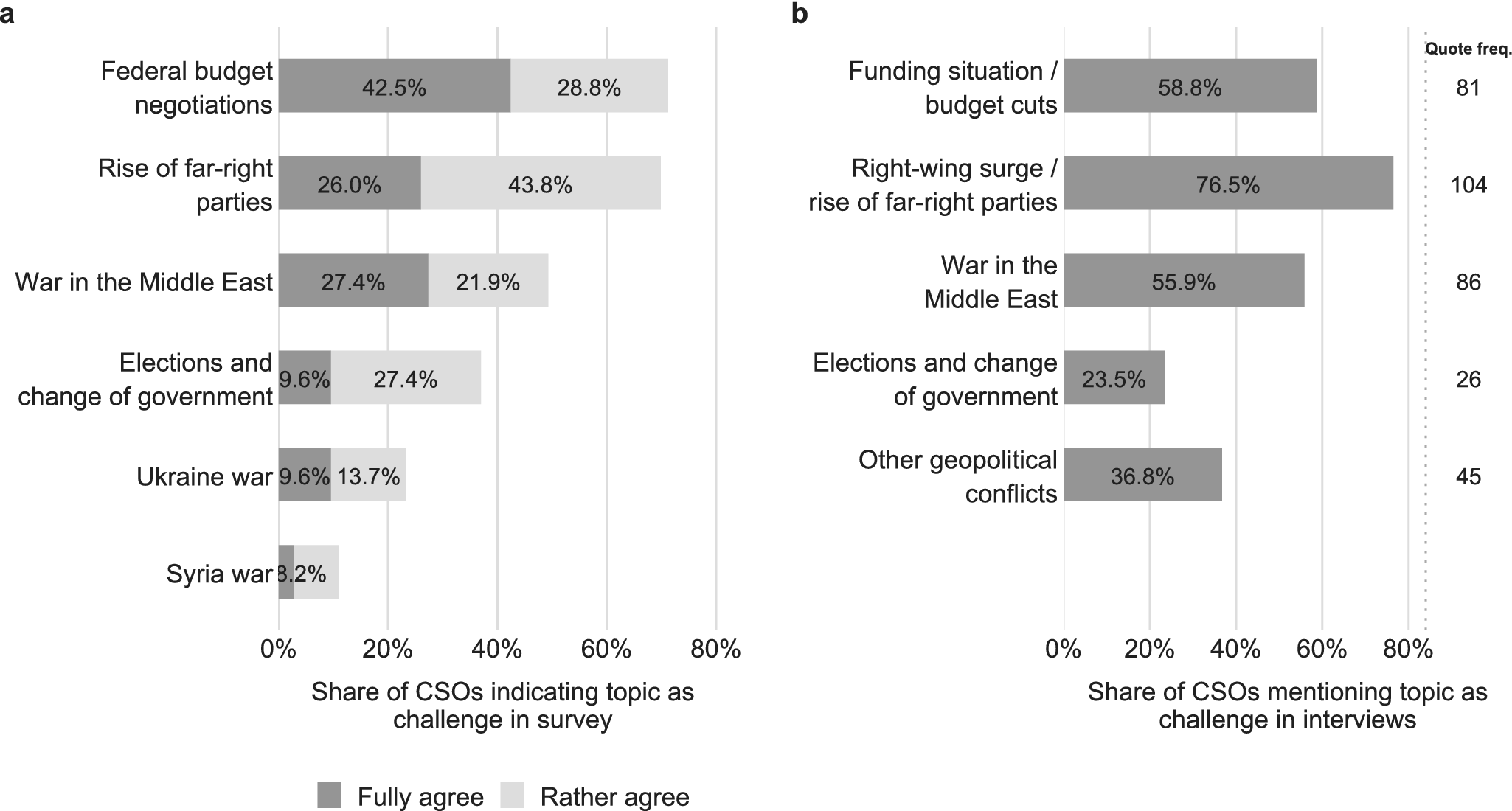
In 2024, semi-structured interviews were conducted with project coordinators and senior staff responsible for project conception and implementation from all 74 projects receiving funding at the point of time. Most interviews were conducted online; some occurred during in-person site visits. The central interview question for our analysis was: “Which social and political developments have influenced the project implementation in the last year?” Interviews were recorded, transcribed, and analyzed using qualitative content analysis (Kuckartz, Reference Kuckartz2014) with QDA software. Initial open coding inductively identified three major crises: austerity, right-wing surge, and war in the Middle East. In a second step, coded text segments were clustered according to restrictions (concrete limitations on organizational work) as well as strategic and operational responses, relating the data to the above-cited literature. We additionally quantified the inductively coded crisis-related issues by calculating document and quote frequencies to assess their prevalence and intensity (as shown in Figure 1b below).
External factors as challenges to project work based on survey (a: 5-point Likert scale) and interviews (b: mentions, quote frequencies). Survey question (a): “The following external factors have caused challenges in the project over the last 12 months,” N = 74; Interview question (b): “What current or foreseeable social developments are relevant to your project work, both positively and negatively?”; Quote freq. = number of coded segments, N = 68.

Fig. 1. Long description
Panel a is a stacked horizontal bar chart showing the share of C S O s indicating topics as challenges on a scale of 0 to 80 percent. The bars are split into Fully agree in dark gray and Rather agree in light gray.
* Federal budget negotiations: 42.5 percent fully agree and 28.8 percent rather agree.
* Rise of far-right parties: 26.0 percent fully agree and 43.8 percent rather agree.
* War in the Middle East: 27.4 percent fully agree and 21.9 percent rather agree.
* Elections and change of government: 9.6 percent fully agree and 27.4 percent rather agree.
* Ukraine war: 9.6 percent fully agree and 13.7 percent rather agree.
* Syria war: 3.2 percent fully agree and 8.2 percent rather agree.
Panel b is a single-color horizontal bar chart showing the share of C S O s mentioning topics as challenges in interviews, with a secondary column for Quote frequency.
* Funding situation or budget cuts: 58.8 percent with a quote frequency of 81.
* Right-wing surge or rise of far-right parties: 76.5 percent with a quote frequency of 104.
* War in the Middle East: 55.9 percent with a quote frequency of 86.
* Elections and change of government: 23.5 percent with a quote frequency of 26.
* Other geopolitical conflicts: 36.8 percent with a quote frequency of 45.
Survey
Annual standardized mandatory surveys were sent to all funded projects, with full response rates (74 of 74 projects in 2024) due to program evaluation requirements. The questionnaire covered organizational characteristics, project activities, challenges, and resource situations. Items on threat scenarios (developed by Sommer & Ratzmann, Reference Sommer and Ratzmann2022) were administered in 2020, 2021, and 2024 for longitudinal comparison. Based on the 2023 interview analysis, Likert-scale items measuring right-wing surge impacts and concerns were included in 2024. Survey respondents were the same organizational representatives as interviewees, with opportunities to consult their teams before responding. Descriptive statistical analyses in STATA (StataCorp, 2023) and R (R Core Team, 2024) included frequency distributions and cross-tabulations. Figures were created using R (ggplot2). Despite the relevance of the data, the sample size remains too small for, for example, a full statistical analysis of organizational differences impacting reactions and restrictions. It only provides preliminary insights into this topic, as shown later.
Empirical data
We now move to the empirical material of our study by focusing on three moments of crisis. In each section, we analyze restrictions and limitations in the work of CSOs, as well as reactions and coping strategies. First, we look at a crisis which is mentioned by many CSOs we studied: austerity and budget cuts in (public) funding. We then proceed with a look at the right-wing surge and the consequences that followed the war in the Middle East, which both had effects on the CSOs’ work. We identified these three moments of crisis by inductive open coding of the interviews (see Figure 1b), and they were the strongest areas of constraints mentioned in our survey data (see Figure 1a).
Austerity and budget cuts
Despite the existence of public funding programs, the work of many CSOs in Germany occurs in overall precarious conditions. Organizations in the field of diversity promotion and anti-discrimination are shaped by a“ lack of stability and sustainability,” as a study describes (Bartel & Kalpaka, Reference Bartel and Kalpaka2023, p. 176). Recently, this trend has been worsened by cuts in public budgets, austerity measures, and inflation. Our survey data show that 71% of the studied CSOs considered delayed public budgeting as a major constraint and challenge to their work in 2024 (see Figure 1a). In addition, 45% referred to inflation and price increases as a key challenge.
In the interviews with the studied CSOs, a main concern was the project-based and short-term funding. Organizations mentioned that they were confronted by a high level of bureaucracy and reporting to receive funding, as well as by a “high fluctuation of staff” due to unstable work conditions. “Staff just leaves, if funding is uncertain,” one interview partner described the situation. As a result, the actual potential of the work of the CSOs was limited. Instead of planning activities and focusing on outreach, the organizations pointed out that they had to find new staff, compensate for the lack of funding, and fill out reports. “That is not sustainable at all,” an organization told us in an interview. In addition, high inflation worsened the conditions for the CSOs in recent years. Due to increasing costs for rent, salaries, or workshops, many (especially smaller, grassroots) organizations reported that they were forced to reduce already planned activities. One interviewed CSO framed it this way: “Last year was the first year where we could not do everything we had planned. Expenses were increasing all over. […] In the end, we had to cut a lot.”
A further restrictive development occurred at the end of 2023. The federal public budget for the year 2024 was delayed and could not be finalized in time. As a result, many of the studied CSOs did not receive their funding as planned. One organization described this as “restrained planning,” and many criticized the resulting uncertainty in our interviews. Planned events and activities were canceled, put on hold, or postponed. An interview partner talked about “two lost months.” Some larger organizations, which had savings or other funding sources, took over some of the financial risks and provided bridging loans (for staff, rent, or activities), but especially small organizations without financial power were impacted by hardships, as our data show. A public letter signed by more than 70 key organizations active in the field of democracy promotion, including organizations we studied, framed the situation as an “existential threat” (Bundesarbeitsgemeinschaft Demokratieentwicklung, 2023).
Almost all the interviewees pointed out that the situation constrained their scope of action. However, the events in late 2023 were not a singular occurrence and must be seen as part of a history of austerity. Regulations for public debts limit the government from increasing public expenses—even in times of economic decline and needed investments. Currently, many areas of public budgets are being cut, and especially the field of democracy promotion (including diversity and anti-discrimination) is subject to discussion. Some of the studied CSOs were already facing budget cuts, especially on the local level; others worried about the future of their work and reported increased pressure to save money. One interview partner spoke about an increased “pressure of competition, because of increasing budget cuts and resulting uncertainties.”
The increased worries about budget cuts are also related to resentments against diversity and anti-discrimination programs by right-wing actors (reported by 49% of the studied CSOs in the survey 2024), with the AfD (Alternative für Deutschland) party at its forefront. The interviewed CSOs pointed to two ways of resulting constraints. First, especially in regions with strong right-wing influence, CSOs worry about losing funding approval. Several organizations, especially in East Germany, reported funding cuts, trouble finding new funding options, and spoke about a “risk of funding cuts, if right-wing or anti-democratic actors come into positions of power.” In addition, right-wing actors make use of German tax regulations for civil society (called “Gemeinnützigkeit,” reduced taxation for non-profit organizations). The constraining effects of regulations on CSOs have been criticized by scholars for a long time (e.g., Anheier & Toepler, Reference Anheier and Toepler2020; Strachwitz, Reference Strachwitz2019). Recently, these tax regulations seem to be increasingly used to threaten the work of CSOs active in the field of diversity and anti-discrimination by aiming to reject tax reductions and enforce funding cuts, as several of the studied CSOs pointed out.
In our research sample, several restrictions are visible in terms of budgeting and austerity. Not all of them seem to be intended by state actors to hinder CSOs. Nonetheless, they limit the work of the studied organizations and confine their scope of action. Instead of portraying these developments as caused by an “invisible hand” of the market, our research shows that the restrictions are largely influenced by political decisions: by a limited response to rising inflation, by specific designs of funding programs (including bureaucratic and tax requirements), by specific drafting of public budgets, and by increasing budget cuts.
While budget restrictions are difficult to counter, we notice different forms of responses and strategies to deal with the constraints among the studied CSOs. Despite many interviewed CSOs reporting a reduction in activities and outreach related to increasing expenses and budget cuts, several organizations were able to replan activities to save money while continuing to offer them. “We reacted to that [financial constraints] by becoming more flexible in our activities and work,” one of the interviewed CSOs described. Events were moved from in-person to online, and some organizations asked for small participation fees for workshops. New fundraising channels were acquired, and cooperation partners covered increasing expenses and (public) budget cuts.
In addition, some of the studied CSOs developed strategies to tackle the restrictions more politically. In the last months, an increase in protests, open letters, and campaigns against budget cuts and for better funding regulations in the field of democracy promotion and anti-discrimination was visible, in which several of the studied CSOs took part. (See for example a campaign against cuts in democracy-promotion programs, which was signed by about 200 CSOs in summer 2024 [https://gerade-jetzt-fuer-alle.de].) It is about “exercising political pressure” one interviewee framed it. Many CSOs signed up and united in these protests.
Right-wing surge
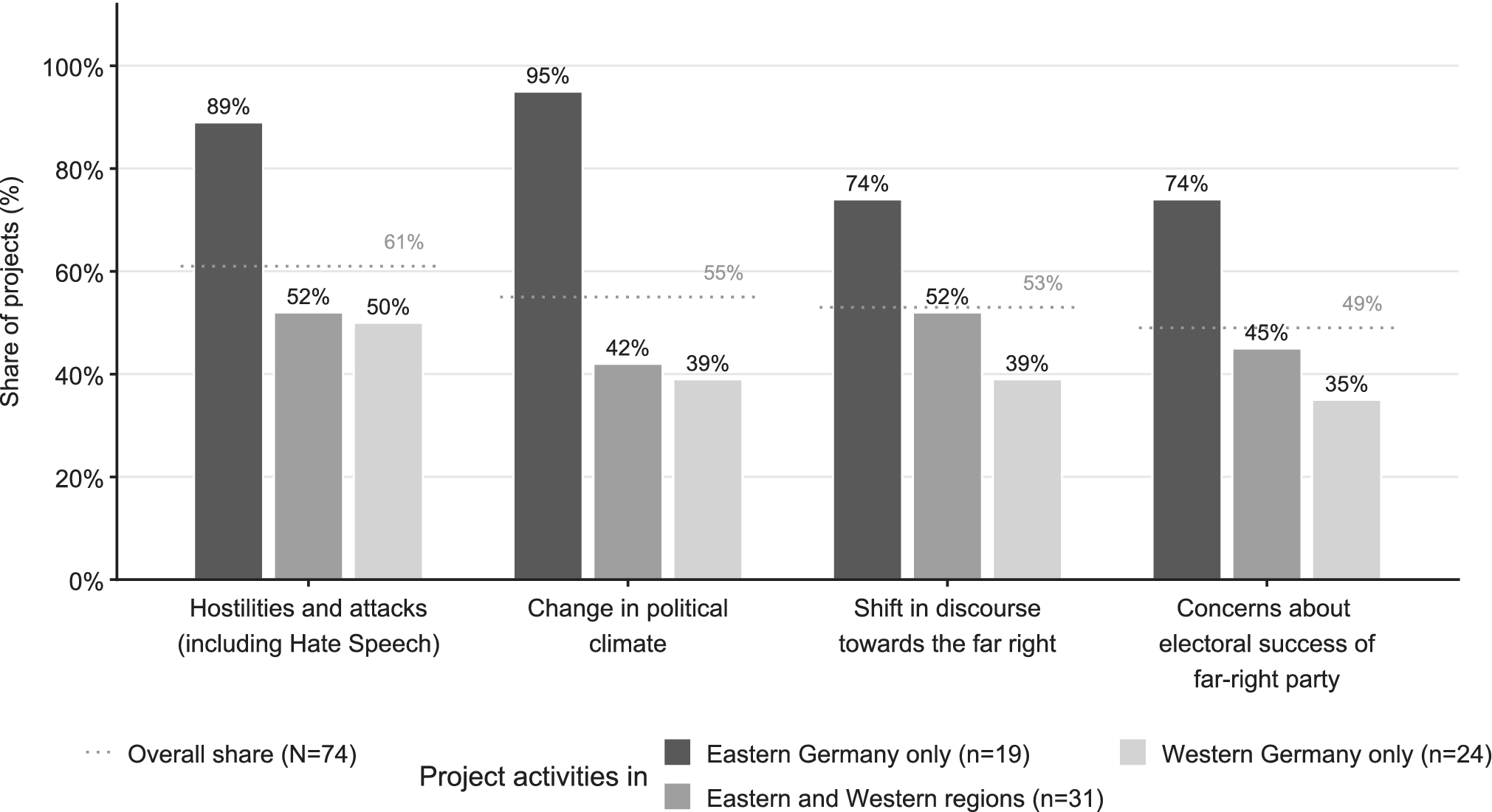
As mentioned above, budget cuts for diversity promotion and anti-discrimination programs are one consequence of a rising right-wing influence. However, funding and financial instability are not the only restrictions. While right-wing narratives and threats have been long-standing in Germany, there has recently been a surge in attacks and electoral successes of far-right parties (Zick et al., Reference Zick, Küpper and Mokros2023), leading to challenges in the work of the surveyed CSOs (see Figure 1a and b). As seen in Figure 2, 61% of the CSOs reported concrete threats, hostilities, and attacks (including Hate Speech online) in the survey. In addition, CSOs reported experiencing restrictions due to a changing political climate in their region (55%) as well as to a shift in discourses toward the far right (53%). In the interviews, one CSO framed this as a “creeping process in which right-wing ideas become normalized.” All this has been especially alarming for CSOs in regions with a high presence of far-right narratives, particularly but not exclusively, in the Eastern regions of Germany (e.g., in the survey, 74% of the projects active in Eastern Germany reported concerns about the electoral success of a far-right party compared to 35% in Western Germany; see Figure 2).
Political developments affecting project work by region (CSO active in Eastern Germany, Western Germany, both regions). Survey question: “Due to the following developments, we are already facing tangible effects on the project’s work” (5-point Likert scale), N = 74.

Fig. 2. Long description
The y-axis represents the share of projects as a percentage from 0 to 100. The x-axis lists four political developments. A legend at the bottom identifies three categories: Eastern Germany only (dark gray, n equals 19), Eastern and Western regions (medium gray, n equals 31), and Western Germany only (light gray, n equals 24). A dotted horizontal line in each group indicates the overall share for N equals 74.
* Hostilities and attacks (including Hate Speech): Eastern Germany 89 percent, both regions 52 percent, Western Germany 50 percent. Overall share is 61 percent.
* Change in political climate: Eastern Germany 95 percent, both regions 42 percent, Western Germany 39 percent. Overall share is 55 percent.
* Shift in discourse towards the far right: Eastern Germany 74 percent, both regions 52 percent, Western Germany 39 percent. Overall share is 53 percent.
* Concerns about electoral success of far-right party: Eastern Germany 74 percent, both regions 45 percent, Western Germany 35 percent. Overall share is 49 percent.
In all categories, projects active only in Eastern Germany report significantly higher tangible effects compared to other regions.
Our empirical material shows restrictions on CSOs due to the right-wing surge in three key aspects:
First, realizations of activities became more complicated, requiring more resources for adaptations and outreach, which slowed down the work of the organizations. The increase in disinformation and conspiracy theories necessitated constant adaptations to maintain the effectiveness of the studied CSOs’ pedagogical offers. Additionally, right-wing groups exerted growing pressure and aggression toward the organizations, as many studied CSOs noted, for example, by right-wing-oriented parents who boycotted activities in schools. “This is a whole new level, which I have not experienced before,” one interviewed CSO said to describe the increase of right-wing sentiments in the context of schools. Amidst this hostile climate, successfully implementing project activities and offers has become increasingly difficult for CSOs. This is especially challenging in rural areas, where it is harder to reach the population in general due to long distances and poor infrastructure.
Second, concerns regarding right-wing threats are increasing. Around a third of the studied CSOs faced intimidation, defamation, and hate speech (see also Schöll, Reference Schöll2025). Additionally, in the survey data, an increase in threats and attacks throughout the years is observable in the form of discrimination and insults against employees (numbers rise from 20% in 2020 to 40% in 2024), as well as an increase in disruptions and obstructions at events and work processes (increased from 5% in 2020 to 19% in 2024). Vandalism, reported by one of 10 CSOs, included, for example, swastika drawings and unauthorized removal of rainbow flags near offices or events. A small number of the researched CSOs have experienced physical assault toward members of their organization. And even among those who were not (yet) victims of direct attacks, a general, pervasive sense of latent threat is visible. One member of a CSO working in the field of queer youth work stated in an interview that they “no longer feel as safe. And [there is an] increased realization [that] attacks [could] happen.” Establishing safety measures limited CSOs because, as one interview partner described, doing this “takes time and (…) emotional resources because it’s incredibly stressful.”
Third, emotional strain, risk of burnout, and increased stress among CSO staff bear the risk of further instabilities. Staff from marginalized or racial groups are particularly subject to emotional distress and (re-)traumatization due to discrimination, threats, and potential physical violence. As one interview partner noted, these circumstances made it “a big challenge to pursue [their work].” Therefore, internal counseling and support became necessary for many of the studied CSOs, further straining the organizations’ resources. Personal safety concerns and unpredictable futures in increasingly hostile environments also led some employees to consider relocating from the region or country. Consequently, CSOs were facing staff shortages and turnover, intensifying the CSOs’ already unstable working conditions.
While threat scenarios were paralyzing the work of the studied CSOs and slowing down their activities, the organizations, however, found ways to contest right-wing threats and deal with increased pressure and limitations. CSOs bundled resources to establish protection concepts in response to and the prevention of minor and major attacks. They invested in the conceptualization and realization of security measures for their offices, events, and activities. One CSO member stated that they specifically paid “more attention to the sentiment” in the region and at the venues of their activities, which also “require[d] the research [to ensure] that [they] do not accidentally end up with right-wing security companies.” Precautionary measures included, for example, closed-door events and less high-profile formats. To increase safety for staff, CSOs organized “safety training for volunteers where [they] g[a]ve out rules of conduct,” and overstaffed workshop activities (for example, a two-person team instead of one person). In addition, contact information of both organizations and cooperation partners was often removed from websites or publications, leading to a paradigm of “do not show your face.” This can be interpreted as a backlash to numerous movements in recent years that had the ambition to mobilize pro-democratic voices, show their faces, and create visibility of a diverse and plural society. A troubling consequence of this is, among others, that especially migrant and community organizations of the research sample collaborate with more precautions, and networking becomes more difficult due to their vulnerability.
However, the right-wing surge in Germany also underscored the critical role of these civil society actors in safeguarding democratic values. Many CSOs responded by developing positive counter-narratives. They collaborated with state structures such as public schools and (local) authorities, who increasingly recognized the relevance of the work and requested consultation. Some of the studied CSOs collaborated, for example, with youth centers, provided political education, or proactively organized school visits with politicians in rural areas to approach hard-to-reach target groups. In addition, many CSOs focused specifically on strengthening marginalized communities, for example, by offering counseling and establishing support structures for individuals and communities experiencing discrimination.
Participation in the numerous protests against the right-wing developments in the winter of 2024 (these protests took place as a nationwide reaction [Rucht, Reference Rucht2024] to a meeting between AfD and far-right actors who planned a program of forced “re-migration” and displacement of immigrants and “non-assimilated citizens” [Bensmann et al., Reference Bensmann, von Daniels, Dowideit, Peters and Keller2024]) served as an additional source of motivation for many CSO workers and fostered solidarity. As one interviewee explained:
There were already individual, progressive, committed [people] before, but they have now found each other, they can now strengthen each other, and exchange knowledge. There’s also a lot of regional capacity building, for example, intervention groups that are being created.
Overall, we notice that CSOs often responded to threats and the right-wing surge with cooperation and mutual support within their networks, and partially with government actors. To regain their scope of action, a clear positioning of their own organizations as part of a civil society against right-wing actors was an important and enhancing strategic measure.
War in the Middle East
Wars and displacement have shaped the Middle East, especially Israel/Palestine, for decades (see Smith, Reference Smith2021), with the discourse surrounding the escalation on October 7, 2023, Israel’s subsequent war in Gaza, and the accusation of genocide against Israel also creating notable consequences for CSOs in Germany (Gorelik et al., Reference Gorelik, Schellbach and Zadoff2024). In the interviews, CSOs described these events as a “major rupture,” “disruption,” and “break” in their work. In our survey, 49% of the studied CSOs stated challenges to their activities related to the war in the Middle East (see Figure 1a). These organizations, working intersectionally as well as with a focus on specific forms of discrimination, faced distinct challenges—particularly community self-organizations and those addressing anti-semitism and anti-muslim racism, for whom the escalation of violence in the Middle East has proven especially disruptive. Besides frictions between CSOs, we notice increasing challenges for the organizations in their work. In the following, we first look at CSOs working on anti-semitism and their balancing act between requests and resources. Second, we present challenges that arose for CSOs in the field of anti-muslim racism after October 7th. Finally, we illustrate tensions occurring in the activities of a CSO aiming to bridge the two forms of discrimination.
Since October 2023, CSOs in the field of anti-semitism have experienced both a rapid increase in inquiries from authorities, media, and educational institutions on the topic of the Middle East war (OFEK, 2023), while simultaneously observing fears and withdrawals among their Jewish target groups. In the interviews, CSOs described a “sudden increase of additional work in the field,” while “a lot of people stayed away [from the CSOs activities], because they had safety concerns.” The organizations referred to an “enormous uncertainty and insecurity within the Jewish community” and “an explosion of fear” in their target groups. This created a dual challenge that restricted the activities of the studied CSOs, as accessibility and participation became more difficult. Reactions to this increased demand varied: some of the interviewed employees of CSOs saw the current attention on anti-semitism as positive, while others considered these developments as limitations and a burden on planned activities. Behind this was also the fear that the activities of the CSOs would come under pressure, as they could only react to symptoms and miss addressing the structural problems of anti-semitism. Several organizations reported in interviews that the events of October 7th were overshadowing their regular work. For example, a CSO that typically raised awareness for Jewish life in schools stated that they were now confronted with questions about the Middle East rather than their intended educational content. Another CSO compared their work since the increase in inquiries to a “fire extinguisher,” which prevented them from continuing the long-term projects they had previously planned.
Moreover, offers of support against anti-semitism were being brought to CSOs by right-wing populists in disguise. Several of the interviewed CSOs pointed out that they faced instrumentalization by right-wing populist networks who sought to outsource antisemitism exclusively to racialized and muslim-classified people, which “helps the right with their narratives quite well, because they always present anti-Semitism as a problem of migrants.” This required CSOs working on anti-semitism to carefully select inquiries, developing the skills to differentiate genuine anti-semitism prevention interests from those that might jeopardize their long-term goals through association with right-wing actors. One CSO reported in an interview:
The right-wing populist spectrum is now […] actually approaching us with a supposed suggestion of protecting Jewish life in Germany. We receive inquiries from right-wing populist press portals and (…) it requires some expertise to look closely at who is actually behind it.
Just like organizations on anti-semitism, CSOs working on anti-muslim racism experienced a cut in their work after October 7th, 2023. Many of the studied CSOs reported increasing concerns about funding cuts and pressure to secure (alternative) funding sources as public budgets in this field were expected to be especially cut. While the assumption had previously prevailed that there had been progress toward greater Muslim visibility, participation, and stable structures for their needs in German society, after October 2023, organizations felt that the work against anti-muslim racism had been set back by a decade (cf. CLAIM – Allianz gegen Islam- und Muslimfeindlichkeit, 2024). CSOs working in the field of anti-muslim racism faced legitimacy challenges in speaking about Gaza. Some CSOs mentioned in interviews that their offered educational programs suffered due to the target group’s refusal to participate because they felt their needs in speaking about Gaza were ignored.
One example illustrates the risk of an increasing friction: an interviewed CSO pointed to the paradox that its target group was “experiencing that they’re not welcome at certain demonstrations and [were] being met with racist hostility, at, mind you, protests against the far-right.” The CSO’s staff faced the difficult task of explaining to their target group that they could face hostility even at supposedly anti-discrimination spaces. In this regard, the work of CSOs and the creation of alliances seems especially important. Interviewees emphasized the need to educate people about discrimination mechanisms in general, so that anti-racist approaches are not based on similar discriminatory structures as racism (see also Arnold & Kiefer, Reference Arnold and Kiefer2024).
The complexities and uncertainties for CSOs working on both anti-semitism and anti-muslim racism emerged clearly after October 7th, 2023. One of the studied CSOs referred to an incident where a visibly Muslim group visited Jewish participants in a synagogue through the CSO’s activity. The police appeared when the group left the synagogue, creating conflicting interpretations in the critique of anti-semitism and anti-muslim racism: From an anti-semitism-critical perspective, the police authorities were negligent, as security precautions—a usual security measure in front of synagogues in Germany—were not guaranteed from the outset since the police were only present at the end of the visit. From an anti-muslim racism-critical perspective, the presence of the police during a visit to a synagogue by people visible as Muslims could be interpreted as a general suspicion of an anti-semitic potential for violence. Faced with this delicate balancing act, the interviewed CSO decided to focus on its educational mission while avoiding political statements regarding the Middle East war in order not to jeopardize the interpersonal relationship in the cooperation and to continue enabling such cross-community interactions.
In summary, CSOs in our research sample that are addressing anti-muslim racism and anti-semitism experienced distinct forms of paralysis, which are limiting their scope of action. CSOs working against anti-semitism were torpedoed by excessive demand diverting their regular work, while CSOs focusing on anti-muslim racism were paralyzed within their cooperation and activities by the pressure to justify their positions and legitimacy. Moreover, organizations experienced threatening situations such as hate speech and the fear of attacks that further complicated their work.
CSOs from both fields adopted de-escalating strategic approaches while maintaining to play an important role for their respective affected target groups. Despite increasing tensions and frictions in German (civil) society following October 7th (cf. CLAIM – Allianz gegen Islam- und Muslimfeindlichkeit, 2024; OFEK, 2023), some of the studied organizations were able to continue to reach out and build alliances. The experience of having allies in the work against anti-muslim racism and anti-semitism during this challenging period proved to be empowering for the CSOs we studied. Time will reveal whether the fractures will be permanent or whether the collaborations we observe can be resumed.
Discussion
Organizations in the field of diversity promotion and anti-discrimination in Germany face an increase in financial constraints due to long-term austerity and precarious funding combined with current public budget cuts; we observe increased safety concerns and political pressure for the organizations due to existing right-wing narratives and threats, combined with a current surge of attacks and boosting election results for far-right parties; and we notice existing tensions in the Middle East combined with the current escalation in Israel/Palestine affecting these CSOs in forms of complex political, interpersonal, and educational challenges. These different crises create restrictions and lead to a reduced scope of action for CSOs, as our data show. This includes challenges in project activities and reaching target groups, increased resource allocation for adaptations and safety measures, and emotional stress on staff. Besides concrete restrictions, latent worries about a decline in democratic culture and increasing authoritarian tendencies keep the CSOs occupied and demand their attention. Based on our research data, we further cluster these restrictions and reactions.
First, the different crises amplify each other’s effects on the studied CSO, and the crises’ trigger events are deeply intertwined with continuous stresses (cf. Lawrence et al., Reference Lawrence, Homer-Dixon, Janzwood, Rockstöm, Renn and Donges2024). For example, right-wing actors actively push for budget cuts in public diversity and anti-discrimination funding programs, which shows how political pressure, combined with acute budget negotiations, creates a dual constraint on CSOs’ financial stability. Moreover, while budget cuts limit resources, the right-wing surge necessitates additional expenses on security measures and adaptation of programs. Similarly, the escalation of the war in the Middle East requires the CSOs to respond to new challenges, a rising demand, and a growing presence of anti-semitic and anti-muslim threats. Yet, they must do so with limited financial means due to continuous austerity politics and within an increasingly hostile political environment. Structural factors such as chronic underfunding and marginalization of certain communities create a long-term framework, while situative factors due to current crises manifest as pressures that require acute adaptations.
Second, the character of the organizations and the region in which they operate are decisive for how strong the restrictive effects are. When taking a closer look at the type of organizations, our data show that restrictions intensified for certain CSOs. Structural underfunding combined with increased right-wing pressure and specific regional challenges creates an especially precarious situation for organizations located in Eastern Germany. CSOs in these regions reported increasing threats of austerity and funding cuts by right-wing parties in our interviews. Direct attacks are predominantly mentioned by CSOs operating in Eastern Germany. At the same time, grassroots organizations, which in many cases are run by racialized and marginalized groups, are specifically concerned about budgeting, inflation, as well as the political consequences of the right-wing surge. Especially community self-organizations and organizations involved in anti-racist (empowerment) work reported increasing worries about so-called “re-migration” plans by far-right actors. Moreover, CSOs working on anti-semitism and on anti-muslim racism—many of them self-organizations—are impacted by the war in the Middle East more strongly than other CSOs, our data show.
Finally, our analysis identifies three forms of reactions and strategies against restrictions, visible in all three crises we focused on. Some are more intentional strategies, while others are more unintentional reactions. First, we notice moments of paralysis in the work of the CSOs. Organizations react by reducing planned activities due to budget cuts, right-wing threats, as well as in the aftermath of the 7th of October 2023. In many cases, paralysis occurs due to frozen budgets or the need for project adaptations, as well as emotional distress and overburdened staff. Second, CSOs develop internal strategies to keep activities running while facing restrictions and hardships. This includes replanning activities due to budget cuts, developing safety concepts to continue activities despite threats from right-wing actors, or establishing supervision and emotional work to support each other/the CSOs’ staff. Third, the formation of (new) alliances and protests is visible as a response to restrictions. CSOs join campaigns and demonstrations against increasing budget cuts or create alliances and support with other CSOs against right-wing threats, the rise of anti-muslim racism, and anti-semitism.
The article contributes to the debate around shrinking (civic) space in Western democratic countries. It presents new empirical data from publicly funded, diversity-promoting CSOs, which are especially targeted by the aforementioned developments in complex, intertwined ways. The article indicates that the restrictions are neither solely caused by government actors nor always intentionally planned. This corresponds with literature understanding shrinking spaces in more indirect ways and beyond solely looking at the state (cf. Anheier et al., Reference Anheier, Lang and Toepler2019; Anheier & Toepler, Reference Anheier and Toepler2020; Sommer & Ratzmann, Reference Sommer and Ratzmann2022). Among these, we put emphasis on questions of budgeting and austerity.
By doing so, the article underlines the need to conceptualize the analysis of shrinking space in more nuanced ways. Our data show that restrictions and civic space are contested (cf. Hummel, Reference Hummel2022) and that alliances can form against budget cuts and the right-wing surge. Moreover, the studied CSOs experience restrictions in different ways. While some CSOs benefit from state funding, the funding can remain precarious, and organizations can still experience a narrowing of their scope of action by right-wing threats. These different layers and the complexity of restrictions and reactions need to be considered in the study of shrinking space.
The poly-crisis of the post-migrant society
We referred to the CSOs we studied as post-migrant alliances: actors from diverse backgrounds that are united by the cause of promoting a plural but equal society. This shared purpose is seriously challenged by the aforementioned crises. We notice a poly-crisis of the post-migrant society; a crisis that impacts society at large, and that consists of several (own) moments of crises, including austerity, the impact of wars and global conflicts, as well as the increase of anti-democratic sentiments and right-wing extremism. This crisis, as Lawrence (Reference Lawrence, Homer-Dixon, Janzwood, Rockstöm, Renn and Donges2024, p. 2) writes, “push[es] a global system out of its established equilibrium.”
At the same time, we observe that (new) alliances are being formed against these developments. The results of our analysis are ambiguous. In our study, we find evidence of alliance fragility but also alliance re-strengthening and re-emergence by responding to these moments of crisis. While austerity measures, budget cuts and right-wing treats have put diversity-promoting CSOs under great pressure, numerous protests against ideas of mass deportations (“remigration”) in the winter of 2024 and against cuts of public funding prove that the studied field of CSOs is not (yet) in a minority position in their defense of a diverse, pluralistic society (see also Foroutan, Reference Foroutan2024)—and that civic space remains contested.
Moreover, polarized perspectives on the Middle East war fundamentally challenge the common ground of post-migrant alliances. Solidarities beyond ethnicity, religion, or cultural heritage—an essential characteristic of these alliances—are currently at stake. The increasing fragility of alliances is illustrated by our empirical findings, such as right-wing attempts to pit CSOs against each other or the perceived rejection of some actors in anti-right-wing demonstrations. Nevertheless, we find CSO actors trying to re-establish alliances, rebuild bridges, and discuss common perspectives on October 7th and the Middle East war.
These findings among the studied CSOs—between increasing frictions and the emergence of new alliances—draw an ambiguous picture of the current state of post-migrant alliances and their society. It remains open whether the new alliances we observed can create a viable counterpoint to the intensifying poly-crisis in society.
Conclusion
The article has looked at publicly funded CSOs in the field of diversity promotion and anti-discrimination in Germany. Focusing on three current moments of crises (austerity and budget cuts, right-wing surge, and the war in the Middle East), we asked how they impact the work of the CSOs.
In our data, we observed several increasing restrictions and limitations of the CSOs’ scope of action, ranging from latent worries to direct threats. Among them, some restrictions are indirectly targeting CSOs, and some are occurring from non-state actors. At the same time, we noticed contestations to these restrictions, ranging from paralysis to internal coping strategies and the formation of new (political) alliances. The CSOs are facing a spectrum of restrictions, and they respond by using multiple strategies. We argue that the dynamic of restrictions and reactions needs to be understood by taking the complexity of the empirical reality into account. By doing so, we gain insights into the contested character of civic space as well as of post-migrant society, in which plurality is the central conflict line.
The research results point to political developments and (poly-)crises, which shape the work of CSOs in Germany and are also noticeable in other parts of the world (cf. CIVICUS, 2024). Some of these crises are likely to become more severe in the future, such as budget cuts or the growing influence of right-wing and authoritarian politics. The article has demonstrated the intertwined character of these crises and has offered first insights into how different (organizational) types of CSOs are impacted and develop different coping strategies. It remains important to continue this study, to expand the research sample to other types of CSOs, and to compare the research results to the situation in other countries. It remains important to gain more insights into the impact of crises on the work of CSOs—in Germany and globally.
Data availability statement
The data were collected as part of the evaluation of the model projects in the field of diversity promotion funded by the Federal Ministry for Family Affairs, Senior Citizens, Women and Youth (BMFSFJ), Germany. Data were collected by the authors as part of the expert group “Democracy Promotion and Democratic Practice,” DeZIM Institute, Berlin. The publications of the expert group do not represent the opinion of the BMFSFJ or the Federal Office of Family Affairs and Civil Society Functions (BAFzA). The authors are responsible for the content of their statements. The authors have received informed consent from the research participants.
Author contribution
All authors contributed to the study conception and design. Material preparation, data collection, and analysis were performed by the authors. Drafts of the manuscript were written by all authors, who also commented on the manuscript. All authors read and approved the final manuscript.
Competing interests
The authors have no conflicts of interest to declare that are relevant to the content of this article.
Ethical standard
The study followed the institute’s ethical guidelines based on the WMA Helsinki Declaration, Belmont Report, and Nürnberg Codex.

 Open access

