





Introduction
A nationally representative survey in the United States reported that 92% of respondents experiencing major depressive episodes reported significant sleep complaints (Geoffroy et al., Reference Geoffroy, Hoertel, Etain, Bellivier, Delorme, Limosin and Peyre2018). Within this cohort, 85.2% exhibited insomnia symptoms, while 47.5% showed hypersomnia symptoms. Meta-analyses have consistently demonstrated a significant relationship between depression and various sleep disturbances, including longer wake after sleep onset (WASO; Ho et al., Reference Ho, Poon, Wong, Chan, Law, Yeung and Chung2024; Tazawa et al., Reference Tazawa, Wada, Mitsukura, Takamiya, Kitazawa, Yoshimura and Kishimoto2019), longer sleep onset latency (SOL), lower sleep efficiency (SE), and more nocturnal awakenings (Ho et al., Reference Ho, Poon, Wong, Chan, Law, Yeung and Chung2024; Lovato & Gradisar, Reference Lovato and Gradisar2014). Furthermore, insomnia is associated with an increased risk of developing subsequent depression (Baglioni et al., Reference Baglioni, Battagliese, Feige, Spiegelhalder, Nissen, Voderholzer and Riemann2011; Blanken, Borsboom, Penninx, & Van Someren, Reference Blanken, Borsboom, Penninx and Van Someren2020; Buysse et al., Reference Buysse, Angst, Gamma, Ajdacic, Eich and Rössler2008), while persistent sleep disturbances (Lee et al., Reference Lee, Cho, Olmstead, Levin, Oxman and Irwin2013) and various sleep disorders, including insomnia, hypersomnia, obstructive sleep apnea (OSA), and restless legs syndrome (Zhang et al., Reference Zhang, Ma, Du, Wang, Li, Zhu and Li2022), predict depression. Together, these findings underscore the bidirectional relationship between sleep disturbances and depression.
Depression is associated not only with sleep disturbances but also with disruptions in circadian rhythms. Circadian rhythms encompass the 24-hour cycles of a wide array of behavioral and physiological processes (Carpenter et al., Reference Carpenter, Crouse, Scott, Naismith, Wilson, Scott and Hickie2021), including but not limited to the sleep–wake cycle. Disruptions in circadian rest–activity rhythms, such as delayed sleep phase and eveningness, are prevalent in depression (Crouse et al., Reference Crouse, Carpenter, Song, Hockey, Naismith, Grunstein and Hickie2021) and are hypothesized as core pathophysiological mechanisms in mood syndromes (Carpenter et al., Reference Carpenter, Crouse, Scott, Naismith, Wilson, Scott and Hickie2021). A recent meta-analysis focusing on actigraphic circadian rest–activity rhythms has shown lower 24-hour adjusted mean activity (indicated by midline estimating statistic of rhythms), amplitude, and interdaily stability in depressed individuals (Ho et al., Reference Ho, Poon, Wong, Chan, Law, Yeung and Chung2024). Additionally, circadian misalignment, which is a type of circadian disruption operationalized as the difference between the timing of dim light melatonin onset, the timing of minimum core body temperature, and the timing of mid-sleep, was associated with heightened depression severity (Emens et al., Reference Emens, Lewy, Kinzie, Arntz and Rough2009; Hasler, Buysse, Kupfer, & Germain, Reference Hasler, Buysse, Kupfer and Germain2010). Furthermore, late meal patterns, higher levels of cortisol awakening responses, less robust rest–activity rhythms (Zhang et al., Reference Zhang, Ma, Du, Wang, Li, Zhu and Li2022), and eveningness (Carpenter et al., Reference Carpenter, Crouse, Scott, Naismith, Wilson, Scott and Hickie2021) are risk factors for depression. A longitudinal study revealed that older men exhibiting less robust circadian rest–activity rhythms had greater odds of developing clinically significant depressive symptoms (Smagula et al., Reference Smagula, Ancoli-Israel, Blackwell, Boudreau, Stefanick, Paudel and Cauley2015). In summary, existing literature has consistently demonstrated a bidirectional relationship between depression and both sleep disturbances and circadian disruptions.
In view of the significance of sleep and circadian rhythms, a Transdiagnostic Intervention for Sleep and Circadian Dysfunction (TSC) has been developed to address common sleep and circadian issues, such as insomnia, hypersomnia, and delayed and advanced sleep phase (Harvey & Buysse, Reference Harvey and Buysse2017). It has shown efficacy in improving various sleep and circadian disorders (Sarfan et al., Reference Sarfan, Hilmoe, Gumport, Gasperetti, Zieve and Harvey2021) along with insomnia symptoms (Smagula et al., Reference Smagula, Gasperetti, Buysse, Irwin, Krafty, Lim and Harvey2024; Yau et al., Reference Yau, Ng, Lau, Poon, Yeung, Chung and Ho2024), eveningness (Harvey et al., Reference Harvey, Hein, Dolsen, Dong, Rabe-Hesketh, Gumport and Blum2018), general sleep disturbance and sleep-related impairment, and various sleep parameters derived from sleep diaries, including SE, total wake time, and wake time variability (Harvey et al., Reference Harvey, Dong, Hein, Yu, Martinez, Gumport and Buysse2021; Yau et al., Reference Yau, Ng, Lau, Poon, Yeung, Chung and Ho2024). The TSC group, relative to usual care, also exhibited higher response rates and medium to large effects on depressive symptoms (Cohen’s d = 0.40–0.84; Smagula et al., Reference Smagula, Gasperetti, Buysse, Irwin, Krafty, Lim and Harvey2024; Yau et al., Reference Yau, Ng, Lau, Poon, Yeung, Chung and Ho2024) as well as significant improvements in functional impairment (Harvey et al., Reference Harvey, Dong, Hein, Yu, Martinez, Gumport and Buysse2021; Yau et al., Reference Yau, Ng, Lau, Poon, Yeung, Chung and Ho2024) and general psychiatric symptoms (Harvey et al., Reference Harvey, Dong, Hein, Yu, Martinez, Gumport and Buysse2021). The current study is based on the work done by Yau et al. (Reference Yau, Ng, Lau, Poon, Yeung, Chung and Ho2024), which implemented a group-based TSC and yielded medium to large effects on most outcomes, including depressive symptoms, insomnia severity, sleep disturbances, sleep-related impairment, fatigue, anxiety symptoms, quality of life, sleep diary-derived SE, and sleep quality (SQ) (Cohen’s d: 0.67–1.22), at immediate posttreatment. These findings indicate the effectiveness of sleep and circadian-targeted interventions in managing both sleep and psychological domains.
The roles of sleep parameters in sleep improvements in TSC
While the impact of TSC on diverse sleep outcomes has been well-documented, the underlying mechanism driving these improvements remains underexplored. Existing literature has predominantly focused on cognitive behavioral therapy for insomnia (CBT-I; Morin & Espie, Reference Morin and Espie2004), widely recognized as the gold standard treatment for insomnia. Indeed, a meta-analysis revealed that the effect of CBT-I on insomnia is partially mediated by dysfunctional beliefs about sleep and hyperarousal (Parsons, Zachariae, Landberger, & Young, Reference Parsons, Zachariae, Landberger and Young2021). In this review, three studies were included to explore the mediating effect of time in bed (TIB). However, two of them did not find mediating effects of CBT-I on insomnia severity, while TIB significantly mediated the effect on variability in SOL in the remaining study. Other studies included in the review reported inconsistent results regarding the mediating effects of other behavioral mediators (Parsons, Zachariae, Landberger, & Young, Reference Parsons, Zachariae, Landberger and Young2021). Specifically, variability in bedtime was a significant mediator. However, other factors, such as consistency in awake times, consistency in rise times, and WASO, were not significant mediators. The contradictory results suggested that the roles of behavioral mediators, particularly sleep parameters, have not been fully explored. As TSC incorporates modules that foster behavioral modifications, such as improving SE and reducing TIB (Harvey & Buysse, Reference Harvey and Buysse2017), it is crucial to examine the role of sleep parameters in the improvement of sleep outcomes. Consequently, a notable gap exists in understanding the potential mediating effects of sleep parameters within the TSC framework.
Sleep-related mediators of psychological improvements in TSC
Only a handful of studies have explored the underlying roles of sleep-related mediators in the psychological changes associated with TSC. One study demonstrated that the effects of TSC on functional impairment and general psychiatric symptoms were mediated by sleep-related impairment and a composite score of six sleep and circadian health dimensions, but not sleep disturbance (Armstrong, Dong, & Harvey, Reference Armstrong, Dong and Harvey2022). Meanwhile, another study found that reduced eveningness, daytime sleepiness, and sleep–wake problems were significant mediators of the effects of TSC on reduced risk in emotional, cognitive, behavioral, social, and physical domains (Dong, Gumport, Martinez, & Harvey, Reference Dong, Gumport, Martinez and Harvey2019). These studies examined a range of different sleep-related mediators in TSC, but their results were inconclusive due to the scarcity of relevant literature. Besides, sleep-related mediators of changes in depressive symptoms have not been investigated in TSC, while significant mediating effects of insomnia on depression have been reported for CBT-I (Norell-Clarke et al., Reference Norell-Clarke, Tillfors, Jansson-Fröjmark, Holländare and Engström2018; Ubara et al., Reference Ubara, Tanizawa, Harata, Suh, Yang, Li and Okajima2022). Hence, there is a significant gap in knowledge regarding the sleep-related mediators of psychological improvements, particularly in relation to depressive symptoms, within the context of TSC. Additionally, the sleep-related mediators in existing research mainly focused on sleep measures, such as insomnia severity, sleep-related impairment, and sleep disturbance. Given that these variables are potentially mediated by sleep parameters, the effects of TSC on psychological outcomes may be serially mediated by sleep parameters and sleep measures. In the present study, psychological outcomes included measures of depression, anxiety, fatigue, functional impairment, and health-related quality of life. In view of these research gaps, our focus lies in exploring the roles of sleep parameters in improving sleep measures and the serial mediating effects of sleep parameters and sleep measures on psychological outcomes. Understanding how these sleep parameters and sleep measures interact with the treatment process can provide valuable insights into optimizing the effectiveness of TSC for improving psychological outcomes.
The present study aimed to (1) evaluate whether changes in sleep diary-derived parameters mediate the effects of TSC on sleep measures and (2) explore whether the changes in sleep diary-derived parameters and sleep measures sequentially mediate the effects of TSC on psychological outcomes. Based on the evidence above, we hypothesized that changes in sleep diary-derived parameters would mediate the effects of TSC on all sleep measures, and that the changes in sleep diary-derived parameters and sleep measures would sequentially mediate the effects of TSC on depression, anxiety, fatigue, functional impairment, and health-related quality of life. The hypotheses and specific mediation analyses were not preregistered.
Methods
Study design
The current study was a secondary analysis of a two-arm randomized controlled trial conducted at The Chinese University of Hong Kong between January 2019 and September 2021 (Yau et al., Reference Yau, Ng, Lau, Poon, Yeung, Chung and Ho2024). During the study period, eligible individuals who passed a structured clinical interview were randomly assigned to a TSC group or care-as-usual (CAU) group in a 1:1 allocation ratio. The TSC group received six 2-hour weekly sessions of group-based TSC, while the CAU group received usual care over a 6-week period. Outcome measures were collected at baseline, immediate posttreatment, and 12-week follow-up. However, the focus of this study is the mediator of the pre–post difference, so the 12-week follow-up was not included in the analysis. This study was preregistered on ClinicalTrials.gov (NCT03786731) and was approved by the Joint Chinese University of Hong Kong – New Territories East Cluster Clinical Research Ethics Committee (2018.479). Detailed information about the study procedure can be found in the primary analysis (Yau et al., Reference Yau, Ng, Lau, Poon, Yeung, Chung and Ho2024).
Participants
The inclusion criteria were as follows: (1) Hong Kong residents aged ≥18 years; (2) Cantonese language fluency; (3) current major depressive disorder (MDD) based on the Chinese-bilingual Structured Clinical Interview for Diagnostic and Statistical Manual of Mental Disorders, fourth edition (SCID; First, Williams, Karg, & Spitzer, 2016/Reference First, Williams, Karg and Spitzer2020; So et al., Reference So, Kam, Leung, Chung, Liu and Fong2003); (4) a score ≥ 10 on the Patient Health Questionnaire-9 (PHQ-9; Kroenke, Spitzer, & Williams, Reference Kroenke, Spitzer and Williams2001); (5) one or more self-reported sleep or circadian problems based on the Sleep and Circadian Problems Interview (Morin, Reference Morin1993); (6) adequate opportunity and circumstances for sleep to occur; and (7) a willingness to provide informed consent and comply with the trial protocol. The sleep and circadian problem checklist includes time needed to fall asleep ≥30 minutes for ≥3 nights per week, WASO ≥30 minutes for ≥3 nights per week, <6-hour sleep per night, or ≥9-hour sleep per night per 24-hour period for ≥3 nights per week, variability in the sleep–wake schedule ≥2.78 hour within a week, and falling asleep after 2:00 a.m. on ≥3 nights per week.
Participants were excluded if they met any of the following criteria: (1) other major psychiatric disorders based on the Chinese bilingual SCID (First, Williams, Karg, & Spitzer, 2016/Reference First, Williams, Karg and Spitzer2020; So et al., Reference So, Kam, Leung, Chung, Liu and Fong2003); (2) major medical or neurocognitive disorders that made participation infeasible; (3) current suicidal risk indicated by a score ≥2 on the ninth item of the Beck Depression Inventory-II (Beck, Steer, & Brown, Reference Beck, Steer and Brown1996); (4) narcolepsy, OSA, or restless leg syndrome (RLS)/periodic leg movement disorder (PLMD) based on the SLEEP-50 (Spoormaker, Verbeek, Van Den Bout, & Klip, Reference Spoormaker, Verbeek, Van Den Bout and Klip2005; ≥7 on narcolepsy; ≥15 on OSA; ≥7 on RLS/PLMD); (5) past or current involvement in a psychological treatment program for depression and/or sleep problems; (6) shift work, pregnancy, work, family, or other commitments that interfered with regular nighttime sleep patterns; (7) hospitalization; and (8) a change in psychotropic drugs within 2 weeks before baseline assessment.
Intervention
The TSC intervention was conducted in small groups of six to eight participants, comprising a total of nine treatment groups. All participants received 6 weekly 2-hour group sessions. The group-based TSC intervention was developed based on the treatment protocol proposed by Harvey and Buysse (Reference Harvey and Buysse2017). The protocol integrates components from a range of interventions and strategies, including CBT-I (Morin & Espie, Reference Morin and Espie2004), IPSRT (Frank, Reference Frank2007), chronotherapy (Wirz-Justice, Benedetti, & Terman, Reference Wirz-Justice, Benedetti and Terman2013), and motivational interview (Miller & Rollnick, Reference Miller and Rollnick2013). Each session started with agenda setting and a review of participants’ weekly sleep diaries and homework and concluded with behavioral goal setting and the assignment of homework. The participants received four core modules that were applicable to most members of their group. Optional modules were also delivered according to their needs, such as (a) enhancing SE using stimulus control and sleep restriction; (b) reducing excessive TIB using sleep restriction; (c) addressing delayed or advanced phase by shifting the timing of light exposure; and (d) dealing with sleep-related worry and vigilance using strategies such as cognitive therapy and setting worry time. A more detailed description of the intervention can be found in the original article (Yau et al., Reference Yau, Ng, Lau, Poon, Yeung, Chung and Ho2024).
Outcome measures
Sleep diary-derived parameters
Sleep diary-derived parameters were assessed using the Consensus Sleep Diary (Carney et al., Reference Carney, Buysse, Ancoli-Israel, Edinger, Krystal, Lichstein and Morin2012). SE, TIB, total sleep time (TST), SOL, WASO, number of awakenings (NOAs), SQ, and restfulness after sleep (RF) were calculated for each day and averaged over a week. SQ and RF were measured using 4-point Likert scales.
Sleep measures
Insomnia symptom severity was measured using the Insomnia Severity Index (ISI; Bastien, Vallières, & Morin, Reference Bastien, Vallières and Morin2001), comprising seven items rated on a 5-point Likert scale. The total score ranges from 0 to 28, with a higher score indicating more severe insomnia symptoms. The Chinese version of ISI showed acceptable internal consistency (Cronbach’s α = 0.75–0.91).
Sleep disturbance and sleep-related impairment were measured using the short forms of Patient-Reported Outcomes Measurement Information System (PROMIS; Buysse et al., Reference Buysse, Yu, Moul, Germain, Stover, Dodds, Johnston and Pilkonis2010) Sleep Disturbance (PROMIS-SD) and Sleep-Related Impairment (PROMIS-SRI), respectively. Each questionnaire consists of eight items rated on a 5-point Likert scale. The computed score was standardized to a T-score with a mean of 50 and a standard deviation of 10, with a higher score indicating worse sleep disturbance and sleep-related impairment. The PROMIS-SD and PROMIS-SRI showed high reliability of 0.80–0.91 and 0.80–0.90, respectively.
Psychological outcomes
Depressive symptom severity was measured using the PHQ-9 (Kroenke, Spitzer, & Williams, Reference Kroenke, Spitzer and Williams2001). This questionnaire contains nine items rated on a 4-point Likert scale. The third item, ‘Trouble falling or staying asleep, or sleep too much’, was excluded from the analysis to avoid potential confound with the sleep measures. The scores of the remaining eight items were summed and referred to as PHQ-8. The total score ranges from 0 to 24, with a higher score indicating more severe depressive symptoms. The Chinese version of PHQ-8 has acceptable reliability (Cronbach’s α = 0.73–0.87).
Anxiety symptom severity was measured using the Hospital Anxiety and Depression Scale (HADS; Zigmond & Snaith, Reference Zigmond and Snaith1983). The anxiety subscale of this questionnaire (HADS-A) consists of seven items rated on a 4-point Likert scale. The total score of the subscale ranges from 0 to 21, with a higher score indicating more severe anxiety symptoms. The Chinese version of HADS-A showed acceptable internal consistency (Cronbach’s α = 0.77–0.88).
Fatigue was measured using the Multidimensional Fatigue Inventory (MFI; Smets, Garssen, Bonke, & De Haes, Reference Smets, Garssen, Bonke and De Haes1995). This questionnaire contains 20 items rated on a 5-point Likert scale. It comprises five subscales: general fatigue, physical fatigue, reduced activity, reduced motivation, and mental fatigue. The total score ranges from 20 to 100, with a higher score indicating greater fatigue. The Chinese version of MFI demonstrated good internal consistency, with a Cronbach’s α of 0.82–0.94.
Functional impairments were measured using the Sheehan Disability Scale (SDS; Sheehan, Reference Sheehan1983). This questionnaire consists of three items rated on an 11-point Likert scale. The items assess disruptions in family, work, and social impairment. The total score ranges from 0 to 30, with a higher score indicating worse impairments. The Chinese version of SDS has a good internal consistency (Cronbach’s α = 0.89–0.93).
Health-related quality of life was measured using the Short Form (Six-Dimension) Health Survey (SF-6D; Brazier, Roberts, Tsuchiya, & Busschbach, Reference Brazier, Roberts, Tsuchiya and Busschbach2004). This questionnaire consists of six items, each on a different domain: physical functioning, role limitation, social functioning, bodily pain, mental health, and vitality. Each item was rated and adjusted with a set of coefficients derived from a Hong Kong normative sample (McGhee et al., Reference McGhee, Brazier, Lam, Wong, Chau, Cheung and Ho2011). The total weighted SF-6D score ranges from 0.315 to 1, with a higher score indicating a healthier state. The Cronbach’s α of the Chinese version of SF-6D was 0.64–0.80.
Statistical analysis
Statistical analysis was performed using R version 4.3.1 (R Core Team, 2023), with a significance level of .05 and 95% confidence intervals (CIs). Demographics and outcome measures were described using chi-square test of independence or independent sample t tests as appropriate. Gender and age were included as covariates in all subsequent models. For Aim 1, a series of simple mediation analyses were performed to explore whether sleep diary-derived parameters mediated the relationship between TSC and sleep measures (Figure 1). For Aim 2, serial mediations were further conducted to evaluate whether sleep diary-derived parameters and sleep measures sequentially mediated the effects of TSC on psychological outcomes (Figure 2). To minimize the impacts of multiple testing, only sleep parameters identified as significant mediators across all simple mediation analyses were included in the serial mediation models.
Conceptual model of the mediation on sleep measures.

Conceptual model of the serial mediations on psychological outcomes.

The R package lavaan (Rosseel, Reference Rosseel2012) was used to perform structural equation models with full information maximum likelihood to handle missing data. The R package semhelpinghands (Cheung, Reference Cheung2022) was used to obtain the 95% bootstrapping CIs for standardized path coefficients with 10,000 iterations. The dependent variables in all models were the outcome measures at immediate posttreatment. To estimate the mediated effect, potential mediating variables at immediate posttreatment were considered mediators in the models, with baseline scores for both the mediating and outcome variables controlled as covariates. This model is referred to as a half-longitudinal model with analysis of covariance, which exhibited good performance to estimate the mediated effect in a pretest–posttest control group design (Valente & MacKinnon, Reference Valente and MacKinnon2017).
Results
Demographics and characteristics
A total of 152 participants with MDD were included in the analysis (mean age = 34.0; 79.6% female). Seventy-seven participants were randomized into the TSC group (mean age = 35.1; 77.9% female), and 75 were randomized into the CAU group (mean age = 32.8; 81.3% female). As shown in Table 1, the two groups are comparable in age, proportion of gender, and all outcome measures at baseline (ps ≥ .05). There is no missing data for any measure at baseline. At immediate posttreatment, 17.8% of the participants did not complete the sleep diary, PROMIS-SD, and PROMIS-SRI, and 16.4% did not complete other questionnaires. The authors assert that all procedures contributing to this work comply with the ethical standards of the relevant national and institutional committees on human experimentation and with the Helsinki Declaration of 1975, as revised in 2008. Detailed information about participants, including employment status, marital status, clinical history, and a breakdown of sleep and circadian problems, can be found in Supplementary Material 3 (Yau et al., Reference Yau, Ng, Lau, Poon, Yeung, Chung and Ho2024).
Descriptive analysis of demographics and outcome measures

Note: HADS-A, anxiety subscale of the Anxiety and Depression Scale; ISI, Insomnia Severity Index; MFI, Multidimensional Fatigue Inventory; NOA, number of awakenings; PROMIS-SD, Patient-Reported Outcomes Measurement Information System–Sleep Disturbance; PROMIS-SRI, Patient-Reported Outcomes Measurement Information System–Sleep-Related Impairment; PHQ-9; Patient Health Questionnaire Hospital; RF, restfulness after sleep; SDS, Sheehan Disability Scale; SE, sleep efficiency; SF-6D, Short Form (Six-Dimension) Health Survey; SOL, sleep onset latency; SQ, sleep quality; TIB, time in bed; TST, total sleep time; WASO, wake after sleep onset.
a p value of independent sample t-test (*p < .05; **p < .01; ***p < .001).
Mediators of sleep measures
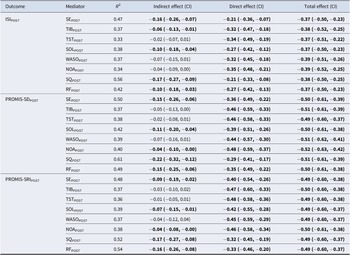
As shown in Table 2, TSC was associated with a significant reduction in immediate posttreatment insomnia symptom severity (standardized total effect: −0.37 to −0.39), sleep disturbance (standardized total effect: −0.49 to −0.52), and sleep-related impairment (standardized total effect: −0.49 to −0.50). For insomnia symptom severity, mediation was observed via SE (−0.16, 95% CI [−0.26, −0.07]), TIB (−0.06, 95% CI [−0.13, −0.01]), SOL (−0.10, 95% CI [−0.18, −0.04]), SQ (−0.17, 95% CI [−0.27, −0.09]), and RF (−0.10, 95% CI [−0.18, −0.03]), but not TST, WASO, or NOA. For sleep disturbance, significant mediators included SE (−0.15, 95% CI [−0.26, −0.06]), SOL (−0.11, 95% CI [−0.20, −0.04]), NOA (−0.04, 95% CI [−0.10, −0.00]), SQ (−0.22, 95% CI [−0.32, −0.12]), and RF (−0.15, 95% CI [−0.25, −0.06]), but not TIB, TST, or WASO. Sleep-related impairment showed a similar pattern with significant mediators including SE (−0.09, 95% CI [−0.19, −0.02]), SOL (−0.07, 95% CI [−0.15, −0.01]), NOA (−0.04, 95% CI [−0.08, −0.00]), SQ (−0.17, 95% CI [−0.27, −0.08]), and RF (−0.16, 95% CI [−0.26, −0.08]), but not TIB, TST, or WASO.
Mediators of sleep measures at immediate post-treatment

Note: Standardized coefficients [95% bootstrapping confidence interval]. ISI, Insomnia Severity Index; PROMIS-SD, Patient-Reported Outcomes Measurement Information System–Sleep Disturbance; PROMIS-SRI, Patient-Reported Outcomes Measurement Information System–Sleep-Related Impairment; SE, sleep efficiency; TIB, time in bed; TST, total sleep time; SOL, sleep onset latency; WASO, wake after sleep onset; NOA, number of awakenings; SQ, sleep quality; RF, restfulness after sleep. Significances were indicated by bold.
The direct effects of TSC on all sleep measures were significant across all simple mediation models. These results indicated that SE, SOL, SQ, and RF partially mediated the effect of TSC on all sleep measures (Table 2).
Serial mediators of psychological outcomes
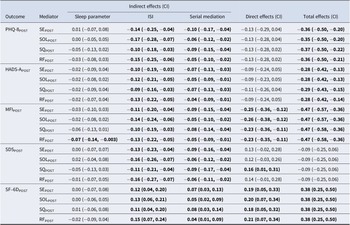
TSC was associated with a significant improvement in depressive symptom severity (standardized total effect: −0.35 to −0.37), anxiety symptom severity (standardized total effect: −0.28 to −0.29), fatigue (standardized total effect: −0.47), and quality of life (standardized total effect: 0.38). However, the TSC group did not demonstrate a significant reduction in functional impairment (standardized total effect: −0.09) compared to the CAU group.
Insomnia symptom severity significantly mediated the relationship between TSC and all psychological outcomes, including depressive symptom severity (standardized indirect effect: −0.10 to −0.17), anxiety symptom severity (−0.13 to −0.09), fatigue (−0.14 to −0.10), functional impairment (−0.16 to −0.11), and quality of life (0.11 to 0.15) at immediate posttreatment (TSC ➔ insomnia symptom severity ➔ psychological outcomes; Figure 3a).
Conceptual models of the indirect effects in the serial mediation model on psychological outcomes through (A) sleep measures, (B) sleep diary-derived parameters, and (C) both mediators serially.

The effects of TSC on depressive symptom severity standardized indirect effect: −0.05 to 0.01), anxiety symptom severity (−0.02), functional impairment (−0.05 to 0.02), and quality of life (−0.02 to 0.01) were not mediated by sleep diary-derived parameters. Although the relationship between TSC and fatigue was significantly mediated by RF (−0.07, 95% CI [−0.14, −0.00]), other sleep diary-derived parameters, including SE (−0.03, 95% CI [−0.10, 0.03]), SOL (−0.02, 95% CI [−0.08, −0.02]), and SQ (−0.06, 95% CI [−0.13, 0.01]), did not significantly mediate the effects of TSC on fatigue (TSC ➔ sleep diary-derived parameters ➔ psychological outcomes; Figure 3b).
The effects of TSC on all psychological outcomes were serially mediated by sleep diary-derived parameters, including SE, SOL, SQ, and RF, along with insomnia symptom severity (TSC ➔ sleep diary-derived parameters ➔ insomnia symptom severity ➔ psychological outcomes; Figure 3c). The serial indirect effects were significant for depressive symptoms (standardized indirect effect: −0.10 to −0.05), anxiety symptoms (−0.07 to −0.04), fatigue (−0.09 to −0.05), functional impairment (−0.09 to −0.06), and quality of life (0.04–0.08).
The direct effects on fatigue (−0.26 to −0.23) and quality of life (0.18–0.21) were significant across models with SE, SOL, SQ, and RF as mediators. The direct effect of TSC on functional impairment was significant in the model with SQ (0.16, 95% CI [0.01, 0.31]) but not in models with SE, SOL, and RF. The nonsignificant direct effects of TSC on depressive symptoms (−0.13) and anxiety symptoms (−0.11 to −0.09) indicated that the treatment effects on depression and anxiety were fully mediated by sleep diary-derived parameters and insomnia symptom severity.
The results of the mediation analysis with insomnia severity as the mediator are summarized in Table 3. Similar results were found in models with sleep disturbance (Supplementary Material 1) and sleep-related impairment (Supplementary Material 2) as mediators.
Mediators of psychological outcomes at immediate post-treatment

Note: HADS-A, anxiety subscale of the Anxiety and Depression Scale; ISI; Insomnia Severity Index; MFI, multidimensional fatigue inventory; NOA, number of awakenings; PHQ-9, Patient Health Questionnaire Hospital; RF, restfulness after sleep; SDS, Sheehan disability scale; SE, sleep efficiency; SF-6D, short form (six-dimension) health survey; SOL, sleep onset latency; SQ, sleep quality; TIB, time in bed; TST, total sleep time; WASO, wake after sleep onset. Significances were indicated by bold.
Discussion
The present study explored whether changes in sleep diary-derived parameters mediated the effects of TSC on sleep measures and whether these parameters, in turn, sequentially mediated the effects of TSC on psychological outcomes through subsequent changes in sleep measures. Consistent with our hypotheses, a number of sleep diary-derived parameters, including SE, SOL, SQ, and RF, significantly mediated the changes in insomnia symptom severity, sleep disturbance, and sleep-related impairment. In terms of serial mediations, the effects of TSC on all psychological outcomes were mediated by SE, SOL, SQ, and RF sequentially with insomnia symptom severity.
Simple mediation model
The total effects were significant for insomnia symptom severity, sleep disturbance, and sleep-related impairment, suggesting that the TSC is effective in treating sleep problems. Our findings revealed that the improvements in sleep measures were mediated by sleep diary-derived parameters, including SE, SOL, SQ, and RF. The TSC protocol incorporates modules designed to improve sleep measures through behavioral changes. For example, Optional Module 1 (improving SE) of TSC includes sleep restriction (Harvey & Buysse, Reference Harvey and Buysse2017), which is effective in reducing SE and SOL compared with control conditions (Maurer et al., Reference Maurer, Schneider, Miller, Espie and Kyle2021). Therefore, the changes in SE and SOL stemming from these modules mediated the treatment effects on sleep measures. On the contrary, significant indirect mediating effects were also demonstrated by SQ and RF, which represent the daily experience of SQ and restfulness, respectively. These parameters are self-rated, unlike SE and SOL, which are calculated based on a sleep diary. Hence, these notable indirect effects highlight the importance of sleep experience, in addition to sleep-diary derived parameters, in contributing to a reduction in sleep complaints and improvements in sleep measures, including less sleep difficulties and dissatisfaction. Future research could explore the efficacy of integrating personalized strategies for TIB and TST, taking into consideration individuals with varying sleep durations, to elucidate their potential mediating effects on both sleep and psychological outcomes.
Our findings revealed that sleep diary-derived SE, SOL, SQ, and RF partially mediated the changes in sleep measures. In addition to the modules targeting changes in SE and SOL, TSC also includes modules that place less emphasis on sleep diary-derived parameters. For example, some modules focus on the modification of sleep beliefs (Core Module 3: Correcting unhelpful sleep-related beliefs) and presleep arousal (Optional Module 4: Reducing sleep-related worry and vigilance) (Harvey & Buysse, Reference Harvey and Buysse2017). A meta-analysis has demonstrated significant mediating roles of presleep arousal and sleep-related dysfunctional beliefs in CBT-I (Parsons, Zachariae, Landberger, & Young, Reference Parsons, Zachariae, Landberger and Young2021). Therefore, we speculate that improvements in sleep measures in TSC were similarly mediated by presleep arousal and sleep-related dysfunctional beliefs, which were not included in our models. As a result, the mediation of sleep measures by sleep diary-derived parameters was only partial, as these measures do not fully capture the cognitive and hyperarousal changes that occur throughout the course of TSC.
Serial mediation model
Central to our research findings, the effects of TSC on a range of psychological outcomes in individuals were significantly mediated by changes in sleep-diary-derived parameters and subsequent improvement in insomnia symptom severity, highlighting the important role of intermediary changes in sleep resulting in the therapeutic effects of TSC. Consistent with previous CBT-I research (Cunningham & Shapiro, Reference Cunningham and Shapiro2018; Norell-Clarke et al., Reference Norell-Clarke, Tillfors, Jansson-Fröjmark, Holländare and Engström2018), our findings found that TSC, a newly developed transdiagnostic intervention, alleviates depressive symptoms through insomnia symptom improvement. Furthermore, our results suggest that TSC effectively facilitated a range of psychological improvements through improvements in sleep in people with MDD. These findings contribute to the development of transdiagnostic sleep intervention for mental disorders by demonstrating its generalizability and the pivotal role of sleep in a broad range of clinical improvements. Further research in broader clinical samples is warranted to confirm whether similar mechanisms operate transdiagnostically.
However, sleep diary-derived parameters alone did not mediate changes in psychological outcomes. Together with the significant serial mediations mentioned earlier, these findings suggested that changes in sleep measures are essential for sleep diary-derived parameters to contribute to improvements in psychological outcomes. This underscores the critical role of sleep measures in sleep interventions and aligns with the partial mediations observed in simple mediation models. Although certain treatment components target beliefs or worries instead of the behavioral aspects of sleep (Harvey, Reference Harvey2002), they may still influence psychological improvements indirectly through their impacts on sleep measures. Therefore, the modular-based approach of TSC demonstrates great flexibility and effectiveness by incorporating components from various effective interventions to address different aspects of sleep.
Our results revealed full mediations for depressive and anxiety symptoms and functional impairment, but partial mediations for fatigue and quality of life. This discrepancy may stem from the multidimensional nature of the MFI and SF-6D. The MFI measures general fatigue, physical fatigue, reduced activity, reduced motivation, and mental fatigue, while the SF-6D contains questions on physical functioning, role limitation, social functioning, bodily pain, mental health, and vitality. Certain subscales may be less relevant to improvements in sleep diary-derived parameters and sleep measures. For example, Core Module 2 of TSC specifically targets improvements in daytime functioning (Harvey & Buysse, Reference Harvey and Buysse2017). Therefore, improvements in motivation, social functioning, and daytime functioning could be influenced by factors beyond sleep diary-derived parameters and sleep measures, resulting in partial mediations for fatigue and quality of life.
Clinical significance
This study explored the mediators of the associations between TSC and sleep and psychological outcomes in the context of MDD. Our results further validate the importance of sleep in driving improvements in psychological outcomes, including depressive and anxiety symptoms. Changes in sleep diary-derived parameters and sleep measures sequentially contributed to these psychological improvements. However, we found no significant mediating effects of sleep diary-derived parameters alone on psychological outcomes, suggesting that sleep measures, instead of sleep diary-derived parameters, play a pivotal role in enhancing psychological outcomes. This highlights the necessity of ensuring changes in sleep measures to achieve meaningful psychological improvements. Additionally, our results demonstrated that improvements in depressive and anxiety symptom severity were fully mediated by the sequential effects of sleep diary-derived parameters and sleep measures. These results indicated that the changes in sleep diary-derived parameters and sleep measures may be essential factors in the pathway linking TSC to improvements in depressive and anxiety symptoms, suggesting that interventions and population-level strategies targeting sleep and circadian rhythm could be promoted to improve psychological outcomes. Furthermore, our findings further validate the potential roles and underlying mechanisms of sleep and circadian-targeted transdiagnostic interventions in addressing mental disorders.
Limitations and further direction
Although this study highlighted the roles of sleep parameters and outcomes in the effect of TSC, other important elements of TSC, such as presleep arousal and circadian rhythm, were not evaluated. Future research using a parallel mediation model that incorporates multiple mediators could provide a more comprehensive understanding of the underlying mechanisms throughout the intervention. Second, this study employed a half-longitudinal mediation analysis due to its pretest–posttest design. Incorporating additional assessment time points during the intervention could offer deeper insights into the trajectories and interactions of sleep, circadian rhythm, and depressive symptoms over time. Third, this study did not explore changes following each module, limiting its ability to disentangle the therapeutic effects of individual components of TSC. A micro-randomized controlled trial could address this limitation by assessing the impact of each module and informing the development of just-in-time adaptive interventions to maximize effectiveness. Fourth, this study did not account for multiple models tested due to its exploratory nature, which should be considered when interpreting the findings. Based on Nakagawa and Cuthill (Reference Nakagawa and Cuthill2007), corrections for multiple corrections further reduce power, increase the likelihood of a type II error, and may also contribute to publication bias. Nonetheless, future research with a larger sample is needed. Fifth, the majority of the sample were female, and all participants were Hong Kong Chinese adults. The extent to which the findings generalize to males and other racial and ethnic groups is an important direction for future research. Lastly, mediators of longer-term outcome were not analyzed due to the small sample size at the 12-week follow-up. This is an important issue to be addressed in future research.
In conclusion, this study explored the mediating effects of sleep diary-derived parameters on the relationships between TSC and sleep measures, as well as the serial mediations involving the effects of sleep diary-derived parameters and sleep measures on psychological outcomes. The results highlighted that the effects of TSC on sleep measures were mediated by sleep diary-derived parameters, particularly SE, SOL, SQ, and RF. Furthermore, the sleep diary-derived parameters and sleep measures serially mediated the effects of TSC on psychological outcomes. These findings contribute to a deeper understanding of the underlying mechanisms of transdiagnostic sleep- and circadian-targeted intervention, while also offering valuable insights for future research and clinical applications.
Supplementary material
The supplementary material for this article can be found at http://doi.org/10.1017/S0033291726103481.
Acknowledgments
The authors thank all the participants in the study and the members of the Public Mental Health Laboratory, The Chinese University of Hong Kong, for their assistance in data collection and article preparation. The authors acknowledge the use of GPT-3.5-Turbo for paraphrasing and proofreading from February 2025 to November 2025 (https://poe.com/GPT-5).
Funding statement
The work described in this article was fully supported by a grant from the Research Grants Council, University Grants Committee, of the Hong Kong Special Administrative Region, Hong Kong, China (Project No. CUHK 24604518) awarded to Fiona Yan-Yee Ho. The funding source had no involvement in study design, intervention, collection, analysis, and interpretation of data, writing of the report, or the decision of article submission for publication. There are no financial interests to disclose in relation to the Transdiagnostic Intervention for Sleep and Circadian Dysfunction.
Competing interests
The authors declare none.





 Open access

