




No CrossRef data available.
Article contents
Equivalence between the functional equation and Voronoï-type summation identities for a class of L-functions
Published online by Cambridge University Press: 25 November 2024
Abstract
To date, the bestmethodsfor estimating the growth of mean values of arithmetic functions rely on the Voronoï summation formula. By noticing a general pattern in the proof of his summation formula, Voronoï postulated that analogous summation formulas for 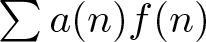 $\sum a(n)f(n)$ can be obtained with ‘nice’ test functions f(n), provided a(n) is an ‘arithmetic function’. These arithmetic functions a(n) are called so because they are expected to appear as coefficients of some L-functions satisfying certain properties. It has been well-known that the functional equation for a general L-function can be used to derive a Voronoï-type summation identity for that L-function. In this article, we show that such a Voronoï-typesummation identity in fact endows the L-function with some structural properties, yielding in particular the functional equation. We do this by considering Dirichlet series satisfying functional equations involving multiple Gamma factors and show that a given arithmetic function appears as a coefficient of such a Dirichlet series if and only if it satisfies the aforementioned summation formulas.
Keywords
MSC classification
Primary:
11M06: $zeta (s)$ and $L(s, chi)$
Information
- Type
- Research Article
- Information
- Copyright
- © The Author(s), 2024. Published by Cambridge University Press on behalf of The Royal Society of Edinburgh
References
Arai, T., Chakraborty, K. and Kanemitsu, S.. On modular relations. In Number theory, Volume 11 of Ser. Number Theory Appl., (World Sci. Publ., Hackensack, NJ, 2015).Google Scholar
Banerjee, D. and Maji, B.. Identities associated to a generalized divisor function and modified Bessel function. Res. Number Theory 9 (2023), .CrossRefGoogle Scholar
Berndt, B. C.. Generalised Dirichlet series and Hecke’s functional equation. Proc. Edinburgh Math. Soc. (2) 15 (1966/67), 309–313.Google Scholar
Berndt, B. C.. Identities involving the coefficients of a class of Dirichlet series. I, II. Trans. Am. Math. Soc. 137 (1969), .CrossRefGoogle Scholar
Berndt, B. C.. Identities involving the coefficients of a class of Dirichlet series. III. Trans. Amer. Math. Soc. 146 (1969), 323–348.Google Scholar
Berndt, B. C.. Identities involving the coefficients of a class of Dirichlet series. IV. Trans. Amer. Math. Soc. 149 (1970), 179–185.Google Scholar
Berndt, B. C.. Identities involving the coefficients of a class of Dirichlet series. VII. Trans. Amer. Math. Soc. 201 (1975), 247–261.Google Scholar
Berndt, B. C.. Identities involving the coefficients of a class of Dirichlet series. V VI. Trans. Amer. Math. Soc. 160 139–156; ibid. 160, 157–167, (1971).CrossRefGoogle Scholar
Berndt, B. C., Dixit, A., Gupta, R., and Zaharescu, A.. Two general series identities involving modified Bessel functions and a class of arithmetical functions. Can. J. Math. 75 (2022), 1–31.Google Scholar
Berndt, B. C., Dixit, A., Gupta, R. and Zaharescu, A.. A class of identities associated with Dirichlet series satisfying Hecke’s functional equation. Proc. Amer. Math. Soc. 150 (2022), 4785–4799.CrossRefGoogle Scholar
Berndt, B. C., Dixit, A., Roy, A. and Zaharescu, A.. New pathways and connections in number theory and analysis motivated by two incorrect claims of Ramanujan. Adv. Math. 304 (2017), 809–929.Google Scholar
Berndt, B. C., Kim, S. and Zaharescu, A.. Weighted divisor sums and Bessel function series, IV. Ramanujan J. 29 (2012), 79–102.CrossRefGoogle Scholar
Bochner, S.. Some properties of modular relations. Ann. Math. (2) 53 (1951), 332–363.CrossRefGoogle Scholar
Cahen, E.. Sur la fonction  $\zeta(s)$ de Riemann et sur des fonctions analogues. Ann. Sci. Éc. Norm. Supér. (3) 11 (1894), 75–164.CrossRefGoogle Scholar $\zeta(s)$ de Riemann et sur des fonctions analogues. Ann. Sci. Éc. Norm. Supér. (3) 11 (1894), 75–164.CrossRefGoogle Scholar
Chakraborty, K., Kanemitsu, S. and Maji, B.. Modular-type relations associated to the Rankin-Selberg L-function. Ramanujan J. 42 (2017), 285–299.Google Scholar
Chandrasekharan, K. and Minakshisundaram, S.. Typical means (Tata Institute of Fundamental Research. Monographs on Mathematics and Physics. 1), Vol. X, (University Press, Oxford, 1952).Google Scholar
Chandrasekharan, K. and Narasimhan, R.. Hecke’s functional equation and arithmetical identities. Ann. Math. (2) 74 (1961), 1–23.Google Scholar
Chandrasekharan, K. and Narasimhan, R.. Hecke’s functional equation and the average order of arithmetical functions. Acta Arith. 6 (1961), 487–503.CrossRefGoogle Scholar
Chandrasekharan, K. and Narasimhan, R.. Functional equations with multiple gamma factors and the average order of arithmetical functions. Ann. Math. (2) 76 (1962), 93–136.CrossRefGoogle Scholar
Chandrasekharan, K. and Narasimhan, R.. The approximate functional equation for a class of zeta-functions. Math. Ann. 152 (1963), 30–64.Google Scholar
Dixit, A., Maji, B., and Vatwani, A.. Voronoï summation formula for the generalized divisor function $\sigma_{z}^{(k)}(n)$. preprint, arXiv: 2303.09937.Google Scholar $\sigma_{z}^{(k)}(n)$. preprint, arXiv: 2303.09937.Google Scholar
Goldfeld, D., and Li, X.. Voronoï formulas on GL(n). Int. Math. Res. Not. 2006 (2006), .Google Scholar
Hamburger, H.. Über die Riemannsche Funktionalgleichung der ζ-Funktion. I. Math. Z. 10 (1921), 240–254.CrossRefGoogle Scholar
Hamburger, H.. Über die Riemannsche Funktionalgleichung der ζ-Funktion. II. Math. Z. 11 (1921), 224–245.CrossRefGoogle Scholar
Hamburger, H.. Über die Riemannsche Funktionalgleichung der ζ-funktion. dritte mitteilung: Die funktionalgleichung der L-Reihen. Math. Z. 13 (1922), 283–311.CrossRefGoogle Scholar
Hamburger, H.. Über einige Beziehungen, die mit der Funktionalgleichung der Riemannschen ζ-Funktion äquivalent sind. Math. Ann. 85 (1922), 129–140.CrossRefGoogle Scholar
Hardy, G. H.. A further note on Ramanujan’s arithmetical function $\tau(n)$. Proc. Camb. Philos. Soc. 34 (1938), 309–315.Google Scholar $\tau(n)$. Proc. Camb. Philos. Soc. 34 (1938), 309–315.Google Scholar
Hardy, G. H. and Landau, E.. The lattice points of a circle. Proc. R. Soc. Lond. Ser. A 105 (1924), 244–258.Google Scholar
Kanemitsu, S., Tanigawa, Y., and Tsukada, H.. A generalization of Bochner’s formula. Hardy-Ramanujan J. [Electronic only] 27 (2004), 28–46.Google Scholar
Kanemitsu, S., Tanigawa, Y. and Tsukada, H.. Some number theoretic applications of a general modular relation. Int. J. Number Theory 2 (2006), 599–615.CrossRefGoogle Scholar
Kanemitsu, S. and Tsukada, H.. The modular relation supremacy. Contributions to the theory of zeta-functions, Volume 10 of Series on Number Theory and its Applications (World Scientific Publishing Co. Pte. Ltd, Hackensack, NJ, 2015).Google Scholar
Kim, S.. Sums of divisors functions and Bessel function series. J. Number Theory 170 (2017), 142–184.CrossRefGoogle Scholar
Littlewood, J. E.. Lectures on the theory of functions, (University Press, Oxford, 1944).Google Scholar
Miller, S. D. and Schmid, W.. Automorphic distributions, L-functions, and Voronoi summation for GL(3). Ann. Math. (2) 164 (2006), 423–488.CrossRefGoogle Scholar
Oswald, N. M. R.. On a relation between modular functions and Dirichlet series: found in the estate of Adolf Hurwitz. Arch. Hist. Exact Sci. 71 (2017), 345–361.CrossRefGoogle Scholar
Riemann, B.. Über die Anzahl der Primzahlen unter einer gegebenen Grösse. Mon. Not. Berlin Akad. (1859), 671–680.Google Scholar
Selberg, A.. Old and new conjectures and results about a class of Dirichlet series, In Proceedings of the Amalfi Conference on Analytic Number Theory (Maiori, 1989), (Salerno: Univ. Salerno, 1992), . Salerno.Google Scholar
Titchmarsh, E. C.. Introduction to the theory of Fourier integrals, Vol. X, (Clarendon Press, Oxford, 1937).Google Scholar
Tsukada, H.. A general modular relation in analytic number theory. In Number theory. Ser. Number Theory Appl. Vol. 2, p. (Hackensack, NJ: World Science Publication, 2007).CrossRefGoogle Scholar
Voronoï, G.. Sur un problème du calcul des fonctions asymptotiques. J. Reine Angew. Math. 126 (1903), 241–282.Google Scholar
Voronoï, G.. Sur une fonction transcendante et ses applications à la sommation de quelques séries. Ann. Sci. ÉCole Norm. Sup. (3) 21 (1904), 207–267.CrossRefGoogle Scholar
Wilton, J. R.. A note on Ramanujan’s arithmetical function $\tau(n)$. Proc. Camb. Philos. Soc. 25 (1929), 121–129.CrossRefGoogle Scholar $\tau(n)$. Proc. Camb. Philos. Soc. 25 (1929), 121–129.CrossRefGoogle Scholar
Hafner, J. L. On the representation of the summatory functions of a class of arithmetical functions. In Analytic number theory (Philadelphia, Pa., 1980). Lecture Notes in Math Vol. 899, p. (Berlin-New York: Springer, 1981).CrossRefGoogle Scholar