

Introduction
Emotions play a central role in organisational life. They shape how individuals interpret managerial behaviour, evaluate fairness and risk, and regulate their engagement with work (Ashkanasy & Daus, Reference Ashkanasy and Daus2005; Weiss & Cropanzano, Reference Weiss, Cropanzano, Staw and Cummings1996). Research in organisational behaviour has long recognised that emotional experiences are not peripheral to work but are integral to how organisational processes are enacted, interpreted, and sustained (Barsade & Gibson, Reference Barsade and Gibson2007; Bradley, Greer, Trinh & Sanchez-Burks, Reference Bradley, Greer, Trinh and Sanchez-Burks2024; Grandey, Diefendorff & Rupp, Reference Grandey, Diefendorff and Rupp2013). Among the most influential frameworks for understanding workplace emotion is Affective Events Theory (AET), which conceptualises emotions as responses to discrete events that occur in the flow of work and that subsequently influence attitudes and behaviour over time (Weiss & Cropanzano, Reference Weiss, Cropanzano, Staw and Cummings1996).
AET has been widely applied to examine how daily interactions with supervisors, colleagues, and organisational systems generate affective reactions that shape job satisfaction, performance, and withdrawal behaviours (Beal, Weiss, Barros & MacDermid, Reference Beal, Weiss, Barros and MacDermid2005; Ilies, Schwind & Heller, Reference Ilies, Schwind and Heller2007). Central to this framework is an event-based logic in which affective experience is episodic, arising in response to identifiable workplace incidents that punctuate otherwise stable conditions. While AET acknowledges that emotions may vary in intensity and duration, its explanatory structure rests on the assumption that affective reactions are temporally bounded and that emotional experience attenuates or resolves between events (Beal et al., Reference Beal, Weiss, Barros and MacDermid2005; Weiss & Cropanzano, Reference Weiss, Cropanzano, Staw and Cummings1996).
This assumption has proven productive across many organisational settings. However, a growing body of research suggests that emotional experience at work may not always conform to an episodic pattern. Studies of emotional labour and emotion regulation demonstrate that organisational roles and norms shape not only emotional expression but also the sustained management of emotion over time (Grandey, Reference Grandey2000; Hülsheger & Schewe, Reference Hülsheger and Schewe2011). Research on leadership under conditions of accountability and scrutiny further shows that managerial roles increasingly require emotional restraint, self-monitoring, and containment, particularly in environments characterised by reputational risk and formal oversight (Gardner, Fischer & Hunt, Reference Gardner, Fischer and Hunt2009; Lupu & Empson, Reference Lupu and Empson2015). These literatures indicate that emotional experience may be structured by enduring organisational conditions rather than triggered solely by discrete events.
The limits of an event-centred account of emotion become particularly visible in organisational contexts characterised by sustained oversight and regulatory intensity. In such environments, work is organised around continuous evaluation, formal accountability, and heightened visibility (Greenwood, Raynard, Kodeih, Micelotta & Lounsbury, Reference Greenwood, Raynard, Kodeih, Micelotta and Lounsbury2011; Power, Reference Power2022). Organisational members operate within systems where scrutiny is ongoing rather than intermittent, and where behavioural discretion is constrained by institutionalised expectations of compliance and defensibility. Research on audit cultures and risk governance shows that these conditions reshape everyday organisational practices, including how authority is exercised and how responsibility is experienced (Power, Reference Power2007, Reference Power2022). Emotional experience in these settings may therefore be shaped by prolonged exposure to oversight rather than by isolated interactions.
Supervision is a critical site through which these dynamics are enacted. Supervisory relationships are structurally embedded, emotionally consequential, and asymmetrically experienced (Anseel & Sherf, Reference Anseel and Sherf2025; Breevaart & Zacher, Reference Breevaart and Zacher2019; Graen & Uhl-Bien, Reference Graen and Uhl-Bien1995). Prior research has shown that supervisory behaviour is a central source of affective experience at work, influencing employees’ emotional responses, sense-making, and behavioural adjustment (Ashkanasy & Humphrey, Reference Ashkanasy, Humphrey, Bryman, Collinson, Grint, Jackson and Uhl-Bien2011; Dasborough, Ashkanasy, Tee & Tse, Reference Dasborough, Ashkanasy, Tee and Tse2009). In oversight intensive environments, supervisors must navigate competing demands for relational engagement, procedural consistency, and reputational defensibility. This often results in interactional patterns characterised by emotional restraint, reduced expressiveness, and careful modulation of tone and presence (Gardner et al., Reference Gardner, Fischer and Hunt2009; Voronov & Vince, Reference Voronov and Vince2012).
Employees, in turn, interpret supervisory behaviour through affect laden leadership processes and emotional cues (Shao, Reference Shao2024). Research on abusive supervision and interactional justice demonstrates that when emotional cues are ambiguous, employees engage in heightened interpretive effort to infer intent, evaluation, and personal risk (Bies, Reference Bies, Cropanzano and Ambrose2015; Chan & McAllister, Reference Chan and McAllister2014). These interpretive processes are emotionally consequential, particularly in contexts where power asymmetries are pronounced, and outcomes carry reputational or career implications (Oh & Farh, Reference Oh and Farh2017). Under such conditions, emotional experience may not be confined to discrete supervisory events but may persist as a background condition that shapes how subsequent interactions are perceived.
Drawing on a phenomenological study of employees and managers in the post–Royal Commission Australian financial services sector, this paper examines affective experience under conditions of sustained oversight. Following the Royal Commission into Misconduct in the Banking, Superannuation and Financial Services Industry, supervisory roles became central to organisational efforts to restore trust, demonstrate accountability, and enact cultural reform (Australian Government Treasury, 2019; Australian Prudential Regulation Authority, 2020). These reforms intensified monitoring, formalised evaluative processes, and narrowed the emotional latitude available to supervisors, creating organisational conditions in which emotional experience was shaped by continuous exposure to oversight rather than episodic incidents.
The study draws on semi-structured interviews, critical incident elicitation, and systematic attention to non-verbal cues to capture how employees and managers experience supervision within this environment. Consistent with phenomenological approaches to organisational research, the analysis foregrounds lived experience and meaning-making rather than behavioural frequency or attitudinal measurement (Finlay, Reference Finlay2002; Maitlis & Christianson, Reference Maitlis and Christianson2014). Participants’ accounts indicate that emotional experience was not primarily organised around isolated affective events that subsequently resolved. Instead, affective experience was described as cumulative, ambient, and carried across everyday supervisory interactions marked by tone, pacing, silence, and emotional restraint. Managers described regulating their emotional expression in response to institutional expectations, while employees described sustained interpretive labour as they attempted to make sense of supervisory intent and organisational risk.
To guide the inquiry, the study addresses the following research question: How do employees and managers experience affect within supervisory contexts characterised by sustained organisational oversight?
This paper extends AET in three analytically distinct but interrelated ways. First, it refines AET’s temporal assumptions by showing that affect may persist as a sustained condition under continuous oversight rather than arising only as episodic reactions to discrete events. Second, it demonstrates how ambiguity and emotional restraint within supervisory interaction generate affect through sustained interpretive labour. Third, it shows how affective conditions circulate recursively across supervisory relationships as emotional pressures are absorbed and transmitted across roles. While several literatures inform the analysis, AET provides the primary theoretical lens through which affect in oversight saturated supervisory contexts is examined.
By clarifying this extension, the paper advances AET’s capacity to account for organisational environments characterised by ongoing accountability and evaluative scrutiny. More broadly, it aligns emotion research with empirical accounts of supervision under contemporary forms of governance, clarifying how affect operates when work is organised around continuous oversight rather than discrete interpersonal events. In doing so, it provides a theoretically grounded account of supervision as a sustained emotional condition rooted in lived experience.
Theoretical background
AET occupies a central position in organisational research on workplace emotion. Introduced by Weiss and Cropanzano (Reference Weiss, Cropanzano, Staw and Cummings1996), AET shifted attention away from stable dispositions and towards the emotional significance of everyday workplace experiences. The theory conceptualises emotions as responses to discrete events that occur during work and that subsequently influence attitudes and behaviours. By foregrounding affective reactions to routine interactions with supervisors, colleagues, and organisational systems, AET provided a systematic account of how emotion enters organisational life.
A key contribution of AET lies in its integration of emotion into broader models of work behaviour (Kammeyer-Mueller, Rubenstein & Barnes, Reference Kammeyer-Mueller, Rubenstein and Barnes2024; Weiss & Cropanzano, Reference Weiss, Cropanzano, Staw and Cummings1996). Rather than treating affect as peripheral or epiphenomenal, the theory positions emotional experience as a proximal mechanism linking workplace events to cognitive appraisal, attitudinal formation, and behavioural response (Weiss & Cropanzano, Reference Weiss, Cropanzano, Staw and Cummings1996). Empirical research drawing on AET has demonstrated robust associations between affective reactions and outcomes such as job satisfaction, task performance, organisational citizenship behaviour, and withdrawal (Beal et al., Reference Beal, Weiss, Barros and MacDermid2005; Ilies et al., Reference Ilies, Schwind and Heller2007). These findings have reinforced AET’s value as a foundational framework for understanding the emotional texture of organisational life.
At the same time, AET’s explanatory power is grounded in a specific set of assumptions about how emotional experience is structured. Emotional reactions are theorised as responses to identifiable incidents that punctuate the workday. These reactions are dynamic and variable, but they are nonetheless assumed to be temporally bounded. This temporal framing enables researchers to locate affective experience within particular moments and to distinguish emotion from more enduring attitudes or dispositions. As such, AET’s influence rests not only on its conceptualisation of emotion but also on its implicit assumptions about temporality and resolution.
Episodic emotion as a structural requirement
The temporal architecture of AET is central to its theoretical coherence. Emotional experience is conceptualised as episodic, arising in response to discrete events and attenuating as those events recede (Weiss & Cropanzano, Reference Weiss, Cropanzano, Staw and Cummings1996). This episodic framing allows affective reactions to be analytically linked to specific triggers and to be modelled as transient states that fluctuate across time. It also underpins the theory’s distinction between affective experience and more stable attitudinal constructs, such as job satisfaction or organisational commitment.
Subsequent empirical work has reinforced this temporal logic, although more recent research increasingly highlights the dynamic and socially embedded nature of emotional experiences in organisational settings (Beal et al., Reference Beal, Weiss, Barros and MacDermid2005; Ilies et al., Reference Ilies, Schwind and Heller2007; Wang, Liu, Ling, Fan & Chen, Reference Wang, Liu, Ling, Fan and Chen2023). Research examining daily affective fluctuations shows that emotions vary across moments and days in response to changing situational demands (Beal et al., Reference Beal, Weiss, Barros and MacDermid2005; Ilies et al., Reference Ilies, Schwind and Heller2007). Even when emotional reactions are intense or recurrent, they are typically assumed to resolve or return to baseline, allowing subsequent events to be experienced afresh. This assumption is not incidental. It is a structural requirement of AET, enabling the theory to explain how discrete events generate affective reactions that shape downstream outcomes without collapsing emotion into a chronic state.
However, this temporal framing also imposes boundaries on what AET can explain. While AET recognises that work environment features may influence affective experience, these features are typically conceptualised as background conditions that shape event appraisal rather than as mechanisms generating sustained affective conditions in the absence of discrete triggering events. By conceptualising affective responses as episodic and typically attenuating as events recede, AET is less well equipped to account for affective experience that persists in the absence of identifiable triggering events or that remains active across extended periods of time. It is important to distinguish the sustained affective conditions described in this study from both emotion and mood as conceptualised within AET. Within AET, affect functions as an umbrella construct encompassing both emotions and moods. Emotions are typically understood as episodic reactions triggered by discrete workplace events, whereas moods are more diffuse affective states that may arise from accumulated experiences but remain largely internal to the individual (Ashkanasy & Humphrey, Reference Ashkanasy, Humphrey, Bryman, Collinson, Grint, Jackson and Uhl-Bien2011; Barsade & Gibson, Reference Barsade and Gibson2007; Weiss & Cropanzano, Reference Weiss, Cropanzano, Staw and Cummings1996).
The phenomenon described in this study differs from both constructs and from depletion-based explanations such as burnout, which primarily capture emotional exhaustion resulting from resource loss (Maslach, Schaufeli & Leiter, Reference Maslach, Schaufeli and Leiter2001). Participants did not describe episodic emotional reactions tied to identifiable events, nor did they describe diffuse internal mood states. Instead, they described sustained affective conditions that emerged through ongoing supervisory interpretation and institutional accountability pressures. These conditions were relationally structured within supervisory interactions and maintained through continuous interpretive monitoring of tone, silence, and evaluative signals. As such, the affective dynamics observed here reflect a socially embedded and temporally sustained condition rather than an episodic emotion or internally generated mood state as typically conceptualised within AET (Ashkanasy & Daus, Reference Ashkanasy and Daus2005; Maitlis, Vogus & Lawrence, Reference Maitlis, Vogus and Lawrence2013; Weiss & Cropanzano, Reference Weiss, Cropanzano, Staw and Cummings1996).
While the theory recognises that emotional reactions may accumulate and influence future appraisal, it continues to privilege discrete incidents as the primary source of affective experience. This raises important questions about the applicability of event-centred models of emotion in organisational environments where emotional experience is structured by sustained conditions rather than by isolated events.
Emotion regulation, emotional labour, and sustained organisational constraint
Parallel streams of organisational research have examined emotional experience through a different lens. Research on emotional labour and emotion regulation has demonstrated that organisational roles and norms prescribe how emotions should be expressed, suppressed, or managed over time (Gabriel, Diefendorff & Grandey, Reference Gabriel, Diefendorff and Grandey2023; Grandey, Reference Grandey2000; Hülsheger & Schewe, Reference Hülsheger and Schewe2011). In these accounts, emotion is not solely a reaction to events but an ongoing aspect of role performance shaped by sustained organisational expectations. Emotional regulation is continuous rather than episodic, reflecting enduring demands for professionalism, composure, and alignment with organisational norms. Recent research has also begun to explore how sustained affective states shape work attitudes and behavioural outcomes within contemporary organisational contexts, extending AET-informed research beyond discrete emotional episodes (Nimon, Shuck, Fulmore & Zigarmi, Reference Nimon, Shuck, Fulmore and Zigarmi2023), including how affective commitment as a persistent emotional state can drive downstream behavioural outcomes such as unethical behaviour (Fulmore, Nimon & Reio, Reference Fulmore, Nimon and Reio2024).
Leadership research has further highlighted the sustained emotional demands associated with positions of authority. Leaders are often required to regulate their emotional display to convey stability, credibility, and control, particularly under conditions of scrutiny or uncertainty (Ashkanasy & Humphrey, Reference Ashkanasy, Humphrey, Bryman, Collinson, Grint, Jackson and Uhl-Bien2011; Gardner et al., Reference Gardner, Fischer and Hunt2009). These expectations are embedded in organisational structures and reinforced through evaluation and accountability mechanisms. As a result, emotional restraint becomes a normative feature of leadership roles, shaping not only outward expression but also subjective experience.
Importantly, these literatures neither directly challenge AET nor do they seek to replace event-centred accounts of workplace emotion. Instead, they reveal forms of emotional experience that are sustained, regulated, and embedded within organisational roles and expectations. Research on emotional labour and emotion regulation has focused primarily on how individuals manage emotion, and the costs associated with that management (Grandey, Reference Grandey2000; Hülsheger & Schewe, Reference Hülsheger and Schewe2011), rather than on how affective experience itself is generated and sustained over time. As such, these literatures sit alongside AET without being fully integrated into its explanatory framework, leaving unresolved questions about how sustained emotional constraint intersects with event-based affective processes (Voronov & Vince, Reference Voronov and Vince2012).
Supervision as an emotionally consequential and structurally embedded practice
Supervision represents a critical site for examining these unresolved questions. Supervisory relationships are inherently asymmetrical, combining authority, evaluation, and relational engagement (Graen & Uhl-Bien, Reference Graen and Uhl-Bien1995). As a result, supervisory behaviour is a potent source of emotional experience, shaping how employees interpret feedback, assess personal risk, and regulate their conduct at work (Dasborough et al., Reference Dasborough, Ashkanasy, Tee and Tse2009). Emotional cues conveyed through supervision, including tone, responsiveness, and attentiveness, play a central role in employee sense-making and affective response (Breevaart & Zacher, Reference Breevaart and Zacher2019).
Supervision is structurally embedded within organisational systems. Supervisors act as intermediaries between institutional demands and everyday work practice, translating formal requirements into relational interaction (Graen & Uhl-Bien, Reference Graen and Uhl-Bien1995; Lupu & Empson, Reference Lupu and Empson2015). This positioning exposes supervisors to competing expectations, including the need to demonstrate compliance, maintain relational credibility, and regulate emotional dynamics within teams (Gardner et al., Reference Gardner, Fischer and Hunt2009). As a result, supervisory interactions are shaped not only by interpersonal considerations but also by organisational conditions that constrain discretion and emotional expression (Voronov & Vince, Reference Voronov and Vince2012).
Research on leadership and supervision has shown that these structural pressures influence how supervisors manage their emotional presence, often resulting in restrained or carefully modulated forms of interaction (Ashkanasy & Humphrey, Reference Ashkanasy, Humphrey, Bryman, Collinson, Grint, Jackson and Uhl-Bien2011; Gardner et al., Reference Gardner, Fischer and Hunt2009). Employees, in turn, must interpret supervisory behaviour within these constrained conditions, engaging in ongoing sense-making to infer intent, evaluation, and organisational risk. These dynamics position supervision as a relational practice through which sustained organisational conditions are experienced emotionally.
Institutional oversight, accountability, and emotional governance
Contemporary organisational research has documented the increasing prevalence of institutional regimes of oversight, audit, and accountability that shape how work is organised and evaluated (Greenwood et al., Reference Greenwood, Raynard, Kodeih, Micelotta and Lounsbury2011; Power, Reference Power2007). Organisational actors are required to align their behaviour with formalised standards that extend beyond immediate task demands and are subject to continuous evaluation.
Scholars have begun to examine the emotional implications of these arrangements. Research on institutional work demonstrates that organisational structures shape not only what actions are taken but also how emotions are expressed, regulated, and rendered legitimate (Voronov & Vince, Reference Voronov and Vince2012). Expectations of composure, neutrality, and restraint become embedded within professional roles, shaping emotional experience over time. Emotional conduct is thus governed through institutional norms rather than left to individual discretion.
Under conditions of sustained oversight, emotional experience may therefore be structured by ongoing exposure to evaluation rather than by discrete interactions. Research on accountability and organisational scrutiny highlights how evaluation increasingly operates as a continuous condition, shaping how individuals experience authority, responsibility, and relational engagement over time (Roberts, Reference Roberts2009; Schillemans & Busuioc, Reference Schillemans and Busuioc2015). Within such environments, emotional expression is not only situational but subject to ongoing monitoring and self-regulation, as organisational demands for defensibility and control become embedded in everyday practice (Berti & Simpson, Reference Berti and Simpson2021; Fotaki, Kenny & Vachhani, Reference Fotaki, Kenny and Vachhani2017). These insights suggest that affective experience may be organised around enduring organisational conditions, raising questions about the sufficiency of event-centred accounts of workplace emotion when evaluation and accountability are persistent rather than episodic (Ashkanasy & Humphrey, Reference Ashkanasy, Humphrey, Bryman, Collinson, Grint, Jackson and Uhl-Bien2011).
Reconsidering event-centred accounts of workplace emotion
Taken together, these literatures point to a substantive conceptual tension in event-centred theories of workplace emotion. AET provides a powerful account of how discrete work events generate affective reactions that shape attitudes and behaviour (Beal et al., Reference Beal, Weiss, Barros and MacDermid2005; Weiss & Cropanzano, Reference Weiss, Cropanzano, Staw and Cummings1996). However, its explanatory architecture assumes that emotional responses are time bounded and diminish as events recede, an assumption that becomes strained in organisational environments characterised by sustained oversight, emotional regulation, and continuous accountability (Ashkanasy & Humphrey, Reference Ashkanasy, Humphrey, Bryman, Collinson, Grint, Jackson and Uhl-Bien2011; Roberts, Reference Roberts2009).
When affective experience is structured by ongoing organisational conditions rather than punctuated by discrete events, the foundational assumptions of event-centred emotion theories no longer fully hold. Emotional experience does not reliably attenuate between events nor can it be easily traced to identifiable triggers. Instead, affect may persist as a condition that frames interpretation, heightens vigilance, and shapes how subsequent interactions are experienced, as observed in organisational contexts marked by continuous evaluation and constrained discretion (Fotaki et al., Reference Fotaki, Kenny and Vachhani2017; Maitlis & Christianson, Reference Maitlis and Christianson2014). Under such conditions, emotional experience is cumulative and relational rather than anchored to discrete interpersonal encounters.
These observations do not undermine the value of AET. Rather, they indicate the need for empirical examination of affective experience in contexts where the theory’s temporal assumptions are strained. They point to the importance of examining supervision within oversight saturated environments, where emotional cues are sustained and where interpretation itself becomes emotionally consequential (Ashkanasy & Daus, Reference Ashkanasy and Daus2005; Voronov & Vince, Reference Voronov and Vince2012). This paper addresses this need by empirically examining how employees and managers experience supervision under conditions of sustained oversight, providing a basis for extending AET beyond event-centred accounts of workplace emotion.
Method
This study adopts an interpretivist qualitative research design grounded in phenomenology. The study draws specifically on an interpretive phenomenological orientation informed by the work of van Manen (Reference van Manen2016) and Finlay (Reference Finlay2002, Reference Finlay2011), which emphasises understanding lived experience through reflective interpretation. The aim is to understand how employees and managers experience and make sense of supervision under conditions of sustained organisational oversight. Consistent with interpretivist assumptions, the study treats emotional experience as socially constructed and contextually embedded, rather than as an objective or universally measurable phenomenon (Schwandt, Reference Schwandt, Denzin and Lincoln1994). Meaning is understood to arise through individuals’ interpretations of their lived experiences within institutional and relational contexts.
Phenomenology provides an appropriate methodological orientation for examining affective experience in organisational settings where emotional cues are subtle, ambiguous, and embedded in everyday interaction (Finlay, Reference Finlay2002). Rather than seeking to explain behaviour through causal relationships, phenomenology focuses on how individuals experience, interpret, and ascribe meaning to events and conditions as they are lived (van Manen, Reference van Manen2016). This orientation aligns with the study’s interest in sustained emotional conditions and interpretive processes, which cannot be adequately captured through event counts or attitudinal measures.
AET informed the study as a sensitising framework rather than as a deductive model. AET provided conceptual guidance for attending to emotionally salient moments within supervisory interactions, while remaining open to how participants themselves described, organised, and interpreted their experiences (Weiss & Cropanzano, Reference Weiss, Cropanzano, Staw and Cummings1996). This approach is consistent with qualitative applications of theory that use established frameworks to orient analysis without imposing predefined categories or hypotheses (Maitlis & Christianson, Reference Maitlis and Christianson2014).
Research context
The study was conducted within the Australian financial services sector following the Royal Commission into Misconduct in the Banking, Superannuation and Financial Services Industry (Australian Government Treasury, 2019). This period was characterised by intensified regulatory scrutiny, expanded accountability requirements, and heightened organisational emphasis on oversight, compliance, and cultural reform (Power, Reference Power2007; Roberts, Reference Roberts2009). Supervisory roles became central to organisational responses to these reforms, positioning managers as key intermediaries between institutional expectations and everyday work practices (Lupu & Empson, Reference Lupu and Empson2015).
While the financial services sector provides a particularly visible example of sustained oversight following regulatory reform, similar conditions of continuous evaluation and accountability exist across many highly regulated organisational environments, including healthcare, aviation, and large-scale service operations (Power, Reference Power2007; Roberts, Reference Roberts2009; Schillemans & Busuioc, Reference Schillemans and Busuioc2015). The context therefore serves as an analytically rich setting through which to examine affective experience under sustained organisational scrutiny rather than as a sector-specific anomaly.
This context provides a theoretically relevant setting for examining affective experience under sustained oversight. Rather than treating financial services sector as exceptional, the study uses the sector as empirically rich environment in which conditions of continuous evaluation, reputational risk, and constrained discretion are particularly visible (Roberts, Reference Roberts2009). These conditions make it possible to examine how emotional experience unfolds when organisational oversight is persistent rather than episodic (Power, Reference Power2007).
Participants and sampling
Participants were recruited using purposive sampling to capture rich accounts of supervisory experience from individuals embedded in oversight intensive organisational roles within the Australian financial services sector (Patton, Reference Patton2002). The study focused on the post–Royal Commission period, a context characterised by heightened regulatory scrutiny, expanded accountability requirements, and intensified managerial oversight.
The study initially recruited and interviewed 44 participants across employee and managerial roles. Two participants, both from the managerial cohort, did not complete the required consent documentation. In accordance with ethical research protocols, the interview data from these participants were excluded from analysis. The final analytic sample therefore comprised 42 participants, including 29 employees and 13 managers.
Employees were recruited from roles involving sustained exposure to evaluative supervision and accountability processes, including compliance, risk management, project-based functions, and business analysis. These roles spanned analyst, manager, and executive positions within compliance, risk, technology, finance, strategy, and program delivery functions. Managers held formal supervisory responsibility within these environments and occupied strategic or operational oversight roles, including senior executives and board-level roles responsible for organisational risk, compliance, technology governance, and financial oversight, positioning them simultaneously as enactors and subjects of organisational control. This dual-cohort design enabled examination of supervisory experience across hierarchical positions, recognising that emotional interpretation and meaning-making are shaped by positional asymmetries.
Interviews were conducted until thematic sufficiency was achieved. Consistent with phenomenological standards, sufficiency was assessed in terms of conceptual depth and recurrence of experiential patterns rather than numerical thresholds (Vagle, Reference Vagle2018). Analysis indicated that novel insights diminished after approximately 35 interviews, with thematic stability observed within and across employee and manager cohorts (Guest, Namey & Chen, Reference Guest, Namey and Chen2020; Hennink, Kaiser & Marconi, Reference Hennink, Kaiser and Marconi2017). Saturation was assessed through iterative comparison of emerging codes and experiential patterns across successive interviews, allowing the researcher to determine when additional interviews were no longer generating substantively new interpretive categories. This suggested that the core experiential structures relevant to supervisory oversight had been adequately captured.
The final sample reflected diversity in gender, hierarchical position, and professional function, with a balanced gender composition (21 men, 21 women). While the study does not seek statistical generalisation, its contribution lies in analytic or theoretical generalisation, whereby insights derived from rich empirical material are used to refine and extend existing theoretical frameworks (Yin, Reference Yin2018). In this study, the empirical analysis is used to examine the temporal assumptions embedded within AET and to develop a conceptual account of sustained affective conditions under oversight intensive supervisory contexts. The diversity of participants across roles and organisational functions supports this analytic generalisation by enabling the identification of recurring experiential patterns and relational dynamics that inform theoretical development rather than population-level inference (Guest et al., Reference Guest, Namey and Chen2020; Hennink et al., Reference Hennink, Kaiser and Marconi2017).
Data collection
Data were collected through semi-structured interviews, typically lasting between 45 and 90 min. Interviews were conducted either face-to-face or via secure virtual platforms, depending on participant availability and organisational constraints. The semi-structured format allowed participants to narrate their experiences in their own terms while ensuring coverage of supervisory interactions, emotional responses, and interpretive processes.
The interview protocol incorporated the Critical Incident Technique to elicit concrete examples of emotionally salient supervisory encounters (Butterfield, Borgen, Amundson & Maglio, Reference Butterfield, Borgen, Amundson and Maglio2005). Participants were invited to describe specific interactions that stood out as meaningful, challenging, or emotionally impactful, and to reflect on how these experiences influenced their perceptions of supervision and their own behaviour at work. This approach anchored discussion in lived experience rather than abstract evaluation. While Critical Incident Technique was used to anchor discussion in concrete experiences, participants frequently moved beyond isolated incidents to describe ongoing supervisory conditions and affective states that persisted across interactions. In this sense, the critical incidents served primarily as entry points into broader narratives through which participants articulated sustained and ambient affective experiences.
Throughout the interviews, attention was paid to non-verbal cues, including pauses, changes in tone, facial expression, and bodily posture. These cues were noted contemporaneously and treated as part of the interpretive material, recognising that emotional experience is often conveyed through embodied expression rather than explicit description. Interviews were audio recorded with consent and transcribed verbatim. Field notes were maintained to capture contextual observations and initial analytic impressions.
Data analysis
Data analysis followed an iterative, interpretive process consistent with phenomenological methodology (Finlay, Reference Finlay2002). Analysis proceeded through several stages. Transcripts and field notes were read repeatedly to develop a holistic understanding of participants’ experiences. Initial coding focused on how participants described supervisory interactions, emotional responses, and interpretive processes. Codes were then iteratively refined and grouped into higher-order themes that captured recurring patterns of affective experience across both employee and manager accounts. Interpretations were revisited and adjusted across successive readings of the data, with attention to patterns across cases and between employee and manager cohorts (Maitlis & Christianson, Reference Maitlis and Christianson2014). AET informed analysis by sensitising attention to emotionally salient moments within supervisory narratives, without constraining interpretation to predefined event categories (Blumer, Reference Blumer1954). Critical Incident Technique supported analytic focus on episodes that participants themselves identified as meaningful (Butterfield et al., Reference Butterfield, Borgen, Amundson and Maglio2005), while non-verbal cues were used to enrich interpretation of emotional significance and intensity. Non-verbal data (e.g., pauses, gaze shifts, posture changes, and changes in tone) were coded as indicators of emotional intensity and persistence and were interpreted alongside participants’ verbal narratives during theme development, consistent with phenomenological approaches that attend to embodied experience (Finlay, Reference Finlay2011).
Analysis remained grounded in participants’ accounts, with conceptual development emerging through engagement with the data rather than through theoretical imposition (Finlay, Reference Finlay2002). Differences and convergences between employee and manager accounts were examined to illuminate how positional location shaped emotional experience and meaning-making (Maitlis & Christianson, Reference Maitlis and Christianson2014).
Rigour and trustworthiness
Several strategies were employed to enhance the rigour and trustworthiness of the study. Reflexivity was maintained throughout data collection and analysis, with the researcher documenting assumptions, emotional responses, and analytic decisions in reflexive memos (Finlay, Reference Finlay2002). This process supported ongoing examination of how the researcher’s positioning informed interpretation. Given the researcher’s professional background in financial services, reflexive journaling was used to document assumptions and interpretive challenges throughout the research process to ensure that emerging themes remained grounded in participant accounts rather than researcher expectations.
Triangulation was achieved through the integration of multiple sources of interpretive material, including interview narratives, critical incidents, and non-verbal observations. An audit trail was maintained to document analytic decisions and coding development, supporting transparency and dependability (Lincoln & Guba, Reference Lincoln and Guba1985). Together, these strategies support the credibility and interpretive integrity of the findings.
Findings
The analysis revealed supervision as an affectively consequential and interpretively demanding aspect of organisational life. While participants occasionally described supportive or neutral supervisory interactions, emotionally consequential experiences were more frequently associated with ambiguity, restraint, and accountability pressures. The analysis therefore focuses on these moments because they revealed the affective dynamics most relevant to the research question. Participants did not describe emotional experience as arising from isolated incidents or discrete supervisory encounters, affect was experienced as something that developed over time, shaped by repeated exposure to oversight, constrained emotional expression, and the ongoing effort required to interpret managerial intent within compliance saturated environments. Emotional meaning was derived less from what was explicitly said or done, and more from how tone was held, how presence was regulated, and how attention was distributed across everyday interactions.
Across accounts, supervision was described as an enduring emotional presence rather than a series of momentary exchanges. Although participants frequently referred to broader regulatory pressures, these pressures were experienced primarily through supervisory relationships, where organisational expectations and accountability demands were translated into everyday interaction. Employees and managers alike spoke of emotional states that persisted beyond individual meetings or interactions, carrying forward into subsequent encounters and shaping how new situations were approached. Feelings of vigilance, tension, uncertainty, and emotional narrowing were not tied to single events, but accumulated gradually through repeated exposure to oversight practices characterised by restraint, procedural focus, and limited relational latitude. These affective conditions formed the backdrop against which supervisory behaviour was interpreted and experienced.
The dual-cohort design provided insight into how these emotional conditions were lived from different organisational positions. Employees described navigating supervision through heightened sensitivity to subtle cues, engaging in sustained interpretive effort to infer meaning, evaluation, and personal risk. Managers, in contrast, described the emotional work of absorbing institutional pressure, regulating their own affective expression, and maintaining steadiness under conditions of scrutiny and accountability. Although these experiences differed in form, they unfolded within the same organisational environment and reflected shared structural constraints that shaped emotional experience across roles.
The analysis was attentive not only to participants’ narratives but also to embodied expressions of affect. Shifts in posture, changes in tone, hesitation, and emotional intensity were treated as integral to meaning-making rather than as ancillary detail. These non-verbal cues illuminated how participants continued to carry emotional experience as they recounted supervisory encounters, revealing the persistence and weight of affective conditions that extended beyond specific moments in time.
Three analytic themes were developed to capture the affective patterns through which supervision was experienced within these environments. Each theme integrates employee and manager perspectives, reflecting how affective experience was produced, sustained, and transmitted within structurally regulated supervisory contexts. Together, the themes depict supervision as an emotionally mediated practice shaped by institutional conditions, constrained expression, and ongoing interpretive labour, rather than as a sequence of discrete affective events.
Supervision as a sustained affective condition
Across accounts, supervision was experienced as a sustained affective condition that accumulated over time. Emotional experience was rarely anchored to a single meeting or interaction. Instead, participants described supervision as an ongoing presence that shaped anticipation, vigilance, and self-regulation across the workday and beyond. Affect did not dissipate between encounters. It lingered, framing how subsequent interactions were approached and interpreted.
Employees frequently described this condition as one of gradual emotional narrowing. P10 reflected on how prolonged exposure altered her orientation towards supervision: For me, bit by bit, I’m like, I actually don’t believe anything you’re saying anymore … I felt like I was being sent on a wild goose chase, as she repeatedly shifted her gaze around the room, making frequent self-adjustments to her posture and eyewear. Her account conveyed an erosion of emotional certainty that unfolded incrementally rather than in response to a single precipitating event.
A similar sense of affective carryover appeared in P14’s account. He described how an early supervisory interaction continued to shape his emotional state long after it had passed: It was from that moment, literally, that things went off the rails … I started second-guessing myself constantly, with visible flushing and frequent shifts in seated posture as he spoke. Rather than resolving, the emotional impact of supervision persisted, prompting ongoing self-monitoring and behavioural caution.
This sustained emotional alertness was also evident in how employees described anticipation rather than reaction. P06 explained, You’re always on edge. Even when nothing’s happening, you’re waiting for something to happen, while maintaining an averted orientation from the camera, engaging in repetitive tapping movements on the table surface and regularly scanning the surrounding environment. In his account, supervision was experienced as ambient rather than episodic, with emotional vigilance becoming habitual rather than situational.
Managers described parallel experiences of sustained affective exposure, though articulated through the demands of accountability and emotional containment. P33 spoke about the emotional toll embedded in her supervisory role: I hate that part of my role… I find the conversations very stressful… it takes a lot of effort really to have those difficult conversations, maintaining a sustained direct gaze into the camera and periodically adjusting her seated position. Her account reflected the ongoing effort required to regulate emotional expression across repeated supervisory interactions, rather than strain arising from isolated incidents.
For many managers, the cumulative nature of this affective condition extended beyond the workplace. P34 described the personal impact of sustained organisational pressure: There were nights that I couldn’t sleep because I was so despondent and upset … it wasn’t a good time, with recurrent visible flushing as he alternated his gaze between the surrounding environment and the camera, repeatedly adjusting his glasses. His account illustrated how emotional strain accumulated over time, crossing the boundary between work and personal life.
Employees often described adapting their behaviour pre-emptively in response to this sustained affective environment. P14 explained, You don’t want to ask questions anymore. You don’t want to be visible. You just try to get through, with continued visible flushing and frequent shifts in posture demonstrating how withdrawal emerged gradually as a form of emotional self-preservation rather than as an immediate response to a specific supervisory act.
Managers recognised similar patterns of endurance and containment in their own experiences. P41 described the emotional pressure of operating under continuous scrutiny: I didn’t feel safe … I was being micromanaged to the minute of my life, speaking with highly animated hand movements, frequent self-adjustments of posture, and repeated shifts of attention across the room. Her account reflected an affective condition shaped by ongoing oversight rather than discrete supervisory encounters.
P43 similarly characterised supervision as a persistent backdrop rather than a sequence of peaks: The regulatory burden has been relentless … it never really stops, maintaining a focused and intent demeanour while regularly scanning the surrounding environment. The language of relentlessness captured the temporal continuity of emotional experience, reinforcing the sense that supervision was lived as an enduring condition rather than a series of isolated moments.
Across both employee and manager accounts, supervision was experienced as a sustained affective condition embedded within everyday organisational life. Emotional experience accumulated through repeated exposure to oversight, accountability, and constrained emotional expression. Rather than resolving between interactions, affect was carried forward, shaping anticipation, interpretation, and engagement over time. For both employees and managers, supervision was lived as an enduring emotional presence that framed how work itself was experienced.
Building on the persistence of affective conditions described above, the second theme examines how these conditions are generated and sustained through ambiguity and interpretive labour within supervisory interaction.
Emotional restraint, ambiguity, and interpretive labour
Where supervision was experienced as a sustained affective condition, its emotional consequences were produced and maintained through restraint, ambiguity, and the continuous effort required to interpret meaning in the absence of explicit cues. Participants did not describe emotionally charged encounters marked by overt hostility, confrontation, or expressive outbursts. Instead, emotional experience emerged through what was withheld, softened, delayed, or left unresolved. Meaning was constructed through inference rather than instruction, requiring ongoing interpretive labour that carried its own emotional weight.
Employees described working environments in which clarity was scarce, and communication was carefully managed. P19 reflected on how ambiguity shaped her experience of supervision and decision-making over time: I realised I couldn’t run the project the way I needed to. I couldn’t share things without worrying – have I shared too much, have I shared too little? As she spoke, she appeared visibly flushed and increasingly nervous, her voice wavering before she paused briefly to regain composure. Her account illustrates how emotional strain was not triggered by a single exchange, but by the sustained effort required to continuously calibrate what was safe to say and what needed to remain unsaid.
This interpretive burden was echoed in P20’s account. He described how mixed signals and shifting expectations required constant monitoring of tone and intent: One-minute things were fine, then suddenly they weren’t. You start questioning yourself – did I misunderstand something; did I miss a cue? He spoke rapidly, frequently scanning the room while clenching his fists, alternating between averted gaze and moments of intense focus on the camera. His embodied tension reflected the cognitive and emotional effort involved in trying to reconcile contradictory messages over time, where certainty was elusive and meaning had to be continually reconstructed.
P22 similarly described how emotional restraint on the part of leaders shifted responsibility for meaning-making onto employees. She explained, You end up fitting yourself into a very narrow box. You stop challenging things because it’s clear that there’s only one acceptable way of thinking. She appeared visibly uncomfortable, struggling to maintain eye contact with the camera while repeatedly adjusting her hair. Over time, she noted, this narrowing of expression became habitual, with emotional energy redirected towards compliance rather than engagement.
Managers’ accounts revealed that ambiguity was often produced intentionally and framed as professionalism under sustained accountability. P32 described the cumulative strain of operating under continuous regulatory and organisational scrutiny, reflecting on a period in which emotional containment became increasingly difficult: It was terrible. It was very stressful … I hated coming into work … I didn’t know what else I could do. Nothing I tried worked. As he spoke, his voice lowered noticeably, his face became visibly red, and his gaze shifted around the room, indicating the effort involved in maintaining composure while remaining credible and defensible. His account suggested that emotional restraint was not confined to isolated incidents but sustained across time, shaping how emotion was managed and withheld.
P31 described a similar dynamic in her own leadership role, explaining how regulatory pressure narrowed the space for relational engagement and required constant focus on delivery: There’s method in the madness behind everything… you’ve just got to talk through the impacts … and keep things moving. As she recalled these moments, her body language became increasingly restless; she played with her hair, cleaned her keyboard, and pulled her shoulders back, her posture tightening as she spoke. While she framed this restraint as necessary at the time, her account suggested that emotional cues were constrained, leaving team members to infer reassurance, intent, and risk in the absence of explicit expression.
Across both employee and manager accounts, ambiguity functioned as an emotional amplifier rather than a neutral absence. Employees described expending significant emotional effort attempting to interpret silence, delayed responses, and shifts in tone. Managers described consciously limiting emotional expression to remain professional, defensible, and focused on delivery. This combination produced an environment in which emotional experience was shaped less by overt interaction and more by continuous interpretive labour.
In these accounts, emotion did not arise from discrete affective events, it emerged through sustained engagement with uncertainty, where individuals were required to monitor themselves, manage expression, and infer meaning in the absence of clear signals. Emotional restraint and ambiguity thus operated as central mechanisms through which supervision was experienced as emotionally consequential, even in the absence of explicit conflict or confrontation.
While the preceding theme shows how affective conditions emerge through supervisory ambiguity and restraint, the third theme examines how these emotional dynamics circulate across hierarchical roles within oversight-saturated environments.
Affective transmission and recursive emotional effects across roles
The affective conditions described in the preceding analysis did not remain confined to individual experiences or discrete supervisory encounters. Instead, emotional strain circulated across organisational roles, moving through hierarchical relationships and re-emerging in altered form. Participants described how pressure, restraint, and ambiguity were absorbed, regulated, and passed on, generating recursive emotional effects that sustained the very conditions they were attempting to manage.
Employees frequently described experiencing pressure as something that travelled through layers of authority rather than originating in a single interaction. P19 reflected on how accountability and emotional strain were displaced downward through the organisation: They’d say, ‘It’s alright, we’ll solve it here so I don’t have to go to my boss.’ Then all that pressure just comes down on you. As she spoke, she briefly paused to regain composure before continuing. Her account located emotional strain not in individual supervision, but in a cascading process through which pressure was repeatedly absorbed and redistributed.
This sense of affective transmission was echoed in P20’s account. He described how emotional cues were communicated through atmosphere rather than explicit instruction: You could feel it … even when nothing was being said … you start replaying things in your head, trying to work out what changed or what you missed. As he revisited this moment, he appeared visibly distressed, repeatedly adjusting his hands on the keyboard. In his account, emotional information travelled indirectly, shaping behaviour through vigilance rather than direct communication.
P22 similarly described learning how to regulate her behaviour by observing how pressure landed on others: It was very common to be ridiculed openly for thinking differently… and after a while you just learn not to do that … you just become a yes person. While speaking, she appeared visibly uncomfortable, her gaze turning away from the camera as she adjusted her jumper. Emotional restraint was learned vicariously, reinforcing conformity and narrowing expression across the team.
Managers described parallel processes of affective absorption and redistribution under sustained accountability. P36 articulated how pressure was experienced at senior organisational levels and subsequently channelled through supervision, framing accountability as unavoidable rather than discretionary: You’ve been dealt something that’s not palatable. You didn’t want to do it, but it’s got to be done. As this account was delivered, P36’s demeanour was stern and controlled, with sustained eye contact and minimal expressive variation. The account conveyed a clear awareness that pressure had to be carried and located somewhere within the system, even when doing so narrowed relational engagement and intensified supervisory firmness.
P35 described experiencing this process acutely in her own leadership role, particularly when translating regulatory expectations into action within teams. Reflecting on the cumulative nature of pressure, she explained: I can do all the inspirational things in the world, but there are certain people who just refuse to prioritise … and at some point you still have to get it done. Throughout her response, P35 struggled to maintain eye contact, frequently smiling while speaking and only intermittently looking towards the camera. Her gestures were restless, and her delivery suggested an effort to soften the weight of what she was describing. While this persistence was framed as necessary at the time, the account indicated that emotional consequences were not always immediately visible, with strain and fatigue often remaining unspoken within teams.
Across participants’ accounts, affective transmission was described as a routine feature of supervisory practice within oversight saturated environments. Emotional restraint at senior levels shaped how pressure was managed and redistributed, with accountability demands refracted through supervisory relationships rather than contained at their source. Employees described adjusting behaviour in anticipation of supervisory tone shaped by upstream pressures, while managers described regulating emotional expression as part of meeting organisational expectations, often becoming aware of downstream emotional effects only in retrospect.
Through these processes, emotional experience was reproduced across roles and carried forward over time. Vigilance, restraint, and interpretive effort were sustained through hierarchical relationships, such that supervision was experienced as a conduit for organisational affect rather than as a series of isolated emotional encounters.
Discussion
AET has played a foundational role in explaining how workplace emotions arise from everyday work experiences and shape subsequent attitudes and behaviour (Gabriel et al., Reference Gabriel, Diefendorff and Grandey2023; Weiss & Cropanzano, Reference Weiss, Cropanzano, Staw and Cummings1996). By linking affective reactions to discrete events embedded in the flow of work, AET has provided a powerful framework for understanding variability in emotion and behaviour across time (Beal et al., Reference Beal, Weiss, Barros and MacDermid2005; Ilies et al., Reference Ilies, Schwind and Heller2007). The present study extends this framework by drawing on empirical evidence from oversight saturated supervisory contexts, where participants’ accounts consistently indicated that affective experience was not organised primarily around discrete events, but was instead experienced as sustained, cumulative, and temporally persistent.
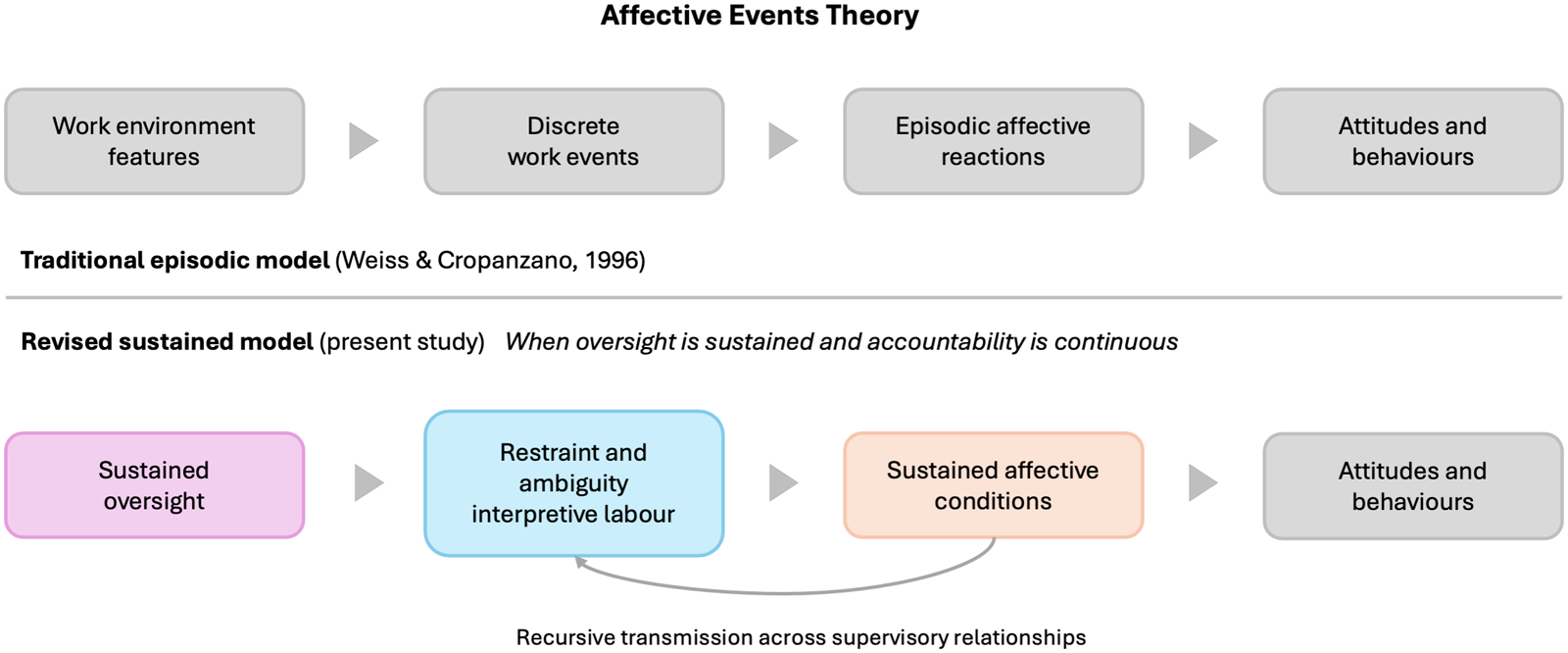
Importantly, this extension does not challenge the central insight of AET that affect matters for work behaviour. Rather, it clarifies how affective experience is structured when work is organised around continuous accountability, evaluative scrutiny, and constrained discretion. Across all three themes, the findings demonstrate that affective experience in such contexts is shaped by sustained conditions, ambiguity, and recursive transmission across roles. Taken together, the findings clarify how affective experience is structured in supervisory contexts characterised by sustained oversight, with implications for the temporal assumptions, emotional cues, and level of analysis embedded in AET (see Figure 1).
Extending Affective Events Theory under sustained oversight.
From episodic affect to sustained affective conditions
AET conceptualises affective experience as episodic, arising in response to identifiable work events and attenuating as those events recede (Weiss & Cropanzano, Reference Weiss, Cropanzano, Staw and Cummings1996). This temporal logic underpins much of the empirical work derived from AET, particularly within person studies that model affective reactions to daily events as proximal predictors of performance, withdrawal, and well-being (Beal et al., Reference Beal, Weiss, Barros and MacDermid2005; Ilies et al., Reference Ilies, Schwind and Heller2007). In many organisational contexts, this assumption is empirically well supported. Taken together, these findings suggest that under conditions of sustained oversight, affective experience may become organised not around discrete events but around enduring relational conditions that shape how subsequent interactions are interpreted within the AET framework.
The present findings identify a boundary condition to this temporal logic. As shown in Theme 1, participants across both employee and manager cohorts rarely described affective experience as rising and resolving around discrete supervisory events. Instead, they described emotional states characterised by vigilance, anticipation, and carryover across interactions, including periods where no interaction occurred at all. Affect was experienced as persistent rather than episodic, shaping how subsequent interactions were approached and interpreted. These patterns are not anomalous cases within the data; they were consistent across participants and roles.
This distinction is not merely semantic. Research on workplace emotion has long recognised that affective experience may carry over beyond discrete events and shape interpretation and behaviour across time, particularly in contexts characterised by uncertainty and role-based demands (Ashkanasy & Humphrey, Reference Ashkanasy, Humphrey, Bryman, Collinson, Grint, Jackson and Uhl-Bien2011; Beal et al., Reference Beal, Weiss, Barros and MacDermid2005). As observed in the present study, affective experience remained active in the absence of identifiable triggering incidents, functioning as a background condition that framed ongoing interpretation, vigilance, and behavioural adjustment. Extending AET to account for this temporal organisation allows the theory to retain its explanatory power while recognising that affective experience may be structured differently when organisational oversight is continuous rather than intermittent (Maitlis et al., Reference Maitlis, Vogus and Lawrence2013).
It is also important to distinguish these sustained affective conditions from stress or burnout. Classic models of burnout conceptualise emotional experience primarily in terms of depletion, exhaustion, and resource loss (Maslach et al., Reference Maslach, Schaufeli and Leiter2001), while emotional labour research has focused on the costs and outcomes associated with regulating emotional expression (Hülsheger & Schewe, Reference Hülsheger and Schewe2011). In contrast, participants’ accounts in this study centred on ongoing monitoring, anticipatory regulation, and interpretive vigilance oriented towards managing uncertainty and exposure rather than towards recovery from overload. This distinction, grounded in both the data and the literature, clarifies that the present extension of AET concerns the temporal organisation of affective experience rather than its intensity or valence. These patterns therefore differ from chronic stress conditions, as participants described sustained interpretive vigilance and relational monitoring rather than emotional exhaustion or resource depletion.
Drawing on the preceding analysis, the following proposition is advanced to formalise this extension and guide future empirical examination:
Proposition 1: Under conditions of sustained organisational oversight, affective experience persists as a sustained condition shaped by ongoing vigilance, anticipation, and interpretive carryover, rather than arising and attenuating in response to discrete work events.
Restraint, ambiguity, and interpretive labour
AET treats work events as the primary source of affective reactions, with emotional cues typically embedded in observable interactions (Weiss & Cropanzano, Reference Weiss, Cropanzano, Staw and Cummings1996). In many settings, supervisory behaviour provides legible signals that can be readily linked to affective responses. In contrast, the findings reported here indicate that affective experience in oversight saturated contexts is frequently produced through ambiguity and restraint rather than overt behaviour.
As documented in the findings, employees consistently described expending emotional effort interpreting what was not said, delayed, or softened. Research on organisational sense-making and emotion has shown that silence, procedural language, and neutral tone can become emotionally consequential when meaning must be inferred rather than explicitly communicated (Maitlis et al., Reference Maitlis, Vogus and Lawrence2013). In such contexts, interpretation itself becomes ongoing work, with emotional energy directed towards calibrating what can be safely expressed and how supervisory cues should be read (Maitlis & Christianson, Reference Maitlis and Christianson2014). These accounts indicate that affective experience may be generated through interpretive processes even in the absence of discrete affective events.
Managers’ accounts help to contextualise this process. As observed in the findings, managers described deliberately regulating emotional expression in response to accountability demands and defensibility norms. Prior research has shown that emotional restraint is frequently framed as professionalism and necessary leadership practice under conditions of scrutiny and evaluation (Ashkanasy & Humphrey, Reference Ashkanasy, Humphrey, Bryman, Collinson, Grint, Jackson and Uhl-Bien2011; Gardner et al., Reference Gardner, Fischer and Hunt2009). While such restraint may serve organisational aims, it also reduces the availability of relational cues that employees rely on for reassurance and orientation, effectively shifting the burden of meaning-making onto subordinates (Bies, Reference Bies, Cropanzano and Ambrose2015).
Taken together, these patterns indicate that affective experience may be shaped by cues that are subtle, withheld, or procedurally neutral, rather than by overt emotional expression. Ambiguity and emotional restraint operated as mechanisms through which affect was generated and sustained within supervisory relationships, particularly in contexts of continuous accountability (Maitlis et al., Reference Maitlis, Vogus and Lawrence2013). This observation aligns with research on emotion regulation and emotional labour, which has documented the ongoing management of emotion as a feature of organisational roles (Grandey, Reference Grandey2000; Hülsheger & Schewe, Reference Hülsheger and Schewe2011), while adding empirical specificity by showing how such regulation gives rise to sustained interpretive labour that is itself emotionally consequential.
Accordingly, a second proposition is advanced:
Proposition 2: In supervisory contexts characterised by sustained oversight, emotional restraint and ambiguity generate affective experience through sustained interpretive labour, even in the absence of discrete, identifiable affective events.
Affective transmission and recursive effects across roles
AET is most often operationalised at the individual level, modelling how discrete work events shape an individual’s affective experience and subsequent behaviour (Beal et al., Reference Beal, Weiss, Barros and MacDermid2005; Weiss & Cropanzano, Reference Weiss, Cropanzano, Staw and Cummings1996). The findings reported here indicate that, under conditions of sustained oversight, affective experience was not confined to individual actors. Participants described emotional pressure as moving through organisational hierarchies, shaping behaviour even in the absence of direct supervisory interaction. Employees experienced this pressure as travelling downward through layers of authority, while managers described accountability as a persistent condition that had to be absorbed and redistributed through supervisory practice.
Across accounts, affective transmission was not framed as deliberate or intentional. Rather, it emerged as a routine feature of supervision within accountability driven environments, where emotional restraint and role-based responsibility shaped how pressure was managed and conveyed. As affect was absorbed, regulated, and passed on across roles, emotional experience became relational and cumulative, extending beyond event-reaction sequences tied to specific interactions.
This pattern has important implications for AET’s individual level emphasis. When affect is produced, regulated, and transmitted across roles, emotional experience cannot be fully understood as an individual response to discrete events, but instead emerges through relational processes within organisational contexts (Zhang, Voronov, Toubiana, Vince & Hudson, Reference Zhang, Voronov, Toubiana, Vince and Hudson2024). Recognising recursive affective transmission clarifies why emotional conditions may persist even when individual actors attempt to regulate or contain emotional expression.
A third proposition follows:
Proposition 3: Under conditions of sustained oversight, affective conditions circulate recursively across supervisory relationships as emotional pressures are absorbed, regulated, and transmitted across hierarchical roles.
Implications for supervision research
The findings also refine how emotionally consequential supervision is conceptualised (Groth, Bindl, Wang & van Kleef, Reference Groth, Bindl, Wang and van Kleef2024). Much of the supervision literature focuses on observable leader behaviours and their effects, including destructive or abusive supervision (Chan & McAllister, Reference Chan and McAllister2014; Tepper, Reference Tepper2000). The present findings indicate that in oversight saturated contexts, emotionally consequential supervision may be less visible and more ambiguous, with restraint and procedural defensibility narrowing relational cues.
As demonstrated across the findings, emotional impact did not require hostile intent or overt mistreatment. Instead, sustained affective conditions arose through ambiguity, restraint, and recursive transmission. This suggests that models of supervision that rely exclusively on behavioural markers may underestimate emotional impact in contexts where meaning is produced through absence, delay, and controlled expression. Recognising temporality, ambiguity, and interpretation as central features of supervisory experience expands the conceptual space of supervision research without collapsing it into intent-based models.
From a managerial perspective, the findings suggest that organisations operating under sustained oversight may benefit from actively reducing the interpretive burden placed on employees. This may involve clarifying evaluative expectations, communicating supervisory intent more explicitly, and acknowledging the relational consequences of emotional restraint in leadership practice. In oversight intensive environments, employees frequently attempt to infer meaning from tone, silence, or procedural communication. Managers who provide clearer explanations of decision rationales, signal support more explicitly, and differentiate compliance requirements from evaluative judgement may reduce the interpretive labour experienced by employees while still maintaining regulatory defensibility, an approach that reflects what might be described as defensible expressiveness in supervisory communication.
Limitations
The extension of AET developed in this paper is grounded in phenomenological evidence from supervisory contexts characterised by sustained oversight, continuous evaluation, and constrained discretion. The findings indicate that affective experience is organised differently in such environments than in settings structured around discrete interpersonal events. The contribution therefore specifies the conditions under which AET’s event-centred temporal logic is most likely to be strained, without proposing a general reconfiguration of the theory. In addition, the use of Critical Incident Technique may have encouraged participants to initially frame their experiences in event-based terms. However, participants frequently expanded these accounts to describe affective conditions that extended beyond discrete incidents, suggesting that the episodic prompts functioned primarily as narrative entry points rather than constraints on how experiences were ultimately interpreted.
Across participants’ accounts, affective experience persisted beyond individual encounters and was carried across time through vigilance, anticipation, and sustained interpretive effort, shaped by regulatory deadlines, auditability, and norms of defensibility. The extension is most salient in environments where accountability is continuous and supervisory discretion is institutionally moderated. In contexts characterised by higher discretion or fewer evaluative pressures, affective experience may remain more episodic, consistent with AET’s original assumptions (Beal et al., Reference Beal, Weiss, Barros and MacDermid2005; Weiss & Cropanzano, Reference Weiss, Cropanzano, Staw and Cummings1996).
The findings are further bounded to supervisory relationships marked by procedural communication and emotional restraint, where ambiguity shifts the burden of meaning-making onto employees. In settings characterised by greater relational openness and less continuous evaluation, the affective dynamics documented here are likely to be attenuated. The extension therefore applies most directly to supervision under formal oversight rather than to leadership interaction more broadly.
The recursive transmission of affect observed in this study reflects the hierarchical organisation of work in the empirical setting. Affective conditions circulated across roles and returned in altered form through supervisory chains, shaped by differential experiences of accountability across organisational levels. In flatter organisational forms, such recursive dynamics may not occur.
Several limitations follow from these boundary conditions. The study relies on retrospective accounts that privilege meaning-making over momentary affective fluctuation, and the highly regulated empirical setting limits direct generalisation. Future research employing longitudinal or experience sampling designs, and comparative studies across other oversight-intensive domains, would further clarify the scope of the extension proposed here. The empirical setting within the Australian financial services sector may also reflect institutional and cultural dynamics specific to that context; future research could examine whether similar affective patterns emerge in other oversight intensive domains such as healthcare, technology governance, or public administration.
Taken together, these boundary conditions and limitations reinforce the paper’s central contribution. The extension of AET articulated here is contextually specific and theoretically precise, refining the theory’s scope while preserving its core explanatory strengths.
Future research
The extension of AET articulated in this study points to several directions for future research. Comparative work across different forms of oversight and accountability could help clarify when affective experience remains anchored to discrete events and when it becomes organised as a sustained condition, thereby further specifying the boundary conditions of AET’s temporal assumptions (Ilies et al., Reference Ilies, Schwind and Heller2007; Weiss & Cropanzano, Reference Weiss, Cropanzano, Staw and Cummings1996). Future studies could also examine the microprocesses of interpretive labour in greater detail, including how employees learn which cues are salient and which interpretations are socially viable under conditions of defensibility and ongoing evaluation (Maitlis & Christianson, Reference Maitlis and Christianson2014). Future research could also examine these dynamics using quantitative approaches, such as experience sampling designs, to explore how sustained affective conditions evolve across supervisory interactions over time. In addition, research designs that capture affective dynamics across organisational levels would enable closer examination of how emotional experience is transmitted and reinforced across roles, moving beyond linear event reaction sequences to account for recursive processes embedded in supervisory practice (Voronov & Vince, Reference Voronov and Vince2012).
Conclusion
This paper examined how affective experience unfolds within supervisory contexts characterised by sustained oversight, continuous accountability, and constrained discretion. Drawing on phenomenological evidence from employees and managers operating in such environments, the study shows that affective experience is frequently organised as a sustained condition rather than as episodic reactions to discrete work events. Across the findings, affect persisted beyond individual interactions was produced through ambiguity and emotional restraint, and circulated recursively across roles. Together, these patterns clarify the conditions under which the event-centred logic of AET is strained.
The paper’s contribution lies in refining, rather than replacing, AET. By specifying boundary conditions related to temporality, emotional cues, and level of analysis, the study extends AET’s explanatory reach to oversight-saturated settings where affect is sustained, meaning must be inferred, and emotional consequences emerge without overt events. In doing so, it preserves AET’s central premise that affect matters for work behaviour while clarifying how affective experience is structured when work is organised around continuous evaluation and defensibility.
More broadly, the findings demonstrate the importance of attending to how supervision is experienced under contemporary forms of governance. When emotional expression is constrained and accountability is ongoing, affective experience becomes less visible yet more persistent, shaping interpretation, anticipation, and engagement over time. From a practical perspective, the findings suggest that organisations operating under sustained oversight should be attentive to the interpretive burden placed on employees within supervisory relationships. When accountability pressures constrain managerial communication, employees may rely more heavily on subtle cues such as tone, silence, and responsiveness to infer intent. Organisations may therefore benefit from supporting managers in communicating expectations more explicitly and in balancing regulatory defensibility with relational transparency. Such practices may help reduce the interpretive labour experienced by employees while maintaining oversight requirements. By grounding theoretical refinement in lived experience, this study contributes to ongoing efforts to adapt foundational theories of workplace emotion to contemporary organisational realities.
Acknowledgements
The authors thank the research participants for their openness and candour. This research was supported by the Australian Government Research Training Program (RTP) Scholarship.
Conflicts of interest
The authors declare none.
Dr. Cathrine Frost holds a PhD in organisational behaviour from Edith Cowan University. Her work examines leadership, supervision, affect, and institutional oversight in regulated environments. Her research focuses on how emotional experience is structured under contemporary governance conditions.
Dr. Andrei Lux holds a PhD in Management from the University of Otago Business School. His research focuses on authentic leadership, follower outcomes, and cross-cultural values in organizational contexts. He is the founder of the Leadership & People Research Cluster at Edith Cowan University and serves as an Associate Editor for the Journal of Management & Organization.
Professor Peter Galvin is Associate Dean (Research) in the School of Business and Law at Edith Cowan University. His research spans strategy and management, with interests in dynamic capabilities, firm boundaries, and modular architectures. He has published widely across leading management journals and previously served as Editor-in-Chief of the Journal of Management & Organization. He holds a PhD from the University of Western Australia.

 Open access

