


Introduction
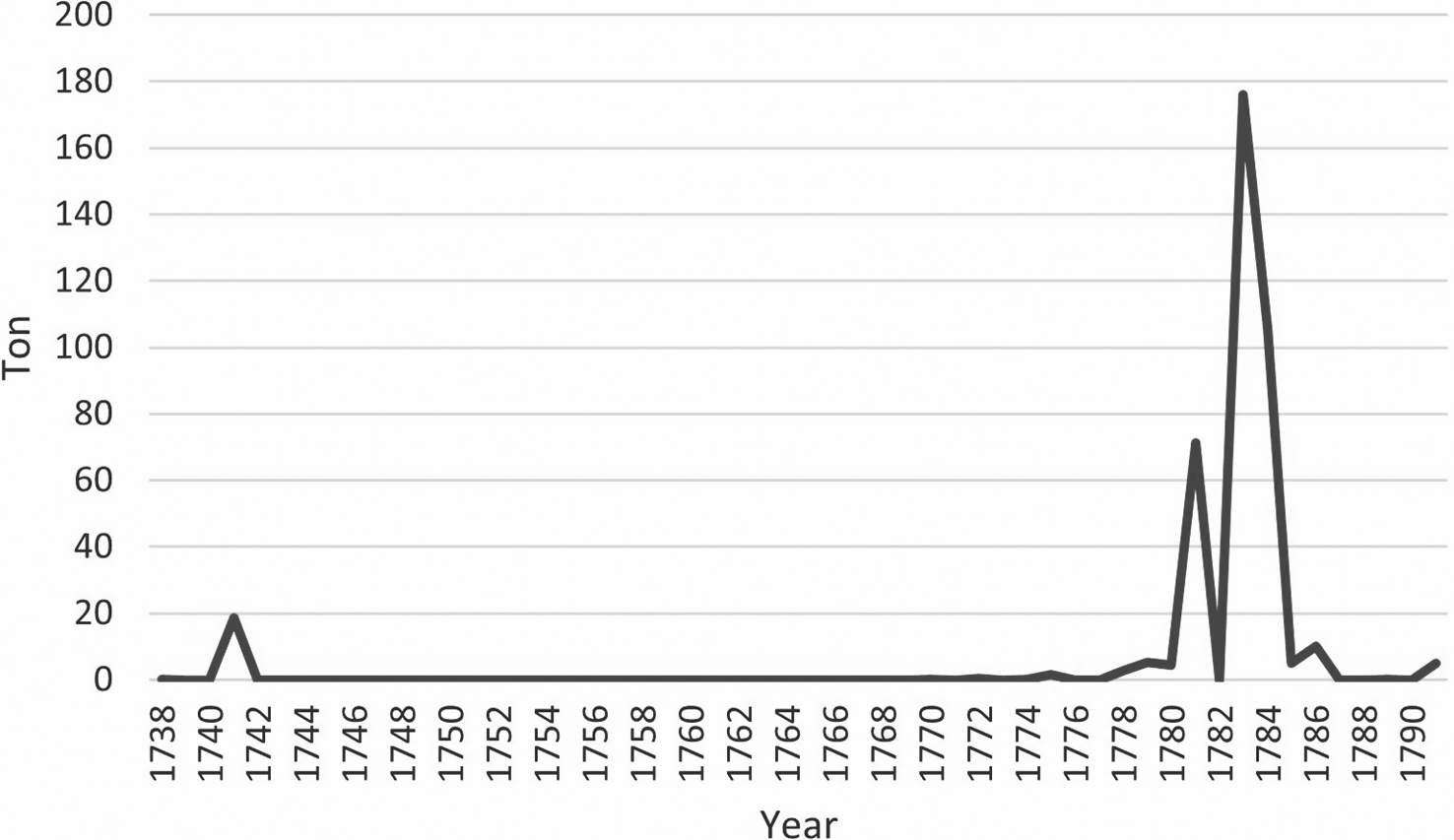
In the eighteenth century, the Swedish trade balance relied heavily on metal exports, primarily iron but also copper. To increase revenue, the government and metal producers constantly sought new markets and niches for their products. One such potential market was Spain. For a long time, however, little happened: in 1741, Sweden exported about 20 tons of copper products to Spain and then almost nothing for several decades (Figure 1). In the 1750s, a Swedish trade report even dismissed the idea of exporting copper to Spain.Footnote 1
Swedish copper exports to Spain, 1738–1791.Source: Riksarkivet, Kommerskollegium, Kammarkontoret, Generalpersedelextrakt, Årsberättelser utrikeshandel serie 2, 1738–1791

Then there was a significant change. In 1781, 1783, and 1784, almost 370 tons of copper products went to Spain—primarily to Cadiz but also Ferrol.Footnote 2 Most of it (354.4 tons) was thin copper sheet to sheathe the hulls of the Spanish navy’s ships.Footnote 3 Thanks to these three years, Cadiz ranked seventh among export destinations for Swedish copper in the entire eighteenth century. Just as suddenly as it started, exports dried up in 1785.
This article considers this dramatic shift in global resource flows in the eighteenth century. We analyze consuls’ impact on commodity chains by using a microhistorical perspective on how goods were produced and transported, which processes and agents facilitated that, and how people solved credit-related issues. Although there is plenty of data about their economic function, there has been little interest in consuls who actively participated in large-scale, long-distance trade. The article contributes to the study of global commodity chains as well as that of consuls by combining the two fields. As we show, consuls were crucial for Spain’s ambitions to keep up in the naval arms race. This era of Spanish military history cannot be understood without consuls and their role in handling sudden demands in a slow-moving system.
Previous Research
In the eighteenth century, global and interregional trade continued to intensify. More and more goods and people crossed the seas for profit.Footnote 4 One of the significant and largely unanswered questions in early modern historical research concerns the practical prerequisites for international trade. How was demand in distant markets around the globe linked with producers at the other end of the commodity chain, defined as “a network of labor and production processes whose end result is a finished commodity.”Footnote 5 The literature is emphatic about the complex, changing nature of commodity chains, though previous research has pieced together how certain types of goods found their way from manufacturer to customer, such as linen from Silesia, glass beads from Venice, and metals from Sweden and Great Britain.Footnote 6 We know less about the trade facilitation dynamics when war, politics, or technological innovation changed the conditions for global trade.Footnote 7
It seems likely that consuls were important in making global commodity chains work, so the institution has gained much scholarly attention in the past two decades.Footnote 8 In tandem with economic developments, the number of both consulates and states employing consuls rose. Predominantly stationed in port towns, a consul was an official representative who helped the subjects of his employer government by sharing information, safeguarding trade, assisting the diplomatic service, and helping people who needed legal, financial, or medical assistance.Footnote 9
Yet, the literature cannot agree whether consuls provided any economic function of note. Some argue consuls created the trust necessary for long-distance trading operations, providing merchants and producers with vital information through reports and letters.Footnote 10 Consuls also protected goods and ships by defending the rights and privileges of their merchant marine. This was an important service in the eighteenth century, when France and Great Britain’s global rivalry caused havoc in maritime trade in times of war. It then fell to diplomats and consuls to negotiate the release of ships, goods, and sailors.Footnote 11 Other studies have yielded more negative results. Merchants operating in foreign places could manage their affairs without involving consuls. In Cadiz, for example, the Genoese instead sought to become naturalized in order to further their interests in the colonial trade.Footnote 12 The Swiss managed without consuls altogether.Footnote 13 Moreover, even when consuls were treated as the leaders of foreign nations they formally were, they faced the near-impossible task of obstructing a receiving state set on curbing foreign economic influence. As Recio Morales shows, the tenacious defense of French privileges by its consuls in Spain was in vain when the Spanish authorities set out to end the French dominance of Spanish commerce.Footnote 14 Other scholars have emphasized that consuls tended to prioritize their personal interests or interest groups, so consuls and their networks are rather to be viewed as rent-seekers or, at best, suboptimal providers of public goods.Footnote 15 Even scholars positive to the institution of consul view self-interest as something that could prevent consuls from fulfilling their economic function.Footnote 16
There were four reasons why outcomes varied. First, consular posts gave holders considerable room for maneuver, as oversight was almost impossible because of the long distances involved. The consuls’ personal characteristics and interests were contributory factors. Second, the disparity reflected the complex reality facing consuls. There were no multilateral treaties regulating their position, while the nature of trade and the commercial and legal infrastructure varied from place to place. The situation was further complicated by bilateral treaties and privileges grounded in custom, meaning that different nations could enjoy different rights in the same port town. Third, the state of the art is lacking in dialogue, often because of language barriers. Although we need to account for the fact that consuls exercised their duties under varying conditions, historians lack the methods and theories to accommodate contrasting results. Fourth, and crucial to this article, scholars mainly focus on consuls as trade facilitators for others by offering information or protection and fail to address evident cases of consuls acting as contractors or entrepreneurs. Plainly, consuls could be involved in both the production and transport of goods in their home country and where they were posted, and their office provided them with certain advantages as contractors. True, most consuls did not take on contracts for foreign governments, and some states forbade consuls from commercial activities altogether.Footnote 17 Other nations, nonetheless, encouraged consuls to participate in commerce and some, like Sweden, even authorized them to act as affiliated merchants.Footnote 18 Thus, it is crucial to include this aspect when analyzing consuls’ economic importance, as they could very well get involved in commerce.
The literature on early modern state formation emphasizes how private contractors supplied key resources and services, especially to the armed forces.Footnote 19 The services that consuls provided in these instances not only had economic effects but also were part of the state formation process. Admittedly, previous research has noted that consuls took on contracts. The Swedish consul in Algiers ran a gunpowder factory in the early nineteenth century; the Swedish consul in Tunis in the mid-eighteenth century supplied the bey with cannons; the Swedish consul in Sardinia in the mid-eighteenth century ran government mines and was involved in lead, silver, and salt production; and the Spanish and Imperial consuls in Cadiz and Trieste supplied the Spanish military with supplies, arms, and shipbuilding materials.Footnote 20 However, the literature rarely discusses how consuls combined their contractor and consular roles or why it was such a potent combination.
One important exception is Klemens Kaps’s work on Paolo Greppi, the Imperial consul in Cadiz, who tried to acquire contracts to supply the Spanish navy with copper and quicksilver. Kaps mentions such factors as Greppi’s connections with the Habsburg court that facilitated export licenses for large quantities of copper, the desire of the Habsburgs to increase metal exports, Greppi’s father’s well-established and extensive Mediterranean trade network, and his connections in Cadiz, where one of the Spanish navy’s main naval bases lay.Footnote 21 While this is valuable because Kaps highlights the factors that enabled consuls to try to acquire government contracts, it warrants further study. First, Kaps does not focus on the practical logistics and the commodity chain’s coordination. The large amount of copper the Spanish navy requested required some influence over the production planning and logistics. In other words, we also need to know how intermediaries such as consuls successfully intervened in the commodity chain. Second, such trade deals were struck in a transnational context. where several processes were in motion simultaneously, not only the exporting nation’s determination to increase its volume of trade. When analyzing the role of consuls, all the relevant structural factors and processes should be included.
The Case Study, Method, and Sources
For this article we concentrate on the case of a Swedish consul in Cadiz, Hans Jacob Gahn (1748–1800), who delivered copper sheets to the Spanish navy between 1780 and 1784. The deal resulted in a brief but substantial shift in trade patterns. We link the Spanish government’s frequent use of contractors with colonial powers’ arms race on the one hand and the Swedish government’s plan to increase copper exports via production reforms and export subsidies on the other. Gahn was a suitable character to facilitate this connection, both because of his position as the Swedish consul in Cadiz and as someone with the necessary contacts in the mining industry.
Objections could be made about the representativeness of our case study. What can five years of copper exports say about commodity chains and consuls? We would counter that its short-livedness is what makes it easier to determine what impact consuls might have on production and export volumes. Moreover, we focus on one transaction and one agent in line with the microhistorical approach. Since its advent as a historical method, microhistory, the study of singular episodes or persons, has successfully been employed to uncover general or larger patterns of actions, ideas, and mentalities as well as people’s agency within these structures.Footnote 22 Microhistory is eminently well suited to pinpoint Gahn’s impact on such large-scale economic volumes and trends as the spike between 1781 and 1784 (Figure 1).
The microhistorical method means that the present study, as Levi has it, is “essentially based on the reduction of the scale of observation,” which de Vries says “allows for a meticulous reconstruction of events and relationships.”Footnote 23 A central part of microhistory is source pluralism and connecting information from different types of sources to fill gaps and make connections that otherwise remain invisible, or what Levi calls reading “beyond the edge of the page.”Footnote 24 We have used different types of sources—private letters, consular reports, production and export data, notarial records, and so on—from eleven different archives in Sweden and Spain.
Ultimately, the purpose of zooming in on a varied collection of sources is to bring to the fore the important features and actions that otherwise might be missed: the significance of place and agency, for example, or the practices and relationships that underpinned commercial exchanges of this kind—in other words, the everyday business of large-scale transactions and commodity chains.Footnote 25 The microhistorical method means it is possible to analyze Gahn as an agent working in a range of local, national, and international contexts where production, trade, distribution, political decisions, and diplomacy had repercussions on all three levels. Microhistory allows us to explain and understand the much larger story.
We have pieced together pieces of information to reconstruct the events terms. For sources of a more formal character, such as reports, notarial deeds, and statistics, we have relied primarily on the Swedish National Archives, the Provincial Historical Archive of Cadiz, and the Swedish mining industry archives held by Archive Centre Dalarna. We have also made use of other material, including private correspondence, found elsewhere, and of Fredrik Clason’s genealogy of the Gahn family, published in 1950—Clason had access to sources no longer available.
In some instances, we have had to rely on deductions based on context provided by the literature or our own findings. Gahn was a successful merchant and contractor of note who is a relative unknown in Swedish historiography.Footnote 26 Spanish historians have focused on his lumber deliveries to the Spanish navy in the 1790s; his deliveries of copper in the early 1780s are merely mentioned in passing.Footnote 27 The present study adds new knowledge about a key agent whose enterprise increased commercial ties between southern and northern Europe. Sadly, Gahn’s correspondence on the subject does not survive, so his thoughts and plans for this period are lost to us. Instead, we have had to recreate his actions and likely considerations.
We begin by looking at market conditions, why the Spanish navy was desperate to source copper, and why the Swedish copper industry was able to provide it. We then analyze Gahn as an entrepreneur to understand why he won the contract, focusing on his background and connections in Cadiz and Sweden. Third, to further illustrate the magnitude of this type of transaction, especially the minutiae involved and the contacts Gahn had to draw on, we follow the production of copper from the smelters and refineries in Sweden via Stockholm and the Øresund to the financing and delivery of the copper sheets in Spain. We conclude with how the nature of Gahn’s involvement changed over time.
Market Conditions
The Demand for Copper Sheathing
The international market for thin copper sheets expanded dramatically in the 1770s when it became the British navy’s metal of choice to sheath the hulls and rudders of their ships operating in tropical waters. Consequently, British ships required less maintenance because of damage caused by shipworms, and clean hulls meant they could travel faster. The market first took off when the British navy went over to copper sheathing, but it skyrocketed when British slave traders took to it in the early 1780s.Footnote 28 Other colonial powers such as Spain and France followed suit. The Spanish had previously avoided importing copper; now they had to if they wanted to compete in the arms race.Footnote 29
The Supply in Sweden
Sweden was well placed to supply copper for two reasons. First, there were many Swedish ships available for cargo destined for Spain, and the volume of directly exported goods, such as iron, timber, and the like, to southern Europe was on the rise.Footnote 30 This trend was in turn part of an intensification of the eastern and northern European trade with the Iberian Peninsula, a development partially driven by the Spanish navy’s appetite for Baltic naval stores.Footnote 31
Second, Sweden had copper available for export because of geopolitics and domestic politics. To increase revenue, the Swedish government had prioritized copper production, and in the second half of the eighteenth century its main export markets were Rouen, Lübeck, and Copenhagen (Cadiz would eventually rank seventh).Footnote 32 Exports began to rise after the Seven Years War (1756–1763) and took off in the late 1770s, and there is much to suggest this was because more Swedish copper was available for export: after decades of decline, production rose in the 1770s and 1780s from 750 to 1,200 tons per annum as the Swedish government invested heavily in new mining projects, production facilities, and the like. At the same time, domestic coin production decreased—the coinage had long been copper basedFootnote 33—and freed up more copper for export. The Swedish government also began offering export premiums and avoided armed conflict until 1788, which mattered because war almost always affected its copper exports negatively.Footnote 34
In other words, when the international demand for copper sheets increased, Sweden was well placed. In the early 1780s, Portugal imported 70 tons and France 427 tons while Spain imported about 370 tons.Footnote 35 This feat was even more impressive considering both Portugal and France had a history of importing Swedish copper, whereas Spain did not.
Gahn the Entrepreneur
Why was Gahn in particular able to secure the copper contract? Gahn and his background, his connections in Sweden and Cadiz, the role of Cadiz as an information node, and his ability to utilize his consular position were all factors. We analyze consuls as businessmen or entrepreneurs, drawing on Casson, Pfeilstetter, and Knight to focus on two things: information and social networks. Gahn’s ability to use information was evident, and, despite information volumes and networks increasing in the eighteenth century, fresh information remained a rare commodity given the relative slowness of communications.Footnote 36 Second, there was Gahn’s ability to create and maintain social networks.Footnote 37
Gahn’s Background and First Years in Spain
Regardless of how Gahn managed to get the contract, the hardest part would be how to produce the requested copper and freight it to Spain. Gahn was well placed for this undertaking.
From the literature, we know that Gahn came from a family with roots in Sweden’s seventeenth-century metal industry. His grandfather founded an iron mill and both he and Gahn’s father were regional government officials. Two of his sisters married mill owners and his brother, the chemist Johan Gottlieb Gahn, had a central position in the mining industry: since 1770 he had worked in Falun, the hub of the Swedish mining industry, and he served on the national Bergskollegium (Board of Mines), where he made a distinguished career for himself. Another brother, Henric Gahn, served as a doctor in the Swedish navy and was a member of the then nongovernment Collegium Medicum (Board of Medicine).Footnote 38 Gahn had connections in different parts of the Swedish administration, especially at the all-important Board of Mines and among the Swedish metal industry.
In addition to his connections in the mining and metal industry at home, Gahn established important networks in Spain. According to a prosopographical study of Swedish consuls, Gahn started his career in the Swedish central administration but began a leave of absence starting in August 1771.Footnote 39 He took up the post of consul in 1773, so the question is what he did during the two-year gap in the Swedish sources. Thanks to his application to the Spanish king to be recognized as a consul, we know more, as the local governors had to provide information about every consular candidate’s personality and background.Footnote 40 On his arrival in Spain in 1771, he served in the illustrious trading house of Rey Brandenburg y Cía (Rey & Brandenburg), a firm dedicated to the colonial trade, the supply and production of lumber and naval stores, and providing loans to shipmasters.Footnote 41 Of the owners, Guillaume Rey was French and Johan Fredrik Brandenburg, the Russian consul in Cadiz, was Swedish.Footnote 42 Crucially, they worked with the Spanish navy, providing services and delivering material from the Baltic, as a recent study of naval contractors has shown.Footnote 43 This type of trade seemingly required a hands-on approach, as we know from the trading house’s conflict with several Swedish merchants Rey visited St. Petersburg in 1768 to acquire naval stores for the Spanish navy.Footnote 44 Working for Rey & Brandenburg gave Gahn experience in how to organize the commodity chains necessary for the types of government contracts he would go on to win.
In addition to Rey & Brandenburg, there were two other Swedish trading houses in Cadiz when Gahn arrived: the Böhl Brothers and one belonging to the vice consul Anders Hagström.Footnote 45 While Gahn seems to have had little to no contact with the Böhls, he maintained good relations with Brandenburg and Hagström, despite beating both men to the consulship in 1773: Hagström acted in Gahn’s place in 1777 and 1778 and Brandenburg acted as a witness at Gahn’s marriage.Footnote 46 As we will see, these relationships were important for Gahn when he got the navy contract.
The Cadiz Consulate
In addition to his contacts in Sweden and Spain, it was to Gahn’s advantage that when the position of Swedish consul opened up in 1773 he was the best option. The previous consul, Dreyer, had been recalled because he had mismanaged his office and was embroiled in a conflict with Hagström. Hagström had served both Dreyer and his predecessor, but his role in the conflict disqualified him.Footnote 47 Meanwhile, Brandenburg’s Russian consulship disqualified him because of the geopolitical rivalry between the two nations.Footnote 48 Gahn won the post. With it came some entirely new commercial possibilities, both because of the consulship per se and because of Cadiz itself.
Situated in the southwest of Spain between the Atlantic and the Mediterranean, Cadiz was an important trading node in the eighteenth century and served as the primary port of import for Spanish colonial goods, connecting the Americas, the Mediterranean, and northern Europe.Footnote 49 Cadiz was also the site of La Carraca, one of three royal naval shipyards. For Swedish purposes, Cadiz was also important as a stopover for its East India ships and for Swedish convoy ships, being at the intersection of the Atlantic and the Mediterranean, and as a salt market—Swedish ships without return cargoes put in at ports such as Cadiz to load up with salt before heading home. Consequently, a great deal of traffic and information came Gahn’s way. He or his assistants met every Swedish ship, from East Indiamen to regular merchant ships and warships, when it anchored in port. As diaries, travelogues, and memoirs show, senior officers and officials socialized with the consul, even staying in his home while on business in the city.Footnote 50 Müller’s study of shipping lists from the period reveals that most Swedish ships that put into Cadiz used him as their commission agent.Footnote 51
Gahn’s correspondence was also a factor. A key consular task was to send information home to the various branches of government.Footnote 52 Gahn kept in contact with the Swedish authorities and the embassy in Spain, but he also corresponded with individual members of the Swedish government and bureaucracy. We know this from a complaint in which Gahn bemoaned his lack of instructions, despite his many letters to individual government servants—and he listed them by name so he could claim he had done all he could.Footnote 53 He also corresponded with several trading houses, although we do not know how many. Finding such information is also hard because consuls’ private correspondence was not the Swedish authorities’ business. Thanks to the dispute between Dreyer and Hagström, however, we know Hagström said he kept in touch with about 30 Swedish trading houses—information that comes to us because Hagström wanted to show the Swedish authorities that he was the more skilled businessman who had helped Dreyer establish himself, not the other way around.Footnote 54
Consuls not only were correspondents but also acted as suppliers or middlemen of goods or items for high-ranking members of the Swedish government and even the royal family.Footnote 55 Private correspondence between Gahn and a Swedish merchant called Wahrendorff reveals Gahn arranged transport for the horses the Spanish king gave the Swedish king in 1779, and, according to a letter from Alejandro O’Reilly to the state secretary Funes Villalpando, Gahn helped a group of Sámi and their reindeer disembark in Cadiz in 1777, sent as a gift by the Swedish king.Footnote 56 All of these contacts increased the flow of information that came Gahn’s way and extended his social network in merchant and government circles.
Gahn’s position was not limited to networking with government offices and trading houses in distant places. He also fraternized with Cadiz’s local and regional authorities. Consular reports written by Gahn and other Swedish consuls in Spain in the eighteenth century reveal it was necessary for the execution of their job to interact with the local authorities.Footnote 57 In Gahn’s case, this included the governor of Cadiz and the naval intendant (a local civil servant), meaning he had some insight into the types and quantities of resources flowing into La Carraca.
Lastly, Swedish consuls were positively encouraged to engage in trade. Their job was not only to help others but also to trade themselves. The lines between the office and a consul’s merchant activities were blurred at best, but in the Swedish case the distinction was even more unclear and perhaps nonexistent.Footnote 58 By extension, the consulate’s merchant activities in important ports such as Cadiz were strongly associated with the Swedish crown by design, and the Cadiz consuls even had to notify the authorities at home if they took on a partner.Footnote 59 This association gave Gahn’s business operation even more weight and credit, which was invaluable when negotiating a contract with the Spanish government.
None of this would have mattered, however, had Gahn not been a highly regarded entrepreneur who could put his contacts and information to good use. His business skill was evident not only from the copper contract but also from the abundant proof that his contacts valued his insight, knowledge, and resourcefulness. He corresponded for many years with the Spanish botanist José Celestino Mutis and helped him build his library in Latin America.Footnote 60 The Hanseatic consul in Cadiz, in his instructions for his replacement, recommended Gahn and the Danish consul as reliable advisors when faced with difficult problems. They were “better than lawyers who only complicated proceedings.”Footnote 61
Our findings from a disparate range of sources corroborate the picture that Gahn’s knowledge and skills were appreciated by his employers and diplomatic superiors. In 1785, he wrote a report for the Swedish government about the possibility of setting up mining projects in the Spanish colonies, and in the 1790s the Swedish government asked for his help to acquire ship masts that they could give as gifts to the Algerian dey.Footnote 62 In 1794, the Swedish envoy described him as someone who should be appointed consul general. Gahn, the envoy wrote, was experienced, skilled, and diligent and was “generally loved and well received.”Footnote 63 In 1775, when the government office in charge of consular business recommended appointing him Swedish consul in Cadiz, it argued that he had been outstanding since he took up his post two years before, as shown by his “well-written reports on the trade of Swedish goods with Spain and the Spanish freight traffic to the Americas.” It added that he had provided an excellent service to merchants, “about which especially the exporters in Gothenburg have praised Gahn, for his knowledge and experience about everything that can promote Swedish trade in Spain, and thereto he has shown such diligence and attention to catering to the concerns of the merchants.”Footnote 64
The Copper Contract
We have no information from Gahn himself about how he secured the copper contract. Almost no consular reports from Gahn survive from this period. There is no information about the copper contract in the archives of the Kommerskollegium (Board of Trade) or the Board of Mines, both of which would have been involved because of their mission to increase foreign trade and metal exports respectively.Footnote 65 What remains are assumptions and connections based on the literature and other sources.
We already know the Spanish navy suddenly needed massive amounts of copper sheathing and that it looked to the Baltic for naval stores. We know the Swedish copper industry stood at the ready to supply copper products. From the literature, we also know the Spanish navy frequently relied on asentistas (contractors) for supplies.Footnote 66 Several people were interested in winning the contract, including Greppi (the Imperial consul) and a Basque merchant called Juan Ignacio de Gardoqui.Footnote 67 Greppi, at the helm of a consortium consisting of Genoese, Milanese, and Spanish trading houses, came close to obtaining the contract, but the number of middlemen involved meant they could not compete with Gahn’s prices.Footnote 68 Greppi eventually secured himself a role as a subcontractor to Gahn.
Gahn was something of a risk taker, a characteristic probably necessary for an undertaking of this magnitude, especially with little prior experience. His brother Henric described him as impatient and hot-headed, borne out by the fact that Gahn, according to Clason, toyed with the idea of using Swedish East Indiamen to take the copper to Spain, escorted by a Swedish naval ship.Footnote 69 Although not a bad idea, it is unclear how Gahn imagined he would persuade the East India Company and the Swedish navy to help him. The lumber contract in the 1790s was another case in point. It was extremely profitable because the ongoing naval conflicts made it so risky. As Sánchez-Diana has shown, Gahn’s solution when the deal fell through was the perhaps even riskier proposal of delivering flour to Venezuela as compensation for his losses.Footnote 70
As revealed by extensive records that survive from the Swedish embassy in Madrid, Sweden’s consuls in Spain collaborated closely with the Swedish diplomatic representative at the Spanish court.Footnote 71 The envoys appreciated Gahn, so much so that in the 1790s the then envoy even recommended that his superiors make Gahn the consul general in Madrid.Footnote 72 Seeing as the negotiations for the copper contract definitely involved the ambassador, this connection was vital. Gahn’s government contacts in Cadiz presumably helped as well. The presence of influential figures, such as the naval intendant, who could vouch for him would have been useful when he eventually bid for the contract, although we do not know for certain if he called on them to do so.Footnote 73
Last but not least, Gahn’s consular correspondence shows he put in a successful request for a lengthy leave of absence in the late 1770s. He returned to Sweden in 1777 and 1778, when he most likely set up the practical arrangements for the first deliveries of copper to Spain, much as members of Rey & Brandenburg, where he trained, had travelled to the Baltic to arrange business. We would suggest this was when he placed the first orders (Figure 4). His request for leave did not mention copper, merely that he wanted to “acquaint himself personally with merchants engaged in foreign trade, especially with Spain, Portugal and the Mediterranean.”Footnote 74 The accounts of the Board of Mines, however, show that Gahn had imported a small batch of copper sheets to Spain in 1775, and a letter from Gahn in March 1776 referred to a small quantity of smideskoppar (processed copper), specially ordered by him and sold at an advantageous price in Cadiz, and which he hoped would lead to further exports.Footnote 75 It may have been a sample intended for the Spanish navy. Regardless, Gahn got in early on the copper sheet boom. He was aware of the commercial potential and was prepared when the opportunity arose.
Production and Freight, 1780–1781
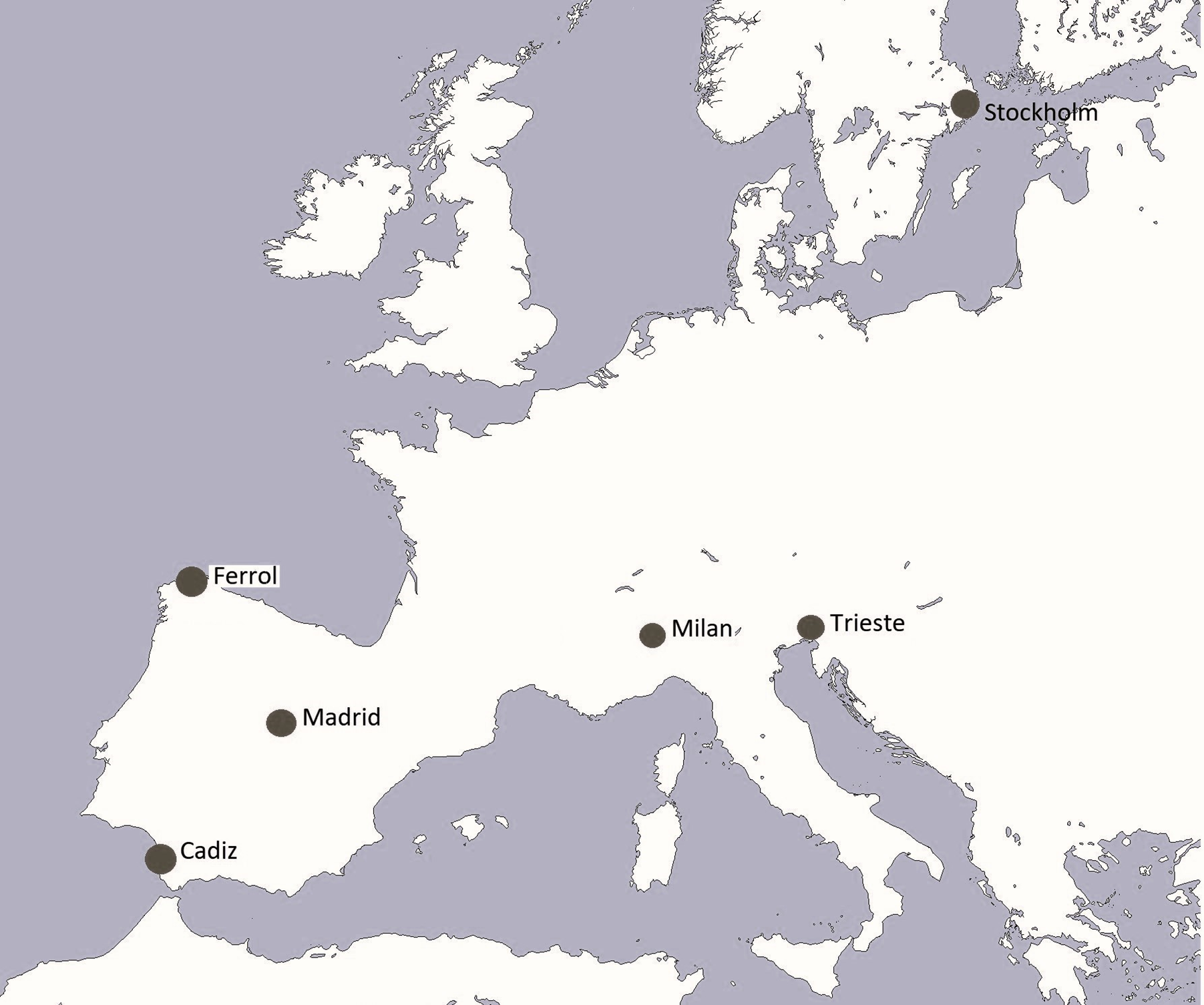
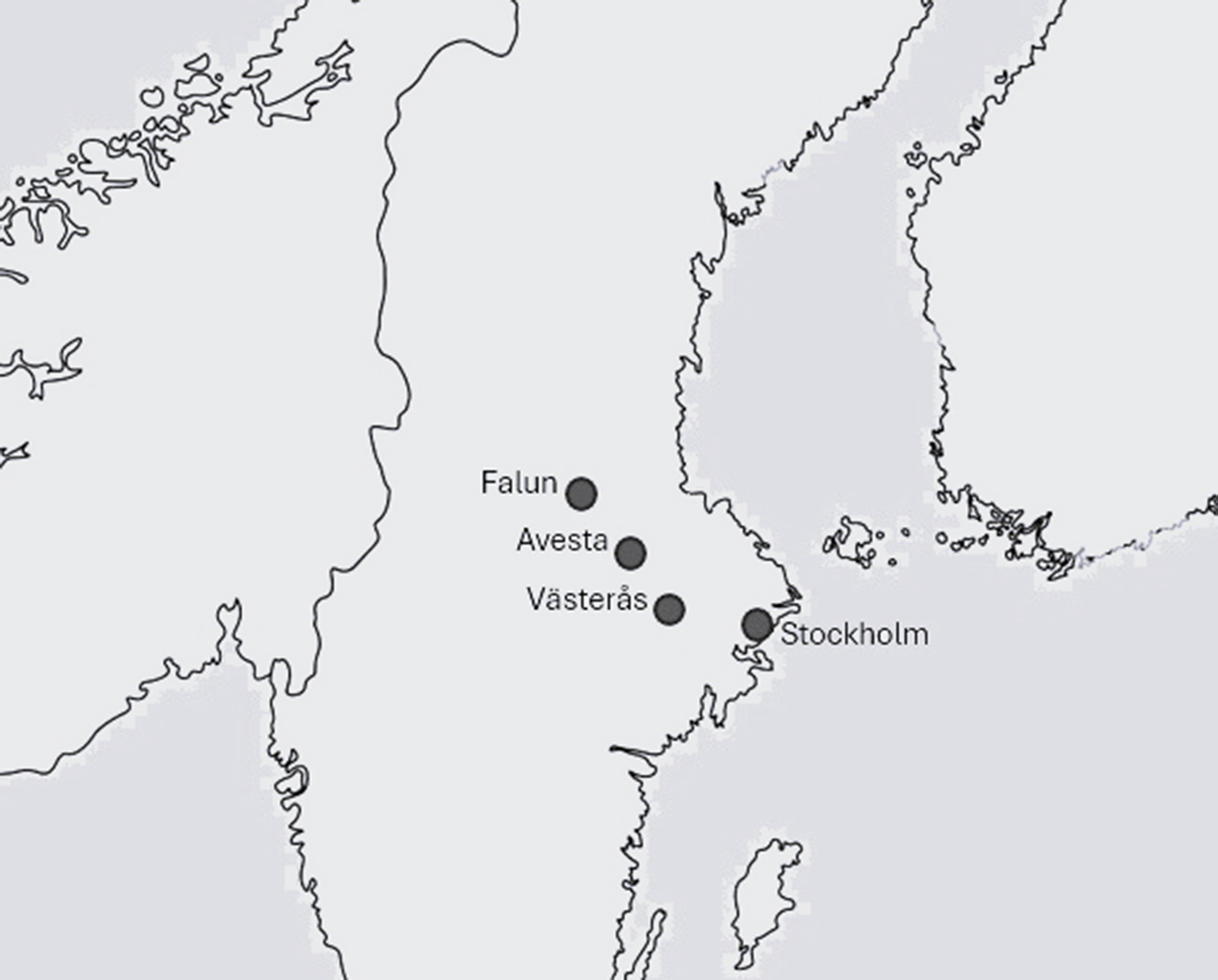
Many factors worked in Gahn’s favor, especially his many connections. We will now turn to how he used not only his contacts in Sweden to produce and transport the copper but also his contacts in Spain to underwrite it. We look at the entire commodity chain to illustrate the scale of the business and how it was carried out and financed. We also show how Gahn eventually restructured his role in the commodity chain and relied more heavily on both Swedish and foreign subcontractors (Figures 2 and 3).
The key places for Gahn’s business.

Mining, metal production, and freight in central Sweden.

Manufacturing and Transporting the Sheets to Stockholm
The copper that would eventually sheathe the hulls of Spanish warships was mined in central Sweden around Falun. Depending on ore quality and the miners’ skill, it took between two and five months to process the ore into raw copper, ready to be transported to the weigh house in Falun. From there, it was sent about 60 kilometers southeast to the copperworks in Avesta, where it was smelted to make refined copper or garkoppar (garcopper) and extracted as copper sheets or items such as coins.Footnote 76 Fortunately for Gahn, the construction of a rolling mill in Avesta was completed in late 1781, just in time to meet increased international demand for copper sheets by almost doubling the production pace.Footnote 77 There were four groups in Sweden who had a use for the copper Avesta produced: the Swedish government, coppersmiths, brass works, and the country’s exporters, mainly the large trading houses in Stockholm. As the importance of copper and brass exports grew, the trading houses acquired a larger share of the copper.Footnote 78
The production chain from mine to finished copper product could take at least six months, and when an order was placed the plant management had to decide whether to prioritize it. Somehow Gahn managed to convince them to prioritize his order and even give it their sole attention, as in October and November 1780: the records of the Avesta copperworks include daily accounts of production and show that all six master smiths at one point or another dealt with Gahn’s order between October 3 and November 8.Footnote 79 Toward the end, almost all the smiths concentrated on Gahn’s order. After about a month, the finished batch consisted of 2,908 copper sheets measuring 65×19 inches, weighing about 127 shippounds, or 18.1 metric tons.Footnote 80 The sheets were then presumably transported overland from Avesta to Västerås and then shipped to Stockholm for export, a ten-day journey.Footnote 81 When that particular batch of copper arrived in Stockholm, it had to wait until 1781 for the sea ice to melt.
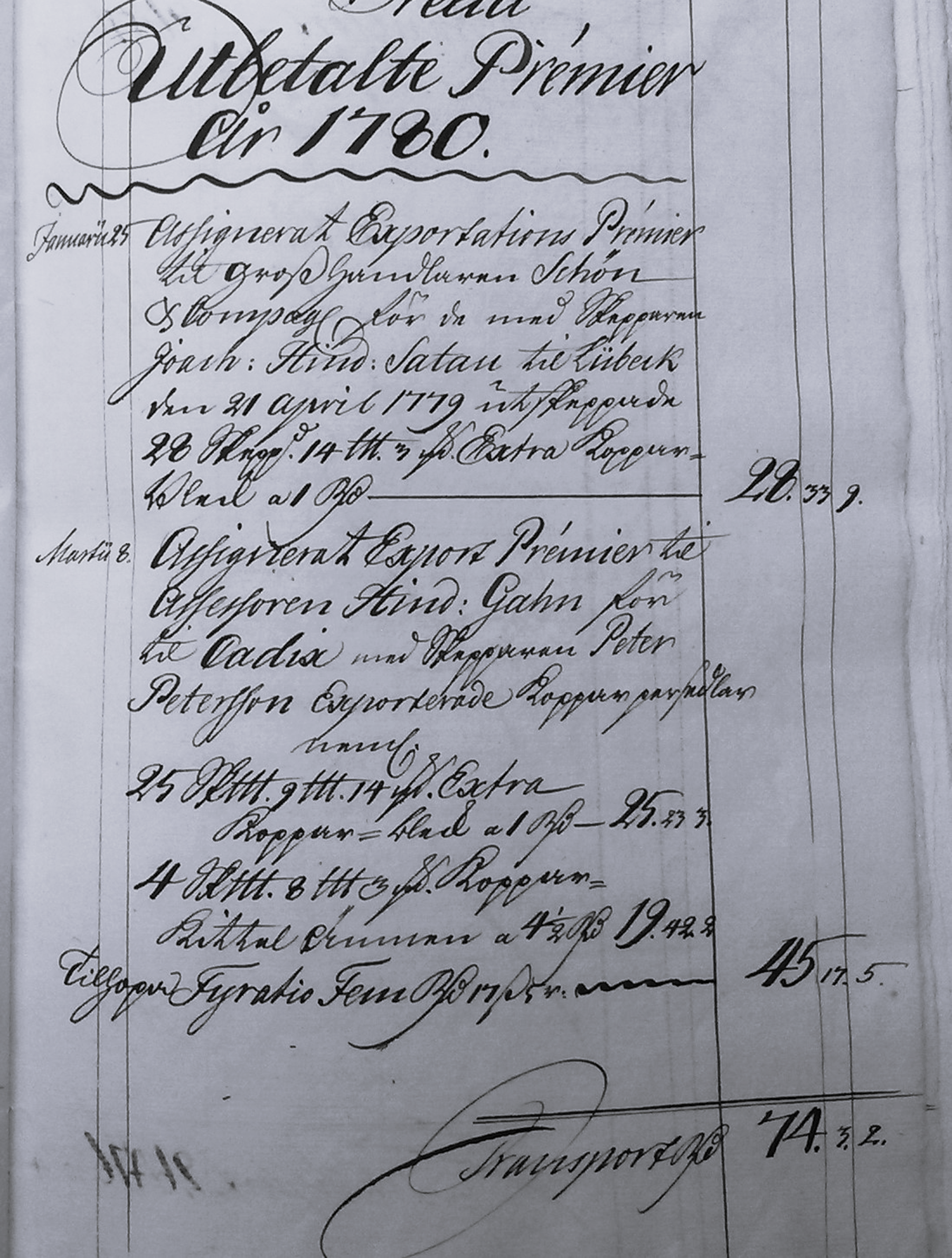
For the oversight of production and freight in Sweden, Gahn relied on a combination of family and trading houses. Gahn’s instructions for managing the production and transport from Falun to Cadiz do not survive, so the network in Sweden he relied on has to be reconstructed from supplementary material and above all the registers of export premiums held in the archives of the Swedish Board of Mines. Introduced by the Swedish government to encourage copper exports, the registers list all who sought and received premiums, thus who in one way or another had helped export Swedish copper.Footnote 82 Among others, the registers record the main players who helped Gahn move the copper from Falun to Spain. Here we find Gahn’s brothers Henric and Johan Gottlieb as well as wholesaler Pomp and Tottie & Arfwedsson, who handled transport abroad. Finally, we also find a certain Henrik Brandenburg, a merchant living in Stockholm.Footnote 83 His presence is noteworthy, as he was the brother of Johan Brandenburg of Rey & Brandenburg, something we would not know were it not for the fact that Henrik wrote his brother’s unsuccessful application for the post of Swedish consul in Cadiz in 1767.Footnote 84 The participation of Henrik Brandenburg strongly hints at a collaboration between Gahn and Rey & Brandenburg (Figures 4).
Export premiums paid on copper exported to Cadiz by Hans Jacob Gahn’s brother Henrik, 8 March 1780. As the production time was at least six months, Hans Jacob Gahn must have placed the order during his stay in Sweden in 1779.
Source: Arkivcentrum Dalarna, Familjegraven F1:2.

Shipping the Copper Abroad
When the copper finally left Stockholm on ships arranged by Pomp or Tottie & Arfwedsson, it spent a couple of months at sea before arriving in Cadiz, perhaps less if the ship made for Ferrol. A random lacuna in the source material in the Stockholm City Archives means we do not know exactly when copper was dispatched or as how many cargos; instead, we have compared the Øresund toll database and notarial records in Cadiz, from which we have identified a few ships that we know carried the copper. In mid-June 1781, Carl Brandt’s ship passed through the Øresund with 500 shippounds of copper destined for Cadiz, and in late October the same year Isak Pålsson also travelled through the Øresund carrying copper. Judging by the notarial records, at least one shipment left Stockholm in February or March 1781 too.Footnote 85
The piecemeal nature of the copper deliveries and long waits meant that Gahn had to extend cash or credit for extended periods of time. The problems did not necessarily end once the copper arrived intact in Cadiz. Pålsson refused to unload his cargo until he received reimbursement for repairs, and Gahn, armed with an injunction to stop him from selling or pawning the copper, ordered him to unload despite his grievances.Footnote 86 Gahn’s stretched and potentially fragile finances called for someone with trust or insight as a backer. The notarial records in Cadiz revealed he initially enlisted Hagström. On February 15, 1781, Gahn went before a notary to request that the Spanish Crown pay him an advance of half the value of the 500 quintals of copper sheets he was going to deliver. If Gahn failed to deliver, Hagström, as the “fiador principal,” would assume full responsibility for reimbursing the Real Hacienda (Royal Treasury).Footnote 87 On July 3, the same year, Gahn again requested an advance of half the value of a delivery, this time of 1,500 quintals of copper sheets. In this instance, Hagström produced the shipment certificate from Stockholm, meaning it had been rushed to Cadiz as soon as the shipment was ready.Footnote 88 In October 1781, Gahn asked for another advance; however, this time his backer was Thomas Gervinais, the owner of Magon Lefer Hermanos, a high-ranking French trading house in Cadiz.Footnote 89
Restructuring and the End of the Deal, 1782–1784
After 1781, Gahn restructured his involvement in the deal to minimize his risk. He started relying on subcontractors or intermediaries and did not submit orders himself. There were no more requests for advances from the Spanish Royal Treasury in the notarial records in Cadiz either. His changed role and the time needed to implement the new plan may explain the lull in deliveries in 1782. Then in 1783 and 1784, 191 and 105 tons were exported from Sweden, one-sixth and one-twelfth of the national yearly production, respectively.Footnote 90
While Gahn continued to rely on his family to an extent, he changed his operations so that Pomp placed orders, as did one Samuel Sandels, who was a senior official at the Swedish Board of Mines. The result was not only that Gahn thereafter placed no orders himself but also that he engineered things so a key player in the Swedish mining industry was actively involved in the deal, guaranteeing its priority in the places where the copper sheets were manufactured. Pomp and Sandels had the running of different parts of the business: Pomp placed the smaller orders for Gahn, which he then transported to Ferrol on his own ships; Sandels handled the larger orders and shipped them to Cadiz via Tottie & Arfwedsson. After Sandels died in March 1784, Gahn’s brother Johan Gottlieb placed the majority of the remaining orders that year.Footnote 91 In addition to the Swedish copper deliveries, Hans Jacob Gahn signed a contract with the Imperial consul Greppi for the delivery of 2,500 quintals, a third of Gahn’s total quota in 1783. The copper was to come from Habsburg mines in Bohemia via Trieste.Footnote 92
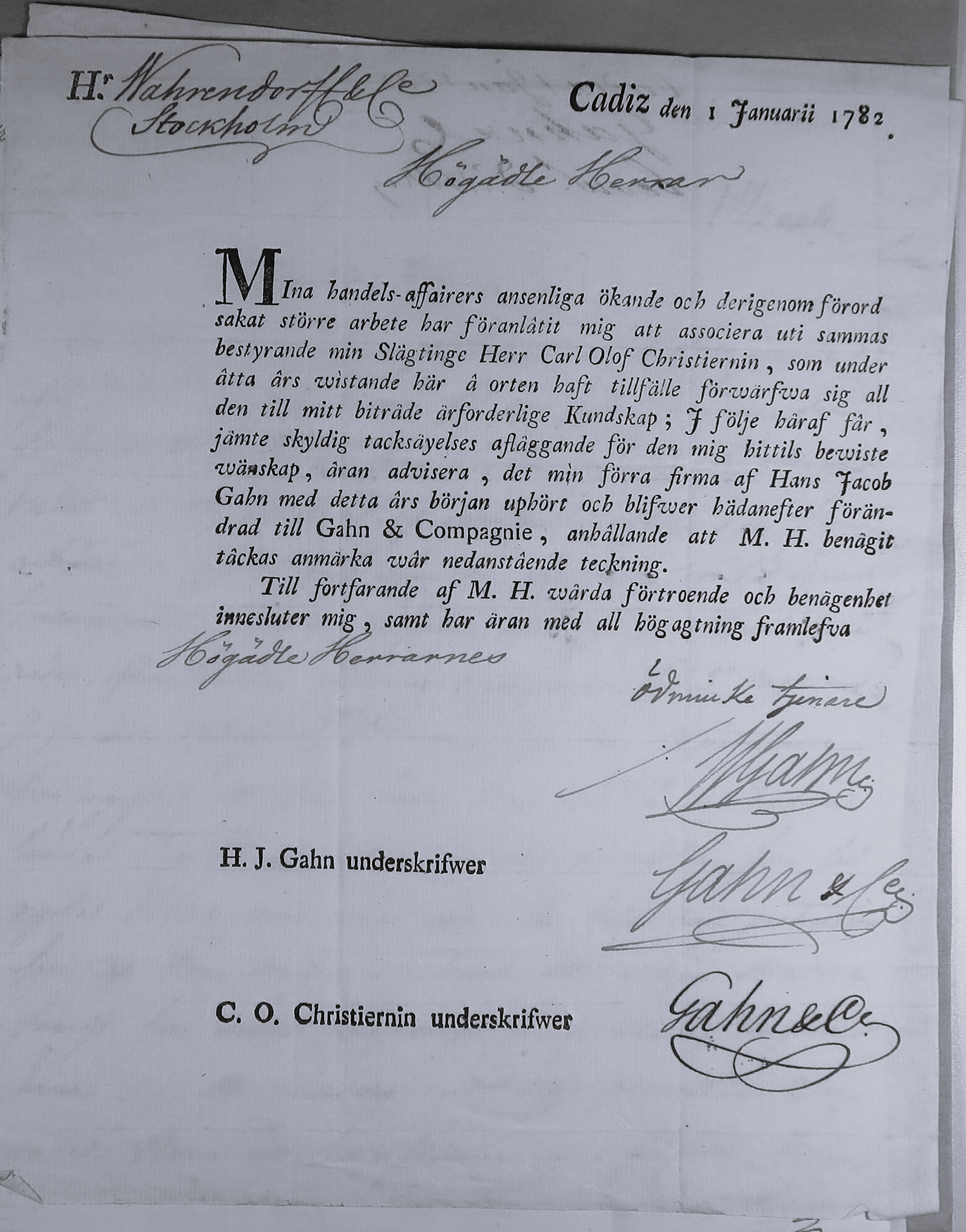
The contract between Gahn and the Spanish navy seemingly lapsed in 1784.Footnote 93 Why Gahn’s involvement ended is unknown. It was unlikely to have been Gahn’s choice, as the deal had enriched him substantially. In his correspondence with Wahrendorff, there is a business circular from 1782 announcing that his business had “expanded so greatly, which had caused him more work and led him to find a business partner” and start a new trading house, Gahn y Cía (Figure 5).Footnote 94
Business circular from Gahn y Cía to Wahrendorff.
Source: Åkers Bruksarkiv, Wahrendorrfska arkivet, B2:236, Gahn till Wahrendorff, 1 January 1782.

It seems the Spanish were casting about for new suppliers. We know that Gahn received complaints in 1783 about ships suffering from corrosion damage caused by the copper, thanks to a note that samples had been dispatched back to Sweden for examination.Footnote 95 At the same time, sheathing hulls with metal was complicated, so it would be simplistic to assume that faulty copper sheets automatically ended the contract.Footnote 96 Whatever the reason, 1784 marked the end of a brief but intense period of Swedish copper exports to Spain, all of it mediated by Hans Jacob Gahn.
Conclusions
This article deals with commodity chains, information flows, agency, and the networks necessary for long-distance trade. The increasing intensity of long-distance trade in the eighteenth century prompts the question of how it was organized and by whom. Consuls were one answer, because they were appointed public servants with political capital and status combined with merchants engaged in large-scale, long-distance trade. In line with previous research, we would suggest it is better to think of consuls who were encouraged to participate in trade themselves, as the Swedish consuls were, as a type of businessmen.Footnote 97 Whereas the literature about consuls focuses on their role as facilitators of trade conducted by others, it is plain their own commercial activities must be taken into account if we are to fully comprehend their economic function.
Consuls were also the answer to how long-distance trade functioned because they, far more than diplomats, were national representatives embedded in a local context. To quote Giles Scott-Smith, “consuls were already native at the time of their appointment, this being an essential aspect of their ability to function between different communities.”Footnote 98 The likes of Gahn had ample opportunity to exploit the pressing demand created by the colonial powers’ naval arms race by simple dint of being “already native.” At the same time, the backing of a foreign state gave Gahn the edge over the local competition. An agent acting in Sweden’s national interest; an operator with access to the workings of the Swedish mining industry; a merchant embedded in Cadiz’s local networks and resource flows: it is impossible to understand Gahn’s success in any one context without taking the others into consideration. Key to it all, however, was Gahn’s consulship.
The impact of consul–entrepreneurs could be dramatic. This one episode in Spanish history cannot be explained without taking consuls like Gahn and Greppi into account. This raises a question as to whether literature has underestimated early modern consuls in terms of economic importance and their ability to actively link production areas with markets. Thanks to the relatively ephemeral character of the transaction, we can fully appreciate Gahn’s contribution. When he acquired the contract, copper exports to Spain boomed. When the contract ended, exports dried up. It is time to acknowledge the degree to which consuls, and by extension the state, could overcome geographical barriers and accelerate global trade.
Acknowledgements
The authors would like to thank Alida Clemente for providing valuable comments on an earlier draft and Manuel Herrero Sanchez for an insightful comment about consuls and industrial production at a seminar in Seville in 2020. The authors would also like to extend their gratitude toward the editor and the three anonymous reviewers who helped us improve the manuscript. The Centre for Privacy Studies, Copenhagen University (DNRF138), provided support during the research process.
Funding statement
Funding for the research in this article was provided by The Swedish Research Council (Vetenskapsrådet), Grant number 2017-06321
Appendix 1 Swedish copper exports to Spanish destinations in tons, 1781–1795

Source: Arkivcentrum Dalarna, Familjegraven F1:2.
Appendix 2 Number of Copper sheets produced for Gahn per day, October 3, 1780–November 8, 1780

Source: Engelsbergsarkivet, Avesta kopparverks arkiv, D5:1.

 Open access

