


2.1 This Chapter’s Plan
This chapter focuses on evaluations of persons as a lens into data production in science and its ethics. That humans are fundamentally evaluative is a basic tenet of social interaction and social life. We are concerned that others understand our intentions adequately, knowing that our actions are being evaluated, and we examine others’ actions and intentions likewise. In many sciences, data production has become a service, with technicians generating data in researchers’ absence. This chapter traces scientists’ and technicians’ evaluations through several contexts. As such, it takes a common problem of data-rich science – the production of data as a service –, considers how it is “staffed” in a specific case, and follows its management ethnographically.
I begin with describing the separation of data-producing technicians from data-using scientists and examine how researchers in astronomy interpret recorded data not only as representing information about the sky, but also as second-order information about the conduct of technicians and the functioning of apparatus. Then I turn to how technicians experience observing in the absence of data users – ever mindful that these can later inspect their work. Eventually, I examine an instructional setting in which junior scientists as apprentices learn from technicians to record data. While I joined these students and technicians as an ethnographer, I realized that both were doing a sort of ethnography themselves. Students are inquirers into locally situated practices who learn from various cues, make sense of how locals react to their actions, and discover how technicians are subject to accountabilities that extend far beyond the local setting. Technicians, in turn, are ethnographers of visiting researchers’ evaluative practices. Thus understood, ethnographic practices support and enable scientific data production while also revealing its ethical tensions.
2.2 Producing Data as a Service
Outsourcing data production and analysis has swiftly gained importance in much scientific work. Genome sequencing is a prominent example. David R. Smith, a microbiologist at the University of Western Ontario (Canada) who studies the genomes of algae, reports that he can now
select an algal strain of interest from the NCMA [National Center for Marine Algae and Microbiota] culture collection, have the NCMA grow the organism, extract DNA, and then send the DNA to a commercial facility of my choosing for high-throughput sequencing, followed by professional bioinformatics consulting and analysis, catered to my project needs.
Much of the sequencing information is generated in factory-like establishments (Cyranoski Reference Cyranoski2016). In this arrangement, data are commodities that companies produce as a service and sell on a market. Smith notes that “[n]ew technologies and the burgeoning biotech industry have made it quick, cheap, and easy for researchers to generate massive amounts of molecular sequence information” (Reference Smith2015, 15). Yet he is also concerned that using such services removes scientists from the objects of their research, possibly impeding their creativity (Smith Reference Smith2015). Biologists Franz Pichler and Susan Turner (Reference Pichler and Turner2007) have expressed concerns regarding the trustworthiness and the quality of data produced in outsourcing, pointing to issues of confidentiality and worry about scientists losing the expertise to use novel laboratory techniques. Nevertheless, they describe these issues as technical problems that proper management can fix.
These commentaries acknowledge, albeit implicitly, the work of technical experts who have previously worked in copresence with researchers but are now separated from them in space and time. This is curious for ethnographers who found that technicians have manual skills that scientists lack (Doing Reference Doing2009), are guardians of technology as well as gatekeepers to the phenomena of science (Barley and Bechky Reference Barley and Bechky1994), and are central to reconciling the temporalities of laboratory work (Law and Akrich Reference Law and Akrich1994; Doing Reference Doing2009). In these accounts, technicians’ work typically becomes visible only when problems arise.Footnote 1 Thus, Steven Shapin demonstrates that Robert Boyle’s trust in his technicians was a key element of his laboratory’s “moral texture” and essential to its success. Yet he also notes that Boyle commonly erased references to technicians from accounts of successful work and blamed them for experimental failure (Shapin Reference Shapin1994, 383).
What happens to scientist–technician relations when data production is outsourced, widely separating scientists and technicians? Has trust in institutions replaced personal trust? How would either case manifest itself and how would this matter to scientific practice? In pursuing these questions, this chapter takes Shapin’s concern with the “moral texture” of knowledge-making relations into the twenty-first century and considers how data are produced in service work.Footnote 2
Changes in astronomical observation offer a compelling case for examining such questions. Prior to the early 2000s, most astronomers submitted observing proposals to time allocation committees staffed by peers who ranked the proposals and allocated telescope observing time. Successful astronomers then traveled to observatories for a certain number of nights to work with the support of staff technicians. Around the year 2000, several major observatories adopted service-mode observing, in which technicians observe in the absence of researchers. Approved projects are ranked in categories and scheduled flexibly according to the requirements specified in approved proposals.Footnote 3 Thus, the ESO delivers data as a product to the authors of the highest-ranked programs, while it offers applicants of lower-ranked programs a capability that they can use at their own risk (of an observing run being “rained out,” for example). Ranked classes thus mark a new distinction of what kind of place the observatory is for staff and scientists, and what it is meant to deliver. In the absence of scientists, observatory staff are now responsible for the quality of data.Footnote 4 Researchers of differently ranked observing programs are “customers, clients, or users” (Boroson Reference Boroson, Boroson, Davies and Robson1996, 245).
Service-mode observing is widely regarded as having improved the quality of astronomical data and the efficiency of telescope use (Giacconi Reference Giacconi2008), but it is not without critics. Senior astronomers worry that practicing service-mode observing exclusively will result in young researchers’ insufficient sense of what is a doable observing program and a lack of responsibility for the costly and sensitive equipment on which their work depends. Novices could lack essential insights into how data are produced. Otfried, a senior researcher who regularly supervises PhD students, explains:Footnote 5
Operating telescopes in pure service mode is troublesome in that astronomers do not know anymore how their data are coming about and therefore they … they do not know the details of their data. (…) I must know how one observes … which restrictions there are … how this works … what … yes … what happens … how does the weather affect it … and all those things. Otherwise you lose touch with what can be achieved and what is a good observing program. You don’t get a good observing program just by having a brilliant idea. It has to be doable. You need to know how things are actually done … and you don’t know this if you’ve never seen a telescope in action.
Otfried acknowledges the functioning of instrumentation and the specific temporalities of observing, but he alludes at most implicitly to the technicians who mediate “all those things” that one must know. While there appears to be a consensus among senior astronomers that data-using researchers need to be familiar with the work done at observatories, the degree of familiarity required is controversial (Lockman Reference Lockman2005). Scientists like Otfried argue that experiencing observing at one observatory is sufficient for developing proposals more generally, given that many observatories are “one of a kind” – standardized places whose operation historians of science have linked to factories and industrial work.Footnote 6
2.3 Evaluations and Accountabilities
Steven Shapin (Reference Shapin1994, 367) argues that scientists’ and technicians’ “knowledge-making relations” have a “moral texture.” He uses historical sources to locate the foundations of this moral texture in trust and moments of praise, blame, and justification. But how could such relationships unfold when data makers and data users do not work in copresence?
Whatever distance does to scientific work, one can assume that it does not undo the fact that humans are fundamentally evaluative (Laidlaw Reference Laidlaw2014). Praise, blame, and justification pervade social life, whether people meet face to face, talk about others in their absence, or use various communication media. The prospect of being evaluated informs much of what we do and don’t do. Ethnomethodologist Kenneth Liberman argues that the first “rule” of participating in social life is to avoid embarrassment.Footnote 7 Linguist Stephen Levinson (Reference Levinson1983, 321fn16) points out that participants in conversation “are constrained to utilize the expected procedures [of talk in interaction] not (or not only) because failure to do so would yield ‘incoherent discourses,’ but because if they don’t, they find themselves accountable for specific inferences that their behaviour will have generated.” After all, participants in conversation mutually monitor each other (Goffman Reference Goffman1964).
Is such mutual monitoring also practiced in service encounters and in service work done at a distance? Unlike many other encounters, exchanges between clients and service providers are asymmetrical, and this is bound to affect how its participants evaluate each other (Goffman Reference Goffman1983). Paul Manning’s (Reference Manning2008) interpretation of the imagined conversations that baristas of the coffee chain Starbucks post at an online site about their face-to-face encounters with “Stupid Customers of the Week” provides an example. Manning argues that these imagined conversations illustrate how these service providers are dissatisfied with customers not recognizing their skills. Manning finds two ideal models of talk in tension with each other:
One of these is a technical script based on craft knowledge possessed by the baristas which contradicts the notion that “the customer is always right” (…). The other is a normative egalitarian model of talk between peers in which the barista deserves the same treatment as is normatively expected by customers.
Service encounters are thus fraught with ethical tension. But, of course, ethical evaluations matter not only there. Ethics pervades everyday interactions from turn-taking in conversation to expressions and gestures of politeness, and may well be fundamental to social interaction itself.Footnote 8 Thus conceived, ethics is everywhere. But why should one attend to its situated visibility and focus on face-to-face encounters in the service work of data production if the latter appears to be marked by the absence of such interactions between producers and users?
First, even when labor is divided and distributed, people and their work are commonly assessed in their absence. As Karl Marx writes in volume 1 of Capital, “it is by their imperfections that the means of production in any process bring to our attention their character of being the products of past labour. A knife which fails to cut, a piece of thread which keeps on snapping, forcibly remind us of Mr A, the cutler, or Mr B, the spinner” (1990 [Reference Marx1867], 289). Although Marx does not explicitly formulate this as an instance of (personified) blame, such evaluations, and appertaining typifications, could easily be invoked here. Second, attending ethnographically to ethical evaluations in interactions and ordinary encounters is a means for avoiding privileging rational reflection and alleged choice-making. It calls for looking beneath normative and institutionalized discourses. Third, if ethics pervades social interactions and knowledge production, it is pointless to seek to define its borders. However, it remains the case that for ethics to matter beyond face-to-face encounters, evaluations must be communicated. Ethnographers can witness the “communicative methods and labor” of making ethics “recognizable and effective in discursive interaction” (Lempert Reference Lempert2013, 387).
Thus conceived, ethics must be fundamental to data production – distributed or not –, as it is to all collaborative scientific work. But merely positing its existence fails to address how it unfolds and what it can tell us about the conditions of service work in data-rich science. Aiming to develop a more fine-grained analysis, I draw on studies that have adopted an interactional approach in the study of what anthropologist Webb Keane (Reference Keane2016, 100) calls “ethical life”: the “saturation of social existence with evaluations of persons, their relations, and their actions.”Footnote 9 Philosopher Bernard Williams (Reference Williams1985; Reference Williams1986) is intrigued by the possibility of making sense of ethical variety by taking an “ethnographic stance”: “the situation of an observer who has an imaginative understanding of a society’s ethical concepts and can understand its life from the inside, but does not share those concepts” (Williams Reference Williams1986, 203–204). This perspective aims at attaining the experiencing subject’s first-person perspective, while maintaining the reflective distance of a third-person view.
By contrast, it is from the second-person perspective that people “are compelled to account for themselves to another – for example, with excuses, accusations, justifications, praise, or blame.” It is the “natural home for ethical reasoning, explanations, justifications, and all the other dynamics that prompt reflexivity” (Keane Reference Keane2016, 243, 244). This perspective always requires an interlocutor for its realization.Footnote 10 At times, this may be an ethnographer. Erving Goffman (Reference Goffman1963) illustrates the third-person perspective when he observes that stigmatized persons are highly skilled in seeing themselves from another’s perspective, often as a type of person.
Keane emphasizes that ethics is eventful, with ethical evaluations being instigated by what, inspired by J. J. Gibson (Reference Gibson, Shaw and Bransford1977), he calls ethical affordances – “any aspects of people’s experiences of themselves, of other people, or of their surround, that they may draw on as they make ethical evaluations and decisions, whether consciously or not” (Keane Reference Keane2014, 7). Ethical affordances can matter in contexts of production – remember Marx’s observation of “Mr A, the cutler, or Mr B, the spinner.”
Now consider, again, the work of David R. Smith, the biologist introduced in Section 2.2. He describes how he can complete a “shopping list” for the collection of microbiotic algae cultures and end up receiving sequence information from a commercial company. Of course, shopping involves many intricate decisions that a shopping list cannot specify: “how to find things, which aisles to go down in what order, how to decide between competing brands, etc.” (Suchman Reference Suchman2007, 119). The list only states how the activity is to turn out. Imagine that this work is done as a service. It is likely to occur under constraints of time and available resources, and then accusations of blame may be just around the corner. What if the requested organic apples are not in stock today? What if a certain cheese is currently available only at another branch at the other side of town? Always tied to the here and now, the temporality of shopping is bound to be distinct from how, for example, Pierre Bourdieu has portrayed scholarly work as being characterized by skholé, the free time of philosophical reflection.Footnote 11
As Manning (Reference Manning2008) and Keane (Reference Keane2016) illustrate, we can study ethical evaluations by attending to narratives and imagined conversations. Here, accountability-as-responsibility is a second-order phenomenon that presumes ethnomethodological accountability. But we can also witness ethical evaluations in social interaction, including conversation. How joking together and formulating utterances collaboratively may be heard as levelling hierarchies,Footnote 12 and how pauses may instigate justifications or explanations demonstrates the constitutive role of conversation in ethical life.Footnote 13 I shall attend to such uses in considering my ethnographic material. Focusing on the actors’ perspectives and attending to situated actions, including talk, I do so by considering service-mode observing from three viewpoints: scientists using data, technicians producing data in their absence, and a case where scientists joined technicians in a run of service-mode observing.
2.4 Scientists Using Data in the Absence of Technicians
Let us now turn to the use of data produced in service mode, and there to the evaluation of persons and their actions in a situation where the smooth flow of work with digital photographic exposures was suspended.
All optical astronomical exposures contain artifacts of the observing situation, including image distortions of the telescope and camera and the blurring of images due to atmospheric turbulence. Digital pixel images are “arrays of numbers” (Lynch Reference Lynch1991a) that researchers use arithmetically, for example, by adding, subtracting, or dividing entire images pixel by pixel (see Chapter 1).Footnote 14 One of the first steps in processing them is to divide the science exposures (recorded at night) by so-called flatfield frames, which are recorded before or after stars appear in the sky. As images of the twilight sky, flatfield exposures record the camera’s pixel-to-pixel sensitivity variations only. Dividing the science exposures (which contain the same variations but also traces of stars, etc.) by the flatfields is meant to “cancel out” these artifactual variations and yield science images with desired “flat” backgrounds, that is, uniform noise levels.Footnote 15
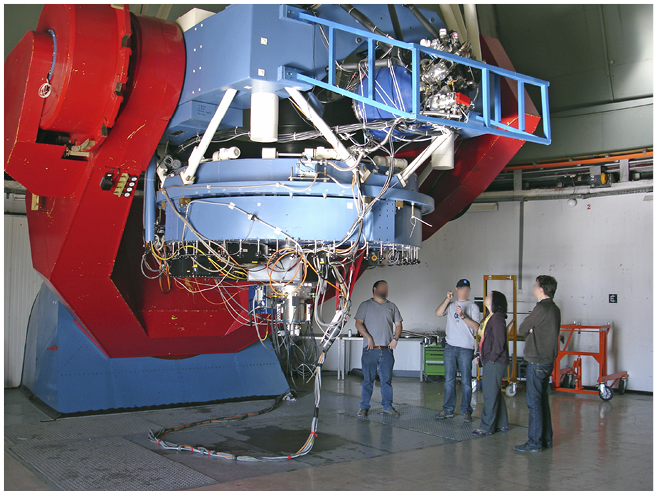
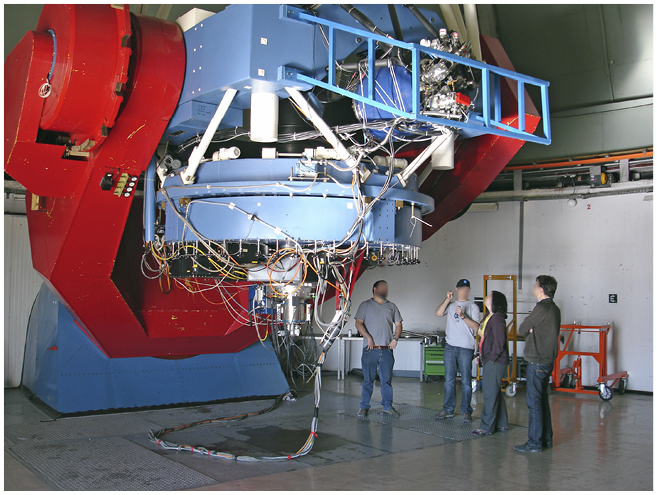
However, this was not what Nadine, the PhD student whom we met in the Introduction, found with exposures made in service mode by technicians operating Omega2000, a near-infrared camera attached to the 3.5-meter telescope at Calar Alto Observatory (Spain). A ring-like feature in her exposures that seemed to be due to excess light in the telescope troubled Nadine. She worried about its detrimental effect on her data analysis, particularly when combining these data with another dataset: optical (visible light) exposures taken with the Wide-Field Imager (WFI), a camera installed at the 2.2-meter telescope at La Silla Observatory (Chile; see Figure 2.1). As it was not resolved easily in dialogue with Otfried, her supervisor, Nadine’s problem became a topic at the next group meeting.
Staff scientists and visiting astronomers at the 2.2-meter telescope at La Silla Observatory. The WFI camera is visible as the metallic cylinder under the primary mirror encasement. Visiting astronomers commonly take tours of the observatory, where they witness and experience the observatory as a rigorously and accountably organized space-time.
Note: The online version shows the colors of the original figure.
There, the team’s conversation focused on the computational uses of their exposures, such as subtracting an artifactual “detector distribution” (instrumental response) and dividing images by flatfield exposures. It includes evaluations of data, telescope, camera, and the observatory staff member (“night assistant”) who recorded them. Half an hour into the meeting, the following exchange ensued between Otfried, Otto, and Owen, all senior group members and experienced observers:
Transcript 2.2
1
Otfried: …but if you take out the overall detector distribution first. You know it from all the runs you have with Omega2000 over the last years … and take it out. Then you would see at least more easily whether the flatfield [is
2
Otto: [This would be one possibility … if the flatfield is … you do this … take a master-flat in all the main filters and divide your incoming flatfield … you can do this in Omega with this … and then you can better judge what has
3
Otfried: Sure!
4
Otto: This would be one possibility … but this is not specific to Omega. If I want to compare … for instance WFI flatfields … they are completely different on the 10 … 15 percent level also.
5
Owen: Mm hm
6
Otfried: The flatfields … yeah … sure!
7
Otto: But that is not the flatfield. It is bad illumination. But this is … in the case of WFI it is an error made by the night assistant … because the scattered light is strange … they pointed at the Schmidt telescope ((located at the observatory in the neighboring dome)) or whatever they did wrong … I don’t know. But for Omega it’s the sky.
8
Otfried: It happened to me as well … I would not blame the night assistant.
9
Otto: For Omega it is the sky illumination which changes wildly … in some cases. It’s also because … I had to point this out to Calar Alto … because in our service run … what they did was … they took one series of flatfields … four or five images in the first night and that was it! And you should never do this with Omega. You should try to get a flatfield every night in order just to pick the best ones.
10 ((9 seconds))
11
Otfried: Anyway … it looks as if we had [( )
12
Otto: [and I am puzzled by this circular thing.
In this exchange, data are inspected as a window into the functioning of the telescopic apparatus and the work of those who operate it. As these scientists debate a compromised flatfield exposure, two sets of choices are in focus: observers decide when and how to take flatfields and data analysts decide which flatfields to work with. Otfried and Otto draw on their experiences at two observatories. Otto refers to the artifact that troubles Nadine with the indexical “that” (line 7) and describes it as “this circular thing” (line 12). He acknowledges that picking a “good” flatfield calibration exposure is difficult, as their shape differs from case to case in a way that he specifies quantitatively (line 4). Otto and Otfried agree that the artifact was not due to a bad flatfield exposure (lines 6 and 7), but they are unable to reconstruct the observing situation with the data they have. Otfried hears Otto as “blaming the night assistant” at La Silla for having, perhaps, pointed the telescope in the wrong direction in the twilight sky (line 8), and informing “Calar Alto” (line 9). Otto then proceeds to admonish the observatory for not taking proper flatfield exposures every night, thus moving from criticizing a type of person to criticizing an organization. Conceivably, someone higher up in its hierarchy could sanction technicians.
That these researchers noticed an artifact instigated this discussion. It prompted Otto to evaluate the actions of observatory technicians who are absent physically and who are otherwise not mentioned when discussing data analyses. Both Otto and Otfried acknowledge that observers have the power to act and to do things differently. However, the staff observer’s possible judgment and resulting choice to point the telescope “wrongly” remains unattended in this brief exchange. A complex situation at the observatory, which may have been largely out of the observer’s control (perhaps due to technical malfunctions or poor weather conditions), is collapsed into “troublesome” digital recordings for which an unspecified individual, a member of the category of “night assistants,” is held accountable.Footnote 16 But those who could give an account are not present.
Accusing an observatory staff member of a technical error, as Otto does, may not suffice to identify the artifact as an ethical affordance, even when Otfried hears it as an instance of blame. Perhaps more telling is a comment that Curt, a postdoctoral scholar, made. In a conversation with fellow group members he mused that “perhaps the night assistant does not like me” when a smaller-than-expected fraction of his B-ranked service-mode program had been executed.Footnote 17 This is another instance of where the smooth progress of work seemed suspended, now due not to the troubling quality of data, but because of the limited amount of data delivered. Of course, personal sympathy should not affect the operations of a formal organization like an observatory, but here a researcher (who has been a visiting astronomer before) imagines himself as being evaluated (“not liked”) by “the night assistant.” This is a third-person view of himself by an imagined other, a view in which “the night assistant” is recognized as a person imbued with the capacity to evaluate and make decisions.
Curt’s remark may well have been ironical or even a joke that highlights the otherwise backgrounded expectation that observatory staff ought not to make decisions based on evaluating persons. Curt added that he presumed that staff observers try to play it safe and “prefer imaging over spectroscopy.” Recording spectra (which involves positioning a slit on the sky and deciding on its width) is generally considered as more challenging, and prone to mistakes, than taking images. Thus, imaging poses smaller risks of retrospective blame. Much as in the conversation of Transcript 2.2, Curt typifies the “night assistant” as an “ethical figure” (Keane Reference Keane2016, 153).
2.5 Technicians Producing Data in the Absence of Researchers
As researchers like Otto interpret some artifacts as ethical affordances in evaluating the work of observatory staff, these technicians are aware, and wary, that they become thus visible to data users. Oscar, a telescope and instrument operator (TIO) at Calar Alto, explains: “If the observation is good … of course … that’s our job. If the observation is bad … is not okay … well … everybody can say … well … you are not working okay.” Separated from data users, Oscar is wary of having no chance to respond to this criticism.Footnote 18
One night, as I was attending service-mode observations at Calar Alto Observatory with Jorge, a night astronomer, he noticed sudden variations in the “seeing” – the undesired blurring of images due to atmospheric turbulence (measured in arc seconds, a unit of angular scale). Observing programs specify a maximal allowable seeing limit, but sudden variations in seeing can make adhering to such limits challenging. Staff observers are faced with the decision to continue or stop an ongoing observing block (OB). In the following, I transcribe in quotations marks what I heard as reported direct speech. Jorge told me:
In a night like this … the seeing can change very fast … so probably during a focus series you are below a certain value … but five minutes later it is probably very different … and then it is very difficult to decide what to do … because the observer wants exactly 1.4 ((arc seconds)) but what happens if it is 1.5 … and if it is dancing between 1.2 and 1.5 or 1.6 … so this is … ehhh … a difficult part … because (…) so … some observers … you have a situation like this … for example … if the seeing is 1.5 then you decide … well … if I don’t do this then … hmmm … the other thing that I can do is just close the telescope … so … I will do it anyway … just in case that the observer … finally wants this observation … they can send it to the trash or whatever … but then … the main observer … that one using the data … as well… goes … well … ((mimicking an angry voice)) “Come on! I told you specifically that the seeing limit was 1.4 … so why did you take the data?”
Speaking in the ethnographer’s presence, Jorge gives an account of himself as making a reasoned decision aimed at benefitting an imagined researcher, whom he typifies as a third person. Conditions of fluctuating seeing, for which existing rules do not apply, call for observers to decide and reflect on being held accountable for their actions. Jorge describes his decision to go on with observing as a virtuous act, done for the potential benefit of a researcher.
Bypassing the rigid scheduling of OBs, Jorge describes himself as offering “free data” to a researcher who can discard them without foregoing the observatory’s promised delivery of data meeting the specifications. Not shutting the telescope down when data of potentially usable quality can be taken attests to a sense of workmanship that is valued at the observatory. Performed while conducting service-mode observations, it is “an act that does not call attention to itself” (Lambek Reference Lambek2015, 292), an act that may remain unrecognized and that users may not value. Note that Jorge typifies the researcher’s imagined reaction, and with it the researcher, suggesting that this is not a singular incident. Jorge portrays this researcher as excessively demanding in terms that are not neutral but evaluative.
2.6 A Ship, Not a Factory: Conflicting Senses of Place
Conflicting senses of place inform evaluations of researchers and technicians in service-mode observing. We have so far explored the ethical figure of observatory staff members being blamed for taking poor data. Let us now meet its counter-figure: researchers as excessively demanding data users.
Although service-mode observing is prevalent today, few observatories have abandoned the visitor mode altogether. Some researchers still visit observatories for training and for conducting programs requiring on-the-spot decisions. Staff members generally appreciate that researchers visit the observatory to witness their work, to accept responsibility themselves, and to learn to write OBs that are considerate of the overheads that are unavoidably part of observing. Thus, Catalina, a colleague of Jorge at Calar Alto Observatory, insists that astronomers would do well to “remember that there is a moon in the sky that can disturb your observations and that you need time for the calibrations.” She also notes that “astronomers always want to observe” and, when pushing too hard, must be stopped from putting instrumentation at risk. Catalina recalls a situation prior to the introduction of the service mode at Calar Alto:
We were having dinner … and it was raining. And then the astronomer tells me “I am going to the …” That was when we were observing in the dome. Was quite six years ago. He tells me “I’m going to the … telescope.” And I say “Okay … but please don’t open the dome … because it’s raining.” And he says “Ah… okay.” And then I was relaxed … having my dinner. And then I come here to the office. It was raining. I was coming with the car. I see the 2.2 ((meter telescope)) with the dome open. And I just go to him and I say “What are you doing? It’s raining!” And he says to me “Yes … but it’s the time for the sky flat … and I can’t lose them.” And I say “You can lose ((them)) because it’s raining!” And he says “No no no … I have to take my sky flats.” And it was raining! And then I go quite fast to the dome and I close the dome.
Addressing the ethnographer, Catalina uses reported direct speech, conserving the dialogue (in second-person address) which documents this astronomer’s lack of attention to her instructions and his lack of acknowledging her as a person who merits proper attention. This visiting astronomer not only demonstrated poor judgment and made a technical mistake, but also committed an ethical breach. That he put the observatory’s equipment at risk of damage is apparent. Catalina does not emphasize this further as she recalls acting as the equipment’s guardian. But she adds that she went to call the technical director to the scene who spoke with the visitor and reminded him of the observatory’s social order and the need to abide by Catalina’s command.
At times it may be the observatory’s weather officer who intervenes. The term “officer” here alludes to the hierarchical organization of observatory work and echoes a notion that many staff members share: that the observatory resembles a ship, and not a factory that delivers ready-made commodities. The resemblance between observatory and ship, which is also perceived among staff at La Silla Observatory, is furthered by its isolation, its rigid scheduling of work tasks, its code of conduct, the typical duration of work stints on the mountain (ten to fourteen days), as well as the uncertainty of navigating in a changing environment of which one is not entirely in control.Footnote 19
Visitors’ eagerness not to lose any observing time may take a turn for the odd, as Pablo, an administrator at La Silla Observatory, illustrates:
Astronomers are not better than other people. I have been here for many years and I have seen everything. (…) There was a professor who observed at the 3.6-meter telescope … and we found him peeing in a corner of the building! The 3.6 dome is fairly big and there are lots of rooms that are not used. It is over-constructed in a way. But the toilet is on the third floor. In the old times the control room was on the fifth floor. And this professor was too lazy to go down … he had no time for that … he did not want to lose one minute of his observing.
The stories that Catalina and Jorge retell illustrate how critical data are to these scientists’ professional lives. Numerous similar narratives, usually featuring astronomers’ excessive concern over maximizing their exposure time, circulate among staff members at observatories, but they do not seem to travel far beyond. Along with a distant data user’s imagined blame (see Jorge in Transcript 2.3), they illustrate the ethical figure of the excessively demanding user. For observatory staff members, such narratives affirm what it means to do the right thing at the right time in the right way, that is, to act in ways that are valued locally.Footnote 20
2.7 Scientists and Technicians Observing Together
Many of the Heidelberg Institute’s graduate students are sent to observatories to experience a week or two of the work and life there. They experience observatories’ spatial and temporal organization (mealtimes, places forbidden to visit at certain times, closing window shutters at twilight) and are taken on informal tours of the telescopes (Figure 2.1). They interact with the observatory’s technical staff, mostly at night in the telescope control room. It is there that, in Keane’s (Reference Keane2016) terms, visitors interact with staff technicians in the second-person perspective.
In December 2009, I joined Nora and Mary on their observing run with the WFI camera at the 2.2-meter telescope at La Silla Observatory.Footnote 21 Nora, a PhD student, visited the observatory for ten nights of observing as part of her training. She did not have an observing program of her own. Mary was a postdoctoral member of the MAMBO research group whose observations were scheduled for this period. Mary had applied for thirty one-hour-long exposures that were required to reach the sensitivity she needed for her project of supplementing an existing dataset of the Chandra Deep Field South. The time allocation committee ranked her program relatively low, making its completion unlikely.Footnote 22 Although she was not required to be present for her relatively undemanding observations, she decided to join the observing run in which her project was scheduled. Mary explains:
I had this project for three years now … every year it was ranked low … although I was never told why. I don’t know. In the first year I got nothing … because it was just bad weather for a week … basically. In the second year it was also hampered by bad weather … which meant I got two hours. And so when I now got the third year approved … but low ranking … I thought I have better chances of getting data if I actually go there. (…) Of course … it’s a little bit devious of me … I guess … is the word ((laughs cautiously)) … to try to come here just to make sure that my program gets observed. But I mean … I hope that I do not push too much for my program … because I realize that ((other)) people have higher priority.
Mindful of her project’s low ranking, Mary hopes to influence nightly decision-making. In doing so, she orients to an “ethic of fair treatment” (Goffman Reference Goffman1983, 14–15) that encompasses not only the proposal review process and the act of observing, but also her previous, largely failed attempts to obtain data for her project.
Mary is accompanied by Olli, her husband, who, too, is an astronomer. Also visiting is Anna, a PhD student in charge of operating the GROND (Gamma Ray Burst Optical/Near-Infrared Detector) instrument, a camera designed to record the afterglows of distant cosmic explosions. Apart from WFI and GROND, the Fiber-Fed Extended Range Optical Spectrograph (FEROS) is attached to the telescope. Only one instrument can be used at a given time; switching between them takes about one minute.
Late in one afternoon, before Nora’s fifth and Mary’s third observing night at the telescope, Nora meets with Tim, the night astronomer responsible for the telescope. They develop a draft schedule for the upcoming night that includes OBs pertaining to three different programs. This schedule is bound to be modified throughout the night.
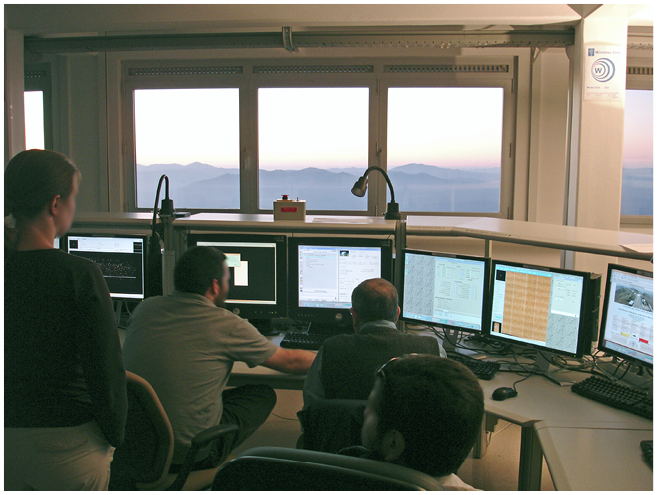
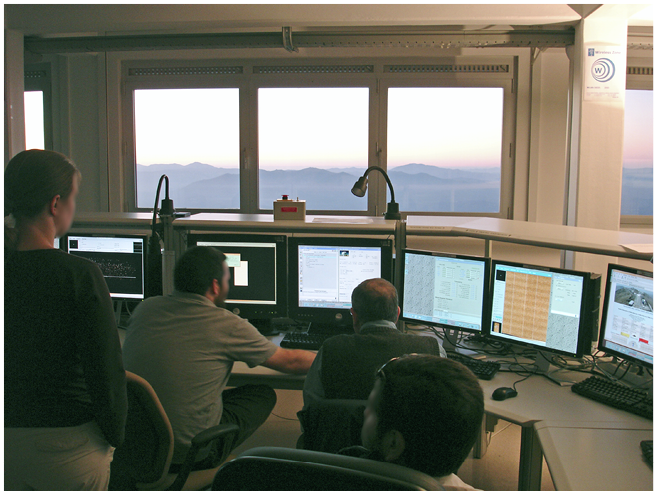
With twilight approaching, visitors and TIOs meet in the control room, situated in a building 500 meters away from the telescope. The observatory’s three largest telescopes are operated from there.Footnote 23 Each is controlled from a niche equipped with a workstation for the telescope controls as well as with a so-called BOB (Broker for Observing Blocks) terminal, at which the schedule – a sequence of OBs pertaining to the individual programs – is displayed and rearranged. Additional screens display measurements of the weather conditions, an all-sky camera, and camera view into the telescope dome (Figure 2.2). In the control room, a complex set of technical operations is collapsed into screen work.Footnote 24
At twilight in the control room of the 2.2-meter telescope at La Silla Observatory. A visiting astronomer (standing) looks on as the TIO (seated, right) and the night astronomer (seated, left) record a series of calibration exposures.
Note: The online version shows the colors of the original figure.
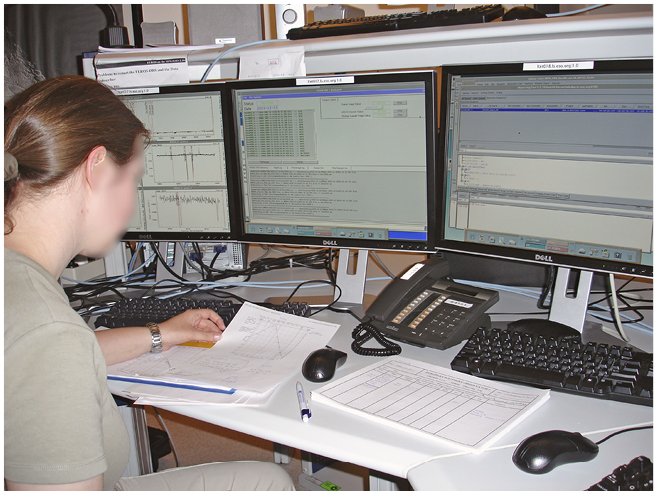
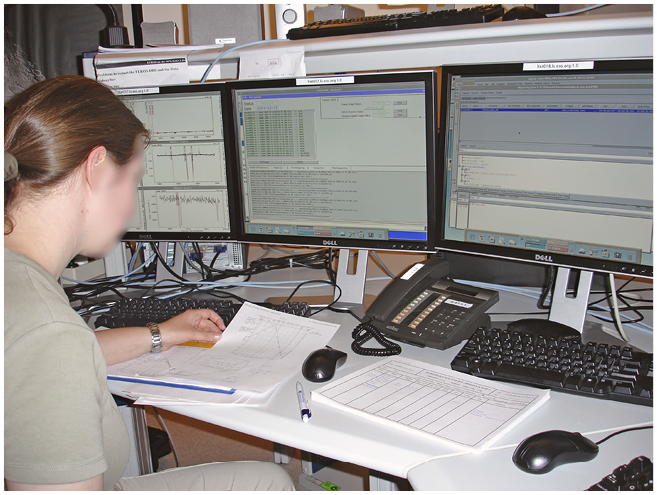
Observing begins during twilight with a series of flatfield exposures. Sitting at the telescope controls, Carlos, the TIO, completes these exposures with input from Tim. Taking flatfields demands staying in tune with the fading daylight. The two work with visibly intense concentration and talk in Spanish, precluding interventions from the visitors (who are unable to speak Spanish with any fluency). In auditory copresence, Nora sits a few meters away at the BOB terminal (Figure 2.3). She waits for Tim and Carlos to tell her the details of finished exposures that she records by hand in the observing log.
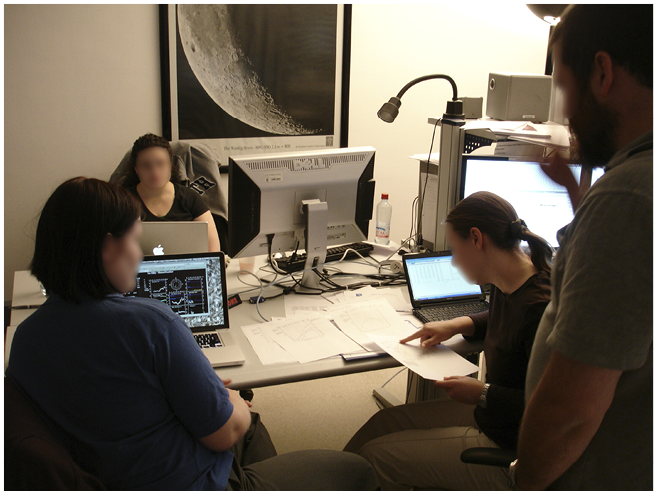
At the BOB terminal. This visiting astronomer examines an air mass plot; the handwritten observing log is visible in front of the keyboard.
Note: The online version shows the colors of the original figure.
At 20:34 CST (Chilean Standard Time), while calibration exposures are recorded, Mary joins Nora at the BOB terminal. Nora has just returned to the control room from a brief walk outside:
Transcript 2.7 (20:34 Chilean Standard Time)
1
Nora: The wind was very strong when I went
2
Mary: ((looks at current weather data on the La Silla MeteoMonitor)) It says stable at eleven ((meters per second)) … on this one
3
Nora: Ahh: ahh: ehm … I just don’t know when we close (the) dome heh
4
Mary: Fifteen … I think … ((examines the telescope manual)) close is twenty ((meters per second))
5
Nora: Yeah … but the pointing limit … was … what does it mean?
6
Mary: Well I guess it means you can’t point so that the wind comes right into the wing … the hole ((the dome slit)) … because that would destroy everything … but I … I … I wouldn’t actually know … exactly … which targets that meant we would have to skip
7
Nora: You have to check the direction … of the wind
8
Mary: Yea:h: … but (if) we are like picking my objects hhhh … I don’t know where that is (hhhh)
Nora’s experience of the wind outside instigates a joint attempt with Mary to understand how it will affect their scheduling (line 6), since the dome has to be shut above a certain wind speed and wind direction. Mary appears to be concerned about whether her targets may be affected (line 8).
Thirty minutes later, about halfway through the calibrations, the wind remains worrisome. Tim and Olli have now joined Nora and Mary at the BOB terminal:
Transcript 2.8 (21:03 Chilean Standard Time)
1
Olli: How’s the wind doing?
2
Mary: It’s the same
3
Tim: The wind will be an issue
4
Mary: Do you think so? I thought it will go down
5
Tim: I mean we are very close to not being able to go south … and I don’t know where the things are ( )
6
Mary: ( )
7
Tim: What’s south?
8
Nora: What is the declination?
9
Olli: Latitude
10
Tim: We are minus 27 or something
11
Nora: Minus 29 … so (say) minus 30 … so everything above minus 30 is north and everything below minus thirty is south ((Tim inspects the air-mass diagrams, which list the target objects’ coordinates))
12
Tim: This is minus 33 … this target is minus 33
Olli’s question (line 1), whose significance Tim affirms and specifies (in lines 3 and 5), triggers participants’ assessments of the wind’s possible impact on the observing program. Above a certain wind speed, the dome slit must not face the wind. Thus, certain observing targets may need to be excluded from the schedule. Tim’s questioning of the visitors in line 7 can be read as posing them an “exam question” (Mehan Reference Mehan1979), for as a night astronomer at this observatory he should know the answer, but he may have also asked about the targets’ coordinates. To identify which targets may be affected, the celestial coordinates (“declination” in line 8) must be compared with the observatory’s geographical latitude. This is what Tim, Nora, and Olli do (in lines 7 to 11). At least one target seems to be affected (line 12).
Unlike the many exchanges between the visiting astronomers and Tim that punctuate the observing night, the visitors rarely talk with Carlos, the TIO. Mary does so just as her program’s first hour-long WFI exposure was to begin. For doing so, the telescope is pointed to the celestial coordinates of Mary’s target:
Transcript 2.9 (22:07 Chilean Standard Time)
1
Carlos: So what now?
2
Mary: WFI
3
Carlos: WFI? … okay … change
4 ((26 seconds))
((Carlos types into the keyboard of the telescope controls))
5
Carlos: Same settings?
6
Mary: We do the pointing
7
Carlos: Focus
8
Mary: Focus … but no standards
9
Carlos: No standards?
10
Mary: Not … just yet … maybe later
11
Carlos: Okay
12
Mary: Maybe next time
Carlos’ question (in line 1) may be rhetorical since he should have seen WFI indicated on his terminal as the next instrument to be used. After preparing the observations at the telescope control, he corrects how Mary references the upcoming activity (lines 7 and 8). Her decision not to observe standard stars for her program apparently surprises him, but he accepts Mary’s decision and executes her instructions. Willing to forego one set of standard star observations, Mary can be heard as aspiring to save time for another of her long exposures.
Once this exposure is completed, Carlos examines it for the shape of stellar images (expressing his satisfaction when these look round as required) and measures the seeing (the blurring of starlight by the atmosphere) using the images of stars visible in it. Carlos seems focused on producing data with accountably round, well-focused stellar images. Mary and Carlos thus seem wary of making the exposures suit their respective computational uses and accountabilities, epistemic (Mary) and institutional (Carlos). Nora records Carlos’ seeing measurement in the observing log.
As Mary’s long exposure is in progress, the schedule is reassessed:
Transcript 2.10 (22:13 Chilean Standard Time)
1
Olli: So what’s the plan?
2
Nora: Ehm … so now we do one of Mary’s fields
3
Olli: Yeah
4
Nora: and then just one of John’s … maybe … and then going back to hers or to the FEROS thing which will … we should go back to
5
Mary: Then UTC ((Coordinated Universal Time)) would be three … that is two hours away
6
Nora: Yeah … we could also do maybe two of John’s … if that is possible … and then do the FEROS and then go back to your field
7
Mary: Eh:: … but we have (said) first … we have said to do FEROS as late as possible [if that could be
8
Nora: [mm hm yes we could also do two fields of yours … yeah … I just would want to do this one … [( )
9
Mary: [Yes so
10
Nora: and I think ( ) these I want ( )
11
Mary: so ( ) specifically … the east is done
12
Nora: and there is only one left and there is no VR left and … I mean … we could do the 40 fields, but I would rather ( )
Prompted by Olli’s question, Nora formulates an account of the ongoing observation and of possible ways to continue (lines 2, 4, and 6). Mary intercepts Nora (line 7) by reminding her of her promise to schedule FEROS observations late (this would make Mary’s and John’s observations with WFI possible beforehand, thus gaining her program another OB). Nora acknowledges this (line 8), but alludes to her responsibility of scheduling a target from the A-ranked proposal (“this one”) of John, an absent astronomer. She continues in lines 10 and 12 with recounting her bookkeeping of OBs for John’s program, which involve several filters and positions on the sky. In line 12, “VR” is a shorthand for the V and R band filters used for John’s project, while “40 fields” is a shortcut reference to the celestial coordinates of target fields in John’s program (at a declination of 40 degrees south). Throughout the night, Nora and Mary cannot agree among themselves on a sequence of OBs for implementation.
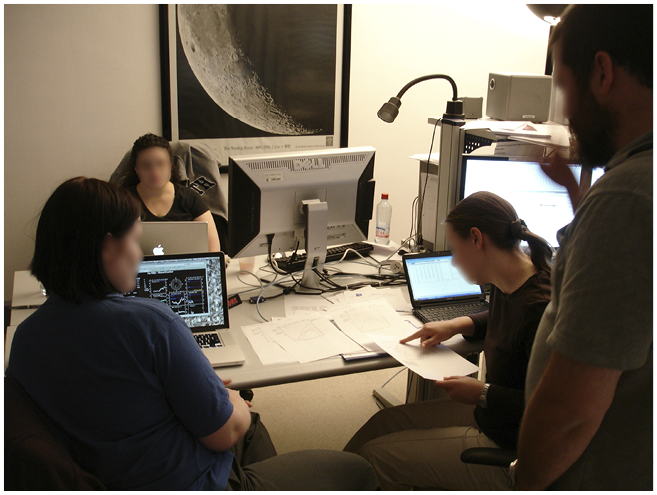
Later in the night, Tim joins Nora, Mary, and Olli at the BOB terminal (Figure 2.4). He looks at the monitor and comments:
Visiting astronomers (sitting) and a staff night astronomer (standing) inspecting air mass plots pertaining to three observing projects.
Note: The online version shows the colors of the original figure.
Tim begins reciting the upcoming plan. He thus makes it audibly available to everybody in at the telescope controls. A long pause (line 2) suggests that he does not finish reciting the sequence. This pause opens a slot that Mary fills, continuing Tim’s list of instrument names that index the respective upcoming OBs. By doing so she acknowledges Tim’s first part of the formulation. Tim’s response (in line 5) may signal his approval of the plan or his confidence in Mary’s ability to continue formulating the sequence he had begun. Tim may have tested Mary’s competence or “fished for information” about upcoming observations.Footnote 25
Minor as this scene may appear, it is throughout the night that Tim initiates formulations and reformulations of the upcoming schedule. Mary and Nora contribute their more specialized knowledge of the observing programs and thus participate in the formulation-building. As he guides the formulating, Tim consistently assesses calibration exposures and monitors the instrument performances for which the observatory and its staff are held accountable. Tim’s lack of knowledge may have been prompted the paired structure of talk in Transcript 2.11, but it encapsulates a pattern of talk that emerges throughout the night: Tim initiating collective formulations and modifications of the observing plan.
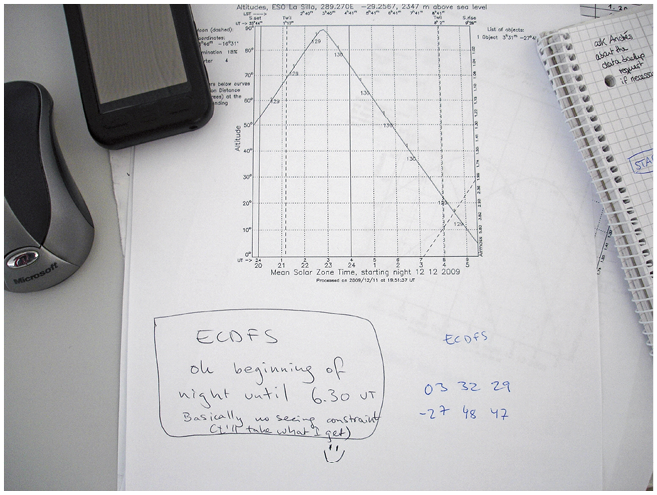
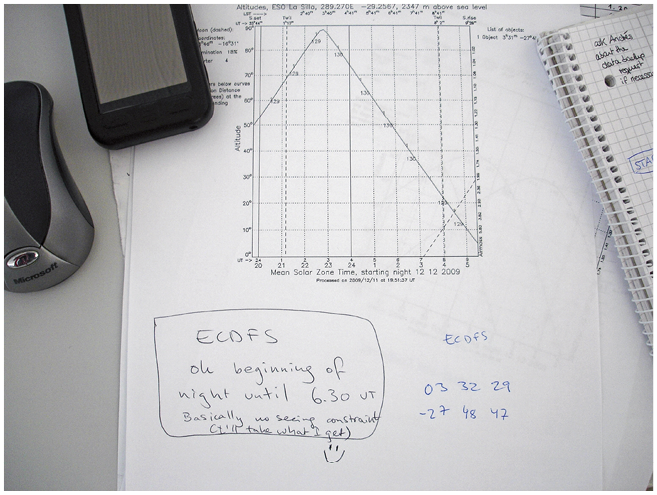
Let us now jump three days ahead, to the end of Mary’s and Olli’s last night on the mountain. At this point, fifteen of the thirty-hour-long exposures that she needed had been taken. Mary leaves the documents pertaining to her program behind at the BOB terminal, appending them with a handwritten note that said, “Basically no seeing constraint (I’ll take what I get),” adding a smiley face to her message (Figure 2.5). As such, she authorizes overriding the specifications that her proposal defined. Not only does this suggest Mary’s recognition of staff technicians’ decision-making powers. Her personalized style and the humbleness of phrasing the request also contrast markedly with what might have been expected of an excessively demanding user, as characterized earlier in this chapter.
Air mass plot pertaining to Mary’s observing program. The curve (above) shows her target objects’ altitude above the horizon (in degrees) throughout the night (continuous line). The diagram also shows the end of twilight and the beginning of dawn (vertical dashed lines) as well as the rising moon (rising dashed line in the bottom right corner). Mary’s handwritten note (below), added shortly before she left the observatory, specifies the conditions needed for observing her program and advertises its relative lack of meteorological constraints to the observer in charge of nightly scheduling.
Note: The online version shows the colors of the original figure.
2.8 Discussion
In science and technology studies it is commonly analysts who examine ethical issues, such as when they point out that aspirations to openness lead to “unethical” scientific knowledge, or when the trustworthiness of data, dealing responsibly with the privacy of human subjects, uses of algorithms, and regulating data access are at stake.Footnote 26 By attending to “ethical life,” the “saturation of social existence with evaluations of persons, their relations, and their actions” (Keane Reference Keane2016, 100), I consider ethics differently. I took a common problem of data-rich science – the production of data as a service –, considered how it is “staffed” in a specific case, and followed its management ethnographically. The move in astronomy from visiting-mode to service-mode observing offers exemplary insights into ordinary evaluations. I identified ethical figures that ascribe certain forms of conduct to types of people, observed situated actions in the control room as a site where ethical evaluations become witnessable, and noticed how visiting astronomers became accidental ethnographers of the observatory’s ethical life.
2.8.1 Ethical Figures in Data Production
Although service-mode observing is commonly understood as an impersonal mechanism, data-using researchers and data-producing technicians occasionally typify each other as ethical figures. When researchers debated technical issues with data, observatory staff members emerged as actors only when they could be assigned blame for the insufficient quality or quantity of data. This blame was never directed at named (or known) individuals but always at members of the category of “night assistant,” who are, by implication, considered interchangeable. On the other hand, staff observers regard some scientists as members of another category: excessively demanding users who disregard what kind of organization the observatory is – more a ship than a factory. Usually shared with fellow staff members only, their audience is local.
The accountability of interaction that visiting astronomers experience in the observatory’s control room is confined to its situated enactment. The disjuncture between researchers’ and technicians’ accountabilities, and the resulting disappointment and blame, is a tension in service-mode observing. As scientist–technician interactions have become discontinuous and fraught, ethical figures and ethical accounts travel unevenly in the landscape of data production, and the importance of social interactions often remains unrecognized.
2.8.2 Situated Actions and Ethical Practice
Taking interlocutors seriously, and acknowledging them as meriting attention, is an ethical practice.Footnote 27 For visiting scientists, it is only at night in the control room that the category of “night assistant,” or rather, “telescope and instrument operator,” becomes filled with life. Mary experienced this on her visit to La Silla. Seeking to complete more of her low-ranked observing program, she engaged in the mutual accountability of social interaction. Whereas ethical figures emerged in third-person perspective (Transcripts 2.2 to 2.5), it is in the control room that visitors interact with staff technicians in the second-person perspective. Visitors draw on their interactional competence and become thereby available to staff members’ mutual monitoring.
In recording science exposures of documented absolute time (duration), temporality is a dominant concern for all participants in the control room. Their shared task is to accommodate preliminary schedules with a dynamic environment. There is “no time out” (Garfinkel Reference Garfinkel and Rawls2002, 118, 259) from the joint work of getting through the observing night together. This night’s irreversible temporality is critically different from the visitors’ scholarly work back home. Only at night in the control room can data users witness the accountabilities and dilemmas that staff members face as they seek to move from a “shopping list” to obtaining useful data. As visiting astronomers come to learn from those who work for them, the hierarchy characteristic of service encounters is, for the time being, flattened or even reversed.
Observatory staff members and visiting astronomers collaborate in formulating and reformulating plans for the night, but they do not contribute to this work equally. Staff astronomers have institutional rights to initiate and guide the formulation and reformulation of the schedule, thus instructing visitors about the social and temporal order of observing. In the conversation of Transcript 2.10, Tim is not present when Nora, Mary, and Olli contemplate the schedule. On their own, they hesitate to formulate a revision for adoption. Perhaps they are wary of being held accountable for it. Later in the night, Tim set out to formulate a “best-case scenario” for the rest of the observing night. He drew Anna, Mary, and Nora – who knew specific programs and their ranking in greater detail – into making this knowledge consequential for subsequent actions. In contributing to such formulations, visitors learn without being visibly taught (cf. Schwartz Reference Schwartz1976, 64).
2.8.3 Members Doing Ethnography
It seems far-fetched that novice researchers could learn how to control telescope and detectors during their brief stays on the mountain. They could not possibly deal with a malfunction of equipment. And they would quickly forget many details if they did not practice their observing skills. If so, what of lasting value could they possibly learn during their brief stays at the observatory? What kind of expertise do they acquire? What, after all, is the point of their visit to the mountain?
When junior scientists visit an observatory, they experience its organizational hierarchy, rigorously disciplined space-time, and the unfolding of the observing night in its control room. There, they can dwell on their ordinary interactional competence in negotiating the nightly observing program and witnessing how staff astronomers deal with their work’s accountabilities and dilemmas. There, they experience which “overheads” are involved and what it means for observations that there is a moon in the sky, as Catalina remarked dryly (in Section 2.6). There, they are “investigating as well as using practical actions, reflexively discovering a local organization of practical actions” (Lynch Reference Lynch and Lynch2022, 10; emphasis in original). Much of this local organization is a social organization. Are these visiting astronomers, then, doing a sort of ethnography? Conversely, when we ponder the accounts that Jorge, Catalina, and Pablo give in Transcripts 2.3 to 2.5, are observatory staff members like them also doing a sort of ethnography, but of the visiting astronomers’ culture? After all, Jorge, Catalina, and Pablo appeared to have acquired a sort of what Bernard Williams (Reference Williams1986, 203–204) called an “ethnographic stance” – an understanding of visitors’ ethical concepts, without sharing them.
Early in his Studies in Ethnomethodology, Harold Garfinkel remarks that it is in “doing, recognizing, and using ethnographies” that members accomplish the “analyzability of actions-in-context” (Reference Garfinkel1967, 10). Garfinkel does not specify what exactly he means with “ethnography,” but, following Alex Dennis (Reference Dennis2024, 101), we can suspect that his use of the term is “deflationary”: “[b]eing able to see what is being done in a setting is fieldwork, and being able to describe that to others is ethnography.” This inclusive understanding is shared by ethnomethodologists like Stephen Hester and Peter Eglin (Reference Hester and Eglin2017, 200). Rawls and Lynch (Reference Rawls and Lynch2024) call it “endogenous ethnography.” However, one may feel like responding that if everyone is an ethnographer, nobody is. Is calling what these scientists and technicians do “ethnography” not a stretch of what is already a “catchall phrase” whose “meaning is extremely general and vague” (Harper Reference Harper2000, 241)?
Sociological and anthropological ways of doing ethnography are informed by an epistemology and ontology and are oriented toward the production of written accounts for nonmembers (Blommaert and Jie Reference Blommaert and Jie2020). As such, they differ from these scientists’ and technicians’ apparently quotidian practices. There is an important sense in which what these scientists do goes beyond a deflationary sense of doing ethnography, if the latter regards them as inquirers into the “practical circumstances that confront the member going about the business of everyday life” (Hester and Eglin Reference Hester and Eglin2017, 200). After all, being at the observatory is not part of visiting astronomers’ everyday life. As we have seen, some of them may, in fact, disturb the observatory’s regular and ordinary life. Scientists and technicians thus inquire into what are, to them, an unfamiliar sociotechnical environment and visitors of uncertain power, respectively. Some of them make their experiences accountable as narratives (cf. Transcripts 2.3, 2.4, and 2.5) and written notes (Figure 2.5).Footnote 28 These inquiries are part of their professional work, but seem less conspicuous than, for example, statisticians’ routine ethnographic forays in search of categories that they can subsequently probe quantitatively, such as by censuses (Mair et al. Reference Mair, Greiffenhagen and Sharrock2016). In his ethnographic study of a halfway house for narcotics offenders, Lawrence Wieder (Reference Wieder1974) noticed that the house’s new residents were in much the same situation as the ethnographer, having to make sense of a “convict code,” an unspecified set of maxims that seemed binding for residents and staff. This suggests a convergence of learners’ practices, including those of the ethnographer. In Chapter 3, I use Wieder’s (Reference Wieder1974) study as a resource for understanding graduate student learning in the making and use of large datasets.Footnote 29 Thus understood, the quality of data produced at the observatory, and the maintenance of communal skills, are accomplished thanks to a twofold ethnographic move.
2.8.4 Experience beyond Interaction
Let me end this chapter with a note on astronomers’ experience of nightly observing beyond social interaction, probing further into their reasons for visiting observatories. One night, at the end of an hour-long exposure, Mary seemed captivated when watching the CCD readout slowly emerging on screen over half a minute. I perceived this to be somber moments of raised attention and pause. When I asked her about this a few weeks later, she replied in an email:
It brought tears to my eyes to think that these photons have traveled for billions of years, crossing endless distances, and then I caught them here. They will not travel any further. And it happened just nearby where I am, just then. I am serious, and it is very silly, but I certainly do get a strong feeling of awe when the CCD reads out. It is not at all the same when you go home and see it on the computer. Then it is just pixels with varying intensity, it is just numbers and digits and data to crunch. But on the mountain, I know that those photons that have been traveling on their own for that long are falling on my head. And I can catch some of them. It is poetic. And silly. :)
In this response, Mary gives importance to the observing situation’s “here and now.” Invoking contemporary physics and cosmology, which describe light as photons traversing a vast universe for billions of years, she links vision to touch: photons can be caught or fall on your head. Conceived as such, the distant universe is, at the observatory, a part of the tangible world to which astronomers can expose their detectors and their bodies, the observational machinery functioning as a tool that extends human senses. What the readout CCD image shows are traces. But what makes it possible “to leave traces and to read them is the material continuity, physicality, and sensuousness of the world,” as Sybille Krämer (Reference Krämer, Krämer, Kogge and Grube2007, 15; my translation) argues. A figure–ground reversal is invoked, the observatory being the figure that makes the ground, the universe-filled-with-radiation, conceivable. Arguably, temporal sequences of activity contribute to this astronomer’s experience of immediacy, which includes waiting for the exposure to end. During the exposure, the social, the technical, and messengers of a nature distant in space and time (“photons”) are copresent or coeval, and Mary is aware of this.Footnote 30 That she remembers this experience so vividly weeks later suggests that this memory endures, giving meaning to her work at other times and other places.

 Open access