


Introduction
Obesity is a major and growing public health problem in the United Kingdom, which is putting a large strain on the UK's National Health Service. If current trends continue, it has been predicted that 60% of adult men, 50% of adult women and 25% of children will be obese by 2050 (Butland, Reference Butland, Jebb, Kopelman, McPherson, Thomas, Mardell and Parry2007).
In the United Kingdom, practitioners within general practice would seem to be in a good position to tackle the problem not least because of their regular contact with the UK population (National Audit Office, 2001). UK government health policy looks set to continue to shift management of long-term conditions away from hospitals and into primary care (Department of Health, 2000b). There is a financial imperative to keep patients out of hospitals, as well as reduce the current cost and time burden, which currently falls on general practice, where obese individuals have been shown to generate higher prescription costs and take up more consultation time than healthy-weight individuals (Lean, Reference Lean2000; Counterweight Project Team, 2005).
The clinical reasons for promoting moderate weight loss and weight maintenance in primary care are well documented (Tuomilehto et al., Reference Tuomilehto, Lindström, Eriksson, Valle, Hämäläinen, Ianne-Parikka, Keinänen-Kiukaanniemi, Laakso, Louheranta, Rastas, Salminen and Uusitupa2001; Wing and Hill, Reference Wing and Hill2001; Torgerson et al., Reference Torgerson, Hauptman, Boldrin and Sjöström2004). There is also evidence that weight management approaches and nutritional guidance within primary care are well received by patients (Hiddink et al., Reference Hiddink, Hautvast, van Woerkum, Fieren and van ‘t Hof1997; Galuska et al., Reference Galuska, Will, Serdula and Ford1999) and that individually directed advice is effective (Shaw et al., Reference Shaw, O'Rourke, Del. and Kenardy2005; Shaw et al., Reference Shaw, Gennat, O'Rourke and Del2006; Brunner et al., Reference Brunner, Rees, Ward, Burke and Thorogood2007).
General practice staff have had guidance on obesity since 2006 in the form of Clinical Guideline 43 (National Institute for Health and Clinical Excellence (NICE), 2006) and care pathways to help them raise the issue of weight opportunistically both with adults and children (Department of Health, 2006).
Within the general practice team, it has often been the practice nurse who has been viewed as both the ‘chronic disease manager’ and ‘health promoter’ (Health Departments of Great Britain, 1989; Department of Health, 1992; Department of Health, 2000a) and therefore in an ideal position to take on the management of obese patients. However, questions remain about the readiness and enthusiasm of health professionals, including nurses, to tackle the problem within their day-to-day work and how they view this role and responsibility.
Rationale
There have been few published studies exploring practice nurses’ perceptions of managing obese patients and none have done so since the 2006 National Institute for Health and Clinical Excellence (NICE) and the Department of Health guidance on obesity was published.
The constructs of role adequacy and role legitimacy have been used previously to explore how practitioners respond to clients with drug and alcohol problems and explain the extent of their willingness to take on new dimensions to their professional role (Shaw et al., Reference Shaw, Cartwright, Spratley and Harwin1978; Skinner et al., Reference Skinner, Roche, Freeman and Addy2005; Loughran et al., Reference Loughran, Hohman and Finnegan2010). Role adequacy (a practitioner's sense of self-efficacy in responding to patients’ problems) and role legitimacy (their perceived boundaries of professional responsibility and right to intervene) can similarly be explored in relation to practitioners who may be expected to tackle obesity. This study aimed to identify the factors impacting on practice nurses’ role adequacy and legitimacy regarding obesity.
Methods
This qualitative study was approved by Kings College Research Ethics Committee and received research governance approval from Southwark Primary Care Trust. Semi-structured face-to-face interviews were conducted with practice nurses in Lambeth, Southwark and Lewisham. Sampling for this study was purposive and sought to achieve maximum variation of location of practice and size. A total of 46 practice nurses within the 19 selected practices were invited by letter to take part and contacted subsequently by telephone. Of these, 22 agreed to be interviewed from 16 of the 19 practices. Researcher (V.B.) conducted one of the interviews, with the first author (C.N.) conducting the remainder between November 2008 and May 2009. The interviews lasted between 36 and 69 min. Twenty-one of the interviews took place in surgeries and one at the Department of General Practice. Twenty-one participants were female and one was male.
The semi-structured interview guide (see Table 1) was based on one developed for an earlier study with GPs in the same practices, following a review of the literature on management of obesity in general practice. The guide was a flexible framework for questioning, with some additional questions added to make the guide more relevant to practice nurses. The interviewer combined open questions to elicit free responses, with focused questions for probing and prompting. Interviews were digitally recorded and transcribed verbatim. Coding was iterative and was informed by the accumulating data and continuing thematic analysis.
Topic guide for the interviews

NICE = National Institute for Health and Clinical Excellence.
A random sample of seven transcripts were read and coded by a second researcher (A.D.) to confirm rationale of coding and the results were discussed between the two researchers in order to generate initial themes. Researcher C.N. coded and analysed the entire dataset and discussed analysis with two further researchers (A.W. and S.R.).
Findings
The predictors of practice nurses’ role adequacy and role legitimacy could be grouped by whether they related to the nurse's own individual professional practice or related to the GP practice context within which they worked. The factors could also be grouped by their positive and negative effect on nurse role legitimacy and adequacy (Table 2).
Factors affecting practice nurse role legitimacy and role adequacy
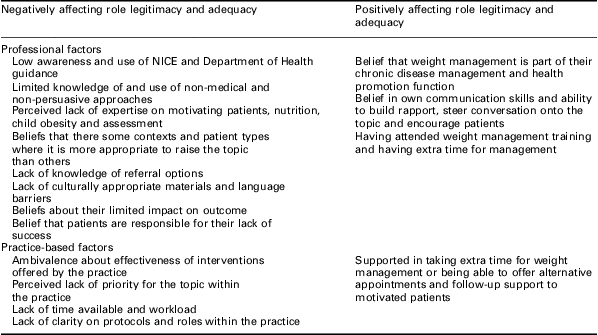
NICE = National Institute for Health and Clinical Excellence.
Professional factors
Belief that weight management is part of their chronic disease management and health promotion function
When asked whether they felt it was their role to help manage obesity, most nurses believed that it was because it fell under their ‘health promotion’ and ‘management of chronic diseases’ responsibilities.
we're monitoring …the chronic diseases and all that so I think … it's our role, yeah. (PN10)
Low awareness and use of NICE and Department of Health guidance
For most nurses, familiarity with the 2006 NICE guidance on obesity was very limited, with most not having read it or having done so only briefly.
Vaguely, I have sort of looked at it, I couldn't tell you specifically… (PN12)
Those who had read the guidance said they found little of use or anything new for them as practice nurses. There was also low awareness of the Department of Health obesity care pathways for health professionals despite the fact that some nurses expressed a need for guidance with a ‘step-by-step approach’.
Rather than using these guidance documents, nurses said they referred to websites with links from their electronic patient record system such as EMIS Mentor or patient information online or in a leaflet form. Some nurses asked GPs, dieticians or other nurses for information.
We use the internet … for researching …or I would call a dietician at the hospital…ask for some specific sheets. (PN14)
Limited knowledge of and use of non-medical and non-persuasive approaches
The Department of Health obesity pathway for primary care is based on a client-centred and empowerment approach – the transtheoretical model of behaviour change or ‘Motivational Interviewing’ (Prochaska et al., Reference Prochaska, DiClemente and Norcross1992). Many nurses said they had done some training on this approach, but mainly in the context of other issues such as smoking cessation or coronary heart disease. Most nurses lacked training on using this approach for brief interventions for obesity. Instead, they described how they intuitively assessed motivation in order to decide whether they could bring up the topic without using any specific motivational interviewing assessment tools.
You can usually kind of pick up on how interested people might be. (PN21)
When nurses talked about their health promotion role, they described what has been viewed as a medical approach to health promotion (Ewles and Simnett, Reference Ewles and Simnett2003), that is, preventing ill health by seeking to obtain patient compliance with preventive medical procedures such as health checks and screening.
You do a lot of health promotion at first contact for new patients … we do their weight and all that. (PN10)
Nurses also recounted approaches, which have been described by Ewles and Simnett as expert-led persuasive approaches to educating patients and encouraging behaviour change.
It is our role to … try and help them lose weight really, or get them to see what they need to do. (PN7)
This approach was sometimes felt to be inadequate.
I suppose it's a nursing thing that you want to do for people, you want to give them something, have them walk off with something, you know. Whereas with the weight thing, it's so much in their court. (PN13)
Nurses sometimes described client-centred and empowerment approaches, but these appeared to be used less consistently.
I help them to see where they could improve on their diet or exercise, just by the simple things like taking the stairs instead of the lift – that kind of thing… . …if they wanted to start jogging or something then I find them whatever suits them really, … it's very, very individual. (PN7)
Perceived lack of expertise in motivating patients, as well as in nutrition, child obesity and assessment
Many nurses perceived themselves as ‘unspecialist’ on the topic, particularly in the areas of nutrition, child obesity, assessment and the management of unmotivated patients. Some nurses were concerned about the validity of body mass index (BMI) measurements for different patient groups.
I'm not trained in dietetics and … in weight management, mine's more of a general healthy lifestyle kind of ‘common sense’ information that I'm giving them. (PN12)
Belief in own communication skills and ability to build rapport, steer conversation onto the topic and encourage patients
Despite feeling ‘unspecialist’, many nurses believed their communication skills as practice nurses were beneficial and that they felt skilled at building rapport, bringing up the topic at the right time and negotiating goals. When nurses described successful outcomes, these skills were described.
I think you can manipulate a conversation quite easily round, I don't think it's that hard. (PN14)
‘your BMI is this and the normal one is between this and this …so if we do something about it…I'm here anytime, come and see me’, …I encourage them …tactfully, not like just bring it up. (PN15)
Having attended weight management training and having extra time
The nurses who felt effective had generally had some training and time to implement what they had learned.
I probably may be more effective because I'm quite comfortable, … I give that bit of extra time and I've had a bit of training, so I have a bit more at my fingertips to offer them in that short, brief intervention. (PN6)
After the training… I come back…okay I'm going to do a clinic… (PN5)
One nurse suggested that having training on weight management would help nurses to bring up the topic more opportunistically, as training in smoking cessation had encouraged them to do.
Belief that there are some contexts and patient types where it is more appropriate to raise the topic than others
Nurses described how they brought up the topic within the context of tasks such as health checks, screening, tests, medication reviews or the need to collect BMI data. These ‘tasks’ allowed them to broach the topic safely, particularly in non-weight-related consultations. Nurses varied in their beliefs about which contexts they could raise the topic. Some approached the topic cautiously, while others were happy to weigh most people.
I sometimes think of how you can broach the subject? I used to do … ‘ooh lets check your blood pressure’ … it looks like I am just checking a few things and then bring it up that way. (PN21)
I do try and aim to weigh pretty much most of the people that come through here at some point or do their blood pressure check…, whatever they've come in for, so if they come for their smear, I'll say ‘pop on the scales’. (PN12)
More comfortable raising issue with people with co-morbidities
Many nurses said they felt more comfortable and justified in bringing up the topic with patients with co-morbidities related to their weight.
It's harder when they are healthy and overweight … if they are hypertensive, if they have had a heart attack, if they are diabetic, it's easier then to tackle the problem. (PN2)
I guess your priority is always when somebody's already got an established chronic disease, but actually that's allowed isn't it… (PN6)
Fears about raising the topic with children, young people and parents
Nurses felt unqualified to intervene with children and young people mostly for fear of triggering eating disorders especially with teenagers. Many described a more tentative approach, avoiding direct discussion of weight and focusing on healthy eating and physical activity.
I see teenagers and I talk about healthy eating with them but I also don't want them to … become anorexic so I am very careful about it, I just talk about healthy eating and exercise; I don't talk about dieting because I don't think that's right. (PN11)
Nurses were also concerned about how to broach the issue with parents.
It is so hard, especially if the mum is big, … which one do you deal with? Do you deal with them both? probably you should deal with the cause first, but that's really tough. (PN9)
Lack of knowledge of referral options
Nurses were most familiar with dieticians and local exercise on referral programmes as referral options. Most were unaware of or rarely referred to other community-based lifestyle programmes such as healthy walks programmes, community physical activity opportunities or the child obesity treatment programme operating locally.
everything is a bit ‘airy fairy’ and not well coordinated … you don't know quite where to refer people to. (PN7)
Lack of culturally appropriate materials and language barriers
Most nurses did not believe that having a different culture, age or gender to that of their patient affected how they brought up the topic, although admitted communication was more difficult with people whose first language was not English and where there was a lack of culturally appropriate patient information on the topic.
how do you even start the subject…when sometimes you're barely able to do the consultation as it is without using the telephone? (PN4)
Beliefs about their own limited impact on outcome
Many nurses believed that they had the communication skills needed to support patients to lose weight, but this often contrasted with their perceptions of the impact they had. Success was seen as rare and mainly due to the patient being particularly motivated.
it was good but she must have been motivated, I don't think it was particularly me. (PN8)
Belief that patients are responsible for their lack of success
The main reasons respondents cited for lack of success were also factors that they felt were beyond their control such as low patient motivation, patient denial or the patient's personal circumstances.
people know what they should be doing but lack the intention to do it. (PN21)
you've got housing issues, you have no money, you have no work, you've never worked and I'm talking about losing weight, I mean get real, you know. (PN11)
Practice factors
There were a number of factors affecting role legitimacy and adequacy, which were related to the context within which the nurse worked.
Ambivalence about effectiveness of interventions offered by the practice
Many respondents were ambivalent about the long-term effectiveness of interventions such as obesity medication, very low-calorie diets and dietetic consultations. Many, however, looked favourably on commercial slimming groups or the idea of having a similar type of group within the practice.
I feel quite justified from a nursing point of view that the WeightWatchers and the Slimming World are sensible, healthy, good, well run, good eating plans. (PN14)
I would like to run … a weight loss group … somewhere people can have their weight checked and not having to pay five pounds. (PN21)
Perceived lack of priority for topic within the practice
Most nurses did not perceive obesity to be a priority in the practices they worked in and they reported a lack of discussion about the topic among their colleagues.
there are so many other things that you need to keep up to date with …things like that tend to be put on a bit of a back burner and unless you're made to do it… (PN18)
Many nurses were unsure whether the practice had a register of obese patients as part of the Quality and Outcomes Framework and were not aware whether there was anyone in practice with a special interest. One nurse said she had a special interest, but it was not widely known within the practice.
Lack of time available and workload
Nurses in general felt they had more time than GPs, although still not enough for routinely managing obese patients.
you're like a ‘Jack of all trades, master of none’ and at the moment a lot of us are feeling overwhelmed because everything comes on the poor Practice Nurse. (PN11)
OK, you've got ten minutes, so the most important thing on their mind is you dealing with what they've come in for. If by any chance you get … to deal with other issues that's what we try and do. (PN18)
Supported in taking extra time for weight management or being able to offer alternative appointments and follow-up support to motivated patients
Only one of the practices allocated time to a nurse to run a weight-loss group. Many nurses, however, felt that it was acceptable in the practice to offer alternative appointments to patients who either specifically asked for help losing weight, and with whom they had raised the issue but there had not been time within the consultation. In both situations, motivation of the patient determined whether they actually received the follow-up support.
if somebody is really into that frame of mind where they want to lose weight, then it's my job to actually support them and help them. (PN4)
we'll offer the fact that they can come back and get weighed here, they don't have to pay, blah, blah, blah. You don't get many takers! (PN18)
Sometimes a follow-up appointment was described to patients as a ‘health check’ or test in order to increase the likelihood of them coming back.
if I can see that someone is really receptive and they are at risk, then I say … ‘why don't you come and get your blood pressure done?’ (PN20)
Lack of clarity on protocols and roles within the practice
Nurses had different views on whether obesity management was the role of the practice nurse or GP. Some nurses felt that it was more their role than the GP, with others seeing it as everyone's role. Some nurses felt that although their colleagues believed it was the practice nurse's role more than the GP's they did not necessarily agree.
Although most nurses said they had had some referrals from the GP ‘to follow up patients’ and generally referred patients to GPs when patients wanted medication, the lack of clear protocols on referral between GP and practice nurse within practices was evident.
If the GP is interested in the subject I am sure he is doing just as good as a practice nurse, but I think if there is no interest, then … it is equally the same with us practice nurses, if we have got an interest then we will do and if we are not really interested… (shrugs) (PN3)
Discussion
Most nurses felt theoretically that it was their role to manage obesity as part of their chronic disease management and health promotion remit, but this was at odds with the rather limited role they described. It is encouraging that many nurses felt that they had the communication skills necessary to bring up the topic with patients, negotiate goals and build rapport. However, nurses who felt most positively about their role were those who had received training on obesity and had the time to use this knowledge and skill with patients within consultations or in a group, or were able to refer to a group run by a colleague within the practice. This reflects previous research, which has also shown that nurses who ran weight-loss clinics felt most positively about their effectiveness and confident in their role (Hoppe and Ogden, Reference Hoppe and Ogden1997). Clearly, these factors require support from the practice and are rarely factors individual nurses can wholly determine.
There were many factors that seemed to negatively affect the role legitimacy and adequacy of nurses, many of which are also common to GPs. Barriers to managing obesity within primary care have been found previously to include the psychological complexity of the topic, rates of relapse, perceived lack of effective interventions, lack of time, lack of resources and lack of onward referral options (Maryon-Davis, Reference Maryon-Davis2005).
The few qualitative studies of nurses’ perceptions of managing obesity (mostly published before the 2006 guidance) found ambivalence and frustration with this topic (Mercer and Tessier, Reference Mercer and Tessier2001). This was also evident for many nurses we interviewed.
The 2006 guidance on obesity might have been expected to address their concerns, but this study found that it does not seem to have had much effect on nurses’ professional practice. The lack of engagement with NICE obesity guidance has been found in other research (Turner et al., Reference Turner, Shield and Salisbury2009). This may be due to poor dissemination or a lack of relevance to UK general practice (Mercer, Reference Mercer2009). In any case, nurses are using a wide range of other sources of information, which may be contributing to their continuing sense of being unspecialised in this area and lacking clarity on a useful approach.
The lack of knowledge of local referral options is affecting their role adequacy and legitimacy, as they feel they do not have much to offer patients, particularly when combined with their ambivalence about long-term effectiveness of many interventions they or their colleagues can offer within the practice. This has also been found among GPs (Epstein and Ogden, Reference Epstein and Ogden2005). However, we found favourable views of commercial slimming groups among nurses reflecting previous research (Mercer and Tessier, Reference Mercer and Tessier2001).
Nurses felt confident in their communication skills but believed they had limited impact on outcomes for patients, believing that success or failure was down to patient motivation. The belief that patients’ lack of motivation is largely responsible for lack of success has been found in previous studies of both nurses and GPs (Hoppe and Ogden, Reference Hoppe and Ogden1997; Mercer and Tessier, Reference Mercer and Tessier2001; Epstein and Ogden, Reference Epstein and Ogden2005; Nelson et al., Reference Nelson, Adamson and Moore2006). It could be argued that nurses’ medical approach to health promotion and mainly expert-led persuasive approaches to health promotion and behaviour change may be leading to frustration both with the unmotivated patient and their adequacy and legitimacy in obesity management. This may be overcome by stronger emphasis on a patient-centred empowerment approach.
Nurses appeared to possess greater role adequacy and legitimacy with patients with co-morbidities, which perhaps suggest some fears about raising the topic in cases of simple non-complicated obesity and perhaps also heavy workload and lack of time. Considering the number of people who are overweight and obese coming into general practice, this is of concern and a missed opportunity.
Nurses’ belief about their lack of expertise regarding obesity has been found previously (Mercer and Tessier, Reference Mercer and Tessier2001; Michie, Reference Michie2007). Many nurses felt unskilled not only in motivating patients, but also in providing nutrition advice and measuring and assessing patients. Many nurses were particularly unsure about managing child obesity. There is little evidence that by raising the topic with children they will cause eating disorders, but some nurses worried about this. Their uncertainty about how best to tackle the topic with parents may also be leading to under-management of obesity in children.
In the drug and alcohol field, role support was found to be a predictor of practitioner role adequacy and legitimacy (Skinner et al., Reference Skinner, Roche, Freeman and Addy2005; Loughran et al., Reference Loughran, Hohman and Finnegan2010). For the nurses we interviewed, support for their role by their practice was similarly important. Lack of time and existing workload are still barriers and have been well reflected in the literature (Prout et al., Reference Prout, Butler and Kinnersley2003; Nelson et al., Reference Nelson, Adamson and Moore2006). There was also a lack of discussion about obesity within their practices. The Quality and Outcomes Framework, which incentivises only the recording of BMI, has clearly been an insufficient incentive to actual management. Practice nurses are unlikely to focus on obesity when there are so many other, more scrutinised and rewarded, priorities. Without protected time for obesity management and clear expectations and protocols for management, practice nurses will find it difficult to extend the boundaries of their role.
Limitations of this study
The coding of the data was undertaken by the main researcher, with a second researcher coding a sample of seven interviews. Data were not collected on whether a practice nurse was a nurse practitioner or practice nurse, which may have been an important factor. During recruitment, nurses were told that the interviews would be about the take-up and use of NICE guidance on obesity. This may have influenced some nurses to prepare for the interview. Some nurses were also aware that the interviewer worked locally for the Primary Care Trust as an obesity lead and had organised local training on obesity (which two of the participants had attended), which may have affected responses, particularly about training. The opinions expressed in the interviews may not be similar to all nurses in all practices. Those who declined to be interviewed may be less informed and interested in obesity as a topic than those who wanted to be interviewed. Lambeth, Southwark and Lewisham are multi-cultural, mostly urban boroughs with a number of socio-economically deprived wards; therefore, the findings in the study may not be generalisable to all practice nurses and practices within the United Kingdom.
Recommendations
Practice nurses have the potential to impact on the large numbers of patients affected by and at risk of obesity. However, in order for nurses to improve their role adequacy and legitimacy and extend their role regarding obesity, there is a need, in particular, to address their low engagement with guidance, lack of training in conducting evidence-based brief interventions for obesity and the lack of a supportive framework within practices for their obesity management role. Although one intervention has shown promise in addressing these barriers (Counterweight Project Team, 2008), there is still little financial incentive for most practices to take weight management seriously.
As commissioning of many services in the United Kingdom shifts to consortia of GPs, it remains to be seen whether this will lead to allocation of further resources and time to the management of obesity within practices or the commissioning of weight management services by other providers and, if so, to what extent this will be practice nurse led. In any case, it is unlikely that nurses will be able to develop a weight management dimension to their roles and increase their role adequacy and legitimacy in this area without the support of GPs.
Funding
The study was made possible by the Primary and Community Care Research Support Programme funded by Guys and St Thomas’ Charitable Trust.
Acknowledgements
We would like to thank the practice nurses who gave their time for this research. We would also like to thank Dr Susan Robinson and Dr Lesley Dibley for their advice and Vanita Bhavnani for conducting one of the interviews.



