

1. Introduction
The stability of money demand has received great attention over the years because it is considered crucial information for monetary policy determination. Successfully pinning down money demand shocks makes the job of targeting interest rates easier, thereby facilitating the central bank’s macroeconomic objectives. Furthermore, monetary aggregates had also been considered in the past as potential targets of monetary policy. Attention to money demand in the field of monetary economics began to fade in the early 1990s with the publication of influential monetary papers that focused exclusively on interest rates. Relying on the findings that the previously stable relationship between simple-sum money and other key macroeconomic variables began to weaken dramatically after 1980, Friedman and Kuttner (Reference Friedman and Kuttner1992) and Bernanke and Blinder (Reference Bernanke and Blinder1992) show that changes in the federal funds rate encapsulate the effects of monetary policy, with money balances moving endogenously with high, and difficult to predict, variation.
To a large extent, information from monetary aggregates ostensibly exited monetary modeling since the early 1990s. Important research has successfully endeavored to—as Leeper and Roush (Reference Leeper and Roush2003) put it—“bring money back in monetary policy” since then. A growing number of structurally sound monetary models with Divisia money have emerged in more modern times. We have in mind important work in money demand determination by Serletis (Reference Serletis1991), Serletis and Gogas (Reference Serletis and Gogas2014), Jadidzadeh and Serletis (Reference Jadidzadeh and Serletis2019), and Barnett et al. (Reference Barnett, Ghosh and Adil2022). And for monetary policy identification, contributions too numerous to list by Belongia and Ireland [see the recent work in Belongia and Ireland (Reference Belongia and Ireland2016) and Belongia and Ireland (Reference Belongia and Ireland2018)] as well as Keating et al. (Reference Keating, Kelly, Smith and Valcarcel2019). However, to date, the majority of monetary research seems to continue to dismiss the information that monetary aggregates bring to economic modeling, perhaps clinging to the memory of the conclusions surrounding the instability of money demand that emerged since 1980 in the U.S.
Two prongs of research have investigated the breakdown in the stability of money demand. A set of papers finds the instability of the money demand function is associated with the sample period. For instance, Ball (Reference Ball2001) extends the post-war sample period of Stock and Watson (Reference Stock and Watson1993) from 1987 to 1996, and rejects a stable long-run demand for the conventional M1 aggregate, which was claimed by the former paper. Judson et al. (Reference Judson, Schlusche and Wong2014) observe breakdowns of the money demand function in the early 1990s and late 2000s. Many papers provide tests for structural breaks. Gregory and Hansen (Reference Gregory and Hansen1992) and Breuer and Lippert (Reference Breuer and Lippert1996) are among the first to test the structural shift in the cointegration between money aggregates and other economic variables. Choi and Jung (Reference Choi and Jung2009) detect two structural breaks in the sample from 1959 to 2000, and otherwise find a stable interest elasticity of money demand in every subsample separated by those two structural breaks. These studies examine money demand with data from the Federal Reserve’s conventional (typically referred to as simple-sum) monetary aggregates.
Another line of papers advances that a diminished connection between money and its opportunity cost can be attributed to measurement error. Lucas and Nicolini (Reference Lucas and Nicolini2015) propose a new aggregate, which treats currency, demand deposits, and money market deposit accounts (MMDA) as alternative means of payments. Teles and Zhou (Reference Teles and Zhou2005) use simple-sum M1 before 1980, and money with zero maturity (MZM) after 1980 as the measure of transaction demand for money. Both new measures find a more stable long-run relationship among money, prices, a measure of economic activity, and a nominal interest rate. Belongia (Reference Belongia1996) and Hendrickson (Reference Hendrickson2014) re-examine previous empirical models that find unstable money demand from simple-sum money by replacing the latter with the Divisia monetary aggregates proposed by Barnett (Reference Barnett1980). They find robust links between money growth and inflation, nominal income growth, as well as the output gap.
Closely related to our work, Serletis and Gogas (Reference Serletis and Gogas2014) and Belongia and Ireland (Reference Belongia and Ireland2019) adopt a Johansen (Reference Johansen1991) framework to identify significant cointegrating relationships between Divisia monetary aggregates and measures of opportunity costs. We follow their approach and expand it with the Johansen (Reference Johansen1995) cointegration analysis with restrictions on deterministic trends. We contribute to the analysis of aggregate money demand estimation by finding stable relationships with Divisia under a larger set of cointegrating specifications than previously modeled.
Specifically, we answer two questions by testing cointegrating relationships between real money balances, scaled by nominal output, and the opportunity costs of holding money. First, are structural breaks and the instability of the money demand function endemic in conventional simple-sum aggregates? Second, are the Divisia monetary indexes indeed immune to those breaks; and if so, can a more granular investigation on the components of the Divisia aggregate—and their associated price duals—shed light on the (in)stability of money demand?
To answer these two questions, we compare the performance of simple-sum M2 and M3 with Divisia M2 and Divisia M3 in their ability to properly characterize money demand. First, we compare the elasticity of money demand with respect to two measures of opportunity costs of holding money: the three-month Treasury-bill rate (henceforth, T-bill yield) and the real user cost of Divisia.Footnote 1 We consider the user costs associated with the Divisia M2 and Divisia M3 aggregates constructed by Barnett et al. (Reference Barnett, Liu, Mattson and van den Noort2013). We begin from two premises: (i) Divisia indices are informative and (ii) there is additional information content in Divisia user costs separate from Divisia aggregates. We look for statistical relationships between real user costs and monetary assets.Footnote 2 Beyond the statistical advantages we consider, Belongia (Reference Belongia2006) and Belongia and Ireland (Reference Belongia and Ireland2019) argue for a more theoretical interpretation. They advance that when interest returns on monetary assets are non-trivial, the user cost is a more theoretically coherent measure of the opportunity cost than a short-term nominal interest rate. On the other hand, Serletis and Gogas (Reference Serletis and Gogas2014) estimate long-run money demand relationships of Divisia quantity aggregates with the three-month T-bill yield.
Admittedly, a theoretical connection between the T-bill yield and Divisia aggregates (or their components) is more tenuous than that of real user costs. Thus, Belongia and Ireland (Reference Belongia and Ireland2019) make a persuasive case on theoretical grounds. But we also think Serletis and Gogas (Reference Serletis and Gogas2014) make a convincing case on statistical grounds. From a statistical perspective, a reduced-form analysis of the relationship between the holding costs of holding monetary assets and the quantities of such assets can be open more generally to various interest rates as is emphasized by Cagan (Reference Cagan1956).Footnote 3 Therefore, we remain agnostic in our empirical search between considering user costs as Belongia and Ireland (Reference Belongia and Ireland2019) do, or considering the T-bill rate as in Serletis and Gogas (Reference Serletis and Gogas2014), and we indeed verify statistically that real user costs bear stronger cointegrating relationships with money demand (scaled by nominal income) than a more typical short-term interest rate, such as the T-bill yield.
Second, we focus on a potential structural break surrounding the second quarter of 1980, when deregulation on interest-bearing checking accounts led to many financial innovations in retail banking. We then expand analysis to the broader aggregates of Divisia M3 and Divisia M4 for a second potential break around the Great Financial Crisis (GFC) of 2007 and its aftermath. Finally, we document the cointegrating relationships between quantities demanded of individual monetary assets and their associated user costs. This analysis is important as it facilitates identifying which monetary assets contribute most to the (in)stability of money demand—and it can be conducted thanks to the granularity of user cost data for each type of monetary asset that is provided by the Center of Financial Stability (CFS). Our results indicate that the user costs of Divisia carry information content, not only for the aggregate indices but also for those associated with their components.
The rest of this paper is organized as follows. Section 2 provides a brief background on Divisia aggregation. Section 3 outlines the methodology we employ to test for long-run cointegrating relationships. Section 4 introduces the data and conducts unit root tests for the series we consider. Section 5 presents the main results of the study. Section 6 extends the analysis by entertaining the possibility of a structural break in 1980. Section 7 investigates whether the information content of broader (M3 and M4) Divisia aggregates is diminished by the GFC of 2007. Section 8 provides a more granular investigation by extending the investigation to an analysis of Divisia components. Section 9 concludes.
2. Background on Divisia monetary aggregates and the real user costs
We consider Divisia monetary aggregates and their price duals—or Divisia real user costs—as alternative measures of monetary quantities and opportunity costs of holding monetary assets. All series are reported at monthly frequencies. Divisia quantity and price indexes are fundamentally different from simple-sum monetary aggregates and market short-term interest rates in their construction.
Data availability by the CFS dictates our sample spans January 1967—March 2020. There are important institutional reasons why we stop our analysis in 2020. The Federal Reserve implemented a sudden and unprecedented redefinition of the money supply at that time. Historically, M1 had been a narrow and relatively liquid monetary aggregate. M2 and M3 had traditionally been broader and less liquid aggregates. Beginning April 2020—bucking over 100 years of tradition—the Federal Reserve began including savings deposits as part of M1. It also began amalgamating other time deposits in that measure. Constrained by this important structural change in measurement standards, the CFS began a different accounting: Savings and OCD (thrifts and commercial) and MMDAs (thrifts and commercial) began to be added to savings deposits and were assigned a single user cost under the new designation ‘Other Liquid Deposits.’ This portentous change complicates the granular analysis in this paper.
One way to address this recent break in measurement standards is done by Isakin and Serletis (Reference Isakin and Serletis2023). They begin with these new definitions of monetary assets as the components of the aggregates and then extrapolate backwards by averaging the user costs of the various disaggregated components into the newly defined assets (e.g. Other Liquid Deposits).
Models attentive to business cycle frequencies—particularly for the purposes of forecasting—should probably use the most recent and up-to-date definitions as is convincingly done by Isakin and Serletis (Reference Isakin and Serletis2023). However, our historical investigation of the long-run cointegrating relationships hinges on the important financial innovations of the 1980s that gave rise to a larger portfolio of monetary assets such as OCDs and MMDAs, and others. All these assets had varying liquidity properties with user costs that differed materially in the 1990s and 2000s, became more similar between 2008 and 2015, only to materially decompress and substantially vary afterwards. We opt to ascribe ourselves to the original definitions of the various assets that remained relevant for these last 40 years.
In the future, economists may find that 2020 could have had outsize effects in the long-run cointegrating relationships between monetary assets and interest rates. However, it will not be tractable to ascertain whether it was the COVID shock itself or the change in the measurement of monetary assets that would explain this new break in the relationship. Establishing this will require more data than is currently available, as the shock is too recent—at the time of this writing—to collect inference on the long-run cointegrating relationship for a post-2020 sample.
Seminal work in Barnett (Reference Barnett1978) and (Reference Barnett1980) demonstrated how economic aggregation theory could be used to construct appropriate measures of money balances, where liquidity services are provided through an entire gamut of assets that includes various types of interest-bearing assets and non-interest-bearing deposits. By comparison, the simple-sum measures of money balances the Federal Reserve reports are problematic. This is because traditional measures of M1 and M2 simply add up the nominal value of all monetary assets in circulation while ignoring the fact that their components yield different flows of liquidity services and, in equilibrium, also differ in the opportunity (or user) costs that households and firms incur when they include them in their portfolios. Chrystal and MacDonald (Reference Chrystal and MacDonald1994) dubbed the essential message of Barnett’s work—that simply summing monetary assets imposes, unrealistically, that they are perfect substitutes for each other even when they render different yields—as the “Barnett Critique.” Belongia and Ireland (Reference Belongia and Ireland2014) emphasize the Barnett Critique is “ $\ldots$
as relevant today as it was 30 years ago.”
$\ldots$
as relevant today as it was 30 years ago.”
As Barnett (Reference Barnett1978) emphasizes, the assumptions implicit in the data construction procedures should be consistent with the assumptions used to generate the models in which the data are nested. Absent coherence between the structure of an aggregator function and the econometric models in which aggregates are embedded, measurement error likely occurs. Simple-sum aggregates lack this coherence.
The derivation of Divisia monetary aggregates is firmly embedded in microeconomic theory. Consider a decision problem over monetary assets. Let $m_{t}$
be the vector of real balances of monetary assets in period
$m_{t}$
be the vector of real balances of monetary assets in period $t$
and
$t$
and $r_{t}$
denote the vector of holding-period yields for those assets. The one-period holding yield of a benchmark asset is denoted as
$r_{t}$
denote the vector of holding-period yields for those assets. The one-period holding yield of a benchmark asset is denoted as $R_{t}$
. The monetary service this benchmark asset provides is strictly due to investment returns and otherwise generates negligible liquidity services.
$R_{t}$
. The monetary service this benchmark asset provides is strictly due to investment returns and otherwise generates negligible liquidity services. $R_{t}$
is typically referred to as the benchmark rate, which corresponds to a notional maximum holding yield available to households and firms during period
$R_{t}$
is typically referred to as the benchmark rate, which corresponds to a notional maximum holding yield available to households and firms during period $t$
. The decision problem features the maximization of utility from monetary assets subject to a restriction of total planned expenditure in monetary services
$t$
. The decision problem features the maximization of utility from monetary assets subject to a restriction of total planned expenditure in monetary services $y_{t}$
.
$y_{t}$
.
 \begin{align*}&\quad\;\; \mathrm {Max}\,\,u(m_t) \\ &\mathrm {subject\, to\,} \pi'_{\!\!t}m_t=y_t \end{align*}
Barnett (Reference Barnett1978) shows the real user cost for each weakly separable group of monetary assets is calculated by:
 \begin{equation} \pi _{it}=\frac{R_{t}-r_{it}}{1+R_{t}} \end{equation}
The solution to this microeconomic problem shows that the exact monetary aggregate ( $M_{t}$
) should equal the utility generated from an optimal allocation of monetary assets
$M_{t}$
) should equal the utility generated from an optimal allocation of monetary assets $m_t^*$
to a representative agent. The real user cost in (1) and the quantity of a given monetary asset jointly determine the expenditure share of the asset relative to the total expenditure of monetary services. The growth rate of the monetary aggregate (and its price dual) is determined by the growth in its underlying monetary assets (and their own real user costs) weighted by their respective expenditure shares, which are themselves functions of real user costs of the form described in (1). The following describes the aggregate quantity index and its associated aggregate user cost:
$m_t^*$
to a representative agent. The real user cost in (1) and the quantity of a given monetary asset jointly determine the expenditure share of the asset relative to the total expenditure of monetary services. The growth rate of the monetary aggregate (and its price dual) is determined by the growth in its underlying monetary assets (and their own real user costs) weighted by their respective expenditure shares, which are themselves functions of real user costs of the form described in (1). The following describes the aggregate quantity index and its associated aggregate user cost:
 \begin{equation} \frac{d \log M_{t}}{d t}=\Sigma _{i}s_{it}\frac{d \log m^*_{it}}{d t} \end{equation}
 \begin{equation} \frac{d \log \Pi _{t}}{d t}=\Sigma _{i}s_{it}\frac{d \log \pi _{it}}{d t} \end{equation}
where $s_{it}$
is the expenditure share of each monetary asset in the total expenditure.
$s_{it}$
is the expenditure share of each monetary asset in the total expenditure.
 \begin{equation} s_{it}=\frac{\pi _{it} m^*_{it}}{y_{t}} \end{equation}
The real user cost dual satisfies Fisher’s factor reversal in continuous time
 \begin{equation} \Pi _t M_t=\pi'_{\!\!t} m_t \end{equation}
The Divisia index is a discrete-time approximation of equation (2) described as:
 \begin{equation} \log M_t-\log M_{t-1}=\sum ^n_{i=0}\bar{s}_{it}(\log m^*_{it}-\log m^*_{i,t-1}) \end{equation}
where
 \begin{equation} \bar{s}_{it}=\frac{1}{2}(s_{it}+s_{i,t-1}) \end{equation}
describes the expenditure shares associated with each underlying monetary asset $i$
. In comparison, the simple-sum monetary index assigns a time-invariant equal weight to each monetary asset, and it is constructed as:
$i$
. In comparison, the simple-sum monetary index assigns a time-invariant equal weight to each monetary asset, and it is constructed as:
 \begin{equation} \log M_t-\log M_{t-1}=\sum ^n_{i=1}\frac{1}{n}(\log m^*_{it}-\log m^*_{i,t-1}) \end{equation}
CFS provides data for various Divisia quantity indexes and their respective real user costs at various levels of aggregation, as well as their components. Divisia M1 includes currency (C), demand deposits (DD), other checkable deposits (OCDs) at commercial banks, and OCDs at thrift institutions. Given its narrowness, we do not conduct our investigation at the M1 level of aggregation. Divisia M2 (henceforth, DM2) adds the following components to DM1: savings deposits (SDs) at commercial banks, SDs at thrift institutions, retail money-market funds (RetailMM), small time deposits (STDs) at commercial banks, and STDs at thrifts. Divisia M3 (henceforth, DM3) adds large time deposits (LTDs) and Overnight and Term Repurchase Agreements (REPOs) to DM2. Divisia M4 (henceforth, DM4) is, currently, the broadest monetary aggregate—excluding credit card-augmented aggregates—currently available in the U.S. It adds commercial paper (CP), and 3-month T-bills to the components in DM3.
The simple-sum counterpart of the M2 monetary aggregate, as well as real personal income, PCE chain-type price index, and the T-bill yield are drawn from the Federal Reserve Bank of St. Louis’ FRED database. Currently, a measure of M3 is not made available by the Federal Reserve. We produce our own measure of simple-sum M3 from the component information made available by CFS. The natural logarithms of these monetary aggregates scaled by output, as well as their associated user costs are plotted in Fig. 1.Footnote 4
Monetary aggregate and interest rate data. Both the Divisia and simple-sum aggregates are log transformed and normalized by the product of the PCE price index and personal income as the scale variables. Shaded areas denote NBER recession dates.

3. Methodology
Our estimates of money demand—and the long-run relationship between money balances and interest rates—are obtained by applying the Johansen (Reference Johansen1991) maximum likelihood approach together with the Johansen (Reference Johansen1995) extension for linear restrictions on the cointegrating equation and corresponding vector error correction model (VECM). We test the long-run cointegrating relationships specified in two typical functional forms of money demand.
Dating back to Cagan (Reference Cagan1956), the log-level (semi-log) functional form is commonly used as a standard practice (see, e.g., Stock and Watson (Reference Stock and Watson1993) and Ball (Reference Ball2001)). Another functional form is the double log (log-log) form proposed by Meltzer (Reference Meltzer1963) (see also Hoffman and Rasche (Reference Hoffman and Rasche1991) and Belongia and Ireland (Reference Belongia and Ireland2019)). In this specification, the money demand equation becomes a nonlinear function of the opportunity cost. Bae et al. (Reference Bae, Kakkar and Ogaki2006) claim the double-log form can better accommodate the liquidity trap—that results from extremely low short-term interest rates—than the benchmark semi-log form. The two functional forms are given by:
 \begin{equation} Log\,level \;:\; ln(m^a_t)=\alpha _0+\alpha _1(t)-\alpha _{2}r_t \end{equation}
 \begin{equation} Double\,log \;:\; ln(m^a_{t})=\delta _{0}+\delta _{1}(t)-\delta _{2}ln(r_t) \end{equation}
where
 \begin{equation} m^a_t=\frac{M^a_t}{P_t Y_t} \end{equation}
denotes the logarithm of real money balances scaled by nominal income, and $r_t$
represents the opportunity cost of holding money. The price level (
$r_t$
represents the opportunity cost of holding money. The price level ( $P_t$
) is measured by the PCE Chain-type price index.
$P_t$
) is measured by the PCE Chain-type price index. $Y_t$
denotes real personal income, which is theoretically linked with the output and consumption of households. Our results are qualitatively robust to alternative measures of price and output, such as CPI and real GDP.
$Y_t$
denotes real personal income, which is theoretically linked with the output and consumption of households. Our results are qualitatively robust to alternative measures of price and output, such as CPI and real GDP.
We specify the following VECM:
 \begin{equation} \begin{gathered} \Delta \mathrm{Y}_t=\mu _t+\gamma \beta ^{\prime }\mathrm{Y}_{t-1}+\sum _{k=1}^{p-1}\Gamma _k \Delta \mathrm{Y}_{t-k} +\varepsilon _t \end{gathered} \end{equation}
where $\mu _t$
consists of deterministic terms,
$\mu _t$
consists of deterministic terms, $\Gamma _k$
are the short-run adjustment coefficients on
$\Gamma _k$
are the short-run adjustment coefficients on $\Delta \mathrm{Y}_{t-k}$
, and the error correction term
$\Delta \mathrm{Y}_{t-k}$
, and the error correction term $\gamma$
shows the response of
$\gamma$
shows the response of $\Delta Y_t$
to a deviation from the long-run cointegrating relationship. Insofar as
$\Delta Y_t$
to a deviation from the long-run cointegrating relationship. Insofar as $\Delta \mathrm{Y}_t$
and its lag terms contain
$\Delta \mathrm{Y}_t$
and its lag terms contain $I(0)$
processes, the cointegration relations—if they exist—should be captured in
$I(0)$
processes, the cointegration relations—if they exist—should be captured in $\beta 'Y_{t-1}$
. The vector
$\beta 'Y_{t-1}$
. The vector $\beta$
in equation (12) includes the relevant parameters in the cointegration equations. Since the rank of the long-run impact matrix (
$\beta$
in equation (12) includes the relevant parameters in the cointegration equations. Since the rank of the long-run impact matrix ( $\gamma \beta ^{\prime }$
) gives the number of cointegrating relationships in the system, we apply the Johansen (Reference Johansen1991) likelihood ratio (LR) test—and the Johansen (Reference Johansen1995) extension—for the number of cointegrating relationships from equation (12).
$\gamma \beta ^{\prime }$
) gives the number of cointegrating relationships in the system, we apply the Johansen (Reference Johansen1991) likelihood ratio (LR) test—and the Johansen (Reference Johansen1995) extension—for the number of cointegrating relationships from equation (12).
We allow deterministic trends as functions of time $t$
[e.g.,
$t$
[e.g., $\alpha _{1}(t)$
and
$\alpha _{1}(t)$
and $\delta _{1}(t)$
in equations (9–10)] to enter into the cointegrating equation. Johansen (Reference Johansen1995) summarizes how deterministic trends in VAR specifications correspond to those in the cointegrating equation and the VECM, shown in Table 1 below. Given that the asymptotic distribution of the LR test does not have the usual
$\delta _{1}(t)$
in equations (9–10)] to enter into the cointegrating equation. Johansen (Reference Johansen1995) summarizes how deterministic trends in VAR specifications correspond to those in the cointegrating equation and the VECM, shown in Table 1 below. Given that the asymptotic distribution of the LR test does not have the usual $\chi ^2$
distribution—and it depends on the assumptions made for deterministic trends—in order to carry out the Johansen cointegrating test, we need to make a determination regarding if/how trends are specified in the cointegrating equation. Following Johansen (Reference Johansen1995), the hypothesis
$\chi ^2$
distribution—and it depends on the assumptions made for deterministic trends—in order to carry out the Johansen cointegrating test, we need to make a determination regarding if/how trends are specified in the cointegrating equation. Following Johansen (Reference Johansen1995), the hypothesis $H(r)$
that the number of cointegrating relationships equals to
$H(r)$
that the number of cointegrating relationships equals to $r$
is tested under the following assumptions on the deterministic term (
$r$
is tested under the following assumptions on the deterministic term ( $\mu _{t}$
) in equation (12):
$\mu _{t}$
) in equation (12):
Trend assumptions for Johansen (Reference Johansen1995) cointegration test

Note: $\gamma$
is the coefficient of the cointegrating component in the VECM model.
$\gamma$
is the coefficient of the cointegrating component in the VECM model.
This table shows five (i)—(v) assumptions with the following considerations:
-
(i). Model $H(r) \;:\; \mu _t=0$
(no constant): All the series in
$\mathrm{Y}_t$
are
$I(1)$
without drift and the cointegrating relations
$\beta ^{\prime } \mathrm{Y}_t$
have mean zero.
$H(r) \;:\; \mu _t=0$
(no constant): All the series in
$\mathrm{Y}_t$
are
$I(1)$
without drift and the cointegrating relations
$\beta ^{\prime } \mathrm{Y}_t$
have mean zero. -
(ii). Model
$H(r)\;:\; \mu _t=\mu _0=\gamma \rho _0$
(restricted constant): The series in
$\mathrm{Y}_t$
are
$I(1)$
without drift and the cointegrating relations
$\beta ^{\prime } \mathrm{Y}_t$
have non-zero means
$\rho _0$
. -
(iii). Model
$H(r)\;:\; \mu _t=\mu _0$
(unrestricted constant): The series in
$\mathrm{Y}_t$
are
$I(1)$
with drift vector
$\mu _0$
and the cointegrating relations
$\beta ^{\prime } \mathrm{Y}_t$
may have a non-zero mean. -
(iv). Model
$H(r)\;:\; \mu _t=\mu _0+\gamma \rho _1 t$
(restricted trend). The series in
$\mathrm{Y}_t$
are
$I(1)$
with drift vector
$\mu _0$
and the cointegrating relations
$\beta ^{\prime } \mathrm{Y}_t$
have a linear trend term
$\rho _1 t$
. -
(v). Model
$H(r)\;: \mu _t=\mu _0+\mu _1 t$
(unrestricted constant and trend). The series in
$\mathrm{Y}_t$
are
$I(1)$
with a linear trend (quadratic trend in levels) and the cointegrating relations
$\beta ^{\prime } \mathrm{Y}_t$
have a linear trend.


We impose a constant in every bivariate specification we estimate in this paper. Thus, we concentrate on the latter four (ii—v) criteria of the Johansen (Reference Johansen1995) test, where $\rho _j$
correspond to the
$\rho _j$
correspond to the $\alpha _j$
coefficients in the semi-log form specified in equation (9) or the
$\alpha _j$
coefficients in the semi-log form specified in equation (9) or the $\delta _j$
coefficients in the double-log form specified in equation (10) for
$\delta _j$
coefficients in the double-log form specified in equation (10) for $j=\{0,1,2\}$
.
$j=\{0,1,2\}$
.
As Ball (Reference Ball2001) points out, including trends may yield unreliable estimates of the parameters because of the high collinearity between trend balances and income. Therefore, Ball (Reference Ball2001) also estimates cointegrating equations with the added constraint that income elasticity is unity. These estimates turn out to be informative and do not alter the findings that the demand for money has become unstable when the sample size is extended beyond the late 1980s and up to the mid-1990s. We follow this reasoning and we impose the unitary income elasticity assumption in our equations (9) and (10).
4. The persistence of Divisia aggregates and their price duals
Our sample encompasses January 1967—March 2020 measured at monthly frequencies. Fig. 1 shows the series we consider in the paper. All monetary aggregates are scaled by the PCE times real personal income and are all log transformed. The first four charts in the top row of Fig. 1 denote the Divisia aggregates ( $DM1$
–
$DM1$
– $DM4$
) at the four levels of aggregation the CFS provides. The next three charts that follow in the second row the simple sum measures
$DM4$
) at the four levels of aggregation the CFS provides. The next three charts that follow in the second row the simple sum measures $M1$
–
$M1$
– $M3$
, and the last chart on the second row is the monthly average of the T-bill yield. The remaining charts on the bottom row are the price duals of each of the four Divisia quantity indices; namely,
$M3$
, and the last chart on the second row is the monthly average of the T-bill yield. The remaining charts on the bottom row are the price duals of each of the four Divisia quantity indices; namely, $DM1\_RUC$
—
$DM1\_RUC$
— $DM4\_RUC$
, real user cost indices.
$DM4\_RUC$
, real user cost indices.
Unit root test results

Note: DF-GLS is the modified Dickey-Fuller test statistic proposed by Elliott et al. (Reference Elliott, Rothenberg and Stock1996). Lags denote the number of lags included in the modified DF regression. The difference between the second and the third panels is marked by whether a linear trend is entered into the test equation. RUCs denote real user costs. The optimal lags are selected based on SIC or modified SIC criteria.
In line with Johansen and Juselius (Reference Johansen and Juselius1990), Benati et al. (Reference Benati, Lucas, Nicolini and Weber2016), Anderson, et al. (Reference Anderson, Bordo and Duca2017) among many others, the theoretical money demand framework is interpreted here as describing potential long-run cointegrating relationships between two variables: the log money-output ratio—as a measure of the real demand for money relative to a scale variable—and the opportunity cost of holding money, expressed in levels or log levels. Adopting this approach requires that the two variables be generated by integrated time series processes.
Table 2 shows results from Dickey and Fuller (Reference Dickey and Fuller1979) unit root tests for each of the variables plotted in Fig. 1. We use the “local to unity GLS” detrending procedure introduced by Elliott et al. (Reference Elliott, Rothenberg and Stock1996) to gain greater power against the null of stationarity over what the standard Dickey-Fuller regression provides. The lower tail critical values are interpolated from the Elliott et al. (Reference Elliott, Rothenberg and Stock1996) simulation for $T = \{50, 100, 200, \infty \}$
. The null hypothesis of a unit root is rejected for estimates that fall below these critical values. By default, a constant is included since a mean-zero assumption is unrealistic for most of our series.
$T = \{50, 100, 200, \infty \}$
. The null hypothesis of a unit root is rejected for estimates that fall below these critical values. By default, a constant is included since a mean-zero assumption is unrealistic for most of our series.
Panel A at the top of Table 2 shows our tests fail to reject the null hypothesis of a unit root in the level of the log money-output ratio $ln(m^a_t)$
for all the simple-sum and Divisia money measures we consider. The DF-GLS test rejects the null of a unit root for all series when expressed in first differences. We find overwhelming evidence that all monetary aggregates are characterized by a difference-stationary I(0) process.
$ln(m^a_t)$
for all the simple-sum and Divisia money measures we consider. The DF-GLS test rejects the null of a unit root for all series when expressed in first differences. We find overwhelming evidence that all monetary aggregates are characterized by a difference-stationary I(0) process.
The middle panel (B) of Table 2 repeats the analysis for our interest rate measures—both in levels [ $r_t$
] or log levels [
$r_t$
] or log levels [ $ln(r_t)$
]. The DF-GLS test fails to reject the null of a unit root for the level, or log level, of the T-bill yield. Conversely, the null of a unit root is rejected for all four levels of the user cost. Moreover, the unit root hypothesis is also rejected for the log levels of the user costs of Divisia M2, M3, and M4. These results are qualitatively consistent with those found in Belongia and Ireland (Reference Belongia and Ireland2019), who argue that there are low-frequency stochastic trends that mirror those in the log money-output ratio, which are swamped by volatile transitory fluctuations in interest rates. Our evidence is consistent with that of a linear deterministic trend as the likely contributor to the level-stationarity of most real user costs. The only exception to this robust finding in rates appears for the T-bill yield. This presents a statistical reason against the consideration of a short-term rate as the cost of holding money balances. Belongia (Reference Belongia2006) outlines emphatically the problems of including more conventional short-term rates in statistical money demand equations since they more likely reflect the price of monetary substitutes, such as bonds, rather than the “price” of monetary services themselves. The own-price of money is more closely connected to the real user cost on the theoretical grounds established in Barnett (Reference Barnett1978) and (Reference Barnett1980).
$ln(r_t)$
]. The DF-GLS test fails to reject the null of a unit root for the level, or log level, of the T-bill yield. Conversely, the null of a unit root is rejected for all four levels of the user cost. Moreover, the unit root hypothesis is also rejected for the log levels of the user costs of Divisia M2, M3, and M4. These results are qualitatively consistent with those found in Belongia and Ireland (Reference Belongia and Ireland2019), who argue that there are low-frequency stochastic trends that mirror those in the log money-output ratio, which are swamped by volatile transitory fluctuations in interest rates. Our evidence is consistent with that of a linear deterministic trend as the likely contributor to the level-stationarity of most real user costs. The only exception to this robust finding in rates appears for the T-bill yield. This presents a statistical reason against the consideration of a short-term rate as the cost of holding money balances. Belongia (Reference Belongia2006) outlines emphatically the problems of including more conventional short-term rates in statistical money demand equations since they more likely reflect the price of monetary substitutes, such as bonds, rather than the “price” of monetary services themselves. The own-price of money is more closely connected to the real user cost on the theoretical grounds established in Barnett (Reference Barnett1978) and (Reference Barnett1980).
Panel C at the bottom of Table 2 incorporates both constants and trends in the DF-GLS test equation of the level data for each of the four real user costs. This allows us to examine whether a linear trend is a source of the level-stationarity of these price duals. All real user costs, but that of M3, reveal a unit root in their data generating process. Combining this information with the first-difference stationarity found in the other panels of the table suggests the presence of deterministic trends as the source of persistence in these interest rates.
5. Cointegration analysis
This section outlines our investigation of the long-run relationship between Divisia monetary aggregates and short-term interest rates, and provides a comparison with the simple-sum counterparts. We choose not to examine M1, given its narrowness, and we focus our cointegrating analysis on monetary balances at higher levels of aggregation. Two practical reasons inform our decision. First, past structural models of the economy that included money in the specification often included the broader aggregate M2 (e.g., Christiano et al. (Reference Christiano, Eichenbaum and Evans1999) and, more recently, Keating et al. (Reference Keating, Kelly, Smith and Valcarcel2019)). Second, one of the arguments used to justify removing monetary aggregates from monetary modeling was the apparent loss of signal in M2 balances for overall economic activity since the 1980s. The suggestion is that information content from monetary aggregates, even the broader ones, began to decay in the wake of momentous financial innovations that began after 1980 in the U.S.
Throughout our investigation, we normalize all monetary aggregates by the PCE index times real personal income. Table 3 reports full sample estimates of the interest elasticity of money demand in the semi-log form for Divisia M2, Divisia M3, and their simple-sum counterparts. We log-transform the monetary aggregates but keep the interest rates in levels. We test for cointegrating relationships between the log money-output ratio and its associated real user cost, or the T-bill yield, in a bi-variate framework described in the VECM system in equation (12) under specifications (9) and (10). We consider both the maximum eigenvalue test and the trace test for the null of no cointegrating relationship for each bi-variate specification under the four (ii.—v.) linear restrictions on the cointegrating equation for the VECM specified in Johansen (Reference Johansen1995).Footnote 5
Cointegrating money demand relationships (Semi-log form)

Note: The number of cointegrating equations (single in our bivariates) are tested at a 5% significance level following Johansen (Reference Johansen1995). We first conduct the maximum eigenvalue test or the trace test for the null of no cointegrating relationship between each pair of variables shown in the table. The table shows estimates of $\alpha _2$
for every bi-variate specification that fails to reject the null of no cointegration for each of the (ii.—v.) specifications of the Johansen (Reference Johansen1995) test, where
$\alpha _2$
for every bi-variate specification that fails to reject the null of no cointegration for each of the (ii.—v.) specifications of the Johansen (Reference Johansen1995) test, where $\alpha _{2}$
is Johansen (Reference Johansen1991) maximum likelihood estimates of the coefficients of the first cointegrating vector, normalized so that the coefficient on
$\alpha _{2}$
is Johansen (Reference Johansen1991) maximum likelihood estimates of the coefficients of the first cointegrating vector, normalized so that the coefficient on $ln(m_t)$
equals one. Numbers in brackets underneath each estimate of
$ln(m_t)$
equals one. Numbers in brackets underneath each estimate of $\alpha _2$
denote the t-statistic. Any blank (missing value) in each element denotes no cointegration was found for that particular pair of variables under that particular specification for the relevant sample. Real user costs (
$\alpha _2$
denote the t-statistic. Any blank (missing value) in each element denotes no cointegration was found for that particular pair of variables under that particular specification for the relevant sample. Real user costs ( $RUC_t^a$
) are congruent with
$RUC_t^a$
) are congruent with $a=2,3$
levels of aggregation. Optimal lag lengths are chosen according to the Akaike (Reference Akaike1974) criterion.
$a=2,3$
levels of aggregation. Optimal lag lengths are chosen according to the Akaike (Reference Akaike1974) criterion.
We first conduct the maximum eigenvalue test or the trace test for the null of no cointegrating relationship between each pair of variables shown in Table 3. The table shows estimates of $\alpha _2$
for every bi-variate specification that fails to reject the null of no cointegration for each of the (ii.—v.) specifications of the Johansen (Reference Johansen1995) test, where
$\alpha _2$
for every bi-variate specification that fails to reject the null of no cointegration for each of the (ii.—v.) specifications of the Johansen (Reference Johansen1995) test, where $\alpha _{2}$
represents the Johansen (Reference Johansen1991) maximum likelihood estimates of the coefficients of the first cointegrating vector, normalized so that the coefficient on
$\alpha _{2}$
represents the Johansen (Reference Johansen1991) maximum likelihood estimates of the coefficients of the first cointegrating vector, normalized so that the coefficient on $ln(m_t)$
equals one. Numbers in brackets underneath each estimate of
$ln(m_t)$
equals one. Numbers in brackets underneath each estimate of $\alpha _2$
denote the t-statistic. Any blank (missing value) in each element denotes no cointegration was found for that particular pair of variables under that particular specification for the relevant sample. Optimal lag lengths are chosen according to the Akaike (Reference Akaike1974) information criterion.Footnote 6
$\alpha _2$
denote the t-statistic. Any blank (missing value) in each element denotes no cointegration was found for that particular pair of variables under that particular specification for the relevant sample. Optimal lag lengths are chosen according to the Akaike (Reference Akaike1974) information criterion.Footnote 6
The first two columns of Table 3 show that neither of the two variants of the Johansen (Reference Johansen1995) test fail to reject the null of no cointegration between the T-bill yield ( $r_{t}$
) and the simple-sum M2 or simple-sum M3 aggregates (
$r_{t}$
) and the simple-sum M2 or simple-sum M3 aggregates ( $m^a_{t}$
). Consequently, no estimate of
$m^a_{t}$
). Consequently, no estimate of $\alpha _2$
in equation
$\alpha _2$
in equation $ln(m^a_t)=\alpha _0+\alpha _1(t)-\alpha _{2}r_t$
is reported in the first two columns of Table 3. Divisia M2 and Divisia M3 provide stark contrast. The third column of the table reveals that all (ii.—v.) specifications of the Johansen (Reference Johansen1995) test reject the null of no cointegration between Divisia M2 and the yield on the T-bill. The ensuing
$ln(m^a_t)=\alpha _0+\alpha _1(t)-\alpha _{2}r_t$
is reported in the first two columns of Table 3. Divisia M2 and Divisia M3 provide stark contrast. The third column of the table reveals that all (ii.—v.) specifications of the Johansen (Reference Johansen1995) test reject the null of no cointegration between Divisia M2 and the yield on the T-bill. The ensuing $\alpha _{2}$
estimate in our money demand equation for the semi-log form has the expected sign consistent with a correct interpretation of money demand. The fourth column of Table 3 shows Divisia M3 is cointegrated with the T-bill yield for the restricted constant (ii.) and the restricted trend (iv.) specifications in Johansen (Reference Johansen1995). However, specification (v.) finds no evidence of cointegration between Divisia M3 and the T-bill yield, and while the unrestricted constant (iii.) specification finds a cointegrating relationship, the
$\alpha _{2}$
estimate in our money demand equation for the semi-log form has the expected sign consistent with a correct interpretation of money demand. The fourth column of Table 3 shows Divisia M3 is cointegrated with the T-bill yield for the restricted constant (ii.) and the restricted trend (iv.) specifications in Johansen (Reference Johansen1995). However, specification (v.) finds no evidence of cointegration between Divisia M3 and the T-bill yield, and while the unrestricted constant (iii.) specification finds a cointegrating relationship, the $\alpha _{1}$
estimate shows the wrong sign.
$\alpha _{1}$
estimate shows the wrong sign.
The bottom panel of Table 3 repeats the analysis when we replace the T-bill yield with the Divisia price duals. We look for cointegrating relationships between M2 and the real user cost of M2, as well as M3 and its respective user cost. Comparing the first column (for simple-sum M2) and the third column (for Divisia M2) shows that all specifications find a cointegrating relationship between Divisia M2 and its user cost. All coefficients have the expected sign; they all are statistically significant and quite close in magnitude. This suggests that a Divisia M2 money demand equation is quite insensitive to the Johansen (Reference Johansen1995) cointegrating specification for the (ex)inclusion of trend. On the other hand, only one Johansen (Reference Johansen1995) cointegrating specification finds cointegration between simple-sum M2 and the Divisia M2 user cost. Comparing the second and fourth columns shows a Divisia M3 money demand as a function of the real user cost of M3 is robust to the Johansen (Reference Johansen1995) cointegrating assumptions, and it vastly outperforms a characterization of money demand with simple-sum M3, since no evidence of cointegration is found there.
Table 4 is the analog for the previous table when the interest elasticity of money demand is now modeled in the double-log form. The top panel shows that Johansen (Reference Johansen1995) finds no cointegration between the log of the T-bill yield and either simple-sum aggregate in our sample. On the other hand, three of the four Johansen (Reference Johansen1995) cointegrating criteria do not show a cointegrating relationship between the log of the T-bill yield and Divisia aggregates. The unrestricted constant (ii.) specification finds cointegration between Divisia M2 and the log of the T-bill yield with a correct sign for $\delta _{2}$
. The restricted constant (i.) specification finds cointegration between Divisia M3 and the log of its associated user cost, and while the sign is consistent with an interpretation of money demand, the
$\delta _{2}$
. The restricted constant (i.) specification finds cointegration between Divisia M3 and the log of its associated user cost, and while the sign is consistent with an interpretation of money demand, the $\delta _{2}$
estimate is not statistically significant.Footnote 7
$\delta _{2}$
estimate is not statistically significant.Footnote 7
Cointegrating money demand relationships (double-log form)

Note: The number of cointegrating equations (single in our bivariates) are tested at a 5% significance level following Johansen (Reference Johansen1995). We first conduct the maximum eigenvalue test or the trace test for the null of no cointegrating relationship between each pair of variables shown in the table. The table shows estimates of $\alpha _2$
for every bi-variate specification that fails to reject the null of no cointegration for each of the (ii.—v.) specifications of the Johansen (Reference Johansen1995) test, where
$\alpha _2$
for every bi-variate specification that fails to reject the null of no cointegration for each of the (ii.—v.) specifications of the Johansen (Reference Johansen1995) test, where $\alpha _{2}$
is Johansen (Reference Johansen1991) maximum likelihood estimates of the coefficients of the first cointegrating vector, normalized so that the coefficient on
$\alpha _{2}$
is Johansen (Reference Johansen1991) maximum likelihood estimates of the coefficients of the first cointegrating vector, normalized so that the coefficient on $ln(m_t)$
equals one. Numbers in brackets underneath each estimate of
$ln(m_t)$
equals one. Numbers in brackets underneath each estimate of $\alpha _2$
denote the t-statistic. Any blank (missing value) in each element denotes no cointegration was found for that particular pair of variables under that particular specification for the relevant sample. Real user costs (
$\alpha _2$
denote the t-statistic. Any blank (missing value) in each element denotes no cointegration was found for that particular pair of variables under that particular specification for the relevant sample. Real user costs ( $RUC_t^a$
) are congruent with
$RUC_t^a$
) are congruent with $a=2,3$
levels of aggregation. Optimal lag lengths are chosen according to the Akaike (Reference Akaike1974) criterion.
$a=2,3$
levels of aggregation. Optimal lag lengths are chosen according to the Akaike (Reference Akaike1974) criterion.
The bottom panel of Table 4 paints a different picture and highlights that not only is there information in the aggregate Divisia measures, but also in their associated user costs. Looking at the first and third columns reveals that both simple-sum M2 and Divisia M2 are cointegrated with the (log) user cost of M2 across all specifications. The $\delta _{2}$
coefficient estimates are closer across (ii.—v.) for Divisia M2 than for simple-sum M2. This suggests Divisia is less sensitive to the Johansen (Reference Johansen1995) cointegration criteria. Moreover, the t-statistics are always larger for Divisia M2 than for simple-sum M2 in each specification. Comparing the second and fourth columns provides a more severe contrast between Divisia M3 and simple-sum M3. A cointegration relationship is never found between the log of the real user cost of M3 and simple-sum M3. Whereas Divisia M3 and the log of its associated user cost reveal a strong cointegrating relationship suggestive of a robust money demand characterization with the
$\delta _{2}$
coefficient estimates are closer across (ii.—v.) for Divisia M2 than for simple-sum M2. This suggests Divisia is less sensitive to the Johansen (Reference Johansen1995) cointegration criteria. Moreover, the t-statistics are always larger for Divisia M2 than for simple-sum M2 in each specification. Comparing the second and fourth columns provides a more severe contrast between Divisia M3 and simple-sum M3. A cointegration relationship is never found between the log of the real user cost of M3 and simple-sum M3. Whereas Divisia M3 and the log of its associated user cost reveal a strong cointegrating relationship suggestive of a robust money demand characterization with the $\delta _{2}$
remaining quite close across specifications.
$\delta _{2}$
remaining quite close across specifications.
If—contrary to common knowledge—monetary assets were homogeneous in providing monetary services, one would expect their quantities would move proportionally with changes in the overall holding cost of aggregate money. In this simplifying and unrealistic case, weighing each asset according to its liquidity would present no advantage in the estimation of money demand. According to the quantity theory of money, the interest rate elasticity of money demand should be significantly negative irrespective of which monetary liabilities the central bank includes in its preferred aggregate. Our results show this primordial liquidity relationship fails to hold for simple-sum measures, but it is always confirmed for all the U.S. CFS Divisia indexes we consider.
6. Structural breaks in long-run money demand
The instability of money demand is often attributed in the literature to financial innovations that took place in retail banking after 1980 in the U.S. To a large extent, these innovations in banking and financial markets emanated from the passage of the Depository Institutions Deregulation and Monetary Control Act of 1980 (DIDMCA). DIDMCA resulted in a robust deregulation in the way interest rates were paid by depository institutions, making them a matter of private discretion. Previously, Regulation D prohibited U.S. banks from paying interest on demand deposits and checking accounts. Furthermore, DIDMCA allowed Negotiable Order of Withdrawal (NOW) accounts, essentially one type of interest-bearing demand deposit accounts, to be offered nationwide, ending the era when monetary assets yielded zero interest earnings.
There are institutional reasons that substantiate the passage of DIDMCA in 1980 as the source of instability in the information content of monetary assets. Beyond these convincing institutional changes in money markets, we look for breaks in the time series properties of the relevant data. Table 5 shows results of the Andrews and Ploberger (Reference Andrews and Ploberger1994) statistical test for a single structural break at unknown change date, and the Bai and Perron (Reference Bai and Perron2003) test for multiple breaks at unknown change points. The top panel shows the Andrews and Ploberger (Reference Andrews and Ploberger1994) test finds a structural break in 1980 within a 95% confidence interval for both (normalized M2 and M3) Divisia aggregates. When we allow for two breaks, the Bai and Perron (Reference Bai and Perron2003) test also finds a break in 1980. The test finds a second break for Divisia M2 in 2012, close to the date of the third episode of quantitative easing, and a second break in 1988 for Divisia M3.
Structural break tests at unknown break point

Note: The 95% confidence intervals are enclosed in parentheses. The distribution function used for computing the intervals is given in Bai (Reference Bai1997). The procedure to generate intervals for multiple breakpoints is described in Bai and Perron (Reference Bai and Perron2003).
The middle panel of Table 5 repeats the two tests for the real user costs of both Divisia aggregates. The Andrews and Ploberger (Reference Andrews and Ploberger1994) test finds a break in both user costs in late 2008 around the onset of the zero lower bound (ZLB) period. The Bai and Perron (Reference Bai and Perron2003) test also finds 2008 as one of the breaks for the user cost of Divisia M2. When allowing for two breaks, Bai and Perron (Reference Bai and Perron2003) finds a break in both user costs in the late 1970s, a period associated with high and volatile interest rates.
Finally, the bottom panel tests structural breaks in the residuals from regressing Divisia M2 and M3 and their respective user costs. The results suggest that while the break in Divisia or user costs is found early in 1980, according to the previous tests, the break in the residuals (hence a break in the relationship) occurs with a slight delay in the middle of 1981 for the M3 regression and the middle of 1982 for the M2 regression. Overall, these statistical tests show a preponderance of evidence for a structural break in 1980.Footnote 8
To assess the extent to which financial innovations might have caused a break in money demand, we consider two subsamples separated by a pre- and post-May 1980, the month when DIDMCA is believed to have been fully implemented. We focus our analysis at the M2 level of aggregation, which encapsulates the majority of newly created deposits in the aftermath of DIDMCA; namely, “other checkable deposits” (OCDs) and “retail money market funds” (RMMFs). Nevertheless, we also include an analysis of M3 here because it includes other assets, such as repurchase agreements, which might have grown in importance since the GFC period.
6.1 Money demand as a function of the T-bill yield
Table 6 shows subsample results for money demand as a function of the T-bill yield. Essentially, the top panel of Table 6 estimates the semi-log specification shown in the top panel of Table 3 while breaking the sample in 1980:Q2. The first column in the top panel shows that between 1967 and 1980, all four specifications find a cointegrating relationship between simple-sum M2 and the T-bill yield. The estimates of $\alpha _{2}$
in equation (9) are all close in magnitude and statistically significant with t-statistics of 6.9 or greater.
$\alpha _{2}$
in equation (9) are all close in magnitude and statistically significant with t-statistics of 6.9 or greater.
Cointegrating money demand relationships with 3 m T-bill rate: pre- & post-1980 samples

Note: The top panel and bottom panels contain the semi-log and the log-log specifications, respectively. The number of cointegrating equations (single in our bivariates) are tested at a 5% significance level following Johansen (Reference Johansen1995). We first conduct the maximum eigenvalue test or the trace test for the null of no cointegrating relationship between each pair of variables shown in the table. The table shows estimates of $\alpha _2$
or
$\alpha _2$
or $\delta _2$
for every bi-variate specification that fails to reject the null of no cointegration for each of the (ii.—v.) specifications of the Johansen (Reference Johansen1995) test, where
$\delta _2$
for every bi-variate specification that fails to reject the null of no cointegration for each of the (ii.—v.) specifications of the Johansen (Reference Johansen1995) test, where $\alpha _{2}$
is Johansen (Reference Johansen1991) maximum likelihood estimates of the coefficients of the first cointegrating vector, normalized so that the coefficient on
$\alpha _{2}$
is Johansen (Reference Johansen1991) maximum likelihood estimates of the coefficients of the first cointegrating vector, normalized so that the coefficient on $ln(m_t)$
equals one. Numbers in brackets underneath each estimate of
$ln(m_t)$
equals one. Numbers in brackets underneath each estimate of $\alpha _2$
or
$\alpha _2$
or $\delta _2$
denote the t-statistic. Any blank (missing value) in each element denotes no cointegration was found for that particular pair of variables under that particular specification for the relevant sample. Optimal lag lengths are chosen according to the Akaike (Reference Akaike1974) criterion.
$\delta _2$
denote the t-statistic. Any blank (missing value) in each element denotes no cointegration was found for that particular pair of variables under that particular specification for the relevant sample. Optimal lag lengths are chosen according to the Akaike (Reference Akaike1974) criterion.
The second column of Table 6 shows that our conclusions do not change when considering Divisia M2 in the money demand equation (9). The magnitudes of the $\alpha _{2}$
coefficients seem somewhat larger for the constant specifications (ii.—iii.) than the trend specifications (iv.— v.) in the Johansen (Reference Johansen1995) criteria, but all coefficients are statistically significant with the correct sign. The third columns shows simple-sum M3 only cointegrates with the T-bill under the unrestricted trend specification (v.) before 1980, whereas Divisia M3 in the fourth column shows cointegration and statistical significance under all criteria.
$\alpha _{2}$
coefficients seem somewhat larger for the constant specifications (ii.—iii.) than the trend specifications (iv.— v.) in the Johansen (Reference Johansen1995) criteria, but all coefficients are statistically significant with the correct sign. The third columns shows simple-sum M3 only cointegrates with the T-bill under the unrestricted trend specification (v.) before 1980, whereas Divisia M3 in the fourth column shows cointegration and statistical significance under all criteria.
Looking at columns 5—8 in that top panel of Table 6, the cointegration relationships between the T-bill and monetary aggregates largely break down in the post-1980 sample. Only the trend (iv.— v.) specifications show cointegration between simple-sum M2 and the yield on the three-month T-bill. The same holds for simple-sum M3. The $\alpha _{2}$
estimate for both aggregates is significantly negative contradicting a money demand interpretation. Divisia M3 suffers from the same negative estimate issue. However, the constant (ii.—iii.) specifications show results consistent with money demand for Divisia M2 in this sample.
$\alpha _{2}$
estimate for both aggregates is significantly negative contradicting a money demand interpretation. Divisia M3 suffers from the same negative estimate issue. However, the constant (ii.—iii.) specifications show results consistent with money demand for Divisia M2 in this sample.
The bottom panel of Table 6 shows subsample results for money demand as a function of the log of the T-bill. This is consistent with the log-log specification shown in the top panel of Table 4 for the T-bill yield in samples that straddle 1980. In the pre-1980 sample, the estimates of $\delta _{2}$
in equation (10) are, for the most part, qualitatively consistent with those of the semi-log specification in the top panel. Simple-sum M2 and Divisia M2 significantly cointegrate with the T-bill yield under all Johansen (Reference Johansen1995) criteria with the correct sign. We reach the same conclusions for simple-sum M3 under trend (iv.— v.) specifications and for Divisia M3 under constant (ii.—iii.) specifications. Columns 5—8 in the bottom panel of Table 6 show that after 1980, simple-sum M2 shows a negative sign for
$\delta _{2}$
in equation (10) are, for the most part, qualitatively consistent with those of the semi-log specification in the top panel. Simple-sum M2 and Divisia M2 significantly cointegrate with the T-bill yield under all Johansen (Reference Johansen1995) criteria with the correct sign. We reach the same conclusions for simple-sum M3 under trend (iv.— v.) specifications and for Divisia M3 under constant (ii.—iii.) specifications. Columns 5—8 in the bottom panel of Table 6 show that after 1980, simple-sum M2 shows a negative sign for $\delta _{2}$
, which is problematic. Divisia M2 only shows a qualitatively sensible cointegrating relationship with the T-bill yield under the unrestricted constant (iii.) and Divisia M3 rarely exhibits a statistically significant
$\delta _{2}$
, which is problematic. Divisia M2 only shows a qualitatively sensible cointegrating relationship with the T-bill yield under the unrestricted constant (iii.) and Divisia M3 rarely exhibits a statistically significant $\delta _{2}$
estimate and never with the correct sign. Puzzlingly, while the semi-log form in the top panel of Table 6 showed simple-sum M3 never has a correct sign for
$\delta _{2}$
estimate and never with the correct sign. Puzzlingly, while the semi-log form in the top panel of Table 6 showed simple-sum M3 never has a correct sign for $\delta _{2}$
after 1980, the log-log form shows a correct sign for M3 and the T-bill yield.
$\delta _{2}$
after 1980, the log-log form shows a correct sign for M3 and the T-bill yield.
Overall, the picture that emerges from Table 6 is that, both for the semi-log form (top panel) and the log-log form (bottom panel), the T-bill yield cointegrates well (irrespective of the Johansen (Reference Johansen1995) selection criteria) with simple-sum M2 in a way that is consistent with a traditional money demand interpretation. The same conclusion holds for Divisia M2. While evidence of cointegration is weaker for M3, the trend specification for the semi-log and log-log forms show simple-sum M3 cointegrates with the T-bill yield with a correct sign for $\alpha _{2}$
or
$\alpha _{2}$
or $\delta _{2}$
. Divisia M3 cointegrates with the correct sign for
$\delta _{2}$
. Divisia M3 cointegrates with the correct sign for $\alpha _{2}$
under all (ii.— v.) specifications, and for
$\alpha _{2}$
under all (ii.— v.) specifications, and for $\delta _{2}$
under the no-trend specifications (ii.—iii.). However, the long-run relationship between the T-bill yield and these monetary aggregates largely breakdown in the post-1980 sample. This breakdown could be explained by the fact that about one third of the post-1980 sample encompasses the ZLB period, which compressed the T-bill yield to near zero for over half a decade and to abnormally low values for over a decade. We test this with another subsample estimation for the pre- and post-2008 period. But first, we repeat the analysis of Table 6 replacing the T-bill yield with the user costs of Divisia M2 and Divisia M3, neither of which were driven to zero in the aftermath of the GFC period or thereafter.
$\delta _{2}$
under the no-trend specifications (ii.—iii.). However, the long-run relationship between the T-bill yield and these monetary aggregates largely breakdown in the post-1980 sample. This breakdown could be explained by the fact that about one third of the post-1980 sample encompasses the ZLB period, which compressed the T-bill yield to near zero for over half a decade and to abnormally low values for over a decade. We test this with another subsample estimation for the pre- and post-2008 period. But first, we repeat the analysis of Table 6 replacing the T-bill yield with the user costs of Divisia M2 and Divisia M3, neither of which were driven to zero in the aftermath of the GFC period or thereafter.
6.2 Money demand as a function of the user cost of Divisia money
Table 7 shows subsample results for money demand for M2 as a function of the user cost of M2, as well as money demand for M3 as a function of the user cost of M3. As in the previous table, the top panel shows results for the semi-log specification of equation (9) and the bottom panel of Table 7 shows results for the log-log form in equation (10). While the magnitudes of the estimates are more sensitive among the (ii.—v.) specifications for bivariate pairs with user costs (than they were for the T-bill yield), the conclusions are far more robust for our cointegration analysis with user costs. In the pre-1980 subsample, both simple-sum M2 and Divisia M2 are cointegrated with the user cost of Divisia M2 with the correct sign for $\alpha _{2}$
or
$\alpha _{2}$
or $\delta _{2}$
. A largely similar conclusion can be drawn for a money demand interpretation based on cointegration evidence between Divisia M3 and its associated user cost. However, evidence of cointegration between simple-sum M3 and the user cost of M3 is never found.
$\delta _{2}$
. A largely similar conclusion can be drawn for a money demand interpretation based on cointegration evidence between Divisia M3 and its associated user cost. However, evidence of cointegration between simple-sum M3 and the user cost of M3 is never found.
Cointegrating money demand relationships with user costs: pre- & post-1980 samples

Note: The top panel and bottom panels contain the semi-log and the log-log specifications, respectively. The number of cointegrating equations (single in our bivariates) are tested at a 5% significance level following Johansen (Reference Johansen1995). We first conduct the maximum eigenvalue test or the trace test for the null of no cointegrating relationship between each pair of variables shown in the table. The table shows estimates of $\alpha _2$
or
$\alpha _2$
or $\delta _2$
for every bi-variate specification that fails to reject the null of no cointegration for each of the (ii.—v.) specifications of the Johansen (Reference Johansen1995) test, where
$\delta _2$
for every bi-variate specification that fails to reject the null of no cointegration for each of the (ii.—v.) specifications of the Johansen (Reference Johansen1995) test, where $\alpha _{2}$
is Johansen (Reference Johansen1991) maximum likelihood estimates of the coefficients of the first cointegrating vector, normalized so that the coefficient on
$\alpha _{2}$
is Johansen (Reference Johansen1991) maximum likelihood estimates of the coefficients of the first cointegrating vector, normalized so that the coefficient on $ln(m_t)$
equals one. Numbers in brackets underneath each estimate of
$ln(m_t)$
equals one. Numbers in brackets underneath each estimate of $\alpha _2$
or
$\alpha _2$
or $\delta _2$
denote the t-statistic. Any blank (missing value) in each element denotes no cointegration was found for that particular pair of variables under that particular specification for the relevant sample. Optimal lag lengths are chosen according to the Akaike (Reference Akaike1974) criterion.
$\delta _2$
denote the t-statistic. Any blank (missing value) in each element denotes no cointegration was found for that particular pair of variables under that particular specification for the relevant sample. Optimal lag lengths are chosen according to the Akaike (Reference Akaike1974) criterion.
The user cost results from the post-1980 sample provide salient contrast with the conclusions we drew for the T-bill yield. Inspecting columns 5—8 in the top panel of Table 7 for the $\alpha _{2}$
estimate of the semi-log form—along with the bottom panel for the
$\alpha _{2}$
estimate of the semi-log form—along with the bottom panel for the $\delta _{2}$
estimate of log-log form—reveals a powerful message regarding the information content of Divisia balances and their price duals. The strong evidence of cointegration between simple-sum M2 and the user cost of M2 we see in the pre-1980 sample largely vanishes in the post-1980 period. Three of the four specifications that showed a strong cointegrating relationship before 1980 fail to find cointegration after 1980. Only one specification for M2 shows cointegration with a correct sign for
$\delta _{2}$
estimate of log-log form—reveals a powerful message regarding the information content of Divisia balances and their price duals. The strong evidence of cointegration between simple-sum M2 and the user cost of M2 we see in the pre-1980 sample largely vanishes in the post-1980 period. Three of the four specifications that showed a strong cointegrating relationship before 1980 fail to find cointegration after 1980. Only one specification for M2 shows cointegration with a correct sign for $\alpha _{2}$
after 1980, but the estimate has the smallest t-statistic across all our exploration of M2. Conversely, Divisia M2 cointegrates with the user cost of M2 after 1980 under all Johansen (Reference Johansen1995) criteria.
$\alpha _{2}$
after 1980, but the estimate has the smallest t-statistic across all our exploration of M2. Conversely, Divisia M2 cointegrates with the user cost of M2 after 1980 under all Johansen (Reference Johansen1995) criteria.
Finally, simple-sum M3 never cointegrates with the user cost of Divisia M3 in the post-1980 sample. On the other hand, with the exception of the unrestricted trend (v.) Johansen (Reference Johansen1995) criteria, we find strong evidence of cointegration between Divisia M3 and the user cost of M3—with correct signs for the $\delta _{2}$
estimates—in the post-1980 sample.
$\delta _{2}$
estimates—in the post-1980 sample.
Taking stock of our analysis thus far renders a few poignant conclusions. First, the full sample analysis of Tables 3 and 4 provide strong evidence that the simple-sum M2 and M3 aggregates fail to cointegrate with the T-bill yield—both when estimating semi-log or double-log functional forms of money demand. On the other hand, Divisia M2 and Divisia M3 show evidence of stronger cointegration with the T-bill yield under both functional forms in the full sample. Second, our subsample analysis in Table 6 suggests that the cointegration failure of simple-sum M2 in the full sample can be explained by a structural change taking place in 1980. We find that under Regulation D before 1980—when the Board of Governors of the Federal Reserve restricted interest earnings on checkable accounts—both simple-sum M2 and Divisia M2 show a consistent connection with interest rates—both the T-bill yield as well as the user cost of M2. Third, the relationship between simple-sum M2 and the T-bill yield largely breaks down in the post-1980 sample, while simple-sum M3 rarely cointegrates with interest rates in subsamples straddling 1980, and never cointegrates in the full sample. Fourth, simple-sum M2 cointegrates well with the user cost of M2 before 1980, but that relationship again largely breaks down after 1980. Finally, we show strong evidence that Divisia M2 and Divisia M3 cointegrate with their respective user costs both in the pre- and post-1980 samples.
7. The information content of broader Divisia aggregates in the post-GFC period
In addition to structural breaks in the information content in monetary aggregates, instability in the functional form of money demand could also arise from structural change in agents’ opportunity cost of holding money. We now consider alternative subsamples allowing for the possibility that the ZLB that began in December 2008 could have introduced a structural break in money demand via the interest rate. Therefore, we turn our attention to two other subsamples flanked by the onset of the GFC and its aftermath. The last quarter of 2008 brought about two major events in the history of monetary policy: the federal funds rate reached ZLB, and the Federal Reserve initiated balance sheet policy as a new tool of monetary policy marked by what would become the first round in a set of Quantitative Easing measures. Motivated by the period of uninformative zero nominal interest rates that began in late 2008, Lucas and Nicolini (Reference Lucas and Nicolini2015) and Anderson et al. (Reference Anderson, Bordo and Duca2017) turn back to a quantity-theoretic approach to monetary policy analysis.
Divisia M3 and M4 money demand relationships: pre- & post-GFC samples

Note: The number of cointegrating equations (single in our bivariates) are tested at a 5% significance level following Johansen (Reference Johansen1995). We first conduct the maximum eigenvalue test or the trace test for the null of no cointegrating relationship between each pair of variables shown in the table. The table shows estimates of $\alpha _{2}$
and
$\alpha _{2}$
and $\delta _{2}$
for every bi-variate specification that fails to reject the null of no cointegration for each of the (ii.—v.) specifications of the Johansen (Reference Johansen1995) test, where
$\delta _{2}$
for every bi-variate specification that fails to reject the null of no cointegration for each of the (ii.—v.) specifications of the Johansen (Reference Johansen1995) test, where $\alpha _{2}$
and
$\alpha _{2}$
and $\delta _{2}$
are the Johansen (Reference Johansen1991) maximum likelihood estimates of the coefficients of the first cointegrating vector, normalized so that the coefficient on
$\delta _{2}$
are the Johansen (Reference Johansen1991) maximum likelihood estimates of the coefficients of the first cointegrating vector, normalized so that the coefficient on $ln(m_t)$
equals one. Numbers in brackets underneath each estimate of
$ln(m_t)$
equals one. Numbers in brackets underneath each estimate of $\alpha _{2}$
and
$\alpha _{2}$
and $\delta _{2}$
denote the t-statistic. Any blank (missing value) in each element denotes no cointegration was found for that particular pair of variables under that particular specification for the relevant sample. Real user costs (
$\delta _{2}$
denote the t-statistic. Any blank (missing value) in each element denotes no cointegration was found for that particular pair of variables under that particular specification for the relevant sample. Real user costs ( $RUC_t^a$
) are congruent with
$RUC_t^a$
) are congruent with $a=3,4$
levels of aggregation. Optimal lag lengths are chosen according to the Akaike (Reference Akaike1974) criterion.
$a=3,4$
levels of aggregation. Optimal lag lengths are chosen according to the Akaike (Reference Akaike1974) criterion.
Given our results in the previous section that simple-sum aggregates essentially fail in the post-1980 period, we eschew any further analysis of simple-sum aggregates for the volatile period following the GFC. We replace Divisia M2 with Divisia M4, as the broadest measure of money available for the U.S., which augments the assets reflected in M3 with non-bank-issued liquidity assets, such as commercial paper and T-bills. Bae et al. (Reference Bae, Kakkar and Ogaki2006) suggest the nonlinear feature of the double-log form is better suited than the semi-log form in accommodating the liquidity trap that took place during the 2008–2015 period, and therefore it is a more appropriate approach for estimating the elasticity of money demand. We take this point and we estimate the double-log form when we look for cointegration between Divisia M3 and Divisia M4 and their respective user costs. Mattson and Valcarcel (Reference Mattson and Valcarcel2016) show that, while the user costs of all Divisia aggregates made available by the CFS experienced substantial compression in the aftermath of the GFC, they remained well above the ZLB. On the other hand, the T-bill yield reached and remained at virtually zero for a substantial amount of time following GFC. Thus, we estimate the semi-log form of a money demand specification when considering cointegration between Divisia M3 and Divisia M4 and the T-bill yield.Footnote 9
Table 8 shows estimates consistent with an appropriate characterization of money demand for Divisia M3 and Divisia M4. The top panel shows cointegration tests for bivariate semi-log specifications between the T-bill yield and Divisia M3, or Divisia M4, for samples that straddle the third quarter of 2008. The top left column shows that for a pre-GFC sample, Divisia M3 cointegrates with the T-bill yield under all (ii.—v.) Johansen (Reference Johansen1995) cointegrating criteria. The second column reveals the same conclusion can be drawn for Divisia M4. Conversely, the next two columns in the top panel of Table 8 shows the T-bill yield fails to cointegrate with Divisia M3 or Divisia M4 after the GFC period. The likely explanation is the protracted period of a virtual zero level for this rate following 2008. This would suggest the GFC destroys the information content the T-bill yield carries for money demand determination. The bottom panel of Table 8 shows cointegration tests for bivariate log-log specifications between Divisia M3 and the user cost of M3, as well as Divisia M4 and its associated user cost. The leftmost column of the bottom panel shows that, for the pre-GFC sample, all (ii.— v.) Johansen (Reference Johansen1995) criteria show cointegration between Divisia M3 and its user cost. All $\delta _{2}$
estimates are significant and carry the expected sign for a correct characterization of money demand. The next column shows similar findings for Divisia M4 in the pre-GFC period. Importantly, the next two columns show that both Divisia M3 and Divisia M4 continue to cointegrate well under all Johansen (Reference Johansen1995) criteria after the GFC. All
$\delta _{2}$
estimates are significant and carry the expected sign for a correct characterization of money demand. The next column shows similar findings for Divisia M4 in the pre-GFC period. Importantly, the next two columns show that both Divisia M3 and Divisia M4 continue to cointegrate well under all Johansen (Reference Johansen1995) criteria after the GFC. All $\delta _{2}$
estimates remain statistically significant. Interestingly, the magnitude of the
$\delta _{2}$
estimates remain statistically significant. Interestingly, the magnitude of the $\delta _{2}$
coefficients in the respective money demand equations are somewhat higher in the post-GFC period. This underscores that the user costs of Divisia M3 and Divisia M4 do not suffer from the information loss that seemed to ensnare the T-bill yield after 2008.
$\delta _{2}$
coefficients in the respective money demand equations are somewhat higher in the post-GFC period. This underscores that the user costs of Divisia M3 and Divisia M4 do not suffer from the information loss that seemed to ensnare the T-bill yield after 2008.
8. An investigation of the components of the Divisia aggregate
We now turn to a more granular investigation of the long-run money demand relationships by examining the quantity of each monetary asset reflected in the Divisia aggregates and its related user cost. This analysis should be particularly informative to ascertain whether newer interest-bearing deposit products stemming from the financial deregulation following the passage of DIDMCA in 1980 have made the estimation of the money demand function more difficult. Importantly, since we look at the quantity of each disaggregated monetary asset, the results will bind only to information on quantities and otherwise be silent on the issue of appropriate liquidity weighting.
Not only does CFS provide the user cost for each of the four monetary (Divisia M1—Divisia M4) aggregates (some of which we employ in our analysis above), but it also produces and distributes the user costs of each component asset including: currency, demand deposits, other checkable deposits, savings deposits, retail money markets, institutional money markets, STDs, LTDs, repurchase agreements, commercial paper, and T-bills. In this section we are looking more granularly at balances for each component, and therefore, we replace the user costs of M2, M3, and M4 Divisia aggregates with the user costs of these components in our regressions.
Table 9 shows estimates of the long-run cointegrating relationship between the quantity of each type of monetary asset and its associated user cost, or the T-bill yield. We follow here the same reasoning in the previous section, which led us to estimate the semi-log form of money demand when considering the T-bill yield and the double-log form of money demand when considering user costs. The top panel of Table 9 shows cointegration estimates and a money demand estimation that follows equation (9) for the log of each asset (scaled by nominal income) and the T-bill yield. The bottom panel of Table 9 shows cointegration estimates and a money demand estimation that follows equation (10) for the log of each asset and the log of its respective user cost. For example, the leftmost column in the top panel estimates a regression of the form of (9) between the log of currency balances and the rate of the T-bill—whereas the leftmost column in the bottom panel estimates a regression of the form of (10) between the log of currency balances and the log of the user cost of currency.
Cointegrating money demand relationships for individual monetary assets

Note: The top panel and bottom panels contain the semi-log and the log-log specifications, respectively. The number of cointegrating equations (single in our bivariates) are tested at a 5% significance level following Johansen (Reference Johansen1995). We first conduct the maximum eigenvalue test or the trace test for the null of no cointegrating relationship between each pair of variables shown in the table. The table shows estimates of $\alpha _2$
or
$\alpha _2$
or $\delta _2$
for every bi-variate specification that fails to reject the null of no cointegration for each of the (ii.—v.) specifications of the Johansen (Reference Johansen1995) test, where
$\delta _2$
for every bi-variate specification that fails to reject the null of no cointegration for each of the (ii.—v.) specifications of the Johansen (Reference Johansen1995) test, where $\alpha _2$
or
$\alpha _2$
or $\delta _2$
are the Johansen (Reference Johansen1991) maximum likelihood estimates of the coefficients of the first cointegrating vector, normalized so that the coefficient on
$\delta _2$
are the Johansen (Reference Johansen1991) maximum likelihood estimates of the coefficients of the first cointegrating vector, normalized so that the coefficient on $ln(m_t)$
equals one. Numbers in brackets underneath each estimate of
$ln(m_t)$
equals one. Numbers in brackets underneath each estimate of $\alpha _2$
or
$\alpha _2$
or $\delta _2$
denote the t-statistic. Any blank (missing value) in each element denotes no cointegration was found for that particular pair of variables under that particular specification for the relevant sample. Optimal lag lengths are chosen according to the Akaike (Reference Akaike1974) criterion.
$\delta _2$
denote the t-statistic. Any blank (missing value) in each element denotes no cointegration was found for that particular pair of variables under that particular specification for the relevant sample. Optimal lag lengths are chosen according to the Akaike (Reference Akaike1974) criterion.
The top panel shows that only currency balances cointegrate well with the T-bill yield under all of the (ii.—v.) Johansen (Reference Johansen1995) criteria. The next column in the top panel shows cointegration between demand deposits and the T-bill yield is only found for the unrestricted constant (iii.) in Johansen (Reference Johansen1995). Results from the top panel of Table 9 show that some components do not cointegrate with the T-bill yield (e.g. savings) or if they do, they show a statistically significant estimate with an incorrect sign for $\alpha _{2}$
(e.g. STDs, LTDs, REPOs). Overall, the top panel of Table 9 shows generally weak evidence of cointegration between most monetary assets and the T-bill yield, which suggests their relationship would fail to qualify as a feasible characterization of monetary demand functions.
$\alpha _{2}$
(e.g. STDs, LTDs, REPOs). Overall, the top panel of Table 9 shows generally weak evidence of cointegration between most monetary assets and the T-bill yield, which suggests their relationship would fail to qualify as a feasible characterization of monetary demand functions.
The bottom panel of Table 9 yields stark contrast to the evidence from the top panel. All (ii.—v.) criteria of the Johansen (Reference Johansen1995) test find strong evidence of cointegration between: currency, demand deposits, savings, and Repos with their respective user costs—all with the correct sign. For all other components, at least two criteria of the Johansen (Reference Johansen1995) test find cointegrating relationships with their respective user costs (except for institutional money markets, which cointegrate with their own user cost under a single criteria). This table provides a total 40 estimates of $\delta _{2}$
for all combinations of 10 pairs times four Johansen (Reference Johansen1995) criteria. Notably, out of these 40 estimates, 29 show the correct sign consistent with a negative user cost elasticity of money demand; nine fail to find a cointegrating relationship; and only two find an inverted sign for
$\delta _{2}$
for all combinations of 10 pairs times four Johansen (Reference Johansen1995) criteria. Notably, out of these 40 estimates, 29 show the correct sign consistent with a negative user cost elasticity of money demand; nine fail to find a cointegrating relationship; and only two find an inverted sign for $\delta _{2}$
(both trend specifications for STDs).
$\delta _{2}$
(both trend specifications for STDs).
The more traditional monetary assets that existed well before 1980—such as currency, demand deposits, and various time deposits—show strong cointegration with their respective user costs. This robust evidence for user costs contrasts an apparent lack of a strong link most of these traditional assets have with the T-bill yield. Less traditional assets such as: OCDs, retail, and institutional money market funds gained popularity as a result of financial innovations that ensued after 1980. Our tests show that OCDs cointegrate with the T-bill yield but always with the incorrect sign for $\alpha _{2}$
; and they cointegrate with their respective user costs with a correct sign for
$\alpha _{2}$
; and they cointegrate with their respective user costs with a correct sign for $\delta _{2}$
under criteria (ii.) and (iii.), but only one shows a significant estimate of
$\delta _{2}$
under criteria (ii.) and (iii.), but only one shows a significant estimate of $\delta _{2}$
. A similar picture emerges for retail money market funds, which cointegrate with the T-bill yield with the wrong sign for
$\delta _{2}$
. A similar picture emerges for retail money market funds, which cointegrate with the T-bill yield with the wrong sign for $\alpha _{2}$
. While we find evidence of cointegration between retail money market funds and their user cost for most specifications, none of them show a statistically significant estimate of
$\alpha _{2}$
. While we find evidence of cointegration between retail money market funds and their user cost for most specifications, none of them show a statistically significant estimate of $\delta _{2}$
.
$\delta _{2}$
.
Interestingly, under the constant criteria (ii.—iii.) of the Johansen (Reference Johansen1995) test, institutional money markets cointegrate both with their user cost, as well as the T-bill yield. Repurchase agreements became popular vehicles of short-term debt in the aftermath of the GFC. We find strong evidence of cointegration with their user cost under all specifications (see bottom panel of Table 9), and generally weak evidence of a sensible relationship with the T-bill yield. Finally, we aggregate instruments of private and public debt in the form of commercial paper and T-bill balances and test the cointegration relationship with the average of their respective user costs and the T-bill yield. We find these balances generally cointegrate with both interest rate measures, with the expected sign for five of the eight Johansen (Reference Johansen1995) criteria.
Results from our granular analysis provide evidence that the user costs of Divisia carry information content that is material and meaningful for monetary assets in a way that seems to be sorely lacking in the T-bill yield. This conclusion seems to buttress our findings of the superior information content of user costs at the aggregate level, relative to the T-bill yield.
9. Concluding remarks
We find evidence consistent with many earlier works that the once-strong connection between the opportunity cost of holding money and simple-sum money aggregates experienced a substantial breakdown after 1980 in the U.S. The substantial deregulation in financial markets that resulted from DIDMCA in 1980 seemed to arrest the information content that was carried by monetary aggregates. This information failure has been used in the field to essentially ignore monetary aggregates since then and, by and large, rationalize taking money out of monetary models in modern times—particularly, when dealing with monetary policy determination. Our results demonstrate that the instability in money demand documented in the literature is inextricably linked to the failure of simple-sum monetary aggregates to properly account for the price of interest-earning bank deposits.
We find this lack of information from simple-sum aggregation extends to the GFC period and beyond. Deregulation on interest-bearing checking accounts and other financial innovations in retail banking since 1980, as well as the post-2007 GFC period—when a series of new Federal Reserve balance sheet policies was implemented—all seem to have contributed to erasing the signal from simple-sum money aggregates. We find money demand measured with simple-sum aggregates is relatively stable only in the period preceding 1980. Conversely, we find Divisia money indexes show stable interest elasticity of money demand under two functional forms of money demand across multiple cointegrating criteria both before 1980—and more important—since DIDMCA.
We also provide empirical evidence that the user cost of money provides better signal as a dual price of money than the T-bill yield. As far as we know, ours is the first granular investigation of money demand relationships by estimating cointegration between observable component assets of the Divisia aggregates and their respective user costs in a historical context. We find robust evidence of the statistical advantages of directly connecting monetary assets and the user costs of those assets. We find that both aggregate and granular information on the price duals of money highlight that money demand is much more stable than what is suggested by attempting to connect improperly weighted monetary aggregates with traditional nominal interest rates associated with more segmented markets, such as the T-bill yield. The inescapable conclusion is that the instability of money demand is a matter of measurement rather than a consequence of a structural change in agents’ preference for monetary assets.
Acknowledgements
We thank Editor Serletis for the judicious and expeditious handling of our manuscript. We appreciate two anonymous reviewers for helpful comments and suggestions. We thank attendees of the 9th Conference of the Society of Economic Measurement (SEM 2024) in Atlanta for their feedback, as well as Jeff van den Noort and the Center for Financial Stability for data support. And we remain most grateful to William A. Barnett for being a constant source of inspiration. The standard disclaimer applies.


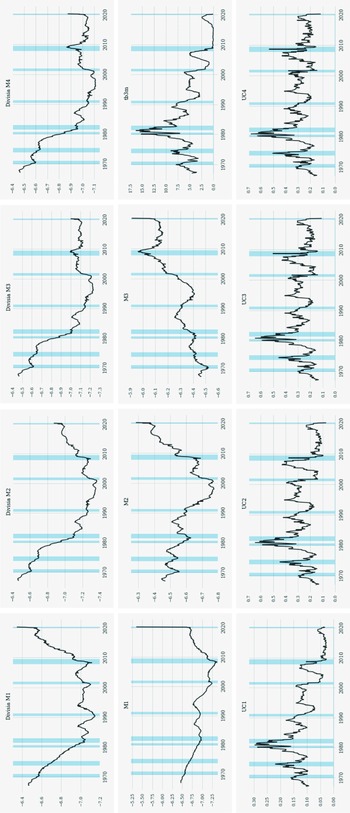


 Open access

