





Management Implications
Euphorbia esula (leafy spurge) and Linaria vulgaris (yellow toadflax) are invasive perennial weeds of pasture and rangeland across the Northern Great Plains. Aminocyclopyrachlor, imazapic, and picloram are the most common herbicides used to manage these weeds, with recurrent applications needed for effective management. Saflufenacil is a contact herbicide labeled to suppress some perennial weed species when applied alone. Mixing saflufenacil with these other herbicides could improve E. esula and L. vulgaris management. Efficacy for the commonly applied herbicides and saflufenacil was additive for control estimates, height, and stem population density reductions for both species. While some herbicides alone (i.e., aminocyclopyrachlor and imazapic) provided similar effectiveness as the mixtures with saflufenacil, land managers may consider applying the mixtures for additive activity, increasing the spectrum of weeds controlled, and reducing selection pressure. Management tactics will likely be needed within a year after the initial treatment.
Introduction
Leafy spurge (Euphorbia esula L.) and yellow toadflax (Linaria vulgaris Mill.) are pervasive weeds of pasture and rangeland in the Northern Great Plains (DiTomaso Reference DiTomaso2000). If not effectively managed, these species may decrease land value and displace desirable vegetation (DiTomaso Reference DiTomaso2000; Krueger-Mangold et al. Reference Krueger-Mangold, Sheley and Svejcar2006). Herbicides are the most common management tactics for weeds in pasture and rangeland (Jones et al. Reference Jones, Ehlert, Rozeboom, Alms and Vos2025; Mangold et al. Reference Mangold, Fuller, Davis and Rinella2018; Schohr et al. Reference Schohr, Gornish, Woodmansee, Shaw, Tate and Roche2019). Few herbicides are available to effectively manage these two species (Almquist et al. Reference Almquist, Wirt, Adams and Lym2015; Johnson et al. Reference Johnson, Grovenburg, Perkins, Jenks, Inselman and Swanson2014; Lym Reference Lym1998). Most of the available herbicides belong to the synthetic auxin herbicide group (WSSA Group 4) due to selectivity and safety on grass vegetation common in pasture and rangeland (Grossman Reference Grossmann2010). Acetolactate synthase (ALS [EC 2.2.1.6])-inhibiting herbicides (WSSA Group 2) are also applied to manage E. esula, but these herbicides are not as effective on L. vulgaris (Almquist et al. Reference Almquist, Wirt, Adams and Lym2015; Johnson et al. Reference Johnson, Grovenburg, Perkins, Jenks, Inselman and Swanson2014).
Saflufenacil is a protoporphyrinogen oxidase (PPO [EC 1.3.3.4])-inhibiting herbicide (WSSA Group 14) that has primarily been utilized as a preplant burndown herbicide to manage broadleaf weeds (Owen et al. Reference Owen, Mueller, Main, Bond and Steckel2011; Soltani et al. Reference Soltani, Shropshire and Sikkema2009). Due to limited activity on grasses, saflufenacil is labeled for applications in pasture and rangeland (Anonymous 2024a). Current labeling and research suggest that saflufenacil has utility to improve the activity of imazapic (WSSA Group 2) when mixed to manage E. esula (Anonymous 2024b; Datta et al. Reference Datta, Rapp, Scott, Charvat, Zawierucha and Knezevic2013). However, saflufenacil is labeled only to suppress other weeds that inhabit pasture and rangeland (Anonymous 2024b). While not labeled to suppress L. vulgaris, mixing saflufenacil with a commonly applied herbicide may improve management effectiveness. Herbicide mixtures are generally more effective and reduce selection pressure compared with a single herbicide, especially when an additional mode of action is included (Barbieri et al. Reference Barbieri, Young, Dayan, Streibig, Takano, Merotto Junior and Avila2022; Wehtje and Gilliam Reference Wehjte and Gilliam2012).
Saflufenacil is a fast-acting, contact herbicide that provides some soil-residual activity (Grossmann Reference Grossmann2010). It disrupts the conversion of protoporphyrinogen IX to protoporphyrin IX, ultimately preventing the synthesis of chlorophyll production and the production of free radicals to cause cell peroxidation (Beale and Weinstein Reference Beale, Weinstein and Dailey1990; Dayan and Duke Reference Dayan and Duke1997). The mode of action of these herbicides is dissimilar to commonly applied herbicides in pasture and rangeland (e.g., synthetic auxin herbicides). Synthetic auxin herbicides are slow acting and phloem mobile with activity predominantly on broadleaf weeds. The phytotoxic activity of synthetic auxin herbicides is due to the de-repression of transcription factors from auxin receptors. The effect increases auxin concentrations in plant cells and causes growth malformations and the excessive production of reactive oxygen species, which ultimately leads to plant death due to chloroplast destruction (Grossman Reference Grossmann2010). ALS-inhibiting herbicides (i.e., imazapic) are slow acting and phloem-mobile and disrupt the synthesis of branched-chain amino acids (Shaner et al. Reference Shaner, Anderson and Stidham1984). These branched-chain amino acids (leucine, valine, and isoleucine) are important constituents for essential plant functions, including enzymes (Anderson and Hibberd Reference Anderson and Hibberd1985; Singh and Shaner Reference Singh and Shaner1995).
When herbicides with unique modes of action are applied in mixture, the resultant activity can be additive, synergistic, or antagonistic (Colby Reference Colby1967; Zhang et al. Reference Zhang, Hamill and Weaver1995). The rapid activity of saflufenacil may inhibit the absorption and/or translocation of herbicides with slower activity (Ashigh and Hall Reference Ashigh and Hall2010; Eubank et al. Reference Eubank, Nandula, Reddy, Poston and Shaw2013). However, mixtures of similar herbicides (i.e., imazaquin [Group 2] and acifluorfen [Group 14]; dicamba [Group 4] and fomesafen [Group 14]) resulted in increased activity on various annual species (Kelley et al. Reference Kelley, Wax, Hager and Riechers2005; Wesley and Shaw Reference Wesley and Shaw1992). Knowledge of how saflufenacil influences the activity of auxin herbicides, and imazapic on these weeds under field conditions is critical for effective management. The objective of this research was to determine the effect of mixing saflufenacil with commonly applied herbicides to manage E. esula and L. vulgaris in pastures and rangeland.
Materials and Methods
Experiment Sites
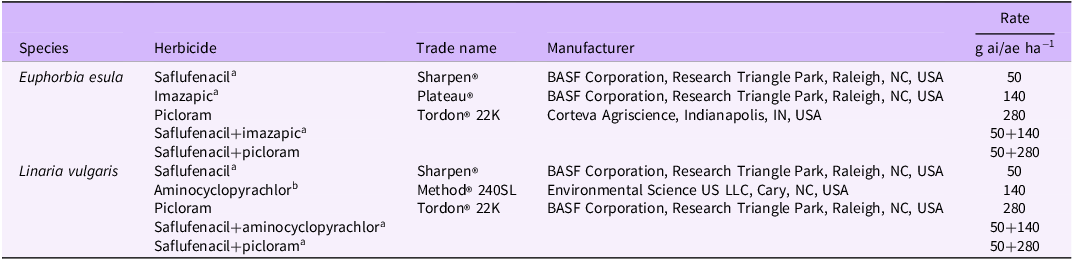
Euphorbia esula experiments were established in Codington County (45.036741°N, 97.251394°W) and Brown County (45.479837°N, 98.514055°W), South Dakota, USA, in 2023 and 2024, respectively. Experiments were arranged as a randomized complete block design with treatments replicated three times. Plots were 3-m wide and 11-m long. Experiments were established in 21 by 46 m areas with uniform distribution of each weed species where E. esula and L. vulgaris existed at 108 (2023) to 111 (2024) and 94 (2024) to 114 (2023) stems m−1 on average, respectively. The Codington County site was treated on June 27, 2023, and the Brown County site was treated on June 13, 2024, with a CO2-powered backpack sprayer at an output of 187 L ha−1 with TT 11003 nozzles (TeeJet® Industries, Wheaton, IL, USA) approximately 50 cm over the vegetation canopy. Euphorbia esula plants were in the yellow bract stage and approximately 13 to 71 cm in height at the time of application. Linaria vulgaris experiments were established in McPherson County (45.809806°N, 99.449022°W), South Dakota, USA, in 2023 and 2024. The site was treated on August 8, 2023, and September 11, 2024. Linaria vulgaris plants were treated at the flowering stage at approximately 25 to 43 cm in height with the spray parameters as described above. Herbicide treatments in the L. vulgaris experiment were applied with TT 11003 nozzles in 2023 and AIXR 11003 nozzles (TeeJet® Industries) in 2024. Herbicide treatments are provided in Table 1. Herbicide rates were selected based on the lower field use rates to avoid maximum weed response (i.e., complete control) to increase the ability to detect interactions with the corresponding mixtures.
Herbicide treatments applied to determine the effect of saflufenacil in combination with other herbicides on Euphorbia esula (Brown and Codington counties) and Linaria vulgaris (McPherson County) in South Dakota in 2023 and 2024.

Table 1. Long description
The table presents a comparison of herbicide treatments for Euphorbia esula and Linaria vulgaris, including the species, herbicides used, trade names, manufacturers, and application rates. The table has five columns: Species, Herbicide, Trade name, Manufacturer, and Rate. The Species column lists Euphorbia esula and Linaria vulgaris. The Herbicide column lists various herbicides such as Saflufenacil, Imazapic, Picloram, and Aminocyclopyrachlor, as well as combinations of these herbicides. The Trade name column lists the corresponding trade names for each herbicide, such as Sharpen, Plateau, Tordon 22K, and Method 240SL. The Manufacturer column lists the manufacturers, including BASF Corporation, Corteva Agriscience, and Environmental Science US LLC. The Rate column lists the application rates in grams of active ingredient per hectare. Notable trends include the use of Saflufenacil in combination with other herbicides for both species, and the varying rates of application depending on the herbicide combination.
a Inclusion of crop oil concentrate at 1% v/v.
b Inclusion of methylated seed oil at 0.5% v/v.
Visual control estimations were conducted at 1 yr after treatment (YAT) on a rating scale ranging from 0% to 100%, where 0% equals no control and 100% equals complete control. Plant heights were quantified by measuring the height of three arbitrarily selected plants from the soil surface to the meristem (growing point). Stem densities were quantified by arbitrarily placing a 0.1 m−2 quadrat two places near the center of each plot. Reductions for plant height and stem density were calculated using Equation 1: $\% \;{\rm{reduction}} = 100{\rm{*}}\;\left[ {{{\left( {{\rm{nontreated}}\;{\rm{value}} - {\rm{treated}}\;{\rm{value}}} \right)} \over {{\rm{nontreated}}\;{\rm{value}}}}} \right]$
Quadrats were arbitrarily placed in the centers of plots to ensure sampling was conducted on plants that received adequate herbicide coverage. All evaluations were conducted on both experiments for E. esula and L. vulgaris.
Statistical Analysis
Visual control estimates, height reduction, and stem density reduction data for each species were subjected to ANOVA using the GLIMMIX procedure in SAS v. 9.4 (Statistical Analysis Software Institute, Cary, NC, USA) at a significance level of α = 0.05. Herbicide treatment was considered a fixed effect, while location/site-year was considered a random effect to increase the inference of the analyses (Blouin et al. Reference Blouin, Webster and Bond2011; Moore and Dixon Reference Moore and Dixon2015). Treatment means were separated using Fisher’s LSD (P ≤ 0.05). The visual control estimates from the nontreated plots (e.g., 0%) were removed from the analysis to avoid violation of constant variance assumptions required for ANOVA.
Herbicide mixtures with saflufenacil were evaluated to determine whether the resultant activity (visual control estimates, height reduction, and stem density reduction) on each species was additive, antagonistic, or synergistic using Colby’s method (Colby Reference Colby1967). Colby’s method calculates an expected response value for a herbicide mixture based on the control with the individual herbicides and the expected response value is then compared with the response of the tested herbicide mixture. Herbicide mixtures with saflufenacil were analyzed using the equation for Colby’s method (Equation 2): $E = \left( {X + Y} \right) - \left( {{{xy}}\over{{100}}} \right)$
where E is expected % response of the herbicide mixture, X is % response of saflufenacil when applied alone, and Y is % response of aminocyclopyrachlor, imazapic, or picloram when applied alone. The expected response was compared with the observed response using a two-sided t-test (α = 0.05). If the response was greater than the expected response, the mixture was synergistic, whereas if the response was lower than the expected response, the mixture was antagonistic (Colby Reference Colby1967). If the observed and expected responses were not different, the mixture was considered additive (Colby Reference Colby1967).
Results and Discussion
Euphorbia esula
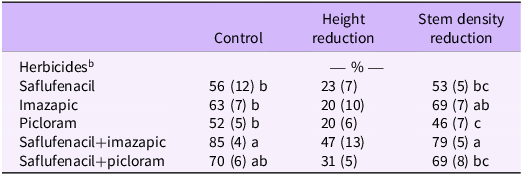
Herbicide influenced the visual control estimates (P = 0.03) and stem density reduction (P = 0.002), but not the height reduction (P = 0.13) of E. esula at 1 YAT. Saflufenacil+imazapic provided greater control (85%) than either herbicide applied alone (Table 2). Control with saflufenacil+picloram was not different than with saflufenacil+imazapic or each herbicide applied alone (Table 2). Control with each herbicide applied alone never exceeded 63% (Table 2). Saflufenacil+imazapic and imazapic provided the greatest stem density reduction, followed by saflufenacil, saflufenacil+picloram, then picloram (Table 2). Height reductions ranged from 20% to 47% and were not different across tested treatments (Table 2). Saflufenacil+imazapic and saflufenacil+picloram were additive for visual control estimates, stem density reduction, and height reduction of E. esula (Table 3).
Euphorbia esula visual control estimates, height reduction, and stem density reduction with commonly applied herbicides mixed with saflufenacil 1 yr after treatment in experiments conducted at Brown and Codington counties, South Dakota, in 2023 and 2024. a

Table 2. Long description
A table with three columns labeled Control, Height reduction, and Stem density reduction, and five rows labeled with different herbicides. The table presents data on the percentage of visual control, height reduction, and stem density reduction of Euphorbia esula after treatment with various herbicides. The herbicides listed are Saflufenacil, Imazapic, Picloram, Saflufenacil plus Imazapic, and Saflufenacil plus Picloram. Each row provides specific percentage values for control, height reduction, and stem density reduction, along with standard errors in parentheses. Notable trends include higher control and stem density reduction with Saflufenacil plus Imazapic compared to other treatments. Height reduction percentages are relatively similar across treatments.
a Means that share the same letter within columns are not statistically different based on Fisher’s LSD (P < 0.05).
b Herbicide rates: saflufenacil (50 g ai ha−1), imazapic (140 g ai ha−1), picloram (280 g ae ha−1).
Euphorbia esula visual control estimates, height, and stem density reduction (expected and observed) with saflufenacil+imazapic or saflufenacil+picloram 1 yr after treatment in experiments conducted at Brown and Codington counties, South Dakota, in 2023 and 2024.

Table 3. Long description
The table presents data on the visual control estimates, height reduction, and stem density reduction of Euphorbia esula after treatment with saflufenacil and imazapic or saflufenacil and picloram. The data is from experiments conducted in Brown and Codington counties, South Dakota, in 2023 and 2024. The table has three main sections: Control, Height reduction, and Stem reduction, each with columns for Expected, Observed, and P-value. The Control section shows that saflufenacil and imazapic have an expected and observed control rate of eighty-four percentage, while saflufenacil and picloram have an expected control rate of seventy-nine percentage and an observed control rate of seventy percentage. The Height reduction section indicates that saflufenacil and imazapic have an expected height reduction of thirty-eight percentage and an observed height reduction of forty-seven percentage, with a P-value of zero point six two. Saflufenacil and picloram have an expected height reduction of thirty-eight percentage and an observed height reduction of thirty-one percentage, with a P-value of zero point three nine. The Stem reduction section shows that saflufenacil and imazapic have an expected stem reduction of eighty-seven percentage and an observed stem reduction of seventy-nine percentage, with a P-value of zero point three six. Saflufenacil and picloram have an expected stem reduction of seventy-seven percentage and an observed stem reduction of sixty-nine percentage, with a P-value of zero point five zero.
a Herbicide rates: saflufenacil (50 g ai ha−1), imazapic (140 g ai ha−1), picloram (280 g ae ha−1).
b NC, not calculated.
Previous research showed similar E. esula control estimates with picloram (43% to 54%) at 1 YAT, but control estimates were lower for imazapic (33%) (Beck et al. Reference Beck, Lym, Becker, Ferrell, Finnerty, Frank, Henson and Peterson1993; Lym and Messersmith Reference Lym and Messersmith1987; Markle and Lym Reference Markle and Lym2001). No data for control estimates exist in published literature for saflufenacil, saflufenacil+imazapic, or saflufenacil+picloram for comparison. Stem density reductions in this research were dissimilar to results for previous research with imazapic (30%), while being similar for saflufenacil (52%) and saflufenacil+imazapic (87%) at 1 YAT (Datta et al. Reference Datta, Rapp, Scott, Charvat, Zawierucha and Knezevic2013). While no stem density reduction data exist for saflufenacil+picloram on E. esula, the mixture can be deemed as effective as saflufenacil+imazapic for stem density reduction based on previous and presented research (Datta et al. Reference Datta, Rapp, Scott, Charvat, Zawierucha and Knezevic2013). While stem reductions were present, the lack of differential height reductions suggests that plants surviving these herbicides will exhibit similar regrowth and fitness, which may not impede spread of the infestations (Liu et al. Reference Liu, Groff, Anderson, Brown, Cahill, Paulow and Bennet2023). No herbicide mixture provided E. esula stem density reductions greater than 79% at 1 YAT, suggesting that follow-up management tactics will be needed (Lym Reference Lym1998). Support for follow-up management is clear when efficacy of the herbicides applied at the tested rates continues to decrease or remain the same at 2 YAT (Datta et al. Reference Datta, Rapp, Scott, Charvat, Zawierucha and Knezevic2013; Hein and Miller Reference Hein and Miller1991; Lym and Messersmith Reference Lym and Messersmith1987; Markle and Lym Reference Markle and Lym2001).
Linaria vulgaris
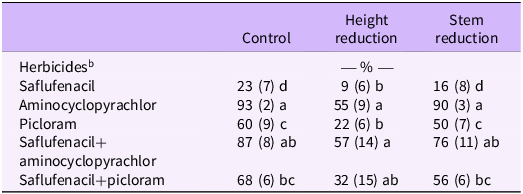
Herbicide influenced visual control estimates (P < 0.0001), stem density (P < 0.0001), and height reduction (P = 0.013) of L. vulgaris at 1 YAT. Aminocyclopyrachlor and saflufenacil+aminocyclopyrachlor provided the greatest control (87% to 93%) (Table 4). Control was not different between the two herbicide mixtures. However, saflufenacil+picloram was less effective than aminocyclopyrachlor (Table 4). Picloram provided control not different from saflufenacil+picloram but less than that of aminocyclopyrachlor and saflufenacil+aminocyclopyrachlor. As was seen for E. esula, saflufenacil provided the least control (Table 4).
Linaria vulgaris visual control estimates, height reduction, and stem density reduction with commonly applied herbicides mixed with saflufenacil 1 yr after treatment in experiments conducted at McPherson County, South Dakota, in 2023 and 2024. a,c,d

Table 4. Long description
The table presents data on the effects of different herbicides on the control, height reduction, and stem reduction of Linaria vulgaris. It includes five rows for different herbicides and three columns for control percentage, height reduction percentage, and stem reduction percentage. The herbicides listed are Saflufenacil, Aminocyclopyrachlor, Picloram, Saflufenacil combined with Aminocyclopyrachlor, and Saflufenacil combined with Picloram. Saflufenacil shows the least control at twenty-three percentage, while Aminocyclopyrachlor shows the highest control at ninety-three percentage. The combinations of Saflufenacil with Aminocyclopyrachlor and Saflufenacil with Picloram show intermediate levels of control. Height reduction and stem reduction follow similar patterns, with Aminocyclopyrachlor and its combination with Saflufenacil showing the highest reductions. The data indicates that Aminocyclopyrachlor and its combination with Saflufenacil are the most effective in controlling Linaria vulgaris.
a Means that share the same letter within columns are not statistically different based on Fisher’s LSD (P < 0.05).
b Herbicide rates: saflufenacil (50 g ai ha−1), aminocyclopyrachlor (140 g ai ha−1), picloram (280 g ae ha−1).
c Statistically not different; S+A 87ab and S+P 68 bc. Letters denote the similar values as well as the standard error.
d The letters denote statistical difference. If values share similar letters, the values are not different. S+A = 76ab and S+P = 56bc. The standard error help illustrate the overlap as well.
Aminocyclopyrachlor and saflufenacil+aminocyclopyrachlor provided the greatest stem density reduction followed by saflufenacil+picloram, picloram, then saflufenacil (Table 4). Stem density reductions were not different between the herbicide mixtures (Table 4). Aminocyclopyrachlor and saflufenacil+aminocyclopyrachlor provided the greatest L. vulgaris height reduction (Table 4). Picloram and saflufenacil provided the least height reduction (Table 4). Linaria vulgaris height reduction when treated with saflufenacil+picloram was not different from any other herbicide treatment (Table 4). Saflufenacil+imazapic and saflufenacil+picloram were additive for visual control estimates, stem density, and height reduction for L. vulgaris 1 YAT (Table 5).
Linaria vulgaris visual control estimates, height, and stem density reduction (expected and observed) with saflufenacil+aminocyclopyrachlor or saflufenacil+picloram 1 yr after treatment in experiments conducted at McPherson County, South Dakota, in 2023 and 2024.

Table 5. Long description
The table presents data on the effects of different herbicide treatments on Linaria vulgaris visual control estimates, height, and stem density reduction. It includes expected and observed values for height reduction and stem density reduction, along with corresponding P-values. The table has four rows and twelve columns. The rows are labeled with the herbicide treatments: Saflufenacil plus aminocyclopyrachlor and Saflufenacil plus picloram. The columns are divided into three main sections: Control, Height reduction, and Stem reduction. Each section contains Expected, Observed, and P-value columns. For Saflufenacil plus aminocyclopyrachlor, the observed control is eighty-seven percentage, with a P-value of zero point five. The expected height reduction is fifty-nine percentage, observed height reduction is fifty-seven percentage, with a P-value of zero point nine one. The expected stem reduction is ninety-two percentage, observed stem reduction is seventy-six percentage, with a P-value of zero point three eight. For Saflufenacil plus picloram, the observed control is sixty-eight percentage, with a P-value of zero point eight nine. The expected height reduction is twenty-nine percentage, observed height reduction is thirty-two percentage, with a P-value of zero point eight seven. The expected stem reduction is fifty-eight percentage, observed stem reduction is fifty-six percentage, with a P-value of zero point eight zero.
a Herbicide rates: saflufenacil (50 g ai ha−1), aminocyclopyrachlor (140 g ai ha−1), picloram (280 g ae ha−1).
Similar control estimates were observed in North Dakota at 1 YAT with aminocyclopyrachlor (100%) applied at the same rate and picloram (59%) applied at a greater rate (560 g ae ha−1) than used in the current study at 1 YAT (Almquist et al. Reference Almquist, Wirt, Adams and Lym2015). No published data exist on the effectiveness of saflufenacil alone or in mixture with other herbicides on L. vulgaris for comparison. Linaria vulgaris stem density reductions ranged from 76% to 90% at 1 YAT with treatments containing aminocyclopyrachlor, which may provide long-term management, but regardless, other tactics should be implemented (Almquist et al. Reference Almquist, Wirt, Adams and Lym2015; Egan and Irwin Reference Egan and Irwin2008). Aminocyclopyrachlor is effective on L. vulgaris and other weed species, but land managers may be reluctant to use the herbicide due to the accompanying grazing and haying restrictions after application (Anonymous 2024a). If aminocyclopyrachlor was not included, stem density reduction was never greater than 56% suggesting that these treatments are not effective long-term.
The results of these experiments provide further evidence demonstrating saflufenacil’s additive activity when included with commonly applied herbicides for E. esula and L. vulgaris management. While mixtures of herbicides belonging to similar groups of the tested herbicides in this research provided synergism on annual weeds, this result was not evident on the perennial species tested (Kelley et al. Reference Kelley, Wax, Hager and Riechers2005; Shaw and Westley 1995; Wesley and Shaw Reference Wesley and Shaw1992). Because saflufenacil is not widely applied to manage these weed species, applications of this herbicide in mixtures could disrupt management history that placed great selection pressure on these two species (Liu et al. Reference Liu, Groff, Anderson, Brown, Cahill, Paulow and Bennet2023). Recommendations of sole reliance and recurrent applications of mixtures containing saflufenacil must be done with caution, as both species are genetically diverse, which result in rapid adaptation to selection pressure (Ward et al. Reference Ward, Reid, Harrington, Sutton and Beck2008; West et al. Reference West, Gaskin, Milan and Rand2023).
All herbicides (excluding saflufenacil) were applied at a lower rate in the present research compared with the maximum labeled rates (aminocyclopyrachlor: 140 vs. 315 g ae ha−1; imazapic: 140 vs. 210 g ai ha−1; picloram: 280 vs. 1,122 g ae ha−1) (Anonymous 2023a, 2023b, 2024a). Utilizing the lower rates of the tested herbicides may have reduced the success of long-term management of both species. If a higher rate of the tested herbicides were utilized, greater long-term management could be expected (Almquist et al. Reference Almquist, Wirt, Adams and Lym2015; Bowes and Molberg Reference Bowes and Molberg1975; Hein and Miller Reference Hein and Miller1991; Morris et al. Reference Morris, Monaco and Rigby2009). Antagonism was not realized for any response variable on either species, but these results could be dependent on varying herbicide rates (Flint et al. Reference Flint, Cornelius and Barrett1988). Additivity, antagonism and synergism should be further evaluated on the tested species with greater and varying rates to further characterize the activity of the tested herbicide mixtures to ensure effective weed management (Barbieri et al Reference Barbieri, Young, Dayan, Streibig, Takano, Merotto Junior and Avila2022; Sukhoverkov and Mylne Reference Sukhoverkov and Mylne2021).
Future research should evaluate the activity of mixtures of saflufenacil and commonly applied herbicides on other weed species in pasture and rangeland, as no published data currently exist. Determining effective herbicide mixtures including saflufenacil to manage other weed species is important, as limited options exist in pasture and rangeland (DiTomaso et al. Reference DiTomaso, Masters and Peterson2010). While not directly evaluated in these experiments, these herbicides can injure or kill desirable vegetation at the tested rate or greater (Arnold and Santelmann Reference Arnold and Santelmann1966; Beran et al. Reference Beran, Masters and Gaussoin1999; Carter and Lym Reference Carter and Lym2018; Lym et al. Reference Lym, Becker, Moechnig, Halstvedt and Peterson2017; Shinn and Thill Reference Shinn and Thill2004; Thilmony and Lym Reference Thilmony and Lym2017). Quantifying the impacts on desirable vegetation is crucial to maintain competitive vegetation with later-emerging weeds (DiTomaso et al. Reference DiTomaso, Masters and Peterson2010; Lamb et al. Reference Lamb, Keller and Shea2024). Future research should also be conducted in areas with a broad range of non-target vegetation to quantify broader ecological impacts.
Acknowledgments
The authors extend sincere thanks to the following County Weed Supervisors for finding sites to conduct the research: Chris Hemen (Brown County), Steve Molengraaf (Codington County), and Mike Schwingler (McPherson County; former County Weed Supervisor). The authors express gratitude to Micheal D. K. Owen for critically reviewing the article before submission.
Funding statement
Project funding was provided by the South Dakota Weed and Pest Control Commission.
Competing interests
Authors declare no competing interests.



 Open access

