





1 Introduction
Infinitary $L_{\omega _1\omega }$
formulas allow countable conjunctions and disjunctions, but only finite strings of quantifiers. The following result of Scott [Reference Scott and Addison14] illustrates the expressive power of
$L_{\omega _1\omega }$
formulas allow countable conjunctions and disjunctions, but only finite strings of quantifiers. The following result of Scott [Reference Scott and Addison14] illustrates the expressive power of $L_{\omega _1\omega }$
. (See [Reference Ash and Knight4] for more background.)
$L_{\omega _1\omega }$
. (See [Reference Ash and Knight4] for more background.)
Theorem 1.1 (Scott)
For any countable structure $\mathcal {A}$
in a countable language L, there is an
$\mathcal {A}$
in a countable language L, there is an $L_{\omega _1\omega }$
-sentence
$L_{\omega _1\omega }$
-sentence $\varphi $
whose countable models are just the isomorphic copies of
$\varphi $
whose countable models are just the isomorphic copies of $\mathcal {A}$
.
$\mathcal {A}$
.
We call $\varphi $
a Scott sentence for
$\varphi $
a Scott sentence for $\mathcal {A}$
. For a computable language L, computable infinitary formulas are the formulas of
$\mathcal {A}$
. For a computable language L, computable infinitary formulas are the formulas of $L_{\omega _1\omega }$
in which the disjunctions and conjunctions are over c.e. sets. These formulas, despite being infinitely long, seem comprehensible. Many of the
$L_{\omega _1\omega }$
in which the disjunctions and conjunctions are over c.e. sets. These formulas, despite being infinitely long, seem comprehensible. Many of the $L_{\omega _1\omega }$
-formulas that describe interesting properties of structures, and important relations on elements, turn out to be computable infinitary.
$L_{\omega _1\omega }$
-formulas that describe interesting properties of structures, and important relations on elements, turn out to be computable infinitary.
For $L_{\omega _1\omega }$
, there is no prenex normal form. We cannot always bring the quantifiers outside. However, we can bring the negations inside. This yields a different normal form. We classify formulas in this normal form based on the number of alternations of
$L_{\omega _1\omega }$
, there is no prenex normal form. We cannot always bring the quantifiers outside. However, we can bring the negations inside. This yields a different normal form. We classify formulas in this normal form based on the number of alternations of $\bigvee \exists $
and
$\bigvee \exists $
and $\bigwedge \forall $
. In particular, a
$\bigwedge \forall $
. In particular, a $\Pi _2$
formula has the form
$\Pi _2$
formula has the form $\bigwedge _i(\forall \bar {u}_i)\bigvee _j(\exists \bar {v}_{i,j})\alpha _{i,j}(\bar {u}_i,\bar {v}_{i,j})$
, where
$\bigwedge _i(\forall \bar {u}_i)\bigvee _j(\exists \bar {v}_{i,j})\alpha _{i,j}(\bar {u}_i,\bar {v}_{i,j})$
, where $\alpha _{i,j}(\bar {u}_i,\bar {v}_{i,j})$
is quantifier-free. In [Reference Miller10], A. Miller showed that for relational languages, no infinite structure can have a
$\alpha _{i,j}(\bar {u}_i,\bar {v}_{i,j})$
is quantifier-free. In [Reference Miller10], A. Miller showed that for relational languages, no infinite structure can have a $\Sigma _2$
Scott sentence. Harrison-Trainor [Reference Alvir, Greenberg, Harrison-Trainor and Turetsky2] showed that the same is true for an arbitrary language.
$\Sigma _2$
Scott sentence. Harrison-Trainor [Reference Alvir, Greenberg, Harrison-Trainor and Turetsky2] showed that the same is true for an arbitrary language.
Montalbán [Reference Montalbán11] characterized the structures with a $\Pi _{\alpha +1}$
Scott sentence. He found quite a few different-looking conditions. We give just two.
$\Pi _{\alpha +1}$
Scott sentence. He found quite a few different-looking conditions. We give just two.
Theorem 1.2 (Montalbán)
Let $\alpha $
be a countable ordinal, and let L be a countable language. For a countable L-structure
$\alpha $
be a countable ordinal, and let L be a countable language. For a countable L-structure $\mathcal {A}$
, the following are equivalent:
$\mathcal {A}$
, the following are equivalent:
-
1. $\mathcal {A}$
has a
$\Pi _{\alpha +1}$
Scott sentence;
$\mathcal {A}$
has a
$\Pi _{\alpha +1}$
Scott sentence; -
2. for each tuple
$\bar {a}$
, the orbit is defined by a
$\Sigma _\alpha $
formula; -
3. for each tuple
$\bar {a}$
, there is a
$\Sigma _\alpha $
formula that implies (in
$\mathcal {A})$
all
$\Pi _\alpha $
formulas true of
$\bar {a}$
.


For an infinite structure, the simplest form for a Scott sentence is $\Pi _2$
. Montalbán’s Theorem (with
$\Pi _2$
. Montalbán’s Theorem (with $\alpha = 1$
) yields the following.
$\alpha = 1$
) yields the following.
Corollary 1.3. For a countable structure $\mathcal {A}$
, the following are equivalent:
$\mathcal {A}$
, the following are equivalent:
-
1.
$\mathcal {A}$
has a
$\Pi _2$
Scott sentence; -
2. for each tuple
$\bar {a}$
, the orbit is defined by an existential formulaFootnote
1
; -
3. for each tuple
$\bar {a}$
, there is an existential formula that implies the universal type of
$\bar {a}$
.


Remark. A further condition, obviously equivalent to Conditions 2 and 3, says that for each tuple, some existential formula implies the elementary first-order type.
In [Reference Alvir, Knight and McCoy3], there is an example of a computable structure $\mathcal {A}$
with a
$\mathcal {A}$
with a $\Pi _2$
Scott sentence but not one that is computable
$\Pi _2$
Scott sentence but not one that is computable $\Pi _2$
. The structure is “unary.” Unary structures will be important for our main results. The language of these structures consists just of unary relation symbols, and the structures satisfy some special axioms (see Section 2.4). Most of this article concerns the following problem, which was stated in [Reference Alvir, Knight and McCoy3].
$\Pi _2$
. The structure is “unary.” Unary structures will be important for our main results. The language of these structures consists just of unary relation symbols, and the structures satisfy some special axioms (see Section 2.4). Most of this article concerns the following problem, which was stated in [Reference Alvir, Knight and McCoy3].
Problem. When does a countable structure have a computable $\Pi _2$
Scott sentence?
$\Pi _2$
Scott sentence?
In the remainder of Section 1, we give some complexity results for the class of structures with a $\Pi _{\alpha +1}$
Scott sentence, not necessarily computable. We also give a condition that is necessary and sufficient for a structure to have a computable
$\Pi _{\alpha +1}$
Scott sentence, not necessarily computable. We also give a condition that is necessary and sufficient for a structure to have a computable $\Pi _2$
Scott sentence. This condition is not very satisfying—it does not yield a computable infinitary sentence characterizing the class. In Section 2, we give a few examples of structures with and without computable
$\Pi _2$
Scott sentence. This condition is not very satisfying—it does not yield a computable infinitary sentence characterizing the class. In Section 2, we give a few examples of structures with and without computable $\Pi _2$
Scott sentences. We also provide some background on unary structures. In Section 3, we give some conditions sufficient to guarantee that a structure has a computable
$\Pi _2$
Scott sentences. We also provide some background on unary structures. In Section 3, we give some conditions sufficient to guarantee that a structure has a computable $\Pi _2$
Scott sentence, together with examples showing that these conditions are not necessary.
$\Pi _2$
Scott sentence, together with examples showing that these conditions are not necessary.
In Section 4, we give a condition that is necessary and sufficient for a unary structure to have a computable $\Pi _2$
Scott sentence. This condition is also not very satisfying, although we will use it in Section 5, where we show that, for the class
$\Pi _2$
Scott sentence. This condition is also not very satisfying, although we will use it in Section 5, where we show that, for the class $KU$
of unary structures with a computable
$KU$
of unary structures with a computable $\Pi _2$
Scott sentence, the index set is
$\Pi _2$
Scott sentence, the index set is $\Pi ^1_1$
-complete. This implies that there is no computable infinitary sentence characterizing the class. Similarly, if L is a “rich”Footnote
2
computable language, then for the class
$\Pi ^1_1$
-complete. This implies that there is no computable infinitary sentence characterizing the class. Similarly, if L is a “rich”Footnote
2
computable language, then for the class $K_L$
of L-structures with a computable
$K_L$
of L-structures with a computable $\Pi _2$
Scott sentence, the index set is
$\Pi _2$
Scott sentence, the index set is $\Pi ^1_1$
-complete. Alvir, Csima, and Harrison-Trainor [Reference Alvir, Csima and Harrison-Trainor1] have also shown this, independently, and at approximately the same time.
$\Pi ^1_1$
-complete. Alvir, Csima, and Harrison-Trainor [Reference Alvir, Csima and Harrison-Trainor1] have also shown this, independently, and at approximately the same time.
1.1 Complexity consequences of Montalbán’s Theorem
The lemma below says how complicated it is to define the standard back-and-forth relations $\leq _\alpha $
. (For a discussion of these relations, see [Reference Ash and Knight4].)
$\leq _\alpha $
. (For a discussion of these relations, see [Reference Ash and Knight4].)
Lemma 1.4. Let L be a computable language. For each computable ordinal $\alpha \geq 1$
, and each pair of tuples of variables
$\alpha \geq 1$
, and each pair of tuples of variables $\bar {x},\bar {y}$
of the same length, there is a computable
$\bar {x},\bar {y}$
of the same length, there is a computable $\Pi _{2\alpha }$
formula that defines the relation
$\Pi _{2\alpha }$
formula that defines the relation $\bar {x}\leq _\alpha \bar {y}$
in all L-structures.
$\bar {x}\leq _\alpha \bar {y}$
in all L-structures.
Proof. For $\alpha = 1$
, the formula is the conjunction over finitary existential formulas
$\alpha = 1$
, the formula is the conjunction over finitary existential formulas $d(\bar {x})$
of formulas saying that
$d(\bar {x})$
of formulas saying that $d(\bar {y})\rightarrow d(\bar {x})$
. We can take the conjuncts to be finitary
$d(\bar {y})\rightarrow d(\bar {x})$
. We can take the conjuncts to be finitary $\forall \exists $
, so that the conjunction is computable
$\forall \exists $
, so that the conjunction is computable $\Pi _2$
. For
$\Pi _2$
. For $\alpha> 1$
, the formula is the conjunction over
$\alpha> 1$
, the formula is the conjunction over $1\leq \beta < \alpha $
, and further tuples of variables
$1\leq \beta < \alpha $
, and further tuples of variables $\bar {u},\bar {v}$
of the same length, of computable
$\bar {u},\bar {v}$
of the same length, of computable $\Pi _{2\beta }$
formulas saying
$\Pi _{2\beta }$
formulas saying $(\forall \bar {v})(\exists \bar {u})\bar {y},\bar {v}\leq _\beta \bar {x},\bar {u}$
.
$(\forall \bar {v})(\exists \bar {u})\bar {y},\bar {v}\leq _\beta \bar {x},\bar {u}$
.
Using this lemma, we characterize the structures that have a $\Pi _{\alpha +1}$
Scott sentence.
$\Pi _{\alpha +1}$
Scott sentence.
Theorem 1.5. Let L be a countable language. For each countable ordinal $\alpha $
, there is a
$\alpha $
, there is a $\Pi _{2\alpha +2}$
-sentence characterizing the class of L-structures that have a
$\Pi _{2\alpha +2}$
-sentence characterizing the class of L-structures that have a $\Pi _{\alpha +1}$
Scott sentence. For a computable language L and a computable ordinal
$\Pi _{\alpha +1}$
Scott sentence. For a computable language L and a computable ordinal $\alpha $
, the sentence is computable
$\alpha $
, the sentence is computable $\Pi _{2\alpha +2}$
.
$\Pi _{2\alpha +2}$
.
Proof. By Theorem 1.2, the structure $\mathcal {A}$
has a
$\mathcal {A}$
has a $\Pi _{\alpha +1}$
Scott sentence, if and only if for each tuple
$\Pi _{\alpha +1}$
Scott sentence, if and only if for each tuple $\bar {a}$
, there is a
$\bar {a}$
, there is a $\Sigma _\alpha $
formula that implies (in
$\Sigma _\alpha $
formula that implies (in $\mathcal {A})$
all
$\mathcal {A})$
all $\Pi _\alpha $
formulas true of
$\Pi _\alpha $
formulas true of $\bar {a}$
. Then the class is characterized by the computable
$\bar {a}$
. Then the class is characterized by the computable $\Pi _{2\alpha +2}$
-sentence saying that for all tuples
$\Pi _{2\alpha +2}$
-sentence saying that for all tuples $\bar {x}$
, there exist some
$\bar {x}$
, there exist some $\beta < \alpha $
and some further tuple
$\beta < \alpha $
and some further tuple $\bar {u}$
such that for all
$\bar {u}$
such that for all $\bar {y}$
and
$\bar {y}$
and $\bar {v}$
, if
$\bar {v}$
, if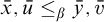 $\bar {x},\bar {u}\leq _\beta \bar {y},\bar {v}$
, then
$\bar {x},\bar {u}\leq _\beta \bar {y},\bar {v}$
, then $\bar {x}\leq _\alpha \bar {y}$
.
$\bar {x}\leq _\alpha \bar {y}$
.
Corollary 1.6. For a computable language L and a computable ordinal $\alpha $
, the index set for the class of L-structures with a
$\alpha $
, the index set for the class of L-structures with a $\Pi _{\alpha +1}$
Scott sentence is
$\Pi _{\alpha +1}$
Scott sentence is $\Pi ^0_{2\alpha +2}$
. In particular, the index set for the class of L-structures with a
$\Pi ^0_{2\alpha +2}$
. In particular, the index set for the class of L-structures with a $\Pi _2$
Scott sentence is
$\Pi _2$
Scott sentence is $\Pi ^0_4$
.
$\Pi ^0_4$
.
Corollary 1.6 is due to Gonzalez [Reference Gonzalez7]. Theorem 1.5 was certainly known to Gonzalez and Rossegger, who, in [Reference Gonzalez and Rossegger8], showed that for a rich computable language L and a computable limit ordinal $\alpha $
, the index set for the class of L-structures with a computable
$\alpha $
, the index set for the class of L-structures with a computable $\Pi _\alpha $
Scott sentence is
$\Pi _\alpha $
Scott sentence is $\Pi ^1_1$
-complete.
$\Pi ^1_1$
-complete.
Toward our main problem, the theorem below gives a necessary and sufficient condition for a structure (possibly in a rich language) to have a computable $\Pi _2$
Scott sentence.
$\Pi _2$
Scott sentence.
Theorem 1.7. Let $\mathcal {A}$
be a countable structure for a computable language L. Then
$\mathcal {A}$
be a countable structure for a computable language L. Then $\mathcal {A}$
has a computable
$\mathcal {A}$
has a computable $\Pi _2$
Scott sentence iff there is a uniformly c.e. family
$\Pi _2$
Scott sentence iff there is a uniformly c.e. family $\Gamma _i(\bar {u}_i)$
of sets of universal formulas such that
$\Gamma _i(\bar {u}_i)$
of sets of universal formulas such that $\mathcal {A}$
omits all
$\mathcal {A}$
omits all $\Gamma _i(\bar {u}_i)$
, and every countable L-structure
$\Gamma _i(\bar {u}_i)$
, and every countable L-structure $\mathcal {B}$
not isomorphic to
$\mathcal {B}$
not isomorphic to $\mathcal {A}$
realizes some
$\mathcal {A}$
realizes some $\Gamma _i$
.
$\Gamma _i$
.
The proof involves just writing what it means to have a computable $\Pi _2$
Scott sentence. The characterization does not tell us what the structures look like, and it does not yield anything like Theorem 1.5. Our result in Section 5 explains why, in fact, no nice characterization is possible.
$\Pi _2$
Scott sentence. The characterization does not tell us what the structures look like, and it does not yield anything like Theorem 1.5. Our result in Section 5 explains why, in fact, no nice characterization is possible.
2 First examples
In this section, we consider some examples of structures with and without a computable $\Pi _2$
Scott sentence.
$\Pi _2$
Scott sentence.
2.1 Linear orders
The following results are known (see the paper of Gonzalez and Rossegger [Reference Gonzalez and Rossegger8]). Both are easy to prove.
Proposition 2.1. The usual ordering on the rationals has a computable $\Pi _2$
, even finitary, Scott sentence.
$\Pi _2$
, even finitary, Scott sentence.
Proposition 2.2. The usual ordering on the rationals is, up to isomorphism, the only countably infinite linear ordering with a $\Pi _2$
Scott sentence.
$\Pi _2$
Scott sentence.
2.2 Torsion-free Abelian groups
For groups, the usual language has one binary operation symbol (for the group operation), one unary operation symbol (for the inverse), and one constant (for the identity). We show that among torsion-free Abelian groups of rank $1$
, the only one with a computable
$1$
, the only one with a computable $\Pi _2$
Scott sentence is the additive group of rationals
$\Pi _2$
Scott sentence is the additive group of rationals $\mathbb {Q}$
. The fact that
$\mathbb {Q}$
. The fact that $\mathbb {Q}$
has a computable
$\mathbb {Q}$
has a computable $\Pi _2$
Scott sentence is surely known. We give a proof to illustrate what these sentences can express.
$\Pi _2$
Scott sentence is surely known. We give a proof to illustrate what these sentences can express.
Proposition 2.3. The group $\mathbb {Q}$
has a computable
$\mathbb {Q}$
has a computable $\Pi _2$
Scott sentence.
$\Pi _2$
Scott sentence.
Proof. For a computable $\Pi _2$
Scott sentence, we may take the conjunction of the finitary (universal) axioms for Abelian groups, a computable
$\Pi _2$
Scott sentence, we may take the conjunction of the finitary (universal) axioms for Abelian groups, a computable $\Pi _1$
sentence saying that the group is torsion-free, and computable
$\Pi _1$
sentence saying that the group is torsion-free, and computable $\Pi _2$
sentences saying that the group is divisible and has rank
$\Pi _2$
sentences saying that the group is divisible and has rank $1$
. At some x is not
$1$
. At some x is not $0$
and for all pairs
$0$
and for all pairs $x,y$
, there are integers
$x,y$
, there are integers $m,n$
, not both zero, such that
$m,n$
, not both zero, such that $mx + ny = 0$
. To say that the group is divisible, we say that every element is divisible by all non-zero n.
$mx + ny = 0$
. To say that the group is divisible, we say that every element is divisible by all non-zero n.
Proposition 2.4. No rank $1$
torsion-free Abelian group apart from
$1$
torsion-free Abelian group apart from $\mathbb {Q}$
has a
$\mathbb {Q}$
has a $\Pi _2$
Scott sentence.
$\Pi _2$
Scott sentence.
Proof. Let G be a subgroup of $\mathbb {Q}$
. By a result of Baer [Reference Baer6], the isomorphism type of G is determined by the divisibility type of a non-zero element a, where this is given by the collection of prime powers that divide a. If, for a particular prime p, a is divisible by
$\mathbb {Q}$
. By a result of Baer [Reference Baer6], the isomorphism type of G is determined by the divisibility type of a non-zero element a, where this is given by the collection of prime powers that divide a. If, for a particular prime p, a is divisible by $p^n$
for all n, then the same is true for all elements. If G is not isomorphic to
$p^n$
for all n, then the same is true for all elements. If G is not isomorphic to $\mathbb {Q}$
, then for any non-zero element a, there is some prime p and some n such that
$\mathbb {Q}$
, then for any non-zero element a, there is some prime p and some n such that $p^n$
does not divide a. Replacing a by a multiple, if necessary, we may suppose that p itself does not divide a. The function
$p^n$
does not divide a. Replacing a by a multiple, if necessary, we may suppose that p itself does not divide a. The function $x\rightarrow px$
takes G to a copy
$x\rightarrow px$
takes G to a copy $pG$
that is a proper substructure of G. Any existential formula true of a in G is true of
$pG$
that is a proper substructure of G. Any existential formula true of a in G is true of $b = pa$
in
$b = pa$
in $pG$
. It is also true of b in G. However, no automorphism of G takes a to b. Since the orbit of a is not defined by an existential formula, G cannot have a
$pG$
. It is also true of b in G. However, no automorphism of G takes a to b. Since the orbit of a is not defined by an existential formula, G cannot have a $\Pi _2$
Scott sentence, by Corollary 1.3.
$\Pi _2$
Scott sentence, by Corollary 1.3.
2.3 Subfields of the algebraic numbers
For fields, the standard language has two binary operation symbols, one for addition and one for multiplication, and two constants, for the additive and multiplicative identities.
Proposition 2.5. If F is a subfield of the algebraic numbers, then it has a $\Pi _2$
Scott sentence. Moreover, if F is computable, then we may take the Scott sentence to be computable
$\Pi _2$
Scott sentence. Moreover, if F is computable, then we may take the Scott sentence to be computable $\Pi _2$
.
$\Pi _2$
.
Proof. Let S be the set of polynomials $p(x)$
over
$p(x)$
over $\mathbb {Q}$
(or
$\mathbb {Q}$
(or $\mathbb {Z}$
) with roots in F. Then F has a Scott sentence saying that the structure is a field of characteristic
$\mathbb {Z}$
) with roots in F. Then F has a Scott sentence saying that the structure is a field of characteristic $0$
in which every element is a root of some polynomial in S and all polynomials in S have roots. This Scott sentence is
$0$
in which every element is a root of some polynomial in S and all polynomials in S have roots. This Scott sentence is $\Pi _2$
. If F is computable, then S is c.e., and the Scott sentence is computable
$\Pi _2$
. If F is computable, then S is c.e., and the Scott sentence is computable $\Pi _2$
.
$\Pi _2$
.
2.4 Unary structures
Let L be the language consisting of unary relation symbols $U_n$
, for
$U_n$
, for $n\in \omega $
. Below, we define the class of unary structures. For
$n\in \omega $
. Below, we define the class of unary structures. For $\sigma \in 2^{<\omega }$
, we write
$\sigma \in 2^{<\omega }$
, we write $\sigma (x)$
for the formula
$\sigma (x)$
for the formula $\bigwedge _{\sigma (n) = 1}U_n(x)\ \&\ \bigwedge _{\sigma (n) = 0}\neg {U_n(x)}$
.
$\bigwedge _{\sigma (n) = 1}U_n(x)\ \&\ \bigwedge _{\sigma (n) = 0}\neg {U_n(x)}$
.
Definition 1. A unary structure is an L-structure $\mathcal {A}$
such that for all
$\mathcal {A}$
such that for all $\sigma \in 2^{<\omega }$
, the formula
$\sigma \in 2^{<\omega }$
, the formula $\sigma (x)$
is satisfied in
$\sigma (x)$
is satisfied in $\mathcal {A}$
either by infinitely many elements or by none.
$\mathcal {A}$
either by infinitely many elements or by none.
Axioms. The class of unary structures is axiomatized by elementary first-order sentences saying, for each $\sigma \in 2^{<\omega }$
and
$\sigma \in 2^{<\omega }$
and $n\geq 1$
,
$n\geq 1$
,
 $$ \begin{align*}(\exists x)\sigma(x)\rightarrow (\exists^{\geq n}x)\sigma(x).\end{align*} $$
The axioms above are $\forall \exists $
-sentences. The conjunction is a computable
$\forall \exists $
-sentences. The conjunction is a computable $\Pi _2$
sentence
$\Pi _2$
sentence $\beta $
. In this section, we give some background on completions of this set of axioms—theories of unary structures. We connect these theories to sub-trees of
$\beta $
. In this section, we give some background on completions of this set of axioms—theories of unary structures. We connect these theories to sub-trees of $2^{<\omega }$
. We then describe the example from [Reference Alvir, Knight and McCoy3] of a unary structure that has a
$2^{<\omega }$
. We then describe the example from [Reference Alvir, Knight and McCoy3] of a unary structure that has a $\Pi _2$
Scott sentence but not one that is computable
$\Pi _2$
Scott sentence but not one that is computable $\Pi _2$
.
$\Pi _2$
.
2.4.1 Theories of unary structures
In unary structures, the quantifier-free $1$
-types in variable x just say
$1$
-types in variable x just say $U_nx$
or
$U_nx$
or $\neg {U_nx}$
for
$\neg {U_nx}$
for $n\in \omega $
. The isomorphism type of a unary structure
$n\in \omega $
. The isomorphism type of a unary structure $\mathcal {A}$
is determined by the number of elements realizing the different quantifier-free
$\mathcal {A}$
is determined by the number of elements realizing the different quantifier-free $1$
-types. The elementary first-order theory
$1$
-types. The elementary first-order theory $Th(\mathcal {A})$
is determined just by the formulas
$Th(\mathcal {A})$
is determined just by the formulas $\sigma (x)$
that are satisfied.
$\sigma (x)$
that are satisfied.
Proposition 2.6. For a unary structure $\mathcal {A}$
,
$\mathcal {A}$
, $Th(\mathcal {A})$
is generated by the
$Th(\mathcal {A})$
is generated by the $\exists \cup \forall $
part. Moreover, the theory admits elimination of quantifiers.
$\exists \cup \forall $
part. Moreover, the theory admits elimination of quantifiers.
Proof. We consider the $L_s$
-reduct
$L_s$
-reduct $\mathcal {A}^s$
of
$\mathcal {A}^s$
of $\mathcal {A}$
, for
$\mathcal {A}$
, for $s\in \omega $
. For each s,
$s\in \omega $
. For each s, $Th(\mathcal {A}^s)$
is
$Th(\mathcal {A}^s)$
is $\aleph _0$
-categorical, generated by the true sentences saying for each
$\aleph _0$
-categorical, generated by the true sentences saying for each $\sigma \in 2^s$
, how many elements satisfy
$\sigma \in 2^s$
, how many elements satisfy $\sigma (x)$
. There is either a single universal sentence
$\sigma (x)$
. There is either a single universal sentence $(\forall x)\neg \sigma (x)$
or an infinite family of existential sentences, one for each n, saying
$(\forall x)\neg \sigma (x)$
or an infinite family of existential sentences, one for each n, saying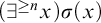 $(\exists ^{\geq n}x)\sigma (x)$
. Note that either possibility implies the sentences
$(\exists ^{\geq n}x)\sigma (x)$
. Note that either possibility implies the sentences $(\exists x)\sigma (x)\rightarrow (\exists ^{\geq n}x\sigma (x)$
, which were among the axioms for unary structures. We have seen that for each s,
$(\exists x)\sigma (x)\rightarrow (\exists ^{\geq n}x\sigma (x)$
, which were among the axioms for unary structures. We have seen that for each s, $Th(\mathcal {A}^s)$
is generated by its
$Th(\mathcal {A}^s)$
is generated by its $\exists \cup \forall $
part. Hence, the same is true for
$\exists \cup \forall $
part. Hence, the same is true for $Th(\mathcal {A})$
.
$Th(\mathcal {A})$
.
Each elementary first-order formula $\varphi (\bar {x})$
in the language L uses only symbols from some finite language
$\varphi (\bar {x})$
in the language L uses only symbols from some finite language $L_s$
. In
$L_s$
. In $\mathcal {A}^s$
, the tuples satisfying
$\mathcal {A}^s$
, the tuples satisfying $\varphi (\bar {x})$
satisfy one of finitely many quantifier-free types. We have a quantifier-free formula
$\varphi (\bar {x})$
satisfy one of finitely many quantifier-free types. We have a quantifier-free formula $\varphi ^*(\bar {x})$
equivalent to
$\varphi ^*(\bar {x})$
equivalent to $\varphi (\bar {x})$
in
$\varphi (\bar {x})$
in $\mathcal {A}^s$
, and therefore, in
$\mathcal {A}^s$
, and therefore, in $\mathcal {A}$
.
$\mathcal {A}$
.
Let T be a completion of the theory of unary structures. Each model has infinitely many realizations of every isolated quantifier-free $1$
-type. The models differ in the number of realizations of non-isolated types.
$1$
-type. The models differ in the number of realizations of non-isolated types.
2.4.2 Scott sentences for unary structures
By Theorem 1.5, it is, in general, computable $\Pi _4$
to say that a structure has a
$\Pi _4$
to say that a structure has a $\Pi _2$
Scott sentence. For unary structures, we save a quantifier.
$\Pi _2$
Scott sentence. For unary structures, we save a quantifier.
Proposition 2.7. The class of unary structures with a $\Pi _2$
Scott sentence is characterized by a computable
$\Pi _2$
Scott sentence is characterized by a computable $\Pi _3$
sentence.
$\Pi _3$
sentence.
Proof. Let $\varphi $
be the conjunction of the computable
$\varphi $
be the conjunction of the computable $\Pi _2$
sentence
$\Pi _2$
sentence $\beta $
characterizing the unary structures and the computable
$\beta $
characterizing the unary structures and the computable $\Pi _3$
sentence saying that for all x, there is some
$\Pi _3$
sentence saying that for all x, there is some $\sigma \in 2^{<\omega }$
such that x satisfies
$\sigma \in 2^{<\omega }$
such that x satisfies
 $$\begin{align*}\sigma(x)\ \&\ (\forall y)[\sigma(y)\rightarrow \bigwedge_n (U_ny\leftrightarrow U_nx)].\end{align*}$$
We show that $\mathcal {A}$
is a unary structure with a
$\mathcal {A}$
is a unary structure with a $\Pi _2$
Scott sentence iff
$\Pi _2$
Scott sentence iff $\mathcal {A}\models \varphi $
. First, suppose
$\mathcal {A}\models \varphi $
. First, suppose $\mathcal {A}$
is a unary structure with a
$\mathcal {A}$
is a unary structure with a $\Pi _2$
Scott sentence. By Montalbán’s Theorem, the orbit of each element is defined by an existential formula. By elimination of quantifiers, we may take the existential formula to be quantifier-free, of the form
$\Pi _2$
Scott sentence. By Montalbán’s Theorem, the orbit of each element is defined by an existential formula. By elimination of quantifiers, we may take the existential formula to be quantifier-free, of the form $\sigma (x)$
for some
$\sigma (x)$
for some $\sigma \in 2^{<\omega }$
. Thus,
$\sigma \in 2^{<\omega }$
. Thus, $\mathcal {A}\models \varphi $
. Now, suppose
$\mathcal {A}\models \varphi $
. Now, suppose $\mathcal {A}\models \varphi $
. Then
$\mathcal {A}\models \varphi $
. Then $\mathcal {A}$
is a unary structure. Moreover, for each tuple
$\mathcal {A}$
is a unary structure. Moreover, for each tuple $\bar {a}$
, we get a quantifier-free formula
$\bar {a}$
, we get a quantifier-free formula $d(\bar {x})$
that defines the orbit—the formula has conjuncts saying that
$d(\bar {x})$
that defines the orbit—the formula has conjuncts saying that $x_i=x_j$
or
$x_i=x_j$
or $x_i\not = x_j$
to match the equality relation on
$x_i\not = x_j$
to match the equality relation on $\bar {a}$
, and further conjuncts
$\bar {a}$
, and further conjuncts $\sigma _i(x_i)$
, one for each i, where
$\sigma _i(x_i)$
, one for each i, where $\sigma _i(x_i)$
defines the orbit of
$\sigma _i(x_i)$
defines the orbit of $a_i$
. By Montalbán’s Theorem,
$a_i$
. By Montalbán’s Theorem, $\mathcal {A}$
has a
$\mathcal {A}$
has a $\Pi _2$
Scott sentence.
$\Pi _2$
Scott sentence.
Corollary 2.8. The index set for the class of unary structures with a $\Pi _2$
Scott sentence is
$\Pi _2$
Scott sentence is $\Pi ^0_3$
.
$\Pi ^0_3$
.
2.4.3 Connection to trees
Given a unary structure $\mathcal {A}$
, we get a unique tree
$\mathcal {A}$
, we get a unique tree ${T\subseteq 2^{<\omega }}$
such that
${T\subseteq 2^{<\omega }}$
such that $\sigma \in T$
if and only if some element of
$\sigma \in T$
if and only if some element of $\mathcal {A}$
satisfies
$\mathcal {A}$
satisfies $\sigma (x)$
. The tree T has no dead ends. Each element a of
$\sigma (x)$
. The tree T has no dead ends. Each element a of $\mathcal {A}$
represents a unique path p through T, where for
$\mathcal {A}$
represents a unique path p through T, where for $\sigma \in 2^{<\omega }$
,
$\sigma \in 2^{<\omega }$
, $\mathcal {A}\models \sigma (a)$
iff
$\mathcal {A}\models \sigma (a)$
iff $\sigma \subseteq p$
. The theory of
$\sigma \subseteq p$
. The theory of $\mathcal {A}$
depends just on the set of nodes in the tree. The model itself depends on the number of elements representing the different (non-isolated) paths. For any tree
$\mathcal {A}$
depends just on the set of nodes in the tree. The model itself depends on the number of elements representing the different (non-isolated) paths. For any tree $T\subseteq 2^{<\omega }$
with no dead ends, we get a complete theory
$T\subseteq 2^{<\omega }$
with no dead ends, we get a complete theory $Th_T$
generated by the axioms, for
$Th_T$
generated by the axioms, for $\sigma \in 2^{<\omega }$
, saying
$\sigma \in 2^{<\omega }$
, saying $(\forall x)\neg {\sigma (x)}$
if
$(\forall x)\neg {\sigma (x)}$
if $\sigma \notin T$
, and
$\sigma \notin T$
, and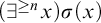 $(\exists ^{\geq n}x)\sigma (x)$
, for all n, if
$(\exists ^{\geq n}x)\sigma (x)$
, for all n, if $\sigma \in T$
. The models of
$\sigma \in T$
. The models of $Th_T$
are the unary structures
$Th_T$
are the unary structures $\mathcal {A}$
such that
$\mathcal {A}$
such that $Th(\mathcal {A}) = Th_T$
. Note that there always exist such models—choose a countable dense set
$Th(\mathcal {A}) = Th_T$
. Note that there always exist such models—choose a countable dense set $\mathbb {D}$
of paths through T, and let
$\mathbb {D}$
of paths through T, and let $\mathcal {A}$
have infinitely many elements representing each path in
$\mathcal {A}$
have infinitely many elements representing each path in $\mathbb {D}$
.
$\mathbb {D}$
.
Proposition 2.9. Let $T\subseteq 2^{<\omega }$
be a tree with no dead ends. Then
$T\subseteq 2^{<\omega }$
be a tree with no dead ends. Then $Th_T$
is decidable iff T is computable.
$Th_T$
is decidable iff T is computable.
Proof. First, suppose that T is computable. We have seen that the theory $Th_T$
is complete, generated by the axioms given in the paragraph above. Since T is computable, the set of axioms is computable. Therefore,
$Th_T$
is complete, generated by the axioms given in the paragraph above. Since T is computable, the set of axioms is computable. Therefore, $Th_T$
is decidable. Now, suppose that
$Th_T$
is decidable. Now, suppose that $Th_T$
is decidable. For
$Th_T$
is decidable. For $\sigma \in 2^{<\omega }$
,
$\sigma \in 2^{<\omega }$
, $\sigma \in T$
iff
$\sigma \in T$
iff $Th_T$
contains the sentence
$Th_T$
contains the sentence $(\exists x)\sigma (x)$
. Therefore, T is computable.
$(\exists x)\sigma (x)$
. Therefore, T is computable.
Remark. Let $T\subseteq 2^{<\omega }$
be a tree with no dead ends. Then
$T\subseteq 2^{<\omega }$
be a tree with no dead ends. Then $Th_T$
has a model with a
$Th_T$
has a model with a $\Pi _2$
Scott sentence iff the isolated paths are dense in T.
$\Pi _2$
Scott sentence iff the isolated paths are dense in T.
2.4.4 Example recalled
We recall the example from [Reference Alvir, Knight and McCoy3].
Theorem 2.10. There is a computable unary structure $\mathcal {A}$
with a
$\mathcal {A}$
with a $\Pi _2$
Scott sentence but no computable
$\Pi _2$
Scott sentence but no computable $\Pi _2$
Scott sentence.
$\Pi _2$
Scott sentence.
The proof uses ideas of Badaev [Reference Badaev5] and Selivanov [Reference Selivanov15]. The first step is to construct a computable tree $T\subseteq 2^{<\omega }$
with no dead ends and with just one non-isolated path p, which is not computable. The theory
$T\subseteq 2^{<\omega }$
with no dead ends and with just one non-isolated path p, which is not computable. The theory $Th_T$
is decidable. The structure
$Th_T$
is decidable. The structure $\mathcal {A}$
is a computable model of
$\mathcal {A}$
is a computable model of $Th_T$
. It is atomic, since no element can represent the non-computable path p. In [Reference Alvir, Knight and McCoy3], there is a direct argument that
$Th_T$
. It is atomic, since no element can represent the non-computable path p. In [Reference Alvir, Knight and McCoy3], there is a direct argument that $\mathcal {A}$
has no computable
$\mathcal {A}$
has no computable $\Pi _2$
Scott sentence.
$\Pi _2$
Scott sentence.
3 Partial results
In this section, we give some conditions that imply the existence of a computable $\Pi _2$
Scott sentence, together with examples showing that the conditions are not necessary. The result below is given in [Reference Alvir, Knight and McCoy3].
$\Pi _2$
Scott sentence, together with examples showing that the conditions are not necessary. The result below is given in [Reference Alvir, Knight and McCoy3].
Proposition 3.1. Let $\mathcal {A}$
be a computable structure, and suppose there is a c.e. family
$\mathcal {A}$
be a computable structure, and suppose there is a c.e. family $\Phi $
of
$\Phi $
of $\exists $
-formulas such that each tuple in
$\exists $
-formulas such that each tuple in $\mathcal {A}$
satisfies some
$\mathcal {A}$
satisfies some $d(\bar {x})\in \Phi $
, and any two tuples satisfying the same formula in
$d(\bar {x})\in \Phi $
, and any two tuples satisfying the same formula in $\Phi $
are automorphic.Footnote
3
Then
$\Phi $
are automorphic.Footnote
3
Then $\mathcal {A}$
has a computable
$\mathcal {A}$
has a computable $\Pi _2$
Scott sentence.
$\Pi _2$
Scott sentence.
Under the hypothesis of Proposition 3.1, there is a computable function f that takes each tuple $\bar {a}$
to an
$\bar {a}$
to an $\exists $
-formula defining the orbit. There are computable structures, with a computable
$\exists $
-formula defining the orbit. There are computable structures, with a computable $\Pi _2$
Scott sentence, but with no such function.
$\Pi _2$
Scott sentence, but with no such function.
Proposition 3.2. There is a computable graph $\mathcal {A}$
with a computable
$\mathcal {A}$
with a computable $\Pi _2$
Scott sentence, such that no
$\Pi _2$
Scott sentence, such that no $\Delta ^0_2$
function assigns to each tuple an existential formula that defines the orbit.
$\Delta ^0_2$
function assigns to each tuple an existential formula that defines the orbit.
Proof. We build $\mathcal {A}$
to satisfy the requirements
$\mathcal {A}$
to satisfy the requirements $R_e$
for all e.
$R_e$
for all e.
-
Re:
$\varphi _e^K$
does not assign to each tuple
$\bar {a}$
an existential formula defining the orbit.


To satisfy $R_e$
, we designate two elements
$R_e$
, we designate two elements $a_e,b_e$
—these will represent different connected components. We make sure that if
$a_e,b_e$
—these will represent different connected components. We make sure that if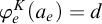 $\varphi _e^K(a_e) = d$
, where d is an existential formula true of
$\varphi _e^K(a_e) = d$
, where d is an existential formula true of $a_e$
, then d is also true of
$a_e$
, then d is also true of $b_e$
but the two are not automorphic. To start off, we make
$b_e$
but the two are not automorphic. To start off, we make $a_e$
and
$a_e$
and $b_e$
each part of a cycle of size
$b_e$
each part of a cycle of size $p_e$
(different values for different e). If we guess that
$p_e$
(different values for different e). If we guess that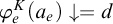 $\varphi _e^K(a_e)\downarrow = d$
, where d is an existential formula true of
$\varphi _e^K(a_e)\downarrow = d$
, where d is an existential formula true of $a_e$
, and also of
$a_e$
, and also of $b_e$
, then we extend so that
$b_e$
, then we extend so that $a_e,b_e$
are not automorphic, making
$a_e,b_e$
are not automorphic, making $a_e$
part of a cycle of length r and making
$a_e$
part of a cycle of length r and making $b_e$
part of a cycle of size
$b_e$
part of a cycle of size $s\not = r$
(choosing r and s larger than the stage and the size of any other cycles already in the graph).
$s\not = r$
(choosing r and s larger than the stage and the size of any other cycles already in the graph).
If, later, we guess that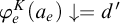 $\varphi _e^K(a_e)\downarrow = d'$
, where
$\varphi _e^K(a_e)\downarrow = d'$
, where $d'$
is an existential formula true of
$d'$
is an existential formula true of $a_e$
, we first extend so that the connected components of
$a_e$
, we first extend so that the connected components of $a_e$
and
$a_e$
and $b_e$
match—
$b_e$
match— $d'$
is then true of both. Then we extend further, making
$d'$
is then true of both. Then we extend further, making $a_e$
part of a cycle of length
$a_e$
part of a cycle of length $r'$
and
$r'$
and $b_e$
part of a cycle of length
$b_e$
part of a cycle of length $s'\not = r'$
as before. We continue in this way. For each new guess that
$s'\not = r'$
as before. We continue in this way. For each new guess that $\varphi _e^K(a_e)\downarrow = d_{e,n}$
, where this is an existential formula true of
$\varphi _e^K(a_e)\downarrow = d_{e,n}$
, where this is an existential formula true of $a_e$
, we first extend the connected components of
$a_e$
, we first extend the connected components of $a_e$
and
$a_e$
and $b_e$
to make them match, so that
$b_e$
to make them match, so that $d_{e,n}$
is also true of
$d_{e,n}$
is also true of $b_e$
. We then make
$b_e$
. We then make $a_e$
part of a new cycle of length
$a_e$
part of a new cycle of length $r_{e,n}$
and we make
$r_{e,n}$
and we make $b_e$
part of a cycle of length
$b_e$
part of a cycle of length $s_{e,n}\not = r_{e,n}$
.
$s_{e,n}\not = r_{e,n}$
.
If $\varphi _e^K(a_e)$
converges to d, where d is an existential formula true of
$\varphi _e^K(a_e)$
converges to d, where d is an existential formula true of $a_e$
, then after finitely many steps, we will computably know the part of K and
$a_e$
, then after finitely many steps, we will computably know the part of K and $K^c$
used in the computation. In this case d is true of both
$K^c$
used in the computation. In this case d is true of both $a_e$
and
$a_e$
and $b_e$
, but the two are not in the same orbit. The connected components of
$b_e$
, but the two are not in the same orbit. The connected components of $a_e$
and
$a_e$
and $b_e$
are finite and not isomorphic. If
$b_e$
are finite and not isomorphic. If $\varphi _e^K(a_e)$
actually diverges, but infinitely often we guess that it converges to an existential formula true of
$\varphi _e^K(a_e)$
actually diverges, but infinitely often we guess that it converges to an existential formula true of $a_e$
, then
$a_e$
, then $a_e$
and
$a_e$
and $b_e$
are in the same orbit, which is defined by the formula describing the original cycle of size
$b_e$
are in the same orbit, which is defined by the formula describing the original cycle of size $p_e$
and one extra cycle that each is a part of. The connected components of
$p_e$
and one extra cycle that each is a part of. The connected components of $a_e$
and
$a_e$
and $b_e$
are both infinite and isomorphic.
$b_e$
are both infinite and isomorphic.
To produce a computable $\Pi _2$
Scott sentence for
$\Pi _2$
Scott sentence for $\mathcal {A}$
, we first consider the set S of all existential sentences true in
$\mathcal {A}$
, we first consider the set S of all existential sentences true in $\mathcal {A}$
and the set T of all universal sentences true in
$\mathcal {A}$
and the set T of all universal sentences true in $\mathcal {A}$
. Since
$\mathcal {A}$
. Since $\mathcal {A}$
is computable, the set S is c.e., and the set T is co-c.e. Let
$\mathcal {A}$
is computable, the set S is c.e., and the set T is co-c.e. Let $\{\psi _n: n \in \omega \}$
be a computable list of all finitary universal sentences in the language of graphs. Then by a standard technique, employed, for instance, in [Reference Ash and Knight4], there is a sequence of infinitary computable
$\{\psi _n: n \in \omega \}$
be a computable list of all finitary universal sentences in the language of graphs. Then by a standard technique, employed, for instance, in [Reference Ash and Knight4], there is a sequence of infinitary computable $\Pi _1$
sentences
$\Pi _1$
sentences $\tau _n$
, each built entirely from the logical constants for truth and falsity, so that
$\tau _n$
, each built entirely from the logical constants for truth and falsity, so that $\tau _n$
is logically equivalent to truth iff
$\tau _n$
is logically equivalent to truth iff $\psi _n \in T$
; and
$\psi _n \in T$
; and $\tau _n$
is logically equivalent to falsity iff
$\tau _n$
is logically equivalent to falsity iff $\psi _n \notin T$
. Therefore, the conjunction
$\psi _n \notin T$
. Therefore, the conjunction $\left (\bigwedge _{\varphi \in S}\varphi \right ) \wedge \left (\bigwedge _{n} (\tau _n \rightarrow \psi _n)\right )$
is a computable
$\left (\bigwedge _{\varphi \in S}\varphi \right ) \wedge \left (\bigwedge _{n} (\tau _n \rightarrow \psi _n)\right )$
is a computable $\Pi _2$
sentence logically equivalent to the conjunction of the finitary existential and universal sentences true in
$\Pi _2$
sentence logically equivalent to the conjunction of the finitary existential and universal sentences true in $\mathcal {A}$
.
$\mathcal {A}$
.
Next, consider the computable $\Pi _2$
sentence
$\Pi _2$
sentence $\gamma $
stating that every finite tuple
$\gamma $
stating that every finite tuple $\bar {x}$
that forms a finite linear chain of distinct elements is part of one or two cycles; i.e., for each such
$\bar {x}$
that forms a finite linear chain of distinct elements is part of one or two cycles; i.e., for each such $\bar {x}$
, either there is
$\bar {x}$
, either there is $\bar {y}$
so that
$\bar {y}$
so that $\bar {x}\bar {y}$
forms a cycle; or there are distinct
$\bar {x}\bar {y}$
forms a cycle; or there are distinct $x, \bar {x}', \bar {x}," \bar {y}$
, and
$x, \bar {x}', \bar {x}," \bar {y}$
, and $\bar {z}$
so that
$\bar {z}$
so that $\bar {x} = \bar {x}'x\bar {x}"$
and
$\bar {x} = \bar {x}'x\bar {x}"$
and $x\bar {x}'\bar {y}$
forms a cycle, and
$x\bar {x}'\bar {y}$
forms a cycle, and $x\bar {x}"\bar {z}$
forms a cycle. Next, consider the computable
$x\bar {x}"\bar {z}$
forms a cycle. Next, consider the computable $\Pi _2$
sentence
$\Pi _2$
sentence $\rho $
saying that for each x, there exists y such that for some e, y lies on a cycle of length
$\rho $
saying that for each x, there exists y such that for some e, y lies on a cycle of length $p_e$
and there is a finite path from x to y.
$p_e$
and there is a finite path from x to y.
Let $\varphi = \left [\left (\bigwedge _{\varphi \in S}\varphi \right ) \wedge \left (\bigwedge _{n} (\tau _n \rightarrow \psi _n)\right )\right ] \wedge \gamma \wedge \rho $
. Clearly,
$\varphi = \left [\left (\bigwedge _{\varphi \in S}\varphi \right ) \wedge \left (\bigwedge _{n} (\tau _n \rightarrow \psi _n)\right )\right ] \wedge \gamma \wedge \rho $
. Clearly, $\mathcal {A} \models \varphi $
. Now consider a countable graph
$\mathcal {A} \models \varphi $
. Now consider a countable graph $\mathcal {B}$
so that
$\mathcal {B}$
so that $\mathcal {B} \models \varphi $
. The conjuncts
$\mathcal {B} \models \varphi $
. The conjuncts $\gamma $
and
$\gamma $
and $\rho $
imply that each connected component of
$\rho $
imply that each connected component of $\mathcal {A}$
and
$\mathcal {A}$
and $\mathcal {B}$
consists entirely of finite cycles, one of which is a cycle of length
$\mathcal {B}$
consists entirely of finite cycles, one of which is a cycle of length $p_e$
for some e. The fact that
$p_e$
for some e. The fact that $\mathcal {A}$
and
$\mathcal {A}$
and $\mathcal {B}$
satisfy the same existential and universal sentences implies a number of basic facts. First, each connected component contains exactly one element that is a part of multiple cycles. Moreover, since
$\mathcal {B}$
satisfy the same existential and universal sentences implies a number of basic facts. First, each connected component contains exactly one element that is a part of multiple cycles. Moreover, since $\gamma $
says that each finite chain is itself part of a cycle, each connected component actually contains one element that is a “center,” i.e., part of every cycle in that component. Second, for each e, there are exactly two cycles of length
$\gamma $
says that each finite chain is itself part of a cycle, each connected component actually contains one element that is a “center,” i.e., part of every cycle in that component. Second, for each e, there are exactly two cycles of length $p_e$
, and these are not connected to each other; and for
$p_e$
, and these are not connected to each other; and for $e \not =e'$
, a cycle of length
$e \not =e'$
, a cycle of length $p_e$
is not connected to a cycle of length
$p_e$
is not connected to a cycle of length $p_e'$
.
$p_e'$
.
By the construction of $\mathcal {A}$
, for each e, consider the two connected components of
$\mathcal {A}$
, for each e, consider the two connected components of $\mathcal {A}$
where each contains a cycle of length
$\mathcal {A}$
where each contains a cycle of length $p_e$
; either they are isomorphic, or each contains a cycle of a length that the other does not. Because
$p_e$
; either they are isomorphic, or each contains a cycle of a length that the other does not. Because $\mathcal {B}$
satisfies the same existential and universal sentences that
$\mathcal {B}$
satisfies the same existential and universal sentences that $\mathcal {A}$
does, the two connected components of
$\mathcal {A}$
does, the two connected components of $\mathcal {B}$
that contain a cycle of length
$\mathcal {B}$
that contain a cycle of length $p_e$
must look exactly the same as those in
$p_e$
must look exactly the same as those in $\mathcal {A}$
. Because
$\mathcal {A}$
. Because $\rho $
implies that
$\rho $
implies that $\mathcal {A}$
and
$\mathcal {A}$
and $\mathcal {B}$
consist entirely of these kinds of connected components, we conclude
$\mathcal {B}$
consist entirely of these kinds of connected components, we conclude $\mathcal {A} \cong \mathcal {B}$
.
$\mathcal {A} \cong \mathcal {B}$
.
Proposition 3.3. For a computable structure $\mathcal {A}$
with a
$\mathcal {A}$
with a $\Pi _2$
Scott sentence, there is always a
$\Pi _2$
Scott sentence, there is always a $\Delta ^0_3$
function f taking each tuple
$\Delta ^0_3$
function f taking each tuple $\bar {a}$
to an
$\bar {a}$
to an $\exists $
-formula that defines the orbit.
$\exists $
-formula that defines the orbit.
Proof. To say of a given existential formula $d(\bar {x})$
that it defines an orbit, it is enough to say that it is satisfied, and for all
$d(\bar {x})$
that it defines an orbit, it is enough to say that it is satisfied, and for all $\bar {y}$
that satisfy
$\bar {y}$
that satisfy $d(\bar {y})$
, the
$d(\bar {y})$
, the $\forall $
-formulas true of
$\forall $
-formulas true of $\bar {x}$
are true of
$\bar {x}$
are true of $\bar {y}$
. This is computable
$\bar {y}$
. This is computable $\Pi _2$
, uniformly in
$\Pi _2$
, uniformly in $d(\bar {x})$
. From this, it is clear that we have a
$d(\bar {x})$
. From this, it is clear that we have a $\Delta ^0_3$
function taking each
$\Delta ^0_3$
function taking each $\bar {a}$
to the first orbit-defining
$\bar {a}$
to the first orbit-defining $\exists $
-formula
$\exists $
-formula $d(\bar {x})$
that is true of
$d(\bar {x})$
that is true of $\bar {a}$
.
$\bar {a}$
.
Our results so far show that, among structures with $\Pi _2$
Scott sentences, there is little connection between having a computable
$\Pi _2$
Scott sentences, there is little connection between having a computable $\Pi _2$
Scott sentence and the computational difficulty of finding, the orbit-defining formulas (beyond the constraints of Proposition 3.3). The graph in Proposition 3.2 has a computable
$\Pi _2$
Scott sentence and the computational difficulty of finding, the orbit-defining formulas (beyond the constraints of Proposition 3.3). The graph in Proposition 3.2 has a computable $\Pi _2$
Scott sentence, but there is no
$\Pi _2$
Scott sentence, but there is no $\Delta _2^0$
function taking each tuple to an
$\Delta _2^0$
function taking each tuple to an $\exists $
-formula that defines the orbit. On the other hand, the structure in Theorem 2.10 lacks a computable
$\exists $
-formula that defines the orbit. On the other hand, the structure in Theorem 2.10 lacks a computable $\Pi _2$
Scott sentence, although it does have a
$\Pi _2$
Scott sentence, although it does have a $\Delta _2^0$
function taking each tuple to a quantifier-free formula that defines the orbit.
$\Delta _2^0$
function taking each tuple to a quantifier-free formula that defines the orbit.
In the graph from Proposition 3.2, where we have a computable $\Pi _2$
Scott sentence, we also have a computable procedure that assigns to each tuple
$\Pi _2$
Scott sentence, we also have a computable procedure that assigns to each tuple $\bar {a}$
an existential formula
$\bar {a}$
an existential formula $\varphi _{\bar {a}}(\bar {x})$
(satisfied by
$\varphi _{\bar {a}}(\bar {x})$
(satisfied by $\bar {a}$
), where the tuples satisfying this formula belong to one of only finitely many orbits. The structure in Theorem 2.10, with no computable
$\bar {a}$
), where the tuples satisfying this formula belong to one of only finitely many orbits. The structure in Theorem 2.10, with no computable $\Pi _2$
Scott sentence, does not have this property. These examples suggested the following result.
$\Pi _2$
Scott sentence, does not have this property. These examples suggested the following result.
Proposition 3.4. Assume that $\mathcal {A}$
is a structure with the following properties:
$\mathcal {A}$
is a structure with the following properties:
-
1. The
$\forall \exists $
-theory of
$\mathcal {A}$
, call it S, is
$\Sigma ^0_2$
. -
2. Every tuple
$\overline {a} \in \mathcal {A}$
has an orbit in
$\mathcal {A}$
defined by a finitary existential formula. -
3. There is a computable sequence of finitary existential formulas
$(\varphi _i)_{i \in \omega }$
such that:-
• for every
$\overline {a} \in \mathcal {A}$
, there is a formula
$\varphi _i(\overline {x})$
with
$\mathcal {A} \models \varphi _i(\overline {a})$
; -
• for each
$i \in \omega $
, there is a finite list of orbit-defining existential formulas
$\gamma _1(\overline {x}), \ldots , \gamma _{k_i}(\overline {x})$
with
$\mathcal {A} \models (\forall \overline {x})[\varphi _i(\overline {x}) \rightarrow (\gamma _1(\overline {x}) \vee \cdots \vee \gamma _{k_i}(\overline {x}))]$
.
-




Then $\mathcal {A}$
has a computable
$\mathcal {A}$
has a computable $\Pi _2$
Scott sentence.
$\Pi _2$
Scott sentence.
The next lemma will be used to prove Proposition 3.4. It will be used again in Section 5. Before stating the lemma, we give a definition and some notation.
Definition 2. We say that an existential formula $d(\bar {x})$
splits in a structure
$d(\bar {x})$
splits in a structure $\mathcal {A}$
if there exist tuples
$\mathcal {A}$
if there exist tuples $\bar {a},\bar {b}$
and an existential formula
$\bar {a},\bar {b}$
and an existential formula $d'(\bar {x})$
such that
$d'(\bar {x})$
such that $\bar {a},\bar {b}$
both satisfy
$\bar {a},\bar {b}$
both satisfy $d(\bar {x})$
, but just one of the two satisfies
$d(\bar {x})$
, but just one of the two satisfies $d'(\bar {x})$
.
$d'(\bar {x})$
.
Notation. For a structure $\mathcal {A}$
,
$\mathcal {A}$
, $NS(\mathcal {A})$
is the set of existential formulas
$NS(\mathcal {A})$
is the set of existential formulas $d(\bar {x})$
that are satisfied in
$d(\bar {x})$
that are satisfied in $\mathcal {A}$
and do not split in
$\mathcal {A}$
and do not split in $\mathcal {A}$
.
$\mathcal {A}$
.
Lemma 3.5. Let $\mathcal {A},\mathcal {B}$
be structures for the same computable language, each with a
$\mathcal {A},\mathcal {B}$
be structures for the same computable language, each with a $\Pi _2$
Scott sentence. If
$\Pi _2$
Scott sentence. If $NS(\mathcal {A}) = NS(\mathcal {B})$
, then
$NS(\mathcal {A}) = NS(\mathcal {B})$
, then $\mathcal {A}\cong \mathcal {B}$
.
$\mathcal {A}\cong \mathcal {B}$
.
Proof. We write $NS$
for the common set
$NS$
for the common set $NS(\mathcal {A}) = NS(\mathcal {B})$
. We may suppose that each formula
$NS(\mathcal {A}) = NS(\mathcal {B})$
. We may suppose that each formula $d(\bar {x})\in NS$
implies
$d(\bar {x})\in NS$
implies $\pm \alpha (\bar {x})$
for
$\pm \alpha (\bar {x})$
for $\alpha $
among the first n atomic formulas in variables in the n-tuple
$\alpha $
among the first n atomic formulas in variables in the n-tuple $\bar {x}$
—we drop from
$\bar {x}$
—we drop from $NS$
, the formulas that do not have this feature. Let
$NS$
, the formulas that do not have this feature. Let $D_{\top }$
be the set of formulas
$D_{\top }$
be the set of formulas $d(x)\in NS$
in one variable. For each formula
$d(x)\in NS$
in one variable. For each formula $d(\bar {u})\in NS$
, let
$d(\bar {u})\in NS$
, let $D_{d(\bar {u})}$
be the set of formulas
$D_{d(\bar {u})}$
be the set of formulas $d'(\bar {u},x)\in NS$
such that
$d'(\bar {u},x)\in NS$
such that $d(\bar {u})\ \&\ d'(\bar {u},x)\in NS$
. In both
$d(\bar {u})\ \&\ d'(\bar {u},x)\in NS$
. In both $\mathcal {A}$
and
$\mathcal {A}$
and $\mathcal {B}$
, the formulas in
$\mathcal {B}$
, the formulas in $D_{\top }$
define the orbits of single elements. The formulas in
$D_{\top }$
define the orbits of single elements. The formulas in $D_{d(\bar {u})}$
define the orbits of one-element extensions of tuples in the orbit that is defined by
$D_{d(\bar {u})}$
define the orbits of one-element extensions of tuples in the orbit that is defined by $d(\bar {u})$
.
$d(\bar {u})$
.
Proceeding much as Scott did, we arrive at a common Scott sentence $\varphi $
that is the conjunction of the following:
$\varphi $
that is the conjunction of the following:
-
1. the sentence saying
$(\forall x)\bigvee _{d\in D_{\top }}d(x)\ \&\ \bigwedge _{d\in D_{\top }}(\exists x) d(x)$
, and -
2. a sentence for each
$d(\bar {u})\in NS$
saying that for all
$\bar {u}$
satisfying
$d(\bar {u})$
,
$(\forall x)\bigvee _{d'\in D_{d(\bar {u})}}d'(\bar {u},x)\ \& \ \bigwedge _{d'\in D_{d(\bar {u})}} (\exists x)d'(\bar {u},x)$
.




Scott built a Scott sentence for a structure, focusing on tuples in the structure, and choosing for each tuple a particular formula that defines the orbit. We focus directly on formulas that define the orbits. We use the fact that for all tuples in the orbit defined by a formula $d(\bar {u})$
(in either structure), the formulas
$d(\bar {u})$
(in either structure), the formulas $d'(\bar {u},x)$
that define the orbits of
$d'(\bar {u},x)$
that define the orbits of $1$
-element extensions are the same.
$1$
-element extensions are the same.
We are now ready to prove Proposition 3.4.
Proof of Proposition 3.4
Recall that S is the $\forall \exists $
-theory of
$\forall \exists $
-theory of $\mathcal {A}$
, which is assumed to be
$\mathcal {A}$
, which is assumed to be $\Sigma _2^0$
.
$\Sigma _2^0$
.
Define the sentence $\Theta = [\bigwedge _{\overline {x}} \forall \overline {x} \bigvee _{i \in \omega } \varphi _{i}(\overline {x})]\ \&\ \bigwedge _{\psi \in S} \psi $
. The first conjunct is computable
$\Theta = [\bigwedge _{\overline {x}} \forall \overline {x} \bigvee _{i \in \omega } \varphi _{i}(\overline {x})]\ \&\ \bigwedge _{\psi \in S} \psi $
. The first conjunct is computable $\Pi _2$
, so consider the second. Since the set S is
$\Pi _2$
, so consider the second. Since the set S is $\Sigma _2^0$
, we have the standard trick of creating a computable sequence of computable
$\Sigma _2^0$
, we have the standard trick of creating a computable sequence of computable $\Sigma _2^0$
sentences
$\Sigma _2^0$
sentences $\tau _n$
built out of
$\tau _n$
built out of $\top $
and
$\top $
and $\bot $
to define membership in S of the nth finitary
$\bot $
to define membership in S of the nth finitary $\forall \exists $
-sentence
$\forall \exists $
-sentence $\psi _n$
. Therefore, the second conjunct is logically equivalent to the computable
$\psi _n$
. Therefore, the second conjunct is logically equivalent to the computable $\Pi _2$
sentence
$\Pi _2$
sentence $\bigwedge _{n \in \omega } (\tau _n \rightarrow \psi _n)$
. Thus,
$\bigwedge _{n \in \omega } (\tau _n \rightarrow \psi _n)$
. Thus, $\Theta $
is computable
$\Theta $
is computable $\Pi _2$
.
$\Pi _2$
.
Claim: $\Theta $
is a Scott sentence for
$\Theta $
is a Scott sentence for $\mathcal {A}$
Proof of Claim
Let $\mathcal {B}$
be a countable model of
$\mathcal {B}$
be a countable model of $\Theta $
. We show that
$\Theta $
. We show that $\mathcal {A}\cong \mathcal {B}$
using the lemma above.
$\mathcal {A}\cong \mathcal {B}$
using the lemma above.
-
1.
$\mathcal {A}$
has a
$\Pi _2$
Scott sentence.Each tuple
$\bar {a}$
in
$\mathcal {A}$
satisfies some
$\varphi _i(\bar {x})$
. Then the orbit is defined by one of finitely many
$\exists $
-formulas
$\gamma _j(\bar {x})$
. -
2.
$NS(\mathcal {A}) \subseteq NS(\mathcal {B})$
.Let
$d(\bar {x})$
be a formula in
$NS(\mathcal {A})$
. Since
$\mathcal {B}$
satisfies the
$\forall \exists $
-theory of
$\mathcal {A}$
,
$d(\bar {x})$
is satisfied in
$\mathcal {B}$
. If
$d(\bar {x})$
split in
$\mathcal {B}$
, we would have an
$\exists $
-formula
$d'(\bar {x})$
and tuples
$\bar {b}_1$
,
$\bar {b}_2$
, such that
$\bar {b}_1$
satisfies
$d(\bar {x})\ \&\ d'(\bar {x})$
and
$\bar {b}_2$
satisfies
$d(\bar {x})\ \&\ \neg {d'(\bar {x})}$
. However, the
$\forall \exists $
sentence saying is true in
$$\begin{align*}(\forall\bar{x},\bar{x}')[(d(\bar{x})\ \&\ d(\bar{x}')\ \&\ d'(\bar{x}))\rightarrow d'(\bar{x}')]\end{align*}$$
$\mathcal {A}$
, so it is also true in
$\mathcal {B}$
.
-
3.
$\mathcal {B}$
has a
$\Pi _2$
Scott sentence.Each tuple
$\bar {b}$
in
$\mathcal {B}$
satisfies some
$\varphi _i(\bar {x})$
, so it satisfies one of the
$\exists $
-formulas
$\gamma _j(\bar {x})$
. Since
$\gamma _j(\bar {x})$
defines the orbit of some tuple in
$\mathcal {A}$
, it is in
$NS(\mathcal {A})$
, so it is also in
$NS(\mathcal {B})$
. Then by Corollary 1.3,
$\mathcal {B}$
has a
$\Pi _2$
Scott sentence. -
4.
$NS(\mathcal {B})\subseteq NS(\mathcal {A})$
.Let
$d(\bar {x})\in NS(\mathcal {B})$
. Then
$d(\bar {x})$
is satisfied by some
$\bar {a}$
in
$\mathcal {A}$
. Say that
$\gamma (\bar {x})$
is an
$\exists $
-formula that defines the orbit of
$\bar {a}$
. Suppose that
$d(\bar {x})$
splits in
$\mathcal {A}$
. We have some
$\bar {a}'$
, not automorphic to
$\bar {a}$
, but also satisfying
$d(\bar {x})$
. Say that the orbit of
$\bar {a}'$
is defined by the
$\exists $
-formula
$\gamma '(\bar {x})$
. Then the
$\exists $
-sentence
$(\exists \bar {x})[d(\bar {x})\ \&\ \gamma '(\bar {x})]$
is true in
$\mathcal {A}$
but false in
$\mathcal {B}$
, a contradiction.















We have shown that the hypotheses of Lemma 3.5 are satisfied. Therefore, $\mathcal {A}\cong \mathcal {B}$
. This completes the proof that
$\mathcal {A}\cong \mathcal {B}$
. This completes the proof that $\Theta $
is a computable
$\Theta $
is a computable $\Pi _2$
Scott sentence for
$\Pi _2$
Scott sentence for $\mathcal {A}$
.
$\mathcal {A}$
.
Once again, however, we see that Proposition 3.4 does not provide a necessary condition for having a computable $\Pi _2$
Scott sentence.
$\Pi _2$
Scott sentence.
Proposition 3.6. There is a computable structure $\mathcal {A}$
such that:
$\mathcal {A}$
such that:
-
1.
$\mathcal {A}$
has a computable
$\Pi _2$
Scott sentence; -
2. for any c.e. set S of existential formulas, if each element of
$\mathcal {A}$
satisfies some
$\alpha \in S$
, then there is some
$\alpha \in S$
that is satisfied by elements in infinitely many orbits.


Proof. The structure $\mathcal {A}$
is, essentially, a countable family of unary structures, based on a uniformly computable family of trees
$\mathcal {A}$
is, essentially, a countable family of unary structures, based on a uniformly computable family of trees $T_e$
with no dead ends. For each e,
$T_e$
with no dead ends. For each e, $T_e$
will be either the set of finite sequences of
$T_e$
will be either the set of finite sequences of $0$
’s, or the set of sequences of form
$0$
’s, or the set of sequences of form $\sigma _e\tau $
, where
$\sigma _e\tau $
, where $\sigma _e$
is a finite sequence of
$\sigma _e$
is a finite sequence of $0$
’s of a special length and
$0$
’s of a special length and $\tau $
has all of its
$\tau $
has all of its $1$
’s before any of its
$1$
’s before any of its $0$
’s. In the first case,
$0$
’s. In the first case, $T_e$
has just one path. In the second,
$T_e$
has just one path. In the second, $T_e$
has infinitely many paths. All but one are isolated. The language of
$T_e$
has infinitely many paths. All but one are isolated. The language of $\mathcal {A}$
consists of unary relations
$\mathcal {A}$
consists of unary relations $U_e$
for
$U_e$
for $e\in \omega $
and
$e\in \omega $
and $V_{e.n}$
for
$V_{e.n}$
for $e,n\in \omega $
. In
$e,n\in \omega $
. In $\mathcal {A}$
, the relations
$\mathcal {A}$
, the relations $U_e$
partition the universe into infinite sets, and the relations
$U_e$
partition the universe into infinite sets, and the relations $V_{e,n}$
are subsets of
$V_{e,n}$
are subsets of $U_e$
. The elements of
$U_e$
. The elements of $U_e$
represent paths through
$U_e$
represent paths through $T_e$
via their membership (or not) in the
$T_e$
via their membership (or not) in the $V_{e,n}$
. More specifically, each node
$V_{e,n}$
. More specifically, each node $\sigma \in T_e$
corresponds to a quantifier-free formula
$\sigma \in T_e$
corresponds to a quantifier-free formula $d_\sigma $
saying that
$d_\sigma $
saying that $x\in U_e$
and
$x\in U_e$
and $x\in V_{e,n}$
if
$x\in V_{e,n}$
if $\sigma (n) = 1$
and
$\sigma (n) = 1$
and $x\notin V_{e,n}$
if
$x\notin V_{e,n}$
if $\sigma (n) = 0$
. In
$\sigma (n) = 0$
. In $\mathcal {A}$
, each element a is in exactly one
$\mathcal {A}$
, each element a is in exactly one $U_e$
, where it represents some isolated path in
$U_e$
, where it represents some isolated path in $T_e$
. Some
$T_e$
. Some $\sigma $
isolates the path and then
$\sigma $
isolates the path and then $d_\sigma $
defines the orbit. Moreover, each isolated path of
$d_\sigma $
defines the orbit. Moreover, each isolated path of $T_e$
is represented in
$T_e$
is represented in $\mathcal {A}$
by infinitely many elements.
$\mathcal {A}$
by infinitely many elements.
To construct $T_e$
, we start putting in at step s just
$T_e$
, we start putting in at step s just $0^s$
. If for some s, when we have put into
$0^s$
. If for some s, when we have put into $T_e 0^n$
for all
$T_e 0^n$
for all $n < s$
, we see that
$n < s$
, we see that $W_{e,s}$
has a quantifier-free formula
$W_{e,s}$
has a quantifier-free formula $d(x)$
satisfied by an element of
$d(x)$
satisfied by an element of $U_e$
that is not in any
$U_e$
that is not in any $V_{e,n}$
, then
$V_{e,n}$
, then $T_e$
is the result of attaching to the sequence
$T_e$
is the result of attaching to the sequence $0^s$
the sequences
$0^s$
the sequences $\sigma $
of form
$\sigma $
of form $1^j0^k$
. We assume that at stage s,
$1^j0^k$
. We assume that at stage s, $W_{e,s}$
can only contain formulas with symbols
$W_{e,s}$
can only contain formulas with symbols $V_{e,n}$
for
$V_{e,n}$
for $n < s$
. If there is no such d in
$n < s$
. If there is no such d in $W_e$
, then
$W_e$
, then $T_e$
has just the path
$T_e$
has just the path $0^*$
. Thus, either
$0^*$
. Thus, either $T_e$
has just the path
$T_e$
has just the path $0^*$
, and the elements representing that path do not satisfy any formula
$0^*$
, and the elements representing that path do not satisfy any formula $d\in W_e$
, or else
$d\in W_e$
, or else $T_e$
has a formula d satisfied by elements representing all but the non-isolated path in
$T_e$
has a formula d satisfied by elements representing all but the non-isolated path in $T_e$
, infinitely many.
$T_e$
, infinitely many.
We now describe the explicit construction of $\mathcal {A}$
from the uniformly computable family of trees
$\mathcal {A}$
from the uniformly computable family of trees $T_e$
. The universe of
$T_e$
. The universe of $\mathcal {A}$
is divided into infinitely many infinite, computable sets
$\mathcal {A}$
is divided into infinitely many infinite, computable sets $A_e$
. For each stage s that
$A_e$
. For each stage s that $T_e$
just looks like the set of nodes of all
$T_e$
just looks like the set of nodes of all $0$
’s, we assign the sth element a of
$0$
’s, we assign the sth element a of $A_e$
to this path, so
$A_e$
to this path, so $U_e(a)$
and
$U_e(a)$
and $\neg V_{e, n}(a)$
for all n. If we see at some stage s that
$\neg V_{e, n}(a)$
for all n. If we see at some stage s that $T_e$
is not just the set of nodes of all
$T_e$
is not just the set of nodes of all $0$
’s, then we know exactly what the paths in
$0$
’s, then we know exactly what the paths in $T_e$
look like: (1) the path of all
$T_e$
look like: (1) the path of all $0$
’s; (2) paths that begin with
$0$
’s; (2) paths that begin with $0^s$
and continue with a
$0^s$
and continue with a $1^j$
for some j and then have all
$1^j$
for some j and then have all $0$
’s; and (3) the sole non-isolated path of
$0$
’s; and (3) the sole non-isolated path of $0^s$
followed by all
$0^s$
followed by all $1$
’s. We divide the remaining elements of
$1$
’s. We divide the remaining elements of $A_e$
into infinitely many infinite, computable sets and assign infinitely many elements to each of the isolated paths in
$A_e$
into infinitely many infinite, computable sets and assign infinitely many elements to each of the isolated paths in $T_e$
, i.e., those of the form (1) or (2).
$T_e$
, i.e., those of the form (1) or (2).
For a Scott sentence $\varphi $
, we take the conjunction of the following:
$\varphi $
, we take the conjunction of the following:
-
1. the existential and universal sentences true in
$\mathcal {A}$
—the conjunction of the existential sentences is computable
$\Pi _2$
, and the conjunction of the universal sentences is also equivalent to a computable
$\Pi _2$
sentence; -
2. the computable
$\Pi _2$
sentence
$(\forall x)\bigvee _e U_ex$
; -
3. the computable
$\Pi _2$
sentences
$(\exists x)V_{e,n}x\rightarrow (\forall x)\bigvee _{n'> n}\neg {V_{e,n'}x}$
, for all e and n.


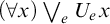


Let $\mathcal {B}$
be some model of
$\mathcal {B}$
be some model of $\varphi $
. By (2), in
$\varphi $
. By (2), in $\mathcal {B}$
, each element is in some
$\mathcal {B}$
, each element is in some $U_e$
. Also, because the existential theories match, if
$U_e$
. Also, because the existential theories match, if $\sigma $
is an isolating node, then there are infinitely many elements satisfying
$\sigma $
is an isolating node, then there are infinitely many elements satisfying $d_\sigma $
. There are universal sentences
$d_\sigma $
. There are universal sentences $(\forall x)(U_e(x)\rightarrow \bigvee _{\sigma \in T_{e,n}}d_\sigma (x))$
, saying that each element of
$(\forall x)(U_e(x)\rightarrow \bigvee _{\sigma \in T_{e,n}}d_\sigma (x))$
, saying that each element of $U_e$
in
$U_e$
in $\mathcal {B}$
satisfies
$\mathcal {B}$
satisfies $d_\sigma $
for some
$d_\sigma $
for some $\sigma $
at level n in
$\sigma $
at level n in $T_e$
. These sentences guarantee that each element of
$T_e$
. These sentences guarantee that each element of $U_e$
represents some path in
$U_e$
represents some path in $T_e$
. We must show that no element of
$T_e$
. We must show that no element of $\mathcal {B}$
represents a non-isolated path. We suppose that
$\mathcal {B}$
represents a non-isolated path. We suppose that $W_{e,s}$
has a quantifier-free formula
$W_{e,s}$
has a quantifier-free formula $d_e$
true of elements representing the all-
$d_e$
true of elements representing the all- $0$
path in
$0$
path in $T_e$
. We may suppose that
$T_e$
. We may suppose that $d_e$
mentions only
$d_e$
mentions only $V_{e,n}$
for
$V_{e,n}$
for $n < s$
. The non-isolated path in
$n < s$
. The non-isolated path in $T_e$
has
$T_e$
has $s 0$
’s, followed by all
$s 0$
’s, followed by all $1$
’s. By (3), for
$1$
’s. By (3), for $e,s$
, this path is not represented in
$e,s$
, this path is not represented in $\mathcal {B}$
. For an isomorphism between
$\mathcal {B}$
. For an isomorphism between $\mathcal {A}$
and
$\mathcal {A}$
and $\mathcal {B}$
, we just map elements of
$\mathcal {B}$
, we just map elements of $\mathcal {A}$
in
$\mathcal {A}$
in $U_e$
and representing a given path in
$U_e$
and representing a given path in $T_e$
to elements of
$T_e$
to elements of $\mathcal {B}$
in
$\mathcal {B}$
in $U_e$
and representing the same path.
$U_e$
and representing the same path.
We need to show that if every element of $\mathcal {A}$
satisfies some existential formula in
$\mathcal {A}$
satisfies some existential formula in $W_e$
, then some existential formula
$W_e$
, then some existential formula $d\in W_e$
is satisfied by elements in infinitely many orbits. We will show something stronger. The theory of
$d\in W_e$
is satisfied by elements in infinitely many orbits. We will show something stronger. The theory of $\mathcal {A}$
has effective elimination of quantifiers, so we may replace each existential formula by a quantifier-free formula that is equivalent over the theory. We may suppose that if d is enumerated into
$\mathcal {A}$
has effective elimination of quantifiers, so we may replace each existential formula by a quantifier-free formula that is equivalent over the theory. We may suppose that if d is enumerated into $W_e$
at stage s, then d mentions only
$W_e$
at stage s, then d mentions only $V_{e,n}$
for
$V_{e,n}$
for $n < s$
, not for
$n < s$
, not for $n\geq s$
. Let
$n\geq s$
. Let $c_e$
be an element of
$c_e$
be an element of $U_e$
representing the path
$U_e$
representing the path $p^*$
in
$p^*$
in $T_e$
. If
$T_e$
. If $W_e$
has an existential/quantifier-free formula d satisfied by
$W_e$
has an existential/quantifier-free formula d satisfied by $c_e$
, then
$c_e$
, then $T_e$
has infinitely many paths, and d is satisfied by all elements of
$T_e$
has infinitely many paths, and d is satisfied by all elements of $U_e$
—infinitely many representing each of the isolated paths.
$U_e$
—infinitely many representing each of the isolated paths.
4 Characterizing
$KU$

In this section, we give a condition that, at least for unary structures $\mathcal {A}$
with a
$\mathcal {A}$
with a $\Pi _2$
Scott sentence and a computable theory, is necessary and sufficient for
$\Pi _2$
Scott sentence and a computable theory, is necessary and sufficient for $\mathcal {A}$
to have a computable
$\mathcal {A}$
to have a computable $\Pi _2$
Scott sentence. This characterization is not very satisfying, although we will use it in Section 5.
$\Pi _2$
Scott sentence. This characterization is not very satisfying, although we will use it in Section 5.
Theorem 4.1. Let $\mathcal {A}$
be a unary structure with a
$\mathcal {A}$
be a unary structure with a $\Pi _2$
Scott sentence and a computable theory. Then
$\Pi _2$
Scott sentence and a computable theory. Then $\mathcal {A}$
has a computable
$\mathcal {A}$
has a computable $\Pi _2$
Scott sentence iff there is a computable quantifier-free
$\Pi _2$
Scott sentence iff there is a computable quantifier-free $\Pi _2$
formula
$\Pi _2$
formula $\psi (x)$
that, in all models of
$\psi (x)$
that, in all models of $Th_{\mathcal {A}}$
, is satisfied by just the elements that realize isolated types.
$Th_{\mathcal {A}}$
, is satisfied by just the elements that realize isolated types.
Remarks. For a quantifier-free formula $\psi (x)$
, satisfaction of
$\psi (x)$
, satisfaction of $\psi (x)$
by an element b in a unary structure depends just on the quantifier-free type of b. If T is the tree associated with
$\psi (x)$
by an element b in a unary structure depends just on the quantifier-free type of b. If T is the tree associated with $\mathcal {A}$
, then
$\mathcal {A}$
, then $Th_T = Th(\mathcal {A})$
. The quantifier-free type of an element b in a model of
$Th_T = Th(\mathcal {A})$
. The quantifier-free type of an element b in a model of $Th_T$
is determined by the path that b represents. Thus, we may say that
$Th_T$
is determined by the path that b represents. Thus, we may say that $\psi (x)$
is satisfied by the path. A quantifier-free
$\psi (x)$
is satisfied by the path. A quantifier-free $\Pi _2$
formula
$\Pi _2$
formula $\psi (x)$
is satisfied by the path p if for each conjunct, there is some disjunct
$\psi (x)$
is satisfied by the path p if for each conjunct, there is some disjunct $\alpha (x)$
that satisfies p. The quantifier-free formula
$\alpha (x)$
that satisfies p. The quantifier-free formula $\alpha $
, in a finite language
$\alpha $
, in a finite language $L_s$
, is equivalent to a finite disjunction of
$L_s$
, is equivalent to a finite disjunction of $\sigma (x)$
for
$\sigma (x)$
for $\sigma \in 2^s$
, and p satisfies
$\sigma \in 2^s$
, and p satisfies $\alpha (x)$
if
$\alpha (x)$
if $\sigma (x)\subseteq p$
, for one of these
$\sigma (x)\subseteq p$
, for one of these $\sigma (x)$
.
$\sigma (x)$
.
Proof of Theorem 4.1
We split the proof into some lemmas. The first lemma gives the easier implication.
Lemma 4.2. Let $\mathcal {A}$
be a unary structure with a
$\mathcal {A}$
be a unary structure with a $\Pi _2$
Scott sentence and a computable theory. Suppose further that there is a computable
$\Pi _2$
Scott sentence and a computable theory. Suppose further that there is a computable $\Pi _2$
formula
$\Pi _2$
formula $\psi (x)$
that is satisfied, in all models of
$\psi (x)$
that is satisfied, in all models of $Th(\mathcal {A})$
, by just the elements that realize isolated types. Then
$Th(\mathcal {A})$
, by just the elements that realize isolated types. Then $\mathcal {A}$
has a computable
$\mathcal {A}$
has a computable $\Pi _2$
Scott sentence.
$\Pi _2$
Scott sentence.
Proof. Since $\mathcal {A}$
is unary,
$\mathcal {A}$
is unary, $Th(\mathcal {A})$
is generated by its
$Th(\mathcal {A})$
is generated by its $\forall \cup \exists $
-sentences. Let
$\forall \cup \exists $
-sentences. Let $\beta $
be a computable
$\beta $
be a computable $\Pi _2$
sentence equivalent to the conjunction of these. (We use that
$\Pi _2$
sentence equivalent to the conjunction of these. (We use that $Th(\mathcal {A})$
is computable here.) Then
$Th(\mathcal {A})$
is computable here.) Then $\varphi = \beta \ \&\ (\forall x)\psi (x)$
is also computable
$\varphi = \beta \ \&\ (\forall x)\psi (x)$
is also computable $\Pi _2$
. We claim that
$\Pi _2$
. We claim that $\varphi $
is a Scott sentence for
$\varphi $
is a Scott sentence for $\mathcal {A}$
.
$\mathcal {A}$
.
Clearly, $\mathcal {A}\models \beta $
. Since
$\mathcal {A}\models \beta $
. Since $\mathcal {A}$
has a
$\mathcal {A}$
has a $\Pi _2^0$
Scott sentence,
$\Pi _2^0$
Scott sentence, $\mathcal {A}$
is atomic. So,
$\mathcal {A}$
is atomic. So, $\mathcal {A}\models (\forall x)\psi (x)$
and thus
$\mathcal {A}\models (\forall x)\psi (x)$
and thus $\mathcal {A}\models \varphi $
. Let
$\mathcal {A}\models \varphi $
. Let $\mathcal {B}$
be another model of
$\mathcal {B}$
be another model of $\varphi $
. Satisfying
$\varphi $
. Satisfying $\beta $
implies that a model is a unary structure with
$\beta $
implies that a model is a unary structure with $Th(\mathcal {A})$
; satisfying
$Th(\mathcal {A})$
; satisfying $(\forall x)\psi (x)$
implies that the model is atomic. (More specifically, the formulas
$(\forall x)\psi (x)$
implies that the model is atomic. (More specifically, the formulas $\sigma (x)$
, for
$\sigma (x)$
, for $\sigma \in 2^{<\omega }$
, that are satisfied and do not split are the same for all models of
$\sigma \in 2^{<\omega }$
, that are satisfied and do not split are the same for all models of $\beta $
. The quantifier-free type generated over
$\beta $
. The quantifier-free type generated over $Th(\mathcal {A})$
by such a
$Th(\mathcal {A})$
by such a $\sigma (x)$
is determined by
$\sigma (x)$
is determined by $\beta $
and
$\beta $
and $\sigma $
, and
$\sigma $
, and $\beta $
guarantees that
$\beta $
guarantees that $\sigma (x)$
is satisfied by infinitely many elements.) Since
$\sigma (x)$
is satisfied by infinitely many elements.) Since $\mathcal {A}$
and
$\mathcal {A}$
and $\mathcal {B}$
are countable atomic models of the same theory,
$\mathcal {B}$
are countable atomic models of the same theory, $\mathcal {A}\cong \mathcal {B}$
.
$\mathcal {A}\cong \mathcal {B}$
.
For the harder implication, we suppose that $\mathcal {A}$
has a computable
$\mathcal {A}$
has a computable $\Pi _2$
Scott sentence
$\Pi _2$
Scott sentence $\varphi $
. We must find a computable quantifier-free
$\varphi $
. We must find a computable quantifier-free $\Pi _2$
formula
$\Pi _2$
formula $\psi (x)$
that is satisfied by just the isolated paths. Let T be the tree associated with
$\psi (x)$
that is satisfied by just the isolated paths. Let T be the tree associated with $\mathcal {A}$
, so that
$\mathcal {A}$
, so that $Th(\mathcal {A}) = Th_T$
. The model
$Th(\mathcal {A}) = Th_T$
. The model $\mathcal {A}$
has no elements representing non-isolated paths. We consider models of a special form. For a path p through T, let
$\mathcal {A}$
has no elements representing non-isolated paths. We consider models of a special form. For a path p through T, let $\mathcal {B}_p = \mathcal {A}\cup \{b\}$
, where b is a further element, not in
$\mathcal {B}_p = \mathcal {A}\cup \{b\}$
, where b is a further element, not in $\mathcal {A}$
, representing the path p. The following is clear.
$\mathcal {A}$
, representing the path p. The following is clear.
Lemma 4.3. $\mathcal {B}_p\models \varphi $
iff p is isolated.
$\mathcal {B}_p\models \varphi $
iff p is isolated.
The next lemma gives a computable $\Pi _2$
formula
$\Pi _2$
formula $\psi (x)$
of a special form.
$\psi (x)$
of a special form.
Lemma 4.4. Let T be a computable tree with no dead ends and with isolated paths dense, and let $\mathcal {A}$
be the prime model of
$\mathcal {A}$
be the prime model of $Th_T$
. Suppose
$Th_T$
. Suppose $\mathcal {A}$
has a computable
$\mathcal {A}$
has a computable $\Pi _2$
Scott sentence
$\Pi _2$
Scott sentence $\varphi $
. Then there is a computable
$\varphi $
. Then there is a computable $\Pi _2$
formula
$\Pi _2$
formula $\psi (x)$
, a c.e. conjunction of c.e. disjunctions of formulas
$\psi (x)$
, a c.e. conjunction of c.e. disjunctions of formulas $\sigma (x)$
for
$\sigma (x)$
for $\sigma \in 2^{<\omega }$
such that for all paths p,
$\sigma \in 2^{<\omega }$
such that for all paths p, $\mathcal {B}_p\models \psi (b)$
iff p is isolated.
$\mathcal {B}_p\models \psi (b)$
iff p is isolated.
Proof. We may suppose that $\varphi = \bigwedge _i (\forall \bar {u}_i)\psi _i(\bar {u}_i)$
, where for each i,
$\varphi = \bigwedge _i (\forall \bar {u}_i)\psi _i(\bar {u}_i)$
, where for each i, $\psi _i(\bar {u}_i)$
is computable
$\psi _i(\bar {u}_i)$
is computable $\Sigma _1$
. In
$\Sigma _1$
. In $Th_T$
, we have quantifier elimination. We may suppose that
$Th_T$
, we have quantifier elimination. We may suppose that $\psi _i(\bar {u}_i)$
has the form
$\psi _i(\bar {u}_i)$
has the form $\bigvee _j\alpha _{i,j}(\bar {u}_i)$
, where
$\bigvee _j\alpha _{i,j}(\bar {u}_i)$
, where $\alpha _{i,j}(\bar {u}_i)$
is quantifier-free. In addition, we may suppose that
$\alpha _{i,j}(\bar {u}_i)$
is quantifier-free. In addition, we may suppose that $\alpha _{i,j}(\bar {u}_i)$
gives the complete quantifier-free type of
$\alpha _{i,j}(\bar {u}_i)$
gives the complete quantifier-free type of $\bar {u}_i$
in some finite language
$\bar {u}_i$
in some finite language $L_s = \{U_n:n < s\}$
, saying for each pair of variables
$L_s = \{U_n:n < s\}$
, saying for each pair of variables $u,v\in \bar {u}_i$
whether
$u,v\in \bar {u}_i$
whether $u = v$
, and saying for each single variable v, that
$u = v$
, and saying for each single variable v, that $\sigma (v)$
holds for some
$\sigma (v)$
holds for some $\sigma \in 2^s$
.
$\sigma \in 2^s$
.
For the models $\mathcal {B}_p = \mathcal {A}\cup \{b\}$
, we may fix
$\mathcal {B}_p = \mathcal {A}\cup \{b\}$
, we may fix $\mathcal {A}$
, say with universe the odd numbers, and we may let
$\mathcal {A}$
, say with universe the odd numbers, and we may let $b = 0$
. For each i, we consider the possible assignments t mapping
$b = 0$
. For each i, we consider the possible assignments t mapping $\bar {u}_i$
to
$\bar {u}_i$
to $\mathcal {A}\cup \{b\}$
. For an assignment t taking
$\mathcal {A}\cup \{b\}$
. For an assignment t taking $\bar {u}_i$
to
$\bar {u}_i$
to $\mathcal {A}\cup \{b\}$
, let
$\mathcal {A}\cup \{b\}$
, let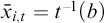 $\bar {x}_{i,t} = t^{-1}(b)$
and let
$\bar {x}_{i,t} = t^{-1}(b)$
and let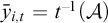 $\bar {y}_{i,t} = t^{-1}(\mathcal {A})$
. For the least s such that
$\bar {y}_{i,t} = t^{-1}(\mathcal {A})$
. For the least s such that $\alpha _{i,j}(\bar {u}_i)$
is in the language
$\alpha _{i,j}(\bar {u}_i)$
is in the language $L_s$
, we may write
$L_s$
, we may write $\alpha _{i,j}(\bar {u}_i)$
as
$\alpha _{i,j}(\bar {u}_i)$
as $\rho _{i,j}(\bar {u}_i)\ \&\ \beta _{i,t,j}(\bar {x}_{i,t})\ \&\ \gamma _{i,t,j}(\bar {y}_{i,t})$
, where
$\rho _{i,j}(\bar {u}_i)\ \&\ \beta _{i,t,j}(\bar {x}_{i,t})\ \&\ \gamma _{i,t,j}(\bar {y}_{i,t})$
, where $\rho _{i,j}(\bar {u}_i)$
gives the equality relation on
$\rho _{i,j}(\bar {u}_i)$
gives the equality relation on $\bar {u}_i$
,
$\bar {u}_i$
, $\beta _{i,t,j}(\bar {x}_{i,t})$
assigns some
$\beta _{i,t,j}(\bar {x}_{i,t})$
assigns some $\sigma _x\in 2^s$
to each
$\sigma _x\in 2^s$
to each $x\in \bar {x}_{i,t}$
, and
$x\in \bar {x}_{i,t}$
, and $\gamma (\bar {y}_{i,t})$
assigns some
$\gamma (\bar {y}_{i,t})$
assigns some $\sigma _y\in 2^s$
to each
$\sigma _y\in 2^s$
to each $y\in \bar {y}_{i,t}$
. Say that
$y\in \bar {y}_{i,t}$
. Say that $\sigma _u$
is the element of T assigned to the variable u in
$\sigma _u$
is the element of T assigned to the variable u in $\alpha _{i,j}(\bar {u}_i)$
.
$\alpha _{i,j}(\bar {u}_i)$
.
We write $\alpha _{i,j}(t(\bar {u}_i))$
for the result of plugging in
$\alpha _{i,j}(t(\bar {u}_i))$
for the result of plugging in $t(u)$
for the variable u in the formula
$t(u)$
for the variable u in the formula $\alpha _{i,j}(\bar {u}_i)$
. The formula is satisfied in
$\alpha _{i,j}(\bar {u}_i)$
. The formula is satisfied in $\mathcal {B}_p$
by the assignment just in case all three parts are satisfied. We have
$\mathcal {B}_p$
by the assignment just in case all three parts are satisfied. We have $\mathcal {B}_p\models \rho _{i,j}(t(\bar {u}_i))$
when
$\mathcal {B}_p\models \rho _{i,j}(t(\bar {u}_i))$
when $t(u) = t(v)$
iff
$t(u) = t(v)$
iff $u = v$
is a conjunct of
$u = v$
is a conjunct of $\rho _{i,j}$
. We can check this effectively, just looking at
$\rho _{i,j}$
. We can check this effectively, just looking at $\rho _{i,j}(\bar {u}_i)$
and t. We have
$\rho _{i,j}(\bar {u}_i)$
and t. We have $\mathcal {B}_p\models \gamma _{i,t,j}(t(\bar {y}_{i,t}))$
iff
$\mathcal {B}_p\models \gamma _{i,t,j}(t(\bar {y}_{i,t}))$
iff $\mathcal {A}\models \bigwedge _{y\in \bar {y}_{i,t}}\sigma _y(t(y))$
. Finally,
$\mathcal {A}\models \bigwedge _{y\in \bar {y}_{i,t}}\sigma _y(t(y))$
. Finally, $\mathcal {B}_p\models \beta (t(\bar {x}_{i, t}))$
iff
$\mathcal {B}_p\models \beta (t(\bar {x}_{i, t}))$
iff $\sigma _x\subseteq p$
for all
$\sigma _x\subseteq p$
for all $x\in \bar {x}_{i,t}$
.
$x\in \bar {x}_{i,t}$
.
For each i and each assignment t mapping $\bar {u}_i$
to the universe of
$\bar {u}_i$
to the universe of $\mathcal {B}_p$
, let
$\mathcal {B}_p$
, let $S(i,t) = \{j: \mathcal {B}_p\models \rho _{i,j}(t(\bar {u}_i))$
and
$S(i,t) = \{j: \mathcal {B}_p\models \rho _{i,j}(t(\bar {u}_i))$
and $\mathcal {B}_p\models \gamma _{i,t,j}(t(\bar {y}_{i,t}))$
}. Our
$\mathcal {B}_p\models \gamma _{i,t,j}(t(\bar {y}_{i,t}))$
}. Our $\psi (x)$
should say that for all i and all
$\psi (x)$
should say that for all i and all $t:\bar {u}_i\rightarrow \mathcal {A}\cup \{b\}$
, there is some
$t:\bar {u}_i\rightarrow \mathcal {A}\cup \{b\}$
, there is some $j\in S(i,t)$
such that t makes
$j\in S(i,t)$
such that t makes $\beta _{i,t,j}(\bar {x}_{i,t})$
true.
$\beta _{i,t,j}(\bar {x}_{i,t})$
true.
In case $\mathcal {A}$
is computable, then for each
$\mathcal {A}$
is computable, then for each $i,t$
, the set
$i,t$
, the set $S(i,t)$
is c.e., depending only on
$S(i,t)$
is c.e., depending only on $\mathcal {A}$
and the c.e. set of disjuncts from the original
$\mathcal {A}$
and the c.e. set of disjuncts from the original $\varphi $
. We can then let
$\varphi $
. We can then let $\psi (x) = \bigwedge _{i,t}\bigvee _{j\in S(i,t)}\beta ^*_{i,t,j}(x)$
, where
$\psi (x) = \bigwedge _{i,t}\bigvee _{j\in S(i,t)}\beta ^*_{i,t,j}(x)$
, where $\beta ^*_{i,t,j}(x)$
is the result of replacing each variable in
$\beta ^*_{i,t,j}(x)$
is the result of replacing each variable in $\bar {x}_{i,t}$
by x. This is computable
$\bar {x}_{i,t}$
by x. This is computable $\Pi _2$
, with the desired meaning.
$\Pi _2$
, with the desired meaning.
In case $\mathcal {A}$
is not computable, the construction of
$\mathcal {A}$
is not computable, the construction of $\psi (x)$
is a little more complicated. We first recall the set
$\psi (x)$
is a little more complicated. We first recall the set $NS(\mathcal {A})$
, defined in Section 3, which is actually the same for all models of
$NS(\mathcal {A})$
, defined in Section 3, which is actually the same for all models of $Th_T$
, and is easily seen to be a
$Th_T$
, and is easily seen to be a $\Pi _1^0$
set, since T is computable. Next, for each i and each assignment t, and each quantifier-free formula
$\Pi _1^0$
set, since T is computable. Next, for each i and each assignment t, and each quantifier-free formula $d(\bar {y}_{i, t})$
, let
$d(\bar {y}_{i, t})$
, let $S(i, t, d) = \{j: \mathcal {B}_p\models \rho _{i,j}(t(\bar {u}_i))$
and
$S(i, t, d) = \{j: \mathcal {B}_p\models \rho _{i,j}(t(\bar {u}_i))$
and $Th_T\vdash d(\bar {y}_{i, t})\rightarrow \gamma _{i,t,j}(\bar {y}_{i,t})\}$
. Note that
$Th_T\vdash d(\bar {y}_{i, t})\rightarrow \gamma _{i,t,j}(\bar {y}_{i,t})\}$
. Note that $S(i, t, d)$
is computable; it doesn’t, in fact, even depend on where the assignment t sends
$S(i, t, d)$
is computable; it doesn’t, in fact, even depend on where the assignment t sends $\bar {y}_{i, t}$
in
$\bar {y}_{i, t}$
in $\mathcal {A}$
beyond whether the elements are equal or not.
$\mathcal {A}$
beyond whether the elements are equal or not.
Now we are almost ready to construct our modified $\psi (x)$
. First, for each i consider the set
$\psi (x)$
. First, for each i consider the set $C_i$
consisting of the conjuncts
$C_i$
consisting of the conjuncts $\lambda _t$
, one for each assignment t, from the
$\lambda _t$
, one for each assignment t, from the $\psi (x)$
we defined in case
$\psi (x)$
we defined in case $\mathcal {A}$
was computable; i.e.,
$\mathcal {A}$
was computable; i.e., $\lambda _t = \bigvee _{j \in S(i, t)} \beta ^*_{i, t, j}(x)$
. For each quantifier-free formula
$\lambda _t = \bigvee _{j \in S(i, t)} \beta ^*_{i, t, j}(x)$
. For each quantifier-free formula $d(\bar {y}_{i, t})$
, let
$d(\bar {y}_{i, t})$
, let $\lambda _{t, d} = \bigvee _{j \in S(i, t, d)} \beta ^*_{i, t, j}(x)$
. Now let
$\lambda _{t, d} = \bigvee _{j \in S(i, t, d)} \beta ^*_{i, t, j}(x)$
. Now let $C_i^* = \{\lambda _{t, d}: d(\bar {y}_{i, t}) \in NS(\mathcal {A})\}$
.
$C_i^* = \{\lambda _{t, d}: d(\bar {y}_{i, t}) \in NS(\mathcal {A})\}$
.
Claim: $C_i = C_i^*$
Proof of Claim
Let $\lambda _t \in C_i$
, and let
$\lambda _t \in C_i$
, and let $\bar {a} = t(\bar {y}_{i, t})$
. Since
$\bar {a} = t(\bar {y}_{i, t})$
. Since $\mathcal {A}$
has a
$\mathcal {A}$
has a $\Pi _2$
Scott sentence, there is
$\Pi _2$
Scott sentence, there is $d(\bar {y}_{i, t}) \in NS(\mathcal {A})$
with
$d(\bar {y}_{i, t}) \in NS(\mathcal {A})$
with $\mathcal {A} \models d(\bar {a})$
. Thus, for all j, we have
$\mathcal {A} \models d(\bar {a})$
. Thus, for all j, we have $j \in S(i, t)$
iff
$j \in S(i, t)$
iff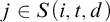 $j \in S(i, t, d)$
. Therefore,
$j \in S(i, t, d)$
. Therefore, $\lambda _t = \lambda _{t, d} \in C^*_i$
. Conversely, let
$\lambda _t = \lambda _{t, d} \in C^*_i$
. Conversely, let $\lambda _{t, d} \in C^*_i$
. Let
$\lambda _{t, d} \in C^*_i$
. Let $\bar {a} \in \mathcal {A}$
with
$\bar {a} \in \mathcal {A}$
with $\mathcal {A} \models d(\bar {a})$
. Let
$\mathcal {A} \models d(\bar {a})$
. Let $t'$
be the assignment with
$t'$
be the assignment with $t'(\bar {x}_{i, t}) = t(\bar {x}_{i, t})$
, and
$t'(\bar {x}_{i, t}) = t(\bar {x}_{i, t})$
, and $t'(\bar {y}_{i, t}) = \bar {a}$
. Thus, for all j, we have
$t'(\bar {y}_{i, t}) = \bar {a}$
. Thus, for all j, we have $j \in S(i, t')$
iff
$j \in S(i, t')$
iff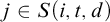 $j \in S(i, t, d)$
. Therefore,
$j \in S(i, t, d)$
. Therefore, $\lambda _{t, d} = \lambda _{t'} \in C_i$
.
$\lambda _{t, d} = \lambda _{t'} \in C_i$
.
Finally, since $NS(\mathcal {A})$
is
$NS(\mathcal {A})$
is $\Pi ^0_1$
, we have a computable sequence of computable
$\Pi ^0_1$
, we have a computable sequence of computable $\Pi _1$
propositional formulas
$\Pi _1$
propositional formulas $(\tau _n)_{n\in \omega }$
, built up from
$(\tau _n)_{n\in \omega }$
, built up from $\top $
and
$\top $
and $\bot $
, such that
$\bot $
, such that $\tau _n$
is logically equivalent to
$\tau _n$
is logically equivalent to $\top $
if n is (the code for) a formula in
$\top $
if n is (the code for) a formula in $NS(\mathcal {A})$
, and
$NS(\mathcal {A})$
, and $\bot $
otherwise. For our formula
$\bot $
otherwise. For our formula $\psi (x)$
, we take the conjunction, over
$\psi (x)$
, we take the conjunction, over $i,t$
and quantifier-free
$i,t$
and quantifier-free $d(\bar {y}_{i, t})$
, of the formulas
$d(\bar {y}_{i, t})$
, of the formulas $(\tau _d\rightarrow \bigvee _{j\in S_{(i,t,d)}}\beta ^*(x))$
. This computable
$(\tau _d\rightarrow \bigvee _{j\in S_{(i,t,d)}}\beta ^*(x))$
. This computable $\Pi _2$
formula has the meaning we want.
$\Pi _2$
formula has the meaning we want.
To complete the proof of the harder implication, we prove the following.
Lemma 4.5. Let $\psi (x)$
be a quantifier-free computable
$\psi (x)$
be a quantifier-free computable $\Pi _2$
formula such that for all paths p in T,
$\Pi _2$
formula such that for all paths p in T, $\mathcal {B}_p\models \psi (b)$
iff p is isolated. Then in all models
$\mathcal {B}_p\models \psi (b)$
iff p is isolated. Then in all models $\mathcal {B}$
of
$\mathcal {B}$
of $Th_T$
,
$Th_T$
, $\psi (x)$
is satisfied by just those elements b that represent an isolated path.
$\psi (x)$
is satisfied by just those elements b that represent an isolated path.
Proof. Let $\mathcal {B}$
be a model of
$\mathcal {B}$
be a model of $Th_T$
, and let b be an element. Since
$Th_T$
, and let b be an element. Since $\mathcal {A}$
is the prime model, we may suppose that
$\mathcal {A}$
is the prime model, we may suppose that $\mathcal {A}\subseteq \mathcal {B}$
. Moreover, since
$\mathcal {A}\subseteq \mathcal {B}$
. Moreover, since $\mathcal {A}$
has infinitely many elements representing any given isolated path, we may suppose that
$\mathcal {A}$
has infinitely many elements representing any given isolated path, we may suppose that $b\notin \mathcal {A}$
. Since the formula
$b\notin \mathcal {A}$
. Since the formula $\psi (x)$
is quantifier-free, with just the variable x,
$\psi (x)$
is quantifier-free, with just the variable x, $\mathcal {B}\models \psi (b)$
iff
$\mathcal {B}\models \psi (b)$
iff $\mathcal {A}\cup \{b\}\models \psi (b)$
.
$\mathcal {A}\cup \{b\}\models \psi (b)$
.
This completes the proof of Theorem 4.1.
5
$\Pi ^1_1$
-completeness

For a class K, the index set, denoted by $I(K)$
, is the set of computable indices of structures in K. Recall that for a fixed computable language L, the set
$I(K)$
, is the set of computable indices of structures in K. Recall that for a fixed computable language L, the set $K_L$
denotes the class of L-structures with a computable
$K_L$
denotes the class of L-structures with a computable $\Pi _2$
Scott sentence, and
$\Pi _2$
Scott sentence, and $KU$
denotes the class of unary structures with a computable
$KU$
denotes the class of unary structures with a computable $\Pi _2$
Scott sentence. In this section, we first show that for an arbitrary computable language L,
$\Pi _2$
Scott sentence. In this section, we first show that for an arbitrary computable language L, $I(K_L)$
is
$I(K_L)$
is $\Pi ^1_1$
. From this, we get the fact that
$\Pi ^1_1$
. From this, we get the fact that $I(KU)$
is
$I(KU)$
is $\Pi ^1_1$
. Next, we show, with some effort, that
$\Pi ^1_1$
. Next, we show, with some effort, that $I(KU)$
is complete
$I(KU)$
is complete $\Pi ^1_1$
. From this, we conclude that for any rich computable language L,
$\Pi ^1_1$
. From this, we conclude that for any rich computable language L, $I(K_L)$
is complete
$I(K_L)$
is complete $\Pi ^1_1$
.
$\Pi ^1_1$
.
5.1
$I(K_L)$
and
$I(KU)$
are
$\Pi ^1_1$


Proposition 5.1. For an arbitrary computable language L, $I(K_L)$
is
$I(K_L)$
is $\Pi ^1_1$
.
$\Pi ^1_1$
.
Proof. Using Lemma 3.5, we see that $\mathcal {A}$
has a computable
$\mathcal {A}$
has a computable $\Pi _2$
Scott sentence iff:
$\Pi _2$
Scott sentence iff:
-
1.
$\mathcal {A}$
has a
$\Pi _2$
Scott sentence, and -
2. there is a computable
$\Pi _2$
sentence
$\varphi $
such that:-
(a)
$\mathcal {A}\models \varphi ,$
and -
(b) for all
$\mathcal {B}$
, if
$\mathcal {B}\models \varphi $
, then-
i.
$NS(\mathcal {A}) = NS(\mathcal {B}),$
and -
ii. each tuple in
$\mathcal {B}$
satisfies some
$d\in NS(\mathcal {A})$
.
-
-


We calculate separately the complexities for the pieces, and then put them together.
-
• To say of a structure
$\mathcal {A}$
and an existential formula
$d(\bar {x})$
that
$d(\bar {x})\in NS(\mathcal {A})$
is computable
$\Pi _2$
. -
• To say that
$\mathcal {A}$
has a
$\Pi _2$
Scott sentence, we say that every tuple satisfies some formula in
$NS(\mathcal {A})$
. This is computable
$\Pi _4$
. -
• For a computable
$\Pi _2$
sentence
$\varphi $
, saying that
$\mathcal {A}\models \varphi $
is computable
$\Pi _2$
, uniformly. -
• For structures
$\mathcal {A}$
and
$\mathcal {B}$
, to say that
$NS(\mathcal {A}) = NS(\mathcal {B})$
, we take the conjunction over existential formulas
$d(\bar {x})$
of formulas saying that
$d(\bar {x})$
is in
$NS(\mathcal {A})$
iff it is in
$NS(\mathcal {B})$
. This is computable
$\Pi _3$
. -
• To say of a tuple
$\bar {b}$
that it satisfies in
$\mathcal {B}$
some
$d(\bar {x})\in NS(\mathcal {A})$
, we take the disjunction, over existential formulas
$d(\bar {x})$
, of formulas saying that
$d(\bar {x})\in NS(\mathcal {A})$
and
$\mathcal {B}\models d(\bar {b})$
. This is computable
$\Sigma _3$
. -
• Saying that every tuple in
$\mathcal {B}$
satisfies some formula in
$NS(\mathcal {A})$
is computable
$\Pi _4$
.











To say that $\mathcal {A}$
has a computable
$\mathcal {A}$
has a computable $\Pi _2$
Scott sentence, we say that
$\Pi _2$
Scott sentence, we say that $\mathcal {A}$
has a
$\mathcal {A}$
has a $\Pi _2$
Scott sentence, and there is a computable
$\Pi _2$
Scott sentence, and there is a computable $\Pi _2$
sentence
$\Pi _2$
sentence $\varphi $
, true in
$\varphi $
, true in $\mathcal {A}$
, such that for every
$\mathcal {A}$
, such that for every $\mathcal {B}$
satisfying
$\mathcal {B}$
satisfying $\varphi $
,
$\varphi $
, $NS(\mathcal {A}) = NS(\mathcal {B})$
and each tuple in
$NS(\mathcal {A}) = NS(\mathcal {B})$
and each tuple in $\mathcal {B}$
satisfies some
$\mathcal {B}$
satisfies some $d(\bar {x})$
in
$d(\bar {x})$
in $NS(\mathcal {A})$
. This has the form
$NS(\mathcal {A})$
. This has the form $\Pi _4^c\ \&\ \bigvee _\varphi (\Pi _2^c\ \&\ (\forall \mathcal {B})(\Pi _2^c\rightarrow \Pi _4^c))$
, where
$\Pi _4^c\ \&\ \bigvee _\varphi (\Pi _2^c\ \&\ (\forall \mathcal {B})(\Pi _2^c\rightarrow \Pi _4^c))$
, where $\Pi _2^c$
and
$\Pi _2^c$
and $\Pi _4^c$
refer to computable
$\Pi _4^c$
refer to computable $\Pi _2$
and computable
$\Pi _2$
and computable $\Pi _4$
statements, respectively. By results of Kleene ([Reference Rogers13, p. 375] or [Reference Ash and Knight4, p. 76]), we can bring the number quantifier
$\Pi _4$
statements, respectively. By results of Kleene ([Reference Rogers13, p. 375] or [Reference Ash and Knight4, p. 76]), we can bring the number quantifier $\bigvee _\varphi $
inside the set quantifier
$\bigvee _\varphi $
inside the set quantifier $(\forall \bar {B})$
and make other transformations to arrive at the fact that
$(\forall \bar {B})$
and make other transformations to arrive at the fact that $I(K_L)$
is
$I(K_L)$
is $\Pi ^1_1$
.
$\Pi ^1_1$
.
Corollary 5.2. $I(KU)$
is
$I(KU)$
is $\Pi ^1_1$
.
$\Pi ^1_1$
.
Proof. If L is the language of unary structures, then $I(KU)$
is the intersection of the
$I(KU)$
is the intersection of the $\Pi ^1_1$
set
$\Pi ^1_1$
set $I(K_L)$
with the set of indices of unary structures, which, by Lemma 2.7, is
$I(K_L)$
with the set of indices of unary structures, which, by Lemma 2.7, is $\Pi ^0_2$
.
$\Pi ^0_2$
.
5.2 Completeness for
$I(KU)$

In what follows, we shall use the material from Section 2.4.
Theorem 5.3. $I(KU)$
is complete
$I(KU)$
is complete $\Pi ^1_1$
.
$\Pi ^1_1$
.
Proof. To show that $I(KU)$
is complete
$I(KU)$
is complete $\Pi ^1_1$
, we show that
$\Pi ^1_1$
, we show that $I(WF)\leq _m I(KU)$
, where
$I(WF)\leq _m I(KU)$
, where $WF$
is the class of sub-trees of
$WF$
is the class of sub-trees of $\omega ^{<\omega }$
that have no path. Given an index for a computable tree
$\omega ^{<\omega }$
that have no path. Given an index for a computable tree $S\subseteq \omega ^{<\omega }$
, we will pass effectively to a triple of indices for a computable tree
$S\subseteq \omega ^{<\omega }$
, we will pass effectively to a triple of indices for a computable tree $T\subseteq 2^{<\omega }$
, a computable unary structure
$T\subseteq 2^{<\omega }$
, a computable unary structure $\mathcal {A}$
, and a computable
$\mathcal {A}$
, and a computable $\Pi _2$
formula
$\Pi _2$
formula $\Phi (x)$
. The tree T has no dead ends, and the isolated paths are dense. The structure
$\Phi (x)$
. The tree T has no dead ends, and the isolated paths are dense. The structure $\mathcal {A}$
is the atomic model of
$\mathcal {A}$
is the atomic model of $Th_T$
, with a
$Th_T$
, with a $\Pi _2$
Scott sentence. We must arrange that
$\Pi _2$
Scott sentence. We must arrange that $\mathcal {A}$
has a computable
$\mathcal {A}$
has a computable $\Pi _2$
Scott sentence iff
$\Pi _2$
Scott sentence iff $S\in WF$
. By Theorem 4.1,
$S\in WF$
. By Theorem 4.1, $\mathcal {A}$
has a computable
$\mathcal {A}$
has a computable $\Pi _2$
Scott sentence iff there is a quantifier-free computable
$\Pi _2$
Scott sentence iff there is a quantifier-free computable $\Pi _2$
formula
$\Pi _2$
formula $\Psi (x)$
, that is satisfied, in models of
$\Psi (x)$
, that is satisfied, in models of $Th_T$
, by all elements that represent isolated paths and not by any elements that represent non-isolated paths. If
$Th_T$
, by all elements that represent isolated paths and not by any elements that represent non-isolated paths. If $S\in WF$
, then the formula
$S\in WF$
, then the formula $\Phi (x)$
will have this property. If
$\Phi (x)$
will have this property. If $S\notin WF$
, then we make sure that no such computable
$S\notin WF$
, then we make sure that no such computable $\Pi _2$
formula works. The following technical lemma gives a nice list of the formulas
$\Pi _2$
formula works. The following technical lemma gives a nice list of the formulas $\Psi _e(x)$
that we need to consider.
$\Psi _e(x)$
that we need to consider.
Lemma 5.4. There is a computable list of computable quantifier-free $\Pi _2$
formulas
$\Pi _2$
formulas $\Psi _e(x) = \bigwedge _k\Psi _e^k(x)$
, such that every computable quantifier-free
$\Psi _e(x) = \bigwedge _k\Psi _e^k(x)$
, such that every computable quantifier-free $\Pi _2$
formula
$\Pi _2$
formula $\Psi (x)$
is logically equivalent to some
$\Psi (x)$
is logically equivalent to some $\Psi _e(x)$
, and each
$\Psi _e(x)$
, and each $\Psi _e(x)$
has the following properties:
$\Psi _e(x)$
has the following properties:
-
1. for each k, the conjunct
$\Psi _e^k(x)$
is a c.e. disjunction of formulas
$\sigma (x)$
for
$\sigma \in 2^{<\omega }$
; -
2. if
$k' < k$
, then
$\Psi _e^k(x)$
logically implies
$\Psi _e^{k'}(x)$
.


Proof. We can massage a computable quantifier-free $\Pi _2$
formula to arrive at an equivalent formula with Properties (1) and (2). For the given
$\Pi _2$
formula to arrive at an equivalent formula with Properties (1) and (2). For the given $\Psi (x)$
, the set C of conjuncts is c.e. We may suppose that C is the range of a total computable function
$\Psi (x)$
, the set C of conjuncts is c.e. We may suppose that C is the range of a total computable function $k\rightarrow \Psi ^k(x)$
. If in k steps of enumerating C, we see a new element, then we let
$k\rightarrow \Psi ^k(x)$
. If in k steps of enumerating C, we see a new element, then we let $\Psi ^k(x)$
be the first, and if there is no new element, then we let
$\Psi ^k(x)$
be the first, and if there is no new element, then we let $\Psi ^k(x)$
be the computable
$\Psi ^k(x)$
be the computable $\Sigma _1$
formula with the single disjunct
$\Sigma _1$
formula with the single disjunct $\top $
, or
$\top $
, or $\sigma (x)$
, for
$\sigma (x)$
, for $\sigma = \emptyset $
. Each
$\sigma = \emptyset $
. Each $\Psi ^k(x)$
is the disjunction of a c.e. set of quantifier-free formulas
$\Psi ^k(x)$
is the disjunction of a c.e. set of quantifier-free formulas $\alpha (x)$
. For
$\alpha (x)$
. For $\alpha (x)$
in the finite language
$\alpha (x)$
in the finite language $L_s$
, we can replace
$L_s$
, we can replace $\alpha (x)$
by a finite disjunction of formulas
$\alpha (x)$
by a finite disjunction of formulas $\sigma (x)$
, for
$\sigma (x)$
, for $\sigma \in 2^s$
. In this way, we arrive at a formula with property (1). For each k, we have a c.e. set
$\sigma \in 2^s$
. In this way, we arrive at a formula with property (1). For each k, we have a c.e. set $D^k$
of disjuncts of
$D^k$
of disjuncts of $\Psi ^k(x)$
. We allow
$\Psi ^k(x)$
. We allow $D^k = \emptyset $
. Let
$D^k = \emptyset $
. Let $C^k$
be the (possibly empty) set of formulas obtained by choosing one disjunct from each
$C^k$
be the (possibly empty) set of formulas obtained by choosing one disjunct from each $D^{k'}$
for
$D^{k'}$
for $k'\leq k$
, and taking the conjunction, which is equivalent to a single conjunct. The modified formulas
$k'\leq k$
, and taking the conjunction, which is equivalent to a single conjunct. The modified formulas $\Psi ^k(x)$
have Property (2).
$\Psi ^k(x)$
have Property (2).
The tree T we construct will be the union of subtrees $T_e$
, and our construction will guarantee that if S has a path and
$T_e$
, and our construction will guarantee that if S has a path and $\Psi _e(x)$
is satisfied by all elements representing isolated paths through
$\Psi _e(x)$
is satisfied by all elements representing isolated paths through $T_e$
, then it is also satisfied by elements (in some non-atomic models
$T_e$
, then it is also satisfied by elements (in some non-atomic models $\mathcal {B}$
of
$\mathcal {B}$
of $Th_T$
) representing some non-isolated path in
$Th_T$
) representing some non-isolated path in $T_e$
. In the construction, we will refer to the natural topology on
$T_e$
. In the construction, we will refer to the natural topology on $2^\omega $
, generated by the basic clopen sets
$2^\omega $
, generated by the basic clopen sets $N_\sigma = \{f:f\supseteq \sigma \}$
for
$N_\sigma = \{f:f\supseteq \sigma \}$
for $\sigma \in 2^{<\omega }$
. For the subspace
$\sigma \in 2^{<\omega }$
. For the subspace $[T]$
consisting of paths through T, we have a topology consisting of the sets
$[T]$
consisting of paths through T, we have a topology consisting of the sets $U\cap [T]$
, where U is open in
$U\cap [T]$
, where U is open in $2^\omega $
. For each
$2^\omega $
. For each $\Psi _e^k(x)$
, the set of paths p such that the elements representing p satisfy
$\Psi _e^k(x)$
, the set of paths p such that the elements representing p satisfy $\Psi _e^k(x)$
is open.
$\Psi _e^k(x)$
is open.
5.2.1 Construction in stages
The construction proceeds in stages. At stage s, we have a finite subtree $T^s$
of T. We label the nodes that are terminal in
$T^s$
of T. We label the nodes that are terminal in $T^s$
either
$T^s$
either $fin$
or
$fin$
or $fin^*$
, where the label
$fin^*$
, where the label $fin$
on a node
$fin$
on a node $\sigma $
indicates that
$\sigma $
indicates that $\sigma $
already isolates a path, while the label
$\sigma $
already isolates a path, while the label $fin^*$
indicates that
$fin^*$
indicates that $\sigma $
may at later stages have incomparable extensions. We also label certain non-terminal nodes
$\sigma $
may at later stages have incomparable extensions. We also label certain non-terminal nodes $fin^*$
. These will acquire a new successor at the next stage. We have a finite set
$fin^*$
. These will acquire a new successor at the next stage. We have a finite set $A^s$
of elements a in
$A^s$
of elements a in $\mathcal {A}$
. To each such a, we assign a node
$\mathcal {A}$
. To each such a, we assign a node $\sigma $
that is terminal in
$\sigma $
that is terminal in $T^s$
, putting into the diagram of
$T^s$
, putting into the diagram of $\mathcal {A}$
sentences
$\mathcal {A}$
sentences $\pm U_na$
to make a satisfy
$\pm U_na$
to make a satisfy $\sigma (x)$
. Toward the formula
$\sigma (x)$
. Toward the formula $\Phi (x)$
, for each
$\Phi (x)$
, for each $k\leq s$
, we put finitely many disjuncts into
$k\leq s$
, we put finitely many disjuncts into $\Phi ^k(x)$
. In the end,
$\Phi ^k(x)$
. In the end, $\mathcal {A}$
should have infinitely many elements satisfying
$\mathcal {A}$
should have infinitely many elements satisfying $\sigma (x)$
for each
$\sigma (x)$
for each $\sigma \in T$
. Each element of
$\sigma \in T$
. Each element of $\mathcal {A}$
should represent a path that is isolated. The formula
$\mathcal {A}$
should represent a path that is isolated. The formula $\Phi (x)$
should be satisfied, in models of
$\Phi (x)$
should be satisfied, in models of $Th_T$
, by all elements representing isolated paths, and, if
$Th_T$
, by all elements representing isolated paths, and, if $S \in WF$
, by no elements representing non-isolated paths.
$S \in WF$
, by no elements representing non-isolated paths.
Stage $0$
. At stage
$0$
. At stage $0$
,
$0$
, $T^0$
consists just of
$T^0$
consists just of $\emptyset $
, with the label
$\emptyset $
, with the label $fin^*$
,
$fin^*$
, $A^s$
has a single element, and
$A^s$
has a single element, and $\Phi ^0(x)$
has the single disjunct
$\Phi ^0(x)$
has the single disjunct $\top $
.
$\top $
.
Stage $s+1$
. At stage
$s+1$
. At stage $s+1$
, each node that was terminal in
$s+1$
, each node that was terminal in $T^s$
gets at least one extension terminal in
$T^s$
gets at least one extension terminal in $T^{s+1}$
. Non-terminal nodes added at stage s and labeled
$T^{s+1}$
. Non-terminal nodes added at stage s and labeled $fin^*$
may get a further terminal extension in
$fin^*$
may get a further terminal extension in $T^{s+1}$
.
$T^{s+1}$
.
Each element $a\in A^{s+1}$
is assigned some
$a\in A^{s+1}$
is assigned some $\sigma $
that is terminal in
$\sigma $
that is terminal in $T^{s+1}$
; we include in the atomic diagram the facts given by
$T^{s+1}$
; we include in the atomic diagram the facts given by $\sigma (a)$
. Also, for each node
$\sigma (a)$
. Also, for each node $\sigma $
terminal at stage s, we add to
$\sigma $
terminal at stage s, we add to $\mathcal {A}$
one new element satisfying
$\mathcal {A}$
one new element satisfying $\sigma (x)$
. This will guarantee that every isolated path in T corresponds to infinitely many elements of
$\sigma (x)$
. This will guarantee that every isolated path in T corresponds to infinitely many elements of $\mathcal {A}$
.
$\mathcal {A}$
.
If $\sigma \in T^s$
has just one extension
$\sigma \in T^s$
has just one extension $\sigma '$
that is terminal in
$\sigma '$
that is terminal in $T^{s+1}$
, then all elements of
$T^{s+1}$
, then all elements of $A^s$
that satisfied
$A^s$
that satisfied $\sigma (x)$
at stage s satisfy
$\sigma (x)$
at stage s satisfy $\sigma '(x)$
at stage
$\sigma '(x)$
at stage $s+1$
. (There is also a new element of
$s+1$
. (There is also a new element of $A^{s+1}$
that satisfies
$A^{s+1}$
that satisfies $\sigma '(x)$
.) If a node
$\sigma '(x)$
.) If a node $\sigma $
, terminal in
$\sigma $
, terminal in $T^s$
and labeled
$T^s$
and labeled $fin^*$
, has incomparable terminal extensions in
$fin^*$
, has incomparable terminal extensions in $T^{s+1}$
, and if all the terminal extensions are labeled
$T^{s+1}$
, and if all the terminal extensions are labeled $fin^*$
, then for
$fin^*$
, then for $\sigma '$
the least such (in the natural ordering of nodes), all elements of
$\sigma '$
the least such (in the natural ordering of nodes), all elements of $A^s$
that satisfied
$A^s$
that satisfied $\sigma (x)$
will satisfy
$\sigma (x)$
will satisfy $\sigma '(x)$
. If a node
$\sigma '(x)$
. If a node $\sigma $
, terminal in
$\sigma $
, terminal in $T^s$
and labeled
$T^s$
and labeled $fin^*$
, has incomparable terminal extensions in
$fin^*$
, has incomparable terminal extensions in $T^{s+1}$
, and if at least one of these is labeled
$T^{s+1}$
, and if at least one of these is labeled $fin$
, then, for
$fin$
, then, for $\sigma '$
the least such (in the natural ordering), all elements of
$\sigma '$
the least such (in the natural ordering), all elements of $A^s$
satisfying
$A^s$
satisfying $\sigma (x)$
at stage s will satisfy
$\sigma (x)$
at stage s will satisfy $\sigma '(x)$
(as does one of the new elements). This will guarantee that the elements of
$\sigma '(x)$
(as does one of the new elements). This will guarantee that the elements of $\mathcal {A}$
correspond only to isolated paths through T.
$\mathcal {A}$
correspond only to isolated paths through T.
For our computable $\Pi _2$
formula,
$\Pi _2$
formula, $\Phi (x) = \bigwedge _k\Phi ^k(x)$
, at each stage
$\Phi (x) = \bigwedge _k\Phi ^k(x)$
, at each stage $s\geq k$
, we put into
$s\geq k$
, we put into $\Phi ^k(x)$
disjuncts
$\Phi ^k(x)$
disjuncts $\sigma (x)$
for all
$\sigma (x)$
for all $\sigma $
that are terminal in
$\sigma $
that are terminal in $T^s$
. The tree T will have some paths p that we plan, from the beginning, to make non-isolated. We will call these “routinely non-isolated.” We do not want such a p to satisfy our
$T^s$
. The tree T will have some paths p that we plan, from the beginning, to make non-isolated. We will call these “routinely non-isolated.” We do not want such a p to satisfy our $\Phi (x)$
. If we add a node
$\Phi (x)$
. If we add a node $\sigma $
of p at stage s, we give it the label
$\sigma $
of p at stage s, we give it the label $fin^*$
, and we put into
$fin^*$
, and we put into $T^s$
a terminal extension of
$T^s$
a terminal extension of $\sigma $
that is not on p. We plan, at stage
$\sigma $
that is not on p. We plan, at stage $s+1$
, to give
$s+1$
, to give $\sigma $
another extension that is on p.
$\sigma $
another extension that is on p.
We have described completely how $\mathcal {A}$
and
$\mathcal {A}$
and $\Phi (x)$
are constructed from the tree T, so the rest of the argument, until the final verification, focuses mainly on T.
$\Phi (x)$
are constructed from the tree T, so the rest of the argument, until the final verification, focuses mainly on T.
5.2.2 Base of
$T_e$
, and codes for level
$1$
of S


We have a routine non-isolated path $0^*$
(none of whose nodes is terminal at any stage). Branching off, for each e, we have
$0^*$
(none of whose nodes is terminal at any stage). Branching off, for each e, we have $\sigma ^e = 0^{e+1}1$
, the base of the sub-tree
$\sigma ^e = 0^{e+1}1$
, the base of the sub-tree $T_e$
, in which we will challenge
$T_e$
, in which we will challenge $\Psi _e$
. We extend
$\Psi _e$
. We extend $\sigma ^e$
to nodes coding level
$\sigma ^e$
to nodes coding level $1$
of the tree S, the elements
$1$
of the tree S, the elements $(m)$
at level
$(m)$
at level $1$
of S, if any. We have a routine non-isolated path
$1$
of S, if any. We have a routine non-isolated path $q = \sigma ^e0^*$
(again none of whose nodes is terminal at any stage). Branching off, we have
$q = \sigma ^e0^*$
(again none of whose nodes is terminal at any stage). Branching off, we have $\sigma ^e0^{m+1}1$
, regardless of whether
$\sigma ^e0^{m+1}1$
, regardless of whether $(m)\in S$
. If
$(m)\in S$
. If $(m)\in S$
, then we add
$(m)\in S$
, then we add $s = \sigma ^e0^{m+1}11$
, with the label
$s = \sigma ^e0^{m+1}11$
, with the label $fin^*$
. If
$fin^*$
. If $(m)\notin S$
, then we add
$(m)\notin S$
, then we add $\sigma ^e0^{m+1}10$
, with the label
$\sigma ^e0^{m+1}10$
, with the label $fin$
. We will extend this to the single path
$fin$
. We will extend this to the single path $\sigma ^e0^{m+1}101^*$
.
$\sigma ^e0^{m+1}101^*$
.
5.2.3 First challenge
Let $s_1$
code a node
$s_1$
code a node $(m)$
at level
$(m)$
at level $1$
of S above
$1$
of S above $\sigma _e$
. The node
$\sigma _e$
. The node $s_1$
gives us permission to issue a first challenge node
$s_1$
gives us permission to issue a first challenge node $\nu _1 = s_11$
. To the side of
$\nu _1 = s_11$
. To the side of $\nu _1$
, we begin building a routine non-isolated path
$\nu _1$
, we begin building a routine non-isolated path $r_1 = s_10^*$
, with isolated paths
$r_1 = s_10^*$
, with isolated paths $s_10^{k+1}1^*$
branching off from it. At the stage when we add
$s_10^{k+1}1^*$
branching off from it. At the stage when we add $\nu _1$
to the tree, we give it the label
$\nu _1$
to the tree, we give it the label $fin^*$
. We also add
$fin^*$
. We also add $\tau _1 = s_101$
, with the label
$\tau _1 = s_101$
, with the label $fin$
. By our convention described above, elements of
$fin$
. By our convention described above, elements of $\mathcal {A}$
that were introduced earlier and satisfy
$\mathcal {A}$
that were introduced earlier and satisfy $s_1$
will satisfy
$s_1$
will satisfy $\tau _1$
, rather than
$\tau _1$
, rather than $\nu _1$
; there will be new elements that satisfy
$\nu _1$
; there will be new elements that satisfy $\nu _1$
.
$\nu _1$
.
The idea of the challenge is as follows. If $\Psi _e(x)$
is threatening to witness that
$\Psi _e(x)$
is threatening to witness that $\mathcal {A}$
has a computable
$\mathcal {A}$
has a computable $\Pi _2$
Scott sentence, then
$\Pi _2$
Scott sentence, then $r_1$
should not satisfy
$r_1$
should not satisfy $\Psi _e(x)$
. We try to trick
$\Psi _e(x)$
. We try to trick $\Psi _e(x)$
by extending
$\Psi _e(x)$
by extending $\nu _1$
to an isolated path p, until we see that it satisfies
$\nu _1$
to an isolated path p, until we see that it satisfies $\Psi _e(x)$
, at which point, we introduce a split. The purpose of the path
$\Psi _e(x)$
, at which point, we introduce a split. The purpose of the path $r_1$
is to guarantee that, if this p extending
$r_1$
is to guarantee that, if this p extending $\nu _1$
satisfies
$\nu _1$
satisfies $\Psi _e(x)$
, then for at least one
$\Psi _e(x)$
, then for at least one $\Psi ^k_e$
, the nodes that witness this satisfaction must all extend
$\Psi ^k_e$
, the nodes that witness this satisfaction must all extend $\nu _1$
. If this first challenge seems to be met, and we get permission (because
$\nu _1$
. If this first challenge seems to be met, and we get permission (because $(m)$
has extensions in S), then there will be further challenges.
$(m)$
has extensions in S), then there will be further challenges.
5.2.4 Seeming to meet the first challenge
Extending $\nu _1$
, we have a routine non-isolated path
$\nu _1$
, we have a routine non-isolated path $\nu _10^*$
, and branching off, we have a family of nodes
$\nu _10^*$
, and branching off, we have a family of nodes $\pi _k = \nu _10^{k+1}1$
, indexed by k. We will extend
$\pi _k = \nu _10^{k+1}1$
, indexed by k. We will extend $\pi _k$
, adding further
$\pi _k$
, adding further $1$
’s. Let
$1$
’s. Let $p^k = \nu _10^{k+1}1^*$
. Let
$p^k = \nu _10^{k+1}1^*$
. Let $\Psi _e^k(x)$
be the kth conjunct of
$\Psi _e^k(x)$
be the kth conjunct of $\Psi _e(x)$
. Let
$\Psi _e(x)$
. Let $O_k$
be the set of paths f through T that satisfy
$O_k$
be the set of paths f through T that satisfy $\Psi _e^k(x)$
. The sets
$\Psi _e^k(x)$
. The sets $O_k$
are open, and by our assumptions on the conjuncts of
$O_k$
are open, and by our assumptions on the conjuncts of $\Psi _e^k(x)$
,
$\Psi _e^k(x)$
, $O_1\supseteq O_2\supseteq O_3\supseteq \ ... $
. If
$O_1\supseteq O_2\supseteq O_3\supseteq \ ... $
. If $\Psi _e(x)$
is threatening to witness that
$\Psi _e(x)$
is threatening to witness that $\mathcal {A}$
has a computable
$\mathcal {A}$
has a computable $\Pi _2$
Scott sentence, then it is not satisfied by
$\Pi _2$
Scott sentence, then it is not satisfied by $r_1$
. There will be some first k such that
$r_1$
. There will be some first k such that $r_1\notin O_k$
. We look for this k. At stage s, we take the first
$r_1\notin O_k$
. We look for this k. At stage s, we take the first $k \leq s$
, if any, such that
$k \leq s$
, if any, such that $r_1$
fails to satisfy any of the stage s disjuncts of
$r_1$
fails to satisfy any of the stage s disjuncts of $\Psi _e^k(x)$
. Believing that we have the correct k, we watch for a disjunct of
$\Psi _e^k(x)$
. Believing that we have the correct k, we watch for a disjunct of $\Psi _e^k(x)$
, say
$\Psi _e^k(x)$
, say $\sigma (x)$
, such that
$\sigma (x)$
, such that $\sigma \subseteq p^k$
; if no such disjunct appears, then
$\sigma \subseteq p^k$
; if no such disjunct appears, then $p^k$
will be isolated, but the elements corresponding to
$p^k$
will be isolated, but the elements corresponding to $p^k$
fail to satisfy
$p^k$
fail to satisfy $\Psi _e^k(x)$
. Moreover, if at stage s, we see a disjunct
$\Psi _e^k(x)$
. Moreover, if at stage s, we see a disjunct $\sigma (x)$
of
$\sigma (x)$
of $\Psi _e^k(x)$
such that
$\Psi _e^k(x)$
such that $\sigma \subseteq p^k$
, then since
$\sigma \subseteq p^k$
, then since $r_1 \notin O_k$
, it must be true that
$r_1 \notin O_k$
, it must be true that $\nu _1 \subseteq \sigma $
. Assuming that we have k and
$\nu _1 \subseteq \sigma $
. Assuming that we have k and $\sigma $
, the challenge
$\sigma $
, the challenge $\nu _1$
seems to be met by the terminal node
$\nu _1$
seems to be met by the terminal node $\sigma _1$
of
$\sigma _1$
of $T_e^s$
such that
$T_e^s$
such that $\sigma \subseteq \sigma _1\subseteq p^k$
.
$\sigma \subseteq \sigma _1\subseteq p^k$
.
Our guess at k will change if we later see a disjunct of $\Psi _e^k$
that puts
$\Psi _e^k$
that puts $r_1$
in
$r_1$
in $O_k$
. The new guess, if any, is some
$O_k$
. The new guess, if any, is some $k'> k$
. When our guess changes in this way, we abandon the part of the tree
$k'> k$
. When our guess changes in this way, we abandon the part of the tree $T_e$
that extends
$T_e$
that extends $\pi _k$
(or any
$\pi _k$
(or any $\pi _j$
for
$\pi _j$
for $j < k'$
), canceling all challenges that extend
$j < k'$
), canceling all challenges that extend $\pi _k$
and making all of the currently terminal nodes isolated. For the new guess
$\pi _k$
and making all of the currently terminal nodes isolated. For the new guess $k'$
, we proceed as above, except that we watch
$k'$
, we proceed as above, except that we watch $\Psi _e^{k'}(x)$
and
$\Psi _e^{k'}(x)$
and $p^{k'}$
instead of
$p^{k'}$
instead of $\Psi _e^k(x)$
and
$\Psi _e^k(x)$
and $p^k$
.
$p^k$
.
If $r_1$
does not satisfy
$r_1$
does not satisfy $\Psi _e(x)$
, then our guess will eventually settle on the first k such that
$\Psi _e(x)$
, then our guess will eventually settle on the first k such that $r_1\notin O_k$
. If
$r_1\notin O_k$
. If $\nu _1$
is actually met, by some
$\nu _1$
is actually met, by some $\sigma _1\subseteq p^k$
, then
$\sigma _1\subseteq p^k$
, then $\pi _k$
will have non-isolated extensions, as
$\pi _k$
will have non-isolated extensions, as $\sigma _1$
becomes the base for further challenges. For
$\sigma _1$
becomes the base for further challenges. For $j\not = k$
, the paths that extend
$j\not = k$
, the paths that extend $\pi _j$
are all eventually isolated.
$\pi _j$
are all eventually isolated.
If $r_1$
actually satisfies
$r_1$
actually satisfies $\Psi _e(x)$
, then each guess at the first k such that
$\Psi _e(x)$
, then each guess at the first k such that $r_1\notin O_k$
is eventually changed, and the part of the tree extending
$r_1\notin O_k$
is eventually changed, and the part of the tree extending $\pi _k$
is eventually abandoned—with all paths becoming isolated. In this case, the only non-isolated path that extends
$\pi _k$
is eventually abandoned—with all paths becoming isolated. In this case, the only non-isolated path that extends $\nu _1$
is
$\nu _1$
is $\nu _10^*$
, but none of the nodes along this path is ever terminal in
$\nu _10^*$
, but none of the nodes along this path is ever terminal in $T^s$
, so no element in
$T^s$
, so no element in $\mathcal {A}$
represents this path and this path will not satisfy the
$\mathcal {A}$
represents this path and this path will not satisfy the $\Phi $
we are constructing.
$\Phi $
we are constructing.
5.2.5 Continuing
Suppose that we have $\sigma ^e\subseteq s_1\subseteq \nu _1\subseteq \sigma _1$
, where
$\sigma ^e\subseteq s_1\subseteq \nu _1\subseteq \sigma _1$
, where $\sigma ^e$
is the base for
$\sigma ^e$
is the base for $T_e$
,
$T_e$
, $s_1$
codes a node
$s_1$
codes a node $(m)$
at level
$(m)$
at level $1$
of S,
$1$
of S, $\nu _1$
is a challenge permitted by
$\nu _1$
is a challenge permitted by $s_1$
, and
$s_1$
, and $\sigma _1$
meets the challenge. The node
$\sigma _1$
meets the challenge. The node $\sigma _1$
serves as a new base, from which we may, if
$\sigma _1$
serves as a new base, from which we may, if $(m)$
has a successor
$(m)$
has a successor $(m,m')$
in S, pass to a node
$(m,m')$
in S, pass to a node $s_2$
coding
$s_2$
coding $(m,m')$
. This gives us permission to issue a new challenge
$(m,m')$
. This gives us permission to issue a new challenge $\nu _2$
. The challenge
$\nu _2$
. The challenge $\nu _2$
may be met in some
$\nu _2$
may be met in some $\sigma _2$
. In general, if we have
$\sigma _2$
. In general, if we have $\sigma _{i-1}\subseteq s_i\subseteq \nu _i\subseteq \sigma _i$
, where
$\sigma _{i-1}\subseteq s_i\subseteq \nu _i\subseteq \sigma _i$
, where $s_i$
codes a node at level i of S,
$s_i$
codes a node at level i of S, $\nu _i$
is the ith in a chain of challenges, and
$\nu _i$
is the ith in a chain of challenges, and $\sigma _i$
meets the challenge
$\sigma _i$
meets the challenge $\nu _i$
, we use
$\nu _i$
, we use $\sigma _i$
as a base, after which we may, if permitted, issue a subsequent challenge.
$\sigma _i$
as a base, after which we may, if permitted, issue a subsequent challenge.
5.2.6 Kinds of paths through T and corresponding elements in
$\mathcal {A}$

During the construction, we have in mind three kinds of paths for T. (These categories of paths are not necessarily mutually exclusive, as explained below.)
-
1. Definitely isolated: A path with a node labeled
$fin$
. -
2. Routine non-isolated: When we start building one of these paths, we have in mind that it will be non-isolated. These have come up in various parts of the construction:
-
• the path
$0^*$
from which all the base nodes
$\sigma _e$
branch; -
• each path of the form
$q = \sigma ^e0^*$
or
$q = \sigma _j0^*$
, where
$\sigma _j$
is a base node after j challenges have been met; and each branch off of q codes whether or not an element m at level
$j+1$
extends the sequence in S coded by
$s_j \subset \sigma _j$
; -
• each path of the form
$r = s_j0^*$
to the side of a challenge node
$\nu _j = s_j1;$
-
• each path of the form
$t = \nu _j0^*$
, where
$\nu _j$
is a challenge node; branching off of t are the paths of the form
$p^k$
; a node of one of these
$p^k$
may meet the challenge
$\nu _j$
.
-
-
3. Challenge: The challenge paths are the paths that extend a challenge node
$\nu _j$
, are not of the form t or q above, and do not contain a node of the form
$s_k0$
for any
$k> j.$


The routine non-isolated paths will remain non-isolated, unless they extend a $\pi _k$
associated with a challenge
$\pi _k$
associated with a challenge $\nu _j$
, and the corresponding r associated with this challenge is seen to satisfy
$\nu _j$
, and the corresponding r associated with this challenge is seen to satisfy $\Psi _e^k$
, in which case all of these paths become definitely isolated.
$\Psi _e^k$
, in which case all of these paths become definitely isolated.
A challenge path could be isolated, without being definitely isolated, for two reasons. First, if it is a $p^k$
above a challenge
$p^k$
above a challenge $\nu _j$
, and the corresponding r associated with this challenge fails to satisfy a
$\nu _j$
, and the corresponding r associated with this challenge fails to satisfy a $\Psi _e^{k'}$
for some
$\Psi _e^{k'}$
for some $k' < k$
. Second, if it is a
$k' < k$
. Second, if it is a $p^k$
above a challenge
$p^k$
above a challenge $\nu _j$
, and it fails to satisfy
$\nu _j$
, and it fails to satisfy $\Psi _e^k$
. A challenge path will be non-isolated if it is the limit of an infinite sequence of challenge nodes that, together, code a path through S, and all challenges are met by
$\Psi _e^k$
. A challenge path will be non-isolated if it is the limit of an infinite sequence of challenge nodes that, together, code a path through S, and all challenges are met by $\Psi _e$
.
$\Psi _e$
.
5.2.7 Formal construction and verification
Given a computable tree $S\subseteq \omega ^{<\omega }$
, and our computable sequence of
$S\subseteq \omega ^{<\omega }$
, and our computable sequence of $\Psi _e$
, we construct our computable tree
$\Psi _e$
, we construct our computable tree $T\subseteq 2^{<\omega }$
, our computable structure
$T\subseteq 2^{<\omega }$
, our computable structure $\mathcal {A}$
, and our computable
$\mathcal {A}$
, and our computable $\Pi _2$
-formula
$\Pi _2$
-formula $\Phi (x)$
. The construction proceeds in stages. Since in Section 5.2.1, we described how to get the stagewise approximations of
$\Phi (x)$
. The construction proceeds in stages. Since in Section 5.2.1, we described how to get the stagewise approximations of $\mathcal {A}$
and
$\mathcal {A}$
and $\Phi (x)$
from the stagewise approximation and labeling of T, we focus only on the latter.
$\Phi (x)$
from the stagewise approximation and labeling of T, we focus only on the latter.
We first specify what information is used and what corresponding finite portion of T is constructed and labeled at each stage.
-
1. Input tree
$S:$
At stage s, we use finitely much information about
$S\subseteq \omega ^{<\omega }$
;
$S\cap s^{< s}$
. Note that this is a finite subtree of S. -
2. Formulas
$\Psi _e(x)$
, for
$e < s$
, on our special list:At stage s, for each
$e < s$
and
$k\leq s$
, we see for which
$\sigma \in 2^{<\omega }$
,
$\sigma (x)$
has been enumerated by stage s as a disjunct of
$\Psi _e^k(x)$
.


Given this information, we construct and label the tree stagewise, with $T^s$
the stage s approximation, as follows:
$T^s$
the stage s approximation, as follows:
Stage 0: $T^0$
=
$T^0$
= $\emptyset $
with the empty node labeled
$\emptyset $
with the empty node labeled $fin^*$
.
$fin^*$
.
Stage s: First, for all terminal nodes labeled $fin$
in
$fin$
in $T^{s-1}$
, we extend the node uniquely.
$T^{s-1}$
, we extend the node uniquely.
Adding base nodes and nodes to code sequences in S:
We add to $T^s$
the base node
$T^s$
the base node $\sigma ^{s-1}$
, and for each
$\sigma ^{s-1}$
, and for each $m < s$
, we add one of two extensions of the node
$m < s$
, we add one of two extensions of the node $\sigma ^{s-1}0^{m+1}1$
, labeled accordingly, as described in Section 5.2.2, depending on whether or not
$\sigma ^{s-1}0^{m+1}1$
, labeled accordingly, as described in Section 5.2.2, depending on whether or not $(m)$
is a level one node in S. For all
$(m)$
is a level one node in S. For all $\sigma ^{e}$
with
$\sigma ^{e}$
with $e < s-1$
, we add one of the two extensions of the nodes
$e < s-1$
, we add one of the two extensions of the nodes $\sigma ^e0^{s}1$
, labeled accordingly. These nodes are terminal at this stage. The non-terminal node
$\sigma ^e0^{s}1$
, labeled accordingly. These nodes are terminal at this stage. The non-terminal node $0^{s}$
is labeled
$0^{s}$
is labeled $fin^*$
; and, similarly, for each
$fin^*$
; and, similarly, for each $e < s$
, the non-terminal node
$e < s$
, the non-terminal node $\sigma ^e0^{s}$
is labeled
$\sigma ^e0^{s}$
is labeled $fin^*$
. (These are nodes along the routine non-isolated paths of the form, respectively,
$fin^*$
. (These are nodes along the routine non-isolated paths of the form, respectively, $0^*$
and q, described in Section 5.2.6.)
$0^*$
and q, described in Section 5.2.6.)
Similarly, for each node in the tree extending some $\sigma ^{e}$
, if
$\sigma ^{e}$
, if $\sigma _j$
was the terminal node seen to meet a jth challenge at a previous stage, where
$\sigma _j$
was the terminal node seen to meet a jth challenge at a previous stage, where $j < s-1$
, then
$j < s-1$
, then $\sigma _j$
is the base node for the
$\sigma _j$
is the base node for the $(j+1)$
th challenge. That is,
$(j+1)$
th challenge. That is, $\sigma _j$
is already associated with a j length sequence
$\sigma _j$
is already associated with a j length sequence $\tau $
in S, and for each
$\tau $
in S, and for each $m < s$
, we add (if it was not already added previously) one of two extensions of the node
$m < s$
, we add (if it was not already added previously) one of two extensions of the node $\sigma _j0^{m+1}1$
, labeled accordingly, depending on whether or not
$\sigma _j0^{m+1}1$
, labeled accordingly, depending on whether or not $\tau ^\frown m$
is in S. If
$\tau ^\frown m$
is in S. If $\tau ^\frown m$
is in S, then this extension is designated as one of the
$\tau ^\frown m$
is in S, then this extension is designated as one of the $s_{j+1}$
nodes and labeled
$s_{j+1}$
nodes and labeled $fin^*$
. Each non-terminal node
$fin^*$
. Each non-terminal node $\sigma _j0^{s}$
is labeled
$\sigma _j0^{s}$
is labeled $fin^{*}$
. (These nodes lie on the routine non-isolated path of the form q described in Section 5.2.6.)
$fin^{*}$
. (These nodes lie on the routine non-isolated path of the form q described in Section 5.2.6.)
Adding challenge nodes and the nodes “to the side,” and their extensions:
To each of the uncanceled nodes $s_j$
added at previous stages that code the presence of a sequence
$s_j$
added at previous stages that code the presence of a sequence $\tau $
of length j in S, we add (if it was not already added at an earlier stage) an extension
$\tau $
of length j in S, we add (if it was not already added at an earlier stage) an extension $\nu _j = s_j1$
, one of the jth challenge nodes; for each
$\nu _j = s_j1$
, one of the jth challenge nodes; for each $k < s$
, we add a node of the form
$k < s$
, we add a node of the form $s_j0^{k+1}1$
(if it was not already added) and label it
$s_j0^{k+1}1$
(if it was not already added) and label it $fin$
. We label the non-terminal nodes of the form
$fin$
. We label the non-terminal nodes of the form $s_j0^{s}$
with
$s_j0^{s}$
with $fin^*$
. (These are nodes along the routine non-isolated paths of the form r described in Section 5.2.6.)
$fin^*$
. (These are nodes along the routine non-isolated paths of the form r described in Section 5.2.6.)
To each of these challenge nodes $\nu _j$
(whether seemingly met or not met), and for each
$\nu _j$
(whether seemingly met or not met), and for each $k < s$
, we add the node (if it was not already added)
$k < s$
, we add the node (if it was not already added) $\pi _k = \nu _j0^{k+1}1$
and label it
$\pi _k = \nu _j0^{k+1}1$
and label it $fin^*$
. For each
$fin^*$
. For each $\pi _k = \nu _j0^{k+1}1$
that was added at an earlier stage, if the action above it has not already been canceled, and no base node for a later challenge extends
$\pi _k = \nu _j0^{k+1}1$
that was added at an earlier stage, if the action above it has not already been canceled, and no base node for a later challenge extends $\pi _k$
, then there must be a unique terminal node above
$\pi _k$
, then there must be a unique terminal node above $\pi _k$
labeled
$\pi _k$
labeled $fin^*$
. Extend this node with a
$fin^*$
. Extend this node with a $1$
and label it
$1$
and label it $fin^*$
. Each non-terminal node of the form
$fin^*$
. Each non-terminal node of the form $\nu _j0^{s}$
is labeled
$\nu _j0^{s}$
is labeled $fin^{*}$
. (These are nodes along the routine non-isolated paths of the form t described in Section 5.2.6.)
$fin^{*}$
. (These are nodes along the routine non-isolated paths of the form t described in Section 5.2.6.)
Note that, according to this construction, no challenge node $\nu _j$
is ever terminal at any stage s, but instead its extensions along the various
$\nu _j$
is ever terminal at any stage s, but instead its extensions along the various $\pi _k$
are the terminal nodes.
$\pi _k$
are the terminal nodes.
Seeming to meet challenges and canceling extensions of challenges:
Based on the information used at this stage, we consider each challenge node $\nu _j$
from an earlier stage that has not been canceled. There are four possibilities:
$\nu _j$
from an earlier stage that has not been canceled. There are four possibilities:
-
1. At a previous stage, the challenge seemed to be met via the open set
$O_k$
and a certain node extending
$\nu _j$
, as described in Section 5.2.4, and that still seems to be the case. Then no further action is taken for the sake of this challenge at this stage. (However, as described immediately above, we will continue to add the extensions of
$\nu _j$
, the nodes
$\pi _{k'}$
for all
$k'$
with
$k < k' <t$
at subsequent stages t, as long as
$\nu _j$
is not canceled.) -
2. At a previous stage, the challenge seemed to be met according to the open set
$O_k$
and a certain node of
$\nu _j0^{k+1}1^*$
, but at stage s, we see for the first time that the routine non-isolated path r “to the side of”
$\nu _j$
is in
$O^k$
. Then for each
$k' \leq k$
, we cancel all action above
$\pi _{k'} = \nu _j0^{k'}1$
, uniquely extend all currently terminal nodes above
$\pi _{k'} = \nu _j0^{k'}1$
, and label all of these terminal nodes
$fin$
. (This will cancel any work for higher challenges that extend
$\nu _j0^{k'}1$
.) -
3. Based on stage s information, there is now a least
$k < s$
for which the challenge seems to be met via the open set
$O^k$
and a certain node extending
$\nu _j$
, as described in Section 5.2.4. Then let
$\sigma _j$
be the current terminal node in
$T^s$
with
$\sigma _j \subset \nu _j0^{k+1}1^*$
. Then this node is designated as the base node for the next challenge and is labeled
$fin^*$
. -
4. We are not in any of the previous cases, and the challenge by
$\nu _j$
is not met at stage s via any
$k < s$
. Then no further action is taken. (Note that we already extended the nodes above the
$\pi _k$
extending such a
$\nu _j$
, as described above.)


This concludes the stage s construction and labeling of $T^s$
.
$T^s$
.
Lemma 5.5. The tree T has no dead ends, with isolated paths dense.
Proof. We start with $T^0 = \{\emptyset \}$
. At stage
$T^0 = \{\emptyset \}$
. At stage $s+1$
, each terminal node of
$s+1$
, each terminal node of $T_s$
is properly extended in
$T_s$
is properly extended in $T_{s+1}$
. Thus, there are no dead ends.
$T_{s+1}$
. Thus, there are no dead ends.
The construction of T follows the classification of its paths given in Section 5.2.6. If a node $\sigma $
has an initial segment or extension labeled
$\sigma $
has an initial segment or extension labeled $fin$
, then clearly it is an initial segment of an isolated path. So we can assume that
$fin$
, then clearly it is an initial segment of an isolated path. So we can assume that $\sigma $
has no such initial segment or extension. In particular,
$\sigma $
has no such initial segment or extension. In particular, $\sigma $
is not the initial segment or the extension of a node that is ever canceled, and
$\sigma $
is not the initial segment or the extension of a node that is ever canceled, and $\sigma $
cannot lie on or below a routine non-isolated path of the form
$\sigma $
cannot lie on or below a routine non-isolated path of the form $0^*$
, q, or r described in Section 5.2.6, because any node on such a path has an extension labeled
$0^*$
, q, or r described in Section 5.2.6, because any node on such a path has an extension labeled $fin$
. Therefore, there is a greatest j so that
$fin$
. Therefore, there is a greatest j so that $\sigma $
is an extension of a challenge node
$\sigma $
is an extension of a challenge node $\nu _j$
and an initial segment or an extension of a
$\nu _j$
and an initial segment or an extension of a $\pi _k$
associated with this challenge. This
$\pi _k$
associated with this challenge. This $\pi _k$
does not extend to a challenge node
$\pi _k$
does not extend to a challenge node $\nu _{j+1}$
, because, otherwise
$\nu _{j+1}$
, because, otherwise $\sigma $
is an initial segment of the routine non-isolated path r to the side of this
$\sigma $
is an initial segment of the routine non-isolated path r to the side of this $\nu _{j+1}$
, or an extension of
$\nu _{j+1}$
, or an extension of $\nu _{j+1}$
(but j is maximal). Since this
$\nu _{j+1}$
(but j is maximal). Since this $\pi _k$
is not subject to a cancellation, either the challenge of
$\pi _k$
is not subject to a cancellation, either the challenge of $\nu _j$
is never met, or it is met via some
$\nu _j$
is never met, or it is met via some $k' < k$
. In this case,
$k' < k$
. In this case, $\pi _k$
itself isolates the unique path on which it lies, so
$\pi _k$
itself isolates the unique path on which it lies, so $\sigma $
is an initial segment of an isolated path.
$\sigma $
is an initial segment of an isolated path.
Lemma 5.6. The structure $\mathcal {A}$
is a model of
$\mathcal {A}$
is a model of $Th_T$
, so it is unary, and
$Th_T$
, so it is unary, and $\mathcal {A}$
has a
$\mathcal {A}$
has a $\Pi _2$
Scott sentence.
$\Pi _2$
Scott sentence.
Proof. The construction in Section 5.2.1 guarantees that if $\sigma $
first enters T at stage s, then at each stage
$\sigma $
first enters T at stage s, then at each stage $t \geq s$
, we add to
$t \geq s$
, we add to $\mathcal {A}$
a new element that will represent some path extending
$\mathcal {A}$
a new element that will represent some path extending $\sigma $
Therefore, each isolated path must be represented by infinitely many elements of
$\sigma $
Therefore, each isolated path must be represented by infinitely many elements of $\mathcal {A}$
.
$\mathcal {A}$
.
A routine non-isolated path, once we start building it, will not have any further nodes terminal in $T^s$
. Thus, such a path cannot be represented by any element of
$T^s$
. Thus, such a path cannot be represented by any element of $\mathcal {A}$
. Therefore, any element of
$\mathcal {A}$
. Therefore, any element of $\mathcal {A}$
is initially assigned to a node marked
$\mathcal {A}$
is initially assigned to a node marked $fin$
; or to a node marked
$fin$
; or to a node marked $fin^*$
of the form
$fin^*$
of the form $s_j$
,
$s_j$
, $\pi _k$
, or
$\pi _k$
, or $\pi _k1^n$
for some n, where
$\pi _k1^n$
for some n, where $\pi _k$
is an extension of some challenge node
$\pi _k$
is an extension of some challenge node $\nu _j$
. (Recall that challenge nodes
$\nu _j$
. (Recall that challenge nodes $\nu _j$
are never terminal.) Now, a terminal node
$\nu _j$
are never terminal.) Now, a terminal node $s_j$
that is uncanceled at the next stage will extend to incomparable nodes, one of which is marked
$s_j$
that is uncanceled at the next stage will extend to incomparable nodes, one of which is marked $fin$
. By construction, any of the elements of
$fin$
. By construction, any of the elements of $\mathcal {A}$
initially assigned to
$\mathcal {A}$
initially assigned to $s_j$
will be assigned to this incomparable node. Any terminal node of the form
$s_j$
will be assigned to this incomparable node. Any terminal node of the form $\pi _k$
or
$\pi _k$
or $\pi _k1^n$
will either never have incomparable nodes above it, or if it does, it is because at some later stage there is a terminal node
$\pi _k1^n$
will either never have incomparable nodes above it, or if it does, it is because at some later stage there is a terminal node $\sigma _j$
, that serves as the next base node for challenges. At the next stage, above this
$\sigma _j$
, that serves as the next base node for challenges. At the next stage, above this $\sigma _j$
, there may be a terminal node marked
$\sigma _j$
, there may be a terminal node marked $fin$
, because for the
$fin$
, because for the $\tau $
in S associated with
$\tau $
in S associated with $\nu _j$
there may be some m such that
$\nu _j$
there may be some m such that $\tau ^\frown m$
is not in S. By construction, any element in
$\tau ^\frown m$
is not in S. By construction, any element in $\mathcal {A}$
initially assigned to
$\mathcal {A}$
initially assigned to $\pi _k$
or
$\pi _k$
or $\pi _k1^n$
will then be assigned to this node. If, on the other hand, at the next stage, above this
$\pi _k1^n$
will then be assigned to this node. If, on the other hand, at the next stage, above this $\sigma _j$
, there are no such terminal nodes marked
$\sigma _j$
, there are no such terminal nodes marked $fin$
, it is because all of these nodes are of the form
$fin$
, it is because all of these nodes are of the form $s_{j+1}$
; and, by construction, all of the elements in
$s_{j+1}$
; and, by construction, all of the elements in $\mathcal {A}$
initially assigned to
$\mathcal {A}$
initially assigned to $\pi _k$
or
$\pi _k$
or $\pi _k1^n$
will now be assigned to the least of these
$\pi _k1^n$
will now be assigned to the least of these $s_{j+1}$
. Then, at the very next stage, by construction, they will all be assigned to an extension of this
$s_{j+1}$
. Then, at the very next stage, by construction, they will all be assigned to an extension of this $s_{j+1}$
marked
$s_{j+1}$
marked $fin$
. Therefore, the elements of
$fin$
. Therefore, the elements of $\mathcal {A}$
all represent isolated paths through T. Therefore,
$\mathcal {A}$
all represent isolated paths through T. Therefore, $\mathcal {A}$
has a
$\mathcal {A}$
has a $\Pi _2$
Scott sentence.
$\Pi _2$
Scott sentence.
We have shown that $\mathcal {A}$
is a unary structure with a
$\mathcal {A}$
is a unary structure with a $\Pi _2$
Scott sentence. Since the tree T is computable,
$\Pi _2$
Scott sentence. Since the tree T is computable, $Th_T$
is computable, and this is the theory of
$Th_T$
is computable, and this is the theory of $\mathcal {A}$
. Then by Theorem 4.1,
$\mathcal {A}$
. Then by Theorem 4.1, $\mathcal {A}$
has a computable
$\mathcal {A}$
has a computable $\Pi _2$
Scott sentence iff there is a computable
$\Pi _2$
Scott sentence iff there is a computable $\Pi _2$
formula
$\Pi _2$
formula $\Psi (x)$
that, in models of
$\Psi (x)$
that, in models of $Th_T$
, is satisfied just by the elements that represent isolated paths.
$Th_T$
, is satisfied just by the elements that represent isolated paths.
Finally, then, we can turn our attention to the relevant matters of satisfaction of computable, quantifier-free $\Pi _2$
formulas
$\Pi _2$
formulas $\Phi (x)$
and
$\Phi (x)$
and $\Psi _e(x)$
in our models of
$\Psi _e(x)$
in our models of $Th_T$
. An element b in a model
$Th_T$
. An element b in a model $\mathcal {B}$
of
$\mathcal {B}$
of $Th_T$
satisfies
$Th_T$
satisfies $\Psi (x)$
iff it satisfies
$\Psi (x)$
iff it satisfies $\Psi ^k(x)$
for all k, and it satisfies
$\Psi ^k(x)$
for all k, and it satisfies $\Psi ^k(x)$
iff it satisfies some disjunct
$\Psi ^k(x)$
iff it satisfies some disjunct $\sigma (x)$
(for
$\sigma (x)$
(for $\sigma \in 2^{<\omega }$
). As we said in Section 4, satisfaction of these quantifier-free formulas depends only on the path represented by b, and we may just say that p satisfies
$\sigma \in 2^{<\omega }$
). As we said in Section 4, satisfaction of these quantifier-free formulas depends only on the path represented by b, and we may just say that p satisfies $\Psi (x)$
if for each k, or for each sufficiently large k (since our
$\Psi (x)$
if for each k, or for each sufficiently large k (since our $\Psi _e$
have the special features), there is some disjunct
$\Psi _e$
have the special features), there is some disjunct $\sigma (x)$
of
$\sigma (x)$
of $\Psi ^k(x)$
such that
$\Psi ^k(x)$
such that $\sigma \subseteq p$
.
$\sigma \subseteq p$
.
Lemma 5.7. Suppose $S\in WF$
. Then the constructed
$S\in WF$
. Then the constructed $\Pi _2$
formula
$\Pi _2$
formula $\Phi (x)$
is satisfied by all isolated paths and not by any non-isolated paths.
$\Phi (x)$
is satisfied by all isolated paths and not by any non-isolated paths.
Proof. First note that, since $S \in WF$
, the only non-isolated paths through T are routine non-isolated. This is because any challenge path p can pass through only finitely many challenge nodes, since a chain of challenge nodes corresponds to a chain of nodes in S, and an infinite chain would be a path through S. For a particular challenge path, p, let
$S \in WF$
, the only non-isolated paths through T are routine non-isolated. This is because any challenge path p can pass through only finitely many challenge nodes, since a chain of challenge nodes corresponds to a chain of nodes in S, and an infinite chain would be a path through S. For a particular challenge path, p, let $\nu _j$
be the last challenge node p extends and
$\nu _j$
be the last challenge node p extends and $\pi _k$
be the extension above
$\pi _k$
be the extension above $\nu _j$
along p. If
$\nu _j$
along p. If $\pi _k$
does not isolate p, then p must extend
$\pi _k$
does not isolate p, then p must extend $\pi _k$
through a node in T that codes how some
$\pi _k$
through a node in T that codes how some $\tau ^\frown m \notin S$
; otherwise, p, since it is a challenge path, would run through a
$\tau ^\frown m \notin S$
; otherwise, p, since it is a challenge path, would run through a $\nu _{j+1}$
.
$\nu _{j+1}$
.
For all k, the disjuncts of $\Phi ^k(x)$
correspond to nodes that are terminal in
$\Phi ^k(x)$
correspond to nodes that are terminal in $T^s$
at some stage
$T^s$
at some stage $s\geq k$
. The construction ensures that the nodes along a routine non-isolated path are never terminal at any stage s, and hence are never included among the disjuncts of any
$s\geq k$
. The construction ensures that the nodes along a routine non-isolated path are never terminal at any stage s, and hence are never included among the disjuncts of any $\Phi ^k(x)$
. All other paths are isolated, and once we have an extension of an isolating node as a terminal node in
$\Phi ^k(x)$
. All other paths are isolated, and once we have an extension of an isolating node as a terminal node in $T^s$
,
$T^s$
, $\Phi ^k(x)$
will be satisfied.
$\Phi ^k(x)$
will be satisfied.
Lemma 5.8. Suppose $S\notin WF$
. Then for all e, if
$S\notin WF$
. Then for all e, if $\Psi _e(x)$
is satisfied by all isolated paths through T and not by any routine non-isolated path, then it is satisfied by some non-isolated challenge path p in
$\Psi _e(x)$
is satisfied by all isolated paths through T and not by any routine non-isolated path, then it is satisfied by some non-isolated challenge path p in $T_e$
.
$T_e$
.
Proof. The fact that $\Psi _e(x)$
is satisfied by all isolated paths and not by any routine non-isolated paths guarantees that all challenges are eventually met. The fact that
$\Psi _e(x)$
is satisfied by all isolated paths and not by any routine non-isolated paths guarantees that all challenges are eventually met. The fact that $S\notin WF$
means that there is a path in S. We will have
$S\notin WF$
means that there is a path in S. We will have $\sigma ^e\subseteq s_1\subseteq \nu _1\subseteq \sigma _1\subseteq s_2\subseteq \nu _2\subseteq \sigma _2\subseteq s_3\subseteq \nu _3\subseteq \sigma _3\subseteq \dots $
, where
$\sigma ^e\subseteq s_1\subseteq \nu _1\subseteq \sigma _1\subseteq s_2\subseteq \nu _2\subseteq \sigma _2\subseteq s_3\subseteq \nu _3\subseteq \sigma _3\subseteq \dots $
, where $s_i$
codes the node on this path through S at level i,
$s_i$
codes the node on this path through S at level i, $\nu _i$
is a challenge, and
$\nu _i$
is a challenge, and $\sigma _i$
meets the challenge. For each i, let
$\sigma _i$
meets the challenge. For each i, let $r_i$
be the non-isolated path to the side of
$r_i$
be the non-isolated path to the side of $\nu _i$
. Let
$\nu _i$
. Let $k_i$
be the first k such that
$k_i$
be the first k such that $r_i$
fails to satisfy
$r_i$
fails to satisfy $\Psi _e^{k_i}(x)$
. All paths that extend
$\Psi _e^{k_i}(x)$
. All paths that extend $\sigma _i$
satisfy
$\sigma _i$
satisfy $\Psi _e^{k_i}(x)$
, and one of these is
$\Psi _e^{k_i}(x)$
, and one of these is $r_{i+1}$
. Therefore,
$r_{i+1}$
. Therefore, $k_{i+1}> k_i$
. Let
$k_{i+1}> k_i$
. Let $p = \cup _i\sigma _i$
. Then p is a non-isolated challenge path through
$p = \cup _i\sigma _i$
. Then p is a non-isolated challenge path through $T_e$
. For each k, there is some i such that
$T_e$
. For each k, there is some i such that $k_i\geq k$
. Since
$k_i\geq k$
. Since $\sigma _i\subseteq p$
, p satisfies
$\sigma _i\subseteq p$
, p satisfies $\Psi _e^{k_i}(x)$
. Since
$\Psi _e^{k_i}(x)$
. Since $\Psi _e^{k_i}(x)$
logically implies
$\Psi _e^{k_i}(x)$
logically implies $\Psi _e^k(x)$
, p satisfies
$\Psi _e^k(x)$
, p satisfies $\Psi _e^k(x)$
. Therefore, p satisfies
$\Psi _e^k(x)$
. Therefore, p satisfies $\Psi _e(x)$
.
$\Psi _e(x)$
.
Since the above lemma is true for all e, by Theorem 4.1, Lemma 5.4, and the two preceding lemmas, we have completed the proof of Theorem 5.3.
We have shown that $I(KU)$
is complete
$I(KU)$
is complete $\Pi ^1_1$
. We obtain the following.
$\Pi ^1_1$
. We obtain the following.
Corollary 5.9. For an arbitrary rich computable language L, the index set for the class K of L-structures with a computable $\Pi _2$
Scott sentence is complete
$\Pi _2$
Scott sentence is complete $\Pi ^1_1$
.
$\Pi ^1_1$
.
Proof sketch
We consider the language L with a single binary relation. There is an obvious Turing computable embedding $\Phi $
from the class K of unary structures to a class consisting of certain undirected graphs made up of infinitely many daisies, where each daisy consists of a center c, with infinitely many petals, one of size
$\Phi $
from the class K of unary structures to a class consisting of certain undirected graphs made up of infinitely many daisies, where each daisy consists of a center c, with infinitely many petals, one of size $2n+1$
or
$2n+1$
or $2n+2$
for each n. We let
$2n+2$
for each n. We let $K_D$
be the class of graphs isomorphic to those in the range of
$K_D$
be the class of graphs isomorphic to those in the range of $\Phi $
. Let
$\Phi $
. Let $\mathcal {A}\in K$
. If
$\mathcal {A}\in K$
. If $\mathcal {A}$
has a computable
$\mathcal {A}$
has a computable $\Pi _2$
Scott sentence, then it is easy to see that
$\Pi _2$
Scott sentence, then it is easy to see that $\Phi (\mathcal {A})$
does. Conversely, if
$\Phi (\mathcal {A})$
does. Conversely, if $\Phi (\mathcal {A})$
has a computable
$\Phi (\mathcal {A})$
has a computable $\Pi _2$
Scott sentence
$\Pi _2$
Scott sentence $\varphi _D$
, then we get a computable
$\varphi _D$
, then we get a computable $\Pi _2$
Scott sentence for
$\Pi _2$
Scott sentence for $\mathcal {A}$
by taking the conjunction of the computable
$\mathcal {A}$
by taking the conjunction of the computable $\Pi _2$
sentence characterizing unary structures and the “pullback” of
$\Pi _2$
sentence characterizing unary structures and the “pullback” of $\varphi _D$
(see [Reference Knight, Miller and Van den Boom9]).
$\varphi _D$
(see [Reference Knight, Miller and Van den Boom9]).
Acknowledgments
We thank the referee for helpful comments, and Rachael Alvir, Barbara Csima, and Matthew Harrison-Trainor for gracefully navigating the inadvertent overlap of this project with their own.
Funding
The second author acknowledges travel and research support provided by Wellesley College.


 Open access

