





Nomenclature
- BOG
-
boil-off gas
- CO2
-
carbon dioxide
- FC
-
fuel cell
- GH2
-
gaseous hydrogen
- H2
-
hydrogen
- HTF
-
heat transfer fluid
- LH2
-
liquid hydrogen
- MH
-
metal hydride
- PEMFC
-
polymer electrolyte membrane fuel cell
- RFID
-
radio-frequency identification
- TMS
-
thermal management system
Symbols
- $\alpha $
-
heat transfer coefficient (W/(m2K))
-
$\Delta {E_{{\rm{pot}}}}$
-
difference of potential energy (J)
-
$\Delta H$
-
reaction enthalpy (kJ/mol)
-
$\Delta T$
-
temperature difference (K)
-
$\lambda $
-
thermal conductivity (W/(mK))
-
$A$
-
area (m²)
-
$\dot m$
-
mass flow (kg/s)
-
$M$
-
molar mass (g/mol)
-
$\dot n$
-
molar mass flow (mol/s)
- p
-
pressure (bar)
-
$\dot Q$
-
heat of reaction (kW)
-
${R_{{\rm{total}}}}$
-
total thermal insulance (m²K/W)
-
$s$
-
travel distance (m)
- T
-
temperature (°C)
-
${U_{{\rm{total}}}}$
-
total heat transfer coefficient (W/(m²K))


1.0 Introduction
Hydrogen is a promising energy carrier to decarbonise energy-intensive industries or to enable sustainable transportation for long-haul routes. In the aviation sector in particular, hydrogen is an increasingly investigated fuel option, especially in its liquid form [1, Reference Baroutaji, Wilberforce, Ramadan and Olabi2]. However, many challenges regarding its storage or handling still have to be solved to successfully utilise liquid hydrogen in aircrafts and at airport infrastructures. One major challenge is the inevitable formation of hydrogen boil-off gas and the corresponding losses when the BOG is vented. These hydrogen losses reduce the overall efficiency of the LH2 supply chain and any exposure implies a safety risk at the airport [Reference Stephan, Breiteneder and Winklhofer3, Reference Huete and Pilidis4]. Moreover, the release of hydrogen to the ambient would partially offset the climate benefit of savings in CO2 emissions, as hydrogen indirectly influences global warming [Reference Warwick, Griffiths, Keeble, Archibald, Pyle and Shine5].
Hence, means for capturing and re-using the BOG should be implemented [Reference Mangold, Silberhorn, Moebs, Dzikus, Hoelzen, Zill and Strohmayer6–Reference Turner, Contaut, Tarantino and Masson9]. Besides the extensive effort of installing pipelines underneath the airport’s apron to recover the boil-off losses, an infrastructure-independent system based on metal hydrides (MHs) could be a promising alternative [Reference Franke, Kazula and Enghardt10, Reference Pohl11]. While MHs are the most compact and safest state to store hydrogen, they can also directly absorb gaseous hydrogen (GH2) at ambient pressures and temperatures [Reference Rosso and Golben12, Reference Dornheim13]. When subsequently increasing the MH’s temperature, e.g. by using the waste heat of a fuel cell (FC), the hydrogen can be released at a higher pressure to be directly supplied to the FC [Reference Kölbig, Bürger and Linder14].
The goal of this study is to conceptualise a BOG recovery system that utilises the aforementioned advantageous properties of MHs. In contrast to an infrastructure-demanding pipeline-based recovery system, the concepts rely on multiple, exchangeable MH cartridges, which are used in a circulating manner. Firstly, fundamentals of LH2 handling are described and the state-of-the-art of MH-based BOG recovery is presented in the following section. Subsequently, the methodology of the conceptual design phase is briefly introduced before the design process is conducted and the results are combined into a design proposal.
2.0 LH2 handling and boil-off
2.1 Review of LH2 handling at airports
Venting is the process of safely releasing hydrogen vapour from the LH2 tank once it has reached its maximum allowable pressure [Reference Huete and Pilidis4]. Reasons for pressure rise are displacement of the GH2 during refilling or hydrogen evaporation due to heat input for example from the atmosphere into the cryogenic tank. Although vented hydrogen gas can be ignited and burn safely at the venting nozzle in stationary applications, this venting procedure results in limitations in an airport environment as flare stacks need to be distanced 60 m from any occupied building [Reference Huete and Pilidis4, 15]. Such safety requirements make venting in aircraft applications especially undesirable and may lead to no-venting regulations in the first phases of LH2 operations in airport environments [Reference Huete and Pilidis4].
Two possible scenarios to transfer hydrogen from storage facility of the airport to the aircraft are a distribution by bowser trucks and a supply by a pipeline dispenser system [Reference Mangold, Silberhorn, Moebs, Dzikus, Hoelzen, Zill and Strohmayer6, Reference Franke, Kazula and Enghardt10, Reference Postma-Kurlanc, Leadbetter and Pickard16], which are illustrated in Fig. 1. While the pipeline dispenser system allows the recovery of BOG, the distribution by trucks offers higher flexibility [Reference Franke, Kazula and Enghardt10]. Bowser trucks allow the delivery even to remote parking locations, which is especially advantageous for a transitional phase in which various fuel types may still be spatially separated. Furthermore, bowsers enable emergency refueling [Reference Mangold, Silberhorn, Moebs, Dzikus, Hoelzen, Zill and Strohmayer6]. In future airport operation, there will be a tradeoff between bowser distribution, with its low capital costs and higher operational costs, and a pipeline dispenser system, with its high capital costs and lower operational costs [Reference Mangold, Silberhorn, Moebs, Dzikus, Hoelzen, Zill and Strohmayer6]. As the potentially higher boil-off losses of the bowser distribution are not favourable, additional devices for BOG recovery are hence recommended for the bowser trucks, which enhances the efficiency of the supply chain and may also decrease the financial loss resulting from the venting of BOG [Reference Mangold, Silberhorn, Moebs, Dzikus, Hoelzen, Zill and Strohmayer6, Reference Brewer8].
Hydrogen distribution scenarios at airports. (a) bowser distribution and (b) pipeline dispenser system.

During the different phases of the refueling process, the boil-off rate differs as there are different sources which trigger the evaporation [Reference Petitpas7, Reference Franke, Kazula and Enghardt10, Reference Rosso and Golben12]. Although some phases like cooling down the hoses or depressurising the bowser’s vessel generate short bursts of GH2, the boil-off rate is nonetheless fairly constant during the whole refueling process of approximately 30 minutes [Reference Mangold, Silberhorn, Moebs, Dzikus, Hoelzen, Zill and Strohmayer6, Reference Petitpas7, Reference Rosso and Golben12]. The amount of BOG that needs to be vented strongly depends on the specific filling process and on the applied means of mitigation [Reference Petitpas7, Reference Franke, Kazula and Enghardt10]. For example, a range of 2–3% of the delivered LH2 is typically lost in the receiving vessel [Reference Petitpas7, Reference Petitpas17]. Although these specific transfer losses cannot be totally avoided, they can be reduced to 0.1% by using a top-fill method [Reference Petitpas7]. However, the BOG losses from chilling down the components or from depressurisation of delivering vessel of the bowser truck are more severe, so that the total loss can sum up to 15% of the delivered LH2 [Reference Mangold, Silberhorn, Moebs, Dzikus, Hoelzen, Zill and Strohmayer6, Reference Petitpas7]. While the need of depressurisation of the bowser depends on regulations, the chill down losses depend on temperatures and transfer frequencies [Reference Petitpas7]. Despite these uncertainties, Mangold et al. proposed a hydrogen capacity of 50 kg for a boil-off recovery system onboard of a refueling truck [Reference Mangold, Silberhorn, Moebs, Dzikus, Hoelzen, Zill and Strohmayer6]. Based on their estimations of the chill-down losses of the pipes prior to refueling, this capacity is assumed to be sufficient to capture the BOG of four several aircraft refueling procedures.
Compared to the total mass of a trailer for transporting fossil fuels of typically 34 tons, an LH2-trailer exhibits a lower total mass of approximately 27 tons due to the low density of LH2 [18, 19]. This weight margin could be used to integrate a boil-off recovery system into the trailer of the bowser truck.
During the design of an LH2 tank, the dormancy time, which is the time span until the internal pressure reaches the venting pressure, is a principal design parameter [Reference Huete and Pilidis4]. The dormancy time drives the mass of the tank as it is linked to the thermal insulation and the design pressure [Reference Huete and Pilidis4]. Especially for LH2 tanks of aircrafts, there will be a tradeoff between the achievable dormancy time and the mass of the tank. The availability of on-ground BOG recovery system could reduce the dormancy time requirements and thereby reduce the weight of the aircraft.
2.2 Boil-off recovery by metal hydrides
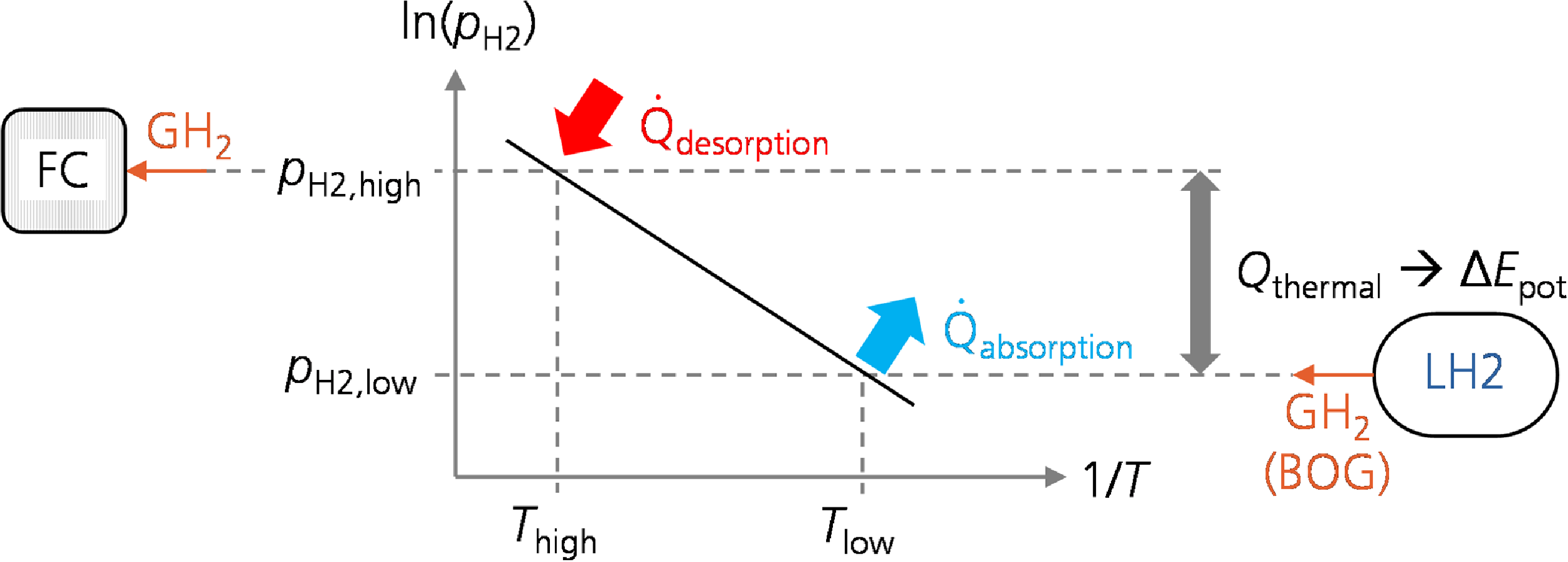
With their potential ability to absorb hydrogen at low pressure levels, metal hydrides can be used to capture, store and compress the BOG released from LH2 tanks for further utilisation, as illustrated in Fig. 2 [Reference Franke, Kazula and Enghardt10, Reference Rosso and Golben12, 20, Reference Fujitani, Nishimura, Nishio, Sato and Yonezu21]. When absorbing the BOG from a low pressure LH2 tank, the MH needs to reject the heat of the absorption reaction. On the contrary, a supply of heat is required to drive the release of hydrogen by desorption. The black line indicates the equilibrium pressure of the material in relation to the temperature T. This pressure-temperature-correlation can be utilised to supply the hydrogen at a higher pressure level p high than the available pressure level p low during the uptake of the BOG. In an exemplary arrangement with a fuel cell as a consumer, the waste heat of the fuel cell can be sufficient to achieve a desorption pressure high enough for the hydrogen to be directly supplied to the FC. This process of hydrogen compression by waste heat further increases the efficiency of the MH-based BOG recovery beyond the effect of only mitigating the hydrogen losses.
Schematic plot of the working principle of hydrogen compression by metal hydride from low pressure liquid hydrogen (LH2) storage to the supply pressure of a fuel cell (FC).

Several studies highlight the potential of MHs for BOG recovery [Reference Rosso and Golben12, Reference Nakano, Maeda, Ito, Masuda, Kawakami, Tange, Takahashi and Nishida22–Reference Hampton, Slattery and Oztek25]. Fuura et al. developed an on-board MH system to capture the boil-off losses that result over time from heat leakage between LH2 tank and the ambient atmosphere for example during parking periods [Reference Fuura, Tsunokake, Hirotani, Hashimoto, Akai, Watanabe, Enoki and Akiba24]. To absorb the corresponding relatively low hydrogen mass flow rates, the cooling by natural convection with the ambient air proved to be sufficient. In another study, Rosso et al. not only demonstrated the capture but also the subsequent compression of low-pressure GH2 [Reference Rosso and Golben12, Reference Rosso and Golben23]. By achieving rapid absorption rates in their experiments with the help of forced liquid cooling, they validated that MHs are also suited to capture the typically higher mass flow rates of BOG, which occur during LH2 refueling operations. Nakano et al. indicated that the thermo-physical properties of BOG deviate from the properties of usual GH2 due to the different composition of spin of their nuclei [Reference Nakano, Maeda, Ito, Masuda, Kawakami, Tange, Takahashi and Nishida22]. Nevertheless, their experiments demonstrated that the effects on the absorption and desorption behaviour are neglectable for a MH based on Lanthanum and Nickel.
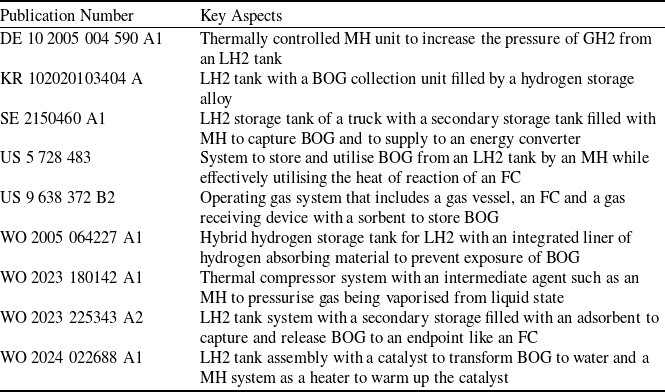
Besides these scientific publications, there are several patented concepts summarised in Table 1 that describe the use of MHs or other hydrogen absorbing materials to handle BOG.
Overview of patents for the capture, recovery or pressurisation of BOG from LH2 storage by MHs or any other solid hydrogen storage material

Although these publications illustrate various ways to successfully recover boil-off losses with MHs by capturing, storing and compressing, each of the presented systems is dedicated to a single, specific application, which results in the following limitations for the implementation at airports:
-
• No trans-sectoral use is considered, like BOG capture from an aircraft’s LH2 tank and a subsequent consumption in a ground-based vehicle;
-
• Limited to narrow operation windows and therefore not suited for varying pressure levels of different boil-off sources and several potential consumers;
-
• No mobile use intended to enable distribution or intermediate hydrogen storage according to the needs of the processes at the airport.
The goal of this study is to elaborate a conceptual design of a BOG recovery system, which overcomes these limitations by using exchangeable MH cartridges as illustrated in Fig. 3.
Metal hydride (MH) cartridge system to capture boil-off gas (BOG) at airports from multiple sources and to re-use the BOG in vehicles or any other hydrogen consumer as indicated by the recycling symbol.

3.0 Methodology of the conceptual design
The design of complex systems is usually supported by methodical design approaches like the VDI guideline 2221, which defines the central objectives, activities and results of the design process. Such approaches reduce the complexity of a design task by breaking it down into discrete process steps [Reference Pohl11, Reference Feldhusen and Grote26–Reference Kazula28]. Figure 4 depicts the process that is used in this study for the conceptual design of the BOG recovery system. The following subsections present the results of these process steps.
Process steps of the conceptual design in respect to Ref. [Reference Pahl, Beitz, Blessing, Feldhusen, Grote and Wallace27].

4.0 Rresults of the conceptual design
4.1 Requirements
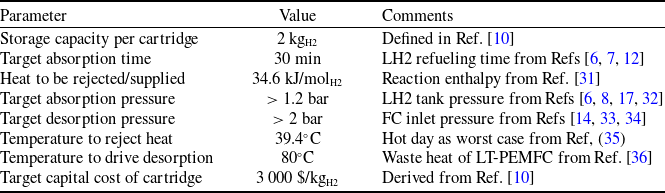
The alloy LaNi4.6Al0.4 is favourable for MH-based BOG recovery as it exhibits low hysteresis, favourable equilibrium pressures with flat plateau slope and fast kinetics [Reference Rosso and Golben12]. Hence, the derivation of the requirements in Table 2 base on this alloy. With its usable hydrogen capacity of 1.3 weight percent, an amount of approximately 150 kg of LaNi4.6Al0.4 will be required to store 2 kg of hydrogen. Considering a weight ratio of 1:1 for the MH material weight to the empty cartridge weight, the total cartridge weight adds up to 300 kg [Reference Bürger, Sourmelis Terzopoulos, Kretschmer, Kölbig, Brack and Linder29]. Based on an alloy density of 7.44 kg/l and a packing density of 60%, the volume of the MH material results in approximately 35 l [Reference Rosso and Golben12, Reference Hahne and Kallweit30]. This leads to a characteristic nature of the MH cartridges to be compact but heavy which needs to be considered in the conceptual design.
Excerpt from the requirements list of the boil-off recovery system

4.2 Functional structure tree
Breaking down a complex overall function into subfunctions increases the transparency of the relationships of in- and outputs and helps to identify the required physical processes and components [Reference Pahl, Beitz, Blessing, Feldhusen, Grote and Wallace27]. The functional structure tree according to Fig. 5 illustrates the derived subfunctions of the BOG recovery system.
Functional structure tree of the BOG recovery system.

4.3 Conceptual design areas and corresponding working principles
Based on the functional structure tree, the scope of the conceptual design of this study is framed with the help of Fig. 6. Besides defining the designated application areas of the BOG recovery system, this illustration highlights the main subsystems with their tasks and elements. For these subsystems, potential working principles are elaborated in the following subsections.
Overview of the potential subsystems involved in the BOG recovery process.

4.3.1 Interface design proposals
Generally, an MH vessel consists of a gas-proof containment in which the MH material is placed, of a thermal management system (TMS) with a heat transfer fluid (HTF) to remove or supply the reaction heat and of means for the input, output and distribution of hydrogen [Reference Pohl11, Reference Lototskyy, Tolj, Pickering, Sita, Barbir and Yartys34]. The essential interfaces of the MH cartridge are schematically illustrated in Fig. 7. To keep the exchangeable MH cartridge as simple as possible, the identifier can be a passive device like a barcode or an RFID chip, which is analysed and communicated by a stationary reading device. The temperature sensor of the cartridge could also be part of the stationary infrastructure.
Essential interfaces of the cartridges and overarching management system for control.

While there are various ways to remove and to supply the reaction heat, the use of liquid, such as water-glycol mixtures, or air as HTF are commonly applied to reject heat to the ambient atmosphere and to transfer waste heat to the MH material [Reference Lototskyy, Tolj, Pickering, Sita, Barbir and Yartys34, Reference Nguyen and Shabani37]. Figure 8 presents the TMS principles that are considered for the heat transfer out of and into the MH cartridge. It should be noted, that the sensible heat capacity of the cold BOG potentially assists the removal of the absorption heat [Reference Rosso and Golben12]. Thereby, the hydrogen would not only act as a reactant, but also as a HTF. However, the use of hydrogen as a HTF is not considered in this study.
Potential TMS interfaces (a), (b) and (c) for heat transfer out of/into the MH cartridge.

Although Fig. 8 depicts fans to drive the air flow, both convection types, natural and forced, may be used. However, natural convection only allows low specific absorption and desorption rates [Reference Davids, Lototskyy, Malinowski, van Schalkwyk, Parsons, Pasupathi, Swanepoel and van Niekerk38, Reference Bürger, Dieterich, Pohlmann, Röntzsch and Linder39]. For higher hydrogen mass flows, for example the boil-off losses during refueling operations, slow specific desorption rates would lead to unreasonable system sizes as large amounts of MH material would be required. The use of natural convection is especially challenging for the BOG recovery application with its operating conditions close to the MH material’s equilibrium conditions.
Although forced air convection is more effective than natural convection [Reference Dornheim, Baetcke, Akiba, Ares, Autrey, Barale, Baricco, Brooks, Chalkiadakis and Charbonnier40], it is expected to be more limiting in terms of implementation than the heat transfer by liquids. Firstly, consumers with air cooled PEMFCs will be required to apply heat supply by air. However, liquid cooling is the most common cooling method for FCs with more than 5 kW of power [41]. Secondly, for heat supply by air, the MH cartridges require external fins and have to be installed in the cooling air ducts of the PEMFCs, which will lead to limitations regarding potential consumers due to design space restrictions. For waste heat transfer through liquid media, positioning of the MH cartridges is less restricted, as the HTF lines could be placed more versatilely. Fast couplings in the HTF lines allow easy and quick replacement of the MH cartridges.
For an MH cartridge with liquid heat transfer, internal fins are important to utilise the high thermal performance of the liquid HTF, while additional external fins are not reasonable. For heat transfer by air, external fins are of a greater importance than internal fins, but a combination of both shows the highest performance [Reference Dornheim, Baetcke, Akiba, Ares, Autrey, Barale, Baricco, Brooks, Chalkiadakis and Charbonnier40]. These conclusions can be derived from the terms of the total heat transfer coefficient ${U_{{\rm{total}}}}$
, which is part of the following Equations (1), (2) and (3) to calculate the thermal power
${U_{{\rm{total}}}}$
, which is part of the following Equations (1), (2) and (3) to calculate the thermal power $P$
of the TMS of the MH cartridge [Reference Kölbig, Weckerle, Linder and Bürger42, 43]:
$P$
of the TMS of the MH cartridge [Reference Kölbig, Weckerle, Linder and Bürger42, 43]:
 \begin{align}{\rm{P}} = {U_{{\rm{total}}}} \cdot {\rm{A}} \cdot {\rm{\Delta }}T = {U_{{\rm{total}}}} \cdot {\rm{A}} \cdot \left( {{T_{{\rm{HTF}}}} - {T_{{\rm{MH}}}}} \right)\end{align}
 \begin{align}{U_{{\rm{total}}}} = \frac{1}{{{R_{\rm{total}}}}}\end{align}
 \begin{align}{R_{{\rm{total}}}} = \frac{{{s_{{\rm{MH}}}}}}{{{\lambda _{{\rm{MH}}}}}} + \frac{1}{{{\alpha _{{\rm{wall}}}}}} + \frac{{{s_{{\rm{wall}}}}}}{{{\lambda _{{\rm{wall}}}}}} + \frac{1}{{{\alpha _{{\rm{HTF}}}}}}\end{align}
The factor $A$
describes the available area for heat transfer. The terms
$A$
describes the available area for heat transfer. The terms $s$
and
$s$
and $\lambda $
represent the travel distance through the material and its thermal conductivity, while
$\lambda $
represent the travel distance through the material and its thermal conductivity, while $\alpha $
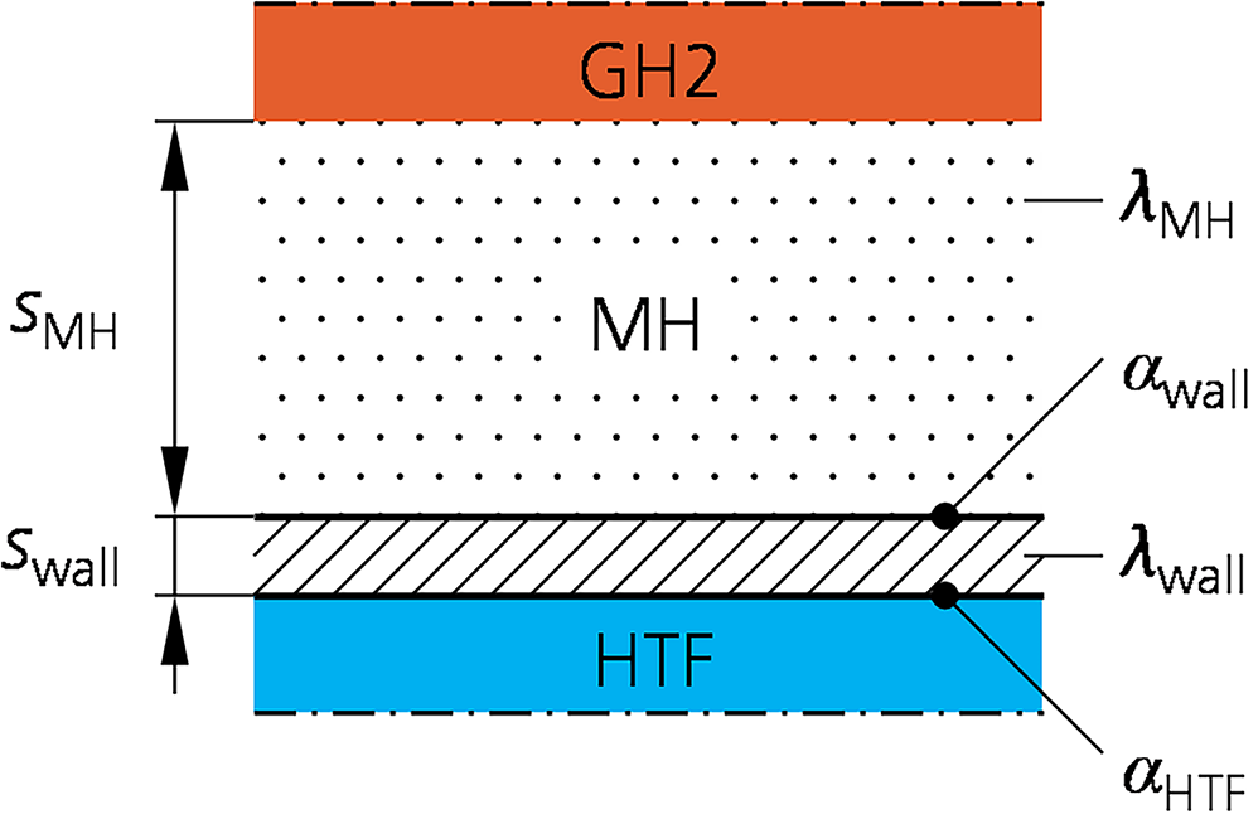
is the term of the heat transfer coefficient. The terms are illustrated in Fig. 9, which displays a schematic cross section resembling a unit cell of an MH cartridge.
$\alpha $
is the term of the heat transfer coefficient. The terms are illustrated in Fig. 9, which displays a schematic cross section resembling a unit cell of an MH cartridge.
Schematic of a unit cell of the MH cartridge to illustrate the heat transfer path.

To keep the MH material in isothermal condition for not deteriorating the reaction rate by heating up or cooling down, the thermal power $P$
should correspond to the heat of reaction
$P$
should correspond to the heat of reaction $\dot Q$
for absorption and desorption as shown in Equation (4):
$\dot Q$
for absorption and desorption as shown in Equation (4):
 \begin{align}{\rm{P}} = \dot Q\end{align}
The heat of reaction $\dot Q$
can be calculated with the molar mass flow of hydrogen
$\dot Q$
can be calculated with the molar mass flow of hydrogen ${\dot n_{{\rm{H}}2}}$
and the reaction enthalpy
${\dot n_{{\rm{H}}2}}$
and the reaction enthalpy $\Delta H$
according to the following Equation (5) [Reference Chabane, Ibrahim, Harel, Djerdir, Candusso and Elkedim44, Reference Weckerle, Nasri, Hegner, Linder and Bürger45]:
$\Delta H$
according to the following Equation (5) [Reference Chabane, Ibrahim, Harel, Djerdir, Candusso and Elkedim44, Reference Weckerle, Nasri, Hegner, Linder and Bürger45]:
 \begin{align}\dot Q = {\dot n_{{\rm{H}}2}} \cdot \Delta H = {\dot m_{{\rm{H}}2}} \cdot \frac{{\Delta H}}{{{M_{\rm{H2}}}}}\end{align}
It has to be noted, that setting the thermal power $P$
equal to the heat of reaction
$P$
equal to the heat of reaction $\dot Q$
is an idealistic scenario. This equivalence assumes steady-state conditions, a uniform temperature distribution in the MH bed and heat transfer only in thickness direction within the unit cell. Nevertheless, this equivalence is used in the following paragraphs to point out the sensitivity of the terms of the heat transfer coefficient
$\dot Q$
is an idealistic scenario. This equivalence assumes steady-state conditions, a uniform temperature distribution in the MH bed and heat transfer only in thickness direction within the unit cell. Nevertheless, this equivalence is used in the following paragraphs to point out the sensitivity of the terms of the heat transfer coefficient ${U_{{\rm{total}}}}$
to derive conclusions for the conceptual design.
${U_{{\rm{total}}}}$
to derive conclusions for the conceptual design.
The average mass flow rate ${\dot m_{{\rm{H}}2}}$
, which results from the target absorption time from Table 2, leads to an average power requirement of 20 kW to reject the heat of reaction
${\dot m_{{\rm{H}}2}}$
, which results from the target absorption time from Table 2, leads to an average power requirement of 20 kW to reject the heat of reaction $\dot Q$
of a single cartridge. Applying this value for the cooling power demand
$\dot Q$
of a single cartridge. Applying this value for the cooling power demand $P$
, according to the idealistic equivalence described above, leads to unreasonable large dimensions of external fins for heat rejection by air, especially at hot day conditions when the temperature difference for heat rejection becomes low. A respective heat transfer coefficient
$P$
, according to the idealistic equivalence described above, leads to unreasonable large dimensions of external fins for heat rejection by air, especially at hot day conditions when the temperature difference for heat rejection becomes low. A respective heat transfer coefficient ${\alpha _{{\rm{HTF}}}}$
of natural convection of 5 W/(m²K) and a temperature difference
${\alpha _{{\rm{HTF}}}}$
of natural convection of 5 W/(m²K) and a temperature difference ${\rm{\Delta }}T$
of 5 K would already lead to an external fin area requirement of 800 m², even when neglecting the other terms of
${\rm{\Delta }}T$
of 5 K would already lead to an external fin area requirement of 800 m², even when neglecting the other terms of ${U_{{\rm{total}}}}$
[Reference Dornheim, Baetcke, Akiba, Ares, Autrey, Barale, Baricco, Brooks, Chalkiadakis and Charbonnier40]. As the heat transfer coefficient
${U_{{\rm{total}}}}$
[Reference Dornheim, Baetcke, Akiba, Ares, Autrey, Barale, Baricco, Brooks, Chalkiadakis and Charbonnier40]. As the heat transfer coefficient ${\alpha _{{\rm{HTF}}}}$
of liquid cooling is two orders of magnitude higher, with values in the range of 300 to 1 000 W/(m²K), its area requirement is correspondingly smaller [Reference Dornheim, Baetcke, Akiba, Ares, Autrey, Barale, Baricco, Brooks, Chalkiadakis and Charbonnier40, Reference Feng, Xiangming, Ouyang, Languang, Wu, Kulp and Prasser46]. Hence, liquid heat transfer is recommended to not deteriorate the compact nature of the MH cartridges.
${\alpha _{{\rm{HTF}}}}$
of liquid cooling is two orders of magnitude higher, with values in the range of 300 to 1 000 W/(m²K), its area requirement is correspondingly smaller [Reference Dornheim, Baetcke, Akiba, Ares, Autrey, Barale, Baricco, Brooks, Chalkiadakis and Charbonnier40, Reference Feng, Xiangming, Ouyang, Languang, Wu, Kulp and Prasser46]. Hence, liquid heat transfer is recommended to not deteriorate the compact nature of the MH cartridges.
When using liquid heat transfer, the heat conduction through the MH material drives the total heat transfer coefficient ${U_{{\rm{total}}}}$
. As MH powder material shows a low effective thermal conductivity
${U_{{\rm{total}}}}$
. As MH powder material shows a low effective thermal conductivity ${\lambda _{{\rm{MH}}}}$
in the range of 0.1–1 W/(mK), the thermal resistance of the cartridge wall can usually be neglected [Reference Hahne and Kallweit30, Reference Nguyen and Shabani37, Reference Dornheim, Baetcke, Akiba, Ares, Autrey, Barale, Baricco, Brooks, Chalkiadakis and Charbonnier40, Reference Weckerle, Nasri, Hegner, Bürger and Linder47]. Hence, the travel distance through the MH material
${\lambda _{{\rm{MH}}}}$
in the range of 0.1–1 W/(mK), the thermal resistance of the cartridge wall can usually be neglected [Reference Hahne and Kallweit30, Reference Nguyen and Shabani37, Reference Dornheim, Baetcke, Akiba, Ares, Autrey, Barale, Baricco, Brooks, Chalkiadakis and Charbonnier40, Reference Weckerle, Nasri, Hegner, Bürger and Linder47]. Hence, the travel distance through the MH material ${s_{{\rm{MH}}}}$
should be minimised during the sizing process of the cartridge either by a thin MH bed design or by implementing internal fins as proposed above. Another approach is to increase the effective thermal conductivity of the MH material
${s_{{\rm{MH}}}}$
should be minimised during the sizing process of the cartridge either by a thin MH bed design or by implementing internal fins as proposed above. Another approach is to increase the effective thermal conductivity of the MH material ${\lambda _{{\rm{MH}}}}$
by compressing the MH powder to pellets or by adding materials with high thermal conductivity, e.g. aluminum, expanded natural graphite or carbon fibers [Reference Lototskyy, Tolj, Pickering, Sita, Barbir and Yartys34, Reference Nguyen and Shabani37, Reference Kölbig, Weckerle, Linder and Bürger42, Reference Bae, Tanae, Monde and Katsuta48]. While adding passive materials increases the overall mass of the cartridge, the utilisation of externally formed pellets limits the design possibilities of the cartridge and may lead to hydrogen mass transfer limitations [Reference Nguyen and Shabani37, Reference Kölbig, Weckerle, Linder and Bürger42].
${\lambda _{{\rm{MH}}}}$
by compressing the MH powder to pellets or by adding materials with high thermal conductivity, e.g. aluminum, expanded natural graphite or carbon fibers [Reference Lototskyy, Tolj, Pickering, Sita, Barbir and Yartys34, Reference Nguyen and Shabani37, Reference Kölbig, Weckerle, Linder and Bürger42, Reference Bae, Tanae, Monde and Katsuta48]. While adding passive materials increases the overall mass of the cartridge, the utilisation of externally formed pellets limits the design possibilities of the cartridge and may lead to hydrogen mass transfer limitations [Reference Nguyen and Shabani37, Reference Kölbig, Weckerle, Linder and Bürger42].
4.3.2 Metal hydride cartridge design proposals
Besides the properties of the MH material and the means for thermal management, the outer shape of the vessel of the cartridge influences the performance of the system. Figure 10 introduces different designs for vessel shapes and summarises their specific properties.
Overview of different vessel shapes and their properties according to Refs [Reference Pohl11, Reference Rosso and Golben12, Reference Lototskyy, Tolj, Pickering, Sita, Barbir and Yartys34, Reference Kölbig, Weckerle, Linder and Bürger42, Reference Yang, Wang, Zhang, Meng and Rudolph49–Reference Röver, Roth, Hoffmann, Baetcke and Herzog51].

All cartridge cross sections of Fig. 10(a)–(c) are illustrated with two types of internal channels: arteries for hydrogen transfer and lines to accommodate the liquid HTF. While a filter tube is often used as a hydrogen artery for MH powder beds, a drilled hole is sufficient for compact MH pellets [Reference Yang, Wang, Zhang, Meng and Rudolph49]. The design of the HTF lines depends on the sizing of the TMS as described in the previous section. The shape, size and number of HTF lines is driven by the intention to reduce the travel distance through the MH material ${s_{{\rm{MH}}}}$
. The acceptable travel distance depends on the target value for the thermal power
${s_{{\rm{MH}}}}$
. The acceptable travel distance depends on the target value for the thermal power $P$
, on the available area
$P$
, on the available area $A$
, on the available temperature difference
$A$
, on the available temperature difference $\Delta T$
and on the applied means to enhance the effective thermal conductivity of the MH bed
$\Delta T$
and on the applied means to enhance the effective thermal conductivity of the MH bed ${\lambda _{{\rm{MH}}}}$
. Thus, the overall design is also driven by the dimensions of the cartridge. While a compact design requires numerous HTF lines and preferably contains internal fins as well, a long and thin cartridge with a thin MH bed might work with only a few HTF lines or even with none at all, when external fins become promising. Hence, the final design choice depends on the available design space and requires a dedicated conceptual design study.
${\lambda _{{\rm{MH}}}}$
. Thus, the overall design is also driven by the dimensions of the cartridge. While a compact design requires numerous HTF lines and preferably contains internal fins as well, a long and thin cartridge with a thin MH bed might work with only a few HTF lines or even with none at all, when external fins become promising. Hence, the final design choice depends on the available design space and requires a dedicated conceptual design study.
Another point that has to be considered for the cartridge design is the expansion of the MH material during hydrogenation, which can lead to stresses and failure of the cartridge [Reference Kölbig, Weckerle, Linder and Bürger42, Reference Weckerle, Bürger and Linder52]. To compensate for the expansion, the MH powder may be filled into the cartridge up to a porosity of approximately 67% [Reference Kölbig, Weckerle, Linder and Bürger42]. However, this leads to a tradeoff between a dense filling to increase the storage capacity and an effective thermal conductivity of the MH bed on the one hand and larger stresses in the cartridge on the other hand [Reference Lototskyy, Tolj, Pickering, Sita, Barbir and Yartys34, Reference Kölbig, Weckerle, Linder and Bürger42]. Besides limiting the filling density, the addition of expanded natural graphite can also protect the cartridge from stresses, as it compensates the expansion of the MH [Reference Lototskyy, Tolj, Klochko, Davids, Swanepoel and Linkov53].
4.3.3 Proposals for metal hydride cartridge logistics
Potential locations to place the cartridges during BOG capture are shown in Fig. 11. Although option (a) enhances flexibility between actual BOG rates and hydrogen demands by allowing to refill the MH cartridges also with hydrogen from the grid, this solution requires higher infrastructure demands and thereby offsets the benefits of bowser distribution. Hence, it may be beneficial to implement option (b), (c) or (d) in combination with only a single, separate facility for intermediate storage. This intermediate storage acts as buffer during times with high amounts of boil-off and low hydrogen demand of consumers or vice versa. The storage could be positioned underground or could be a common storehouse as in Fig. 6. The storage is preferably equipped with connections to the stationary GH2 pipeline grid. This enables to refill the MH cartridges in phases with low boil-off occurrence and high demand of the consumers. Moreover, the MH cartridges could also deploy the hydrogen into the grid for re-liquefaction and thereby serve as a buffer to translate the rapid bursts of BOG from the refueling operations to a constant hydrogen mass flow, which is suited for the liquefier [Reference Rosso and Golben12].
Potential positioning of MH cartridges during LH2 refueling.

Option (c) and (d) may be beneficial compared to (b), as the systems of the bowser truck could be used to supply electrical power for sensors, for communication or to drive the HTF pump. As described in Section 2.1, the LH2 trailer offers a weight margin of approximately 7 tons that can be used for the integration of the cartridges and further subsystems. However, the hydrogen capacity of 50 kg suggested by Mangold et al. could not be fully achieved by retrofitting a conventional LH2 trailer, as this capacity would require 25 cartridges in total which leads to a total cartridge weight of 7.5 tons. Nevertheless, the mismatch may be solved by modifying the LH2 trailer or by slightly reducing the total capacity of the recovery system onboard of the refueling truck.
Besides weight, the total capacity that is installed in the LH2 trailer might also lead to challenging heat rejection demands if multiple cartridges are absorbing in parallel. Based on the estimations of Mangold et al. shown in Section 2.1 [Reference Mangold, Silberhorn, Moebs, Dzikus, Hoelzen, Zill and Strohmayer6], an amount of 12.5 kg of BOG forms during the chill-down prior to refueling. Assuming that no depressurisation of the bowser truck is necessary in the environment of an airport, no BOG needs to be vented after refueling. During refueling, the transfer losses may be as low as 0.1% of the delivered hydrogen as also described in Section 2.1. Based on exemplary predictions of LH2 fuel masses onboard of a future hydrogen-powered regional, narrow-body and wide-body aircraft of approximately 1, 5 and 20 tons [Reference Mangold, Silberhorn, Moebs, Dzikus, Hoelzen, Zill and Strohmayer6, Reference Brewer8, Reference Clemente54], the BOG losses during transfer are 1, 5 and 20 kg, respectively. Together with the 12.5 kg of BOG prior to refueling, the total losses sum up to 13.5, 17.5 and 32.5 kg. Assuming that all aircraft categories are refueled within the target absorption time of 30 minutes from Table 2, the heat rejection demands result to approximately 135, 175 and 325 kW based on the equation in Section 4.3.1. To limit this cooling power demands, it may be reasonable to reduce the hydrogen mass flow rates by operating multiple LH2 trailers in parallel, especially if larger aircrafts are refueled.
However, option (b) can still be promising as it offers high independency and flexibility. Especially for lower hydrogen mass flow rates, when natural convection is sufficient to reject the heat of absorption, this positioning can be beneficial.
Besides the positioning of the MH cartridges, potential means for replacement and transportation have to be considered. Due to the high weight of the MH cartridges, devices like industrial robots, cranes, conveyor belts, staff with exoskeletons, hand lift trucks, forklifts or towing tractors with trailers may be suitable. In addition, the cartridges should offer means for handling like handles, lugs, threads, wheels, guide rails or guide pins and poka-yoke elements. The cartridges may also be equipped with bumper devices like rubber slipovers to protect the vessel or the interface components from damage during the handling operations. Although MHs are described as an intrinsically safe hydrogen storage form due to the moderate pressures and the endothermic nature of the hydrogen release, a connection tear-off or a vessel rupture still implies a safety risk due to the pyrophoric nature of MHs [Reference Lototskyy, Tolj, Pickering, Sita, Barbir and Yartys34, 36, Reference Zalosh55].
4.4 Combination of working principles to a design concept
Based on the description of the working principles, the most promising ones are combined to the design concept illustrated in Fig. 12. Depending on the boil-off source, the use of two different TMS interfaces is proposed for the BOG capture. To meet the high BOG mass flow rates during LH2 refueling, liquid cooling is applied to meet the demands for powerful heat rejection. Thus, the positioning according to Fig. 11 option (c) or (d) is proposed as the additional systems of the TMS, like heat exchangers with fans and HTF pumps, could be supplied with electrical power from the truck.
Proposed design concept for boil-off recovery at airports by MH cartridges.

For low boil-off rates on the other hand, for example the evaporation rates caused by heat leak when the aircraft is out of operation and exceeded its dormancy time, natural convection may be sufficient. The use of passive natural cooling can be beneficial in this case, as infrastructure and power supply demands will be minor allowing for more flexible positioning of the cartridges. As illustrated, the external fins for the heat rejection to the ambient air are not part of the cartridge, as permanently attached fins would lead to high space demands in all other subsystems and are prone to damage during handling.
In the consumer subsystem, however, only the use of liquid as HTF is proposed due to the limitations of air, which have been described in Section 4.3.1. Moreover, it may be reasonable to have a pre-heater or a secondary hydrogen tank in the consumer subsystem for its startup, when no waste heat is available yet to drive the desorption reaction.
Referring to the buffer storage, a connection to the hydrogen grid ensures refilling of the cartridges when the occurring boil-off rates are too low to cover the demands of the consumers. On the contrary, hydrogen can also be fed back to re-liquefaction or converted it into heat or electricity for stationary use when the boil-off rates exceed the demands of the consumers.
Regarding the design of the cartridge itself, the prismatic vessel shape is favourable because of the following reasons:
-
• most compact design that leads to smallest space demands;
-
• shape is beneficial for handling, integration and stacking while the latter simplifies upscaling by increasing the number of installed cartridges;
-
• good heat transfer capabilities offer high thermal performance for fast absorption, which is necessary for the relatively short duration of the LH2 refueling procedure;
-
• low pressure resistance of this shape is not disadvantageous due to the generally moderate pressure levels of the BOG recovery application;
-
• flat outer faces are beneficial for the thermal coupling to additional external fin units for the natural convection during operation with low hydrogen mass flow rates.
5.0 Conclusions
As the overview of the state-of-the-art examples of BOG recovery by MHs already emphasises the general feasibility and reasonability of this technology, this study provides a conceptual design that uses exchangeable MH cartridges to enable trans-sectoral application. At first, the requirements were identified and a functional structure tree was established before corresponding working principles were determined. Finally, the most promising principles were selected and combined to a design concept proposal for BOG recovery at airports. In upcoming studies, further concepts should be derived from the working principles and subsequently evaluated and benchmarked. Moreover, a proof of concept by experiments based on a small-scale demonstrator is recommended. Therefore, a detailed design of the MH cartridge has to be elaborated and sized. However, the proposed concept already reveals the huge potential of exchangeable MH cartridges to empower future sustainable aviation and to enhance the efficiency of the LH2 supply chain in general. As this concept is not limited to aviation, further markets such as maritime infrastructures or the automotive sector should be addressed to achieve a high market penetration.
Acknowledgements
We wish to acknowledge Dr. Inga Bürger for her ongoing advice and sharing her profound knowledge about metal hydrides and also Prof. Lars Enghardt and Georg Pohl for their support in the investigation of boil-off recovery.
Competing interests
The authors declare none.







 Open access

