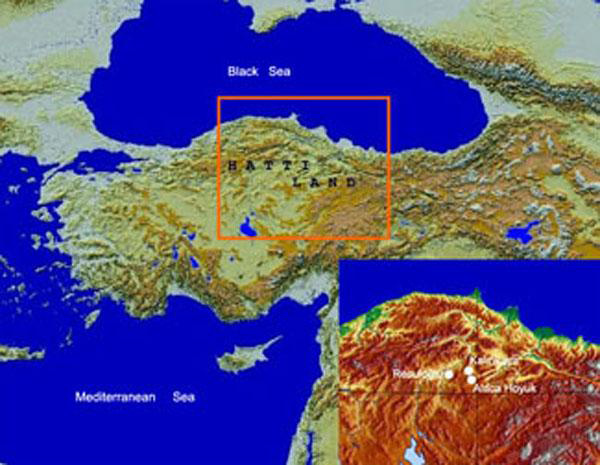


Location of Resuloğlu and Kalınkaya.

Since the late Tahsin Özgüç's pioneering study on this subject (Özgüç 1948), much data has been added on Anatolian Chalcolithic and Early Bronze Age burials, mainly in western and southeast Turkey (Reference WheelerWheeler 1974; Laneri 1999; Sertok & Ergeç 1999; Erkanal & Özkan 1999; Seeher 2001). However, analysis of their features and reports on the larger cemeteries have rarely focussed on pathology and social structure of current Anatolian prehistoric communities (cf. Reference SeeherSeeher 2000). Current excavations of a necropolis at Resuloğlu and the analysis of earlier research at the Kalınkaya cemetery, both in Central Anatolian's Çorum district, are together taking new approaches to the social and cultural structure of northern Central Anatolia, the 'Land of Hatti', before the Hittite impact of the early 2nd millennium BC.
The modern village of Kalınkaya is located c.3 km northeast of Alaca Höyük (Figure 1). Geographically situated on the northern fringes of the Central Anatolian plateau, at c.1 300 masl, the immediate vicinity is characterised by limestone outcrops and wadis cutting deep into the hills slopes, their arable soil today eroded but providing rich farmland in the Anatolian Early Bronze Age. After reports in 1971 that prehistoric burials in Kalınkaya's Toptaştepe area were being systematically looted, the Museum of Anatolian Civilisations (Ankara) and its director R. Temizer carried out two rescue seasons here (1971 & 1973). The lower southern area of the Toptaştepe mound produced an EBA graveyard immediately overlying Chalcolithic deposits that followed the naturally sloping mound's surface. Three different types of burials coexisted here: simple earth graves, cist graves and pithos graves, with the richest inventories belonging to either women or children (infans I/ II). All were found in the same area, with no signs of specific spaces reserved for a specific burial type. Their even horizontal distribution in the same stratigraphic horizon and the funerary assemblage testifies to a limited chronological range in the (late) Early Bronze Age period (2,300-2,250-2000/1,950 BC) (Reference ZimmermannZimmermann 2006).
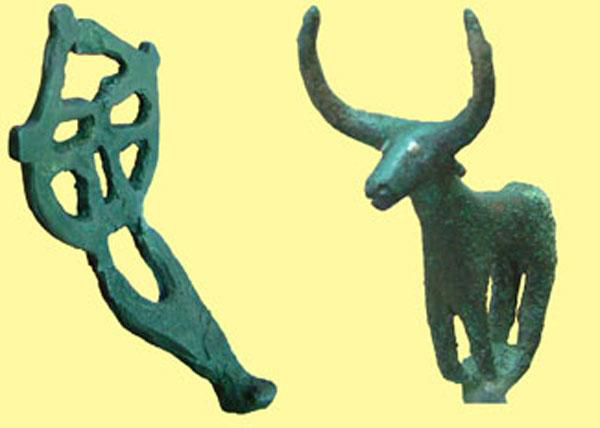
Bull statue and ceremonial standard from Kalınkaya burials.
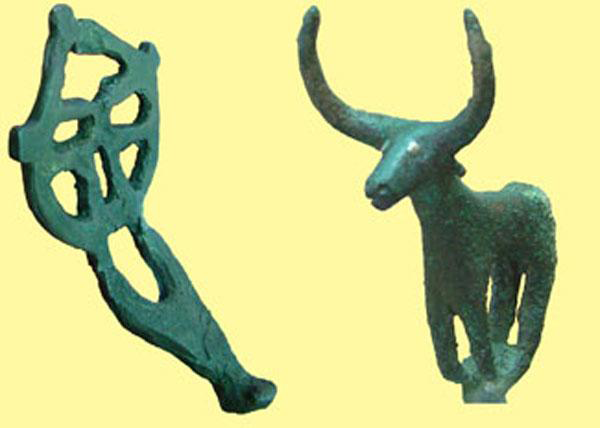
Together with pottery and a rich variety in stone beads, grave goods included a large number of metal objects: stabbing weapons, tools and ritual equipment (Figure 2). Animal statues and an abstract ceremonial standard resemble those found in the 'royal' tombs at Alaca Höyük [Arık 1937: Pl. 270 (CCLXX), Al.1080; Koşay 1938: 124 Pl. 96.97 (from burial 'C']; some details also recall standard types attributed to 'Horoztepe' or Nallıhan near Bolu (cf. Reference MuscarellaMuscarella 1988; Reference ZimmermannZimmermann 2005: 468-70). These items show direct ties with early urban centres like Alaca Höyük, though technically not of such high quality. The silver coating of one Kalınkaya bull statue's eyes (Figure 2), however, required advanced metalworking skills; and unlike the 'Horoztepe' parallels and many others from looted cemeteries in the northern central provinces of modern Turkey that surfaced from the antiquities' market, Kalınkaya's finds can be studied within their full archaeological context.
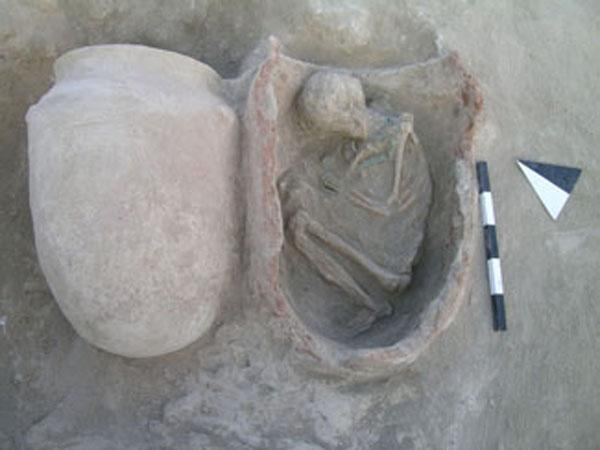
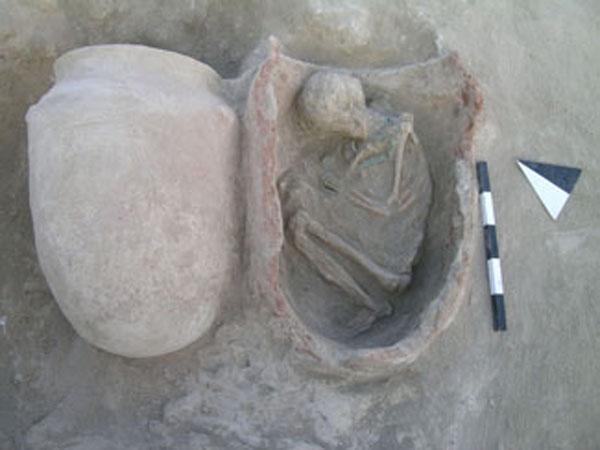
The Resuloğlu cemetery, under excavation since 2003, and its nearby settlement are situated within the borders of Uğurludağ district in Çorum province, roughly 90 kms west of Kalınkaya (Yıldırım & Ediz 2005). The graves lie on a ridge between two mound-type settlements, 630 masl, on the top of the ridge facing to the southeastern mound. The settlements control an important strategic location overlooking the Delice River valley, from Kavsut in the south through Kula, where it meets with Kızılırmak (Halys) river. Building activities just to the north of the cemetery area can be explained as a result of population increase of Resuloğlu people. Graves so far unearthed at Resuloğlu belong to three types: pithoi, cists and jars (Figure 3).
Jar burial from Resuloğlu with metal finds in situ.
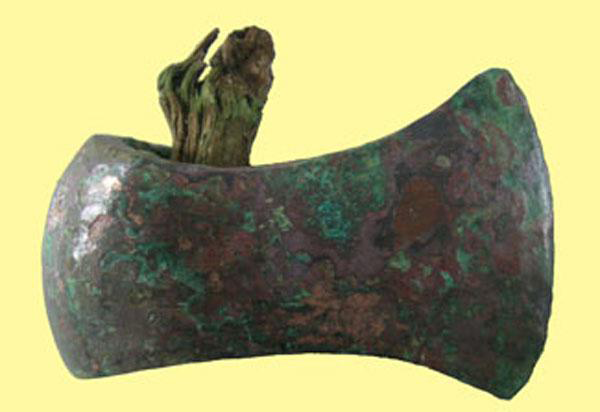
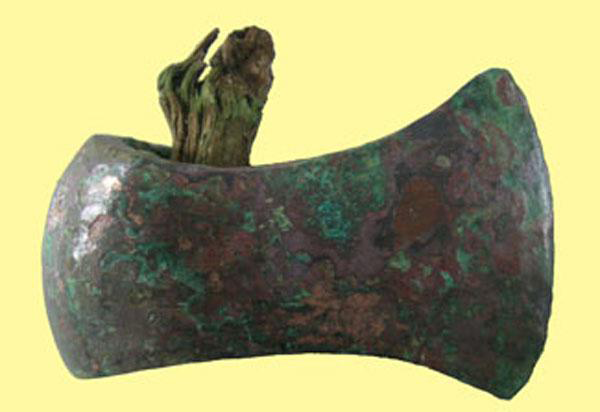
Shafthole axe from Resuloğlu with preserved wooden shaft.
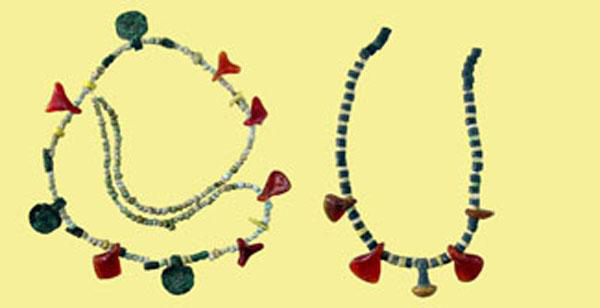
Jewellery from Resuloğlu.
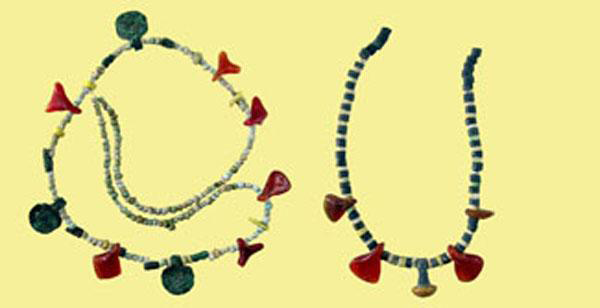
Unlike Kalınkaya, no examples of simple earth burials have yet been found. Burial gifts comprise mostly pottery, metal vessels, weapons and jewellery. So far, no objects related with religion or cult have been found, whereas these were a significant phenomenon of the Kalınkaya burial complex. Preservation is, however, excellent: the sockets of some shafthole axes still contain pieces of wooden shafts (Figure 4). The many necklaces, all of highest quality, show remarkably close typological and technological parallels with the Kalınkaya jewellery (Figure 5). Pendants and beads were likewise made in a wide variety of materials: frit, faience, marine shells, stone, limestone, malachite, carnelian, arsenical mineral (Uzonite), copper/bronze, silver, gold and occasionally electrum.
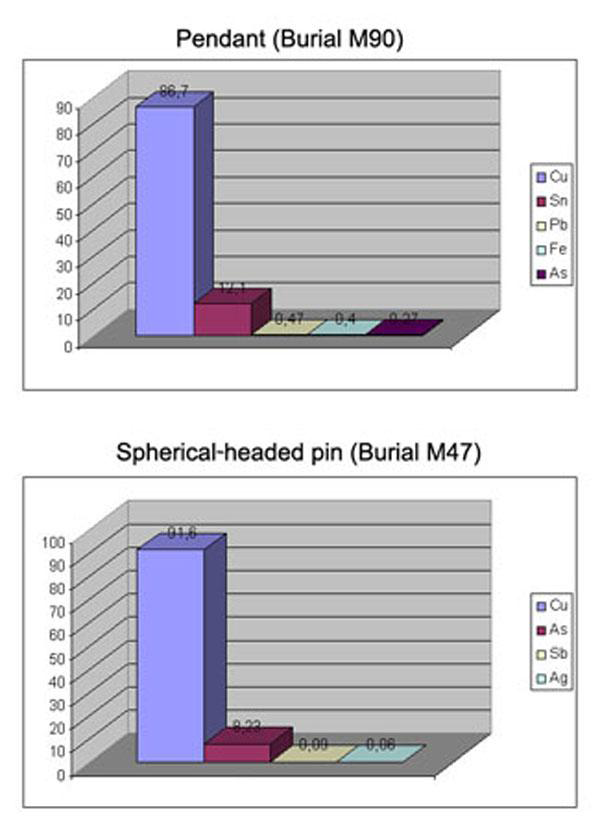
Results from destructive XRF-scannings of Resulğolu metal items [small pendant (burial M90) and spherical-headed pin (burial M47)]. Note the high concentrations of tin and arsenic.

Thanks to a cooperation with Bilkent University's Department of Chemistry (Hasan Erten) and the Turkish Nuclear Research and Training Centre in Sarayköy (Abdullah Zararsız), X-Ray Diffraction (XRD) and destrucive X-Ray Flourescence (XRF) are revealing the chemical composition of the Resuloğlu metals with highest accuracy. This analysis is a crucial facet of our collaboration: although Early Bronze metallurgy was partly studied analytically by Ufuk Esin and Prentiss de Jesus (Esin 1969; Reference DE JesusDe Jesus 1980), and intensive source surveying has been carried out in recent decades (cf. Seeliger et al. 1985; Wagner et al. 2003: 476-94), the rich metal evidence from (Northern) Central Anatolia still lacks a reliable modern database. Questions about what different alloys were used, and what possible metal sources were exploited to guarantee a secure supply for the northern Central Anatolian metalworking communities in the late 3rd millennium BC, are still not sufficiently answered. The first results show surprisingly high concentrations of tin and arsenic (Figure 6), a phenomenon that will be pursued further in the longer run of this scientific project.
The evidence of the Kalınkaya and Resuloğlu cemeteries documented so far yields much potential for further discussion in a still barely investigated region. Styles and technologies allow correlations with nearby sites like Alacahöyük and other, partly looted findspots such as Yenihayat, Balıbağ, Oymaağaç and Göller (cf. Özgüç 1978: 31-36; 89-99; Süel 1989; Emre 1996; Yıldırım 2001). But weapon and jewellery styles point also to parallels with goods produced by West Anatolian and Mesopotamian communities. However, the style of some jewellery from Balıbağ, Resuloğlu and Kalınkaya clearly testifies to craftsmen being capable of producing their own, unique shapes; in doing so, this region, despite the long distance contacts with Near Eastern societies, underlined its original 'Hattian' cultural setting.