


Introduction
Over the past decades, decentralisation in its various dimensions has been implemented with great enthusiasm in many countries around the world. With the expectation of enhancing local democracy and promoting inclusive societies, the power to popularly elect local leaders is being passed down to subnational levels through political decentralisation (Cohen and Peterson Reference Cohen and Peterson1999; Falleti Reference Falleti2005). By means of administrative decentralisation, the subnational layers of government exert autonomous control over their own bureaucracies (“devolution”, Rondinelli, Nellis, and Cheema Reference Rondinelli, Nellis and Cheema1983). Through fiscal decentralisation, tax and spending competencies are transferred to local governments in order to more flexibly respond to the true preferences of citizens with regard to public service provision (Oates Reference Oates1968), to promote efficiency-improving competition for an optimal number of residents (Tiebout Reference Tiebout1956) and to make local public service providers more accountable to taxpayers (Pierson Reference Pierson1995; Salmon Reference Salmon1987). While these reforms are being undertaken with the expectation of achieving social well-being, decentralisation skeptics stress that in developing countries, in particular, there are considerable “dangers of decentralization” (Prud’homme Reference Prud’homme1995) with regard to weak administrative capacities, inefficiencies due to uncompensated spillovers, rising regional disparities and increased corruption and collusion (Neudorfer and Neudorfer Reference Neudorfer and Neudorfer2015; Tanzi Reference Tanzi1996).
This article aims to add insights to the research on the thus far largely ignored danger of decentralisation, namely, the relationship between fiscal decentralisation and organised crime violence (OCV). Clearly, the infiltration of organised crime in public institutions constitutes a major threat to democracy in many countries. Especially in large and diverse nations suffering from a structural presence of criminal organisations, central government efforts to contain criminal activities are often ineffective. In these contexts, local governments are frequently under siege by mafias exerting pressure to facilitate illegal activities within their territory. Indeed, municipalities may increasingly be considered an attractive source of income themselves (Pinotti Reference Pinotti2015a).
Yet, the relationship between the presence of criminal groups and local fiscal arrangements remains largely ignored by scholars within the fields of both decentralisation research and criminology. This stands in contrast to the prominent role this nexus plays in the popular media (Arias Reference Arias2018, 341; Ch et al. Reference Ch, Shapiro, Steele and Vargas2018, 998). Thus, I develop and examine the argument that criminal organisations compete for local public funds as sources of income and enter into violent confrontations with each other. I analyse this issue in the context of the Mexican federal system over the period 1995–2015.
The evidence supports the notion that higher levels of local spending (LS) per capita increase the intensity of existing violent confrontations. LS, however, does not seem to bear relevance to the probability of violent confrontations occurring in the first place. The broader insight is that in countries suffering from a strong presence of organised crime, fiscal decentralisation reforms aimed at increasing the spending responsibilities of local governments can be detrimental to public safety.
Fiscal decentralisation, local resources, and OCV
The following argument is considered to hold in countries characterised by generalised local capture through organised criminal groups (hereafter OCGs). While many types of corruption are initiated by the public servant (Philp Reference Philp, Sampford, Shacklock, Connors and Galtung2006, 45), local capture is driven by a third party as it involves the exertion of illicit influence by a powerful elite on the functioning of governmental affairs. The aim is to ensure some kind of preferential treatment, for example, in the form of the uninterrupted management of drug routes (Kaufmann Reference Kaufmann, Sala-i-Martin and Schwab2004), but also to achieve access to additional income sources and to enhance the capturing party’s legitimacy to exert influence over a certain territory or group of people (Eaton Reference Eaton2006, 561). Here, I consider the third party to consist of OCGs, i.e. groups engaging in extreme violence and corruption (Van Dijk Reference Van Dijk2007, 40) in order to gain access to governmental resources, ranging from judges and police officers to social programmes and budgets (Fuerte, Lujan, and Ponce Reference Fuerte, María, Enrique Pérez and Cordova Ponce2019).
OCGs are characterised by their clandestine nature, their adoption of a shadow state’s role where the formal state is particularly weak, and their functioning as enterprises (Green and Ward Reference Green and Ward2004, 88). They unite the resources of a large number of individuals, accumulate economic, military, and political power, and engage in criminal industries such as drug trafficking or money laundering (Phillips Reference Phillips2015). With regard to the location where the capturing takes place, Yashar (Reference Yashar2018) stresses that OCGs are particularly interested in areas where state capacities are especially weak, and criminal activities can take place uninterrupted. In the context of such “jurisdiction shopping” (Yashar Reference Yashar2018, 101), a weak deterrent effect of police and deficient judiciaries are likely to be important pull factors (see also Van Dijk Reference Van Dijk2007, 46).
Focusing on local police, Manning and Redlinger (Reference Manning, Redlinger and Rock1977) hold that OCGs concentrate on capturing police officers at lower levels of the command chain because capturing officers at higher levels requires considerably more resources. Analogously, I argue that local politicians and officials are less powerful and more accessible to local pressure groups than higher-level officials is that they find themselves on the “invitational edge of corruption” (Manning and Redlinger Reference Manning, Redlinger and Rock1977). Thus, OCGs are particularly interested in focusing their capturing activities at the local level.
This line of reasoning relates to arguments brought forward by skeptics who hold that fiscal decentralisation increases corruption due to a higher level of intimacy between local actors, which enables a collusive environment between powerful local interest groups and local officials (Bardhan and Mookherjee Reference Bardhan and Mookherjee2000, 135; Hernández-Trillo and Jarillo-Rabling Reference Hernández-Trillo and Jarillo-Rabling2008). This notion contradicts decentralisation supporters who expect increased local accountability through decentralisation due to increased physical closeness between taxpayers and decision-makers and a resulting stronger oversight (Rodríguez-Pose and Gill Reference Rodríguez-Pose and Gill2005, 409).
While the empirical literature provides a mixed picture in terms of the presence and direction of the effect of fiscal decentralisation on corruption (Neudorfer and Neudorfer Reference Neudorfer and Neudorfer2015), there is little doubt that local capture is of key concern in contexts of structural OCG presence, in particular since local governments lack bureaucracies that are professional and experienced enough to prevent highly specialised criminal groups from exerting their influence (Ponce Reference Ponce2019) and because local democratic processes are often weak. The techniques applied to capture are diverse and range from bribing, intimidation, and open violence against public officials (Lessing Reference Lessing2015), to vote-buying and illicit campaign financing. In Italy, Alesina, Piccolo, and Pinotti (Reference Alesina, Piccolo and Pinotti2019) estimate that preelection OCG political violence leads to a 2.4 percentage point decrease in the vote share for politicians opposing local OCG influence, which also shows that all of the aforementioned dimensions of decentralisation must be taken into account when evaluating the context of local capture as important interrelations exist between them.
Once governmental actions have become entirely subordinated to the interests of OCGs, capture takes place through a more subtle system of relationships and exchanges of favours (Philp Reference Philp, Sampford, Shacklock, Connors and Galtung2006, 49).
In short, the following mechanism is understood to take place in an enabling environment characterised by a strong organised crime presence, the deficient rule of law, and weak local accountability, ultimately leading to the capture of local institutions. I assume that these conditions are determined exogenously, i.e. by factors such as geography, history, or decentralisation-unrelated political factors. However, it is acknowledged that decentralisation itself may increase or decrease the extent of corruption at the local level, an argument I will resume at a later stage.
Local public resources and OCG turf battles
Here, I focus on the notion that capturing OCGs may have a special interest in gaining access to local budgets. The starting point of the argument is the simple observation formulated by Glaeser and Saks (Reference Glaeser and Saks2006), Goel and Nelson (Reference Goel and Nelson1998) and Acconcia and Cantabene (Reference Acconcia and Cantabene2008) that large budgets present more opportunities to extract rents. This is crucial in the context of fiscal decentralisation reforms because they usually cause local budgets to increase while central government oversight becomes more difficult to exercise. Bardhan and Mookherjee (Reference Bardhan and Mookherjee2006) consider weak government control caused by high communication costs and structural barriers to carrying out central government audits the major source of deficient local accountability and corruption.
The danger of decentralisation opening up income opportunities for local interest groups instead of promoting efficiency and accountability of public institutions was stressed by Eaton (Reference Eaton2006) who, by analysing the Colombian context of civil war, argues that the increase of local public funds fueled the emergence of “armed clientelism”, i.e. the appropriation of local funds by guerrilla and paramilitary groups through violence.
Analogously, OCGs, just as guerrilla and paramilitary groups, can be assumed to desire local fiscal resources in order to finance their operations and reap profits. This may be the case in particular when their main business operations, such as drug trafficking, become riskier through increased government prosecution or harsh competition from other OCGs. Acconcia, Corsetti, and Simonelli (Reference Acconcia, Corsetti and Simonelli2014, 2191) note that in Italy, the interaction between coopted public institutions and decentralisation-induced increases in local public spending caused a tremendous expansion of the profits of OCGs. Public works programmes managed by local administrations became one of the most profitable income sources for mafias.Footnote 1
However, appropriating local public funds may have additional advantages for OCGs. Criminal groups may be interested in financing operations by capturing local governments instead of extracting profits directly from the population through protection money to avoid protest and ensure public support. Even if local budgets are small and not attractive from a rent-seeking perspective, appropriating these funds can serve as a signal to the general population that a criminal group seeks to take over the monopoly on the use of force and establish itself as a legitimate ruler over a certain territory (Eaton Reference Eaton2006).
The exact way in which public funds are appropriated can differ greatly. Methods may include local decision-makers being pressured to assign infrastructure projects to OCG-related contractors who provide overpriced services (Pinotti Reference Pinotti2015a); OCGs holding back the salaries of municipal workers; the creation of fake social organisations which receive funds for public services they never provide (Eaton Reference Eaton2006, 559); or local politicians directly channelling public funds to their supporting OCG (Steele and Schubiger Reference Steele and Schubiger2018, 597).
Local public resources are an incentive for OCGs to diversify their activities into the business of extorting rents from local governments. Now, just as with other territory-based income sources such as drug trafficking, it is likely that OCGs will compete for access to these rents, which may increase the number and intensity of turf battles. Indeed, turf battles, i.e. violent confrontations between OCGs for a market or territory, are the main reason for high levels of violence accompanying criminal industries (Duran-Martinez Reference Duran-Martinez2015; Goldstein Reference Goldstein1985). In the absence of legal mediation, turf battles emerge in order to solve disputes, regulate markets, and enforce contracts. I distinguish between an OCG’s decision to participate in turf battles and the decision to increase their intensity when seeking access to local public funds.
Turf battle participation and intensity
OCGs decide whether they should engage in violence in a rational manner. Engaging in turf battles is a decision of great importance as battles can be bad for business (Yashar Reference Yashar2018, 119) and provoke government crackdowns, attract unwanted publicity and cause an undesired shift of power towards the military branch of the OCG. Criminal leaders need to weigh the benefits of violence against the respective costs (Atuesta and Ponce Reference Atuesta and Ponce2017, 379; Trejo and Ley Reference Trejo and Ley2019). Thus, turf battle participation involves exploring the question of when OCGs decide to enter into conflict with each other.
While, of course, there is ample research on the determinants of OCG violence as such, there does not exist much research on the question of why OCGs decide to go to war. As one exception, Trejo and Ley (Reference Trejo and Ley2018) analyse the factors determining why, at the turn of the last century, Mexican OCGs switched from a state of passivity to a state of violent confrontation. They argue that the main factor determining the outbreak of OCG wars relates to the wave of political change at the subnational level with opposition parties winning elections. The result was a loss of subnational government protection by the powerful Institutional Revolutionary Party (PRI) and a subsequent outbreak of violence. While the authors look at the outbreak from a bird’s-eye perspective over a longer period of time, from a short-term perspective, it is reasonable to assume that turf battles – just as entire wars – are concentrated in time and space and may be triggered, terminated and revived depending on a wide range of factors. Due to the strong territorial dimension of battles, these factors may be more local and less systemic, such as a quarrel over drug-trafficking routes or distribution networks, and battles may last a very limited time only – a span of days, weeks, or months. With regard to local budgets, while substantive, the benefits that can be reaped from them are likely to be relatively low when compared to other important income sources such as drug or human trafficking. Local budgets may not be enough for OCGs to enter into battles with each other.
Even less research exists when the additional feature of battle intensity is introduced. Intensity relates to the level of violence once OCGs have already decided to engage in turf battles. Papachristos (Reference Papachristos2009) argues that after the onset of a violent dispute between criminal groups, these groups enter into an exchange of violent attacks triggered by the social norms of revenge and retaliation, leading to an intensification and spread of criminal violence. However, while norms of retaliation are probably relevant to OCG violence intensity, the decision to continue and scale-up the violent competition is likely to be determined by an economic cost–benefit analysis as well, especially when OCGs are highly professionalised and follow a strict chain of command. With regard to local public resources, while they may still not be an income source important enough to engage in new battles, they can be an additional point of contention between OCGs that are already battling each other. Since the threshold for entering into a turf battle has already been crossed, and the above-mentioned costs of engaging in turf battles are already factored in, OCGs have fewer concerns about increasing the level of violence. Hence, the argument goes that increased local budgets contribute to higher OCG violence levels, conditional on the OCGs already being at war with each other.
An additional issue comes from fiscal decentralisation theory: Many assume that accountability is enhanced when local services are financed through local governments’ own taxes. It is easier for taxpayers to follow-up on how their local taxes are spent (Rodden Reference Rodden2003). Hence, a higher own-revenue share in local budgets may reflect a stronger accountability relationship, less local capture and thus less violent OCG competition. Moreover, since collecting local revenues assumes a certain institutional solidity of a local jurisdiction, a higher share of local revenues in overall revenues suggests a generally higher institutional strength, which could deter OCGs from engaging in violence. Thus, one can expect turf battles to be less of an issue in municipalities with a higher share of own-source revenue.
The case of Mexico
Reports of local capture, a strong presence of organised crime, and past decentralisation reforms render Mexico an important case to investigate. Capture, at the time of writing, of 2,466 local governments by OCGs is a well-documented phenomenon (Aguirre Ochoa and Errera Torres Reference Aguirre Ochoa and Torres2016; Rios Reference Rios2015, 660). Kruijt (Reference Kruijt2011, 23) holds that OCGs are present in or exert significant influence over around 50% of municipal governments.
Local officials have proactively engaged in corruption and collusion (Aguirre Ochoa and Errera Torres Reference Aguirre Ochoa and Torres2016, 662). Due to historically strong patron–client relationships, mayors of the PRI party are most deeply involved in acts of collusion (Cantú and Desposato Reference Cantú and Desposato2012, 13). Oversight bodies controlled by civil society are weak or not established in the first place (Auditoría Superior de la Federación 2013; Rowland Reference Rowland2001). The until recently upheld no-reelection clause for local officials is seen to have hampered electoral accountability for years (Mendoza and Martínez-Vazquez Reference Mendoza, Martínez-Vazquez, Giugale and Benjamin Webb2000, 170). Discussions drawing attention to the nexus between local government and organised crime intensified after the enforced disappearance of 43 students in the city of Iguala, in September 2014 (see Aguirre Ochoa and Errera Torres Reference Aguirre Ochoa and Torres2016, 658).
Over the past four decades, Mexico has experienced a number of political, administrative, and fiscal decentralisation reforms (Rodríguez Reference Rodríguez1993; Salazar Reference Salazar2007). In particular, during the 1980s and 1990s, reforms enhanced competences to raise local taxes and fees and led to a decentralisation of public services, including public safety (Moreno-Jaimes Reference Moreno-Jaimes2008, 90). Also, reforms substantively increased the amount of public resources at the local level through the creation of formula-based and earmarked federal, and, to a smaller extent, state funds (aportaciones) for municipal governments (Salazar Reference Salazar2007, 72)Footnote 2 . These transfers complemented unconditional federal transfers from the tax-sharing scheme (participaciones) (Sour Reference Sour2013, 167).
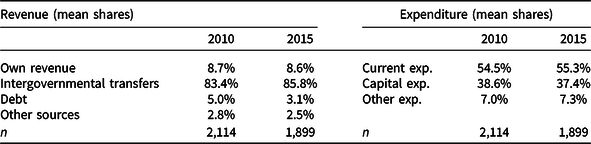
Despite municipal spending still being low,Footnote 3 decentralisation reforms caused a substantial increase in funds available to local governments. While in 1995, municipalities spent around 900 Mexican pesos per capita per year (at 2010 prices, based on data from the Mexican National Statistical Institute – INEGI), this value increased to around 4,500 Mexican pesos in 2015. Table 1 shows that a vast amount of revenues comes from intergovernmental transfers. The remaining revenues stem from property tax and from charges for local public services, debt and other revenues.
Structure of revenues and expenditures of Mexican municipalities
Source: INEGI.
The General Accounting Office has expressed its concerns about the quality of local financial management (Auditoría Superior de la Federación 2013, 34). The federal government has only minimal oversight over LS decisions (Hernández-Trillo and Jarillo-Rabling Reference Hernández-Trillo and Jarillo-Rabling2008), and subnational governments have been accused of not allocating public resources in the interests of their constituencies (Salazar Reference Salazar2007, 70).
From an OCG perspective, Locks (Reference Locks2015) hints at a recent transformation of Mexican OCGs’ business model. The “war on drugs” initiated by President Calderón (2006–2012), led to a decrease in profits from drug trafficking and caused a violent confrontation between drug cartels themselves. Consequentially, many (fragmented) organisations diversified activities from the risky area of international drug trafficking to less risky local criminal activities, such as human trafficking, kidnapping and extortion (Fuerte, Lujan, and Ponce Reference Fuerte, María, Enrique Pérez and Cordova Ponce2019). Between 2007 and 2012, crime rates increased by 150%, while the extortion of companies or citizens increased by 1,250% (Locks Reference Locks2015, 67).
The public discourse revolves around the issue of OCGs extorting local governments for some time already. Trejo and Ley (Reference Trejo and Ley2015) provide evidence that as large cartels disintegrate, smaller OCGs direct their activities towards infiltrating local governments to access public funds (see also Aguirre Ochoa and Errera Torres Reference Aguirre Ochoa and Torres2016, 664; Trejo and Ley Reference Trejo and Ley2016, 46). For example, after the local elections in 2011 in the state of Michoacán, a state where local capture is particularly prevalent (Fuerte, Lujan, and Ponce Reference Fuerte, María, Enrique Pérez and Cordova Ponce2019), the leader of the then powerful Caballeros Templarios is reported to have called a large number of mayors and demanded that 30% of the budget be reserved for public works, 20% of salaries reserved for municipal staff and that public contracts be awarded to companies connected to his organisation (Trejo and Ley Reference Trejo and Ley2015). In 2013, the newspaper Milenio cited confidential documents revealing that the Mexican government estimated the monthly income of the Templarios from extorting municipal governments to be 1 million US dollars (Milenio 2013). The Conference of Mexican Municipalities stated in 2013 that 4 out of 10 mayors are under pressure to provide OCGs with access to public funds (Sin Embargo Editors 2013). In this context, Trejo and Ley (Reference Trejo and Ley2019) provide quantitative and qualitative evidence that OCGs use high-profile criminal violence against local leaders to gain control over municipal affairs, especially when local leaders cannot count on protection from their political rivals at higher levels of government. The assassination of 152 politicians (Etellekt 2018) during the 2018 general elections reflects the OCGs’ strategy to intimidate politicians opposing OCG influence.
At the same time, the bulk of the violence is related to turf battles. For Mexico, there is ample evidence that OCGs enter into battles over access to various income sources in the criminal industry. As Rios (Reference Rios2013) states, the major part of violence is a consequence of competition between OCGs. In particular, the transition of power from the hegemonic PRI to the incoming governments from other parties at various governmental levels caused an outburst of OCV and has even further increased after the initiation of the “War on Drugs” in 2007 (Ponce Reference Ponce2019). The link between local budget size and OCG turf battles will now be investigated.
Empirical analysis
Method
The baseline model of the empirical analysis is a time-series cross-sectional regression of official homicide rates on municipal spending, which serves as a proxy for budget size, making use of the census data provided every five years between 1995 and 2015.Footnote 4 The analysis makes use of data from the population of 2,466 municipalities located in 31 federal states and the Federal District of Mexico City, which became the country’s 32nd federal entity in 2016. The sample size differs over the years under investigation.
In order to distinguish between the occurrence and the intensity of violence, the regression analysis follows the logic of a two-part model (TPM) (Duan et al. Reference Duan, Manning, Morris and Newhouse1983). In a TPM, the variables will be analysed in two steps. The first (binary) part of the model provides results on the probability of municipalities to experience OCV given a vector of explanatory variables. The second (continuous) part presents evidence on the linear relationship between the level of OCV, once it has occurred, and the explanatory variables. The binary part captures the probability of participating in turf battles, while the continuous part measures their intensity (Farewell et al. Reference Farewell2017). The theoretical considerations and some statistical requirementsFootnote 5 make the TPM an adequate model when analysing the OCV variable. Nevertheless, I will also provide the Heckman selection model results for the year 2010 as a robustness check.
Because the time dimension is with five points rather short, a lot of (good) variation would be lost when time and subject-fixed effects were estimated at the same time. In order to preserve the between-subject variation, which is likely to reflect valuable information to be explained (Bell and Jones Reference Bell and Jones2015), while at the same time being transparent on whether the potential effect of budget size on violence is driven by between or within variation, I estimate a hybrid model that explicitly separates between- from within-cluster effects while including time-fixed effects. This way, time-constant municipality-level variables can be included as well.
I estimate an uncorrelated (hybrid)Footnote 6 TPM for longitudinal data (Smith, Maciejewski, and Olsen Reference Smith, Maciejewski and Olsen2018):
 $$\displaylines{
{\rm{Logit}}\{ {\rm{Pr}}({\rm{OCVBI}}{{\rm{N}}_{{\rm{it}}}} = {\mkern 1mu} {\rm{1|}}{\overline {{\rm{LS}}} _{\rm{i}}},({\rm{L}}{{\rm{S}}_{{\rm{it}}}}{\rm{ - }}{\overline {{\rm{LS}}} _{\rm{i}}}),{\overline {{\rm{OR}}} _{\rm{i}}},({\rm{O}}{{\rm{R}}_{{\rm{it}}}}{\rm{ - }}{\overline {{\rm{OR}}} _{\rm{i}}}),{\mkern 1mu} {{\bf{X}}_{{\rm{it}}}},{{\bf{S}}_{\rm{i}}},{{\bf{T}}_{\rm{t}}},{\zeta _{\rm{i}}})\} \cr
= {\beta _{\rm{1}}}{\rm{ + }}{\beta _{\rm{2}}}{\overline {{\rm{LS}}} _{\rm{i}}} + {\beta _{\rm{3}}}({\rm{L}}{{\rm{S}}_{{\rm{it}}}}{\rm{ - }}{\overline {{\rm{LS}}} _{\rm{i}}}) + {\beta _{\rm{4}}}{\overline {{\rm{OR}}} _{\rm{i}}} + {\beta _{\rm{5}}}({\rm{O}}{{\rm{R}}_{{\rm{it}}}}{\rm{ - }}{\overline {{\rm{OR}}} _{\rm{i}}}) \cr
+ {\beta _{\rm{6}}}{{\bf{X}}_{{\rm{it}}}} + {\beta _{\rm{7}}}{\mkern 1mu} {{\bf{S}}_{\rm{i}}} + {\beta _{\rm{8}}}{{\bf{T}}_{\rm{t}}}{\rm{ + }}{\zeta _{\rm{i}}}. \cr} $$
$$\displaylines{
{\rm{Logit}}\{ {\rm{Pr}}({\rm{OCVBI}}{{\rm{N}}_{{\rm{it}}}} = {\mkern 1mu} {\rm{1|}}{\overline {{\rm{LS}}} _{\rm{i}}},({\rm{L}}{{\rm{S}}_{{\rm{it}}}}{\rm{ - }}{\overline {{\rm{LS}}} _{\rm{i}}}),{\overline {{\rm{OR}}} _{\rm{i}}},({\rm{O}}{{\rm{R}}_{{\rm{it}}}}{\rm{ - }}{\overline {{\rm{OR}}} _{\rm{i}}}),{\mkern 1mu} {{\bf{X}}_{{\rm{it}}}},{{\bf{S}}_{\rm{i}}},{{\bf{T}}_{\rm{t}}},{\zeta _{\rm{i}}})\} \cr
= {\beta _{\rm{1}}}{\rm{ + }}{\beta _{\rm{2}}}{\overline {{\rm{LS}}} _{\rm{i}}} + {\beta _{\rm{3}}}({\rm{L}}{{\rm{S}}_{{\rm{it}}}}{\rm{ - }}{\overline {{\rm{LS}}} _{\rm{i}}}) + {\beta _{\rm{4}}}{\overline {{\rm{OR}}} _{\rm{i}}} + {\beta _{\rm{5}}}({\rm{O}}{{\rm{R}}_{{\rm{it}}}}{\rm{ - }}{\overline {{\rm{OR}}} _{\rm{i}}}) \cr
+ {\beta _{\rm{6}}}{{\bf{X}}_{{\rm{it}}}} + {\beta _{\rm{7}}}{\mkern 1mu} {{\bf{S}}_{\rm{i}}} + {\beta _{\rm{8}}}{{\bf{T}}_{\rm{t}}}{\rm{ + }}{\zeta _{\rm{i}}}. \cr} $$
OCVBIN represents a binary response variable indicating whether OCV occurred or not, LS and OR (represented in its form as between- and within-cluster effects) are the variables of interest, i.e. the amount of LS per 1,000 inhabitants, and the share of own-source local revenue in total revenue. X reflects a set of control variables at the municipal level. S is a set of dummy variables identifying the federal state a municipality is located in and holds the unique characteristics of the federal states constant.Footnote 7 ζ is the municipality-specific random intercept. Time dummies (T) control for common trends (t = 1995, 2000, 2005, 2010, 2015). The subscripts identify the municipality i at a given year t.
Analogously, I estimate a log-linear part:
 $$\displaylines{
{\rm{In}}({\rm{OCVCON}}{{\rm{T}}_{{\rm{it}}}}) = {\mkern 1mu} {\beta _{\rm{1}}}{\rm{ + }}{\beta _{\rm{2}}}{\overline {{\rm{LS}}} _{\rm{i}}} + {\beta _{\rm{3}}}({\rm{L}}{{\rm{S}}_{{\rm{it}}}}{\rm{ - }}{\overline {{\rm{LS}}} _{\rm{i}}}) + {\beta _{\rm{4}}}{\overline {{\rm{OR}}} _{\rm{i}}} + {\beta _{\rm{5}}}({\rm{O}}{{\rm{R}}_{{\rm{it}}}}{\rm{ - }}{\overline {{\rm{OR}}} _{\rm{i}}}) \cr
+ {\beta _{\rm{6}}}{{\bf{X}}_{{\rm{it}}}} + {\beta _{\rm{7}}}{\mkern 1mu} {{\bf{S}}_{\rm{i}}} + {\beta _{\rm{8}}}{{\bf{T}}_{\rm{t}}}{\rm{ + }}{\xi _{{\rm{it}}}} \cr} $$
$$\displaylines{
{\rm{In}}({\rm{OCVCON}}{{\rm{T}}_{{\rm{it}}}}) = {\mkern 1mu} {\beta _{\rm{1}}}{\rm{ + }}{\beta _{\rm{2}}}{\overline {{\rm{LS}}} _{\rm{i}}} + {\beta _{\rm{3}}}({\rm{L}}{{\rm{S}}_{{\rm{it}}}}{\rm{ - }}{\overline {{\rm{LS}}} _{\rm{i}}}) + {\beta _{\rm{4}}}{\overline {{\rm{OR}}} _{\rm{i}}} + {\beta _{\rm{5}}}({\rm{O}}{{\rm{R}}_{{\rm{it}}}}{\rm{ - }}{\overline {{\rm{OR}}} _{\rm{i}}}) \cr
+ {\beta _{\rm{6}}}{{\bf{X}}_{{\rm{it}}}} + {\beta _{\rm{7}}}{\mkern 1mu} {{\bf{S}}_{\rm{i}}} + {\beta _{\rm{8}}}{{\bf{T}}_{\rm{t}}}{\rm{ + }}{\xi _{{\rm{it}}}} \cr} $$
using generalised least squares (GLS) with OCVCONT reflecting the conditional continuous part of OCV. Since homicide rates are strongly right-skewed, I log-transformed the dependent variable. The error term is divided into a municipality- and time-variant element. For the intensity model, standard errors reflect heteroscedasticity-corrected Huber/White sandwich estimators. These cannot be calculated for the logit specification. I assume that the two components are not correlated over time (Farewell et al. Reference Farewell2017).
While the longitudinal TPMFootnote 8 provides a baseline as it makes use of a large amount of data over a long period of time, I also provide the results for additional models. First, a longitudinal TPM for the two panels 2010 and 2015, a period when the diversification of OCG activities was most prevalent and a period for which control variables, in particular those related to public security, are available is being presented. Second, because homicide rates can only be considered a proxy for OCG violence, I make use of a much more accurate and recently released dataset provided by the Drug Policy Program at the Center for Teaching and Research in Economics in Mexico City (“CIDE-PPD Database”),Footnote 9 which contains exact data on homicides that are the result of battles between OCGs. Since these data are only available for the period 2006 until 2011 and because the bulk of control variables is only available for 2010, I estimate a cross-sectional TPM for the year 2010. Third, I provide the results for the Heckman selection model for that same year. Fourth, in order to control for spatial dependence, the results of a Spatial Durbin Model (SDM) will be presented.
Variables
For the longitudinal TPM, I use the general homicide rate as a proxy for the presence of OCGs (see Pinotti Reference Pinotti2015b). In the cross-sectional TPM, I include the number of OCG-related deaths from the CIDE-PPD Database in 2010. In order to only capture those deaths related to competition between OCGs, I excluded any violent event that was characterised by the involvement of public security forces. The variable reflects any death related to a direct confrontation between two or more OCGs or to targeted executions of OCG members. However, it has to be kept in mind that some OCG-related deaths may also be related to violence within one particular OCG.
The first independent variable of interest is the amount of LS per capita and year in 1,000 Mexican pesos, equivalent to around USD 63 in 2015. This is an indicator of the size of the local budget. With regard to OR, I calculated the share of own-source revenues in total municipal revenues.Footnote 10
It is likely that there exists a number of variables that influence both the size of local budgets and OCG-related violence. This is why I include a set of control variables at the municipal level (X). The local human development index (HDI) proxies absolute deprivation that can be considered a cause for frustration and anger and cause violence (Neumayer Reference Neumayer2003, 623). Also, they are an important determinant of local budget size, as a large part of the intergovernmental transfers is distributed according to the deprivation criterion (Auditoría Superior de la Federación 2018c). At the same time, own-revenue generation is likely to be lower in poorer municipalities. Also, it may proxy a lack of employment opportunities motivating inhabitants to participate in the illegal economy.
The share of female-headed households proxies a potential disruption of traditional family structures, which is expected to lead to more violence (Villarreal Reference Villarreal2002). It can also be a proxy for the local workforce’s low productivity because household heads must stay at home to take care of domestic work and thus generate lower own-revenue income for local governments. A higher average household size may propel homicide rates because victims are oftentimes related to the offender (Neumayer Reference Neumayer2003). Urban areas are more violent (Buonanno and Montolio Reference Buonanno and Montolio2008, 91) and collect local taxes more efficiently. However, they are also subject to uncompensated spillovers (Arends Reference Arends2020a, 7). They are controlled for by the inclusion of an indicator measuring population density. Noting the share of young males (between 15 and 29 years) and the number of males per female is important because young men in particular are considered to engage in criminal activities (Marselli and Vannini Reference Marselli and Vannini1997, 98). I include the indigenous population proportion because indigenous municipalities are said to be characterised by a higher level of social control, preventing violence from occurring (Villarreal Reference Villarreal2002, 484). Two variables control for population size since small municipalities may have weaker administrative capacities, lower public service delivery quality and more local capture. This could lead to increased levels of violent competition. At the same time, a large part of the nonearmarked intergovernmental transfers is distributed according to the number of inhabitants of a specific municipality (Auditoría Superior de la Federación 2018a). Hence, I first control for the number of a municipality’s inhabitants (population, in 10000s). Second, I include a categorical variable ranging from 0 to 3 with every integer indicating the respective quartile a municipality is located in (municipality size).
Electoral competition has been identified as disrupting patron–client relationships between hegemonic parties and OCGs, leading to a loss of social control and increased violence (Villarreal Reference Villarreal2002). At the same time, decentralisation theory suggests that in healthier local democratic systems, local governments are more responsive to local needs and thus have an interest in increasing LS on essential public services such as health and education (Hecock Reference Hecock2006). Therefore, I calculate the index for the effective number of parties developed by Laakso and Taagepera (Reference Laakso and Taagepera1979), which can be interpreted as the number of relevant parties that participate in a local election.Footnote 11 I include a dummy variable identifying those municipalities that are close to the major drug-trafficking routes, i.e. located in the federal states at the US border or the Pacific coast. Because data were missing for some years, the variables related to the average household size, indigenous population, female-headed households and the HDI were extrapolated. Definitions, sources and summary statistics can be found in online Appendix B.
The longitudinal TPM for 2010–2015 and the cross-sectional regressions for 2010 make use of additional data. Since the presence of OCV can lead to increased investment in local public security and increase the level of LS, implying the risk of reverse causality, I control for local public security resources, which are likely to be related to both the size of the local budget and local violence. First, I include municipal spending on public security (e.g. salaries of local police and administrative personnel, construction and maintenance of police stations and other equipment) per capita in 100 Mexican pesos. Second, I use the number of local police per 1,000 inhabitants. I used multiple imputations to deal with the problem of missing values.Footnote 12 At the same time, these variables can also capture the general institutional strength of local jurisdiction. Moreover, for the regression covering 2010 and 2015, I include the Gini coefficient (inequality) to reflect relative deprivation. Also, I exchange the HDI with the local poverty rate because the former is only available for 2010 while the latter covers both years.Footnote 13
As stated above, I explore a potential difference between a participation and an intensity effect of LS on violence. However, with regard to the various control variables, there is no discussion on this difference in the existing literature, which is why I include the same set of controls in both parts of the TPM.
Results
Table 2 presents the results of the uncorrelated longitudinal TPM for the period 1995–2015.Footnote 14
Uncorrelated longitudinal TPM for the effect of LS on OCV (1995–2015)

* - significant at 5 %; ** significant at 1 %; z- and t-values in parentheses; logit reported as odds ratios; cont. effect reflects percentage change of dep. variable; heteroscedasticity-corrected standard errors.
The model suggests an opposite effect of budget size on the probability of an outbreak of turf battles and the intensity of turf battles, respectively. Looking at the between-municipality effect, an increase of 1,000 Mexican pesos of spending at the local level decreases the odds of being subject to any violence by 10%. In contrast, the continuous part suggests that once violence has occurred, the size of the local budget explains violence intensity: an increase of 1,000 Mexican pesos per capita increases local homicide rates by 13%. Own-revenue mobilisation is significant when looking at the within-effect of the intensity model. Most of the control variables show the expected sign and are significant. R2 (0.47) suggests a solid explanatory power of the continuous part in general.
The results for the TPM for the period 2010–2015 provided in online Appendix C show that while the between-effect of budget size remains significantly positive in the intensity-specification, in the participation-specification, the previously observed negative effect vanishes. At the same time, local police per capita has a significantly negative effect on the occurrence of violence. It is likely that the negative spending effect on the occurrence of violence identified in the previous TPM captures the deterrent effect of police and also the institutional quality of a jurisdiction in general, which is assumed to be an important factor for OCGs when deciding to settle down in a certain jurisdiction. When leaving out the local police variable, the between-effect of budget size turns negative and significant again. However, while the police seem to increase turf-battle intensity, which could also reflect reverse causality as increased homicide rates could lead to deployment of additional police, the significant positive effect of budget size on the level of violence remains robust. The share of locally generated revenues is nil in both parts of the model.
Table 3 contains the results for the OCV-related homicide rates only, for the year 2010. Regarding the intensity-inducing effect of LS, the previous results are confirmed. A rise of LS per capita by 1,000 Mexican pesos increased OCV by 11% in 2010. Again, own-source revenues do not make a difference. Interestingly, neither security spending nor local police have an effect on the occurrence of OCG violence. Using the general homicide rate as the dependent variable instead makes the deterrent effect of local police return (results not shown). This may suggest that while police deter general violence, they do not deter OCG violence.
An ordinary TPM of the effect of LS on OCV in 2010

* - significant at 5 %; ** significant at 1 %; t-values in parentheses; logit reported as odds ratios; cont. effect reflects percentage change of dep. variable; clustered standard errors (cluster variable: federal states); R2is averaged over imputations (Fisher’s z-transformation).
For reasons already outlined, self-selection does not apply in the case of OCG violence. I nevertheless provide the results for the Heckman selection model in online Appendix D. As selection variables, I used population and location along major drug-trafficking routes as these variables are strong determinants of municipalities experiencing OCG homicides in the first place. The results confirm the significant positive effect of budget size at the local level on OCG violence. A distinction between occurrence and intensity is not allowed in this case.
Finally, the issue of spatial dependence needs to be taken into account because the above-presented relationship between LS and OCV can be a result of confounding spatial effects due to a geographical clustering of OCV, i.e. the dependent variable, and because of spillover effects from neighbouring localities in one or more dimensions of the independent variables. Thus, Table 4 presents the results of a SDM (see Elhorst Reference Elhorst2014) of the intensity part for OCV in 2010, which includes the spatially lagged dependent variable and the spatial lag of every independent variable. The first three columns contain the results using contiguity-based row-standardised spatial weights, taking into account neighbours whose economic centres are located within a 50, 100 and 150-kilometer distance. The fourth column reflects a squared inverse distance matrix (distance decay).Footnote 15 The various SDM specifications suggest a fairly stable direct effect of spending on OCV and thus confirms the previously presented results. However, the spatially lagged effects of the independent variables of interest change depending on the weights matrix applied, sometimes indicating spillover effects and sometimes not. These findings, which should be investigated in more detail in subsequent research, confirm the direct effect of spending on violence identified above. The significant and positive Rho suggest that the spatial dependence of the dependent variable is relevant.
A SDM for the intensity effect of LS on OCV in 2010
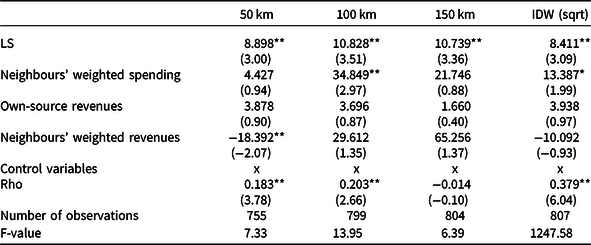
* - significant at 5 %; ** significant at 1 %; t-values in parentheses; heteroscedasticity-corrected standard errors.
In summary, the results suggest a significant and robust positive relationship between the level of local public spending and the intensity of organised crime violence in Mexican municipalities. No significant participation effect of LS can be identified. The results do not suggest that a higher own-revenue share affects violence – with the exception of the baseline model, which indicates that local revenue generation could, in fact, lower violence intensity. While spatial dependence is relevant to OCV, it does not affect the direct relationship between OCV and spending.
Discussion
The results require some discussion. First, the data imply that, in contexts of local capture, the more resources municipalities manage, the more OCG violence occurs. However, as expected, the probability of turf battles occurring and their intensity are two different things. When looking at the period 1995–2015, the effects even point at opposite directions: While more LS seems to have deterred turf battles from starting, it contributed to their intensity. With regard to the participation effect, it is likely that the effect covers spending on local police forces, which could not be controlled for in this specification due to the lack of reliable data. The intensity effect, however, is very robust across all specifications, including those that take security sector investments into account. An alternative explanation could be that the baseline model covers distinct time-periods with violence spiking from 2007 on (see Trejo and Ley Reference Trejo and Ley2018). Decentralisation may have prevented turf battles from occurring in relatively peaceful times while this effect may have vanished after the onset of the “war on drugs”. The closer look at the period 2010–2015 reveals no participation effect.
Second, the hypothesis that a higher share of local own-source revenue increases accountability and thus makes local capture and violence less likely is not supported by most of the models. The prominent exception is the baseline model, which suggests a significant intensity-reducing (within) effect. The latter finding may suggest that own-source revenue has decreased the incidence of local capture and thus contained the intensity of violence when looking at a longer period of time. While decentralisation theory suggests that this is because of an enhanced accountability relationship between government and the citizen, the effect can also reflect a generally higher institutional strength for containing OCG violence. In general, however, the evidence does not seem solid enough to confirm the existence of a relevant effect of higher own-revenue shares. Yet, it may be the case that different forces are at work, which leads to opposing effects cancelling each other out. In fact, there is the possibility that while in general, a higher local revenue generation enhances accountability relationships between local government and the taxpayer, local budgets are easier to access for OCGs because central government oversight is weaker.
Third, it is worth noting that the CIDE-PPD Database provides a unique opportunity to single out turf-battle-related violence at the municipal level, covering all municipalities of the country. This reduces the noise in the data substantially. Looking at the general homicide rates runs the risk of confounding the effect of local budgets on OCG-unrelated and OCG-related violence. This difference may be quite substantial as fiscally stronger local governments may be more effective in combatting “ordinary” violence, as there are no large-scale criminal industries involved and no retaliation is expected. At the same time, local governments may turn a blind eye to OCG-related violence because these organisations are doing the capturing and are likely to avenge any local government prosecution effort.
Fourth, the above-detailed mechanism should be seen as the start of a discussion on capture, local public resources and OCG violence. Clearly, there is a need for further investigation. For example, while OCGs fight for access to local public funds, the victorious party may then use these funds to obtain more and better weaponry in order to push back the rival OCG even further. This may lead to even more violence. These aspects and others of the vicious cycle of OCG violence fueled by growing local budgets should receive more attention in subsequent research.
Finally, it must be noted that the results above are to be understood as indicative evidence. The risks econometric analyses imply, especially with regard to confounding causation with correlation, also apply to this article. In particular with regard to potential reverse causality, i.e. that the presence of organised crime, proxied through OCV, causes higher spending levels, cannot entirely be ruled out. At least three potential sources for reverse causality can be identified. One source relates to the possibility that local governments facing particularly high levels of OCG violence receive more public resources from the federal government in order to fund public security personnel and infrastructure. However, while a programme to strengthen local security institutions was created in 2008, in 2015, this programme only covered 280 municipalities, and, on average, contributed only 1.2% to their budgets (Secretaría de Gobernación 2016, 6). Hence, I consider this risk to be of minor relevance.
The second source refers to OCGs exerting pressure on higher-level officials in state or federal ministries of finance to funnel extra funds to those municipal governments controlled by the respective criminal group. While, in Mexico, there is ample evidence of corruption in state and federal institutions, the distribution of those transfers relevant to municipal governments is based on transparent and easy to understand formulae (Salazar Reference Salazar2007, 72), which are subject to constant auditing by the General Accounting Office as well as by the National Council for the Evaluation of Social Development Policy (CONEVAL). Although it cannot be entirely ruled out, the risk of endogeneity arising from this source is considered to be rather small.Footnote 16
The third potential source of reverse causality relates to a possible relationship between the underspending of resources stemming from social infrastructure funds and funds for strengthening municipalities’ administrative structures, i.e. the two major earmarked transfer schemes, and OCG presence. In particular, the underspending of resources from earmarked transfers, which then remain in the federal budget, is mainly an issue for local governments suffering from weak planning capacities. In the context of OCG capture, it could be that local bureaucrats are more “efficient” in spending the resources because they are under high pressure to funnel the maximum amount of available resources to the capturing OCG. However, it has to be kept in mind that the magnitude of unused funds is limited. For example, the auditing exercises carried out of the fund for strengthening municipalities’ administrative structures for the 2015 and 2016 budget cycles revealed that of the funds from the 161 (2016) and 82 (2015) audited municipalities, the share of unused transfers amounted to only 2.7 and 1.3%, respectively (Auditoría Superior de la Federación 2018a, 2018b). Still, underspending is a recurring issue in the context of Mexico which is why this source of reverse causality cannot easily be dismissed.
From a methodological point of view, good instruments or other quasi-experimental constellations to empirically exclude the risk of reverse causality are not available. One alternative approach to test for endogeneity is to add variables on additional sources of spending which are unlikely to be subject to reverse causality and to test for a similar effect on OCG violence. In the context of Mexico, these sources can stem from emergency and reconstruction funds that are liberated after a certain territory was struck by a natural disaster. This support is mainly provided by the Natural Disaster Fund (FONDEN), but also by other federal entities such as the Ministry of Agriculture and entities at the state level, once a declaration of disaster or emergency is acknowledged, as recorded in the Official Journal of the Federation. These resources are usually not transferred to the local governments directly. For example, the funds administered by FONDEN are implemented directly by the National Works and Public Services Bank (BANOBRAS) (World Bank 2012). However, OCGs can nevertheless attempt to extract rents from the reconstruction processes, for example, through the infiltration of construction companies (Pinotti Reference Pinotti2015b). Thus, online Appendix E includes dummy variables identifying those municipalities that have been included in a disaster declaration related to the three most destructive natural disasters in Mexico, namely hurricanes, earthquakes and volcanic activities. These localities are likely to have benefited from FONDEN.Footnote 17 From the results, it can be concluded that, as expected, local governments included in a declaration of natural disaster suffer from a higher intensity of violence, conditional on this being positive. In fact, a declaration due to a hurricane seems to be conducive to the intensity as well as to the outbreak of violence.
While the assumed mechanism is that the increased levels of violence are due to increased OCG competition for the funds implemented for emergency relief or reconstruction, the results may also indicate that natural disasters cause an eruption of local governance structures and social cohesion which can contribute to an outburst of violence. As a consequence, the results are to be understood as supporting the above argument, while at the same time being subject to the risk of confounding effects.
Conclusions
This quantitative analysis sheds light on a new argument in decentralisation research. Assuming that fiscal decentralization is the driving force behind increasing public resources at the local level, decentralisation reforms can fuel existing turf battles between OCGs and increase the intensity of violence. At the same time, the findings suggest that local public funds are still not so important as to lead to the outbreak of violent confrontations. It seems that fiscal decentralisation rather fans the flames of already existing battles between OCGs.
How do these results relate to the key areas of debate in the general decentralisation literature? Fiscal decentralisation theory promises a substantial increase in service delivery efficiency (Oates Reference Oates2005). However, the above argument suggests that in contexts of local capture through organised crime, decentralisation as such can be a danger to one of the most basic public services delivered, namely public security. As Eaton (Reference Eaton2006) puts it for the case of Colombia: “Thanks to decentralization, the state now funds its own destabilisation because armed groups on the left and right have been able to appropriate decentralised public revenues and to use these funds to further reduce the state’s already limited monopoly over the use of force” (Eaton Reference Eaton2006, 537). This statement can easily be applied to the context of Mexico.
The argument should provoke a debate on the general adequacy of decentralisation-induced higher levels of local public spending in these contexts. In fact, in other sectors, such as health, a discussion on recentralising governmental functions has begun as local governments have been accused of being overburdened with managing technology-centred sectors (see Saltman Reference Saltman2008). Recentralisation could also be an option in countries suffering from generalised local capture.
The general decentralisation literature also holds that decentralisation counteracts local capture (Martinez-Vazquez, Lago-Peñas, and Sacchi Reference Martinez-Vazquez, Lago-Peñas and Sacchi2017) especially through enhanced citizen oversight (Salmon Reference Salmon1987; Seabright Reference Seabright1996). However, sceptics argue that in particular in developing countries, local elites can more easily capture local politicians, especially when local oversight mechanisms and media are weak (Bardhan and Mookherjee Reference Bardhan and Mookherjee2006). In this article, local capture was assumed to be a key condition that needs to be met for the mechanism to be at work. However, whether decentralisation leads to more or less capture at the local level needs further research. With regard to Mexico at least, there are some expectations that the recently introduced right to reelection, and the implied prospect of an additional term in office, renders local leaders more accountable. At the same time, OCGs have been known to decrease electoral competition through killing or threatening undesired local politicians (Ponce Reference Ponce2019). Indeed, with 152 politicians assassinated during the 2018 general elections (most of them engaged in local politics) (Etellekt 2018), the Mexican example shows that the notion of the accountability-enhancing power of local democratic processes should not be overestimated in countries with strong OCG presence.
The preceding observation also hints at relevant interdependencies between the three dimensions of decentralisation. While the incentive for OCGs to engage in violence is induced by fiscal decentralisation, the channels propelling local capture of local funds are located in the dimensions of political as well as administrative decentralisation. For example, local elections open up additional opportunities to gain access to local financial resources. Also, the increased independence of local administrations from central government oversight increases the exposure of local bureaucrats to OCG pressure.
These findings are likely to be relevant for countries experiencing local capture through OCGs such as Colombia, Brazil, Venezuela and various Central American countries (Nagle Reference Nagle2003) amongst others, but also for more advanced economies such as Italy. The results suggest that, as these countries think about further fiscal decentralisation, a cautious approach should be adopted. Weingast (Reference Weingast2014) argues that especially in contexts where local democratic institutions do not (yet) guarantee an adequate level of welfare, decentralisation should not take place in “one great leap” but rather follow a sequential path. Indeed, it seems reasonable to first ensure that existing accountability mechanisms be enhanced. Then, the decentralisation of fiscal responsibilities should be considered.
However, it is crucial to keep in mind the limitations of the study. In particular, in order to substantiate the argument, in-depth qualitative research is needed that takes a closer look at the micromechanisms related to the context of local capture, and the violent competition between OCGs to gain access to local public funds. Here, it can be interesting to take a closer look at the dynamics within OCGs from a local perspective, for example, when it comes to possible power struggles between the “military” and “civil” branches of an organisation, a factor which explains to a large extent the secession of the OCG Los Zetas from the Gulf Cartel (Beittel Reference Beittel2017).
Furthermore, since the empirical part concentrates on Mexico, comparative studies and profound research in other countries will be essential. Data availability limits the generalisability of the argument, since, for the baseline model, the time-series cross-sectional data relate to general homicides and not to OCG-related homicides specifically. Although a cross-sectional regression for the year 2010 was presented in order to take account of violence related to confrontations between OCGs only, more efforts are needed to build comprehensive time-series datasets on different aspects of OCG violence. What is more, since the analysis takes into account data up until 2015, it will be important to follow-up on the results presented using the data to be provided after the 2020 census. Finally, as I cannot entirely rule out the issue of endogeneity, it will be necessary to empirically investigate the argument presented in contexts where quasi-experimental methods such as instrumental variables estimation or discontinuity analysis are possible. Taking these limitations into account, the argument presented should be understood as one contribution that can help broaden an interdisciplinary debate on the relationship between fiscal decentralisation and OCV.
Supplementary material
To view supplementary material for this article, please visit https://doi.org/10.1017/S0143814X20000239
Acknowledgements
The author wishes to thank Ireri Ablanedo, Alma Mata, Herbert Obinger, Carina Schmitt, Andreas Forer, Jan Werner, Jonas Pieper, Miriam Faulwetter, Edward Norton, J. Paul Elhorst, Keisuke Kondo and many more, including various experts from INEGI and the GIZ rule of law project in Mexico.
Data Availability Statement
Replication materials are available in the Journal of Public Policy Dataverse at https://doi.org/10.7910/DVN/LZNMBC.


 Open access

