

Introduction
Mandated reporting policies first originated in the United States (Ainsworth, Reference Ainsworth2002) and have become model legislation for many countries with developed and developing child protection systems. Currently, all American states have laws regarding the reporting of suspected child maltreatment, though there is great variation in the definition of child maltreatment and the identification of the individuals legally responsible for reporting it (Mathews, Reference Mathews2015; Mathews & Kenny, Reference Mathews and Kenny2008; Meriwether, Reference Meriwether1986). These state policies were ultimately federally codified by the Child Abuse Prevention and Treatment Act (CAPTA) (1974).
Despite their ubiquity, the efficacy of these policies is widely debated. Examination of these policies is critical, given that there is often widespread disagreement regarding when it is appropriate to report (Deisz et al., Reference Deisz, Doueck, George and Levine1996) and uncertainty of who is required to report suspected abuse (Foreman & Bernet, Reference Foreman and Bernet2000). Further, many argue that rather than protecting children, mandated reporting policies enable government intrusion into the private family sphere and ultimately punish parenting practices deemed unacceptable by state actors (i.e. caseworkers, police officers, etc.) (Pimentel, Reference Pimentel2015). This may especially be the case related to the differing parenting practices of Black families in contact with child protective services (Marshall & Haight, Reference Marshall and Haight2014; Williams-Butler, Reference Williams-Butler2022; Williams-Butler et al., Reference Williams-Butler, Boyd and Slack2023).
Many argue that mandated reporting practices are responsible for the overrepresentation of Black children in child protective services (Palusci & Botash, Reference Palusci and Botash2021; Pryce & Yelick, Reference Pryce and Yelick2021), a phenomenon that has existed for more than half a century (Dettlaff, Reference Dettlaff2021). This ongoing racial disproportionality has led to ardent debate regarding whether child protection systems should be abolished or reformed (Azzi-Lessing, Reference Azzi-Lessing2021; Barth et al., Reference Barth, Berrick, Garcia, Drake, Jonson-Reid, Gyourko and Greeson2021; Copeland & Pendleton, Reference Copeland and Pendleton2021; Roberts, Reference Roberts2022). Given this fervent discourse, it is important to understand the historical context of how we arrived at this place related to the mandated reporting aspect of CAPTA.
We discuss and demonstrate how the implementation of CAPTA relied heavily on extreme cases of child abuse (which are rare) and largely ignored more structural societal failings such as poverty and structural racism. Child protection systems largely operate in conjunction with, but rarely address, larger more structural societal failings such as poverty or racism directly in policy or practice (Featherstone et al., Reference Featherstone, Gupta, Morris and White2018). The purpose of this paper is to describe the rationale for the passage of CAPTA and to understand the historical resistance to mandated reporting by helping professionals before its passage, how helping professionals reacted to the implementation of mandated reporting, and CAPTA’s present day implications.
Mandated reporting, helping professionals, and child maltreatment
Mandated reporters are individuals required by law to report incidents and suspected incidents of child maltreatment (Child Welfare Information Gateway, 2019). Across the U.S., helping professionals who frequently interact with children and families are considered mandated reporters. In general, helping professionals include those with specialised knowledge who interact with clients with the goal of promoting more effective coping with dilemmas within the areas of physical, psychological, intellectual, and/or emotional well-being (Graf et al., Reference Graf, Sator and Spranz-Fogasy2014; McCully, Reference McCully1966). They may include, but are not limited to, teachers, doctors, social workers, nurses, paramedics, home nurses, psychologists, psychotherapists, coaches, priests and pastors, and police officers (McCully, Reference McCully1966; Ondrejková & Halamová, Reference Ondrejková and Halamová2022). They are often given a high level of professional autonomy or discretion in their everyday practice (Blomqvist & Winblad, Reference Blomqvist and Winblad2022). This is especially the case as it concerns the reporting of child maltreatment (Gilbert et al., Reference Gilbert, Kemp, Thoburn, Sidebotham, Radford, Glaser and MacMillan2009).
Nationally, helping professionals make the largest proportion (66.7 per cent) of reports to child protective services (U.S. Department of Health and Human Services, 2020). Educational personnel such as teachers, school counselors, and school nurses most often report incidents of child maltreatment to child protective services (Sedlak et al., Reference Sedlak, Mettenburg, Basena, Peta, McPherson, Greene and Li2010; U.S. Department of Health and Human Services, 2020, 2021). Law enforcement, medical personnel such as physicians and nurses, social service personnel such as social workers, and mental health personnel are also among the highest reporting groups (U.S. Department of Health and Human Services, 2020). While these helping professionals are currently responsible for the majority of mandated reporting, willingness to engage in mandatory reporting has not always been the case. There was significant resistance toward mandated reporting by those in the helping professions throughout the 1960s and 1970s, when mandated reporting policies first originated (Worley & Melton, Reference Worley and Melton2013; Paulsen, Reference Paulsen1967).
Historical context of mandated reporting
There is a long history of the punitive nature of child protective services in the United States (Antler & Antler, Reference Antler and Antler1979). However, it was not until the early 1960s that the incidence of child abuse and the identification of parents as the main perpetrators of violence against children was considered a prevalent societal problem (Nelson, Reference Nelson1984). Kempe et al. (Reference Kempe, Silverman, Steele, Droegemueller and Silver1962) put child abuse into the national spotlight and framed it as a diagnosable condition using the medical model (Levine & Doueck, Reference Levine and Doueck1995; Raz, Reference Raz2020) in their highly influential article, The Battered Child Syndrome. In the article, identification of child abuse committed by parents was centred as the main barrier to addressing child abuse (Worley & Melton, Reference Worley and Melton2013). Consequently, Kempe et al. (Reference Kempe, Silverman, Steele, Droegemueller and Silver1962) laid out criteria for medical professionals to diagnose child abuse and provided recommendations for what physicians should do when they encountered it.
The Battered Child Syndrome spurred subsequent discussions about lobbying for legislative reform around the identification of child abuse (Mathews, Reference Mathews2015). It also set the agenda for the establishment of mandated reporting laws (Kalichman, Reference Kalichman1999). Ultimately, the article, which is considered the most influential publication on the topic of child abuse (Kalichman, Reference Kalichman1999), launched the movement toward formalisation of child protective services, in part under the guise of holding parents accountable for their actions. These accountability arguments later played a major role in the criminalisation of parents under the pretext of child protective services (Antler & Antler, Reference Antler and Antler1979; Nelson, Reference Nelson1984). For example, Kempe et al. (Reference Kempe, Silverman, Steele, Droegemueller and Silver1962) outlined the ‘psychiatric aspects’ of parents who abused their children, thus offering a justification for removing children from their unfit, endangering parents (Nelson, Reference Nelson1984).
By 1964, approximately half (twent-four) of all states had reporting statutes, and by 1967, all states had laws that required physicians to report suspicions of abuse and neglect (Ramsey & Abrams, Reference Ramsey and Abrams2010). When mandated policies were first created, they specifically applied to physicians because they were perceived as being the most prepared to identify child abuse by virtue of their medical training. Further, physicians were also known to inconsistently report concerns of potential child maltreatment (Fraser, Reference Fraser1978). In the late 1960s and 1970s the body of professionals required to report abuse expanded beyond those in health care settings. It was believed that if multiple individuals who interacted with families were required to report child maltreatment, then abuse could be detected earlier, and serious harm could be prevented. Although initial laws focused on physical abuse that would be most typically identified by physicians, the expansion of reporter categories was paralleled with a broadening of the definitions of child abuse to include other forms of maltreatment relevant to the expertise of additional helping professionals (e.g. emotional abuse, sexual abuse, nutritional maltreatment, exploitation, etc.) (Kalichman, Reference Kalichman1999).
Impact of CAPTA on mandated reporting
Although mandated reporting legislation in the United States initially developed at the state level, the passage of CAPTA upheld these policies and resulted in modifications to existing state child protection laws by setting parameters that jurisdictions had to follow to receive federal funding (Fraser, Reference Fraser1978; Kalichman, Reference Kalichman1999; Mathews, Reference Mathews2015). For example, funding from CAPTA was only made available to states who met certain requirements, such as setting up formalised child protection systems and reporting policies, increasing the list of who was mandated to report, and formally defining child abuse and neglect in line with federal standards (Kalichman, Reference Kalichman1999; Mathews, Reference Mathews2015). In response to CAPTA requirements, states continued to gradually expand who was required to report and what forms of maltreatment were reportable, moving beyond physical abuse (Mathews, Reference Mathews2015). It is important to note that CAPTA was the first enacted federal legislation aimed at child abuse identification and prevention (Melton, Reference Melton2005).
Helping professionals’ resistance to mandated reporting and criticism
Since their inception, mandated reporting policies have been and continue to be a source of great debate (Ainsworth, Reference Ainsworth2002; Drake & Jonson-Reid, Reference Drake and Jonson-Reid2007; Mathews & Bross, Reference Mathews and Bross2008; Melton, Reference Melton2005; Raz, Reference Raz2020). In addition to their lack of evidence base (Melton, Reference Melton2005; Raz, Reference Raz2020), a major criticism of mandated reporting policies is that they cause children and families harm (Melton, Reference Melton2005; Worley & Melton, Reference Worley and Melton2013) and result in family policing through state-mandated surveillance, particularly for families of color and families experiencing poverty (Burton & Montauban, Reference Burton and Montauban2021; Copeland & Pendleton, Reference Copeland and Pendleton2021; Dettlaff & Boyd, Reference Dettlaff and Boyd2020; Meriwether, Reference Meriwether1986; Raz, Reference Raz2020; Rise PAR Team, Reference Markman, Linares, Serdjenian and McCarthy2021). Some argue that reports to child protective services and subsequent investigations often are unwarranted intrusions on family life (Hutchinson, Reference Hutchinson1993) that place parental rights at risk (Cecka, Reference Cecka2014). As a result, caregivers may experience anxiety and fear of having their child(ren) removed (Schreiber et al., Reference Schreiber, Fuller and Paceley2013), which can impact whether and how they seek help (Fong, Reference Fong2020; Melton, Reference Melton2005; Rise PAR Team, Reference Markman, Linares, Serdjenian and McCarthy2021).
Mandated reporting policies position helping professionals as agents of the state by making ‘institutions central to social life, such as education and healthcare, create a pathway to surveillance of the domestic sphere’ (Fong, Reference Fong2020, p. 620). Not surprisingly, these mandated reporting laws were received with concern from many helping professionals and their representative professional organisations. For example, the American Medical Association (AMA) protested the focus on physicians as mandated reporters because they feared that parents might decline seeking medical care for their children due to fear of being accused of child maltreatment (Paulsen, Reference Paulsen1967; Worley & Melton, Reference Worley and Melton2013). As a result, these first laws were expanded to include other helping professionals such as teachers and social workers (Paulsen, Reference Paulsen1967).
Further, the inclusion of penalties for helping professionals who did not report suspected child abuse within mandated reporting laws led to concerns that fear-motivated overreporting would impact families’ willingness to seek services (Raz, Reference Raz2020). Following CAPTA, legislators considered whether to require states to enact specific policies to receive federal funding (Raz, Reference Raz2020). This proposed legislation would expand reporting requirements, including the definition of neglect – which is often a proxy for poverty (Raz, Reference Raz2020). This idea was opposed by many, including the National Council of Juvenile Court Judges and the Mexican American Legal Defense and Education fund, due to concerns that these expansions would lead to the over-policing and abridgment of the rights of low-income families (Raz, Reference Raz2020). Therapeutic professionals feared that mandated reporting could disrupt treatment for families or fundamentally shift the nature of their relationship with clients (Levine & Doueck, Reference Levine and Doueck1995). Levine and Doueck (Reference Levine and Doueck1995) maintained ‘that system [child protection] has both helping and policing functions, and when a therapist makes a report, the therapist becomes part of the policing system’ (p. 25).
The criticisms of and resistance to these policies continues to this day. Current calls for the abolishment of child protection systems have included the repeal of mandated reporting policies (Copeland & Pendleton, Reference Copeland and Pendleton2021; Inguanta & Sciolla, Reference Inguanta and Sciolla2021) including CAPTA (Burton & Montauban, Reference Burton and Montauban2021). There is support for these arguments within the international literature.
Featherstone et al. (Reference Featherstone, Gupta, Morris and White2018) argues that child protective services in English speaking countries worldwide over the past fifty years have adopted a model that focuses on individual or family deficits which are compounded by a heavy reliance on risk assessments. However, in focusing primarily on individual deficits, larger societal issues that also impact child protective services are not taken into account. For example, both poverty (Skinner et al., Reference Skinner, Bywaters and Kennedy2023) and structural racism (Merritt Reference Merritt2021) play a role in increasing the structural risks that parents and children in contact with the system face. However, these issues are rarely addressed directly within the system. As helping professionals continue to debate the utility of mandated reporting policies, it is important to look to the past to understand why and how CAPTA, which cemented these policies, was originally implemented.
Grounded theory
In this paper, grounded theory (Charmaz, Reference Charmaz2006) is used to analyse the data regarding the rationale for the passage of CAPTA. Grounded theory is an inductive form of research that provides a systematic method of organising and analysing data where there is no existing theory that explains the phenomenon being explored. A grounded theory approach challenges the tacit understanding of existing research by not utilising preconceived notions (e.g. hypotheses), but instead allows the data collected to guide the research (Charmaz, Reference Charmaz2006; Merriam & Tisdell, Reference Merriam and Tisdell2016). This approach allows for a broad explanation of beliefs and attitudes (Creswell & Creswell, Reference Creswell and Creswell2017), which is beneficial as it lessens the likelihood of overlooking pertinent information, which may occur in a more narrowly tailored methodology. Because grounded theory is an inductive research approach, the codes created closely mirror the words in the text. This form of coding limits the influence of the researcher’s interpretation and helps to identify patterns (Thornberg & Charmaz, Reference Thornberg, Charmaz and Flick2014).
Grounded theory has been used in the child protection literature to explore the relationships between helping professionals and mandated reporting. Feng et al. (Reference Feng, Fetzer, Chen, Yeh and Huang2010) utilised grounded theory to explore the experiences and perspectives of physicians, nurses, social workers, and teachers when reporting child abuse cases within a multidisciplinary context. Feng et al. (Reference Feng, Chen, Fetzer, Feng and Lin2012) also utilised grounded theory to explore the ethical and legal challenges of mandated reporters and the complex dilemmas they face in their obligation to report cases of child abuse. However, there is a dearth of studies that use grounded theory to analyse historical policy documents, particularly around the origin of child protective services policy.
Current study
This paper explores the rationale for the passage of CAPTA. It also evaluates the impact that mandated reporting had on the helping professional-client relationship. The following three research questions inform the present study:
-
1) What was the rationale for the implementation of CAPTA?
-
2) How did helping professionals react to the implementation of mandated reporting?
-
3) What measures were implemented to compel helping professionals to engage in mandated reporting?
Methods
Data
The data consists of primary congressional records. Congressional records are transcribed, daily accounts of the proceedings of both chambers of the U.S. Congress, which date back to 1873 (Congressional Record, 2022). Records include opening statements, hearings, and deliberation involving witness testimonials, research studies, news articles, and other submitted documents used by Congress to justify the passing of CAPTA. The length of these documents vary, and are dependent on what was presented daily on the House and Senate floor by senators and representatives (Congressional Record, n.d.).
Documents were identified using three databases: ProQuest Congressional, the Federal Register, and Govinfo. These three sites contain searchable repositories of official government documentation including rules, notices of federal agencies, presidential documents, congressional publications, and legislative histories. Search terms used to identify CAPTA adjacent documentation included ‘Child abuse prevention and treatment act’, ‘APTA’, and the public law identification number, ‘P.L. 93-247’. No minimum date was set to limit the search. However, to exclude amended versions of CAPTA and post-passage documentation, 1975 was used as a maximum date.
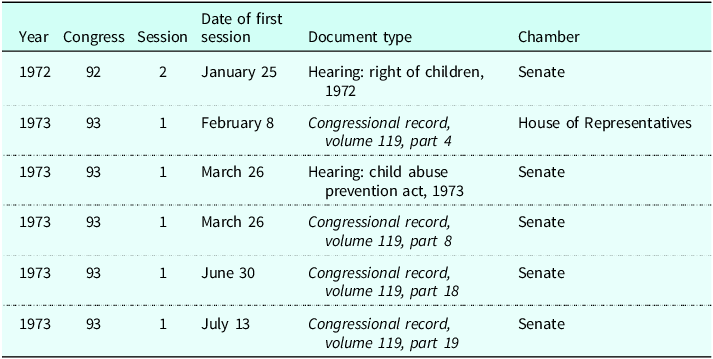
Across the three databases, authors identified 122 documents, which were individually evaluated for relevance to child abuse and neglect. Our objective was to include published congressional discourse that was thematically consistent with CAPTA’s stated overarching objectives of child abuse prevention as a vehicle for addressing child maltreatment during the early to mid-1970s. By including discourse which preceded the ratification of CAPTA, we present the broader legislative context in which CAPTA evolved. Documentation, such as published manuscripts on the topic that explicitly referenced discourse related child well-being, child abuse (i.e. Battered Child Syndrome), child abuse prevention, or treatment was included in the sample. The resultant sample included twelve documents that received an initial code, and six documents that received a focused code due to theoretical saturation. All twelve documents received an initial code to address a criticism of theoretical saturation that no new information emerged in later documents (Low, Reference Low2019). The final analytical sample included six documents, four congressional records and two hearings, which proceeded the passage of CAPTA on January 31, 1974. Table 1 provides an overview of the congressional records analysed in this study.
Congressional records and hearings related to the passing of the CAPTA

Analysis
Two researchers completed the coding process. The coding approach spanned two phases: initial coding, a process of labeling repeated patterns of words, phrases, and sentences; and focused coding, in which selections of refining codes are made based on usefulness to represent the gist of what is taking place in the data (Charmaz, Reference Charmaz2006; Given, Reference Given2008). Initial coding is a process that utilises grounded theory to ascertain the fit and relevance of the data into broader codes. Fit refers to whether the code significantly reflects the purpose in which the language was used and helps prevent the researcher from ascribing their own beliefs onto the data (Charmaz, Reference Charmaz2006; Given, Reference Given2008). Focused coding requires a more in-depth selection process by which researchers construct codes based on what most closely synthesises the main point across multiple codes across documents to compare actions and interpretations of the data (Charmaz, Reference Charmaz2006). Theoretical saturation was reached after review of the first six documents of the twelve total documents identified, as no new information was provided that yielded any further theoretical insights (Bryant & Charmaz, Reference Bryant and Charmaz2007). All legislative records were prepared and coded using NVivo qualitative software (Woolf & Silver, Reference Woolf and Silver2017).
Results
Data analysis yielded three overarching themes: (1) national evidence of child abuse; (2) resistance to intrusion of the helping professional-client relationship; and (3) the necessity of immunity waivers for those who reported instances of child abuse and misdemeanor punishment for those who failed to report such instances.
Theme 1: national evidence of child abuse
There was a general sense during the 1960s and early 1970s that child abuse was a pervasive issue and that not enough was being done to prevent it by those in the community. It was not until Senator Walter Mondale became the chairman of the subcommittee on Children and Youth in 1971 that child abuse and neglect gained visibility as a national issue (U.S. Department of Health and Human Services, 2014). Senator Mondale noted, “Child abuse is one of the most repugnant crimes growing in our midst, because it is practiced on the most helpless members of society… Also, it’s one of the ignored offenses, occurring more often than not in the privacy of homes. Neighbours tend to look the other way, teachers often hesitate to report the parents of bruised and battered students” (119 Cong. Rec. 4288, 1973). Senator Mondale also noted that people were afraid to report child abuse to the police, which ultimately resulted in egregious incidents of abuse.
Several descriptors of horrific incidents were submitted to emphasise the severity of child abuse and its consequences. In a position paper submitted in support of the passing of CAPTA, Dr. Henry Kempe presented many examples of the heinous consequences of abuse for children left in the care of parents instead of being removed through mandated reporting:
Jimmy was a 2-month-old child, who, on admission to the hospital, was found to have bruises around the eyes, 3 small scars on the abdomen and tenderness of the left upper arm. X-ray examination showed a fracture of this area. The police and the child protective services of child welfare were formally notified by the physician, but neither felt that there was enough evidence to present the boy to Juvenile court. One month after discharge, the child was taken to another hospital where he was dead on arrival and his body showed innumerable signs of injuries. (Child Abuse Prevention Act, 1973)
In another statement, Dr. Henry Kempe expressed that “No child should thrive in a hospital; it is the wrong place for a child to thrive. If a child thrives in a hospital, then there must be something drastically wrong in the home” (Child Abuse Prevention Act, 1973). In addition to graphic descriptions of abuse, the difficulties of identifying such abuse despite the existence of state mandated reporting laws were provided to justify the need for federal legislation and resource allocation. An article detailing the work of Dr. Vincent Fontana, who led the New York City Task Force on Child Abuse and directed the treatment of many cases of child abuse at St. Vincent’s Hospital, noted:
All of the 50 states…have child abuse laws. But their provisions and enforcement powers vary and most agencies dealing with the problem are short of trained personnel and funds. Furthermore…child battering is often overlooked by doctors either because they do not recognize it when they see it or are reluctant to report it to the authorities. (119 Cong. Rec. 23454, 1973)
The Battered Child Syndrome, written by Dr. Henry Kempe and colleagues, was also submitted as evidence. Kempe stated that physicians often hesitate to report child abuse because most are humanitarians at heart and do not want to
…assume the role of policeman or district attorney and start questioning patients as if he were investigating a crime. The humanitarian minded physician finds it most difficult to proceed when he is met with protestations of innocence from the aggressive parent, especially when the battered child was brought to him voluntarily. (119 Cong. Rec. 4291, 1973).
A Washington Post article written by Colman McCarthy titled Suffer the Little Children provided additional evidence for why CAPTA was necessary. The article referenced a 1967 survey that stated, “a fifth of some 200 physicians said they seldom or never considered child abuse when examining an injured child; even if they had suspicion and were legally protected to report it, a fourth said they would not” (119 Cong. Rec 9963, 1973).
Given what appeared to be overwhelming evidence of the incidence of child abuse and the lack of will on the part of physicians in reporting it, Dr. Annette Heiser, of the Child Abuse Team of Children Hospital in Washington DC, testified before the Senate that physicians:
Are in a very peculiar circumstance. We need somebody to take care of us, and it has to be the Government. I may be speaking for myself, but I think it is permanently a State’s responsibility, yet it is such a nationwide problem that States are going to need help, and there is no doubt that it must come from the Federal Government (Child Abuse Prevention Act, 1973).
Evidence submitted into the Congressional record overwhelmingly depicted the severe consequences of child abuse and the necessity for a nationwide policy to bolster compliance with mandated reporting. However, few experts acknowledged that despite these egregious incidents of child abuse, most families under the surveillance of child protective services are in the system as a result of neglect, not child abuse. Notably, conversations around neglect were absent in providing rationale for the necessity of CAPTA.
Theme 2: resistance to intrusion of the helping professional-client relationship
Though there was modest support for the implementation of mandated reporting policies in the 1960s and 1970s by those in the Kemp camp and politicians, many in the medical community objected to the intrusion of the state into the client-professional relationship. One article, written by Columbia University Professor of Law, Monrad G. Paulsen, noted the opposition by some professionals in engaging in mandated reporting:
The American Medical Association (AMA) objected to physicians’ being singled out for a special reporting duty. Legislation suggested by the Association encouraged reporting by ‘any doctor of medicine, resident or intern … any registered nurse, any visiting nurse, any school teacher or any social worker acting in his or her official capacity’. The AMA objection was based, in part, on the fear that if doctors alone were to report, parents and other custodians of children would fail to bring their children in for needed medical care. (Rights of Children, 1972)
Further, Senator Mondale noted that at times:
“…the doctor is reluctant to embarrass the patient, public authorities are overwhelmed or may not properly identify [child abuse]. Therefore, for a whole host of reasons… parents when they know they have a problem… are afraid to come in for fear they are going to be indicted for a crime or for fear they will take the children away from them.” (Child Abuse Prevention Act, 1973)
Senator Mondale further suggested that there needed to be more pressure from the government in forcing the hand of the helping professionals in reporting. However, many in the helping professions disagreed with this approach. Those in the fields of welfare and social work felt mandated reporting was ‘inappropriate because it suggests a “penal” approach to the whole subject of child abuse’ (Rights of Children, 1972). The continued resistance of those in the helping professions to report cases of child abuse eventually led to legislative actions to protect professionals in the event of reporting and, later, punish those who failed to report:
It was feared that a good many physicians felt that reporting was either mere ‘meddling’ or a violation of a ‘professional confidence.’ The legislative reporting requirement was designed to overcome inaction based on either opinion, as well as on the reluctance of physicians to ‘become involved’ in proceedings which end in court and require their appearance as a witness. It is likely that some physicians were also deterred by a fear of civil liability should they report, a fear which can be diminished by enacting a statutory immunity from liability’. (Rights of Children, 1972)
Submitted evidence demonstrates there was major resistance among those in the helping professions of being involved with mandated reporting, despite mandated reporting policies being implemented by virtually all states and territories by 1967. In particular, those in the field of social work felt that mandated reporting was penal and punitive in nature before its official codification into federal law. Given this ongoing resistance, additional incentives and penalties were determined to be necessary within the legislation to make it successful.
Theme 3: necessity of immunity waivers for reporters and misdemeanor punishment for those who fail to report child abuse
Given the ongoing resistance of helping professionals to report instances of child abuse despite existing state policies, states established immunity waivers to encourage helping professionals to report instances of child abuse. One document noted that ‘the inclusion of immunity provides some freedom from fear of retaliation by angry and frequently, disturbed parents’ particularly ‘the possibility of criminal or civil action as a consequence of having made the report’ (Rights of Children, 1972). Another section stated, ‘To encourage cooperation with the statute, the reporter is given a certain degree of immunity from the legal liability which might flow from making a report’ (Rights of Children, 1972). These provisions were made to encourage the likelihood of reporting. Immunity waivers were granted for all helping professionals such that ‘any civil or criminal liability for any doctors, school teacher, social worker, welfare worker, medical examiner or coroner who reports an instance of child abuse’ would be covered (119 Cong. Rec. 23901, 1973).
However, some recognised that immunity alone would not suffice to facilitate reporting. Mr. Cranston, a member of the Labor and Public Welfare Subcommittee on Children and youth, acknowledged ‘…the frequent reluctance of members of the medical profession[s] to get involved in what may be a long, drawn-out court case – even though they are protected in many States by immunity statues’ (119 Cong. Rec. 24071, 1973). Legislatures determined that legal consequences were necessary to address the reluctance to report. As a result, the misdemeanor penalty was included as a punishment by the states for a failure to report.
The addition of the penalty is further explained by the American Humane Association Children’s Division that: ‘the underlying philosophy for the inclusion of a penalty clause is that no action can be mandated by law without also providing a penalty for failure to comply with that legal obligation. It is a device for enforcing the law’ (Rights of Children, 1972). Legislators also saw legal consequences for the failure to report as a potential buffer for the impact of mandated reporting on the client-patient relationship. An article submitted during a hearing on the issue states, ‘there is, indeed, little reason for placing a criminal punishment in the law except that its presence may strengthen the point that parents will find a physician’s action in reporting [abuse] more palatable if it is required by law’ (Rights of Children, 1972).
Ultimately, the evidence suggests that legislators saw it necessary to implement a misdemeanor punishment for not reporting suspected cases of child abuse and neglect in order to facilitate the implementation of mandated reporting. Those in the field of social work particularly objected to the punishment and noted that, ‘this arrangement is inappropriate because it suggests a “penal” approach to the whole subject of child abuse’ (Rights of Children, 1972). This demonstrates that before CAPTA was implemented, those in the helping professions identified and objected to its punitive nature before it was codified into law.
Discussion
The passage of CAPTA, the first formal federal government response to child protection (Melton, Reference Melton2005), was pivotal because it solidified mandated reporting policies as the policy response to detecting child abuse and neglect. However, even though CAPTA promoted mandated reporting policies as a sound policy strategy, mandated reporting polices were not evidence-based and continue to be plagued with implementation issues (Ainsworth, Reference Ainsworth2002; Drake & Jonson-Reid, Reference Drake and Jonson-Reid2007; Mathews & Bross, Reference Mathews and Bross2008; Melton, Reference Melton2005; Raz, Reference Raz2020). As our society grapples with how to move forward in detecting and addressing child abuse and neglect, it is important to acknowledge the deleterious effects CAPTA has had on children and families despite its seemingly benevolent intentions. Understanding the context of the drivers that facilitated the passage of CAPTA can provide insight on strategies to effectively prevent, detect, and react to parental child abuse.
A review of legislative Congressional records was used to justify the passage of CAPTA. The presentation of examples of severe child abuse cases were a major driver for the justification of a federal policy for child abuse treatment and prevention. This is supported by contemporary policy analyses which find that, at the state level, child abuse scandals were major drivers of new child abuse legislation (Gainsborough Reference Gainsborough2009; Gainsborough, Reference Gainsborough2010). It is important to note that although severe child abuse cases do occur and need to be addressed, they comprise a small percentage of maltreatment reports. Most reports to child protective services do not involve the substantiation of child abuse or neglect (roughly 56.4 per cent are unsubstantiated and 46 per cent are screened out) or are not serious enough to involve child-family separation (US DHHS, 2020). Neglect is by far the largest driver of child maltreatment cases in most states (US DHHS, 2020). Child protective services policy should not depend on a few worst-case scenarios and instead reflect the more commonplace current realities, namely the lack of resources available to families of origin. Poverty is a structural risk factor that is related to a wide variety of societal factors such as a lack of employment, poor housing, disadvantaged schools, and limited public transportation, among others, that influence contact with child protective services (Featherstone et al., Reference Featherstone, Gupta, Morris and White2018). This focus amplifies the need to invest in child maltreatment prevention (Drake & Jonson-Reid, Reference Drake and Jonson-Reid2007; Jones Harden et al., Reference Jones Harden, Simons, Johnson-Motoyama and Barth2020; Mathews & Bross, Reference Mathews and Bross2008; Melton, Reference Melton2005; Meriwether, Reference Meriwether1986; Raz, Reference Raz2020; Worley & Melton, Reference Worley and Melton2013) and scale back on the current reach of child protective services systems and mandated reporting policies unless resources are invested to address the multitude of implementation failures that persist with these systems and policies. The failure to acknowledge the structural challenges that families face, including racism within the system, is the primary rationale for calls to end mandated reporting and child protection within the United States and instead replace these services with financial support for disadvantaged families (Dettlaff et al., Reference Dettlaff, Weber, Pendleton, Boyd, Bettencourt and Burton2020; Burton & Montauban, Reference Burton and Montauban2021).
Given this, it is no surprise that historically helping professionals showed resistance to engaging in mandated reporting despite the presence of immunity waivers. From the beginning, many professionals saw mandated reporting as a penal form of surveillance that violated the professional-client relationship. As such, the passing of CAPTA was influential in turning helping professionals into unwilling agents of the state, an unfortunate intrusion into the private family sphere that continues to this day.
The addition of legal consequences for failure to report were intended to coerce reporters to make reports. However, these consequences have led to several problematic issues in implementation. While mandated reporting policies can be an important strategy to identify abuse that occurs in private and would not be identified otherwise, these policies have also normalised the surveillance of families and have created a pathway for the unwarranted intrusion into family privacy (Fong, Reference Fong2019, Reference Fong2020). Reporting families for child abuse and neglect concerns that do not exist due to helping professionals’ fear of liability is a prime example of such an unwarranted intrusion. Further, mandated reporting is also at times weaponised by mandated reporters to coerce families into reporting events that may later be used against them (Fong, Reference Fong2020). This demonstrates that the impact of mandated reporting extends beyond its initial intended purpose of detecting child abuse cases.
Given the racial disparities within child protective services and the particularly detrimental impact on Black families (Edwards et al., Reference Edwards, Roberts, Kenny, Raz, Lichtenstein and Terplan2023; Boyd, Reference Boyd2014; Gourdine, Reference Gourdine2019; Kim et al., Reference Kim, Wildeman, Jonson-Reid and Drake2017), there has been great debate about the best way to address the disproportionately detrimental aspects of child protective services with calls to both abolish (Dettlaff et al., Reference Dettlaff, Weber, Pendleton, Boyd, Bettencourt and Burton2020) and reform the current system (Barth et al., Reference Barth, Berrick, Garcia, Drake, Jonson-Reid, Gyourko and Greeson2021). To address racial disparities within the system, Dettlaff et al. (Reference Dettlaff, Weber, Pendleton, Boyd, Bettencourt and Burton2020) calls for the abolition of child protection services and for those services to be replaced with community-based support focused on the overall well-being of families. Others suggest a more reformative approach, such as ending the practice of offering financial incentives to remove children from their homes (Harp & Bunting, Reference Harp and Bunting2020), which would ultimately reduce the likelihood of Black children being placed into child protective services. During a time that is ripe with opportunity to approach child safety in new and improved ways, policymakers and child welfare advocates should evaluate whether or not current mandated reporting policies, particularly CAPTA, have born the fruit of their intended promise and are effectively ensuring child safety and well-being.
Conclusion
As child protection systems continue to evolve and respond to calls for abolition and reform, policymakers and child welfare advocates must consider which interventions are the most effective, least harmful, and cost-efficient to address child maltreatment. Economically supporting families, rather than funneling them through ineffective and harmful systems, may be among the most promising methods to providing safety and well-being to the most vulnerable children and families. Given the myriad of implementation issues with mandated reporting policies and helping professionals’ historical and (for some) current resistance to these policies, it is time that we collectively work toward creating a world where marginalised children and families can be supported outside of the detrimental surveillance components of CAPTA and mandated reporting.
Acknowledgements
The authors would like to thank Michelle Stephens and the Institute for the Study of Global Racial Justice for the funding for this project. The authors would also like to thank Angela Burton for her review of the manuscript.
Competing interests
The authors declare none.

 Open access

