





Climate change, air and water pollution, ocean acidification, land degradation and loss of biodiversity are causing complex social-ecological challenges, and environmental problems are increasing at an alarming rate worldwide (Barnosky & Hadly, Reference Barnosky and Hadly2016). Scientists focusing on these adversely changing world conditions state that a healthy, resilient and functioning ecosystem is necessary for all living things (UN Environment, 2019).
Protecting and restoring the global environment requires larger-scale, collective actions and major changes in people’s behaviour regarding production and consumption, as well as individual choices (Mastrángelo et al., Reference Mastrángelo, Pérez-Harguindeguy, Enrico, Bennett, Lavorel and Cumming2019; UN Environment, 2019). One of the important tools in protecting the global environment is environmental education.
Environmental education refers to “an approach, a philosophy, a tool, and a profession” that aims to raise environmentally literate citizens and addresses the environment and sustainable resources (Monroe, Andrews & Biedenweg, Reference Monroe, Andrews and Biedenweg2008). Environmental education encourages the individual to increase and maintain human–nature interaction over time by developing attitudes, values, knowledge, tendencies and skills to be pro-environmental (Mastrángelo et al., Reference Mastrángelo, Pérez-Harguindeguy, Enrico, Bennett, Lavorel and Cumming2019; Monroe, Reference Monroe2003; UNESCO, 1978). Environmental education is an education that lasts from infancy to old age, as scientific and social conditions related to environmental and sustainability issues are constantly changing. Environmental education requires constant critical thinking and decision making, not only individually but also as a society.
The ultimate goal of environmental education is to raise an environmentally literate citizen. Environmental literacy requires not only basic knowledge of the environment but also a “positive and caring attitude towards the environment” (Eagles & Demare, Reference Eagles and Demare1999). A study conducted by Eagles and Demare (Reference Eagles and Demare1999) states that environmental education given to children aged 11–12 years attending the sixth grade is too late to make a difference in their attitudes towards the environment. From this point of view, it can be said that attitudes are formed in the early period of life; therefore, environmental education should start in early childhood to raise individuals who are highly aware and sensitive to the environment.
Environmental education in early childhood encompasses emotions, tendencies and skills as well as knowledge of the natural world. According to Ruth Wilson (Reference Wilson1994), environmental education in early childhood includes the development of a sense of curiosity, an appreciation of the beauty and mystery of the natural world, opportunities to experience the joy of being close to nature and respect for other living things. At the same time, the development of problem-solving skills and interest and appreciation for the world around us is also within the scope of environmental education. The scope of environmental education states that learning is more than a cognitive process and that emotions play a particularly important role in environmental awareness (see Harlan & Rivkin, Reference Harlan and Rivkin2008). Therefore, opportunities should be provided in early childhood for children to experience peace, joy and fascination with nature because these feelings support their developing knowledge, skills and tendencies (Gardner, Reference Gardner1999). The children’s relationship with themselves, others, the environment and the world is the basis of early childhood learning, but it is also necessary to support their growth and development. Developing the children’s sense of curiosity about nature and enabling them to make discoveries in the real world is only possible with the children’s exposure to nature.
Numerous studies conducted in the past two decades reveal that there is a negative relationship between children’s exposure to nature and health problems (Kalinski, Reference Kalinski2014; Driessnack, Reference Driessnack2009; Louv, Reference Louv2009). Today, children spend less time in nature; so, they remain ignorant of the environment, and this leads them to an unhealthy life (Coyle, Reference Coyle2005; Driessnack, Reference Driessnack2009; Louv, Reference Louv2008; Louv, Reference Louv2009; Roberts, Foehr & Rideout, Reference Roberts, Foehr and Rideout2005). Despite the myriad potential health benefits of exposure to nature and green spaces, many children spend little to no time outside on a regular basis (Chaput et al., Reference Chaput, Tremblay, Katzmarzyk, Fogelholm, Mikkilä and Hu2018; Aggio et al., Reference Aggio, Gardner, Roberts, Johnstone, Stubbs and Williams2017; Larouche, Garriguet & Tremblay, Reference Larouche, Garriguet and Tremblay2017; Moran, Plaut & Merom, Reference Moran, Plaut and Merom2017). Most of the studies linking the increase in children’s health problems with decreased exposure to nature focus on nature for the solution of health problems. Kuo and Taylor (Reference Kuo and Taylor2004), in their study, found that young children showed a decrease in attention deficit and hyperactivity disorder symptoms while dealing with nature. Huh and Gordon (Reference Huh and Gordon2008), on the other hand, draw attention to the relationship between the decrease in outdoor activities and the increase in vitamin D deficiency in childhood. Spending time in nature, recognizing nature and making discoveries to learn positively affect not only their individual health but also their environmental concerns when they reach adulthood and their participation in activities aimed at protecting the environment (Cagle, Reference Cagle2018; James, Bixler & Vadala, Reference James, Bixler and Vadala2010; Rosa, Profice & Collado, Reference Rosa, Profice and Collado2018).
The importance of early childhood for the development of environmental awareness and interest throughout life has led to the emergence of various approaches and philosophical orientations regarding environmental education in early childhood (Ernst & Burcak, Reference Ernst and Burcak2019).
Nature-centred early childhood education has gained significant momentum in the last few years (Larimore, Reference Larimore2016; Sobel, Reference Sobel2016; Wilson, Reference Wilson2018). Studies show that children who spend time outdoors frequently are significantly less stressed, have improved sensory perceptions, have fewer attention difficulties, have reduced rates of physical and emotional illness and obesity, have greater emotional regulation skills, are more likely to be a lifetime outdoor participant and have greater social skills (Kondo, Fluehr, McKeon & Branas, Reference Kondo, Fluehr, McKeon and Branas2018; Müller et al., Reference Müller, Temple, Smith, Kerns, Eycke, Crane and Sheehan2017; Twohig-Bennett & Jones, Reference Twohig-Bennett and Jones2018; Tillmann, Tobin, Avison & Gilliland, Reference Tillmann, Tobin, Avison and Gilliland2018). The nature-centred kindergartens that are designed to include daily outdoor exploration to develop children’s ability to work independently and collaboratively, to act responsibly towards their environment and others and to encourage the love of nature (Moore & Marcus, Reference Moore, Marcus, Kellert, Heerwagen and Mador2008) aim to make children gain their experiences with nature firsthand.
In nature-centred schools, administrators and teachers should have skills and experience in both early childhood education and environmental education (Vandermaas-Peeler & McClain, Reference Vandermaas-Peeler and McClain2015). The nature-centred kindergarten program addresses both child development and environmental values and uses the natural world to support dual goals. This helps the development of the child’s world and the development of an ecological identity or environmental ethics (Kiewra & Veselack, Reference Kiewra and Veselack2016).
In addition, these nature and environmental practices develop and shape children’s ecological awareness, positive environmental attitude, environmental awareness and attitudes towards nature in early childhood (Corraliza & Collado, Reference Corraliza and Collado2019; Evans, Otto & Kaiser, Reference Evans, Otto and Kaiser2018; Phenice & Griffore, Reference Phenice and Griffore2003). It also supports and encourages participation in research processes such as observation, experimentation, data collection, prediction and analysis (Torquati, Gabriel, Jones-Branch & Leeper, Reference Torquati, Gabriel, Jones-Branch and Leeper2010).
For nature and environmental experiences, first, children need to go out from home, out of school, into nature, both through the school program with families. families. Research results indicate that traditional school and classroom education practices, lack of green space, parents’ perception of “stranger danger,” competition with television and video games and less than necessary unstructured play in nature negatively affect children’s exposure to nature; therefore, it causes a lack of exposure of children to nature and deterioration of their interactions with nature (Louv, Reference Louv2009).
In recent years, while the world’s countries draw attention to environmental problems, the education ministries of the countries, non-governmental organizations and policy makers suggest that environmental literacy should be spread among the grassroots and environmental knowledge, awareness and attitudes should be developed as solutions.
When the literature is examined, very few studies have been found, especially in developed countries, on the impact of individual and school-related factors on environmental literacy and awareness (Lin & Shi, Reference Lin and Shi2014; Hungerford & Volk, Reference Hungerford and Volk1990; Kollmuss & Agyeman, Reference Kollmuss and Agyeman2002). Most of these studies draw attention to the early childhood period in gaining environmental awareness. Considering that since most attitudes are formed very early in life, young children should experience positive interactions with the natural environment; otherwise, it will be difficult to develop these attitudes towards nature in the later stages of life (Tilbury, Reference Tilbury1993), the importance of researches that will shed light on developing environmental awareness and positive attitudes in early childhood and necessity is better understood. From this point of view, the aim of the study is to reveal the effect of nature-centred kindergartens and other kindergartens on gaining environmental awareness and attitudes towards the environment in early childhood.
Method
Research model
The research is a descriptive research with a screening model. The screening model aims to reflect the existing situation as it is (Karasar, Reference Karasar2000). The aim of this research is to compare the environmental awareness and attitudes of children attending nature-centred kindergartens and public kindergartens in Balıkesir province.
Study group
The study group of the research consists of a total of 96 children aged 5–6 years who attend nature-centred kindergartens (48) and kindergartens (48) affiliated to the Ministry of National Education (MoNE) operating in the province of Balıkesir, Turkey, in the 2020–2021 academic year.
Nature-Centred Schools: Originating in Scandinavia and Germany, the nature-centred school initiative is widely used in England and Wales and has recently gained popularity in many countries around the world. Although these schools are known by different names such as nature-centred kindergarten, nature kindergarten, forest kindergarten, forest school and Waldkindergarten, the common theme of all these programs is to shape their philosophies and methodologies with nature (Bailie, Reference Bailie2010; Larimore, Reference Larimore2016; Natural Start Alliance, 2014).
Balıkesir Nature-Centred Maki Kindergartens: These institutions, located in Turkey, provide nature-based early childhood education, actualise learning in the context of nature, spend at least 30% of their day outdoors, include nature with all its aspects in the education program and provide education based on the interests of children. These institutions organise educational activities in the natural areas they define as Maki Village and Maki Campus. These areas are natural lands and consist of domestic animals, agricultural fields and fruit trees. In addition, nature is integrated into the interiors, and the playgrounds have an overall natural space appearance rather than structured play materials. Maki kindergartens are defined as nature-centred kindergartens with these features (Bailie, Reference Bailie2010; Green Hearts, 2014; Larimore, Reference Larimore2011; Moore, Reference Moore2014).
Public kindergartens affiliated to the Ministry of National Education (MoNE): These schools implement MoNE 2013 Pre-School Education Program that is prepared according to the developmental levels of children and based on achievements and indicators. Children between 36 and 72 months can receive education in independent kindergartens, and children between 48 and 72 months can attend kindergartens within primary schools. The number of students in a class should not be less than ten and no more than twenty. Considering the social, cognitive, emotional and physical characteristics of children, public kindergartens aim to raise individuals who are open-minded, participatory and self-confident. Education in these institutions is play-based. In the education plans, activities such as play and movement, music, art, science, mathematics, drama, Turkish and literacy preparation are included and performed in large groups and small groups.
Gülay and Ekici (Reference Gülay and Ekici2010) examined the Ministry of National Education’s 2006 Pre-School Education Program in terms of environmental education and concluded that there were no objectives for environmental education in psychomotor and language areas. In their study, Özkan and Tuğluk (Reference Özkan and Tuğluk2020) examined the 2013 MoNE Preschool Education Program in general, and they determined that the objectives for environmental education were insufficient. No environmental objectives were found in the areas of motor development and language development, which are among the development areas in the program. In other areas of development, researchers found that the objectives are insufficient.
The descriptive statistics of children attending to the kindergartens affiliated with the Ministry of National Education and Maki kindergartens that constitute the study group are given in Table 1.
Demographic characteristics of the study group

As seen in Table 1, 48 of the children forming the study group are 5 years old, 48 are 6 years old and 50% are females and 50% are males. Ninety percent of the mothers in Maki kindergarten and 80% of the mothers in the public kindergarten are college graduates. Fifty-four percent of fathers in Maki kindergarten and 56% of fathers in public kindergarten are officers serving for the state. Fifty-two percent of the children in the study group have only 1 sibling.
Data collection tool
In the study, two data collection tools, namely Personal Information Form and Environmental Awareness and Attitude Scale for Preschool Children, were used.
Personal Information Form: In the form developed by the researchers, there are items related to demographic characteristics such as gender, age, education level of parents, etc.
Environmental Awareness and Attitude Scale for Preschool Children: The scale developed by Büyüktaşkapu Soydan and Öztürk Samur (Reference Büyüktaşkapu Soydan and Öztürk Samur2017) for children aged 60–72 months consists of two sub-dimensions as Attitude Towards Environment (15 items) and Environmental Awareness (11 Items) and 26 items.
The reliability coefficients of the Environmental Awareness and Attitude Scale for Preschool Children and its sub-dimensions used in the study were calculated (Table 2). It has been concluded that the α coefficients of the scale validity are over .70, and the scores of questionnaires are reliable (Büyüköztürk, Reference Büyüköztürk2006).
Application of the scale
At the beginning of the research, the Private Nature-Centred Maki Kindergarten operating in Balıkesir and the public kindergartens in the same region were listed, and four schools were determined randomly. For conducting the research, Institutional Review Board (IRB) process for ethics was completed through Balikesir University and required permissions were received from the Balikesir Provincial Directorate of Nationa Education. Schools were visited after obtaining the necessary permission letters regarding the research. The study was conducted with the branches of the schools that agreed to participate in the study. Before the data collection process, the teachers were informed in detail about the purpose of the research and the measurement tools. Personal Information Forms were filled in with the help of teachers. The Environmental Awareness and Attitude Scale for Preschool Children was applied to each child individually by the researcher in the counselling room provided by the school administration.
In the Attitude Toward Environment sub-dimension, the child is shown pictures of two situations accompanied by a formal question, and the child’s answer is received.
In the Environmental Awareness sub-dimension, pictures were shown to the children for each situation. The children were asked to give the green card if the conditions shown were correct, the red card if they were incorrect and the yellow card if children have no idea.
Attitude Towards Environment.

“Sample Item 1 (Attitude Towards Environment sub-dimension): This child warns the people who litter. Whereas that child ignores the people who litter. Do you always ignore people who litter like that child? Do you sometimes warn and sometimes ignore? Or do you always warn the people who litter?” (Image 1) (Büyüktaşkapu Soydan and Öztürk Samur, Reference Büyüktaşkapu Soydan and Öztürk Samur2017, p. 81).
Attitude Towards Environment.

“Sample Item 2 (Attitude Towards Environment sub-dimension): This child likes playing in the garden. That child likes watching TV. Do you always watch TV like this child? (Image 2) Do you sometimes watch TV and sometimes play in the garden? Or do you always play in the garden?” (Büyüktaşkapu Soydan and Öztürk Samur, Reference Büyüktaşkapu Soydan and Öztürk Samur2017, p. 81).
Environmental Awareness.

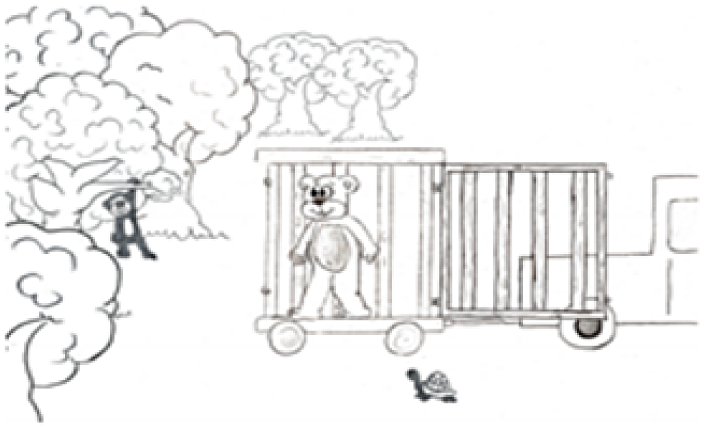
“Sample Item 1 (Environmental Awareness sub-dimension): Instead of taking animals to the zoo, they should be released in the forest to live with their family.” (Image 3) (Büyüktaşkapu Soydan and Öztürk Samur, Reference Büyüktaşkapu Soydan and Öztürk Samur2017, p. 82).
“Sample Item 2 (Environmental Awareness sub-dimension): Measurements should be taken for factory and car smoke.” (Image 4) (Büyüktaşkapu Soydan and Öztürk Samur, Reference Büyüktaşkapu Soydan and Öztürk Samur2017, p. 82).
Environmental Awareness.

Scoring
Scoring in the attitude towards environment scale is carried out as 2 points if the children choose the positive behaviour in an item, 1 if they choose the sometimes option and 0 if they choose the negative behaviour. In the environmental awareness scale, 2 points are given for the correct answer, 1 point for the answer I do not know/I have no idea and 0 points for the wrong answer.
Data analysis
The mean, mode, median, skewness and kurtosis values of the variables in the study were calculated. If the mean, mode and median values of a series are equal in the frequency distribution, we can say that the data are distributed symmetrically around the central tendency measures. In cases where these values are not equal to each other, it can be decided whether the series is normally distributed by looking at the Z scores of the skewness and kurtosis values. The fact that the Z scores of the skewness and kurtosis coefficients remain in the range of (±1.96) indicates that the data exhibit a normal distribution (Field, Reference Field2000; Field, Reference Field2009). An independent samples t-test was used to show whether the environmental awareness and attitudes of the study group differ according to the school they attend. The normality tests of the research data are given in Table 3.
Environmental awareness and attitude scale for pre-school children and Cronbach α coefficients of the scale’s factors

Normality tests of research data

As seen in Table 3, the scores obtained from the measurements of environmental awareness (mean = 17.13, sd = 2.69), and attitude towards the environment (mean = 24.95, sd = 4.6) showed a normal distribution.
Findings
In the study, the findings regarding whether the environmental awareness and attitudes of the children attending the Nature-Centered Maki kindergartens and public kindergartens affiliated to the Ministry of National Education differ according to the type of school are presented below.
When Table 4 is examined, in the environmental awareness sub-dimension, it is observed that the mean score of the children in Maki kindergarten is $\overline X$
= 20.92, and the children in the public kindergarten are
$\overline X$
= 13.35. When the t value obtained as a result of these averages is examined, it is seen that there is a significant (p < .05) difference. This difference is in favour of Maki kindergartens.
$\overline X$
= 20.92, and the children in the public kindergarten are
$\overline X$
= 13.35. When the t value obtained as a result of these averages is examined, it is seen that there is a significant (p < .05) difference. This difference is in favour of Maki kindergartens.
The result of the independent samples t-test showing whether the environmental awareness and attitudes towards the environment of the study group differ according to the school they attend

Pearson correlation results showing whether there is a relationship between the sub-dimensions of the environmental awareness and attitude scale for preschool children

** Correlation is significant at the .01 level (2-tailed).
Considering the sub-dimension of attitude towards the environment, it is seen that while the mean score of the children attending Maki kindergarten is
$\overline X$
= 27.04, the mean score of the children attending the public kindergarten is
$\overline X$
= 22.88. Considering the t value obtained based on these average results, there is a significant difference in the sub-dimension of attitude towards the environment (p < .05). This difference seems to be in favour of Maki kindergarten.
The total mean score of the children attending Maki Kindergarten for the overall Environmental Awareness and Attitude Scale for Preschool Children is
$\overline X$
= 47.96. The total mean score of the children attending the public kindergarten was calculated as
$\overline X$
= 36.23. When the t value obtained for the total scores is examined, it is seen that the difference between the scores obtained from the overall scale is significant (p < .05) and in favour of Maki kindergartens.
The Pearson correlation results showing whether there is a relationship between the Environmental Awareness and Attitude Scale’s Sub-Dimensions for Preschool Children are given in Table 5. The Pearson correlation coefficients were calculated for the multidirectional relationship between the scale items. As seen in the table, a high positive correlation (r = .87) was observed between the items of attitude towards the environment and environmental awareness sub-dimensions.
Discussion, Conclusion and Suggestions
The present study used quantitative methods to compare children’s attitudes towards the environment and environmental awareness between a traditional pre-school program and a nature-based pre-school program among children from the same population. The study was completed with the participation of 48 children attending a nature-centred kindergarten and 48 children attending a kindergarten affiliated with the Ministry of National Education. In line with the findings of the study, the following conclusions were reached.
Environmental awareness and attitudes towards the environment of 5–6-year-old children attending nature-centred kindergartens were found to be higher than children attending public kindergartens. The nature-centred kindergarten’s program is based on both early childhood education (developmentally appropriate practices) and practices such as environmental education. Teaching staff should have skills and experience in both early childhood education and environmental education (Vandermaas-Peeler & McClain, Reference Vandermaas-Peeler and McClain2015). The nature-centred kindergarten program addresses both child development and environmental values and uses the natural world to support dual goals. It helps the development of the children’s world (in all areas such as cognitive, physical, social, emotional, aesthetic and spiritual) and an ecological identity or environmental ethics (Kiewra & Veselack, Reference Kiewra and Veselack2016). It has been determined that environmental education given in studies supporting the results of this research leads to an increase in the attitudes and awareness levels of young children towards the environment (Fetihi & Gülay, Reference Fetihi and Gülay2011; Gülay, Yılmaz, Turan Güllaç & Önder, Reference Gülay, Yılmaz, Turan Güllaç and Önder2010; Gülay Ogelman, Reference Gülay Ogelman2012; Gülay Ogelman & Durkan, Reference Gülay Ogelman and Durkan2014; Özdemir and Uzun, Reference Özdemir and Uzun2006; Sungurtekin, Reference Sungurtekin2001).
Private Maki Kindergarten in the study group is nature centred. Every day, the school takes its students to a natural land of 4000 square meters, which they call Maki Village, and this land enables children to interact with nature. Among the activities prepared to create this interaction, the properties of the seed, the structure of the trees, the soil and living things, my garden, the ones caught in my lens can be counted. It can be said that children’s environmental awareness is higher thanks to these practices.
The ultimate goal of environmental education is to raise an environmentally literate citizen. Environmental literacy requires not only basic knowledge of the environment but also a positive and caring attitude towards the environment. Exposing children to nature and including practices that increase environmental awareness in early childhood programs can solve the increasing concerns of today’s youth and facilitate the understanding of ecological concepts (Coyle, Reference Coyle2005; Driessnack, Reference Driessnack2009; Louv, Reference Louv2009). Supporting the results of this research, Inoue (Reference Inoue, Cutter-Mackenzie, Malone and Barratt Hacking2018) concluded in his study that children in nature-centered kindergartens are encouraged to explore the systems in nature, while the basic concepts of ecology are taught in other schools, they not only learn it in nature-centred schools but also associate it with life. In the present study, the low environmental awareness of children in kindergartens affiliated to the Ministry of National Education may be due to the attitude of the teacher and school management. In the study carried out by Buhan (Reference Buhan2006), it is stated that the level of pre-school teachers’ involvement in environmental education activities does not differ according to professional seniority. In the same study, teachers working in kindergartens affiliated to the Ministry of National Education give less place to environmental education activities than those working in private kindergartens. Teachers with bachelor’s and master’s degrees give more space to environmental education than teachers who have graduated from high school. In terms of age, it was determined that teachers in the 26–30 age group gave more space to environmental education activities than other age groups.
One of the reasons for the low environmental awareness of children in public kindergartens may be how much environmental awareness is included in the pre-school education program. In studies in which preschool education programs are examined in terms of environmental education (Erdoğan, Bahar, Özel, Erdaş & Uşak, Reference Erdoğan, Bahar, Özel, Erdaş and Uşak2012; Gülay & Ekici, Reference Gülay and Ekici2010), it is stated that environmental education is insufficient and should be given more place in pre-school education programs. The results of the abroad study, in which the environmental education was studied, also show that environmental education in Turkey should be more intertwined with nature (Öztürk Aynal, Reference Öztürk Aynal2013).
It is very important to include environmental education programs in the pre-school period and to introduce environmental education to young children for forming the basis of curious learning. With environmental programs, according to Wilson (Reference Wilson1996), young children learn how they need healthy interaction with the environment, not only because of physical dependence on the environment but also because of psychological and emotional interaction with nature. The main purpose of early childhood environmental education is to promote the protection of the natural world and to help the healthy development of children (Wilson, Reference Wilson1996). Nature has many physical and mental health benefits. Some of these benefits have been briefly discussed before. According to Driessnack (Reference Driessnack2009), direct exposure to nature is important for children’s physical and emotional health, development of cognitive processes and resilience to negative stress and depression.
According to the results of the research, the attitudes towards the environment and environmental awareness of the children attending nature-centred schools are high, revealing the necessity of giving more place to environmental education in public schools. For this reason, it can be suggested to increase environmental activities in the pre-school education program, to provide training to teachers and school administrators on environmental awareness and to include families in activities to increase their awareness. The present study was conducted with preschool children aged 5–6 years. Within the scope of the same subject, research on school management, teacher and family attitudes can be carried out.
Acknowledgements
None.
Financial Support
This research received no specific grant from any funding agency, commercial or not-for-profit sectors.
Conflicts of Interest
None.
Assoc. Dr. Kazım Biber: He completed her undergraduate degree in Elementary Teaching in 1992. He completed his master’s degree in Balıkesir University Social Sciences Institute and his doctorate in Preschool Education at Marmara University (2012). He is working as the head of Balıkesir University Necatibey Education Faculty Preschool Education Department currently. He conducts researches in fields of Art Education, Family Education and Participation courses.
Hülya Cankorur: He was born in Balıkesir. He graduated from Uludag University (NEF) Chemistry Teaching Department in 1988. He started to work in the Ministry’s In-Service Training. He attended Bilkent and DEU English Language Education certificates and received English Chemistry Science and received the title of Technical Teacher. He taught Scientific Principles of Technology at his school. In 2007, he received TÜBİTAK-BİDEB Project Consultancy. He worked as a Chief Technician in MAY Workshops. He prepared scientific projects as a consultant teacher. Participated in the particle physics training. ATLAS, CMS, ALICE, LEIR and CAST trainings that participated in the Turkish Language Teaching Program at CERN in 2014.
Rabia Sultan Güler: She was born in Balıkesir. While continuing her education at Rahmi Kula Anatolian High School, she made a presentation as a speaker at the International Scientific Research Congress (IBAD). In the same year, the article “How Pre-School Teachers and Teacher Candidates Cope with Stress” was published in the Journal of Educational Researches of Uşak University. She attended the 2nd International Geography Education Congress (UCEK). She made it to the finals in the 18th Science Research Projects Competition of Private Ege High School with her project in the field of health in 2021. She continues to study at Rahmi Kula Anatolian High School.
Ecenur Demir: She was born in Balıkesir. After successfully completing her education at Balıkesir Mehmetçik Primary School and Balıkesir Racing Secondary School, she continued her education at Balıkesir Rahmi Kula Anatolian High School and made it to the finals in the 18th Science Research Projects Competition of Private Ege High School in 2021 with her health project. She continues to study at Rahmi Kula Anatolian High School.




 Open access

