


1 Introduction: Seabed Lines of Communication
We know every single day that what’s connecting us around the world, physically and visually, are these cables and the systems that run on them. And we want to make sure that these systems are trusted, that they’re secure, and that people can be connected all around the world.
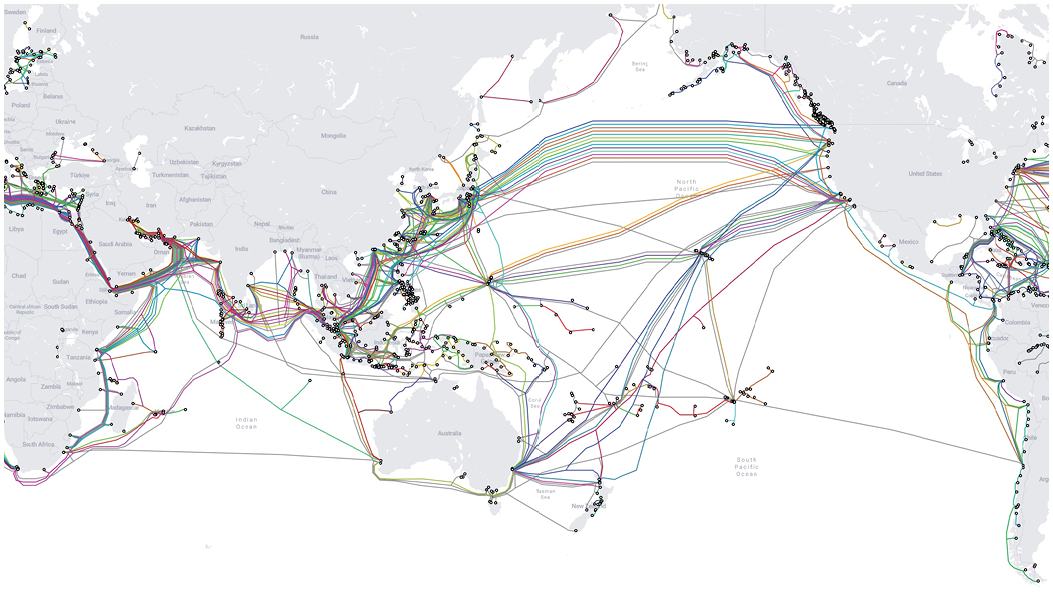
Sino-US competition is defining Indo-Pacific international security as both poles (and respective allies) compete for relative power. Due to entrenched strategic competition, both powers are attempting to reduce reliance on adversary supply chains and lessen perceived vulnerabilities across critical sectors and services. International data flows – integral to the functioning of modern digital societies – are under renewed scrutiny by both China and the United States. Approximately 98 per cent of international data flows are transmitted via optical fibre submarine telecommunications cables which transit the seabed (see Figure 1). Since the Crimean War in the mid-1850s, submarine cables have a rich history of cutting, censorship and military communication enablement in many conflicts. In recent years, concerning episodes of suspected cable sabotage and resulting increased media attention have raised the public profile of submarine cable networks and corresponding vulnerabilities – resulting in heightened scrutiny amongst politicians, military and government leaders, academics, the cable industry and the general polity. In the modern era, these critical infrastructures are perceived as vulnerable due to risks associated with breaks, espionage, sabotage and data integrity. While these networks have been fought over in consecutive conflicts since the 1850s, after a period of relative stability in the post–Cold War era, intensified network-based Sino-US competition in the Indo-Pacific is now once again playing out on the seabed.
Indo-Pacific existing and planned submarine cable networks as at April 2026, CC BY-SA 4.0.
Indo-Pacific Submarine Cable Map, TeleGeography, April 2026, CC BY-SA 4.0, www.submarinecablemap.com/#/.
In the last fifteen years, as China’s relative global power has matured, the rising power is attempting to displace Western (primarily US, French and Japanese) historical domination of the submarine cable industry via its Digital Silk Road Initiative. Simultaneously, in Europe and the Indo-Pacific, various instances of seabed warfare (e.g. Nord Stream) and suspicious seabed incidents (e.g. Taiwan Matsu Islands) have occurred, contributing to a reinvigorated political focus on seabed critical infrastructure security amongst many Indo-Pacific states. As a result, submarine cable network resilience and connectivity have become a key area of action and cooperation by Indo-Pacific nations, and through multilateral institutions including the Quadrilateral Security Dialogue. In sum, as Sino-US geopolitical competition intensifies throughout the Indo-Pacific, control over optical fibre cables which transit the seabed has become a high-stakes battleground with profound implications for the functioning of our modern digital society.
At the nation-state level, severe cable outages can pose grave national security risks. In the most extreme cases, submarine cable outages can cut entire nations from data connectivity, forcing reliance on satellite connectivity which transmits reduced capacity and is slow and expensive. Cable outages reduce data transmission capacities and require the telecommunications cable owners and operators to reprioritise data flows, potentially disrupting emergency communications and military command and control functions. Too, cable outages may require data be re-routed through vulnerable or less secure cable networks – built and operated by adversaries – thus introducing interception and espionage risks. Prolonged outages also have the potential to economically and politically destabilise states which could be leveraged for geopolitical purposes. Importantly, cable faults have regional consequences and rarely affect just one state. A cable fault will usually affect the myriad landing states, as well as users located regionally or indeed globally. Thus, states have a responsibility to secure these seabed lines of communication within their respective jurisdictions (and in the high seas) not only for their respective social, economic and security well-being, but also for the collective regional and global benefit. According to scholar Ash Rossiter, states are recognising ‘the need to play an increasingly active role in the security of the undersea cables’.Footnote 2
In the subsequent sections, I illustrate (empirically and theoretically) how and why key Indo-Pacific states are adapting respective foreign and defence policies to secure submarine cable networks amid intensifying US–China competition and perceived seabed instability. I am compelled to examine the global and regional dynamics which have driven Indo-Pacific states to once again scrutinise submarine cable security with increased alarm and the corresponding policy responses. I posit that states compete for cable centrality as these infrastructures rapidly transmit information between continents and islands, geographically traverse maritime and coastal zones, and physically constrict and aggregate information flows through limited chokepoints. This competition manifests in new forms of state intervention and policies to monopolise infrastructural nodes, control data flows and dominate network production. Competition over submarine cable networks in the Indo-Pacific demonstrates the broader concept of network-based competition, first posited by academic Seth Schindler and colleagues, which frames contemporary Sino-US competition as a contest for centrality in digital, infrastructure, production and financial networks.Footnote 3
Within this network-based competition framework, scholars Henry Farrell and Abraham Newman’s ‘weaponised interdependence’ approach illustrates how states can operationalise control over network nodes through the ‘panopticon effect’ and the ‘chokepoint effect’, referring to the ability to intercept information flows and restrict network hub use, respectively.Footnote 4 While Farrell and Newman provide a ‘structural explanation of interdependence in which network topography generates enduring power imbalances among states’,Footnote 5 this Element applies the framework to submarine cable networks, examining how states are attempting to gain and maintain respective central positions. I detail how Indo-Pacific states compete to attain network positions with an eye to reducing their respective vulnerability, though such structural positioning creates conditions that could enable weaponisation – whether or not states intend to exploit these positions.
To substantiate these arguments, this Element proceeds as follows. This introductory section provides a brief historical analysis of submarine cable technical development and geopolitics, before overviewing the network components and why these infrastructures are perceived as both vulnerable and strategic. The second section, ‘Submarine Cable Competition in Context’, evaluates the growing scholarly literature and outlines key considerations pertaining to modern Sino-US competition, with a focus on technology. The Element’s theoretical grounding – network-based competition and weaponised interdependence – is then posited, followed by the Element’s novel typology of nodes, flows and production. Section 3, ‘Cable Breaks Abound: Accidental, Negligent or Malicious?’ documents the spate of cable breaks in both the Indo-Pacific and Europe, which heightened awareness of cable vulnerability and validated security concerns that have shaped state interventions, as mapped in Section 4, ‘The Indo-Pacific Adapts’. Section 5, ‘The Nodes-Flows-Production Contest’, analyses these responses and overlays a network-based competition lens to characterise Indo-Pacific policy intervention under three broad categories – nodes, flows and production. This typology reveals how states compete for network centrality to reduce vulnerability, though such structural competition creates conditions that risk weaponisation. This Element’s concluding section, ‘The Seabed and Indo-Pacific Security’, analyses the implications for Internet bifurcation, assesses notions of victory amid intensifying Sino-US competition and examines various constraints limiting state control over submarine cable networks.
This Element makes three distinct contributions to the scholarly understanding of Indo-Pacific submarine cable infrastructure contestation and network-based competition. First, it provides a new empirical analysis of how key Indo-Pacific states are adapting foreign and defence policies to perceived seabed insecurity, including the establishment of China’s Digital Silk Road, the Australian Infrastructure Financing Facility for the Pacific and the Quad Partnership for Cable Connectivity and Resilience, amongst other initiatives. Second, this Element posits a novel nodes-flows-production typology to understand how network-based competition is operationalised in the Indo-Pacific, detailing how states are attempting to control submarine cable regional connectivity (nodes), secure and exploit data transmission (flows) and defend supply chains including repair capacity (production). Third, the subsequent sections establish how states compete for network centrality to reduce vulnerability – though such structural competition creates conditions that risk weaponisation, reflecting Farrell and Newman’s warning against increasing systemic weaponisation risk.
1.1 From the Telegraph to Optical Fibre
Transmitting information efficiently has been a perennial challenge for human society. Submarine cable networks are now the connective tissue between terrestrial fibre networks and play an indispensable role in enabling the modern Internet and data transfer. Since the first networks were laid, these infrastructures have been primarily privately owned by myriad telegraph companies, telecommunication firms, and now big tech firms (known in the industry as ‘hyperscalers’), often through consortia arrangements. These infrastructures have evolved since the mid-1800s, technologically, commercially and strategically – issues this brief history examines.
Until the optical telegraph was operationalised in the eighteenth century, information transmission was limited to the speed of a horse or ship. Early telegraphy was enabled by optical telegraphs, which conveyed text via visual signals. To convey messages, signal towers were constructed at regular intervals (within sight distance) and affixed with semaphore rigs which were manipulated to pass messages. However, electrical telegraphy quickly replaced optical telegraphy. Electrical telegraphy used wires to transmit electrical signals between points. The first commercial electrical telegraph was operational by the mid-1800s, and efforts were made to insulate cables for subsea use. By 1852 London and Paris were connected by a submarine telegraph link, and Ireland was connected to London by 1853.Footnote 6 In 1866 the first transatlantic telegraph was completed, and lines were rapidly laid to India in 1870 and Australia in 1872. By 1902, with the completion of a network across the Pacific Ocean, Britain’s submarine cable industry had laid a truly global network – dubbed the ‘All Red Line’.Footnote 7 While cables were usually laid by telegraph companies for commercial gain, the British Admiralty, Colonial Office, War Office and Foreign Office’s ‘political reasons’ helped to justify these networks.Footnote 8 Indeed, according to academic Jill Hills, ‘the submarine telegraph cable extended the “space” of empire to facilitate the unification of territory into nation-states and to allow long-distance control of alien territories’.Footnote 9 Hills adds that despite the telegraph system being privately owned, the British elite perceived the network as a ‘strategic resource to be used for the defense of empire’.Footnote 10
Submarine telegraphy played a key role in various international conflicts. Global network expansion through British subsidies was instigated by conflict, including the Indian Mutiny, the Crimean War, the American Civil War, the Boer War and the First World War.Footnote 11 At the outset of the First World War, Britain swiftly severed Germany’s submarine telegraph cables, and attacking/defending these infrastructures remained a key battleground throughout the conflict at a global scale. Cable laying and repair became a perilous task, requiring naval escorts due to the risk of attack. According to historian Jonathan Reed Winkler, ‘although most of the fighting between Germany and Britain occurred on the Western Front, it was the struggle for control over worldwide communications that made the war global’.Footnote 12 In one prominent Indo-Pacific example in 1914, the German light cruiser SMS Emden was sunk by the Australian light cruiser HMAS Sydney in the Indian Ocean’s Cocos Islands, which the SMS Emden visited to destroy British telegraphy infrastructure. However, cable networks were not simply cut and severed but also comprehensively censored throughout the First World War, as part of a broader effort to disrupt and intercept enemy communications. The British implemented a vast system of censorship across its cable network, with an emphasis on restricting enemy naval or military information transmission, preventing false report circulation, collecting actionable military intelligence and denying the enemy commercial benefit.Footnote 13 British cable censors were located across the globe, from Egypt to Fiji and from Mauritius to New Zealand.Footnote 14
During the Second World War, submarine telegraph cables were again a key target as Britain both severed Germany’s subsea connections in the Atlantic and also censored other messages and deliberately slowed cable traffic.Footnote 15 In the Indo-Pacific, Japan took aim at submarine cable infrastructure, cutting or seizing most British, Dutch, French and American cables in East Asia following the Pearl Harbour attack and shelling Cocos Islands’ landing station in 1942.Footnote 16 By severing or seizing submarine cables, governments and militaries were forced to instead transmit messages via radio, which was more easily intercepted. For example, during the Second World War, two cables were severed off Vietnam’s coast near Saigon which connected Japan and which the Allies struggled to intercept.Footnote 17 By severing these Japan-operated cable networks, Japanese military communications instead transmitted wirelessly, which could more readily be intercepted and decrypted. Indeed, according to scholars Motohiro Tsuchiya and Kristi Govella, ‘as the construction of these cable networks is influenced by geopolitics so too is their destruction’.Footnote 18
During the early Cold War period, coaxial cables began to be laid on the seabed, enabling a far greater data-carrying capacity including multiple voice channels. Coaxial cables were able to transmit high-frequency signals at higher speeds which enabled radio, television and early Internet transmission. While few details exist about submarine cable sabotage during the Cold War period, several notable examples have been detailed. First, in 1959, after a high number of cable breaks occurred off Newfoundland, the Soviet fishing vessel Novorossiysk was boarded by the USS Roy O. Hale.Footnote 19 The Americans suspected the Novorossiysk of purposefully sabotaging cables and boarded the fishing vessel after complaints from cable operators AT&T and Western Union to examine the ship’s logs. Although the US Navy concluded publicly that it found no incriminating proof of intentional sabotage, this incident was the first ever enforcement action justified by the 1884 Convention for the Protection of Submarine Telegraph Cables.Footnote 20 Second, through the 1970s the United States tapped Soviet military cables in the Sea of Okhotsk, north of Japan. Codenamed Operation Ivy Bells, this joint US Navy, US Central Intelligence Agency and US National Security Agency action targeted Soviet communications pertaining to nuclear intercontinental ballistic missile tests and capabilities. In order to tap the cable networks, US submarines installed recording devices, which were then retrieved and processed.Footnote 21 While Operation Ivy Bells was compromised in the early 1980s, as scholar Caitlin Morris notes, these taps ‘are credited as some of the most daring and successful intelligence operations of the Cold War’.Footnote 22
During the 1980s, fibre optic cables were developed and replaced coaxial cables – which used light (rather than electricity) to transmit signals through thin glass threads. Fibre optic cables had a much greater carrying capacity, and the first transatlantic fibre optic cables operational in 1988 – TAT-8 – could carry 280 megabits per second, which equated to 40,000 telephone circuits. The first fibre optic cable to traverse the Pacific – Trans-Pacific Cable 3 (TPC-3) – was laid a year subsequent in 1989. Fibre optic cables were largely laid on the same routes as retiring coaxial cables, and as technology rapidly improved, cable carrying capacity sharply increased, meaning many optical fibre cables reached ‘economic obsolescence before technological obsolescence’.Footnote 23 Optical fibre submarine cables rapidly replaced coaxial cables during the 1990s, dramatically increasing the flow of bits, enabling the Internet’s global commercialisation and its embedding into many facets of society.
Importantly too, the telecommunications industry underwent a dramatic transformation during the 1980s and 1990s as large state-owned telecommunications firms were broken up and privatised. During the 1980s American AT&T was broken up as Japan’s Nippon Telegraph and Telephone Corporation and Britain’s British Telecom were privatised, with France Telecom following in the 1990s.Footnote 24 As a result, submarine cable network development was increasingly driven by profit, and a cable-laying boom ensued – eventually crashing in the late 1990s due to excess built capacity.Footnote 25 However, despite the cable market crash, the boom resulted in a dramatic increase in global carrying capacity – while in 1988, 1,800 voice paths crossed the Pacific and submarine cables carried 16 per cent of transmission capacity globally, by 2003, 1.87 billion voice paths crossed the Pacific and cables carried 94.4 per cent of global data transmission capacity.Footnote 26 Put simply, in the post–Cold War period, submarine cable networks became a key enabler of modern information flows and the indispensable backbone of the Internet, but not without controversy.
The role submarine cables played in Western signals intelligence collection efforts was laid bare in 2013 when former American intelligence contractor Edward Snowden leaked a large cache of highly security-classified documents to journalists. As the documents detailed, the US National Security Agency, sometimes in collaboration with Five Eyes international partner agencies and telecommunications firms, used submarine cable infrastructure to undertake ‘upstream’ collection – meaning intercepting transiting data from fibre optic cables and internet backbone infrastructure.Footnote 27 As the leaked documents illustrated, upstream collection took place on a global scale including at cable network infrastructures located in non-Five Eyes countries. The Edward Snowden global surveillance disclosures – including revelations about indiscriminate Western cable interception programmes – sparked global controversy. According to American academic Jeffrey T. Richelson, the revelations ‘sparked one of the most significant controversies in the history of the U.S. Intelligence Community’.Footnote 28 Importantly, and as this Element will detail, Snowden’s revelations sowed distrust of Western telecommunications infrastructure amongst various Global South nations at the time, with implications for supplier choices in the years that followed.
A significant commercial shift is currently changing the economics of submarine cable network installation and operation. While most cable projects in the past several decades have been owned and financed through consortia arrangements – whereby multiple (usually) telecommunications firms collaborate to install and share a new network – American big tech firms, also known as hyperscalers or content providers, are now driving the development of many new networks. These hyperscalers, most prominently Google, Meta, Amazon and Microsoft, can justify joining consortia or owning cables outright, principally to support their respective cloud services, video/audio calling, searches, video content distribution and increasingly so for artificial intelligence (AI) production (whether training or geographically dispersed inference). According to TeleGeography, a data research firm, AI is a ‘key driver of future long-haul demand’,Footnote 29 and for cable networks entering service between 2024 and 2027, hyperscalers have invested in 100 per cent of trans-Atlantic routes, 80 per cent of trans-Pacific routes, and 77 per cent of routes in Oceania.Footnote 30 By investing in these networks through a consortium, or indeed as the sole owner, these hyperscalers are able to build high-capacity networks; determine cable landing points which align with data centres; reduce costs; build redundancy and swap fibre pairs or partial fibre pair capacity with other hyperscalers or carriers.Footnote 31 As a result, traditional telecommunication carriers are no longer the principle users of international data capacity through submarine cables, and the ever-growing hunger for capacity from American hyperscalers is increasingly dictating new subsea network dynamics.
1.2 Submarine Cable Networks
As I stress in this Element, submarine cable networks are indeed ‘networks’ – consisting of many elements, materials and components which enable data to flow between the parts and the control centre. These networks are one sub-element of the Internet’s enabling infrastructure, which comprises various parts including routers, modems, media and exchanges. This section overviews various core elements of a submarine cable network to illustrate the network’s physicality and to highlight some technological developments.
Fundamentally, data is represented in ones and zeroes and transmitted by a network ‘packet’ through an optical fibre cable. Each packet consists of both control information (which directs the packet to its destination and is often referred to as a header) and the user data (commonly referred to as a payload). Importantly, modern optical fibre networks often distribute packets across multiple networks, which are re-assembled at the destination. When stored, data is generally kept within a semiconductor memory chip as electrons. To transmit packets rapidly between landmasses, data is generally transferred via a submarine cable or via satellite. As satellite data transmission is relatively slow and costly, submarine cable networks transfer approximately 98 per cent of international data traffic and are the backbone of the modern Internet. To transmit packets through submarine cables, data is transmitted optically by specialised lasers via optical fibres.
While specifics vary, modern submarine cables consist of various components, and the glass optical fibres are sheathed by multiple insulating layers.Footnote 32 The thin glass optical fibres at the core are insulated by silicone gel, ultra-high strength steel wires, a copper sheath, a polyethylene insulator, nylon yarn bedding, galvanised armour wires and tar-soaked nylon yarn.Footnote 33 These cables, termed the wet segment, are often armoured and buried in shallower waters and near the coast, but in deep waters are laid on the seabed and are roughly the diameter of a garden hose.Footnote 34 Long-distance cables are electrified by power repeaters, which are located at approximately 80-to-100-kilometre intervals. According to TeleGeography, as of early 2025 active and planned submarine cables total over 600, and in excess of 1.48 million kilometres of cable is currently in service.Footnote 35
These cables are connected to terrestrial fibre networks via various shore-based infrastructures (also known as the dry segment). When a cable makes landfall, it generally passes through a beach manhole or a beach joint which connects to a cable landing station. While cable landing stations have historically been built near the beach manhole and connected via backhaul to data centres, now cable landing stations and data centres can be co-located, and numerous submarine cable networks often terminate at a single cable landing station. Cable networks are controlled by network operations centres and network management systems (which can often be operated remotely), which control and monitor network activity and performance. Finally, submarine cable networks are laid and repaired by a fleet of specialised vessels complete with highly trained crews. These cable ships, built with bow and/or stern sheaves, lay, maintain and repair the infrastructures. While some of these cable ships are owned and operated directly by the firm laying the networks, others are subcontracted to perform the task. Moreover, many cable repair vessels operate as part of a subscription-based maintenance repair agreement zone, while some are contracted directly by the cable operator in the event of a fault.
A variety of new sensor technologies are being integrated into submarine cable networks, which can be used to monitor network cable operations as well as the underwater environment. Various technologies, including but not limited to distributed acoustic sensing, state of polarisation sensing and distributed fibre sensing, are being deployed on networks to better observe network performance and to identify risks to networks in real time – enabling proactive repairs and even interdiction of ships or individuals which pose risks to cables. Additionally, some cables (described as SMART Cables – Science Monitoring And Reliable Telecommunication) are being fitted with oceanographic sensors which can be used to monitor environmental indices, including sea levels, climate and earth changes, tsunamis and earthquakes.Footnote 36 These sensing and monitoring technologies have profound environmental and network security implications but also raise important questions about how intelligent commercial submarine cable networks could be utilised by militaries and security agencies to better monitor the underwater domain and, correspondingly, whether these infrastructures thus become legitimate military targets during a conflict.
When submarine cables are damaged, the cables are not always entirely severed. A ‘shunt fault’ occurs when the cable’s insulation is compromised, thereby disrupting the electricity flow to repeaters. Even though many cables are buried in relatively shallow water initially, damage is still possible, often due to seabed movements and subsequent cable exposure. Cable faults can occur due to a variety of issues, including component failure, dredging, geological incidents and abrasion. Many faults cannot be formally attributed, and the cause can remain unknown. As cable monitoring and sensing become more widely implemented, it is easier for cable operators to pinpoint fault locations and disrupt an external threat before damage occurs.
To safeguard and protect submarine telegraph networks from damage, various international legal and diplomatic initiatives have been undertaken. In May 1865 the International Telegraph Union was established with a mandate to coordinate international telegraph networks and to set standards and frameworks. In 1932 the International Telegraph Union was combined with the International Radiotelegraph Union to become the International Telecommunication Union – still operating in the modern era. Moreover, in 1884 key states signed the Convention for the Protection of Submarine Telegraph Cables which aimed to protect cable networks and set rules pertaining to submarine cable networks laying and installation. According to the Convention, outside of territorial waters:
The breaking or injury of a submarine cable, done wilfully or through culpable negligence, and resulting in the total or partial interruption or embarrassment of telegraphic communication, shall be a punishable offense, but the punishment inflicted shall be no bar to a civil action for damages.Footnote 37
However, according to Article 15 of the Convention, ‘it is understood that the stipulations of this Convention shall in no wise [sic] affect the liberty of actions of belligerents’.Footnote 38 Article 26 of the 1958 Geneva Convention on the High Seas outlined how ‘all States shall be entitled to lay submarine cables and pipelines on the bed of the high seas’, adding that laying and maintenance should not be impeded, and due regard should be made to existing seabed infrastructure.Footnote 39 Article 27 required states legislate measures to punish individuals who wilfully or through culpable negligence damage submarine cables within respective jurisdictions.Footnote 40 The 1958 Geneva Convention on the Continental Shelf further outlined in Article 4 that continental shelf exploration and natural resource exploitation must not impede submarine cable laying or maintenance.Footnote 41 In the same year the International Cable Protection Committee (ICPC) was founded – comprising governments and submarine cable industry players – which aimed to improve cable security by providing a forum for technical, legal and environmental exchanges at a global level.Footnote 42
The 1982 United Nations Law of the Seas Convention (UNCLOS) is considered the primarily legal regime for submarine cable protection in the modern era. According to Article 58, states are free to lay submarine cables within exclusive economic zones provided due regard is given to the rights and duties of the coastal state and comply with relevant local laws and regulations.Footnote 43 Likewise, Article 79 outlines that all states can lay cables on continental shelfs.Footnote 44 Importantly, Article 87 notes that all states are free to lay submarine cables in the high seas, and Article 113 requires states adopt legislation which establishes that conduct which interrupts or obstructs, or is liable to interrupt or obstruct, submarine cable networks – whether through culpable negligence or wilfully – a punishable offence.Footnote 45 Many states do not fulfil this UNCLOS obligation to criminalise conduct which damages, or could damage, these seabed networks.
1.3 Perceived Infrastructural Vulnerability
As I argue throughout this Element, submarine cable networks are sites of acute geopolitical competition as these infrastructures first, rapidly transmit information between continents and islands; second, geographically traverse vulnerable maritime and coastal zones; and third, physically constrict data to limited static conduits, see Figure 2. I engage and expand each of these unique network characteristics in turn – to illustrate why submarine cable networks have historically been, and continue to be, a site of geopolitical contention and state control.
Submarine cable network characteristics driving state control.
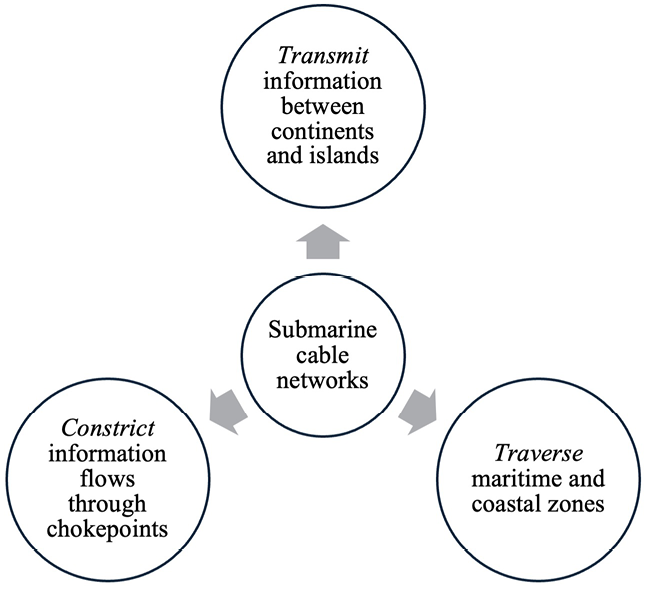
Submarine cable networks transcend spatial boundaries and transmit information as bits at the speed of light. Importantly, the packets of data which flow through cable networks do not only cross international borders – but should be considered in a more holistic and comprehensive manner. Many submarine cable networks transmit information domestically within states – whether connecting an archipelago, connecting the mainland to islands, or across harbours or lakes. These cable networks may transmit information between states and dependent territories, within empires, to allies, to conflict zones, to multilateral diplomatic networks, to international organisations and between scientific bodies. The bits which these networks transmit enable critical infrastructure operations and our modern digital society relies on data flows for basic functioning – including financial systems, medical infrastructure, personal communications and government services. Put simply, a submarine cable network’s critical role in information transmission – which underpins the functioning of our modern society – drives state control and influence.
The second factor driving states to intervene in submarine cable networks in the way these networks traverse vulnerable maritime and coastal zones. According to scholars Christian Bueger and Timothy Edmunds, maritime spaces are subjected to unique vulnerabilities, including a greater propensity for interstate conflicts, extremism and terrorism, and blue crime.Footnote 46 These networks are laid through the high seas, contested seas, maritime choke points, conflict zones and congested seabed areas. These networks routinely operate beyond state jurisdictions or within overlapping jurisdictions. As effective maritime domain awareness is unachievable by most states – especially underwater – the maritime environment in which these networks are laid is little understood and under-monitored. States’ ability to monitor or protect these static seabed infrastructures is limited by the unique challenges of operating in the maritime domain, often beyond respective jurisdictions or beyond the geographically imposed capacities of navies or coast guards.
Third, submarine cable networks constrict and aggregate data flows through limited and often geographically congregated conduits. Due to the considerable costs required to lay, maintain and operate submarine cable networks – which require a robust business case or considerable state subsidies – cable networks are limited in number and limited in geographic distribution. By virtue of this relative network scarcity (when compared with terrestrial fibre), submarine cable networks necessarily constrict data flows through limited conduits, resulting in perceived vulnerability. Specifically, these limited conduits enable states to censor network traffic and to otherwise control the data flows. The limitation on network conduits also simplifies signals intelligence collection, which can be concentrated in landing stations. By constricting data flows in this manner, states correspondingly place a high priority on both ensuring cable network suppliers are ‘trusted’ and ensuring repair capacity is sufficient to safeguard network uptime.
As a colleague and I have argued elsewhere,Footnote 47 this current era of submarine cable competition differs from previous eras in four fundamental ways. First, the basic functioning of our modern societies relies on the connectivity provided by submarine cable networks (and indeed digital infrastructure more broadly) to a higher degree than in previous eras. Global annual bandwidth demand is rapidly growing,Footnote 48 and according to one report, approximately US$10 trillion in financial transactions is facilitated daily through cables.Footnote 49 While satellite data transfer is improving, space-based communications cannot match the speed and capacity modern submarine cables provide – making these seabed conduits an indispensable enabler of our modern digital society. Second, in the post–Cold War era, state sovereignty and direct control of these seabed networks have eroded due to privatisation. Scholar Brendon Cannon notes that ‘cables are not sovereign property as such. They are instead a mix of public and private and often involve consortium’.Footnote 50 Third, and as I elaborate in Section 2, modern submarine cable competition in the Indo-Pacific is fuelled by Sino-US competition. Fourth, states in the modern era are taking a regional approach to cable security rather than being concerned with just the networks which connect it or its territories directly. As a result, foreign assistance budgets and other tools of statecraft are being mobilised to influence third-country networks. These four aspects – our unprecedented modern reliance on submarine cable networks, the post–Cold War decline of state cable industry control, modern Sino-US competition centred around technology and the regional state approach to cable security – distinguish this modern era of cable competition from those which preceded it.
1.4 Research Approach and Scope
At the outset, it must be noted that this Element primarily analyses civilian seabed critical infrastructure rather than military seabed cables and sensors. Indeed, the seabed hosts an array of military seabed infrastructures, including cables, sensors and hydrophones. The location and details of these infrastructures are generally security-classified and closely guarded military secrets. While this Element does engage with military postures, due to the limited availability of data with respect to military seabed infrastructure, this work is primarily focussed on civilian critical seabed infrastructure. In addition, while the seabed is increasingly congested due to seabed electricity cables, seabed gas pipelines, conduits associated with offshore energy extraction (renewable and fossil) and the prospect of seabed mining, this Element will focus its analysis on submarine telecommunication cables.
Moreover, while submarine cable networks are routinely severed and damaged by anchors, fishing equipment and natural incidents, this Element will focus primarily on state-based and malicious risks – risks which are more prominent in an era of heightened strategic competition. Data from the International Cable Protection Committee shows that of the 100–150 submarine cable faults which occur annually, none are verified to have been severed maliciously,Footnote 51 with the possible exception of the June 2025 conviction of a Chinese vessel captain for damaging a cable network off Taiwan.Footnote 52 However, these routine threats to submarine cable networks are generally well-managed by industry and usually do not result in state intervention. As I will establish in this Element, states in the Indo-Pacific are devising foreign and defence policies to secure cable networks in this era of heightened geopolitical competition and increased regional conflicts – an era in which cable interference and sabotage are re-emerging as a concern amongst Indo-Pacific leaders and officials. Another challenge in drafting this Element is the rapidly evolving nature of submarine cable policy, as cable incidents continue to occur and state responses mature. As such, the proceeding sections are an attempt to catalogue and analyse this developing policy domain, which will consolidate as the months and years progress. Lastly, this Element provided but a brief analysis of the international legal dimensions of submarine cable security, which has been analysed extensively elsewhere,Footnote 53 to instead focus on Indo-Pacific security considerations.
2 Submarine Cable Competition in Context
To understand submarine cable contestation in the Indo-Pacific, three contexts require illumination. First, a growing body of scholarly literature proves that cables have historically been sites of geopolitical contestation, but that contemporary competition highlights distinct dynamics of digital dependence and privatisation. Second, submarine cables occupy a perilous position at the intersection of intensifying Sino-US competition, which spans 5G telecommunications technology, Internet governance and semiconductors. Third, network-based competition and weaponised interdependence frameworks provide apt analytical tools to examine Indo-Pacific cable competition. This section evaluates cable scholarship, situates cables in Sino-US competition and posits a theoretical framework before introducing the nodes-flows-production typology which illustrates network-based competition.
2.1 Growing Submarine Cable Scholarly Literature
Various scholars have analysed how geopolitics and conflict have played out on the seabed and affected submarine cable networks. According to historian Daniel H. Headrick’s 1981 book The Tools of Empire: Technology and European Imperialism in the Nineteenth Century, cables were ‘an essential part of the new imperialism’.Footnote 54 Specifically, in peacetime, cables were the lifeline for imperial business communications; in a crisis, cables were ‘valuable tools of diplomacy’ and in war, cables were ‘security itself’.Footnote 55 Fellow historian Jonathan Reed Winkler’s 2008 monograph Nexus: Strategic Communications and American Security in World War I finds that the First World War demonstrated how ‘the imposition of censorship over the cables touching U.S. territory, the coordination of this with other forms of Allied censorship, and the creation of a wartime traffic monitoring group gave U.S. officials a taste of the great power to be gained from control of the cables’.Footnote 56 Historian Paul Kennedy, writing in a 1979 edited volume chapter titled ‘Imperial Cable Communications and Strategy’ finds that between 1870 and 1914, Britain’s efforts to both build a comprehensive cable system and to effectively plan offensive and defensive seabed operations ‘strengthened the military bonds of empire in peacetime’, while also enabling Britain to ‘meet the hazards and shocks which a worldwide war could present’.Footnote 57
While the above academic literature examines submarine cable security from the mid-1850s until the end of the First World War, less analysis has been dedicated to the Second World War or Cold War era. Despite this, as Sino-US geopolitical tensions intensify, and as conflict returns to the European continent, some scholars are positing analysis. Scholar Nicole Starosielski’s 2015 monograph The Undersea Network argues for a ‘counterintuitive’ understanding of global cable infrastructure which is ‘wired rather than wireless; semicentralized rather than distributed; territorially entrenched rather than deterritorialized; precarious rather than resilient; and rural and aquatic rather than urban’.Footnote 58 Moreover, academic Peter J. Hugill finds that submarine cables are an ‘explicitly geopolitical construct, integral to the process of hegemonic maintenance, challenge, and response that has been ongoing among the polities at the core of the capitalist world economy’.Footnote 59
Concurrently, a growing body of literature is emerging which assesses submarine cable security and international relations. Scholars Christian Bueger and Tobias Liebetrau’s 2021 article ‘Protecting Hidden Infrastructure: The Security Politics of the Global Submarine Data Cable Network’ warns that research ‘interest in cables has increased, but remains confined to a narrow technical debate, which does not pay attention to the politics of technology and the governance challenges that cables raise’.Footnote 60 Scholar and diplomat Hilary McGeachy’s 2022 analysis titled ‘The Changing Strategic Significance of Submarine Cables: Old Technology, New Concerns’ argues that ‘submarine cables have “always” had strategic value’ and that ‘submarine cables provide a means to understand more about the concept of strategic technology competition’.Footnote 61 McGeachy finds that since 2015, both China’s efforts to establish Chinese firms in the cable supply chain and renewed government attention on ‘information-related companies and infrastructure’ have altered Western strategic assessments on submarine cable networks.Footnote 62 Also, legal scholars Douglas Guilfoyle, Tamsin Phillipa Paige and Rob McLaughlin’s 2022 paper contends that cables’ ‘increased utility, and the radically increased reliance of States upon submarine data cables for data transfer, serves to emphasise the potential consequences of their vulnerability to damage by malicious acts, accidents, or natural phenomena’.Footnote 63
Some scholars have given specific attention to submarine cable policy in the Indo-Pacific. Scholar Kristi Govella argues that maritime and economic securitisation has altered the prevailing cable policy discourse, that in the Indo-Pacific specifically this new discourse is ‘already reshaping the physical layout of regional cable architecture’ due to investment decisions and that cable network resilience should be driven by a ‘whole life cycle’ strategy.Footnote 64 Academic Brendon J. Cannon finds that the Quad can further work to strengthen cable security through developing ‘interagency coordination’ and ‘global governance’, as well as by ‘developing regional connectivity strategies’.Footnote 65 Despite some Indo-Pacific nations – especially in the Pacific OceanFootnote 66 – not accepting the securitisation discourse, scholar Tara Maria Davenport argues that the physical protection of these subsea networks is ‘an inherent component of “resilience”’.Footnote 67 On Southeast Asia, analyst Elina Noor finds that ASEAN nations are increasingly being forced to choose between Chinese or American subsea networks, which is consequently fragmenting subsea digital connectivity.Footnote 68 These scholars collectively echo that submarine cable security cannot be considered in isolation and indeed should be situated at the intersection of the prevailing geopolitical rivalry.
2.2 Sino-US Tech and Internet Competition
China and the United States are engaged in an intense battle for supremacy in the Indo-Pacific. Both states are competing for military, cultural, institutional, economic and technological superiority. According to Eric Schmidt, former Google CEO, Sino-US technology and innovation competition is the ‘century defining contest’.Footnote 69 China has rapidly risen as a great power and is attempting to dislodge the United States in various domains, especially in networks. According to scholars Kai He and Mingjiang Li’s writing in 2020, ‘US–China strategic competition has just begun.’Footnote 70
Various scholars agree that technology and innovation is a key contributor to great power status. According to historian Paul Kennedy, military power relies on a strong economy, which in turn requires superior technology.Footnote 71 Kennedy asserts that the relative power of states and empires is determined by the effect that economic and technological change has on social structures, governance arrangements and military power.Footnote 72 Political scientist Robert Gilpin finds that superior military and industrial technologies allow states to ‘seize the opportunities or overcome the constraints provided by the external environment in order to advance its economic, security, or other interests’.Footnote 73 Put simply, cutting-edge technology and robust innovation are key drivers of power in the international system of states.
In recent years, China has invested heavily in high-tech innovation and rapidly climbed the economic value chain. Chinese tech firm HuaweiFootnote 74 has led the charge in many of these technologies, especially in the telecommunications domain. According to scholars Andrew B. Kennedy and Darren J. Lim, innovating information and communication technologies have been a focus for China, underpinned by considerable increases in R&D expenditure.Footnote 75 As technological prowess relates to international relations, Kennedy and Lim argue that ‘under certain conditions the rising state’s [technological innovation] activities will generate negative order externalities for the dominant state, particularly by undermining its preferred rules, practices and institutional arrangements’.Footnote 76 Despite these negative order externalities, political scientist Daniel Drezner highlights that ‘technological latercomers’ often struggle to gain global market share as ‘the ingredients for motivating technological catch-up are ill-suited for technological leadership’.Footnote 77 In any case, in the eyes of many first Trump Administration officials, Huawei was a strategic rather than a commercial challenge, as ‘Huawei was a national champion of America’s primary geopolitical rival’.Footnote 78
Sino-US technology competition takes a variety of forms and extends into competition for Internet-related technologies. From AI, 5G telecommunications, e-commerce and digital payments, to social media, quantum computing and semiconductor manufacture, American and Chinese firms are competing for supremacy. Indeed, in Internet standards and governance, the two nations advocate for differing governance conceptions (multistakeholder vs state-centred), and China is advocating to replace the long-established TCP/IP (Transmission Control Protocol/Internet Protocol) with a ‘New IP’, which would incorporate greater controls at the network level.Footnote 79 Furthermore, Sino-US technological competition extends beyond just the two superpowers and extends to respective partners and allies. Scholar Xinghua Liu finds that the United States does not further its technological leadership unilaterally but employs a ‘digital coalition’ model, in coordination with like-minded allies and states, to compete technologically with China.Footnote 80 In this sense, allies and partners play key roles in operationalising the superpowers’ technological and innovation agendas and in enabling technological supremacy.
As this analysis illuminates, the United States and China are locked in entrenched competition across a variety of domains, crucially, including technology innovation generally and Internet leadership specifically. This rivalry, in the context of Sino-US network-based competition and physical infrastructure characteristics I outline below, aids in understanding why submarine cable networks have become a key battleground, especially when compounded against the European seabed warfare harbinger, as the next section outlines.
2.3 Network-Based Competition and Weaponised Interdependence
The contemporary Sino-US rivalry can be understood as ‘network-based competition’ – meaning a contest for centrality in digital, infrastructure, production and financial networks.Footnote 81 In this framework, posited by academic Seth Schindler and colleagues, the dominant components of networks are interconnectivity, interdependence and control of non-linear often non-hierarchical nodes.Footnote 82 This framework builds on international relations scholarship which illuminates the role of infrastructure in international relations,Footnote 83 and the importance of political, economic and social linkages and networks.Footnote 84 Furthermore, this framework builds on existing theorising concerning connectivity geopolitics,Footnote 85 and the ways in which power in the international system is not ‘uniform or continuous over space’ but is dependent on a combination of ‘proximity and reach’.Footnote 86
Through this lens, state control of data, knowledge, technical standards, capital and production capacity affords network leverage, which in turn is a source of hegemony in the international system.Footnote 87 Hegemony under this approach affords the ability of a state to ‘order relations among actors’.Footnote 88 This approach is based on both critical geopolitical economy scholarship and contemporary Cold War historiography.Footnote 89 Rather than relying on a realist approach which emphasises structural conditions and the anarchic global system, this network-centric approach highlights the interconnected nature of modern international relations in which ‘network centrality’ is a key state goal.Footnote 90 According to Schindler and colleagues:
Rather than a zero-sum contest to control territory, the US and China seek to establish centrality in networks through which they can project geopolitical and geoeconomic power. In practice, this is done through a range of strategies, such as (1) establishing rules of the game that determine how networks are integrated, who can participate in them and enforcing compliance, (2) restructuring networks, or, in limited cases, (3) building alternative competing networks.Footnote 91
Scholar William Kindred Winecoff highlights that under this ‘network approach’, the United States will maintain predominance if other states continue to integrate into US-led networks, but that interdependence can result in other states feeling threatened by such ‘hierarchical patterns of interdependence [resulting in these states] seek[ing] to resist exposure by forming alternative clubs’.Footnote 92 Moreover, scholars Robert O. Keohane and Joseph S. Nye, Jr describe a ‘“policy-networks” model of governance’, through which ‘interdependence’ results in ‘continuing interactions’ amongst players.Footnote 93 They also argue that within limits, ‘asymmetrical interdependencies’ can be considered ‘sources of power among actors’.Footnote 94
Connected to network-based competition, the concept of ‘weaponised interdependence’ was first articulated by academics Henry Farrell and Abraham Newman in 2019 to describe how network interconnectedness can afford exploitable benefits to states with jurisdictional (whether physical or legal) control over network nodes and vulnerabilities for those without.Footnote 95 Importantly, networks are often structured asymmetrically, meaning some nodes are more comprehensively connected than others, meaning interdependencies can be leveraged.Footnote 96 According to Farrell and Newman:
states with political authority over the central nodes in the international networked structures through which money, goods, and information travel are uniquely positioned to impose costs on others. If they have appropriate domestic institutions, they can weaponize networks to gather information or choke off economic and information flows, discover and exploit vulnerabilities, compel policy change, and deter unwanted actions.Footnote 97
Under the weaponised interdependence framework, two forms of weaponisation are described – the ‘panopticon effect’ and the ‘chokepoint effect’. The panopticon effect refers to the way in which states with jurisdictional or physical access to network hub nodes can use their position of network centrality to intercept and glean information which is otherwise transiting the hub – offering a ‘key window into the activity of adversaries’.Footnote 98 The ‘chokepoint effect’ refers to the ‘coercive power’ network centrality provides states, allowing hub access by other states (or indeed firms) to be limited or penalised for strategic reasons.Footnote 99 Importantly, Farrell and Newman find that to harness both the panopticon and chokepoint effects, states need both network hub jurisdictional control and ample legal and regulatory ‘institutional capacity’.Footnote 100
The weaponised interdependence idea was first articulated as a warning to government officials against the unintended effects of leveraging network access and network choke points. By exploiting interdependence, fellow states may likewise attempt to leverage networks, to disengage from networks or to reduce vulnerability by revising networks.Footnote 101 As Farrell and Newman write, ‘the more that privileged states look to take advantage of their privilege, the more that other states and nonstate actors will take action that might potentially weaken or even undermine the interdependent features of the preexisting system’.Footnote 102 Therefore, states would be wise to resist weaponising interdependence, so centralised exchanges can continue to deliver universal benefits. However, it seems some US officials adopted the idea as a strategy. Writing several years after first positing the weaponised interdependence concept in 2019, Farrell and Newman noted that at least one Trump Administration officials had read their academic article and concluded that weaponising choke points was sound policy.Footnote 103 According to academic Chris Miller in his book Chip War, while discussing Huawei with a former senior US official, the source commented: ‘weaponized interdependence … it’s a beautiful thing’.Footnote 104
However, the degree to which states could indeed weaponise interdependence in submarine cable network dynamics has been questioned. Scholar Lars Gjesvik argues that, while ‘seemingly ripe for state exploitation as digital infrastructures become more critical, the second incarnation [2010 onwards] of the [submarine cable] network has instead empowered private corporations and given them greater ability to resist state attempts at weaponization’.Footnote 105 Gjesvik’s analysis centred on trans-Atlantic cable networks. Indeed, the private ownership of these seabed networks will limit the degree to which states can intervene and interfere. Rather, through this present Element I seek to articulate how and why states are attempting to control these networks, rather than the success or otherwise of the resulting interventions (which is engaged with in Section 5), vis-à-vis private actors.
Moreover, scholars Dwayne Woods and Junda Li apply the weaponised interdependence framework to submarine cable networks in their 2024 article ‘Dangerous Depths of Bifurcation: The Rise of “Inter-National Security Narcissists” and Undersea Cable (Dis)Connections’, arguing that the framework ‘falls short in accounting for the proactive reshaping of network topologies by states seeking to mitigate these very vulnerabilities’.Footnote 106 When it comes to submarine cable networks, using a sequential game model, Woods and Li find that in response to perceived cable network vulnerability, both China and the United States have respectively attempted to construct parallel (or bifurcated) networks, which has resulted in the ‘fragmentation’ of the global cable system – a phenomenon the weaponised interdependence framework had not previously accounted for.Footnote 107 While Woods and Li model bifurcation as a response to vulnerability, this Element identifies the mechanisms through which key Indo-Pacific states reshape network topologies, utilising a novel nodes-flows-production typology to understand how states seek centrality – not just how centrality is mitigated.
Building on this growing astute scholarship, this Element is unique due to the way it catalogues both the global dynamics pertaining to submarine cable vulnerability and how key Indo-Pacific states have adapted foreign and defence policy. Moreover, this present treatment’s novel categorisation of state responses to perceived cable insecurity is a defining feature, in addition to the network-based competition lens which guides analysis and illustrates how Sino-US competition over submarine cable networks can inform competition in other network domains – including digital, infrastructure, production or capital.
2.4 Infrastructural Control Imperatives
I now turn to identify three imperatives which are driving new foreign and defence policies associated with submarine cables in the Indo-Pacific. These imperatives are nodes, flows and production (see Figure 3). Each of these factors is illustrated in turn and used as a typology in Section 5 to illustrate how states are attempting to attain and maintain centrality in submarine cable networks.
State Submarine Cable Control Imperatives.
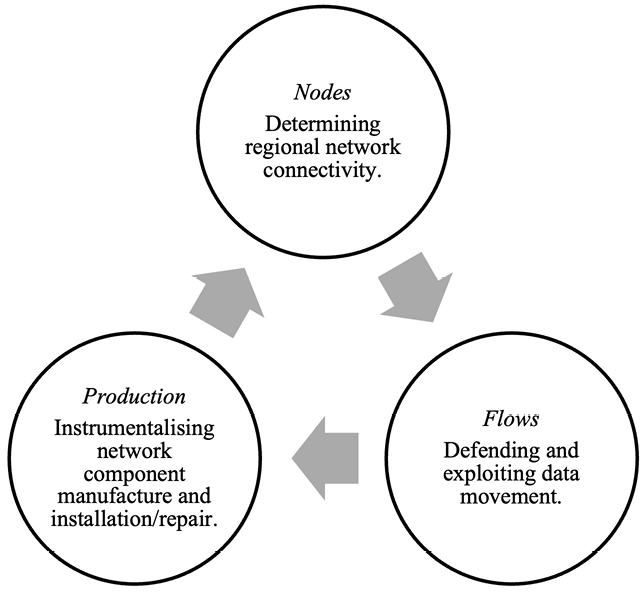
Nodes refers to the submarine cable network’s physical geography and chokepoint positioning. Specifically, nodes consist of the physical network, including landing station locations, cable routes and interconnection (branching) points. By influencing and controlling network nodes, states can determine the contours of data flows and include or exclude fellow states in global data flows. States can attain forms of network centrality by controlling network nodes – creating privileged positions for themselves and/or allies/partners in data flows and through excluding others. Importantly, nodes denote the physical architecture of data connectivity, and centrality or control can be leveraged for strategic or economic gain.
Flows denote the data stream which transits submarine cable networks, such as Internet traffic, AI inference, cloud data or government communications, transferred across international boundaries. Controlling data movement is significant for states, whether defending flows from interruption or sabotage or exploiting for espionage or signals intelligence purposes. In this sense, flows create both a vulnerability and an opportunity for states – and this aspect is driving states to adopt policies which enable better control over data transmission.
Production pertains to the entire submarine cable network supply chain, from materials and components to specialised installation and repair capacities. These firms and supply chains are significant as the owners, operators, builders and repairers of this infrastructure are primarily privately owned. Due to the concentrated nature of this specialised and sensitive industry, which operates at a global scale, many states are reluctant or unwilling to rely on suppliers headquartered in countries deemed politically untrustworthy. By developing sovereign or allied supply chain capacity, states reduce dependence on adversary suppliers for cable installation and repair, thereby avoiding vulnerabilities that could enable network exploitation.
These state imperatives are interconnected and are mutually reinforcing. For example, controlling nodes can better enable defence and exploitation of flows, and state influence over production can afford power over nodes. Section 5 employs this novel framework to analyse how various key Indo-Pacific states are attempting to attain positions of network centrality in submarine cable nodes, flows and production.
2.5 Conclusion
This section posited the analytical framework employed throughout this Element. Network-based competition illustrates how states compete for centrality in infrastructure networks, and weaponised interdependence demonstrates how these infrastructures can be exploited through the panopticon and chokepoint effects. My novel nodes-flows-production typology is a useful lens to understand how states in the Indo-Pacific are intervening in submarine cable networks, securing central network positions that reduce vulnerability but can create the structural conditions that risk weaponisation. The next section shifts focus to examine various suspicious cable incidents in Europe and the Indo-Pacific, which in combination have driven increased state intervention in this strategic communications domain.
3 Cable Breaks Abound: Accidental, Negligent or Malicious?
A spate of recent submarine cable incidents in Europe and the Indo-Pacific has revealed seabed insecurity as a renewed public policy concern. Whether in the Baltic Sea, the Red Sea or in the waters off Taiwan, these contemporary incidents share commonalities, including dragged anchors, plausible deniability or constrained and/or underwhelming responses from affected states. Although geographically dispersed, these incidents show how political instability or conflict on land can result in seabed insecurity. This section documents these important cases, demonstrating how these collectively foster conditions which are driving systematic state intervention in cable networks.
3.1 European Waters
While the European incidents occurred in the context of Russia’s hybrid warfare campaign against NATO states during the Ukraine conflict, rather than driven by Sino-US competition, these nonetheless illustrate how geopolitical rivalry can manifest as seabed insecurity, thereby generating the climate of uncertainty and fear that is driving new cable policies. Instances of suspectedFootnote 108 seabed warfare, which hadn’t taken place since the Second World War, emerged as a key security concern in many European capitals as acts of suspected cable sabotage abounded. While these cases occurred in European rather than Indo-Pacific waters – the subject of this Element – these cases are nonetheless relevant for several reasons. First, while occurring in Europe, these incidents made headlines globally, meaning relevant government and military officials across the Indo-Pacific would have been (at minimum) aware of the incidents. Second and relatedly, these incidents demonstrated to officials outside Europe how possible modern grey-zone seabed warfare tactics can play out and how submarine cables can be targeted, in the context of a major continental war, in this case between Russia and Ukraine. Third, these cases demonstrate the strategic and commercial impacts of multiple simultaneous cable breaks under suspicious circumstances. Fourth, Europe’s policy, legal and military responses illustrated to non-European states the options available to secure submarine cable networks, which could be adapted to local (in this case Indo-Pacific) contexts. Ultimately, I understand these European cases as a ‘harbinger’ for Indo-Pacific states, which have prompted new policy responses, as detailed in Section 4.
3.1.1 Svalbard: January 2022
In the lead-up to Russia’s full-scale invasion of Ukraine, the first seabed incident to rattle European capitals occurred. On 7 January 2022, the Svalbard Undersea Cable System, which connects Norway’s Svalbard Satellite Station and the Norwegian mainland, was partly severed. The Svalbard Satellite Station, the world’s largest satellite ground station and located in the Arctic Circle, enables various critical functions for NASA and the European Organisation for the Exploitation of Meteorological Satellites, as well as facilitating European Space Agency Earth observation and Galileo and Copernicus satellite operations. Norway’s Svalbard Archipelago is strategically located near Russia’s Northern Fleet (tasked with nuclear deterrence patrols) based at Severomorsk in the Kola Peninsula and could play a role in maritime anti-access/area denial operations in the Barents Sea and the North Atlantic in the event of conflict.Footnote 109 The incident severed one of the two 1,300 kilometre fibres connecting the satellite station, owned by Space Norway, forcing the cable operators to rely on the backup link.Footnote 110 Heavy trawling was occurring in the vicinity of the cable network at the time of incident.Footnote 111 In the incident’s aftermath, various analysts and journalists speculated about the possibility of foul play.Footnote 112 While police opened an investigation, no individual was charged, and the incident was never formally attributed. Despite Norwegian authorities’ failure to pin a culprit, this incident was the first of several suspicious incidents to occur in Europe since 2022.
3.1.2 Nord Stream: September 2022
On 26 September 2022, three explosions ruptured the Nord Stream 1 and 2 natural gas pipeline network which connected Russia to Germany through the Baltic Sea. While not a submarine telecommunications cable network, this incident is nevertheless relevant and detailed here as it was a prominent example of seabed warfare against seabed critical infrastructure in the Baltic Sea. This incident occurred in the context of Russia’s invasion of Ukraine involving tactics relevant to submarine cable protection. Moreover, the incident contributed to the perceived insecurity of seabed critical infrastructure globally – whether telecommunication cables or gas pipelines. Nord Stream 1 was opened in 2011 at a cost of US$8 billion, and Nord Stream 2 was completed in September 2021 (but never operated) at a cost of US$11 billion.Footnote 113 While the network was majority owned by Russia’s state-owned Gazprom, Western European energy firms had partnered and invested substantial sums in the gas network. News of the pipeline attack drew strong statements from European and world leaders. European Commission president Ursula Von der Leyen blamed the leaks as ‘sabotage’ and threatened that any attacks on Europe’s energy infrastructure would be met with the ‘strongest possible response’.Footnote 114 Then, US Secretary of State Antony Blinken called the incident ‘apparent sabotage’ and Mateusz Morawiecki, prime minister of Poland, added that the attack ‘probably marks the next step of escalation of the situation in Ukraine’.Footnote 115 Kremlin spokesman Dmitry Peskov dismissed any Russian involvement in the attack as ‘predictable, stupid and absurd’.Footnote 116
According to reporting in the Washington Post in June 2023, classified documents allegedly released by former Air National Guardsman Jack Teixeira as part of ‘The Discord Leaks’ show that the CIA and European intelligence agencies were aware of a Ukrainian plot to attack the gas pipeline network as early as mid-2022.Footnote 117 This revelation prompted Russia’s Deputy Head of the Security Council Dmitry Medvedev to state that ‘we [Russia] have no constraints – even moral – left to prevent us from destroying the ocean floor cable communications of our enemies’.Footnote 118 In early February 2024 Sweden concluded its investigation, citing a lack of jurisdiction, and Danish police concluded its case later that month, citing that while sabotage did occur, there existed no basis for a criminal case.Footnote 119 However, in mid-2024 Germany issued an arrest warrant for a Ukrainian diving instructor, whom it alleges sabotaged the pipeline with two fellow Ukrainian accomplices, although the Ukrainian government was not implicated.Footnote 120 While a gas pipeline and not a submarine telecommunications cable, the Nord Stream sabotage highlighted the vulnerabilities associated with Europe’s seabed critical infrastructure during conflict. Neither pipeline has been repaired.
3.1.3 NewNew Polar Bear: October 2023
Another European gas pipeline, as well as various submarine telecommunication cables, was damaged in another suspicious incident in October 2023. This time, on 8 October 2023 the Hong Kong-flagged and Chinese-owned NewNew Polar Bear cargo ship dragged its anchor in the Baltic Sea and severed the €300 million European Union-financed Balticconnector bidirectional natural gas pipeline, which traverses 77 kilometres of sea between Inkoo in Finland and Paldiski in Estonia. Simultaneously, the anchor severed various submarine cable networks, including the Kingisepp-Kaliningrad System (Baltika), owned by Russia’s Rostelecom and connecting St Petersburg through the Baltic Sea to the Russian exclave of Kaliningrad.Footnote 121 Also damaged was the Sweden-Estonia (EE-S1) cable network, owned by Arelion, GN Great Nordic and Telia Eesti, which connects Stavsnäs, Sweden with Kärdla and Tallinn in Estonia, and was operational in 1995.Footnote 122 Finally, one cable connecting Estonia and Finland owned by Internet service provider Elisa was also damaged on 8 October, although the exact cable was not disclosed.Footnote 123
In the incident’s aftermath, NATO Secretary General Jens Stoltenberg stated that if indeed the act was ‘proven to be an attack on NATO critical infrastructure … it will be met by a united and determined response from NATO’.Footnote 124 Finland’s Minister of European Affairs Anders Adlercreutz questioned how the NewNew Polar Bear’s captain could fail to realise he was dragging an anchor for hundreds of kilometres, adding that despite a lack of admissions, ‘I think everything indicates that it was intentional’.Footnote 125 Finnish authorities declared that the damage ‘could not have occurred by accident’ and appeared to be a ‘deliberate … external act’.Footnote 126 In August 2024, Chinese authorities in Beijing concluded a probe which found that indeed the NewNew Polar Bear did damage the gap pipeline and submarine telecommunication cables, but that the incident was accidental due to a ‘strong storm’.Footnote 127 While the submarine cables were rapidly repaired, the Balticconnector repairs took six months, and gas was again flowing in April 2024.
3.1.4 Yi Peng 3: November 2024
The subsequent incident to rattle Europe occurred on 17 and 18 November 2024, when two submarine telecommunication cables were severed under suspicious circumstances. During the incident, the Chinese-flagged bulk carrier Yi Peng 3 dragged its anchor while traversing the Baltic Sea, severing two submarine cable networks. The severed cables included the BCS East-West Interlink submarine cable which connects Sventoji, Lithuania with Sweden’s Gotland Island. The 218 kilometre cable was commissioned in 1997 and is owned by Sweden’s Arelion.Footnote 128 Also severed was the C-Lion1, owned by Finnish firm Cinia Oy and commissioned in 2016; this 1,172 kilometre cable connects Hanko and Helsinki in Finland to Rostock in Germany.Footnote 129 Following the incident, Germany’s Defence Minister Boris Pistorius told reporters that ‘we have to say, without knowing exactly who it came from, that this is a hybrid action. We also have to assume, without knowing it yet, that it was sabotage’.Footnote 130 According to the Swedish Prosecution Authority, ‘the offence is currently being investigated as sabotage’.Footnote 131
Rather than allow Yi Peng 3 to depart the Baltic Sea (as did NewNew Polar Bear in 2023), a Danish Navy ship pursued and intercepted the Yi Peng 3, and European warships surrounded the bulk carrier while investigations ensured. Investigators believed the Yi Peng 3 severed both cables by intentionally dragging its anchor for over 160 kilometres in mild sea and weather conditions.Footnote 132 While the Kremlin press office stated that allegations of its involvement in the incident are ‘absurd, unsubstantiated accusations’, the Wall Street Journal reported that various Western law-enforcement and intelligence officials understand a link exists – indeed the vessel was carrying Russian fertiliser and had just departed Russia’s Ust-Luga port prior to the incident.Footnote 133
Following a month-long diplomatic delay, on 21 December 2024 China allowed German, Swedish, Finnish and Danish investigators to board the Yi Peng 3,Footnote 134 which had anchored in the Kattegat strait between Sweden and Denmark. Later that day, Yi Peng 3 departed westward to resume commercial activity.Footnote 135
3.1.5 The Eagle S Incident: December 2024
While investigations into the Yi Peng 3 were ongoing, another incident occurred on Christmas Day 2024, during which the Cook Islands flagged oil tanker Eagle S fouled four submarine telecommunication cables as well as one submarine electricity cable in the Baltic Sea. After departing Russia’s Ust-Luga port (as did Yi Peng 3), Eagle S sailed westward through the Gulf of Finland within Finland’s Exclusive Economic Zone dragging its anchor.Footnote 136 The Eagle S’ anchor damaged several seabed infrastructures, including Estlink 2, a 650 megawatt, €320 million high-voltage power cable connecting Estonia and Finland, which was inaugurated in 2014 and connected Nordic and Baltic energy markets. Damaged also was the Finland–Estonia Connection 1 (FEC-1) and Finland–Estonia Connection 2 (FEC-2), both inaugurated in 2000 and owned by Finnish telecom Elisa, which connects Tallinn in Estonia and Helsinki in Finland. Both cable networks fouled by Eagle S were repaired by 7 January 2025.Footnote 137 Hong Kong-based CITIC Telecom International’s Baltic Sea Submarine Cable network was also fouled by the Eagle S. The Baltic Sea Submarine Cable network, inaugurated in 2000 and measuring 1,042 kilometres, connects Tallinn in Estonia, Helsinki in Finland and Stockholm in Sweden.Footnote 138 Lastly, C-Lion1, severed by Yi Peng 3 a little over a year earlier, was also fouled.
The Eagle S was formally seized by Finnish authorities on 26 December 2024. Finnish police and border guards commandeered the vessel and took charge of the bridge, holding it in Finnish territorial waters.Footnote 139 A Finnish court on 3 January 2025 rejected a request by the United Arab Emirates-based owners to release the vessel.Footnote 140 According to Estonian reporting, if the Eagle S was not stopped, its anchor would have impacted the Estlink 1 submarine power cable within half an hour and the recently repaired Balticconnector gas pipeline within the hour.Footnote 141 The Eagle S is thought to be part of Russia’s fuel tanker ‘Shadow Fleet’, which circumvents Western sanctions imposed associated with Russia’s war against Ukraine, bypasses Western insurance regimes, is usually ageing and is owned by obscure entities.Footnote 142 Finnish Prime Minister Petteri Orpo told reporters that this latest damage ‘underlies the danger of the [Russia’s] shadow fleet in the Baltic Sea’.Footnote 143 In June 2025, Finland’s National Bureau of Investigation concluded its investigation and charged the Eagle S’ captain, first officers and second officers with aggravated sabotage and aggravated interference with telecommunications,Footnote 144 but in October 2025 the charges were dismissed by a Helsinki District Court citing a lack of jurisdiction and questions of intent.Footnote 145
3.1.6 Europe’s Response
These cumulative incidents have dramatically heightened tensions in the seas surrounding Europe and have resulted in a variety of responses from individual European states and multilateral European organisations. Various European nations are incorporating seabed critical infrastructure protection into respective defence and national security strategies. For example, according to Ireland’s 2024 Defence Policy Review, the nation will place ‘an immediate focus on our maritime domain and the protection of critical undersea infrastructure’.Footnote 146 According to France’s 2022 National Strategic Review, the nation aims to better monitor and assess seabed activity to support France’s advanced submarine cable industry and indeed, in January 2025, the French government purchased Alcatel Submarine Networks (ASN) – a world-leading submarine network business – from Nokia.Footnote 147 In 2022 France also released a first-of-its-kind public Seabed Warfare Strategy.Footnote 148 The Netherlands’ 2024 Defence White Paper highlights Russian attempts at mapping North Sea underwater infrastructure and notes that ‘sabotage is suspected’ regarding the NewNew Polar Bear incident and its 2023 Security Strategy admits that ‘the increased dependence on the North Sea and seabed for critical infrastructure gives opponents more opportunities to disrupt our society in part or whole’.Footnote 149 According to the United Kingdom’s 2023 Defence Command Paper, its procurement of multi-role ocean surveillance vessels will ‘further enhance protection of the undersea and seabed infrastructure that is essential to the UK’s economic and energy security’.Footnote 150 The United Kingdom launched its Atlantic Bastion programme in December 2025, which will create a ‘hybrid force’ of autonomous vessels, AI and crewed platforms to defend submarine cables and pipelines.Footnote 151 Finland also considered seabed critical infrastructure in its 2024 Government Defence Report, noting that ‘the safeguarding of uninterrupted trade, incident-free maritime transport and undersea infrastructure is critical to ensuring the continued safety, security and functioning of society in Finland’.Footnote 152
At the multilateral level, NATO has launched a suite of initiatives to safeguard European seabed infrastructure. The NATO Critical Infrastructure Cell was stood up and held its first meeting in May 2024, at which NATO Secretary General Jens Stoltenberg noted that in response to Russia’s hybrid campaign, ‘the increasing dependency of our societies on undersea infrastructure means we need to do more to enhance their security’.Footnote 153 Also in 2024, NATO launched its Maritime Centre for the Security of Critical Undersea Infrastructure, an ‘operational hub’, based at NATO’s Maritime Command in Northwood, United Kingdom.Footnote 154 In January 2025 NATO launched ‘Baltic Sentry’ – a collaborative military activity to bolster NATO’s presence in the Baltic Sea to better defend seabed critical infrastructure.Footnote 155 As part of Baltic Sentry, a range of military platforms, including frigates, maritime patrol aircraft and naval drones, were deployed to improve NATO member countries’ ability to deter and respond to seabed critical infrastructure incidents, and in September 2025 the mission was bolstered by further assets after ‘unidentified drones’ were detected near Denmark’s military installations.Footnote 156 Also in January 2025, as part of Baltic Sentry, NATO announced TASK FORCE X, an initiative to better harness emerging technologies – including AI and autonomous systems – to better monitor and protect seabed critical infrastructure.Footnote 157
In February 2025, the European Commission published its ‘Joint Communication to Strengthen the Security and Resilience of Submarine Cables’, which announced initiatives focussed on cable incident prevention, detection, response and deterrence, and also detailed a proposal to establish a Cable Vessel Reserve Fleet.Footnote 158 European Commission executive vice president Henna Virkkunen stated that ‘we want to make sure Europe is equipped not only to prevent and detect sabotage to cables but also to actively deter, repair and respond to any threat to critical infrastructure’.Footnote 159 The bloc is also making significant investments in new submarine cable networks through its Connecting Europe Facility Digital programme, which by December 2024 had invested €420 million in submarine cable projects that link the EU and its immediate region.Footnote 160 Lastly, the Joint Expeditionary Force – a UK-led multinational partnership with various European militaries which pools and coordinates high-readiness military forces – has deepened cooperation on seabed critical infrastructure protection since 2023 and has jointly monitored European critical seabed infrastructure using ships and aircraft.Footnote 161 Notably, European states have focussed primarily on the physical threat of cable cutting and sabotage, rather than espionage. This dynamic contrasts with the predominant Indo-Pacific discourse, which is shaped by concerns about data interception and signals intelligence collection through cable infrastructure.
3.2 Indo-Pacific Seabed Insecurity
In the Indo-Pacific, cable insecurity has emerged across two distinct regions: the waters off Taiwan, where repeated incidents have been linked to Chinese-flagged vessels, and the Red Sea, where Houthi attacks on merchant shipping have imperilled critical intercontinental cable routes. These regions are addressed in turn.
3.3 Taiwan
Submarine cable networks are routinely fouled in the waters off Taiwan – especially cable networks which connect Taiwan’s outer islands located in the Taiwan Strait. Media reports have swirled for several years about suspicious damage to Taiwan’s submarine cable networks.Footnote 162 Indeed, according to one report, between 2019 and 2023 Taiwan recorded thirty-six cable incidents associated with its submarine cable networks.Footnote 163 As a result of these incidents – and China’s ongoing provocations against the state – Taipei is working actively to protect its digital seabed links.
Much of this cable insecurity is concentrated in the waters off Taiwan’s Matsu Islands. The second of two networks which connect Taiwan’s Matsu Islands was severed in May 2022, causing a ten-day Internet outage, relatively short due to the fact that repairs had already been arranged for the first fouled cable.Footnote 164 Then, in February 2023, two submarine cables which connect Taiwan’s outlying Matsu Islands were severed in a six-day period, first by a Chinese fishing vessel and subsequently by the anchor of a Chinese cargo ship.Footnote 165 The 13,000 residents of Taiwan’s Matsu Islands were effectively left without Internet access for 50 days until the first cable network was repaired, with severely limited connectivity provided by a microwave radio transmission system which prioritised critical government communications.
Further concerning incidents took place in 2025. On 3 January 2025, Taiwanese authorities briefly detained the Cameroon-registered vessel Shun Xing 39, suspecting it of dragging its anchor over – and as a result severing – the US-bound Trans-Pacific Express submarine cable.Footnote 166 Due to inclement weather, the vessel could not be boarded and subsequently departed Taiwanese waters. The vessel was thought to be owned by a Hong Kong firm linked to China and operating with a Chinese crew. According to Taiwan’s Coast Guard with reference to the incident: ‘we cannot rule out the possibility of a Chinese flag-of-convenience ship engaging in grey-zone harassment’.Footnote 167 Lloyd’s List Intelligence reported that the vessel indeed had three identities – Tanzania-flagged Xing Shun 39, Cameroon-flagged Shun Xing 39 and Cameroon-flagged Xing Shun 39 – a ‘deliberate deceptive practice’.Footnote 168
Just one month subsequent, on 25 February 2025, the Taiwan-Penghu No. 3 subsea cable system was severed. According to reports, the Togolese-registered and China-linked cargo ship Hongtai 58 (also known as Hongtai168) was anchored above the cable network for several days and did not respond to radio warnings to depart the cable grounds for fear of fouling the seabed networks.Footnote 169 The cable network was severed on 25 February 2025, and the Taiwanese Coast Guard swiftly intercepted the vessel, escorted it to Anping (on Taiwan’s south-west coast) and boarded, detaining its crew.Footnote 170 In response, Beijing accused Taiwan of ‘manipulating’ China’s involvement before the facts could be established.Footnote 171 Despite Beijing’s protests, in June 2025 a court in Taiwan convicted the ship’s captain to three years imprisonment for damaging the submarine cable network with an anchor, noting that ‘the impact is enormous, and the defendant’s actions should be severely condemned’.Footnote 172
As a result of these incidents, Taiwan is attempting to alleviate its dependency on submarine cable networks by investing in alternative data transmission methods. The country is pursuing advanced satellite systems and investing in its indigenous space industry.Footnote 173 As an interim measure, Taiwan has developed communications balloons, which Wu Cheng-wen, Taiwan’s science and technology minister, described as an ‘intermediate solution’ to restore emergency communications.Footnote 174 Improvements to Taiwan’s telecommunications legislation – which would boost prison sentences and fines for cable damage – were also pursued.Footnote 175 In October 2025 Taiwan launched a new global initiative to enhance submarine cable security, dubbed the Management Initiative on International Undersea Cables, also known as ‘RISK’ an acronym for risk mitigation, information sharing, systemic reform and knowledge building.Footnote 176 According to Taiwan’s Foreign Minister Lin Chia-lung, the initiative is a ‘global partnership’ and that Taiwan’s experiences ‘have taught us an important lesson – resilience cannot be taken for granted. It must be built through planning, implementation, and cooperation’.Footnote 177
It is unclear whether these concerning incidents involving submarine cables in Taiwan’s waters are accidental, negligent or malicious. Moreover, no concrete links have been made between these incidents and Beijing, or indeed the Baltic Sea incidents. Indeed, the waters off Taiwan are busy shipping routes, frequented by fishing and other commercial vessels and dredging is common. However, these incidents have been perceived by some as Chinese provocations, testing Taiwan’s resolve and response or the strength of the US–Taiwan relationship,Footnote 178 possible probes ahead of a future invasion.Footnote 179 Whether or not these beliefs are valid, the relatively high number of submarine cable incidents off Taiwan’s coats has contributed to a regional discourse of seabed insecurity, prompting defensive initiatives.
3.3.1 Red Sea
Another friction point for submarine cable networks on the periphery of the Indo-Pacific is the Red Sea. The Red Sea is a vital transit point for high-capacity cable networks connecting Asia, the Middle East, Africa and Europe. This narrow sea, connected to the Indian Ocean by the Bab al-Mandab choke point, is bordered by Yemen, Djibouti, Somalia and Eritrea. Soon after conflict returned to the Gaza Strip in October 2023, Yemen’s Houthi rebels instigated a crisis in the Red Sea by attacking transiting vessels with links to Israel. Since November 2023, over fifty Houthi attacks against vessels have been recorded by the US Department of Transportation, including unmanned aerial vehicle attacks, unmanned surface vehicle attacks, ballistic missile and cruise missile attacks, amongst other tactics.Footnote 180 In response, a twenty-four-nation coalition stood up Operation Prosperity Guardian in December 2023, which was tasked with ending the Houthi blockade and countering Houthi attacks against vessels transiting the Red Sea. Moreover, in January 2024 the US and UK coordinated air strikes against Houthi sites in Yemen.Footnote 181 The ongoing civil war and political instability in Yemen demonstrate how insecurity and volatility on land can deleteriously impact submarine data connectivity by delaying routine maintenance and emergency repair – with global implications.
On 24 February 2024, three major submarine cable networks reported faults in the Red Sea – the Asia Africa Europe-1 (AAE-1), Europe India Gateway (EIG) and the SEACOM/Tata TGN-Eurasia.Footnote 182 Coincidentally, just several days earlier on 18 February 2024, the Belize-flagged MV Rubymar was attacked by the Houthis while transiting the Red Sea. The vessel sank on 2 March 2024 – the first ship sunk by the Houthis during the crisis – and has subsequently been blamed by some for severing the submarine cable networks while drifting and dragging its anchor. According to US National Security Council spokesman John Kirby, ‘those cables were cut, most likely by an anchor dragging from the Rubymar as she sank’.Footnote 183 Despite this view, the precise cause of these cable faults has not been confirmed.
Following the MV Rubymar’s sinking, further high-capacity trunk cables were cut in 2024 and 2025. Despite being severed in February 2024 as above (and repaired by that July), the Asia Africa Europe-1 (AAE-1) cable was again severed in December 2024. Moreover, the PEACE submarine cable system was fouled in March 2025, also in the Red Sea. Then, in September 2025 four major subsea networks were severed in the vicinity of the Bab el-Mandeb Strait, including the South East Asia–Middle East–Western Europe 4 (SMW4), the India–Middle East–Western Europe (IMEWE), the FALCON GCX as well as the Europe India Gateway.Footnote 184 Microsoft’s widely used Azure cloud services were also disrupted by the cable outage.Footnote 185 According to one report, industry specialists attribute these outages to a commercial vessel’s dragged anchor, and subsequent repairs were slow.Footnote 186
For its part, the Houthis deny any efforts at disrupting cables, despite reports that a map of submarine cable networks in the Red Sea was posted to a Houthi-linked Telegram (messaging app) channel.Footnote 187 According to Yemeni rebel leader Abdel Malek al-Houthi, ‘we have no intention of targeting sea cables providing internet to countries in the region’.Footnote 188 Rather, the chief concern in the Red Sea is the inordinately long repair time required to fix fouled cable networks due to onerous Yemeni permitting requirements and the difficulty for repair crews to operate in conflict zones. While the most economical route between Europe and Asia, owners and investors of new cable networks are now avoiding the Red Sea, perceiving it as a ‘critical, high-risk single point of failure’, according to an industry insider.Footnote 189 This case demonstrates how conflict and political instability can disrupt these critical infrastructures, prolonging maintenance and repair.Footnote 190 As the Red Sea is a transit point for high-capacity intercontinental subsea networks, cable breaks in this region have a disproportionately detrimental effect on global data connectivity.
3.4 Conclusion
These incidents have transformed the public perception of submarine cable infrastructures from hidden data conduits to critical liabilities and targets. Europe’s spate of cable cuts, blamed on Russia’s hybrid operations, has prompted a militarised response, evidenced through NATO’s Baltic Sentry and respective national cable protection strategies. In the Indo-Pacific, repeated incidents off Taiwan indicate possible grey-zone Chinese activity, and Red Sea instability shows how conflict imperils global connectivity through repair delays. In sum, these incidents indicate that cables are vulnerable and that attributing incidents (legally or otherwise) can be challenging. While several major Indo-Pacific interventions preceded these incidents, these incidents since 2022 have validated early concerns and accelerated competitive positioning. The next section details key Indo-Pacific state policy responses that began in the mid-2010s and intensified following these incidents, showing how states compete for network centrality amid renewed recognition of cable vulnerability.
4 The Indo-Pacific Adapts
As China’s Digital Silk Road and expanding cable industry challenged Western dominance from 2015 onwards, cables re-entered Indo-Pacific strategic competition after decades of relative stability. The incidents documented in Section 3 validated these concerns and intensified policy responses. This section maps both early interventions and recent accelerations. This empirical section highlights how various key Indo-Pacific states and blocks are adapting to perceived submarine cable vulnerability and reshaping regional connectivity. I commence by examining early efforts by the BRICs grouping to lay its own submarine cable network. The analysis then turns to China’s various efforts at increasing its market capitalisation, including through the Digital Silk Road and state-subsidised industry. Efforts by Quad nations both collectively and individually are then examined, in addition to the Trilateral Partnership for Infrastructure Investment in the Indo-Pacific. The interventions this section analyses demonstrate network-based competition in operation, as Indo-Pacific states actively mould network topologies but create conditions that risk weaponisation as states seek to reduce respective vulnerabilities – interventions that can be understood across the nodes, flows and production dimensions (introduced in Section 2). While the nodes-flows-production typology provides analytical clarity, in practice these imperatives frequently overlap as the same initiative, or policy, can simultaneously pursue nodal control, flow security and production dominance. Section 5 untangles these dimensions.
4.1 BRICS
One of the first attempts at challenging Western submarine cable network dominance in the post–Cold War era was undertaken by the BRICS. The grouping, which then consisted of Brazil, Russia, India, China and Saudi Arabia (but has since expanded), in 2012 sought to construct a 34,000 kilometre submarine cable network, dubbed the ‘BRICS Cable’.Footnote 191 It was hoped that the BRICS Cable, expected to cost US$1.5 billion and operational by 2014, would better facilitate communications between the bloc and, in turn, promote trade and investment amongst the grouping. The BRICS Cable network would also better connect Africa (through South Africa) with BRICS member nations.Footnote 192 The proposed cable network was turbocharged in 2013 when US National Security Agency contractor Edward Snowden disclosed a cache of highly classified documents to the media, many of which overviewed how the United States and its allies monitor and intercept data flowing through submarine cable networks, a practice known as ‘upstream’ collection.Footnote 193 The Snowden Disclosures gave BRICS members another reason to pursue a submarine cable network – to safeguard data integrity by routing around US and Western signals intelligence collectors. According to analyst Lane Burdette, Brazil was a key proponent of the BRICS cable network, as the South American nation perceived an overreliance on US data routing.Footnote 194
In 2015 the BRICS cable idea was shelved. While the exact reason for the project’s failure is murky, some blame a lack of finances,Footnote 195 while others point to a lack of cohesion amongst the grouping.Footnote 196 According to scholar Daya Kishan Thussu, the BRICS Cable ‘would have been a symbolic act of di-Americanizing the infrastructure of the Internet’.Footnote 197 Although the BRICS cable never eventuated, BRICS leaders continue to prioritise digital infrastructure. According to the 2024 Kazan Declaration, member states are encouraged to ‘explore the possibility for joint activities in the field of digital infrastructure to ensure the integrity, stability of the functioning and security of national segments of the Internet’.Footnote 198 The failed BRICS Cable case demonstrates how both economic and security imperatives drove an attempt to intervene in the submarine telecommunication network ecosystem.
4.2 China
In this era of heightened international tensions, China is actively furthering regional connectivity via submarine cable networks in line with its national interest – as Beijing considers cable networks a security concern.Footnote 199 This section outlines China’s political-level strategy including its Belt and Road and Digital Silk Road strategies, its growing cable industry and how its illegal claim over the South China Sea is deleteriously affecting submarine cable connectivity for neighbouring nations.
4.2.1 The Digital (Information) Silk Road
While China consolidated its submarine cable connectivity projects under its Digital Silk Road in 2015 (part of the Belt and Road Initiative), many of the projects were already being pursued as part of China’s ‘informatisation’ efforts as well as via its ‘Digital China’ strategy.Footnote 200 The Belt and Road Initiative is China’s signature international development programme, which, according to scholars Colin Flint and Cuiping Zhu, is an effort at simultaneous ‘economic integration, regional influence, and global geopolitical competition’.Footnote 201 Informatisation refers to ‘the introduction of digital technologies and the leveraging of data and information to make more efficient all aspects of the economy and government’,Footnote 202 while ‘Digital China’, a core element of the nation’s 14th Five-Year Plan (published in 2021), furthered informatisation through accelerated digitised development.Footnote 203 Furthermore, the nation’s ‘Made in China 2025’ strategy (published in 2015) prioritised ‘internet infrastructure’, including accelerating the construction and development of fibre-optic networks.Footnote 204
Against this policy backdrop, China’s efforts at promoting submarine cable network resilience, connectivity and production beyond its borders are now consolidated under its Digital Silk Road initiative. Part of the Belt and Road Initiative (originally announced in 2013), the Digital Silk Road (announced in 2015) focussed China’s efforts on submarine cable network construction. According to its March 2015 official ‘Action Plan on the Belt and Road Initiative’:
We should jointly advance the construction of cross-border optical cables and other communications trunk line networks, improve international communications connectivity, and create an Information Silk Road. We should build bilateral cross-border optical cable networks at a quicker pace, plan transcontinental submarine optical cable projects, and improve spatial (satellite) information passageways to expand information exchanges and cooperation.Footnote 205
In 2017, China released its ‘Vision for Maritime Cooperation under the Belt and Road Initiative’ which emphasised promoting ‘maritime connectivity’ including submarine cable networks.Footnote 206 The vision highlighted the Asia Pacific Gateway (APG) cable network (NEC-laid which connects East Asia to Southeast Asia) as a completed project under the initiative. Also in 2017, China’s vice-minister at the Ministry of Industry and Information Technology, Chen Zhaoxiong, told attendees at the Fourth World Internet Conference in Wuzhen that as part of his nation’s Digital Silk Road, China’s ‘info-communications industry will not only pay attention to our own development, but also other countries across the world’.Footnote 207 From its inception, China’s approach to submarine cable network connectivity took a distinctly international rather than domestic character.
Several years subsequent, in 2022, China’s State Council Information Office published a White Paper articulating its international cyberspace agenda. According to the document, its top priority was information infrastructure construction, and the White Paper articulated how cable network projects contribute to improve connectivity amongst BRI participating countries.Footnote 208 According to the White Paper:
Chinese enterprises have provided support for many countries in constructing information and communications infrastructure, opening up digital information expressways for other developing countries. By laying cables and building base stations, China has helped expand the coverage of optical communication in these countries, giving a powerful boost to local telecommunications.Footnote 209
In recent years, China has declared its submarine cable network achievements as part of the BRI and the Digital Silk Road. In China’s October 2023 White Paper on its Belt and Road Initiative, the nation spruiked its Digital Silk Road achievements, including progress constructing various international submarine cables, without naming networks.Footnote 210 Also, according to a report published by China’s World Internet Conference in 2023, the US$290 million Asia Direct Cable (ADC) System, led by China Telecom but laid by Japan’s NEC, has been labelled a Belt and Road project.Footnote 211
Of note, while China’s cable network projects have primarily been intra-Asia, efforts at digitally connecting Africa are also a feature of China’s strategy. In July 2024, Jin Zhuanglong, China’s Minister of Industry and Information Technology spoke about China’s assistance to create a ‘digital Africa’ – which will include both submarine and terrestrial cable assistance.Footnote 212 In sum, although it is difficult to attribute cable networks directly to the nebulous Belt and Road Initiative or the Digital Silk Road, laying new submarine cable networks by Chinese firms is a cornerstone of China’s efforts at remaking global digital information flows as part of its flagship foreign policy initiative.
4.2.2 China’s Growing Cable Industry
To implement China’s efforts at increased market capitalisation globally, its primary submarine cable network firm is HMN Technologies (herein HMN Tech) – formerly Huawei Marine Networks, then a division of Huawei Technologies. Of the over 600 operational cable networks in 2025, 40 were supplied by HMN Tech (including under its former guise of Huawei Marine Networks).Footnote 213 While many HMN Tech networks are small domestic networks, large projects include the 25,000-kilometre PEACE Cable network which connects Singapore to France via Maldives, Pakistan, Seychelles, Kenya, Somalia, Saudi Arabia, Egypt, Cyprus, Malta and Tunisia. The firm was slated to lay the South East Asia–Middle East–Western Europe 6 (SeaMeWe-6) cable network until the United States government intervened in 2023, resulting in the contract being awarded to US-based SubComFootnote 214 and in response China planned a US$500 million cable network that would rival SeaMeWe-6.Footnote 215 Although HMN Tech’s footprint is global, no HMN Tech-supplied cable network connects India, Australia, the United States or Japan.
The firm has faced strong geopolitical headwinds. After rapidly gaining market share in the 2010s, the United States placed Huawei Technologies and many of its affiliates on its ‘Entity List’, which restricted the firms’ purchase of US-made parts and components.Footnote 216 In 2020, after sustained pressure against the firm by the United States, Huawei technologies divested Huawei Marine Networks, and an 81 per cent stake was acquired by Suzhou-headquartered Hengtong Group – a large Chinese optical fibre and power cable manufacturer. The firm was renamed as HMN Technologies (shortened to HMN Tech) and in a statement upon rebranding, the firm noted that ‘HMN Tech remains an independent joint venture entity with an independent board and management team’.Footnote 217 According to the firm, in the last 10 year it has participated in over 100 projects and constructed in excess of 60,000 kilometres of submarine cables worldwide.Footnote 218 An HMN Tech corporate video notes that ‘in the past decade, we have left our mark on the world’.Footnote 219
China is also a major regional hub for submarine cable repair capabilities. Cable repair capacity is concentrated in S.B. Submarine Systems (SBSS). Originally a joint venture between the Chinese government and UK-registered Great Eastern Telecommunications in 1995, in 2005 British-headquartered Global Marine Systems became a major stakeholder.Footnote 220 SBSS’ ships contribute to a regional consortium which repairs cables (including American) in the Pacific’s Yokohama Zone.Footnote 221 However, in mid-2024 SBSS was embroiled in international controversy after Wall Street Journalists accused the firm’s vessels of hiding location data and reported that US officials are warning telecommunication companies that SBSS crews could tamper with cables during repairs.Footnote 222 This scandal promoted SBSS to issue a public statement, noting that it operates honestly, transparently and legally and that it opposes the ‘generalization of a national security concept to suppress and discredit our company’.Footnote 223 Despite this, due to concerns over China’s ability to interfere with cable networks via SBSS (parent company is now China Telecom which is part of the state-owned China Telecommunications Corporation), Global Marine is reportedly divesting its stake in the Chinese firm.Footnote 224
4.2.3 South China Sea and Alternate Networks
Another way in which China is attempting to shape submarine cable network dynamics is through its contested control over the South China Sea. Specifically, China’s illegal claim over this strategic seascape is being pursued, in part, by denying cable installation and repair requests from non-Chinese firms.Footnote 225 Moreover, cable repairs in this relatively shallow sea are considerably delayed, and many applications are being rejected.Footnote 226 Vietnam’s subsea conduits have been particularly affected by China’s unlawful annexation of the South China Sea. In 2023, when all five of Vietnam’s submarine cable networks were severed, repairs took eight long months to complete. Moreover, in April 2024 a cable ship working within Vietnam’s Exclusive Economic Zone and escorted by a Vietnamese naval vessel was confronted by a Chinese coastguard ship demanding information about the cable ship’s work and loitering near the cable grounds.Footnote 227 As a result of China’s South China Sea claim and resulting interference in cable networks, non-Chinese installers are increasingly wary of working in this contested seascape, and many new submarine cable networks are, if possible, avoiding the sea altogether, for example, transiting the Indonesian Archipelago between Singapore and the Pacific Ocean – as discussed in more detail below. According to Mao Ning, a Chinese Foreign Ministry spokesperson, China ‘has always taken a welcoming attitude and supported other countries and telecommunications companies in laying international submarine cables in waters under China’s jurisdiction’.Footnote 228 However, evidence suggests this sentiment does not apply in the South China Sea.
China has moved quickly to secure its seabed lines of communication through high-level political strategies including the Digital Silk Road and through fostering a cable industry which can effectively lay and repair cable networks. While it’s difficult to ascertain the exact nature of the relationship between Beijing and its submarine cable industry or the relationship between the Belt and Road Initiative and claimed BRI-backed cable network projects, it’s clear that China has lofty ambitions for submarine cable connectivity and plans to dislodge the West’s cable primacy.
4.3 The Quad
The preceding analysis groups the United States, India, Australia, Japan and India under a Quad umbrella, as this grouping has centralised various submarine cable network security initiatives. As such, the preceding analysis will detail common Quad initiatives before shifting to focus on how each Quad state is progressing on submarine cable security issues unilaterally. However, the preceding analysis proves that the unilateral versus multilateral distinction can be ambiguous, and at the time of writing, many of these efforts are still latent. The Quad grouping first announced its plans to shape submarine cable networks in May 2023 via a new ‘Quad Partnership for Cable Connectivity and Resilience’.Footnote 229 At that time, according to a joint statement, the partnership was intended to ‘strengthen cable systems in the Indo-Pacific, drawing on Quad countries’ world-class expertise in manufacturing, delivering and maintaining cable infrastructure’.Footnote 230 As part of this partnership, Australia agreed to establish the ‘Indo-Pacific Cable Connectivity and Resilience Program’, later renamed the ‘Cable Connectivity and Resilience Centre’ and analysed below.Footnote 231
On 21 September 2024, Quad heads of state released ‘the Wilmington declaration’ at the fourth Quad Leaders’ Summit. In noting that ‘the Quad is here to stay’ and that ‘robust funding’ will be directed at Quad priorities, the Declaration celebrated the Quad Partnership for Cable Connectivity and Resilience’s successes, including Australia’s Cable Connectivity and Resilience Centre (outlined below), Japan’s provision of technical assistance in the Pacific, and the United States’ CABLES Program (outlined below) achievements.Footnote 232 The declaration noted plans to connect all Pacific Island nations with cable networks and that since the previous Quad Leaders’ Summit, US$140 million in cable network funding had been committed. The declaration noted that the leaders ‘underscore our commitment to an inclusive, open, sustainable, fair, safe, reliable and secure digital future’.Footnote 233
Several days later on 25 September 2024, a US-proposed statement titled ‘The New York Joint Statement on the Security and Resilience of Undersea Cables in a Globally Digitalized World’ was endorsed by Quad members, the UK and the EU, as well as Canada, the Federated States of Micronesia, Finland, France, the Marshall Islands, the Netherlands, New Zealand, Portugal, the Republic of Korea, Singapore, Tonga and Tuvalu. The ‘New York Statement’ acknowledged the criticality of submarine cable networks and society’s corresponding dependency and vulnerability. Endorsers agreed to a range of principles including resilient and redundant design, use of ‘secure and verifiable’ suppliers with clear governance and ownership structures, close industry and government coordination, better spatial and route planning, best practice sharing, third-country influence risk assessments, data risk mitigation frameworks and, finally, adherence to international law.Footnote 234 Of note, the New York Declaration articulated how submarine cable networks regard not only the length of submerged cable but are also part of a broader ecosystem, which includes elements related to ‘construction, operation, surveillance, maintenance and repair, such as landing stations, software, and the terrestrial parts of the submarine cable connecting to them, repair centers, as well as the fleet of deployment, maintenance and repair vessels’.Footnote 235
Announced in late 2024 were plans to create a ‘Quad Action Plan to Protect Commercial Undersea Telecommunications Cables’, although at the time of writing this action plan has not yet materialised. The Trump Administration’s approach to the Quad remains to be fully determined, though the grouping has continued to engage and the administration has not signalled an intention to abandon it.
4.4 United States
The United States deploys several strategies to further submarine cable networks in its national interest. This section overviews US strategy concerning cable security and its ‘Team Telecom’ before examining the US’ efforts at a cable repair fleet and its diplomatic efforts including the CABLES Program. At the time of writing, the impact of the Trump Administration on cable security policy issues is unclear. As is clear, the United States is a key player in subsea communications, and since 2018 has dramatically increased its efforts primarily at nullifying China’s efforts at increased market capitalisation and also at cable flow resilience.
4.4.1 Central and Foreign Strategy
At the strategic level, while not mentioning submarine cables specifically, the United States’ 2022 ‘National Security Strategy’ highlights technology as a core element of modern geopolitical competition – noting that ‘the digital backbones of the modern economy must be open, trusted, interoperable, reliable, and secure’.Footnote 236 The National Security Strategy also commits US Government investment in ‘high-quality digital infrastructure’ in the Global South.Footnote 237 Likewise, the 2022 US Indo-Pacific Strategy committed the nation to promoting ‘secure and trustworthy digital infrastructure’ in the region.Footnote 238 The Biden Administration’s March 2023 National Cybersecurity Strategy places a priority on international supply chains, noting how the US, in collaboration with partners and allies, will ‘implement best practices in cross-border supply chain risk management and work to shift supply chains to flow through partner countries and trusted vendors’.Footnote 239 In May 2024, the US Department of State published its ‘International Cyberspace & Digital Policy Strategy’ which listed enhancing submarine cable resilience and security as a specific priority line of effort.Footnote 240 According to US assessments, cable disruption and destruction due to accidents, natural disasters or hostile actions are a key vulnerability. Also, the strategy articulates how ‘choices made about which vendors to rely on for undersea cable infrastructure, maintenance, and repair operations can either drive development and innovation or lead to new forms of dependency and insecurity’.Footnote 241
Both the first Trump and subsequent Biden administrations implemented various diplomatic projects and initiatives which aimed at submarine cable security. Specifically, the Trump Administration launched its Digital Connectivity and Cybersecurity Partnership (DCCP) in 2018, which continued through the Biden Administration and concluded in 2024. Launched in July 2018 as a whole-of-government initiative with an initial US$25 million investment, the DCCP aimed to promote an ‘open, interoperable, secure, and reliable Internet’.Footnote 242 The DCCP has been associated with various submarine cable projects, including the Central Pacific CableFootnote 243 and submarine cable capacity in Bangladesh.Footnote 244
The Partnership for Global Infrastructure and Investment (PGI) was established in 2022 in partnership with the G7 and was dubbed the ‘G7’s flagship infrastructure and investment initiative’.Footnote 245 The fund aimed to collectively mobilise US$700 billion (US$200 million from the US) by 2027 for ‘sustainable infrastructure’, and by 2024 the United States had ‘mobilised’ US$60 billion through ‘federal financing, grants, and leveraged private sector investment’.Footnote 246 The US Department of State noted that ‘PGI offers a positive alternative to the models of infrastructure financing and delivery that are often opaque, fail to uphold standards, exploit workers, and leave the recipient countries worse off’.Footnote 247 When it comes to submarine cables, according to a White House statement in 2024, a US State Department’s US$15 million investment in Pacific Island cable networks is a PGI investment.Footnote 248
In addition, the Biden Administration’s 2022 Indo-Pacific Economic Framework for Prosperity (IPEF) economic initiative had an opaque role in supporting submarine cable initiatives. According to the US Trade and Development Agency (USTDA – which administers many cable development projects), US assistance for various submarine cable projects advances the IPEF, including networks in IndonesiaFootnote 249 and in Bangladesh.Footnote 250 In sum, the US Government included submarine cable network financing in various diplomatic and foreign assistance projects since 2018.
4.4.2 Team Telecom
Another key US initiative was the April 2020 Trump Administration’s formalisation, via executive order, of a bureaucratic group dubbed ‘Team Telecom’.Footnote 251 Based at the US Department of Justice’s National Security Division, Team Telecom’s members are derived from that department, as well as the Department of Defense and Department of Homeland Security.Footnote 252 Additionally, Team Telecom relies on a wide assortment of advisers, including the Secretaries of States, Treasury and Commerce, in addition to trade, intelligence, technology and White House representatives. This multidisciplinary team is tasked with advising the US Federal Communications Commission on law enforcement and national security considerations associated with telecommunications licences and telecommunications foreign ownership or control.Footnote 253 Concerning submarine cable security, Team Telecom is responsible for reviewing applications for new or transferred international telecommunication services to or from the US and for new or transferred submarine cable landing licences. While this initiative was officially country-agnostic, FCC Commissioner Brendan Carr singled out China upon its formalisation in April 2020, stating:
The President’s committee will have a full docket, and near the top of it, I recommend that the committee examine every carrier owned by the Chinese government that now connects to networks here in the U.S.—including China Unicom and China Telecom.Footnote 254
4.4.3 Industry and the Cable Security Fleet
The United States has had a vibrant domestic submarine cable industry for many years. Its flagship submarine cable firm is SubCom. Established in 1955, SubCom has laid and deployed over 200 subsea systems which would traverse Earth over 21 times. The firm has a close working relationship with the US Government and military and played a key role in the US Cable Security Fleet. In 2019, US Congress passed a bill to establish a Cable Security Fleet which would consist of privately owned, US-documented and commercially viable ships ‘to meet national security requirements’ associated with submarine cable repair.Footnote 255 The legislation appropriated US$10 million per year (US$5 million per vessel per year) to be spent during fiscal years 2021 to 2035 inclusive and stipulated US citizenship requirements for owners and operators.Footnote 256 The Cable Security Fleet was implemented by the US Department of Transportation’s US Maritime Administration and two SubCom-owned ships were acquired for the programme – CS Dependable which operated in the Pacific Ocean, and CS Decisive which operated in the Atlantic.Footnote 257 However, in 2022 the Department of Transportation (DoT) defunded the Cable Security FleetFootnote 258 and in 2024 the Biden Administration cut funding for the initiative. According to retired US Navy Captain Douglas R. Burnett, while Congress recognised the pressing national security need for the CSF, ‘DoT opposition is tied to bureaucratic complacency, outdated misconceptions of modern international communication technology and potential disruptive impacts, and an unexplained view that protecting cables is not important or is a problem for others’.Footnote 259 Republican Senator Ted Cruz voiced his dismay in August 2024 at Biden’s decision to cut funding for the CSF, arguing, ‘The security of undersea cables depends on having access to these “trusted” ships for maintenance and repair of cables, rather than relying on foreign-flagged repair ships sometimes owned by foreign adversaries, which may be recalled to their home countries or otherwise pose risks and reliability concerns during conflict.’Footnote 260 It is unclear whether the Trump Administration will reinstate the CSF.
4.4.4 CABLES Program
Another line of US Government effort to shape global submarine cable network dynamics is the Department of State’s CABLES Program. Established and implemented by US-based connectivity and digital infrastructure consultancy APTelecom, the CABLES Program utilises its US$5 million budget to build regional capacity and provide technical assistance to regional submarine cable network stakeholders. According to the US International Cyberspace & Digital Policy Strategy, the Cables Program works ‘throughout the East Asia Pacific region, responsibly informing essential telecommunications and cables infrastructure stakeholders of the perils of choosing untrusted suppliers’.Footnote 261 While public details are scarce, the CABLES Program is primarily a diplomatic effort at dissuading foreign telecommunications officials from contracting Chinese firms associated with submarine cable networks.
In sum, the United States’ efforts primarily revolve around defending its dominant position in the submarine cable market from China while its efforts at a sovereign cable repair capacity have stalled. In addition to these formal initiatives, recent press reports also note how the United States lobbies foreign officials against using Chinese vendors for submarine cable networks. According to reports, the United States lobbied Vietnam to avoid Chinese suppliers and also lobbied firms planning to lay trans-Pacific cables to route around the South China Sea.Footnote 262 Reuters reports that American lobbying efforts on consortium members of the SeMeWe-6 cable successfully flipped the project from HMN Tech to SubCom.Footnote 263 While the Trump Administration was re-inaugurated in 2025, his Administration has not implemented any unique programmes which secure submarine cables specifically, despite various executive orders pertaining to maritime strategy, maritime energy and seabed mining.Footnote 264 In combination, the United States has pivoted since 2018 and is now actively defending its position as a market leader in submarine cable network installation.
4.5 Australia
While a middle power in Indo-Pacific strategic affairs, Australia plays an active role in submarine cable network security in this new geopolitically charged environment. Indeed, for several decades Australia has enforced submarine cable ‘protection zones’ off its western and eastern coasts. Although legislative improvements could be made, these zones, which criminalise a range of actions which damage or could foul submarine cable networks,Footnote 265 are nevertheless viewed as an international ‘gold standard’ and a legislative model which other states could adapt and adopt. As these protection zones were enacted primarily to deter accidental and negligent seafaring practices – rather than to respond to seabed warfare and geopolitical competition – this section will instead focus on Australia’s Cable Connectivity and Resilience Centre as well as its ‘Australian Infrastructure Financing Facility for the Pacific (AIFFP)’ – both established to thwart China’s forays into the submarine cable market and promote Internet connectivity in line with Australia’s security interests. Indeed, according to its ‘2023–2030 Australian Cyber Security Strategy’, connectivity and cyber resilience in the Indo-Pacific can be consolidated through submarine cable infrastructure investments.Footnote 266
4.5.1 Australian Infrastructure Financing Facility for the Pacific
The Australian Infrastructure Financing Facility for the Pacific, part of Australia’s Department of Foreign Affairs and Trade, was announced in November 2018 and operational in July 2019. The AIFFP partners with Indo-Pacific states and private entities to invest in a range of infrastructure across the Pacific (plus Timor-Leste), including energy, water, transport and telecommunications. According to the AIFFP, the facility designs and delivers ‘high impact, safeguarded projects’,Footnote 267 which has included a range of submarine cable network infrastructure.
The AIFFP was established in tumultuous times and was an initiative implemented under Australia’s ‘Pacific Step-up’ – in part a response to Beijing’s increasing influence amongst Pacific island nations. Identified in Australia’s 2017 Foreign Policy White Paper, support for Pacific island nations was prioritised, as Australian foreign policy officials admitted that ‘like all great powers, China will seek to influence the [Indo-Pacific] region to suit its own interests’.Footnote 268 In 2018, Australia’s then foreign minister Julie Bishop claimed that China was engaging in ‘dept trap diplomacy’, whereby Pacific island states were being ‘trapped into unsustainable debt outcomes’, adding that the ‘trap can then be a debt-for-equity swap and they have lost their sovereignty’.Footnote 269
Since its inception and with a budget of AU$2 billion, the AIFFP has been Australia’s vehicle for cable infrastructure financing, via both grants and loans. Of the 20 projects listed online at the time of writing in 2026Footnote 270 as either ‘completed’ or ‘signed and announced’, six pertain to submarine cable network infrastructure projects (see Table 1). As Table 1 illustrates, Australia’s projects avoid Chinese suppliers, favouring American, Japanese and Australian firms. It also demonstrates the collaborative nature of Australia’s submarine network investments, including Quad nations, as well as New Zealand and Taiwan in some instances.
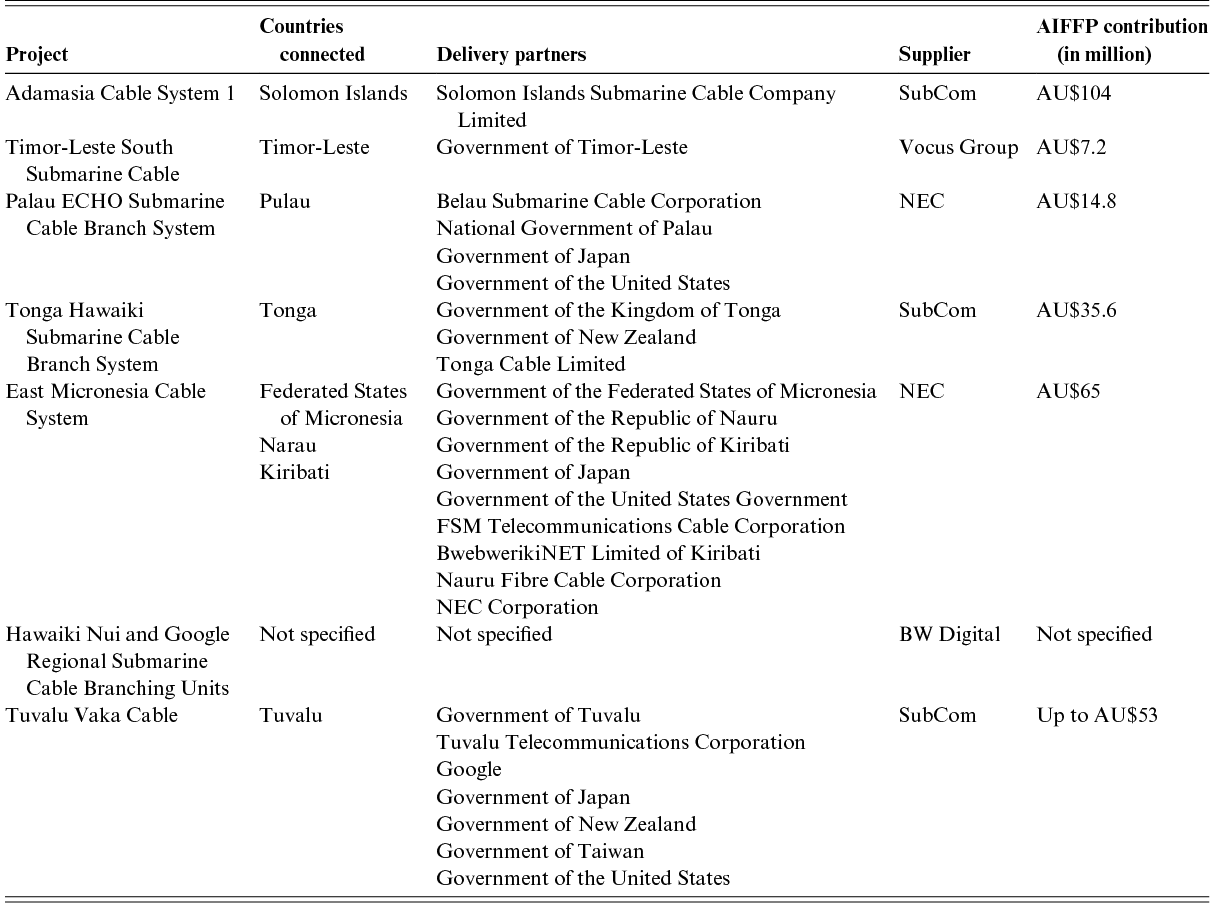
Table 1 Long description
Data mentioned is as follows. The table contains columns labelled Project, Countries connected, Delivery partners, Supplier, and AIFFP contribution. It summarises submarine cable network infrastructure projects supported through the Australian Infrastructure Financing Facility for the Pacific (AIFFP).
Adamasia Cable System 1 connects the Solomon Islands. Delivery partner: Solomon Islands Submarine Cable Company Limited. Supplier: SubCom. AIFFP contribution: AUD$104 million.
Timor-Leste South Submarine Cable connects Timor-Leste. Delivery partner: Government of Timor-Leste. Supplier: Vocus Group. AIFFP contribution: AUD$7.2 million.
Palau ECHO Submarine Cable Branch System connects Palau. Delivery partners: Belau Submarine Cable Corporation, National Government of Palau, Government of Japan, and Government of the United States. Supplier: NEC. AIFFP contribution: AUD$14.8 million.
Tonga Hawaiki Submarine Cable Branch System connects Tonga. Delivery partners: Government of the Kingdom of Tonga, Government of New Zealand, and Tonga Cable Limited. Supplier: SubCom. AIFFP contribution: AUD$35.6 million.
East Micronesia Cable System connects the Federated States of Micronesia, Nauru, and Kiribati. Delivery partners: Government of the Federated States of Micronesia, Government of the Republic of Nauru, Government of the Republic of Kiribati, Government of Japan, Government of the United States Government, FSM Telecommunications Cable Corporation, BwebwerikiNET Limited of Kiribati, Nauru Fibre Cable Corporation, and NEC Corporation. Supplier: NEC. AIFFP contribution: AUD$65 million.
Hawaiki Nui and Google Regional Submarine Cable Branching Units connect unspecified locations. Delivery partners not specified. Supplier: BW Digital. AIFFP contribution not specified.
Tuvalu Vaka Cable connects Tuvalu. Delivery partners: Government of Tuvalu, Tuvalu Telecommunications Corporation, Google, Government of Japan, Government of New Zealand, Government of Taiwan, and Government of the United States. Supplier: SubCom. AIFFP contribution: up to AUD$53 million.
‘Investment Map’, Government, The Australian Infrastructure Financing Facility for the Pacific, 2025, www.aiffp.gov.au/investments.
4.5.2 Cable Connectivity and Resilience Centre
Under the Quad umbrella, in July 2024 Australia launched its Cable Connectivity and Resilience Centre. With a budget of AU$18 million over a four-year period and an Indo-Pacific-wide mandate, the Cable Connectivity and Resilience Centre will commission policy-relevant research and analysis to inform regulations, policy development and decision-making, provide training and technical assistance, and share information between governments and industry, including by hosting international dialogues.Footnote 271 According to Australia’s Foreign Minister Penny Wong, the Centre’s ‘work is integral to the prosperity and security of our region’.Footnote 272 As of 2026 the Centre has hosted a series of workshops across the Indo-Pacific on cable network futures, has funded several research projects and has appointed EY, a consulting firm, to implement its programme of work.
4.6 Trilateral Partnership for Infrastructure Investment in the Indo-Pacific
Another grouping formed to support submarine cable projects (amongst other infrastructure developments) is the Australia–Japan–United States ‘Trilateral Partnership for Infrastructure Investment in the Indo-Pacific’. This partnership, between the Australian Department of Foreign Affairs and Trade, the United States Overseas Private Investment Corporation (OPIC), and the Japanese Bank for International Cooperation, was announced in July 2018.Footnote 273 According to the joint statement, the three nations expressed ‘the belief that good investments stem from transparency, open competition, sustainability, adhering to robust global standards, employing the local workforce, and avoiding unsustainable debt burdens’.Footnote 274
The partnership’s first project, announced in October 2020, was the US$30 million Palau spur cable.Footnote 275 The spur was designed to connect Palau to the Meta and Google-owned (NEC built) Echo cable, which will connect Singapore, Jakarta, Guam and California via the Indonesian archipelago, thus avoiding the South China Sea. The Echo Cable is scheduled for completion in the fourth quarter of 2025 and will be Palau’s second submarine cable connection. Other submarine cable projects funded under the partnership include the NEC-supplied East Micronesia Cable System, which will connect Tarawa (Kiribati), Kosrae (Micronesia) and Yaren (Naru) to Pohnpei (Micronesia) – which has an existing link to the SubCom-laid HANTRU1 Cable System that connects to the Pacific Ocean cable hub of Guam.Footnote 276 The East Micronesia Cable System has an estimated cost of AU$135 million and is scheduled for completion late 2025. According to one senior US official commenting on the East Micronesia Cable System, ‘secure and resilient digital connectivity has never been more important’.Footnote 277
In sum, Australia, the United States and Japan have mobilised this new multilateral grouping to tackle regional submarine cable connectivity gaps by subsidising cables in the Pacific Ocean, thereby thwarting China’s attempts at laying networks via HMN Tech.
4.7 Japan
Tokyo has made various unilateral efforts to further submarine cable resilience, regional connectivity and supply chain security in line with its national interests. Industrially, Japan’s NEC is a leading submarine cable network player and has laid over 400,000 kilometres of subsea cable globally, with close ties to the Japanese Government. In 2008, NEC acquired OCC Corporation (Ocean Cable & Communications) which manufactures optical submarine cables domestically in Japan.Footnote 278 This acquisition reportedly took place amid concern within NEC that China’s Huawei would acquire the strategically important Japanese cable manufacturer.Footnote 279 In July 2024 then US Secretary of State Antony Blinken visited NEC’s Tokyo headquarters, where he was briefed on a range of technologies, including submarine cable technologies. Blinken noted to the press that ‘the leading edge work that [NEC] are doing on undersea cables and communications systems … are the future for digital communications’, lauding NEC as a ‘trusted vendor’.Footnote 280 However, according to NEC President and CEO Takayuki Morita in 2025, the Japanese government provides little assistance to NEC amid global competition, noting that ‘we are the only one fighting with no support’.Footnote 281 Amid this discontent, in late 2025 reports emerged that Tokyo may support NEC to acquire a cable installation and repair fleet – pending approvals.Footnote 282
Tokyo has also announced a range of submarine cable network initiatives, but implementation has been patchy. In 2021, Prime Minister Kishida Fumio announced plans to create a subsea ‘Digital Garden City Superhighway’ which would encircle Japan, economically revitalise Japan’s regions and be part of Tokyo’s Digital Garden City Nation vision.Footnote 283 While this project was expected to be completed by 2025, the originally proposed new submarine cable network is yet to be installed. In addition, in 2022, Tokyo announced it will spend US$440 million to geographically decentralise submarine cable-landing stations and data centres, citing both economic and security justifications.Footnote 284 In early 2025, Nikkei Asia reported that Japanese ministries are planning to support capital investment in subsea networks and subsidise investment in cable laying vessels.Footnote 285 In foreign relations beyond the Indo-Pacific, Tokyo inked an MoU with the European Union on 3 July 2023 to further ‘secure, resilient and sustainable global connectivity’, although the agreement did not commit either side to any specific joint projects.Footnote 286 Japan’s Ministry of Economy, Trade, and Industry in April 2025 announced that submarine cable policy would be integrated into its purview.Footnote 287 Despite intentions, Tokyo’s efforts at intervention in the submarine cable network market have largely focussed on subsidising regional networks, and unilateral cable resiliency efforts have yielded mixed results at the time of writing. Nevertheless, these efforts to date demonstrate Tokyo is motivated to better secure its cable networks, even if implementation has been uneven.
4.8 India
Despite India’s Quad membership, the key South Asian state is currently prioritising its submarine cable security over promoting regional resilience.Footnote 288 New Delhi’s telecommunications regulators are encouraging the nation’s cable operators to invest in a sovereign India-flagged repair capacity, to diversify the geographic spread of cable landing locations and to connect coastal Indian cities (and new data centres) via domestic submarine cable networks.Footnote 289 Despite these policy priorities, India currently lacks any regional strategy for cable connectivity in either the India Ocean or the wider Indo-Pacific and does not currently invest in cable networks for neighbouring nations. According to a September 2024 joint Quad statement, India recently commissioned a feasibility study to assess expanding ‘undersea cable maintenance and repair capabilities in the Indo-Pacific’.Footnote 290
Opportunities exist for India to foster a domestic submarine cable manufacture capacity – whether by encouraging Indian firms or inviting foreign entities to establish factories. Furthermore, at least publicly, India has not articulated how its national security apparatus will respond to the increasing instances of seabed warfare or how India will protect the cable networks beyond its EEZ. According to scholar Jagannath Panda, while India’s key role in the emerging Indo-Pacific security architecture is clear, the country should integrate submarine cable networks into its regional deterrence strategy, especially vis-à-vis China.Footnote 291 In comparison to its Quad partners, India is the least active player in submarine cable network intervention and currently focusses its efforts on domestic rather than regional initiatives. Like Japan, despite patchy implementation to date, India’s efforts nevertheless demonstrate that New Delhi is taking the security of its cable networks seriously, working internally through policy options for future implementation.
4.9 Conclusion
This empirical mapping proves systemic yet evolving state competition in the Indo-Pacific to control cable networks. China’s Digital Silk Road is pitted against the more fragmented Western counter-measures, as each side seeks to exclude respective rivals and reduce respective vulnerability by securing a favourable network position. Other initiatives detailed, including Australia’s AIFFP, the US’ Team Telecom and the Trilateral Partnership show how states mobilise diplomatic and financial tools to dictate network topologies. However, various of these efforts remain challenging to implement, such as the US’ Cable Security Fleet, Japan’s resiliency initiatives and India’s repair strategy. This variation may reflect varying state capacities, threat perceptions, and industrial bases – rather than an absence of competitive dynamics. While this section has focussed on major and selected middle powers, smaller Indo-Pacific states are also navigating this competition, whether as increasingly active cable policy actors or as policy takers caught between competing US and Chinese connectivity offers. A fuller treatment of these states’ responses remains an important avenue for future research. Nevertheless, the subsequent fifth section categorises these responses within a nodes-flows-production typology, showing how key Indo-Pacific states compete for structural positions which lessen dependency risk, which simultaneously create conditions which could be weaponised.
5 The Nodes-Flows-Production Contest
Major powers in the Indo-Pacific are responding in a variety of ways to submarine cable network competition in this era of heightened Sino-US geopolitical competition. Drawing on cases from the preceding empirical sections, this final analytical section examines and categorises state imperatives to intervene in submarine cable networks, positing three broad categories – nodes, flows and production (see Figure 3). While some overlap exists between these three categories, this distinction is a useful lens to understand how network-based competition is operationalised in the Indo-Pacific – how states control regional network nodes, how flows are defended and exploited and how production is secured. The following analysis interweaves network-based competition perspectives to better illustrate how states are responding to this renewed, perceived seabed connectivity threat and to illuminate various implications for international relations as states are driven to pursue network centrality.
5.1 Nodes
In the Indo-Pacific, funding, laying and operating new and existing regional submarine cable networks is a key battleground between the United States and China. I argue that control over regional connectivity is a key state imperative and is driving network competition in the Indo-Pacific. Control is exerted through influencing network geographical contours (including cable routes and landing station locations), through selecting installers and facilitated through new bureaucratic infrastructures. Major Indo-Pacific powers such as the United States, China and India, plus middle powers such as Australia, are relatively sufficiently connected with commercially viable networks and can veto any ‘untrusted’ suppliers which intend to connect respective shores. As such, emphasis is placed by these wealthier nations on intervening in regional connectivity – submarine cable networks that connect regional neighbours. Ultimately, states are sovereign and can decide on the nature and variety of respective connections; however, pressure and subsidies by powerful states can influence network characteristic choices. Immense efforts are being undertaken by great and middle powers to dictate regional connectivity – the network’s nodes.
As this Element has outlined, submarine cable connectivity is vital for economic growth and global competitiveness, for national security, as well as for the functioning of modern digital societies. As demand for bandwidth from states, businesses and societies grows, submarine telecommunication networks provide the only reliable, stable and cost-effective method of data transmission between continents and islands. Despite advances in satellite data transmission capacities, submarine cables remain the backbone of modern information flows. Moreover, cable connectivity is expensive, and new projects require either a strong business case to attract investors or be subsidised/funded through a state (often through a state-owned telecommunications company). Alternatively, submarine cable network projects are funded (to varying degrees) by multilateral institutions, including the World Bank and the Asian Development Bank. Therefore, nodal connectivity refers to efforts by states to influence the contours of new regional cable networks and to influence the choice of suppliers (as distinct from supply chains). In exerting influence over regional connectivity projects, restricting adverse suppliers is usually a high priority and a method of exclusion.
In this context, an underlying motivation behind initiatives like the Digital Silk Road and the Trilateral Partnership for Infrastructure Investment in the Indo-Pacific is to exclude rivals. Exclusionary policies by the United States and its allies are designed to perpetuate the West’s central role in submarine cable networks and to hobble attempts by China to make inroads. Conversely, China’s ambitions in the cable market are designed to dislodge the West’s central position in digital connectivity and build alternative competing networks. Due to the immense costs associated with submarine cable network design, installation and operation, many smaller countries are forced to make a choice between these competing poles, which naturally excludes the losing side from the infrastructure network. Network exclusion diminishes regional influence, which in turn diminishes relative power. Hence, excluding rivals from new subsea networks has considerable strategic implications for both the winners and losers.
Moreover, states are dictating network geographical characteristics, including landing points (such as deciding which states and cities are to be connected) and routing (such as avoiding hostile or unstable zones) which can create or alleviate dependencies. For example, China has effectively locked the South China Sea to non-Chinese subsea fibre projects by enforcing onerous permitting requirements in that region. As a result, various new trans-Pacific cable projects from Singapore to the United States are transiting the Indonesian archipelago rather than the South China Sea. By influencing cable routes, states can pursue strategic connections and exclude rivals. As a result, submarine cable networks help to bolster trade, military or diplomatic ties between a state and states connected to the network.
In order to pursue network centrality in submarine cable nodes, new bureaucratic infrastructures have been established to rapidly respond, intervene and exclude rivals. As the previous section illustrated, a range of new multilateral initiatives and (intra)governmental groupings have been created to better control new network nodes. For example, the United States established its Digital Connectivity and Cybersecurity Partnership, plus the Partnership for Global Infrastructure and Investment in part to establish its strategic position in subsea networks. Likewise, Australia rapidly stood up the Australian Infrastructure Financing Facility for the Pacific in addition to the Cable Connectivity and Resilience Centre to further its influence over regional subsea network connectivity. Moreover, multilateral architecture, including the Trilateral Partnership for Infrastructure Investment in the Indo-Pacific is a Western attempt at maintaining its strategic position in cable networks and excluding alternative Chinese networks. China too has launched its Digital Silk Road in 2015 with a view to enhancing its centrality in subsea networks for strategic reasons. In this new era, states are investing directly or through multilateral arrangements in new regional cable networks.
As a result of this new bureaucratic architecture that has been established since 2015, in several cases new submarine cable network projects are being determined by strategic state investment and subsidies rather than commercial and market dynamics. Moreover, this new bureaucratic architecture is resulting in swifter and more discrete state intervention than was the case in the late 2010s and early 2020s. For example, international diplomatic controversies ensued in 2016 and 2020 when Chinese firms were set to win submarine cable installation contracts in the Solomon Islands, and then Kiribati, Micronesia and Narau, respectively. In both of these cases, Western nations stepped in to thwart Chinese bids, in the process establishing bureaucratic infrastructure which has since been mobilised to subsidise or fund regional cable networks before China can mount a compelling offer. Moreover, these bureaucratic architectures are not being implemented unilaterally but are being coordinated amongst partners for maximum effect. As outlined in an earlier section, the Trilateral Partnership for Infrastructure Investment in the Indo-Pacific combines American, Japanese and Australian state capital to circumvent China’s cable network-laying ambitions and advance collective nodal control amongst like-minded democracies.
By intervening in regional submarine cable network design, states are able to both exert regional influence and promote respective notions of ‘data integrity’. Just as states invest in physical infrastructure in developing states to build influence, centrality in physical submarine cable networks is likewise used as a tool of statecraft and as a source of power. Functioning cable networks can be used as a tool of geopolitical leverage, of economic control, of soft power and of technological standards leadership. For many small islands and less developed states which receive a subsidised or externally funded cable network, continued access to the data conduit is often an existential issue. Concurrently, by intervening in network nodal connectivity, middle and great powers can dictate network security, thereby setting and enforcing rules and standards. Specifically, states can ensure networks avoid hostile states (and associated territories) which could gain physical or digital access to the network or subject the network to undue monitoring. While these network infrastructures may not be otherwise commercially viable, by subsidising or investing in networks directly, powerful states can determine routing decisions to accommodate respective national security imperatives.
As outlined, states are increasingly intervening in new submarine cable network designs to further visions of regional connectivity, according to respective national interests, which can create the conditions for weaponisation. As these connectivity ideals are sometimes not commercially viable, states are increasingly subsidising and investing to better control future network contours. This competition to control the contours of subsea digital connectivity positions states for future possible leverage. Simply put, in this era of heightened geopolitical competition, Indo-Pacific great and middle powers are vexed by the contours of new regional submarine cable networks and how centrality in these networks can be used to further a favourable balance of power.
5.2 Flows
The second imperative driving states to intervene in the global submarine cable ecosystem is flow control – defending the data that transits submarine cable networks from accidental, negligent and intentional incidents. Moreover, flow control can also result in weaponising data flows and exploiting these transmissions for strategic purposes – as Farrell and Newman describe as the ‘panopticon effect’ – which is ‘the ability to glean critical knowledge from information flows’.Footnote 292 The digital interconnectedness afforded by submarine cable networks results in both strategic benefits and also strategic vulnerabilities. Even though the overwhelming majority of cable faults occur due to accidents, negligence and natural phenomena, in this era of heightened geopolitical tensions between China and the United States, the fear of hostile cable incidents and espionage is driving state intervention.
Unlike strategies to intervene in network nodes (as articulated above), Indo-Pacific nations have been slow and/or reluctant to articulate public strategies to defend submarine cable networks. While counterparts in Europe – both nation-states and regional organisations such as NATO and the European Union – have publicised investment into cable protection strategies, states in the Indo-Pacific have thus far been reluctant to likewise articulate defensive plans against hostile actions.Footnote 293 This reluctance is due to the lack of suspicious seabed incidents which have taken place in the Indo-Pacific, compared with the various high-profile suspicious examples in Europe this Element has detailed. While in late 2025 Australia’s Chief of Navy said publicly that the loss of Australia’s submarine cable networks would be an ‘existential threat’,Footnote 294 the country’s 2024 Civil Maritime Security Strategy does not consider the particulars of seabed critical infrastructure,Footnote 295 and Australia’s 2024 National Defence Strategy likewise does not engage with seabed lines of communication.Footnote 296 Moreover, little is publicly known about the offensive seabed warfare and cable disruption plans of Indo-Pacific nations – information which is a closely guarded secret.
Nevertheless, Indo-Pacific states are pursuing network flow resilience through various softer strategies, including advisory functions and best-practice strategies. For example, the multilaterally endorsed ‘New York Joint Statement on the Security and Resilience of Undersea Cables in a Globally Digitalized World’, as noted above, advocates for submarine cable network design prioritising ‘resilience, redundancy, and security’, in addition to ‘spatial and route planning to promote coordinated use of seabeds, protect cables from natural or man-made hazards, ease chokepoints, and reduce risk of inadvertent disruption while expanding global connectivity’.Footnote 297 Likewise, the United States’ Office of Economic Security, the Supply Chain Resilience Center, and the Cybersecurity and Infrastructure Security Agency collaboratively published a report in 2024 titled ‘Priorities for DHS [Department of Homeland Security] Engagement on Subsea Cable Security & Resilience’, which advocates for better public–private coordination and streamlined permitting, licencing and regulation, in addition to clearer emergency management and incident response arrangements.Footnote 298
Moreover, the International Cable Protection Committee (ICPC), which has an extensive membership primarily consisting of industry players in addition to key governments and public agencies including the governments of Australia and India, plus the US Navy and China Telecommunication Corporation, advocates for effective submarine cable security and resilience amongst governments globally. The ICPC’s flagship ‘Government Best Practices for Cable Protection Resilience’ publication is a guide for public officials to security cable networks, advising best practices across key issues including fishing and anchoring risks, seabed spatial separation, charting, domestic protective legislation frameworks, government points of contact, regulatory ease of repair, critical infrastructure designation and data sharing.Footnote 299 Through joining and supporting the work of the ICPC, these key Indo-Pacific governments and agencies are attempting to further the resilience and security of global subsea connectivity through public policy advocacy.
Exploiting submarine cable flows in the modern era is likewise little understood publicly due to security classification barriers but, nevertheless, drives submarine cable flow policies and explains why states pursue centrality. The Snowden revelations in 2013 laid bare how submarine cable landing stations can be sites of monitoring and signals intelligence collection. Indeed, cable networks presumably remain a key enabler of data interception and signals intelligence collection in the modern era, although details are difficult to ascertain. Securing flows can be understood by the ‘panopticon effect’, which articulates how control of network infrastructure can permit data monitoring. In this sense, China’s efforts at installing an alternate network of submarine cables – via its Digital Silk Road – can be posited as a push to simultaneously escape the West’s panopticon, and perhaps enable its own.
Securing cable flows from disruption is currently the least developed imperative for Indo-Pacific states, unlike for European counterparts. This perceived latency is due to a lack of urgency in the Indo-Pacific to actively defend these networks and hampered by a methodological difficulty to ascertain how militaries are preparing for seabed warfare due to security classification restrictions. We cannot assume that just because Indo-Pacific states do not publicly link undersea warfare capability development with submarine cable protection, that these seabed infrastructures are being neglected by militaries. However, this public sluggishness may be strategic rather than permanent. As future cable incidents occur in the Indo-Pacific, these soft governance mechanisms outlined above may be deemed inadequate, and submarine cable defence may be formalised and publicised.
5.3 Production
The third imperative driving states to intervene in the submarine cable ecosystem is perceived production and supply chain vulnerabilities. As this Element illuminates, supporting sovereign or allied cable network suppliers is a foremost consideration when considering new networks. States can hobble hostile suppliers through sanctions, through onerous permitting requirements, by avoiding particular firms in new projects and by banning cables landing within jurisdictions. In this context, supply chains refer not only to the raw materials and components which make up cable networks but also to repair capacities and sovereign industry capabilities. Assured access to cable network materials, components, expertise and repair capabilities is fundamental in driving resilience and connectivity, as outlined above.
Submarine cable networks consist of many materials and components. The average length of cable alone consists of a range of materials, including (from outside in) tar-soaked nylon yarn, galvanised armour wires, nylon yarn bedding, polyethylene insulator, copper sheath, ultra-high strength steel wires, buffering material (plastic/steel) and silicone gel, before ultimately the optical fibres.Footnote 300 Most cables are also powered to operate underwater repeaters, utilise branching units and Reconfigurable Optical Add/Drop Multiplexers, and landing stations require a range of specialised equipment. The origin and sources of these materials and components are being increasingly scrutinised. States are increasingly aware of these supply chain issues to ensure availability in a crisis. Fears over inbuilt backdoors and compromised equipment also drive supply chain scrutiny. As submarine cable networks have been key sites of signals intelligence collection and espionage, concerns over technically compromised equipment abound.
States’ fears of being strategically dependent on others for these key components and materials are driving policy responses and intervention. By extension, many major and middle powers are attempting to onshore or ‘friendshore’ submarine cable manufacture and operation capabilities or support existing sovereign industry.Footnote 301 American efforts at obstructing China’s submarine cable industry are evidenced through its addition of Huawei Marine Networks in 2020 to the ‘entity list’, resulting in its divestment from Huawei and phoenixing as HMN Tech under a new parent company.Footnote 302 After the United States successfully thwarted HMN Tech’s bid to install the intercontinental SeaMeWe-6 cable network, China’s foreign ministry issued a statement noting that the United States ‘should stop fabricating and spreading rumours about so-called “data surveillance activities” and stop slandering and smearing Chinese companies’.Footnote 303
Sovereign cable repair capacity has become an issue of interest and action amongst Indo-Pacific states. While cable resilience in peacetime is largely managed by the private sector, conflict would entail a new set of considerations. As this Element has illuminated, during conflict submarine cable networks and associated installation and repair vessels become a target as maintaining network uptime is paramount. Ensuring submarine cable network resilience during a conflict would take a coordinated approach from military assets, coastguard vessels, cybersecurity specialists, the cable industry and policy coordination departments. Militaries and coast guards would be required to defend not only military seabed infrastructure but also civilian telecommunications cables, which would likewise be targeted during a confrontation. As submarine cable networks have not been targeted in a full-scale conflict since the Second World War (when telegraph cables were linking the globe), how optical fibre cables would be targeted (e.g. kinetically or virtually) and affect the outcome of a war is uncertain. However, in today’s digitally interconnected society, targeting submarine cable networks during a conflict would have devastating ramifications for the populations and communities affected. During a conflict, whereby flows of goods and services are interrupted and cables are targets, a sovereign cable industry would be a vital component of national power. From an American perspective, analysts Daniel F. Runde, Erin L. Murphy and Thomas Bryja argue that ‘the overreliance on Chinese [cable] repair ships due to limited alternatives in the marketplace is another vulnerability if, during a time of military conflict, the Chinese government prohibits access to its repair ships’.Footnote 304
Submarine cable repairs are generally coordinated and undertaken through cable maintenance zone agreements, which pool cable repair ships within specified maritime areas or individual maintenance contracts. While these agreements have operated largely successfully for many years, many states are increasingly concerned about the availability of these vessels in a crisis and a state’s inability to dictate repair priorities. While submarine cable repair hubs (docks and depots) and repair ship flags have been decided by commercial factors, geopolitical factors are changing the geography of these repair infrastructures. States are increasingly attempting to intervene in submarine cable repair arrangements in order to dictate repair prioritisation, such as the (now defunded) United States Cable Security Fleet, China’s involvement in S.B. Submarine Systems and India’s feasibility studies into sovereign repair fleets. Also, by controlling cable repair infrastructures, these services can be shared with partners and be used as a tool of statecraft while also mitigating the possibility that cable engineers interfere with submarine cables while undertaking repairs or introduce backdoors or otherwise compromise the networks.
By supporting the production of sovereign and/or friendly submarine cable network supply chains, these firms can be instrumentalised by states and be incorporated as an element of statecraft – the possible limitations of which are engaged with in Section 6. Due to the close relations these firms have with respective governments – including financial – an alignment with national security objectives is expected. As a result, states could leverage respective firms to further national security objectives and implement defence and foreign policy agendas with geopolitical implications. As a result, there emerges a blurring between the commercial and security logics which drive submarine cable network design and maintenance. While in the post–Cold War era cable networks were largely driven by commercial considerations, geopolitical factors are increasingly dictating network dynamics, including supply chains and industry considerations. In sum, submarine cable supply chains, whether they be materials or components, the cable industry or repair capabilities, are being increasingly scrutinised by states seeking greater control. By controlling the supply, states can ensure sovereign oversight of these critical infrastructures and improve connectivity on respective terms, simultaneously furthering geopolitical goals of attaining or maintaining network centrality.
5.4 Conclusion
In the Indo-Pacific, efforts at network centrality are driving state intervention into submarine cable network nodal control, flow rule and production dominance. Indo-Pacific states have made considerable efforts to control network nodes through subsidies and bureaucratic infrastructure – evidenced by China’s Digital Silk Road and Western competing initiatives. These initiatives secure network positions that reduce vulnerability to adversary control. In contrast, efforts at controlling flows have remained relatively mild in the Indo-Pacific, as states focus on softer governance and advisory resilience initiatives to date, rather than military responses (at least articulated publicly). Despite this, the panopticon effect, and ability to monitor data traffic, does explain the value in, and efforts to, control network flows. Controlling production is a significant line of effort amongst Indo-Pacific states, which can blur the line dividing security and commercial logics. This analysis demonstrates how states in the Indo-Pacific compete for network centrality to mitigate vulnerabilities, though structural competition creates conditions that risk weaponisation – echoing Farrell and Newman’s warning. However, limitations to this weaponisation possibility exist, which are engaged in the following concluding section.
6 Conclusion: The Seabed and Indo-Pacific Security
As Sino-US competition revolves around network centrality – and the global order continues to fracture – submarine cable networks will remain a focus of geopolitical competition. States in the Indo-Pacific are adapting to this age of heightened geopolitical competition and securing seabed lines of communication accordingly. As I outlined in this Element, various key Indo-Pacific states have already adapted policies to maintain centrality in submarine cable networks, and further steps are expected in the coming years. As these networks are vital to the functioning of our modern digital societies, maintaining uptime on ‘trusted’ subsea networks is a paramount national security consideration for many leaders. According to historian Richard Dunley:
In wartime, arguably more than at any other time, information is power. It is through this lens that we must view the global submarine cable network. Cutting and tapping cables is important, but these tend to be the acts of a disruptor. Western nations [and indeed all major powers] need to think once again about how they would exploit their control of the global commons in time of war to control the global communications infrastructure, and the knowledge that flows across it.Footnote 305
This Element first outlined the historical progression from the telegraph era to modern optical fibre networks, finding that submarine cable networks are perceived as vulnerable as these networks rapidly transmit information between continents and islands, geographically traverse maritime and coastal zones, and physically constrict and aggregate information flows through limited chokepoints. Second, after outlining modern Sino-US competition over technological primacy, I posited network-based competition and weaponised interdependence frameworks, and articulated a novel policy typology to analyse how Indo-Pacific states are responding to seabed insecurity. Third, this Element analysed a range of contemporary cable cuts and suspicious incidents in both the Indo-Pacific (Taiwan and Red Sea) and extra-regionally (Baltic Sea) to illustrate why submarine cable security is now receiving renewed policy attention. Fourth, this Element focussed on how key Indo-Pacific states and the Quad are responding to perceived submarine cable insecurity, primarily across foreign and defence policy domains. The final analytical section posited a novel nodes, flows and production framework to understand and examine the goals of various Indo-Pacific states and how these efforts point to a network-based competition model through which interdependence could be weaponised. The competition I illustrated in this Element over submarine cable networks is a microcosm of broader Sino-US competition centred around networks – whether digital, infrastructural, capital or production.
This Element examined how states are pursuing network centrality to reduce vulnerability in seabed digital connectivity, rather than whether these efforts are successful. Indeed, according to Gjesvik, private corporations can ‘resist state attempts at weaponization’.Footnote 306 According to Gjesvik:
The ability of states to reach into, mobilize, and benefit from their centrality in the network has therefore weakened as corporations gain in relative strength. The strong position of the market players in turn affords them greater agency to pursue their own interests, that are often at odds with the interests of states.Footnote 307
Gjesvik captures an inherent tension and highlights that despite state attempts to control these networks, success may be limited by corporate interest and market dynamics. However, Gjesvik’s views, using trans-Atlantic cables as a case study, may not give adequate weight to the tools states have available, including landing licences, national security legislation, entity lists and direct subsidies. Indeed, the ability of a state to mobilise respective central positions in networks will be limited to a degree by the network owners and/or operators. Likewise, states will be limited by the imposition of technical and geographical realities, for example, fibre optic cables are more difficult to clandestinely tap without access to landing stations, fibre optic networks can more easily re-route data to avoid single-point disruptions, and the Indo-Pacific’s vast geography and correspondingly distributed cable routes are more challenging to patrol than the Baltic Sea. As a result, network-based competition is both intensifying yet constrained, as fierce competition ensues to control networks that perhaps cannot be fully managed.
Competition to lay and operate rival submarine cable networks raises questions over ‘bifurcation’ of the Internet – meaning the creation of distinct and disconnected American- and Chinese-led Internets. However, while potentially causing nominal data transfer delays, analysts Jocelinn Kang and Jessie Jacob note that due to the Internet’s ‘circuitous’ nature in which data is ‘dynamically reroute[d]’, such network bifurcation will have a ‘minimal impact’ on network performance.Footnote 308 Ultimately, despite a potential lack of direct connections between China and the United States, for example, data will still flow via intermediaries. However, as Dwayne Woods and Junda Li argue, this bifurcation, articulated as the ‘proactive reshaping of network topologies by states seeking to mitigate these very vulnerabilities’ is not adequately considered by the weaponised interdependence framework.Footnote 309 Indeed, even if submarine cable network bifurcation has a negligible technical effect on global data transfer between these two blocs, the existence of two networks challenges the panopticon effect and reduces dependency vulnerabilities as competitors build and use respective ‘trusted’ networks. This Element has highlighted these various efforts in the Indo-Pacific, supporting Woods and Li’s contention that the potential for interdependence to be weaponised is slowly leading to subsea network bifurcation.
According to Schindler and colleagues, when Sino-US competition is centred on network centrality, ‘it is very difficult to imagine either side achieving a resounding victory’.Footnote 310 Victory will remain elusive as smaller states can pursue strategies of ‘omni-alignment’ and resist choosing sides.Footnote 311 When it comes to cable networks, smaller states can hedge, for example, permitting HMN Tech to install some networks and Western firms to install others. Moreover, the choice of submarine cable network supplier origin can differ from alignment in other networks – whether it be finance, infrastructure or production. How third states respond to Sino-US competition for network centrality will influence which pole dominates. As this competition progresses, winners and losers can be identified.
How the second Trump Administration perpetuates intervention in submarine cable networks and pursues network centrality, amid its efforts to disengage globally, is at the time of writing still unclear. According to Winecoff, the US could give up its structural power through ‘malintent and/or short-sightedness’, warning that while ‘the United States possesses network prominence now [writing in 2020]. In the 21st century it should prioritize good stewardship of it’.Footnote 312 However, Trump is not stewarding the United States’ leading global role, and future researchers should monitor how Trump’s non-traditional foreign and national security policies play out on the seabed.
One key technological factor that will determine the future of the Indo-Pacific’s submarine cable networks and corresponding Sino-US competition is sensing technology. A range of new sensing technologies are being installed on submarine cable networks, which I overviewed briefly in the preceding sections. These new sensing technologies have the potential to further network resilience by enabling real-time network monitoring, which means that negligent or malicious actors can be interdicted before cable damage occurs. These technologies can also streamline repairs by better pinpointing fault locations and assisting to more efficiently schedule maintenance before outages occur. However, these sensors can also monitor the seabed and underwater domain and can provide useful intelligence to militaries pertaining to surface and subsurface vessel movements and other events. By turning submarine telecommunication cables into sensing networks, these cables may become more vulnerable in a conflict as the infrastructures take on a distinct military value.
This Element has provided a succinct analysis of Indo-Pacific submarine cable geopolitics and posited a novel typology to understand how competition over this distinct infrastructure is regionally generalisable, under a network-based competition model. Nevertheless, this study faced limitations. Notably, due to the sensitive nature of undersea warfare, security classifications restrict our understanding of how Indo-Pacific states are adapting to seabed insecurity, vis-à-vis cables. Likewise, commercial sensitivities limit available data pertaining to network dynamics and state-industry relations. Moreover, the focus on Indo-Pacific dynamics inherently limits detailed comparisons with other regions, including Europe, in which seabed insecurity is perhaps more acute. Also, this Element has focussed on middle and major powers in the Indo-Pacific at the expense of smaller nations, including those in the Indian Ocean, Southeast Asia and the Pacific, which collectively have considerable influence to determine which pole succeeds in attaining a more prominent position of network centrality. Lastly, as the months and years progress, Indo-Pacific state submarine cable policy responses will continue to mature and evolve as future seabed incidents occur – meaning this study is but a preliminary examination of this fast-moving policy domain.
Further in-depth study is needed to better understand how conflict has played out on the seabed historically, the often-opaque relations between governments and respective submarine cable industries, the new geographies of future networks, the corresponding future repair requirements, and how other states are adapting. As the seabed becomes more congested, further instances of seabed warfare take place (whether confirmed or suspected), civillian cable networks become seabed sensors and great powers funnel ever more money into respective cable industries, Indo-Pacific seabed connectivity will remain at the forefront of Sino-US strategic competition. As geopolitical tensions heighten across the Indo-Pacific, cable policy will no longer be the domain of telecommunications and foreign policy agencies, but coastguards and navies will play an increasingly prominent role – as is happening in Europe. As China and the United States (and partners) compete for centrality in submarine cable networks, these nations should operate deftly so as to not weaponise the very networks these states are attempting to secure.
Acknowledgement
I’d like to acknowledge the excellent research assistance undertaken by Mr Shengzhe (Toby) Shen, Miss Tilly Robson, Mr Oscar Youlten and Ms Inès Carlier who contributed to the research of this Element. Thanks are also due to colleagues who reviewed earlier versions of this Element, including Dr David Brewster and Dr Anthony Bergin. This Element was written as part of the Australian Department of Defence-funded Strategic Policy Grant Program project ‘2024-053: Defending Critical Seabed Infrastructure’, which I lead through the University of Melbourne. The ideas put forth in this Element are solely my own and do not reflect Australian Department of Defence policy or the policy of any other department, agency or organisation. All errors remain my own.
Kai He
Griffith University
Kai He is Professor of International Relations at Griffith University, Australia. He has authored or co-authored six books and edited or co-edited six volumes. Among his notable works are Institutional Balancing in the Asia Pacific (Routledge, 2009), China’s Crisis Behavior: Political Survival and Foreign Policy (Cambridge, 2016), and After Hedging (Cambridge Elements in International Relations in 2023).
Steve Chan
University of Colorado Boulder
Steve Chan is College Professor of Distinction (Emeritus) at the University of Colorado Boulder. His publications include twenty-five books and about two hundred articles and chapters. His most recent book is Culture, Economic Growth, and Interstate Power Shift: Implications for Competition between China and the United States (Cambridge University Press, 2024).
Rumi Aoyama
Waseda University
Rumi Aoyama is Professor at the Graduate School of Asia-Pacific Studies at Waseda University, and director of Waseda Institute of Contemporary Chinese Studies. Her publications include thirteen books and more than one hundred and fifty articles and chapters. Her book, Contemporary China’s Foreign Policy [Gendai chuugoku no gaikou] was honored with the 24th Masayoshi Ohira Foundation Memorial Prize.
Advisory Board
Amitav Acharya, American University
Dewi Fortuna Anwar, National Research and Innovation Agency (BRIN), Indonesia
Mely Caballero-Anthony, Nanyang Technological University
Rosemary Foot, University of Oxford
Evelyn Goh, Australian National University
Deborah Larson, University of California, Los Angeles
T. V. Paul, McGill University
Yan Xuetong, Tsinghua University
About the Series
Elements in Indo-Pacific Security publishes original and authoritative works on diverse security topics, encompassing not only traditional issues of war and peace but also emerging concerns such as space competition and climate change. It also explores interactions among actors within this region and between them and others beyond it.
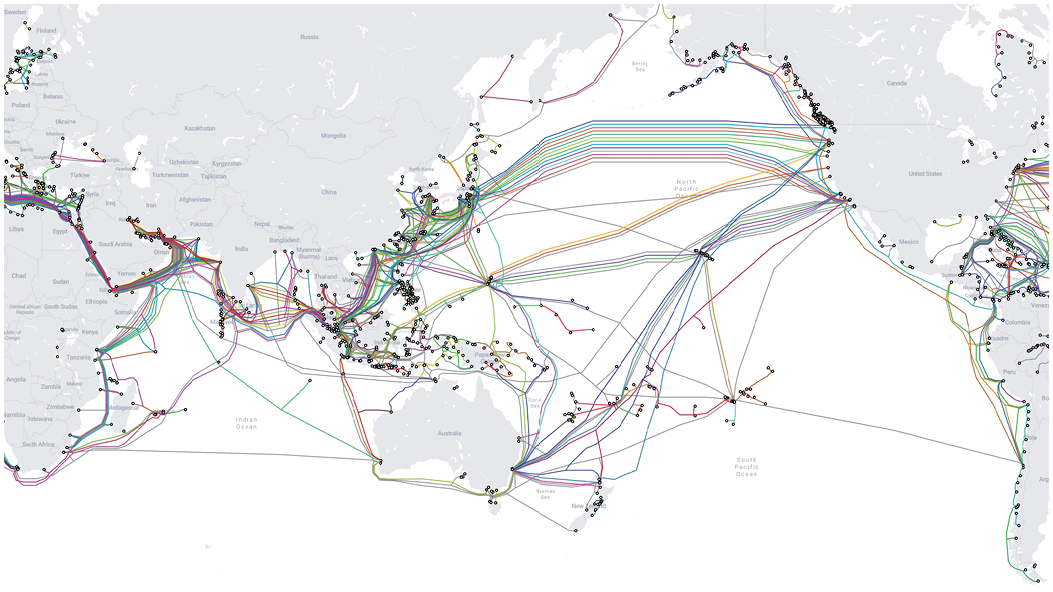
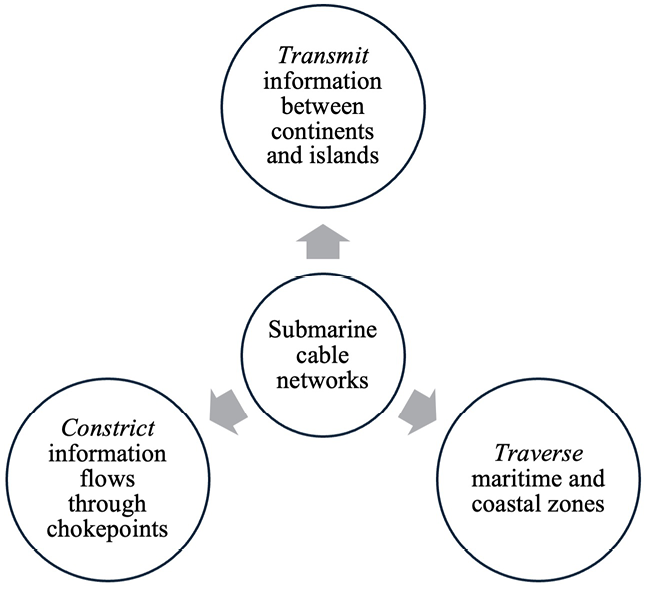
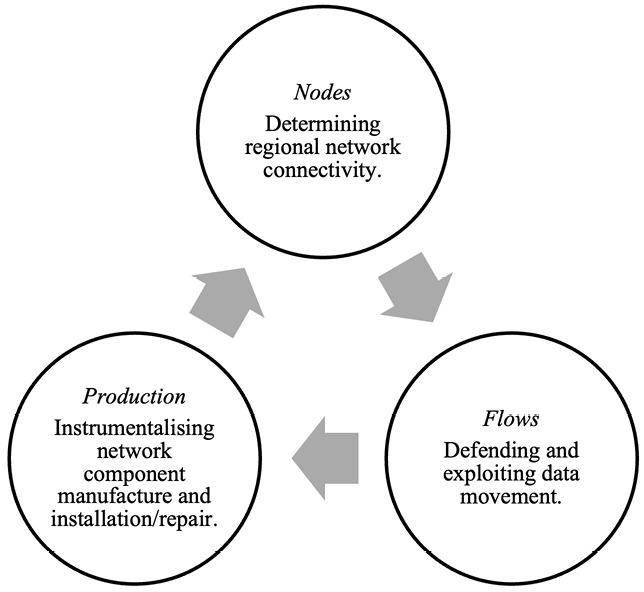
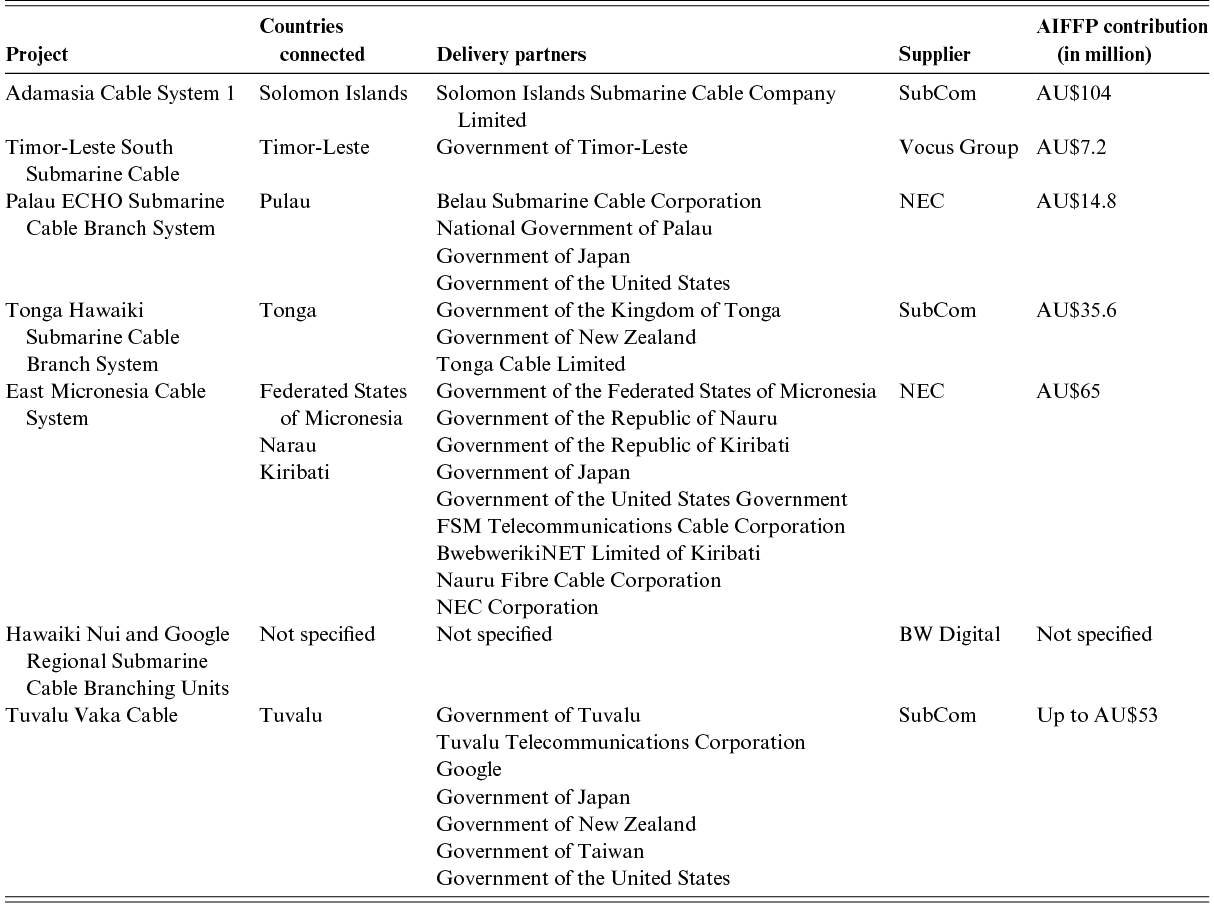

 Open access