

1. Introduction
This paper presents the first detailed investigation of the tonal patterns of the previously undocumented San Juan Piñas variety of Mixtec (henceforth SJPM; also known as Tò’ōn Ndá’ví), spoken in the Santiago Juxtlahuaca municipality of Oaxaca, Mexico, as well as in diaspora communities in Mexico and the United States. We provide a description and analysis of the lexical and grammatical tonal systems of this language, how these systems interact with each other, and how they interact with other grammatical aspects of the language. We show that SJPM offers a number of new insights into tonal variation within Mixtec languages, and contributes to our broader typological and theoretical understanding of tone, grammatical tone systems, and lexical-grammatical tone interactions.
A long tradition of documentation of tonal systems of Mixtec language varieties, spanning several decades since Pike’s (Reference Pike1944, Reference Pike1948) seminal work, reveals a great amount of complexity and diversity: typically analyzed as involving a tripartite tone contrast, most Mixtec languages permit a greater number of tones on individual syllables compared to other Oto-Manguean languages (see DiCanio & Bennett Reference DiCanio, Bennett, Chen and Gussenhoven2021 for an overview). These languages also exhibit complex tone sandhi systems, but individual varieties differ in terms of the nature and number of tone sandhi patterns attested (Pike Reference Pike1948, Pankratz & Pike Reference Pankratz and Pike1967, Josserand Reference Josserand1983, Dürr Reference Dürr1987, Daly & Hyman Reference Daly and Hyman2007). We propose that the tonal system of SJPM is best described with three underlying tonal primitives, a H tone, a L tone, and a M tone, which may surface as level tones or in rising contour tones associated on single morae in complex lexical tone patterns. In addition, SJPM exhibits a high number of tonal processes, some of which we detail in this paper. While other Mixtec varieties are analyzed with all surface M tones as underspecified underlyingly as /Ø/ (Daly & Hyman Reference Daly and Hyman2007, Carroll Reference Carroll2015), we propose that SJPM possesses a contrast between underlyingly specified M-toned tone-bearing units (TBUs) and underlyingly toneless /Ø/ TBUs that receive a M tone by default or by tone spreading. Tonal systems with a /M/ vs. /Ø/ contrast are typologically highly unusual, but have also been posited for genetically related languages such as Nochixtlán Mixtec (McKendry Reference McKendry2013, Reference McKendry2018) and Sierra Juárez Zapotec (Bickmore & Broadwell Reference Bickmore and Broadwell1998), as well as genetically unrelated languages such as Poko Rawo (McPherson & Dryer Reference McPherson and Dryer2021). With three tone contrasts realized in all positions and only few TBUs that are underlyingly toneless, SJPM exhibits a high degree of tonal density (as defined in Gussenhoven Reference Gussenhoven2004 and Hyman Reference Hyman2009): the proportion of underlyingly specified (H, L, or M) TBUs is high compared to unspecified (/Ø/) TBUs in this language.
The lexical tone patterns in SJPM moreover exhibit complex interactions with grammatical tone, which is used to encode tenseFootnote 1 and negative polarity on the verb, sometimes in conjunction with segmental morphology. Tone also plays a role in pronominal marking (via fusion of vocalic enclitics to verb stems) and in encoding transitivity alternations and denominal adjective derivation, though these latter processes are not fully productive in SJPM. Thus, tone carries a high functional load in the morphological system of SJPM. That being said, the grammatical tone systems of Mixtec languages remain understudied (for an overview, see Palancar et al. Reference Palancar, Amith, García, Palancar and Léonard2016), so another goal of this paper is to contribute to our broader understanding of such systems. We propose that the SJPM grammatical tone system is best analyzed through the association of floating tones (L, H, or LH), which generally dock to the leftmost TBU of the morpheme within their (syntactic) scope. These morphosyntactically-triggered tonal melodies exhibit asymmetries in terms of their interaction with lexical tone, with grammatical tone either accommodating the lexical tone of the verb stem (forming tonal contours) or replacing it. We analyze tonal replacement/avoidance patterns in lexical-grammatical tone interactions as resulting from dominance properties of individual tonal exponents (as proposed in Rolle Reference Rolle2018). Specifically, we propose that grammatical tone in SJPM may be classified as non-dominant neutral within a dominance theory of grammatical tone, involving primarily concatenation of tonal exponents and lexical tones. In cases where the concatenation of grammatical tone to lexical tone would yield tonotactically illicit patterns, however, grammatical tone replaces lexical tone, among other strategies. Thus, the asymmetries observed in lexical-grammatical tone interactions result from the avoidance of phonotactically marked tonal sequences. In these cases, we argue that lexical tonal contrasts are sacrificed in order to preserve the morphological contrasts in paradigms if the phonological grammar prevents keeping both.
We also show that the availability of both segmental and tonal exponents of morphosyntactic categories, as well as the tonal phonology properties of the language that allow complex contours in single morae, allow for the preservation of most lexical and grammatical tonal contrasts in SJPM verbal paradigms. Thus, SJPM instantiates a case of a language with both a high lexical role for tone and a complex grammatical tone system—characteristics also found across the Otomanguean family. This is notable in light of Rolle’s (Reference Rolle2018) prediction that such systems, if they exist at all, should be rare cross-linguistically (see also Grimm Reference Grimm2022 for further discussion).
The remainder of this paper is organized as follows. In Section 2, we begin with background information on San Juan Piñas Mixtec and the developing corpus on which our description and analysis are based. In Section 3, we provide an overview of the segmental phonology and basic morphological properties of the language, illustrating primarily with verbs. In Section 4, we address lexical tone patterns, including general tonotactic constraints operating in the language. In Section 5, we describe the grammatical tone system of the language and patterns of segmental and tonal exponence in verb paradigms. In Section 6, we analyze the interaction between lexical and grammatical tone in SJPM within the dominance framework proposed in Rolle Reference Rolle2018 and situate the SJPM grammatical tone system within a developing typology of grammatical tone. We conclude in Section 7.
2. The language
2.1. Background
The Mixtec languages belong to the Amuzgo-Mixtecan branch of the Otomanguean language family and are spoken in the Mixteca region in the Mexican states of Oaxaca, Guerrero, and Puebla (Smith Stark Reference Smith Stark1995). SJPM is spoken in the Municipality of Santiago Juxtlahuaca, Oaxaca, Mexico, and diaspora communities in California and other communities in the United States and Mexico. There are approximately half a million speakers of all Mixtec varieties in Mexico (INEGI 2020), and between 50,000 and 100,000 speakers of Mixtec in California (Kresge Reference Kresge2007). There is declining vitality of Mixtec language varieties both in Oaxaca and in diaspora communities; however, there are ongoing language strengthening and reclamation efforts on both sides of the border (Campbell & Reyes Basurto Reference Campbell, Basurto, Giacomo, Mendoza and Swanton2023).
There are approximately sixty varieties of Mixtec (Eberhard et al. Reference Eberhard, Simons and Fennig2023), which Josserand (Reference Josserand1983) groups within twelve dialectal areas. SJPM is located within the Southern Baja Mixtec dialect area within this classification. A long tradition of tonal documentation of Mixtec varieties has revealed that there is a high degree of tonal diversity even among closely related varieties (Campbell Reference Campbell2017). Within this line of work, the Southern Baja varieties remain particularly understudied (though see Carroll Reference Carroll2015 on Ixpantepec Nieves Mixtec and Peters Reference Peters2018 and Eischens Reference Eischens2022 on San Martín Peras Mixtec). This paper thus contributes to our broader understanding of such varieties in its focus on SJPM.
2.2. Methodology
This paper reports on results of research conducted as part of a broader San Juan Piñas Mixtec language project, which aims to provide comprehensive description and documentation of SJPM, as well as develop a language corpus and other resources for language strengthening and reclamation, as designed and overseen by language expert and co-author, Claudia Juárez Chávez. The data presented in this paper primarily consist of linguistic examples obtained through targeted elicitation, although the broader SJPM documentary corpus also features more naturalistic data from different speech genres.Footnote 2 We have found that the particular tonal processes investigated in this paper reliably take place word-internally, regardless of whether these forms are produced in isolation or in phrasal contexts. We thus take the findings of this paper to serve as baselines for future work investigating other tonal processes in larger prosodic domains.
Statements about frequency made throughout this paper are based on a lexical database categorized by word class and by various prosodic properties, such as the moraic size of stems and whether the forms are glottalized. The major word classes in the sample (which are minimally bimoraic, as discussed in more detail in Section 3) include 386 bimoraic stems and 102 trimoraic stems (all monomorphemic) in native vocabulary. In addition, our description and analysis of grammatical tone patterns are based on a sample of partial paradigms of 180 verbs within the database. Though not exhaustive, we take this sample of vocabulary and inflected forms as representative.
3. Phonological and morphological preliminaries
3.1. Segmental phonology
The segmental inventory of SJPM involves nineteen consonants, five oral vowels, and three nasal vowels (a description of the SJPM segmental inventory is provided in Van Doren et al. Reference Van Doren, Borquez, Chávez and Caballero2024). The consonant phonemic inventory of SJPM is provided in Table 1.Footnote 3
SJPM consonant phoneme inventory.

Table 1. Long description
The table consists of seven columns for place of articulation: Bilabial, Labiodental, Alveolar, Post-alveolar, Palatal, Velar, and Glottal. The rows represent the manner of articulation:
* Plosive: p (Bilabial); t and pre-nasalized d (Alveolar); k, k super w, and pre-nasalized g (Velar).
* Nasal: m (Bilabial); n (Alveolar); palatal nasal symbol (Palatal).
* Tap/flap: alveolar tap symbol (Alveolar).
* Fricative: f and v (Labiodental); s (Alveolar); esh and ezh (Post-alveolar); h (Glottal).
* Affricate: voiceless post-alveolar affricate and pre-nasalized voiced post-alveolar affricate (Post-alveolar).
* Lateral approximant: l (Alveolar).
SJPM exhibits a simple five-vowel system (/i, e, a, o, u/) and contrastive vowel nasalization for three vowels (/ĩ, ã, õ/), as shown in Table 2.
SJPM vowel phoneme inventory.

Table 2. Long description
The table consists of three columns representing tongue position: Front, Central, and Back. The rows represent vowel height: Close, Mid-close, and Open.
* The Close row contains the front vowels i and i-tilde, and the back vowel u.
* The Mid-close row contains the front vowel e and the back vowels o and o-tilde.
* The Open row contains the central vowels a and a-tilde.
Nasalized versions of vowels are indicated by a tilde symbol.
There is no phonemic vowel length contrast in SJPM: as described in the next section, root morphemes are minimally bimoraic with a surface contrast between short vowels in disyllabic words and long vowels in monosyllabic words.
Throughout this paper, we use both IPA (with Chao tone numerals) and notation conventions developed by language expert and co-author, Claudia Juárez Chávez, which build upon existing orthographic conventions developed for other Mixtec varieties, including those of the Ve’e Tu’un Savi (Mixtec Language Academy).Footnote 4
3.2. Word, morpheme, and prosodic structure
SJPM syllables are canonically CV, with optional onsets and no codas, following the pattern attested across Mixtec (Longacre Reference Longacre1957; see also discussion in Macaulay Reference Macaulay1996 and Uchihara & Mendoza Ruiz Reference Uchihara and Ruiz2022). The minimal prosodic word in SJPM and in Mixtec more generally is bimoraic, otherwise known as a ‘couplet’ (following Pike Reference Pike1944, Reference Pike1948), which corresponds to the canonical morphological root. In both SJPM and other Mixtec varieties, the distribution of tonal, segmental, and supra-segmental contrasts in these language varieties is sensitive to the couplet, and the couplet may be the domain of tonal and segmental processes. We assume that this bimoraic phonological unit is equivalent to a metrical foot, aligned at the right edge of a prosodic word (e.g. Carroll Reference Carroll2015, Penner Reference Penner2019, Uchihara & Mendoza Ruiz Reference Uchihara and Ruiz2022). Specific phenomena that are relevant for this proposal in SJPM include the following (adapted from Duarte Borquez Reference Duarte Borquez2023):
(1)
a.
Glottalization is only attested within the couplet, associating with the first vowel of the couplet.
b.
In disyllabic couplets, phonemically nasal vowels are only attested in the final syllable of the couplet.
c.
Allophonic pre-aspiration of voiceless obstruents is only attested in the medial position of disyllabic couplets.
d.
The couplet is the domain of realization of tonal melodies in lexical roots (Section 4) and a domain relevant for several tonal processes involving grammatical tone patterns (Section 5).
Thus, and as also argued for other Mixtec varieties (Penner Reference Penner2019), we take the couplet to correspond to a metrical foot given the templatic function it plays in the synchronic phonology of SJPM (including its minimal prosodic word requirement), as well as the role it serves as the domain for phonotactic patterns and phonological processes. As we discuss in detail in Sections 4 and 5 below, this prosodic domain is crucial for the tonal phonology of the language. In this regard, SJPM resembles other unrelated languages that possess tone patterns and processes sensitive to the metrical foot (e.g. Kera (Chadic); Pearce Reference Pearce2006).
As shown in 2a, bimoraic roots may be realized as monosyllabic with a long vowel ((C)VV) or disyllabic with two short vowels ((C)VCV). As mentioned above, the bimoraic couplet is the domain of glottalization, which in SJPM is contrastive, as the examples in 2b illustrate. We follow the analyses of other Mixtec varieties in Macaulay & Salmons Reference Macaulay and Salmons1995, Gerfen Reference Gerfen1999, and Cortés et al. Reference Cortés, Mantenuto and Steffman2023 and of SJPM in Duarte Borquez Reference Duarte Borquez2023 in analyzing glottalization as a feature of root templates (couplets) associated in the surface form with the couplet-initial vowel. Our transcription of glottalization (ˀ), adopted from Cortés et al. Reference Cortés, Mantenuto and Steffman2023, indicates that glottalization is phonetically associated with the vowel.
(2)
a.
(C)VV
nìí
ni1i5
‘blood’
(C)VCV
ùvì
u1vi1
‘two’
b.
(C)VˀV
nì’í
ni1ˀi5
‘hard’
(C)VˀCV
ù’vì
u1ˀvi1
‘painful’
In addition to the patterns provided above, a significant number of roots in SJPM are trimoraic.Footnote 5 We take these forms to be monomorphemic synchronically, though most can be diachronically traced as being derived through the lexicalization of monomoraic prefixes and classifiers attaching to bimoraic stems (see below),Footnote 6 but loss of productivity has obscured their morphological structure (for further discussion, see Macaulay Reference Macaulay1996, Palancar et al. Reference Palancar, Amith, García, Palancar and Léonard2016, and Penner Reference Penner2019). These forms will be revisited in Section 4.2, as they are relevant to the distribution of lexical tonal contrasts realized within the metrical foot.
Although roots in SJPM may also be nominal or adjectival/adverbial, this paper primarily investigates the verbal system of the language, given that verbs show the highest amount of inflectional complexity, tonal or otherwise. First, we note that there are broadly two classes of verbs: a ‘non-alternating’ verb class with a single stem form across inflectional contexts, and an ‘alternating’ verb class that exhibits stem allomorphy (see Bickford & Marlett Reference Bickford and Marlett1988, Macaulay Reference Macaulay1996, Hollenbach Reference Hollenbach2015, and Palancar et al. Reference Palancar, Amith, García, Palancar and Léonard2016 for discussion of this system in other Mixtec varieties). As exemplified in Table 3 below, in the ‘alternating’ verb class, two distinct stems are used in the irrealisFootnote 7 and realis (indicative) mood contexts, respectively. We assume that these stem changes involve suppletive allomorphy, as they do not figure into our discussion of the lexical and grammatical tonal patterns.Footnote 8 Regardless of whether they alternate, irrealis stems are unmarked in inflection (both tonally and segmentally), while realis stems may be marked though tonal and segmental exponents of different inflectional categories (in patterns discussed in detail throughout Section 5). As shown in Table 3, uninflected irrealis stems are used to encode the future,Footnote 9 and, when used in isolation, are understood as citation forms of the verbs (accordingly, they may be translated by speakers into Spanish infinitival forms). In contrast, the realis stems, which bear additional inflection, are used to express the present and past tenses. See also Hollenbach Reference Hollenbach2015 for discussion.
TAM contrasts in non-alternating vs. alternating verb stems.

Table 3. Long description
The table is organized into six columns. The first column lists the mood (Irrealis or Realis). The middle four columns are grouped under two main headers: Non-alternating (verb stem k e macron t a macron, meaning exit) and Alternating (verb stem k a macron t a macron, meaning sing). The final column lists the tense (Future, Present, or Past).
* Irrealis Mood (Future Tense):
- Non-alternating: M dot M tone, k e macron t a macron, phonetic k e super 3 t a super 3.
- Alternating: M dot M tone, k a macron t a macron, phonetic k a super 3 t a super 3.
* Realis Mood (Present Tense):
- Non-alternating: H dot M tone, k e acute t a macron, phonetic k e super 5 t a super 3.
- Alternating: H dot M tone, x i acute t a macron, phonetic esh i super 5 t a super 3.
* Realis Mood (Past Tense):
- Non-alternating: L M dot M tone, k e grave e macron t a macron, phonetic k e super 13 t a super 3.
- Alternating: L M dot M tone, x i grave i macron t a macron, phonetic esh i super 13 t a super 3.
Given the minimal word requirement of the language, most monomoraic elements (setting aside a small number of sentential particles) are generally bound morphemes that concatenate on either side of the root: as with other Mixtec varieties, SJPM has a synthetic morphological system. A partial template of the verb complex is given in 3, along with some representative examples.Footnote
10 The preverbal morphemes (represented here as prefixes) may encode various derivational and inflectional distinctions; additionally, the forms in 3 demonstrate that event-modifying morphology (e.g. repetitive and causative morphology) surfaces closer to the root than inflectional morphology encoding tense and polarity. Notably, the irrealis stem of alternating verb stems (e.g. kātā ([ka3ta3]) ‘sing’) is the base for derivational affixation, regardless of the tense of the verbal complex.Footnote
11 Finally, these examples also show that negation and tense morphology may be expressed either segmentally or tonally.
(3)
neg-tns-caus-rep-rootFootnote
12
a.
ndākātā
nda3-ka3ta3
‘sing again (irr)’
b.
sándākātā
sa5-nda3-ka3ta3
‘make sing again (irr)’
c.
sàándākātā
sa15-nda3-ka3ta3
‘made sing again (pst)’
d.
nìsándākātā
ni1-sa5-nda3-ka3ta3
‘made sing again (pst)’
e.
sàándākātā
sa15-nda3-ka3ta3
‘not make sing again (neg.irr)’
f.
kònísándākātā
ko1-ni5-sa5-nda3-ka3ta3
‘did not make sing again (neg.pst)’
In contrast, postverbal morphology consists of what we take to be clitics, as they attach to either the verb root itself or a following dependent of the verb, such as a postverbal adverb (e.g. Macaulay Reference Macaulay1987, Yuan Reference Yuanto appear). The enclitics may be pronominalFootnote 13 or else express a variety of illocutionary meanings. A non-exhaustive list of the pronominal enclitics of SJPM is given below in Table 4.Footnote 14 Although the majority of the enclitics in our inventory are consonantal (CV), there are five attested vocalic (V) enclitics in SJPM (two of which freely alternate with their CV counterparts). Note also that a subset of the enclitics, including a vocalic one, is listed as tonally underspecified but bearing a floating L tone.Footnote 15 As we further detail throughout the paper (especially in Section 4.1 and Section 5), the enclitics are relevant to understanding the broader tonotactic patterns of the language.
SJPM pronominal enclitics.

Table 4. Long description
The table consists of eleven columns and two rows of data under a header row.
Header Row (Categories):
1 S G, 2 S G, 3 S G dot m, 3 S G dot f, 3 dot n, 1 P L dot excl, 1 P L dot incl, 2 P L, 3 P L dot m, 3 P L dot f, 3 P L dot n.
Data Row 1 (Orthographic forms):
- 1 S G: equals è
- 2 S G: equals ón
- 3 S G dot m: equals ra
- 3 S G dot f: equals ñá forward slash equals án
- 3 dot n: equals ña forward slash equals an
- 1 P L dot excl: equals ndi
- 1 P L dot incl: equals é
- 2 P L: equals ndó
- 3 P L dot m: equals ndya
- 3 P L dot f: equals ná
- 3 P L dot n: equals na
Data Row 2 (Phonetic forms with tone markers):
- 1 S G: equals I super 1
- 2 S G: equals õ super 5
- 3 S G dot m: equals ɽa super plus 1
- 3 S G dot f: equals ɲa super 5 forward slash equals ã super 5
- 3 dot n: equals ɲa super plus 1 forward slash equals ã super plus 1
- 1 P L dot excl: equals n di super plus 1
- 1 P L dot incl: equals I super 5
- 2 P L: equals n do super 5
- 3 P L dot m: equals n dʒa super plus 1
- 3 P L dot f: equals na super 5
- 3 P L dot n: equals na super plus 1
The consonantal and vocalic enclitics differ in how they attach with their hosts. We assume that cliticization of the consonantal enclitics forms recursive prosodic words, as illustrated in 4 (see Uchihara & Mendoza Ruíz Reference Uchihara and Ruiz2022 for a similar proposal for Alcozauca Mixtec).Footnote
16 In these examples, we see that the clitics surface outside of the metrical foot, forming an extended prosodic word (‘ω2’). The first cycle of the prosodic pord, whose right edge coincides with the right edge of the foot, is represented as ‘ω1’. In this paper, we represent the prosodic word and recursive prosodic word with square brackets and the metrical foot with parentheses.
(4)
kātā [ka3ta3] ‘sing’
a.
Verb=3sg.f:
kātā
ñá
[[(ka3ta3)]ω1=ɲa5]ω2
‘She will sing.’
b.
Verb=2pl:
kātā
ndó
[[(ka3ta3)]ω1=ndo5]ω2
‘You (pl.) will sing.’
In contrast, as with other Mixtec varieties, the vocalic enclitics fuse segmentally and tonally with the final TBU of their hosts (e.g. Carroll Reference Carroll2015, Penner Reference Penner2019, DiCanio et al. Reference DiCanio, Zhang, Whalen and García2020, Uchihara & Mendoza Ruiz Reference Uchihara and Ruiz2022), shown in 5, below. We moreover observe that the vocalic enclitics are prosodically incorporated into their hosts, meaning that a vocalic enclitic that attaches to a bimoraic root is incorporated into the metrical foot. Although the resulting segmental patterns will not be discussed further, the tonal patterns will be revisited in Section 4.1.Footnote
17
(5)
kātā [ka3ta3] ‘sing’
a.
V=1sg:
kātēè
[(ka3t=e
31
)]ω
‘I will sing.’
b.
V=3sg.f:
kātá
[(ka3t=a
5
)]ω
‘She will sing.’
c.
V=3.n:
kātā
[(ka3t=a
3
)]ω
‘It (e.g. the baby) will sing.’
To summarize, this section has provided an overview of the segmental phonology of SJPM, as well as surveyed key prosodic and morphological properties of the language. With these baselines in place, the remainder of this paper focuses on the tone system of SJPM.
4. Lexical tone system.
4.1. Lexical tone patterns and tonotactics
The lexical tone system of SJPM involves three level tones, namely H (V5), M (V3), and L (V1), illustrated in the minimal set in 6 and their corresponding f0 pitch traces in Figure 1. We consider these three level tones to be tone feature primitives in SJPM.
(6)
a.
H
íín
[ĩ5ĩ5]
’hail’
b.
M
īīn
[ĩ3ĩ3]
’one’
c.
L
ììn
[ĩ1ĩ1]
’nine’
f0 track of SJPM H (íín [ĩ5ĩ5] ‘hail’), M (īīn [ĩ3ĩ3] ‘one’) and L (ììn [ĩ1ĩ1] ‘nine’) lexical tones.Footnote 20

Figure 1. Long description
The X-axis represents Normalized Time from 0.00 to 1.00. The Y-axis represents f 0 in Hertz, ranging from 100 to 350. Three distinct colored lines represent different lexical tones.
* The high tone, shown in red, starts at approximately 260 Hertz and maintains a relatively flat, slightly rising trajectory, ending near 280 Hertz.
* The mid tone, shown in green, starts at approximately 235 Hertz and remains nearly horizontal across the entire time duration, ending at roughly 230 Hertz.
* The low tone, shown in blue, starts at approximately 175 Hertz, rises slightly to a peak of 185 Hertz at 0.25 time, and then steadily declines to approximately 145 Hertz by the end of the track.
A legend on the right side identifies the red line as high, the green line as mid, and the blue line as low.
SJPM licenses association of sequences of level tones in a single mora, namely LM (V13) (7a, b) and LH (V15) (7c–e). MH rising contours are not attested underlyingly.Footnote
18 Falling contour tones are likewise unattested in lexical tone patterns; they surface only in grammatically derived tonal melodies or in highly restricted contexts involving a floating L tone, as discussed in more detail below.
(7)
a
LM.M
tìīnā
ti13na3
‘dog’Footnote
19
b.
LM.H
chàāká
t͡ʃa13ka5
‘fish’
c.
LH.M
chìíkī
t͡ʃi15ki3
‘prickly pear’
d.
H.LH
yúchàá
ʒu5t͡ʃa15
‘tender’
e.
M.LH
yūvìí
ʒu3vi15
‘petate’
Contours on single morae in SJPM are restricted to two-tone combinations; three-tone contours on single morae do not occur in this language variety.Footnote 21 As discussed in Section 6, this tonotactic constraint plays a role in the analysis of grammatical tone patterns in SJPM.
The underlying tonal melodies of bimoraic root templates include the presence of floating L tones (Duarte Borquez Reference Duarte Borquez2022, Caballero et al. Reference Caballero, Chávez, Yuan, de la Cruz Sanchez, Smith, Irizarry, Ni and Harley2024). Bimoraic root templates exhibit a maximum of four tones in lexical tonal melodies (with up to three linked tones and a floating tone), but more complex tonal melodies are attested in derived environments: bimoraic stems sponsor up to four linked tones, whether monosyllabic (8a) or disyllabic (8b). Monomoraic functional morphemes, on the other hand, sponsor up to two linked tones, as shown in 8c where the negative marker bears a LH rising tone (ko15).
(8)
a.
LH.LH
ìíìí
i
15i
15
neg.delicate
‘not delicateʼ
b.
LH.ML
kìíkuīì
ki15kw=i31
neg.sew=1sg
‘I will not sew.’
c.
LH-M.M
kòóndīkō
ko15-ndi3ko3
neg.pst-grind
‘did not grind’
These patterns are taken as evidence that, as proposed for other Mixtec varieties (e.g. Ixpantepec Nieves Mixtec (Carroll Reference Carroll2015), Ixtayutla Mixtec (Penner Reference Penner2019), Alcozauca Mixtec (Uchihara & Mendoza Ruiz Reference Uchihara and Ruiz2022)), the TBU in SJPM is the mora: lexical tone patterns in morphemes show distributions that are sensitive to moraic size, not syllabic structure.
The three tonal primitives of SJPM combine in tone patterns in bimoraic root templates, which are largely mirrored in monosyllabic and disyllabic stems. We assume the bimoraic root template (or ‘couplet’) is the basic unit of analysis for lexical tone distributions and tonal processes in SJPM, following other analyses of Mixtec tone systems (Pike Reference Pike1947, Reference Pike1948, Dürr Reference Dürr1987, Josserand Reference Josserand1983). A total of eighteen lexical tone patterns are attested in root templates in the SJPM corpus.Footnote 22 We analyze some of these patterns as involving tonally unspecified TBUs (/M.ØL/, /H.ØL/, /LM.ØL/, /LH.ØL/), the evidence for which is both provided immediately below as well as in Section 5.1 and Section 5.3 (recall from Section 3.2 as well that certain pronominal enclitics are also posited to be tonally unspecified). Representative examples of lexical tonal melodies in bimoraic (glottalized and non-glottalized) monosyllabic and disyllabic root templates in native vocabulary are provided in Table 5, where floating tones are indicated with a superscript. Some lexical tone melodies surface with upstep of the second of a sequence of H stem tones, represented with a level [6] tone in the IPA transcription.Footnote 23
SJPM lexical tone patterns in native bimoraic root templates (couplets).

Table 5. Long description
The table categorizes tone patterns into rows and syllable structures into columns. The columns are divided into Monosyllabic (C V V and C V glottal V) and Disyllabic (C V C V and C V glottal C V). Each entry includes the word in italics, its I P A transcription with tone numbers (1 to 5), and the English translation.
* /H.H/: Examples include ‘hail’ (monosyllabic) and ‘difficult’ or ‘thief’ (disyllabic).
* /M.M/: Examples include ‘one’ (monosyllabic) and ‘rabbit’ or ‘expensive’ (disyllabic).
* /M.O super L/: Examples include ‘bird’ (monosyllabic) and ‘flower’ or ‘sweet potato’ (disyllabic).
* /L.L/: Examples include ‘nine’ (monosyllabic) and ‘priest’ or ‘painful’ (disyllabic).
* /H.M/: Examples include ‘there’ (monosyllabic) and ‘far’ or ‘big’ (disyllabic).
* /H.L/: Examples include ‘weak’ (monosyllabic glottal) and ‘wide’ (disyllabic).
* /M.L/: Examples include ‘tomorrow’ (monosyllabic) and ‘hole’ or ‘frog’ (disyllabic).
* /M.H/: Examples include ‘thick’ (monosyllabic) and ‘celebration’ or ‘cloth’ (disyllabic).
* /H.O super L/: Examples include ‘slowly’ (monosyllabic) and ‘turtle’ or ‘humble’ (disyllabic).
* /L.H/: Examples include ‘snake’ (monosyllabic) and ‘head’ or ‘cactus’ (disyllabic).
* /L.M/: Examples include ‘man’ (monosyllabic) and ‘belly’ or ‘sibling’ (disyllabic).
* /M.LH/: Examples include ‘skin’ (monosyllabic) and ‘chayote’ (disyllabic).
* /LM.H/: Example is ‘fish’ (disyllabic).
* /LH.M/: Examples include ‘mouse’ (monosyllabic) and ‘metate’ or ‘picture’ (disyllabic).
* /H.LH/: Examples include ‘green’ (monosyllabic) and ‘tender’ or ‘stingy’ (disyllabic).
* /LM.O super L/: Examples include ‘chin’ (monosyllabic) and ‘dog’ (disyllabic).
* /LH.H/: Examples include ‘flea’ (monosyllabic glottal) and ‘ant’ (disyllabic).
* /LH.O super L/: Examples include ‘fat’ (monosyllabic glottal) and ‘dream’ (disyllabic).
As mentioned above, SJPM exhibits a high degree of tonal density, defined as the proportion of underlyingly specified (H, L, or M, in the case of SJPM) TBUs compared to unspecified (/Ø/) TBUs in the language (Gussenhoven Reference Gussenhoven2004, Hyman Reference Hyman2009). Given this high tonal density, the restrictions on prosodic size and shape of stems, and the high number of tone patterns available for bimoraic stems, we conclude that there is a high functional load of tone for lexical contrasts, as also proposed for other varieties of Mixtec (e.g. Palancar et al. Reference Palancar, Amith, García, Palancar and Léonard2016).
The contrasts between /M.L/ and /M.ØL/ and between /H.L/ and /H.ØL/ (exemplified below in 9a–d and 9e–h, respectively) suggest that these tonal patterns are not automatically associated to TBUs in this language, that is, the alignment of these tones to TBUs is not phonologically predictable in lexical tone patterns. These contrasts provide additional evidence against the automatic association of tones, as formulated in the Universal Association Conventions (Goldsmith Reference Goldsmith1976; see also Hyman & Ngunga Reference Hyman and Ngunga1994, Archangeli & Pulleyblank Reference Archangeli and Pulleyblank1994, Tranel Reference Tranel1995, and McPherson & Dryer Reference McPherson and Dryer2021).
(9)
/M.L/ vs. /M.Ø
L
/ stems
a.
/M.L/
ʒa3vi1
‘hole’
b.
/M.L/
so3ko1
‘shoulder’
c.
/M.ØL/
i3ta3+1
‘flower’
d.
/M.ØL/
i3su3+1
‘deer’
/H.L/ vs. /H.Ø
L
/ stems
e.
/H.L/
ndi5ka1
‘wide’
f.
/H.L/
t͡ʃa5ʔa1
‘weak’
g.
/H.ØL/
kwi5ɲo6+1
‘jealous’
h.
/H.ØL/
si5ʔi6+1
‘woman’
The tonal configurations of stems with underspecified TBUs with floating L tones in their underlying forms may have arisen through a diachronic process of rightward tonal shift that affected some tone classes in SJPM, a process claimed to have shaped the tone systems of other Mixtec varieties (Hollenbach Reference Hollenbach, Wise, Headland and Brend2003, McKendry Reference McKendry2013; see also Penner Reference Penner2019). According to this proposal, informed by reconstruction of the tone system of Proto-Mixtec (Longacre Reference Longacre1957, Dürr Reference Dürr1987; see also McKendry Reference McKendry2013), the tone patterns of couplets involving two tones, T1 and T2, originally associated with the first and second mora, respectively, have become displaced, with T1 reassociating with the second mora and T2 becoming a floating tone. The comparative evidence supports a diachronic process of rightward tone shift in SJPM: SJPM M-toned stems bearing floating L tones correspond to couplets with *ML tone patterns in Proto-Mixtec. While in other Mixtec varieties this diachronic process is analyzed as resulting in lexical tone melodies aligned with the right edge of the couplet and with initial toneless TBUs (e.g. Southeastern Nochixtlán Mixtec; McKendry Reference McKendry2013), we propose that diachronic rightward shift in SJPM involved displacement of the L tone (T2 in Proto-Mixtec *M.L couplets),Footnote 26 leaving the second TBU of these stems toneless (*/M.L/ → /M.ØL/). In addition, we propose that this diachronic rightward shift may be straightforwardly extended to account for the /H.ØL/, /LM.ØL/, and /LH.ØL/ patterns, in that they likewise may have arisen from rightward shift of the L tone in *H.L, *M.L, and *LH.L forms.Footnote 27 We also present further synchronic evidence for underspecification in SJPM from grammatical tone patterns in Section 5 below.
As seen in Table 5 above, all nine logical possible combinations of level tones are attested in couplets. On the other hand, some three-toned lexical tone patterns are only marginally attested in the SJPM corpus, while others are unattested. Importantly, we observe a systematic restriction with respect to falling contours on single morae, as these are completely unattested in lexical tone patterns. Though they are present in morphologically complex forms, they are still distributionally highly restricted in such contexts as well, appearing only in couplet-final position (aligned at the right edge of the first cycle of the prosodic word). An example of this is observed in the context of 1sg marking, which involves the attachment of a L-toned vocalic enclitic that coalesces with the final vowel of the stem (as introduced in Section 3.2 above). As shown in 8b above and in the following examples in 10, the L tone of this vocalic pronominal form concatenates to the lexical tone of the base, yielding a falling contour when cliticizing to M-final (10a) and H-final (10b) stems.
(10)
Stem
Stem=1sg
a.
[L.M]
kàkū
[L.ML]
kàkuīì
[(ka1ku3)]ω
[(ka1kw=i
31
)]ω
‘survive’
survive=1sg
‘I will survive.’
b.
[M.H]
tūtú
[M.HL]
tūtíì
[(tu3tu5)]ω
[(tu3t=i
51
)]ω
‘whistle’
whistle=1sg
‘I will whistle.’
Other instances of falling contours are found in derived forms containing a stem bearing a floating L tone. As shown below in 11, when a /M.ØL/ stem attaches a H-toned enclitic—for example, the 3sg.f enclitic =ɲa5— the floating L tone associates leftward with its host, again creating a falling contour in couplet-final position. In isolation, however, the floating L tone of the stem goes unrealized, leading to a level M-tone pronunciation of the stem—for example, [M.M] ɲa³ʔmi³ ‘sweet potato.’ We assume that /M.ØL/ stems otherwise surface as [M.M] in final position due to a process of rightward M tone spreading.
(11)
/M.Ø
L
/stem
/M.Ø
L
/ stem=3sg.f
a.
[M.M]
ñā’mī
[M.ML=H]
ñā’mīì ñá
[(ɲa3ʔmi3+1)]ω
[[(ɲa3ʔmi
31
)]ω1=ɲa5]ω2
‘sweet potato’
sweet.potato=3sg.f
‘her sweet potato’
b.
[M.M]
ītā
[M.ML=H]
ītāà ñá
[(i3ta3+1)]ω
[[(i3ta
31
)]ω1=ɲa5]ω2
‘flower’
flower=3sg.f
‘her flower’
Otherwise, derived falling contours are completely unattested in couplet-initial position and in pre-couplet morae in SJPM. We attribute this gap to two interacting tonotactic restrictions operating in SJPM: falling contours are not permitted lexically, and, in derived contexts, are only permitted in the final position of the prosodic word. As discussed in Section 6, this proposal has consequences for the analysis of grammatical tone patterns in SJPM.
Relatedly, while falling melodies in bimoraic couplets (/H.L/, /H.M/ and /M.L/) are attested in SJPM, they are relatively marginal in lexical patterns of bimoraic stems in native vocabulary: from a total of 386 bimoraic stems, /H.L/ melodies account for just 1.81% of the sample,Footnote 28 /H.M/ melodies constitute only 4.40% of the sample, and /M.L/ patterns make up 4.40% of the sample. In contrast, the most frequently attested tone patterns include /M.M/ (16.58%), /L.L/ (11%), /M.H/ (15.28%), and other rising melodies (/L.H/ (10.36%) and /L.M/ (7.25%)). There is thus a clear trend in the language favoring rising tonal melodies. This finding is consistent with the generalization that there are no falling contours on single morae in the underlying lexical patterns of SJPM, against a noted cross-linguistic trend where falling melodies are proposed to be more common cross-linguistically (Zhang Reference Zhang, Hiratoni, Coetzee, Hall and Kim2000, Reference Zhang2001, Yip Reference Yip2002).
Finally, some additional gaps in the inventory of lexical tone patterns include the following: (i) toneless (Ø) TBUs never appear in couplet-initial position, a pattern that may be attributed to the aforementioned diachronic rightward shift that affected only the second TBU in some tone patterns of couplets; (ii) M tone never combines with LM contours in any order; and (iii) L does not occur with toneless (Ø) TBUs or LH contours.
Table 6 summarizes the frequencies of each tone pattern attested in the SJPM corpus.
Distribution of lexical tone patterns in native lexical stems.

Table 6. Long description
The table is organized into five columns. The first column lists Tone Patterns, followed by two columns under the heading Monosyllabic (C V V and C V super glottal stop V) and two columns under the heading Disyllabic (C V C V and C V super glottal stop C V).
Data rows include:
* forward slash H dot H forward slash: Monosyllabic 6.75% and 1.69%; Disyllabic 2.35% and 2.43%.
* forward slash M dot M forward slash: Monosyllabic 18.91% and 6.77%; Disyllabic 18.86% and 14.63%.
* forward slash M dot null super L forward slash: Monosyllabic 9.45% and 8.47%; Disyllabic 7.54% and 4.88%.
* forward slash L dot L forward slash: Monosyllabic 2.70% and 11.86%; Disyllabic 12.26% and 21.95%.
* forward slash H dot M forward slash: Monosyllabic 1.35% and 11.86%; Disyllabic 3.30% and 4.88%.
* forward slash H dot L forward slash: Monosyllabic null and 6.77%; Disyllabic 0.94% and 2.43%.
* forward slash M dot L forward slash: Monosyllabic 2.70% and 1.69%; Disyllabic 4.24% and 12.20%.
* forward slash M dot H forward slash: Monosyllabic 8.10% and 13.56%; Disyllabic 18.86% and 14.63%.
* forward slash H dot null super L forward slash: Monosyllabic 2.70% and 5.1%; Disyllabic 4.71% and 2.43%.
* forward slash L dot H forward slash: Monosyllabic 17.57% and 10.17%; Disyllabic 8.49% and 4.88%.
* forward slash L dot M forward slash: Monosyllabic 12.16% and 15.25%; Disyllabic 4.24% and 7.32%.
* forward slash M dot L H forward slash: Monosyllabic 9.46% and null; Disyllabic 1.41% and null.
* forward slash L H dot M forward slash: Monosyllabic 1.35% and 3.39%; Disyllabic 3.30% and 2.43%.
* forward slash L M dot H forward slash: Monosyllabic 6.75% and null; Disyllabic 1.88% and null.
* forward slash H dot L H forward slash: Monosyllabic null and null; Disyllabic 1.41% and 4.88%.
* forward slash L M dot null super L forward slash: Monosyllabic null and null; Disyllabic 3.77% and null.
* forward slash L H dot H forward slash: Monosyllabic null and null; Disyllabic 1.41% and null.
* forward slash L H dot null super L forward slash: Monosyllabic null and 3.39%; Disyllabic 0.94% and null.
The bottom row shows totals: Monosyllabic 19.18% and 15.28%; Disyllabic 54.92% and 10.62%.
4.2. Lexical tone patterns in verb stems
In addition to the phonotactic constraints on tonal distributions noted, the tone patterns of different lexical classes in SJPM (e.g. nouns, adjectives, adverbs, and verbs) exhibit asymmetries.Footnote 29 Of particular interest in this paper are the tone patterns of verbs, which, as mentioned above, exhibit the highest degree of complexity in terms of grammatical tone. Notably, verbs have the smallest number of lexical tone patterns of all the major word classes in SJPM: from the eighteen possible lexical tonal patterns attested in the language, only eleven are attested in bimoraic verb roots surfacing in the irrealis mood (i.e. uninflected form). One systematic restriction in lexical tone patterns of verbs concerns the fact that H-initial melodies are generally unattested in bimoraic verb stems. The sole exception is the /H.M/ melody, which arises in a single verb, sa5ʔa3 ‘do, make’. This restriction in the lexicon against couplet-initial H tone is also documented in other Mixtec lexical tone systems, and may be attributed to the role that H tone plays in encoding verbal inflection (Carroll Reference Carroll2015, Palancar et al. Reference Palancar, Amith, García, Palancar and Léonard2016). The attested lexical tone patterns of bimoraic verb stems are given in Table 7.Footnote 30
Lexical tone patterns in bimoraic verb stems.

Table 7. Long description
The table contains seven columns organized by Tone Melody.
* Tone Melody forward slash L dot L forward slash: Monosyllabic kò’òn (kõ super 1 glottal stop õ super 1) ‘go’; Disyllabic kùsù (ku super 1 su super 1) ‘sleep’.
* Tone Melody forward slash M dot M forward slash: Monosyllabic kōōn (kõ super 3 õ super 3) ‘fall rain, hail’; Disyllabic ndīkō (n di super 3 ko super 3) ‘grind’.
* Tone Melody forward slash M dot Ø super L forward slash: Monosyllabic xīī (shi super 3 i super 3 plus 1) ‘wilt’; Disyllabic ndāsī (n da super 3 si super 3 plus 1) ‘close’.
* Tone Melody forward slash L dot M forward slash: Monosyllabic yà’ā (zha super 1 glottal stop a super 3) ‘pass’; Disyllabic kìkū (ki super 1 ku super 3) ‘weave’.
* Tone Melody forward slash L dot H forward slash: Monosyllabic is empty; Disyllabic ndàtá (n da super 1 ta super 5) ‘tear’.
* Tone Melody forward slash M dot L forward slash: Monosyllabic xā’àn (shã super 3 glottal stop ã super 1) ‘smell’; Disyllabic kō nì (ko super 3 ni super 1) ‘love’.
* Tone Melody forward slash M dot H forward slash: Monosyllabic īín (ĩ super 3 ĩ super 5) ‘peel with hand’; Disyllabic kīnī (ki super 3 ni super 5) ‘shoot’.
* Tone Melody forward slash H dot M forward slash: Monosyllabic sá’ā (sa super 5 glottal stop a super 3) ‘do, make’; Disyllabic is empty.
* Tone Melody forward slash M dot L H forward slash: Monosyllabic kōòón (kõ super 3 õ super 15) ‘spread’; Disyllabic is empty.
* Tone Melody forward slash L H dot M forward slash: Monosyllabic is empty; Disyllabic xìítā (shi super 15 ta super 3) ‘pull, drag’.
* Tone Melody forward slash L H dot Ø super L forward slash: Monosyllabic is empty; Disyllabic xàání (sha super 15 ni super 6 plus 1) ‘dream’.
Tonal lexical contrasts in verb stems are realized in both morae of bimoraic stems, whether monosyllabic or disyllabic. In the trimoraic verb stems documented so far, the first mora surfaces with a M tone; the prosodic foot (couplet), aligned at the right edge of the (minimal) prosodic word, bears the lexical tone contrasts in trimoraic verb roots.Footnote 31 The attested lexical tone melodies of these root types are provided in Table 8. The couplet is indicated in parentheses and mora breaks indicate the alignment of tones to specific morae.
Lexical tone patterns in trimoraic verb stems.

Table 8. Long description
The table consists of four columns: Tone Melody, Trimoraic Stem (orthographic), Trimoraic Stem (phonetic), and Gloss.
* Row 1: /M.M.M/, k u n d a t u, k u super 3 (n d a super 3 t u super 3), ‘wait’.
* Row 2: /M.M.O super L/, n d a t o o n, n d a super 3 (t o tilde super 3 o tilde super 3 plus 1), ‘light’.
* Row 3: /M.L.L/, k i x a a, k i super 3 (sh a super 1 a super 1), ‘arrive’.
* Row 4: /M.H.H/, k u s i k i, k u super 3 (s i super 5 k i super 5), ‘play’.
* Row 5: /M.M.H/, k u n d a s i, k u super 3 (n d a super 3 s i super 5), ‘get scared’.
* Row 6: /M.L.M/, n d a k o o, n d a super 3 (k o super 1 o super 3), ‘wake up’.
* Row 7: /M.L M.O super L/, n o t a a a, n o super 3 (t a super 1 3 glottal stop a super 3), ‘need’.
* Row 8: /M.L H.M/, k u n d y e e e, k u super 3 (n d zh e super 1 5 glottal stop e super 3), ‘watch’.
* Row 9: /M.H.O super L/, k u t o o, k u super 3 (t o super 5 o super 6 plus 1), ‘like’.
* Row 10: /M.H.M/, k u x i n i, k u super 3 (sh i super 5 n i super 3), ‘eat dinner’.
* Row 11: /M.L.H/, t a n d a a, t a super 3 (n d a super 1 glottal stop a super 5), ‘get married’.
* Row 12: /M.L.H super L/, k u y u u, k u super 3 (zh u super 1 glottal stop u super 5 plus 1), ‘fear’.
These verb stems are the base for tonal and segmental exponence of both derivational and inflectional morphology, which, as alluded to in Section 3.2 above, exhibit ‘layering’ of exponents, as one moves outwards from the root. We turn to grammatical tone patterns next.
5. Grammatical tone patterns
In this paper, we adopt Rolle’s (Reference Rolle2018) definition of grammatical tone as a tonal pattern or process that is not general across the phonological grammar of a language but is instead associated with a specific morpheme or construction or a natural class of morphemes or constructions. While previous research on Mixtec tone systems has focused primarily on lexical tone patterns, the role that tone plays in the encoding of morphological contrasts in these language varieties and how these interact with the lexical tone system has remained largely underinvestigated (cf. Palancar et al. Reference Palancar, Amith, García, Palancar and Léonard2016, Swanton & Mendoza Ruiz Reference Swanton, Ruiz, Arellanes and Guerrero2021). As in other Mixtec varieties documented to date, SJPM exhibits a robust grammatical tone system, with tonal exponence playing a crucial role in the encoding of TAM and negative polarity.
We provide the first detailed description of the grammatical tone system of SJPM, focusing on tonal patterns of verbs inflected for tense and negative polarity. There are four dimensions of exponence of these inflectional categories in SJPM: (i) tone may be the sole exponent of inflection (referred to as ‘tonal morpheme’ in Welmers Reference Welmers1959 and Hyman Reference Hyman2006); (ii) tonal exponents may either replace, accommodate, or avoid lexical tones; (iii) there is a choice between segmental and tonal allomorphs for some inflectional categories; and (iv) there is a trend of contrast preservation of paradigmatic contrasts in tonal/segmental exponence. In this section, we organize the description and analysis of grammatical tone in terms of its function within the inflection system.
5.1. Tonal exponents
We analyze grammatical tone patterns in SJPM as resulting from the association of grammatical floating tones. Specifically, SJPM possesses three morphosyntactically-triggered tonal melodies that are consistently associated with specific tense and polarity values across paradigms: a H tone encoding present tense, a L tone encoding past tense, and a LH melody encoding negative polarity. The grammatical tone patterns in SJPM can thus be straightforwardly analyzed as involving an additive underlying phonological item (for discussion about criteria for assessing item-based vs. process-based analyses of grammatical tone, see Sande Reference Sande2022).
A partial template of the SJPM verb complex is shown again in 12 (partially repeated from Section 3.2 above). The docking patterns of tonal exponents are exemplified in 13 in various derived forms of the verb kātā [ka3ta3] inflected for the past tense, which is encoded through a L tone. As these examples demonstrate, tonal exponents dock to the leftmost TBU of the morpheme within their (syntactic) scope. Therefore, the resulting tone patterns may surface directly on the verbal root, as in 13b, or on the leftmost derivational (or inflectional) morpheme of the verb stem prior to the concatenation of the tonal morpheme (13c-d).
(12)
tns-caus-rep-root
(13)
a.
M.M
kātā
ka3ta3
‘sing’
root
b.
LM.M
xìītā
ʃi13ta3
‘sang’
pst.root
c.
L-M.M
ndàkātā
nda1-ka3ta3
‘sang again’
pst.rep-root
d.
LH-M-M.M
sàándākātā
sa15-nda3-ka3ta3
‘made sing again’
pst.caus-rep-root
Notably, the addition of the derivational (repetitive (13c) and causative (13d)) prefixes does not trigger tonal alternations in the stem; the only tonal change in these cases is the one brought about by the exponence of past tense. This is consistent with the broader notion of ‘layering’ of tonal (and segmental) patterns moving outwards from the root.
Below, we illustrate the grammatical tone patterns associated with present tense (H), past tense (L), and negation (LH) in turn.
5.2. Present tense inflected verbs
Present tense is encoded via a H tone, which replaces lexical M (14a–e) and L (14f, g) tones of the TBU to which it docks. In 14h, in which H tone applies vacuously to a H-initial verb stem, sa5ʔa3 ‘do, make’, the contrast between irrealis and present tense is neutralized. No other contrasts are neutralized with present tense, since bimoraic verb stems are otherwise L- or M-initial.
(14)
Stem
Present H tone
a.
M.M
chāā
tʃ͡a3a3
H.M
cháā
tʃ͡a5a3
‘write’
b.
M.M
ndīkō
ndi3ko3
H.M
ndíkō
ndi5ko3
‘grind’
c.
M.M
kātā
ka3ta3
H.M
xítā
ʃi5ta3
‘sing’
d.
M.H
tī’ví
ti3ʔvi5
H.H
tí’ví
ti5ʔvi5
‘sweep’
e.
M.L
kōnì
ko3ni1
H.L
kónì
ko5ni1
‘love’
f.
L.M
kìkū
ki1ku3
H.M
kíkū
ki5ku3
‘weave’
g.
L.L
kuàkù
kwa1ku1
H.L
xákù
ʃa5ku1
‘laugh’
h.
H.M
sá’ā
sa5ʔa3
H.M
sá’ā
sa5ʔa3
‘do/make’
This process is schematized in 15 using an autosegmental representation (Goldsmith Reference Goldsmith1990).
(15)
Association of H present tense grammatical tone
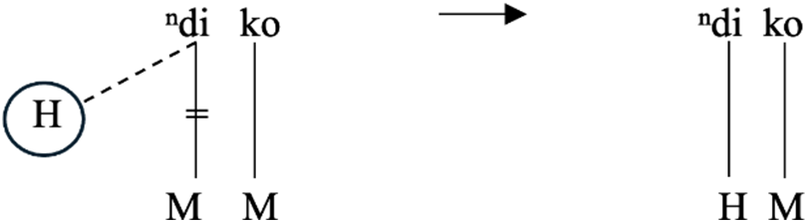
The grammatical H tone may also dock on stems with derivational prefixes, such as repetitive
nda3- (16a) or causative sa5- (16b). As with 14h above, the present H tone vacuously applies in H-initial causative verb stems.
(16)
Stem
Present tense (/H/)
a.
M-M.M
ndākātā
H-M.M
ndákātā
nda3-ka3ta3
nda5-ka3ta3
rep-sing
prs.rep-sing
‘sing again’
‘singing again’
b.
H-M.M
sákātā
H-M.M
sákātā
sa5-ka3ta3
sa5-ka3ta3
caus-sing
prs.caus-sing
‘make sing’
‘making sing’
While the present-tense grammatical tone pattern involves the replacement of lexical tone in most verb forms, verbs that have a lexical contour tone in the first TBU undergo a different process: in these cases, the grammatical tone melody does not replace the lexical contour, but instead docks to an epenthetic high, front vowel, crucially not found in the citation form of the verb. As a result, the underlying lexical tones are preserved. This is shown in 17.
(17)
a.
LH.ØL
xàání
ʃa15ni6+1
‘dream’
b.
H.LH.ØL
íxàání
i5ʃa15ni6+1
‘dreaming’
c.
LH.ØL
yàákón
ʒa15kõ6+1
‘peel w/knife’
d.
H.LH.ØL
íyàákón
i5ʒa15kõ6+1
‘peeling with knife’
e.
LH.M
xìítā
ʃi15ta3
‘pull’
f.
H.LH.M
íxìítā
i5ʃi15ta3
‘is pulling’
Based on our corpus, no verbs with a stem-initial level tone bear this prefix, while all verbs with a stem-initial contour tone do bear it. Therefore we claim this is an instance of tonally-driven epenthesis: the phonological grammar supplies an epenthetic front, high vowel in order to realize a grammatical tone when the grammatical tone would otherwise replace a contour lexical tone, a restriction also documented for Alcozauca Mixtec (Uchihara & Mendoza Ruiz Reference Uchihara and Ruiz2022).Footnote 32 This phenomenon can be characterized as an instance of tonological indomitability, where the set of exceptional targets that resist association of grammatical tone share tonal characteristics (Rolle Reference Rolle2018). Thus, in the case of SJPM, tonal contours on single morae are impervious to replacement by grammatical tones. As described in Section 5.4 below, further support for this characterization comes from the fact that tonal-driven epenthesis is also attested in negative polarity marking with the same verb stems, where the lexical tone contours of the stem’s first TBU are again preserved. Tonal-driven epenthesis may therefore be viewed as a general response to the inability to replace lexical tonal contours with grammatical tones. It should also be noted that failure of contour tones to undergo replacement by grammatical tones cannot be explained as avoidance of a marked structure, as we have already seen that sequences of H tones (which would result if tonal replacement would take place) are attested in both lexical tone patterns and in grammatically derived melodies.
Finally, a class of stems, which we posit to be underlyingly /M.ØL/, exhibits yet another tone pattern when inflected for present tense. Recall from Section 4.1 that these stems may be analyzed as diachronically arising from a */M.L/ form in Proto-Mixtec, whereby the L tone has displaced rightward in SJPM, leaving the couplet-final TBU unspecified. Further evidence for this idea comes from the resulting pattern of grammatical tone association in such contexts. Notably, as shown in 18(a–d), these stems surface with a [H.↑H] tone pattern (with phonetic upstep of the second H-toned TBU of the stem, represented with a level [6] tone in the IPA transcription) in the present tense, rather than the expected [H.M] pattern. Indeed, these stems contrast with /M.M/ stems that do surface as [H.M] in the present tense, as shown in 18e–h.
(18)
Stem
Present tense (/H/)
a.
[M.M]
kāvā
ka3va3
[H.↑H]
kává
ka5va6
‘drive’
b.
[M.M]
kōnī
ko3ni3
[H.↑H]
xíní
ʃi5ni6
‘see’
c.
[M.M]
kākī
ka3ki3
[H.↑H]
xákí
ʃa5ki6
‘put’
d.
[M.M]
kā’ndyā
ka3ʔnd͡ʒa3
[H.↑H]
xá’ndyá
ʃa5ʔndʒ͡a6
‘cut’
e.
[M.M]
nōmī
no3mi3
[H.M]
nómī
no5mi3
‘hug’
f.
[M.M]
ndīkō
ⁿdi3ko3
[H.M]
ndíkō
ndi5ko3
‘grind’
g.
[M.M]
kākā
ka3ka3
[H.M]
xíkā
ʃi5ka3
‘walk’
h.
[M.M]
kuākū
kwa3ku3
[H.M]
xákū
ʃa5ku3
‘cry’
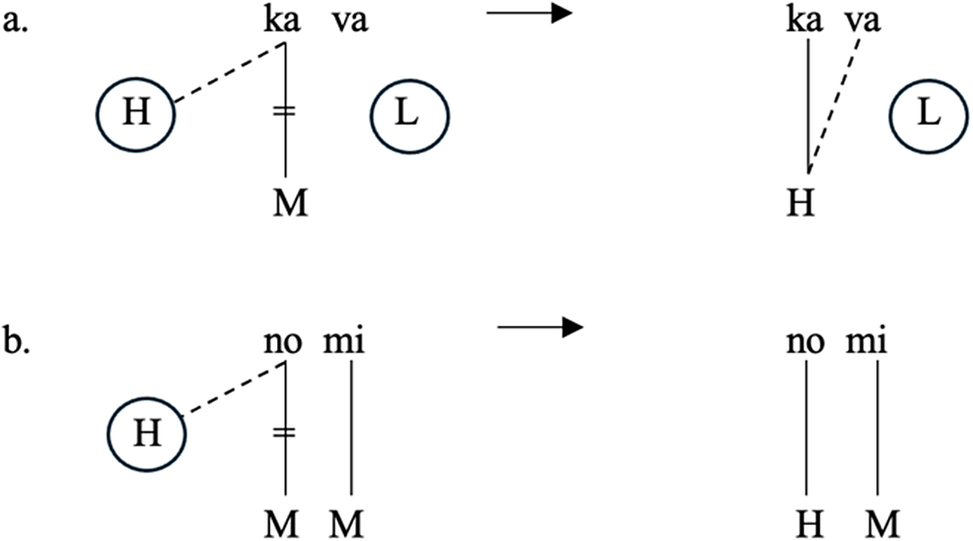
We attribute this contrast to differences in (under)specification of verb stems: in the absence of any derivational prefixes, the grammatical H floating tone docks on the first TBU of the couplet and then spreads rightward onto the second, toneless TBU in /M.ØL/ stems, as represented in autosegmental terms in 19a. Conversely, the present tense forms of fully specified /M.M/ stems are [H.M], because rightward H tone spreading does not target tonally specified TBUs, shown in 19b.
(19)
Present tense tone patterns in /M.ØL/ and /M.M/ stems
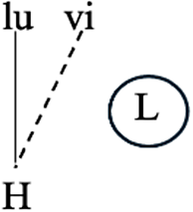
Notably, this analysis generalizes beyond cases of grammatical H tone. For instance, we claim that rightward H tone spreading is also responsible for the surface [H.↑H] tone pattern of monomorphemic (non-verbal) /H.ØL/ stems, as exemplified in 20 with lúví ([lu5vi6+1]) ‘turtle’. In Section 5.4, we will also show that our analysis extends to the grammatical tone patterns of negative polarity inflected forms of /M.ØL/ verbs.
(20)
Rightward H tone spreading in /H.ØL/ stems
An alternative analysis, which we argue against, also involves positing different underlying representations of the two types of M-toned stems, but without underspecification. Suppose a treatment under which /M.ML/ stems involve a single, doubly-linked M tone (followed by a floating L tone), while /M.M/ stems have each TBU independently linked to a M tone. Upon attachment of the grammatical H tone, this H tone would replace the doubly-linked M tone, yielding a form where both TBUs surface with a H tone ([H.↑H]); in contrast, in stems with two independently linked M tones, only the first M tone would be replaced by the grammatical H tone pattern ([H.M]). This alternative, however, can be ruled out, since it incorrectly predicts unattested tonal realizations upon attachment of other grammatical tone patterns, including negative LH. Specifically, a floating LH tone pattern would be predicted to surface as [L.H] in these doubly-linked M stems (assuming a left-to-right mapping of the LH melody). However, as discussed in detail in Section 5.4 below, attachment of the negative LH tone to such stems results in a surface [LH.H] pattern (with rightward H tone spreading), contrasting with /M.M/ stems, which surface as [LH.M] when inflected for negative polarity. Therefore, the (under)specification analysis yields the correct empirical generalizations and allows us to unify the grammatical tone patterns of present and negative inflected forms, as well as the tone patterns of monomorphemic H-toned stems that bear floating L tones.Footnote 33
In sum, we have detailed the patterns that arise from the association of a floating H grammatical tone, encoding present tense. This H tone docks to the first TBU of the stem and may: (i) replace L and M stem tones, (ii) apply vacuously to H stem tones, and (iii) dock to an epenthetic high front vowel ([i]) if the stem bears a contour tone. We have also illustrated a pattern of rightward H-tone spreading that takes place in inflected /M.ØL/ stems, which, in turn, provides further evidence for such toneless TBUs.
5.3. Past tense inflected verbs
Past tense in SJPM may also be encoded through a grammatical pattern—a L floating tone that docks on the leftmost TBU of the morpheme within its scope. However, past tense may also be encoded with a ni1- prefix, which is described as ‘completive’ in other Mixtec varieties (Pike Reference Pike1944, Macaulay Reference Macaulay1996), and proposed to be the diachronic source of the floating L grammatical tone across Mixtec (Hollenbach Reference Hollenbach, Wise, Headland and Brend2003). We analyze the ni1- prefix as an allomorph of past tense in SJPM, as the segmental and tonal morphs are both semantically equivalent for native speakers and generally in free variation, except in particular tonal contexts.
As shown in Table 9, both allomorphs are optionally attested for past-inflected verbs in most contexts (e.g. a–d). However, in cases where the first TBU of the stem is L, the tonal exponent of past tense generally may not attach (as in e–g)—unless the L-initial stem displays an irrealis/realis stem alternation (as in h). Lastly, the tonal exponent may not attach to stems with a rising tone on the first TBU, as in (i).Footnote 34 We take this to be a type of phonologically conditioned allomorphy (see also Mendoza Ruiz Reference Mendoza Ruiz2016 and Uchihara & Mendoza Ruiz Reference Uchihara and Ruiz2022 for Alcozauca Mixtec). We illustrate these patterns with bimoraic verb stems.
Tonal and segmental allomorphs of past tense in bimoraic stems.

Table 9. Long description
The table consists of eight columns organized into four main sections: Verb Tone, Past n i super 1- Allomorph, Past L Allomorph, and English gloss.
* Row a: Verb tone M.M, n d i k o (n d i super 3 k o super 3). Past n i- allomorph L-M.M, n i n d i k o (n i super 1- n d i super 3 k o super 3). Past L allomorph L M.M, n d i i k o (n d i super 1 3 k o super 3). Gloss: ground.
* Row b: Verb tone M.H, k e e (k e super 3 glottal stop e super 5). Past n i- allomorph L-M.H, n i k e e (n i super 1- k e super 3 glottal stop e super 5). Past L allomorph L M.H, k e e (k e super 1 3 glottal stop e super 5). Gloss: checked by touch.
* Row c: Verb tone M.L, k u v i (k u super 3 glottal stop v i super 1). Past n i- allomorph L-M.L, n i k u v i (n i super 1- k u super 3 glottal stop v i super 1). Past L allomorph L M.L, k u u v i (k u super 1 3 glottal stop v i super 1). Gloss: got sick.
* Row d: Verb tone H.M, s a a (s a super 5 glottal stop a super 3). Past n i- allomorph L-H.M, n i s a a (n i super 1- s a super 5 glottal stop a super 3). Past L allomorph L H.M, s a a a (s a super 1 5 glottal stop a super 3). Gloss: made or did.
* Row e: Verb tone L.M, k a k u (k a super 1 k u super 3). Past n i- allomorph L-L.M, n i k a k u (n i super 1- k a super 1 k u super 3). Past L allomorph: N A. Gloss: survived.
* Row f: Verb tone L.L, k a a n (k a tilde super 1 glottal stop a tilde super 1). Past n i- allomorph L-L.L, n i k a a n (n i super 1- k a tilde super 1 glottal stop a tilde super 1). Past L allomorph: N A. Gloss: spoke.
* Row g: Verb tone L.L, c h a n d y a (t s h a super 1 glottal stop n d y a super 1). Past n i- allomorph L-L.L, n i c h a n d y a (n i super 1- t s h a super 1 glottal stop n d y a super 1). Past L allomorph: N A. Gloss: got cut.
* Row h: Verb tone L.L, k u a k u (k w a super 1 k u super 1). Past n i- allomorph L-L.L, n i x a k u (n i super 1- s h a super 1 k u super 1). Past L allomorph L.L, x a k u (s h a super 1 k u super 1). Gloss: laughed.
* Row i: Verb tone L H.H super L, x a a n i (s h a super 1 5 n i super 6 plus 1). Past n i- allomorph L-L H.H, n i x a a n i (n i super 1- s h a super 1 5 n i super 6 plus 1). Past L allomorph: N A. Gloss: dreamt.
As seen in the examples in Table 9(e–g), the L grammatical tone pattern may undergo tonal blocking: native speakers’ metalinguistic judgments are that only a segmentally-marked alternative exists to encode past tense in these contexts. No such blocking effect occurs in (h), however, as the segmental stem allomorphy allows for the disambiguation between irrealis (kuàkù [kwa1ku1]) and past (xàkù [ʃa1ku1]). This blocking pattern is moreover in contrast to the vacuous application of H tone in causative stems, exemplified in 16b in Section 5.2 above, where future and present tense interpretations are available for the same (homophonous) forms.
In the examples shown so far, the past tense floating L tone concatenates with surface M and H tones, yielding rising contours in the first TBU of bimoraic couplets. We analyze this process as concatenation of the grammatical tone to the lexical tone, a process represented in 21 with ndīkō ([ndi3ko3]) ‘grind’.
(21)
Association of L past tense grammatical tone in bimoraic stems
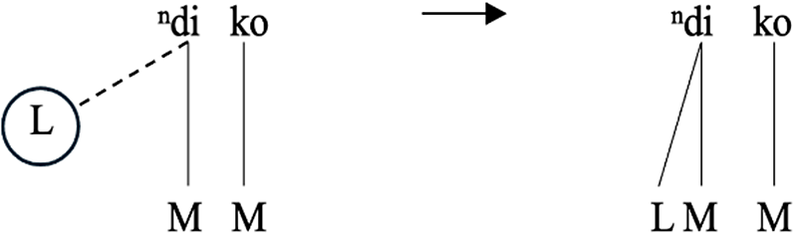
In contrast to bimoraic stems, trimoraic stems display multiple phonologically-conditioned tonal association patterns in the past tense. As we show in this section, the metrical foot or ‘couplet’ is crucial to the analysis of the tonal patterns in these longer stems. Importantly, these patterns are predictable. First, as shown in 22(a–c), the L past tense tone may replace (rather than concatenate to) a couplet-external M tone, which surfaces as a level L tone when the immediately following, couplet-initial TBU bears a H or a M tone. Alternatively, it may instead concatenate to a surface M, forming a contour, as in 22(d–f): the contour pattern is only attested when the immediately following couplet-internal TBU bears a L tone followed by a M or H tone (including if the L forms a contour with the following tone, as in 22f).
(22) Grammatical tone patterns of past-inflected trimoraic stems
Stem
Past tense (/L/)
a.
M(H.H)
kūsíkí
L(H.H)
sàsíkí
ku3(si5ki5)
sa1(si5ki5)
‘play’
‘played’
b.
M(H.M)
sāchíñō
L(H.M)
sàchíñō
sa3(tʃ͡i5ɲo3)
sa1(tʃ͡i5ɲo3)
‘work’
‘worked’
c.
M(M.M)
kāndītā
L(M.M)
kàndītā
ka3(ndi3ta3)
ka1(ndi3ta3)
‘jump’
‘jumped’
d.
M(L.M)
nōkò’ōn īnī
LM(L.M)
nòōkò’ōn īnī
no3(kõ1ʔõ3) i3ni3
no13(kõ1ʔõ3) i3ni3
‘remember’
‘remembered’
e.
M(L.H)
tāndà’á
LM(L.H)
tàāndà’á
ta3(nda1ʔa5)
ta13(nda1ʔa5)
‘get married’
‘got married’
f.
M(LM.ØL)
nōtàā’ā
LM(LM.ØL)
nòōtàā’ā
no3(ta13ʔa3+1)
no13(ta13ʔa3+1)
‘ought to, need to’
‘needed to’
The set of patterns shown in monomorphemic trimoraic forms is also found in derived (multimorphemic) trimoraic contexts. A M-toned derivational morpheme inflected for the past tense similarly surfaces with a level L tone when concatenating with a H- or M-initial bimoraic verbal stem (23a, b) but again surfaces with a LM contour if the first TBU of the bimoraic stem bears a L tone followed by a M or H tone (23c, d). Moreover, the grammatical L tone systematically concatenates with the H tone of derivational prefixes, for example, causative sa5- (23e). This is consistent with the patterns attested elsewhere in the language where L tones do not replace H or M tones.
(23) Grammatical tone patterns of past-inflected derived trimoraic stems
Stem
Past tense (/L/)
a.
M-(H.M)
ndūñó’ōn
L-(H.M)
ndùñó’ōn
ndu3-(ɲõ5ʔõ3)
ndu1-(ɲõ5ʔõ3)
irr.inch-lost
pst.inch-lost
‘get lost’
‘got lost’
b.
M-(M.M)
ndākātā
L-(M.M)
ndàkātā
nda3-(ka3ta3)
nda1-(ka3ta3)
irr.rep-sing
pst.rep-sing
‘sing again’
‘sang again’
c.
M-(L.M)
ndākuà’ā
LM-(L.M)
ndàākuà’ā
nda³-(kwa1ʔa3)
nda13-(kwa1ʔa3)
irr.rep-deliver
pst.rep-deliver
‘deliver again’
‘delivered again’
d.
M-(L.H)
ndānòná
LM-(L.H)
ndàānòná
nda3-(no1na5)
nda13-(no1na5)
irr.rep-open
pst.rep-open
‘open again’
‘opened again’
e.
H-(M.M)
sákuīsō
LH-(M.M)
sàákuīsō
sa5-kwi3so3
sa15-(kwi3so3)
caus-carry
pst.caus-carry
‘load’
‘loaded’
Finally, a third pattern emerges in past-inflected trimoraic forms when both TBUs of the bimoraic couplet are L-toned. In such contexts, the initial M-toned TBU outside of the couplet is realized with a level L tone—but the first TBU of the couplet surfaces as M rather than the expected L. Examples of this third pattern are provided in 24, below. Again, this pattern holds regardless of whether the trimoraic form is monomorphemic, as in 24(a, b), or if it contains a derivational morpheme attached to a bimoraic root (as in 24c, d).
(24)
Stem
Past /L/
a.
M(L.L)
kīkòtò
L(M
.L)
xìkōtò
ki3(ko1to1)
ʃi
1
(ko
3
to1)
irr.visit
pst.visit
‘visit’
‘visited’
b.
M(L.L)
kīxàà
L(M
.L)
kìxāà
ki3ʃa1a1
ki
1
(ʃa
3
a1)
irr.arrive
pst.arrive
‘arrive’
‘arrived’
c.
M-(L.L)
kūñò’mà
L-(M
.L)
kùñō’mà
ku3-(ɲo1ʔma1)
ku
1
-(ɲo
3ʔma1)
irr.inch-smoke
pst.inch-smoke
‘get smoked’
‘got smoked’
d.
M-(L.L)
ndàkūsù
L-(M
.L)
ndākùsù
nda3-(ku1su1)
n
da
1
-(ku
3
su1)
irr.rep-sleep
pst.rep-sleep
‘sleep again’
‘slept again’
Altogether, these surface tone patterns are fully predictable based on both tonal context and prosodic domain. We argue that the placement and distribution of grammatical tone is partially dependent on prosodic structure, including the metrical foot, which is the domain of various phonological processes and static phonological constraints in the language, as discussed in Section 3.2 above. We offer three concrete observations based on the above examples. First, whereas the L grammatical tone systematically forms LM contours when associating within the couplet, these LM contours are restricted outside the couplet to occur only when a sequence of two L tones, separated by a couplet boundary, would be expected instead. Second, whether the resulting LML patterns involve a LM contour or a sequence of level L and M tones depends on the tone of the second TBU within the couplet. Finally, sequences of L tones are tolerated in various other contexts, such as within the couplet and in non-derived contexts, given the existence of L-L.L forms such as nìkà’àn ([ni1-kã1ʔã1]) ‘spoke’.
We argue that these observations are interrelated, arising from the interaction of two different constraints: (i) a general constraint against LM contours outside of the metrical footFootnote 35 and (ii) an Obligatory Contour Principle (OCP) constraint militating against sequences of L tones. The former constraint accounts for why grammatical L tone generally replaces the leftmost M tone in trimoraic stems. However, tonal replacement is blocked in certain phonological environments: LM contours are attested outside of the metrical foot only when their presence helps avoid an OCP violation.
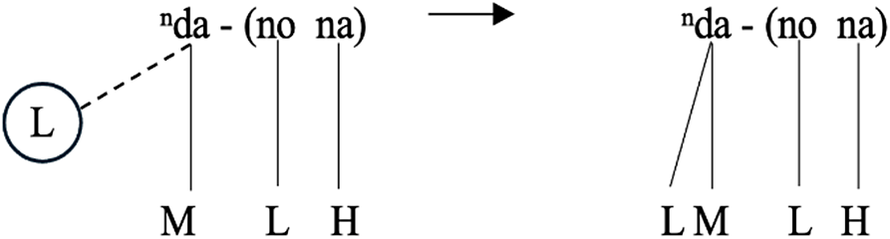
First, consider the derivation in 25, below. Here, replacing the lexical tone of the first TBU with grammatical L tone would introduce an OCP violation, given that the adjacent TBU, the first TBU of the couplet, bears L tone as well (arising in a [L(L.X)] configuration). Therefore, the grammatical L tone instead concatenates with the lexical M tone of the initial TBU resulting in a contour that prevents the OCP violation.
(25)
L tone dissimilation though contour formation
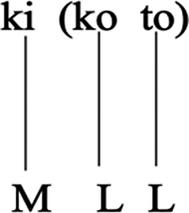
In the case of trimoraic stems containing L-toned couplets (/M(L.L)/), however, contour formation is not attested (the past form is [L(M.L)], not *[LM(L.L)]). We claim this is due to the status of L-toned couplets as having two adjacent, independently linked L tones, incurring a violation of the OCP in their underlying representation, as shown in 26. As we argue below, violations of the OCP are tolerated in underlying representations but banned in phonologically derived environments.
(26)
Underlying representation of L-toned couplets
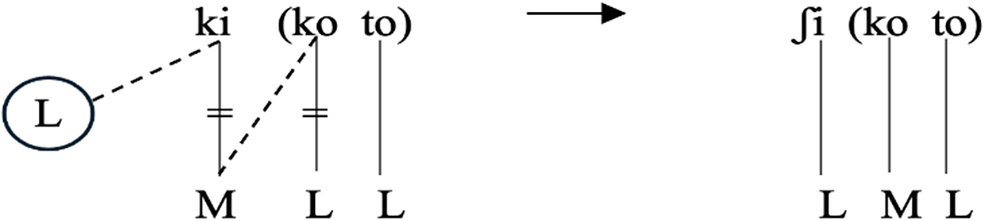
We are agnostic about the precise mechanism by which the [L(M.L)] past form is achieved, and outline two possible analyses below; both are compatible with tonal processes attested elsewhere in the language. First, the relevant process may be analyzed as a tone shift: under this approach, upon docking of the grammatical L tone pattern, the lexical M tone of the initial TBU spreads rightward, delinking the initial L tone of the couplet from the initial mora. The lexical M tone is itself delinked from the initial TBU. This is exemplified in 27. As in the cases of L tone dissimilation through contour formation schematized in 25, this tone shift would avoid a violation of the OCP while preserving a lexical tone contrast: the lexical tone of the first TBU of the stem is realized within the couplet.
(27)
L tone dissimilation through tone spreading and delinking
Alternatively, these forms may be analyzed as involving delinking of the L tone of the couplet-initial TBU; the newly toneless TBU would then acquire surface pitch through default M tone insertion, a process that is independently attested in the language (Caballero et al. Reference Caballero, Chávez, Yuan, de la Cruz Sanchez, Smith, Irizarry, Ni and Harley2024, Duarte Borquez Reference Duarte Borquez2022). This alternative is exemplified in 28. Delinking of the L tone of the couplet-initial TBU repairs the OCP-L violation, while allowing maintenance of the lexical L tone pattern in the second TBU of the couplet.
(28)
L tone dissimilation through tone delinking and default M tone insertion

Finally, it is important to note that this violation of the OCP is tolerated in non-derived environments—it is only ruled out when the association of floating L tones (and their replacement of lexical tone) creates the environment for the OCP restriction against two consecutive L tones in the relevant prosodic context. That is, we propose that repairs to OCP-L violations in SJPM involve a type of phonologically-derived environment effect, a phenomenon whereby a phonological pattern arises by virtue of another phonological alternation applying first, creating a new phonological environment (for discussion, see Inkelas Reference Inkelas2014, inter alia). Indeed, as mentioned above, forms such as nìkà’àn [ni1-kã1ʔã1] ‘spoke’ are permitted, as L tones linked to their respective morphemes do not trigger L tone dissimilation, as illustrated in 29. In other words, sequences of L tones are attested across the couplet boundary in the absence of the application of a grammatical tone process.
(29)
No dissimilation of underlyingly linked L tones
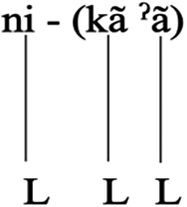
Overall, the variable realization of the grammatical tone patterns in past inflected verbs is fully phonologically predictable, with both concatenation with and replacement of lexical tones by grammatical tones being driven by tonotactic well-formedness constraints in the language.
Thus far, we have documented the patterns that result from the application of H and L grammatical tones, encoding present and past tense, respectively. These reveal two asymmetries in the grammatical tonal system of SJPM. First, grammatical H generally replaces the first mora of stem tones, while grammatical L may replace or concatenate with them, depending on the tone pattern and prosodic size of the stem. We aim to further account for these facts in Section 6 below. However, we turn to the tonal patterns seen in negative inflected verbs in Section 5.4 next, as these both extend and corroborate the generalizations we have formed thus far.
5.4. Negative inflected verbs
Finally, as with present and past tense, negative polarity in SJPM may be encoded tonally, through a grammatical LH tonal allomorph in the irrealis mood. Negative polarity may also be encoded segmentally, through a marker ko15 (bearing the same melody as the tonal allomorph), in realis contexts (this alternation is also attested elsewhere in Mixtec; see Hollenbach Reference Hollenbach2015, Palancar et al. Reference Palancar, Amith, García, Palancar and Léonard2016, Swanton & Mendoza Ruiz Reference Swanton, Ruiz, Arellanes and Guerrero2021, and Uchihara & Mendoza Ruiz Reference Uchihara and Ruiz2022).
Like the tonal exponents of present and past tense, the negative polarity tonal melody associates with the first TBU of the morpheme within its scope. This LH grammatical tone pattern replaces the lexical tone of the first TBU of verb stems, as shown in 30. Moreover, tonal replacement of lexical tones by grammatical tones is attested in all examples below, regardless of whether the first TBU of the base bears a M (30a–d), a L (30e, f), or a H (30g) tone, and regardless of whether the stem is bimoraic (30a–c, e–g) or trimoraic (30d).
(30)
Stem
Negative irrealis (/LH/)
a.
M.M
ndīkō
ndi3ko3
LH.M
ndìíkō
ndi15ko3
‘grind’
b.
M.L
kū’vì
ku3ʔvi1
LH.L
kùú’vì
ku15ʔvi1
‘get sick’
c.
M.H
kātón
ka3tõ5
LH.H
kàátón
ka15tõ5
‘tie’
d.
M.M.M
kāndītā
ka3ndi3ta3
LH.M.M
kàándītā
ka15ndi3ta3
‘jump’
e.
L.L
kùsù
ku1su1
LH.L
kùúsù
ku15su1
‘sleep’
f.
L.M
kìkū
ki1ku3
LH.M
kìíkū
ki15ku3
‘weave’
g.
H.M
sá’ā
sa5ʔa3
LH.M
sàá’ā
sa15ʔa3
‘do/make’
We will show throughout this section that the negative grammatical tone pattern involves a sequence of two tonal primitives, /L/ and /H/, which both associate to the left edge of the stem, rather than a true /LH/ contour. The representation of this process is shown in 31, below.
(31)
Association of LH negative polarity grammatical tone to ndīkō (/ndi3ko3/) ‘grind’
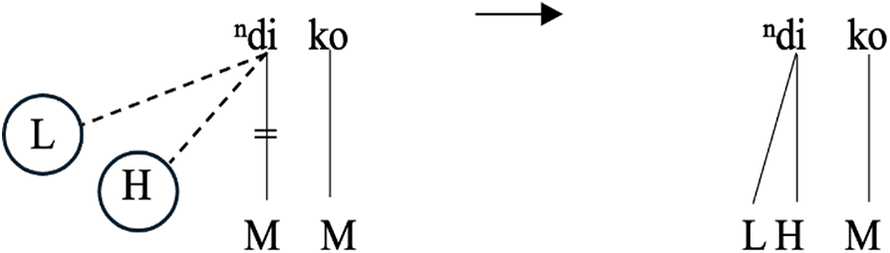
As also attested in (positive) present tense-inflected forms, the negative LH melody associates with an epenthetic vowel if the stem bears a lexical contour tone in the first TBU, as shown in 32. This, again, can be understood as a response to the impossibility of grammatical tones replacing lexical contour tones. Notably, the segmental allomorph of the negative marker is not deployed in these contexts, which we attribute to its morphosyntactic conditioning, that is, the segmental negative marker ko15 is precluded from occurring in irrealis contexts.Footnote
36
(32)
Stem
Negative irrealis (/LH/)
a.
LH.↑HL
xàání
ʃa15ni6+1
LH.LH.↑HL
ìíxàání
i15ʃa15ni6+1
‘dream’
b.
LH.↑HL
yàákón
ʒa15kõ6+1
LH.LH.↑HL
ìíyàákón
i15ʒa15kõ6+1
‘peel with knife’
c.
LH.M
tìívī
ti15vi3
LH.LH.M
ìítìívī
i15ti15vi3
‘lose’
Recall also that a subclass of verb stems are posited in this paper to be underlyingly /M.ØL/, and that these verbs are realized with a [H.↑H] tone pattern in the present tense due to H tone spreading. The examples in 33(a–d) below show that a comparable pattern arises when the hypothesized /M.ØL/ verb forms are in the negative irrealis: the first TBU of the verb stem bears the LH negative grammatical tone melody, with the H tone then spreading to the second TBU (again, the second H is upstepped). Once again, on par with their present-inflected counterparts, the negative inflected /M.M/ forms in 33(e–f) do not display H tone spreading to the second TBU.
(33)
Stem
Negative irrealis (/LH/)
/M.Ø
L
/ verb forms
a.
[M.M]
kāvā
ka3va3+1
[LH.↑H]
kàává
ka15va6+1
‘drive’
b.
[M.M]
kōnī
ko3ni3+1
[LH.↑H]
kòóní
ko15ni6+1
‘see’
c.
[M.M]
kākī
ka3ki3+1
[LH.↑H]
kàákí
ka15ki6+1
‘put’
d.
[M.M]
kā’ndyā
ka3ʔnd͡ʒa³+1
[LH.↑H]
kàá’ndyá
ka15ʔndʒ͡a6+1
‘cut’
/M.M/ verb forms
e.
[M.M]
nōmī
no3mi3
[LH.M]
nòómī
no15mi3
‘hug’
f.
[M.M]
ndīkō
ⁿdi3ko3
[LH.M]
ndìíkō
ⁿdi15ko3
‘grind’
H tone spreading in negative inflected forms of /M.ØL/ stems such as kāvā ([ka3va3+1]) ‘drive’ is represented in 34. As mentioned above, that only H spreads can be taken as evidence that the LH melody is not a true contour.
(34)
Rightward spreading of H tone after attachment of negative LH
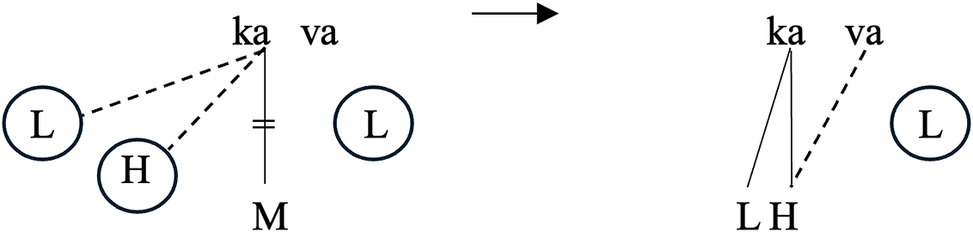
The examples shown thus far all involve negative irrealis forms, which involve the grammatical LH tone pattern directly interacting with the lexical tones of verb stems. Additional tonal and segmental patterns obtain in other negative-inflected verbs in other tense configurations. Crucially, the interactions between the LH grammatical tone melody and the tonal exponents of tense (L and H for past and present, respectively) are restricted, since the tonal and segmental allomorphs of negation have morphosyntactically conditioned distributions. As illustrated in Table 10, the tonal LH allomorph is used with irrealis stems, while the segmental allomorph ko15- is used with realis stems.
TAM and polarity contrasts in the verb stem /M.M/ ndīkō [ndi3ko3] ‘grind’.

Table 10. Long description
The table is organized into six columns.
* Row 1 (Irrealis): Positive Polarity shows tone M dot M, word ndīkō (superscript n d i 3 k o 3). Negative Polarity shows tone L H dot M, word ndìíkō (superscript n d i 15 k o 3). The tense is Future (irrealis).
* Row 2 (Realis): Positive Polarity shows tone H dot M, word ndíkō (superscript n d i 5 k o 3). Negative Polarity shows tone L minus H dot M, word kòndíkō (k o 1 minus superscript n d i 5 k o 3). The tense is Present.
* Row 3 (Realis): Positive Polarity shows tone L minus M dot M, word nìndīkō (n i 1 minus superscript n d i 3 k o 3). Negative Polarity shows tone L minus H minus M dot M, word kòníndīkō (k o 1 minus n i 5 minus superscript n d i 3 k o 3). The tense is Past n i 1 minus.
* Row 4 (Realis): Positive Polarity shows tone L M dot M, word ndìīkō (superscript n d i 13 k o 3). Negative Polarity shows tone L H minus M dot M, word kòóndīkō (k o 15 minus superscript n d i 3 k o 3). The tense is Past.
Multiple distinct tonal patterns are attested in the realis forms. First, the negative present is encoded with L tone on the segmental allomorph ko- and H tone on the first TBU of the verb stem. The negative past reveals two additional patterns. If the segmental allomorph attaches to the segmental past tense prefix ni1-, ko- again only bears L tone and the H tone of the negative polarity tonal melody is realized on the latter prefix. If the ko- prefix attaches directly to the verb stem, it bears the full LH tonal melody and the verb stem appears without the grammatical L tone.
What is notable about the former two patterns in the present and past, respectively, is the loss of the H tone on the negation segmental morph. We analyze these patterns as involving a phonologically general process of (progressive) tonal absorption, where, in underlying /LH-H/ sequences across the couplet boundary or in TBUs preceding the couplet, there is simplification of the LH contour, becoming L before the H tone, /LH-H/ → [L-H]. We propose that this process takes place straightforwardly in the negative present; for example, /LH-H.M/ /ko15-ndi5ko3/ → L-H.M [ko1-ndi5ko3] ‘not grinding’.Footnote
37 In the case of negative past stems with the past ni1- prefix, we posit that the H tone spreads from the segmental marker ko15- onto the stem, replacing the lexical tone of the ni1- prefix (LH-L → LH-H), as shown in 35a. This process then yields the context for tonal absorption (LH-H → L-H), as shown in 35b.
(35)
a.
H-tone spreading
LH-L-M.M
→
LH-H-M.M
ko15-ni1-(ndi3ko3)
→
ko15-ni5-(ndi3ko3)
‘did not grind’
b.
Tonal absorption
LH-H-M.M
→
L-H-M.M
ko15-ni5-(ndi3ko3)
→
ko1-ni5-(ndi3ko3)
‘did not grind’
kòníndīkō
We note that tonal absorption is a tonal process that is prosodically restricted. Specifically, this process is attested in the boundary between the negative segmental prefix and the stem, whether across the couplet boundary as in the negative present (/LH-(H.X)/ → L-(H.X)), or preceding the couplet as in the negative past with the ni1- prefix (/LH-L-(X.X)/ → L-H-(X.X)). In other prosodic domains, such as within the metrical foot (equivalent to the couplet), there is no tonal absorption. For instance, recall that when a LH grammatical tone pattern docks to the first TBU of bimoraic stems with a final H tone, the LH-H pattern persists; for example, /M.H/ /(ka3tõ5)/ → LH.H [(ka15tõ5)] ‘won’t tie.’ Likewise, there are lexical LH.H patterns in non-derived forms; for example, chòó’ó [t͡ʃo15ʔo5] ‘flea.’ This pattern further exemplifies the crucial role that metrical structure plays in the analysis of tonal processes in SJPM.
The third negative pattern, attested in the past tense, exhibits a LH contour in the segmental negative marker ko15-, followed by the stem bearing its lexical tones. Notably, this pattern does not exhibit the expected layering of tonal markers, given the absence of the L tonal exponent in the first TBU of the stem (as otherwise attested in the positive polarity); for example, LH-M.M ko15-ndi3ko3 rather than *LH-LM.M *ko15-ndi13ko3). These forms could be argued to exhibit a paradigm uniformity effect between the two types of negative past forms (with and without the past ni1- prefix), though we leave further investigation of this idea for future work.Footnote 38
Finally, for the verb stems that bear a lexical contour tone in the first TBU, the epenthetic vowel seen above again surfaces in the negative present. As shown in 36(a, b), the segmental morph ko- bears only a L tone rather than the expected LH melody, while the epenthetic vowel bears a H tone. This pattern is consistent with the analysis of the negative present developed above, in that a posited underlying LH-H sequence is simplified via (progressive) tonal absorption (e.g. /LH-H-LH.M/ /ko15-i5-ti15vi3/ → L.H.LH.M [ko1-i5-ti15vi3]).
(36)
Irrealis
Negative present
a.
‘dream’
LH.HL
xàání
ʃa15ni6+1
L.H.LH.HL
kòíxàání
ko1-i5-ʃa15ni6+1
b.
‘lose’
LH.M
tìívī
ti15vi3
L.H.LH.M
kòítìívī
ko1-i5-ti15vi3
The negative past forms of these verbs are given in 37(a, b); these too follow from the analysis of the negative past presented above: the H tone of the negative LH melody is either realized on the prefix ni-, if present, or on the negative morph itself.
(37)
Irrealis
Negative past
a.
‘dream’
LH.HL
xàání
ʃa15ni6+1
L.H.LH.HL
kòníxàání
ko1-ni5-ʃa15ni6+1
LH.LH.HL
kòóxàání
ko15-ʃa15ni6+1
b.
‘lose’
LH.M
tìívī
ti15vi3
L.H.LH.M
kònítìívī
ko1-ni5-ti15vi3
LH.LH.M
kòótìívī
ko15-ti15vi3
5.5. Interim summary
This section has detailed the grammatical tone patterns that arise in the present and past tense, as well as in the negative polarity in SJPM. These grammatical tones are analyzed as floating tones that associate to the leftmost TBU of the verb stem, that is, as concatenative tonal morphemes that exhibit prefix-like behavior. The tonal association patterns are summarized below (38):
(38)
SJPM grammatical tone patterns: summary
-
• Present tense is encoded with a H tone which may replace M and L tones on the verb stem and may apply vacuously to stems that already bear a H tone in the initial TBU of the stem. However, they may not associate with TBUs that contain a contour, resulting in the insertion of an epenthetic vowel.
-
• Past tense is encoded with a L tone or with a segmental allomorph ni1-. The tonal morph yields different patterns depending on the phonological and prosodic context. In couplet-initial position, it concatenates with M and H, creating contours; (vacuous) association with a L TBU is blocked, resulting in a segmental allomorph. However, in pre-couplet position, the relevant TBU may either surface with a contour or simply with L, depending on the tonal pattern of the stem.
-
• Finally, negative polarity has a LH tonal melody, which we have decomposed into a sequence of L and H. The LH melody may associate to the verb stem, a segmental prefix, or both, depending on the tense specification of the stem.
Throughout this section, we have also made a number of analytical claims, on the basis of the exact tonal association patterns that arise in different contexts. For instance, we provided evidence for positing the existence of tonally unspecified TBUs, based on a pattern of H tone spreading across couplets. Likewise, we identified several interacting tonal constraints and processes that occur in some prosodically defined environments but not others, revealing the significance of prosodic domains in this language—specifically, the couplet (equivalent to a metrical foot) and whether individual TBUs are internal or external to this domain. SJPM can thus be added to the list of languages where the tonal system is sensitive to metrical structure, as posited for both related (e.g. Ixtayutla Mixtec; Penner Reference Penner2019) and unrelated (Kera (Chadic); Pearce Reference Pearce2006) languages.
SJPM is representative of Mixtec grammatical tone systems, which have been characterized in the literature as involving a high functional load (Pankratz & Pike Reference Pankratz and Pike1967, Palancar et al. Reference Palancar, Amith, García, Palancar and Léonard2016, DiCanio et al. Reference DiCanio, Benn and García2021). This assessment is not made on the basis of the number of tonal exponents available in the language, but rather in terms of their systematicity in verb paradigms:Footnote 39 all forms of inflected verbs have distinctive tone patterns involving these exponents, which are crucial for retrieving grammatical information (mood and/or tense). Furthermore, some segmental allomorphs for some grammatical categories are tonally conditioned, contributing to the centrality of tone for lexical and grammatical contrasts in this language.
In the remainder of this paper, we provide an account of these lexical-grammatical tone interactions. We argue that the various patterns that arise result from dominance properties of individual tonal exponents, constrained by the general phonotactic restrictions of tonal patterns in the language.
6. Lexical-grammatical tone interactions
We have now seen that both lexical and grammatical tone have a high functional load in SJPM, and that grammatical tone patterns exhibit different behaviors in terms of their interaction with lexical tone in different prosodic and tonal contexts. But is there a unifying mechanism that governs the interaction between lexical and grammatical tone in this language? In this section, we examine this question through the lens of a dominance framework of grammatical tone (Rolle Reference Rolle2018). In Section 6.1, we provide a brief overview of this theory, and propose that the grammatical tones of SJPM are best characterized as non-dominant, and that the appearance of dominance of some tonal exponents (associated with replacement of lexical tones by grammatical tone patterns) in particular environments may be responses to various tonotactic constraints—not idiosyncratic properties of individual tonal exponents. In Section 6.2, we then show that SJPM offers an empirical challenge to a key prediction made by Rolle (Reference Rolle2018) regarding how conflicts arising in lexical-grammatical tone interactions are resolved.
6.1. Non-dominant neutral grammatical tone in SJPM
In the dominance framework of grammatical tone of Rolle Reference Rolle2018,Footnote 40 the behavior of grammatical tone patterns results from idiosyncratic properties of grammatical tonal exponents in terms of their (in)ability to delete the underlying tone of the target (where the target is understood to be the morpheme(s) where grammatical tone associates): dominant grammatical tone involves systematic deletion of the underlying tone of the target, while no such systematic deletion is attested in non-dominant grammatical tone. Under this view, the typological parameters that shape variation in grammatical tone (GT) systems cross-linguistically can be understood to result from the following tension, from Rolle Reference Rolle2018:10:
[w]ithin dominant GT all outputs have a uniform tone shape which has the advantage of providing a more consistent cue for the grammatical category of the trigger, but sacrifices the lexical contrast of the target. In contrast with non-dominant GT, outputs do not have a uniform form and thus maintain lexical contrast unambiguously, but at the cost of having a less delimited cue for the trigger.Footnote 41
Importantly, (non-)dominance is idiosyncratic, in that whether tones are dominant or non-dominant cannot be predicted by any other properties of the grammar.
We propose that the SJPM grammatical tone system can be broadly classified as non-dominant neutral, which is defined as follows:Footnote
42
(39)
Neutral non-dominant grammatical tone: ‘the lack of automatic replacement/deletion of the underlying tone of the target or automatic non-application of the grammatical tone (i.e. simple toneme concatenation)’ (Rolle Reference Rolle2018:4)
In other words, we propose that the grammatical tones in SJPM—present H, past L, and negative LH—are all concatenative in nature. Given the particular patterns detailed throughout Section 5, however, this proposal requires some elaboration. Although we see a clear illustration of this concatenative behavior in cases of attachment of the grammatical L tone pattern encoding past tense in bimoraic stems (where the grammatical L tone creates a contour with the lexical stem tone), this is less immediately obvious for the present H and negative LH tonemes, as they replace lexical tones in most (but not all) contexts. Nonetheless, we argue that the association patterns of present H and negative LH—replacement, blocking, and tonal conditioned epenthesis—are all phonologically predictable rather than idiosyncratic, and thus should not be viewed as dominant. This, in turn, suggests a uniformly non-dominant (i.e. concatenative) approach.
We posit that the complete range of surface grammatical tone patterns in SJPM can be attributed to a single idiosyncratic pattern of concatenation for all grammatical floating tones, with all deviations from this pattern surfacing in phonologically specific contexts as avoidance of tonotactically illicit sequences. We have already argued that some patterns of concatenation of grammatical tone with lexical tone can be analyzed as involving avoidance of tonotactically illicit sequences (i.e. LM contours in pre-couplet morae of trimoraic stems, where concatenation avoids an OCP-L violation across the couplet boundary). We add here that the patterns of H and LH grammatical tone association may likewise be analyzed in terms of the phonological grammar: specifically, concatenation of H and LH to form contours is not possible because this would yield either falling or complex contours, both of which are independently ruled out in SJPM (except in very restricted environments), as already established in Section 4.1. Table 11 summarizes the different types of potential and attested interaction between lexical and grammatical tone in SJPM for each tonal exponent.
SJPM lexical-grammatical tone interactions and relationship to phonological grammar.

Table 11. Long description
The table consists of four columns: Tonal Exponent, Expected Pattern Under Concatenation, Attested Interaction With Lexical Tone, and Repair of Illicit Tonal Sequences.
* Row 1: Present tense H. Expected patterns are asterisk H M and asterisk H L. Attested interaction is the replacement of M and L. Repair involves the avoidance of falling contours in couplet-initial position.
* Row 2: Present tense H (continued). Expected pattern is asterisk H L M. Attested interaction is grammatical tone conditioned epenthesis. Repair is the inability to alter an input monomoraic tonal contour, referred to as tonal indomitability.
* Row 3: Past tense L. Expected pattern is asterisk L M (X dot X). Attested interaction is the replacement of M. Repair involves the avoidance of L M contours outside of the couplet.
* Row 4: Negative L H. Expected patterns are asterisk L H M and asterisk L H L. Attested interaction is the replacement of M and L. Repair is the avoidance of complex contours in single morae.
* Row 5: Negative L H (continued). Expected pattern is asterisk L H L M. Attested interaction is grammatical tone conditioned epenthesis. Repair is the inability to alter an input monomoraic tonal contour (tonal indomitability).
This table has a number of components. It specifies what tonotactic violation would result from the expected pattern of concatenation of different tonal exponents to lexical tone: for instance, falling contours would arise in base-initial TBUs with M and L tone upon attachment of present H tone (*HM, *HL), and complex contours would arise in single morae in the case of attachment of negative LH to M and L lexical tones (*LHM, *LHL). This table also illustrates that different tonotactically illicit sequences may be repaired through a single mechanism (e.g. tonal replacement is attested in different contexts involving H, L, and LH grammatical tones), though some types of repairs are exclusively attested in specific phonological environments (e.g. grammatical tone conditioned epenthesis is only attested in cases of tonological indomitability of contour tones). There are thus a variety of constraints imposed by the phonological grammar and a variety of repairs available to avoid them.
As mentioned above, it would not be viable to take the SJPM grammatical tone system to involve both dominant and non-dominant tonal exponents, with replacement vs. concatenation in grammatical tone patterns resulting exclusively from the status of individual grammatical tones as dominant or recessive. In this treatment, negative LH and present H would be dominant and past L would be non-dominant—all idiosyncratic properties of the tonal exponents in question. However, recall that concatenation, replacement, and other processes in grammatical tone patterns in SJPM have clear phonological distributions, as shown above. We therefore contend that these distributions are better captured by a uniformly non-dominant approach for all tonal exponents, coupled with general tonotactic constraints in the language.
6.2. Grammatical tone patterns reference morphological properties
With our classification of the grammatical tones of SJPM in place, we now turn to the factors that condition the choice of specific repair in each case (e.g. deletion of lexical tone) vs. other logically possible alternatives (e.g. deletion of the grammatical tone, maintaining an unmarked tone, etc.). Within the dominance framework, these results are predicted to be determined entirely by the phonological grammar of each language in neutral grammatical tone systems. That is, while some languages may allow both the grammatical tone and underlying lexical tone to surface, in other languages either the lexical tone or the grammatical tone may be deleted due to general tonal markedness constraints. This leads Rolle to formulate the following predictions if conflicts arise in these systems:
(i) there is no influence based on the morphological identity of the sub-constituents to resolve the conflict, and consequently (ii) the least phonologically marked output will surface to resolve it. The strongest version of this principle is … [the n]eutral G[rammatical] T[one] conflict resolution: conflicts in neutral patterns are entirely resolved via reference to phonological markedness, and never to morphological properties (Reference Rolle2018:192) (emphasis ours).
Given that the SJPM grammatical tone system is neutral, we now assess whether the strong version of this prediction is borne out in this language. In fact, we propose that SJPM presents an empirical challenge to this principle: the choice of repair in cases where the interaction between lexical and grammatical tone leads to a tonotactically illicit configuration is in fact resolved in terms of the morphological properties of the tonemes in conflict. That is, we posit that SJPM is a language where the tonal grammar and availability of both tonal and segmental exponents of inflection allows for preservation of most lexical and grammatical tonal contrasts in verb paradigms—but the preservation of grammatical tone is prioritized over lexical tone if one of the two must be deleted and if there are no morphological or phonological mechanisms to keep both. This logic is evident throughout the lexical-grammatical tone interactions summarized in Table 11, above, which showed the replacement of L and M lexical tones in various inflected environments.
As a concrete example, consider again the tone patterns of /M.M/ verb stems when inflected for present tense, repeated in 40, below: in these cases, the concatenation of grammatical H tone would yield an illicit falling [HM] contour in the first stem mora; grammatical H tone replaces lexical M tone instead.
(40)
Stem
Present tense
a.
M.M
nōmī
no3mi3
‘hug’
H.M
nómī
no5mi3
b.
M.M
ndīkō
ndi3ko3
‘grind’
H.M
ndíkō
ndi5ko3
c.
M.M
tīīn
tĩ3ĩ3
‘grab’
H.M
tíīn
tĩ5ĩ3
d.
M.M
ñōō
ɲo3o3
‘drag’
H.M
ñóō
ɲo5o3
Thus, in a context where either the grammatical H tone or the lexical M tone could be deleted, it is the grammatical H tone that survives. Similar asymmetries were shown throughout Section 5 with grammatical L and LH surviving over lexical tones. Crucially, we take such asymmetries to be morphological in nature, in that grammatical tones are morphemes (mappings between individual tones to particular inflectional categories) while lexical tones are not. In other words, this asymmetry cannot be resolved based on purely phonological properties of L, M, and H tones, divorced from their lexical vs. grammatical status.
To strengthen this claim, we offer and reject an alternative that would be consistent with Rolle’s prediction that the conflict between lexical and grammatical tones should be resolved on entirely phonological grounds. This alternative involves appealing to the relative markedness of tones in SJPM. Specifically, under this alternative, the tone replacement patterns attested in verb paradigms would be predictable on the basis of the relative markedness of each tonal value, which would be assessed in terms of the (in)ability of each tone to be overwritten in cases of tonal conflict, with marked tones being preserved in outputs over unmarked tones (Archangeli & Pulleyblank Reference Archangeli and Pulleyblank1994). In 40, M is replaced by H, which would suggest a H > M markedness hierarchy under this view. Given that M tones are replaced by L tones in some past tense marked forms, we might also conclude under this alternative that L tones are more marked than M tones, yielding a L > M ranking. Thus, this alternative would allow us to attribute the tonal deletion patterns to the relative markedness of H, L, and M tones, which in SJPM would involve a H > L > M scale.
We argue, however, that the consideration of additional tonal processes in SJPM significantly weakens the arguments for positing a markedness analysis of tonal replacement patterns. In particular, a phonological argument for distinguishing marked from unmarked tonal values comes from additional asymmetries in trigger/target patterning in tonal spreading. L, M, and H tones may spread in SJPM in different contexts, and each process exhibits differences in terms of possible targets for spreading. Crucially, such patterns reveal a contradictory markedness behavior of M tones in SJPM. In 41, we summarize the properties of L and M tone spreading in SJPM.
(41)
Tone spreading of L and M tones in SJPM
a
L tones may spread onto toneless TBUs in the stem-enclitic domain, but not onto tonally specified M and H TBUs (Caballero et al. Reference Caballero, Chávez, Yuan, de la Cruz Sanchez, Smith, Irizarry, Ni and Harley2024, Duarte Borquez Reference Duarte Borquez2022).
b.
M tones may spread onto toneless TBUs in /M.ØL/ stems and other stems with toneless TBUs (Section 4), but there is no evidence that M ever spreads onto tonally specified TBUs (e.g. L and H).
Given that both L and M tone can only spread onto toneless TBUs, this would suggest that both are relatively unmarked. A third spreading pattern, namely that of H tone spreading, is especially relevant for the assessment of tonal markedness. We have already seen in Section 4 and Section 5.2 that H tones may spread onto toneless TBUs, both in monomorphemic /H.ØL/ stems and in present forms of /M.ØL/ stems. However, we now show that H tone spreading cannot target M tones. This is demonstrable in the tone patterns below, in which a H tone from a nominal classifier proclitic may spread onto the initial TBU of its host. As shown in 42, H tone may spread onto a L-toned stem TBU—but not a M-toned stem TBU.Footnote
44
(42)
a.
rá víxì
tí chínkì
/ɾa5=vi1ʃi1/ → [ra5=vi
5
ʃi1]
/ti5=t͡ʃĩ1ki1/ → [ti5=t͡ʃĩ
5
ki1]
cl.3.liq=sweet
cl.3.rnd=pine cone
‘soda’ (lit. ‘sweet liquid’)
‘pine cone’
b.
rá lō’ō
tí kīnī
/ɾa5=lo3ʔo3/ → [ra5=lo3ʔo3]
/ti5=ki3ni3/ → [ti5=ki3ni3]
cl.3.liq=small
cl.3.an=ugly
‘small liquid (e.g. puddle)’
‘bad/ugly animal’
The H tone spreading pattern seen in 42 is informative. Although the ability for H to spread onto L is consistent with a markedness ranking that emerges in tonal replacement patterns, the inability for H to spread onto M contradicts this ranking. Specifically, while the tonal replacement pattern in present tense forms would suggest a H > M hierarchy, the inability for H to spread onto M in 42 would instead suggest M > H.
However, this contradiction could be resolved by simply acknowledging that H-tone has different grammatical sources across these examples: in 42, it is a lexical tone, while, in 40, it is a grammatical tone. We thus conclude that it is indeed the morphological status of H-tone that allows it to survive in 40, rather than relative phonological markedness.
In sum, we propose that the availability of both segmental and tonal exponents of morphosyntactic categories, as well as the tonal properties of the language that allow complex contours in single morae, allows preservation of most lexical and grammatical tonal contrasts in SJPM verbal paradigms. Thus, SJPM instantiates a case of a language with both a high lexical role for tone and a complex grammatical tone system. This is notable in light of Rolle’s (Reference Rolle2018) prediction that such systems, if they exist at all, should be rare cross-linguistically (see also Grimm Reference Grimm2022 for another case and further discussion).
7. Conclusion
This paper has provided the first comprehensive description and analysis of the lexical and grammatical tone systems in SJPM. First, we have identified a number of tonotactic asymmetries in the language, such as the general absence of (non-derived) falling contours and the inability for individual TBUs (morae) to host more than two tones. These are not only revealed by the lexical tone patterns in the language, but are also mirrored by the grammatical tone system, which result from the association of grammatical floating tones. We have argued that tonal concatenation, replacement, and avoidance patterns in lexical-grammatical tone interactions are determined jointly by the status of grammatical tones as non-dominant (in the sense of Rolle Reference Rolle2018), the aforementioned tonotactic restrictions, and various tonal processes that operate in the language. Close examination of lexical-grammatical tone patterns furthermore contributes relevant evidence for positing tonal representation, including tonal (under)specification: we propose SJPM has a typologically unusual /M/ vs. /Ø/ contrast in its tone system, previously proposed for genetically related languages such as Nochixtlán Mixtec (McKendry Reference McKendry2013, Reference McKendry2018) and Sierra Juárez Zapotec (Bickmore & Broadwell Reference Bickmore and Broadwell1998), as well as genetically unrelated languages such as Poko Rawo (McPherson & Dryer Reference McPherson and Dryer2021).
We have argued that the tone system of SJPM is of interest to a developing typology of grammatical tone for a number of reasons: (i) it instantiates a system whereby a variety of tonal patterns emerge in inflectional paradigms with clear phonological conditioning; (ii) while the asymmetries observed in lexical-grammatical tone interactions result from the avoidance of phonotactically marked tonal sequences, we argue that the choice of repair is sensitive to the morphological properties of the tones in conflict, with grammatical tones winning over lexical tones; (iii) it exhibits grammatical tone driven epenthesis, previously thought to be unattested in grammatical tone systems (Rolle Reference Rolle2018; cf. Rolle & Merrill Reference Rolle and Merrill2022).
Finally, on the level of micro typology, we have alluded to the high degree of diversity attested in Mixtec tone systems, with Mixtec varieties exhibiting differences in terms of how many tones may surface on an individual TBU, and phonological analyses differing in terms of whether tonal representation involves underspecification and the number and nature of tonal sandhi phenomena attested (Daly & Hyman Reference Daly and Hyman2007, McKendry Reference McKendry2013, Carroll Reference Carroll2015, Penner Reference Penner2019, DiCanio & Bennett Reference DiCanio, Bennett, Chen and Gussenhoven2021). Furthermore, the grammatical tone systems and the interaction between lexical and grammatical tone in Mixtec varieties are still largely understudied (cf. Palancar et al. Reference Palancar, Amith, García, Palancar and Léonard2016). We seek to contribute to further careful documentation and analysis of these systems, as their systematic comparison will deepen our understanding of the tonal variation within the Mixtecan language family and, more generally, what are possible interactions between grammatical tone and the phonological grammar across Mixtec languages and beyond.
Acknowledgements
We would like to express our gratitude to our San Juan Piñas Mixtec language teachers, Maestras Claudia Juárez Chávez, Basi Juárez Chávez, Cirila Pérez Morelos, Basilisa Pérez Morelos, and their families for teaching us about the SJPM language and culture. We also would like to thank two anonymous reviewers for their helpful feedback, as well as Francisco Arellanes, Christian DiCanio, Ben Eischens, Marc Garellek, Sharon Rose, and Hiroto Uchihara for useful comments and suggestions. For assistance on this manuscript, we thank our research assistants, Tylar Kameda, Isabel Martinez, and Casey O’Brien. Lastly, we would like to thank audiences at UCSD, UCSC, UC Berkeley, Uni Leipzig, SUNY Buffalo, and Universidad Nacional Autónoma de México, as well as at WCCFL 39, the 2021 Princeton Phonology Forum, WSCLA 26, and the 21st Meeting of the Réseau Français de Phonologie.
Data availability statement
Supplementary audio data materials are available online at California Language Archive, Survey of California and Other Indian Languages, University of California, Berkeley, http://doi.org/10.7297/X2D50M9G.
Conflict of interest statement
The authors declare no conflict of interest.
Funding disclosure statement
This research received no external funding.
Ethics statement
The authors declare that the research presented in this article has been conducted in accordance with the ethical requirements of UC San Diego and UCLA.


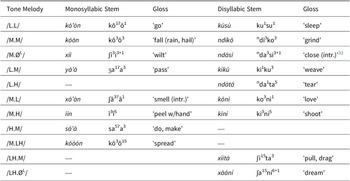


 Open access

