

Redeployment of services in the National Health Service is often top-down, initiated by decision makers in response to a trend or politics, rather than as a result of local evidence gathering. With much of research and resources dedicated to symptom-focused interventions, psychiatric rehabilitation became unfashionable over the past decade as a kind of ‘palliative care’. Reference Wykes and Holloway1 It lost significant resources and remains threatened in a climate of public finance retrenching. Recent focus on recovery meant a significant change of attitudes and models of care support rehabilitation once again. 2 Whereas most old-style in-patient units are closing down, some services are reborn as community recovery and rehabilitation teams (CRRTs).
The population of the London borough of Tower Hamlets, currently at 220 000, grows rapidly and is characterised by wide ethnic, cultural and socioeconomic diversity, with large minority ethnic communities, especially Bangladeshi and Somali. The redeveloped, affluent parts of the borough neighbour some of the most deprived areas in the UK. 3 Before the introduction of CRRTs, specialist rehabilitation was provided in a 13-bedded in-patient unit. Many service users with enduring illness stayed for lengthy periods on the acute wards or received residential care costing almost £900 000 annually, with doubtful value for money. Stakeholders believed that a significant number could be discharged or moved to less supported accommodation more quickly with the provision of intensive community rehabilitation, making a case for a CRRT. Since pre-existing sources of data were inadequate, we designed this survey to identify rehabilitation needs, create a pathway for appropriate referrals and inform the development of a CRRT.
Method
Participants
We surveyed all 1353 service users living in Tower Hamlets, subject to care programme approach (CPA) under four locality community teams, an assertive outreach team and an early intervention service. From a database of active users we extracted names, date of birth, team, care coordinator and address, and applied the inclusion criteria. Recruitment was not required as users were not asked to provide information; respondents were their care coordinators. Managers decided that participation should be mandatory to maximise rate of response.
Data collection
Data were collected using a purpose-made questionnaire. After a literature review we identified a number of well-established instruments with relevant properties. The Community Placement Questionnaire, Reference Clifford, Charman, Webb, Craig and Cowan4 designed to examine long-stay in-patients preparing for their rehabilitation back to the community, is a standardised, staff-completed tool that records demographics, ratings of social functioning, problem behaviour, disability, social contact, accommodation and day-care needs. The Health of the Nation Outcome Scales (HoNOS) Reference Wing, Beevor, Curtis, Park, Hadden and Burns5 was developed as a measure of mental health and social functioning. The last four subscales in particular are pertinent to a recovery-oriented service, as they refer to problems with relationships, daily living, living conditions, occupation and activities. The Camberwell Assessment of Need Reference Phelan, Slade, Thornicroft, Dunn, Holloway and Wykes6 is a schedule for the assessment of needs in mental health services, designed to provide the total number of needs, met needs and unmet needs, and the clinical version allows staff to plan patients' care. The Social and Occupational Functioning Assessment Scale (SOFAS) Reference Goldman, Skodol and Lave7 was also examined: developed as a modified version of the Global Assessment of Functioning scale for the purposes of DSM-IV Axis V, SOFAS produces a single rating between 0 and 100 describing the service user's level of social, interpersonal and occupational functioning, while excluding the severity of symptomatology.
No instrument from those reviewed was considered sufficient and the option of using them all was ruled out as impractical. Even though their perspectives are not identical, there is considerable overlap between items and they have shown substantial associations. Reference Slade, Beck, Bindman, Thornicroft and Wright8 Accordingly, we developed a new questionnaire incorporating ideas and items from these instruments, deeming any sacrifice of psychometric properties acceptable. A pilot questionnaire was tested by several care coordinators for feedback and improvement. The questionnaire aimed to produce a comprehensive user profile and to be suitable for referral and initial assessment. The first part asked about basic demographics, current care input, professionals involved and contacts. The second part had sections for residential needs, education, occupation, social and leisure activities, and an ‘illness profile’ that included diagnoses, level of engagement and adherence, risk factors and physical disabilities and needs. The last part incorporated a newly devised socio-occupational functioning scale (score: max. 10, min. 1), an estimate of the level of basic daily activities and the number of unmet needs. Respondents were finally asked whether the user was considered suitable for referral to the CRRT. Box 1 provides an outline of the questionnaire.
Box 1 Questionnaire outline
Part 1
Demographics
1 Current mental health professionals involved.
2 Current mental health services involved.
Part 2
3 Current residential placement.
4 Are the service user's accommodation needs met?
5 If unmet/overmet, what ideally would be required?
6 Is the service user housed in or out of the borough?
7a Is there an identified carer?
7b Have the carer's needs been assessed?
8a Does the service user have children under age18?
8b If yes, are Social Services aware or involved?
8c Do the children live with the service user?
8d Are the children on the ‘at risk’ register?
8e If yes, please specify the category.
9 Formal qualifications.
10 Current occupation.
11 Time spent involved in employment/meaningful activities.
12 Date of last paid employment.
13 Category of last paid employment.
14 Have the service user's occupational needs been met?
15 Is there a documented occupational action plan?
16 Current activities.
17 Are the service user's social/leisure needs met?
18 Has an action plan for the unmet needs been created?
19 Has the service user been assessed by a clinical psychologist?
20a Primary diagnosis.
20b Comorbidity.
21 Number of psychiatric admissions in the past 5 years?
22 Duration of longest admission in the past 5 years.
23 How many times has the patient been detained under the Mental Health Act?
24 Concordance with medication.
25 Relapse indicators recorded in medical notes.
26 Engagement with services.
27 Risk factors.
28 Risk assessment/risk management plan in medical notes.
29 Does the person have any physical illness or disability?
30 How much help does the person receive from friends or relatives for physical health?
31 How muchhelp does thepersonreceive fromlocal services for physical health problems?
32 How much help does the person need from local services for physical health problems?
33 Has a physical health assessment been done in the past year?
Part 3
34 Social and occupational functioning assessment scale (score1-10).
35 What support is currently being provided for activities of daily living?
36 To what degree do existing services meet the patient's needs?
37 Please indicate which services you feel the patient should be considered for?
Procedure
One questionnaire for each service user was pre-populated by software with available data. Collated in packs with instructions, they were distributed by hand and collected regularly. Response was reinforced with email reminders, visits and feedback to managers. Data were transcribed and analysed using EpiData version 3.0 on Windows XP (EpiData Association, www.epidata.dk). Validity checks, prompts, jumps and calculations in the transcription programme increased validity and efficiency. We transcribed every 20th record on another data-set (n = 50) and compared them with the main data-set for consistency, finding minimal discrepancies (18 in 4500 fields). Paper copies were stored securely and the data-set was kept on three password-protected back-ups.
We compared the returned questionnaires with the total distributed, looking for significant differences based on gender, age and name of team. We calculated descriptive statistics using proportions and distribution means, including missing data when >5%. We also identified service users ‘in need of rehabilitation’ using arbitrary cut-offs: socio-occupational functioning score <5, unmet need score >12 and those identified by care coordinators as potential referrals. Subgroup data were used in 11 univariate comparisons with the population producing confidence intervals at α = 0.5. These three subgroups were not mutually exclusive; any of these four characteristics was deemed as a proxy ‘threshold’ for possible services being offered by the CRRT.
Questionnaires were screened by two staff members and compared against draft referral criteria, including all users considered for referral by their care coordinator. Users thus identified were reviewed at a second stage at our weekly multidisciplinary meeting and those confirmed to be suitable were invited for a referral.
Results
From 1353 distributed questionnaires, 982 were returned, including 48 for users not subject to CPA or deceased, giving a response rate of 72%. Comparing available data between distributed and returned questionnaires, no statistical differences were found. Demographics reflected the local population; mean age was 42 years and the vast majority were White Christian or Bangladeshi Muslim. Up to 15% needed an interpreter and 27% preferred to speak a language other than English. The majority (83.3%) lived in general housing, with a significant proportion receiving informal (14%) or professional (3.2%) care at home; 13% lived in supported accommodation. There were 84 individuals waiting for general housing and 65 waiting for supported housing.
The majority of the service users were care-coordinated by a nurse or a social worker and they saw their care coordinator less than fortnightly. Only 30% regularly met a second mental health professional, usually a social or support worker. The majority (67%) were reviewed by a psychiatrist less than monthly. Community teams appeared to be the only service provider for almost 70% of users. For the rest, the most significant input came from non-statutory organisations and local authority and housing associations, a significant 8.7% seeing the latter on a weekly basis or more often. About 34% received care from at least one friend or relative but only 19% of these received a carer's needs assessment. Another 22.6% (35% for females) had underage children, but 80% of the care coordinators did not indicate whether the children lived in the same home or whether Social Services were involved.
Educational achievement appeared on average to be low, but a significant 51% had some qualification or training. Nonetheless, 73% were unemployed, 37% for more than 4 years. For 52% of the users, unmet occupational needs were reported, but only 22% had a documented plan to address them. For social activity, the majority (62%) met friends and family regularly and engaged in leisure activities (39%). Fewer were involved with resource centres (14%), participated in faith activities (10%) or engaged in physical exercise (1%), and 2.5% had no meaningful activity at all.
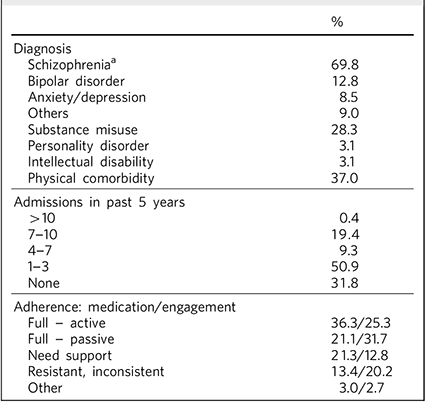
Table 1 gives an overview of psychiatric problems, adherence and engagement. Although 37% of users also received adequate help for physical health problems, 64% had not had a physical assessment during the past year. The most prevalent risk areas were vulnerability (32%), self-neglect (29%), substance misuse (27%), self-harm (22%) and violence (22%).
Morbidity and adherence (n = 934)
| % | |
|---|---|
| Diagnosis | |
| Schizophrenia a | 69.8 |
| Bipolar disorder | 12.8 |
| Anxiety/depression | 8.5 |
| Others | 9.0 |
| Substance misuse | 28.3 |
| Personality disorder | 3.1 |
| Intellectual disability | 3.1 |
| Physical comorbidity | 37.0 |
| Admissions in past 5 years | |
| >10 | 0.4 |
| 7–10 | 19.4 |
| 4–7 | 9.3 |
| 1–3 | 50.9 |
| None | 31.8 |
| Adherence: medication/engagement | |
| Full – active | 36.3/25.3 |
| Full – passive | 21.1/31.7 |
| Need support | 21.3/12.8 |
| Resistant, inconsistent | 13.4/20.2 |
| Other | 3.0/2.7 |
a Includes schizoaffective disorder.
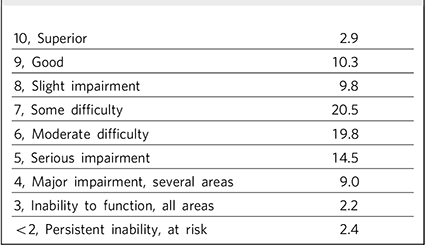
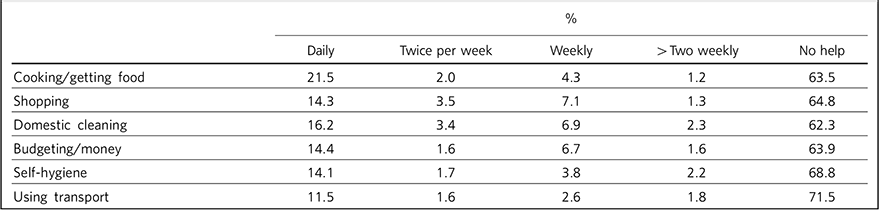
Tables 2 and 3 show the distribution of the patients on each level of psychosocial disablement and the existing support for activities of daily living, Table 4 provides the level of unmet needs in various domains of psychosocial function. Finally, Table 5 compares 11 variables between the 4 ‘in-need-of-rehabilitation’ subgroups. Despite significant overlap between the latter, the cut-offs used did not identify exactly the same patients.
Level of social and occupational functioning a (n = 934)
| 10, Superior | 2.9 |
| 9, Good | 10.3 |
| 8, Slight impairment | 9.8 |
| 7, Some difficulty | 20.5 |
| 6, Moderate difficulty | 19.8 |
| 5, Serious impairment | 14.5 |
| 4, Major impairment, several areas | 9.0 |
| 3, Inability to function, all areas | 2.2 |
| <2, Persistent inability, at risk | 2.4 |
a Adapted from the Social and Occupational Functional Assessment Scale (SOFAS). Reference Goldman, Skodol and Lave7
Support provided for basic tasks (n = 934)
| % | |||||
|---|---|---|---|---|---|
| Daily | Twice per week | Weekly | >Two weekly | No help | |
| Cooking/getting food | 21.5 | 2.0 | 4.3 | 1.2 | 63.5 |
| Shopping | 14.3 | 3.5 | 7.1 | 1.3 | 64.8 |
| Domestic cleaning | 16.2 | 3.4 | 6.9 | 2.3 | 62.3 |
| Budgeting/money | 14.4 | 1.6 | 6.7 | 1.6 | 63.9 |
| Self-hygiene | 14.1 | 1.7 | 3.8 | 2.2 | 68.8 |
| Using transport | 11.5 | 1.6 | 2.6 | 1.8 | 71.5 |
Unmet needs (n = 934)
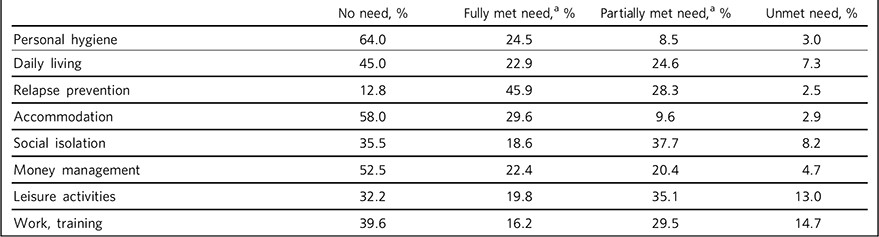
| No need, % | Fully met need, a % | Partially met need, a % | Unmet need, % | |
|---|---|---|---|---|
| Personal hygiene | 64.0 | 24.5 | 8.5 | 3.0 |
| Daily living | 45.0 | 22.9 | 24.6 | 7.3 |
| Relapse prevention | 12.8 | 45.9 | 28.3 | 2.5 |
| Accommodation | 58.0 | 29.6 | 9.6 | 2.9 |
| Social isolation | 35.5 | 18.6 | 37.7 | 8.2 |
| Money management | 52.5 | 22.4 | 20.4 | 4.7 |
| Leisure activities | 32.2 | 19.8 | 35.1 | 13.0 |
| Work, training | 39.6 | 16.2 | 29.5 | 14.7 |
a Due to services offered.
Subgroup analyses (n = 934)

| Mean (95% CI) | ||||
|---|---|---|---|---|
| Total population n = 982 | Functioning <5 n = 306 | Needs score >12 n = 167 | Possible referral n = 371 | |
| Mean age, years | 41.85 | 42.93 (41.35–44.52) | 39.10 (37.00–41.20) | 41.59 (40.19–42.99) |
| Males, % | 61.2 | 63.0 (56.7–68.9) | 66.9 (58.5–74.4) | 63.5 (57.8–68.9) |
| 1 contact/week or more, % | 28.0 | 32.8 (32.8–46.2) | 23.1 (20.4–52.4) | 23.6 (15.9–34.6) |
| Schizophrenia, a % | 69.8 | 66.4 (60.2–72.1) | 66.9 (58.5–74.4) | 67.0 (61.4–72.2) |
| Living independently, % | 64.1 | 52.1 (45.8–58.4) | 57.7 (49.1–65.8) | 52.4 (46.7–58.1) |
| Unmet housing needs, % | 19.4 | 25.6 (20.5–31.5) | 40.0 (32.0–48.6) | 26.7 (22.0–32.1) |
| Poor engagement, b % | 20.2 | 33.6 (27.9–39.8) | 31.5 (24.2–40.0) | 24.7 (20.0–29.9) |
| Physical illness, % | 37.0 | 47.9 (39.5–57.9) | 36.9 (27.0–50.5) | 38.9 (32.3–57.9) |
| Functioning, SOFAS score | 6.21 | 3.97 (3.81–4.14) | 5.4 (5.06–5.73) | 6.36 (6.12–6.59) |
| Needs score | 8.35 | 11.02 (10.26–11.78) | 15.46 (15.05–15.87) | 10.50 (9.78–11.23) |
| Possible referral, % | 37.7 | 50.4 (44.1–56.7) | 59.2 (50.6–67.3) | 100 |
SOFAS, Social and Occupational Functioning Assessment Scale. Reference Goldman, Skodol and Lave7
a Includes schizoaffective disorder.
b Resistant to suggestions, fails to keep appointments.
Discussion
Our survey was a strategic, targeted, consumer- and recovery-focused tool for the development of a new service offering a holistic approach to patient care. The results confirmed that there were unmet needs for recovery-oriented input among users of mainstream secondary services and supported investment in a new rehabilitation service in an era of resource restriction. Reference Wolfson, Holloway and Killaspy9 Severe mental illness can become a major hurdle to living life to the full and offering opportunities to patients is essential in keeping hope alive. Equally important to the treatment of symptoms is the access to accommodation, training, occupation, entertainment and, above all, positive social roles and identity. Reference Roberts, Davenport, Holloway and Tattan10,Reference Deegan11 Providers seek more efficient ways of delivering psychiatric rehabilitation, recognising that it still has an important role in promoting the individual's potential to maximise quality of life and sense of agency. Reference Wykes and Holloway1,2,Reference Wolfson, Holloway and Killaspy9-Reference Deegan11
Community recovery and rehabilitation teams can provide localised, personalised care that offers users choice and combats stigma. Reference Wolfson, Holloway and Killaspy9 This entails multidisciplinary care coordination of users in the community; expert assessments; transition work between supported placements; dynamic monitoring of morbidity, ability and physical health; and consultation on recovery and management of treatment resistance. Addressing social needs is essential, including education, occupation and finances, with emphasis on social inclusion and empowerment. Reference Wolfson, Holloway and Killaspy9-Reference Deegan11 Community recovery and rehabilitation teams have not been extensively studied but incorporate an eclectic approach, extrapolating support from research on intensive case management and occupational rehabilitation. Reference Hutchinson and Razzano12-Reference Crowther, Marshall, Bond and Huxley14
Reliably screening needs and potential for change is the first step in targeting users presenting a degree of treatment resistance and chronic reduction of functioning that affects their quality of life and impedes independent living. The characteristics and needs of this population in Tower Hamlets were often assumed or noted on an individual basis but this was the first time that collective evidence was produced to inform service redevelopment.
Sociocultural factors had to be taken into account, such as the burden of stigma in Muslim communities and care of females with dependent children. The majority of service users had a diagnosis of schizophrenia, with multifaceted needs considering medication, psychological interventions, occupational therapy and nursing. Significant comorbidity with substance misuse indicated a need for specialist input, albeit compared with other inner-London areas this was less pronounced. Reference Menezes, Johnson, Thornicroft, Marshall, Prosser and Bebbington15
Specific socio-occupational needs were highlighted. The respondents reported significant need in housing, especially low-support, independent and floating-support housing. In addition, users had extremely low levels of paid employment, a restricted range of meaningful activities and low educational attainment. Whether this was primarily due to reduced functioning or limited access to opportunities and support is hard to conclude. Additionally, ‘functioning’ and ‘unmet need’ scores seemed to identify different aspects, such that the latter were often associated with inadequate housing but not necessarily disability.
This survey indicated that although on average available services provided for basic care, input may be inadequate to cover complex needs. Overall, there was low level of intervention from psychiatrists, psychologists and occupational therapists, whereas many users could have benefited from a more multidisciplinary approach. In addition, non-statutory providers appeared underused. Occupational placements could partly address the remarkable lack of employment and brokering access to other outlets of psychosocial activity was also strongly indicated. It was unclear whether physical health needs were adequately addressed and known health risks were not adequately monitored.
Three characteristics were identified as most pertinent to our referral and assessment criteria:
-
1 low level of social, occupational and self-care activity,
-
2 unmet needs for support and opportunities, and
-
3 potential for engagement and meaningful change.
The last proved difficult to ascertain from the survey. The team applied clinical judgement in identifying potential, which could only be confirmed after a period of care. Conversely, diagnosis, symptomatology or physical disability did not differentiate users considered likely to benefit from the CRRT.
The results informed the efficient allocation and streamlining of resources. A case-load for the CRRT of 150 was deemed realistic, requiring 10 full-time care coordinators. The high need for psychological and occupational input supported the recruitment of occupational therapists, qualified psychologists, interpreters and bilingual support workers, as well as two psychiatrists, a full-time consultant and a junior at advanced training or specialty doctor level.
The survey provided some additional, unintended insights. A 72% response rate in a ‘mandatory’ project raises questions about care coordinators' attitudes towards service research. Missing data and discrepant answers in some items were beyond that expected to be due by chance, raising doubts on the detail of knowledge that many care coordinators have of users in their care and might indicate negative attitudes towards some user needs (e.g. co-occurrence of ‘no meaningful activities’ with ‘occupational needs met’). Finally, contemplated referrals were often inappropriate; only half of those with low psychosocial functioning were included, whereas the disability of those deemed suitable was at the population average, with needs often skewed by unsuitable housing. This finding highlighted an additional need for staff training in rehabilitation and recovery.
Study limitations
Sampling error was insignificant. Non-sampling errors, namely inaccurate answers, flaws of the questionnaire, respondent confusion or other human factors are hard to quantify, but likely to have occurred in random directions. Care coordinators might have exaggerated the disablement of users they considered suitable for transfer or they might have downplayed the needs of those that they preferred to keep. This might also have influenced the response rate, with some groups under-represented. Respondents may also have felt that their work was being scrutinised, subtly influencing responses. The research team were insiders with motivation to identify rehabilitation needs, but quantification and a standardised questionnaire limited spurious interpretations. Destined for local service appraisal and planning, one would need to be cautious before generalising the results to other populations or circumstances. The choice of respondents, justified for practicality and ethical concerns, admittedly omitted the patient perspective. Evidence shows that user-rated unmet need is among the best indicators of quality of life Reference Slade, Leese, Cahill, Thornicroft and Kuipers16 and that agreement between staff and users contributes in predicting treatment outcomes. Reference Lasalvia, Bonetto, Tansella, Stefani and Ruggeri17 Although promotion of quality of life is at the core of modern rehabilitation, quantifying it remains a major challenge that has not been adequately tackled by research. 18 Items addressing quality of life were incorporated in our questionnaire, but further qualitative work might be a good next step.
Acknowledgements
I thank the staff of Tower Hamlets CRRT for their valuable contribution, especially Clive Denton, Team Manager, Julian Edwards, Trainee Psychologist and, above all, Dr Chris Sage, Consultant Psychiatrist, who conceptualised, designed and led this study.


 Open access


eLetters
No eLetters have been published for this article.