


A dramatic increase in twin pregnancies has been observed in the past decades, primarily related to assisted reproductive techniques (ART) and increased average maternal age during pregnancy (American Congress of Obstetricians and Gynecologists [ACOG], 2004).
There were 57,956 twin pregnancies in Brazil in 2013 (DATA SUS, 2015). An increase of 76% of multiples pregnancy births was observed in the state of Rio de Janeiro between 1990 and 2009 (DATASUS, 2015). This increase is greater than the observed increase in developed countries. For example, the 2011 twin birth rate in the United States was 33.2 per 1,000 total births, and this rate was essentially unchanged from 2009 and 2010. Increases averaged nearly 3% annually from 1980 to 2004 (peaking at more than 4% from 1995 to 1998), but the pace of the increase slowed to one half of 1% annually from 2005 to 2011 (Martin et al., Reference Martin, Hamilton and Osteman2012). The multiple maternity rate in the United Kingdom decreased slightly to 15.6 per 1,000 women giving birth in 2013 compared with 15.9 in 2012 (Office for National Statistics, 2014).
Twin gestations are at increased risk for preterm delivery, intrauterine growth restriction, and congenital anomalies (ACOG, 2004; Creasy et al., Reference Creasy, Resnik and Iams2009; Little & Nevin, Reference Little and Nevin1989b). The presence of malformation in one twin has an impact on the perinatal outcomes of the affected twin and the normal fetus. The incidence of structural defects is approximately 1.5 times greater than singleton pregnancies for all twins. This rate reaches 2.3 when monochorionic (MC) twins are compared with dichorionic (DC) twins (Purisch et al., Reference Purisch, DeFranco, Muglia, Odibo and Stamilio2008).
Structural anomalies are responsible for the increased risk of preterm delivery, perinatal death, and intrauterine growth restriction in singleton gestation (Purisch et al., Reference Purisch, DeFranco, Muglia, Odibo and Stamilio2008; RCOG, 2008). There is an exceptional and challenging obstetric condition among twins that is described as discordant malformation, which occurs when one fetus is apparently normal and the co-twin carries a malformation that is identified using antenatal ultrasound. (Diana et al., Reference Diana, Timothy, Mary and Fergal2010; Lust et al., Reference Lust, De Catte, Lewi, Deprest, Loquet and Devlieger2008).
The management of discordant malformation is even more complex in some developing countries, where the law does not allow selective feticide (SF) for the abnormal twin even under conditions that are not compatible with neonatal life. The multidisciplinary attending teams in these countries should be aware of the natural history of discordant malformation in twins. The importance of the timing of delivery should be emphasized, considering the balance between intrauterine death and preterm birth (Shek et al., Reference Shek, Hillman and Kilby2014).
The present study investigated perinatal outcomes of discordant anomalous twins in a Brazilian tertiary center where SF is not performed.
Methods
Data were collected retrospectively from the Instituto Fernandes Figueira/FIOCRUZ (IFF/FIOCRUZ), Brazil between January 2002 and December 2014. IFF/FIOCRUZ is a tertiary maternity facility in the state of Rio de Janeiro, Brazil.
The following inclusion criteria were used: discordant anomalous malformation diagnosed or confirmed on ultrasound performed at IFF/FIOCRUZ, prenatal care and delivery performed at the same center, and confirmation of the malformation during postnatal care. All ultrasound scans were performed by senior members of the Department of Obstetrics, who are specialized in maternal–fetal medicine.
The following exclusion criteria were used: complications related to childbirth described in the medical records that may have influenced perinatal outcome, lack of information on delivery conditions or neonatal care in the records, no after birth confirmation of a malformation that was previously diagnosed during the prenatal period. Zygosity was not determined in the present study.
Congenital defects were classified according to the 10th revision of the International Statistical Classification of Diseases and Related Health Problems (ICD-10; WHO, 2015).
Adverse outcomes were defined as prematurity, mortality, or the development of the following diagnoses: (1) periventricular–intraventricular hemorrhage; (2) retinopathy; (3) periventricular leukomalacia; (4) mechanical ventilation; (5) necrotizing enterocolitis; or (6) surfactant use during the hospital stay. Statistical analyses were performed in SPSS Software version 2.0 using chi-square tests and independent samples test. The significance level was set at 0.05.
The Institutional Ethics Review Board approved and registered the study protocol (CAAE 0085.0.008.000-11).
Results
The database search identified 74 twin pregnancies with discordant malformation. The final data analysis was based on 40 pregnancies. Thirty-four cases were excluded because of complications related to childbirth that may have influenced perinatal outcome, a lack of information on delivery conditions or neonatal care in the records, and no after-birth confirmation of a malformation that was previously diagnosed during the prenatal period.
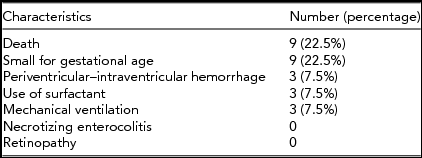
The mode of delivery was vaginal in 9 (22.5%) cases and cesarean section in 31 (77.5%) cases. Table 1 summarizes the maternal–fetal characteristics and Table 2 summarizes normal twin adverse outcome characteristics.
Maternal Characteristics and Pregnancy Information of Twins With Discordant Malformations
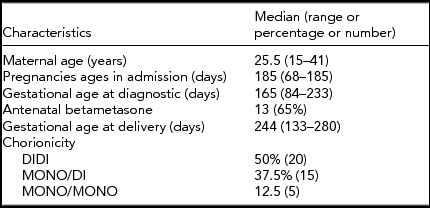
DIDI = dichorionic; MONO/DI = monochorionic/diamniotic; MONO/MONO = monochorionic/monoamniotic.
Normal Twin Adverse Outcomes
The commitment of organs and systems, according to the ICD-10 classification, was divided as follows: digestive system 27.2 (34%), central nervous system 17.6 (22%), urinary tract system 13 (17%), circulatory system 13.6 (17%), others 12 (15%), respiratory system 9.6 (12%), eyes, ears, face 5.6 (7%), genital 1.6 (2%), and chromosomal anomalies 1.6 (2%). Table 3 shows the congenital anomalous defects according to the ICD-10.
Congenital Defects According to the ICD-10

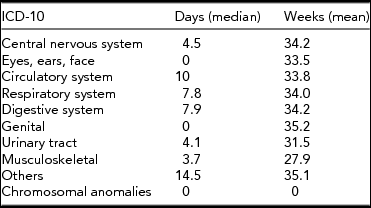
Table 4 lists the average of length of stay of the non-affected twin in the Neonatal Intensive Care Unit (NICU) according to the ICD-10.
Length of Stay in the Neonatal Intensive Care Unit/Gestational Age at Delivery-Normal Twin
A total of nine deaths of normal co-twins were observed during the study period. Table 5 shows the causes of death in normal twins according to the ICD-10 (WHO, 2015).
Death: Normal Twin
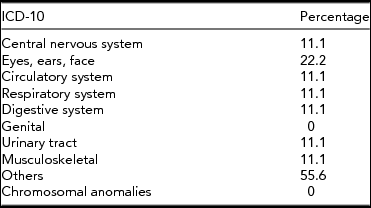
The nine deaths of healthy twins were associated with the following malformations according to the ICD-10: the ‘Others’ category accounted for five (55.6%) deaths; Eyes, ears, face and circulatory system were responsible for 2 (22.2%) deaths and 1 (11.1%) death, respectively. A 10-fold higher risk of death in the normal twin was observed in cases of death of the anomalous twin (p = .002, OR 10.55, 95% CI: 1.9–58.52).
The ‘others’ category of the ICD-10 was also associated with higher rates of prematurity, with a mean gestational age at birth of 27.9 weeks. Notably, delivery before 30.4 weeks was a significant predictor of fetal death (p = .01).
Discussion
The present study investigated perinatal outcomes of twin gestations complicated by a discordant malformation. Monozygotic pregnancies are not always associated with malformations in both fetuses. This happens because MZ twins are not necessarily phenotypically identical. Early post-twinning mutational events can be responsible for this discordance.
The digestive system was found to be the most commonly affected system in our population studies, which differs from the other studies that indicated the circulatory system to be most commonly affected. This could be attributed to the sample populations studied (Chang et al., Reference Chang, Chao, Cheng, Chung, Chueh, Chanq and Spoonq2004; Kang et al., Reference Kang, Liao, Brizto, Francisco, Krebs and Zugaib2014).
Normal adverse outcomes for twins, such as death, small for gestational age, periventricular–intraventricular hemorrhage, use of surfactant, and mechanical ventilation had a lower gestational age of 33 weeks.
Other system changes were responsible for the highest average length of hospital stay in the neonatal ICU, compared to the healthy twin. The severity of hydrops fetalis explained pregnancies bearing this condition and fetuses with intrauterine growth restriction.
Single fetal death in a twin pregnancy is traditionally known as a serious complication of the entire pregnancy (Chang et al., Reference Chang, Chao, Cheng, Chung, Chueh, Chanq and Spoonq2004). Previous studies demonstrated the association between perinatal mortality and severe malformations (Heydanus et al., Reference Heydanus, Santema, Stewart, Mulder and Wladimiroff1993; Kang et al., Reference Kang, Liao, Brizto, Francisco, Krebs and Zugaib2014; Nassar et al., Reference Nassar, Adra and Gomez2000). Our study demonstrated a strong association between death of the normal twin and anomalous twin death. A total of nine deaths of the normal co-twin were observed during study period.
A systematic review of the literature to assess the risk of co-twin death after intrauterine death of one fetus revealed that the risks of MC and DC co-twin deaths were 12% (95% CI: 7–18; p = .02) and 4% (95% CI: 2–7; p = .74), respectively (Ong et al., Reference Ong, Zamora, Khan and Kilby2006).
Another recent systematic review of the literature evaluated the effect of SF versus conservative management on perinatal outcome of the normal fetus in DC and MC twins discordant for anencephaly. This review concluded that SF did not reduce perinatal mortality, but it resulted in significantly longer gestations and higher birth weight. Therefore, SF appears to be the management of choice in DC twins discordant for anencephaly. SF also increased birth weight in MC twins, but no clear recommendations were made in this review because of the complexity of this group (Lust et al., Reference Lust, De Catte, Lewi, Deprest, Loquet and Devlieger2008).
The mean gestational age at delivery in the present study was 34.9 weeks. Previous studies reported that the mean gestational age at delivery in twin pregnancies with a fetal abnormality varied from 32 to 35.7 weeks (Chang et al., Reference Chang, Chao, Cheng, Chung, Chueh, Chanq and Spoonq2004; Gul et al., Reference Gul, Cebeci, Aslan, Polat, Sozen and Ceylan2005; Harper et al., Reference Harper, Odibo, Roehl, Longman, Macones and Cahill2012; Malone et al., Reference Malone, Craigo, Chelmow and Alton1996). The presence of fetal hydrops was related to a preterm delivery mean of 27.9 weeks, which is approximately 4.1 weeks earlier than reported by Kang et al. (Reference Kang, Liao, Brizto, Francisco, Krebs and Zugaib2014).
In conclusion, the management of twin pregnancies with one malformed fetus is complex. The first step is to distinguish the chronicity, because different management options are available for MC and DC twin pregnancies. Severe abnormalities should also be differentiated. The presence of a fetus with one major fetal malformation in a DC twin gestation increases the risk of preterm delivery (Gedikbasi et al., Reference Gedikbasi, Akyol, Yildirim, Ekiz, Gul and Ceylan2010). Although active management of DC twins improved gestational age and birth weight, these improvements are not statistically significant (Gedikbasi et al., Reference Gedikbasi, Akyol, Yildirim, Ekiz, Gul and Ceylan2010). Whether the best management is expectant or intervention in the case of MC twins is not certain. The preliminary results revealed no improvement in fetal outcome with active management. However, the number of cases in each group was too small to allow any definitive conclusions of the best approach to maximize the chances of survival of the normal co-twin and prevent preterm delivery. More prospective research is required to establish the best management of pregnancies with discordant anomalous twins.



