


Introduction
So-called tubular pottery comprises ceramic artifacts of unknown use recovered from Late Holocene archaeological sites generated by the complex hunter-gatherers of southeastern South America, especially in the middle and lower basins of the Paraná and Uruguay Rivers up to the Salado River valley (Aldazabal Reference Aldazabal1995–96; Brunazzo Reference Brunazzo1999; Caggiano Reference Caggiano1984; Díaz Reference Díaz1977; Farías Reference Farías2005; Freitas Reference Freitas1942; Reference Freitas1953a,Reference Freitasb; Frère Reference Frère2015; Gaspary Reference Gaspary1945; Reference Gaspary1950; Ghiani Echenique et al. Reference Ghiani Echenique, Uvietta and Gambaro2013; González Reference González2005; Hilbert Reference Hilbert1991; Lafon Reference Lafon1971; Loponte Reference Loponte2008; Lothrop Reference Lothrop1932; Márquez Miranda Reference Márquez Miranda1932; Oliveira Cézar Reference Oliveira Cézar1895; Ottalagano Reference Ottalagano2013; Reference Ottalagano2015; Ottalagano & Pérez Reference Ottalagano and Pérez2013; Paleo & Pérez Meroni Reference Paleo and Pérez Meroni2005–06; Reference Paleo, Pérez Meroni, Austral and Tamagnini2008; Pérez Reference Pérez2017; Schmitz et al. Reference Schmitz, Ceruti, González and Rizzo1972; Serrano Reference Serrano1922; Reference Serrano1931; Reference Serrano1933; Reference Serrano1972; Vignati Reference Vignati1942) (Fig. 1).
(Left, shaded). The known dispersion range (approximately) of tubular artifacts in South America. (Right) The southernmost distribution range with the locations of the sites where the samples were taken for this study: (1) Cerro Lutz; (2) La Argentina and Isla Lechiguanas site 3; (3) La Fortuna and Las Tejas San Nicolás site 1; (4) La Bellaca (sites 1, 2 and 3), Anahí, Guazunambí, Punta Canal, Rancho Largo, Túmulo de Campana (sites 1 and 2), Médanos de Escobar, El Cazador 3 and El Espinillo.

These artifacts have a totally unique morphology within what is known in the typology of archaeological ceramics worldwide, and to prove one of the hypotheses raised here would add the tubular artifacts to the select group of ceramics exclusively manufactured for mortuary purposes, of which there are very few examples in the world. The initial hypothesis about their use began with ethnohistorical sources. They indicated a mortuary usage for similar devices, at the same time explaining the meaning of their complex designs and allowing us to look into the symbolic conception of life after death within these ethnographic groups, which we could eventually extend to pre-Columbian times; knowledge that archaeologists can rarely recognize with any degree of certainty. Also, the symbolic meaning of these devices, which involves life after death in tombs, helps us to increase our understanding about the many ways in which complex hunter-gatherers went about establishing their ownership of territories by signalling sacred landscapes.
In this study, the tubular artifacts are described and analysed in order to understand their singularity, providing another example of how technical analysis can help to identify symbolic pottery within the archaeological context. This preliminary characterization will allow us to understand better the ethnographic descriptions and interpretation of these artifacts.
The tubular pottery
These artifacts are associated with different closely related archaeological units, including those informally identified as Plain Pottery Cluster, Incised Pottery Cluster, the so-called Goya-Malabrigo contexts and others that do not yet have a specific cladistic definition (Loponte Reference Loponte2008; Loponte & Acosta Reference Loponte and Acosta2016; Serrano Reference Serrano1972). The oldest record to date corresponds to the Playa Mansa site, dated to 2400 ± 20 radiocarbon years bp, where what appears to be an apical fragment was recovered (Escudero & Coll Reference Escudero, Coll, Loponte and Pérez2013, 28, piece 28.235). The most modern finding corresponds to Cerro Bauer, dated to 242 ± 24 radiocarbon years bp (see Table 1), reaching the historical period. Their morphological particularity and spatio-temporal range suggest that these artifacts were a local/regional development used by human groups who shared a similar lifestyle adapted to continental wetlands and a similar material culture. Tubular artifacts have been recovered from sites interpreted to be residential camps, where burials have also often been detected. These pieces are essentially thick ceramic tubes between 10 and 45 cm long, open at both ends and conical in shape in most cases (Fig. 2). Their walls are between 6 and 25 mm thick, with some reaching up to 45 mm or even more. Those with simpler designs have one narrow end, referred as to apical in this manuscript, and a wider one at the opposite end, referred to as basal. The apical opening measures between 1 and 4 cm in diameter, while the basal one regularly reaches between 6 and 10 cm. This is the simplest design and it is probable that a significant portion of them have a lateral or medial duct approximately 1 or 2 cm in diameter on one of their sides (see Fig. 2, piece A; Fig. 4, piece A; see also Loponte Reference Loponte2008, 244). Within this general design, there is a wide variety of forms that have been given different typologies (Caggiano Reference Caggiano1984; Díaz Reference Díaz1977; Farías Reference Farías2005; Gaspary Reference Gaspary1945; Hilbert Reference Hilbert1991; Serrano Reference Serrano1966; Reference Serrano1972, among others). In some pieces, for example, a solid apical appendage has been added (Fig. 2, pieces B, C & D). In archaeological units where the pots include zoomorphic appendages, these are often incorporated into tubular artifacts (Fig. 2, pieces C, E & F) and coexist with the simplest ones. In the most complex tubular pieces, the appendages and modelling acquire an aesthetic predominance over the artifact's basic design, also increasing the size of the base and the apical sector of the central duct (Fig. 2, pieces E & F, and Fig. 3). In the same way, in assemblages where the pottery is incised, tubular artifacts often have similar incisions (Fig. 4; Loponte Reference Loponte2008, 244). The internal duct, both in simpler and more complex pieces, can be mostly cylindrical or trunk-conical (Serrano Reference Serrano1972).
The various tubular pottery designs. (A) Side view of a simple tubular artifact with medial duct (indicated by the dotted circle and arrow). Below, top view of the same basal fragment (La Bellaca site 1); (B) Side view of a simple tubular artifact with solid appendix (La Bellaca site 1); (C) Simple tubular artifact with solid appendage, probably with a zoomorphic design (Talavera Island, private collection); (D) Tubular artifact with extended solid appendage (described as a ‘bell’ by Gaspary Reference Gaspary1950) (Cerro Grande, Isla los Marinos); (E) Lateral view and idealized schematic cut of a tubular artifact with a cylindrical hole with bilateral zoomorphic appendages (‘bell’). (Taken and modified from Caggiano Reference Caggiano1982.); (F) Lateral view and idealized schematic cut of a tubular device with zoomorphic appendages (‘bell’). (Taken and modified from Hilbert Reference Hilbert1991.)

(A) Complex tubular artifact with two front appendages of stylized bird heads (probably the Psittacidae family), curated at La Paz Regional County Museum ‘Alicia González Castrillón’; (B) Complex tubular artifact with canid appendage (probably pre-Columbian Canis familiaris), recovered at Las Tejas San Nicolás site 1. In both cases, the inner sides of the central ducts are exposed in the right-hand images.

Apical fragments of simple tubular artifacts. Upper row: Side views of piece 101. The medial duct is indicated by a full arrow. Bottom row: Two sides and top view of piece 102. The dotted arrows in both pieces indicate the areas where the white paint is better preserved over the reddish and few black surfaces derived from the firing process. Provenance: Las Tejas San Nicolas site 1 (‘Goya-Malabrigo’ cluster). The scale is approximate.

Sites, number of samples and types of analysis carried out for this study. *maximum and minimum radiocarbon dates. **estimated chronological range (no 14C dates were available). Tub.=tubular; Com.=common vessels.

Tubular artifacts are also called alfarerías gruesas [thick pottery] because of the thickness of their walls, or campanas [bells] because they are approximately campaniform in shape (Caggiano Reference Caggiano1984; Gaspary Reference Gaspary1945). Some authors only use the descriptive term ‘bell’ for artifacts with zoomorphic appendages, but these differences are all part of the variation within the general Bauplan. Even Serrano (Reference Serrano1972, 48) and Gaspary (Reference Gaspary1950, 40), the two authors who began to systematize the study of these artifacts, gave the name ‘bells’ to tubular artifacts without zoomorphic appendages, but with handles or simple protuberances similar to those observed in some simple tubular artifacts (for example, compare piece B in Figure 2, which is a simpler design, with piece D in the same figure, described as a ‘bell’ in the literature).
Differences in nomenclature can also be observed in Uruguayan archaeology, where the simplest designs are also called ‘botellones’ [big bottles] or ‘thick pottery’ in generic form (Freitas Reference Freitas1953a,Reference Freitasb; Hilbert Reference Hilbert1991). One of the designs coincides with that of simple tubular pottery open at both ends (Hilbert Reference Hilbert1991, fig. 95); but there is another type where the apical end is closed and the medial duct comes very close to this extreme (Hilbert Reference Hilbert1991, figs 96 & 97). Farías (Reference Farías2005), also in the Uruguayan context, distinguishes between alfarería gruesa campanuliforme [campaniform thick pottery] with zoomorphic appendages, and alfarería gruesa cilíndrica [cylindrical thick pottery] or alfarería gruesa tubular [tubular thick pottery], which correspond to the simplest tubular artifacts (see also Díaz Reference Díaz1977). Beneath all this complex descriptive variety, the basic concept is a thick-walled device, wide/open at its lower end and with one or two smaller ducts in its apical and/or medial sectors (Gaspary Reference Gaspary1950, 35). The different uses of terminology and structural or morphological characteristics to distinguish between the various designs (i.e. ‘thick pottery’, ‘bells’, ‘big bottles’, ‘spouts’, ‘thick cylindrical pottery’, etc.) have created a picture that could lead to some confusion.
Tubular artifacts are often painted white (Farías Reference Farías2005; Freitas Reference Freitas1953a,Reference Freitasb; Frère Reference Frère2015; Hilbert Reference Hilbert1991; Loponte Reference Loponte2008; Ottalagano Reference Ottalagano2013; Ottalagano et al. Reference Ottalagano, Reinoso and Freirein press; Pérez Reference Pérez2017; Vignati Reference Vignati1942; and others). This colour must have had a particular meaning, because utilitarian pots are painted red; meanwhile white paint is extremely rare. This last colour in tubular pottery was applied directly onto the exterior walls after firing (i.e. Fig. 4; Fig. 5B; Fig. 14D), but there are also examples of interior applications (Fig. 5F; Fig. 14C). This occurs in both simple and complex tubular artifacts. The white paint is usually faded and only remains in parts on the surfaces of the sherds, in places where it has resisted erosion, solubilization and entrainment processes which the pigments are subjected to after being buried in the local organic and water-saturated soils. Previous X-Ray Diffraction (XRD) analyses of remnants of this colour on three sherds of complex tubular pieces recovered from sites located on the Middle Paraná River identified hydroxyapatite (Ottalagano et al. in press). A similar result was obtained by Frère (Reference Frère2015), who identified hydroxyapatite in the white pigments used on simple tubular artifacts from the Salado River valley. Following this same concept of white paint, it is common for tubular artifacts to have a cream slip, especially those that are not painted white, with the obvious intention of making their outer appearance whiter (Fig. 2, A & B; Fig. 14, B & C). The use of this white slip is again distinctive of tubular artifacts, as in the collections they came from it was not applied to utilitarian pots, or is extremely rare. These slips are generally better preserved than white pigments, often presenting a cracked appearance. Their application may have involved the addition of a colouring material to the liquid clay, which conceptually can be considered a pre-firing paint (García Rosselló & Calvo Trías Reference García Rosselló and Calvo Trias2013; Ottalagano et al. Reference Ottalagano, Domínguez and Bozzano2015; Rye Reference Rye1981). Studies carried out with XRD identified illite as a potential source of the white colour in some complex tubular artifacts. Furthermore, the use of a kind of cast (CaSO4), or a related compound, should not be discarded (Ottalagano et al. in press).
(A) Apical sector with smoothing and burnishing; (B) Apical sector finished by smoothing and small polishing patches, with traces of white paint; (C) Bottom view of the internal area of a base, finished by circular smoothing; (D, E) Bottom view of the apical duct; (F) Internal view of the irregularly smoothed apical duct. Note the white-grey colouration added with a slip and with white paint superimposed.

In addition to their surface colours, tubular artifacts are made from a very distinctive oxidized fabric, which often results in reddish or orange colors. Conversely, ordinary vessels have a widely predominant dark-coloured matrix in freshly fractured sherds, which indicates the existence of an oxygen-reduced firing atmosphere (see below). Another peculiarity of tubular pottery is the absence of carbon deposits and the adhesion of substances or erosion marks (Loponte Reference Loponte2008; Pérez Reference Pérez2017; for the contrary, see Frenguelli Reference Frenguelli1927 and Aversente et al. Reference Aversente, Loponte and Acostams.). The tendency to lack macro organic residues is particularly striking, given that the internal channels of simple tubular artifacts are narrow and usually poorly smoothed down with a rough surface which is ideal for retaining substances that have circulated through this inner channel.
Finally, it should be noted that while the apical ends in simple pieces usually have an irregular profile, the basal ones are regular and have the same tangential plane around their perimeters, which makes them suitable for eventually being supported on soil or other surfaces. Concurrently, the trunk-conical format helps maintain a vertical axis of stability at rest. In the same way, pieces with large appendages are arranged in opposite directions to maintain their balance, as shown in Figure 2, pieces E and F.
Functional hypotheses
Torres (Reference Torres1910) and Serrano (Reference Serrano1929) considered that the most complex tubular artifacts had a totemic character as an iconic symbol of identity, mainly due to their peculiar structure and zoomorphic appendages. However, it should be noted that ordinary pots from the same context also often have zoomorphic appendages (Ottalagano Reference Ottalagano2013; Serrano Reference Serrano1972). Frenguelli (Reference Frenguelli1927) considered that they were used to conserve fire; that is, burning coals would have been placed inside them. A few years later, Lothrop (Reference Lothrop1932) considered that the simplest tubular artifacts would have been used as fire dogs, that is, as pedestals for placing pots on the fire. While these artifacts have a similar morphology to those of some fire dogs, as illustrated in the archaeological literature (e.g. Aston Reference Aston1989), they certainly do not meet some of the classical design requirements as being an adequate area for supporting vessels, including a lack of evidence of abrasion and carbon deposits. Following the hypothesis that associated them with fire, Gaspary (Reference Gaspary1945) suggested that more complex artifacts were used as incense burners in mortuary contexts. A different idea for the simplest artifacts was postulated by Oliveira Cézar (Reference Oliveira Cézar1895), who considered them spouts for skin bags for transferring liquids. This idea was later followed by Serrano (Reference Serrano1972, 22) who called them tubos troncocónicos [trunk-conical tubes]; nowadays, this hypothesis is followed in a similar fashion by some contemporary authors. Although this idea, like every previous one, is a possible explanation, there is no functional or convincing model for which these heavy artifacts, sometimes up to 20 cm high, with irregular apical sectors, often painted white and also often with a hole in the medial sector, could have served such purposes. Similarly to the first authors, Lafon (Reference Lafon1971) found ‘thick pottery’ associated with burials at an unidentified site in the south of the province of Entre Ríos, which he considered to be part of a mortuary ritual. This author also gave the name ‘thick pottery’ to simple tubular artifacts, as is recorded in his field notebooks and on the labels packed with some of these pieces recovered by this researcher. Consistent with the findings of Lafon and some previous authors, Hilbert (Reference Hilbert1991) considered that tubular artifacts, even the simplest ones, were funerary offerings. In our own excavations carried out at different sites in the Paraná and Uruguay River basins, we have not been able to identify any associations between these artifacts and any type of activity or mortuary structure, but this does not prevent us from considering the hypotheses raised by Gaspary, Lafon and Hilbert regarding mortuary usage.
Materials and methods
In order to advance this study of tubular pottery, after soft cleaning, both the surfaces and pastes of 80 sherds and 20 freshly broken selected sherds were observed with an ESEM FEI Quanta 200 microscope (between 10× and 100×). Thin sections were analysed with a petrographic microscope, comparing the results with those obtained from ordinary pots from a previous analysis. After that, the chemical compositions of the pastes and inclusions of both tubular and ordinary pots were determined by Energy Dispersive X-ray analysis in an EDX Genesis Apex 2, expressed as atomic weight (Wt %) or coverage area (At %), and subsequently analysed using Laser Ablation Breakdown Spectroscopy (LIBS). For the latter, each sherd was pulverized in an agate mortar and fired at different temperatures (500°C, 600°C, 700°C and 800°C). In this way, from each fragment of pottery, four sub-samples fired at different temperatures were generated. The cooking temperature control was carried out with a thermocouple type K and a NOVUS-Smartmeter. The samples were cooled in the air and, once at room temperature (RT), they were placed in plastic containers previously washed with alcohol. The resulting samples were analysed with an Ocean Optics 2500+ device, with a lamp energy of 400 J, a laser of 50 mJ, a focal length of 6.2 cm, a delay time of 2.08 μs and a detection range of between 200 and 730 nm.
From the previous samples, sufficient quantities were separated to perform an analysis by Fe57 Mössbauer Spectroscopy. The firing times during these essays were selected based on the previous literature (Wagner et al. Reference Wagner, Gebhard, Murad, Riederer, Shimada, Ulbert and Wagner1998; Reference Wagner, Gebhard, Häusler, Hutzelmann, Riederer, Shimada, Sosa and Wagner1999; Reference Wagner, Wagner, Hausler and Shimada2000) in order to ensure that the reaction equilibrium for the respective temperatures had been reached. The spectra were taken at RT in a conventional constant acceleration spectrometer in transmission geometry with a 57Co/Rh source. The measurements were recorded at 10 mm/s and then fitted using the NORMOS program developed by Brand (Reference Brand1987). The spectra were fitted to Lorentzian line shapes using a minimum number of doublets and sextets.
In parallel to these analyses, another 13 sherds of simple tubular pottery were selected to determine their fatty acid composition. Approximately 2 g of the interior sides of the sherds were crushed in a mortar after their surfaces had been scraped to remove any lipids of external origin. The lipids were extracted with 10 ml of chloroform/methanol (2:1 v/v) by ultrasonication of the ground samples for 20 minutes at RT. The solids were removed by centrifugation (3500 rpm, 15 minutes), followed by filtration and then the solvent was evaporated under a stream of N2. The fatty acid methyl esters (FAMEs) were prepared according to Indarti et al. (Reference Indarti, Abdul Majid, Hashim and Chong2005) by adding H2SO4 1% to methanol and heating at 80°C for 1 h. After cooling to RT, 5 ml of NaCl 5% was added and the methyl ester derivatives were recovered with chloroform. The solvent was then removed under nitrogen and the FAMEs were dissolved in 500 μL hexane for analysis by gas chromatography.
The FAMEs were analysed using a Shimadzu 17A gas chromatograph equipped with a split injector (ratio set at 1:10) and a flame ionization detector (FID) system. The samples were separated using a capillary column (30 m × 0.25 mm i.d., 0.25 μm-thick film) and coated with BPX-70 stationary phase (70% cyanopropyl polysilphenylene-siloxane). The injector and detector temperatures were kept at 230°C. The carrier gas was nitrogen set at a flow rate of 0.8 ml/minute. The initial oven temperature was 140°C for 5 minutes, followed by a 140°C to 190°C increase at a rate of 4°C/minute. This was followed by a 13-minute hold at 190°C, after which the temperature was increased to 200°C at 50°C/minute and remaining at 200 °C for 2 minutes. Three replicates were analysed for each sample and the peaks were identified by comparing them with several external qualitative standards (Supelco, MO, USA). These results were compared with those previously obtained in ordinary vessels recovered from regional sites and the same temporal block (Pérez et al. Reference Pérez, Acosta, Naranjo and Malec2013). A summary of the performed analyses can be seen in Table 1.
In this paper, we refer to the ‘matrix’ to identify material with a slime particle size which corresponds to clay; ‘paste’ means the result of a mixture of the matrix and the inclusions (including the natural and artificial tempers); while the term ‘fabric’ involves the matrix, the inclusions and the firing conditions. We define ‘smoothing’ as the process of smoothing the walls of pieces, but leaving their surfaces rough to the touch; ‘polished’ means the process derived from polishing which leaves surfaces smooth to the touch and without a glossy aspect. We reserve the term ‘burnished’ for surfaces that, in addition to being smooth to the touch, have a glossy surface.
Results
Conservation and fracture processes
The state of conservation of tubular pottery sherds does not differ from ordinary vessels. The fracture planes are irregular and sharp, showing no significant erosion during their burial process and subsequent depositional stasis within the soil matrix. The shapes of the sherds tend to be quadrangular or irregular (Figs 4 & 5A, B & F), typically derived from the fragmentation of modelled artifacts. The simpler pieces frequently show a fracture that divides the artifacts into two large sectors, the apical and the basal, as if the main fracture had happened in the middle sector of all the pieces (Figs 2A, 2B; 4A, 4B; 5A, 5B). Indeed, complete apical and basal sectors are often recovered, but complete medial sectors are extremely rare.
Manufacture process and inclusions
The pieces were modelled and/or with paste aggregates with the exception, perhaps, of expanded bases, which could have been made by coiling (Fig. 5C). The internal sectors of the expanded bases generally present a more or less regular smoothing, executed by circular movements (Fig. 5C). As the fragments correspond to the apical sectors, the roughness of the internal surfaces is greater. This is a consistent observation given that the potters did not have full access to the small ducts to smooth or polish them (Figs 5D, E & F). These axial ducts were probably manufactured in two different ways. In the base area, they were formed by modelling or coiling, while in the apical sector, at least in some pieces, they seem to have been executed by introducing a more-or-less cylindrical object into a solid block of fresh paste, thus displacing part of it. This operation, which could have been executed even with a small stick, was not always performed in an equidistant manner from the future axis of the piece and, therefore, the ducts can be displaced from this axial axis (Figs 5D & E). External smoothing, which is the most common treatment, was carried out longitudinally, from the basal to the apical sector, or vice versa. Some pieces were subsequently polished or burnished, following the same direction (Fig. 5A). The fabrics are reddish in colour, which denotes a completely oxidated firing atmosphere, which will be discussed in more detail below.
The sections show a sparsely cohesive paste, with numerous lines of cleavage. The textures are loose and friable in most of the samples (x80 ≥ 90%), with a low level of cohesion, often with internal exfoliation processes and numerous interstices (Figs 6, 7E & 7F), with few exceptions where the pastes are partially more cohesive (Fig. 6E). All the thin sections show a low level of fluidity (Figs 7A, B & C) derived from lightly kneaded pastes. These are dense, with few pore spaces, oscillating around ~5 per cent. The same results were obtained from thin sections made on complex tubular artifacts with zoomorphic appendages recovered from sites located on the mid-Paraná River (Ottalagano Reference Ottalagano2015).
Fresh breaks in tubular artifact walls. Pieces A–D show very friable fabric with cleavage lines (especially pieces A, C and D), and slightly more cohesion in pieces B and E.

Top row: Thin-section micrographs of a simple tubular pottery captured by a metallographic microscope. The black and reddish inclusions are basically iron oxide slumps of different granulometry. Bottom row: Fresh break micrographs captured by SEM. (D) Iron oxide pellets (bright when observed by ESEM), indicated by the arrows; (E) Preserved tissues, indicated by the arrows, surrounded by natural lumps of aluminum silicate; (F) Empty spaces in the paste.

The most abundant inclusions are quartz and opaque minerals (Fig. 7, pieces A, B & C). Compared with ordinary pots (Ottalagano Reference Ottalagano2015; Pérez Reference Pérez2017), they have smaller quantities of quartz in their sand fractions. The opaque minerals are basically iron oxides (Table 2; Figs 7D, 8A, B & C). Their dimensions vary from less than 1 mm to ~10 mm in diameter. In very small quantities, there are crushed ceramics of different sizes (≤10 mm; see Fig. 8D), natural lumps of aluminum silicates (up to 1 mm; Figs 7E & F, 8D), volcanic shreds, bio-clasts and some carbonized and/or preserved tissues (Fig. 7E).
Chemical composition in terms of the atomic composition of black/reddish pellets included in the matrix (Wt %).

(A, B, C) Iron oxide pellets, which in the above SEM images are bright due to their metallic composition; (D) Crushed ceramic as a temper surrounded by natural lumps of aluminum silicates. The square in each micrograph indicates the area analyzed by EDAX. Top right graphic: Chemical composition of one iron pellet sample. Bottom right graphic: Chemical composition of the crushed pottery in image D.

Opaque minerals and quartz are natural inclusions in some local clay banks and are found in both utilitarian vessels and tubular artifacts. In the latter, opaque minerals tend to include larger ones according to the need to maintain thicker walls (cf. Rye Reference Rye1981). When cooked they harden, acting as natural tempers. Previous X-ray analysis showed their metallic composition (Loponte Reference Loponte2008), as corroborated by EDAX. In effect, nine of these pellets show a high percentage of Fe (x9 = 37.91 ± 15.89 Wt %: see Table 2; or 21.04 ± 11.89 At %). Crushed pottery is also present, but in smaller quantities. The tempers observed by SEM and analysed by EDAX have a similar colour and chemical composition as the matrix (Fig. 6, piece D), with a low concentration of Fe. This occurs in both tubular pottery (x11 = 0.96 ± 0.60 At %) and ordinary pots (x9 = 1.21 ± 0.85 At %). Finally, the lumps of natural silicates have the same composition as the matrix and crushed sherds, but they are smaller and size-selected (~200μ); they generally do not include iron micropellets, as eventually crushed pottery does.
Chemical composition of the matrix in tubular pottery and common pots
The chemical composition of the matrix does not show any substantial differences between tubular and common vessels (see Table 3). However, both groups present some smaller differences including a greater range of variation in the former, thus allowing them to be grouped into different clusters that are, however, not exclusively of each type (Fig. 9).
Chemical composition in terms of the atomic percentages (Wt %) of the pastes determined by EDAX on tubular artifacts and ordinary vessels.

Analysis of the main components (left) and groups of components (Mahalanobis cluster) where the tubular pottery subsets range from samples 1 to 11 (in red +), and the ordinary vessels from samples 12 to 20 (in blue □).

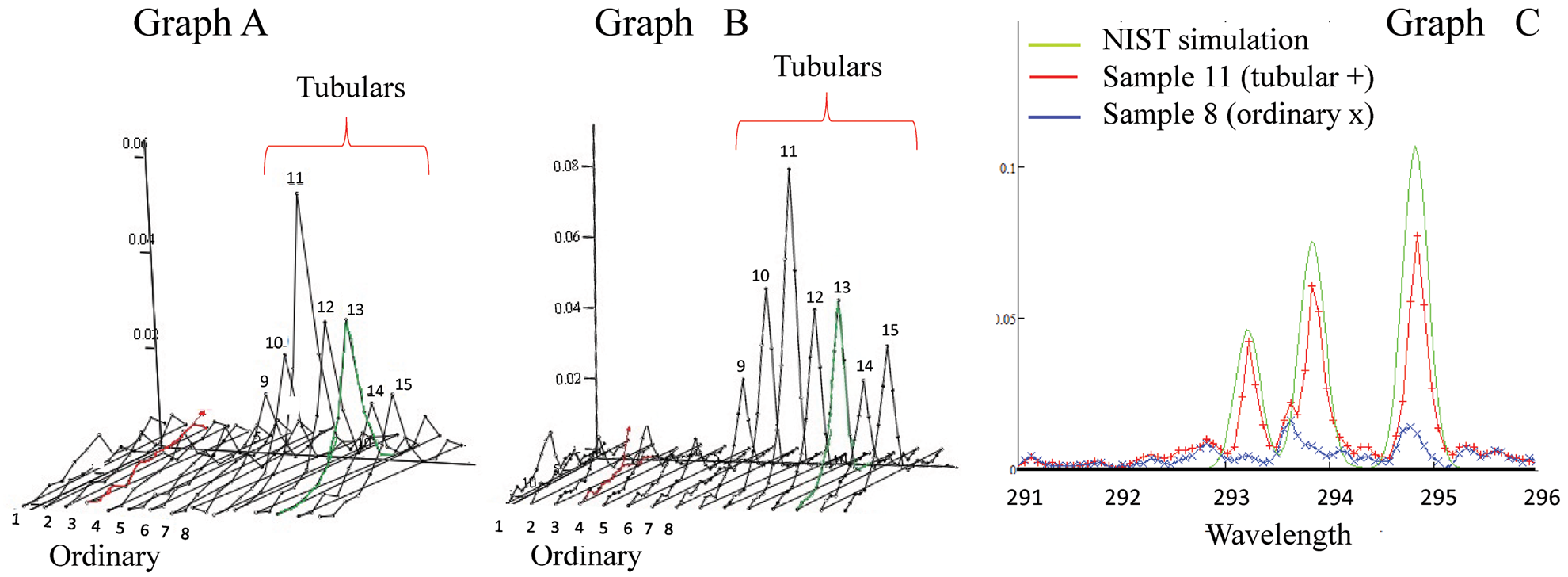
The LIBS analysis of tubular artifacts and common vessels yielded generally similar results to those obtained with the semi-quantitative EDAX. However, this method has a greater qualitative sensitivity that allowed very small amounts of Cu and Ba to be identified in both types and 18 spectral bands (SB) in high proportions found exclusively in tubular pottery (see Figure 10, graphs A & B). By contrasting these SB values with those provided by the National Institute of Standards and Technology (NIST, USA), manganese emerges as being the only compatible element (Figure 10, graph C by way of example compares samples of both pottery types against the standard).
(Graph A) Peaks of Mn λ = 348.2 nm; (Graph B) Peaks of Mn λ = 482.1 nm in tubular pottery samples (pieces 9 to 15) compared to the values of ordinary vessel samples (pieces 1 to 8); (Graph C) NIST simulation (solid green line), which correlates with the triple peak of Mn observed in the tubular pottery in sample 11 (red + line) and shows a lack of correlation with the ordinary vessels in sample 8 (blue x line).
The intensity of the Mn peaks decreases as a function of temperature; this does not happen with other elements such as K (see Figure 11). The sub-sample of tubular pottery annealed at 500°C had the highest concentration of Mn, which gradually reduced to the lowest concentration in the sub-samples annealed at 700°C and remained almost constant at 800°C, which is the maximum annealing temperature of these samples in the laboratory.
Decreasing Mn concentrations according to increasing cooking temperature.
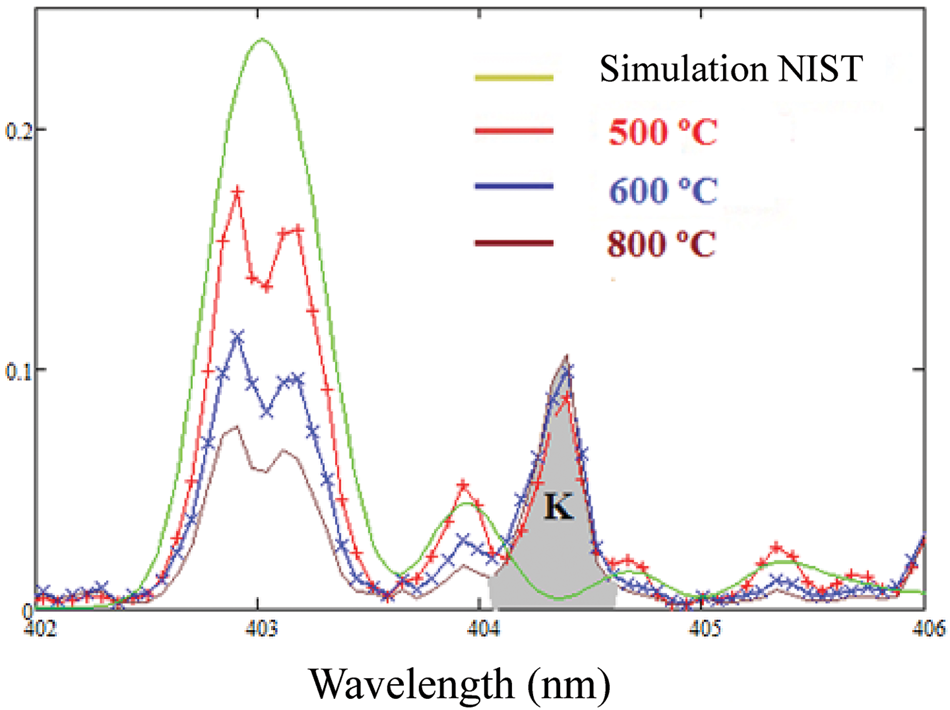
Since Mn compounds are not recognized at these levels in ordinary vessels, it should be ruled out that they are a product of post-depositional contamination and thus differentially added to tubular pottery. Moreover, tubular pottery was fired by aboriginal groups at 800–850°C (see below); thus, the only possible explanation for these Mn spectral bands is a post-firing application of a volatile Mn compound.
Firing temperatures
The first remarkable difference between these sets of samples is the colour of the powders resulting from grinding. The former are reddish to light brown due to the action of sufficient temperature and oxygen; meanwhile, the latter are black or dark brown due to reduction conditions (Fig. 12) (Murad & Wagner Reference Murad and Wagner1998; Rye Reference Rye1981; Wagner et al. Reference Wagner, Wagner, Hausler and Shimada2000).
On the left, two columns with six samples of pulverized tubular pottery fragments; on the right, two columns of ground fragments of ordinary vessels.

There are different scenarios for performing a Mössbauer study of archaeological pieces. When clay from an archaeological site is available, the firing context can be emulated in the laboratory under different conditions. A comparison of the Mössbauer spectra corresponding to these controlled experiments can be compared with the spectra of ancient ceramics to identify the original production techniques. If the original clay is not available, refiring the ancient pottery samples in the laboratory may help to determine the original firing conditions. The latter procedure was the one employed to perform the Mössbauer analysis.
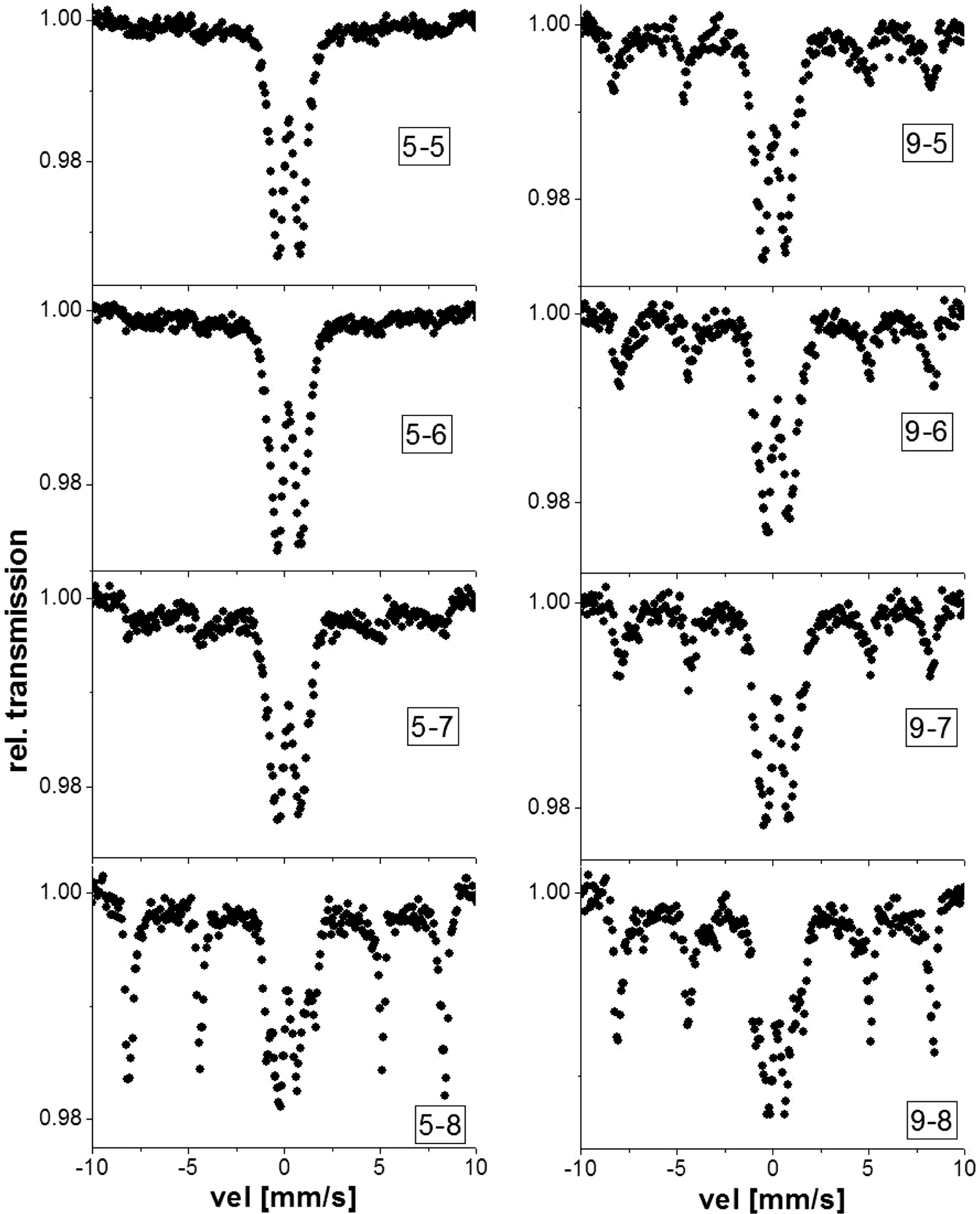
The RT Mössbauer parameters that change most sensitively during the oxidizing firing of pottery clays are the quadrupole splitting of the trivalent iron, QS (Fe3+), and the nonmagnetic Anm fraction. When heated in air, there is a strong increase from the QS (Fe3+) for fresh clay up to that corresponding to a firing temperature of 400°C and reaches a maximum on firing at 700°C. Then, between 700°C and 900°C, hematite forms from the iron set free from the clay matrix (Wagner et al. Reference Wagner, Gebhard, Häusler, Hutzelmann, Riederer, Shimada, Sosa and Wagner1999). In a Mössbauer spectrum, the absence of or decrease in Fe2+ is indicative of an oxygen-rich atmosphere in the original firing. For clays fired under reducing conditions, instead a reduction of Fe3+ occurs at around 500°C and the Fe2+ content increases until 800°C, but there is no increase in QS (Fe3+) (Murad & Wagner Reference Murad and Wagner1998). In both subsets (tubular and ordinary vessels), the higher percentage of non-magnetic Fe3+ reveals that the sherds were not fired at above 900°C, when entire structural iron forms hematite. The spectra obtained from samples from ordinary vessels denote firing under reducing conditions at 800°C, followed by intentional or accidental exposure to oxidation in the air, at around 700–750°C, after the firing cycle. The result of these firing conditions consists of sherds with black cores and slightly lighter external surfaces or with a thin reddish layer. The spectra obtained from tubular samples, in turn, indicate firing at 800°C under a reducing atmosphere, followed by oxidation at the end of the firing cycle, which started at higher temperatures, around 800–850°C. In the Mössbauer spectra, this is seen as a decrease in non-magnetic areas (doublets) due to the formation of hematite (sextet), because at elevated temperatures (above 700°C) small hematite particles may coalesce into larger ones (Wagner et al. Reference Wagner, Wagner, Hausler and Shimada2000). As an example, in Figure 13, the Mössbauer spectra for sample 5 (ordinary vessel) and sample 9 (tubular) refired at 500°C, 600°C, 700°C and 800°C are shown.
The Mössbauer spectra of samples 5 (left) and 9 (right) refired at 500°C, 600°C, 700°C and 800°C.
Carbon deposits and evidence of use
An inspection of 80 fragments, many corresponding to large fragments of tubular artifacts, did not allow any evidence of carbon or organic residues to be identified, with the exception of a single fragment (Fig. 14B), which showed an encrusted residue on the inner side. This adherence has not yet been analysed, but it could correspond to a post-depositional process as well as an archaeological event. A similar encrustation was found on the inner side of a complex tubular artifact with a large zoomorphic appendage of a canid (Fig. 3). The lack of carbon and other residues is not due to erosion or other post-depositional processes, since common vessels at the same sites regularly present evidence of carbon on their external walls. Contrarily, the incrustations observed on tubular pottery correspond to the sediments at the sites, oxides and/or carbonates, resulting from natural processes that occur in the regional mollisols. The absence of traces of carbon is remarkable, including the sectors of the internal ducts that have white paint, where it would be noticed quickly, as well as in sectors that are rough enough to be able to retain the carbonaceous microparticulate products of combustion. This inspection also made it possible to rule out the existence of scratch marks or some types of friction both on the internal and external sides of the walls.
Sherds from tubular artifacts. Piece B with internal adherence (right). Piece C with internal white paint (right). Piece D with external white paint.

Fatty acids
The analysis of fatty acids in pottery is recognized as a useful method for analysing the composition of foods held in containers and to understand the technological, morphological, functional and even stylistic variability of ceramics (Barnard & Eerkens Reference Barnard and Eerkens2007; Condamin et al. Reference Condamin, Formenti, Michel and Blond1976; Craig et al. Reference Craig, Steele and Fischer2011; Eerkens Reference Eerkens2002; Reference Eerkens2005; Reference Eerkens, Barnard and Eerkens2007; Evershed et al. Reference Evershed, Heron, Charters, Goad, White and Page1990; Reference Evershed, Mottram, Dudd, Charters, Stott and Lawrence1997; Malainey Reference Malainey, Barnard and Eerkens2007; Malainey et al. Reference Malainey, Przybylski and Sherriff1999; Skibo Reference Skibo2013; Skibo & Deal Reference Skibo, Deal, Yeung and Li1995). The porous microstructure of aluminum silicate, which constitutes the pastes’ clay matrix, favours the absorption and retention of the organic matter contained in fatty acids. Most lipids, which are very abundant in foods, are relatively stable over time (Christie Reference Christie1989; Evershed Reference Evershed1993). The initial burning of vessels eliminates any pre-existing organic matter (Johnson et al. Reference Johnson, Clark, Miller-Antonio, Robins, Schiffer and Skibo1988), so vessels began usage without fatty acids in the pastes. In addition, experimental studies have shown that fragments buried in archaeological sediments are not contaminated by fatty acids from the sedimentary matrix (Deal & Silk Reference Deal, Silk, Kolb and Lackey1988; Heron et al. Reference Heron, Evershed and Goad1991), or they become so very slowly and in low quantities (Charters et al. Reference Charters, Evershed, Goad, Binkhorn and Denham1993; Rottländer Reference Rottländer, Biers and McGovern1990). For all this, it is considered that the recovered fatty acids in archaeological pottery correspond to its use (Eerkens Reference Eerkens, Barnard and Eerkens2007), unlike the botanical micro-rests recovered from ceramic surfaces, which may simply be a secondary association.
We analysed nine sherds from ordinary vessels taken at random from four archaeological sites in the region. It is estimated that they were mainly used to boil and serve food (Pérez et al. Reference Pérez, Acosta, Naranjo and Malec2013). As a control, four sediment samples were analysed from the four different archaeological sites included in this study, where no fatty acids were detected. Subsequently, 13 fragments of simple tubular pottery recovered from eight sites in the area, which came from the same type of substrate, were analysed. Half of the fragments belonged to the apical and middle sectors of the ducts, and the rest were basal fragments. All of the sherds from ordinary pots presented a wide variety of fatty acids (Table 4), which were related to processing fish, terrestrial mammals and plants (Pérez Reference Pérez2017; Pérez et al. Reference Pérez, Acosta, Naranjo and Malec2013). Following the same detection methodology, no fatty acids were detected in any of the sherds of tubular pottery analysed (listed in Table 1).
Fatty acid percentages in ordinary vessels. No fatty acids were detected in 13 sherds of tubular pottery from different sites (see Table 1).

Discussion
The typological and structural peculiarity of tubular artifacts was noticed at an early stage by all of the researchers working in the region. During the segmentation that took place in the literature in the first half of the twentieth century, the simplest were called ‘spouts’, ‘peaks’, ‘fire dogs’, ‘tubular pottery’, etc., and the more complex were colloquially called ‘thick pottery’ or ‘bells’; this was the beginning of a dissociation that hindered their interpretation, as the former were assumed to have a utilitarian function due to their simpler design, and the latter a symbolic character. However, it is quite clear that both types of artifacts were designed following the same general outline. In contexts where ordinary pottery has zoomorphic appendages, they were usually incorporated into tubular artifacts. As the number of published pieces increases, more examples of intermediate designs between simple and complex forms are recognized. In this sense, the different types can be considered isocrestic variations of the same idea (see Sackett Reference Sackett, Thomson, García and Kense1985). This Bauplan with spatial drifts and a cultural selection of the different designs includes cumulative changes that evolved over time and space.
When comparing tubular and common pottery, technological and functional differences arise. In the former, the fabrics are of poor quality; they are dense, with few pores, barely kneaded, friable and in general tend to shed and/or exfoliate. There are some pieces with a greater degree of compaction, but in general they are exceptions. These properties do not support a utilitarian use, particularly when compared with ordinary vessels. Tubular artifacts have fewer inclusions of quartz and a slightly different chemical composition in the paste that suggests a different preparation, and they definitely had a differential firing process, resulting in a distinctive fabric. Moreover, they were subjected to a unique treatment to whiten their appearance with the addition of white-grey slips and/or white paint. The eventual addition of a manganese compound would add even more differences to the preparation and/or final use of these artifacts.
From a functional point of view, the differences are also remarkable. In the tubular artifacts studied here, there are no erosion marks or adhered substances (with some exceptions that should be studied properly), fatty acids or carbon residues. Parallel to these results, the overall design and structure of these pieces emphasizes a singular functionality, where a distinctive and peculiar visual impact is offered. The use of calcined bone to obtain the white colour could have been just a technical resource, but it could also have had a symbolic meaning. Together with all the obtained data, the hypothesis that they are artifacts for symbolic use emerges as the best positioned one. The association with burials as indicated by Lafon (Reference Lafon1971) seems to be, for the moment, the only finding that would allow them to be linked to any particular activity.
Although we are not certain of the association between these artifacts and the mortuary structures in local archaeological studies, there are ethnographic descriptions that link them explicitly. These historical records were generated from observations of aboriginal groups from the Guaycurú linguistic family, which were located in the same basin towards the north, adjacent to the study area. These groups, in addition to spatial proximity, had a lifestyle, material culture and symbolic behaviours similar to those observed in previous populations where tubular artifacts are recorded (Caggiano Reference Caggiano1984; Lothrop Reference Lothrop1932; Métraux Reference Métraux1937; Reference Métraux1944; Reference Métraux and Steward1946; Ottalagano Reference Ottalagano2013; Palavecino Reference Palavecino1933; Reference Palavecino and Levene1939; Torres Reference Torres1911). We here transcribe two descriptions that are related to similar artifacts. The first was written by the Jesuit Sánchez Labrador in the eighteenth century:
Sobre cada sepultura había una estera de enea… ponen sobre la estera unos cántaros de varias figuras y grandeza. Unos parecen campanas… y en lugar de asas, en unos hay como una hacha y en otros como una mano de almirez. Los más tenían unos dibujos negros sobre campo blanco… Lo que no se puede penetrar es por qué debajo de los cántaros grandes había dos ó tres chicos de la misma forma; también por qué unos tenían suelo y otros no; y, finalmente por qué en todas las sepulturas estaba un cántaro de éstos con tres agujeros, uno a un lado, otro en medio y otro en el fondo. Ofrecióse que dichos agujeros servían para que el espíritu metido en su tinaja, tenga sol, viento y comodidad para registrar lo que pasa por afuera y por dentro de las sepultura, cuando gustare vivir en retiro.
[On each grave there was a mat … they put some pitchers of various shapes and sizes onto the mat. Some looked like bells… and instead of handles, in some there was something like an axe and in others something like a pestle. Most had black drawings on a white background … they could not be penetrated because under the big pitchers there were two or three small pitchers of the same shape; also because some were closed and others not; and, finally, in every grave there was one of these pitchers with three holes, one in one side, another in the middle and another in the bottom. These holes allowed the spirit in his jar to feel the sun and the wind, and to record in comfort what was happening outside and inside the grave, when he wanted to live in retirement] (Sánchez Labrador Reference Sánchez Labrador1910, 93–4, author's translation)
The second description we include here is by Félix de Azara, a naturalist living in the same region at the end of the eighteenth century, who referred to the same indigenous groups:
Hasta poco ha los enterraban sentados, dejándoles la cabeza fuera cubierta con una olla o campana de barro cocida … arrancándole las yerbas y poniendo encima muchas campanas de barro boca abajo, y unas dentro de otras.
[Until recently they buried (their dead) in a sitting position, leaving the head above ground and covered with a pot or a bell made of fired mud … tearing up the grass and putting many of these mud bells upside down, each one inside another.] (Azara [1847] Reference Azara1943, 149, author's translation)
These ethnographic descriptions practically describe tubular artifacts. In the first place, there is a remarkable morphological similarity, as the ethnographic pieces are bell-shaped with holes in the basal, apical and medial sectors. These are noticeable coincidences. In addition, there is an impressive concurrence related to the whitened surface, which is also an exceptional similarity to the tubular artifacts. Only the ‘black drawings’ were not recorded in the archaeological devices, which is a minor difference; however, black paint usually contains manganese compounds which could eventually have been lost. It is very interesting to note that none of the chroniclers indicated that these ‘bells’ were utilitarian objects, but that they seem to have been manufactured specifically for mortuary purposes, with a precise symbolic meaning. This would to a large extent explain the absence of organic residues. There are also no indications that they were associated with combustion structures, which would also explain the absence of carbon deposits and the presence of volatile manganese compounds in the archaeological pieces. The use of different sized ‘bells’ could also explain, at least in part, the dimensional variability in some contexts, where the smaller ones could have been put inside the larger ones, including miniatures. It should be noted that incised designs always decorate the apical end of these devices (i.e. Figs 2C, 4A & 4B), as well as the zoomorphic appendages (when they had them), which is the sector where they should be seen. In the same way, the medial hole should be above the surface of the ground. Thus, if the tubular artifacts were partially buried in the subsurfaces of the tombs, the probability of their being displaced and not integrated into the grave pits is very high, which would explain why they are not regularly recovered in association with mortuary structures and the peculiar fracture process of these devices.
As a result of using tubular pottery in their tombs, these artifacts would have been signalling the surface, constituting one way of gaining ownership over the landscape. The stylistic information about these devices, especially those with incised and/or zoomorphic appendages, could also constitute a sign of the ethnicity, lineage and/or personal identity of the buried individual, as well as giving a powerful symbolic message, whereby people's spirits (following ethnographic descriptions) could be connected to the outside world.
Conclusions
The use of constructive techniques, morphologies and singular stylistic resources that were articulated for the elaboration of tubular artifacts is best explained by actions closely associated with symbolic aspects, as has been postulated for other contexts and artifacts (Gosselain & Livingstone Smith Reference Gosselain, Livingstone Smith, Livingstone Smith, Bosquet and Martineau2005). The particular stylistic attributes, such as those evidently observed in tubular pieces, emit meanings intended to be observed both by the community and by other individuals, constituting a powerful means of symbolic communication (Wobst Reference Wobst and Cleland1977; Reference Wobst and Chilton1999). In this way, the peculiar sum of the attributes of these artifacts arranged on the surfaces of tombs would have had a visible symbolic message for those individuals who could decode it; as precisely the visibility and external appearance were a crucial aspect of the symbolic contents (cf. Wiessner Reference Wiessner1983).
There are few examples in the world of pottery that were manufactured exclusively for mortuary purposes. Some classic examples include the canopic vessels from the dynastic period in Egypt (Budge Reference Budge2010), the contexts of the Neolithic period in northwest China (Hung Reference Hung2011; Underhill Reference Underhill2002) and some miniatures that would have been manufactured for mortuary rituals in some pre-Columbian Andean societies (Valdez et al. Reference Valdez, Williams and Bettcher2006). All of these cases refer to state or Neolithic/Formative societies. In our case, if tubular artifacts were mortuary pottery, and we believe that this is for now the best available hypothesis, they would be the first example in the world to be identified for complex hunter-gatherer societies.



