

My focus in Chapters 1, 2, and 3 will be on lyric poetry, where in verse for children and elsewhere, species began to speak during the nineteenth century. As we will see, the stereotyping of animal utterances in onomatopoeias is an ancient poetic device which has always had the implication that animals of a single species share a single voice. As early as 1819, Keats’s “Ode” refers to the “self-same song” (65) of the nightingale that sounds the same in 1819 as it did to Ruth when she was a gleaner in Judea. Though the nightingale does not speak in the poem, nor is its song represented in an onomatopoeia, these lines endow it with a species identity defined by an unchanging voice. Later in the nineteenth century, at a crossing of poetic history and the history of science, onomatopoeia comes to be used as an aid to species identification, and a genre I will call species lyric emerges in which species are personified and endowed with speech to describe their own habits, diet, and appearance. A little-noticed work for children published anonymously in 1832 was as far as I know the first work in any genre to use onomatopoeia as an aid to species identification, and also enables us to establish the generic traits of species lyric. It was titled The Minstrelsy of the Woods, or Sketches and Songs Connected with the Natural History of … British and Foreign Birds.1 It is explicitly addressed to young readers, both in its dedication to the anonymous author’s “beloved young relatives” and in the introductory poem, “To my Brother’s Children.” The book’s introduction states its debt to Thomas Bewick’s History of British Birds (1797–1804) and to Georges Cuvier’s The Animal Kingdom (published in 1807 as Le Règne Animal). Bewick and Cuvier are indeed major sources for Minstrelsy’s descriptions of birds’ appearance and habit; it also draws from them fundamental principles of organization. The basic object of study in Minstrelsy, as in Bewick and Cuvier, is the species, and the work’s aim is to teach its readers to identify the species of birds they encounter in the wild. Its organization is thus modeled on that which Bewick made standard for field guides to this day, with the work divided into sections grouping birds by families, and, within these sections, a chapter devoted to each species. The family divisions used, however, are not the traditional ones found in Bewick, but the six orders of Cuvier’s classification.
To the taxonomic markers of habit, plumage, and so forth that it adopts from Bewick and Cuvier, Minstrelsy adds phonetic transcriptions of bird calls. In some cases, these transcriptions are traditional, as when the cry of the tawny owl is described as “well imitated by the syllables tee-whit or too-whit, and the hollow shuddering kind of note too-whoo.”2 The book’s title points two ways; as well as a handbook on identifying birds by their song, it is also a miscellany of poetry about birds. While it includes long passages from other poets including James Thomson and Charlotte Smith, much of Minstrelsy’s poetry is original. Each of the birds it treats has a poem dedicated to it, in many of which the birds speak for themselves, with the syllabic transcription of their songs making a refrain. Thus, “The Song of the Wood-Grouse”:3
This lyric’s speaker is not exactly an individual grouse. Rather, the lyric subject in this poem is a species, and the landscape it represents is not a particular place but a species’ habitat, in which is set the syllabified call that typifies the species in the abstract. Formally, the lyric’s most striking feature, shared by other poems in the volume, is the split between the speech in which the wood-grouse describes itself and the incorporated call that it quotes as an onomatopoeia. This split between onomatopoeia and speech will recur in different forms throughout the studies that follow and will open fissures in the species concept itself. In this chapter and the next, we will observe a generic contrast between texts that endow animals with speech and texts that represent their calls by onomatopoeia. In reading Darwin, we will attend to a related problem in the representation of species when we trace the recurrent tension in his work between representations of species consciousness and of the automatic and involuntary behaviours in which species identity is embodied.
Both the genres of animal onomatopoeia and that of species lyric flourished during the nineteenth century. We will return to onomatopoeia in Chapter 3; species lyric will be considered here as providing clearer examples of the emergence of biological species and populations in literary history as collective subjects. Species lyrics with a singular speaker personifying a species, as in Minstrelsy, are relatively rare. Poems in which the species speaks in chorus, though, become common enough during the century to be an object of parody. An example attributed to Thomas Hardy from 1912 can stand for many others. It was not published under his name, but appeared in The Book of Baby Birds, a work for children authored by his second wife, to characterize the yellowhammer:
As we will see, in poetry published under his own name, Hardy resists the idea that species are a form of collective life, as well as the use of onomatopoeia to give such lives voice. But here, writing anonymously in what by this time had become a conventional genre, especially in works for children, he adheres closely to the model Sarah Waring had established eighty years before. In this poem, the yellowhammer speaks as a species, describing its own habits, diet, habitat, and song as aids to recognition for young readers.
Unlike Hardy, his contemporary Rudyard Kipling is committed throughout his work to representing and distinguishing what he takes to be species and racial types. In Part III, I will discuss the Lamarckian fables of the Just-So Stories (1902) and the species relations in The Jungle Book (1894). When in the latter text, Kipling writes a species lyric for monkeys, its major concern is to police the distinction between species, which it represents as threatened by interspecies envy and rivalry, and by the monkey species’ gift for mimicry:
As we will see in Part III, Kipling’s representation of the human boy Mowgli whose education is The Jungle Book’s subject defines him as a universal animal – one who can learn to speak with all the other animals in their own languages. The monkey appears in this lyric as a parody of the human – a mimic who can “talk just like men” by reproducing the sounds of all the other beasts and birds as “jabber.” In Chapter 2, we will discuss the suspicion of onomatopoeia as a form of mimicry that pervades nineteenth-century English poetry from the Romantics on; Kipling’s representation of monkeys in this species lyric belongs to this tendency.
In the course of the nineteenth century, defining and policing species identity became a project inseparable from racial politics. The poetics of species lyric resemble and shade into those of lyrics that personify racial identities. This is the formal premise of Langston Hughes’s “The Negro Speaks of Rivers” (1921).
Here, as in other poems I have listed, a first-person lyric subject personifies an identity that encompasses many individual lives. This aspect of Hughes’s project in this poem seems clear; we should not, however, take for granted that it will always be obvious when an individual lyric speaker embodies a species or racial identity. In the decade before he died in 1892, Alfred Tennyson wrote in a note to his 1850 poem In Memoriam that “‘I’ is not always the author speaking of himself, but the voice of the human race speaking through him.”7 Making In Memoriam a species lyric focuses or refocuses the poem’s explicit discussion of the improvement of the human “type” over the course of time in its epilogue; if the speaker personifies the human race, however, he does so from the standpoint of whiteness.8 In a late section, the poem imagines how in the time to come, the race will “Move upwards, working out the beast, / And let the ape and tiger die” (118. 27–8). References to the ape and the tiger are frequently used in Victorian racist discourse to animalize racial others; in 1865, during the controversy occasioned by Governor Edward Eyre’s mass murders in Morant Bay, Jamaica, Tennyson himself (who subscribed to Eyre’s legal defence fund), intervened in a discussion of the events by repeating “n*****s are tigers, n*****s are tigers.”9 In the nineteenth century, the life of the species becomes inseparable from extinctionist discourse directed at presumptively competing species, and also at the racial other.
As biological species and races become historical agents, then, they also become able to speak in lyric. By 1876, species lyric appears to have become recognizable enough as a poetic genre to be parodied. In Chapter 3, we will see how central jokes about natural history and taxonomy are to the nonsense of Edward Lear; in this context, it’s not surprising to find him writing a parody of species lyric. I will be arguing in particular that the nonsense words in Lear’s late verse are a kind of anti-onomatopoeia, as we see in “The Pelican Chorus,” where the pelicans describe their habitat, diet, and song:
I will return to the antithetical relation between onomatopoeia and nonsense in Lear; in this stanza, he uses onomatopoeia, not as a means of recording the species’ characteristic song, but rather to register the “flumpy” sound of webbed feet on sand. The pelicans’ song itself, far from being onomatopoeic, is made of densely layered linguistic, rhetorical, and grammatical word games. The suspension of meaning in the song derives not from the primacy of sound, but from incoherence, paradox, and aporia in the process of signification. The pelicans’ utterance is not outside language, like a bird’s song, but rather belongs to too many languages: “Ploffskin” and “Ploshkin” sound like Russian, while “Pelican jee” includes a term of endearment from Hindustani. The irony of “We think no birds so happy as we” is not resolved by the poem’s story, which concerns the ambivalent feelings of the parent pelicans on the day of their daughter’s marriage to a crane. And rhetorical balance of the last line produces grammatical and logical perplexities that defy explication; Sara Lodge discovered that it parodies the Augustan style of a sentence in a 1770 speech by Lord Mansfield, which Lear knew from Lindley Murray’s English Reader.10 The pelican’s nightly song locates them not in a field guide, but in an anthology.
***
The emergence of biological species and populations onto the stage of history as collective subjects was a long process, dating back to the eighteenth century and the emergence of statistical demographics, of scientific breeding, and of Malthusian political economy. In this book, however, my discussion of the problematic of species will center on the work of Charles Darwin. I hope this move seems intuitive, given the fundamental importance of Darwin’s work to the nineteenth-century species concept. Though, even if the move to Darwin seems intuitive, it must be confessed that while his best-known book ostensibly has “species” as its topic, Darwin’s work in fact has surprisingly little to say about the concepts of species and population. In particular, Darwin overwhelmingly theorizes natural selection as operating on individual organisms. The same is true of sexual selection. In Darwin’s theory, individual traits that give an advantage in survival or reproduction tend to become dispersed in the population as a whole, but there is no mechanism by which a population as such can be subject to selection. In evolutionary theory in our own time, natural selection is understood having multiple levels of operation – possibly acting on the gene, the family, and the entire population or group, as well as on the individual living being.11
Darwin’s work, as I have said, deals almost exclusively with selective forces that act on individuals. One exception to this generalization, though, is a passage from The Origin of Species where he theorizes what has come to be known as kin selection. In a chapter where he considers apparent difficulties confronting the theory of natural selection, Darwin devotes an extended passage to the problem posed for his theory by the existence of neuter or sterile members of insect species with body types specially adapted for the role they play in the communal life of the hive or of the ant colony. The problem posed by neuters, which Darwin initially thought posed an “insuperable” difficulty for his theory (Origin, 175), is that their adaptations seem impossible to account for by natural selection, which works on variations that spread in a population when they are transmitted by inheritance.
Darwin solved this problem by recognizing that individual organisms are not the only objects of natural selection. The comparative advantage to a population of close kin bestowed by the traits of members who do not reproduce can be transmitted by heredity through their relatives. As Darwin says, “selection may be applied to the family, as well as to the individual” (Origin, 177).
His evidence for this claim, as often in The Origin, comes from selection under domestication: “A well-flavoured vegetable is cooked, and the individual is destroyed; but the horticulturist sows seeds of the same stock, and confidently expects to get nearly the same variety; breeders of cattle wish the flesh and fat to be well marbled together: the animal has been slaughtered, but the breeder goes with confidence to the same family” (177). Darwin’s analogy compares non-reproductive members of a population to animals and vegetables killed for food. The analogy is not directly eugenic; it doesn’t describe killings that aim to improve the species. It suggests – in some ways more disturbingly – that the species or family is constituted as an object of selection by a primal sacrifice. Darwin’s personified “Nature” – if she existed – could certainly select a trait without killing its bearer; but for a population or family to become recognizable to science or indeed to poetry, a sacrifice seems to be required, just as in artificial selection, the establishment of a new breed of tasty vegetables or of cattle with well-marbled meat requires sacrificing one of its members.
In The History of Sexuality, Foucault proposed that in the nineteenth century, “Western man” learned “what it meant to be a living species.”12 By so learning, “he” acquired a new form of identity and became able to say, as in the remarkable passage of Foucauldian ventriloquism already quoted: “I – as species rather than individual.”13 To consider the question of who it is that can say “I” in this way, and under what circumstances, I return to lyric to close this chapter by considering two poems that engage critically with the conventions of the species lyric. In both works, the question whether the speaker is an individual bird or an entire species lies at the center of the poem’s interpretation. The first of these poems is Algernon Swinburne’s “Itylus,” written in 1863 or 1864 and published in his 1866 volume Poems and Ballads. A major part of Swinburne’s project in this entire volume is to unravel the fictions of presence that enable Romantic lyric and its ironized Victorian doppelganger, the dramatic monologue. The volume thus abounds in “heres” and “nows” without a stable referent (“The Garden of Proserpine”) and confessional utterances that turn out never to have been spoken (“The Triumph of Time”). Even in a volume so self-conscious in its reflection on lyric norms, “Itylus” may be the single poem most actively self-reflexive about its own genre. The poem’s speaker is Philomela, after her transformation into a nightingale. The words of the poem can thus be identified with the nightingale’s song, a canonical figure for lyric utterance in Keats, Shelley, Coleridge, Barrett Browning, and elsewhere.
Besides its renown as a songbird, the nightingale’s return to Europe in the spring and its habit of singing at night are two other traits that recur in its appearances as a figure for lyric; they determine the time and season in which Swinburne’s poem appears to present its speaker:
Even in this stanza, a single sentence with the present-tense declaration “I … sing” at its center, the present – spring, night-time – is defined antithetically. The nightingale sings clothed with “the light of the night”; the wild birds that follow it into the northern spring are said to “find the sun” – though, coming as they do from the south, they might equally be said to flee it.
The chiastic interchange of opposed terms is indeed the organizing principle of this poem. The song of the nightingale, who was once Philomela, is addressed to her sister the swallow, formerly Procne. The difference between the two birds as it is presented in the nightingale’s song is the basis for the canonical reading of “Itylus,” in which Margot Louis argues that each of the birds personifies a style of nineteenth-century lyric: the nightingale is haunted by the memory of traumatic past she and her sister share, and represents an art of truth-telling; her utterance is her rebuke to what Louis terms art of denial, personified by the swallow, whom her sister charges with singing in forgetfulness.15 The antithesis between the sisters is real and important, but the drama of the poem comes from its tendency to collapse as the nightingale worries whether she can remain different from her sister: “Hast thou forgotten ere I forget?” she asks; “Can I remember if thou forget?” The main sense of the nightingale’s address to her sister is that she should stop singing: “O swallow, sister, O rapid swallow, / I pray thee sing not a little space” (49–50). It doesn’t require a very subtle dialectician to see that in a poem about two singing birds, the one whose song urges the other to be silent is as much her double as her opposite: both birds, after all, are singing.
The differences between them, problematic as they are, are differences of species. The nightingale and the swallow have different songs, though the poem does not represent this difference. They also differ in their migratory habits, a difference whose appearance in the poem shows Swinburne’s awareness of current natural history. Until the nineteenth century, Europeans did not know what became of the swallow in winter. Unlike nightingales, whose migration to North Africa and Arabia was generally understood, the swallow’s migration was a mystery, and indeed writers from Aristotle to Gilbert White of Selborne held that swallows did not migrate at all but rather went into hibernation.16 Only after 1808, when a French ship reported encountering swallows off Senegal in October, did it come to be accepted that the European swallow winters in the southern hemisphere, often in sub-Saharan Africa.17
In Swinburne’s poem, the nightingale’s address to the swallow refers repeatedly to their different migratory habits:
These references also decentre the nightingale’s own speech, which I read earlier as taking place in the spring. If that is the case, how could she speak to her sister and rebuke her for seeking spring elsewhere? There is no here and now in this poem that is not also far away. (Which is not to address the ambiguity of “after,” which could either have a spatial reference, meaning “fly towards,” or a temporal one, meaning “fly when spring is done.”)
Another kind of ambiguity appears in the poem because what seem like specifications of presence can also be read as abstractions. When the nightingale tells us that she sings “all spring through,” “Clothed with the light of the night on the dew,” she may not be describing her own particular circumstances in the present moment of her song, but giving an abstract account of her habits. She would speak as the personification of her species, brought forward to represent it as in other species lyrics. The place and time from which this description issues would also be abstract and impossible to identify with any of the times and places referred to in the poem, notwithstanding its appearance of lyric immediacy. This is what it would mean for a species to be a lyric subject, who could say – or sing – “I – as species.” In Swinburne’s lyric practice, the “I” who speaks for the species is not present, but rather enacts the displacement or depresencing of the individual lyric subject.
The poem thus stages, on one hand, a dialogue between two sisters, and, on the other, a contrast between two species. The choice between these two readings might be understood as depending on whether we understand lyric as predominantly a dramatic form – that is, as mimetic – or as a rhetorical one in which a personified abstraction is characterized metonymically by a list of specific traits. The poem allegorizes this undecidability in its own concept of lyric by narrating the split between the sisters, telling the story that led to their transformation into birds of different species. The symbol of both their sameness and their difference, the symbol in which the poem’s ambiguities are concentrated, is that of blood. As sisters, Procne and Philomela are figuratively of one blood. After Philomela’s rape by Procne’s husband, Tereus, he renders her mute by tearing out her tongue. Blood, however, substitutes for her lost power of speech and becomes the means by which the bond between the sisters is restored, when the imprisoned Philomela tells her story by weaving it in “a scarlet design on a white ground” and having the resulting fabric smuggled to Procne – Swinburne’s “woven web that was plain to follow” (52). Blood is the thread that re-establishes the bond of kinship between the sisters, decisively privileging it over Procne’s relation by marriage to her husband.
But the trace of blood also becomes the elementary form of difference that, in Swinburne’s rendering of the story, finally divides the sisters for good and transforms them into creatures of different species. In Ovid’s version, after Procne learns of her sister’s rape, she rescues her, and, to punish Tereus, the two sisters slaughter his and Procne’s son, Itys. (The name “Itylus” in Swinburne’s title is a diminutive form of Itys.) Having killed the boy, they “cooked his flesh, braising some in bronze pots, and roasting some on spits,” and served it as a meal for his father. Only when Tereus has eaten his fill does “Philomela [leap] forward … her hair spattered with the blood of the boy she had madly murdered [and] thrust Itys’ head, dripping with gore, before his father’s face” (Metamorphoses 6). At this, the enraged father draws his sword and rushes in pursuit of the sisters, whereupon the gods, appalled at the scene, intervene and transform all three into birds of different species – a hoopoe, a swallow, and a nightingale.
It is the difference in species, and the difference in song, between the nightingale and the swallow that Swinburne’s poem ascribes to the differentiating agency of a blood trace:
The trace of Itylus’s blood makes a difference between the kind of animal that can follow it and the kind that can’t. It calls out in a trope that echoes the reference to Abel’s blood in Genesis 4:10 but is only heard by one bird and not by the other. For the nightingale who remembers, but only for her, it asks a question that establishes an unbridgeable difference between her and the swallow. Like the traces of blood haunting Victorian poems contemporary with “Itylus,” such as Tennyson’s Maud and Christina Rossetti’s “The Convent Threshold,” Itylus’s memory contains within itself the possibility of its own erasure or non-existence. One bird in Swinburne’s poem remains on the trace; for the other, it has gone. The swallow strays (43), but the nightingale remains fixed “To the place of the slaying of Itylus, / The feast of Daulis, the Thracian sea” (47–8).
Swinburne’s poem can thus be read as a fable about the origin of species with the ambivalence of blood ties at its center. In this fable, as in Darwin’s analogical account of kin selection, species identity originates when someone is killed and eaten. The species can come into being only as a subject in a state of melancholy.
This conclusion may very well seem too sweeping, and is perhaps based on a fanciful conjunction of texts. But in this book’s final part, I will discuss the emergent science of anthropology, founded in the decade of Poems and Ballads on the basis of Darwin’s work, whose major early contribution was the theory of totemism, proposing that all human kinship systems were originally founded on a concept of “blood brotherhood” established by ritual sacrifice and food sharing. Totem theory influenced late Victorian Gothic, especially Dracula, where we also find a theory of species identity founded on blood sacrifice. Notwithstanding my dalliance with lyric in this chapter, Gothic from Frankenstein and The Last Man to Dr. Jekyll and Mr. Hyde, The Island of Dr. Moreau, and Dracula may well be the richer genre in examples of the new biopolitical subject, who assumes the first person “as a species rather than as an individual.”
***
To close this consideration of species lyric, I turn again to Hardy, this time to poems published under his own name. “The Robin” was published in Moments of Vision (1917), and, like “Itylus,” it has a bird for its speaker:18
As in Swinburne’s poem, the interpretation of this also turns on whether its speaker is an individual or a species, and so on whether this poem should be read as a species lyric. In “The Robin,” the divergence between the experience of an individual bird and the abstract position from which it is narrated takes place during the course of the poem, culminating in what appears to be the speaker’s narration of his own death. By the end of the poem, the speaker has emerged as a personification of the robin species in the abstract, whose life is unaffected by the death of its individual members.
The turn in the poem occurs at its midpoint, between stanzas two and three, as the season changes from summer to winter. The end of stanza two is also the moment when the robin’s speech is briefly suspended to incorporate an onomatopoeic representation of its non-linguistic call “chink and prink.” “Prink” is a near-synonym for “preen” and has a semantic function in designating the bird’s self grooming, as well an onomatopoeic one; “chink” is a pure onomatopoeia for the robin’s low chatter as it bathes.
In the coming chapters, I will argue that onomatopoeia is associated by Hardy and other poets with the impersonal life of animal species, especially birds. The incorporation of onomatopoeia here coincides with the bringing to a point of the question that organizes the first half of the poem, that of the robin’s awareness of its species identity. Does the robin know it is a robin? Throughout the opening two stanzas, it looks into pools, and the poem represents it as always on the brink of seeing its own reflection. This is literally its position in stanza two; in stanza one, its situation on the brink of seeing itself is built into the experience of reading, as the line break at the end of line five briefly allows us to read “bird” as the object of “see” and to imagine the robin in flight, looking at a pool and seeing its own reflection as well as that of the sky – before the next line transforms it into the subject of a subsequent verb: “I see in pools / The shining sky, / And a happy bird.” Throughout its opening two stanzas, Hardy’s poem verges on showing the robin’s self-recognition. When the bird drinks the water in which its reflection appears, it precipitates the change of seasons in the poem’s second half and brings on its own death. The robin shares the fate of Narcissus, doomed to die if he recognizes himself.
Like Lear’s “Pelican Chorus” and Swinburne’s “Itylus,” Hardy’s “The Robin” makes a critical response to the poetic and natural-historical genre of the species lyric; in this poem, the topic is the speaker’s recognition of his own species identity. Here as in Swinburne, species identity comes into being as self-alienation and melancholy.
Hardy expresses trouble elsewhere in his work at the idea of collective life. In the late “Sine Prole” [“Without Children”] (1925), he reflects on his relation to his own lineal forebears and on his childlessness. He views his “line … As one long life” (4, 8), which now, in his person, sees “the close … coming” (10), and “Makes to Being its parting bow” in the poem itself (12). The speaker in this poem too is a kind of collective subject, here embodying a kin group.
And in this poem as in “The Robin,” to embrace such a collective is to embrace death. In thinking about this topic with reference to human beings, Hardy makes clear its biopolitical dimension, as he concludes by reframing the looming extinction of his “line” explicitly in terms of race, contrasting his own equanimity at the prospect with the supposed concern for their racial future shown by Jews in biblical times: “Unlike Jahveh’s ancient nation, / Little in their line’s cessation / Moderns see for surge of sighs” (13–15). Hardy’s own childlessness is thus disturbingly imagined as a practice of autogenocide, which the Jews are represented as blindly or stubbornly rejecting.
“Sine Prole” shows a particular combination of the originally Christian conception of the Jew as essentially anti-modern because incapable of embracing his own extinction, with a nineteenth-century idea of the history of the race as embodying a collective life. But it shares with Swinburne’s poem the sense that there is something melancholy about species life. In the remainder of this book, I will explore this sense as it is manifest in late Victorian anthropology, poetry, and Gothic fiction. I will also pursue the related topic of species identity as automatism, first in poetic onomatopoeia and subsequently in a reading of Darwin. In my discussion of Darwin, a recurrent topic will be the continuity of his thought and Freud’s, and I will close with a consideration of how the problematic of species Freud inherits from Darwin shapes cruxes in his thinking of sexuality, kinship, and the drive.
In our own time, syllabic representations of animal calls are most familiar in birders’ field guides and in stories and verse for children.1 Teaching a single iterable version of what each kind of animal says became a function of children’s literature in the first half of the nineteenth century, as did the syllabic representation of birdsong in field guides.2 As we saw in Chapter 1, the earliest field guide to have used this device, Sarah Waring’s Minstrelsy, was published in 1832, and it combines the two genres. Waring explicitly addresses her work to young readers in its dedication and in an introductory poem.3 Minstrelsy’s aim is to teach its readers to identify the species of birds they encounter in the wild, and though she models her work on Bewick and Cuvier, Waring’s use of onomatopoeias as an aid to identification appears to be her own innovation and makes an intervention into what I will argue in this chapter is a Romantic-era debate about animal utterance, automatism, and species identity.
Besides Bewick and Cuvier, one of the work’s other acknowledged sources is Gilbert White’s Natural History of Selborne. White’s letters on the natural history of his parish in Hampshire were first published in 1788 (dated 1789), and by 1827, they had reached a third edition. Birdsong is one of this work’s recurring topics; for White, it forms part of his larger project of investigating “the life and conversation of animals” to supplement the “bare descriptions” of “foreign systematics” like Linnaeus.4 Unlike Waring, White does not transcribe bird calls; nor does he view them as a tool for identifying birds by species. He is rather interested in interpreting them, and his treatment of them as meaningful amounts to a sustained rebuke to the Cartesian and Lockean philosophical tradition of denying non-human animals the power to speak:
[M]any of the winged tribes have voices adapted to express their various passions, wants, and feeling; such as anger, fear, love, hatred, hunger, and the like. All species are not equally eloquent; some are copious and fluent in their utterance, while others are confined to a few important sounds: no bird, like the fish kind, is quite mute, though some are rather silent. The language of birds is very ancient, and like other ancient modes of speech, very elliptical; little is said, but much is meant and understood.5
White’s extensive discussions of birdsong thus characteristically view them as communicative, and seek to explain their meaning and social function:
All of the tuneful passeres express their complacency by sweet modulations, and a variety of melody. The swallow … by a shrill alarm bespeaks the attention of the other hirundines, and bids them be aware that the hawk is at hand. Aquatic and gregarious birds, especially the nocturnal, that shift their quarters in the dark are very noisy and loquacious; as cranes, wild-geese, wild-ducks, and the like: their perpetual clamour prevents them from dispersing and losing their companions.6
Even when Natural History of Selborne aims to represent bird calls rather than interpret them, it stresses their variability, and never makes recourse to syllabic transcription. When White gives measurements of birdsong’s pitch, he concludes that they vary within species:
[N]either owls nor cuckoos keep to one note. A friend remarks that many (most) of his owls hoot in B flat; but that one went almost half a note below A. The pipe he tried their notes by was a common half-crown pitch-pipe. … A neighbour of mine, who is said to have nice ear, remarks that the owls about this village hoot in three different keys, in G flat, or F sharp, in B flat and A flat. He heard two hooting to each other, one in B flat. Query: Do these different notes proceed from different species, or only from various individuals? The same person finds upon trial that the note of the cuckoo (of which we have but one species) varies in different individuals; for, about Selborne wood, he found they were mostly in D: he heard two sing together, the one in D, the other in D sharp, who made a disagreeable concert.7
In the nineteenth century, though, species identity becomes associated with forms of automatism like the syllabified call. The growing acceptance of onomatopoeia as a tool for identifying birds appears in Natural History of Selborne’s publication history; during the Victorian period, the work was repeatedly reissued, and in many of these reissues, Gilbert White’s descriptions of birds were supplemented with notes providing syllabic transcriptions of their calls.8
Waring’s Minstrelsy does not seem to have been widely read, so the emergence of this kind of transcription can’t be attributed to its influence. It does make clear, though, the technique’s source in poetry. As we have seen, the book is a compendium of poems about birds, including original species lyrics like “The Song of the Wood-Grouse,” in which a bird endowed with speech describes its own identifying traits, and uses onomatopoeia to quote a stereotyped version of its call. Another lyric on the same plan is given to the African Honey-Bird, whose refrain runs “Give heed to my note, so shrill and clear: / Come follow the honey-bird cheer, cheer, cheer.”9 The species lyric of the stormy petrel announces that it has no song to quote: “No song-note have we but a piping cry / That blends with the storm when the winds rise high.”10 The cuckoo’s lyric thematizes the incorporation of its song in human language, cheerfully terming it a mockery:
In syllabifying and transcribing bird calls, Minstrelsy adopts an approach to identifying birds by species that doesn’t have a precedent in earlier works of natural history. The precedents for such transcriptions are to be found elsewhere. Some are traditional and have come along with other onomatopoeias to form a regular part of English as such. The names of the owl and the cuckoo, for instance, both come into English from other languages, but are onomatopoeic in origin.12 In the eighteenth century, the practice of giving birds names that transcribe their calls was adopted as a specific response to encounters with hitherto unknown fauna of the New World. The English name of the whippoorwill, a species of goatsucker, is first recorded in 1709 in John Lawson’s New Voyage to Carolina, which writes of the “Whippoo-Will, so nam’d, because it makes those Words exactly.”13 The author of Minstrelsy is well aware of the precedent for her project in the travel literature of the Americas, and includes her own chapter on the whippoorwill, which quotes at length from Charles Waterton’s Wanderings in South America, the North-West of the United States, and the Antilles (1825):
There are nine species [of goatsucker] here. The largest appears nearly the size of an English wood-owl. Its cry is so remarkable, that having once heard it, you will never forget it. … Suppose yourself in hopeless sorrow, begin with a high loud note, and pronounce, “ha, ha, ha, ha, ha, ha, ha,” each note lower and lower, till the last is scarcely heard, pausing a moment or two between each note, and you will have some idea of the moaning of the largest Goatsucker in Demerara.
Four other species of the Goatsucker articulate some words so distinctly, that they have received their names from the sentences they utter, and absolutely bewilder the stranger on his arrival in these parts. The most common one … alights three or four yards before you, as you walk along the road, crying, “Who-are-you, who-who-who-are-you.” Another bids you, “Work-away, work-work-work-away.” A third cries, mournfully, “Willy-come-go. Willy-Willy-Willy-come-go.” And high up in the country, a fourth tell you to “Whip-poor-Will. Whip-whip-whip-poor-Will.”
You will never persuade the negro to destroy these birds, or get the Indian to let fly his arrow at them.14
Waterton elsewhere makes explicit the identification between the nocturnal whippoorwill and the enslaved Indians and Africans of the Caribbean and the American South that overdetermined its English name:
“Whip-poor-Will,” and “Willy come go,” are the shades of those poor African and Indian slaves, who died worn out and brokenhearted. They wail and cry … all night long; and often, when the moon shines, you see them sitting on the green turf, near the houses of those whose ancestors tore them from the bosom of their helpless families.15
This identification disappears from Minstrelsy, however, where the author’s own transcriptions of bird calls typically have no semantic content, and where the meanings of the names and transcriptions she takes over from elsewhere are normally ignored.16 Contrast the poem she writes for the “Willy-come-go” with Waterton’s account, where its call is said to speak for enslaved people’s ghosts:
Minstrelsy forgets Waterton’s identification of the bird and the Indian, and thus strips the social meaning Waterton had given them from its fear of humans and its call. Even where the poetry in Minstrelsy gives versions of bird calls that include English words, it tends to ignore or diminish their semantic content.
***
Minstrelsy is an early but by no means unique example of nonce transcriptions of birdsong in the nineteenth century. Not every such transcription was linked to species poetics. In a version of the of the Romantic aesthetic of particularity, syllabic transcriptions of a bird’s song could be used to distinguish the utterance of a particular bird at a given time and place from all others. The German forester and naturalist Johann Matthaus Bechstein made a transcript of a nightingale’s song in the late eighteenth century; according to a sceptical British writer in 1836, it begins “Tiuu tiuu tiuu – spe tiu zqua” and continues for thirteen lines of print, ending “gaigaigai gaigaigai–Quior ziozio pi.” This writer refers to Bechstein’s transcription as a “nursery ditty,”18 and argues that it is in general not “of much use to … describe the notes of birds in writing.”19 John Clare’s transcription of a nightingale’s song in his 1832 poem “The Progress of Ryhme” [sic] was not published in his lifetime; it fills nine lines of verse and makes an implicit rebuke to versions like “jug jug” that present themselves as normative or typical of the species. In his Why Birds Sing, the musicologist David Rothenberg praises the musicality of Clare’s transcription and connects his work and Bechstein’s to the Surrealist poetry of Kurt Schwitters.20
These experiments notwithstanding, most syllabic transcriptions of bird calls in the nineteenth century represent what is purportedly the call or song of a species.21 In some cases, the transcriptions, like Waring’s, are made up of nonsense words. In 1837, for instance, an article in the first issue of The Naturalist describes the song of the sedge-reedling: “it is a strange medley … combining a characteristic chiddy, chiddy, chit, chit, chit, with a very sparrowlike chou, chou, chou, and an occasional peet-weet, reminding one forcibly of the chimney-sparrow.”22 In others, the renderings use words, but always with the implication that the bird’s call conveys a meaning of which it is unaware. Also in 1837, William MacGillivray writes of the chaffinch’s song that “the people in the south of Scotland most unpoetically imagine [it] to resemble the words ‘wee, wee, wee, wee drunken sowie,’ to which no doubt it bears some resemblance.”23 Birders in North America seem especially given to this type of syllabification of birdsong: the well-known rendering of the white-throated sparrow’s song as “Old Sam Peabody, Peabody” is first found in print in 1871.24 The New York state naturalist and writer John Burroughs wrote about his visits to Britain in 1889’s Fresh Fields, where he says of the song-thrush that “it is easy to translate its strain into various words” and fancies that to a boy out walking with a girl it might say, “kiss her, kiss her; do it, do it; be quick, be quick; stick her to it, stick her to it; that was neat, that was neat; that will do.”25 For the yellowhammer’s song, he gives one of each kind of transcription: “Sip, sip, sip, see-e-e-e; or If, if, if you please-e-e-e.”26
The lore of birdsong transcriptions is rationalized by Charles Louis Hett in his 1898 Dictionary of Bird Notes. This volume contains an alphabetical list of what it terms “spellings” of bird notes, keyed to the name of the appropriate birds, followed by a list of birds, each with its note. Verso pages are left blank for the book’s users to add their own notes. Hett frequently gives alternate “spellings” for a bird’s note – as in the entry on the chaffinch’s song: “‘tol-de-rol, lol, chickweedo’ [as we will see, this rendering had become conventional] or ‘tol, lol, lol, kiss me dear’ with occasional ‘wee, wee,’ or snore of a drunken man.”27 The song of the male capercaillie is given as “peller-peller-peller”; of the female as “gock-gock-gock.”28
Transcriptions of this kind were an important part of the culture of amateur naturalists in the nineteenth and twentieth centuries; they play little role in official science. They are also lacking from works catering to the large number of nineteenth-century fanciers of cage birds. Throughout the century, there was an extensive trade in what we would today think of as field birds, which were kept at home by fanciers. Species kept as pets or trained for competition included crows, ravens, many members of the families of larks, finches (including the canary), and thrushes (especially the nightingale), as well as exotic birds still widely domesticated today such as parrots. With the partial exception of corvids (who were sometimes taught to speak), all of these species were valued above all for their abilities as singers, and training these abilities was one of the fancier’s principal tasks.
As this implies, fanciers did not view bird species as limited to a single characteristic song. On the contrary, guides to the management of cage birds give extensive advice on how birds can be taught both music composed by humans and the songs of other bird species. Samuel Beeton thus describes how thrushes may be taught tunes played on the flute or tin whistle, or whistled by the mouth.29 The bullfinch likewise, according to Bechstein, can “learn all kinds of songs, airs and melodies,” which they sing “in a soft, pure, round, flute-like note, which becomes the more agreeable if they are taught by means of a flute or of the mouth.”30 The skylark too can be trained by whistling.31 Many species will also learn music from other birds. The linnet, Bechstein writes, will learn the songs of other birds like the nightingale, the lark, or the chaffinch if kept near it.32 The reed thrush’s song is greatly improved when it is “disciplined” by proximity to a nightingale.33
The literature of bird fanciers is full of anecdotes about birds whose capacity to learn and reproduce the sounds they hear around them has humorous or uncanny consequences. Beeton relates how “once, on passing a bird fancier’s, my attention was arrested by a most extraordinary noise coming from a bird that was hung up for sale. It was a bullfinch, and as near as I can express it in writing this was his lay, ‘Chuff-chuff-chuff-chuff-creak-creak-chuff-chuff-chuff,’ and then a sort of ‘cluck, cluck,’ such as a nurse makes to a baby.” The seller cannot account for “this extraordinary music,” but on further inquiry Beeton finds that the bird’s previous owner had lodged at a tobacco manufacturer’s at Bermondsey and the bird’s
discordant noise … was an exact imitation of that which was going on from morning to night at the tobacco-mill. The “chuff-chuff” was the noise of the cutting-knives, the “creak-creak” the unoiled crank turned by the horse, and the “cluck, cluck” the sound made by the horse-driver when he wanted his animal to go faster.34
When writers like Beeton do give transcripts of a species’ characteristic song, it is so they can be trained up to sing it, rather than so they can be recognized in the wild. In a discussion of chaffinch singing matches, on which he tells us “much money is lost and won,” Beeton opens by noting that chaffinches of different counties sing different songs, distinguishing between those on the Essex and the Kent sides of the Thames estuary. The Essex song is “Toll-loll-loll-chickweedo,” and it is this song that the birds must sing when competing in London’s East End.35 Beeton quotes an informant on the conditions of competition, which are “that the bird who delivered the greatest number of notes in fifteen minutes was to be declared the winner … A perfect note, according to bird-keeping phraseology, is a perfect and complete toll-loll-loll-chickweedo: if this phrase is a syllable short, it counts for nothing.”36
For fanciers, syllabic transcriptions of birdsong serve the formation rather than the recognition of species identity. The malleability of species traits implicit in songbird fanciers’ practice of teaching birds of different species to sing one another’s songs is also apparent in their fondness for biological hybrids. Crosses of the canary with other species were a particular favourite; Beeton describes canary–goldfinch crosses as the most beautiful and the most likely to succeed,37 but canaries were also crossed with linnets and other species of finches and with sparrows.38 The connection between hybridity of song and biological hybridity is made explicit by a naturalist cited in Bechstein, who, holding the consensus view of naturalists in the period that birdsong is normally a means by which male birds attract a mate, suggests that though birds in confinement “will learn the songs of birds they are constantly kept with,” in the wild, “the peculiar note of each is an unerring mark for each to discover its own species. If a confined bird had learned the song of another … and was set at liberty, it is probable that it would never find a mate of its own species.”39 By the mid-nineteenth century, birdsong and species identity are inextricably related – even for writers like Darwin, though he views the relation in a more complex way than Bechstein. In The Descent of Man, Darwin indeed represents song as a means by which male birds compete for mates – but recognizes that even in the wild, birds of different species imitate one another’s songs.40 Moreover, he argues that cross-species sex results from the aesthetic preference of some female birds for masculine traits – including song – of other species, leading to comedies of mésalliance of the kind he relates involving a blackbird and a thrush, as well as different species of geese, ducks, grouse, and pheasants (Descent, 465–6).
***
Poets know the technique we have been discussing as onomatopoeia, and as we return to poetry, I will argue that a submerged debate about onomatopoeia carried out in poetry throughout the century has species identity and the relation between humans and other animals as its implied topic. In the remainder of this chapter, I will consider two different kinds of animal onomatopoeia in Romantic poetry. In the examples to be discussed, I will argue that onomatopoeia is treated as a poetic error, incorporating animal utterance in the poem only to reject it, or to make the animal itself an object of sacrifice.
Onomatopoeia’s foundational theorist was Quintilian, in whose late first-century Institutio Oratoria the term refers – as its etymology implies – to any new creation of a word. The examples Quintilian gives, however, are all of what would be termed onomatopoeias in our time, words coined to refer to a sound while also mimicking it: they are “mugitus, lowing, sibilus, a hiss, and murmur.”41 For the Elizabethan rhetorician George Puttenham, onomatopoeia is “the New namer”;42 Puttenham is explicit that the newly minted word should be “consonant” to the nature of its object, and gives a list of onomatopoeic representations of sounds as illustrations: “as the poet Virgil said of the sounding of a trumpet, ta-ra-tant, taratantara, or as we give special names to the voices of dombe beasts, as to say, a horse neigheth, a lion brayes, a swine grunts, a hen cackleth, a dogge howles, and a hundred mo.”43
It is the trope of onomatopoeia in this sense that Minstrelsy adapts from poetry to the purposes of natural history. As Puttenham implies, animals whose calls are rendered by onomatopoeia are viewed as “dumb” – that is to say capable only of making sounds that can be named or mimicked, not of uttering speech that might be translated. In its use of onomatopoeia, as we have seen, Minstrelsy makes a contrast with one of its sources, White’s Natural History of Selborne, which without using onomatopoeias represents birds as conversing in an unknown language.44
In what follows, I will view onomatopoeia as a trope that incorporates the utterances of non-human animals into language while also rendering them mute. Either by transcribing an animal call in nonce syllables – such as “he-de-he-de-he” – or by giving it a name, as in the examples from Quintilian and Puttenham, onomatopoeia incorporates animal sounds into human speech, while excluding any possibility that they might belong to language in their own right.45 In this view, the long history of onomatopoeia in poetry and – more recently – in nature writing constitutes a counter-tradition to the equally long literary history of talking animals. In The Open, Giorgio Agamben avers that “up until the eighteenth century, language – which would become man’s identifying characteristic par excellence – jumps across orders and classes, for it is suspected that even birds can talk.”46 As the passage from White I have just mentioned shows, this history is too simple. Romantic-era nature writing revives the idea that non-human animals have their own languages, and as we will see in the next chapter, the Darwinian critique of anthropocentrism rejected theories of language that exclude non-human animals. In what follows, I will argue that a revival of onomatopoeia in Romantic poetry stages the problem the animal–automaton poses for a poetry of nature.
Both the onomatopoeic animal and the talking one are represented in Romantic-era poetry, though animal speech is in fact surprisingly rare.47 I begin, however, with texts from slightly later showing the contradiction between the two kinds of representation. Minstrelsy, for example, indulges a taxonomist’s dream by endowing birds with language so that they may describe in words their own wordless song. The contradiction between representations of non-human animals as speaking and as nonspeaking is still more acute in Lewis Carroll’s Alice books, where Jacques Derrida aligns it with what he takes to be the difference between poetic and philosophical views of the animal. At the end of Through the Looking Glass, when the newly wakened Alice asks her kitten whether it had a role in her dream, she gets no answer: it only purrs. “It is a very inconvenient habit of kittens … that, whatever you say to them, they always purr,” writes Carroll, and goes on to ask, “how can you talk with a person if they always say the same thing?” (344). Derrida identifies the prose realm to which Alice awakes at the end of her dream with philosophy: Carroll’s complaint about the kitten, he breezily notes, is “exactly like Descartes.”48 In dreams and in poetry, though, Carroll and Derrida both imply, the animals can speak; for the latter, “thinking concerning the animal,” while excluded from philosophy, “derives from poetry [la pensée de l’animal, si il y’en a, revient à la poésie].”49
The first animal to speak in Carroll’s Alice books is the White Rabbit – who says “Oh dear! Oh dear! I shall be too late” as he hurries by on his way to a rabbit hole. Alice does not think his utterance is anything “very remarkable”; only when the Rabbit takes “a watch out of his waist-coat pocket” and looks at it before hurrying on does she start to her feet and follow down the hole to Wonderland (Carroll, 24). The talking animal is one who doesn’t know the time, and we will see that this conjunction in Carroll obeys a logic previously established by poetry. To understand this logic, let me recall Descartes, who does not in fact quite say that an animal always says the same thing. Rather he argues that animal utterance is automatic, unlike that of human beings, which he takes to be the expression of rational thought:
And speech must not be confused with the natural movements that are signs of passion and can be imitated by machines as well as by animals; neither must one imagine, as did certain of the ancients, that animals speak, although we do not understand their language. For if that were true, they would be able to make themselves understood by us as well as by members of their species, since they have many organs that correspond to ours.50
The philosopher’s repeated analogy in his discussion of the animal’s automatism is between its action and that of a clock; here is the most extended version of this analogy:
I know that animals do many things better than we do, but this does not surprise me. It can even be used to prove that they act naturally and mechanically, like a clock which tells time better than our judgment does. Doubtless when the swallows come in spring, they operate like clocks. The actions of honey bees are of the same nature, and of cranes in flight.51
Descartes’s examples of animal automatism – the swallows returning in spring, the bees’ labour, and the calls of cranes in flight – all refer to well-established poetic topoi.52 Far from differentiating philosophy from poetry, Descartes’s examples of animal behaviour have a specifically poetic origin.
Since ancient times, as well as transcribing animals’ calls and birdsongs, poets have observed the synchronization of their behaviour with the hour and the season. Such transcriptions are especially common in late medieval and early modern poetry – as in the Middle English round “Sumer is icumen in, / Lhude sing cuccu!” which re-entered the canon in 1801 with the second edition of Ellis’s Specimens of the Early English Poets.53 In Elizabethan lyric, the cuckoo, the cock crowing at daybreak, and the nocturnal owl are stock figures. Two of them are paired at the end of Shakespeare’s Loves Labour’s Lost, in songs contrasting “Hiems, Winter” and “Ver, the Spring; the one side maintained by the owl, th’ other by the cuckoo” (5. 2. 891–3). This song is also an example of the characteristically Elizabethan device of making the formula for a bird’s song into a pun, by which it is arbitrarily endowed with meaning: The owl’s “tu-whit, tu who” thus sums up the play’s theme: to wit, to woo; while the cuckoo’s song hails the cuckold, becoming a “word of fear, / Unpleasing to a married ear!” (5. 2. 901–2).54
This poetic tradition is eclipsed during the seventeenth and eighteenth centuries, but reappears in new contexts during the nineteenth. As we have seen, poetry for children takes on the function of teaching stereotyped versions of animal sounds. Works of natural history begin to use syllabic transcriptions, especially of bird calls, as a taxonomic device; this way of identifying birds presumes that, as Carroll said of kittens, they are animals who always say the same thing. The revival of lyrics that record bird calls and use animals to mark time was not limited to the nursery and the field guide. Other genres of poetry recover the convention to define themselves by contrast with animals’ supposed character as automata and mimics. The device of punning on the bird’s song and the convention of treating it as a natural clock or calendar both reappear as objects of parody in a poem from 1830 where Alfred Tennyson rewrites Shakespeare’s song from Love’s Labour’s Lost. Like its model, Tennyson’s song has two parts. In the first, the owl sits silent as the cock crows and the day begins; in the second, the poet recalls the owl’s nocturnal call, which neither part of the poem directly reproduces. The inability to do so is the second song’s topic:
Even as it echoes Shakespeare and repeats his pun, Tennyson’s poem disavows echo and breaks the identity between language and the cry of the owl on which the pun depends. “Thy tuwhit” becomes only the name of the owl’s call, rather than a representation or echo of it.
Slight as it is, this jokey piece of Tennysonian ephemera belongs at the centre of a certain nineteenth-century poetic canon. For in the form of a Shakespearian song it revisits the topic and some of the key terms of one of William Wordsworth’s best-known autobiographical poems, eventually incorporated into The Prelude, but published separately in the 1800 edition of Lyrical Ballads as “There was a boy.”55 In this poem, Wordsworth describes how a child – a version of himself – in the Lake District, at night, by the water, “with fingers interwoven, both hands / Press’d closely palm to palm and to his mouth / Uplifted … / Blew mimic hootings to the silent owls / That they might answer him” (7–11). At first the owls answer his call, “With quivering peals, / And long halloos” which are “redoubled and redoubled” by echoes across the water (13–15). But sometimes pauses of silence “mock’d his skill” (17) – and, at those moments, the boy would experience an access of consciousness – “a gentle shock of mild surprise” that would carry awareness of himself and his surroundings deep into his heart (19). In this access of consciousness, there is also an intimation of mortality – for the poem goes on to tell us of the boy’s death “when he was ten years old” (32). As Paul de Man notes, the adult poet, who stands “mute” over the boy’s grave, is a double of the silent boy, waiting in silence by the lake for an answer from the owls.56 The poem is thus legible as a parable of the poet’s coming into being through the contemplation of death, in a moment of rupture with the animal world.
By combining in a single text allusions to Shakespeare’s song and to Wordsworth’s narrative, Tennyson’s poem rewrites this parable and shifts its setting from the life of the individual to the history of poetry. In his version, when Shakespeare’s stereotyped “tu-whit, tu whoo” – which does not appear in “There was a boy” – fails to mimic the owl, the poem stages its own specifically linguistic character, recalling the Elizabethan identification of poetry and birdsong only to make a break with it. Further, by making this break in a mash-up of Shakespeare and Wordsworth, Tennyson implies that his poem’s relation to early modern lyric is not unique, but rather characteristic of his own period in literary history, with Wordsworth chosen as its exemplary figure.
Let me for a moment take Tennyson’s parody seriously as a guide to the relation between Wordsworthian lyric and its models. Although the model for Lyrical Ballads was ostensibly to be found in the printed and oral ballad traditions, there are few examples to be found there of birdsong. The nightingale’s jug-jug, the cuckoo’s song, and the owl’s tu-whit-tu-woo, all to be found in Wordsworth and Coleridge’s collection, come from early modern lyric, and there is evidence that in their dialogue as they assembled their collection, the two poets had these conventional representations of birdsong on their minds as a kind of running joke. In the spring of 1798, about a year before the likely date of “There was a boy,” Wordsworth wrote “The Idiot Boy,” a poem whose narrative opens with the “lonely shout, / Halloo! Halloo!” of the young owl (5–6); the owls’ calls accompany the entire story of Johnny’s midnight ride, whose happy conclusion the narrator introduces by summing up: “The owls have hooted all night long, / And with the owls began my song, / And with the owls must end” (444–6). The last word, however, belongs to Johnny himself, who tells what has happened to him in only two lines: “The cocks did crow tu-whoo, tu-whoo, / And the sun did shine so cold” (460–1). Johnny’s narration of his adventures both repeats and parodies the stereotyped representation of the owl’s cry, along with its traditional time-telling function; as he transposes the names of the cock and the owl, Johnny also reverses night and day. In this poem too, as in “There was a boy,” the celebration of poetic power accompanies a mimetic or nominative failure.57 The same serious joke appears at the opening of Coleridge’s “Christabel,” written around the same time as “The Idiot Boy.”58 This passage displays a mimetic excess that like Johnny’s narrative has the effect of prying apart the links between a bird, the stock representation of its call, and the time of day or night: “Tis the middle of the night by the castle clock, / And the owls have awakened the crowing cock; / Tu-whit! – Tu-whoo! / And hark, again! The crowing cock, / How drowsily it crew” (1–5).59
A chain of allusions to cocks crowing at the wrong time stretches out from “Christabel” into later poetry. Walter Scott’s version of “Clerk Saunders” in The Minstrelsy of the Scottish Borders has the cocks crowing at midnight (stanza 21), in a line that Tennyson acknowledged as a source for the cock’s crowing “an hour ere light” in “Mariana” (27).60 We also find other reworkings of the matter of “There was a Boy” contemporaneous with Tennyson’s. For instance a sonnet by John Clare, published in the Englishman’s Magazine in August 1831, also uses stock representations of bird calls to pry apart their attachment to a single type of bird or time or place. Here a boy mistakes the black-cap’s song for the nightingale’s, leading him to wonder if May has come in March:
***
For Keats, the connection of error with animals and with poetry is a recurrent theme. In a journal letter from the spring of 1819 he wonders how the “erroneous” reasonings of human beings would appear to a “superior being”: “though erroneous they may be fine.” This qualified fineness, he goes on, “is the very thing in which consists poetry; and if so it is not so fine a thing as philosophy – For the same reason that an eagle is not so fine a thing as a truth.”62 On one side of the binaries organizing this passage lie philosophy and truth; on the other are the half-truths of poetry and animals. In the spring odes of 1819, contemporaneous with this letter, Keats picks up the topic of the animal voice that sounds at the wrong time from the earlier romantics, though his more subjective poetics tends to transform the animal’s error into an error of its hearer.
Neither in the odes nor elsewhere in his poetry does Keats write out syllabic transcriptions of animal utterances, like those Wordsworth and Coleridge revive from Renaissance lyric. His work, however, is rich in onomatopoeia; as we will see two of the odes turn on canonical examples of the genre taken from Quintilian: “murmur” and “low.” In “To Autumn,” Keats develops techniques from late eighteenth-century works such as Collins’s “Ode to Evening” and Gray’s “Elegy.” Like the earlier Romantics, though, Keats adopts a critical relation to his models. Where for Wordsworth and Coleridge, animal voices are excluded from poetry, in Keats, they are incorporated under what we will see to be the sign of melancholy.
The “Ode to a Nightingale” has birdsong as its occasion, and the temporal dislocation the song induces is one of its major topics. The poem is framed by inextricable confusions of day with night and waking with sleeping. It is set in the springtime month of May, when the nightingale arrives, but the bird sings “of” summer (10), and its song precipitates in the poet a reverie on the coming summer flowers, concluding with the “musk rose, full of dewy wine, / The murmurous haunt of flies on summer eves” (49–50).63 This line, unlike any of the references to the nightingale’s song itself, mimics the sound to which it refers. The poem’s recourse to onomatopoeia occurs at the moment where it represents the poet as most thoroughly transported by the nightingale’s song, a moment corresponding to the “false surmise” of grieving nature that Milton summons up and then rejects in the form of a flower catalogue in “Lycidas.”
Onomatopoeia marks an even more categorical poetic error in the “Ode on a Grecian Urn.” Since the ode is addressed to a silent artifact and takes silence in the form of negation – as in unheard melodies – as a major topic, the representation of a voice makes a major break in its decorum. As with the “Ode to a Nightingale” and its representation of summer, though, the dialectical logic of this poem eventually leads it to represent the very thing whose absence set it in motion. In the ode’s penultimate stanza, the images on the urn are given, by means of rhetorical questions, the very thing that up to this point they, like the urn itself, have lacked – an origin and a destination: “To what green altar … ?” (32); “What little town … ?” (35). At this moment, the poem’s silence is broken, and Keats sums up the illusions about the urn that the poem has entertained – the illusions of consciousness, of change, of speech – in the onomatopoeic utterance of an animal: a heifer, “lowing at the skies” (33).
Even more markedly than the murmur of flies in the “Ode to a Nightingale,” the heifer’s low breaks into the “Ode on a Grecian Urn” as a violation of its conventions and functions to signal a deepening of illusion, a moment of maximal enchantment that precedes the poem’s turn and its disenchanted close. In the last of Keats’s odes, a similar turn away from illusion also constitutes the main drama and, as in the earlier odes though in a more complex way, this turn is mediated by animal sounds.
Keats wrote “To Autumn” on September 19, 1819, and more than any of his other writing it has affinities with the tradition of closely observed writing on English natural history White inaugurated in Natural History of Selborne. The poem shows White’s influence and that of the column on the calendar and rural life that Keats’s friend and mentor Leigh Hunt published in his paper The Examiner.64 A possible source for “To Autumn” is White’s attention to what he calls the language of birds and to its social function around the time of migration:
We have, in the winter, vast flocks of the common linnets; more, I think, than can be bred in any one district. These, I observe, when the spring advances, assemble on some tree in the sunshine, and join all in a gentle sort of chirping, as if they were about to break up their winter quarters and betake them to their proper summer homes. It is well known, at least, that the swallows and the fieldfares do congregate with a gentle twittering before they make their respective departure.65
Keats’s swallows twittering in the skies as they gather to migrate echo White’s, as more generally does the way “To Autumn” in its last stanza gives its animals, birds, and insects utterances proper to the time and season when they occur.
The poem’s opening, however, represents animals that, like others we have seen in Romantic poetry, mistake the time. As in Keats’s other odes, animals here appear as projections of a poetic false surmise, though here indeed the error is not even expressed in sound, but only imputed by the poem. The first stanza of “To Autumn” consists of an incomplete sentence apostrophizing autumn as the “bosom-friend” of the sun. In spite of this apostrophe, though, the stanza’s main point is that autumn is difficult to recognize. She is veiled in mists, and even her sex is hard to determine: partnered with the presumably masculine sun, she appears to be a goddess of the harvest. But Keats’s term “friend” is non-committal. Even more crucially, in the exceptionally warm September of 1819, in the first stanza of this ode addressed to her, autumn does not appear as herself, but as summer. Together with the sun, she loads the trees with fruit and nuts, and sets “budding more, / And still more, later flowers for the bees, / Until they think warm days will never cease, / For summer has o’erbrimmed their clammy cells” (8–11). The bees’ deception is another one of the animals’ mistakes about time that I have argued open a space for poetry in Romantic and post-Romantic writing. Unlike other animals we have discussed, though, Keats’s bees are silent. Rather than making a sound at the wrong time, the bees are endowed with thoughts about the wrong season.
Like the murmur of flies in the “Ode to a Nightingale” and the heifer’s low in “Ode on a Grecian Urn,” neither of which properly belongs in the poem where it appears, the bees’ thought forms part of a fabric of illusion whose dissolution constitutes the poem’s action. The entire first stanza consists of misrecognitions, among which autumn’s appearance as an extended summer is only the most basic. Grammatically, the stanza is a sentence fragment that addresses autumn without telling or asking her anything, like an envelope without a letter inside. Together with the sun, she is personified as something like a divinity: the two of them collaborate, breathing together to shape the destinies of crops, animals, and human beings. Helen Vendler sees in them the hazy outlines of a “sky-god impregnating a goddess.”66
But the poem’s address to autumn as a goddess is no more to be relied on than the season’s apparent offer of a perpetual supply of more and later flowers and fruits. In the second stanza, the poem’s work of demystification replaces the supposed divinity with representations of human beings. Now autumn appears in succession as a reaper, a thresher, a gleaner, and a cider-maker. Autumn in this stanza is not made by gods, but by human labour. Like the divinities of the first stanza, however, the labourers of the second don’t actually do anything. As generations of the poem’s critics have observed, the stanza represents a thresher who doesn’t thresh, a reaper who doesn’t reap, and a gleaner and a cider-maker who are caught, motionless, respectively in mid-stride and between the last drops of cider falling from the press.67 The poem’s opening stanza, lacking a verb, shows autumn and the sun conspiring to bring about a fruit harvest that, in the stanza’s tenseless time, cannot occur. Though the second stanza has verbs, it nonetheless represents the harvest only under the sign of negation. In the motionless scenes the stanza shows us, the harvest is the thing that is not happening.
In the first two stanzas of “To Autumn,” the personifications of the season conspire to hide it by presenting an autumn of endless warm days from which labour and even movement are excluded. More accurately, the trouble with the scenes where autumn appears in these stanzas is less what they exclude than a kind of excess in her self-presencing. Bringing surfeit and over-fullness, she is not recognized as herself. Personified as a reaper, she is unable to reap because the late-flowering poppies overcome her with their scent. At the end of the second stanza, the cider-press crushes out the juice with which the fruit had been filled to bursting in the first, in a metapoetic moment that announces the poem’s will to wring out its own figural excesses and confront autumn in its truth.
Of these excesses, the most important is the personification of autumn itself. This figure organizes the poem’s first two stanzas and determines its genre as an ode. It provides the medium for the poem’s rejection of theology as it shifts from a representation of the season as made by gods to one in which it is made by human beings. But in the last stanza, to experience autumn as actually present – in the “now” first specified in line 31 – requires giving up the idea that the season is made at all, or that there is any agency responsible for it.
As it moves from its first to its second stanza, I have argued, the poem abandons its personification of autumn as a goddess and personifies her anew as a human being. In the course of the last stanza, though, it abandons personification altogether, and indeed more broadly the figure of metaphor that enables us to identify autumn as anything at all, whether human or divine. While the poem therefore does not represent autumn as animal, in its last stanza it does complete a trajectory begun with the shift from divine to human persons by representing an autumn scene populated only by non-human animals. These animals make sounds, breaking the silence that has prevailed in the poem until now, and replacing the static scenes which have hitherto been its object of representation with a soundscape constituted in time.
By making sound the medium in which autumn appears, Keats recognizes the season as an essentially temporal phenomenon. But why animal sounds? These animals don’t sing out of time to announce a supernatural visitation or as part of a poetic reverie. The animal sounds that suffuse Keats’s poem are of the Cartesian type: they mark time. They are all proper to a warm September evening in the south of England, and their conjunction in Keats’s soundscape endows it with a determinate location in time and space.68 Keats’s animals function together as a clock, and he adopts the Cartesian model of animal behaviour precisely because, as we have seen, the main point of the poem’s final stanza is to produce a representation of autumn from which agency and thought have been emptied out. Nature here is observed with the eyes and ears of a natural historian, as the stanza suggests by its echoes of Gilbert White.
Though the sounds that the poem represents in its final stanza are all animal sounds, the nature in which these sounds occur is not one from which human beings are excluded. It is a nature that includes culture, though unlike the nature of the first two stanzas, it is not entirely given over to it. Human beings shape this landscape, raise animals and crops in it, and use them for food. This is the significance of the stubble-fields over which the sun sets. The flowers that overcame the reaper in stanza two are gone now, and the day’s labour has been completed. Nonetheless, autumn’s presence in this final stanza includes absence, for instance in the after-image of flowers in Keats’s description of the fields and clouds at sunset: “barred clouds bloom the soft-dying day / And touch the stubble-field with rosy hue” (25–6).
The synthesis of antithetical pairs, like nature/culture and presence/absence, is indeed the governing formal principle of this representation of autumn. Its paradigmatic image is that of the gnats rising and falling on the intermittent breeze, “borne aloft / Or sinking as the light wind lives or dies” (28–9). Not only life and death come together in this liminal moment: the birdsong that suffuses it represents the final conjuncture of two species that the advancing year will separate. The swallows overhead are gathering to migrate, but the robins in the garden will remain to endure the winter.69 The evanescence of Keats’s autumn evening is the evanescence of the last moment in which these two songs will be heard together.
A similar but somewhat grimmer conjunction of opposites appears in Keats’s soundscape with the reference to “full-grown lambs” that “loud bleat from hilly bourn” (30). The phrase “full-grown lambs” has sometimes been read as an oddly periphrastic reference to sheep.70 In fact, however, it does not properly refer to a living animal at all, but to meat – or, given the plural, to animals destined for slaughter. In the annual cycle of sheepherding, lambs are born in the spring. In flocks of dairy and wool sheep, which only require a small number of rams as sires, the superfluous males are normally slaughtered in the fall.71 Their meat was consumed as “full-grown lamb”; outside Keats’s poem, the phrase appears in the nineteenth century only in contexts informed by this practice.72 Its use here, in the plural, is a kind of catachresis, in which meat appears still on the hoof, at once bleating and bleeding.
By introducing into his representation of sheepherding this reference to its sacrificial logic, Keats differentiates his poem from pastoral, as he had also done by his references to reaping and to the grain harvest. I will return to the significance of this reference to sacrifice and to the consumption of meat; before doing so, let me note another instance in Keats’s autumnal soundscape of apparently posthumous animal life. In lines I have already cited, Keats begins his catalogue of autumn’s sounds by referring to the gnats among the willows at the water’s edge: “in a wailful choir the small gnats mourn / Among the river sallows” (27–8). Like “bleat,” “twitter,” “whistle,” and probably even “sing” later in the stanza, the word “mourn” is an onomatopoeia, even though unlike them it does not name the act of making a sound. Unlike these onomatopoeias, where the mimetic and semantic functions coincide, in “mourn,” they are split. Mimetically, the word represents the sound of gnats’ wings in flight; semantically, it refers to an affective state or psychic process. Even more acutely than other onomatopoeias, with its double reference, “mourn” poses the problem of how an animal noise – the sound of gnats’ wings – becomes a word.
I have read Keats’s poem as dramatizing the de-personification of autumn; as it unfolds, its figures of the season as produced by divine or human agency are replaced by the representation of nature as an automaton. In the context of this reading, it is impossible to take at face value the last stanza’s endowment of its gnats with the capacity to mourn proleptically their own impending deaths. Like most of the poem’s readers, I take the stanza’s description of the autumn landscape and its dwellers to express a consciousness of the passage of time in the observing poet. The “bloom” of the soft-dying day on the stubble-fields at sunset appears in this reading as a projection of the poet’s memory of actual blooms that had once been there. In this reading, the gnats that “mourn” at evening would be an example of what John Ruskin was later in the century to call pathetic fallacy. But regardless of where we locate the mourning consciousness in this line, pathetic fallacy cannot be the sole determinant of “mourn.” Rather, Keats’s poem asserts, the word also functions as a transcription of the actual sound of the gnats’ wings. Rising and falling with the wind rather than originating as a breath, the hum of the swarm in flight exemplifies the automatic, unconscious, and collective dimensions of animal life. But the word that represents it also signifies what philosophy for a long time took to be the most inward, profound, and characteristically human form of consciousness, the consciousness of death.73 In poetry, as we saw, Wordsworth identifies this consciousness with a break between the human and the non-human animal. To interpret Keats’s poem, we should ask what principle links the two referents it attaches to the word “mourn.”
That principle appears later in the passage: it is the principle of sacrifice. The analogy the poem supplies for reading in “mourn” at once a sound and a state of consciousness is that of seeing full-grown lambs at once as live animals and as meat.74 The gnats themselves appear in “To Autumn” to serve as swallow-food. In this poem, to make an animal’s life-process into a concept or into a word is to eat it. We know that it was written as Keats abandoned his ambition to write an epic on the Hyperion story. Some critics have seen it as a farewell to poetry in general, and Keats certainly wrote little or no verse after September 1819. If, as I have argued, “To Autumn” compares making poetry out of animals to eating them, it is a suggestive conjunction that on his return to London the month after the poem was written, he became a vegetarian.75
***
In this chapter, my point of departure was the poetic basis of the philosophical and natural historical traditions in which the sounds animals make are understood as innate and automatic expressions of species identity. The first field guide to use onomatopoeias did so in verse. Descartes’s original examples of animal automatism – including the migration of swallows, the flight of cranes, and the social behaviour of bees – derive from poetry. The incorporation into philosophy and amateur naturalism of poetic versions of animal behaviour and animal calls, seems in the nineteenth century to have motivated a poetic counter-tradition, in which animals fail to behave like automata and poets insist that they can’t echo animal voices. This counter-tradition historically originated in the Romantic era, but it would be an error to identify it with Romanticism as such, which also includes much natural historical writing, including poems where the animals do not miss their proper time, and works, like many of Clare’s bird poems, that contain elaborate phonetic renderings of animal sounds. As we have seen, “To Autumn,” the last of Keats’s odes, ends by representing a chorus of animal sounds, all heard at their right time and season. I have argued that here, the incorporation of animal automatism in poetry, rather than being the object of demystifying critique or mockery, occasions melancholy. Keats identifies animals that tell time with animals killed for food.
Along with many other allusions to Romantic poetry, Carroll includes in the Alice books a recollection of the gnats of “To Autumn.” In Through the Looking Glass, as Alice travels by train towards the fourth square of the chessboard where the story unfolds, she becomes aware of “an extremely small voice, close to her ear” (Carroll, 222). This voice belongs to a gnat, whose predominant characteristic is that it is “very unhappy” (223), much of its speech being accompanied by sighing. This unhappiness receives no explanation in Carroll’s text; it is motivated by the recollection of Keats’s onomatopoeic form of the sound of gnats in flight: “mourn.”
Rather than explaining its unhappiness, the gnat’s discourse is largely concerned with the two topics at issue in the last stanza of Keats’s poem: naming and eating. In its survey of looking-glass insects the creatures the gnat describes turn out to be animated words – typically, words for food.76 Alice is thus introduced to the snapdragon-fly – whose “body is made of plum pudding, its wings of holly-leaves,” and whose “head is a raisin burning in brandy” – and to the Bread-and-Butterfly – “whose wings are thin slices of Bread-and-butter, its body … a crust, and its head … a lump of sugar” (227). Whereas in Keats the animal’s becoming-language makes it into food, in Carroll’s looking-glass world the transformation of words into animals makes them inedible: foodstuffs become insects. And as is very often the case in the Alice books, looking-glass insects are also jokes about what should be eaten and what shouldn’t, and about who eats and who is eaten. As the novel vomits out the language of food in insect form, the words not only become inedible animals, but also starving ones: when she learns that the Bread-and-Butterfly requires weak tea with cream for food, Alice recognizes a difficulty:
A full account of the Alice books and their claims about poetry would need to discuss their representations of food and animals, as well as of language, and to explain the system by which Carroll’s narrative allows for any of these terms to be transformed into either of the others. Sometimes these transformations seem unremarkable – like the walrus and the carpenter’s consumption of live oysters – and sometimes they are very strange, like the lobster’s complaint that he has been baked too long. Such an account would bring into view a Victorian reading of Romanticism as a question of diet.77 Alice – who very much resembles some protagonists of the Lyrical Ballads – needs to be instructed in what she can eat and when. The readings in this chapter have described two kinds of Romantic language. One, in Wordsworth and Coleridge, is characterized by the non-incorporation of animal voices. This language opens out an interior space to which the animal remains a stranger. The other, which I have identified with the onomatopoeic last stanza of Keats’s “To Autumn,” incorporates the voices of non-human animals into human utterance. In so doing, it opens out an interior space that is alimentary as well as psychic.78
The nexus of my concerns in this chapter is established in a passage from Jacques Lacan’s seminar that points to an antinomy between onomatopoeia and nonsense, while making apparently offhand reference to Lewis Carroll and Edward Lear, and also to Darwin. Citations of Darwin are infrequent in Lacan’s works; he came on the anecdote referred to here (also discussed in an essay published in the 1967 Écrits) in Ernest Jones’s “The Theory of Symbolism,” and it derives not from the naturalist’s published works, but from a passage in George G. Romanes’s Mental Evolution in Man (1888).1 On its original publication, the anecdote was embedded in Victorian debates about the origin of language and about its relation to the utterances of non-human animals. When in the twentieth century it is appropriated by psychoanalysis, this context largely disappears, even though the relation between language and onomatopoeia remains a recurrent topic in psychoanalytic literature.
When Romanes wrote Mental Evolution in Man, onomatopoeia was a key topic in debates on the origin of language. Since many non-human animals, especially birds, are gifted vocal mimics, the idea that human language originates in onomatopoeia was held to animalize it. In his discussion of these issues, Romanes quotes an observation Darwin made of one of his grandchildren:
The child, who was just beginning to speak, called a duck a “quack”; and, by special association, it also called water “quack.” By an appreciation of the resemblance of qualities, it next extended the term “quack” to denote all birds and insects on the one hand, and all fluid substances on the other. Lastly, by a still more delicate apprehension of resemblance, the child eventually called all coins “quack,” because on the back of a French sou it had once seen the representation of an eagle.2
In this part of his work, Romanes is responding to Max Müller’s widely influential Lectures on the Science of Language (1861). There, Müller argues that language is inseparable from cognition, viewing every language as deriving from a small number of “roots,” each of which denotes a concept. Writing immediately after the publication of Darwin’s Origin, Müller argues that the possession of language “is a frontier between man and brute, which can never be removed.”3 In advancing his view of language as distinctively human, Müller rejects earlier theories of language as originally onomatopoeic – arising from the imitation of animal calls and other natural sounds – or as expressive – arising from the instinctive expression of primary affects, such as fear and disgust. These theories he memorably termed respectively the “bow-wow”4 and the “pooh-pooh”5 theories of language, and he rejects them both on the explicit grounds that if either were true, “it would be difficult to understand why brutes should be without language.”6 Of onomatopoeic theory, in particular, he gives the authority of Étienne Bonnot de Condillac for protesting that it would “place man even below the animal” by supposing him “to have taken a lesson from birds and beasts.”7
While Müller maintained that “no process of natural selection could ever distill significant words out of the notes of birds or the cries of beasts,”8 Darwin held that natural selection had in fact evolved human speech from forms of utterance observable in non-human animals, including song, imitations of the voices of other animals, and instinctive cries (Descent 109). In the passage just quoted, Romanes gives Darwin’s authority to support his argument against Müller that “onomatopoeia in all its branches has been the most important of all principles which were concerned in the first genesis of speech.”9
When Lacan cites Darwin as mediated by Romanes and Jones, however, it is not in service of an argument about language’s origin, or, directly, about the similarity or difference between human and animal utterance. The psychoanalytic tradition is clear and explicit in accepting Darwin’s account of species transmutation and in recognizing the kinship of human beings with other animals. In the following chapters, we will trace some vicissitudes in Darwin’s influence on psychoanalysis and in how Freud theorized the human–animal relation. Animals also have pivotal roles in Lacan’s work in its structuralist phase, as Derrida documents in The Animal That Therefore I Am.10 In particular, Lacan’s essay on the “Mirror Stage” explains the formation of the ego in a moment of specular identification with a double or a mirror image with reference to research on the sexual maturation of pigeons.11 Lacan’s writing on the signifier makes repeated reference to non-human animals’ ability to lay and follow tracks and to dissimulate by falsifying their trails.12 Nonetheless, as Derrida shows, Lacan’s theory of language makes no fundamental break with the tradition going back to Descartes and Müller that reserves language uniquely for humans.
Unlike Romanes, who first published it, Lacan discusses Darwin’s anecdote about his grandchild without referring to the role mimicry of an animal played in the child’s acquisition of language. And yet repeated references in his work suggest that such a role exists. In Seminar VI, where Lacan eventually introduces Darwin’s anecdote, he discusses a case history of Ella Sharpe’s where a patient relates his fantasy of barking like a dog. For Lacan, this is a fantasy of being-other (se faire autre). “He makes himself into something other than what he is with the help of … a signifier. Barking is the signifier of what he is not.”13 For Lacan, then, onomatopoeia signifies not identification with a non-human animal, but difference from it: the dog’s bark ceases to be a mere animal cry and is raised to the level of the signifier when it is displaced from its animal origin.
Lacan does not, however, typically represent the transformation of onomatopoeia into a signifier as effected in fantasy. Other examples he discusses, including Darwin’s anecdote of his grandchild, involve children, who transform onomatopoeias into signifiers by making them the names of species. Thus Darwin’s grandson gives a duck the name “quack”; in another story Lacan tells, his friend’s child names the family dog a “bowwow.” In Lacan’s work, the transformation of an onomatopoeia into a signifier is usually treated as belonging to developmental psychology (psychologie génétique). This field, he says, studies “how the dear little ones, who are so dumb, begin to acquire their ideas” – Bruce Fink’s translation “dumb” effaces the break with the animal in the original: “le cher petit, qui est si bête.”14
For Lacan, the primordial act of naming is identified with the figure of metaphor. And throughout his work, metaphor and signification require a break with the animal. In the 1960 essay “The Subversion of the Subject and the Dialectic of Desire,” he writes that entry into language takes place only when the child “by disconnecting the thing [i.e., the animal] from its cry, raises the sign to the function of the signifier.”15 The animal, then, can emit signs; these become signifiers when they are displaced by metaphor. Lacan is writing here of what his editors tell us is a children’s rhyme: “The dog goes meow, the cat goes woof-woof.” He refers to this rhyme also in Seminar VI, writing of it as “primitive metaphor … purely and simply constituted by means of signifying substitutions.”16 As John Powell Ward has pointed out, Lacan dramatizes the entry into language with the same trope we have seen in Wordsworth and Coleridge, where onomatopoeias are mocked by juxtaposition with the wrong animal.17
Lacan’s theory of language relies on an implicit contrast between the seeming automatism of the animal’s stereotyped call and human language, which, disconnecting the call from the animal, transforms it into a signifier. He reads Darwin’s anecdote, in which the child is observed to “detach the ‘quack’ from the duck that made it,” as a parable representing this contrast. In giving the name “quack” first to a bird, then to fluids, then to a coin, Lacan writes, the child does not seek their “meaning [sens] or essence [essence].” Rather, it speaks “nonsense [non-sens]” – a term Lacan goes on to gloss with reference to the English “genre” of nonsense, whose two “eminent examples” he names as Edward Lear and Lewis Carroll.18 In what follows, I will develop Lacan’s implication that English nonsense writing enacts a defunctioning of onomatopoeia that separates the animal from its call, and also explore the use of onomatopoeia and other nonsense words as names. In doing so, I will take Lacan’s use of Darwin as an authority for his claims as license to suggest that the mockery of onomatopoeia and of onomatopoeic species names in nonsense literature was an historical phenomenon, linked to the parody of species lyric we have already seen in nonsense verse, arising from a general crisis in the concept of species.
***
As we have seen, writers of children’s literature began using onomatopoeia to identify animal species in the 1830s. Lewis Carroll’s nonsense books do not use onomatopoeia; indeed their founding premise is that in Wonderland and Looking-glass Land, non-human animals are endowed with speech. But in Carroll’s contemporaries, we can find writers making nonsense out of onomatopoeia in the way Lacan describes. Here is a poem from Christina Rossetti’s Sing Song, published in 1872:
This poem follows the logic I have already discussed, by which the automatism of the birds’ calls are figured by their function as a clock. With its apparent aim of teaching what the cock says, it is atypical of Sing Song as a whole, where animals’ names and calls are typically made the occasion for games with human language. Indeed, even in this poem, Rossetti is less interested in birdsong than she is in scansion. The poem doesn’t teach a single stereotyped call for the cock: It gives two, and its main point is to insist on difference even where there seems to be sameness, as in its two opening syllables: “Kookoo.” The calls are a lesson in quantitative meter: the scansion of the cock’s two cries remains uncertain until the long “kee” in line 3 resolves it into choriambic
( – ˘ ˇ – ), or possibly iambic (˘ – ˘ – ). To read the poem is to learn that one “koo” is not the same as the other, and therefore also to learn scepticism about the mimetic power of onomatopoeia in general.
Throughout Sing Song, animal utterance calls not for mimicry but for interpretation: “What does the donkey bray about? / What does the pig grunt through his snout? / What does the goose mean by a hiss? Oh, Nurse, if you can tell me this, / I’ll give you such a kiss” (“What does the donkey bray about,” 1–4). Fully immersed in language, these animals converse in a medium where words are not tethered to a single speaker, context, or meaning. It may be that the cock crows in the poem – but, as the volume reminds us later, “baby crows, without being a cock” (“A pin has a head, but has no hair,” 14). The characteristic form of the poems in Sing Song is the riddle, in which the reader is asked to find the concept represented by a phrase like “The cod-fish has a silent sound” (“The peacock has a score of eyes,” 3). The poems’ plays on words with double meanings in some cases required the illustrator, Arthur Hughes, to abandon verisimilitude and treat images as words. What is in one sense a picture of a cat lashing itself with nine tails that Hughes drew to accompany the line “A sailor’s cat is not a cat” is in another sense a rebus, a picture of the word “cat o’ nine tails,” not a cat at all (Figure 1).
Christina Rossetti, “A city plum is not a plum,” with wood engraving after Arthur Hughes. From Sing-Song (1872).
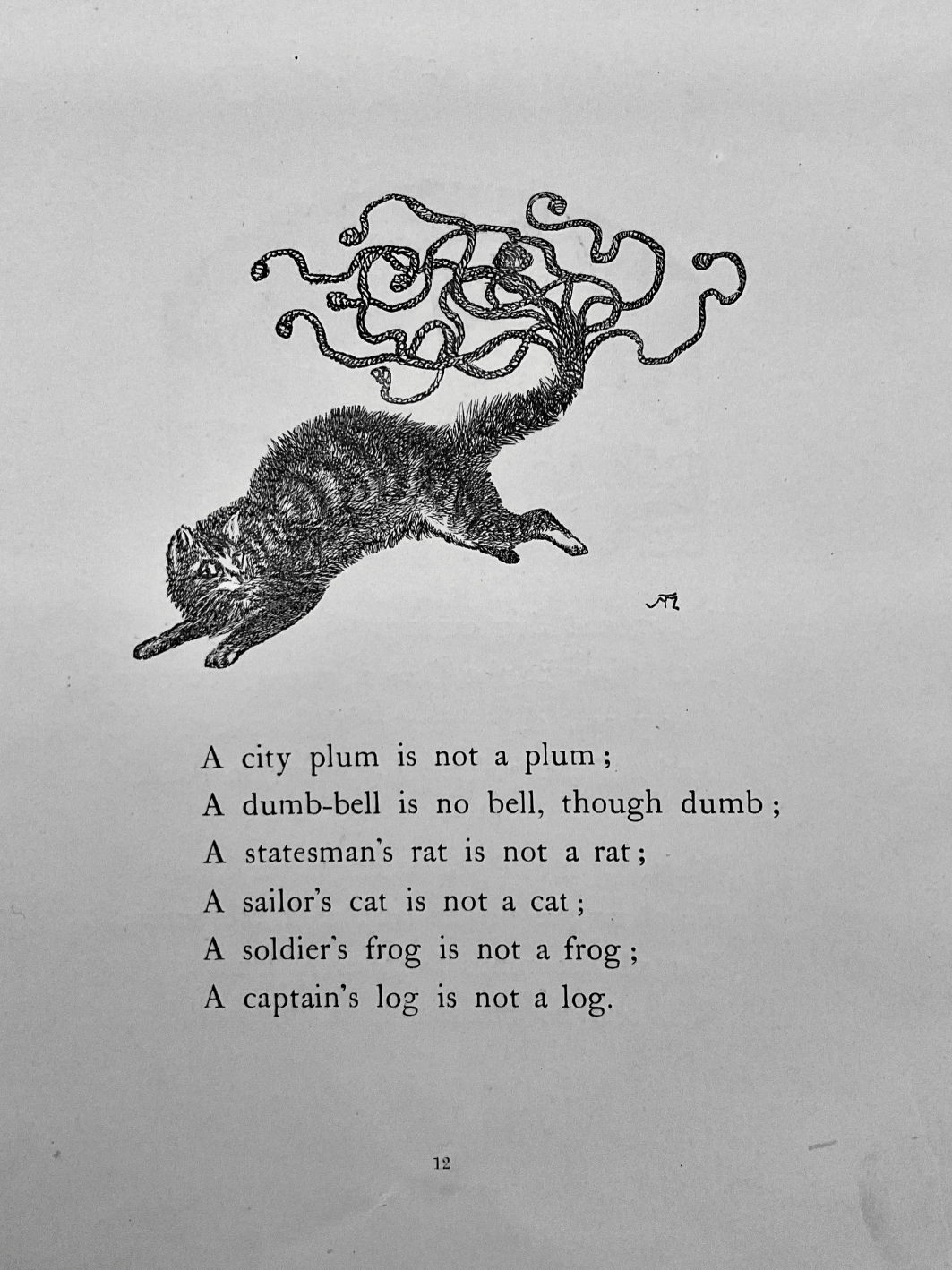
The transformation into nonsense of animals and their cries is thus one of Sing Song’s principal themes, though Rossetti is not usually considered a writer of nonsense poetry.19 The term was coined as a description of his own work by Edward Lear, who published A Book of Nonsense in 1846. Natural history and species identity are central topics in Lear’s life’s work; as well as authoring nonsense verse and travel literature, he also had a long career as a painter and illustrator, initially with birds and other animals as his primary subjects. While still in his teens, he collaborated on Illustrations of British Ornithology (1821–34), and his first solo publication was Illustrations of the Family Psitacidae, or Parrots (1830–2), for which he carried out the paintings in the gardens of the Zoological Society in London, and which won him election as an associate member of the Linnaean Society in 1830. He probably worked as an illustrator on Darwin’s Voyage of the Beagle20 and was an enthusiastic admirer of its author.21
The contents of the first and second editions of A Book of Nonsense were exclusively in the verse form Lear popularized that we now call the limerick. Lear’s limericks are defined by their verse form and by a recurring logical schema, which establishes the genre as having a primary concern with human beings, each of whom is characterized in relation to the entire species by accidental individual traits. Thus: “There was an old man” – or young lady, or young person – and so forth. Next, often, a specification of habitat – for example, “of the Nile.” Finally, the peculiarity of the individual specimen that gives rise to the poem: “There was an old person whose habits / Induced him to feed upon Rabbits.” Often the action of the limerick punishes the protagonist’s eccentricity and narrates her or his reversion to an implied norm: “When he’d eaten eighteen, he turned perfectly green, / Upon which he relinquished those habits” (165). In many cases, the norm is enforced, sometimes violently, by a nameless “they”:
As these poems – both added to Lear’s limericks in 1861 – show, human–animal relations are a topic in Lear’s poetry from the beginning, often eroticized, as in the old man’s dance with the raven. The interspecies romance here includes a crossing of species attributes – as the illustration makes clear (Figure 2), man and raven are doubles, and the word “bird” in line 3, as Matthew Bevis points out, could refer to either of them.22
Edward Lear, “There was an Old Man of Whitehaven” (1861)
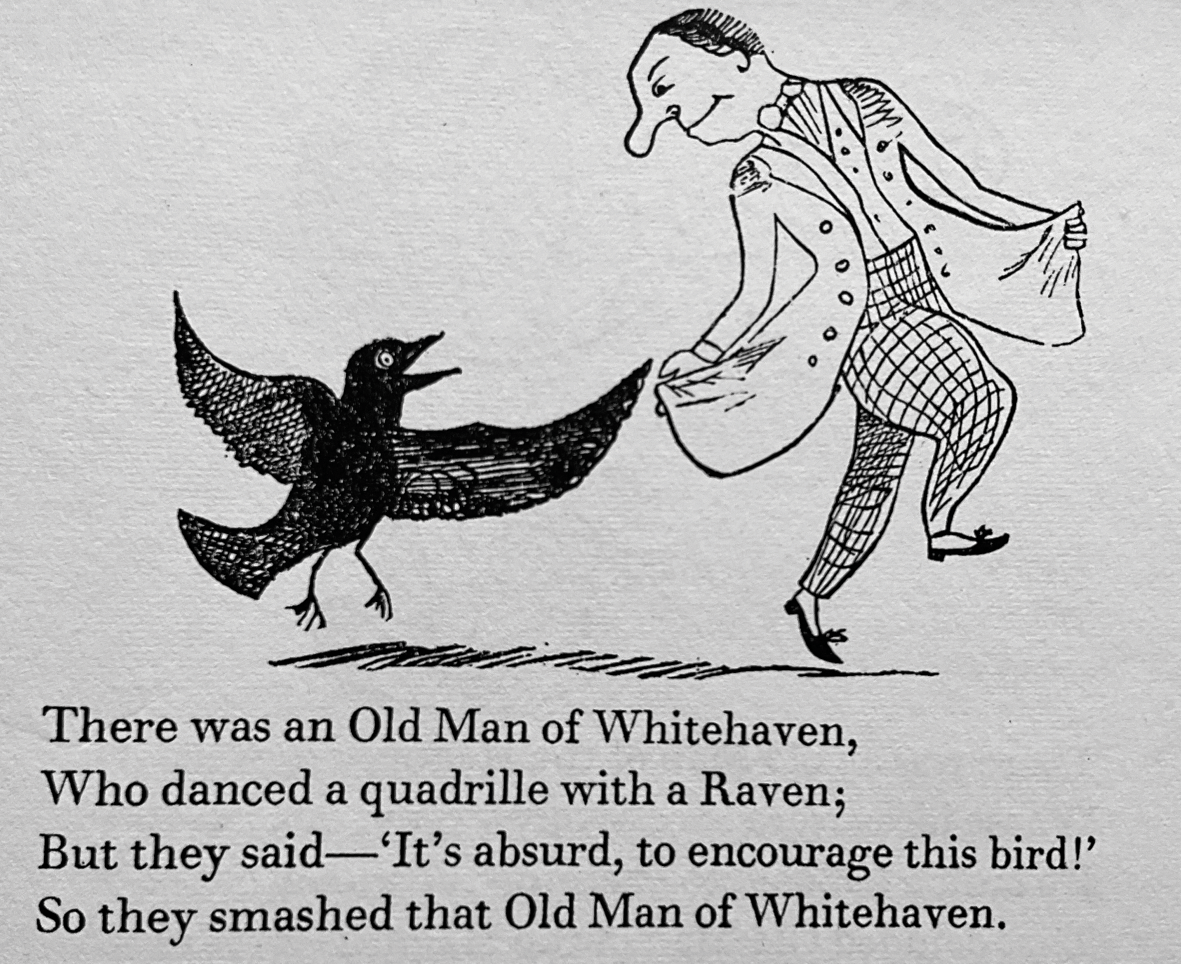
The erotics of Lear’s limericks thus cross species and other categories. The limericks also – occasionally – use onomatopoeia:
Beginning with the 1870 publication of Nonsense Songs, Stories, Botany, and Alphabets, though, non-human animals, no longer brutalized, become the major protagonists of Lear’s verse and begin to speak. The change results in part from the influence of Lewis Carroll, whose Alice in Wonderland was published in 1865. While the Alice books imagine worlds in which all kinds of hierarchy – including the fundamental hierarchy that sets human beings above other animals – are temporarily inverted, they don’t challenge or play with species taxonomy. Charles Dodgson, the books’ real-life author, was strongly opposed to Darwin and to the idea of species transmutation. Lear, on the other hand, read The Origin of Species in the mid-1860s with admiration.23 As Matthew Bevis notes, his late work, like Darwin’s Descent of Man, abounds in cross-species desire, non-human animals with aesthetic preferences, and song.24 Lear composed music for several of his narratives of animal courtship, and these narratives themselves, like “The Owl and the Pussycat,” typically represent their characters as singers: they are poems about song and about occasions for song.
The songs are not, however, onomatopoeic. Not that onomatopoeias are absent from the late poetry – but they are as we shall see defunctioned and turned into nonsense. Before turning to the central topic of sound and sense in Lear, though, I want to note how important questions about species are in Lear’s late work. The limericks, as we have seen, have human protagonists, each of whom belongs to a class singled out from the mass of humanity in general: “an Old Person of Leeds.” The late poems typically have non-human protagonists; rather than being identified as particular members of a general species, though, these protagonists are usually described with a definite article that would normally particularize them as in some sense unique, or refer to an entire unique species, as in the poem on “The Wood-Grouse” discussed earlier.25 The characters in “The Owl and the Pussycat” and “The Duck and the Kangaroo,” probably Lear’s two first nonsense songs, are individual members of real animal species; the definite articles that refer to them seem only to single them out as unique within the work where they appear: “The owl who is the subject of this particular story.” But the status of creatures like the Quangle-Wangle is harder to discern. Is there only one Quangle-Wangle – is he a species of one? Before the two works in which the Quangle-Wangle appears (“The Story of Four Little Children Who Went Round the World” and “The Quangle-Wangle’s Hat”), Lear seems to have introduced it under a different spelling as “a Clangle-Wangle” in “The History of the Seven Families of Lake Pipple-Popple.” This Clangle-Wangle is undoubtedly a member of a species, which Lear identifies as “by no means commonly to be met with” and for which he supplies a full description:
They live in the water as well as on land, using their long tail as a sail when in the former element. Their speed is extreme, but their habits of life are domestic and superfluous, and their general demeanour pensive and pellucid. On summer evenings they may sometimes be observed near the Lake Pipple-Popple, standing on their heads and humming their national melodies: they subsist entirely on vegetables, excepting when they eat veal, or mutton, or pork, or beef, or fish, or saltpeter.
The Clangle-Wangle (or Clangel-Wangel, in a further alternate spelling Lear suggests) is then a rare species, but also apparently a universal one, native to both water and land, and both vegetarian and omnivorous.
Whether it is the same creature or not, the Quangle-Wangle who appears in Lear’s subsequent works appears to be sui generis. In the poem Lear wrote in which he is the main player, he appears as a double of the author, hidden behind his own gorgeously ornamented self-presentation:
The poem opens with the Quangle-Wangle’s complaint that “very few people” come to the top of his tree, and that in consequence “life on the whole is far from gay!” But in time there come, first Mr. and Mrs. Canary, and then creatures of a host of other species, all asking to build their houses on the Quangle-Wangle’s hat:
They are joined by creatures of yet other species, such as “The Pobble who has no toes /… / And the Dong with the luminous nose” (38–40), who enter the poem from other works by Lear – and the poem ends with a dance:
The dance figures the harmonious relations among the species in the poem – and, more equivocally, their relations with the figure without a species who makes the space where they assemble. The Quangle-Wangle’s melancholy seems at the end of the poem to have lifted; but when he speaks, it is only “To himself” (47), unlike all of the other creatures in the poem, whose utterances are spoken in chorus and addressed to others.
The relations between species, and between species and individuals who appear to be without a species – who are perhaps the last of their species – are indeed the dominant topic of Lear’s late work. All of his courtship narratives, like that of the Owl and the Pussycat, cross species lines.26 Parodies of natural histories of species abound, like the paragraph just quoted on the Clangle-Wangle. Beginning with his 1870 volume, Lear’s publications included nonsense botanies, with illustrations, of imaginary plant species, each with a name spoofing the conventions of Linnaean taxonomy. The supposed species are, however, radically hybrid, cobbled from beings and artifacts from altogether different taxonomic realms grafted onto a stem with leaves (Figure 3). The names Lear gives his invented species are moreover as hybridized as the nonsense plants themselves, typically combining English words with Latin case endings: “Manypeeplia Upsidownia.” Lear’s jokes about natural history are invariably also jokes about language.
Edward Lear, “Manypeeplia Upsidownia” (1871)
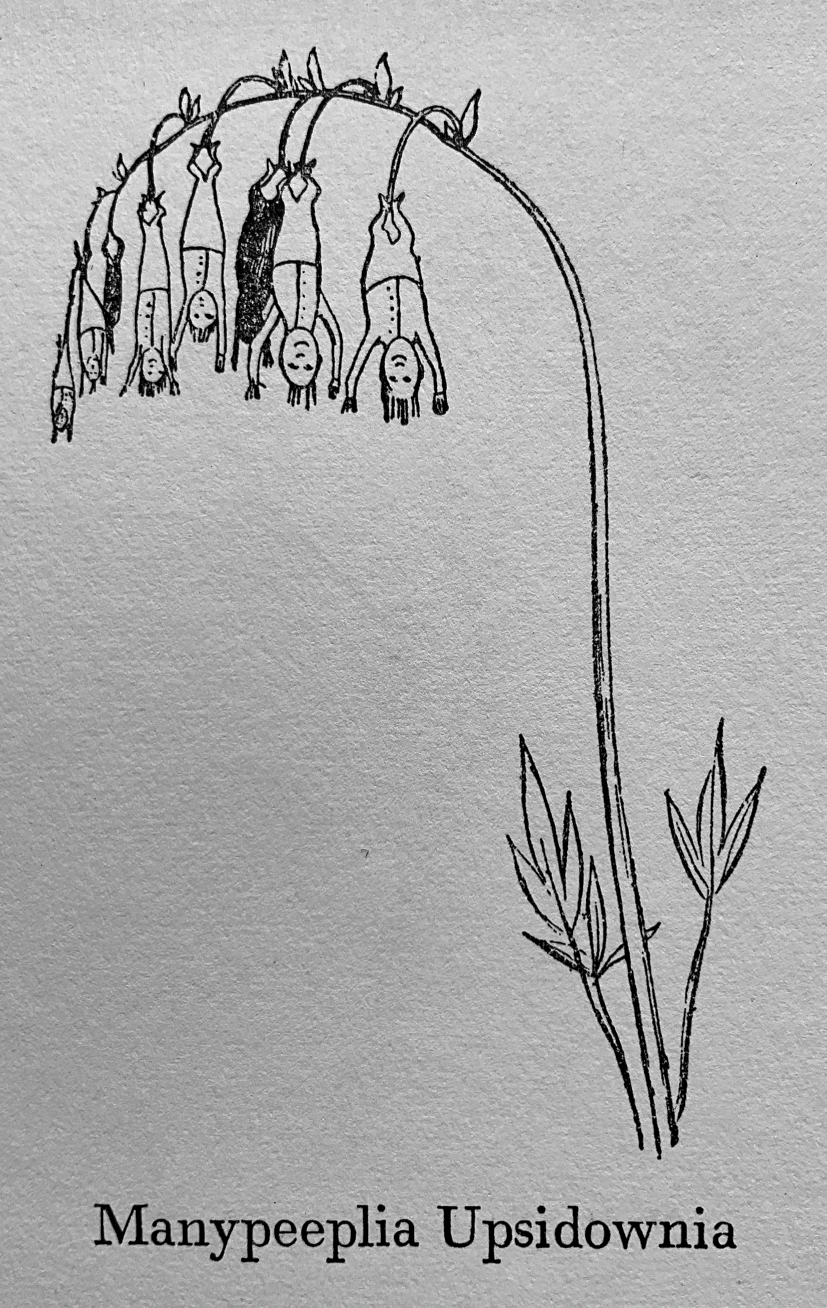
Lear’s imaginary creatures have surprisingly few literary antecedents – in a very different mode, these would include Swift’s Houyhnhnms and Yahoos. They belong to the nineteenth century, the era when species become historical agents. But they have many successors, ranging from creatures in Dr. Seuss and Maurice Sendak’s books to alien species in speculative fiction and fantasy. Like Lear’s creatures themselves, these imaginary beings are figures through which the biopolitical topics of species, population, race, adaptation, and ecology undergo literary and cultural mediation. These topics pervade Lear’s own writing. “The Jumblies” is another poem that describes its protagonists with a definite article, though it leaves it unclear what kind of group the Jumblies are – a family, a clan, a species? The poem begins:
Although the Jumblies have “friends,” these disappear in the poem’s odd, melancholy refrain, in which they are defined ethnographically – by their habitat and body markings (are these tattoos?):
Here the Jumblies appear as a population imperilled as much by their restricted habitat as by their unorthodox choice of watercraft.
“The Pobble who has no Toes” (1876) poses similar problems, although in this case the Pobble appears, initially, as an individual:
In the course of the poem, however, the Pobble does, as “they” warn, suffer the loss of his toes during a swim across the Bristol Channel. At its close, his Aunt Jobiska consoles him with “eggs and buttercups fried with fish” and with a piece of folk wisdom perhaps invented for the occasion: “It’s a fact the whole world knows / That Pobbles are happier without their toes” (49–50) – thus suddenly implying that the accident that has befallen her particular Pobble is not singular, but rather defines a type. “The Pobble” of the title would then no longer be an individual but a species, and the poem would read, as Matthew Bevis has put it, as a “just-so story” – a Lamarckian fable of species transmutation.27 Similar confusions are endemic in Lear’s poetry. The failed courtship narratives of the Yonghy-Bonghy-Bó and the Dong both feature characters who appear to belong to classes with one member. The Yonghy-Bonghy-Bó first appears (without the terminal accent) as the letter Y in an alphabet Lear composed in 1870; since alphabetization is a tool for classifying, his presence here along with “The Zigzag Zealous Zebra” (269) further emphasizes the anomaly of his status as the unique member of his own taxon.28
The anomaly of figures like the Yonghy-Bonghy-Bó and the Quangle-Wangle is most fully thematized in “The Scroobious Pip,” which Lear wrote in 1871 and 1872 but left unfinished. The poem resembles “The Quangle-Wangle’s Hat” in having as its protagonist a figure who belongs to no class of animals, but nonetheless mediates them all. In this poem, the form that contains all the animals is the song with which the poem closes, in which they all “roared and sang and whistled and cried” the name of the Scroobious Pip (98). Until this point, however, the poem’s topic is the unanswered question of where the Scroobious Pip fits in the animal kingdom. The question is posed first by the beasts, then by the birds, the fish, and the insects. The poem stages the enigmatic relation between the Scroobious Pip and its interlocutors as a relation between onomatopoeia and the nonsense syllables that mark the Pip’s speech as sui generis. Thus at the poem’s opening, the beasts assemble:
They agree that of them all the fox should
The Scroobious Pip, however, does not wait to be asked – at no point does it allow itself to be directly addressed – but rejects the terms of the question by responding at once “with a rumbling sound – / ‘Chippety Flip – Flippety Chip – / My only name is the Scroobious Pip’” (20–2). In succeeding stanzas, the birds assemble – “The Parrot chattered, the Blackbird sung” – and delegate the owl to ask the Scroobious Pip what it is – upon which it asserts “with a chirpy sound – / ‘Flippety Chip – Chippety Flip – / My only name is the Scroobious Pip.’” Similarly, it addresses the fish “with a liquid sound” and the insects with “whistly” one: “Wizziby wip – wizziby wip – / My only name is the Scroobious Pip” (88–90).
The nominalism of Lear’s poetry is evident in the Pip’s assumption that to ask what order of the animal kingdom it belongs to is to ask its name. In its answers to the animals, the Pip distinguishes itself from all of them, but also, by onomatopoeic echoes, identifies itself as a kind of universal animal. In this respect, the poem humanizes the Pip in accordance with an anthropocentric mythology that we will re-encounter in Rudyard Kipling’s Mowgli stories, where Mowgli becomes the only animal in the jungle who can speak to all the other animals in their own languages.
Neither this logic, nor the nominalism that Lear shares with radical Darwinists of the period, explains why the Pip alone of all the animals speaks nonsense.29 We don’t know who named it, though the name “Pip” shows the influence of Dickens’s Great Expectations, whose protagonist, Pip, begins the novel by naming himself.30 In any case, the Pip’s nonsensical name structures its nonsensical refrains, though which its “ip” sound echoes and rhymes, and where its character as a palindrome, reading the same backwards and forwards, is expanded into the ABBA structure of chiasmus: “Chippety Flip – Flippety Chip.”
Nonsense words enter Lear’s poetry after The Origin of Species, along with talking animals and what I have argued is a pervasive concern with questions of species and taxonomy.31 We have seen that Lacan refers to Lear’s nonsense in developing an account of language as constituted by the severing of the link between the animal and its call – the cat and its meow. But the example of “The Scroobious Pip” suggests that the antithesis between nonsense and onomatopoeia is less stable than Lacan would allow. While we know that the Pip can use onomatopoeia to mimic the voices of all the other animals, do we know that it has no call specific to itself? Its nonsensical name itself seems like an instance of automatism, and it may be that the Pip is only so called because it cannot help saying “pip” – just as the names of birds like the cuckoo and the whippoorwill derive from onomatopoeic representations of their calls.
As we saw in Romantic poetry, making language out of animal sounds involves a degree of violence; so too does the making of nonsense. Before we turn to an example of Lear’s nonsense deriving from onomatopoeia, let us examine some other examples. Among Lear’s quarries for nonsense words, as James Williams notes, were the languages of countries in which he traveled.32 Like his botanical names, words formed in this way can be hybrids, abusively attaching English lexical forms to words and fragments from other languages. “Scroobious,” for instance, was one of Lear’s favourite nonsense words and was the first to appear in print; he used it in a limerick in 1854. Williams has identified its source in an episode from Lear’s travels. While sketching in Albania, at the time a Muslim country, Lear was surrounded by villagers who, apparently scandalized by the forbidden act of visual representation, shouted at him the word “Scroo! Scroo!” In narrating the encounter, Lear gives the meaning of the word as “He writes it down! He writes it down!” Williams identifies “scroo” as deriving from shkrova, to write. Williams asserts that “scroo” for Lear was associated with “feelings of acute and nameless embarrassment.”33 Out of it, he made the adjective “scroobious.”
To make nonsense out of language may be a form of defence, an act of aggressive appropriation, or both.34 Two of Lear’s minor poems appropriate foreign words directly and demonstrate the comic violence involved in so doing. They are similar – one, from Lear’s diary in 1864, begins:
In this poem, the terms appropriated are Arabic (bulbul = nightingale; yashmak = veil); in a later poem, published in Laughable Lyrics in 1877, they are Hindustani:
Both poems inflict a jokey Orientalist violence on their source language, aggravated by the music-hall indecency of arbitrarily using foreign words to mean “bottom.”35
If Lear’s nonsense inflicts a certain campy violence on its materials, I want to close my discussion of his work by suggesting that this is not only its relation to foreign languages, but also to onomatopoeia. Few of Lear’s nonsense words derive from onomatopoeia, so one example will be all I can offer. As we saw in the case of Keats, where incorporating animal sounds into language was figured as an act of violence, sounds and their transcriptions don’t enter language without trouble.
“The Dong with the Luminous Nose” was the final poem composed for Lear’s last volume, Laughable Lyrics, in 1876, and it may be his most troubled published work. In the best reading it has received, James Williams begins by noting that it “is a poem full of sounds. In it, ‘the woods and valleys rang,’ the angry breakers ‘roar,’ the watchers ‘cry,’ the Dong’s pipe ‘squeaks.’”36 Like the Yonghy-Bonghy Bò and other characters we have discussed, the Dong’s name is given a definite article, making it the name of a class of which he seems to be the sole member. Like the Yonghy-Bonghy Bò too, the Dong features in a narrative of failed courtship, which, like the other courtships we have discussed in Lear, crosses natural-historical categories (even if nonsensical ones). Here as elsewhere in Lear’s late poems, moreover, the romance’s failure apparently dooms its protagonist to the existential solitude of being the last of his kind.
For Williams, the poem’s organizing trope is the echo. Besides echoing sounds, it is even more than most of Lear’s poetry full of echoes of other poems, Lear’s own above all: “The Dong” has “The Jumblies” as an intertext; its protagonist falls in love with a “Jumbly girl” who arrives with the other Jumblies in their sieve, and he is left desolate when they leave to continue their travels. The poem incorporates the Jumblies’ chorus in full, as well as echoing others of his works. Lear’s editor, Vivien Noakes, has identified a major source for the poem as Thomas Moore’s “A Ballad: The Lake of the Dismal Swamp” (1806), and also echoes of William Collins’s Persian Eclogues (1724) and Tennyson’s “The Lady of Shalott” (1832). Williams further notes recollections of Tennyson’s “Maud” (1855) and Matthew Arnold’s “Dover Beach” (1867); moreover, the poem is full of phrases like “awful darkness,” “rocky shore,” “midnight hour,” and “plaintive pipe” that had become clichés of sublime (or would-be sublime) poetry in the eighteenth century. The poem is written in the irregular stanzas that Collins and his contemporaries made conventional for the sublime or Pindaric ode.
Another feature of poetry in the sublime mode relevant to the setting of “The Dong” is reference to ancient and foreign place names – for example, from Asia Minor and Arabia. In Paradise Lost, among many others, Milton has Ternate and Tidore (2. 635) and “the barren Plaines / Of Sericana” (3. 437); closer to Lear, Shelley’s “Alastor” includes “the lone Chorasmian shore” as a setting, echoed by Matthew Arnold in “Sohrab and Rustum,” which has “the hush’d Chorasmian waste” (878). Khwarazm is a plain in today’s Uzbekistan and Turkmenistan, but for many of Shelley and Arnold’s readers, surely, the grand-sounding name might as well have been invented – as indeed Lear did invent the metrically similar “great Gromboolian plain” on which the Dong wanders, which reappears here from earlier poems. When he uses these poetic devices, Lear strips them of reference to transform them into nonsense – if not to suggest that they were nonsense already.
As it draws poetic devices into its ambit, then, Lear’s poem remakes or reveals them as nonsense. In this light, we can see it as built around a joke about the defunctioning of an onomatopoeia. “Dong” of course is one half of the conventional transcription of a bell’s sound: “Ding-dong.” As Williams notes, Lear uses “ding dong” and variants like “ding a dong” elsewhere in his poetry.37 Only here, however, does the dong appear without its ding.
Lear appropriates the onomatopoeia for nonsense by making it a name, changing it from a sign with a motivated relation to its referent to a signifier with an arbitrary relation to its signified. This appropriation, like the appropriation of foreign words, involves violence; in this case, the violence is castrative and motivates the comic phallic substitute with which the Dong provides himself in the form of a prosthetic nose:
“The Dong,” then, is a poem that allegorizes nonsense’s coming into being through the defunctioning of onomatopoeia; its protagonist personifies the mutilated figure of speech. As the Dong says in his only spoken words, “what little sense I once possessed / Has quite gone out of my head” (62–3). Alongside the poem’s self-reflexive concern with the genesis of nonsense, “The Dong with the Luminous Nose” also recapitulates concerns with population, exogamy, and migration we have seen to pervade Lear’s writing. As with other nonsense creatures in his work, it is uncertain whether the characters in this poem belong to distinct species, or races, or clans – but the poem nonetheless undoubtedly considers the Dong and the Jumbly Girl not as individuals, but as representatives of distinct populations, of which the poem provides a minimal ethnography. The relation between these two fields of concern, one poetic and the other biopolitical, will be the axis followed in the rest of this book. In Part II, I will focus on the work of Darwin, to carry out a symptomatic reading of the suspended reference his argument requires in key terms. In Part III, I will return to the literary representation of species and interspecies relations, setting these in the context of the histories of blood transfusion and of Victorian anthropology’s theorizing of totemism and blood relationship. The book’s closing sections will focus these concerns with reference to another nocturnal figure who, like Lear’s Dong, bears an ambiguous species identity and suffers the burden of confronting the end of its kind – Bram Stoker’s vampire, Dracula.
***
We have already encountered Thomas Hardy’s implication that the continuous life of species is inherently vampiric. Hardy rarely employs onomatopoeia, preferring to endow his animals with speech. We saw in “The Robin” how the appearance of onomatopoeia in the midst of a bird’s speech marks a moment of species identification that heralds its death. Hardy’s poetry is indeed haunted by an idea of species immortality identified with song, to which it repeatedly recurs, always in order to debunk or demystify it. In “The Selfsame Song,” as Daniel Karlin notes, Hardy recalls an idealizing line from Keats’s “Ode to a Nightingale”:39
Hardy refers to Keats in his 1922 poem, taking aim at Keats’s jump from the sound of a supposedly unchanging song to the idea of immortality:
In a rebuke to the theological basis of much Victorian nature writing, Hardy in “The Rambler” (1909) makes the self-undoing claim that he doesn’t even hear the birds whose calls his poem nonetheless records:
To sing in Hardy’s poetics is not to be immortal, but rather to be a ghost, not even heard until too late.
Rather than immortal voices, Hardy’s onomatopoeias typically record the sounds of inanimate objects. In “We Sat at the Window,” a 1917 poem in which he recalls his first marriage as a “waste” of “two souls in their prime,” he writes of a rainy day in July when “Each gutter and spout / Babbled unchecked in the busy way of witless things” (3–5). Onomatopoeias are the sounds of witless things, just as Lear’s Dong is deprived of sense. The onomatopoeia marks time in a scene from which meaning has either departed, or in which it will not be recognized except belatedly. Meaning does not come from sound; thus, for the two characters in “We Sat at the Window,” though the rain babbles in the gutter, the speaker says
Hardy’s poetry draws out the association between onomatopoeia and automatism that has concerned us throughout this chapter. In “The Clock Winder,” also from 1917, the sound of a clock measures out the empty time between a forgotten past and a longed-for future. The poem concerns a parish clerk who each night ascends the clock tower to wind “the rheumatic clock”:
The poem identifies the clock with its winder, who, it turns out, is also marking time in the dark:
In a late memory poem, “The Second Visit” (1928), onomatopoeias recording the sounds of machinery and of birds rhyme with each other, and equally function as a meaningless ground of unchanging sound, against which the poem at its close measures the change in the scene caused by the absence of a single speaking voice. The poem thus opens with an onomatopoeia for the sound of a mill wheel – “Clack, clack, clack, went the mill-wheel as I came” (1) – and registers the sound’s continuity over the years:
But in the poem’s final stanza, the poem distinguishes between the mechanical sound that remains the same and everything that has changed: it’s not the same woman or the same apples; the quack is the same, but the ducks have changed. Recalling Heraclitus, the poem notes that “it’s not the same drops that dash / Over the wet wheel” (10–11). Above all, the poem ends with quoted speech of the woman now missing from the scene: “‘You know I do!’” (12). The poem thus moves from the onomatopoeia of its first line to quoting an absent woman in its last, organizing itself around the contrast between the absent presence of a living voice and the persistence of the machine.
In this contrast, the duck’s quack is on the side of the machine, and I have argued in this chapter that its sameness is constituted by the poetic technique used to record it. Indeed, Hardy’s identification of onomatopoeia and the species concept that in the nineteenth century it came to underwrite with a machine is of a piece with the suspicion of onomatopoeia that we have traced back to the Romantic era. In the poetry we have read, an aesthetic of the particular is privileged over the representation of types, and this aesthetic drives the twin imperatives to expel onomatopoeia from poetic utterance, or to incorporate it. The classical tropes in which non-human animals behave as automata show a corresponding decline. As is well known, Hardy’s writing shows an exceptional sympathy for animal suffering, and this sympathy is manifest in his poetry’s portrayal of animals as capable of speech. We saw such a portrayal in “The Robin,” where, as in the poems of Minstrelsy, an animal endowed with speech cites its own call. In “The Robin,” this citation of onomatopoeia is a harbinger of death. Hardy poems where non-human animals speak include some that adopt complex verse forms, such as the triolets “The Puzzled Game Birds” and “Winter in Durnover Field” and the villanelle “The Caged Thrush Freed and Home Again,” all published in 1902.40 In all of these poems, the verse form constrains utterance by limiting the number of rhymes and by enforcing the repetition of whole lines. These poems, then, do not only endow birds with speech; they do so in a form that celebrates language’s power to escape arbitrary constraint, a theme literalized in the speaker’s escape from captivity in “The Caged Thrush.” Hardy’s 1928 elegy to Wessex the dog also endows an animal with speech – in this case, Wessex himself, who speaks from the dead to the humans with whom he had shared a home when living. Nothing in the poem suggests that they can hear or understand him; the gift of speech ironically does not enable the dog to communicate.
Earlier in Part I, I linked the trouble onomatopoeia causes in “The Robin” to Hardy’s suspicion of species identity. As we saw in “Sine Prole,” his suspicion of species, race, or family types as embodiments of a single continuous life is so intense that he celebrates his own childlessness as a sort of autogenocide. Particularly given that he contrasts the end of his own line with what he represents as the persistence of the collective racial life of the Jews, Hardy’s self-congratulation here is disquieting. The poem makes clear that for him – as for the imaginary creatures of Edward Lear and Bram Stoker – either rejection or acceptance of affinity with a family, species, or racial type takes place in a fully biopoliticized discursive field, so that the question of whether or not to have a child has become a question about the life or death of a population.
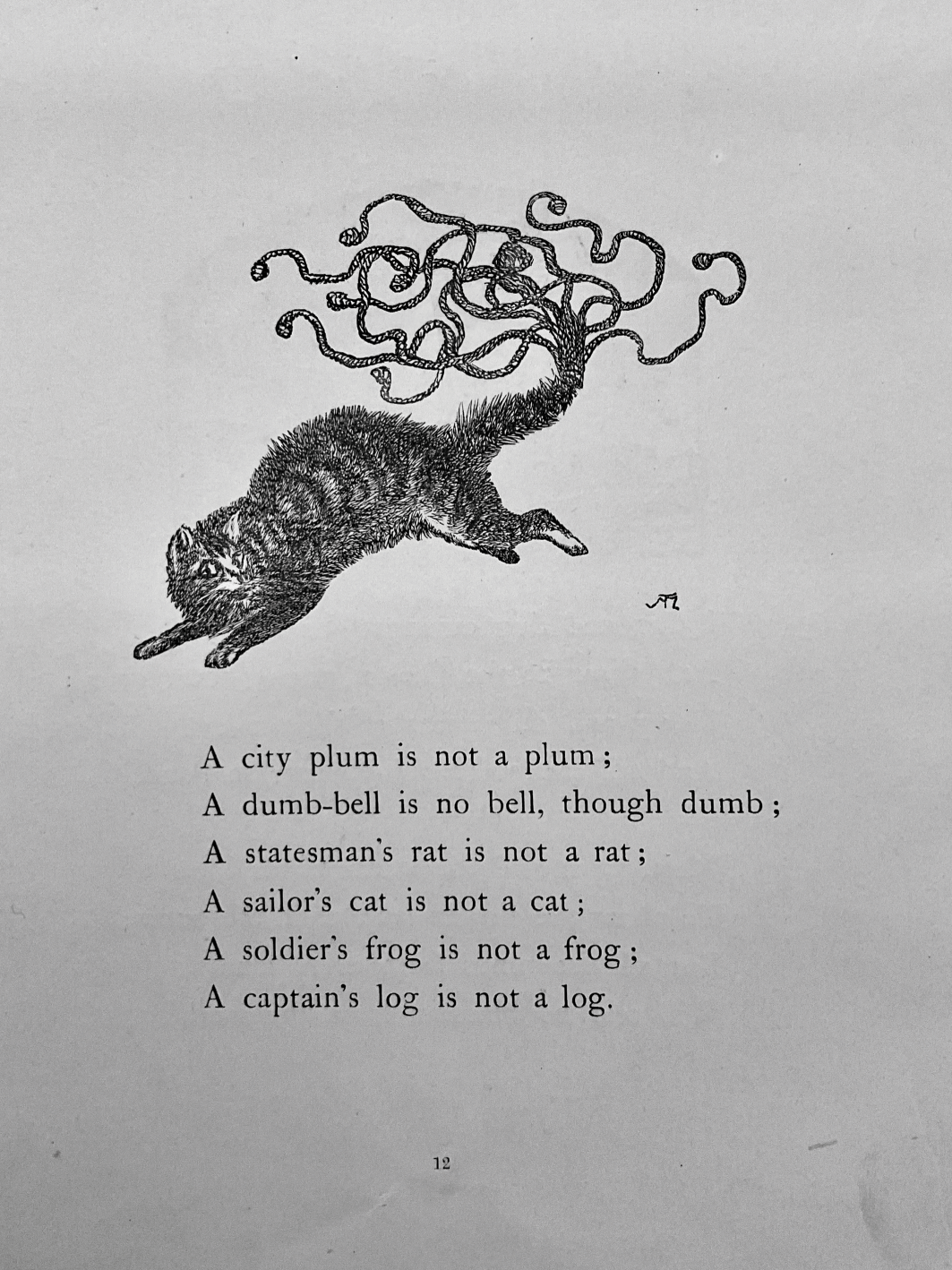
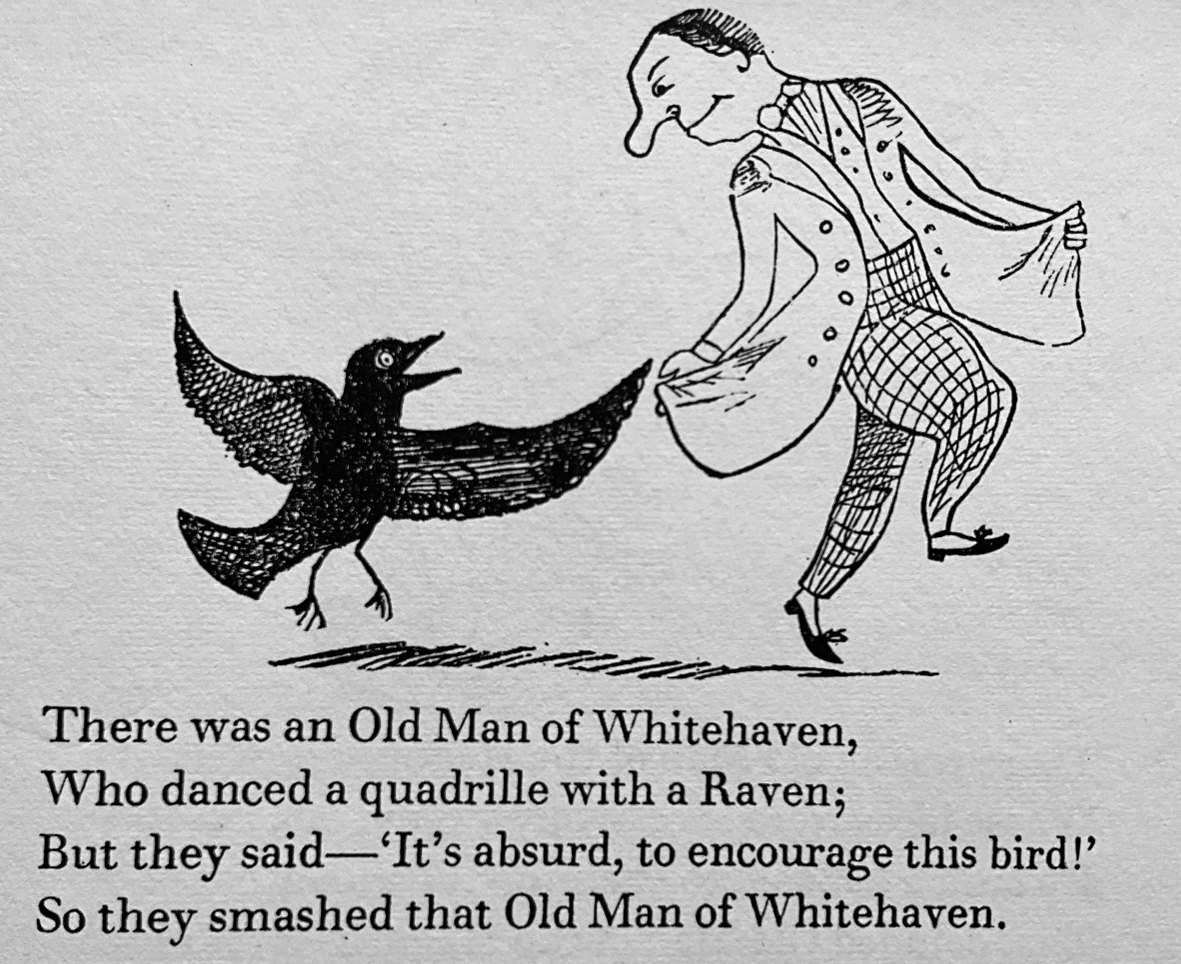

 Open access