

Introduction
This article contributes to the understanding of the racial politics underpinning nation branding, that is, the official communication and promotional strategies developed by state and semi-state agencies to shape the country’s global image (Anholt Reference Anholt2011). Previous studies have critically examined the representation of “others” and the domestic impact of fostering cultural identity in nation branding (Edwards and Ramamurthy Reference Edwards and Ramamurthy2017; Maydell Reference Maydell2020). These studies show how strategies of nation branding often exclude certain populations and may strengthen stereotypes through the tokenistic use of representation. However, research that explicitly explores representations of race as an aspect of nation branding is, to our knowledge, relatively unexplored (e.g., Kaneva and Popescu Reference Kaneva and Popescu2014; Ulver and Osanami Törngren Reference Ulver and Osanami Törngren2023; Vecchi et al. Reference Vecchi, Silva and Jimenez Angel2021).
In this context, Sweden offers a compelling case for examining the racial imagery in nation branding. Sweden’s long and complex history of ethnic and racial diversity includes Indigenous and national minorities, as well as labor migration from the Nordic countries and Europe during the post-war period. Despite this, Sweden has long been perceived as a White nation, centered around the image of a “blonde and blue-eyed” population (Lundström, Reference Lundström2007, Reference Lundström, Twine and Gardener2013; Mattsson and Pettersson Reference Mattsson and Pettersson2007; Sawyer Reference Sawyer2000, 41; Werner Reference Werner2014). Since the 1980s, immigration from outside Europe has further transformed the country’s racial and ethnic composition (Frohnert and Byström Reference Frohnert and Byström2017). Today, over two million of the ten million residents of Sweden are foreign-born; around 3% of the total 10 million persons residing in Sweden have their origins in African countries, 3% in Asia, 1 percent in Latin America, 8 percent in the Middle East, and 10% in other countries.Footnote 1 Considering Sweden’s demographic diversity, to what extent is racial diversity represented in photographic and textual imagery used to market Sweden internationally?
The Swedish case is also interesting in regard to the idealized image of the country that has historically existed both domestically and internationally (Pred Reference Pred2000). The concept of “Swedish exceptionalism” refers to the idea that Sweden has historically been unique and distinct compared to other countries, and a self-image characterized by the idea of being a morally superior country (Alm et al. Reference Alm, Lundahl, Berg, Johansson, Laskar, Martinsson, Mulinari and Wasshede2021; Habel Reference Habel, Freeman and Johnson2012). It emerged as a form of state nationalism that took pride in political welfare projects, evolving into more “toned-down forms of expression” that equated Swedishness with democracy, neutrality, and internationalism (Glover Reference Glover2009, 254). Although there are contradicting narratives about Sweden that challenge the country’s exceptional image (Cassinger et al. Reference Cassinger, Lucarelli and Gyimóthy2019; Ulver and Törngren Reference Osanami Törngren and Ooi2023), images of Sweden often emphasize its progressive identity, a theme consistently reflected in official branding strategies. This includes the closely associated portrayal of Sweden as a racially tolerant, multicultural society (Osanami Törngren and Ooi Reference Osanami Törngren and Ooi2023; Saifer Reference Saifer2021; Ulver and Osanami Törngren Reference Ulver and Osanami Törngren2023).
This article critically examines how racial representations are employed in Sweden’s nation branding by analyzing visuals and texts from the Image Bank of Sweden – an online promotional material hosted on the branding platform Sharing Sweden. Using a two-step mixed-method approach, we first conduct a quantitative analysis of racial and gender representation across image categories. We then perform a multimodal discourse analysis of selected images under the theme “Education and Research,” focusing on a more in-depth interpretation of how racial identities are represented (Thomas et al Reference Thomas, Johnson and Grier2023), particularly the occurrence of tokenistic representations (Grant Reference Grant and Moghaddam2017), racial stereotypes (Davis Reference Davis2018), and fixed images of different racialized groups (McAllister et al. Reference McAllister, Forde, Beykont, Das, Chaudhuri and Turkdogan2024). Leaning on literature on the commodification of race (Crocket Reference Crockett2008; Leong Reference Leong2012; McAllister et al. Reference McAllister, Forde, Beykont, Das, Chaudhuri and Turkdogan2024; Schroeder Reference Schroeder2015), the purpose is to investigate how these racial representations are commodified and leveraged to construct particular notions of Swedish national identity and culture that align with the principles of nation branding.
The article is structured as follows. We begin by reviewing literature on nation branding, followed by research on the commodification of race in advertising and media, as well as studies on race and othering in the marketing of higher education. Next, we introduce the research context by mapping previous work on Swedish branding strategies and examining how race is understood in a Swedish setting. We then present the analyzed material and outline our two-step methodological approach, including a discussion of key methodological considerations. In the results section, we first provide a quantitative analysis of how race is represented in the material, before turning to a qualitative reading of the segment where racial diversity is most prominent – the theme of education and research. Consistent with earlier research on racial commodification in advertising, our findings suggest that the image banks sustain the logic of tokenistic multiculturalism and commodification of racial identities in order to promote Sweden abroad.
The Racial Politics of Nation Branding
In an era of global capitalism, nation-states increasingly compete for tourism, investment, and international reputation. Nation branding refers to coordinated strategies aimed at shaping a country’s global image (Bolin and Ståhlberg Reference Bolin, Ståhlberg, Rosvall and Salovaara-Moring2010; Fan Reference Fan2006, Reference Fan2010; Ståhlberg and Bolin Reference Ståhlberg and Bolin2016), and to present the nation as a “reliable partner” on the world stage (Jordan Reference Jordan2014, 284). This process is typically top-down and selective, highlighting certain cultural aspects while excluding others (Chang Reference Chang2012; Del Bono Reference Del Bono2020). Managed by government agencies and PR firms, nation branding is shaped by internal agendas but also influenced by external perceptions, including stereotypes, media portrayals, and individual experiences (Fan Reference Fan2010). Although these processes are outward-looking toward the international arena, we argue that who gets to represent a country is equally a matter of internal politics, revealing racial politics over representation, belonging, and inclusion.
While nations are not homogeneous entities, nation branding strategies aim to construct a uniform image of the nation (Aronczyk Reference Aronczyk2008; Bolin and Ståhlberg Reference Bolin, Ståhlberg, Rosvall and Salovaara-Moring2010; Kaneva Reference Kaneva2011). Aronczyk (Reference Aronczyk2013) describes nation branding as a “competition for uniqueness,” where a country’s image is often reduced to a few pictures and “catchy slogans,” and treated as “a form of capital” (White Reference White2017, 602). As Kaneva (Reference Kaneva2011, 128) notes, this process “limits the range of possible national identity narratives and shapes them for the benefit of external audiences.” In this effort to create a coherent image, stereotypical identities – “describing a collective identity in a nation based on a simplification of one of its characteristics” (Rivas Reference Rivas2011, 24) – can become “useful.” In this way, nation branding often slips between promoting the notion of “nation-as-state” and conveying images of “nation-as-people” (Widler Reference Widler2007). In doing so, we argue, strategies of nation branding are also actively conveying racialized messages about who belongs to the nation and who does not.
In recent decades, place branding has shifted toward more socially responsible approaches, leading to the emergence of concepts like inclusive place branding (Jernsand and Kraff Reference Jernsand, Kraff, Kavaratzis, Giovanardi and Lichrou2017; Lichrou et al. Reference Lichrou, Kavaratzis, Giovanardi, Kavaratzis, Giovanardi and Lichrou2017). According to Fan (Reference Fan2010), a nation’s reputation depends on how credible its identity claims are perceived to be, and therefore, a nation’s image must be up to date and rooted in the nation’s “reality,” which is constantly changing. Since external perceptions often lag behind the actual state of the nation, the role of nation branding is to bridge the gap between the fluid, multiple realities experienced by people within the country and how the country is perceived by external audiences (Fan Reference Fan2010). From our perspective, the issue of racial representation in national branding can be framed as a way of managing and balancing the contradiction between a growing racial diversity of a country like Sweden and the parallel need for a fixed and homogenous national image in line with the logic of branding.
Racial Representation and the Commodification of Race
Previous studies of the representation of racial and ethnic minorities in national and regional branding materials highlight how these include a “marketization of long-standing, layered hierarchies of othering” (Kaneva and Popescu Reference Kaneva and Popescu2014, 518). Other studies identify patterns of silencing diverse perspectives (Osanami Törngren and Ooi Reference Osanami Törngren and Ooi2023) and the racial capitalization and tokenistic utilization of Black models, and the parallel lack of Asian representation (Ulver and Osanami Törngren Reference Ulver and Osanami Törngren2023). In this regard, this work contributes with a unique focus on a nationally produced visual branding material, which makes it possible to study the representations of different racialized groups in the national imaginary produced for branding purposes.
In examining representations of racial identities in nation branding, we draw on research on the commodification of race in advertising and marketing, including the notion of “consuming the other” (Crockett Reference Crockett2008) and “consuming difference” (Schroeder Reference Schroeder2015). In a conceptual article, Thomas et al. (Reference Thomas, Johnson and Grier2023) propose an approach to examining race in advertising that highlights how the racial aesthetics of advertising is designed to “normalize whiteness” (624). They outline a series of visualization strategies – such as racial dominance and subordination, racial assimilation, racial empowerment, and racial diversity – that reflect different understandings of race, each emerging from specific sociopolitical contexts. It offers a way to approach the significance of race in nation branding, which, in a sense, is a matter of marketing, not a product or a service, but an entire country.
Based on hooks’ seminal text “Eating the Other” (Hooks Reference Hooks1992), McAllister et al. (Reference McAllister, Forde, Beykont, Das, Chaudhuri and Turkdogan2024) propose a critical marketing perspective that accounts for contradictions – such as how seemingly affirmative representations can rely on essentialized and fixed images of racialized groups. Similarly, Leong (Reference Leong2012) argues that the commercialization of racial identities is central to racial capitalism,Footnote 2 where social or economic value is extracted from racial identity. In this framework, racial identities become symbolic assets, valued more for their aesthetic appeal than for genuine inclusion. Leong further contends that such performative inclusion can enhance the legitimacy and appeal of White individuals and institutions, thereby reinforcing racial hierarchies, under the guise of progress.
In a similar vein, our analysis explores how racial representations and the commodification of race are mobilized in order to advance a country’s international value. An important concept is tokenism, which can be understood as “the practice of satisfying the moral requirement for the inclusion of members of structurally disadvantaged people in groups that are better placed in society” (Grant Reference Grant and Moghaddam2017, 2). When representation is lacking, certain groups may be excluded or depicted in superficial and stereotypical ways. Furthermore, limited representation can result in individuals being overburdened as representatives of minority groups, often becoming the sole bearers of their group’s values and perspectives (Mawani Reference Mawani2004; Osanami Törngren and Ooi Reference Osanami Törngren and Ooi2023; Kraff and Jernsand Reference Kraff and Jernsand2024).
From research on the topic of racial representation in media and advertising (Dixon Reference Dixon, Oliver, Raney and Bryant2019; Dixon, Weeks, and Smith Reference Dixon, Weeks, Smith and Powers2019; Mastro and Stamps Reference Mastro and Stamps2018; Ulver and Osanami Törngren Reference Ulver and Osanami Törngren2023), we know that racial and ethnic representation must be addressed in both quantity and quality. Therefore, this article combines the research strategy of “counting heads” in order to get a picture of which bodies are represented and visually visible, with more careful readings of how different racialized and gendered groups are represented, in order to map any occurrence of racial stereotypes – i.e., overly simplified images or generalizations of a group of people and their characteristics, which may be either negative or positive (Davis Reference Davis2018).
Race and Othering in the Marketing of Higher Education
An important context for our analysis is research on race and othering in advertisements of universities and higher education institutions. In a discussion on educational contexts, Huang et al (Reference Huang, Cockayne and Mittelmeier2024) argue that othering functions as a mechanism for constructing and reinforcing cognitive and emotional boundaries between “us” and “them.” It often influences perceptions of who belongs in higher education and who does not, serving as a discourse of ethnocentrism and exclusion (Dervin and Yuan Reference Dervin and Meifen2022). Those categorized as “they” are frequently framed through a deficit lens, portrayed as less capable, less ethical, or more passive (Huang, Cockayne and Mittelmeier Reference Huang, Cockayne and Mittelmeier2024, 312). Such discourses can significantly hinder students’ sense of belonging (Huang and Cockayne Reference Huang and Cockayne2023) and obstruct broader goals of cultural inclusion (Viggiano et al. Reference Viggiano, López Damián, Morales Vázquez and Levin2018). Adding to previous research, our analysis shows how perceptions of research and higher education are also woven into racial perceptions of national belonging in nation branding.
In relation to the presence of international students, Bamford (Reference Bamford2008) writes that in the UK context, the term “international” is commonly used to label difference, typically referring to individuals and educational systems outside the UK, particularly those where English is not the first language. Moreover, the pedagogical cultures of international students are frequently assumed to be inferior, with their skills and practices viewed as needing improvement to align with the perceived higher standards of host institutions (Hayes Reference Hayes2017). Often embedded within nationalist ideologies of othering, the images tend to focus on individuals rather than on ideas, materials, pedagogies, or educational approaches. This framing reinforces power inequalities and representational injustices in how “others” are perceived and positioned within higher education (Dervin Reference Dervin2016; Huang Reference Huang2022; Huang, Cockayne and Mittelmeier, Reference Huang, Cockayne and Mittelmeier2024).
In her discussion of performative inclusion, Leong (Reference Leong2012) illustrates the concept by reviewing the marketing of higher education, referencing Hartley and Morphew’s study of college viewbooks. Their analysis reveals that institutions frequently overrepresent racially diverse students – particularly Black and Asian individuals – regardless of actual enrollment figures. Thus, the curated images of universities project an illusion of inclusivity and may result in misleading expectations for prospective students, creating a disconnection between institutional branding and the lived experiences of marginalized students. Leong critiques this practice, where diversity is showcased to serve institutional interests (Hartley and Morphew Reference Hartley and Morphew2008). This underscores, we argue, the potential harm of surface-level inclusion, since the qualitative content conveyed by the images may reinforce stereotypes or exclusionary narratives despite diverse visual representation.
Setting the Context
Branding Sweden
Like many countries, Swedish authorities and tourism organizations have gradually adopted more deliberate branding strategies (Valaskivi Reference Valaskivi2016). These efforts date back to the founding of the Swedish Institute in 1945, established to “facilitate the promotion of Sweden and Swedish culture abroad” (Glover Reference Glover2009, 248) and counter negative postwar perceptions. Inspired by nation branding concepts and the Cool Britannia campaign of the 1990s, the Council for the Promotion of Sweden (NSU) was formed in 1995 to support the government’s international promotion efforts and coordinate between agencies such as the Government Offices of Sweden, Visit Sweden, the Swedish Institute, and Business Sweden. By the early 2000s, the Swedish Institute began functioning more like a marketing agency, developing its own image-building strategies (Glover Reference Glover2009; Valaskivi Reference Valaskivi2016).
Sweden’s branding has long centered on the notion of a “progressive Sweden,” a narrative with roots in the 1930s (Musiał Reference Musiał2002). As Glover (Reference Glover2009) shows, this idea of progressiveness and exceptionalism was embedded in platforms like Brand Sweden (2006) and The Image of Sweden 2.0 (2008), which aimed to portray Sweden as “innovative,” “open,” “caring,” and “authentic.” These values often lapse into essentialism, presenting Swedes “as being in ‘a unique position’ because of their ‘unique values’” (Glover Reference Glover2009, 257). Gender equality is central to Sweden’s progressive image, often framed as a “Swedish cultural trait” (Goedecke and Klinth Reference Goedecke and Klinth2021; Jezierska and Towns Reference Jezierska and Towns2018), with similar strategies found across the Nordic region (Larsen et al. Reference Larsen, Moss and Skjelsbæk2021). While official branding strategies rarely mention race or ethnicity explicitly, they are closely tied to images of Sweden as racially tolerant and multicultural (Osanami Törngren and Ooi Reference Osanami Törngren and Ooi2023; Saifer Reference Saifer2021; Ulver and Osanami Törngren Reference Ulver and Osanami Törngren2023). Building on previous research, this study provides further insight into the racialized dimensions of the image of a progressive Sweden conveyed by public strategies.
In recent years, researchers have critically examined several of Sweden’s most prominent branding campaigns, shedding light on the narratives and strategies used to construct and reinforce the country’s international image. For example, in the campaign Curators of Sweden (CoS), the Twitter account @sweden was curated by individuals identified as “ordinary Swedes” for one week per year from 2011 to 2018 (Christensen Reference Christensen2013; Osanami Törngren and Ooi Reference Osanami Törngren and Ooi2023). The campaign was launched as a way to circumvent the challenge of representing Sweden with a single voice and instead aimed to offer a multitude of voices. However, research has shown that the campaign was heavily regulated and surrounded by restrictions (Christensen Reference Christensen2013). While claiming to offer a cacophony of “diverse” Swedish voices, the campaign was, paradoxically, also speaking with the “same” voice (Osanami Törngren and Ooi Reference Osanami Törngren and Ooi2023). In a similar vein, the campaign Call a Swede was launched by an independent tourist association in 2016 and won the Direct Lions Grand Prix at the Cannes Lions Festival the same year. The campaign allowed people from around the world to call a phone number in Sweden and be connected with a random member of the Swedish public. As Pamment and Cassinger (Reference Pamment and Cassinger2018) note, the actual phone calls offered little real insight into life in Sweden. Instead, the campaign’s main value was created in the publicity and attention it generated. However, in both campaigns, perceptions of the “average Swede” play a central role, which raises questions about the role of racialized perceptions of Swedishness in nation branding, as addressed in this study.
Race in the Swedish Context
Understanding racial representation in Sweden requires engaging with the complex and often contradictory ways racial identities are constructed, contested, and mobilized in public discourse and everyday life. A key tension lies between post-racial and pro-racial frameworks, a dynamic seen in other diverse national contexts (Caballero et al. Reference Caballero, Edwards and Puthussery2008). Post-racial positions advocate “moving beyond race” (Saharso and Scharrer Reference Saharso and Scharrer2022), while pro-racial perspectives caution that this can lead to colorblindness, obscuring the lived experiences of racialized minorities and structural inequalities (Osanami Törngren and Suyemoto Reference Osanami Törngren, Sandset, Einhorn, Harbison and Huss2022; Schütze and Osanami Törngren Reference Schütze and Osanami Törngren2022). This tension is especially pronounced in Sweden, where a strong post-racial ideal has shaped public discourse, often avoiding explicit engagement with race (Lundström and Hübinette Reference Lundström and Hübinette2020). Yet, recent years have seen a rise in pro-racial discourses among scholars and activists who argue that confronting racism is essential to achieving genuine post-raciality (Osanami Törngren and Suyemoto Reference Osanami Törngren, Sandset, Einhorn, Harbison and Huss2022).
Despite this shift, race remains a sensitive topic in Sweden, often replaced by euphemisms like ethnicity or nationality. Research shows that notions of Swedishness are deeply tied to Whiteness, with the archetype of the blond, blue-eyed Swede reinforcing racial boundaries (Mattsson Reference Mattsson, de los Reyes and Kamali2005; Mattsson and Pettersson Reference Mattsson and Pettersson2007). The persistent portrayal of Sweden as a White nation (Lundström, Reference Lundström2007, Reference Lundström, Twine and Gardener2013; Mattsson and Pettersson Reference Mattsson and Pettersson2007; Sawyer Reference Sawyer2000; Werner Reference Werner2014) positions female-coded Whiteness as the embodiment of national identity (Mattsson and Pettersson Reference Mattsson and Pettersson2007). This creates a hierarchy where White identity is normative, and non-White persons are seen as perpetual outsiders (Mattsson, Reference Mattsson, de los Reyes and Kamali2005) – even when born in or fully integrated into Swedish society. As a result, perceptions of belonging often hinge on being seen as White or “White-passing” (Lilja Reference Lilja2015), a dynamic evident in studies of White immigrant groups like Polish descendants (Runfors Reference Runfors2020, Reference Runfors2021).
To challenge narrow definitions of Swedishness, new identifying categories such as Afro-Swedes, Swedish Muslims, and Swedish Asians have emerged. Mixed Swedes actively assert their national identity to contest the notion of Sweden as a White nation (Osanami Törngren and Sandset Reference Osanami Törngren, Sandset, Einhorn, Harbison and Huss2022). At the same time, studies on mixed Swedes show that mixed individuals who are visually racialized as non-White often struggle to claim Swedishness, while those who are “White-passing” face limits in identifying as mixed (Osanami Törngren Reference Osanami Törngren2020, Reference Osanami Törngren, Sandset, Einhorn, Harbison and Huss2022). Similar patterns are found among Black and Afro-Swedes (Kalonaityte, Kwesa, and Tedros Reference Kalonaityte, Kawesa and Tedros2007), Swedish Latinas (Lundström Reference Lundström2007), transnational adoptees (Hübinette and Tigervall Reference Hübinette and Tigervall2008), and Swedes with Middle Eastern backgrounds (Khosravi Reference Khosravi2009), all of whom report being questioned about their national belonging. Thus, a growing body of research highlights how racialized understandings of national identity exclude racialized individuals from belonging (Osanami Törngren and Nyström Reference Osanami Törngren and Nyström2024). These dynamics underscore the need to examine how race, Whiteness, and Swedishness intersect in nation branding, reflecting broader societal issues around inclusion and identity.
Data and Method
The material analyzed consists of photographs from the Image Bank of Sweden, which contains over 5,000 images and forms part of the promotional resources available through the nation branding platform Sharing Sweden.Footnote 3 According to the platform, the images “show life in Sweden and reflect such themes as Swedish innovations, nature, culture and lifestyle.”Footnote 4 The Image Bank is administered by the Swedish Institute and Visit Sweden, and the images are freely available for international presentations and marketing of Sweden, though domestic use is prohibited under the terms of use. Each image includes a brief descriptive text and is tagged according to four dimensions: area (including categories such as accommodation, activities, culture, design, education and research, food and drink, nature, society and lifestyle, and symbols and traditions), style (e.g., scenery, close-up, outdoor, indoor, people, no people, action, horizontal, vertical), time (day, night, and seasonal categories), and region (Stockholm, Gothenburg, Malmö, Northern Sweden, Central Sweden, and Southern Sweden). The Image Bank is continuously updated; the images included in this study were those available at the end of March 2023.
From the total collection, we selected images using the platform’s built-in filters. The initial step involved filtering for images tagged with “people” and “day,” along with eight primary filters defined by the Image Bank (marked with * in Table 1), resulting in a pool of over 2,500 images. Within this subset, we applied eight user-defined keywords referring to different groups and environments, generating 16 overlapping codings (see Table 1). These codings are not mutually exclusive, meaning a single image may be tagged with multiple categories. We then excluded images where the number of people was unidentifiable (e.g., large crowds) or where faces were obscured (e.g., back views or partial profiles). This process yielded a final sample of 1,778 images for quantitative analysisFootnote 5 .
Total number of pictures coded within the different themes

We further coded the number of people represented in the pictures according to their ascribed sex (man/woman), racial group (White, Asian, Black, Middle Eastern, Latino, and Racially Ambiguous), and age (adult/child) to quantify the extent of the representation of the different demographic groups. As we do not have any self-identified information on the gender, age, or racial identity, all coding is based on visual ascription. This should be understood as a classification of how race and gender are visually represented, rather than how the individuals self-identify. The racial categories used follow those applied in previous studies in Sweden and the United States (Osanami Törngren and Ulver Reference Osanami Törngren and Ulver2020; Osanami Törngren, Färm, and Ulver Reference Osanami Törngren, Färm, Ulver, Truedson and Lundqvist2021).
Each image was coded for the presence of White and non-White individuals, the position of the person represented in the picture (centered/not centered), and the nature of interactions (interracial, gender-based, and age-based) using a binary system. In the analysis below, we use the terms racialized minorities and people of color (PoC) interchangeably to identify the presence of non-White individuals coded as Asian, Black, Middle Eastern, Latino, and Racially Ambiguous. We use these terms to refer to non-White individuals in the material analyzed because, in the Swedish context, “racialized” is the dominant term, typically applied only to minorities. However, this usage obscures the fact that White individuals are also racialized, albeit in ways that are normalized and less visible (Osanami Törngren Reference Osanami Törngren2022).
Both the quantitative and qualitative analyses rely on racial ascription, which, while commonly used in studies of representation of visible diversity (e.g., Graham and Eriksson Krutrök Reference Graham and Eriksson Krutrök2025), carries limitations and political implications. Racial categories in visual and textual materials are often externally imposed, shaped by dominant societal norms and institutional practices rather than by individuals’ self-understanding. Despite these limitations, we argue that our coding approach is appropriate for the study’s aim: to critically examine how racial diversity is represented in images and texts. The method enables a robust analysis of visual and textual portrayals, while also allowing us to interrogate the racial hierarchies and exclusions reproduced through nation branding.
The pictures were coded by two main coders (Coder 1 coded 53% of the pictures, and Coder 2 – the first author – coded 47%). To assess intercoder reliability, coding for racial groups and gender was tested using a randomly selected 10% of the 1,778 pictures coded by Coders 1 and 2, while a third coder also independently coded another randomly selected 10% of the same dataset. There was 80–99% agreement among the three coders (with the lowest agreement observed in the coding of White female faces), and the intercoder agreement between the two main coders ranged from 83% to 100% (with the lowest agreement in gender representation).
We used a two-step exploratory, sequential mixed-method approach combining quantitative and qualitative content analysis (Creswell and Clark Reference Creswell and Plano Clark2017; Leech and Onwuegbuzie Reference Leech and Onwuegbuzie2009). Mixed-methods research, which adopts multiple data collection methods by combining both quantitative and qualitative analysis, has been widely accepted as a third approach within the social sciences. A sequential mixed-methods design is particularly suitable for this study, as it allows us to first quantify the presence and distribution of racial representation across different keywords in the Image Bank, thereby establishing an overview. This is followed by a qualitative analysis that critically interprets how racial identities are visually and textually constructed within a specific theme, offering deeper insight into the symbolic and ideological dimensions of representation.
In the first step, we quantitatively identify key variables, extreme cases, and demographic characteristics in order to understand the patterns of representation, with a particular focus on racial heterogeneity and homogeneity. Furthermore, we examine the correlation between different racial groups and their representation in the listed themes through Pearson’s correlation to analyze the overall patterns of representation.
In the second step, we conducted a multimodal discourse analysis of a selection of images and their associated texts (Jancsáry, Höllerer, and Meyer, Reference Jancsary, Höllerer, Meyer, Wodak and Meyer2016; Kress and van Leeuwen, Reference Kress and Van Leeuwen2001, Reference Kress and Van Leeuwen2020), building upon the patterns observed in the quantitative analysis. This qualitative analysis focuses on both the explicit content – such as who is depicted, what they are doing, and the setting – and the implicit messages conveyed through different racialized compositions, gaze, body language, and textual framing. We examine how White and PoC bodies are positioned and contextualized within a specific theme, and how these visual portrayals interact with textual descriptions to construct racial meaning. By analyzing these elements, we explore how racial identities are represented within the Image Bank, linking the findings to broader theoretical concerns about national identity, racial visibility, and the commodification of race in nation branding.
The quantitative analysis was conducted by the first author and has subsequently been interpreted and framed theoretically jointly by the authors. The qualitative analysis was carried out in several steps: first, by the two authors independently; second, through collaborative discussions between the authors to develop a consensual understanding of the material; and finally, through further analysis conducted by the second author.
Findings
Who is Represented in the Image Bank of Sweden?
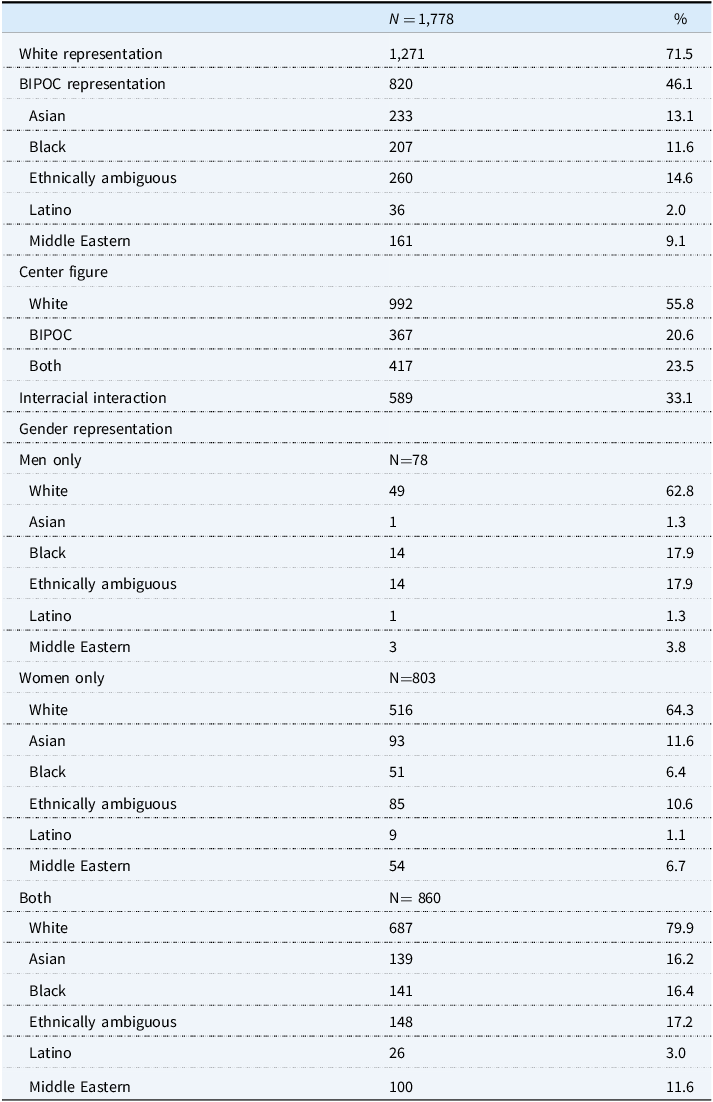
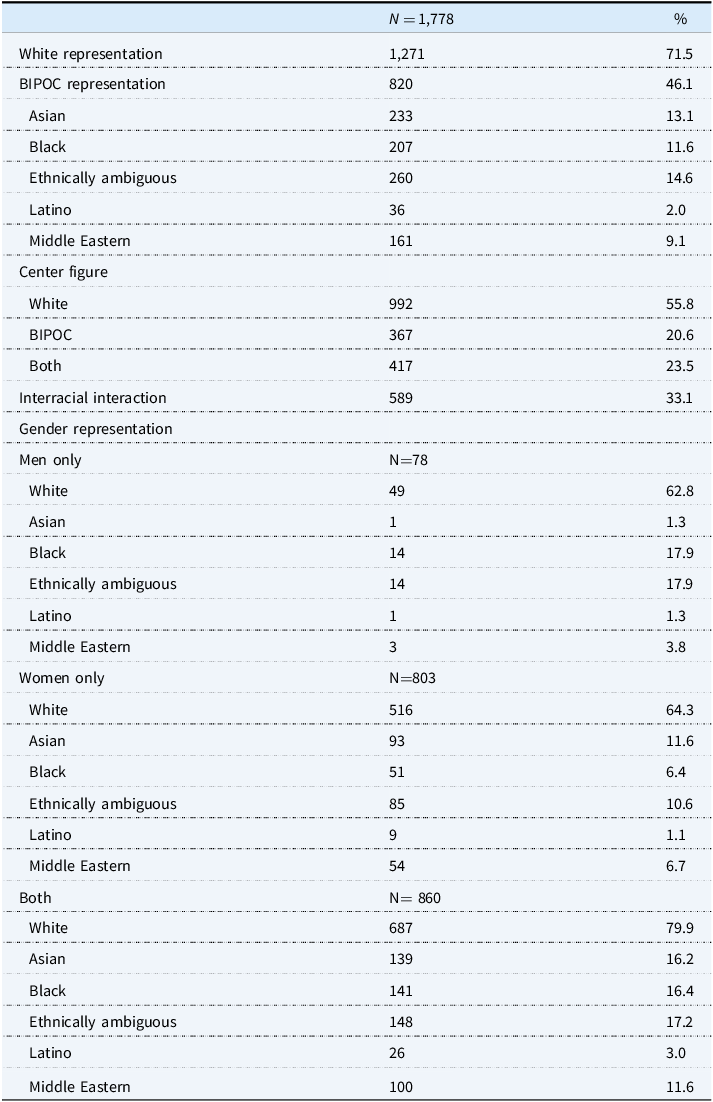
In order to obtain an overall picture of the racial representation, we conducted an exploratory quantitative analysis to examine how different racialized groups are distributed across the Image Bank. Of 1,778 images, 72% (N = 1,271) included White representation, and 46% (N = 820) included representation of racialized minorities. Notably, 54% of the pictures (N = 956, Missing N = 2) of the images did not include any PoC representation. Interracial interaction was observed in 33% of the images (N = 589). While the majority of the pictures featured a White person in the center, 21% (N = 367) centered PoC individuals, and 24% (N = 417) included both.
These descriptive findings suggest that White representation is not only more prevalent but also more visually dominant—White persons are more frequently positioned as the central figure and less often depicted in interracial interactions. This points to a racialized visual hierarchy, which aligns with Thomas et al’s. (Reference Thomas, Johnson and Grier2023, 624) observation of how visual media can “normalize Whiteness.” Meanwhile, the majority of representations of racialized minorities occur alongside White representation and often within interracial interactions, indicating a form of racial diversity that is both distinct from and anchored in normative Whiteness.
Furthermore, our descriptive analysis of the numerical presence of different racial groups in the material reveals notable patterns of representation. The representation of specific racial groups varied from the lowest 2% (Latino) to 13% (Asian); persons coded as racially ambiguous amounted to 15%. We coded 12% Black representation and 9% Middle Eastern representation. We recognize the difficulties of coding the racial ascription of Latinos, which may be converged with the over-representation of coding as racially ambiguous (Porter, Liebler, and Noon Reference Porter, Liebler and Noon2016; Rodriguez, Miyawaki, and Argeros Reference Rodriguez, Miyawaki and Argeros2013); though, the results for these two groups correspond to those of earlier studies. However, in contrast to previous studies indicating an underrepresentation of Asians (Osanami Törngren and Ulver Reference Osanami Törngren and Ulver2020; Osanami Törngren et al. Reference Osanami Törngren, Färm, Ulver, Truedson and Lundqvist2021), the current data from the Image Bank show an overrepresentation of Asians. In the Image Bank, Black and Asian persons seem to be more frequently represented than in the actual population of Sweden, while Middle Eastern and Latino representation seems to be proportional to the country’s general population.
While the number of individuals becomes relatively small when racial representation is broken down by gender, some notable patterns emerge. Across all gender categories, White individuals remain the most prominently represented. The majority of depictions include both men and women (N= 860, 48.4% of total), followed closely by portrayals featuring only women (N= 803, 45.2% of total), whereas representations of men alone are significantly less common (N= 78, 4.4% of total). This imbalance may reflect a deliberate effort to present Sweden as a gender-equal society, potentially leading to overcompensation in branding strategies (Goedecke and Klinth Reference Goedecke and Klinth2021; Jezierska and Towns Reference Jezierska and Towns2018). Moreover, the representation of Asians is higher in images featuring women only than in images featuring only men, while black representation is relatively more present in images featuring men only.
A key question in our analysis is how different racial groups are distributed and represented across various categories of images. Table 3 presents an overview of how these groups appear in different themes. While White individuals dominate the majority of representations, we observe more frequent appearances of individuals from racialized minorities in themes such as Education and Research, Society, and Students compared to Nature, Symbols, or Family. Representation also varies across different groups: Asians are most frequently shown in the two themes Education and Research and Students (35.8% and 40%, respectively), Middle Eastern individuals appear more often than other racialized minorities in Culture, Symbols, Family, and Children, and Black individuals are more visible in Urban and Students (16.5% and 22.5%).
Overview of total representation
Representation of different racial groups in different themes

Note: 5 There are multiple pictures included in the search filter “children”—which includes no children or young adults—where it has not been possible for the coder to make a proper coding.
To explore these patterns further, we examined how consistently different racial groups are represented across themes. We found that some themes – like Activities, Culture, Nature, Symbols, Family, Children, and the Elderly – tend to feature fewer people of color, especially Asian and Black individuals. In contrast, themes such as Friends and Urban show more inclusive representation across all racial groups. One particularly notable pattern is the strong presence of Asian individuals in Education and Research, and Students, where their representation is more frequent and statistically consistent (See Appendix for details.)
This finding is particularly noteworthy in light of previous research highlighting the underrepresentation of Asians and overrepresentation of Black individuals in Swedish media and place branding (Ulver and Osanami Törngren Reference Ulver and Osanami Törngren2023; Osanami Törngren et al. Reference Osanami Törngren, Färm, Ulver, Truedson and Lundqvist2021). This occurs despite a relatively larger social presence of Asians in Sweden compared to other racial minority groups, especially among transnationally adopted Swedes (Hübinette and Tigervall Reference Hübinette and Tigervall2008). At the same time, our results align with Hartley and Morphew’s (Reference Hartley and Morphew2008) study, which found an overrepresentation of both Black and Asian people in higher education marketing. These patterns raise important questions about the overall portrayal of racial diversity in the material and the qualitative portrayal of the Asian group in particular.
Zooming in: How is Racial Diversity Represented?
Considering the above results, we focus our qualitative analysis on a selection of pictures within the theme of Education and Research, namely images focused on students and student life within higher education, where representation of racial diversity is particularly prominent.
Racial Diversity as an International Selling Point
Much of the imagery and textual content within the theme of Education and Research appears to serve a deliberate agenda aimed at attracting potential international students, by portraying Swedish education as excellent, high-quality, and a hub for research and innovation: “Sweden is one of the world’s most innovative and research-intensive nations.”Footnote 6 The material targets prospective international students by highlighting practical aspects such as the availability of English-taught Master’s programs and support for finding accommodation and navigating daily life.
The overrepresentation of racialized minorities, particularly Asians, in the educational theme is striking. Of a total of 427 images in this category, 153 images (35.8%) show one or more Asians in the picture. Considering that two of the largest groups of incoming international students are from India and China (Törneke and Stengård Reference Törneke and Stengård2024), this quantitative portrayal in the Image Bank on Education and Research is indeed targeting prospective foreign international students from Asian countries, by sending a message about the kind of international students Sweden wants to attract.
Under the heading “Higher Education,” a series of pictures depicts Black and Asian students of both genders (Image 1 and 2). Both images and texts emphasize the presence of international students as a key component of Sweden’s “vibrant” academic environment, framing diversity as an asset to the educational experience:
Currently, more than 20,000 foreign students are studying in Sweden, making for a vibrant, international study environment.Footnote 7
In this way, the material constructs “being international” as synonymous with “being non-White,” subtly signaling its target audience.
Magnus Liam Karlsson/imagebank.sweden.se.

Cecilia Larsson Lantz/Imagebank.sweden.se.

The association is even more evident in some of the images in which PoC models are explicitly portrayed as visiting international students. One example is a picture of a young South Asian–looking male presented under the heading “Study in Sweden” (Image 3). In the image, the young man carries a cloth bag with the Swedish flag. The accompanying text reads:
International student with a Study in Sweden tote bag. Sweden offers an international academic environment. The country has a tradition of being open to international influences and looking beyond its borders, and there are more than 20,000 international students studying at Swedish universities.Footnote 8
Similarly, there are images of an Asian man and woman in a forest wearing shirts that say, “Study in Sweden”(Image 4).Footnote 9 The visual emphasis on PoC functions as a coded representation of internationalism, reinforcing the assumption that international students are predominantly PoC. These portrayals serve to promote Swedish higher education rather than reflect the lived experiences of international students (Ford and Cate Reference Ford and Cate2020).
Simon Paulin/imagebank.sweden.se.

Simon Paulin/imagebank.sweden.se.

Another set of images tagged as “student life” shows a group of young Asian women in the city of Uppsala, looking at their mobile phones and taking photographs in front of tourist attractions (Image 5 and 6).Footnote 10 By depicting Asian students in a tourist setting, they are portrayed as inbound travelers and visitors rather than as permanent residents of Sweden. These images, we suggest, evoke perceptions of international students as tourists by recalling well-known caricatures of Asian tourists taking photographs. This gives the impression that the presence of Asians in Sweden is temporary rather than permanent and can be linked to the misconception that Asians are always foreigners (e.g., Tuan Reference Tuan1998; Thai et al. Reference Thai, Szeszeran, Hornsey and Barlow2020).
Magnus Liam Karlsson/imagebank.sweden.se.

Magnus Liam Karlsson/imagebank.sweden.se.

To sum up, the findings illustrate how the Image Bank deploys racial diversity as a strategic tool for international marketing, where the figure of the “international student” is visually constructed through representation of racial diversity and, in particular, images of Asian students. We argue that this practice risks reinforcing the invisibility of racialized minorities in higher education. By portraying them primarily as international and foreign, the images reinforce the idea that PoC, especially Asians, are outsiders rather than integral members of the Swedish population.
“The Excellent Asian Female” as a Symbol of Gender Equality
In addressing a non-Swedish audience, the Image Bank textually presents the Swedish educational system as distinct and exceptional. A recurring description characterizes the educational system at Swedish universities as “student-centered” and “highly informal,” emphasizing values such as initiative, independence, active participation, and openness to questioning taken-for-granted ideas:
Personal initiative and independent thinking are prized. Students are required to take an active role and contribute opinions and ideas at lectures, seminars and in group discussions. Taking the initiative and questioning old presumptions is rewarding, especially in the long term.Footnote 11
This emphasis on the Swedish educational system indirectly portrays international students as “different,” implying that their own education systems are the opposite of Sweden’s – i.e., less student-centered and more formal. As a result, the narrative positions international students as less independent, more passive, and in need of improvement to align with the Swedish model (Bamford Reference Bamford2008; Hayes Reference Hayes2017; Huang, Cockayne, and Mittelmeier Reference Huang, Cockayne and Mittelmeier2024, 312).
Notably, these representations were frequently paired with depictions of Asian students, suggesting a contrast that subtly reinforces cultural hierarchies. Several photographs show East Asian and South Asian individuals engaging with education and research – reading books, working at computers, or conducting scientific experiments. These portrayals include both genders, though there is a noticeable emphasis on female representation. For example, an image depicting an East Asian female scientist is accompanied by a caption that highlights the excellence and global success of Swedish higher education: “Sweden is one of the world’s most innovative and research-intensive nations.”(Image 8).Footnote 12
Ulf Lundin/imagebank.sweden.se.

Ulf Lundin/imagebank.sweden.se.

The representation of Asian females in the material is complex. The presence of Asian women is used to promote not only the excellence of Swedish universities but also the gender equality policies that Sweden proudly promotes. In one of the images titled “Equality in Education and Research,” a female Asian student is shown looking into a microscope, alongside an older woman who appears to be White. They are both dressed in white laboratory coats, and the setting appears to be a clinical or laboratory environment.Footnote 13 The photograph is accompanied by the following quote:
Women comprise roughly 60% of all university students in Sweden. Significantly more women than men participate in adult education.Footnote 14
In a second photograph, the same Asian female model is featured in the center, appearing to engage with scientific equipment, holding a test tube or pipette in front of her (Image 7).Footnote 15 These images echo findings from the US-based studies, which note that representations of women in science often feature Asian or Asian American women rather than White women (Osei-Kofi and Torres Reference Osei-Kofi and Torres2015). The photographs analyzed in the Image Bank appear to reflect similar stereotypes of Asians as hard-working and academically excellent (Chin Reference Chin2020; Lee, Wong, and Alvarez Reference Lee, Wong, Alvarez, Tewari and Alvarez2008; Park Reference Park2008).
These representations exemplify how White institutions engage in racial commodification by assigning value to non-Whiteness (Leong Reference Leong2012). In this way, the promotion of Swedish higher education through the Image Bank relies on commodification of the “excellent Asian female” stereotype – as both a marker of academic excellence and a visual emblem of Sweden’s progressive gender ideals. However, such portrayals also reinforce cultural hierarchies and commodify racial identity, positioning non-White students – particularly Asian women – as symbolic assets used to promote Sweden’s image as superior, innovative, and globally competitive.
Racial Diversity as a Symbol of Multiculturalism
Under the heading “Students in Sweden,” there are several images of racially mixed groups. One set of images, showing racially mixed groups interacting with each other, is accompanied by texts that specifically describe the academic environment in Sweden as “multicultural.” A series of pictures from Stockholm University shows two Asian women, a White woman, and a White man.Footnote 16 Another picture shows the two Asian women and the White man in front of one of the university buildings. The picture is taken from an angle that emphasizes the “Stockholm University” sign on the rooftop, which stands out against the sky.Footnote 17 The caption for these pictures reads:
A modern university with a multicultural environment, Stockholm University is one of the world’s top 100 higher education institutes.Footnote 18
In line with previous research, we identify how higher-education institutions construct abstract notions of diversity through visual and textual messages portraying racially, ethnically, and religiously diverse campus environments as inclusive (Buckner et al. Reference Buckner, Lumb, Jafarova, Kang, Marroquin and Zhang2021).
In another set of images, a group of diverse student bodies – three White female students, one Black male student, and one racially ambiguous female student – are sitting together around a table, engaging in discussion.Footnote 19 The picture is presented with the recurring text about how Swedish education is “student-centric.” Without any reference to international students, these images shift the focus to racialized minorities as symbols of multiculturalism and a study environment characterized by diversity. In this way, the racially mixed groups are positioned as part of the Swedish study environment and as a site of mutual learning (Buckner et al. Reference Buckner, Lumb, Jafarova, Kang, Marroquin and Zhang2021; Haapakoski and Pashby Reference Haapakoski and Pashby2017).
There are no statistics on racial diversity at Swedish universities, but we know that today more than one-third of enrolled students across higher education institutions in Sweden are students with a foreign background or native-born Swedish students of second-generation immigrant background (Törneke and Stengård Reference Törneke and Stengård2024). While the international student environment is mainly depicted without any White student representation, the images of racially mixed groups framed around multiculturalism consistently include White students. This recurring inclusion appears to assign a specific symbolic meaning to the portrayal of a multicultural and inclusive Swedish society – positioning Whiteness as an integral part of a diverse yet harmonious national identity. Given the strong association between Swedishness and Whiteness, the White students may also be interpreted as symbolic representatives of a racially tolerant Swedish society.
There are also isolated portrayals of people of color that attempt to reflect Sweden’s racial and ethnic diversity, though such representations are rare. One set of images features a female student wearing a hijab. She is shown alone, studying at a table (Image 9 and 10).Footnote 20 The images are accompanied by text promoting Sweden’s international study environment, with an added sentence referencing the country’s demographic changes due to immigration:
Sweden offers an international academic environment. The country has a tradition of being open to international influences and looking beyond its borders, and there are more than 38,000 international students studying at Swedish universities. In addition, almost a fifth of the people in Sweden were born abroad or have parents who were born abroad, creating a comfortable atmosphere no matter what country you may call home.Footnote 21
Emelie Asplund/imagebank.sweden.se.

Emelie Asplund/imagebank.sweden.se.

The wording subtly positions the Muslim female student as both part of Swedish society and as an immigrant or descendant of immigrants, thus originating abroad. At the same time, the text suggests that immigrants and children of immigrants contribute to the international academic environment, creating a welcoming environment for international students. This reflects how students with immigrant backgrounds – regardless of how deeply rooted they are in Swedish culture and language – are mobilized as assets in the effort to attract international students. They are thus portrayed as symbolic figures of internationalism intended to make prospective students from abroad, particularly people of color, feel at home.
In this way, students of color are represented as tokenistic symbols of inclusivity and multiculturalism, while White students are consistently included to reinforce a harmonious image of diversity. Their presence can be interpreted as a symbol of Sweden as a tolerant, multicultural society (Osanami Törngren and Ooi Reference Osanami Törngren and Ooi2023; Saifer Reference Saifer2021; Ulver and Osanami Törngren Reference Ulver and Osanami Törngren2023). Meanwhile, isolated depictions of visibly Muslim students, such as a hijab-wearing woman, serve to highlight Sweden’s demographic changes and position immigrant identities as contributors to a welcoming international study environment.
White Students as Symbols of the Nation
In the material, images featuring exclusively White individuals are generally associated with Swedish history in education and its institutions. One set of images from Uppsala University showcases two White, blond students – one male and one female – situated in various parts of the university’s historic buildings, such as the library Carolina Rediviva, which dates back to 1817 (Image 11).Footnote 22 Another image shows the White students in the big entry hall of the university building from 1880 (Image 12).Footnote 23 The images are accompanied by the following text: “For more than 500 years, Uppsala University has been a distinguished seat of learning with rich opportunities for students and researchers at all levels.”Footnote 24
Cecilia Larsson Lantz/Imagebank.sweden.se.

Cecilia Larsson Lantz/Imagebank.sweden.se.

Although the images stage the student’s exploration of Uppsala University’s historic buildings, this is a different kind of exploration than the tourist-like portrayal often associated with Asian students in Uppsala. Through the combination of White student representation and the visual emphasis on the university’s 500-year history, the institution’s historiography becomes closely aligned with Whiteness. The imagery conveys White students as rooted in – or on a path toward becoming rooted in – the traditions of Uppsala student life. We argue that this visual narrative reproduces a taken-for-granted assumption of White Swedish students’ inherent and historically affirmed belonging in higher education.
A similar White-only representation appears in a series of four images titled “Graduation Time.” With the exception of one female figure who is racially ambiguous – thus potentially passing as White – and one blond, White male, the individuals depicted are White females dressed in traditional graduation gowns and white student caps. One of the images features two young White women wearing traditional Swedish student caps, both gazing directly into the camera from a side angle. A blurred Swedish flag is visible on the right-hand side of the frame, subtly reinforcing the national context.Footnote 25 In another image, the same women are shown in full view, dressed in dark formal attire adorned with sashes of honor and medals across their chests. They are holding national banners, further emphasizing their symbolic connection to Swedish academic tradition and national identity.Footnote 26
In the accompanying text, the women are referred to as “Swedes,” rather than the previously used phrase “students in Sweden:”
Every year, around 100,000 Swedes graduate from secondary school, after 12 years of homework. A vital part of the Swedish graduation outfit is the student cap, which dates back to the turn of the 19th century.Footnote 27
In these images, which are rich in national symbolism, there is a tacit association between student traditions, Swedish culture, and Whiteness – where only White students appear eligible to embody and represent Swedish cultural heritage. The combination of the word ”Swede” and visual narratives suggests that white bodies, particularly those of young women, act as gendered symbols of the nation (Mattsson and Pettersson Reference Mattsson and Pettersson2007), reinforcing the idea that national belonging is both racialized and gendered. This illustrates how not only racialized “others” but also White identities are commodified and assigned value in the marketing of Sweden abroad.
A final set of images with exclusively White representation shows students from other countries studying Swedish in Sweden or abroad. The images are accompanied by descriptions of the international student group and promotional text for Swedish language courses:
Many of these students intend to study or work in Sweden, or work at companies related to Sweden. Most of them combine Swedish with other subjects to get a CV that stands out. But there are also those that study Swedish only, often with the goal of becoming a teacher or translator.Footnote 28
The combination of White-only representation and Swedish language courses abroad is intriguing. It reinforces the perceived “uniqueness” of the Swedish language and Sweden itself, as these students are said to study Swedish to “get a CV that stands out.” In contrast to the perception of international students of color as being in Sweden only temporarily and requiring English-language courses, White students abroad are portrayed as motivated by long-term goals, such as moving to Sweden for work. They are also depicted as invested in learning Swedish culture and language, even while living outside of Sweden.
Altogether, this creates what Kaneva and Popescu (Reference Kaneva and Popescu2014, 518) describe as “layered hierarchies of othering.” The findings confirm previous research suggesting that the boundaries of Swedishness are constructed through multiple layers of difference – boundaries that tend to be more permeable for White minorities than for non-White minorities (Mattsson Reference Mattsson, de los Reyes and Kamali2005; Runfors Reference Runfors2020, Reference Runfors2021). The ability to “pass” as White has been identified as a key asset in being accepted as Swedish (Osanami Törngren Reference Osanami Törngren2020, Reference Osanami Törngren, Sandset, Einhorn, Harbison and Huss2022). The underlying message conveyed through these visual representations is that White bodies are more easily integrated into Swedish culture and are more readily granted claims to national belonging.
Conclusions
This article contributes to the literature on racial representation in nation branding by examining the racial dimensions of the Image Bank of Sweden – an online platform promoting Sweden internationally through visual and textual materials. Building on prior studies (Bolin and Ståhlberg Reference Bolin, Ståhlberg, Rosvall and Salovaara-Moring2010; Fan Reference Fan2006, Reference Fan2010; Glover Reference Glover2009; Osanami Törngren and Ooi Reference Osanami Törngren and Ooi2023; Ståhlberg and Bolin Reference Ståhlberg and Bolin2016), we show how racial representations are mobilized to construct an image of Sweden as progressive, international, and inclusive. While these themes are familiar, our analysis reveals that national branding is indeed racialized.
Using a mixed-method approach, we combine quantitative mapping of racial representation with qualitative analysis of selected images and texts. Quantitatively, White individuals dominate the imagery, though Black and Asian individuals appear more frequently than their demographic proportion, while Middle Eastern and Latino representation is less frequent but roughly proportional. White individuals are often at the center or depicted alone, whereas PoC are shown in interaction, with Black representation skewed male and Asian representation skewed female. The review reveals a visual image of Sweden where there is certainly racial diversity, but where there are still signs that Whiteness is centered as the norm (Thomas et al. Reference Thomas, Johnson and Grier2023, 624).
Qualitatively, racialized bodies are used to project Sweden’s image as inclusive and globally engaged, aligning with Leong’s (Reference Leong2012) concept of performative inclusion. PoC – especially Asian women – are framed as ideal international students, symbolizing both academic excellence and gender equality, yet are portrayed as temporary visitors. They appear as overburdened representatives of the stereotype of Asians as hard-working and academically excellent (Chin Reference Chin2020; Lee, Wong, and Alvarez Reference Lee, Wong, Alvarez, Tewari and Alvarez2008; Park Reference Park2008). Images of racial diversity also serve as tokenistic symbols of domestic multiculturalism, typically in mixed groups that reinforce ideals of harmonious integration. In these images, it is the interracial interaction itself that is mobilized to portray Sweden as a racially tolerant, multicultural society (Osanami Törngren and Ooi Reference Osanami Törngren and Ooi2023; Saifer Reference Saifer2021; Ulver and Osanami Törngren Reference Ulver and Osanami Törngren2023). The commodification of race in the image bank thus shows clear signs of “hierarchies of otherness” (Kaneva and Popescu Reference Kaneva and Popescu2014, 518), where different racialized others fulfill different functions in the image of progressive Sweden.
As an overall conclusion, it is evident that the racial aesthetics of the branding material normalizes Whiteness (Thomas et al. Reference Thomas, Johnson and Grier2023), by positioning white students, especially female students, as rooted in national student culture and as embodied symbols of the nation (Mattsson and Pettersson, Reference Mattsson and Pettersson2007). This conflation of Swedishness and Whiteness is enhanced by the fact that foreign White students are depicted as integrating seamlessly, in contrast to the conditional inclusion of PoC. What is even more noteworthy is the ways in which Whiteness is commodified in the promotion of Sweden abroad. This conclusion calls for a deeper look into the commercial value of Whiteness in national brand profiling, for example, in areas where Whiteness dominates the images, such as the nature and culture theme in the Image Bank. An interesting question to explore is how images of White Swedes are being mobilized as “a form of capital” (White Reference White2017, 602), in self-exoticizing narratives about Swedes as a nature-loving people and in images surrounding cultural traditions such as Midsummer and Lucia celebrations.
Future research should explore how the images in the Image Bank are used in practice, particularly by institutions such as universities. It would also be valuable to examine how international audiences interpret these representations and how they relate them to broader perceptions of Sweden. Additionally, with the increasing use of AI-generated stock photography, it would be valuable to investigate how such technologies reshape racial representation and ethnic marketing (e.g., Licsandru and Cui Reference Licsandru and Chi Cui2019), and how they may contribute to new racial dynamics in nation branding. Finally, we want to conclude that, even though a perfect representation of a country’s racial diversity is not achievable, striving for inclusive branding still is an important political ambition, since it is closely linked to questions of belonging.
Supplementary material
The supplementary material for this article can be found at https://doi.org/10.1017/rep.2026.10065.
Acknowledgments
We would like to thank Lisa W. Caruso and Adam Fernström for their valuable assistance in coding the material for this study, Jenny Money for assistance with language review, and the three anonymous reviewers for their insightful comments and constructive suggestions, which have helped us to improve the manuscript considerably.
Funding statement
This research was funded by the Swedish Research Council for Sustainable Development, FORMAS (FR2018/0010).
Competing interests
There is no potential conflict of interest.
Sayaka Osanami Törngren is an Associate Professor in International Migration and Ethnic Relations and a senior researcher at the Malmö Institute for Studies of Migration, Diversity, and Welfare (MIM), Malmö University. She is engaged in multidisciplinary research on identities, racial representation, and racism. Her most recent publications can be found in Sociology Compass, Scandinavian Journal of Hospitality and Tourism, Journal of Marketing Management, Ethnic and Racial Studies, and Identities.
Katarina Mattsson is an Associate Professor in Gender Studies at Södertörn University. Her research lies in the overlap between gender studies and critical Whiteness studies and examines the interplay between gender, nation-building, and Whiteness in tourism and travel. Her most recent publications can be found in Tourist Studies, Scandinavian Journal of Hospitality and Tourism, and The Routledge International Handbook of New Critical Race and Whiteness Studies (2023).











 Open access

