

The Fukushima nuclear accident was caused by a giant tsunami following a magnitude 9 earthquake on March 11, 2011. People within a 20-km radius of the Fukushima Daiichi nuclear power station were forced to evacuate, and more than 140 000 people were displaced. 1
The Great East Japan Earthquake and Fukushima disaster have caused tremendous damage across a wide area, including the Fukushima Prefecture, where residents as a result have been affected by severe psychological distress, problematic drinking, and sleep disturbances. Reference Orui, Ueda and Suzuki2 Since the disaster’s socio-psychological impact has continued for an extended period, Reference Maeda, Harigane and Horikoshi3 physical and mental self-care activities are necessary to promote health and well-being among those affected. Reference Machida, Murakami and Takebayashi4 Laukka Reference Laukka5 argued that listening to music can increase the frequency of positive emotions, such as delight and relaxation, whereas Schäfer Reference Schäfer6 suggested that music can be used to achieve specific goals (eg, self-awareness, social relatedness, and arousal and mood regulation). Previous reports Reference Schäfer6–Reference McCaffrey and Locsin9 suggested that music is effective for self-awareness, emotional well-being, nursing interventions (ie, the interventional use of music as part of the patient’s care plan in the nursing practice setting), and chronic pain alleviation. Furthermore, previous studies Reference Kohara and Matsumoto10,Reference Tanichi, Tatsuki and Saito11 have applied music therapy after disasters. A previous study Reference Kohara and Matsumoto10 on those affected by the Great Hanshin-Awaji Earthquake suggests the usefulness of music therapy, such as improvement of emotional expressions, the activation of physical movement, and the promotion of communication among residents of a care facility for the physically disabled. Another study Reference Tanichi, Tatsuki and Saito11 reports that music was effective at reducing the stress caused by the deployment of the Self-Defense Forces personnel in response to the Great East Japan Earthquake.
Results from previous studies suggest that music may be a useful tool for maintaining one’s mental health and sense of well-being after major disasters. However, there is insufficient scientific knowledge in the theoretical framework of associations between music listening and well-being after a disaster. Further research is needed to ensure that music selection is based on a more rigorous and reproducible methodology. Reference Williams and Hine12 Assuming that 1 strategy is to maintain well-being after a disaster by listening to music as part of a hobby, it is worth investigating that well-being is associated with whether individuals prefer listening to music, how often they listen to music, and whether they have any music-related hobbies. Furthermore, it is also important to investigate differences in the associations between music listening and well-being by age and gender. Despite being major demographic factors, limited knowledge is available regarding age and gender differences. Reference Nilsson13 These associations should be clarified to establish foundational knowledge of music’s effectiveness post-disaster (eg, which populations may most benefit).
Based on these findings, it is expected that clarifying the association between well-being and music listening after disasters will provide some fundamental insights into the promotion of well-being among people affected by a disaster. In this study, “music” does not refer to “music for music therapy” but rather, “music listening as part of a hobby.” Since well-being promotion through music listening as a hobby is a simple method for individual practice, it has potential as a useful stress management strategy. However, few studies have demonstrated associations between well-being and music listening habits after a disaster.
Therefore, this study was conducted to clarify associations between weekly music listening and well-being in the aftermath of the Fukushima disaster. We further examined the strength of these associations by gender and age groups. The Fukushima disaster forced the affected people to undergo a large-scale and long-term evacuation, and its psychosocial effects have been confirmed over an extended period. Reference Maeda, Harigane and Horikoshi3 We chose to focus on this disaster because it is important to discuss its chronic effects.
In this study, we used a variety of well-being scales. Various psychological scales have been used to investigate the mental health and well-being of those affected by a disaster. For example, in the World Health Organization/World Mental Health survey, the Kessler-6 (K6) is utilized as a screening scale for serious mental illness. Reference Kessler, Barker and Colpe14 Nettle Reference Nettle15 identifies 3 forms of well-being: a momentary feeling of emotion (ie, emotional well-being), judgments concerning long-term feelings (life satisfaction), and quality of life in terms of achieving one’s potential (eudemonia). Graham et al. Reference Graham, Laffan and Pinto16 similarly grouped well-being into 3 categories. The first 2 are understood as subjective forms of well-being, whereas the third type of well-being, developed based on Ryff’s psychological theory, Reference Ryff17 is called psychological well-being. Emotional well-being can be measured by the experience sampling method, the day reconstruction method, and via questions about the previous day’s emotional experiences, whereas life satisfaction can be measured by the life evaluation scale and Cantrill’s ladder. Reference Csikszentmihalyi and Larson18–Reference Murakami, Tsubokura, Ono and Maeda22
Well-being has multiple components, as described above, and we compared them using corresponding items, rather than a single well-being item, to comprehensively determine their usefulness for various purposes.
Methods
Participants
A cross-sectional study was conducted with 420 participants (170 men and 250 women) between ages 20 and 59 who had registered to be on the panel of the research company INTAGE Research Inc. and included the Fukushima Prefecture in their address. In other words, to meet inclusion criteria, participants had to be the research company monitors between the ages of 20 and 59 and living in Fukushima Prefecture at the time of the survey. No exclusion criteria within this population were set in this study. Those over 60 years of age were excluded to control for potential bias regarding online surveys (eg, affinity for online surveys). The self-report online survey was conducted from November 6 to 8, 2019, and monitors were recruited until the target number was reached. The gender, age, and evacuation experience due to the Fukushima disaster of the participants were gender: 40.5% men, 59.5% women; age: 14.3% 20s, 21.9% 30s, 31.2% 40s, 32.6% 50s; evacuation experience due to the disaster: 20.7% yes, 79.3% no.
The details and advantages of online surveys have been described elsewhere. Reference Murakami, Suzuki and Yamaguchi23 For example, online surveys have the advantage of reducing bias because participants receive points that can be redeemed for products, thus creating an incentive to participate irrespective of their interests in the survey topics.
Since the strength of the association between music preference and well-being was unknown, the number of participants (420) was determined based on the feasibility of the survey. The number of participants in this study was comparable to or higher than a previous study discussing mental health after the Fukushima disaster (n = 155). Reference Kobayashi, Yoshida and Takebayashi24
Questionnaire Items
Well-being (outcome variables)
In this study, we measured emotional well-being and judgments concerning long-term feelings of well-being. Emotional well-being was divided into positive and negative well-being, in accordance with a previous study. Reference Murakami, Takebayashi and Ono25 In addition, we included K6 as a screening scale for mental illness and changes recorded in mental health after the disaster. Reference Norris, Tracy and Galea26,Reference Orui, Nakajima and Takebayashi27 Positive or negative emotions were evaluated as momentary feelings, psychological distress as stable feelings over the past month, life satisfaction as long-term evaluations of life, and changes in mental health after the Fukushima disaster as changes since the disaster. The questions regarding life satisfaction included an 11-point scale, ranging from 0 to 10, which was based on the Satisfaction with Life Scale (SWLS). Reference Murakami, Takebayashi and Ono25 Positive emotions were assessed on a 2-point scale (no = 0; yes = 1) for 3 items concerning enjoyment, happiness, and laughter. Reference Murakami, Takebayashi and Ono25 Negative emotions were also assessed on a 2-point scale for 2 items: sadness and worry. Reference Murakami, Takebayashi and Ono25 Psychological distress was assessed on a 5-point scale, which ranged from 0 to 4 for each of the 6 items (K6). Reference Kessler, Barker and Colpe14
Participants were also asked to respond to questions regarding changes in their mental health after the disaster. Reference Norris, Tracy and Galea26,Reference Orui, Nakajima and Takebayashi27 Details including diagrams of choices are provided elsewhere. Reference Orui, Nakajima and Takebayashi27 Specifically, participants were asked to select the pattern of their mental health from the Fukushima disaster to the present among 7 options. Thus, this item represents changes in mental health since the Fukushima disaster. The first option, No. 1, showed a pattern of consistent positive mental health after the disaster, whereas Nos. 2 and 3 showed patterns of declining mental health after the disaster followed by a recovery period. No. 4 showed a pattern of mental health deterioration after the disaster and then a recovery period with both improvements and deterioration. Finally, Nos. 5 and 6 showed a pattern of mental health deterioration after the earthquake, whereas No. 7 showed other patterns.
Music listening habits (exposure variables)
The questions on music listening habits were assessed through 4 questions: “Is there any music that you liked to listen to just after the Great East Japan Earthquake? (option: yes or no)”; “Is there any music that you like to listen to these days? (option: yes or no)”; “Please choose the frequency you listen to music that most closely matches (options: more than 2 hours every day; 1–2 hours every day; less than 1 hour every day; once every 2 to 3 days; about once a week; less than once a month)”; and “What are your most cherished hobbies? Please select all that apply. (options: music listening; playing musical instruments; karaoke; watching sports; exercise and sports; art appreciation; watching arts, theater, and dance; movies; Japanese and Western dressmaking; knitting and handicrafts; cooking and pastry making; eating and drinking; gardening; Sunday carpentry work; photography and printing; reading; pachinko [Japanese pinball]; video and computer games; travel; driving; visiting amusement parks, zoos, and aquariums; camping; and other).” We created the first 3 questions and followed the last question as a previous report. 28
Demographics (covariates)
The questions on participants’ demographics included a personality inventory as well as mention of their gender (option: men or women), age, marital status (yes or no), children (presence or absence), evacuation experience due to the Fukushima disaster (ie, The evacuation order has not been lifted and I am still evacuating; I have evacuated in the past due to evacuation orders, but now the evacuation order has been lifted and I have already returned home; the evacuation order has been lifted, but I am still voluntarily evacuating; the evacuation has not been ordered, but I am still voluntarily evacuating; the evacuation has not been ordered, but I have voluntarily evacuated in the past and have returned home; or I have not evacuated), and trusted sources of information, including TV and radio, newspaper, national institution, researchers, friends and acquaintances, Internet by researchers, Internet by non-researchers, and none of the above information (yes or no). These questionnaire items were selected because they were associated with well-being or music listening habits in previous reports. Reference Murakami, Tsubokura, Ono and Maeda22,Reference Tiefenbach and Kohlbacher29–Reference Gosling, Rentfrow and Swann31
The subjective feelings of their health were assessed via 5 options: “How is your current health condition? (options: ‘very good,’ ‘good,’ ‘fair,’ ‘poor,’ and ‘very poor’).” Personality was assessed via the Japanese Version of the Ten Item Personality Inventory (TIPI-J), which has a 7-point scale (1 = disagree strongly to 7 = agree strongly) for each of the 10 items. Reference Gosling, Rentfrow and Swann31,Reference Oshio, Abe and Development32 The details of questionnaires were available elsewhere. Reference Gosling, Rentfrow and Swann31,Reference Oshio, Abe and Development32 Finally, the TIPI-J was classified into 5 subscales: extraversion, cooperativeness, industriousness, neuroticism, and openness. There were no missing data.
Statistical analysis
Data handling
IBM SPSS Statistics 24 was used for this analysis. Outcome (dependent) variables included 5 types of well-being: life satisfaction (range: 0–10), positive emotion (0–3), negative emotion (0–2), psychological distress (2 categories), and changes in mental health after the Fukushima disaster (4 categories). Exposure (independent) variables included 4 types of music listening habits: recent favorite music, listening to favorite music after the disaster, frequency of music listening, and presence/absence of music-related hobbies. Participants’ demographics were considered potential covariates.
Positive and negative emotions were analyzed using the total scores (3 items for positive emotion and 2 items for negative emotions). We calculated the Cronbach’s alpha coefficients across multiple question items (ie, 3 items for positive emotion; 2 items for negative emotion). The Cronbach’s alpha coefficients for positive and negative emotions were 0.793 and 0.584, respectively. Since the alpha coefficient for negative emotions was relatively low, caution should be applied when interpreting the results. Psychological distress was analyzed by dividing the total score of the 6 questionnaire items (0–24) into 2 groups: a low group with a score of 12 or less and a high group with a score of 13 or more. Reference Kessler, Barker and Colpe14 Changes in mental health after the Fukushima disaster were classified into 4 groups: good (No. 1), improving (Nos. 2, 3, and 4), worsening (Nos. 5 and 6), and other (No. 7).
Music listening habits for recent favorite music and listening to favorite music after the disaster were divided into 2 groups according to their answers with or without choice. Frequency of music listening was divided into 2 groups by “more than one day” and “less than one day.” Presence/absence of music-related hobbies was divided into 2 groups according to whether they selected one of the applicable music-related options (ie, music listening, playing musical instruments, and karaoke).
Regarding the evacuation experience due to the Fukushima disaster, the participants were divided into 2 groups irrespective of mandatory or voluntary evacuations: the presence of evacuation and the absence of evacuation. The TIPI-J’s 5 subscales were classified into 2 groups based on the median value. The participants’ subjective feelings about their health were also divided into 2 groups, where the high group included the answers, “very good” and “good,” whereas the low group included “fair,” “poor,” and “very poor.”
Univariate analysis
Chi-square tests were used to investigate the associations between 2 types of outcomes (ie, psychological distress and changes in mental health after the Fukushima disaster) and music listening habits (ie, listening to favorite music after the disaster, recent favorite music, the frequency of music listening, and music-related hobbies) or participants’ demographics (ie, other hobbies, gender, age, personality, marital status, children, subjective feeling of health, and trusted sources of information).
Either the Mann–Whitney U test or Kruskal–Wallis test was used to examine the associations between 3 types of outcomes (ie, life satisfaction, positive emotion, and negative emotion) and music listening habits or participants’ demographics.
Multivariate analysis
A multivariate analysis was utilized to investigate associations between well-being and music listening habits. We also conducted analyses that were stratified by gender and age groups. The association between the variables of music listening habits was examined via the Copper coefficient, which revealed that all were highly correlated (Table 1). Thus, to eliminate multicollinearity, the category of “recent favorite music,” which showed a strong association with other variables, was introduced as an exposure (independent) variable. We included covariates that were significantly associated with the outcome in the univariate analysis. Meanwhile, an ordinal logistic analysis was used for positive emotion as an outcome variable, as univariate analysis showed significant associations between this well-being and music listening habits. The variance inflation factor (VIF) values for “recent favorite music” were less than 2.167. Since the VIF was lower than 2.5, Reference Johnston, Jones and Manley33 the possibility of multicollinearity was considered to be low. Further, as a sensitivity analysis, “listening to favorite music after the disaster” was used as an exposure variable instead of “recent favorite music” to confirm the associations with emotional well-being (an outcome variable).
Associations between music listening habit variables via a Copper coefficient

Ethical Statement
This study was conducted with the approval of the Ethics Committee of the Fukushima Medical University (Approval Number: General 2019-165).
Results
Characteristics of the Participants
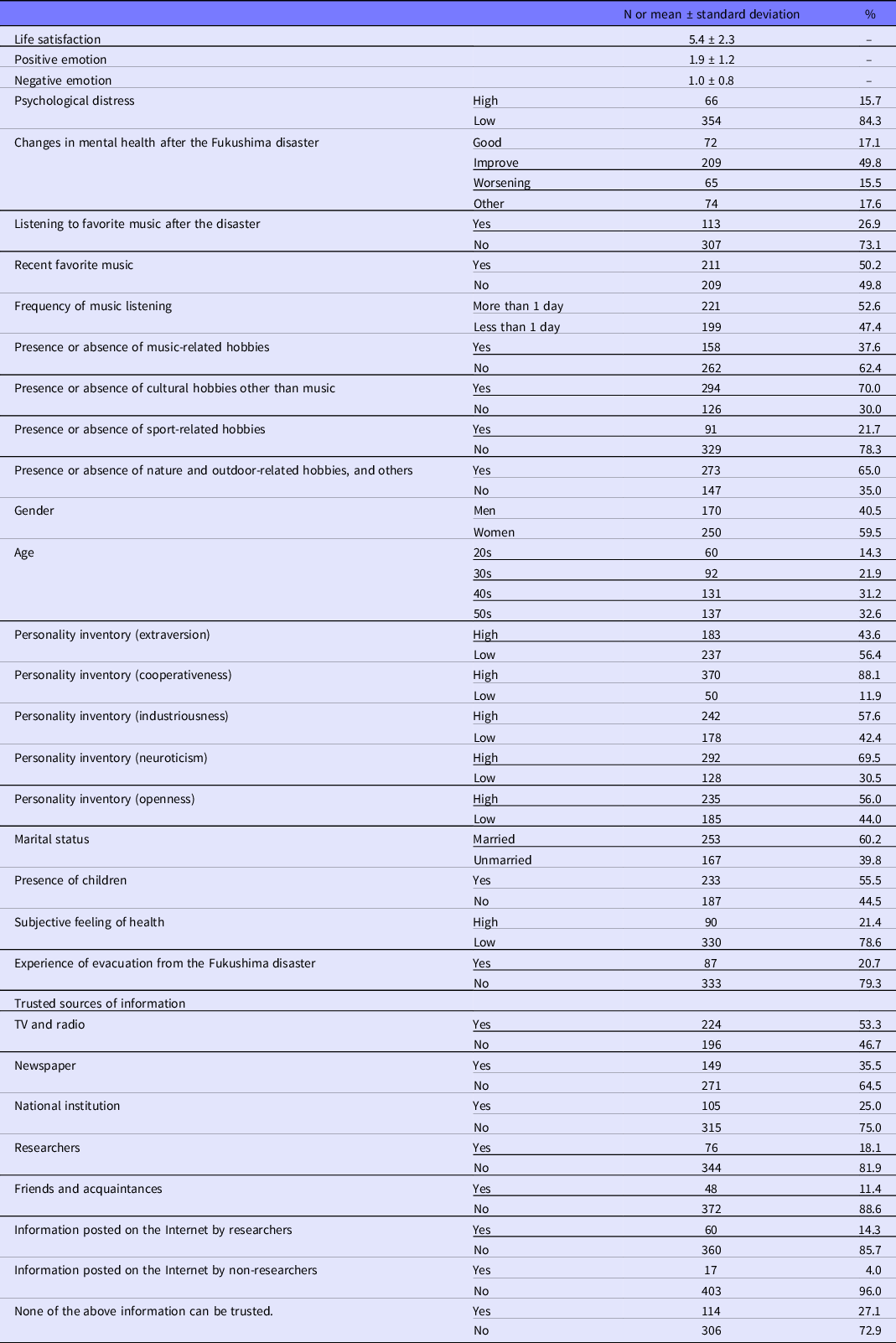
The distribution of the participants is shown in Table 2. As described above, positive or negative emotions were evaluated as momentary feelings, psychological distress as stable feelings over the past month, life satisfaction as a long-term evaluation of life, and changes in mental health after the disaster as post-disaster changes. The means ± standard deviations of life satisfaction, positive emotion, and negative emotion were 5.4 ± 2.3, 1.9 ± 1.2, and 1.0 ± 0.8, respectively. Overall, 15.7% of participants had psychological distress, whereas 17.1%, 49.8%, 15.5%, and 17.6% experienced changes in their mental health after the disaster that was either “good,” “improving,” “worsening,” or “other,” respectively. Regarding music listening habits, 26.9% of the participants answered positively to listening to favorite music after the disaster, whereas 50.2% had a recent favorite type of music. Furthermore, 52.6% of participants listened to music at least once daily, whereas 37.6% had music-related hobbies. The proportions of those who were married and those married with children were 60.2% and 55.5%, respectively.
Participants’ distribution
Associations Between Well-being and Music Listening Habits
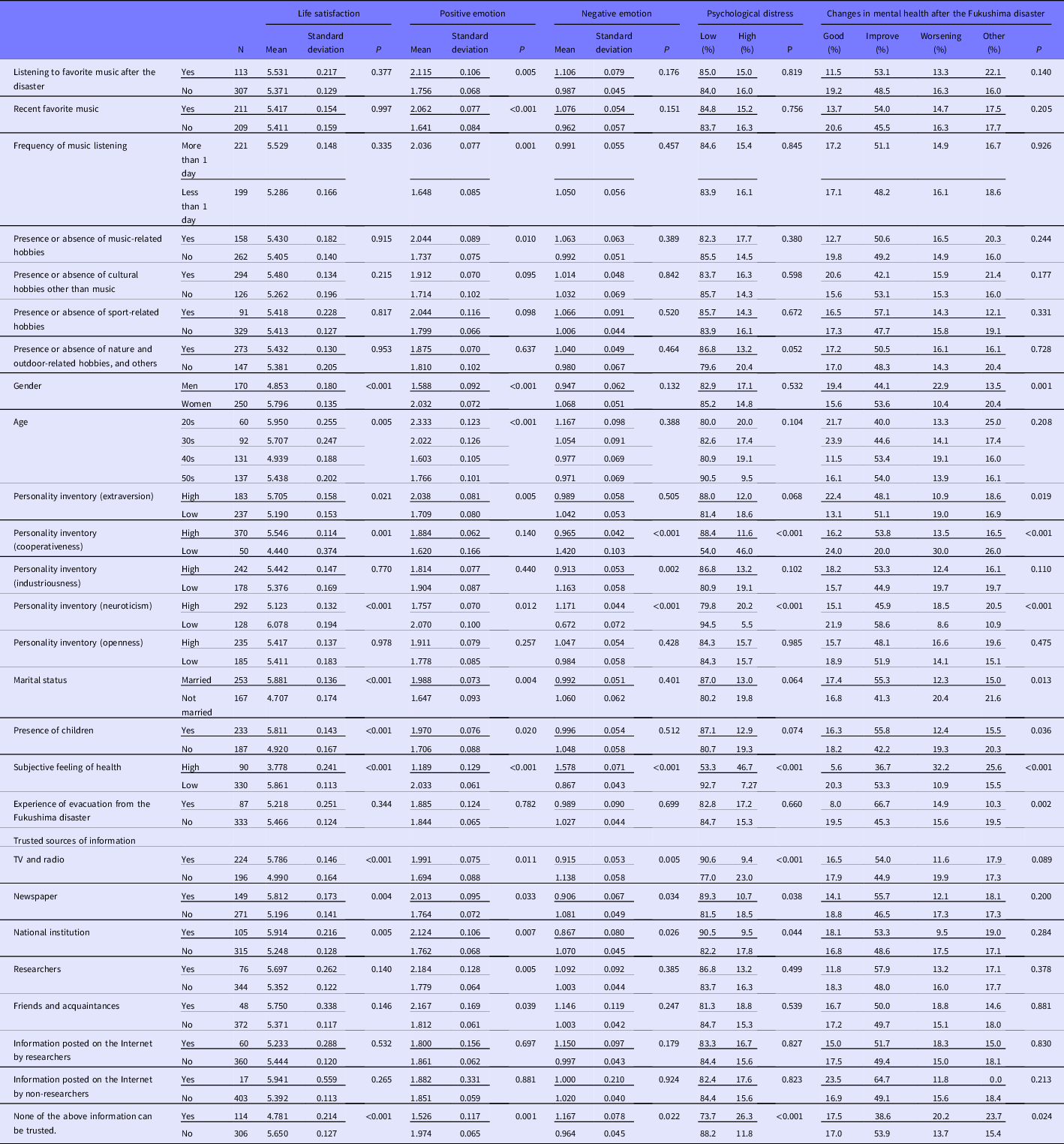
We analyzed the associations between well-being and music listening habits (ie, listening to favorite music after the disaster, recent favorite music, frequency of music listening, and music-related hobbies) as well as those between other variables, including hobbies that were unrelated to music (Table 3). The results showed that significant associations existed between positive emotions and the 4 types of music listening habits (P = 0.005 for listening to favorite music after the disaster; < 0.001 for recent favorite music; 0.001 for frequency of music listening; and 0.010 for presence or absence of music-related hobbies). The participants who had been evacuated due to the Fukushima disaster tended to choose “good” or “other” less frequently and “improve” more frequently than those who had not been evacuated due to the Fukushima disaster (P = 0.002).
Associations between well-being and music listening habits via a univariate analysis
An ordinal logistic analysis showed a significant association between positive emotions and recent favorite music, specifically, even after adjusting for covariates (ie, subjective feeling of health, personality inventory [extraversion and neuroticism], gender, marital status, presence of children, age, trusted sources of information [TV and radio, newspaper, national institution, researchers, friends and acquaintances, and none of the above information can be trusted]) (P = 0.009; Table 4). Meanwhile, the results of gender-specific analyses showed a significant association between positive emotions and recent favorite music in men (P = 0.002), whereas no significant association was found among women (P = 0.098). The analysis stratified by age also showed a significant association between positive emotions and recent favorite music among those in their 40s and 50s (P < 0.001), whereas no significant associations were found among those in their 20s and 30s (P = 0.569). Similar results were found for associations with positive well-being after “listening to favorite music after the disaster” was utilized instead of “recent favorite music” (Table 5).
Associations between positive emotion and music listening habits via an ordinal logistic analysis

CI, confidence interval.
Adjusted by covariates (ie, subjective feeling of health, personality inventory [extraversion and neuroticism], gender, marital status, presence of children, age, trusted sources of information [TV and radio, newspaper, national institution, researchers, friends, and acquaintances]; none of the above information can be trusted).
Associations between positive emotion and listening to favorite music after the disaster via an ordinal logistic analysis

CI, confidence interval.
Adjusted by covariates (ie, subjective feeling of health, personality inventory [extraversion and neuroticism), gender, marital status, presence of children, age, trusted sources of information [TV and radio, newspaper, national institution, researchers, friends, and acquaintances]; none of the above information can be trusted).
Discussion
In this study, we investigated the associations between well-being and music preference after the Fukushima disaster. The mean ± standard deviation of participants’ life satisfaction (ie, a long-term evaluation of life) was 5.4 ± 2.3, which was either similar to or slightly lower than that of those affected by the earthquake (6.3 [Marumori City; 20–49 years old; postal method] Reference Murakami, Harada and Oki34 and 5.9 [Fukushima Prefecture; 20–69 years old; online survey] Reference Murakami, Takebayashi and Takeda35 ). Meanwhile, 15.7% of people experienced psychological distress, which was higher than a 2018 survey (9.9%) among 20- to 79-year-old residents of municipalities where the evacuation orders had been lifted by the postal method. Reference Murakami, Takebayashi and Tsubokura36 Regarding changes in mental health from the Fukushima disaster to the present, the sum of groups categorized as “good” and “improving” was 66.9% (74.7% among those who experienced the evacuation; 64.8% among those who did not experience the evacuation), which was slightly lower than a previous survey that recorded 77.1%, Reference Orui, Nakajima and Takebayashi27 using the postal method (500 participants among evacuation order areas and 500 participants among non-evacuation order areas; ≥ 20 years old). Differences in psychological distress and changes in mental health after the Fukushima disaster between this study and previous ones may be due to variations in the age groups, target areas, and survey methods (online versus postal). Furthermore, sampling bias is likely to occur due to low response rates in postal methods. Therefore, previous studies using postal methods may have shown better mental health than actual.
In this study, among the 5 types of well-being, positive emotions had strong associations with music listening habits. In particular, it is worth noting that no associations were correlated with hobbies other than those pertaining to music. Even after adjusting for covariates, such as personality inventory, those who had a recent favorite type of music (or listened to favorite music after the disaster) experienced a significantly higher degree of positive emotions. According to a previous report, Reference Laukka5 people who listen to music as a specific strategy to achieve some end, such as mood regulation or relaxation, have a higher level of well-being. Additionally, having a recent music listening habit, in general, contributes to an increase in positive emotion. Moreover, the lack of association between evacuation experience and positive emotion highlights the significance of listening to music in the chronic post-disaster period, whether or not individuals have experienced evacuation.
Moreover, the strength of associations between positive emotions and music listening habits differed depending on gender and age, which is consistent with a previous report Reference Nolen-Hoeksema and Aldao37 that suggests that the selection process of emotional regulation strategies differs across these variables. This study revealed that the association between positive emotions and music listening habits was significant for participants in their 40s and –50s but not for those in their 20s and 30s. However, a previous study Reference Groarke and Hogan38 reported that, although controlling emotions by listening to music was a major aim for both younger and older people, younger people were more likely to do so not only to control their positive emotions but also their negative ones. Meanwhile, older individuals with less awareness of their negative experiences were likely to report increased positive emotions. Additionally, men had fewer types of regulatory strategies for depressive affect than women. Reference Nolen-Hoeksema and Aldao37 These results suggest that listening to preferred music had a greater effect on the suppression of negative emotions among men because they have fewer regulatory strategies to utilize. However, our finding on gender difference was inconsistent with a previous report that showed no significance. Reference Nilsson, Lindell, Eriksson and Kellerth39 Further studies are warranted to clarify the gender difference.
In this study, no associations were found between music listening habits and life satisfaction, negative emotions, psychological distress, and changes in mental health after the Fukushima disaster. Similarly, in a previous study, the uses of music therapy, which aimed to treat depressive conditions, did not contribute to promoting life satisfaction. Reference Maratos, Gold, Wang and Crawford40 Meanwhile, some reports show that listening to music may improve psychological distress in patients with chronic pain due to cancer. Reference Siedliecki and Good41 Since participants’ characteristics and aims concerning music differed between this study and others (ie, affected people versus patients; listening habits versus therapy), it is necessary to further investigate the role of music listening habits on these indicators of well-being.
While there are not enough practical examples of music application after disasters, a previous report indicates that music contributed to increased emotional endurance and reduced loneliness in the aftermath of a disaster. Reference Hugelius, Gifford, Ortenwall and Adolfsson42 Music is one of the most noninvasive and convenient means of promoting positive mental health and well-being conditions; therefore, it has the advantage of being utilized in a wide variety of environments, including those with limited resources just after a disaster. This coping method can be easily practiced in the immediate aftermath of a disaster, when there are restrictions on personal hobbies and interests. Furthermore, it also has the potential to be widely used in the event that evacuation becomes necessary. Furthermore, since the Evidence-Based Guideline of Individualized Music for Persons with Dementia has been developed to individualize music for dementia patients, Reference Gerdner43 a similar guide for utilizing music should be developed for those affected by a large-scale disaster. This would encourage individuals to shift perspectives when it comes to managing their well-being after a disaster.
This study has some limitations. First, it cannot prove causality due to its cross-sectional study design. Since the possibility of causality’s reversal or the existence of other factors cannot be denied, it is necessary to increase knowledge on this topic with further intervention studies in the future. Second, since the target population is limited to those who use online surveys, selection bias is a possibility. Third, this study limited participants’ area of residence and age. Thus, the inclusion of different places of residence, ages, and other disasters would advance research toward universal findings. Fourth, since this study’s results were obtained approximately 9 years after the Fukushima disaster, the findings may not apply to the acute phase of a disaster. The results of this study showed that recent favorite music habits or listening to music after the disaster were associated with positive emotion. This study therefore provided useful foundational findings in the chronic phase of a disaster, with consideration that well-being has declined among the people affected by the Fukushima disaster, that resources were generally limited immediately after the disaster, and that music use is useful under such limited resources.
Fifth, in this survey, we did not ask about music before the disaster. By understanding the changes in preferences before and after the disaster, therapists might offer ways to help survivors cope and normalize their mental health. Therefore, it would be of great significance to examine the reasons for the change in music. Sixth, the participants were asked whether they had experienced evacuation due to the disaster but were not asked whether they had been in that location at the time of the disaster. We did not include an item such as bereavement experience with close persons. We could not rule out the possibility that these items were related to the association between well-being and music. Seventh, we did not ask participants to distinguish whether they actively chose to listen to certain music or whether they came to listen to music by chance. Additionally, we did not conduct a survey that intentionally varied the music the participants listened to.
However, despite these limitations, this study provides new findings on the associations between well-being and music listening habits after the Fukushima disaster, highlighting the potential usefulness of music for increasing positive emotions among those affected by a large-scale disaster. It should be noted that this study showed an association and not a causal identification. If the effects of music listening on well-being after a disaster are verified in future longitudinal and interventional studies, the role of music listening in maintaining well-being before and after a disaster would be worth revisiting. For example, it would be useful to create environments that allow individuals to listen to music pre- and post-disaster. In particular, music listening among men and the 40s to 50s age group should be promoted, as suggested by this study. Thus, this study could provide foundational knowledge for further research on the role of music listening in well-being after a disaster.
Conclusion
We examined the association between music preferences and well-being after the Fukushima disaster. The results indicated that music listening habits were associated with positive emotions, and the association between music preferences and well-being varied by gender and age. The findings from this study are expected to serve as a foundation for considering concrete measures to effectively use music in various settings where mental health care is required, including environments where resources are scarce immediately after a disaster.
Note
We prepared this paper after the addition of results and discussion to the abstract that was presented at the 33rd Annual Meeting of the Society for Risk Analysis in Japan. Reference Yoneshiro, Takebayashi and Murakami44
Acknowledgments
We would like to thank Editage (www.editage.com) for English language editing.
Funding statement
No external financial support is used for this article.
Conflict(s) of interest
There are no conflicts of interest to declare.


 Open access

