


The high number of unfilled consultant posts in psychiatry in the UK has recently prompted escalating concern about recruitment of doctors into the specialty. It is widely predicted that, both in Scotland and south of the border, new mental health legislation will exacerbate existing shortages through its impact on consultants’ workloads, and that there will not be suitably qualified applicants for any additional consultant posts that may be created.
It is a general criticism of medical workforce planning that too little attention is paid to retention and retirement (Reference Atherton and MurrayAtherton & Murray, 2000). In psychiatry, we have had the gloomy prognostications arising from a survey of psychiatrists who retired early during the mid-1990s (Reference Kendell and PearceKendell & Pearce, 1997) and a survey in 2001 of consultants over 50 years of age by the College Research Unit (Mears et al, Reference Mears, Kendall and Katona2002, Reference Mears, Kendall and Katona2004), which reported a mean planned retirement age of 60 years. We undertook a survey of senior psychiatrists working in Scotland to ascertain views about recruitment and to elicit intentions about retirement. This paper focuses on the responses to our enquiries about retirement.
Method
Following a review of relevant literature, a questionnaire was designed to obtain information from psychiatrists in Scotland about recruitment and retention which might aid workforce planning. The first brief section collected demographic data including date of birth, grade and sub-specialty. The second section related to recruitment into psychiatry and will be reported in a separate paper. The third, and relatively brief, section asked about retention and retirement intentions. Psychiatrists were asked to state their most likely retirement date, from which their probable age at retirement was calculated. They were asked (in a yes/no forced choice format) whether any of the following might induce them to retire later than the likely date they had given:
-
(a) reduction in workload;
-
(b) pay increase;
-
(c) chance to work part-time without effects on pension;
-
(d) sabbatical/career break opportunities;
-
(e) change of job content;
-
(f) increased staffing levels;
-
(g) other.
There was space to expand on responses to items 5, 6 and 7. Again in yes/no forced choice format, psychiatrists were asked whether they considered it likely that they would return to do locum work after retirement.
Questionnaires were posted in the summer of 2003, accompanied by a covering letter explaining that we were conducting a survey relating to staffing levels on behalf of the Scottish Division of the Royal College of Psychiatrists. The questionnaires were sent to all members of the College who appeared on the College lists as working in Scotland at that time. Respondents were asked to return the questionnaire to the Scottish Division office. A reminder was sent in the subsequent routine College mailing (a stamped envelope was not enclosed on either occasion). To obtain the most exact denominator with regard to consultant numbers, we used figures from the Scottish Division workforce survey, which was completed in September 2003.
Results
Although all grades of psychiatrists on the College list were surveyed, we describe only the retention and retirement responses from consultants. Of 387 psychiatrists believed from College records in September 2003 to be in consultant posts, 212 (55%) responded. Of these, ten had retired already and 22 did not give a date of birth from which their likely age at retirement could be calculated. Analysis of data on predicted age at retirement was thus confined to 180 respondents. Other responses are given as percentages of valid respondents; most, but not all, respondents answered all of the forced choice questions.
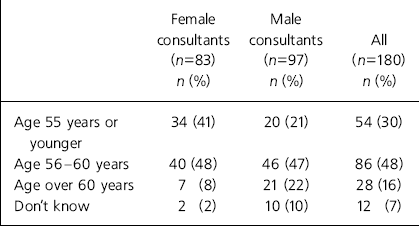
Responses to the question ‘What is your most likely retirement date?’ are shown, in collapsed age bands, in Table 1. Over 90% of working consultants had a proposed retirement date. Excluding the ‘don’t know’ responders, and conducting a 3×2 χ2 comparison of the retirement intention cells in Table 1, female consultants intended to retire significantly earlier than males (χ2=10.8, d.f.=2, P=0.004). A Mann-Whitney comparison of female and male consultants’ proposed retirement ages yielded an identical P value. The mean proposed retirement age of all respondents was 58.0 years (s.d.=2.7), and 45% proposed to retire within the next 10 years (i.e. before 2014).
Most likely age at retirement among consultant psychiatrists working in Scotland
| Female consultants (n=83) n (%) | Male consultants (n=97) n (%) | All (n=180) n (%) | |
|---|---|---|---|
| Age 55 years or younger | 34 (41) | 20 (21) | 54 (30) |
| Age 56-60 years | 40 (48) | 46 (47) | 86 (48) |
| Age over 60 years | 7 (8) | 21 (22) | 28 (16) |
| Don’t know | 2 (2) | 10 (10) | 12 (7) |
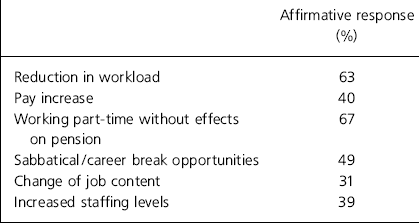
The percentages of consultants responding in the affirmative to factors that might influence them to retire later are given in Table 2. Only 13 respondents (7%) responded negatively to all the suggested inducements, indicating that their retirement date was essentially immutable. In the free text sections, when consultants were asked what changes in their job might induce later retirement, the most common responses were ‘less managerial/administrative work’ (n=25) and ‘having time to develop a special interest’ (n=13). When asked about which staff increases might keep them working longer, the most common responses were more psychiatrists (most stipulated consultants) (n=67), more nurses (n=56), more psychologists (n=45) and more social workers (n=24). When asked if returning after retirement to do locum work was likely, 86 consultants (41% of eligible respondents) replied that it was.
Inducements to retire later
| Affirmative response (%) | |
|---|---|
| Reduction in workload | 63 |
| Pay increase | 40 |
| Working part-time without effects on pension | 67 |
| Sabbatical/career break opportunities | 49 |
| Change of job content | 31 |
| Increased staffing levels | 39 |
Discussion
As part of a larger questionnaire about recruitment and retention, the section on retirement intentions was not extensive. The response rate of 55%, although within the usual range for postal questionnaires, was not high; it is hoped that reasonably generalisable conclusions can be based on the useable responses from 180 consultants. Within these limitations, the survey provides useful data for psychiatric workforce planning in Scotland. The most notable findings were:
-
• the young average age of predicted retirement (58 years);
-
• that 45% predicted retiring within the next 10 years;
-
• that female consultants intended to retire younger than their male counterparts;
-
• that there was a range of factors that might induce later retirement, with only 7% indicating that their retirement date was immutable.
The age of retirement among psychiatrists does mirror more general trends in workforces to retire earlier (Reference Draper, Winfield and LuscombeDraper et al, 1997). The medical workforce may be exhibiting a steeper trend than other employees. Davidson et al (Reference Davidson, Lambert and Goldacre1998, Reference Davidson, Lambert and Parkhouse2001) posed the same questions about retirement to UK medical graduates in two surveys. In 1995, when asked if they intended to work in the National Health Service until normal retirement age, 23% predicted early retirement; in 1998, the corresponding figure was 51%. Posing a similar question to all consultants over age 50 years working in north-west England in 1998, Atherton & Murray (Reference Atherton and Murray2000) found that 49% intended to retire early. French et al (Reference French, Andrew and Awramenko2004) recently reported an average planned retirement age of 60 years among consultants from various specialties in Scotland. The College Research Unit’s survey of consultant psychiatrists, conducted in 2001 (Mears et al, Reference Mears, Kendall and Katona2002, Reference Mears, Kendall and Katona2004), found that the mean planned retirement age was 60 years. Our own survey, conducted only 2 years later, indicated a mean age of 58 years. To enable the data of Mears et al (Reference Mears, Kendall and Katona2002) to be compared with our findings given in Table 1, the percentages of consultants in the Mears study categorised by predicted or actual retirement age were around 20% for retirement age 55 years or less, 45% for age 56-60 years and 35% for age over 60 years. The consultants were aged over 50 years, and thus were to a degree selected as possibly later retirers because they were still working. However, our own data may well suggest an acceleration in early retirement, unless they reflect a specifically Scottish phenomenon.
When consultant workforce planning is based on an anticipated career of 30 years, a 33% retirement rate would be expected over a 10-year period. Our predicted 45% retirement rate during the next 10 years equates to an average consultant career spanning only 22 years. It is unlikely that workforce planners in psychiatry are factoring such a low figure into their equations, with particular implications for consultant staffing during the fairly immediate future.
Although Mears et al (Reference Mears, Kendall and Katona2004) found that female respondents intended to retire earlier than males, other studies have not reported earlier retirement plans among female consultants. However, two large studies which looked at gender differences (Davidson et al, Reference Davidson, Lambert and Goldacre1998, Reference Davidson, Lambert and Parkhouse2001) asked their respondents whether they intended to practise ‘until normal retirement age’. This might have led to male and female respondents interpreting ‘ normal’ retirement ages differently, as more women said they would indeed intend to continue to a ‘normal’ retirement age, which they might have construed as 60 years.
In psychiatry, with our relatively high numbers of female consultants, earlier retirement among women clearly impinges significantly on our workforce. The reasons for this difference may include women wishing to retire early owing to family commitments, wishing to retire contemporaneously with an older spouse, or being less likely to be the principal wage earner, making retirement less financially disadvantageous. One study did find female consultants to be less satisfied with their posts than their male counterparts in child and adolescent psychiatry (Reference Littlewood, Case and GaterLittlewood et al, 2003) and another found female psychiatrists to be more stressed than males (Reference Rathod, Roy and RamsayRathod et al, 2000). These gender differences merit further scrutiny.
It should not be assumed that the decision to retire is a negative reflection upon one’s chosen career. Indeed, the evidence suggests that retirement is beneficial to mental health and well-being, perhaps especially within higher socio-economic groups (Reference Salokangas and JoukamaaSalokangas & Joukamaa, 1991; Reference DrenteaDrentea, 2002; Reference Mein, Martikainen and HemingwayMein et al, 2003). Mears et al (Reference Mears, Kendall and Katona2002, Reference Mears, Kendall and Katona2004) accurately summarised that for each person there will be ‘complex, multidimensional and highly individual’ factors feeding into the decision about retirement age.
The most positive finding in our study, that few consultants had made an immutable decision about retirement, should be viewed against this backdrop. At least one factor may well induce many of us to work for longer, and the 40% of respondents who might be influenced by a pay increase may postpone retirement now that the new consultant contract is in place. There are other common issues which can be tackled centrally, and have emerged as sources of stress and dissatisfaction in other studies, notably excessive bureaucracy and paper-work (Reference Kendell and PearceKendell & Pearce, 1997; Reference Rathod, Roy and RamsayRathod et al, 2000; Reference Davidson, Lambert and ParkhouseDavidson et al, 2001; Mears et al, Reference Mears, Kendall and Katona2002, Reference Mears, Kendall and Katona2004) and the burden of overly demanding workloads (Reference Kendell and PearceKendell & Pearce, 1997; Reference Atherton and MurrayAtherton & Murray, 2000; Reference Davidson, Lambert and ParkhouseDavidson et al, 2001; Mears et al, Reference Mears, Kendall and Katona2002, Reference Mears, Kendall and Katona2004; Reference Pajak, Mears and KendallPajak et al, 2003; Reference French, Andrew and AwramenkoFrench et al, 2004). However, given the ‘highly individual’ factors that give rise to decisions about retirement and the prohibitive costs of employing growing numbers of locum consultants (Reference Mears, Kendall and KatonaMears et al, 2004), it would seem to be a good use of time for managers of psychiatric services across the country to sit down with their more mature consultants and discuss whether and how the latter might be induced to work beyond their currently planned retirement date. The alternative seems likely to comprise a service that is seriously short of consultants, with some of the gaps being filled by expensive retired locums.
Acknowledgements
This project was funded by the Scottish Division of the Royal College of Psychiatrists. The secretarial work was done by Lana Hadden. We are grateful to all respondents.


 Open access


eLetters
No eLetters have been published for this article.