


Introduction
Law and courts scholars are frequently interested in how individual judges’ preferences impact the outcomes of court cases. Most studies that estimate judges’ underlying political inclinations investigate courts in which we observe votes and opinions from each judge, such as the U.S. Supreme Court (Martin and Quinn Reference Martin and Quinn2002; Lauderdale and Clark Reference Lauderdale and Clark2014; Harris and Sen Reference Harris and Sen2019). Many of the world’s courts, however, issue only per curiam judgments – meaning “by the Court” – which conceal judges’ individual votes. Given the complexity of the legal disputes that arrive at high courts, meaningful variation in judges’ preferences likely exists in per curiam settings (e.g., Hangartner, Lauderdale and Spirig Reference Hangartner, Lauderdale and Spirig2025; Wijtvliet and Dyevre Reference Wijtvliet and Dyevre2021), but this variation is often obscured by aggregating preferences into a single judgment.
One such court is the Court of Justice of the European Union (CJEU), which is the high court of the EU and adjudicates cases that are brought forth primarily by member state courts or the European Commission.Footnote 1 Although the CJEU issues its judgments per curiam, the Court’s president assigns one judge-rapporteur (JR) prior to each hearing to write the Court’s judgment. To investigate how much, if at all, the JR may “pull” the Court’s judgment toward their own preferred position, we estimate a convolutional neural network (CNN) that captures how judges’ expressed preferences vary based on the language used in aggregated judgments. First, we estimate each JR’s propensity to express more pro- or anti-EU statements in the judgments that they author (i.e., statements that set precedent that affect member states’ ability to regulate), which is the most prominent dimension of contestation at the CJEU. Then, we leverage the advocate-general’s (AG) opinion that is drafted separately from, and prior to, the Court’s judgment as a comparison point.
This approach allows us to precisely test prior theories that judgments represent a careful balance between individual-level concerns of the judgment-writer and a court overall. For a court, maintaining a consistent jurisprudence helps build public legitimacy (e.g., Hansford and Spriggs II, Reference Hansford and Spriggs2006; Zink, Spriggs II and Scott, Reference Zink, Spriggs and Scott2009), and it is costly for a court to not rule against a government in cases in which the legal grounds warrant it. Conversely, in cases in which the threat of government noncompliance is high, a judgment has direct implications for the efficacy of the institution itself (Staton and Vanberg Reference Staton and Vanberg2008). These considerations lead judges to be more cautious in crafting their ruling. Therefore, we theorize that the ability of a JR to pull the judgment toward their preferred position should be hampered by threats of noncompliance and their relative voting power on the panel (i.e., the number of other judges present on a panel).
The empirical results provide mixed evidence for our theoretically motivated hypotheses. First, we do not find that the number of judges on a panel impacts whether a judgment is more or less pro-EU relative to other judgments the JR has authored. Nonetheless, as the number of judges increases on a panel, all else equal, the judgment is more likely to deviate from the AG’s position. Further, as government noncompliance with the AG’s proposed case outcome becomes more likely (in the sense that more member states submit observations against it), the Court will provide more flexibility to the government in implementing its ruling by taking a more anti-EU position.
In sum, our unique measurement of variation in judgments and AGs’ opinions allows us to empirically assess how apex courts resolve disputes while taking into account government threats of noncompliance. The evidence is largely consistent with previous theories that a court can deal with this challenge by altering what it means for a government to comply with a decision. As such, it is important to account for these competing interests in judicial decision-making; the preferences of a judgment-writer coupled with the institutional interests of a court.
Judgment-writing in per curiam courts and the CJEU
The practice of per curiam judgments traces its lineage to the civil law tradition and its emphasis on the certainty of the law. In other words, “the judge’s function is merely to find the right legislative provision, couple it with the fact situation, and bless the solution that is more or less automatically produced from the union” (Merryman and Pérez-Perdomo, Reference Merryman and Pérez-Perdomo2019, 36). In an effort to maintain this ideal of legal certainty, civil law courts frequently publish their judgments per curiam because publishing dissenting votes and opinions would serve to undermine this certainty.
Despite this obfuscation of judges’ positions, other institutional features of per curiam courts may provide insight into how the judges hearing a case may affect the outcome. One such feature is a court’s assignment of the judge-rapporteur (JR) for a case, which is the publicly identified judge responsible for writing the court’s judgment. In preparation for writing the judgment, the JR collects relevant materials and information regarding the case and presents a preliminary judgment as the basis for starting the deliberative process with the other judges on a panel. As Kelemen (Reference Kelemen2017, 43) describes, the JR’s position “has a greater weight in the eyes of the other judges […] [T]he rapporteur holds a near monopoly over knowledge of facts and other materials concerning the case, including the competing arguments, so the other judges may be left at an informational disadvantage.” The JR, as a result, holds a powerful agenda-setting function that may have an outsized influence over the outcome of a case relative to the other judges. Indeed, scholars have leveraged the role of the JR to provide insight into the decision-making processes of per curiam courts. For example, evidence exists that the JR’s expressed preferencesFootnote 2 predict case outcomes at a number of courts, including the CJEU, the Spanish Supreme Court, and the Italian Constitutional Court (e.g., Cheruvu, Reference Cheruvu2019; Garoupa, Gili and Gómez-Pomar, Reference Garoupa, Gili and Gómez-Pomar2012; Pellegrina and Garoupa, Reference Pellegrina and Garoupa2013).
One attempt to examine across-judgment variation of judges’ preferences in the CJEU comes from Frankenreiter (Reference Frankenreiter2017), which utilizes differences in JR and AG citation behavior in cases to evaluate whether the preferences of their appointing governments affect the cases that JRs cite in their judgments. Unfortunately, this strategy only registers a difference between AG opinions and judgments if a citation is excluded, but cannot account for the context in which a judgment is cited. For instance, a citation may be included in a final judgment, but the citation may be negative (Lindholm, Naurin and Schroeder, Reference Lindholm, Naurin and Schroeder2025).Footnote 3 Critical contextual information, thus, is omitted in this measurement of latent preferences if we only summarize citation patterns.
We build upon these previous efforts to test theories of judicial behavior in per curiam using the CJEU, which is a substantively and empirically useful setting for a number of reasons. Substantively, the CJEU is the high court of the European Union and the subject of extensive international scholarship (e.g., Alter, Reference Alter2001; Stone Sweet and Brunell, Reference Alec and Brunell1998). It has a set of internal procedures similar to those of other high courts, making our findings potentially more generalizable. In particular, the CJEU only issues per curiam judgments like other continental European courts, including Belgium, France, Italy, Luxembourg, and Malta, among others (Raffaelli, Reference Raffaelli2014).
Empirically, given the CJEU’s substantive importance as an international court of consequence, scholars have already hand-coded the dispositions of CJEU judgments, as well as AG opinions, to evaluate whether the Court’s decision-making is affected by threats of legislative override (e.g., Carrubba and Gabel, Reference Carrubba and Gabel2015). We take advantage of one such effort by Larsson and Naurin (Reference Larsson and Naurin2016), which we refer to as L-N, to uncover differences in public position taking by judgment authors. These data, which are made available through the IUROPA CJEU database (Brekke et al., Reference Brekke, Fjelstul, Hermansen and Naurin2023), allow us to empirically explore previously untested theoretical implications of CJEU decision-making.
Critical to our theory of judgment writing on per curiam courts are the procedures by which the CJEU processes cases. Each member state appoints one judge to the CJEU. During the preliminary reference cases available in L-N between 1997 and 2008, the total number of judges on the Court ranged from 15 to 27 due to the EU enlargements in 2004 and 2007. Moreover, the judges are each members of a chamber of three or five judges subject to periodic rotation. They hear the majority of cases within these chambers and, on occasion, hear cases in larger formations of the Court, such as the Grand Chamber (ranging between nine and thirteen judges) and as a full court. The judges very rarely hear cases as a full court.
When a case arrives at the CJEU, the Court’s president – elected by the judges for a three-year term – designates a JR for the case. At the same time, the First Advocate General – elected by the Court’s AGs to a three-year term – designates an AG for the case. The number of AGs on the Court ranged from eight to eleven during this time period. The JR must then write a preliminary report for the case for the Court, which is not made publicly available. The other judges can subsequently vote to have the case decided by a larger formation of the Court or by only those in the JR’s chamber (Brekke et al. Reference Brekke, Fjelstul, Hermansen and Naurin2023). Following this vote, the AG writes an opinion for the case.Footnote 4
Notably, the AG drafts their opinion separately from the judges sitting on the case. The AG does not deliberate with the judges when writing their opinion, nor does the AG have a vote in determining the final outcome of a case. After the AG writes the opinion, which is the first public document produced by the Court regarding the case, the AG reads their opinion in open court to the judges, marking the end of their formal involvement in the case.Footnote 5 The AG’s opinion, thus, informs the judges’ deliberations.
There are multiple factors that may affect how AGs write their opinions. Personal, ideological, or institutional circumstances may influence the drafting of AG opinions. The selection of the AG itself for a particular case may introduce bias into the broader judicial decision-making process. While previous scholarship argues that the AG’s opinion serves as a case’s legal merits (Carrubba and Gabel Reference Carrubba and Gabel2015; Larsson and Naurin Reference Larsson and Naurin2016), we do not rely on such an assumption. Instead, we are interested in when JRs can exert influence to pull a judgment toward their favored position and away from the easier – and commonly resorted to – alternative of agreeing with the AG’s opinion. As such, while strategic selection may affect which AG sits on a given case, we should still observe specific instances when JRs can leverage their agenda-setting power as the judgment-writer to affect the final content of the Court’s ruling to better reflect their preferences.Footnote 6 In other words, though there are differences in AGs’ style, preferences, and background, the standardized procedure through which AG opinions are generated follows identical protocols (i.e., independent drafting, public reading of the pre-deliberation), which ensures a structural comparability that allows us to estimate within-case differences between the AG and the final judgment.
For example, although the JR may not always be pivotal to determine the disposition of a case, they have control over the content of the judgment. While the other judges may ask the JR to amend the judgment to better reflect the preferences of the majority, it is costly for judges to take time away from other cases on which they themselves serve as the JR given the substantial workload at the CJEU (e.g., Bielen et al., Reference Bielen, Marneffe, Grajzl and Dimitrova-Grajzl2018; Roussey and Soubeyran, Reference Roussey and Soubeyran2018). Furthermore, given the tradition of dissent aversion on civil law courts, judges are more likely to be deferential to the rapporteur.Footnote 7
In addition to the preferences of the AG and the JR, other characteristics such as the composition of the Court and the context of the case may also impact the judgment of the Court. First, the number of judges hearing a case may affect the content of the Court’s judgment (Cheruvu and Krehbiel, Reference Cheruvu and Krehbiel2022). As the number of judges hearing a case increases, the amount of influence any one judge has over the outcome of the case should decrease. Subsequently, the JR in a case that the Court’s petit-plenum hears (e.g., 13 judges) should have less control over the judgment’s text in comparison to a JR in a case that is heard in chambers (i.e., the judgment should not “drift” from the overall court’s preferences toward the preferences of the JR). From this logic, our first hypothesis is:
Hypothesis 1. As the number of judges on a panel decreases, the judgment’s drift toward the JR’s overall expressed preferences increases.
A second related implication of our argument pertains to the likelihood of the Court to drift from the AG’s opinion. Cases of higher salience with more difficult or contentious legal questions are generally heard by larger panels of judges at the CJEU (Kelemen, Reference Kelemen2012; Brekke et al., Reference Brekke, Fjelstul, Hermansen and Naurin2023). Given the diversity of legal traditions, ideology, and experience on the Court, the final ruling must accommodate a wider range of preferences as more judges are involved in a case. Indeed, existing scholarship provides evidence that the interests of individual judges serving on a panel, even when not serving as the JR, may affect outcomes at the Court (Wijtvliet and Dyevre Reference Wijtvliet and Dyevre2021; Cheruvu Reference Cheruvu2024). As such, it is likely that a larger panel of judges presiding over a case of legal significance may likely have divergent sentiments from the AG.
Hypothesis 2. As the number of judges on a panel increases, the judgment’s drift away from the AG’s opinion increases.
Another factor that influences the content of judgments is the threat of noncompliance and legislative override. A substantial scholarship analyzes how courts adjust their decision-making when they are unsure whether a government will comply with their ruling (e.g., Vanberg, Reference Vanberg2015). Many such studies only rely on binary pro-/anti-government decisions, which cannot distinguish variation in decisions that constrain behavior on its face while providing substantial leeway in implementation (e.g., Staton and Vanberg, Reference Staton and Vanberg2008; Staton and Romero, Reference Staton and Romero2019). At the CJEU, scholars have demonstrated that a decision is more likely to be contrary to the AG’s preferences as the number of member state observations ( amici curiae briefs) against the AG’s position increases (Carrubba, Gabel and Hankla Reference Carrubba, Gabel and Hankla2008; Larsson and Naurin Reference Larsson and Naurin2016). We expect that a similar relationship should hold with regard to the content of the CJEU’s written judgments.
Hypothesis 3. As the number of member state observations against the AG’s position increases, the judgment’s drift away from the AG’s position increases.
An implicit assumption of Hypothesis 3 is that judges believe that noncompliance can hurt a court institutionally. As an institution that lacks the power of the purse or the sword, courts are frequently dependent on citizens’ willingness to enforce their decisions against a reluctant government (e.g., Gibson, Caldeira and Baird, Reference Gibson, Caldeira and Baird1998). Overt noncompliance by a government can detrimentally affect citizens’ beliefs that a court’s decisions should be followed, and subsequently, affect whether a government will follow a court’s decisions in the future (e.g., Carrubba, Reference Carrubba2009).
Such strategic decision-making to avoid noncompliance requires judges to place their value for the institution above their own personal ideology or other factors that may affect their decision-making. We argue that larger panels should be more likely to prioritize such strategic decision-making, as they are more likely to include institution-focused judges. This argument comports with the finding that smaller panels are less likely to rule against the AG’s position when the balance of government observations is against the AG’s position (Cheruvu and Krehbiel Reference Cheruvu and Krehbiel2022).
Hypothesis 4. As the number of member state observations against the AG’s position increases, the judgment’s drift away from the AG’s position increases with more judges on a panel.
In total, we anticipate that panel size will inhibit individual rapporteurs from shifting judgments toward their own preferences and pull the judgment away from the preferences of the AG. We also expect that the Court will have greater perceived authority to deviate from the AG’s position when there is a stronger signal of opposition from member states. This threat of noncompliance, and thus drift away from the AG’s position, is likely to be stronger among larger panels. To test these theoretical implications, we create a more fine-grained measure of judicial preferences from the text of the Court’s judgments and the AG’s opinions.
Measuring expressed preferences in CJEU decisions
Consider, for example, a JR who is assigned to write the judgment for a case in which they were not in the majority. Since judges cannot differentiate themselves publicly by voting, nor by writing a dissent, the JR may alter their opinion so the judgment is more in line with their underlying preferences. Because we cannot know an opinion writer’s concealed inclinations, our central aim is to apply an appropriate methodological tool to quantify the expressed preference of opinion writers, specifically along the primary dimension of contestation at the CJEU (i.e., pro-/anti-EU).
Though we cannot reliably perform this task systematically at scale by hand with humans, we can uncover subtle patterns in text by estimating a deep convolutional neural network (CNN). A CNN is a supervised learning algorithm that trains a model of JR and AG opinions along a binary pro- and anti-EU dimension provided by human coders from L-N. This allows us to establish a standardized comparison of the JR’s position to the AG’s opinion within each case, as well as the JR’s position to their average stance from other judgments that they author.
Broadly speaking, the CNN begins by taking words that we know appear in cases that express either pro-/anti-EU positions overall based on the L-N data. Then, the algorithm identifies other words that are related to these concepts across JR and AG texts. By extracting salient words that are indicative of pro-/anti-EU statements, we can classify entire opinions along this same dimension of interest. We then use the model’s output to extrapolate how these relationships in writing patterns from judgments and AG opinions are associated with characteristics of each case, such as panel composition or outside legal pressure.
A major benefit of using a CNN is that, when paired with word embeddings, we can effectively address two methodological hurdles that we are faced with: understanding what words are connected to each other, and estimating what words constitute a more pro- or anti-EU stance to a human audience. First, we use word embeddings to represent the underlying meaning between words in a multi-dimensional space. Simply put, words with a similar meaning have close or overlapping distributions (Rodriguez and Spirling Reference Rodriguez and Spirling2022). This approach allows us to go beyond direct word matches because authors often express opinions in divergent language.
Second, we extract salient words using a CNN that discriminates which words help us classify opinions.Footnote 8 One drawback of the CNN is that we cannot precisely identify which specific words correspond to more pro- or anti-EU sentiments; we only receive an estimated overall position for each text we provide the algorithm. However, the primary benefit of the CNN is that we can translate these estimated word associations that are generated from the extensive corpus of JR and AG opinions into a predictive output (bounded between zero and one) along our latent dimension of interest (pro-/anti-EU). We can, therefore, interpret both JR and AG statements as being more or less pro-EU using comparable probabilities, and, most importantly, with estimates of uncertainty.
The first step of the CNN is to quantify semantic meaning between words that appear across documents. Word embeddings represent text as a dense (i.e., not sparse with many zeroes and ones) vector of real numbers. So, each unique word corresponds to a unique integer (e.g., “règlement” = 37). The dimensions of our initial word embedding matrix correspond to the number of words in our corpus by the number of dimensions we wish to compare across (also known as embedding dimensions).
There are two important decisions for us to make: the number of embedding dimensions and the corpus on which we train our word associations. The number of embedding dimensions is the length of each vector in the corpus that we want to “embed.” We use 300 embedding dimensions in the analysis, which is recommended for a large corpus (Patel and Bhattacharyya Reference Patel and Bhattacharyya2017), but this decision is frequently based on researchers’ computing resources, the complexity of their learning task, and the quantity of training examples.Footnote 9 Second, we rely on pre-trained embeddings (specifically the word2vec algorithm) that are generated from millions of documents to represent the word associations. We specifically select the word2vec embedding representation trained on French Wikipedia given that CJEU judgments and opinions are written in French (Ovádek Reference Ovádek2024) and use more technical language than everyday conversation that is found in other pre-trained embeddings from online social media.
Once we have assembled our word embeddings, we need to translate those numerical word associations into estimates of which words are related to more pro- or anti-EU statements. To do this, we rely on a feed-forward CNN that starts with features, which for our purposes are words from opinions, and produces predictions along a latent space by estimating a multivariate linear model. More specifically, we reduce the association between words and pro-/anti-EU classification to a constrained probability space between zero and one by “feeding” those relationships of words through a series of activation functions, such as an inverse logit because our outcome is binary.
To reduce our input matrix of words to a single numerical output for each case, the first step of this process is to reduce the dimensionality of the data through two (hence deep) convolution layers. In each “convolution” or training round, we take only the most informative language from cases, which is known as max pooling (i.e., the words that best predict the case outcome from the L-N data). One convolution and one pooling layer constitute one cycle of our training procedure. We then complete this cycle again by updating the input weights we use in our second convolution layer from the first convolution layer to reduce the words we need to make an accurate prediction (also known as back propagation). Finally, after our second reduction stage that includes a convolution layer and a global max pooling layer (e.g., the most informative words from both convolutions), we can connect the initial words we begin with to the latent pro-/anti-EU dimension for each JR and AG opinion. This final step is also known as a dense layer.
A major concern with using neural networks is that we may overfit our model to our data, especially on a relatively small or topic-specific dataset. We could try to solve this issue by fitting all possible neural networks on the same dataset and averaging the predictions from each model (i.e., ensemble approximation), but it requires large amounts of computing power and storage. Alternatively, we randomly dropout a pre-determined percent of observations before each output layer, which varies the influence a given judgment or opinion (node) has through Monte Carlo sampling (Srivastava et al. Reference Srivastava, Hinton, Krizhevsky, Sutskever and Salakhutdinov2014). More importantly, this approach allows us to calculate the sampling distribution of our point estimate (e.g., the predicted position of an individual text) through a posterior distribution approximating Bayesian inference (Gal and Ghahramani Reference Gal and Ghahramani2016).
In essence, by using dropout layers, we can (1) reduce the likelihood our model captures trends in our sample rather than the population of text, and (2) generate bounds of uncertainty for each text, case, and actor (JR and AG) so that we can determine how precise our estimates are. This second point is incredibly important for us to determine whether a position is truly moderate along the pro-/anti-EU dimension, or whether a text is imprecisely estimated because the author uses language that is not indicative of the latent dimension. With our model architecture prepared, we need to prepare the text from our sample of judgments and AG opinions.
Organizing, cleaning, and training judgments and opinions
To form our sample of CJEU judgments and opinions, we match the texts for each JR-written judgment and AG opinion (Fjelstul et al. Reference Fjelstul, Lindholm, Naurin and Ovádek2023) with data on whether the judgments and opinions were perceived as pro- or anti-EU by human coders (Larsson and Naurin Reference Larsson and Naurin2016). The data from L-N include 84% of the preliminary reference cases sent to the CJEU from 1997 to 2008. Each case is coded by each legal issue that was raised. For each legal issue in a case, the judgment is hand-coded as favoring “more Europe” (pro-EU), the preservation of national sovereignty (anti-EU), or neither, as well as whether the AG opinion suggested a pro-EU or anti-EU ruling prior to the Court’s judgment. L-N additionally code the positions of member states (pro- or anti-EU) as revealed by their observations, or amicus curiae briefs, submitted to the Court.
While the data only span 11 years, which potentially limits our ability to generalize our findings, the Court has not since undergone significant changes to its composition or the institutional environment it operates in. As such, the major features we are interested in remain constant. That is, the JR consistently has a substantial amount of agenda-setting control in determining how a judgment is written. Moreover, the institutional considerations that impact JR’s judgments remain, such as panel size and threats of government noncompliance. We, thus, expect that any drift we detect in these data should be reflective of JR’s influence during the judgment-writing process more generally and should not only be emblematic of writing patterns during this specific time period.
In anticipation of estimating our CNN, we need to clean the text of judgments and opinions. An advantage of using the Fjelstul et al. data is that each written document is already broken into manageable segments, specifically paragraphs. We keep the written documents at the paragraph level for a number of technical and theoretical reasons.
First, though our overall goal is to generate estimates of expressed preferences at the case level, we prefer to construct the CNN at the level in which the legal or rhetorical signal is localized. The paragraphs from the Fjelstul et al. data already align with argumentative units that discuss specific legal provisions, which often span multiple sections. If we were to estimate a CNN at the document level directly, we would receive only one prediction for the whole opinion, even if some portions are more pro-EU while others are anti-EU. In general, section or document level models may perform better when whole sections or the entire document have one fairly uniform stance, and if the portions are short and internally homogeneous because neural models struggle with very long texts. Unfortunately, JR and AG opinions are often quite long and frequently do not take unambiguous stances even within a section.
Second, our hypotheses concern how judge-rapporteurs adjust their writing style across cases and relative to AG opinions, not only precedent valence. Paragraph level granularity captures this expressive variation, which aggregation at the case, issue, or operative level would obscure. While the holdings of a case often appear succinctly in the operative part of judgments, which we may be able to capture by isolating paragraphs that belong to specific issue areas (Schroeder and Lindholm Reference Schroeder and Lindholm2023), our measurement strategy targets expressed preferences through reasoning language, not only the disposition itself.
Next, given the extensive length and number of texts we have, we follow common procedures that reduce the number of words in our corpus further to those that appear most frequently. From the existing documents that are segmented by paragraph, we identify and keep only the most frequently used 5,000 words from the unique 113,593 words (tokens) in our corpus. We then replace words with their unique integers (token indices) that are the by-product of the pre-trained word embeddings. At this stage, for each case, we have trimmed and transformed the text such that each row of our input matrix is one paragraph from one written document and each column represents a word using an integer. Finally, since each paragraph has a different number of words, we need to consider reducing all paragraphs to a common size and increase, or pad, the row length for shorter opinions with zeros. We cap opinions at 500 words, shortening only 23 of 343,660 paragraphs.
Once we have cleaned and organized the text of JR judgments and AG opinions, we develop a training set to estimate, for each paragraph, whether the content is pro- or anti-EU. Conceptually, a paragraph is “pro-/anti-EU” to the extent that it employs language patterns that are statistically associated (calibrated via word embeddings and CNN feature extraction) with pro-/anti-EU outcomes across the full L-N coded corpus. For example, operative language may be neutral (“The Court rules that…”), while reasoning paragraphs reveal whether the JR frames precedent as sovereignty-preserving (anti-EU) or integrationist (pro-EU). This distinction matters theoretically because the JR’s writing becomes the observable trace of preference influence.
For our training set, we must use text in which there is a clear preference expressed, and since we do not isolate which parts of the opinion align with each legal issue, we use only text from cases in which all legal issues were either pro- or anti-EU. As such, our training set includes all cases in which there was no disagreement among a single actor, JR or AG, such that we can say that the actor was pro- or anti-EU in all of the legal issues within that case. For example, if there were three legal issues coded in a case, and the JR expressed continuity across the three issues (took either exclusively pro- or anti-EU stances), we include that case in the training set. Of the 1,599 cases in the dataset, 705 record only one issue of contestation. From the remaining 894 cases, 390 have multiple legal issues that had contrary stances on the EU by the CJEU and 355 by the AG. This means that we set aside approximately 25% of our cases and 29% of coded issues as a test set to ensure that our out-of-sample accuracy is high and not dependent on model choice.
With our CNN estimated, how do we make sense of the output? Remember that we explicitly induce a pro-/anti-EU dimension because the outcome variable is binary, indicating whether the opinion uses similar language to opinions that we know should be pro- or anti-EU based on the human coders from L-N. Therefore, for our final output, we aggregate the paragraph predicted probabilities to measure the average public position-taking on a pro-/anti-EU dimension for the JR and AG in each case. By taking this approach, we can estimate (1) how close the JR’s judgment matches the AG’s opinion along a pro-/anti-EU dimension for each case, as well as across AGs and JRs, and (2) bounds of uncertainty around our predictions (95% credible intervals). From the predictions of our CNN, we can construct and estimate our regression model of how institutional constraints are associated with more or less author drift.
Do fewer constraints lead to greater author drift?
We create our first outcome measure of author drift by taking the absolute difference between the average JR and AG position within each case. Unfortunately, this measure does not give any sense of position with regard to a text being more pro- or anti-EU, which is important if we want to make a claim about the directionality of drift from the AG or the underlying average preferences of the JR. As such, we also take the difference between the mean AG and JR position within each case (e.g., a negative value indicates that the JR takes a more anti-EU position than the AG), as well as the average JR stance in other judgments they author.
The primary predictors of author drift in judgments based on our theory are the number of (1) judges on the panel, and (2) member state observations against the AG’s position. We gather these measures from the existing dataset from L-N. Some cases did not record member state observations or panel size, so our total number of data points in our analysis includes 1,399 cases. We estimate an ordinary least squares (OLS) regression as a base model in which there is an additive relationship between the number of judges on the panel, member state observations, and our outcome (judgment drift).
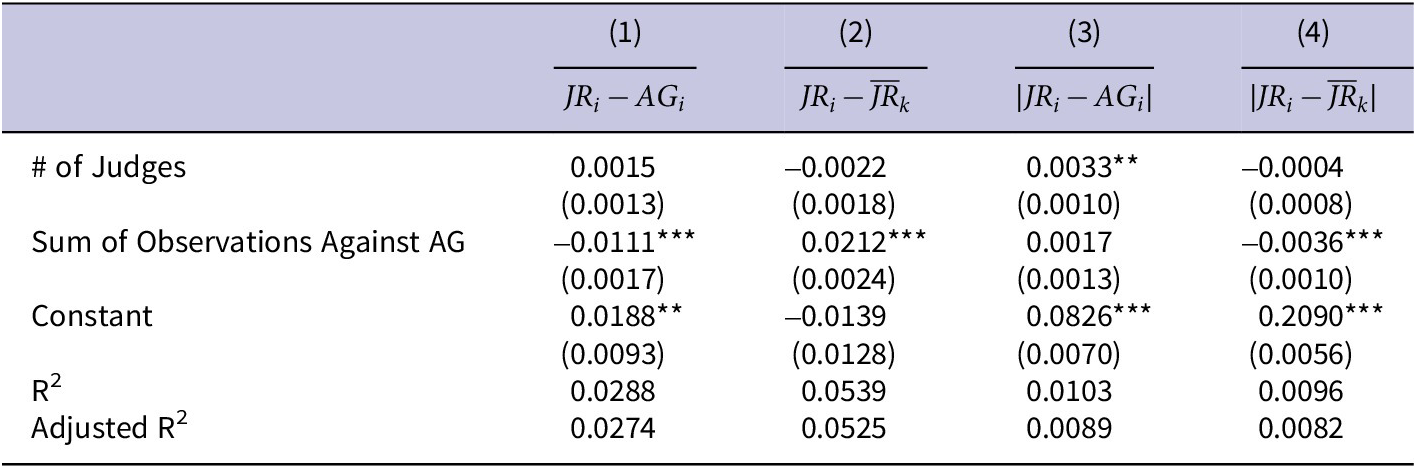
The results of our additive models displayed in Table 1 provide confirmatory evidence for Hypothesis 2 that when there are more judges on the panel there is greater absolute drift away from the AG. Column 3 in Table 1 shows that the drift between the judgment and the AG’s position increases as the number of judges on the panel increases, on average. For example, going from the smallest panel size to the largest panel size (3 to 15), holding the number of observations against the AG constant at the empirically observed mean (approximately 1.4), increases the predicted absolute difference between the judgment and the AG’s position by 0.039 (95% CI = [0.016, 0.063]). To put this in context, the average absolute difference between the judgment and the AG’s position within a given case is 0.105, so such a shift is substantively meaningful (nearly 40% of average within-case distance between the judgment and AG positions). Column 1 of Table 1 shows that the direction of the drift is not different from zero (i.e., not specifically in a pro- or anti-EU direction).
Estimated Association of Case Factors with (1) Within-case i Drift of JR from AG and (2) Within-rapporteur Drift between Case i and Rapporteur k Average

Table 1. Long description
The table has four columns labeled by outcome variables: Column 1 is J R sub i minus A G sub i, Column 2 is J R sub i minus J R bar sub k, Column 3 is the absolute value of J R sub i minus A G sub i, and Column 4 is the absolute value of J R sub i minus J R bar sub k. The rows, from top to bottom, are number of judges, sum of observations against A G, constant, R squared, and adjusted R squared. For each variable, the coefficient is listed, followed by its standard error in parentheses. Statistical significance is marked by asterisks: three for p less than 0.001, two for p less than 0.01, one for p less than 0.05. In Column 1, number of judges has a coefficient of 0.0015 with standard error 0.0013, sum of observations against A G is negative 0.0111 with three asterisks and standard error 0.0017, constant is 0.0188 with two asterisks and standard error 0.0093, R squared is 0.0288, adjusted R squared is 0.0274. In Column 2, number of judges is negative 0.0022 with standard error 0.0018, sum of observations against A G is 0.0212 with three asterisks and standard error 0.0024, constant is negative 0.0139 with standard error 0.0128, R squared is 0.0539, adjusted R squared is 0.0525. In Column 3, number of judges is 0.0033 with two asterisks and standard error 0.0010, sum of observations against A G is 0.0017 with standard error 0.0013, constant is 0.0826 with three asterisks and standard error 0.0070, R squared is 0.0103, adjusted R squared is 0.0089. In Column 4, number of judges is negative 0.0004 with standard error 0.0008, sum of observations against A G is negative 0.0036 with three asterisks and standard error 0.0010, constant is 0.2090 with three asterisks and standard error 0.0056, R squared is 0.0096, adjusted R squared is 0.0082. All models have N equals 1,399. Standard errors are in parentheses. The note explains the meaning of each outcome variable and the significance levels.
Note: The outcome of the first regression model in Column 1 is the directional difference between the JR’s and AG’s positions within case i. We then take the absolute value between the judgment and the AG’s position as the output variable in Column 3. The outcome in Column 2 is the directional difference between the position of the judgment and the overall average position of all other judgments this JRk has authored. N=1,399 for all models. Standard errors are shown in parentheses and statistical significance is indicated as *** p < 0.001; ** p < 0.01; * p < 0.05.
Conversely, we do not find evidence in favor of Hypothesis 1; as the number of judges on the panel decreases, a given judgment does not shift toward the JR’s expressed preferences. Columns 2 and 4 in Table 1 highlight that as the number of judges on a panel increases neither the absolute nor the directional difference between the position of the judgment and the JR’s overall mean position is reduced. In other words, there is not a statistically non-zero linear relationship between the number of judges on the panel and the magnitude or directionality of the difference between a judgment and a JR’s average position. Simply put, we do not find evidence that having more judges on a panel impacts whether a given judgment is closer to the JR’s overall position in other judgments that they have authored, rather only how close that judgment is to the AG’s position (i.e., the judgment tends to be further away from the AG position as the number of judges increases on a panel).
Table 1 also substantiates Hypothesis 3 that as the number of member state observations contrary to the AG’s position increases, the drift between the judgment and the AG’s position increases. Interestingly, Column 1 in Table 1 demonstrates that as the number of member states who have a differing position to the AG increases by one, the drift between the judgment and the AG’s position in the case increases by 0.0111, on average, in a more anti-EU direction. However, this relationship does not operate in both directions; a greater number of member state observations does not increase the absolute distance between the judgment and the AG position (Column 3 of Table 1).
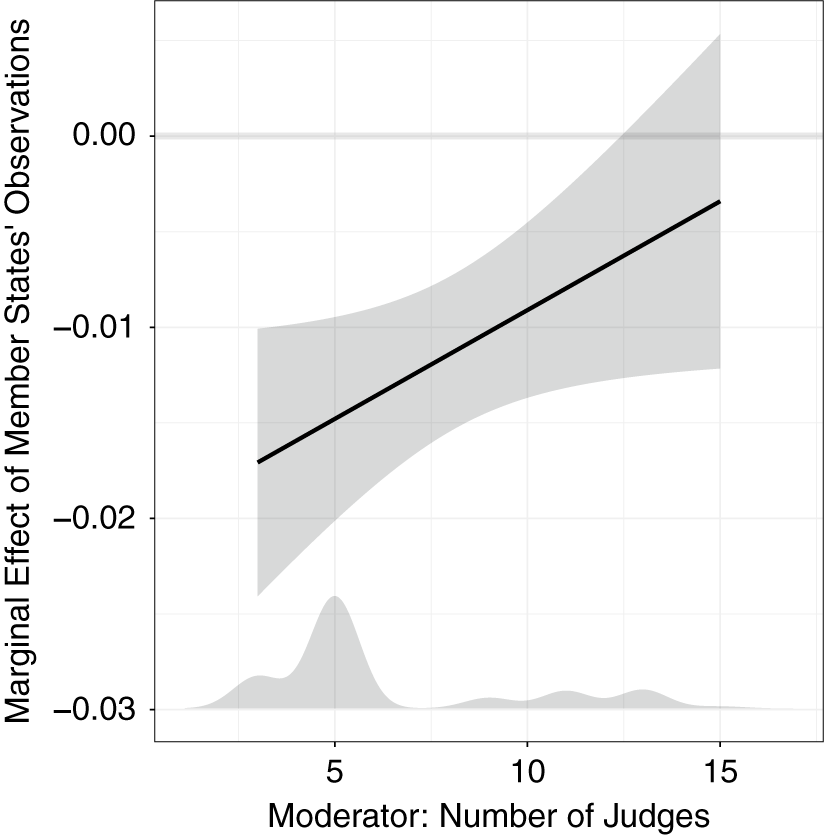
Finally, Figure 1 tests our fourth hypothesis that there is potentially a non-additive (interactive) effect of member states’ observations against the AG’s position based on the number of judges on the panel. We can see in Figure 1 that there is a negative overall marginal effect of member states’ observations on the difference of the judgment from the AG’s position. This confirms our original finding from Column 1 of Table 1; in general, when there are more member states that disagree with the AG’s position, the judgment is more likely to be anti-EU (i.e., a negative directional difference between the JRi and AGi). However, though the marginal effect of member states’ observations does not significantly vary by panel size, Figure 1 shows the relationship may be increasingly positive indicating that the anti-EU impact of member states’ observations may be lessened as panel size increases, which contradicts our hypothesis.
Marginal effect of member states’ observations on direction of drift from the AG’s position varying panel size.
Note: 95% confidence intervals are displayed in light gray ribbons, and the observed frequency density of the moderator is shown along the x-axis. The full table of estimated coefficients can be found in the Supplemental Information.

Figure 1. Long description
Starting from the x-axis labeled Moderator: Number of Judges, values range from approximately 2 to 17. The y-axis, labeled Marginal Effect of Member States’ Observations, ranges from negative 0.03 to 0.00. A black line rises linearly from left to right, indicating increasing marginal effect with more judges. Surrounding the line is a light gray ribbon representing the 95 percent confidence interval, which widens at higher judge counts. Below the x-axis, a light gray density plot shows observed frequency, peaking near 5 judges and tapering off toward higher values. No additional data points or annotations are present.
Notably, our results across the various specifications only explain a small amount of the variation in author drift, as the R-squared values suggest. Given the substantial scholarship on the range of factors influencing case outcomes at the CJEU, such as ideology (Wijtvliet and Dyevre, Reference Wijtvliet and Dyevre2021; Cheruvu, Reference Cheruvu2024), appointing member state bias (Cheruvu Reference Cheruvu2025), and legal tradition (Zhang, Liu and Garoupa, Reference Zhang, Liu and Garoupa2018), it stands to reason that our institutionally related predictors are but only a few of the variables that influence the content of the text of judgments at the CJEU.
Taken together, our results indicate that judgments are likely to drift away from the AG’s opinion when there are more judges on a panel. Moreover, as member states submit observations to the Court opposing the AG’s position, the Court is more likely to side with member states in an anti-EU direction. Finally, the impact of member state observations does not appear to be magnified in cases in which a large panel of judges is sitting. To further demonstrate the insights from our empirical results, we explore a single case that received attention because the AG and the Court publicly differed along the pro-/anti-EU dimension.
Example case: Tanja Kreil v Bundesrepublik Deutschland
Tanja Kreil v Bundesrepublik Deutschland (Case C-285/98) was a sex-discrimination case against the German armed forces (Bundeswehr) with regard to the Council of the European Union Equal Treatment Directive (76/207/EEC). The case concerned the Bundeswehr’s rejection of Kreil’s application for a position in electronic weapons maintenance due to a German law prohibiting women from serving in military roles that involve handling weapons. Germany, Italy, and the UK sent observations in this case supporting an anti-EU position, while the AG supported a pro-EU position.
Although the CJEU also technically issued a pro-EU judgment (as coded in L-N), it considerably deviates from the AG’s substantive opinion. For instance, the Court only included 33% of the references from the AG’s opinion in its final judgment. Notably, the Court excluded references in the AG’s opinion to its past case law in its judgment. If the Court were to include these references, it would not provide the German legislature much flexibility over implementing its ruling.
Specifically, the AG’s recommendation is exact, directly referencing clauses in German legislation to assert that excluding women from a “combat unit” of the armed forces violates EU law. It also cites the CJEU’s judgment in a previous case (C-1/95) that explicitly references Article 3(1) of Council Directive 76/207/EEC.Footnote 10 Instead of pointing to particular clauses, the CJEU’s judgment broadly references “German law” and identifies only the “general exclusion of women from military posts involving the use of arms” as contravening EU law. It also excludes the reference from Case C-1/95. This ambiguous phrasing provides the German legislature with more flexibility, potentially allowing some laws that restrict women from certain combat units. The Court, thus, strategically broadened the interpretation of its ruling by excluding a reference to case law that would have made almost any restriction on women’s service in the Bundeswehr incompatible with EU law (Cheruvu Reference Cheruvu2021).
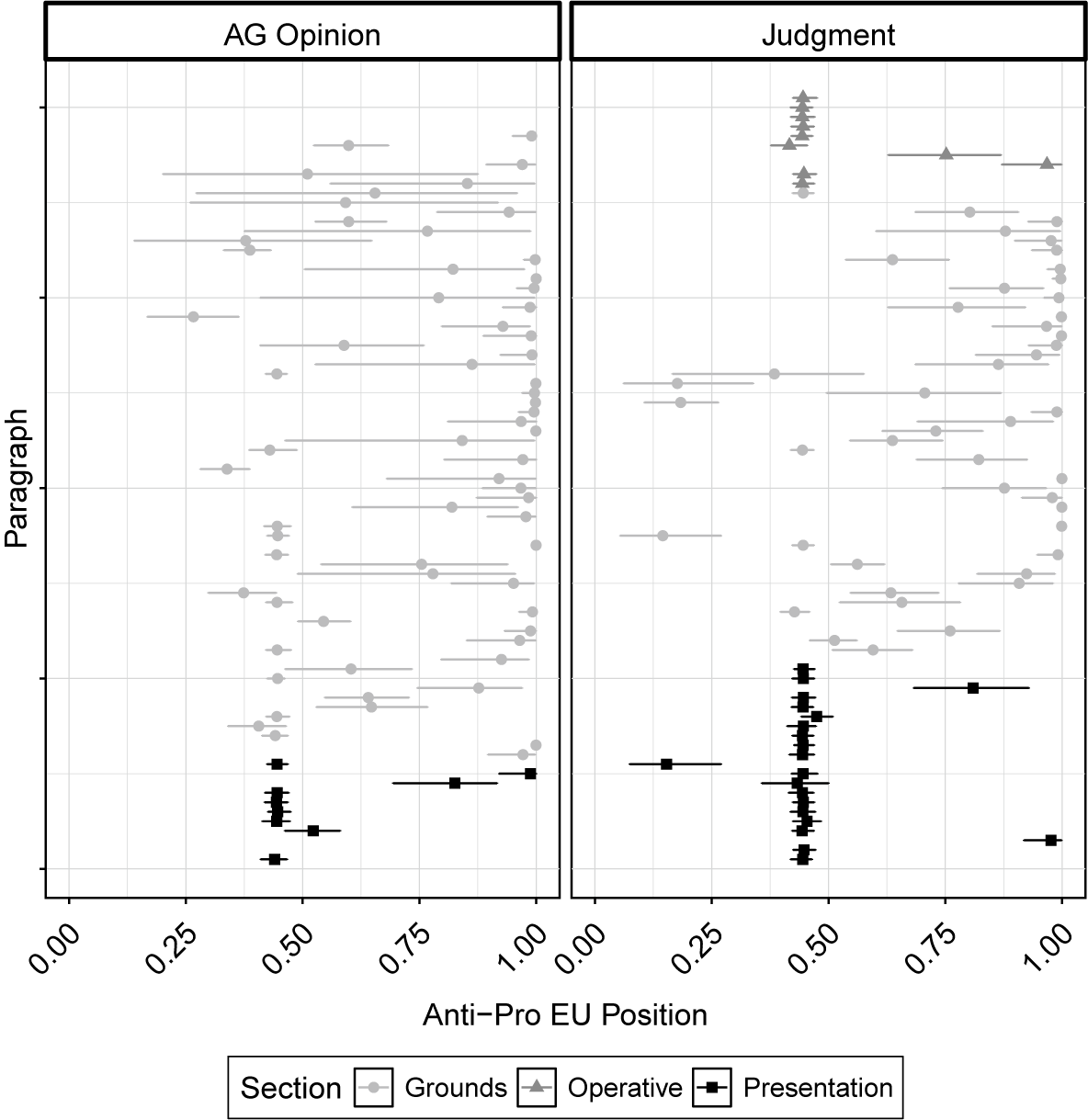
We can detect these divergent expressed preferences with our methodology. To start, for each paragraph, we take 100 draws from the CNN posterior distribution, which allows us to generate a mean predicted position and 95% credible intervals by paragraph. Figure 2 displays the mean predicted value of each paragraph from the AG opinion and judgment along the pro-/anti-EU dimension. For this specific case, the absolute difference between the mean AG and JR position is approximately 0.08, whereas the average within-case absolute difference is only 0.01. In comparison to their other writing, the AG was quite pro-EU (0.73 mean paragraph prediction, compared to this specific AG’s average of 0.37 in all of their other opinions) and the JR was less pro-EU (0.65 mean paragraph prediction, which is still more pro-EU than this JR’s average of 0.47).
Mean predicted value of paragraphs from AG opinion and judgment.
Note: The observed average mean predicted value of each paragraph along the pro-/anti-EU dimension is displayed along the x-axis. The ribbons around the predicted probabilities represent the mean 2.5% and 97.5% values (i.e., 95% credible intervals) from the 100 draws of the CNN posterior distribution. Values closer to zero represent more anti-EU statements, while values closer to one indicate more pro-EU sentiments. The color and shape of the points correspond to the section of the judgment or AG opinion in which each paragraph is presented. Each paragraph is shown sequentially along the y-axis.

Figure 2. Long description
The chart consists of two vertical panels. The left panel is labeled AG Opinion and the right panel is labeled Judgment. Both panels share the same x-axis labeled Anti–Pro EU Position, ranging from 0.00 to 1.00, and the y-axis labeled Paragraph, with paragraphs ordered sequentially from bottom to top. Each panel displays multiple horizontal dot-and-whisker plots, where each dot represents the mean predicted value for a paragraph along the anti- to pro-EU spectrum, and the horizontal lines indicate the 95 percent credible interval for each prediction. In both panels, points are differentiated by shape and color according to section: circles for Grounds (gray), triangles for Operative (gray), and squares for Presentation (black). In the AG Opinion panel, most Presentation section paragraphs cluster near 1.00 (pro-EU), while Grounds and Operative sections are more dispersed, with Grounds spanning the mid-range and Operative points appearing near the top. In the Judgment panel, Presentation paragraphs also cluster near 1.00, with Grounds and Operative sections distributed across the range, but with more Presentation points near 0.50. The legend at the bottom explains the mapping of shapes to sections: Grounds (circle), Operative (triangle), Presentation (square).
Figure 2 shows that there are far more paragraphs from the judgment, rather than the AG opinion, that are predicted to be more supportive of national sovereignty (i.e., closer to zero rather than one). Further, we can also see that we have more precise predictions of those paragraphs from the judgment that are nearest 0.5 along the pro-/anti-EU dimension (because we have greater certainty and smaller credible intervals around our point estimates), which suggests semantic coherence and not a lack of ambiguity. With regard to which sections are most impactful on the Court’s decision, we can see the greatest deviations from neutral along the pro-/anti-EU dimension occur for paragraphs in the “Grounds” section. This makes sense given that the Court and the AG differed the most regarding the basis of the appeal, especially the legal arguments used to challenge the lower court’s judgment. In total, the Court appears to signal a weaker pro-EU stance than the AG, and more in line with member states’ preferences.
Conclusion
The theory and empirical evidence we provide contribute to the literature on how courts manage their many priorities when judgments are authored by one lead judge. First, using the text of judgments from the Court of Justice of the European Union, the results suggest that as the number of judges on a panel increases, the judgment is more likely to drift from the AG’s opinion. Second, we show that as the threat of government noncompliance with an adverse court ruling increases and the AG favors a decision against a government’s preferences, the Court is more likely to provide member states with leniency over policy implementation by deviating from the AG’s position in a direction that favors national sovereignty. This provides more flexibility for the Court to both expand case-law in its preferred direction and obscure noncompliance from public view.
Our findings especially build on existing scholarship that theorizes about this relationship between noncompliance and judicial decision-making. Although an extensive literature finds an association between the threat of noncompliance and whether a court rules to constrain an executive (e.g., Carrubba, Gabel and Hankla Reference Carrubba, Gabel and Hankla2008; Clark Reference Clark2011; Herron and Randazzo Reference Herron and Randazzo2003; Iaryczower, Spiller and Tommasi Reference Iaryczower, Spiller and Tommasi2002), it does not postulate how courts can strategically advance case law according to their preferences while simultaneously mitigating compliance. Judges care about maintaining coherent case law, but they are also acutely aware of the threat of noncompliance they face. This individual-level mechanism coupled with a court’s institutional constraints is often not married theoretically or empirically.
We also acknowledge avenues for future research that can explore other relevant factors at the CJEU that may affect the text of judgments. In particular, our article does not take into account legal tradition (Zhang, Liu and Garoupa, Reference Zhang, Liu and Garoupa2018), gender (Boulaziz, Reference BoulazizForthcoming), or other personal or professional characteristics of judges such as whether they were trained as an academic or served previously as a judge (Brekke et al., Reference Brekke, Fjelstul, Hermansen and Naurin2023). Moreover, pairings between JRs and AGs that vary across these dimensions may yield valuable insight into interpersonal dynamics that affect the text of decisions at the CJEU. Finally, we have only investigated opinions produced during preliminary hearings, but it would be worthwhile to consider if these associations hold in other contexts at the CJEU, such as infringement proceedings.
Empirically, we provide a measurement strategy that satisfies Staton and Vanberg’s (Reference Staton and Vanberg2008, 505) suggestion to “focus on the quality of the rules courts produce and not just on binary characteristics of merits votes.” Specifically, by evaluating the text from judgments and opinions, we move beyond stating whether individual judicial decisions are simply pro- or anti-government. This advancement contributes to recent scholarship that aims to quantify and test strategic judicial behavior within the texts of rulings in a comparative context (e.g., Gabel et al. Reference Gabel, Carrubba, Helmke, Martin, Staton, Ward and Ziegler2024; Gauri, Staton and Cullell Reference Gauri, Staton and Cullell2015; Staton and Romero Reference Staton and Romero2019; Stiansen Reference Stiansen2021). Taken together, our findings provide a fruitful avenue for scholars to continue to explore how the nuances in language used in judicial text may be affected by both internal institutional pressure and external political dynamics.
Supplementary material
The supplementary material for this article can be found at http://doi.org/10.1017/jlc.2026.10030.
Data availability statement
The data, code, and any additional materials required to replicate all analyses in this article are available at the Journal of Law and Courts Dataverse within the Harvard Dataverse Network, at https://doi.org/10.7910/DVN/ZK6GBN (Cheruvu and Ziegler Reference Cheruvu and Ziegler2026).
Acknowledgments
We very much appreciate the willingness of Olof Larsson and Daniel Naurin to share their data publicly to make our extensions possible. We thank Josh Fjelstul, Michal Ovadek, and Johannes Zahner for their careful feedback, as well as participants of CompText 2022 for constructive discussions.
Financial support
The authors have no funding associated with the project to disclose.
Competing interests
The authors declare no potential conflicts of interest with respect to the research, authorship, and/or publication of this article.


 Open access

