

Introduction
Invasive candidiasis is one of the most common healthcare-associated infection in the United States associated with significant all-cause inpatient mortality. Reference Magill, Edwards and Bamberg1 The burden of disease is high in hospitalized patients with approximately 100 cases per 100,000 admissions with Candida species accounting for around three percent of all bloodstream infections. Reference Bourassa-Blanchette, Biesheuvel and Lam2,Reference Koehler, Stecher and Cornely3 Pathomechanism of disease involves overgrowth of yeast in the mouth, intestine, and other mucosal surfaces generally due to antibiotic use allowing selection for oropharyngeal, vulvovaginal, or cutaneous candidiasis. Reference Lass-Florl, Kanj, Govender, Thompson, Ostrosky-Zeichner and Govrins4 Disruption of the intestinal barrier or breach in skin integrity causes dissemination of invasive candidiasis disease to the blood, abdomen, brain, and elsewhere. Candida albicans is the most isolated Candida species, although non-albicans species including Candida auris continue to increase. Unlike other healthcare-associated infections, candidiasis is associated with a late recurrence of infection defined as at least 30 days after the last positive Candida species culture for a prior case. Reference Lai, Hsu and Chu5 Late recurrence occurs in 2%–17% of patients with most studies focused on candidemia. Reference Munoz, Vena and Valerio6,Reference Ala-Houhala and Anttila7
The USA does not have mandatory national surveillance for candidiasis which complicates estimation of mucocutaneous or invasive candidiasis epidemiology and outcomes. The 2016 IDSA Candidiasis Guidelines emphasizes the understanding local epidemiology being critical in making informed therapeutic decisions. Reference Pappas, Kauffman and Andes8 To meet this unmet need, the Centers for Disease Control and Prevention (CDC) Emerging Infections Program (EIP) recently published population-based active surveillance for culture-confirmed candidemia from 10 sites across the USA from 2017 to 2021. Reference Jenkins, Gold and Benedict9 However, Texas was not part of the 10 EIP sites providing a unique opportunity to compare EIP results to the Greater Houston area, an urban area of approximately 5 million persons that includes the metro city of Houston, Texas. Using data from clinical microbiology departments of three large health systems, the aim of this project was to describe the epidemiology, mortality, and Candida-associated readmissions in hospitalized patients with mucocutaneous or invasive candidiasis.
Methods
Data source and study population
This secondary database analysis utilized data from three large health systems in the Greater Houston area, comprising three tertiary care hospitals and 22 community hospitals totaling over 1.6 million hospitalization days annually. Data from 2018 to 2023 for hospitalized patients over the age of 18 was used for these analyses. The study was conducted following the Declaration of Helsinki and was approved by the University of Houston Committee for the Protection of Human Subjects (CPHS: 00002244) and associated hospitals.
Data collection and definitions
Using the electronic health records of each health system, a unique patient study identifier, age, admit date, discharge date, discharge disposition (dead/alive), hospital type (tertiary care/community), culture date, culture source, and Candida species was obtained from the clinical microbiology laboratory for all positive Candida cultures during the study period. This was a non-interventional study, all cultures were obtained at the discretion of the hospital treating team and samples were processed as part of the hospital’s clinical microbiology laboratory standard of care. Surveillance cultures were excluded. Data were cleaned by standardizing Candida species names and culture sources. Anamorph names were utilized throughout this study in accordance with recommendations for laboratory reporting and ease of comparison to other surveillance studies (Supplementary table 1). Reference Kidd, Abdolrasouli and Hagen10 Culture sources were categorized as mucocutaneous infection (including oropharyngeal, vulvovaginal, and cutaneous candidiasis) or invasive candidiasis (including candidemia, abdominal candidiasis, other organ systems such as brain, lung, heart, and eyes). Due to the feasibility of distinguishing bone cultures from cutaneous cultures, bone cultures were included in mucocutaneous candidiasis. Duplicate Candida species from the same culture source obtained on the same culture day were removed. Nosocomial cultures were defined as any positive Candida cultures obtained more than 3 days after hospital admission. Inpatient mortality was defined as all-cause mortality that occurred during the index hospitalization. Candida-associated readmission was defined as a subsequent hospitalization with a positive culture results for a Candida species from any source anytime during the subsequent re-hospitalization. Follow-up for readmission was limited to the study period.
Analysis
Descriptive statistics including mean ± SD for the index admission with a positive Candida culture were used to describe the number of patients and samples, hospital type, patient age, days from admission to date of first Candida culture, time from admission to all Candida cultures, sample source, Candida species, length of hospital stay, inpatient mortality, and Candida-associated readmission. The proportional change in cultures from community and tertiary hospitals, as well as culture source over time was compared using the Mantel-Haenszel χ2 test. Rates per 10,000 hospitalization days were calculated for discharge mortality, Candida species and source of cultures were compared by source (mucocutaneous vs invasive) and hospital type (tertiary vs community) using a Student’s t-test, respectively. Univariate statistics (Chi square and Student t-test) were performed for inpatient mortality and Candida-associated readmissions. Two separate multivariable logistic models were built to identify risk for discharge mortality (model 1) and Candida-associated readmission (model 2) including hospital type (tertiary/community), Candida species, source, year of collection, patient age, and any other variable with a P < .2 from the univariate analysis were included as independent variables in the model. For patients with multiple positive cultures, only the first Candida culture was used in these models. Statistical analysis was performed using SAS Version 9.3 (SAS Institute, Cary, NC). A P < .05 was considered significant. Data visualization was performed using R and R Studio (PBC, Boston, MA) or NCSS 2022 (NCSS, LLC, Kaysville, Utah).
Results
Demographics and epidemiology
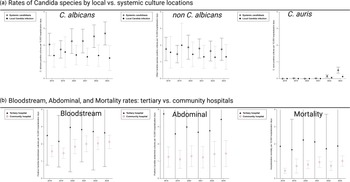
Seven thousand five hundred and fourteen patients aged 64 ± 16 years with 10,183 unique Candida cultures were identified during the study period. The majority (59%) of cultures were nosocomial, with a mean positive culture grown at 9 ± 44 days after hospital admission. Overall length of hospital stay was 21 ± 34 days. Majority of positive Candida specimens were from the blood (32%) followed by abdomen (29%), cutaneous (24%), oropharyngeal (6%), or other sources (6%). The most common Candida species were C. albicans (44%), C. glabrata (21%), C. parapsilosis (13%), C. tropicalis (9%), and C. auris (3%). Changes in demographics and fungal cultures between 2018–2020 and 2021–23 are shown in Table 1. Proportion of cultures from community hospitals increased during the later time as did the proportion of cultures positive from blood samples versus other sources (P < .0001, each). C. auris increased significantly from 2% of cultures from 2018–20 to 5% in 2021–23 (P < .0001). Rates of C. albicans and non-C. albicans positive cultures were higher from invasive candidiasis cultures (2–3 positive cultures per 10,000 patient days) compared to mucocutaneous candidiasis cultures (1–2 positive cultures per 10,000 patient days; P < .001). C. auris was detected starting in 2021 and by 2023 averaged 0.12 (95% CI: 0.00–0.23) positive cultures per 10,000 patient days from local cultures and 0.51 (95% CI: 0.32–0.69) positive cultures per 10,000 patient days from systemic cultures. Rates of bloodstream and abdominal Candida cultures per 10,000 patient days were higher in tertiary hospitals (2–4 positive cultures per 10,000 patient days) compared to community hospitals (1–2 positive cultures per 10,000 patient days; P < .001). Inpatient mortality was also significantly higher in tertiary hospitals (1.93 [95% CI: 1.37–2.49] deaths per 10,000 patient days) compared to community hospitals (0.78 [95% CI: 0.67–0.89] deaths per 10,000 patient days; P < .001). Candida-associated rates are shown in Figure 1.
Patient demographics, hospitalization data, and candida species data over time

Candida culture rate data for patients with first admission. Rates represent initial hospitalization and first culture of each Candida species isolated during the initial hospitalization. Local Candidiasis: oropharyngeal, vulvovaginal, and cutaneous Candidiasis; invasive candidiasis: Candidemia, abdominal Candidiasis, other organ systems (brain, lung, heart, and eyes).

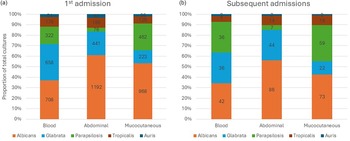
Candida species and source in hospitalized patients with first (panel A) or subsequent admissions (panel B).

Mortality rates
One thousand two hundred and fifty-one patients of 7514 (17%) patients with positive Candida cultures died during their hospitalization. Inpatient mortality was lower at community (0.5–1 deaths per 10,000 patient days) compared to tertiary (1.5–2.5 deaths per 10,000 patient days) hospitals. Inpatient mortality was significantly higher in patients with nosocomial (23%) compared to non-nosocomial (10%) cultures (P < .0001), invasive candidiasis (23%) compared to mucocutaneous candidiasis (7%) (P < .0001), bloodstream (36%) versus non-bloodstream (9%) culture sources (P < .0001), and C. glabrata (20%), C. tropicalis (21%), C. krusei (27%), or C. auris (30%) compared to other Candida species (p ≤ .005, each). In multivariable analysis (Table 2), admission to a tertiary care hospital (OR: 1.2; 95% CI: 1.06–1.39; P = .0046), nosocomial cultures (OR: 2.6; 95% CI: 2.3–3.0; P < .0001), blood culture (OR: 5.8; 95% CI: 5.1–6.7; P < .0001), C. tropicalis (OR: 1.3 95% CI: 1.0–1.6; P = .02), and C. krusei (OR:1.8; 95% CI: 1.1–3.0; P = .02) were significant independent predictors of inpatient mortality.
Predictors of inpatient mortality and candida-associated readmissions in 7 514 hospitalized patients; results from multivariable regression analysis. Blanks represent variables not found to be significant in multivariable analysis. All other candida species used as reference for the candida species evaluated below

Candida-associated readmission
Five hundred and ninety-seven of 6,263 discharged patients (9.5%) were readmitted with positive Candida cultures during the study period. Patients were readmitted a median of 98 (IQR: 26–351) days after discharge from the index hospitalization. One hundred fifty-three of 597 patients (26%) were hospitalized within 30 days of discharge from their index hospitalization. Of the 597 patients readmitted with positive Candida cultures, 485 (89%) were discharged alive after the readmission. Excluding those who died during their index hospitalization, patients who were readmitted with positive Candida cultures were younger (61 ± 15 yr) than those not readmitted (64 ± 16 yr; P = .0001), more likely to be initially hospitalized at a tertiary hospital (10%) versus a community hospital (7%; P < .0001), and more likely to have non-C. albicans cultures (51%) compared to C. albicans (45%) cultures during their index hospitalization (P = .017). In multivariable analyses (Table 2), younger age (OR: 0.99; 95% CI: 0.98-0.99; P < .0001), admission to a tertiary care hospital (OR: 1.56; 95% CI: 1.30–1.88; P < .0001), and non-C. albicans species including C. glabrata (OR: 1.29; 95% CI: 1.03–1.61; P = .030), C. parapsilosis (OR: 1.66; 95% CI: 1.30–2.12; P < .0001), C. krusei (OR: 2.17; 95% CI: 1.1–4.3; P = .027), and C. auris (OR: 2.12; 95% CI: 1.21–3.72; P = .0088) were significant independent predictors of Candida-associated readmissions after index hospitalization.
Discussion
Surveillance studies are of the utmost importance for detecting emerging pathogens and serve as a cornerstone of public health. The only national surveillance study in the USA is the CDC EIP. This group recently published population-based estimates for culture-confirmed candidemia from 2017–2021 demonstrating an overall incidence of 7.4 cases per 100,000 population with considerable variation noted between population areas. Reference Jenkins, Gold and Benedict9 Identifying 6,235 patients and a total of 7381 candidemia cases, C. albicans was most isolated (37%) followed by C. glabrata (30%), C. parapsilosis (14%), and C. tropicalis (6%). C. auris was identified in 0.4% of cases. Median length of hospitalization was 16 days (IQR: 7–33 d), and 33% of cases involved in-hospital deaths with a range of 27%–36%. These data represent the best population-based estimates of invasive candidiasis but are limited to the specific sites used by the CDC EIP network.
In our current study, we integrated clinical microbiology data from 25 tertiary and community hospitals in the Greater Houston area to identify a similar distribution of Candida species among hospitalized patients with candidiasis including bloodstream infections and mucocutaneous infections. Inpatient all-cause deaths in cases with Candida cultures in the bloodwere 36%, comparable to the CDC EIP candidemia study findings. Findings from our study were obtained during a similar time frame with results comparable to the CDC EIP data, again noting increased incidence and mortality in the COVID-19 pandemic era. These analysis techniques could provide a method to generate comparison data in areas of the USA not covered by the EIP program.
Late recurrent candidiasis has been described in case reports and series and is generally defined as a second case of candidiasis occurring at least 1-month after the last blood culture positive with Candida species was obtained from the initial case. Reference Clancy, Barchiesi and Falconi DiFrancesco11 Using a statewide database, the Connecticut Department of Health in conjunction with the CDC EIP program evaluated readmissions due to candidemia in 347 cases of index candidemia. Reference Suschana, Correa, Meek and Banach12 Excluding 121 (35%) patients who died during the index admission, 128 of the remaining 226 individuals (57%) were readmitted for any reason during the follow-up period of which the majority (75%) were admitted within 30-days. Hospital-onset candidemia was the sole independent predictor of all-cause readmission. Our study significantly contributes to these data by demonstrating that most Candida-associated readmissions occur after 30-days of prior discharge. Type of species (primarily non-C. albicans) and admission to a tertiary hospital were more important predictors than hospital-onset but this may be due to more granular data in our database as well as evaluation of candidemia and other Candida species infections. Although all these findings are limited by geographic areas, it is interesting to note the consistency of these findings amongst different geographic areas.
C. auris has quickly become a prevalent multidrug-resistant pathogen with high infection control concerns. C. auris incidence increased over time with rates of 0.5 cases per 10,000 patient days from systemic culture sources. This data provides important hospitalization rates to benchmark continued emergence of C. auris at ours or other geographic locations. An integrated health system in Miami, Florida also showed increased volume of clonal C. auris blood cultures mostly belonging to the South African clade III strains. Reference Rosa, de Paula Baptista and Tran13 Continued genotypic and phenotypic surveillance of this emerging multidrug-resistant pathogen will be crucial to infection control and patient management in the future.
These findings have notable limitations. Each health system microbiology database produced different reports and required significant cleaning to be incorporated together. Species confirmation was not confirmed beyond normal clinical microbiology processes; some misclassification in Candida species might have occurred. Trained investigators used consistent definitions but inconsistencies in data interpretation are still possible. We extracted data from the clinical microbiology departments only, and therefore, other important data such as antifungal treatment were not collected. Expansion of our data collection will be a future focus. However, using the data we obtained, we can replicate many of the analyses from CDC EIP data with a contemporary database. Obtaining these isolates for future susceptibility and genomic analyses will also be prioritized. Finally, blood and abdominal cultures are predictive of invasive candidiasis but have low sensitivity in certain cases potentially making our rates being lower than the actual incidence.
In conclusion, these analyses underscore the substantial burden of candidiasis and the emergence of novel strains, including C. auris. Ongoing surveillance can refine burden estimates and assess the impact of stewardship and infection control interventions.
Supplementary material
The supplementary material for this article can be found at https://doi.org/10.1017/ash.2025.10200
Acknowledgments
All listed authors contributed intellectually and approved the final version of the submitted manuscript. Additional specific contributions are listed. RHP, AP, WM, KP, WH, MAM, TL, NDB, TAE, and KWG contributed to the acquisition and analysis of data and interpretation of results. KWG contributed acquisition of funding. RHP, TAE, and KWG wrote the first draft of the manuscript.
Financial support
This work was supported by Melinta Pharmaceuticals, Inc as an investigator-initiated grant [grant number G0510361 (KG)] and National Institute of Allergy and Infectious Diseases T32 AI141349 (KG).
Competing interests
KWG has received additional research grants paid to his institution from Acurx Pharmaceuticals, Seres Therapeutics, and Vedanta Biosciences. All other authors have no conflicts of interest to disclose.



 Open access

