1 Introduction
1.1 Languages of Central Asia, Past and Present
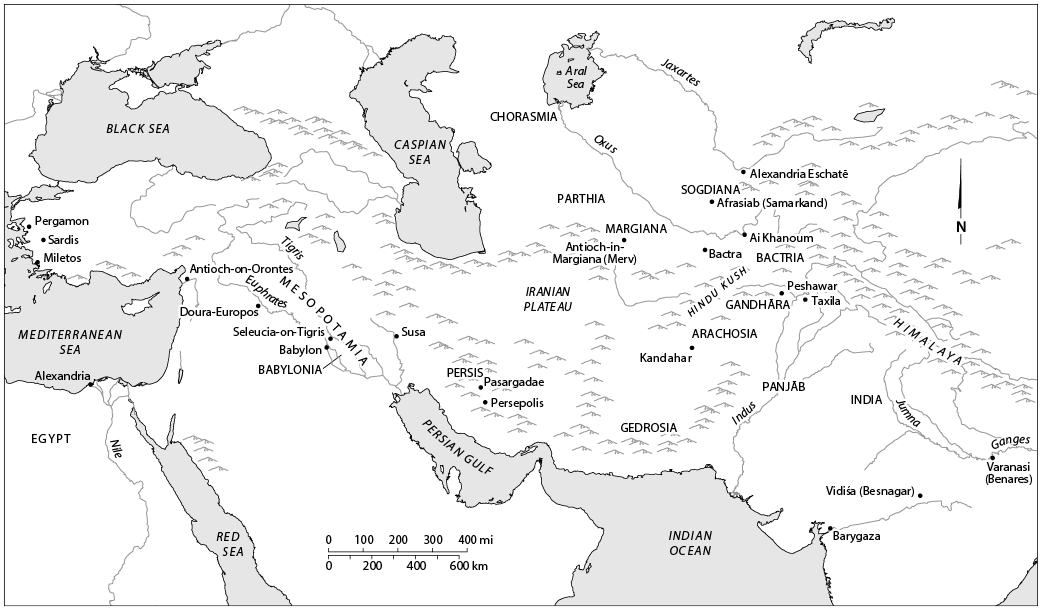
South-eastern Central Asia – the region extending roughly from southern Afghanistan and north-west Pakistan to Samarkand and the Zeravshan valley in central Uzbekistan – is highly multilingual in the present day and was equally multilingual in antiquity (Figures 1 and 2). Today, the dominant language families in Central Asia are Turkic (e.g. Uzbek, Kazakh, Turkmen, Kyrgyz) and Iranian (e.g Tajik, Pamir languages, Dari, Pashto). At the south-eastern fringes of the region, we also find Dardic languages, members of the Indo-Aryan family, and Nuristani languages, members of a separate branch of the Indo-Iranian family from either Iranian or Indo-Aryan (Degener Reference Degener and Sims-Williams2003). Some of these languages have millions of speakers and some are spoken only in a single valley. Even in the former Soviet Central Asian Republics, notionally based around a common Uzbek, Tajik, Turkmen or Kazakh identity, communities are linguistically diverse and individual multilingualism is common (see the studies in Ahn and Smagulova Reference Ahn and Smagulova2016). Other languages, in particular Russian and more recently English, act as pan-regional lingua francas.
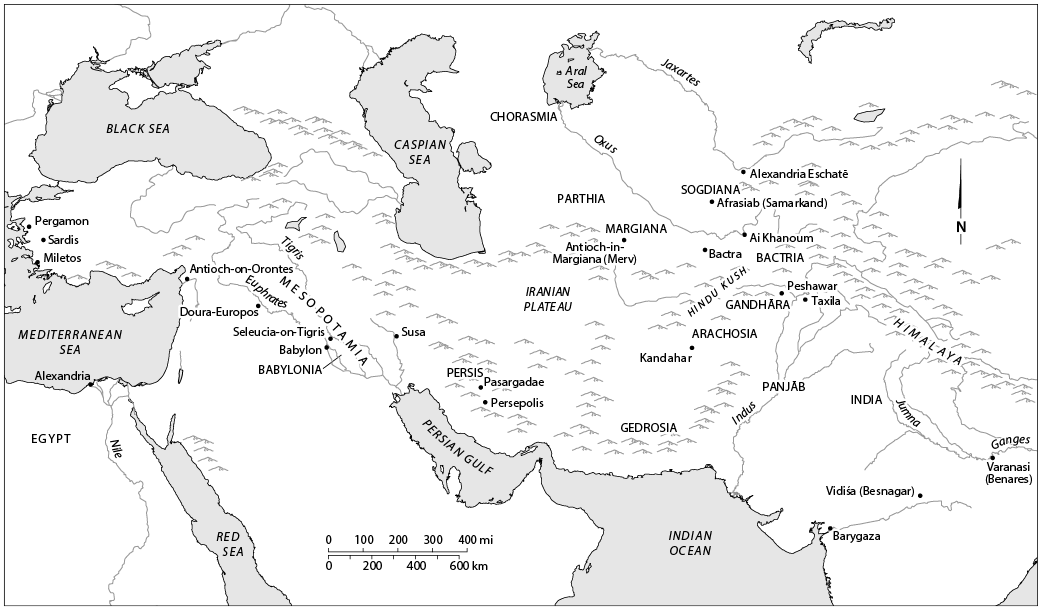
Map of the Hellenistic world.
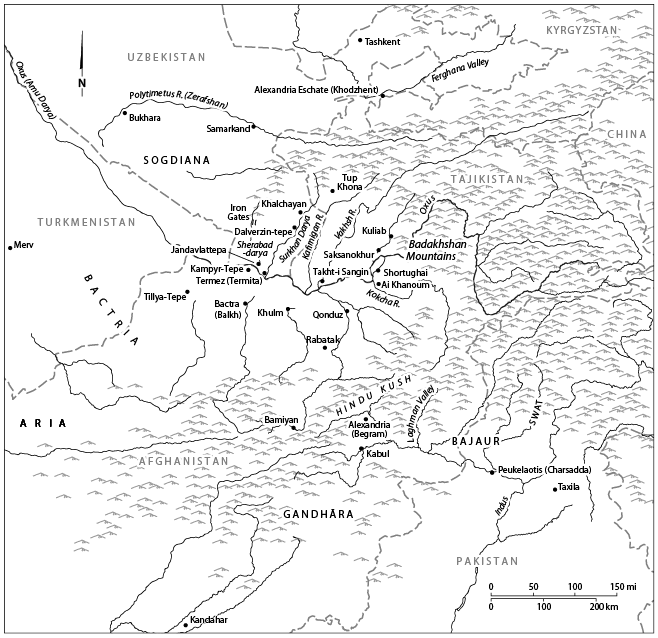
Map of ancient Afghanistan and surrounding regions.
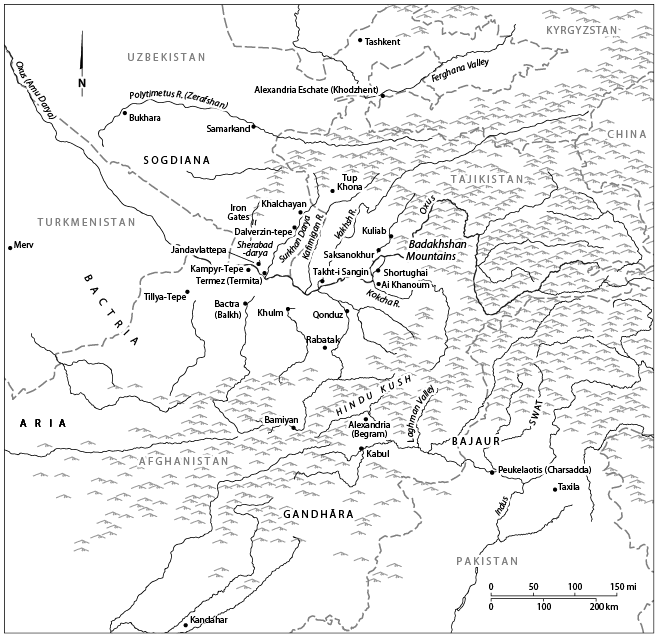
The historical depth of some of these languages in the region is greater than others. Turkic languages are not attested in south-western Central Asia until the second half of the first millennium ce: the earliest written attestations of Turkic languages are found in Mongolia in the eighth century (Johanson Reference Johanson, Johanson and Csató2022). Speakers of Iranian languages seem, from linguistic and archaeological evidence, to have moved into southern Central Asia by the second millennium bce (see the extensive discussion of the evidence in Parpola Reference Parpola and Sims-Williams2003).
The purpose of this Element is to provide an introduction to the linguistic landscape of south-eastern Central Asia in the period from around the fifth century bce to the second century ce. The languages attested by preserved texts at this period belong to the Indo-European (Iranian, Indo-Aryan, Greek) and Semitic (Aramaic) families, with one linguistic isolate, Elamite – a language with no proven genetic relationship to any other language (Tavernier Reference Tavernier, Álvarez-Mon, Basello and Wicks2018). This shows a very different pattern to what we might infer from evidence of historical language family movements, and indeed to the linguistic situation in the present day. The preserved textual evidence, in fact, preserves minority languages that are relative latecomers, historically speaking, much better than it does the dominant local spoken languages (Section 1.3). Aramaic and Elamite, it seems probable, arrived in the region with the Achaemenid Persian administration in the sixth century bce. Greek is later still, with the first evidence of Greek speakers in any significant numbers in Central Asia in the late fourth century bce. Our written sources provide only indirect evidence for spoken languages. Undocumented Iranian languages can be accessed through loanwords and linguistic interference in Aramaic, Greek and Prākrit texts. In the latter part of the period under discussion, we finally begin to find these Iranian languages attested in written form.
1.2 The Historical Context
This Element is concerned with the periods of Achaemenid, Hellenistic and Mauryan rule in the provinces of Bactria (northern Afghanistan, southern Uzbekistan and Tajikistan) and Arachosia (southern Afghanistan), with adjacent regions of Sogdiana (central Uzbekistan) and Gandhāra (eastern Afghanistan and north-western Pakistan). A fuller historical introduction to this period, including full discussion of the archaeological and written evidence, can be found in the chapters in Mairs 2021, with a concise survey in Mairs forthcoming. These ‘Upper Satrapies’ were brought into the Achaemenid empire in the sixth century bce. After the conquests of Alexander, Bactria became the centre of a Hellenistic successor state, and Arachosia and Gandhāra passed under the rule of the Mauryan empire, under the terms of a Seleukid-Maurya treaty, towards the very end of the fourth century. Around the turn of the third–second centuries bce the Graeco-Bactrian kingdom began to expand south of the Hindu Kush, into Arachosia and Gandhāra. ‘Indo-Greek’ kingdoms survived in parts of this region until around the turn of the common era. The Graeco-Bactrian kingdom itself fell to a combination of nomadic invasions, war with Parthia and internal dynastic strife in the mid second century bce. The successors to the Graeco-Bactrian kingdom were the Kushans, a dynasty who originated from the Yuezhi nomadic confederacy, from further to the north-east in Central Asia. How language and script use were shaped by these political events will be considered in greater depth in the following discussion.
1.3 Language and Script
It is important to de-couple language from ethnic identity in Central Asia. Just because someone used the Greek language to write a document, for example, does not mean that they were of Greek descent or identified on a personal level as Greek. Naming practices, too, are an imprecise metric of ethnicity, and may vary depending on context. These factors are well known in the papyrological evidence from Egypt, which shows that in the Hellenistic world people used and moved between languages in ways every bit as complex as in better documented modern societies.
As I have already noted, the languages that survive in written form in Achaemenid and Hellenistic Central Asia are overwhelmingly imperial languages: Aramaic and Elamite from the Achaemenid empire, Greek from the Hellenistic states and Prākrit from the Mauryan empire. Rather than assuming that these were also the dominant spoken languages in the region in this period, it is better to posit a degree of diglossia, with stable coexistence between local spoken languages (among which Iranian languages were probably dominant) and the default written registers. In the Kushan period, as shall be discussed in Section 4, Iranian languages began to be written down, using derivations of the Aramaic and Greek scripts.
Script and language must also therefore be de-coupled from one another. On several occasions in Central Asia, scripts were adapted to write languages other than the ones for which they were designed: Aramaic to write Prākrit and an Iranian language, and Greek to write Bactrian (the Iranian language of the Kushans). This shows that in Central Asia, as well as adhering to historical, imperial written registers, people were also driven to think creatively about adapting these registers to new, local needs.
Overall, the written evidence from Central Asia provides only snapshots of language use. These snapshots are determined by chance survival of evidence and by the locations in which literacy happened to have existed and been deployed in antiquity. It is nevertheless possible, and desirable, to try to bring these together into a panorama, one that may be enhanced by new discoveries in the future. I have not included every text in my survey, but have as far as possible given detailed examples from primary evidence to illustrate the linguistic points that I make.
2 Aramaic, Elamite and Iranian Languages in the Achaemenid East
2.1 The Achaemenid Administration
Bactria and Sogdiana were brought into the Achaemenid empire in the 540s bce by Cyrus the Great (Herodotos I 177; Briant Reference Briant2002, 38–40). Arachosia may also have been annexed at this time. Conquests in India followed in the 530s, and continued under Darius I in the 510s. In his trilingual inscription at Behistun, Darius claimed rule over extensive territories in Central Asia and as far as the Indus Valley (on the archaeological evidence for these, see Wu Reference Wu and Mairs2021 and Petrie Reference 62Petrie and Mairs2021):
Proclaims Darius, the king: These (are) the countries which fell to my lot; by the favour of Auramazda I was their king: Persia, Elam, Babylonia, Assyria, Arabia, Egypt, (the people) who (dwell) by the sea, Lydia, Ionia, Media, Armenia, Cappadocia, Parthia, Drangiana, Aria, Chorasmia, Bactria, Sogdiana, Gandāra, Scythia, Sattagydia, Arachosia, (and) Maka, all round twenty-three countries.
There are no Achaemenid royal inscriptions known from Central Asia, but we do have administrative documents from Bactria and Arachosia. These date to the fourth century bce and constitute the earliest surviving written texts from the region. To understand how these texts came to be written in the scripts and languages they were, we first need to consider the operation of the Achaemenid administration across the empire as a whole.
The Achaemenid empire at its greatest extent included speakers of a dizzying array of languages, from Greek and Egyptian in the west, to Iranian and Indo-Aryan languages in the east. Although the language of the ruling dynasty was Old Persian, this was only a minority language within the empire as a whole. The practical problems of running a multilingual empire were surmounted by the use of multilingual personnel, including translators, and the use of Aramaic as a common administrative language (Tavernier Reference Tavernier, Briant, Henkelman and Stolper2008). The Central Asian evidence shows that Elamite, too, served as a common language of record-keeping well beyond its home region in the southern Zagros.
The most extensive contemporary written evidence for the Achaemenid administration comes from Persepolis and from Egypt. We are, as ever with ancient documents, at the mercy of the gods of chance and of climate in terms of what has come down to us. Documents on perishable materials survive better from Egypt than anywhere else in the ancient world because of the dry climate and hundreds of years of modern excavation, looting and conservation. In other regions, clay tablets survive much better than texts on other media. This is true of Persepolis, where survival of the largest corpus, the Persepolis Fortification Archive, was also aided by the collapse of the building in which they were stored in antiquity.
The Persepolis Treasury and Fortification Archives were recovered from excavations during the 1930s. The texts of the Fortification Archive cover the period 509–493 bce. There are tens of thousands of individual pieces, with the majority in Elamite in the cuneiform script and a smaller number in Aramaic. There are single tablets in a handful of other languages, including Greek and Old Persian. The content of the texts relates to the management of commodities: receipt, transfer, taxation, redistribution and so forth. Full edition and publication of the texts is ongoing (https://isac.uchicago.edu/research/projects/persepolis-fortification-archive, accessed 5 December 2025; see also Briant et al. Reference Briant, Henkelman and Stolper2008 for state of the question as of 2008). The Treasury Archive is smaller, consisting of several hundred pieces, almost all in Elamite, mostly dating to 492–57 bce. Payments in silver are the principal topic. Because of accidents of preservation, we cannot say what, if any, administrative archive on perishable materials such as animal skin or papyrus, probably principally in Aramaic, once existed.
The preserved administrative documents from Egypt are rather different. These are a set of Aramaic documents written on skin and papyrus relating to the affairs of Aršāma, satrap of Egypt in the fifth century bce (Tuplin and Ma Reference Tuplin and Ma2020). Rather than documenting the management of commodities, they mostly contain instructions from Aršāma (who at the time of writing was in Babylonia or Susiana) to a variety of his subordinates (in Egypt). On the basis of this, one might propose a functional division of labour between Aramaic and Elamite in the Achaemenid administration: with Aramaic used for correspondence and long-form texts, and Elamite for records of a more practical, concise and economic nature. We can test this idea further when we come to consider the material from Central Asia.
2.2 Achaemenid Aramaic and Elamite
The forms of the Aramaic and Elamite languages used in the Achaemenid administration are slightly different from earlier standards. Aramaic is a Semitic language, which was widely spoken and written across the Middle East in antiquity. It was written in an abjad, a script in which only consonants and long vowels were routinely marked. Achaemenid official Aramaic ‘bears the characteristic marks of an imperial chancery: script, spelling, morphology, syntax, lexicon, and idiom are much more unified than in the immediately preceding stage, presumably as a result of a large‐scale administrative reorganisation and unification under Darius I and Xerxes’ (Gzella Reference Gzella, Jacobs and Rollinger2021a, 118). Iranian loanwords are common in the Aršāma letters (Tavernier Reference Tavernier, Tuplin and Ma2020, 77–9). We also find occasional calques on Old Persian expressions in the Aramaic of the letters (Tavernier Reference Tavernier, Tuplin and Ma2020, 84–7), implying that they were drawn up by speakers of Old Persian or came from orders originally given in Old Persian, by a native speaker such as Aršāma himself. The Iranian words used in the letters are not just specialist terminology, but include everyday terms. In an instruction from Aršāma about provisioning officials on a journey to Egypt, for example, we find:
Give them this ration, from (one) official to (the next) official, in accordance with the route which is from province to province, until he shall reach Egypt.
The word for ‘route’ is written ’dwn’ in Aramaic,Footnote 1 and derives from an Iranian root *advan- (Tuplin in Tuplin and Ma Reference Tuplin and Ma2020, 178). The other words in the sentence are Aramaic.
Elamite is an ‘isolate’. It is first attested in south-western Iran in the third millennium bce, written in the cuneiform script. In the Achaemenid empire, Elamite was used for royal inscriptions and in administration. There are no surviving texts later than the Achaemenid period, although it is of course very possible that it continued to exist as a spoken language, at least in Elam (Susiana) itself. Like Achaemenid Aramaic, Achaemenid Elamite is influenced by Old Persian. The interference from Old Persian is stronger in Elamite than in Aramaic, and extends to grammar and syntax as well as vocabulary (Tavernier Reference Tavernier, Álvarez-Mon, Basello and Wicks2018, 421).
2.3 Aramaic and Elamite in Bactria and Arachosia
In a perfect world, we would have a completely preserved central archive from Persepolis, or a complete satrapal archive from a region such as Egypt, to compare to the Central Asian material. As the evidence stands, we know that Aramaic was used for satrapal correspondence in Egypt, and that Elamite and Aramaic – and very rarely other languages – were used on tablets at Persepolis, recording management of economic resources. Local languages continued, of course, to be used throughout the empire in a wide range of contexts, spoken and written.
The textual evidence from Achaemenid and immediately post-Achaemenid Central Asia derives from two sources: excavations at the site of Old Kandahar, just to the west of the modern Afghan city of Kandahar; and a group of unprovenanced documents first attested on the antiquities market that can be deduced on internal evidence to have come from northern Afghanistan.
The Aramaic Documents from Bactria
The Bactrian Aramaic documents comprise thirty texts written on prepared animal skin and eighteen on wooden sticks, dating to the 350s–320s bce, with one outlier dated on palaeographical grounds to the first half of the fifth century (Naveh and Shaked Reference Naveh and Shaked2012). They are thus several decades later than the Aršāma letters. We find instructions from a man named Akhvamazda, probably the satrap of Bactria, to a local governor named Bagavant, as well as lists and memoranda. A number of Bactrian place names appear in the texts: Bactra itself, Nikhshapaya (to the north in Sogdiana) and Khulmi. It seems likely that these documents came from the satrapal archive at Bactra, since many of them are rough drafts, not the final versions that would have been sent to Bagavant and other officials (Naveh and Shaked Reference Naveh and Shaked2012, 16–17).
Iranian loanwords are even more frequent in the Bactrian documents than in the Aršāma letters (see the list in Tavernier Reference Tavernier, Tuplin and Ma2020, 79–81). To give just one example, text C6, a fragmentary list of supplies, is full of Iranian words, highlighted here in bold:
Tavernier identifies the following as Iranian words. In line 2, ’krst stands for *ākṛsta-, a type of garment and prbrn for *frabāra- ‘gift’; in line 3, sndst comes from a possible source *sundusta-, although Tavernier also puts a question mark after this and the meaning ‘brocade’; line 4 has smgwn from *sāmagauna- ‘black’; and line 5, ptkrw from *patikaravā- ‘decorated with a picture’. Although the matrix of the document is Aramaic, in this particular text more than a third of the preserved vocabulary items are of Iranian origin. This is an example at the extreme end of the spectrum, but it serves to demonstrate just how heavily iranised in lexicon the administrative Aramaic of Bactria could be.
I am being deliberately vague in using the term ‘Iranian’ instead of ‘Old Persian’. This is because Old Persian is not the only Iranian language that we can surmise to have been used by officials in the satrapal administration of Bactria. Most of the officials in the documents have Iranian names, some with a clear Old Persian origin, but within this there is a sizeable component (eleven individuals in the list given by Naveh and Shaked Reference Naveh and Shaked2012, 58–9) whose names are characteristic specifically of Bactria. The most obvious tell is the appearance of the name of the deified river Oxus, which we also find as a common local name element in literary sources, such as the Alexander historians (e.g. Oxyartes, the father-in-law of Alexander the Great). A man named Vakhshubandaka ‘servant of the Oxus’, for example, appears distributing flour to ration-providers in document C1.
The appearance of clearly local names suggests that satrapal administrations were staffed by a mixture of transplanted Persians and locally recruited staff. This can also be seen in the Aršāma letters, many of which are addressed to the Egyptian officials Psamšek and Nakhthor. The documents in fact probably came from Nakhthor’s own archive (Tuplin and Ma Reference Tuplin and Ma2020 I, 5). While we might expect that locally recruited staff were more numerous lower down the chain of command, with Persians or persianised individuals more heavily represented at the higher levels, they were not confined to merely clerical positions, as the example of Nakhthor himself, and several of our Oxus-named individuals in the Bactrian documents, shows. Vakhshuabradata son of Kshathrakana, for example, was in charge of determining ration distributions in C4.
What are the linguistic implications of this? First of all, it should be reiterated that at the time of the Achaemenid conquest, Central Asia had no indigenous written language that could either be pressed into service by the Achaemenid administration or serve as a vehicle for other genres of writing. We are therefore left to infer spoken language use solely from written evidence in languages that were not native to the region (in the Bactrian case, Aramaic and later Greek). There will of course have been multiple spoken languages in use across the easternmost Achaemenid provinces, probably principally of the Iranian and Indo-Aryan families, but we do not have direct evidence for these contemporary to the Achaemenid period. The indirect evidence of the Bactrian Aramaic documents provides us with a number of individuals who, from their names, were local and probably native or heritage speakers of an Iranian language other than Old Persian. The degree to which such non-Persian members of the Achaemenid administration persianised in their language and culture is, of course, unknown.
We are on firmer ground when we come to look at how individuals of any background acquired and used Aramaic in Achaemenid Bactria. Although the language and handwriting of the Bactrian Aramaic documents and the Aršāma letters are not absolutely identical – which would be unlikely enough in corpora created by two distinct sets of writers, never mind half a century apart – there is enough consistency to show that they are the products of a common, standardised system of scribal training. The palaeography of the two sets of documents is extremely similar (Daniels Reference Daniels, Kaplony and Potthast2020, 10), showing that the scribes who produced them were taught to hold a pen and form their letters according to the same technique. The orthography, too, is in conformity. The way in which the Iranian loanwords that are such a frequent feature of the corpora are integrated into the grammar of the Aramaic is the same across the Aršāma and the Akhvamazda correspondence (Folmer Reference Folmer, Garrison and Henkelman2023, 337; morphological integration is incomplete). The style of the two sets of documents is also fairly uniform (Gzella Reference Gzella, Jacobs and Rollinger2021b, 953; Folmer Reference Folmer, Jacobs, Henkelman and Stolper2017, 442): the scribes responsible follow similar conventions in laying out a document and addressing individuals. ‘All these similarities contribute to the image of a well-organized system of chancelleries working to produce official documents in a uniform way across the empire. This amounts to an astonishing achievement considering the spatial and temporal distances between the material in question’ (Folmer Reference Folmer, Jacobs, Henkelman and Stolper2017, 442).
The Bactrian Aramaic documents do, however, have more interference from Iranian language(s) than the Aršāma letters do. This is visible not just in the greater frequency of Iranian loanwords but also in the syntax of the Aramaic (Folmer Reference Folmer, Garrison and Henkelman2023, 349). One explanation for this is to point to the decades that had elapsed between Aršāma’s tenure in Egypt and Akhvamazda’s in Bactria, and suggest that Old Persian had made further inroads into imperial Aramaic during that time (Folmer Reference Folmer, Garrison and Henkelman2023, 353). We might also wonder, however, whether the presence of speakers of a local Iranian language in the satrapal administration in Bactria also led to a greater use of Old Persian and other Iranian elements.
The mechanisms of Achaemenid imperial rule allowed for a great degree of individual and collective mobility across the empire. People from across the empire could end up in a distant province through military service, administrative appointments, or simply providing the goods and services that kept the empire going. Internal exile was also used as a means of controlling troublesome populations, as we shall see in the section on Greeks and the Greek language in Central Asia. High-ranking Persians such as Akhvamazda and Aršāma could be appointed to provinces as distant as Egypt and Bactria, but we also find mobile individuals of all walks of life, such as the Bactrian military man attested in the Achaemenid garrison at Elephantine in an Aramaic document of 403 bce (Porten and Yardeni Reference Porten and Yardeni1986- D2, 12). All this suggests that the satrapal offices at Bactra were composed of individuals of diverse origins and mother tongues, who worked together to produce the satrapy’s paperwork in Aramaic, their common, standard written language. It would be interesting to know what language(s) these clerks used to speak to one another as they went about their tasks: Old Persian and one or more of the local Iranian languages seem the most likely candidates.
The use of Aramaic as a common administrative language across the empire meant that personnel could be transferred between administrative centres without the need to learn new ways of working and, more specifically, new ways of writing and producing documents. Mobility could actually enhance standardisation, since ‘persons from the eastern provinces could easily come into contact with epistolary traditions and Aramaic language forms more prevalent in the western provinces of the empire’ (Folmer Reference Folmer, Jacobs, Henkelman and Stolper2017, 445). The existence of such a well-entrenched standard also gave incoming conquerors a powerful incentive to keep using it long after the end of Achaemenid rule in Central Asia.
Aramaic and Elamite at Old Kandahar
The evidence from Arachosia is very different to that of the Bactrian Aramaic documents. We have a total of two Elamite and two Aramaic texts from Old Kandahar, with three further Aramaic texts related to the Old Kandahar material from the Laghman valley in eastern Afghanistan, and one from Taxila. Of these, only the Elamite texts date to the Achaemenid period; the Aramaic texts will be discussed in the following section on the linguistic and scriptorial legacy of Achaemenid rule in Central Asia.
Like Bactria, Arachosia was a satrapy of the Achaemenid empire. Its capital was at Old Kandahar, which was partially excavated in the 1970s. Among the finds were two small fragments of Elamite clay tablets very similar to those from Persepolis. They were found discarded in a rubbish pit, whose material is dated by ceramic comparison to the period 700–300 bce (Helms Reference Helms1997, 65ff). One of the tablets (SF 1400) bears only a few signs, whose reading is uncertain. The other (SF 1399) – which survived in the National Museum of Afghanistan in Kabul as recently as 2015 (Fisher and Stolper Reference Fisher and Stolper2015, 3) – measures just 5.6 × 2.6 × 2.8 cm, but as a piece of historical evidence punches well above its physical weight.
I provide here Fisher and Stolper’s reading and translation of the text:
| Side A (Deep Rulings) | ||||
| 1 | [ | ] (blank) | ||
| [ | ] (blank) | |||
| [ | ] (blank) | |||
| [ | ] (blank) | |||
| 5 | [ | ] (blank) | ||
| [ | ] (blank) | |||
| [ | ] (blank) | |||
| Side B (Deep Rulings) | ||||
| 1 | [ | ] | ||
| ⌈30⌉ [ | ] | 30 | ||
| [ | ] | |||
| [ | ] | |||
| 5 | PAP 30 [ | ] | Total 30 | |
| Side A (Perpendicular) | ||||
| [ | ] ⌈x kur?⌉-taš | …workers? | ||
| Edge | ||||
| [ | ] x hi ŠÀ-ma … | including | ||
| Side B (Perpendicular) | ||||
| [ | ] x šu-tur da-ka | …balance on deposit | ||
| [ | ] ⌈ši? na?⌉ e-ri šu-tur da-ka | … its? … balance on deposit | ||
This may not look like much to the uninitiated, but it single handedly proves the existence of an Achaemenid bureaucracy at Old Kandahar and shows that Elamite was used in the Achaemenid administration not just at Persepolis but potentially across the empire (Fisher and Stolper Reference Fisher and Stolper2015, 2; with references to others who have made this same point). Both Old Kandahar tablets bear ‘ruled’ lines incised into the clay, intended to be used as guidelines for writing; these lines are also characteristic of the Persepolis tablets. On SF 1399, the lines run in two directions, perpendicular to one another, a feature also found on some of the Persepolis Elamite tablets (Fisher and Stolper Reference Fisher and Stolper2015, 4–14). The key phrase to note in the text itself is šutur daka ‘balance on deposit’, which is a distinguishing feature of one of the categories of Elamite texts found at Persepolis: ‘calculations of interim balances on hand at regional centers’ (Fisher and Stolper Reference Fisher and Stolper2015, 17). The phrase hi ŠÀ-ma ‘including’ has a wider distribution among the Persepolis texts.
The implications of this text for the organisation of the Achaemenid administration in Arachosia are profound (Fisher and Stolper Reference Fisher and Stolper2015, 19–20) but are outside the scope of this work, where my concern is primarily language and script. In this regard, it should be noted that the Kandahar Elamite texts imply not just the existence of a bureaucracy but of a multilingual bureaucracy with the same kind of functional division between languages and scripts that we see elsewhere in the empire. The Bactrian Aramaic documents and the Kandahar Elamite tablets are complementary, in a sense, in that they show us Elamite in use for accounting – as we find at Persepolis – and Aramaic for higher-level instructions and management – as we find in Egypt. In no case do we yet have direct evidence of this functional division in operation contemporaneously within a single province, but in the state of the evidence it is fair to assume that this is what happened. The fact that Aramaic was also in use at Old Kandahar, and across a much wider region of the Achaemenid empire south of the Hindu Kush, is supported by the later use of Aramaic in the region, to which I now turn.
The Legacy of Aramaic
After a fairly brief period of Greek rule (the linguistic implications of which are discussed in Section 3), the former Achaemenid provinces south of the Hindu Kush passed under the rule of the Mauryas. In the case of the regions around the river Indus, this happened within a few years of Alexander’s death. Arachosia was definitively transferred from Seleukid to Mauryan rule under the terms of a treaty of 303 bce (see e.g. Appian, Syrian Wars 11).
There are no surviving administrative texts from the period of the Mauryan empire or the centuries immediately preceding it. This is because South Asia has, on the whole, a wetter climate than the Middle East and Central Asia, and texts on perishable materials do not survive so well. The earliest preserved inscriptions and coin legends in the two most important ancient Indian scripts, Brāhmī and Kharoṣṭhī, date to the third century bce. Kharoṣṭhī is modelled on the Aramaic script and is found primarily in Gandhāra and the north-west of the Indian subcontinent (Strauch Reference Strauch, de Voogt and Friedrich Quack2012). It later spread into Central Asia. Brāhmī may also be derived ultimately from Aramaic, but the relationship is not so clear cut as is the case with Kharoṣṭhī. Brāhmī originated in the eastern part of the Indian subcontinent, and it and the scripts that evolved from it ultimately displaced Kharoṣṭhī.
We are once again in a situation of having to argue from strong circumstantial but no direct evidence. That Kharoṣṭhī was developed from the Aramaic script used in the administration of the easternmost Achaemenid provinces seems intuitive, even though we lack surviving Kharoṣṭhī evidence from the period of development that preceded its appearance as a fully fledged system in the third century. We know, however, that the use of these two scripts overlapped geographically and chronologically in Arachosia and Gandhāra in the reign of the Maurya emperor Aśoka (c. 304–232 bce), grandson of Chandragupta, who first brought Arachosia into the Maurya empire.
The context in which Brāhmī and Kharoṣṭhī are first attested in the surviving evidence is that of Aśoka’s immense textual output. Aśoka was a convert to the Buddhist dharma, and left inscriptions throughout South Asia describing his conversion and outlining the moral principles his subjects were expected to follow (Falk Reference Falk2006). Most of these inscriptions are in Prākrit in the Brāhmī script. The exception is in the north-west, were we find Kharoṣṭhī-script Prākrit, Aramaic-script Prākrit, Aramaic and Greek. The logic of this distribution is that Aśoka sought to communicate to his subjects throughout the empire in the written medium most commonly used by them, making use of local linguistic and literate expertise – hence Kharoṣṭhī rather than Brāhmī in the north-west. At Shāhbāzgarhī and Mānsehrā in Gandhāra, Kharoṣṭhī was used. At Taxila, on the other hand, which is about 75 kilometres as the crow flies south-west of Mānsehrā and 80 kilometres south-east of Shāhbāzgarhī, we find an Aramaic inscription with the name of Aśoka (Falk Reference Falk2006, 252–3). This suggests strongly that Aramaic had previously been in use at Taxila in the Achaemenid period and Aśoka was continuing a local tradition. Taxila and the Bala Hissar of Charsadda (about 40 kilometres west of Shāhbāzgarhī) are both likely contenders for Achaemenid administrative centres. A fragmentary Aramaic ostracon from Barikot, in the Swat valley, is probably Achaemenid or Mauryan in date. The editors suggest, intriguingly, that it may represent a writing exercise that was part of scribal training (Zellmann-Rohrer and Olivieri Reference Zellmann-Rohrer and Olivieri2019, 208).
We do not find any Kharoṣṭhī-script Aśokan inscriptions further west than Shāhbāzgarhī. There are three Aramaic inscriptions from the Laghmān valley that mention Aśoka, although they are too fragmentary to tell how well they conform to his wider edict-making programme (Falk Reference Falk2006, 247–51). Then there are the edicts from Old Kandahar: a Greek–Aramaic bilingual, a Prākrit-Aramaic bilingual in Aramaic script and a monolingual Greek inscription. If we follow Aśoka’s logic of setting up inscriptions in the prevailing local written language, then this implies a history of both Kharoṣṭhī and Aramaic writing in the western Panjab and Gandhāra, the Aramaic being associated with the Achaemenid presence, and a situation across the Khyber Pass in what is now Afghanistan where the available local languages and scripts of literacy were Aramaic and Greek.
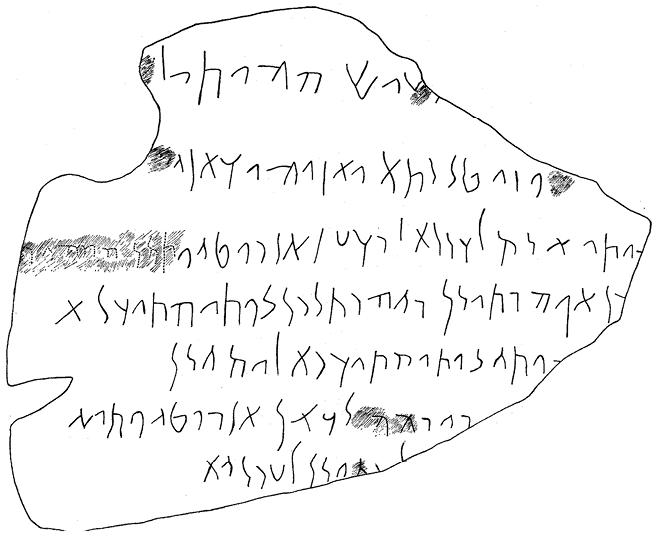
The adaptation of the Aramaic script to write Prākrit at Old Kandahar is highly significant. There is no surviving Kharoṣṭhī material from the site earlier that the second century bce, so the Aramaic script was used instead to represent both an Indian language of empire (Aśokan Prākrit) and an earlier language of empire that continued in use, Aramaic (Greek is considered in Section 3). The bilingual Prākrit-Aramaic inscription (Kandahar III: Benveniste and Dupont-Sommer Reference Benveniste and Dupont-Sommer1966; Figure 3) tends not to receive much attention in scholarship, because it is fragmentary and difficult to understand. This is a pity, because it is by far our most important piece of evidence for the linguistic transition from Achaemenid, to Graeco-Macedonian, to Mauryan rule in Arachosia. It is therefore worth explaining this text in some detail.
Drawing of Kandahar III.
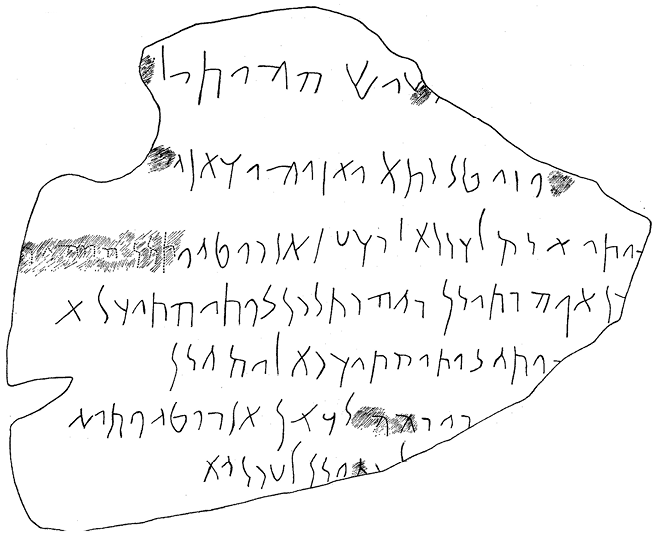
If we transcribe the Aramaic letters of the text, then we can come up with the following (transcription from Shaked Reference Shaked1969):
Plain text here represents the Aramaic language, and I have highlighted Prākrit in bold. The inscription alternates short phrases in Prākrit and Aramaic, where the Aramaic is a direct translation of the Prākrit. The text is too fragmentary to translate successfully, but the Prākrit portions represent a modified text of Pillar Edict 7, known from a site in Delhi. The relevant passage runs as follows:
For when the dharma has acquired lustre and is accepted, this means that compassion will grow among the people, as well as generosity, truthfulness, purity, gentleness and goodness. The beloved of the gods, Piyadasi [= Aśoka], the king declares: The many good deeds I have done have all been welcomed by the people, who have put them into practice. As a result, their obedience to their fathers and mothers has grown and will grow even more in the future, as will their obedience to those deserving respect, their reverence to the old and their concern for the bābhanas [followers of Brahmanic religion] and samanas [followers of non-Brahmanic religions such as Buddhism], the poor and distressed, and slaves and servants.
The Aramaic script does not routinely mark short vowels, so using it to write Prākrit presents certain challenges. The transliteration of Prākrit in Kandahar III makes heavy but not consistent use of matres lectionis (the use of consonant letters to indicate vowels). It is more likely for initial vowels and long or stressed vowels to be written out in full, using an Aramaic semi-vowel, as for example in ’nwpṭyptmnh for anūpaṭīpaṃne. Shorter and/or unstressed vowels are more likely to be omitted, but this is not always the case. The final e of loke is written with ‘ayin (lwk‘y) and that of anūpaṭīpaṃne with h. This may have to do with stress, or perhaps the translator simply does not employ a consistent method for writing this sound. The y following the ‘ayin of loke may be part of the writing of this vowel, or represent a glide between the final vowel of one word and initial vowel of another: what Shaked calls ‘a kind of unofficial sandhi’ (Shaked Reference Shaked1969, 121). Representation of consonants is mostly straightforward. The ‘ch’ sound of kanici (k’ny(š)) is replaced with the closest Aramaic equivalent ‘sh’. The retroflex ṭ of Prākrit is differentiated from ‘plain t’ by use of the Aramaic ‘emphatic’ or pharyngealised ṭ: modern transliteration convention indicates both the Aramaic emphatic consonants and the Indic retroflex consonants with an underdot. The exception may be in the first line where the final ‘t’ of dhaṃmapaṭīpati ((ṭ)yš) is written with Aramaic ṭ, but this portion of the text is damaged. The sound transliterated as v in Prākrit is a voiced labiodental approximant, somewhere between and English ‘v’ and ‘w’, and so Aramaic w is a suitable transliteration.
Like the Aramaic administration documents from Bactria and Egypt, Kandahar III shows Iranian influence. The same Iranian loanword that we find in line 5, ptysty ‘obedience’, also occurs in Kandahar I, the bilingual Greek–Aramaic text (Pugliese Carratelli and Garbini Reference Pugliese Carratelli and Garbini1964, 55). This is a freer adaptation of other Aśokan edicts; the Greek and the Aramaic are also not direct translations of one another. All of these Aśokan texts must have been composed within a few years of one another (unfortunately the archaeological record does not allow us to be more precise), so it is remarkable to find such diversity in script and written language operating at Mauryan Old Kandahar. The Greek of Kandahar I and the monolingual Greek text (Kandahar II), which is by far the longest Aśokan inscription from the site, will be discussed in Section 3. The relationship between Aramaic and Greek at Old Kandahar was, however, not one of straightforward replacement, just as (again, looking forward to Section 3) this was not the case in Bactria. Aramaic continued to be used at Old Kandahar decades after the Aśokan inscriptions. A fragmentary line of Aramaic text is preserved on a sherd from a ceramic vessel excavated at the site (Helms Reference Helms1997, 101: Catalogue Number 1684). The fabric may be dated to the second half of the third century bce, but it has not been fully published, nor is an image apparently available. This means that the Aśokan Aramaic inscriptions at Old Kandahar were not the last dying gasp of old imperial register, pressed into service by a foreign ruler clutching at straws to find a written medium in which to appeal to the local population, but that Aramaic continued to serve some practical purpose even a few generations after the end of Achaemenid rule. The experiment in writing an Indian language in the Aramaic script seems not, however, to have continued. (We might wonder if a similar encounter between Achaemenid Aramaic and an Indian language had been behind the historical development of Kharoṣṭhī in Gandhāra.) There is some later Kharoṣṭhī material from Old Kandahar, dating to between c. 200 bce and 200 ce, but unfortunately this has not been fully published: it seems to consist of personal names written on ceramic vessels (Helms Reference Helms1997, 102).
2.4 Summary
The story of Aramaic and Elamite in Central Asia and the north-western part of South Asia is fundamentally that of written media, employed primarily to run an administration but capable of adaptation to other purposes where necessary. The surviving contemporary written evidence may be scant, but it enables us to draw up a remarkably coherent picture of how and in which languages the Achaemenids administered their easternmost provinces. These languages were not, however, the native languages of the local population. Iranian and Indo-Aryan languages that did not yet possess a written form seem to have been the mother tongues of the majority of the inhabitants of Bactria, Arachosia and Gandhāra, even allowing for immigrants and heritage speakers of other languages of the Achaemenid empire such as Old Persian, Greek or even Aramaic.
The situation that we find in the Achaemenid east is therefore one that was not uncommon across the world in pre-modern times, where the dominant written register, where one existed, was not the home language of most of the population. Making use of writing – whether acquiring literacy for oneself or making use of the services of others – therefore involved crossing linguistic boundaries. The Achaemenid east is perhaps unusual in that we have no evidence that either Aramaic or Elamite were spoken by those who used them in writing at all. To call them ‘dead’ languages is not accurate, because they were very much living registers, capable of adaptation to different tasks, but their domain was above all written, not oral.
We have some very slight evidence for what languages those who wrote in Aramaic and Elamite will have spoken. The Old Kandahar Prākrit–Aramaic bilingual was written by someone who had enough familiarity with Prākrit to represent its sounds successfully in a different script: whether they were themselves local or from the Indian subcontinent is impossible to know. The scenario I like to imagine for the Achaemenid offices of Bactra and Kandahar is of a hubbub of scribes chatting in local vernaculars, perhaps code-switching into one of the languages of administration if discussing a technical matter, and switching to respectful greetings in Old Persian if an important official stops by.
3 Greek and Its Uses in Hellenistic Central Asia
3.1 The Transition from Aramaic to Greek in Bactria
Aramaic, as we have seen, continued to be used in Arachosia and Gandhāra after the conquests of Alexander the Great in the 320s bce and, beyond that, into the Mauryan period. It also continued in use in Bactria, although for an uncertain duration. The satrapal administration at Bactra continued to function as usual at least in the short term. Bactrian Aramaic document C4, a disbursement of barley, bears the date ‘On the 15th of Sivan, year 7 of Alexander the King’ (Naveh and Shaked Reference Naveh and Shaked2012, 203): that is, 8 June 324 bce. In Bactria, for a period at least, it was business as usual (Mairs Reference Mairs2014b, 43–6).
It is possible that Aramaic continued in use as an administrative language in Bactria, alongside Greek, for much longer, or – alternatively – that an experiment was undertaken in using the Aramaic script to write another language, just as at Kandahar. The evidence for this comes from an ostrakon found in the sanctuary of the main temple at the Graeco-Bactrian city of Ai Khanoum. During major renovation works to the temple and its sanctuary in around 200 bce, an earthen embankment was thrown up, and this is where the ostrakon was found (Bernard Reference Bernard1971, 432; illustration: Rapin Reference Rapin1983, 347–8). Its original context is therefore unknown, but its date of production is prior to 200 bce. Unfortunately, there is no thorough edition of the text, and no published discussions of it that take into account the subsequent discovery of the Bactrian Aramaic documents. It appears to be an administrative or accounting text of some sort, with a possible mention of barley and some Iranian personal names (varying readings in Rapin Reference Rapin1992, 105, and Harmatta Reference Harmatta, Harmatta, Puri and Etemadi1994, 390). There is too little grammatical content preserved to say anything much about the language used. Earlier discussions (e.g. Bernard Reference Bernard1972, Rapin Reference Rapin1987) tended towards seeing it as an Iranian language written in Aramaic script, but the case for an Aramaic text with Iranian lexical and perhaps wider linguistic interference is now strengthened by the publication of the Bactrian Aramaic documents. If this was an early attempt at reducing a local Bactrian Iranian language to writing, then it did not continue for long, although elsewhere the Aramaic script was very successfully adapted to Iranian languages (e.g. the Parthian ostraca from Old Nisa in Pahlavi script: Pilipko and Livshits Reference Pilipko and Livshits2004; the Aramaic script texts from Sehyak in Afghan Seistan may also be in Parthian: Morris et al. Reference Morris, Mairs, Zellmann-Rohrer, Trousdale and Allen2022).
The Greek language did not arrive in Central Asia with the conquests of Alexander the Great. At least one group of Greek speakers was exiled to Central Asia in the Achaemenid period: the Branchidae, ancestral custodians of the oracle of Apollo at Didyma, who were relocated by Xerxes to Bactria-Sogdiana after betraying the shrine to him in the early fifth century bce (Hammond Reference Hammond1998). By the time they were encountered by the army of Alexander the Great in the 320s, the Branchidae were allegedly ‘bilingual, having degenerated’ (at least from a Graeco-Macedonian perspective) ‘little by little from their native language under the influence of a foreign one’ (Quintus Curtius Rufus 7.5.29).
Bactria received a substantial number of Greek settlers under Alexander and the Successors, although the figures given by ancient historians are impossible to verify. This was, however, primarily a military settlement, which means that it will have included relatively few Greek women. This means that we must assume inter-ethnic marriage to have been the norm from the earliest generations of the Greek settlement of Bactria, and for multilingualism to have been common within families and communities. Although much about the region’s sociolinguistic landscape remains obscure, we can say with some certainty that it would have been very unusual to encounter a monolingual Greek speaker in Hellenistic Bactria after the first generation of settlers from the Greek world had passed away.
Written Greek was used in a wide range of linguistic domains in the Hellenistic period: administration, literature, intellectual culture, religion, commemoration of the dead. The texts considered in this section are, of course, only those that survive, and offer only a suggestion of what the original Greek written record of the region must have been. Writing was also practised on perishable materials that have not survived well: prepared skin, certainly, and perhaps also papyrus. We know this from the indirect evidence of writing equipment found at sites like Ai Khanoum, Begram and Taxila. Inkwells (ceramic or bronze) and pens were found all over the city of Ai Khanoum (evidence summarised by Rapin Reference Rapin1992, 133). We therefore know that people were writing with pen and ink and that this activity was taking place in areas from private houses to public buildings. Literacy was therefore used for a range of functions in people’s everyday lives, even if it is impossible to say what individual rates of literacy may have been.
At the other end of the spectrum of literacy are much shorter texts, usually on potsherds or bricks, containing only a name or a letter or two, from sites all over Graeco-Bactrian and Indo-Greek territory, from Samarkand to Barikot. On the one hand, there were people capable of reading and writing ‘high’ literature and who used writing in their daily lives. On the other, stray Greek letters used as brick marks (for example at Samarkand: Chichkina Reference Chichkina, Leriche and Tréziny1986, figure 299) do not have to involve any literacy at all, still less knowledge of the Greek language. An intermediate level of literacy may be represented by the occasional individual names found, presumably as ownership marks, on ceramic vessels. The Greek name Nikias, for example, is found on a drinking vessel excavated at Samarkand in an archaeological context of the third or second century bce (Rougemont Reference Rougemont2012, No. 153, 259). Literacy is, of course, a spectrum, and we should imagine that there will have been many people capable only of writing their own name (to subscribe to documents or mark ownership of possessions) or of recognising the names of others (see Youtie Reference Youtie1971 on those in documents from Graeco-Roman Egypt who are described as being able only to ‘write slowly’).
3.2 Greek at Old Kandahar
We have already discussed Aśoka’s programme of inscriptions at Old Kandahar. Alongside Aramaic and Prākrit, he also used Greek. Given that the Graeco-Macedonian occupation of Arachosia lasted only a couple of decades (roughly from Alexander’s passage through Arachosia in 330–29 bce to the treaty between Seleukos and Chandragupta in 303), and that the Alexander historians have very little to say about the region or its capital (Fraser Reference Fraser1996, 132; Ball Reference Ball and Mairs2021, 357), the persistence of Greek in the written record at Old Kandahar is perhaps surprising. Aśoka was, however, as we have seen, proactive in making use of whatever local written medium was available for his inscriptions.
Greek was certainly present at Old Kandahar in some form before Aśoka, and we may even have surviving testimony of this in a statue base that was found re-used in a later archaeological context. This bears a verse dedication of the ‘son of Aristonax’ – only his patronymic is preserved – which was written in elegiac distichs and makes cryptic reference to a wild animal, ‘this (temple) sanctuary’, citizens and a name beginning in ‘Alex-’ (Fraser Reference Fraser1979; Rougemont Reference Rougemont2012, No. 81, 165–6):
‘… of a wild animal, A- … I have set up in this sanctuary, the son of Aristonax, Alex- … among the citizens and of my saviour … [mad]e?’
The metre allows us to see that there must have been a first line, now entirely missing. Fraser, persuasively, suggests that the final line bore a maker’s signature: ‘(so-and-so) made (this)’. He also makes the – he admits, ‘speculative’ – suggestion that the dedication is a thanks-offering for being saved from a wild animal attack, which certainly fits well with the surviving text (Fraser Reference Fraser1979, 11). ‘Alex-’ is intriguing. It is tempting to read it as a form of the name ‘Alexander’ or an ethnic adjective describing a citizen of a city named ‘Alexandria’ (which later sources suggest that Kandahar was), but it is best to remain agnostic. On the basis of the letter forms, Fraser originally proposed a tentative date c. 275 bce or a little earlier. Rougemont pushes this a little earlier still, proposing the very late fourth century or first half of the third. Given that the earliest of Aśoka’s inscriptions date to around 260 bce, there is a strong chance that the ‘son of Aristonax’ inscription pre-dates the Old Kandahar edicts and thus represents an earlier Greek epigraphic tradition at the site.
As with the presence of Aramaic, there is no need either to assume that the use of the Greek language in writing at Old Kandahar presumes a large population of Greek speakers or to impute any kind of strong Greek ‘identity’ or ‘character’ to the city or its inhabitants. As Ball puts it, ‘a Greek name [Aristonax] in Arachosia might mean as little as an Arabic name in Indonesia’ (Ball Reference Ball and Mairs2021, 378). The son of Aristonax made his inscription early enough in the post-Alexander period to have been a first- or second-generation settler, and thus may have felt a stronger connection to Greek language and culture than did subsequent inhabitants of the city.
By the time of Aśoka, Greek was still in active enough use as a written language at Old Kandahar to make it a plausible choice for some of the local versions of his edicts, and moreover for the quality of the written Greek in these edicts to be high. The early editors of these inscriptions may have expressed surprise at the literary quality of the Greek (see e.g. Robert in Schlumberger Reference Schlumberger1964, 136), but there is no longer any reason for us to find the presence of good Greek in third-century Central Asia remarkable. There are now any number of examples of eloquent Greek inscriptions from Arachosia and Bactria, and moreover literary texts from Ai Khanoum (later in this section). Whatever their ethnic and cultural background and affiliations – and I prefer to leave this question open – there were people participating in an active Greek written culture in Central Asia at this period who were very familiar with the Greek literary tradition.
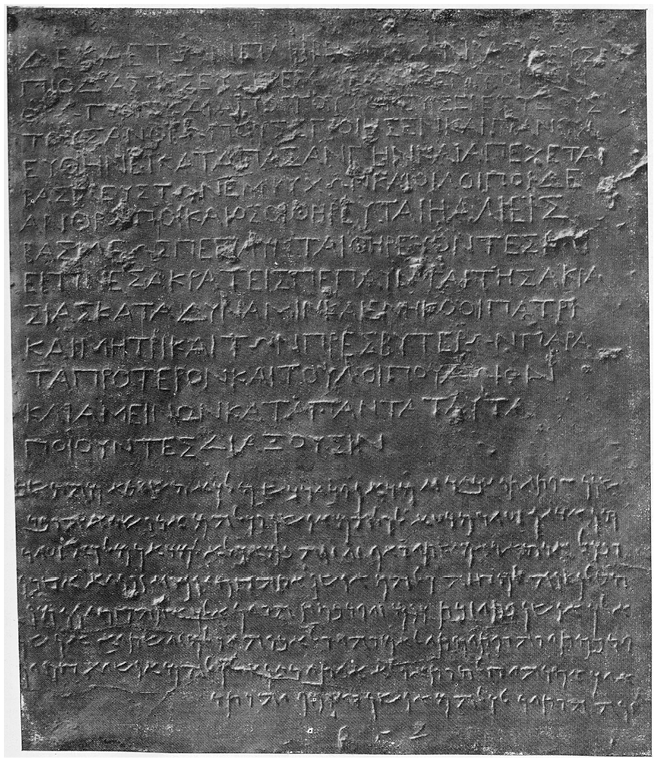
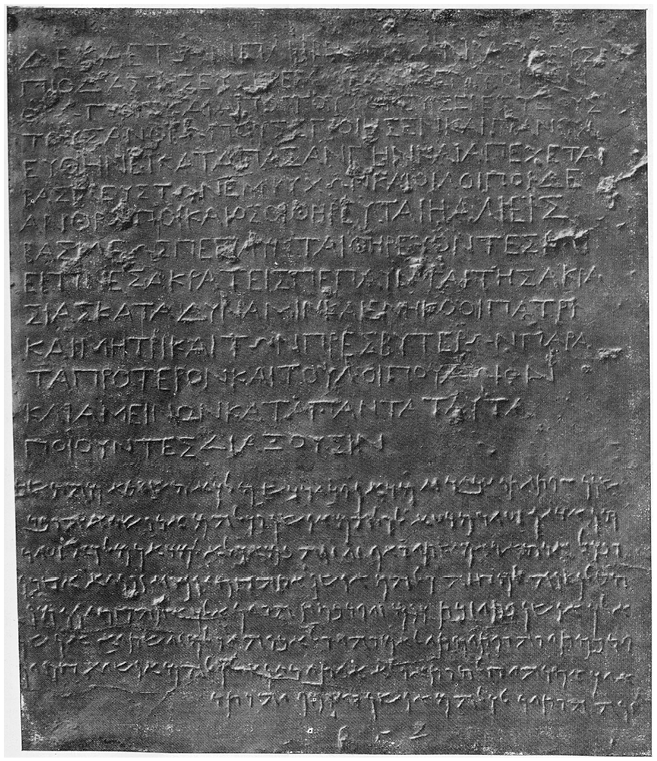
Greek appears in two of the Aśokan inscriptions at Old Kandahar: the Aramaic–Greek bilingual (Kandahar I) and a monolingual Greek inscription (Kandahar II). Kandahar I has already been introduced (Figure 4). The Greek portion of the text is not a direct translation of the Aramaic, nor of any Prākrit original, but rather a free rendering of principles found throughout the Aśokan corpus. Since it is relatively short, it is worth quoting in its entirety in order to give a sense of how the Aśokan dharma was represented in Greek terms (text from Rougemont Reference Rougemont2012 No. 82, 169–71):
‘Ten years having passed (lit. ‘been filled’), king Piodasses made piety known to people. And from this (time) he has made people more pious and everything flourishes on the whole earth. And the king abstains from living beings and the rest of the people and those who (were) hunters and fishers of the king have ceased hunting. And if some (people were) not self-controlled, they have ceased from lack of self control as far as possible. And (they are) obedient to father and mother and to elders, contrary to things (that happened) before. And in the future doing these things they will continue (living) better and more advantageously in all things.’
This is not the place for a full commentary on this text, but a few points are particularly worthy of note in a linguistic context. The ‘Piodasses’ of the inscription is a transcription of Aśoka’s epithet ‘Piyadasi’, a name by which he commonly appears in his inscriptions. The Greek makes an effort not just to render the content of the Aśokan edicts but to cast this content in a way that would make most sense to a Greek-literate audience. The Greek eusebeia ‘piety’ is not a direct translation of the Prākrit dhamma (Sanskrit dharma), which means something more like ‘law’, but it is a good way of communicating the practical implications of this word. Some of the vocabulary is also rather obscure, a topic to which I shall return later. The word used in the Greek for ‘obedient’, enēkoos, is exceptionally rare: it is not in Liddell and Scott. The letters are clear on the stone. As Louis Robert has noted, it is clearly a variant of the much better attested epēkoos, although it is unclear whether the (almost) unique appearance of this form at Kandahar is ‘une innovation voulue ou une conséquence du hasard du silence des autres textes’ (‘a deliberate innovation or a consequence of the chance silence of other texts’) (Schlumberger et al. Reference Schlumberger, Robert, Dupont-Sommer and Benveniste1958, 17). Pugliese Caratelli found one other occurrence of the word in Pollux’s Onomasticon, quoting from an Attic comedy writer of the fifth century bce, and also points out that the verb enakouō is used with the sense ‘obey’ in the Septuagint (Pugliese Carratelli and Garbini Reference Pugliese Carratelli and Garbini1964, 31). Why did the translator of Kandahar I reach for this particular word? The choice of en- instead of ep- remains obscure, but there is good reason to use a word derived from akouō ‘listen’ for ‘obedient’ here, since suśruṣa (I give the Sanskrit form for the same of convenience, since it occurs in several different Prākrit forms) – used to refer to ‘obedience’ to parents and elders in other Aśokan texts – is also derived from a root meaning ‘to listen’. The Greek translation is therefore thoughtful and culturally appropriate.
Squeeze of Kandahar I.
The same is true of the monolingual edict, Kandahar II. This comprises twenty-two long lines of Greek on a single block. The text is grammatically incomplete at both beginning and end, so it seems to have been part of a much longer inscription on multiple blocks, set into the wall of a building. It is a loose translation of part of a collection of fourteen texts within the wider Aśokan epigraphic corpus known as the Major Rock Edicts. These texts are often found together, so the Kandahar stone may originally have been part of a long Greek inscription of all fourteen edicts. Kandahar II contains the latter part of Major Rock Edict 12 and the beginning of Major Rock Edict 13. Some of the vocabulary used is the same as Kandahar I: eusebeia ‘piety’, for example. In other cases, the translator chooses to borrow Indian terms into Greek rather than find a translation equivalent. The Prākrit bramaṇa va śramaṇa (‘Brahmins and śramaṇas’) is translated as bramenai ē sramenai (‘bramanas or sramanas’). Both are terms that would require circumlocution to explain properly in Greek. Brahmins are followers of traditional Vedic religion, and śramaṇas are ascetics belonging to one of several non-Brahmanical Indian religions, such as Buddhism or Jainism. The Greek translator could have chosen to explain these in philosophical terms, omitted them or included them in the more general description of followers of other sects that follows. It cannot be the case that he borrowed these words simply because he could not think of any other way of rendering them. I have previously argued that the decision to transliterate, or borrow, rather than translate is to do with local familiarity with these terms among the inscription’s intended audience at Kandahar (Mairs Reference Mairs, Cromwell and Grossman2018, 224; see also Schmitt Reference Schmitt and Steinmetz1990, 50): they knew what Brahmins and śramaṇas were, and there was no need to translate. Closer reading of the text, however, inclines me more to the opinion that the readers of the Greek Kandahar edict were not expected to be so familiar with Indian religious sects, as the omissions and abbreviations discussed earlier show. I now wonder whether the translator might instead, or in addition, be treating these words as proper nouns. The only other instance where the translator transliterates an Indian term rather than translates or explains it is in the case of the name Piyadasi/Piodassēs. If the translator is consistent in his practice, then it may be that he regards ‘Brahmins and śramaṇas’ in the same way, as names to be transliterated and adapted to Greek phonology.
I shall return to the literary and philosophical language of the Greek of Kandahar II in Section 3.4, and also review a later Greek inscription from Old Kandahar.
3.3 The Greek Administration of Bactria
We have seen that Bactria continued to be administered in Aramaic for at least a short period after Alexander’s conquest, which is in line with the information in the Alexander historians about his keeping some satraps and officials in place (Mairs Reference Mairs2014b, 32–3). We do not know how and when the transition to a Greek-language administration happened, because our surviving Greek administrative texts are only much later, dating to the late third or second centuries bce. The nature of the documentation is also different. Rather than a satrapal archive, we have three texts written on skin, and a collection of economic texts written on ceramic vessels from the treasury at Ai Khanoum. The Ai Khanoum treasury texts are thus more comparable to the Elamite administration tablets from the Achaemenid empire than to the Aramaic material.
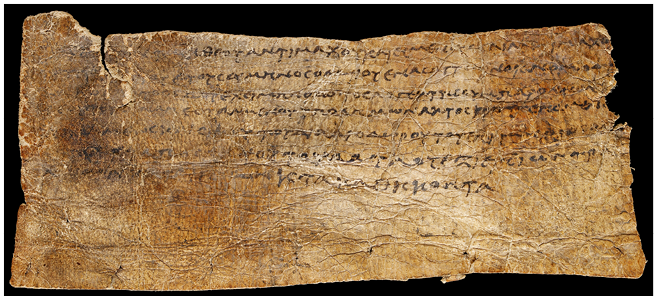
The three texts on skin are without archaeological provenance. The first to be published was a tax receipt now in the Ashmolean Museum in Oxford, which fortunately preserves the names of a number of jointly reigning kings of Bactria, allowing it to be dated to the 180s–70s bce (Figure 5):
‘In the reign of God Antimachos and Eumenes and Antimachos … year 4, month of Olöus, in Asangorna (?), when NN was guardian of the law. Menodotos, tax-gatherer, in the presence of NN, who was sent out likewise by Demonax the former …, and of Simos (?), who was … by agency of Diodorus, controller of revenues, acknowledges receipt from (?) NN the son(?) of Dataes(?), … of the payments due in respect of the purchase.’
As with the Aramaic documents, I am not principally concerned here with the administrative and historical evidence to be gleaned from this text but with the points it enables us to make about language use. Like the Bactrian Aramaic documents, the palaeography is identical to that of comparable documentary texts from Egypt – although in the case of Greek, we are fortunate to have contemporary examples. One of the first editors noted that ‘In spite of the unique provenance of the piece, its palaeography does not seem to me in any way remarkable: I would not have been able to tell from the writing alone that it did not come from Egypt’ (Rea in Rea et al. Reference Rea, Senior and Hollis1994, 262). As was the case with the Aramaic material, this also implies connectivity across long distances: circulation of documents, scribal personnel and systems of training in literacy. Most of the names in the text are Greek, with the exception of the patronymic Dataes (unattested, but probably Iranian) and the place name Asangorna (on the possible location of which see Grenet Reference Grenet1996, 470–4).
The Asangorna Text.
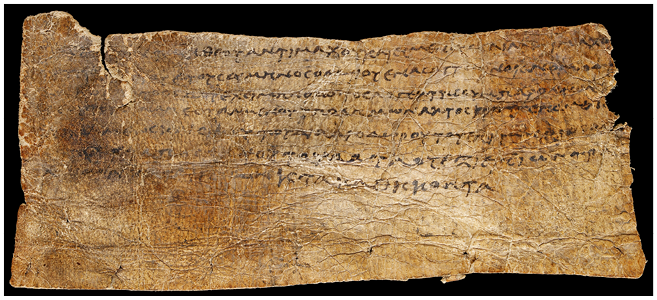
The other two Greek texts on skin came, like the Asangorna tax receipt, from the antiquities market before passing, in this case, into a private collection. One preserves only a few words (Clarysse and Thompson Reference Clarysse and Thompson2007, No. 2, 277–9). The other relates to a payment of a sizeable sum in silver coins, perhaps for hiring mercenaries:
Here we have a Greek place name (which cannot be located on the ground) alongside a possible local Bactrian one. The mention of ‘Scythians’ suggests dealings with people, perhaps the xenoi ‘foreigners’ or ‘mercenaries’ of the text, from the regions to the north of the Graeco-Bactrian kingdom (see further Mairs Reference Mairs2014b, 149). The text dates to the early second century bce, as can be seen from its dating by one of the Graeco-Bactrian kings named Antimachos. As with the Asangorna text, the hand is comparable to contemporary Greek papyri from Egypt (see Clarysse and Thompson Reference Clarysse and Thompson2007, 274).
Greek, therefore, was in use as a language of administration in Hellenistic Bactria for multiple purposes, certainly including taxation. The nature of the Amphipolis document just discussed is not completely clear: it may represent a private contract or a military account. The Greek documentary texts from Ai Khanoum principally concern economic management and were written in ink on vessels containing the commodities (oil and incense are named) and coins to which many of them refer (Rougemont Reference Rougemont2012, Nos. 99–120, 212–30). They are therefore not, strictly speaking, ‘ostraka’, since they were written on intact vessels that were only broken after deposition.
The following texts, written at different times on the same amphora lid, give a good sense of the kind of information these texts contain:
Reconstructions are possible because the same formulae occur on many of the texts from the treasury. These texts are really too fragmentary to yield a joined-up translation, but the activity recorded is as follows. In year 24 of a king whose name is not preserved, olive oil was decanted from two jars into a partly empty vessel. The name of the person responsible for the transfer typically occurs following this in other similar texts. Later, another transfer of olive oil was made by Philiskos into the same jar, and it was sealed by Theophrastos.
Texts concerning coins are similarly concise but informative. Both Greek and Indian monetary systems were in use:
‘By Zenon were counted, through Oxeboakes and Oxybazos 500 drachmas; Oxeboakes sealed (it).’
‘By Philiskos, 10,000 kasapana taxaēna, through Aryandes and Strat(on?).’
The treasury officials bear a mixture of Greek and Bactrian-Iranian names. As we saw with the Bactrian Aramaic documents, Oxus-names are common. The language of administration is Greek, but the native Iranian language(s) of Bactria did not have any written form at this period, so this would have been a default option. ‘Kasapana’ (Kārṣhāpaṇa) refers to Indian punch-marked coins (Audouin and Bernard Reference Audouin and Bernard1973, 243–4), and the particular examples here may have come from Taxila if that is what the otherwise unattested Greek adjective taxaēna refers to. A great many punch-marked coins have indeed been excavated at Ai Khanoum (see e.g. Audouin and Bernard Reference Audouin and Bernard1973 on a hoard from the administrative quarter and Bernard Reference Bernard1985, 72–8 on Indian punch-marked coins at Ai Khanoum from outside hoards). I shall return to the topic of coins and the linguistic information borne on them in Section 3.5.
3.4 Public Inscriptions, Dedications and Epitaphs
Most of our Greek inscriptions from Bactria come from Ai Khanoum and fall into two main categories: inscriptions in public buildings and epitaphs. The Ai Khanoum gymnasium had a statue of an old man, possibly a gymnasiarch, with the succinct dedication ‘Triballos and Straton, (sons) of Straton, to Hermes and Herakles’ (Rougemont Reference Rougemont2012, 209, No. 98): the traditional gods of the gymnasium. The shrine of the city’s probable founder, Kineas, had an originally much lengthier inscription, of which only the base was preserved. This originally bore a full text of the famous maxims from Delphi. A small remnant of this longer text remains on the stone, along with a description of how the inscription came to be made:
‘S[peak well of all], [be a] lover of wisdom … as a child be orderly, as a young man self-controlled, in middle age just, as an elder of good counsel, and as you come to the end without grief.’
‘These wise sayings of men of old, the maxims of renowned men, are enshrined in the holy Pytho [i.e. at Delphi]. There Klearchos copied them conscientiously, and he set them up here in the sanctuary of Kineas, blazing them from afar.’
There is a lot to unpack here, in cultural terms. I do not intend to get into the debate about whether the Klearchos referred to here is the philosopher Klearchos of Soloi (first proposed by Robert Reference Robert1968). This inscription potentially has much to tell us about how the population of Ai Khanoum conceived of their relationship to the Greek world and its symbolic navel, Delphi, at the time of the city’s foundation in the late fourth or early third century bce, and about how this relationship changed in the second century bce, when the shrine was renovated and the stone reused, with the inscribed portion against a wall (Mairs Reference Mairs2014b, 73–4; Mairs Reference Mairs and Mac Sweeney2014a). It shows, certainly, that Greek texts could be and were transmitted across very long distances between Greece proper and Hellenistic settlements such as Ai Khanoum, something that we see also with literature.
The inscriptions in the shrine of Kineas and in the gymnasium show also that Ai Khanoum participated in the Greek ‘epigraphic habit’, although Greek public inscriptions were not as prominent a feature of the urban and civic landscape there as they were in many other Hellenistic cities. There are many possible reasons for this, both cultural/linguistic (fewer people who could read a Greek inscription?) and practical (less extensive use of stone as a building material). As well as the Hellenistic world, the impetus to set up public inscriptions in Central Asia came also from Achaemenid and Mauryan precedent. The Aśokan Edicts at Kandahar, in particular, show interactions between the epigraphic culture of the Mediterranean and that of South Asia, where a stone inscription was considered an appropriate – and presumably efficacious – way to make a public statement of a king’s military power and ethical instructions to his subjects.
The Ai Khanoum and other Bactrian inscriptions constitute a fairly representative sample of the kinds of contexts that called for inscriptions elsewhere in the Hellenistic world: personal dedications to gods at religious sites; tombs or cemeteries; and even public statements of private individuals’ loyalty to kings, and kings’ enforcement of their own authority. One mausoleum was excavated among several present in the necropolis at Ai Khanoum. This had two stone inscriptions at the entrance and a number of ink inscriptions on jars containing bone fragments, naming the deceased, in crypts inside. The latter all bear Greek names in the genitive: Isidora, Lysanias, Kosmos/-as and ‘the little ones’ (tou mikrou and tēs mikras: Rougemont Reference Rougemont2012, Nos. 133–5, 242–4). The stone inscriptions are too badly damaged to yield complete readings (Rougemont Reference Rougemont2012, Nos. 137–8, 244–9). One appears to speak in the first-person voice of the tomb itself. The other refers to a memorial (mnēmeion), to spirits (daimonas) and to kings (basileusi).
Another fragmentary funerary inscription (on an earthenware plaque) comes from Djiga tepe (Kruglikova Reference Kruglikova1977; Martinez-Sève Reference Martinez-Sève and Mairs2021, 237–8), around 50 kilometres north-west of Bactra. I quote this inscription in full to give a sense both of how fragmentary these Bactrian inscriptions can be, and of how it is, nevertheless, possible to recover useful information from them.
‘Alone, without o[thers] … increase … Diogene[s] … departs … father … to the (realm?) of Hades …’
The first line may have been written separately, since the palaeography is different (using lunate sigma, which is not used in the rest of the inscription). The opening words may be a quotation from Iliad 22.39 (Bernard Reference Bernard, Todd, Komini-Dialeti and Hatzivassilou2002, 81–2), where Priam begs Hektor not to fight Achilles lest he be killed. Other things of note include the Greek name Diogenes and the reference to the Greek god of the underworld, Hades. One might wonder whether, given the highly diverse forms of religious practice in evidence in excavated Graeco-Bactrian temples (Ai Khanoum: Francfort Reference Francfort1984; Takht-i Sangin: Wood Reference 65Wood, Kouremenos, Chandrasekaran and Rossi2011), names of gods such as Hades should be taken as an interpretatio Graeca of local deities. The same is true of the names of Hestia and Zeus in the Kuliab inscription, discussed later.
Several Greek inscriptions and other engraved texts are also known from the territory of southern Tajikistan, to the north of the river Oxus from Ai Khanoum and other sites of Afghan Bactria. The Temple of the Oxus at Takht-i Sangin has yielded a number of dedications to the deified river Oxus. The longest of these appears on a clay mould intended to be used to cast a metal vessel of around 1 metre in diameter (Rougemont Reference Rougemont2012, No. 96 bis, 274–6; Drujinina Reference Drujinina2008; Ivantchik Reference Ivantchik2011; Ivantchik Reference Ivantchik, Lindström, Hansen, Wieczorek and Tellenbach2013). This states that Irōmois, son of Nemiskos, has dedicated a bronze vessel weighing 7 talents. A stone base from the Temple, bearing a statue of a satyr playing a double flute, states pithily ‘Atrosōkēs dedicated an offering to the Oxus’ (Rougemont Reference Rougemont2012, No. 95, 196–8). In both these cases we find individuals with Iranian names making dedications in Greek to a local god. An intriguing and very brief stone dedication (Rougemont Reference Rougemont2012, No. 96, 198–9) may be an attempt to represent the phonology of the local Iranian name of the Oxus more accurately in Greek letters: vacat ΥΟΞΟΙ vacat ΟΞ[ - - - - ]. The second, broken word could be ‘to the Oxus’, in a Greek dative case, while the first word – also in a Greek dative – begins with upsilon to better represent the w- sound that began the local name of the Oxus (e.g. later Bactria Oakhsho).
An unprovenanced inscription, said to have been acquired in Kuliab in southern Tajikistan, is a dedication in favour of two Graeco-Bactrian dynasts, and has more overtly Greek cultural reference points than the material from Takht-i Sangin.
‘This fragrant altar to you, Hestia, most honoured among the gods, Heliodotos established in the grove of Zeus with its fair trees, furnishing it with libations and burnt-offerings, so that you may graciously preserve free from care, together with divine good fortune, Euthydemos, greatest of all kings, and his outstanding son Demetrios, renowned for fine victories.᾽
The date is around the turn of the third–second centuries bce, and the kings are Euthydemos I, the founder of a new dynasty, and his son, later Demetrios I, posthumously dubbed Anikētos ‘the Unvanquished’. The victories for which Demetrios is already being praised in the Kuliab inscription are in north-western India. His own coins depict him with the elephant scalp earlier used by Alexander the Great to signify his victories in India (see e.g. Bopearachchi Reference Bopearachchi1991, 164–7). This imagery, along with the religious points of reference in the Kuliab inscription, speaks to a close connection to Hellenistic notions of kingship – association with Zeus as king of the gods, reference to the tychē or ‘good fortune’ of the king, prayers for the king’s wellbeing, and public statement of the position of the designated heir to the throne. The gods involved are Greek – or at least they are given the names of Greek gods. The archaeological context of the inscription, and the nature of the cult site of which it was part, are, it should be reiterated, unknown: it is quite possible that a local cult site and local gods lie behind these Greek names.
3.5 Coinage
The earliest Graeco-Bactrian coinage uses exclusively Greek legends. At first, Seleukid coins circulated in Bactria, until the region’s independence was established under the father and son dynasty of the Diodotids. These put the typically pithy Greek legends on their coins in the genitive: ΒΑΣΙΛΕΩΣ ΔΙΟΔΟΤΟΥ ‘of king Diodotos’. The coinage of these and subsequent Graeco-Bactrian kings circulated for the most part to the north of the Hindu Kush, in a sphere where Greek had become the dominant language of written expression. It was only when the Graeco-Bactrian kingdom started to expand southwards and eastwards (under Demetrios I and others) around the turn of the third–second centuries bce that this changed. The first kings to use Indian languages and scripts on their coins were Pantaleon and Agathokles in the early second century bce (Glenn Reference Glenn2020, 127–48). Alongside this, overtly Indian religious imagery was introduced.
The languages and imagery used on Indo-Greek coins depended to a large extent on where they were minted and intended to circulate. Broadly speaking, monolingual Greek legends prevailed in the original territory of the Graeco-Bactrian kingdom to the north of the Hindu Kush, until this collapsed in the mid second century bce. Under the Mauryan empire in South Asia, the typical coin type was the punch-marked coin, which was a bar of metal bearing stamped, non-figurative designs and no written text. Towards the end of the Mauryan period, die-stamped coins with more elaborate images started to be produced in Gandhāra, probably under Graeco-Bactrian influence. As the Indo-Greek kings moved into this region, whether through outright conquest or increased trade and political influence, they started to strike coins with Prākrit legends in the Brāhmī or Kharoṣṭhī scripts.
Unfortunately most Graeco-Bactrian and Indo-Greek coins in collections lack archaeological provenance (Bernard Reference Bernard1985), but some finds from hoards give us an idea of the distribution of different issues. The hoard of Indian and Indo-Greek coins from Ai Khanoum published by Audouin and Bernard Reference Audouin and Bernard1973 and Audouin and Bernard Reference Audouin and Bernard1974 contains a majority of Indian punch-marked coins (677 pieces) and only six bilingual Greek–Brāhmī drachmas of Agathokles, one of the very first Graeco-Bactrian/Indo-Greek kings to use coins with text in an Indian language. We have already seen that Indian coins were among the commodities counted and stored at the treasury. A hoard of sixty-three tetradrachms from the same city, in contrast, is exclusively Seleukid and Graeco-Bactrian, and monolingual in Greek. This and other hoard evidence indicates that ‘au nord de l’Hindou-Kouch circule un numéraire presque exclusivement gréco-bactrien’ (‘to the north of the Hindu Kush the currency that circulated was almost exclusively Graeco-Bactrian’): Petitot-Biehler Reference Petitot-Biehler1975, 53; on this distribution, and bilingual and Indian issues being south of the Hindu Kush, see also Bopearachchi Reference Bopearachchi1991, 13–14). Nevertheless, there were strong commercial and monetary connections north and south of the mountain range (Bordeaux Reference Bordeaux2018, 145).
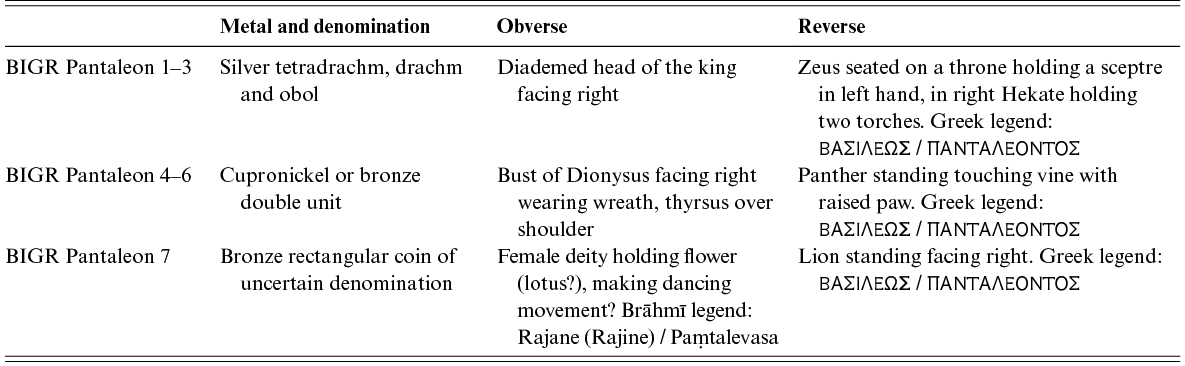
The coinage of Pantaleon, who reigned in the very early second century bce and was probably the first king to use Indian languages on his coinage, indicates how this worked (Table 1). Three basic types of coins issued by Pantaleon are known (all details are taken from the BIGR database of the coins of Bactrian and Indo-Greek rulers: https://numismatics.org/bigr/):
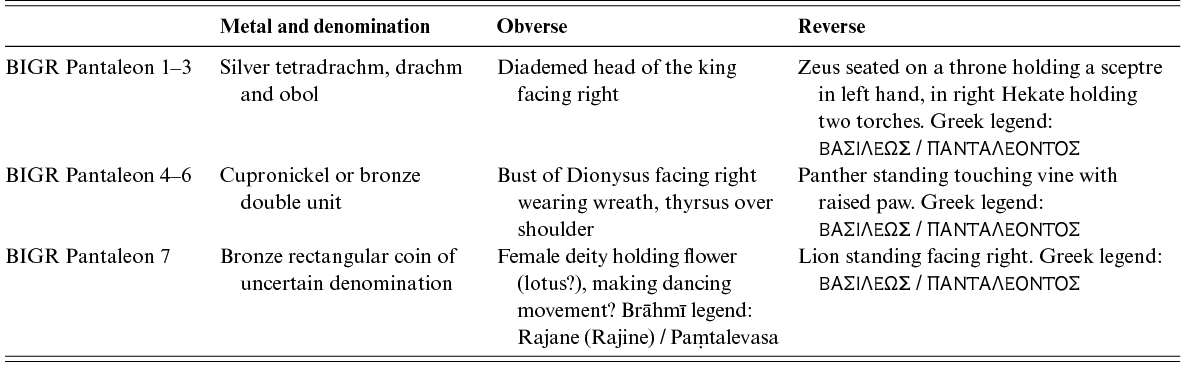
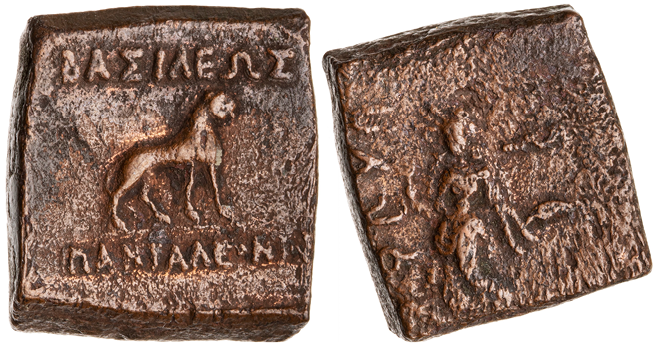
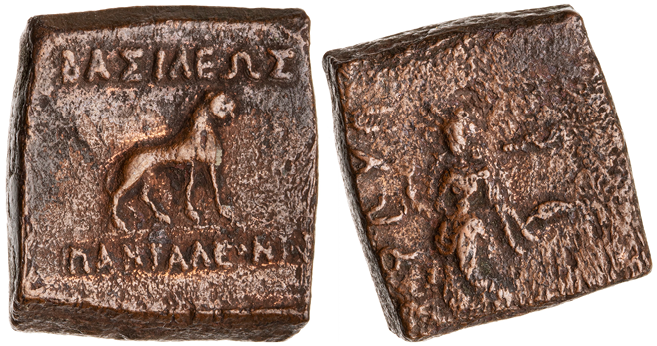
As can be seen, in Pantaleon’s coinage there is a strong correlation between Greek weight standard, Greek divine imagery and Greek legend. His bilingual coinage, in contrast, designed to be circulated in regions of the former Mauryan empire, and to be familiar and acceptable there, follows an Indian format and an Indian divine image and text in Brāhmī Prākrit in addition to Greek (Figure 6).
Type 7 coin of Pantaleon.
Under Agathokles, an immediate successor of Pantaleon, a similar situation prevails. Agathokles issued Greek-style coins, included a ‘pedigree’ series commemorating previous Graeco-Bactrian and Seleukid kings, tracing a line back to Alexander. He also issued bilingual, rectangular coins of a similar style to those of Pantaleon (with Prākrit written in Brāhmī script) but in addition Indian style coins that bore Kharoṣṭhī Prākrit legends alone (summarised in Glenn Reference Glenn2020, 31: BIGR Agathokles 1–22).
The presence of both Kharoṣṭhī and Brāhmī on the coins of Agathokles is at first glance curious. Pantaleon, who as far as we can see started the practice of using Indian languages and scripts on his coinage, used only Brāhmī. All subsequent Indo-Greek kings, from Apollodotos I onwards, use Kharoṣṭhī only. Aśoka, as has already been discussed, used Kharoṣṭhī in his inscriptions in the north-west of his empire and Brāhmī elsewhere. Kharoṣṭhī is moreover attested at Old Kandahar. The divide between territories in which Brāhmī and Kharoṣṭhī were used was, however, never clear cut. We find, for example, a scribe adding his signature in Kharoṣṭhī to Brāhmī inscriptions of Aśokan edicts at three neighbouring sites in Karnataka (Salomon Reference Salomon1998, 136; see further Strauch Reference Strauch, de Voogt and Friedrich Quack2012, 154–9). While there must have been some rationale behind the choice of Brāhmī or Kharoṣṭhī on Indo-Greek coin legends, we are therefore not in a position to say definitively what this was. One can imagine any number of plausible scenarios. We know little of how the Graeco-Bactrian kingdom did diplomatic and commercial business with the Mauryan empire – as it surely did – and it may be that Brāhmī was the script used in correspondence between the two states, and thus associated by them with political power to the south of the Hindu Kush. The earliest Indo-Greek kings may have started out with ambitions for their coins to circulate, and perhaps for their power also to extend, further into South Asia, where Brāhmī was the more commonly used script. As time passed, it may have become clearer that Kharoṣṭhī had greater currency in the regions over which the Indo-Greek kings possessed actual political control.
Languages used on coins are, of course, about more than local languages used in communication. They have the potential to communicate messages about political authority even to those who cannot read them. To give a simplistic example, British coins still bear Latin legends, which few can understand, but which have a broad association with tradition and authority. Bilingual Indo-Greek coins have frequently served as a scholarly metaphor for the multifaceted ethnic and cultural landscape of the kingdoms where they circulated. On a more practical level, bilinguality of text and image allowed coins to be ‘read’ by different populations in ways that were acceptable to them. Images of gods could be ‘read’ through their iconography as different deities with similar attributes, according to the cultural background of the viewer – a topic to which I will return later in this section.
3.6 Greek Literary Culture in Bactria and Arachosia
Epigraphic and literary texts are not two rigidly separate genres. Throughout the Greek-literate world, we find works of literary merit or aspiration written on stone. The most striking example of this from Hellenistic Central Asia is the epitaph of a man named Sōphytos son of Naratos (Rougemont Reference Rougemont2012, No. 84, 173–82; Bernard et al. Reference Bernard, Pinault and Rougemont2004). It was acquired on the antiquities market, and is said to have come from Kandahar. The only available dating criteria are palaeographical, and these allow us only to place the stone roughly in the second century bce. This is a much discussed text (see e.g. Pinault Reference Pinault, Bopearachchi and Boussac2005; Mairs Reference Mairs, Kwapisz, Petrain and Szymański2012; Mairs Reference Mairs2014b, 106–17; Mendoza and Verdejo Manchado Reference Mendoza and Verdejo Manchado2019) and here, as ever, my concern is with language and script over the many other possible avenues of approach to it.
Stele of Sōphytos
The irresistible force of the trio of Fates destroyed the house of my forefathers, which had flourished greatly for many years. But I, Sōphytos son of Naratos, pitiably bereft when quite small of my ancestral livelihood, after I had acquired the virtue of the Archer [i.e. Apollo] and the Muses, mixed with noble prudence, then did consider how I might raise up again my family house. Obtaining interest-bearing money from another source, I left home, keen not to return before I possessed wealth, the supreme good. Thus, by traveling to many cities for commerce, I acquired ample riches without reproach. Becoming celebrated, I returned to my homeland after countless years and showed myself, bringing pleasure to well-wishers. Straightaway I built afresh my paternal home, which was riddled with rot, making it better than before, and also, since the tomb had collapsed to the ground, I constructed another one and during my lifetime set upon it by the roadside this loquacious plaque. Thus may the sons and grandsons of myself, who completed this enviable work, possess my house.
(Acrostic:) Through Sōphytos the son of Naratos.
The epitaph is written in elegiac distichs (with a metrical error in line 18). Sōphytos – despite his non-Greek name and patronymic – refers proudly, in poetic language, to having had a (Greek) cultural education: ‘acquiring the virtues of Apollo and the Muses’. His choice of vocabulary, which I shall discuss further, is obscure: a typical characteristic of Hellenistic poetry.
A serendipitous find in the treasury at Ai Khanoum shows that the kind of Greek literary works that might have been thought to have been inspired by the Muses were circulating in Bactria: Greek was not just a language of administration and political display but of intellectual culture. Room 107 of the treasury – a possible ‘library’ (Rapin and Hadot Reference Rapin and Hadot1987, 260–65) – yielded an imprint of a philosophical dialogue on papyrus and two fragments of a metrical work on prepared skin (a bibliography for both texts is available online at http://claude.rapin.free.fr/2Textes_litt_et_inscr.htm, accessed 5 December 2025). Like all the Ai Khanoum material, these date to some time prior to the destruction of the city in the mid second century bce.
Nothing survives of the papyrus itself on which the philosophical text was written: its fibres had completely degraded. Instead, the text was recovered from an imprint left in decayed mud brick (described by Rapin and Hadot Reference Rapin and Hadot1987, 232–4). The hand of the Greek is comparable to that of Ptolemaic period papyri from Egypt, and Cavallo suggests a mid third century bce date (Cavallo in Rapin and Hadot Reference Rapin and Hadot1987, 236–7). Portions of three columns of text remain, and it is probable that the original scroll was much longer (transcription and translation: Rapin Reference Rapin1992, 116–19, and Rougemont Reference Rougemont2012, 236–40, No. 131). The text is written in the form of a dialogue, of the kind well known from the works of Classical Greek philosophers such as Plato. The text itself is not known from elsewhere. The recurrence of the Greek term idea allows us to connect it to the Platonic theory of forms, but we cannot definitively assign it to an author within this school, or securely identify it with any specific ‘lost’ philosophical text (see the discussion in Hoffmann Reference Hoffmann, Jouanna, Schiltz and Zink2016). It is worth reiterating just what a fluke the discovery of this papyrus imprint was. It shows us that texts on papyrus were circulating in a region where the climatic conditions do not usually permit the preservation of papyrus, and that someone at Ai Khanoum in the third century had the ability and interest to read philosophical works in Greek. It is worth considering alongside other, non-textual evidence for education and Greek culture at Ai Khanoum. The city had a gymnasium, with the typical dedication to Hermes and Herakles (Veuve Reference Veuve1987). A sundial was found in the court of the gymnasium, suggesting that, as at gymnasia elsewhere in the Greek world, scientific and intellectual activity took place there as well as physical exercise (Veuve Reference Veuve1982).
The treasury text on skin is also evidence for Greek cultural activities at Ai Khanoum. This preserves much less text than the papyrus: only a handful of complete words (Rapin Reference Rapin1992, 121–3; Rougemont Reference Rougemont2012, 241–2, No. 132). From this, it can nevertheless be seen that it is in metre (specifically, iambic trimeter), and that the first and second person forms of the verb are used. It therefore seems probable that it comes from a work of drama. Ai Khanoum had a theatre, and one of especially large capacity, set into the slope of the upper city (Bernard Reference Bernard1978, 429–41). Further evidence for a familiarity with Greek theatre comes in a fountain spout in the shape of a comic mask (Leriche and Thoraval Reference Leriche and Thoraval1979).
Greek literary and philosophical works were also known in Arachosia, although the evidence is a little more indirect. As has frequently been pointed out, the vocabulary used in the Greek versions of the Aśokan edicts at Old Kandahar is suggestive of Greek philosophical works (see e.g. Schlumberger Reference Schlumberger1964). For example, the Greek diatribē ‘way of life, pastime’, has a more specialised sense of spending time in discussion or in philosophical debate, and is used in Kandahar II to translate a term, pāṣaṇḍa, in the Aśokan canon that denotes a religious community that lives apart from regular society and follows an individual dharma (Brereton Reference Brereton and Olivelle2019; I use the Sanskrit form of the word because of inconsistency in the Prākrit forms in the Aśokan inscriptions). The inscription of Sōphytos, too, has attracted attention for its highly recondite vocabulary (Hollis Reference Hollis, Obbink and Rutherford2011). This is a typically Hellenistic literary feature. Hellenistic poets such as Kallimachos, Theokritos or Apollonios of Rhodes drew upon the linguistic resources of the entire Greek literary tradition, from Homer onwards, ‘producing a multiplicity and complexity that can only be called Hellenistic’ (Gutzwiller Reference Gutzwiller2007, 41). Using obscure vocabulary could be both scholarly and playful. Sōphytos uses a number of words that we otherwise find only in Hellenistic poets (e.g. line 1, kokuōn ‘ancestors’: Call. Hec. fr. 137: Hollis Reference Hollis, Obbink and Rutherford2011, 114 calls it ‘fabulously rare’; line 3, tunnos ‘so small’: Call. fr. 471, Theoc. Id. 24.139), as well as antiquated terms more usually found in Homer (e.g. line 4 eunis ‘deprived’; discussed in Bernard et al. Reference Bernard, Pinault and Rougemont2004: 242–4, with other examples; see also Hollis Reference Hollis, Obbink and Rutherford2011, 113–16). The funerary inscription from Djiga-tepe discussed earlier also has a possible reference to Homer’s Iliad. A more definite Homeric homage appears in line 11, where Sōphytos echoes the opening lines of the Odyssey (Sōphytos line 11: ἰὼν εἰς ἄστεα πολλά; Od. 1.3: πολλῶν δ’ ἀνθρώπων ἴδεν ἄστεα καὶ νόoν ἔγνω). This kind of Homeric touch was not unusual in the literary tradition of Greek epitaphs within which the inscription of Sōphytos is cast, and reference to this particular line was especially popular: a nice way of summing up a well-travelled man’s life and achievements, within a familiar Homeric framework.
4 Afterlives: Text and Language under the Kushan Empire
4.1 The Indo-Greeks to the Kushans
Like much else about their history, the end of the Graeco-Bactrian and Indo-Greek kingdoms is obscure. The Greek kingdom centred on Bactria fell under a combination of pressures (dynastic strife, war with Parthia, invasion from the north) around the middle of the second century bce (Mairs Reference Mairs2013). This is attested by Greek and Roman historical sources, and by destruction layers at Ai Khanoum. Indo-Greek kings, on the other hand, were still minting coins in north-western India as late as the turn of the Common Era. Most of these kings are known only from their coinage.
Very, very occasionally we find a piece of evidence that tells us something about the personal identities and linguistic repertoires of the inhabitants of these kingdoms. One of these is a dedication left by a Greek envoy from the Indo-Greek king Antialkidas of Taxila at a temple in Besnagar, in the modern Indian state of Madhya Pradesh (discussed by Mairs Reference Mairs2014b, 117–33; Figure 7):
‘This Garuḍa pillar of Vāsudeva, the god of gods,
was constructed here by Heliodora [Hēliodōros], the Bhāgavata,
son of Diya [Diōn], of Takhkhasilā [Taxila],
the Greek ambassador who came from the Great King
Aṃtalikita [Antialkidas] to King Kāsīputra [Kāśīputra] Bhāgabhadra, the Saviour,
prospering in (his) fourteenth regnal year.’
‘(These?) three steps to immortality, when correctly followed,
lead to heaven: control, generosity, and attention.’
Heliodoros’ inscription is in Prākrit and in the Brāhmī script. It dates to some time in the late second century bce. We have here a kind of mirror image of the Sōphytos inscription: a man with a Greek name presenting himself according to Indian cultural terms in an Indian language. Heliodoros, in contrast to Sōphytos, however, names himself explicitly as a ‘Greek’ and gives us some information about his political context, as an ambassador from Antialkidas at Taxila, to the court of the local king Bhāgabhadra. Bhāgabhadra’s use of the title ‘saviour’ (trātāra) is not a typical Indian practice, and it may be that it is done in emulation of the kinds of titles used by Indo-Greek and other Hellenistic kings on their coinage and in dating formulae in their official documents (Mairs Reference Mairs2014b, 124–5), establishing a common ‘language’ of titles in inter-state relationships. Antialkidas’ presentation, in turn, as mahārāja likewise represents the adoption of a recognised contemporary Indian titulary to explain the status of a foreign king.
Part of the Besnagar pillar inscription.
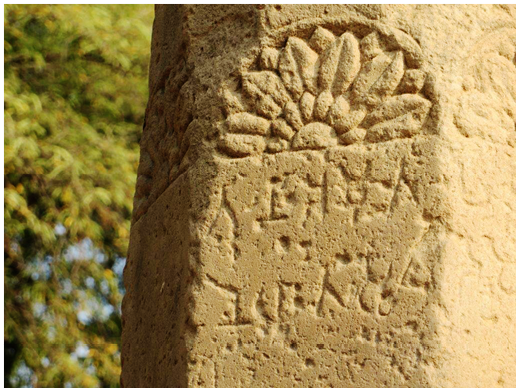
Someone like Heliodoros, with a diplomatic position at an Indian court, and who claimed dedication to a local god, might be assumed to have been capable of operating in one or more Indian languages. Unfortunately, we are once again not in a position to say much for certain about the linguistic landscape and individual linguistic repertoires of the Indo-Greek kingdoms, because the evidence is so scanty. All we can say, from the evidence of bilingual coin legends and the inscription of Heliodoros, is that both were likely characterised by multilingualism. In the following sections, I have two main concerns. First, I shall trace where we have evidence of the persistence of written Greek in Central Asia and north-west India after the fall of the Graeco-Bactrian kingdom in the mid second century bce. Second, I shall describe how writing came to be developed as a tool for recording local Iranian languages in Central Asia: the very languages that I have already argued represented the dominant spoken linguistic medium throughout the Achaemenid and Hellenistic periods. This will mean that I have to touch upon material from much later periods, in particular the Bactrian-language texts of the mid first millennium ce onwards. Broadly, however, I see the scope of this work as extending only into the Kushan period, to about the reign of Kanishka in the second century ce. This is because the corpus of Bactrian-language documents deserves much more space than it would be possible to devote to it here, and because it extends well into the mediaeval period, and far beyond my own area of historical expertise.
4.2 Greek in Gandhāra
Like Aramaic a couple of hundred years earlier, the Greek language and script persisted in some contexts well after the demise of Greek political rule in the region. We have already seen that Greek was used on coin legends by Indo-Greek kings. At the site of Barikot, in the Swat valley, we find a small number of fragmentary incised Greek ‘graffiti’ on ceramic vessels of the second century bce, which probably represent ownership inscriptions (Callieri Reference Callieri1984; Tribulato and Olivieri Reference Tribulato and Maria Olivieri2017). Greek persists in Gandhāra later even than this, but our understanding is often impeded by the lack of secure, datable archaeological context. A collection of metal vessels allegedly found in the Mohmand Agency, to the north of the Khyber Pass on the Pakistani side of the border, contain punched inscriptions in Greek and Kharoṣṭhī script Gāndhārī:
These vessels must originally have been dedicated at a religious site. Falk (Reference Falk2009) dates them to around 150–50 bce, but this is very uncertain. Several things are worthy of note. First, the co-occurrence of Greek and Gāndhārī Prākrit in Kharoṣṭhī script, both in the corpus as a whole and on a single vessel. Second, the presence of Greek and Indian names, and Greek titles, in a way that does not entirely correspond to the language used. The Greek name Kalliphōn is used in both Greek and Kharoṣṭhī and the Greek administrative title meridarch ‘local governor, administrative officer’ also appears in both languages. Episkopos ‘overseer’ is likewise borrowed into Kharoṣṭhī. The name of the divine figure to which the first, bilingually inscribed vessel is dedicated is, in contrast, different in each language, although no straightforward solution presents itself to the identity of either god. Khaosei may be an irregular dative of the Greek entity Khaos, and Boa a representation of the Indian Bhava, also a primeval deity (Falk’s proposition); or we may have here a local deity, perhaps a river god, referred to differently in each language (Rougemont Reference Rougemont2012, 269–70).
Neither of the Greek administrative titles here are commonly found elsewhere in the Hellenistic world, but meridarch is attested several times in Gandhāra. Such titles have considerable longevity in the region. Our primary source of information on these titles – and also on the continuing use of Greek names in Gandhāra – comes from inscribed Buddhist reliquaries. Seventy-one reliquaries inscribed in Kharoṣṭhī-script Gāndhārī are currently known; most reliquaries are uninscribed (see Salomon in Jongeward et al. Reference Jongeward, Errington, Salomon and Baums2012, 164–5; texts and translations of most of these by Baums in Jongeward et al. Reference Jongeward, Errington, Salomon and Baums2012, updated at https://gandhari.org/catalog, accessed 5 December 2025). These inscriptions form a defined genre with a distinctive formula and give a name and some supplementary information about the donor. Their chronological range is from the mid second century bce (reign of the Indo-Greek king Menander) to the late second century ce. We are fortunate that some of the inscriptions bear dates to the reigns of particular kings. Greek titles encountered include meridarkhēs (CKI 32, second or early first century bce; 33, second half of the first century bce or later; 454, 8/7 bce or 2/3 ce), anankaios (CKI 176, c. 150 bce) and stratēgos (CKI 46, 15/16 ce).
Sometimes we see a correspondence between the ethnic origin of the name of the donor and their title. A meridarch named ‘Theuduta’ (Theodotos), for example, dedicated a Buddhist reliquary in the Swat valley in the second or early first century bce (Figure 8):
‘By Theodotos, the meridarch, are established these relics of the śākya sage [i.e. the Buddha], the Lord, for the benefit of many people.’
Indian and Iranian names are, however, by far the most common across the corpus as a whole, even among bearers of Greek-derived titles. For example, on a schist vessel of around the turn of the Common Era, we find:
I do not wish to overemphasise the presence of Greek names and terminology in the Gāndhārī corpus. These words are uncommon (and altogether absent on media other than inscriptions, such as birch-bark manuscripts: Baums Reference Baums and Ray2018, 43), but they are remarkably persistent over long periods of time. Greek personal names occur in families whose onomastic repertoire is otherwise entirely Indian and Iranian. In a reliquary inscription from Bajaur of 19/20 ce (CKI 257), we are given rather a lot of information about a family related to the Apracarājas, a local dynasty who were probably originally sub-rulers to the Indo-Greek king Menander (mid second century bce; see CKI 178, the Shinkot reliquary inscription). The Apracarāja line was founded by Vijayamitra, and ruled between the latter half of the first century ce and the second quarter of the first century ce (Fussman Reference 59Fussman1993, 111; Salomon Reference Salomon and Srinivasan2007a; Kubica Reference Kubica2023, 134–5). The family members named in the Bajaur reliquary inscription are the governor Śatruleka, son of Subhutika and nephew of the king of Apraca (Vijayamitra II), his wife Davili, and sons Iṃdrasena and Menandros. It is important not to get too carried away about the significance of the name Menander here. Could this be an ‘heirloom’ name, commemorating historic political and/or genealogical connections to an Indo-Greek king of two centuries earlier? It is also tempting to see some connection to Menander’s role as a patron of Buddhism (Kubica Reference Kubica2023): did this make this particular Greek name familiar and appropriate in a local Buddhist context?
Reliquary inscription of Theuduta.

Other Greek names with no obvious Buddhist (but some political) resonance occur later still, again usually in families with Indian and Iranian names (for list of Greek names in Gāndhārī inscriptions see Baums Reference Baums and Ray2018, 38, and 40 for the names of the family members of these individuals, where attested). Helaüta son of Demetrios has a compound Greek–Indian name (possibly ‘Helio-gupta’: Baums Reference Baums and Ray2018, 40; CKI 564, 63/64 ce). There is a Hermaios whose son was named Saṯaṣaka and grandson named Muṃji in 98/99 ce (CKI 328) and in a later inscription on the same reliquary, a Heliophilos whose son was named Aprakhaka (114/115 ce). Hermaios and Demetrios were both also the names of Graeco-Bactrian or Indo-Greek kings. These are, as far as I have been able to find, the latest Greek names attested in Gāndhārī inscriptions.
Along with titles and personal names, Greek ways of reckoning time continued to be used in Gandhāra. A reliquary inscription of 15/16 ce is dated yoṇaṇa vaṣaye ‘in the year of the Greeks’ alongside other dating systems (CKI 405: Salomon Reference Salomon, Bopearachchi and Boussac2005). Month names remained in use much longer: CKI 564 (63/63 ce) is dated to the month Gorpiaios, and there are half a dozen inscriptions of the second century ce that use Graeco-Macedonian month names (CKI 328, 114/115 ce: Gorpiaios; CKI 152, ce 144/145: Artemisios; CKI 153, 146/147 ce: Audunaios; CKI 368, 146/147 ce: Oloios; CKI 155, 154/155 ce: Apellaios; CKI 159, 177/178: Artemisios). A term for an intercalary month (embolimos) is even borrowed into Gandhāri (CKI 328, 114/115 ce).
What, if anything, does this amount to? Although the evidence is less copious, it seems indicative of a similar situation to that that pertained in Bactria at the transition between the Achaemenid and the Hellenistic periods – that is to say, a limited degree of administrative continuity, and perhaps also continuity in personnel themselves, stronger in earlier periods than in later.
4.3 Writing Iranian Languages in Central Asia
Gāndhārī has a long and rich history as a literary language, especially for Buddhist texts, in Gandhāra itself and beyond this in Bactria and the Tarim Basin (surveyed by Salomon Reference Salomon2007b). This lies beyond the scope of this work. The Bactrian language, similarly, has a history that I do not attempt to tackle here as a whole. As I have already discussed, my concern is broadly with how new forms and genres of writing in the period between about the second century bce and second century ce made use of old ones.
In the 140s bce, the Graeco-Bactrian kingdom came to an end, under pressures that included the movement of a confederacy of nomads from the north – known in Chinese sources as the Dà Yuèzhī – into the Oxus valley. We have an eye-witness account of the aftermath of this population movement from a Chinese envoy named Zhāng Qiān, as recorded in the Shɩˇjì (Records of the Grand Historian) of Sīmǎ Qiān. Zhāng Qiān visited Bactria in 126 bce, and recorded the following situation:
Daxia (Bactria) is located over 2,000 li southwest of Dayuan [Ferghana], south of the Gui [Oxus] River. Its people cultivate the land and have cities and houses. Their customs are like those of Dayuan. It has no great ruler but only a number of petty chiefs ruling the various cities. The people are poor in the use of arms and afraid of battle, but they are clever at commerce. After the Great Yuezhi [Dà Yuèzhī] moved west and attacked Daxia, the entire country came under their sway. The population of the country is large, numbering some 1,000,000 or more persons. The capital is called the city of Lanshi (Bactra) [Alexandria] and has a market where all sorts of goods are bought and sold.
This is around two decades after the destruction layers at the city of Ai Khanoum, and gives a rather different perspective on what the Dà Yuèzhī invasion meant for Bactria. The conquest was not one of outright destruction. Bactria was still a wealthy, productive, and densely populated country. Militarily, the Bactrians were no longer a formidable force, and political power had been decentralised, but under the Yuèzhī the city of Bactra continued to flourish. Settled, urbanized civilization in Bactria had not been destroyed, and under its new (formerly) nomad rulers it still continued to function (see further Mairs Reference Mairs2014b, 146–76). This means that the conditions were in place for a degree of administrative and, with this, written linguistic continuity.
The first new form of writing we find in Bactria and adjacent regions in this period is not, however, derived from Greek. This is the so-called unknown script, which has recently been partially deciphered (Bonmann et al. Reference Bonmann, Halfmann, Korobzow and Bobomulloev2023). The editors’ suggested new name is the ‘(Issyk-)Kushan script’, for the place where it was first attested and the dynasty of Dà Yuèzhī origin who rose to power in the aftermath of their conquests. Inscriptions in the (Issyk-)Kushan script are found from Issyk Kurgan in the north-east (present-day Kazakhstan), on the route of the Dà Yuèzhī into Bactria, to Surkh Kotal and Dasht-i Nāwūr to the south, in central and south-eastern Afghanistan. Their greatest concentration is around the river Oxus – including at Ai Khanoum – and its northern tributary the Surkhan-darya. Most of these inscriptions date between the second century bce and the third century ce, ‘chronologically corresponding to the rise, heyday and fall of the Kushans’ (Bonmann et al. Reference Bonmann, Halfmann, Korobzow and Bobomulloev2023, 294). ‘The match between the territory of the Kushans (or Dà Yuèzhī) and the find sites of the inscriptions can hardly be a coincidence; the script must have been used to write down either their native language or a prestigious one of their secondary homelands’ (Bonmann et al. Reference Bonmann, Halfmann, Korobzow and Bobomulloev2023, 296).
The new decipherment reveals that this script was used to write a Middle Iranian language related to, but not identical with, other Iranian languages later attested in the region, such as Bactrian and Sogdian. It may be one of the languages brought by the Dà Yuèzhī with them on their migrations (I do not assume that the confederacy was monolingual), or may represent an indigenous language of Bactria-Sogdiana (Bonmann et al. Reference Bonmann, Halfmann, Korobzow and Bobomulloev2023, 325) – one of those whose existence we have inferred in early periods, albeit without direct attestation. Since this is still a partial decipherment, we cannot yet say much about the content of texts written in the (Issyk-)Kushan script, other than in cases where bilingual texts in Bactrian allow us to read royal names and titles.
Based on the partial decipherment, it now appears that the (Issyk-)Kushan script was developed from imperial Aramaic; this is confirmed by sound correspondences established between characters in the script and those in Aramaic (Bonmann et al. Reference Bonmann, Halfmann, Korobzow and Bobomulloev2023, 317). The implications of this have not yet been explored but seem intuitive. Aramaic must have been known as a written register in the place and time when the script was first developed. The earliest known inscription is that at Issyk, and also happens to be the furthest north-east. This implies a much greater penetration of imperial Aramaic into the steppe than is directly attested, whether as a result of direct Achaemenid political control (which did at times extend this far) or through circulation of texts and their associated technologies (see, for example, the Achaemenid connections of the material excavated in a fourth-century bce tomb at Issyk: Bivar Reference Bivar2006). There will be a lot more to be said about the previously ‘unknown script’ and its language as more of it is deciphered.
The script that had the greatest longevity in writing local Iranian languages in Central Asia was, however, not imperial Aramaic but Greek. This forces us to confront a significant time gap between the last surviving Greek texts of any length, in the mid second century bce, and the first extensive Greek-script Bactrian texts in the reign of the Kushan king Vima Takto in the 80s ce. In this period, we have evidence for the adaptation of the Greek script to write Bactrian in the form of coin legends and, possibly, Greek inscriptions (Härtel Reference Härtel2023, 118–23).
Probably the first, superficial impression made by the monumental Bactrian script on a Greek epigrapher is the angularity of the script. There are relatively few curved lines, and omicron, for example, can appear like a square. This angularity is also a feature of some earlier Greek texts from the region. The cauldron mould from Takht-i Sangin discussed earlier, for example, has square omicrons. A very fragmentary inscription from a temple at Sehyak in Afghan Seistan has letter forms very similar to the Takht-i Sangin mould (Morris et al. Reference Morris, Mairs, Zellmann-Rohrer, Trousdale and Allen2022). It was not immediately obvious to the editors whether it was in Greek or in Bactrian, although it has been established that it is Greek. Unfortunately, it is impossible to date this inscription by anything other than flimsy circumstantial evidence, although a date in the last two centuries bce is probable. The same stone bore a later inscription in Aramaic-script Parthian.
Inscriptions, then, show us that the Greek script in use in Bactria and adjacent regions of Central Asia was undergoing its own process of development in the last two centuries bce, in the palaeographical direction of the Kushan Bactrian script (Ivantchik Reference Ivantchik, Lindström, Hansen, Wieczorek and Tellenbach2013), to look at things teleologically. The evidence from coin legends sheds light on another way in which the Greek script was adapted: not just palaeographically, but in terms of its representation of phonology (the use of Greek on post-Graeco-Bactrian and Indo-Greek coinage is discussed more fully by Cribb Reference 58Cribb and Mairs2021, 654–62). The voiceless palato-alveolar fricative (the English ‘sh’ sound) does not occur in Classical Greek and there is no letter for it in the Greek script. When words in which this sound occurs were transcribed from other languages into Greek, it tended to be written as sigma. This is what happens with the rendering of Iranian names in Greek (Härtel Reference Härtel2023, 120), and it is also the strategy employed in the Greek Aśokan edicts. On the coinage minted by the Kushan king Kujula Kadphises in the early first century ce, a new strategy is adopted to represent the ‘sh’ sound in the word Kušān ‘Kushan’. The Greek letter rho is used, and its writing modified until, by the late first century, it had a new form, the letter sho: Ϸ ϸ (see Härtel Reference Härtel2023, 120, on this development).
Greek continued in use in some restricted contexts alongside Bactrian – at least from what we can tell from writing on non-perishable materials. It was used on coin legends until the reign of Kanishka, but with the addition of sho where necessary. On Kanishka’s Greek-legend coinage, for example, his name and title are written ΒΑΣΙΛΕΥΣ ΒΑΣΙΛΕΩΝ ΚΑΝΗϷΚΟΥ ‘king of kings, of Kanishka’ (sic with ‘king’ in the nominative). Greek deities also appear with their names written alongside them in Greek. Inscriptions at the Kushan dynastic sanctuary at Surkh Kotal (Schlumberger et al. Reference Schlumberger, Berre and Fussman1983) are in Bactrian, with the exception of a ‘signature’ at the foot of a Bactrian inscription of which only a few words remain. This reads διὰ Παλαμήδου ‘through Palamedes’ (Rougemont Reference Rougemont2012, No. 94, 194–5). The date of the inscription is not certain, but most scholarly views place it in the early second century ce. What does it mean that someone with a Greek name subscribes in Greek to a Bactrian inscription in a royal sanctuary at this date? First of all, this is very little Greek indeed, as far as quantity goes, and does not prove any thorough knowledge of the language on the part of the author. It is uncertain what Palamedes is claiming. Some suggest that he had some responsibility for the construction of all or part of the sanctuary itself (Bernard Reference Bernard2001 [2003]), others that he is responsible for composing the inscription, and thus represents a member of a scribal class among whom Greek may still have been current (Mairs Reference Mairs2014b, 175; Härtel Reference Härtel2023, 123, 448).
Around 280 kilometres to the south of Surkh Kotal, another early second century Kushan inscription shows some limited, active use of Greek, rather than simply loanwords, in Bactrian. A group of five inscriptions on a boulder at Dasht-e Nāwūr (Fussman Reference Fussman1974; Palunčić et al. Reference Palunčić, Palunčić and Maharaj2023; Halfmann et al. Reference Halfmann, Bonmann, Fries and Korobzow2023), dating to c. 105 ce, include a set of three that represent parallel texts in Bactrian (DN I), the (Issyk-)Kushan script (DN III) and Kharoṣṭhī-script Gāndhārī (DN IV). The first line of DN I gives the date, which includes the month name, Gorpiaios (gorpiaiou). As we have already seen, these month names were current in Gandhāra well into the second century ce, so the presence of this word is not in itself surprising. What is worthy of note is that it is in the Greek genitive case, suggesting that – in dates at least – Greek words might still be used with their correct case endings. The Gāndhārī version of the text also has this month name, but with a Gāndhārī genitive. In this text the loanword stratēgos ‘general’ is also present. But Greek is clearly no longer an important element of the Kushan multilingual and multi-script world in the early second century: Bactrian and Gāndhārī are the most important languages on inscriptions and coins, with some survival of the (Issyk-)Kushan script and its language.
The beginning of the reign of Kanishka I (reigned c. 127–150 ce) marks the final use of the Greek and Gāndhārī languages on Kushan coin legends. Kanishka also previously indicated the names of the gods depicted on his coins in Greek. These are Helios, Selene, Hephaistos, Nanaia, Anemos and Herakles. These names represent not Greek gods per se but an interpretatio Graeca of the gods of the Kushan pantheon Miiro, Mao, Athsho, Nana, Oado and Oesho (Cribb Reference 58Cribb and Mairs2021, 661–2; Cribb Reference Cribb, Ashton and Hunter1998; Sims-Williams and Cribb Reference Sims-Williams and Cribb1996, 107–9). This becomes clearer when Kanishka replaces the Greek names with their Bactrian equivalents: coin dies were actually rubbed down and modified to bear Bactrian royal titles and names of deities (Cribb Reference 58Cribb and Mairs2021, 662).
There is an apparent reference to this process – even as a deliberate policy – in the inscription of Kanishka found at Rabatak, just over 20 kilometres from Surkh Kotal as the crow flies (text and translation: Sims-Williams Reference 64Sims-Williams2004).
In terms of language and script, our main points of interest are in line 3 and line 10. The Rabatak inscription in fact contains the first actual explicit reference to language use and language names in the written record from the region: we have names for the Bactrian (‘Aryan’), Gāndhārī (‘Indian’) and Greek languages. Lines 9–10 spell out the equivalence between Bactrian and Indian gods, which are considered the same entities under different names. The phrase ‘who in Indian is called Mahāsena and is called Viśākha’ is written in smaller letter in between the lines: it has been added as an explanation of the main text. We are told that Mahāsena and Viśākha are the names of Sroshard υνδοοαο ‘in Indian’ (Sims-Williams Reference 64Sims-Williams2004, 64), which in this case must refer to the Gāndhārī language. The most significant section, however, and the one that has provoked the greatest debate, is the statement in line 3 that Kanishka ‘issued [lit. ‘led out’] a Greek (ιωναγγo) edict (and) then he put it into Aryan (αριαo)’. This can be taken in two different ways. The first (followed by Härtel Reference Härtel2023, 126) is to read it as referring solely to the translation of a Greek edict into Bactrian, and thus to Kanisha’s multilingual policies. The second is to read it in a broader sense, as indicating the replacement of Greek by Bactrian on an official level (Sims-Williams and Cribb Reference Sims-Williams and Cribb1996, 82–3; Cribb Reference Cribb, Ashton and Hunter1998). This is supported by the fact that we do indeed at this period see the removal of Greek and its replacement by Bactrian, in the epigraphic record and on coin legends. The very earliest issues of Kanishka, as we have already seen, have the king’s name and titles in Greek (ΒΑΣΙΛΕΥΣ ΒΑΣΙΛΕΩΝ ΚΑΝΗϷΚΟΥ) and the names of the god depicted in Greek (e.g. ΗΛΙΟΣ). Subsequent issues have the name and titles instead in Bactrian (ÞAONANO ÞAO KANΗÞKI KOÞANO ‘of the king of kings Kanishka the Kushan’) along with gods with the same iconography but a Bactrian name (e.g. ΜΙΙΡΟ ‘Mithra’).
As Cribb points out, other than this mention of Greek in the Rabatak inscription and the use of Greek on coins until the early reign of Kanishka, we in fact have no evidence to suggest ‘that the Kushans made any official use of Greek’ (Cribb Reference Cribb, Ashton and Hunter1998, 86). The survival of Greek legends on coins for so long can be in part explained by adherence to locally acceptable forms, familiar and trusted locally, and should not be taken as any indication of strong cultural or political attachment to the Greek language and culture.
The long-term influence of the Greek language in the region can nevertheless be seen through loanwords in Bactrian. As well as the Bactrian inscriptions already discussed, there are documentary texts, written on leather and tally sticks, from northern Afghanistan, dating to the fourth to the eighth centuries ce (on the chronology of the Bactrian documents, see Sims-Williams and Blois Reference Sims-Williams and de Blois2018). We have already seen how some Greek administrative titles and names persisted in Gāndhārī. In the Bactrian documents, in contrast to Gāndhārī, the majority of attested Greek loanwords are economic in nature: for example, σιμιγγο/σιμινο ‘made of silver’ from Greek ἄσημος ‘unmarked, uncoined’, δ(δ)ραχμο ‘drachma, dirham, from Greek δραχμή and δ(δ)ιναρο ‘dinar’ from Latin denarius via Greek (Sims-Williams Reference Sims-Williams and Sims-Williams2002, 228–9). The word χþονο ‘calendar year, regnal year’ has traditionally been taken to derive from the Greek χρόνος, although this is now questioned (Scarborough Reference Scarborough2021). Borrowings from Indian and Iranian – and in later periods Turkic – languages are more numerous than Greek. This is too small a sample to draw overall conclusions about the nature of Greek survivals in Bactrian versus Gāndhārī, but one model that might fit this pattern would be the maintenance of Greek-era administrative structures in Gandhāra, but not in Bactria, and the reliance of the incoming Kushans on Greek terms for a monetary economy into which they had not previously been fully integrated.
5 Conclusion
The Kushan period material helps us to understand the earlier linguistic landscape of the region. It confirms – through the Rabatak inscription and Kanishka’s coinage – that the same divine images could be known by multiple names by different constituencies. This is a phenomenon familiar to scholars from elsewhere in the Hellenistic world. Hellenistic and Kushan comparanda make us add nuance to our reading of the ‘Hades’ of the Djiga-tepe inscription, or the ‘Zeus’ and ‘Hestia’ of the Kuliab inscription. The images on Graeco-Bactrian and Indo-Greek coins, too, could be ‘read’ in multiple ways. Kanishka merely makes explicit what we should take to have been the case all along.
Kushan texts also reveal the contrast between languages of literacy and languages of spoken communication in Central Asia. Loanwords and personal names hint at the existence of one or more predominant spoken Iranian languages in Bactria and Arachosia in the Achaemenid and Hellenistic periods. The emergence of the (Issyk-)Kushan script and later the Bactrian script finally give voice to these languages.
For much of the period during which south-eastern Central Asia was under Achaemenid, Greek and Mauryan rule, to write at all meant to write in one of the languages of imperial power: Aramaic (and Elamite), Greek or Prākrit. None of these were fossilised registers, and each gave scope for local creativity in representing foreign words, expressing literary aspirations or adapting administrative structures and hierarchies to local conditions.
Acknowledgments
I would like to thank Cambridge University Press’s two anonymous readers for their helpful comments on the manuscript, and Arietta and Bosphore Papaconstantinou for providing such a delightful environment in which to write it. I also wish to acknowledge the kindness and generosity of the late Richard Stoneman in sending me photographs of the Besnagar inscription when he visited it in 2016; one of them is reproduced in this work.
Series Editors
Andréas Stauder
École Pratique des Hautes Études-PSL (EPHE)
Andréas Stauder is Professor of Egyptology at the École Pratique des Hautes Études-PSL, in Paris. His research focuses on the origins and early development of writing in Egypt and in comparative perspective, the visual aesthetics and semiotics of Egyptian hieroglyphic writing, the historical linguistics of the Egyptian-Coptic language, the poetics of ancient Egyptian literature, and Egyptian inscriptions in space.
Editorial Board
Wolfgang Behr, University of Zürich
Silvia Ferrara, University of Bologna
Stephen Houston, Brown University
Philip Huyse, École Pratique des Hautes Études-PSL, Paris
Cale Johnson, Freie Universität, Berlin
David Lurie, Columbia University
Rachel Mairs, University of Reading
Ingo Strauch, University of Lausanne
About the Series
The study of ancient writing, though not an institutionalised field itself, has developed over the past two decades into a dynamic domain of inquiry across specialisms. The series aims to reflect and contribute to this ongoing interdisciplinary dialogue while challenging schematic views on writing in the ancient world. Written by a team of specialists, volumes in the series will be broadly accessible to students and scholars.