


1. Introduction
Product development is a key leverage point for facilitating society’s transition towards sustainability (Reference Benn, Edwards and WilliamsBenn et al., 2018). It is not only the core business function through which companies create value, but also the arena where new products, technologies, and business models are envisioned and realized (Reference GaziulusoyGaziulusoy, 2015; Reference Gaziulusoy, Boyle and McDowallGaziulusoy et al., 2013). Especially the early phases of product development, when goals and requirements are set and concepts are created and selected, are decisive as they largely determine a product’s sustainability impact across its life cycle (e.g. Reference Brezet and van HemelBrezet & van Hemel, 1997; Reference Hauschild, Rosenbaum and OlsenHauschild et al., 2018). Capabilities to assess products’ sustainability performance at this stage are therefore essential, given that assessment is a prerequisite for comparison, selection, and identifying improvement opportunities. There is also an increased pressure from EU to comply with standardized approaches to assess sustainability, requiring companies to build capabilities for collecting and tracing sustainability-related data, and for assessing sustainability performance (Reference Lövdahl, Hallstedt, Schulte and CasciniLövdahl et al., 2023). Yet, it is well known that sustainability assessment is particularly challenging in early phases, primarily related to large uncertainty, low availability of data, and time constrains (Reference Schöggl, Baumgartner and HoferSchöggl et al., 2017).
A necessary pre-step before sustainability assessment is the identification and selection of sustainability criteria to answer the question of what sustainability aspects are important to consider. A criterion can be defined as a target of a prioritized aspect or the level of the aspect to strive for, complemented by indicators that signal the degree of compliance (Reference Renn, Jäger, Deuschle and Weimer-JehleRenn et al., 2009). Hence, relevant sustainability criteria must be defined before suitable indicators are specified and assessment can take place. In light of the complexity of the sustainability challenge, identifying a set of criteria that is holistic – to avoid sub-optimization – yet still practically manageable in early product development phases is a challenge (Reference Kravchenko, Pigosso and McAlooneKravchenko et al., 2019). Even after the definition of criteria, assessment remains problematic given lack of data and time constraints (Reference Lövdahl, Schulte, Hallstedt, Malmqvist, Saemundsson, Bystrom and IsakssonLövdahl et al., 2024).
The Leading Sustainability Criteria Workshop (LEASA) (Reference Watz, Hallstedt, Fukushige, Kobayashi, Yamasue and HaraWatz & Hallstedt, 2024) and the Sustainability Fingerprint (SF) (Reference Hallstedt, Villamil, Lövdahl and NylanderHallstedt et al., 2023) are two approaches designed to address these challenges: LEASA aims to support the identification of leading sustainability criteria from a systems perspective, while SF was developed for early-phase sustainability assessment. However, empirical evaluation of these approaches remains limited, and it is therefore unclear how effective they are and what elements future research should focus on. This reflects a broader pattern in the field, where tool development has outpaced systematic evaluation and guidance for practical use (Reference Ahmad, Wong, Tseng and WongAhmad et al., 2018; Reference Vicente and CamochoVicente & Camocho, 2024). Also, despite the existence of hundreds of methods and tools for sustainable design and sustainable product development (SPD) (Reference Schäfer and LöwerSchäfer & Löwer, 2021), there is a lack of understanding about how such methods and tools can be combined to form coherent decision-support systems (Reference Gericke, Eckert and CampeanGericke et al., 2020; Reference Hallstedt, Isaksson, Watz, Mallalieu, Schulte, Mortensen, Hansen and DeinigerHallstedt et al., 2022; Reference Díaz, Schöggl, Reyes and BaumgartnerDiaz et al., 2021). The purpose of this study was therefore not to compare LEASA and SF, but to evaluate their combined use through a multiple case study of four product developing companies. The following research questions (RQs) were addressed:
-
• RQ1: If and how do LEASA and SF, when used complementarily, support sustainability criteria identification and assessment in early product development phases?
-
• RQ2: What are the perceived usefulness, usability, and applicability of these approaches, and what challenges and limitations emerge?
By addressing these questions, this study makes three contributions. First, it provides empirical evidence on the combined use of two SPD supports – an area where prior research is scarce due to a priority on new tool development rather than systematic evaluation and improvement. The study thereby advances understanding of how complementary tools can bridge the gap between strategic intent and operational decision-making in early phases. Second, it identifies value-carrying characteristics that influence the usefulness, usability, and applicability of such supports. Third, the study highlights gaps and improvement needs, and translates these into directions for future research and tool development.
2. Background
This section outlines the theoretical foundations to situate this work and introduces the two approaches evaluated in this study.
2.1. Sustainability assessments as decision support for sustainable product development
Despite the existence of a variety of concepts, methods, and tools for including sustainability aspects in decision-making, the uptake in industry remains lacking (Reference Parolin, McAloone and PigossoParolin et al., 2024; Reference Peace, Ramirez, Broeren, Coleman, Chaput, Rydberg and SauvionPeace et al., 2018). One reason is that the developed supports do not work well together, not least because they in most cases were not designed to do so. This results in a lack of coherence across strategic, tactical, and operational levels of decision-making (Reference Gericke, Eckert and CampeanGericke et al., 2020; Reference Díaz, Schöggl, Reyes and BaumgartnerDiaz et al., 2021). Lack of coherence is problematic for companies wishing to advance their sustainability efforts, which requires a close tie between sustainability ambitions and company strategy (Reference Gaziulusoy and ÖztekinGaziulusoy & Öztekin, 2019; Reference PetersenPetersen, 2021). In practice, this means that sustainability tends to be overlooked or oversimplified in product development decision-making (Reference Brones, de Carvalho and de Senzi ZanculBrones et al., 2017). This tendency is particularly important to address in early phases, which shape the concept development and selection through the definition of requirements and associated performance indicators (Reference Watz and HallstedtWatz & Hallstedt, 2020).
Sustainable Product Development (SPD) intends to support companies in this endeavour by integrating and implementing a strategic sustainability perspective (including life-cycle thinking) into early phases of the product innovation process (Reference Hallstedt and IsakssonHallstedt & Isaksson, 2017). SPD stresses the importance of combining systems thinking and a strategic perspective, meaning that there must be a long-term vision of sustainability that guides product development efforts and ensures that solutions are effective (both from a system- and business perspective) in contributing to moving towards sustainability instead of only reducing negative impact. Accordingly, assessments of product sustainability performance need to consider both efficiency (whether a new product is more sustainable than a previous version or benchmark) and effectiveness (the extent to which a product meets absolute sustainability performance objectives). In the case of the two studied approaches, a strategic perspective and systems thinking are enabled by using the sustainability principles of the Framework for Strategic Sustainable Development (FSSD) (Reference Broman and RobèrtBroman & Robèrt, 2017) as an absolute (i.e. non-relative) definition of a future state of sustainability.
2.2. Leading sustainability criteria workshop and sustainability fingerprint
Going from efficiency to effectiveness in sustainability assessment can be approached using a combination of SPD tools. The first, The Leading Sustainability Criteria Workshop (LEASA) (Reference Watz, Hallstedt, Fukushige, Kobayashi, Yamasue and HaraWatz & Hallstedt, 2024) aims to provide a quick way for identifying sustainability criteria from a systems and absolute perspective and thus to provide a foundation for the selection of indicators for assessment. LEASA provides an answer to the question of ‘what sustainability aspects are relevant for us to reach the long-term vision of sustainability?’ from a company perspective while avoiding reductionism to a few aspects of sustainability, e.g. climate change, or limited parts of the product life cycle. To that end, the eight first-order principles of the FSSD that cover the root causes of ecological and social unsustainability, up-streams in cause-and-effect chains are used as boundary conditions for a vision of sustainability to enable backcasting and strategic decision-making towards that vision (Reference Broman and RobèrtBroman & Robèrt, 2017). In practice, LEASA combines elements of the SPD workshop method (Reference Schulte, Hallstedt, Marjanović, Štorga, Škec, Bojčetić and PavkovićSchulte & Hallstedt, 2018), and the Sustainability Design Space (Reference HallstedtHallstedt, 2017) and consists of four main steps: (1) “To Be” – creating a vision of the ideal sustainable solution; (2) “As Is” – assessing the existing solution through the lens of the sustainability principles and across the life cycle; (3) “Sustainable Design Strategies” – identifying actions to move from “As Is” to “To Be”; (4) “Leading Sustainability Criteria” – turning previous results into leading sustainability criteria (LSC), which are characterized by being critical to address in early design phases to avoid lock-in effects (Reference Kravchenko, Pigosso and McAlooneKravchenko et al., 2019; Reference Watz, Hallstedt, Fukushige, Kobayashi, Yamasue and HaraWatz & Hallstedt, 2024).
Complementarity between LEASA and sustainability fingerprint

The LSC can then be further developed into a “Sustainability Fingerprint” (SF), which is defined as “the sustainability design space, with specific sustainability criteria for a concept, to effectively guide the design and evaluation of alternative design options in the early phases of product development“ (Reference Hallstedt, Villamil, Lövdahl and NylanderHallstedt et al., 2023). To respond to the challenge of finding a balance between using generic and specific sustainability aspects for sustainability performance assessment, SF builds on LSC (which can be developed using LEASA or the Sustainability Design Space method (Reference HallstedtHallstedt, 2017)), applying a “Sustainability Compliance Index” (Reference HallstedtHallstedt, 2017), resulting in a matrix that facilitates the assessment of sustainability criteria for different concepts, products, or solutions across the life cycle on a 0-9 scale. The results from an SF-assessment can then be visualized in a spider web diagram, see Figure 1. The SF may be created by individuals or groups and users may indicate their level of certainty regarding the rating. It is adaptable as to how much information and data is available but was designed to be useful when detailed quantitative data is scarce or unavailable, which is often the case in early phases (Reference Hallstedt, Villamil, Lövdahl and NylanderHallstedt et al., 2023).
3. Methods
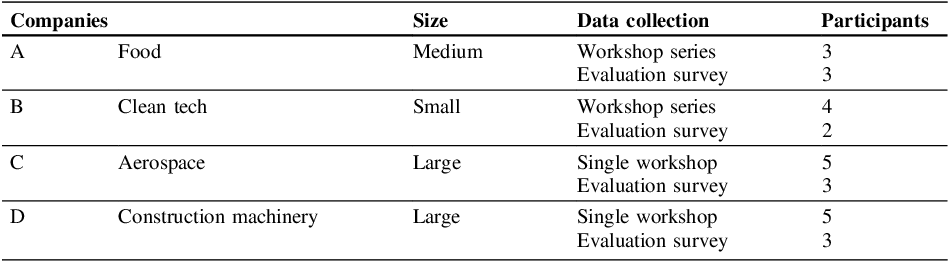
A multiple case study was designed to address the research questions. Four companies in Sweden, see Table 1, were purposefully selected to test the combination of LEASA and SF and reflect on the process, as they shared the SPD capability development need of sustainability performance assessment. The test applications and discussions were guided by company use cases themed product strategy development, which is a key activity influencing product development process design (Reference Baumgartner and RauterBaumgartner & Rauter, 2017). Companies A and B had no prior experience from the two tools. With these companies, a workshop series was conducted consisting of two half-day LEASA workshops, followed by work by the researchers and meetings with the companies, in which LSC were derived, refined, and transformed into a Sustainability Fingerprint. This was followed by a half-day workshop where the developed SF was applied and the process evaluated. Companies C and D had applied LEASA and SF before. With these companies, a single workshop was conducted, revisiting previous LEASA and SF results and further testing and discussing the SF. All workshop participants and all companies afterwards received an evaluation survey to (i) collect quantitative ratings on aspects related to usefulness, usability, and applicability; (ii) capture additional qualitative comments on strengths, limitations, and improvement needs; and (iii) triangulate and complement workshop findings while mitigating social desirability bias through anonymity.
Information about the studied companies and data collection

The data analysis combined descriptive statistics for survey ratings and qualitative thematic coding of workshop notes, transcripts, and open survey responses (Reference FlickFlick, 2018). The evaluation criteria – usefulness, usability, and applicability – served as deductive code groups, while specific codes within these groups were identified inductively from the material. This approach enabled systematic cross-case comparison while remaining open to emergent themes.
Methodological limitations include the limited number of cases and users, and the focus on the Swedish context, limiting generalizability of the findings beyond this geographical setting.
4. Results
This section presents the findings structured along the three evaluation criteria: usefulness, usability, and applicability, followed by a description of identified challenges and limitations. Cross-case patterns are reported, and company-specific nuances are noted where relevant. Data sources include participants’ ratings from post-workshop surveys and thematic analysis of workshop discussions across Companies A–D.
4.1. Usefulness
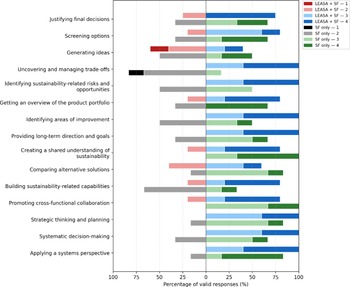
Survey ratings indicate that usefulness was overall perceived positively for both approaches, see Figure 2. For LEASA+SF, the highest scores were for identifying areas of improvement for a product or solution (M=3.6/4), providing long-term direction and goals (3.6), uncovering and managing trade-offs (3.6), identifying sustainability-related risks and opportunities (3.6), creating a shared understanding of sustainability (3.4), promoting cross-functional collaboration (3.4), building sustainability-related capabilities in the team (3.4), and providing a portfolio-level overview (3.4). Lower scores were observed for comparing alternative solutions (2.8), indicating that while the combined approach was valued for strategic framing and communication, its role in detailed option comparison was perceived as moderate. When assessed independently, SF showed a more uneven pattern. While creating shared understanding scored high (3.7), several items received notably lower ratings, particularly uncovering and managing trade-offs (2.0) and identifying sustainability risks and opportunities (2.5). These results suggest that SF alone was considered less effective for strategic purposes and for supporting decision closure, reinforcing its role as a tool for early-phase assessment rather than comprehensive decision support.
Questionnaire results on perceived usefulness of LEASA and SF combined, and of SF alone. Scale: 1=not at all; 2=to a low degree; 3=to some degree; 4=to a high degree

Workshop discussions corroborated these survey findings. Across cases, LEASA was valued for its ability to structure early-phase sustainability thinking and clarify what matters most. Participants described the process as “eye-opening” and “very valuable” for moving from abstract aspirations to actionable criteria. The workshop steps were seen to broaden the scope beyond single issues (e.g., carbon) and to anchor discussions in a systems perspective. This framing was considered particularly useful for aligning internal stakeholders and for informing requirement-setting in early phases. However, the usefulness of LEASA was conditional on clarity and efficiency. While most participants appreciated the structured flow, some noted that the “To-Be” step felt theoretical and unclear. Others emphasized that usefulness of LEASA results depends on integration into existing decision forums, such as stage-gate reviews or project directives, to avoid outputs remaining as workshop artifacts.
SF was regarded as useful for enabling “good enough, early enough” assessments when detailed data are scarce. Participants highlighted its role in surfacing hotspots, comparing alternatives, and supporting trade-off discussions. The visual representation (matrix and spider chart) was repeatedly mentioned as a strength for internal communication and for creating a shared language across roles. In several cases, SF was linked to portfolio-level mapping and strategic dialogues, with comments such as “a tool to do the mapping” and “helps clarify what we mean with waste, water and so on”. Usefulness for SF was also tied to its adaptability: teams valued the possibility to apply it incrementally (e.g., starting with a few criteria or materials) and to revisit assessments as knowledge evolves. At the same time, concerns were raised about the vagueness of scoring and the risk of inconsistent interpretation if used outside a facilitated group setting. Participants at Companies A and C also emphasized that SF was not always useful for making comparisons, as the SCI-level definitions sometimes failed to reflect differences that participants intuitively considered important. Comments included that it “did not show the difference between alternatives” and that the scale wording led to similar scores for concepts that were perceived as very different.
Three recurring conditions shaped perceived usefulness across both tools. First, integration into decision processes was critical: without explicit links to requirement management or portfolio reviews, outputs risked being seen as informative rather than actionable. Second, handling of economic aspects influenced perceptions. While some companies favored including economic criteria within SF for a “full picture”, others preferred keeping financials separate and linking outputs to business-case analyses. Third, confidence under uncertainty remained a challenge. Participants acknowledged that early-phase judgments are inherently subjective; usefulness increased when assumptions were documented and when criteria were calibrated across users. Finally, time horizon expectations varied. LEASA was generally associated with long-term strategic framing, while SF was seen as relevant for both near-term screening and longer-term planning, provided that complexity is managed and preparatory data are available.
In summary, LEASA was perceived as most useful for defining a holistic and prioritized set of sustainability criteria, whereas SF was seen to add value by operationalizing these criteria into comparative assessments and visual outputs that support communication and trade-off discussions. Together, they were considered complementary, with the strongest perceived usefulness when embedded in established decision-making routines and supported by clear guidance on scope and economic linkages.
4.2. Usability
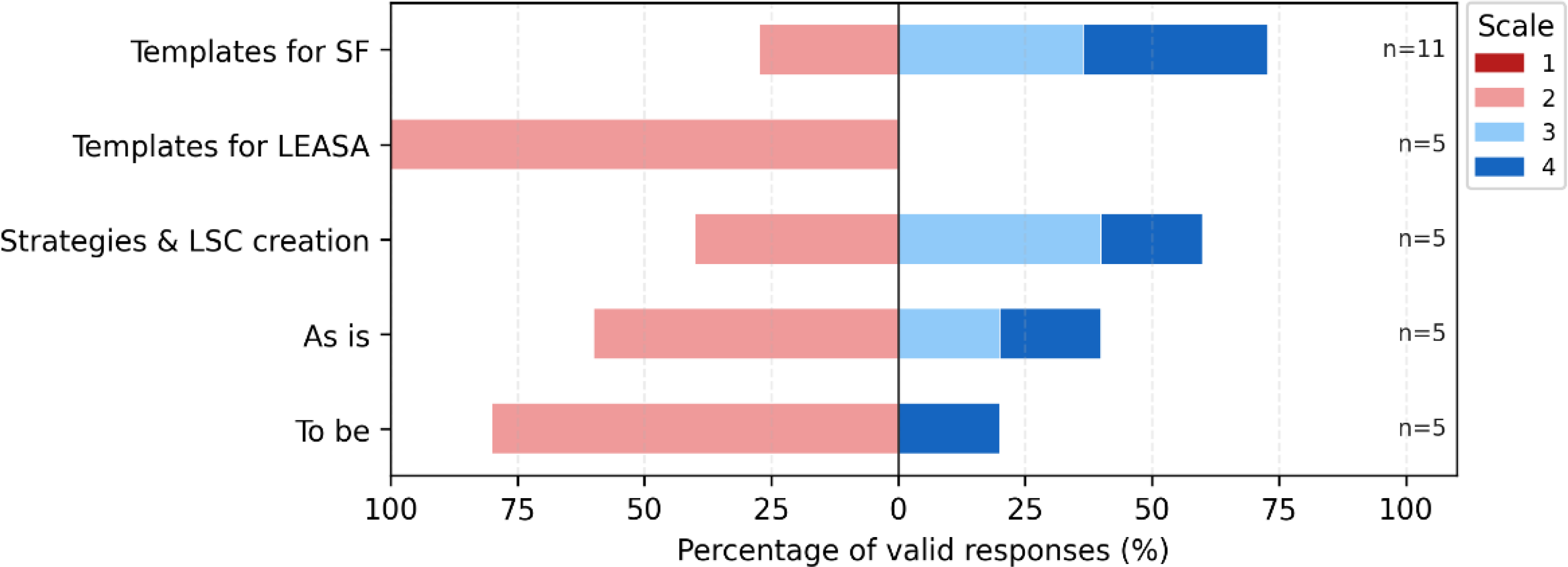
Survey responses on usability were more mixed than for usefulness, see Figure 3. The LEASA templates were perceived as somewhat difficult (M=2.0/4) and the clarity of the steps was rated at a moderate level, rising from To‑Be (2.4) to As‑Is (2.6) and Strategies & Creating LSC (2.8). Across cases, LEASA was considered structured and transparent once the logic became visible, yet initial engagement was described as “confusing” or “too theoretical.” Participants appreciated the funnel-like progression and real-time visualization of inputs, which were said to “trigger new thoughts and ideas.” However, usability was constrained by language complexity and the cognitive load of large templates. Suggestions included simplifying guiding questions, reducing visual density, and providing clearer boundaries for each step.
Survey results for usability of SF and LEASA in general and of specific LEASA steps. Scale: 1=very unclear; 2=somewhat unclear; 3=clear; 4=very clear

For SF, the templates were mostly rated as easy or very easy (3.1). Usability was linked to the clarity of level descriptors and the effort required to score criteria. While the spider chart and matrix were valued for communication, several participants noted that “big tables” and “undefined level scores” could feel overwhelming. Concerns were raised about consistency if the tool were used by individuals rather than in a facilitated group setting. Calibration of scoring and explicit definitions of system boundaries were repeatedly mentioned as prerequisites for reliable application. Facilitation emerged as a critical enabler of usability for both tools. Participants emphasized that the process was “easy to go through” with researcher support but would require training or digital guidance for independent use. Ideas for improvement included stepwise digital interfaces, pre-read materials, and integrated prompts to reduce reliance on expert facilitation.
In summary, usability was perceived as acceptable when strong facilitation and visual feedback were present, but improvements are needed to reduce complexity and enhance clarity for autonomous application. Key conditions include streamlined templates, clearer level definitions, and mechanisms for scoring consistency.
4.3. Applicability
Survey results suggest that the tools were generally perceived as applicable across multiple areas of product development and parts of the product portfolio with some adjustment (M=2.7/4). However, responses also revealed that independent adoption would require targeted support. When participants were asked what support would be needed, three priorities emerged across cases. First, internal training modules were highlighted as essential to build competence and confidence among product developers. Second, respondents emphasized the need for integration with existing tools and systems, such as LCA platforms or KPI dashboards, to streamline workflows and avoid duplication. Third, case examples from other companies were considered important to demonstrate practical application and benefits. External facilitation and digital tool support were mentioned less often, suggesting that companies prioritize building internal capability and embedding the tool into existing processes.
During the workshops, participants emphasized that the tools’ value is greatest when decisions are still flexible and sustainability criteria can influence concept development and selection. Several noted that applicability becomes more challenging in later stages or highly standardized processes, mainly due to data availability and the effort required for detailed assessments. Independent use was seen as feasible only if clear guidance, simplified templates, and organizational buy-in are in place. Without these conditions, the tool risks remaining researcher-dependent and underutilized. Integration into established decision-making routines and alignment with existing systems were repeatedly highlighted as critical for scaling applicability across the organization.
4.4. Challenges, limitations, and future improvement potential
In the workshops and questionnaires, several cross‑cutting challenges were surfaced. First, data gaps and uncertainty were repeatedly emphasized as constraining confident use, particularly for supplier- and competitor‑related information and for early‑stage concepts where evidence is scarce, resulting in risk for assessments to be “based on guessing” when hard numbers are unavailable. Relatedly, boundary definition and level calibration were described as unclear at times, with a preference expressed for clearer acceptability thresholds and space for comments to document assumptions. Participants remarked that terms can be vague, e.g., “‘highly improved’ is hard to measure and very subjective”; thus, more absolute criteria at compliance levels were suggested. Second, facilitation dependency was prominent for LEASA. While the stepwise process was appreciated, it was observed that groups without prior exposure may “get stuck in details” and benefit from experienced moderation and simplified prompts. For Sustainability Fingerprint (SF), independent use was seen as more feasible if definitions are tightened, yet consistency of scoring across users remained a concern. Third, visual and cognitive load was mentioned. Large matrices and whiteboards were considered overwhelming by some, especially in LEASA, suggesting a need for progressive disclosure (e.g., principle‑by‑principle views) and concise visuals. Fourth, a tension was observed regarding the economic dimension. Some preferred to link SF to existing business‑case tools, while others valued having some economic aspects inside the model to make trade‑offs visible directly in the sustainability assessment. Fifth, timing and fit in the process were raised. The tools were viewed as most effective in pre‑study/early concept phases and at portfolio/strategy discussions. Later phases were seen as “too late” because decisions are locked. Ownership was suggested to sit with sustainability or cross‑functional teams to embed iterative updates, creating a “living document”, and to connect outputs to gates and KPIs. Finally, communication use was seen as promising but delicate. While the compact spider web diagram was considered helpful for internal/external dialogue, it was cautioned that external claims require robust evidence and careful wording.
Future improvement wishes converged on several areas: (i) template simplification with clearer LSC descriptions (LEASA) and SCI-level wording (SF), example benchmarks, and optional notes fields; (ii) calibration and training to improve scoring reliability and reduce facilitation load; (iii) integration with existing systems (e.g. requirements specifications, KPIs, business intelligence); (iv) assumption and uncertainty capture (e.g., recording data sources, confidence levels); (v) combinations with scenario analyses for regulations, markets, and technology pathways; and (vi) selective digital guidance and AI integration to surface missing criteria, suggest evidence sources, and generate concise, audience‑specific workshop summaries.
5. Concluding discussion
This study evaluated two complementary approaches, LEASA and Sustainability Fingerprint, for supporting sustainability criteria identification and assessment in early product development phases through a multiple case study involving workshops and surveys. Findings indicate that LEASA and SF together provide a structured pathway from defining sustainability priorities to operationalizing them in assessments. LEASA was found to structure a shared understanding of sustainability and to identify leading sustainability criteria that reflect a systems perspective. SF then translated those LSC into a lightweight comparative assessment and visual summary usable under time and data constraints, creating a “from criteria to assessment” progression. However, effectiveness depended not only on tool complementarity but also on integration into existing decision forums and processes, such as stage-gate reviews and requirement management, highlighting the importance of developing coherent and integrative SPD decision support rather than isolated tool silos (Reference Peace, Ramirez, Broeren, Coleman, Chaput, Rydberg and SauvionPeace et al., 2018; Reference Gericke, Eckert and CampeanGericke et al., 2020; Reference Díaz, Schöggl, Reyes and BaumgartnerDiaz et al., 2021). It can also be noted that the tools score relatively high on usefulness but low on usability, confirming that academic tools often are methodologically robust but lacking when it comes to user experience (Reference Vicente and CamochoVicente & Camocho, 2024).
Based on an evaluation of usefulness, usability, and applicability, this study provides empirical evidence on the combined use of two SPD supports and specifies value‑carrying characteristics of such a combination: (i) criteria clarity rooted in a system definition, (ii) assessment that tolerates sparse data while remaining auditable, (iii) tight process linkages to existing decision forums, and (iv) iterability—treating the fingerprint as a living document. Thereby, it presents a first step towards understanding how fragmented methods and tools could develop into a coherent methodological support for SPD. The study also identifies tensions that the literature often notes but seldom operationalizes in early‑phase practice: whether and, if so, how to integrate economic aspects in sustainability tools; how to handle trade‑offs and weighting without obscuring transparency; and how to manage uncertainty in a way that informs rather than paralyzes decisions.
5.1. Implications and directions for future research
Practitioners consistently asked two business-critical questions in relation to sustainability: “Is it worth it?” and “How fast should we move?”. These questions represent the need for tools that support identifying strategic actions that lead towards sustainability but do so in a way that is beneficial for the company. This requires uncovering and resolving trade-offs between, e.g., the pace of movement towards sustainability and economic aspects like return on investment. LEASA and SF were considered to provide some support in identifying trade-offs but are insufficient for managing trade-offs. The study participants also had differing views on if and how economic aspects should be included in the tools. Future research could explore how backcasting and forecasting scenarios could be used to make uncertainty visible and to identify business risks and opportunities dependent on a product’s sustainability fingerprint (Reference Schulte, Villamil and HallstedtSchulte et al., 2020). This in turn could provide guidance when it comes to translating and weighting SF results in requirements specifications, which have a major effect on the pace of movement (Reference Watz and HallstedtWatz & Hallstedt, 2022). It may be explored whether LEASA outputs can be used to formulate sustainability “musts” and “preferences,” and using SF as the assessment evidence at gates to close the loop between strategic intent and day‑to‑day design choices. Another avenue for future research is to reduce researcher dependency and facilitation load. Two complementary routes emerged: (i) internal capability building (short training modules, calibration sessions, example libraries), and (ii) digital guidance, potentially with targeted AI support, that structures the steps, reduces visual load through progressive disclosure, nudges for missing evidence, and generates audience‑specific summaries. Creating a general starter set of criteria could also increase usability and accelerate adoption, while users could focus on tailoring to sector, product type, and role in the value chain. While LEASA and SF were seen as helpful for identifying sustainability criteria and visualizing performance, their current use may still primarily support incremental improvements. However, the literature emphasizes the importance of not only focusing on efficiency (doing things right) but also on effectiveness (doing the right things) (Reference Baumgartner and RauterBaumgartner & Rauter, 2017; Reference Hauschild, Kara and RøpkeHauschild et al., 2020). To truly guide transformative decisions, more support may be needed to help teams question underlying assumptions, explore alternative system configurations, and assess long-term impacts. In conclusion, the combined LEASA–SF approach offers a promising foundation for supporting sustainability-oriented decisions in early product development. Its value lies in structuring criteria identification, enabling lightweight assessment, and fostering shared understanding. To fully realize its potential, future iterations should strengthen integration with decision processes, reduce facilitation dependency, and support both incremental and transformative change. Doing so will help companies navigate complexity, manage uncertainty, and move strategically toward sustainability.
Acknowledgements
This research was funded partly by the Knowledge Foundation, Sweden, through the Sustainable Product Innovation for Rewarding Transformation (SPIRIT) Synergy Project (contract 20240015). Sincere thanks to the participating companies.


 Open access

