

Introduction
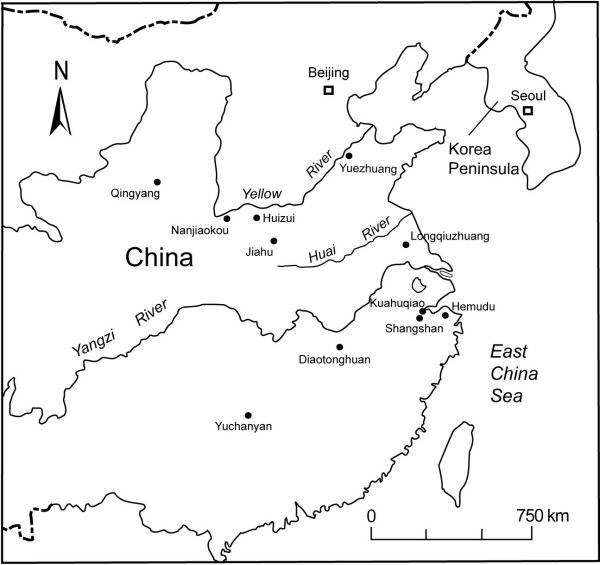
Recent discoveries of rice have stimulated debate on rice (Oryza sativa) domestication in China. Reference FullerFuller et al. (2007) have cast doubt on the previous identification of domesticated rice from the Yangzi and Huai River regions (Figure 1). Their main arguments are the following: (1) rice from the Shangshan and Kuahuqiao sites along the lower Yangzi River was wild; (2) small rice at the Jiahu site along the upper Huai River was wild, and made no contribution to domesticated rice; and (3) fully domesticated rice evolved around 4000 BC in China. Their arguments, however, rely on problematic methods and an incomplete database. By reviewing Shangshan and Jiahu data, we briefly discuss the early rice domestication processes, and our further arguments will be published elsewhere.
Site locations in China.

Shangshan rice
Charred rice remains embedded in potsherds at Shangshan (11000-9000 cal BP) are the earliest relevant record in the Lower Yangzi River valley (Reference JiangJiang & Liu 2006). Macrofossil and phytolith evidence has revealed the presence of chaffs, stalks, and leaves in pottery (Reference ZhengZheng & Jiang in press), suggesting that rice was likely collected by either uprooting or cutting stalks with knives or sickles. Harvesting by uprooting or cutting stalks would have encouraged the selection of mature spikelets with tough rachis. This method probably reduced the chances of slow-ripening spikelets to mature, and of spikelets with a brittle rachis to be selected, eventually leading to successful cereal domestication (Reference HighamHigham 1995; Reference SmithSmith 1998: 73).
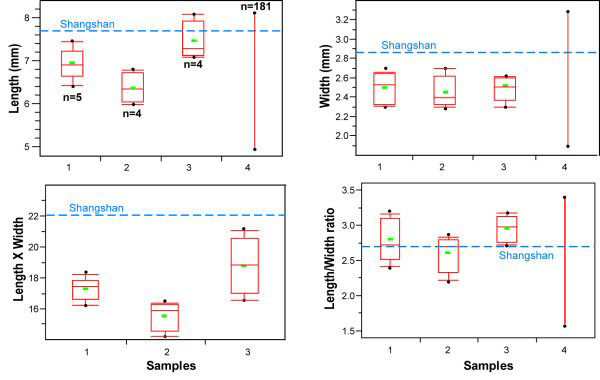
The charred spikelet measurable at Shangshan is larger than spikelets from later periods, but its length/width ratio falls into the range of later domesticated rice at Hemudu (Figure 2). Scars on rachis left from harvesting/shattering are often used for distinguishing domesticated from wild rice. Observation of rachis at Shangshan indicates the presence of both wild and domesticated rice in the early deposits of the site, dating around 10 000 cal BP. The shape of the motor cell phytoliths is similar to that of tropical japonica (Reference ZhengZheng & Jiang in press). All the evidence suggests that Shangshan rice probably consisted of both wild and transitional forms.
Boxplots of rice husk sizes from Lower Yangzi basin. 1. Kuahuqiao; 2. Luojiajiao; 3. Hemudu wild rice; 4. Hemudu rice (only minimum and maximum values are marked). Hatch lines represent one spikelet from Shangshan. The small green box is the mean, and the black dots are minimum and maximum values.

Was Jiahu rice a dead-end wild type?
The earliest rice in north China came from Jiahu (9000-7000 cal BP). The importance of rice in Jiahu subsistence is well documented. An isotopic analysis of human bones shows that the predominant dietary source of Jiahu people was C3 plants, including rice (Reference HUHu et al. 2006). Chemical analyses on organic substances absorbed into ceramic vessels indicates that rice was used for brewing fermented beverages at Jiahu (Reference McGovernMcGovern et al. 2004).
Jiahu yielded many carbonised, dehusked rice grains (Henan Institute of Cultural Relics 1999: 887; University of Science and Technology of China & Henan Institute of Archaeology 2002). We measured 566 intact grains, dating to Jiahu Phases I-III (Figure 3). Compared to previously published measurements (Henan Institute of Cultural Relics 1999: 887), our data suggest that Jiahu grains are not small, but show great variation in size. The significance of the previous measurements, on which Reference FullerFuller et al. (2007) argument relied, is limited by the small sample size.
Boxplots of grain sizes. 1. Jiahu (1999 publication); 2 - 4. Jiahu Phases I - III (authors' measurements); 5. Yuezhuang; 6. Kuahuquiao; 7. Nanjiaokou; 8. Huizui. The ranges of Longquizhuang rice are wrapped in yellow (strata 6) and blue (strata 4). Yellow and blue hatch lines indicate the mean L/W ratios of Longqiuzhuang stratum 6 and 4 each.

We compared rice from Jiahu to other Neolithic (Yuezhuang, Kuahuqiao, Nanjiakou) and Bronze-period (Huizui) sites, dating to 8000-3500 BP (Figure 1). Most Jiahu grains are indistinguishable from later domesticated grains taken from Nanjiakou and Huizui, in size and shape (Figure 3). Observation of spikelet impressions embedded in burnt clay also indicates domesticated rice, as many either lack an awn or show no trace of a broken awn (Henan Institute of Cultural Relics 1999: 883-886). Fuller et al.'s argument for the putative uniqueness of Jiahu rice is thus not supported. Similar to Shangshan, Jiahu rice likely has both wild and early domesticated forms.
Discussion and Conclusion
Fuller et al. assumed that rice was domesticated around 6000 BP, largely based on an increase of grain size from stratum 6 to 4 at Longqiuzhuang. Most domesticated grains at Huizui, however, are as small as those from Longqiuzhuang strata 4 which they regarded as wild (Figure 3). In brief, grain sizes, particularly those of charred remains, are not a reliable indicator of rice domestication.
The earliest rice remains (wild first and domesticated later) were found at Yuchanyan (Reference YuanYuan 2002), Diaotonghuan (Reference ZhaoZhao 1998), and Shangshan along the Yangzi River, dating to 15 000-9000 cal BP. Jiahu indicates habitual use of cultivated rice in northern regions by 9000 cal BP. Yuezhuang in Shandong documents the advance of rice to the lower Yellow River basin well beyond its natural habitat by 8000 cal BP (Crawford et al. 2006). Nanjiaokou (Reference WeiWei et al. 2000) and Huizui (Reference LeeLee et al. 2007) also show rice dispersal to the middle Yellow River region by 6000-5500 cal BP. Rice continued to spread to the upper Yellow River valley by 5500-5000 cal BP, as Qingyang in Gansu reveals (Reference ZhangZhang 2000). Without human intervention to its life cycle, rice could have not reached the Yellow River region as early as 8000 cal BP. Given these facts, Reference FullerFuller et al. (2007) owe readers a plausible explanation for the delay of domestication for 5000 years after its habitual use and over 2000 years after its spread to the north by intensive human interference.
Rice went through long, non-linear domestication processes. By the early Holocene (9000 cal BP), Neolithic people in both north and south China may have been harvesting wild rice and initiating rice cultivation that eventually led to domestication.
Acknowledgements
We would like to thank Gary Crawford, Zheng Yunfei, Chen Xingcan, Arlene Rosen, Ma Xiaolin, Jiao Tianlong, Lan Wanli and Thomas Bartlett for their data, critical comments and expertise.